
Raising Cain at the Cain Center With “Million Dollar Quartet”

Sunny, frolicsome, dark, and bizarre: it’s tough to say whether the best landing spot for Little Shop of Horrors is during the spring, that fragrant time of flowering hope and romance, or the fall, that decaying season of colorful rot and the macabre. All of the Metrolina theatre companies and colleges that have taken us back to Skid Row this century have chosen one of those two seasons for reprising Howard Ashman’s 1982 adaptation of Roger Corman’s cult comedy flick.
The tally among executive directors, department heads, and boards has been decisively autumnal. Judging by the full house on opening night last week at Theatre Charlotte, which previously staged Little Shop in the spring of 2008, I’d say that the movers and shakers at the Queens Road Barn have seen the light and aligned with the popular vote.
No other explanation for the robust turnout – or the rabid response – springs to mind. There was nothing novel or pricey about TC’s prepublicity, unless Facebook and Instagram are suddenly breakthroughs. Nor is name recognition a factor when you consider the director, the lead couple, or the choreographer.
Only if they knew that Kevin Roberge would be can’t-miss as Mr. Mushnik, owner of a perishing Skid Row flower shop – or that real-life dentist Nehemiah Lawson would be don’t-miss as sadistic dentist Orin – would people be flocking to Queens Road with raised expectations. And if you hadn’t seen their award-winning collaboration in Next to Normal down at Fort Mill Community Playhouse two years ago, you wouldn’t know if it was director Scott Albert who chose Peter Liuzzo as his preternaturally nebishy Seymour or the other way around.
Sometimes you need to listen to the vox populi, and sometimes you must try to blot it out. For me on opening night of Little Shop, it was both. My Apple Watch faithfully notifies me the next morning when sound pressure levels reach or exceed 95dB at concerts, musicals, or plays attended the night before. If the noise tops 100dB, the usual number of notices is one to three.

Little Shop smashed that norm, hitting or exceeding the 100dB bar 14 times, and topping out at an astonishing 115dB. I could see it coming when Liuzzo and Gabriella Gonzalez as Audrey, his newly-won sweetheart, merged their voices in the climactic “Suddenly Seymour.” Three doo-wop vocalists emerged from a tenement apartment door, adding glitz, glamour, and sensuality to the spectacle: Olivia Greene as Ronnette, Tia Robbins as Crystal, and Jessica Milner, a trio of rookies.
Then as Seymour and Audrey responded to each other, Liuzzo dug out his coming-into-manhood voice and began belting wildly. Not to be upstaged, Gonzalez, previously confined to the sugary “Somewhere That’s Green,” let loose with her piercing pipes.
When something is this sensational in a community theatre production, I often find myself weeping or sobbing. This time, my instincts had me clamping my hands over my ears in self-defense. Didn’t do much good.
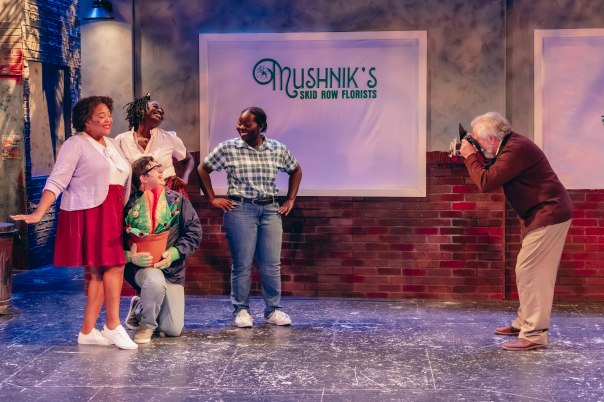
Tinted by J.P. Woody’s groovy lighting, scenic design by Gordon Olson revels in the squalor of the skids with a doo-wop funk and loving detail that reminded me of Mad Magazine comic strips devoured in my youth. The era is the prehistoric ‘50s, when teens toted transistor radios to stay in touch with the Top 40, and Alan Menken’s musical score reveres those vibes as if they are gospel.
From Seymour’s nerdy sweater vest to Orin’s biker black jacket, Rachel Engstrom’s costume designs are also onboard with the ‘50s beat, with such an outrageous variety of looks for the vocal trio that you can look at them as district goddesses. Props, including a mini press camera and various-sized potted Audrey 2’s that double as puppets, are also a treat from Lea Harkins – plus Orin’s diabolical dentist’s drill.

Besides getting the right moves from his talented cast alongside choreographer Georgie DeCosmo, Albert’s stage direction fosters all kinds of synergies that pave the way for Audrey 2 to have the sleek looks of a garish concept sports car and the voice of a rabid boar. Named after his idolized co-worker, Audrey 2, the carnivorous plant that Seymour suddenly discovers during a total eclipse of the sun, has a special cunning, speaking only to Seymour to get his way.
The voice comes lustily from Toni “Aideem” Morrison, and the movements of her leaves and tendrils come mostly from a team of three unseen puppeteers. When the side wall of Mushnik’s Skid Row Florists slides shut to hide the store, a beehive of activity with puppeteers and stagehands is dressing the interior more and more lushly with Audrey 2’s foliage as the bloodthirsty monster grows.
By the end of opening night, that side wall had been dinged with cracks and bruises, and one stagehand, in damage-control mode, was seen frantically exiting at the end of a scene change. The tech perfection extended similarly to the sound: just one brief dropout assailed Gonzalez, and that’s all. Every note from the four-piece band led by Ellen Robison from the keyboard came through undimmed.
Except when the audience broke loose.
Aside from the original Audrey, none of the main characters is burnished with virtue. Seymour’s origins, though not otherworldly, are no less mysterious than Audrey 2’s, orphaned at the flower shop’s doorstep as a babe and living there ever since. His homicidal tendencies, awakened by the arrival of Audrey 2, prove to be benign when he has to pull the trigger.
Munchnik is no less compromised. Although he has opened his door to Seymour, the lad has always slept out front under the cash register. Until he overhears Orin advising Seymour to leave Skid Row with his newfound cash cow, Mushnik never considers adopting the waif or making him his heir. In the hard times, when Mushnik is on the verge of permanently shutting down his shop, there’s not a peep from him that indicates he has given Seymour’s future so much as a thought.
Liuzzo plays his side of this relationship with gratitude, servility, and fear, while Roberge as Mushnik can load up on scorn, exploitation, and intimidation. Nebishy meets nasty. With those considerable hits to Seymour’s self-esteem, Liuzzo’s timidity can extend toward keeping his feelings for Audrey hidden, especially since she is already in Orin’s firm and abusive grasp.

Framed by the threats of an insanely sadistic dentist and a man-eating alien plant with dreams of global domination, the mundane frictions between Seymour and Mushnik can seem comical. But the best comedy contrivance, preserved by Ashman from the Charles Griffith screenplay, is the mutual non-relationship between Seymour and Audrey: both of these sweethearts have good reason to feel unworthy of the other.
It’s pretty classic how clearly Liuzzo and Gonzalez venerate one another before they connect – adding fuel to the explosive audience reaction in Act 2 when they have their “Suddenly Seymour” moment. Roberge coming up on them and taking it all in during an extended smooch is a cherry on top.
Contrasting with all this bliss and twisted domesticity are the crazed, barbecued voices of Lawson and Aideem. Since the days of silent film, dentistry has proudly perched on the knife’s edge between comedy and horror. Thanks to this delicious script, Lawson gets to sharpen that blade more keenly by adding masochism. Not to worry, after Orin nourishes Audrey 2 piecemeal, Lawson returns after intermission in a series of cameos to entice Seymour with additional money-making opportunities.
Yet it’s Aideem who endures forever as Audrey 2, aided by a wonderful tech flourish in the epilogue. His bubbly vibrato is not the deepest I’ve heard out of Audrey 2’s maw, but it’s more than sufficiently low, spirited, and spicy. Aideem’s performance will likely draw another noise notification if you’re wearing an Apple Watch. The final bows certainly will.
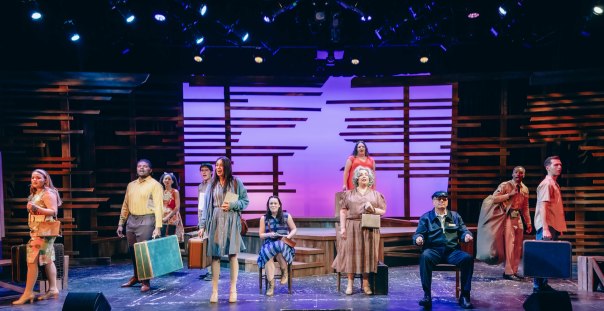
So here’s something we’ve learned over the past month on the Charlotte theatre scene. There are two schools of thought on how to portray a horrifically scarred woman onstage. Back in late February, Carolina Actors Studio Theatre took the cinematic approach at the original Mint Museum on Randolph, painstakingly applying makeup to their leading lady, Zoe Matney, before every performance of Alabaster, down the entire left side of her body from head to ankle.
Now we have the Violet approach at Theatre Charlotte, where Destiney Wolfe stars in the title role with a hideous scar that looks more like a fine line drawn with a red ballpoint pen than a shocking horror. So it was – minus the fine red line – when Lauren Ward originated the role in 1997 on Broadway and when Sutton Foster revived it there in 2014.
Besides the risk of an Emperor’s New Clothes moment from an innocent child (“But Mommy, Violet doesn’t have any scar!”), it figures to be more effortful to watch Wolfe without the scar everybody onstage is talking about and constantly having to imagine a scar we are not seeing. That’s different from reading “The Ugliest Pilgrim” by Doris Betts, the short story that this Jeanine Tesori-Brian Crawley musical is based on.
Until the fourth page, the scar isn’t explicitly mentioned. Once the word is seen, it quickly becomes the center of the story – the reason why Violet is on a bus from Spruce Pine, NC, to Tulsa, where she ardently believes a venerated TV preacher will heal her terrible affliction. Nothing on the remaining 25 pages contradicts the image engraved in our imaginations.
Within the blissful two dimensions of a book, we don’t need to keep imagining what isn’t. Perhaps more subtly, as demonstrated by Matney’s portrayal of June in Alabaster,we can gradually get used to the disfigurement, look past it, and see the person. Along the way, we could also find plenty of relief looking at June’s unscathed side.
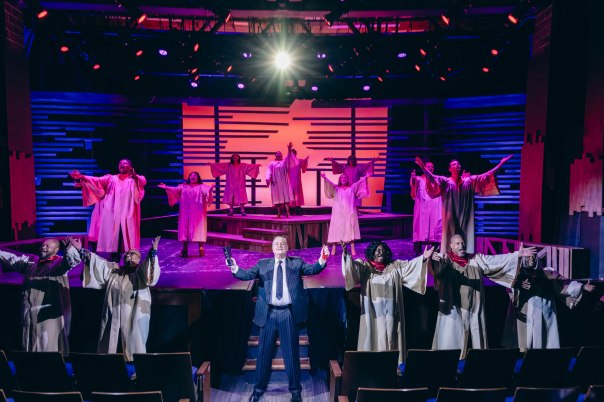
Notwithstanding her terrible scar and her pathetic reliance on Oral Roberts – oops, I mean the famed Oklahoma preacher – Violet is clearsighted enough to grasp her most valid reason for boarding the bus. Spruce Pine is a very small-minded town. Her elders stare at her in pity and her peers are worse, shunning her, mocking her, and pranking her.
As the saying goes, she needs to get out and meet people. Spruce Pine isn’t the place for it.
Betts had Violet saying that in a more biblical way: “Good people have nearly turned me against you, Lord. They open their mouths for the milk of human kindness and boiling oil spews out.”
Told objectively by Crawley rather than in first-person by Betts’s Violet, we see the townsfolk clearly sooner rather than judging them on a single casual quote. Scarred or not, Crawley and Betts agree on one key point: Violet is way too thin-skinned.
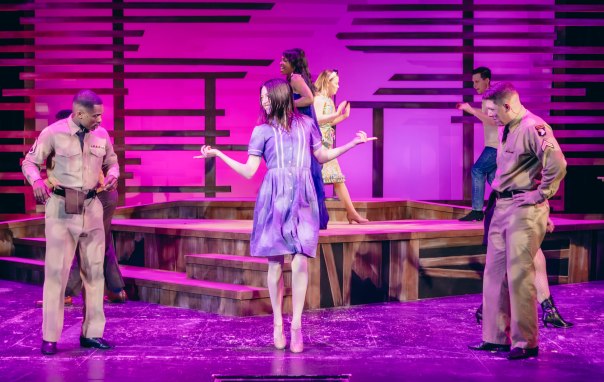
Meanwhile, reasons for dismissing Violet’s self-pity – and doubting her self-awareness – are multiplying. Before the bus reaches Arkansas, she has hooked up with two military men who are quickly captivated by her. Both of them, one black and one white, are eager to show their ardor on a stopover in Memphis, where they spend a night out together.
So the necessity of imagining that hideous scar becomes more urgent for us.
Thankfully, the Memphis sojourn allows Tessori to naturally widen her musical palette, welcoming us to the blues along with the Beale Street underbelly of town. Violet’s dream of healing and her actual Oklahoma encounters with the Preacher are welcome prompts for Tessori to branch out further into righteous, stomping, spirit-of-the-Lord gospel.
A five-piece band led from the keyboard by Danielle Barnes Hayes leaned into the gospel music at the Preacher’s revival meeting as lustily as the more countrified tunes that had gone before. Our eagerness to hear those gospel strains was certainly piqued and primed last Saturday when a seven-voice choir greeted us in the lobby of the old Queens Road Barn, accompanied by a wee electric keyboard, singing hymns and shouts for a half hour before showtime.
While director Stuart Spencer skimps on makeup design, he is deeply attuned to the material, having been part of the Davidson Community Players cast when Violet had its regional premiere in 2010. Was it a makeup job on Cassandra Howley Wood that gave me such a favorable impression of her local debut and the show? Or was it simply the intimacy of Armour Street Theatre, bridging the gap between first-person narrative and Broadway musical?
At the bus station where Violet embarks on her odyssey, at the Memphis music hall where Asley Benjamin belts a couple of songs, and at the Tulsa TV revival, a bigger stage is surely better. More space for more people and more decibels! More opportunities for lighting designer Gordon Olson to colorize costumer Sophie Carlick’s shiny robes for the Preacher’s hallelujah choir – and to add pizzazz to Sharlie Duncan’s choreography!
To their credit, neither of the soldier boys seriously believes that Violet will look any better after her Oral rendezvous in Tulsa when she reboards her Greyhound bus, heads back home to Spruce Pine, and stops off in Arkansas for another meet-up. With Sean Bryant as Flick and Ethan Vatske as Monty, the interracial relationship and rivalry between the soldiers occasionally becomes more compelling and suspenseful than Violet’s cosmetic quest.
Bryant gets the advantage of a more instructive interracial relationship between Flick and Violet. On the way to learning that her inner scars are more debilitating – and curable – than her outer ones, it’s necessary for her to appreciate that there are other, more serious skin problems in life. Beginning with pigment. In the Betts story, there’s one other huge hurdle in Violet’s spiritual growth that we don’t hear about onstage: her use of the N-word. More of Spruce Pine needs to be exorcized from her soul than she realizes.
On top of that, this thin-skinned Violet is stubborn, too. As dynamic as Wolfe’s vocals are, her adamant refusal to believe that anyone besides her daddy could love her is the most startling aspect of Violet we must encounter. We recognize this trait in people we’ve met, maybe in ourselves. Violet’s stubbornness goes so irrationally deep that it not only prolongs her path to enlightenment, it obliges Crawley to pile on a flashback recalling a cruel prank that was played on her by her schoolmates.
Counterbalancing Bryant’s shyness and vulnerability as Flick, Vatske draws the luxuries of being the more cocksure and aggressive Romeo. Just sitting down to play poker with Flick and Violet softens us up to Monty, and confident as he is, Vatske keeps us a little in suspense about with whether he’s playing with the lass or serious. The way Vatske is playing him, you’re not sure whether Monty is sure himself.
This upsized Violet is a special boon for Henk Bouhuys, who draws two plum roles, the sometimes surly, sometimes avuncular Bus Driver and the charismatic Preacher. Never mind that that the Preacher is surrounded by a fervid Gospel Choir, both in the TV flashback and in Tulsa, Bouhuys dominates the stage with his fiery motormouth exhortations.
It’s awesome enough to make his backstage powwows with this pilgrim unexpectedly tender and poignant – a quietly dazzling reality check – and allows Wolfe to enlarge upon Violet’s devotional and delusional traits.
Unfortunately, on a big musical stage, Bouhuys’s dazzle and the decadence of Memphis nightlife tend to cast the flashback scenes between Young Vi and her Father into comparatively dreary shadow. To put it bluntly, when Tessori worked with the multiple Allisons of Fun Home in 2015, she had a superior book and lyrics from Lisa Kron.
So Spencer, Abigail Sharpe as Young Vi, and Nick Southwick as her dad are doing the best they can with the weak hand they are dealt here. It’s heartwarming to see the widower dad teaching Young Vi how to play poker in order to jumpstart her math skills. “Luck of the Draw,” blending this flashback with Violet’s cardplaying triumph over Monty and Flick, puts Sharpe and Southwick to their best use.

But these flashbacks, before and after the catastrophic accident that scars Violet, are also the best reason why we never see that scar on the face of either protagonist. It would need to be applied to Young Vi during the show, a fearsome hurdle for a makeup artists and stage managers.
The script and the dumpy cardigan sweaters the Violets wear supply a wonderful way to differentiate between the two. When we first see Wolfe huddled at the bus station and boarding her bus, she looks more homeless than scarred. It’s only after dark in Memphis, when she’s escorted to the music hall by two strapping soldiers, that Wolfe tosses her cardigan aside and shows signs of full-blooded womanhood.
Miracle of miracles, she becomes flirty!
By Perry Tannenbaum

Almost a year ago, fire struck the Theatre Charlotte building on Queens Road, gouging a sizable trench in its auditorium and destroying its electrical equipment. Repairs and renovations will hopefully be completed in time for the launch of the company’s 95th season next fall, but meanwhile, actors, directors, designers, and technicians are soldiering on at various venues for 2021-22, their year of exile cheerfully branded as “The Road Trip Season Tour.” Ironically enough, Theatre Charlotte’s Season 94 began in September with a downsized musical, The Fantasticks, at the Palmer Building, a facility that once served as a training ground for firefighters. For their 14th production of A Christmas Carol, Theatre Charlotte has moved along to Halton Theater, the permanent home of Central Piedmont Theatre.
Timing is a bit awkward on the campus of Central Piedmont Community College, where a new theater that will be friendlier to dramatic productions – replacing the demolished Pease Auditorium – is slated to open in April with The Diary of Anne Frank. Graced with a generous orchestra pit, the Halton is more hospitable to big splashy musicals (when its sound system responds favorably to our crossed fingers). In fact, this transplanted production of A Christmas Carol, in Julius Arthur Leonard’s adaptation of Charles Dickens’ iconic novella, reminds us how well-suited the old “Queens Road barn” was for such spooky and creepy fare. Not only were the ghosts of Christmases Past, Present, and Future at home there, but so were such confections as Arsenic and Old Lace, Assassins, Blithe Spirit, and To Kill a Mockingbird. The Halton occasionally seemed oversized when You Can’t Take It With You took up residence there at the beginning of Central Piedmont’s current season, and you can imagine how their spectacular 2015 Phantom of the Opera emphasized the grandness of Andy Lloyd Webber’s grand guignol.
Encountering the vastness of the Halton in transplanting Theatre Charlotte’s cozy Christmas Carol, director Jill Bloede has been characteristically resourceful in executing its many daunting scene changes. At times, we could see cast members whisking set pieces off to the wings in a smooth out-with-the-old, in-with-the-new routine. But there were occasions when changes of scenery necessitated a complete closing and reopening of the stage curtains. Veiling the tediousness of that maneuver, Bloede has summoned repeated parades of a small band of merry carolers, coached by Jim Eddings, to cross the stage while the curtains are closed – so you would probably be right in thinking there are more carols sung this year than in Christmases past on Queens Road. My welcome for the carolers on opening night veered toward the unredeemed Ebenezer Scrooge’s grumpy attitude as the evening progressed, yet opening night is destined to be enshrined in Theatre Charlotte lore as the night of the infamous doorknocker scene fiasco.
One of the first indications that Scrooge’s house will be haunted, after a ghostly “Ebenezer Scrooge!” exclamation blows in on the Halton’s sound system, is the brief scene at the threshold to Ebenezer’s home. Here is where Scrooge sees a fleeting glimpse of his deceased partner, Jacob Marley, bringing his doorknocker to life. The precision needed to carry off such a simple scene only became apparent when it went awry. Either the Halton curtains were tardy in arriving at their centerstage spots, where they would fully frame Scrooge’s front door, or the actor who was to lurk unseen behind that door arrived early – and was very clearly seen, garishly aglow. Portraying Scrooge, Hank West seemed sufficiently poised to extemporize while the stage curtains and the lurking Marley came into proper alignment. But the carolers took their cue and entered before West could properly proceed, and the panicked actor behind the door fled. West finished out the brief scene as well he could without any eerie lights beaming through the doorknocker, but the special effect was lost – the only real reason for that scene.
Legions of Theatre Charlotte veterans – and new initiates in years to come – will no doubt keep the memory of this snafu alive for generations, heartily laughing all the more at the incident because it didn’t typify the production. Scenic design by Chris Timmons and lighting by Gordon Olson didn’t expand quite enough to comfortably acclimate at the Halton, nor did the company splurge on smoke or fog effects during its financial woes, which might have deepened the spell of the spookier Marley and graveyard scenes. Don’t expect any snow to flutter down on the vast Halton acreage, either. With balmy temperatures likely to prevail throughout the opening weekend, it’s Beth Killion’s set of period costumes that most successfully instill a chill into the air.
We’ve seen some of this cast before, notably West as Scrooge, Chip Bradley as Christmas Present, and Mary Lynn Bain doubling as Fred’s wife Elizabeth in the present and Belle, Scrooge’s old flame, in the flashbacks. All of these enlarge on their past performances to some extent, maybe West most of all. His meanness is more startling in person than it was in last year’s video version, streamed online, and his sorrow and penitence are also magnified. The graceful arc of Scrooge’s redemption is only slightly bumpier this year with West’s adjustments to the new space, Bloede’s script edits for this intermission-free edition, and a body mic. Projected into a larger hall, Scrooge’s newly minted intentions needed to sound more like settled resolves and less like agonized pleas. Bradley enlarges to a similar degree upon Present’s outsized cheer, the more the merrier in his case – until he issues his climactic admonitions, now sharper in their contrast. Bain seems most content to let her mic do her amplification, but she is stronger this year in the climactic flashback scene when she returns Ebenezer’s engagement ring.
All the newcomers to TC’s Carol are quite fine, a testament to Bloede’s ability to attract talent when she holds auditions. In contrast with the veiled youthful mystery of Anna McCarty last year, Suzanne Newsom brought a nostalgic melancholy to the Ghost of Christmas Past that was quite affecting in its serenity, while Mike Corrigan appeared for the first time as Bob Cratchit – very different with his more muted brand of meekness from Andrea King last year but no less kindly or comical. For richer or poorer, Josh Logsdon and Rebecca Kirby were a fine pairing for the Fezziwigs, Aedan Coughlin doubled well as Young Ebenezer and Ghost of Christmas Future, and Riley Smith brought all the optimism needed for the sanctity of Tiny Tim. With Mitzi Corrigan and Emma Corrigan on board as Mrs. Cratchit and daughter Belinda, there’s plenty of family authenticity around the humble Cratchit hearth – or there will be when Mitzi returns from personal leave due to a death in her real family. Vanessa Davis spelled ably for Corrigan as Mrs. Cratchit at the premiere performance, augmenting her regular role as Mrs. Dilbur.
Assuming that Thom Tonetti was already in character as Jacob Marley during the notorious doorknocker scene, I’ll say his opening night adventures most typified the Theatre Charlotte crew’s tribulations in acclimating to a new space. Marley’s entrance into Scrooge’s home wasn’t dramatized with smoke and lights, and Tonetti didn’t enjoy the benefit of having his prophecies and imprecations magnified with thunderous jolts from the soundboard. During the flashbacks, the actor certainly earned some sort of sportsmanship award, appearing as the younger Jacob opposite the truly younger Coughlin.
Steadying this production and assuring that its professional polish never deteriorated into community theatre chaos for long, West ultimately triumphed over all missteps and obstacles, bringing us the compelling Scrooge we expect in all his goodness. It’s still a strong story, and 24 of its most ardent Theatre Charlotte believers are moonlighting at Central Piedmont, giving this 87-minute production the old college try. A drama within a drama, to be sure, both ending happily.
Originally published on 12/18 at CVNC.org
 We’ve had two new presidents and three elections since the last time I saw a show at The Arts Factory in September 2012. One of those presidents and one of those elections lit the spark that became Crystal Skillman’s Open in 2019. Now that Spirit Square is shuttered for redevelopment, Open is the first of what figures to be a steady migration of local theatre productions from Uptown at 7th Street to the nifty black box on the other side of I-77 at 1545 West Trade.
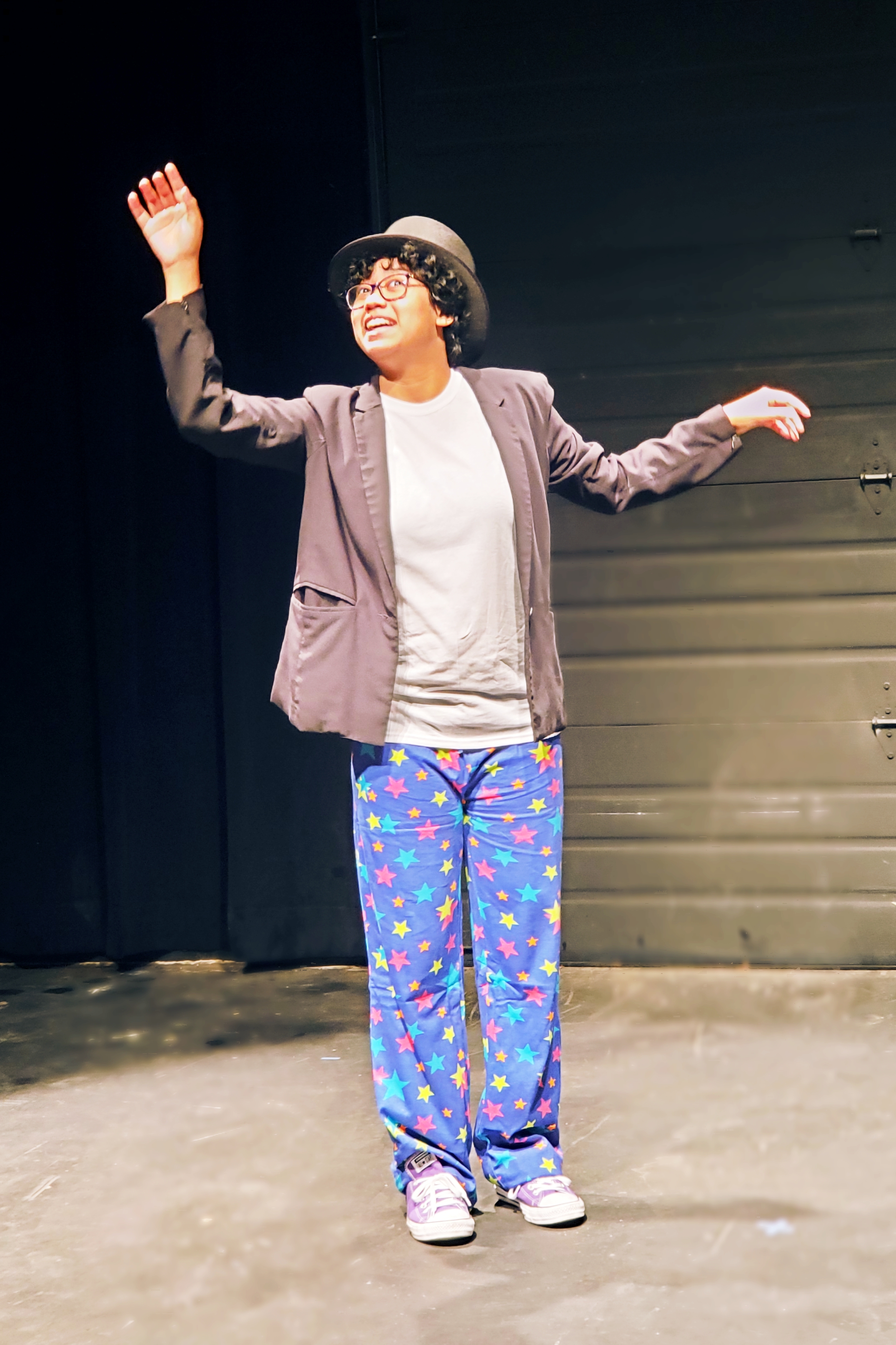
Directed for Three Bone Theatre by Sarah Provencal, Open is a one-woman show featuring Danielle Banks in her Charlotte debut.
We can actually trace the hour when Open began germinating on the surreal “morning after” of November 9, 2016.
“Once He-Who-Shall-Not-Be-Named was elected,” Skillman said in a subsequent interview, “the intolerant times in which we lived have increased. The day after he was elected at six AM, two men in a car driving past me shouted ‘Hilary lost, bitch!’” Out of her anger and pain came a need to escape the world of intolerance and hate she suddenly found herself in.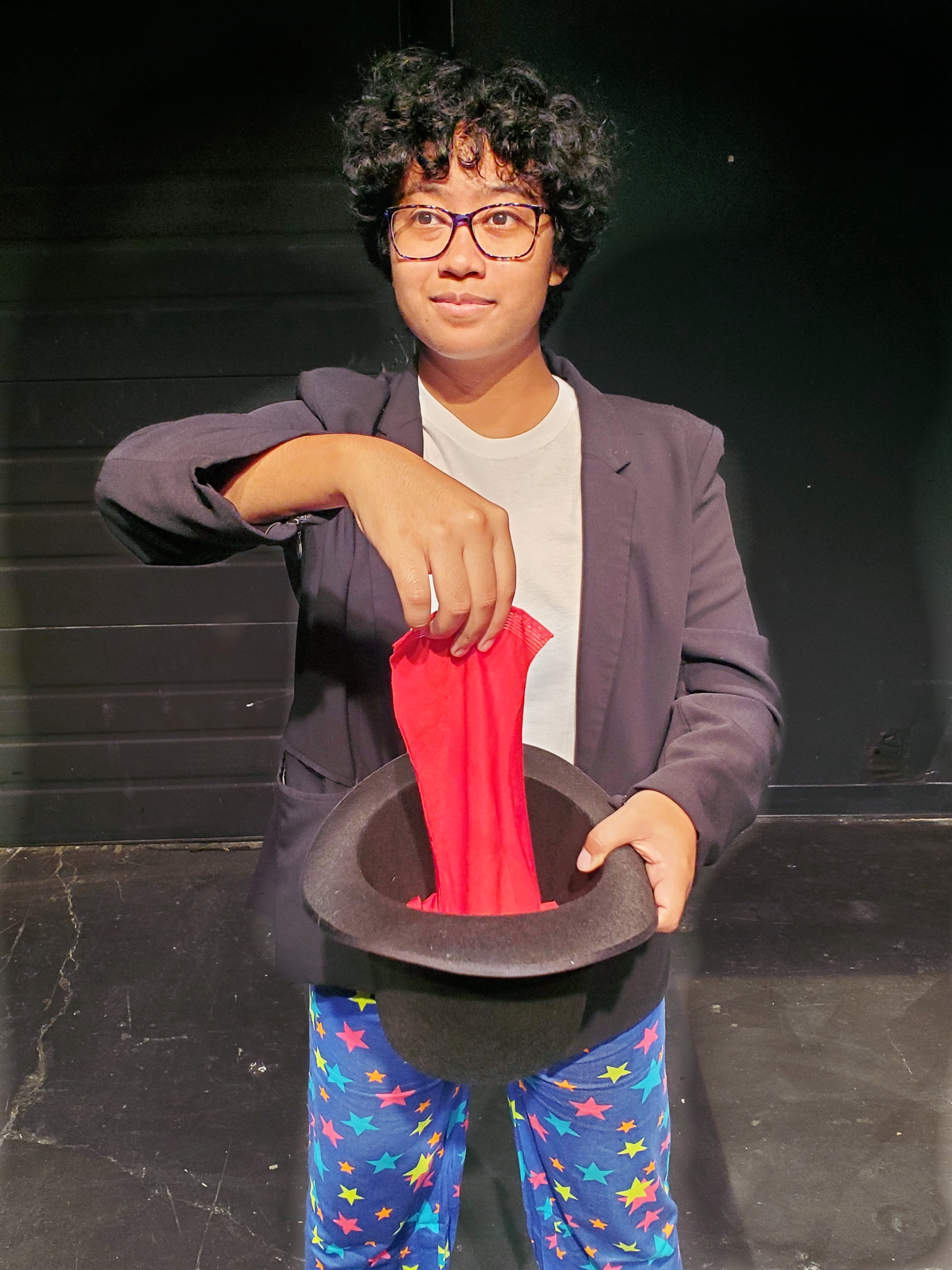
Skillman decided that she needed magic, and her script propounds the idea that we all need magic – and we all can believe in it if we choose. The woman who addresses us, Kristen, is a magician. The Magician.
Except that she isn’t. Kristen is actually a freelance writer, a soon-to-be electronically published author of her first young adult novel, who has extensively researched magic. She will rely on us, her audience, to believe in her magic and to imagine the balls she isn’t juggling, the metal rings she isn’t interlocking and pulling apart, the rope she isn’t cutting and magically restoring, and the deck of playing cards she isn’t shuffling or spreading or offering to an audience member to pick from.
Circuitously, we learn why Kristen needs this magic as she spins her love story. Each of three acts is delineated: first love, commitment, and sacrifice. Yeah, you’ll need to head to the other side of town for The Rocky Horror Show if you’re looking for something silly or frivolous.
While telling us how she has been coaxed out of the closet into a deepening relationship with Jenny, a Kinko’s worker who has helped her with her manuscript, Kristen clues us into why she resists coming out and commitment. Before leaving home for good, Kristen’s dad had encouraged her to be who she truly was – but never to tell Mom because it would kill her.
Kristen’s fondness for misdirection may explain her drift into magic, and her fear of commitment leads to Jenny’s horrendous misfortune, which is much worse than being taunted by a couple of MAGA maniacs. The assault on Jenny by a gang of homophobes has left her in the hospital with a tenuous grip on life. Compounding Kristen’s shock and guilt, Jenny’s parents don’t want her anywhere near their precious daughter.
Now Kristen must not only believe in magic. She must start believing in herself.
Watching my first live Three Bone production in over 20 months, I couldn’t help thinking every so often how ideal Open could have been as an online webcast during the long pandemic lockdown. Scenery, casting, costuming, and playing time are more limited than Prisoner 34042, the distinguished new two-hander that Three Bone premiered in 2019 and reprised online back in April. Already condensed.
The colorful lighting design by Christy Lancaster and Gordon Olson helps Banks in delineating the various segments of her narrative within her three acts and in framing her magic, but Provencal’s sound design is more noticeable and necessary, helping us get our bearings – and adding charm to the magic. Otherwise, the hurried and constricted presentation of Kristen’s story occasionally robbed it of sticking power.
Open lacked the tension of dialogue that frequently punctuated the narrative of 34042, when one of the actresses played multiple roles opposite our heroine. In an online presentation, the absence of additional actors in Open would merely be one more frill we were giving up for COVID-19, starting with not being in a real theater with a real audience in front of artfully fabricated scenery.

Seeing Open in an actual theater space obliges Banks to be more active and dramatic than if she were confined to a TV or computer monitor. And she really is wonderful as Kristen and The Magician, engaging with the audience with a youthful, bubbly vivacity that is only faintly tinged with shyness and hesitance. Banks is genuine in these roles, seemingly herself. We feel ourselves empathetically reaching out to her.
Unfortunately, Banks stays true to those two roles when she’s replicating key dialogues she has had with her beloved Jenny. Here, presumably with Provencal’s approval, the amateur magician becomes an amateur ventriloquist. Banks makes Jenny sound more timorous and shyer instead of the more mature and assertive human who urged Kristen to come out and pushed for lasting commitment.
Having issued so many indulgences and suspended so much disbelief, couldn’t we be asked to go a little further and accept the premise that the bubbly, slightly shy and awkward novelist/magician could miraculously, on cue, become an accomplished actress who can believably channel the Jenny she is so attached to and guilt-ridden about? Sign me up.
Without a substantial Jenny and without the two sets of parents present before us, elements of Kristen’s story begin to deflate and impact less forcefully. It’s not like Skillman didn’t have plenty of time and space to fill in these absences and give Open more heft.
Symptomatic of her crippling haste, Skillman tacks on an unnamed fourth act or epilogue that could be titled “Reconciliation.” Within the space of a single phone call, Kristen’s grief is dispelled – along with maybe her horror, guilt, and regret. On our drive home, I asked my wife Sue and our friend Carol whether this had all happened before or after Kristen had left the hospital for the last time.
None of us could say for sure.
As a fairly frequent reader of Dave Barry’s newspaper work, still recycling in Miami Herald newsletters a full 13 years after he left, I’ve developed a healthy skepticism about whether the humorist is capable of being serious about anything. I was optimistic that I might witness a breakthrough back in 2012 when I realized – as I was preparing to review the original Broadway production – that Rick Elice’s Tony Award-nominated Peter and the Starcatcher was adapted from a novel by Barry and Ridley Pearson.
Surely a prequel to Peter Pan, the most adulated and beloved story of the 20th century, would give Barry the incentive to see beyond his next one-liner, especially with a collaborator on board to keep him from jumping the rails. The giddy acclaim buzzing around the show and its five Tony wins for acting and design further fueled my optimism. On a July evening, I entered the Brooks Atkinson Theatre with the wild expectation of seeing a play that artfully, joyfully, and humorously dovetailed with James M. Barrie’s indelible fantasy.
My expectations were badly misaligned with the clever deconstruct of storytelling that I saw. Elice and Barry were equally tone-deaf to the sense of enchantment that Barrie brought to Peter Pan and to the Englishman’s flavorful zest for the primitive. In its belated rush to chime with the story so many of us grew up with, Starcatcher plopped Neverland in the middle of the ocean rather than up in the stars, Peter remained far from the heartless arrogant joy we all remember, and we were left to figure out that Barry’s Molly was Barrie’s Mary, Wendy’s elegant mom.
Unhindered by my former expectations, I found the touring version of Starcatcher far more enjoyable than the Broadway version when it came to Charlotte in 2014. A lot of credit went to the players. There was more chemistry at Knight Theater between Peter and Molly than I saw on Broadway, therefore more heart emerging from Elice’s script, and unlike the fellow who tried so hard to please as Tony Award winner Christian Borle’s replacement, John Sanders seemed to be having a great time as Black Stache, alias Captain Hook.
Yet I must have still been searching for Barry-Barrie links that I might have missed two years earlier, because I found myself even more pleased last week when Theatre Charlotte opened their 91st season with Jill Bloede directing a strong cast in Peter and the Starcatcher. Adept at zany comedy and slapstick, Bloede knows what this piece is – and what it isn’t. She has prodded Dave Blamy to the top of his game as Stache, no less funny here than in his award-winning turns at Actor’s Theatre in The 39 Steps and The Scene, eight years ago and more. How far can Blamy go over-the-top? The climactic amputation scene will be your delightful answer. Part-time foil and part-time torment, Jeff Powell as Smee outbumbles his master, perpetually aflutter and the perfect complement for Blamy,

Prime yourself for buffoonish villainy rather than hapless wicked cunning to get the full effect of Blamy Stache. The other wicked captain onstage, Tim Huffman as Captain Slank, takes up some of the slack on wickedness and menace – not a surprise if you saw Huffman in his Queens Road debut in The Crucible. Two piratical seamen have gotten wind of the treasure that Lord Leonard Aster is transporting to India. Getting both vessels to sea obliges us to accept that Lord Aster would want her Molly to sail separately from her father with one of the two treasure chests.
With Troy Feay making his Theatre Charlotte debut as milord, there was plenty starchy British propriety on board one of the ships, and with Johnny Hohenstein crossdressing as Mrs. Bumbrake, there was plenty of bawdy bustle aboard the other. Bowen Abbey woos her with intermittent success as Alf, allowing Hohenstein some comical vacillations – and partially explaining her slack supervision of Molly. Hey, they’re all kidnapped anyway, so Mrs. B has some cover for her negligence.
Also kidnapped – sold into slavery, if you want to get picky – are three orphan boys whom Molly befriends. By the process of elimination, we can figure out that the urchin with no name, played with a soft chip on his shoulder by Patrick Stepp, will eventually emerge as Peter. In the spirit of adventure, Molly seeks them out in the bowels of the pirate ship, and in the spirit of Barrie’s Wendy, she takes on the burden of educating the Lost Boys. Fifteen-year-old Ailey Finn is more than sufficiently precocious to portray both the tomboy and maternal dimensions of Molly. Why not? She was Rose of Sharon nearly a year ago in Theatre Charlotte’s Grapes of Wrath!
Stepp and Finn both render their roles like they’re on the cusp of puberty, so their mutual awakening comes moments before they must part forever. With Bloede at the helm, this is the most poignant ending I’ve seen in any Starcatcher production.
We seem to get there at warp speed, even though Bloede manages to sharpen Captain Slank and Mrs. Bumbrake more than I’ve previously experienced. Yet the sensory bombardment is so constant that I can admit without shame that, while I can tell you that Jesse Pritchard and A.J. White played the orphans creditably, I can’t say for sure whether Prentiss was the ornery one or Ted. Likewise, a peep into Wikipedia was necessary to nail down which character wooed Mrs. B.
Somebody remarked to me in the lobby at intermission that Peter and the Starcatcher is like children’s theatre for adults. If you’ve seen ensembles in children’s productions who break away from their characters and directly narrate to the audience, you’ll see the truth of that comment hand-in-hand with Elice’s deconstructing mischief. We are taking in a lot of information here. Listening to the players is often a more reliable indicator of where we are than following the changes in Chris Timmons’ spare set design, nicely coordinated with Gordon Olson’s lighting.
Keeping pace with all that happens is hard enough without worrying how Elice’s play connects with Barrie’s. So don’t. It was only on my third go-round that I realized how important the sound designer’s contributions are to making Starcatcher work. No sound designer is listed in the Theatre Charlotte playbill, so I’ll cite Ben Sparenberg and Rick Wiggins, listed jointly as light and sound board operators. Bloede and her cast certainly keep them busy, and I wouldn’t be surprised to learn that both of them might be cuing sounds together when tensions intensify.
You won’t find much enchantment in this 91st season launch, but there’s some magic aboard one of the ships when we land in Neverland. The journey is roaring good fun at its best, and it’s running with professional polish and precision.


