Tag Archives: Kaylin Gess

Evita’s “New Argentina” Suddenly Reeks of MAGA USA

Review: Evita at Duke Performance Hall

By Perry Tannenbaum
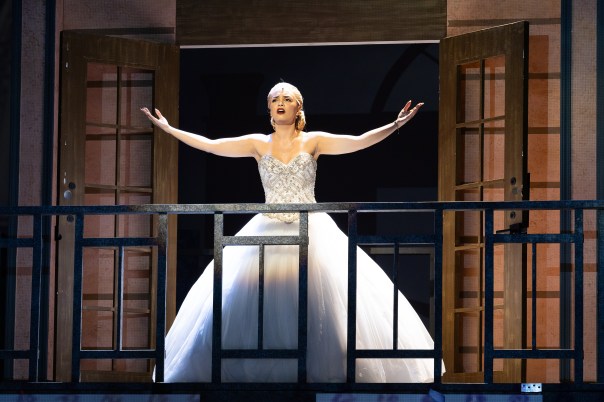
As women and as films, Evita and Melania will never be viewed as two of a kind. Yet in recent years, as Ms. Trump’s husband becomes more ceremonial, militaristic, and authoritarian, a mild kinship and a certain sisterhood have emerged between the two first ladies. There are only a few moments when the current Davidson Community Players’ production of the revered Andrew Lloyd Webber musical, directed with surprising ferocity by Steve Kaliski, seems to reference that kinship.

But there are many more instances when Eva Perón’s “New Argentina” brings present-day USA to mind in all its vulgar MAGA glory. Those happen whenever fervent religious enthusiasm is misdirected. Or when working-class people are talked up so they can be more easily exploited.

By juxtaposing Evita’s glamor, pragmatism, and humble origins with the mixture of street-smart cynicism, working-class empathy, and grudging admiration for homegrown “star quality” that we hear from Che, our narrator, Tim Rice’s libretto has always radiated a reasoned objectivity.

So Kaliski and his principals, Melissa Lozada and Neifert Enrique, aren’t reversing the political lean of Evita. They’re giving the music, the recitative, and the main characters a firm shove in a more malevolent direction.
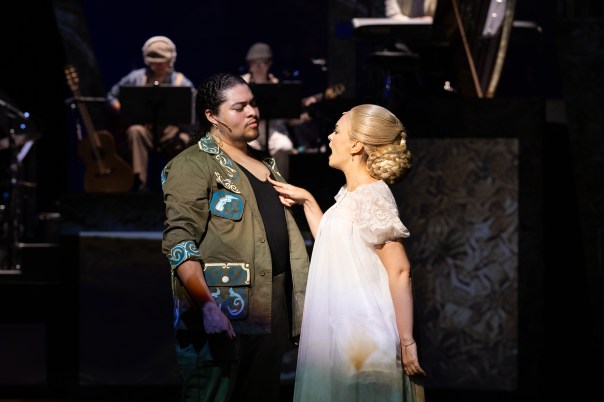
Enrique is particularly startling, easily the most dominant Che we’ve had in the QC. This is a rock tenor who can produce piercingly strong falsetto treble and, minutes later, invade the bass clef so deeply that you wonder where that voice is coming from – and Enrique never makes the mistake of yielding to Lloyd Webber’s singsong to the extent that it dulls Che’s subversive edge.

In sum, Enrique is often powerful enough to make us see the charismatic Evita through his eyes. If you wanted to see the icon as a calculating seductress, who may or may not have gotten religion through her good fortune or failing health, Whitney Drury was perfection in Queen City Theatre Company’s 2010 production, both in the sexual predation that catapulted Evita to celebrity and in her terminal suffering.

On the other hand, if you wanted to be fascinated by an enigmatic Evita, one gifted with so much natural charm and regality that she refuted the whole concept of aristocracy, Lucia Stetson was ideal at Central Piedmont in 2018 – with no shortage of Evita vanity.
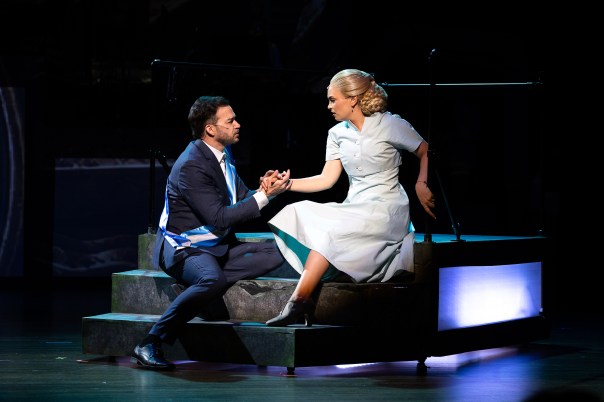
At Duke Performance Hall, on the Davidson College campus, Lozada is simply the meanest and most malignant Eva Perón you’ll likely ever see. Even her “star quality” has a punkish edge as she never quite sheds her peasant roots. There’s a somewhat ghoulish tinge that lingers softly on her final prideful declaration that she has brought her people closer “to the heart of Perón,” her autocratic husband, the nation’s president.

In that moment especially, our clueless Melania pales next to her. We must revert to the golden-haired Trump for a parallel.

Of course, if you saw Lozada in the title role of Electricidad last August, you may already be altering your plans for the final weekend of Evita.Or, if you witnessed Enrique in his most recent title-role triumph down in Matthews as The Prince of Egypt, you may be astonished to hear that his Che is as potent as his Moses.

They aren’t the only reasons why word-of-mouth touting Evita is spreading like a Lake Norman wildfire. Kaliski’s design team has also risen to the challenge of creating a spectacle to match the dimensions of the Duke. Most notable of these are costume designer Sarah Deutsch, lighting designer Kaylin Gess, choreographer Tod A. Kubo, and – perched high in the stratosphere behind the stage’s second scrim – the 10-piece band directed by Matthew Primm.

Upstaging and outsizing them all are the projections designed by Caleb Sigmon, beginning with what may be an actual Eva Perón film! Rice and Lloyd Webber wanted to simulate us all being gathered at a movie theater at the start of their musical when the flick is suddenly interrupted by the announcement of the beloved Evita’s death.
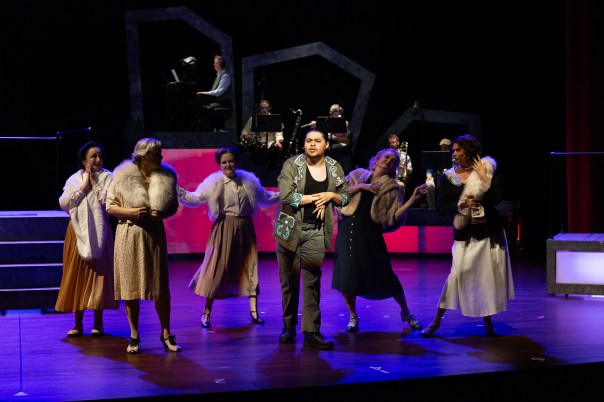
For the first time, this opening scene with its operatic choral requiem seemed prophetic, previewing the wailing and grief that is sure to engulf our streets, churches, and national monuments when 45/47’s number is up. The Amazing Tangerine tries so hard to alienate and disillusion his cult following. In vain, it seems.

Victimized by the wayward Halton Theater sound system when he portrayed Che in 2018, Ron Turner Diaz ages gracefully in the role of the militantly urbane Perón. Effortlessly, he conjures up the personality of a chieftain who will either succumb to Evita’s charm and chutzpah or slay her instantly. There’s a nice tension to their “I’d Be Surprisingly Good for You,” spiced with a tango tang of violence.
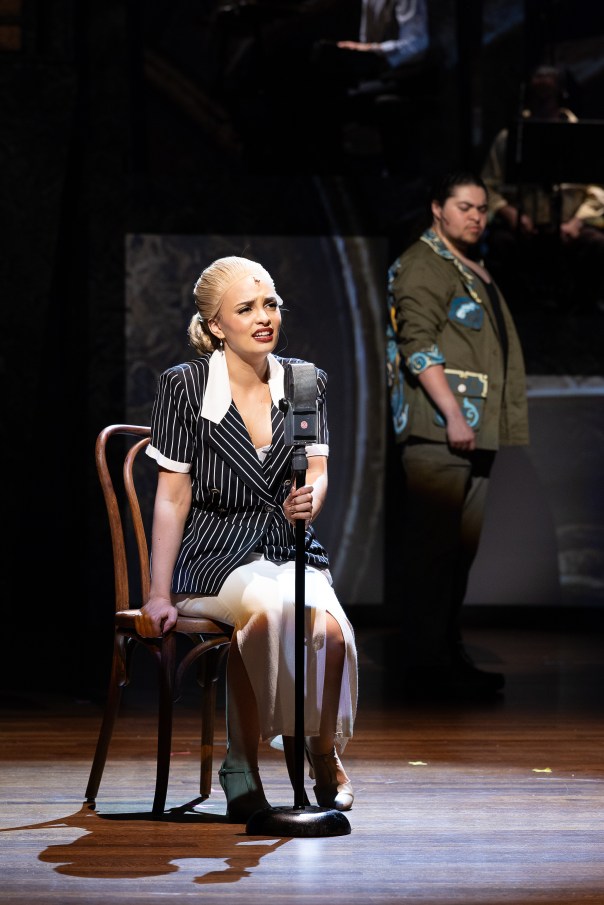
Lastly – except for dozens of aristocrats, lovers, family, military, children, and the citizen ensemble – there’s Tristan Nogueira, rounding out an all-Latino cast of major characters, conclusively answering the question of whether we have enough Hispanic talent in Charlotte to deliver a truly authentic Evita. If you saw Nogueira as the surprisingly skeptical Aaron in The Prince of Egypt, you’ll be pleasantly surprised by his transformation from the future High Priest into lounge lizard Agustin Magaldi, Evita’s first discard.

Extra bonus: Lindsay Litka-Montes sings “Another Suitcase in Another Hall” with a quiet, simmering bitterness as Juan’ s discarded Mistress.

More significant extra bonus: due to popular demand, an extra performance of Evita has been added to its closing weekend. This coming Sunday at 7pm.

Beginning at the Beginning at Cunningham Theatre Center
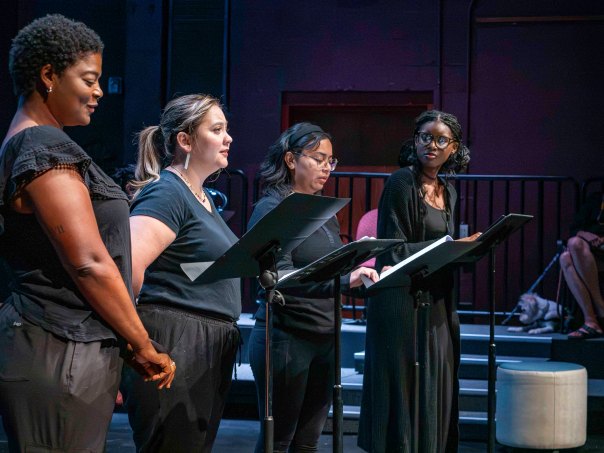
Before the news broke about the extra Evita performance, we returned to the Wildcats campus to usher in the summer – and celebrate Father’s Day – with Common Thread Theatre Company’s Beginning at the Beginning. Staged at the Cunningham Theatre Center, B @ the B was a miniature new play festival showcasing two works-in-progress with an intermission in between and a talkback with playwrights Brian Daye and David Scheonfeld afterwards.

This time, the trip up I-77 wasn’t quite as rewarding. Daye’s one-act, The Race, directed by Eric J. Little, was the better of the two pieces: more compelling action, fuller characterizations, and high-energy performances. Shawn Halliday portrayed the overtly racist Lavell Anderson, on death row as a convicted murderer awaiting execution, while Vanecia Boone was cast as his eleventh-hour appeals attorney, African American cub lawyer Cory Williams, understandably reluctant to take the case.
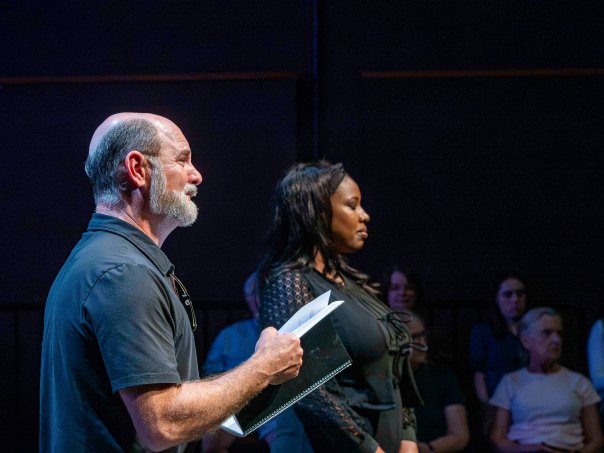
The two shrunken timeframes, the impending execution and the brevity of Daye’s script, short-circuited any racial animosities that may have clouded the budding attorney-client relationship between Cory and Lavell. He had undergone a religious transformation, and she, with even greater speed, is convinced of his innocence.
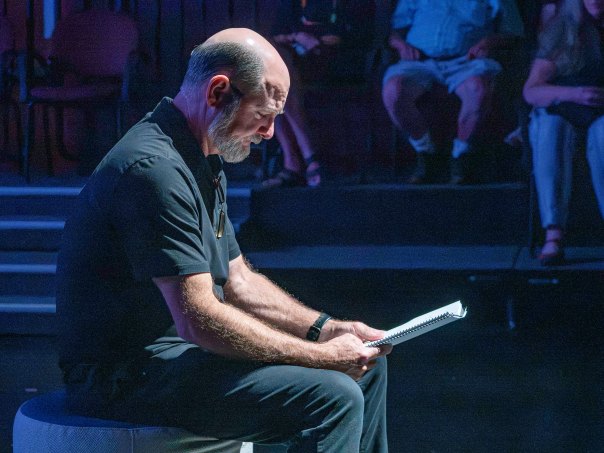
Worse, the case against Lavell, whether 19 years or three months old, is so laughably flimsy that it should never have been brought to court – unless the charge had been armed robbery. Lavell maintains that his accomplice, Vern McCluskey, was the trigger man and that he never fired his gun. Criminology or Forensics 101 are not prerequisites to knowing how Lavell’s assertion can be confirmed: anyone who has read a Perry Mason novel – the series began over 90 years ago – is aware of scientific tests that match a bullet with a gun and determine whether a person has recently used a firearm.

Open and shut. We also liked Isaac Hampton as the big, bigoted prison guard.

Scheonfeld’s Massage Group Therapy was even less fully developed and, consequently, less satisfying. Aside from a creep named John who bedevils at least half of the four masseuses, none of the playwright’s people were sufficiently fleshed out. It was a little awkward to see Justin Peoples as John upstaging the exploited women we’re intended to care about.

Even if Scheonfeld had made his massage parlor workers more distinctive, there would have been another tall obstacle to overcome for me. Switching roles from female lead to director, Boone did not insist that her players – or the dude reading stage directions – speak loudly enough to be heard.

B @ the B hits the road for its concluding weekend, resurfacing at North Carolina A&T University on June 27 and 28, up in Winston-Salem. For the time being, the more rewarding trip is to Davidson for the resumption of the Community Players’ Evita.

As for Winston, best to wait for the International Black Theatre Festival, July 27 through August 1. Charlotte’s own BNS Productions will be among the many fine Black companies there, presenting four performances of August Wilson’s Joe Turner’s Come and Gone, afternoons and evenings on July 31 and August 1.

“Ripcord” Brings Mortal Combat to Senior Living

Review: Ripcord at Davidson College

By Perry Tannenbaum

We’ve had more than a couple of engaging David Lindsay-Abaire moments in the Charlotte metro over the years, beginning with the Actor’s Theatre production of Fuddy Meers in 2002. Wonder of the World continued the company’s love affair with Lindsay-Abaire in 2004, and when the playwright’s Rabbit Hole took the 2006 Tony Award and the 2007 Pulitzer, Actor’s Theatre took full custody for the 2008 Charlotte premiere.

Since then, the edgy Lindsay-Abaire has largely disappeared, along with – not coincidentally, I’d contend – Actor’s Theatre of Charlotte. The exception proved the rule when Carolina Actor’s Studio Theatre mounted a fine production of L-A’s Good People in 2013, for CAST made its exit years before ATC’s demise.

Tiding us over until the current run of Ripcord in a Davidson Community Players productionat Duke Family Performance Hall, Lindsay-Abaire has graced us with numerous softer, cuddlier visitations. For he wrote the book for the musicals that brought the animated Shrek to life in a trinity of darling fluff, beginning with Shrek the Musical before hatching its twin afterbirths, Shrek Jr. and Shrek TYA. A full-length revival was staged at ImaginOn by Children’s Theatre as recently as 2022.

With the touring edition of Lindsay-Abaire’s newest Tony Award winner, Kimberly Akimbo,due for a Knight Theater rendezvous next April, many Charlotte theatergoers may rightly feel that the time is ripe for catching up with this notably successful writer. They will find a very fine production at the Duke, nestled inside the Davidson College student center, although Ripcord isn’t Lindsay-Abaire at his edgiest.

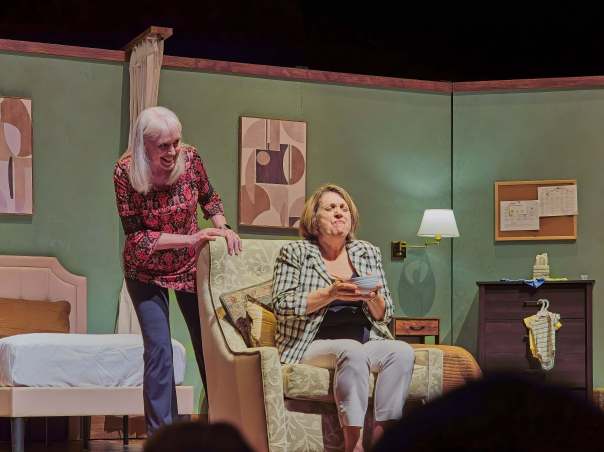
On the other hand, Ripcord isn’t nearly as humdrum as its main locale, Bristol Place Senior Living in New Jersey, would lead you to presume. That’s because roommates Abby and Marilyn have radically clashing temperaments, turning the apartment into a tinderbox. Fundamentally, Abby is misanthropic grouch who treasures her privacy – but instead of forking out the extra cash that would put her in a private apartment, she has pragmatically made herself impossible to live with.

Sunny, cheerful, and chatty, Marilyn is totally averse to the quiet and solitude Abby thrives on, breezing into the suite in a jogging outfit while her sedentary counterpart vegetates on an easy chair. She doesn’t see Abby as a mortal enemy. She’s oblivious to most of the insults that Abby hurls at her and impervious to the rest. Marilyn needs to play with others and blithely treats Abby’s hostility as playful banter.

Such insouciance totally flabbergasts and infuriates Abby, opening avenues to comedy and drama. Lindsay-Abaire slyly chooses both. So do director Matt Webster and his cast, decidedly tipping the scales toward comedy. You can easily despise both Pat Langille as the Pollyanna senior Marilyn and Karen Lico as her adversary.

Abby’s inability to dim Marilyn’s sunniness is frustrating enough for her to enlist the assistance of eager-to-please Scotty, the resident aide who cares most about the women. You can definitely empathize with Scotty when Abby confides in him and keeps pestering him to get Marilyn transferred to a single apartment that has become vacant downstairs.

Strangely enough, Scotty’s patience isn’t as boundless as the saintly Marilyn’s, which gives Lowell Lark some leverage to work with in the role. As a peacemaker, he gently informs Abby that she likes it upstairs, where it’s sunnier and there’s a nice view of the nearby park. As a dealmaker, he won’t commit to speaking to management on Abby’s behalf about moving out her roomie, but he could get in a word for her about serving up some chicken and dumplings – instead of the usual tasteless gruel – if she’ll buy a ticket and come to a show he’s acting in.

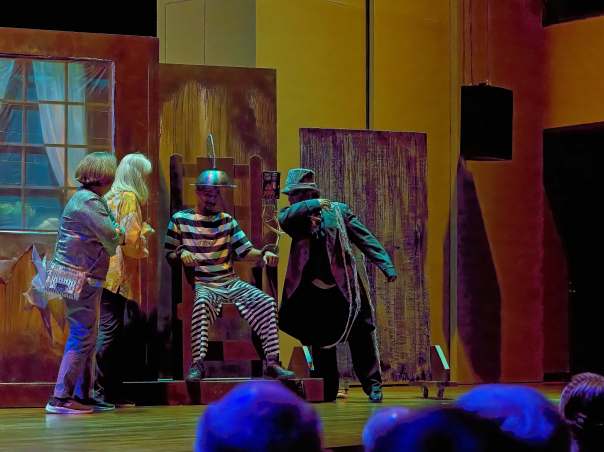
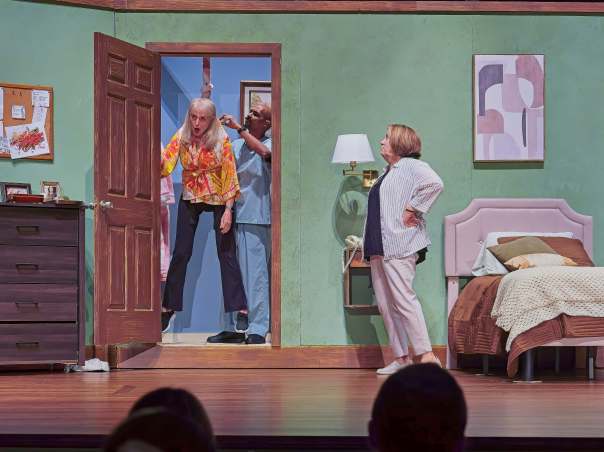
Actually, “Beelzebub’s Den” is a haunted house, liberating us from the ladies’ institutional humdrum bedroom and bath on an excursion to the first of three breakaway scenes, two of them obliging set designer Kaylin Gess to create living quarters that quickly stow away in the Duke’s commodious wings. Lots of work for the seven-person set crew. Doubling as DCP’s lighting designer, Gess gets to supply the phantasmagoria at Beelzebub’s while Beth Killion provides the outré costume designs. Technical director Shawn Halliday also gets in on the fun, here and in the signature skydiving scene.

There’s fun for us watching the haunted house antics, but Abby is neither impressed with Scotty’s acting nor scared by any of the spookiness. Abby matter-of-factly tells that she doesn’t scare. Period.

Enjoy the fun, then, but the prime takeaway from Beelzebub’s is Abby’s pride in her fearlessness. In the very next scene back at assisted living, Marilyn will insist with equal certitude that nothing Abby can do will make her angry. Resistant to all the previous bets her quirky roomie has proposed, including whether she can balance a slipper on her head, Abby sees a betting opportunity here. If Abby can make Marilyn angry, she wins. If Marilyn can scare Abby, victory!

The high stakes are predictable: if Abby wins, Marilyn leaves; if Abby loses, Marilyn gets to take over the coveted bed near the window. Game on!

And no holds barred. Lico and Langille aren’t at the high end of Lindsay-Abaire’s specified age range for their roles, so the patina of seeing ancient biddies acting like kiddies isn’t happening in Davidson. But it is definitely the playwright’s intent for Langille to exceed expectations with her imaginativeness and for Lico to shock us with her meanness and cruelty.

With stakes set this high, this is war, and the warfare escalates each time an attack fails. Bombarding your roomie with phone calls and fake messages or drugging your roomie are not out of bounds as the battles begin. Enlisting your relatives and pranking your opponents’ kin are also legit strategies as the Abby-Marilyn War escalates. The avenues of comedy and drama widen along the way.

Langille and Lico obviously revel in hatching their devilish schemes and flouting our presumptions of senior citizens’ dignity and decorum. So the Odd Couple comedy, seasoned with a half century of aging, works well. But there’s also a theme of bonding that Lindsay-Abaire plants deeply in his script from the moment his antagonists strike their bet. Reviews of the 2015 Manhattan Theatre Club premiere indicate that director David Hyde Pearce missed it with his sitcom reading, and Webster also misses some of the early hints.

Yeah, Scotty the peacemaker and dealmaker subtly evolves into the common enemy – inevitably, the uniter, if both women survive! – when Abby and Marilyn solemnly agree to keep their bet a secret from him. Lark has his best moments when he suddenly appears at an inopportune time, threatening to blow the renegade gamblers’ cover.

The deeper mojo is in the bond formed between the two combatants, a literary staple stretching past Robin Hood and Little John all the way back to the Homeric epics. We’ve all seen two boxers sincerely hugging one another after pummeling each other for 12 or even 15 rounds. That’s genuine emotion, the rawest kind, not ritual or fakery. It comes from a gradually growing appreciation of your opponents’ gifts and grit as the battle grinds on. At its keenest, the upswell of emotion also comes from the realization that your mortal enemy has pushed you to a level that you never believed possible – and that part of extra specialness of your opponents’ performance comes partly from you.

So there are many fine moments that Lico and Langille have once the game is on, though digging into them would disclose too many comical and dramatic spoilers. Equal to any one of them is the spot where, the bet having been won, the combatants begin praising each other for their devilish deeds. At that point, Webster, Lico, and Langille are all catching Lindsay-Abaire’s drift.

Supporting actors are also a treat, starting with Rigo Nova as the Zombie Butler, our host at Beelzebub’s. Transforming into Derek, Marilyn’s son-in-law, Nova is almost as surreal in his geniality and self-doubt. Victimized by one of Marilyn’s pranks, John Pace wears his victimhood well as Abby’s drifter son after donning a clown suit back at the haunted house.

Kimberly Saunders is also spectacularly silent at Beelzebub’s as the Woman in White, but her surprise appearance as Colleen, Marilyn’s daughter, is an immediate joy – for she is foiling Abby’s first wicked prank just by walking through the doorway. Soon she’ll be rubbing her hands with glee at the prospect of joining her Mom in some awesome payback. Mischief is more fun when the whole family is in on the plot.

“Lizzie” Whacks the Bordens in a Creepy, Hard-Rock Witches’ Brew

Review:  Lizzie

By Perry Tannenbaum

It’s amazing what murdering your mom and dad can do for your outlook, for your self-esteem, and especially for your fashion sense. Back in a radically revisionist 1892, Lizzie Borden took an axe and, in a vigorous aerobic workout totaling 81 whacks, achieved all of these wholesome objectives. Or so Lizzie, a rock musical playing at Queens University in a devoutly raucous Actor’s Theatre of Charlotte production, insists on telling us, piling onto the lurid Lizzie urban legend and her bloody skip-rope rhyme. Steven Cheslik-DeMeyer and Tim Maner began work on this musical a couple of years before the centennial of the infamous axe murders, and between 1990 and 2013, the enterprise grew from four songs to a smallish full-sized rock melodrama, taking in Alan Stevens Hewitt along the way to add in new music, lyrics, and orchestrations.

Victims Andrew and Abby Borden do not appear in this rock retelling. Concepts of calibrated punishment, let alone penance, are righteously bludgeoned here. The stage belongs to Lizzie, her elder sister Emma, the Bordens’ housemaid Bridget Sullivan, and Lizzie’s neighbor friend, Alice Russell. Emma also emerges as homicidally inclined, her animus mostly directed at her stepmom because Abby may be scheming to rob the sibs of their inheritance. That threat layers onto Lizzie’s resentment against her dad: there’s no doubt anymore that he molested Lizzie repeatedly. Similarly, suspicions that Alice was deeply in love with Lizzie are confirmed. Perhaps the most startling character makeover here is Bridget, who takes on Miss Danvers-like malevolence, goading Lizzie to the breaking point and slyly pocketing payoffs along the way.

If all this sounds like the lyricist/composers are leaning towards feminism, anarchy, and decadence, then you should also know that director Joanna Gerdy hasn’t pushed back. The writers haven’t mandated that musicians, directors, and designers all be women. That’s Gerdy’s idea, apparanetly. With the possible exception of set construction personnel, she has kept this production cordoned off as an exclusively Women-at-Work zone. Yet it would be a mistake to suggest that the earmarks of testosterone have been banished. Emily Hunter’s choreography, unmistakably suggesting the Weird Sisters of Macbeth when the time comes to burn Lizzie’s bloodstained dress, at other times evokes the strut of heavy metal rockers. Carrie Cranford’s costume designs, prim and Victorian for the principals throughout Act 1, takes on a definite S&M edge after intermission. From the outset, the musicians’ costumes, hairdos, and makeup telegraphed where we were heading. Nor was there anything lacy or dainty about Kaylin Gess’s tabloid set design and how it synergized with Hallie Gray’s creepy, diabolical lighting.

Gerdy and musical director Jessica Borgnis have skillfully interwoven their respective primary goals, creeping us out and rocking our faces off. The thrust of the creepshow began before Actor’s Theatre executive director Chip Decker welcomed us to the company’s 30th season. Added on to the specified core group of players, Gerdy had Emma Lippiner darting around the mysteriously lit Hadley Theater as Young Lizzie, disappearing into the wings and then returning with a skip-rope. We also watched her ascend to the upper level of the Borden home where, flanked by Mom and Dad’s rooms, she ominously swung on a swing. Lippiner had not been instructed to portray a happy child, that was certain. Turn of the Screw or Stephen King were more likely what Gerdy was going for.

There’s certainly an affinity between Lizzie and the repressed teens of Spring Awakening in terms of the period and the style of the Actor’s Theatre production, which stakes its claim to freewheeling anachronisms with Young Lizzie’s plastic skiprope and continues with microphone stands and hand mikes for the ladies. What separates Lizzie from achieving similar greatness is the writers’ failure, despite all the juicy historical sources and suppositions available to them, to fully embrace the concept of a script – and their resolute insistence on developing only their title character.

Credit Gerdy and her cast with finding ways to close the gap. Even with her hair up and confined by a full-length dress, Katy Shepherd remained volatile and spellbinding throughout Act 1, a seething cauldron of sexual and homicidal impulses. The pathologically buttoned-down Kristin Jann-Fischer seemed even more likely to snap in the early going as Emma, but Shepherd suddenly leapfrogged her when Emma left Lizzie alone with her parents. Previous productions of Lizzie have established splatter zones in the theaters where they have played – and a patch of comic relief as melons or pumpkins were hacked. Gerdy doesn’t go for that kind of gore, but when we saw Shepherd’s face smeared and spattered red, a radical change had come over her. It was impossible to say whether that change had led to the violence or whether taking in the spectacle of what she had done had triggered that change. Shepherd seemed equally stunned and liberated by the crime.

By the time we returned from the break, Lizzie had let down her hair and totally changed her look, lounging lasciviously on the only stick of furniture that Gerdy allowed on the floor of the set. With the Weird Sisters episode, we realized that bacchanalian delight and wicked diablerie could reach maximum depth. The shaken demeanor that Shepherd switched on toward the end of Act 1 morphed into evil leers and insane eyerolls in Act 2. While some might find Shepherd’s vocal exploits on par with her acting, I’d say they come fairly close, which is high praise.

My reference to Miss Danvers will be clear enough to anybody who has read Daphne du Maurier’s Rebecca or seen the Oscar-winning Hitchcock film. Yes, there was a Judith Anderson dimension to Shea’s performance as Bridget Sullivan as she prodded Lizzie toward catastrophe, and Shea seemed to haunt the Borden house far more than take care of it. She may have the best voice onstage, even if it doesn’t reach Shepherd’s stratospheric heights. Though she doesn’t evolve, she occasionally dominates. My suspicion about Alice Russell is that the writers didn’t consider changing her with the times. CiCi Kromah’s sweet, sweet performance might have seemed more satisfying back in 1990 – or certainly 1892 – when simply being an open lesbian could stamp you as a kind of small town outlaw. Today, Alice’s sincere love for Lizzie just struck me as a sentimental strain in the story, necessary as part of the sequence that triggered Lizzie’s homicidal rage but discarded afterwards during the crime investigation and Lizzie’s court trial.

Piloting from an electric keyboard, Borgnis drew searing vocals from the true lady outlaws onstage and the requisite smashing and slaying from her tight instrumental quintet, which unexpectedly includes a cello for those unexpected mellow moments. Best of the raucous vocal quartets was “Somebody Will Do Something” bringing us to intermission, but there were three or four of nearly equal power after we returned, including “Burn the Old Thing Up” and “Thirteen Days in Taunton.” Yes, it was noisy when everybody onstage was wailing and rocking, but Actor’s Theatre has always been savvy in measuring the difference between loud and deafening. Once again, they have it dialed in just right.