Tag Archives: Scott Albert

Raising Cain at the Cain Center With Million Dollar Quartet

Review: Million Dollar Quartet at Cain Center for the Arts

By Perry Tannenbaum

By some cosmic coincidence, the publication of Rolling Stone’s special edition listing of The 500 Greatest Songs of All Time in late 2004 anticipated the great flowering of jukebox musicals on Broadway almost immediately afterwards – with hardly a hiccup since. A good 40 years after my last look at Billboard and Cashbox’s weekly Top 100s, the idea of collecting chart-topping hits recorded by the great kings, queens, and groups of pop or rock for live theatre must have been in the air.

Suddenly it gained new traction as a bankable concept. Songlists associated with Elvis Presley, John Lennon, The Beach Boys, and Frankie Valli and the Four Seasons all got the Broadway treatment in 2005. Bob Dylan, Johnnie Cash, Dusty Springfield, and Earth, Wind & Fire were among those basking in the lights of the Great White Way the following year.

So it was hardly a surprise that Cain Center for the Arts, up in Cornelius, was sold on Million Dollar Quartet for their first co-production with neighboring Davidson Community Playhouse. After all, the original concept and book were inspired by hitmakers Elvis Presley, Jerry Lee Lewis, Carl Perkins, and Johnny Cash – all of whom are enshrined in the top 100 of the Rolling Stone 500 list.

The new Cain-DCP collaboration is making history with history: the four rock legends actually did converge in Memphis, at Sam Phillips’ Sun Records studio, spontaneously jammin’ together for one magical evening in December 1956. Phillips wasn’t sure people would believe it, so he snapped a photo of the quartet. Meanwhile, some rascal in the soundbooth rolled the tape.

Was Million Dollar Quartet inevitable by the time it premiered at the Nederlander Theatre in 2010? Maybe it was nudged a little by the Rolling Stone list or the efflorescence of jukebox musicals in 2005, since the Mutrux concept was first put on its feet in Daytona Beach the following year.

The Complete Million Dollar Quartet album, 47 tracks compressed into 78 minutes, had been available commercially in the US since 1988, after gathering bootleg-edition cache for more than three decades. And the whole scenario of the Sun Records session remained the subject of fevered speculation; if anything, boosted by the commercial release, years after the best tracks – and then the complete session – had been kosher in Europe.

About the only logical argument against memorializing the historic Memphis summit meeting was the lukewarm music captured on tape.

Rolling Stone gave it three stars out of five.

Some might find even that middling rating overly generous. Aside from the wretched sonic setup, the fragmentary and impromptu song list was hardly formidable. “Brown-Eyed Handsome Man,” “Peace in the Valley,” and “Down by the Riverside” were readily available from the 1956 tape, but Mutrux nixed other staples such as “When the Saints Go Marchin’ In,” “Black Bottom Stomp,” and “Just a Little Talk With Jesus.”

Apparently, Mutrux had to tread softly among The King’s hits, for “Don’t Be Cruel” and “Love Me Tender,” both on the Complete Million Dollar album, are MIA in the musical, though both were approved for All Shook Up in 2005. So were “Hound Dog,” “That’s All Right,” and “Blue Suede Shoes,” which thankfully – and with full propriety for 1956 – were made available once again.

“Blue Suede Shoes,” a bone of contention between Perkins and Presley – Carl made the big hit recording, but Elvis made his big national live TV splash with it on the Ed Sullivan Show – was an absolute must for Mutrux and co-writer Colin Escott. It was the sort of historic tidbit that could add edge to a chance meeting whether or not it actually came up for conversation, but the writing team had grander plans.

Cleverly sidestepping the question of which of the two disputants would sing the song in their musical, Mutrux has all of the Quartet members on vocals – at the top of the show before Phillips’ narrative unfolds. It’s a perfect fit, beginning with an anthemic cry: Carl sings, Well it’s one for the money, making his entrance. The stop time after that cry allows Johnny to materialize beside a second mic for his Two for the show.

No contest about who makes the biggest entrance after Three to get ready. It’s Elvis, kicking “Blue Suede Shoes” into its 4/4 locomotive gear. Jerry Lee will get his chance, late in Act 2, for a barbaric yawp of his own, his You shake my nerves and you rattle my brain from his iconic “Great Balls of Fire,” when this session reaches full blast.

Now it’s fair to say, even though they aren’t on the Memphis tapes – and didn’t get released until 1957 – that Lewis’s monster hits, “Whole Lotta Shakin’ Goin’ On,” and maybe even “Great Balls” were already in the oven getting baked. Chronology for Johnny Cash’s Sun Records hits, “Folsom Prison Blues” and “I Walk the Line,” is indisputable; they aren’t on the Million Dollar album, either.

Cash’s borrowings are shrewdly selected, stealing “Sixteen Tons” from Tennessee Ernie Ford, a hot hit in ’56, and “Riders in the Sky” from Burl Ives and Vaughan Monroe, already seven years old. Likewise, Perkins is only flashing back a little when he pilfers Bo Diddley’s “Who Do You Love” and Bill Haley and the Comets’ “See You Later, Alligator,” both of them ’56 hits.

Even truthier than Perkins’ dispute with Presley, the singer-guitarist actually did record his forthcoming single, “Matchbox,” in December 1956 – but a day before the Million-Dollar bootleg. And Jerry Lee, still months away from his first Sun release, was an unknown sideman for Perkins at that session. So the script is almost accurate in setting up the Sun Studio get-together as Elvis and Johnny crashing Carl’s recording date.

And Elvis did bring his current girlfriend to the party, though here the writers change her name. They give their Dyanne two sexy songs her real-life counterpart never sang, “Fever” and “I Hear You Knockin’,” again authentically from that era. No less importantly, they have her standing by to console Phillips when his grand plan for the evening falls through.

Inside and out, Cain Center can be viewed as a somewhat downsized Knight Theater, beautifully accommodating around 400, about a third of the Knight’s (and the Nederlander’s) capacity. With its rousing opening, Million Dollar Quartet instantly proved to fit perfectly at the new Cornelius arthouse. Sound was perfectly potted for these ears, and not a single word was lost in our back-row seats on the sold-out opening night.

The same can rarely be said of touring shows at Belk Theater. Or at Theatre Charlotte, which sports half of the Cain’s capacity.

And we liked what we heard as much as what we saw, thanks to director Scott Albert and his cast, costume designer Beth Killion, scenic designer Chip Decker, and lighting designer Gordon Olson. Nor was it surprising to learn that Matty Montes, who portrays Carl Perkins, was also our music director. He plays a mean ax.

Nearly forty years after first discovering the Queen City/Metrolina theatre scene, I found it fairly groundbreaking for DCP artistic director Steve Kaliski to assert in his curtain speech, on a stage so grand, what my first Creative Loafing front-page feature pointed out then: people here greatly underestimate our local theatre talent pool. We can cast all four of these iconic rock giants with local actors, even if they are tasked with accompanying themselves and each other instrumentally as they perform.

All four pairs of blue suede shoes were filled very handsomely, thank you very much. You could actually look forward to a Montes’s instrumental licks as avidly as his vocals. Same can be said even more prodigiously for Ian Benjamin as Jerry Lee, the role that catapulted Levi Kraus to a Tony Award.

Kicking away his piano bench in the flamboyant style of The Killer would oblige Cain Center to take out some serious insurance, yet Benjamin had most of Lewis’s other wild antics covered. He lacked the finely tuned right heel in Jerry Lee’s arsenal, but he had the signature pumping piano action and zigzag runs securely in hand, as well as his outré mic handling. After bringing down the house with “Great Balls of Fire,” Benjamin also proved he could work the crowd he had rattled so triumphantly with his so-predictable “Shakin’” encore.

If you know Jerry Lee’s Sun catalog – or his sensational marital history – you’ll understand why Benjamin gets to be the most sensuous and bawdy member of the quartet. If not, you’ll be reminded. Although there were no photos of The Killer wearing suspenders for me to find with Google, Killion follows in the Broadway production’s footsteps by outfitting Benjamin with a pair.

We see why after Lewis leers at Dyanne in a way that risks Elvis’s rage and his girlfriend’s rejection. But Julia Freeman as Dyanne will not be intimidated. Au contraire. With her “Fever” and her “Hear You Knockin’,” she gives Lewis and then Presley the vamping of their lives.

But it’s with Lewis that she leans suggestively over Jerry Lee’s piano and tugs at those suspenders. Fever, indeed!

For their respective partisans, Eli Fischer as Elvis or Connor Nielsen as Cash may emerge as the apex among the vocalists. Though his bass register doesn’t reach as richly down to San Antone as Johnny’s, there’s an uncanny sameness between Nielsen and The Man in Black up higher in his mid and upper range, conveying the penetration and distinctive off-key astringency of that voice as well or better than I’ve ever heard it before.

Sometimes the visual resemblance was also uncanny. With Elvis or Johnny, just listening obviously wasn’t enough to satisfy Albert in his director’s chair. Most audience members wouldn’t require any actor playing Cash to be as true to his look as you have to be to either the look of Elvis or the less universally imitated Jerry Lee. Nielsen, we can suspect, put in that extra film study.

Fischer may have had the most daunting task as Elvis, considering the charisma he must live up to. Even if this is pre-Army Elvis, Mutrux conscientiously points out that Presley has already played Vegas. That’s more than sufficient excuse for Fischer to layer on all of the signature moves we associate with The King, from his scandalous Ed Sullivan days to his polished King of Vegas years.

So Fischer’s mic handling and stage movement must be on a par with Benjamin’s. We’ve seen enough sliding on two knees to celebrate World Cup goals for that onstage move to strike us now with the same excitement it packed back in the ‘50s. With that move masterfully conquered, this Elvis doesn’t need to sing better than this Jerry Lee, but he does. And anachronistically, when he tosses his scarf and sweat hanky into the front rows, he slays better than The Killer as well.

To say that Fischer’s “That’s All Right” and “Hound Dog” are electrifying is more than fair. But to say that they steal the thunder from Benjamin’s prime Jerry Lee exploits would be very presumptuous. Things get very hot at the Cain.

Come on over.

Vox Populi Deafeningly Lauds “Little Shop” at The Barn

Review: Little Shop of Horrors at Theatre Charlotte

By Perry Tannenbaum

Sunny, frolicsome, dark, and bizarre: it’s tough to say whether the best landing spot for Little Shop of Horrors is during the spring, that fragrant time of flowering hope and romance, or the fall, that decaying season of colorful rot and the macabre. All of the Metrolina theatre companies and colleges that have taken us back to Skid Row this century have chosen one of those two seasons for reprising Howard Ashman’s 1982 adaptation of Roger Corman’s cult comedy flick.

The tally among executive directors, department heads, and boards has been decisively autumnal. Judging by the full house on opening night last week at Theatre Charlotte, which previously staged Little Shop in the spring of 2008, I’d say that the movers and shakers at the Queens Road Barn have seen the light and aligned with the popular vote.

No other explanation for the robust turnout – or the rabid response – springs to mind. There was nothing novel or pricey about TC’s prepublicity, unless Facebook and Instagram are suddenly breakthroughs. Nor is name recognition a factor when you consider the director, the lead couple, or the choreographer.

Only if they knew that Kevin Roberge would be can’t-miss as Mr. Mushnik, owner of a perishing Skid Row flower shop – or that real-life dentist Nehemiah Lawson would be don’t-miss as sadistic dentist Orin – would people be flocking to Queens Road with raised expectations. And if you hadn’t seen their award-winning collaboration in Next to Normal down at Fort Mill Community Playhouse two years ago, you wouldn’t know if it was director Scott Albert who chose Peter Liuzzo as his preternaturally nebishy Seymour or the other way around.

Sometimes you need to listen to the vox populi, and sometimes you must try to blot it out. For me on opening night of Little Shop, it was both. My Apple Watch faithfully notifies me the next morning when sound pressure levels reach or exceed 95dB at concerts, musicals, or plays attended the night before. If the noise tops 100dB, the usual number of notices is one to three.

Little Shop smashed that norm, hitting or exceeding the 100dB bar 14 times, and topping out at an astonishing 115dB. I could see it coming when Liuzzo and Gabriella Gonzalez as Audrey, his newly-won sweetheart, merged their voices in the climactic “Suddenly Seymour.” Three doo-wop vocalists emerged from a tenement apartment door, adding glitz, glamour, and sensuality to the spectacle: Olivia Greene as Ronnette, Tia Robbins as Crystal, and Jessica Milner, a trio of rookies.

Then as Seymour and Audrey responded to each other, Liuzzo dug out his coming-into-manhood voice and began belting wildly. Not to be upstaged, Gonzalez, previously confined to the sugary “Somewhere That’s Green,” let loose with her piercing pipes.

When something is this sensational in a community theatre production, I often find myself weeping or sobbing. This time, my instincts had me clamping my hands over my ears in self-defense. Didn’t do much good.
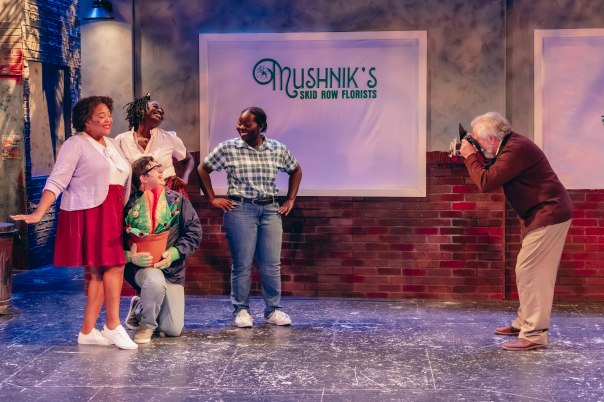
Tinted by J.P. Woody’s groovy lighting, scenic design by Gordon Olson revels in the squalor of the skids with a doo-wop funk and loving detail that reminded me of Mad Magazine comic strips devoured in my youth. The era is the prehistoric ‘50s, when teens toted transistor radios to stay in touch with the Top 40, and Alan Menken’s musical score reveres those vibes as if they are gospel.

From Seymour’s nerdy sweater vest to Orin’s biker black jacket, Rachel Engstrom’s costume designs are also onboard with the ‘50s beat, with such an outrageous variety of looks for the vocal trio that you can look at them as district goddesses. Props, including a mini press camera and various-sized potted Audrey 2’s that double as puppets, are also a treat from Lea Harkins – plus Orin’s diabolical dentist’s drill.

Besides getting the right moves from his talented cast alongside choreographer Georgie DeCosmo, Albert’s stage direction fosters all kinds of synergies that pave the way for Audrey 2 to have the sleek looks of a garish concept sports car and the voice of a rabid boar. Named after his idolized co-worker, Audrey 2, the carnivorous plant that Seymour suddenly discovers during a total eclipse of the sun, has a special cunning, speaking only to Seymour to get his way.

The voice comes lustily from Toni “Aideem” Morrison, and the movements of her leaves and tendrils come mostly from a team of three unseen puppeteers. When the side wall of Mushnik’s Skid Row Florists slides shut to hide the store, a beehive of activity with puppeteers and stagehands is dressing the interior more and more lushly with Audrey 2’s foliage as the bloodthirsty monster grows.

By the end of opening night, that side wall had been dinged with cracks and bruises, and one stagehand, in damage-control mode, was seen frantically exiting at the end of a scene change. The tech perfection extended similarly to the sound: just one brief dropout assailed Gonzalez, and that’s all. Every note from the four-piece band led by Ellen Robison from the keyboard came through undimmed.

Except when the audience broke loose.

Aside from the original Audrey, none of the main characters is burnished with virtue. Seymour’s origins, though not otherworldly, are no less mysterious than Audrey 2’s, orphaned at the flower shop’s doorstep as a babe and living there ever since. His homicidal tendencies, awakened by the arrival of Audrey 2, prove to be benign when he has to pull the trigger.

Munchnik is no less compromised. Although he has opened his door to Seymour, the lad has always slept out front under the cash register. Until he overhears Orin advising Seymour to leave Skid Row with his newfound cash cow, Mushnik never considers adopting the waif or making him his heir. In the hard times, when Mushnik is on the verge of permanently shutting down his shop, there’s not a peep from him that indicates he has given Seymour’s future so much as a thought.

Liuzzo plays his side of this relationship with gratitude, servility, and fear, while Roberge as Mushnik can load up on scorn, exploitation, and intimidation. Nebishy meets nasty. With those considerable hits to Seymour’s self-esteem, Liuzzo’s timidity can extend toward keeping his feelings for Audrey hidden, especially since she is already in Orin’s firm and abusive grasp.

Framed by the threats of an insanely sadistic dentist and a man-eating alien plant with dreams of global domination, the mundane frictions between Seymour and Mushnik can seem comical. But the best comedy contrivance, preserved by Ashman from the Charles Griffith screenplay, is the mutual non-relationship between Seymour and Audrey: both of these sweethearts have good reason to feel unworthy of the other.

It’s pretty classic how clearly Liuzzo and Gonzalez venerate one another before they connect – adding fuel to the explosive audience reaction in Act 2 when they have their “Suddenly Seymour” moment. Roberge coming up on them and taking it all in during an extended smooch is a cherry on top.

Contrasting with all this bliss and twisted domesticity are the crazed, barbecued voices of Lawson and Aideem. Since the days of silent film, dentistry has proudly perched on the knife’s edge between comedy and horror. Thanks to this delicious script, Lawson gets to sharpen that blade more keenly by adding masochism. Not to worry, after Orin nourishes Audrey 2 piecemeal, Lawson returns after intermission in a series of cameos to entice Seymour with additional money-making opportunities.

Yet it’s Aideem who endures forever as Audrey 2, aided by a wonderful tech flourish in the epilogue. His bubbly vibrato is not the deepest I’ve heard out of Audrey 2’s maw, but it’s more than sufficiently low, spirited, and spicy. Aideem’s performance will likely draw another noise notification if you’re wearing an Apple Watch. The final bows certainly will.