Tag Archives: Eli Fischer

Raising Cain at the Cain Center With Million Dollar Quartet

Review: Million Dollar Quartet at Cain Center for the Arts

By Perry Tannenbaum

By some cosmic coincidence, the publication of Rolling Stone’s special edition listing of The 500 Greatest Songs of All Time in late 2004 anticipated the great flowering of jukebox musicals on Broadway almost immediately afterwards – with hardly a hiccup since. A good 40 years after my last look at Billboard and Cashbox’s weekly Top 100s, the idea of collecting chart-topping hits recorded by the great kings, queens, and groups of pop or rock for live theatre must have been in the air.

Suddenly it gained new traction as a bankable concept. Songlists associated with Elvis Presley, John Lennon, The Beach Boys, and Frankie Valli and the Four Seasons all got the Broadway treatment in 2005. Bob Dylan, Johnnie Cash, Dusty Springfield, and Earth, Wind & Fire were among those basking in the lights of the Great White Way the following year.

So it was hardly a surprise that Cain Center for the Arts, up in Cornelius, was sold on Million Dollar Quartet for their first co-production with neighboring Davidson Community Playhouse. After all, the original concept and book were inspired by hitmakers Elvis Presley, Jerry Lee Lewis, Carl Perkins, and Johnny Cash – all of whom are enshrined in the top 100 of the Rolling Stone 500 list.

The new Cain-DCP collaboration is making history with history: the four rock legends actually did converge in Memphis, at Sam Phillips’ Sun Records studio, spontaneously jammin’ together for one magical evening in December 1956. Phillips wasn’t sure people would believe it, so he snapped a photo of the quartet. Meanwhile, some rascal in the soundbooth rolled the tape.

Was Million Dollar Quartet inevitable by the time it premiered at the Nederlander Theatre in 2010? Maybe it was nudged a little by the Rolling Stone list or the efflorescence of jukebox musicals in 2005, since the Mutrux concept was first put on its feet in Daytona Beach the following year.

The Complete Million Dollar Quartet album, 47 tracks compressed into 78 minutes, had been available commercially in the US since 1988, after gathering bootleg-edition cache for more than three decades. And the whole scenario of the Sun Records session remained the subject of fevered speculation; if anything, boosted by the commercial release, years after the best tracks – and then the complete session – had been kosher in Europe.

About the only logical argument against memorializing the historic Memphis summit meeting was the lukewarm music captured on tape.

Rolling Stone gave it three stars out of five.

Some might find even that middling rating overly generous. Aside from the wretched sonic setup, the fragmentary and impromptu song list was hardly formidable. “Brown-Eyed Handsome Man,” “Peace in the Valley,” and “Down by the Riverside” were readily available from the 1956 tape, but Mutrux nixed other staples such as “When the Saints Go Marchin’ In,” “Black Bottom Stomp,” and “Just a Little Talk With Jesus.”

Apparently, Mutrux had to tread softly among The King’s hits, for “Don’t Be Cruel” and “Love Me Tender,” both on the Complete Million Dollar album, are MIA in the musical, though both were approved for All Shook Up in 2005. So were “Hound Dog,” “That’s All Right,” and “Blue Suede Shoes,” which thankfully – and with full propriety for 1956 – were made available once again.

“Blue Suede Shoes,” a bone of contention between Perkins and Presley – Carl made the big hit recording, but Elvis made his big national live TV splash with it on the Ed Sullivan Show – was an absolute must for Mutrux and co-writer Colin Escott. It was the sort of historic tidbit that could add edge to a chance meeting whether or not it actually came up for conversation, but the writing team had grander plans.

Cleverly sidestepping the question of which of the two disputants would sing the song in their musical, Mutrux has all of the Quartet members on vocals – at the top of the show before Phillips’ narrative unfolds. It’s a perfect fit, beginning with an anthemic cry: Carl sings, Well it’s one for the money, making his entrance. The stop time after that cry allows Johnny to materialize beside a second mic for his Two for the show.

No contest about who makes the biggest entrance after Three to get ready. It’s Elvis, kicking “Blue Suede Shoes” into its 4/4 locomotive gear. Jerry Lee will get his chance, late in Act 2, for a barbaric yawp of his own, his You shake my nerves and you rattle my brain from his iconic “Great Balls of Fire,” when this session reaches full blast.

Now it’s fair to say, even though they aren’t on the Memphis tapes – and didn’t get released until 1957 – that Lewis’s monster hits, “Whole Lotta Shakin’ Goin’ On,” and maybe even “Great Balls” were already in the oven getting baked. Chronology for Johnny Cash’s Sun Records hits, “Folsom Prison Blues” and “I Walk the Line,” is indisputable; they aren’t on the Million Dollar album, either.

Cash’s borrowings are shrewdly selected, stealing “Sixteen Tons” from Tennessee Ernie Ford, a hot hit in ’56, and “Riders in the Sky” from Burl Ives and Vaughan Monroe, already seven years old. Likewise, Perkins is only flashing back a little when he pilfers Bo Diddley’s “Who Do You Love” and Bill Haley and the Comets’ “See You Later, Alligator,” both of them ’56 hits.

Even truthier than Perkins’ dispute with Presley, the singer-guitarist actually did record his forthcoming single, “Matchbox,” in December 1956 – but a day before the Million-Dollar bootleg. And Jerry Lee, still months away from his first Sun release, was an unknown sideman for Perkins at that session. So the script is almost accurate in setting up the Sun Studio get-together as Elvis and Johnny crashing Carl’s recording date.

And Elvis did bring his current girlfriend to the party, though here the writers change her name. They give their Dyanne two sexy songs her real-life counterpart never sang, “Fever” and “I Hear You Knockin’,” again authentically from that era. No less importantly, they have her standing by to console Phillips when his grand plan for the evening falls through.

Inside and out, Cain Center can be viewed as a somewhat downsized Knight Theater, beautifully accommodating around 400, about a third of the Knight’s (and the Nederlander’s) capacity. With its rousing opening, Million Dollar Quartet instantly proved to fit perfectly at the new Cornelius arthouse. Sound was perfectly potted for these ears, and not a single word was lost in our back-row seats on the sold-out opening night.

The same can rarely be said of touring shows at Belk Theater. Or at Theatre Charlotte, which sports half of the Cain’s capacity.

And we liked what we heard as much as what we saw, thanks to director Scott Albert and his cast, costume designer Beth Killion, scenic designer Chip Decker, and lighting designer Gordon Olson. Nor was it surprising to learn that Matty Montes, who portrays Carl Perkins, was also our music director. He plays a mean ax.

Nearly forty years after first discovering the Queen City/Metrolina theatre scene, I found it fairly groundbreaking for DCP artistic director Steve Kaliski to assert in his curtain speech, on a stage so grand, what my first Creative Loafing front-page feature pointed out then: people here greatly underestimate our local theatre talent pool. We can cast all four of these iconic rock giants with local actors, even if they are tasked with accompanying themselves and each other instrumentally as they perform.

All four pairs of blue suede shoes were filled very handsomely, thank you very much. You could actually look forward to a Montes’s instrumental licks as avidly as his vocals. Same can be said even more prodigiously for Ian Benjamin as Jerry Lee, the role that catapulted Levi Kraus to a Tony Award.

Kicking away his piano bench in the flamboyant style of The Killer would oblige Cain Center to take out some serious insurance, yet Benjamin had most of Lewis’s other wild antics covered. He lacked the finely tuned right heel in Jerry Lee’s arsenal, but he had the signature pumping piano action and zigzag runs securely in hand, as well as his outré mic handling. After bringing down the house with “Great Balls of Fire,” Benjamin also proved he could work the crowd he had rattled so triumphantly with his so-predictable “Shakin’” encore.

If you know Jerry Lee’s Sun catalog – or his sensational marital history – you’ll understand why Benjamin gets to be the most sensuous and bawdy member of the quartet. If not, you’ll be reminded. Although there were no photos of The Killer wearing suspenders for me to find with Google, Killion follows in the Broadway production’s footsteps by outfitting Benjamin with a pair.

We see why after Lewis leers at Dyanne in a way that risks Elvis’s rage and his girlfriend’s rejection. But Julia Freeman as Dyanne will not be intimidated. Au contraire. With her “Fever” and her “Hear You Knockin’,” she gives Lewis and then Presley the vamping of their lives.

But it’s with Lewis that she leans suggestively over Jerry Lee’s piano and tugs at those suspenders. Fever, indeed!

For their respective partisans, Eli Fischer as Elvis or Connor Nielsen as Cash may emerge as the apex among the vocalists. Though his bass register doesn’t reach as richly down to San Antone as Johnny’s, there’s an uncanny sameness between Nielsen and The Man in Black up higher in his mid and upper range, conveying the penetration and distinctive off-key astringency of that voice as well or better than I’ve ever heard it before.

Sometimes the visual resemblance was also uncanny. With Elvis or Johnny, just listening obviously wasn’t enough to satisfy Albert in his director’s chair. Most audience members wouldn’t require any actor playing Cash to be as true to his look as you have to be to either the look of Elvis or the less universally imitated Jerry Lee. Nielsen, we can suspect, put in that extra film study.

Fischer may have had the most daunting task as Elvis, considering the charisma he must live up to. Even if this is pre-Army Elvis, Mutrux conscientiously points out that Presley has already played Vegas. That’s more than sufficient excuse for Fischer to layer on all of the signature moves we associate with The King, from his scandalous Ed Sullivan days to his polished King of Vegas years.

So Fischer’s mic handling and stage movement must be on a par with Benjamin’s. We’ve seen enough sliding on two knees to celebrate World Cup goals for that onstage move to strike us now with the same excitement it packed back in the ‘50s. With that move masterfully conquered, this Elvis doesn’t need to sing better than this Jerry Lee, but he does. And anachronistically, when he tosses his scarf and sweat hanky into the front rows, he slays better than The Killer as well.

To say that Fischer’s “That’s All Right” and “Hound Dog” are electrifying is more than fair. But to say that they steal the thunder from Benjamin’s prime Jerry Lee exploits would be very presumptuous. Things get very hot at the Cain.

Come on over.

Children’s Theatre Puts a Cherry on Top of a Joyous “Peter Pan”

Review: Peter Pan

By Perry Tannenbaum

DSC01463_sized

It has been well over 100 years since Captain Hook first asked James M. Barrie’s signature protagonist, “Who and what art thou?” Hook has certainly evolved since then, shedding his antiquated diction, but so has “The Boy Who Wouldn’t Grow Up,” as the current Children’s Theatre of Charlotte production of Peter Pan jubilantly reminds us. Peter no longer answers as Barrie prescribed, “I’m youth, I’m joy! I’m a little bird that has broken out of the egg!” Ever since Jerome Robbins, Betty Comden, Adolf Green, and Jule Styne got hold of him for their musical adaptation, Peter says, “I am youth. I am joy. I am freedom!” Without any official conquest or treaty, Neverland became an American territory.

Yet it must be said that, directing the show at McColl Theatre in the ImaginOn complex, Jenny Male has turned back the clock in a couple of key respects. Like the Darling family of Londoners – Wendy, John, Michael, and their parents – Renee Welsh-Noel as Peter spoke with an unmistakable British accent. Better yet, she radiated more pure bird-broken-out-of-the-egg joy than anyone I’ve seen since Mary Martin introduced this musical ages ago. The voice is also very fine, with richer low notes than I’ve heard before from a lady Peter and only a negligible loss of power at the top. Welsh-Noel also boasts more youthful energy than Cathy Rigby, the last marquee name to tour Charlotte in the title role, with a dancer’s athleticism rather than a gymnast’s.

DSC01768_sized

Fresh new joy also radiates from Caleb Ryan Sigmon, who sashays across Neverland and his pirate ship in a silken, spangled, flaming-red greatcoat designed by Ryan Moller that skirts the borders of effeminacy without quite crossing over. Male and choreographer Mavis Scully supply Sigmon with abundant shtick to feast on, and his antics kept the kiddies in a hysterical uproar of laughter. I’m not sure I’ve ever heard more excited glee during an intermission, as if parents had discovered buried treasure in the comedy, the music, and the flying action. Sigmon excelled most notably in “Hook’s Waltz,” slightly eclipsing the éclat he and his crew had created in his previous “Tango” and “Tarantella.” After he concluded the “Waltz” once, I hoped Sigmon would get a second ending to croon. Hamming up “Mrs. Hook’s little baby boy,” he did.

Political correctness, however, has taken away Tiger Lily’s former Native American zest, short-changing Desirae Powell’s chances to shine. “Indians!” and “The Pow-Wow Polka” have gone the way of the passenger pigeon, along with the “Ugg-a-Wugg” title and much of the Styne melody from what is now “True Brothers to the End.” A percussion orgy, maybe African- or Caribbean-inspired, and a splash of Scully choreography replaced the tom-tom tattoo. Hard to say what the main sore point was here, referring to Native Americans or the treaties we made with them. Either way, despite Moller’s evocative costuming, it was difficult for Powell to sustain any traction in her severely pruned role. I’m not sure it was even kosher for her to acknowledge that she was leading a tribe. Gender may also be off limits in our hypersensitive new world: Hook’s “Mysterious Lady” has disappeared, and the first greeting from Wendy to Peter is no longer “Boy.”

The Darling children, products of the Children’s Theatre of Charlotte School of Theatre Training, were absolutely wonderful, perfect examples Male’s meticulous directing. Mary Kathryn Brown artlessly delivered the full range of Wendy – eldest sib, adventurous girl, fantasy mother and wife – with all the joy and frustration of dealing with Peter. Wearing the traditional top hat, Eli Fischer was suitably priggish as John, and Andrew Ahdieh dispatched some endearing business with a teddy bear as Michael. Of course, the boys wanted to go to Neverland – Wendy hardly needed to invite them – but of course they soon got homesick after a few adventures and asked to schlep back across the galaxy. Alison Snow-Rhinehardt presided over the sleepy opening action with a sweet Julie Andrews accent as Mrs. Darling, starting off the canonic “Tender Shepherd” lullaby with a warmth that justified her children’s affections. Snow-Rhinehardt shed her formal during her brood’s absence, transforming into one of the pirate crew, but Jeremy Shane Kinser as Mr. Darling moonlights more prominently, becoming Starkey, one of Hook’s chief henchmen.

Male’s inventive overlays are certainly open to question. She frames the action with a little girl, Wendy’s future daughter, off to the side of the stage, reading the story and ultimately stepping into it for the final scene. In the meanwhile, lights come up on her occasionally as she gets swept up in the action – it seems that she’s supplanting the role of an interpreter for the hearing impaired. And if you think the woman listed in the cast as Tinker Bell is a celesta virtuoso, guess again. After twinkling on walls, furniture, and foliage all through the story, she suddenly flies into Peter’s hideout in the corporeal form of Haley Vogel, drinking Hook’s poison to save dear Peter and dying a fairy’s death. The tableau, Tink cradled in Peter’s arms before we’re entreated to resurrect her with our clapping, is like a Pietà. Kids at the Saturday matinee were as amazed as I was – and responsive. And how about Lisa Schacher as Smee? She was so lovably servile towards Hook that I didn’t begrudge her tagging along behind the Lost Boys at the end.
DSC02046_sized

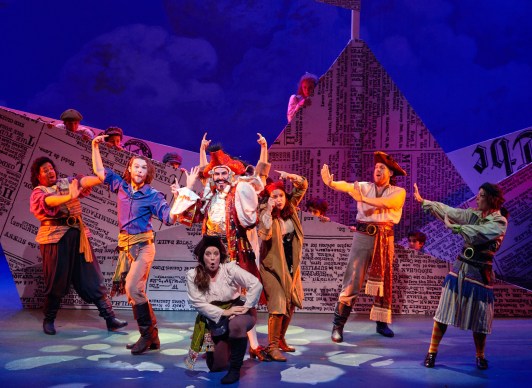
Sets by Robin Best weren’t the most eye-popping that I’ve seen at the McColl, a little humdrum in the framing London scenes but bursting with life in Neverland with a preternaturally large dragonfly painted onto the skein along with clusters of grapes larger than Hook himself. The deck of Hook’s ship was, in the same vein, a monstrously enlarged replica of the boat we first saw on John’s bed, made from a folded-up newspaper. Dreamy and odd. The idea of making Nanna, the Darlings’ dog, into a big floppy puppet was brilliant, but I’m sorry to report that Male and her design team bungled the Croc rather badly, giving us only a tail dangling over the side of that newspaper boat as the action crested. Evidently, nobody at ImaginOn has checked out the wondrous Charlotte Ballet production of Peter Pan and discovered just how hilarious a costumed Croc can be.

But it would be foolish to assert that Children’s Theatre didn’t know what they were doing in this spectacular season opener. Clocking in at 140 minutes, Peter Pan surely ranks among the longest shows ever staged at the McColl Theatre, its opening act longer than most of the shows the company produces. Maybe the cagiest – and subtly effective – thing Male does is in the careful placement of her intermission. Flouting the norm, she doesn’t bring down the curtain on a rousing climax. Instead, we adjourn at the moment when Peter and Tiger Lily shake hands after saving each other from the pirates. When the lights came up, everybody in the audience – children of all ages – knew that there was more to come and that it would be good. The flying by Peter, Wendy, her sibs, and the surprising Tink is delightful throughout, but the curtain call sends Peter out over the audience, an artful cherry on top.