Review: Evita at Duke Performance Hall
By Perry Tannenbaum
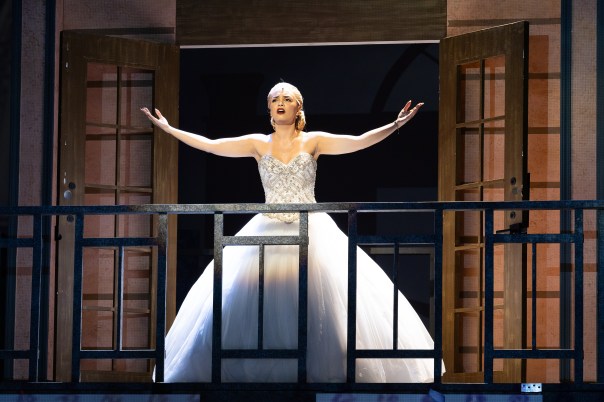
As women and as films, Evita and Melania will never be viewed as two of a kind. Yet in recent years, as Ms. Trump’s husband becomes more ceremonial, militaristic, and authoritarian, a mild kinship and a certain sisterhood have emerged between the two first ladies. There are only a few moments when the current Davidson Community Players’ production of the revered Andrew Lloyd Webber musical, directed with surprising ferocity by Steve Kaliski, seems to reference that kinship.
But there are many more instances when Eva Perón’s “New Argentina” brings present-day USA to mind in all its vulgar MAGA glory. Those happen whenever fervent religious enthusiasm is misdirected. Or when working-class people are talked up so they can be more easily exploited.
By juxtaposing Evita’s glamor, pragmatism, and humble origins with the mixture of street-smart cynicism, working-class empathy, and grudging admiration for homegrown “star quality” that we hear from Che, our narrator, Tim Rice’s libretto has always radiated a reasoned objectivity.
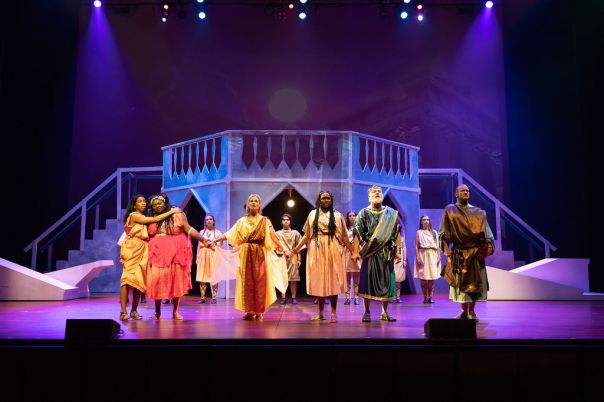
So Kaliski and his principals, Melissa Lozada and Neifert Enrique, aren’t reversing the political lean of Evita. They’re giving the music, the recitative, and the main characters a firm shove in a more malevolent direction.
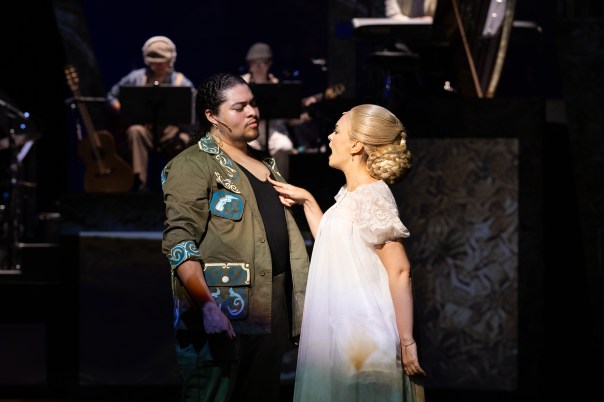
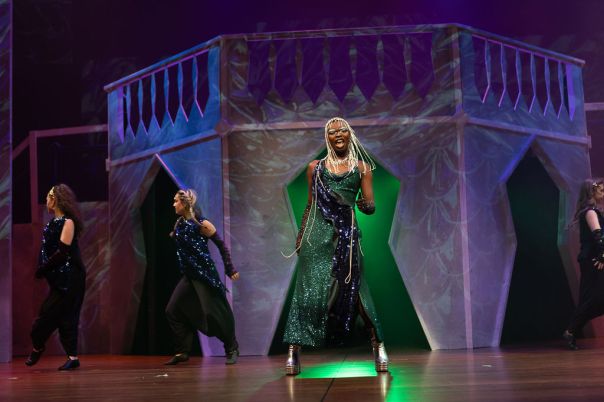
Enrique is particularly startling, easily the most dominant Che we’ve had in the QC. This is a rock tenor who can produce piercingly strong falsetto treble and, minutes later, invade the bass clef so deeply that you wonder where that voice is coming from – and Enrique never makes the mistake of yielding to Lloyd Webber’s singsong to the extent that it dulls Che’s subversive edge.
In sum, Enrique is often powerful enough to make us see the charismatic Evita through his eyes. If you wanted to see the icon as a calculating seductress, who may or may not have gotten religion through her good fortune or failing health, Whitney Drury was perfection in Queen City Theatre Company’s 2010 production, both in the sexual predation that catapulted Evita to celebrity and in her terminal suffering.
On the other hand, if you wanted to be fascinated by an enigmatic Evita, one gifted with so much natural charm and regality that she refuted the whole concept of aristocracy, Lucia Stetson was ideal at Central Piedmont in 2018 – with no shortage of Evita vanity.
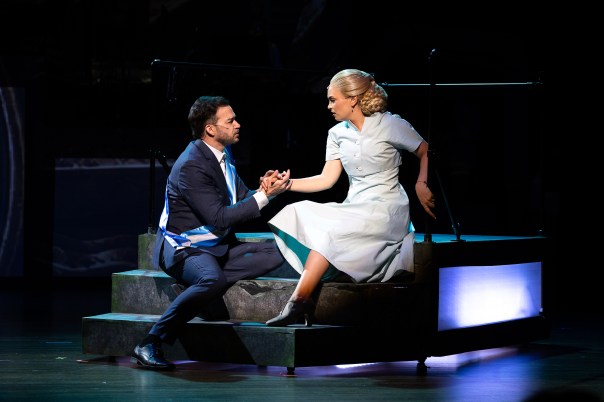
At Duke Performance Hall, on the Davidson College campus, Lozada is simply the meanest and most malignant Eva Perón you’ll likely ever see. Even her “star quality” has a punkish edge as she never quite sheds her peasant roots. There’s a somewhat ghoulish tinge that lingers softly on her final prideful declaration that she has brought her people closer “to the heart of Perón,” her autocratic husband, the nation’s president.
In that moment especially, our clueless Melania pales next to her. We must revert to the golden-haired Trump for a parallel.
Of course, if you saw Lozada in the title role of Electricidad last August, you may already be altering your plans for the final weekend of Evita.Or, if you witnessed Enrique in his most recent title-role triumph down in Matthews as The Prince of Egypt, you may be astonished to hear that his Che is as potent as his Moses.
They aren’t the only reasons why word-of-mouth touting Evita is spreading like a Lake Norman wildfire. Kaliski’s design team has also risen to the challenge of creating a spectacle to match the dimensions of the Duke. Most notable of these are costume designer Sarah Deutsch, lighting designer Kaylin Gess, choreographer Tod A. Kubo, and – perched high in the stratosphere behind the stage’s second scrim – the 10-piece band directed by Matthew Primm.
Upstaging and outsizing them all are the projections designed by Caleb Sigmon, beginning with what may be an actual Eva Perón film! Rice and Lloyd Webber wanted to simulate us all being gathered at a movie theater at the start of their musical when the flick is suddenly interrupted by the announcement of the beloved Evita’s death.
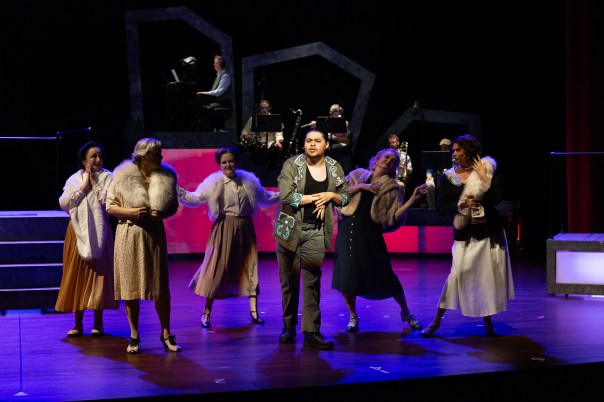
For the first time, this opening scene with its operatic choral requiem seemed prophetic, previewing the wailing and grief that is sure to engulf our streets, churches, and national monuments when 45/47’s number is up. The Amazing Tangerine tries so hard to alienate and disillusion his cult following. In vain, it seems.
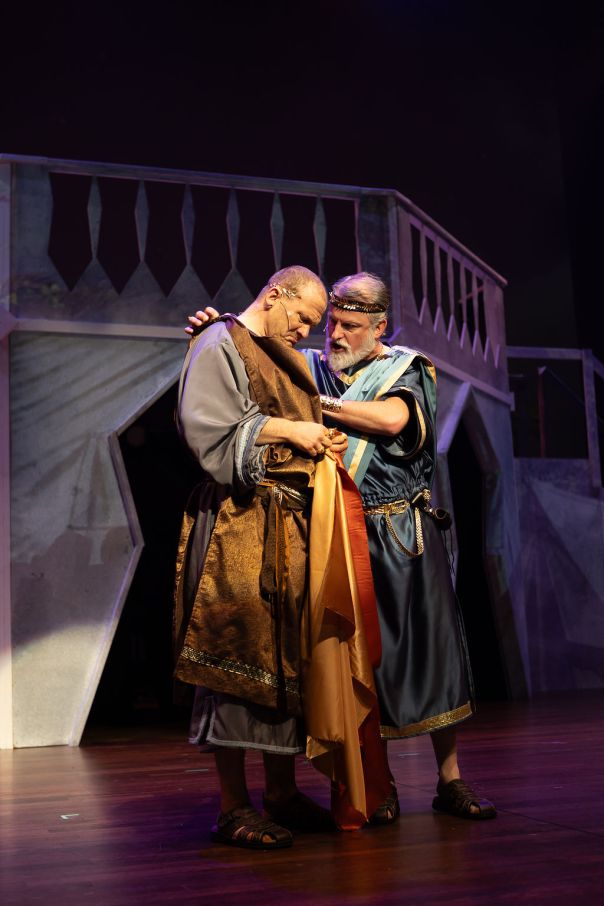
Victimized by the wayward Halton Theater sound system when he portrayed Che in 2018, Ron Turner Diaz ages gracefully in the role of the militantly urbane Perón. Effortlessly, he conjures up the personality of a chieftain who will either succumb to Evita’s charm and chutzpah or slay her instantly. There’s a nice tension to their “I’d Be Surprisingly Good for You,” spiced with a tango tang of violence.
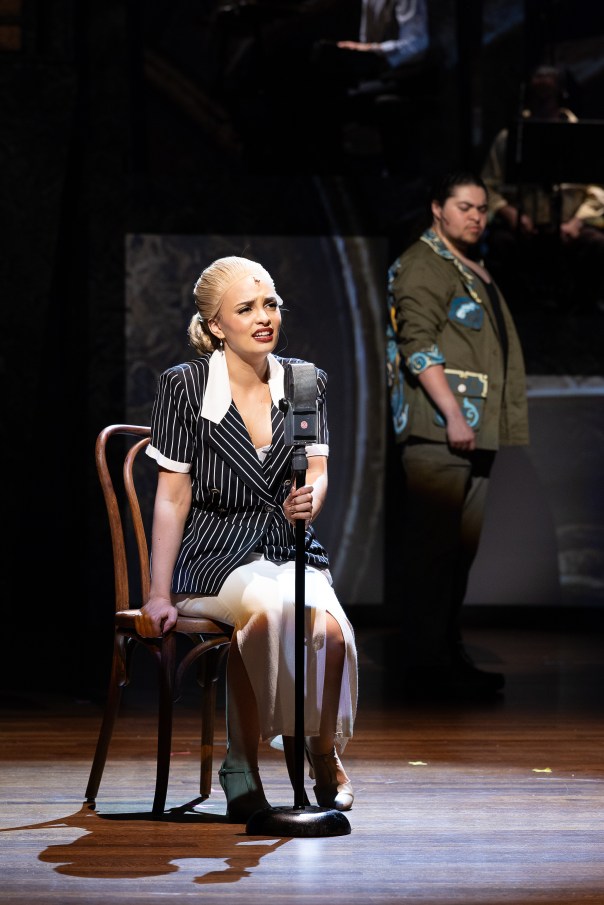
Lastly – except for dozens of aristocrats, lovers, family, military, children, and the citizen ensemble – there’s Tristan Nogueira, rounding out an all-Latino cast of major characters, conclusively answering the question of whether we have enough Hispanic talent in Charlotte to deliver a truly authentic Evita. If you saw Nogueira as the surprisingly skeptical Aaron in The Prince of Egypt, you’ll be pleasantly surprised by his transformation from the future High Priest into lounge lizard Agustin Magaldi, Evita’s first discard.
Extra bonus: Lindsay Litka-Montes sings “Another Suitcase in Another Hall” with a quiet, simmering bitterness as Juan’ s discarded Mistress.
More significant extra bonus: due to popular demand, an extra performance of Evita has been added to its closing weekend. This coming Sunday at 7pm.
Beginning at the Beginning at Cunningham Theatre Center
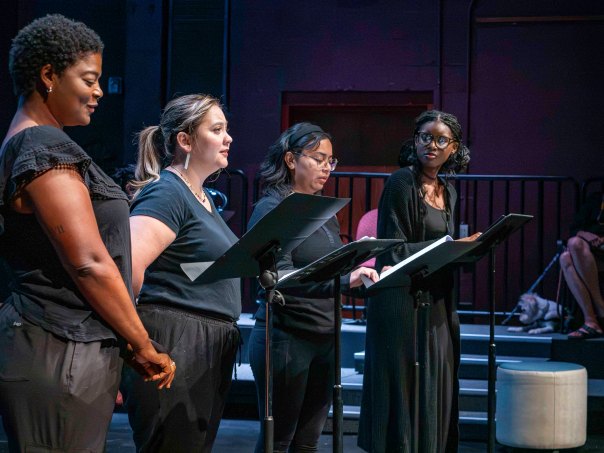
Before the news broke about the extra Evita performance, we returned to the Wildcats campus to usher in the summer – and celebrate Father’s Day – with Common Thread Theatre Company’s Beginning at the Beginning. Staged at the Cunningham Theatre Center, B @ the B was a miniature new play festival showcasing two works-in-progress with an intermission in between and a talkback with playwrights Brian Daye and David Scheonfeld afterwards.
This time, the trip up I-77 wasn’t quite as rewarding. Daye’s one-act, The Race, directed by Eric J. Little, was the better of the two pieces: more compelling action, fuller characterizations, and high-energy performances. Shawn Halliday portrayed the overtly racist Lavell Anderson, on death row as a convicted murderer awaiting execution, while Vanecia Boone was cast as his eleventh-hour appeals attorney, African American cub lawyer Cory Williams, understandably reluctant to take the case.
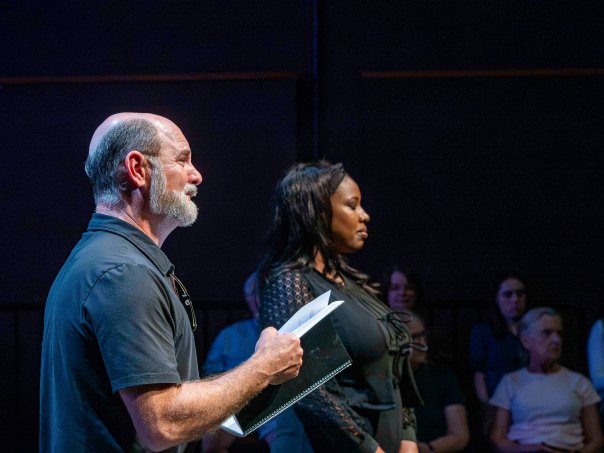
The two shrunken timeframes, the impending execution and the brevity of Daye’s script, short-circuited any racial animosities that may have clouded the budding attorney-client relationship between Cory and Lavell. He had undergone a religious transformation, and she, with even greater speed, is convinced of his innocence.
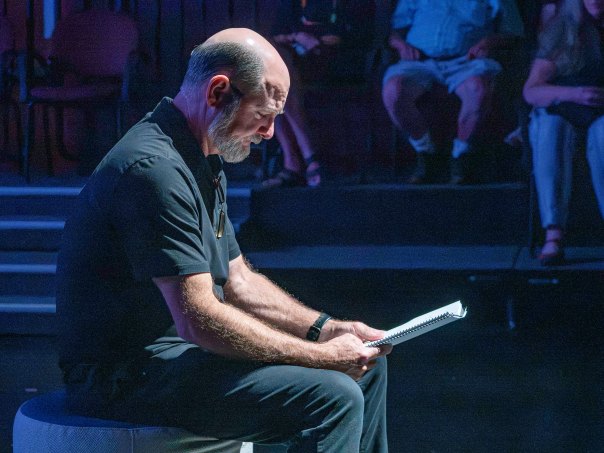
Worse, the case against Lavell, whether 19 years or three months old, is so laughably flimsy that it should never have been brought to court – unless the charge had been armed robbery. Lavell maintains that his accomplice, Vern McCluskey, was the trigger man and that he never fired his gun. Criminology or Forensics 101 are not prerequisites to knowing how Lavell’s assertion can be confirmed: anyone who has read a Perry Mason novel – the series began over 90 years ago – is aware of scientific tests that match a bullet with a gun and determine whether a person has recently used a firearm.
Open and shut. We also liked Isaac Hampton as the big, bigoted prison guard.
Scheonfeld’s Massage Group Therapy was even less fully developed and, consequently, less satisfying. Aside from a creep named John who bedevils at least half of the four masseuses, none of the playwright’s people were sufficiently fleshed out. It was a little awkward to see Justin Peoples as John upstaging the exploited women we’re intended to care about.
Even if Scheonfeld had made his massage parlor workers more distinctive, there would have been another tall obstacle to overcome for me. Switching roles from female lead to director, Boone did not insist that her players – or the dude reading stage directions – speak loudly enough to be heard.
B @ the B hits the road for its concluding weekend, resurfacing at North Carolina A&T University on June 27 and 28, up in Winston-Salem. For the time being, the more rewarding trip is to Davidson for the resumption of the Community Players’ Evita.
As for Winston, best to wait for the International Black Theatre Festival, July 27 through August 1. Charlotte’s own BNS Productions will be among the many fine Black companies there, presenting four performances of August Wilson’s Joe Turner’s Come and Gone, afternoons and evenings on July 31 and August 1.