Tag Archives: Tod Kubo

Waiting for Tina, Janis, and Aretha

Review:  Beehive The 60’s Musical

By Perry Tannenbaum
Beehive Dress Rehearsal; July 4th, 2019

Lovers of The Chiffons, The Ronettes, Donna Loren, and Lesley Gore, rejoice! Or if you’ve never heard of The Chiffons and The Ronettes – or you’ve simply despised Lesley Gore for the past 50 years – have a little patience. Beehive The 60’s Musical, Larry Gallagher’s jukebox revue, has wended its way at long last to Halton Theater. The show has kicked around for over three decades since its New York debut at the Village Gate nightclub in 1986 (the show never ran on Broadway) and my Google searches of past productions – and the original cat album on Spotify – testify to a songlist that has been frequently in flux.

Like a jukebox.

I’ve found accounts of the show that report a full two hours of music, compared to the current CPCC Summer Theatre production that clocked in at a shade over 79 minutes plus a 16-minute intermission. Other reports indicate reprises of hits by the Shangri-Las, Shirley Bassey, Petula Clark, Janis Ian, Sonny & Cher, and Brenda Lee. Most of them opt for a different selection of hits by Janis Joplin.
Beehive Dress Rehearsal; July 4th, 2019

But the good news is that while we endure the Beach Blanket Bingo dross of Loren, Gore & Co. throughout Act 1, there are gems we remember from The Shirelles and The Supremes – and the kooky fun of Shirley Ellis’s “The Name Game” – mixed in with the insufferable pap that prevails. And the 40 minutes after intermission are much improved over the 39 before. We reach a Promised Land of singles originated by Dusty Springfield, Mama Cass, and Jefferson Airplane. We sojourn with the likes of Tina Turner, Janis, and Aretha.

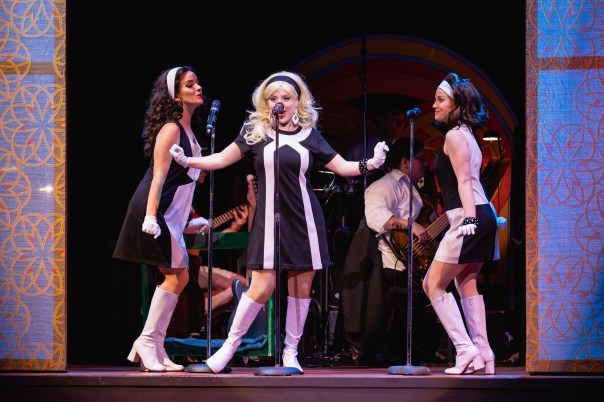
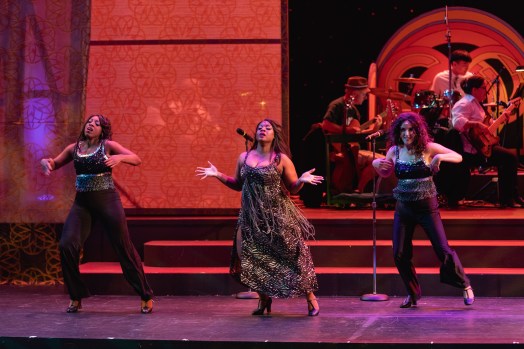
Under the lively direction of Tod Kubo, who also choreographs, Beehive sustains the same high level of artistry and polish that lifted Jekyll & Hyde earlier in the CP Summer season. With wig designs from Barbi Van Schaick, hair reached heights you have to expect from Beehive. Costume designers Bob Croghan and Jennifer O’Kelly, held oddly in check at the outset, break free flamboyantly after intermission, especially when Tina and Janis strut the stage.

Beehive Dress Rehearsal; July 4th, 2019

Defying the Halton’s spacious stage, O’Neill’s scenic design strives to simulate a nightclub feel. Conspiring in the scheme, music director Amy Boger Morris and her band camp upstage, often in plain view and often under a funky “Beehive” logo that helps to fill in the vast expanse of drapery above them.

My apologies if you have not realized that Beehive is an all-woman show, sort of the partner to the all-male Forever Plaid, another jukebox revue that never made it to Broadway. The basic difference between the two, besides gender, is that Beehive has lost all pretenses of sporting a plot. Iris DeWitt as Wanda serves intermittently as our emcee, and the only discernable reason why the other women have character names is so they don’t have to look beyond the script when they introduce themselves in “The Name Game” as Pattie, Alison, Laura, Jasmine, and Gina.

They also go out into the audience and pick out more people to play. Got me on Saturday night! Sorry, no photos or recordings were allowed.

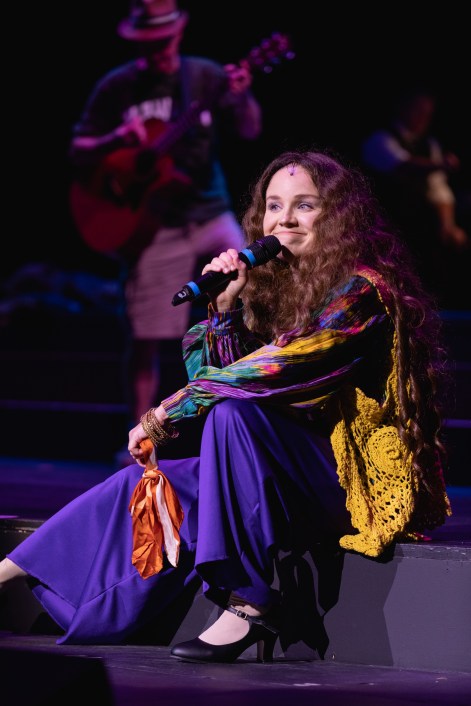
DeWitt, who was quite the authority figure in a 2016 production of Pride and Prejudice at CP, turns out to be a powerful vocalist as well, particularly in “Natural Woman,” her segment in the Aretha trilogy. Caryn Crye is no less revelatory as Laura, since I’ve only seen her in dramas before, most memorably at Theatre Charlotte as Mina Harker in Dracula and as Goody Proctor in The Crucible at CP. She’s stretched a little too far in her Janis Joplin trilogy in “Try (Just a Little Bit Harder),” but her “Me and Bobby McGee” – when she sheds her Pearl fur coat and lounges in her Woodstock gladrags – is a definite highlight.
Beehive Dress Rehearsal; July 4th, 2019

Making her Charlotte debut as Alison, Grace Bell doesn’t get much of a taste of Act 2, but she’s definitely a highlight in the early action, singing The Angels’ “My Boyfriend’s Back” and bringing more to Kubo’s choreography than anyone. Bell’s one spotlight after intermission is a dazzler as she shares the stage with Ava Smith on Jeff Airplane’s “Somebody to Love.” If you’ve seen Smith’s high-energy performances at CP as Frenchy in Grease or at Theatre Charlotte as Annette in Saturday Night Fever, expect more of the same now in Beehive, complementing Bell’s Rockstar moves, aggressively engaging with a guy in the front row, and doing a Pattie solo on Dusty Springfield’s “Son of a Preacher Man.” Sadly, she also draws two Lesley Gore clunkers, but that’s showbiz.

After playing second fiddle to Tyler Smith in Ragtime and Show Boat, Brittany Harrington Currie reminds us here that she also appeared in an Andrew Lloyd Webber revue at CP and is quite comfortable in that format. Currie reveals some truly awesome wheels in “Proud Mary” with her Tina Turner vocal and her frenetic moves. Her vocal on The Shirelles’ “Will You Still Love Me Tomorrow” is a bright spot before we descend into Connie Francis, and her “Never Loved a Man (The Way I Loved You)” keeps the Aretha heat smoldering.

Beehive Dress Rehearsal; July 4th, 2019

Coming over to CP after a series of scintillating outings at Children’s Theatre, including Mary Poppins and Three Little Birds, Janeta Jackson flies under the radar for most of the evening, drawing nothing better than The Chiffons’ “One Fine Day” before intermission. We get a better sampling afterwards, when Jackson leads off the Aretha set with “Chain of Fools,” but it wasn’t enough for me.

I could have said the same about the show if it were possible to restore some of the hits that are no longer available with the rights to perform Beehive. Aretha’s “Respect” and “Do Right Woman” from the cast album would top my list of restorations, making it worthwhile to linger longer at Halton Theater, along with Joplin’s “Piece of My Heart” and her “Ball and Chain.” Unerring with their tempos, Morris and her band squeeze more than 30 tunes into the evening. Sometimes that mitigates the irritants, and sometimes that abbreviates the pleasures.

Debased Jekyll and Monstrous Hyde Still Have Admirers at CP

Review:  Jekyll & Hyde

By Perry Tannenbaum

CPCC "Jekyll & Hyde" Final Dress Rehearsal, June 20th, 2019 

Like other famed works of literature that have been turned into films, plays, and musicals, the story and characters of Strange Case of Dr Jekyll and Mr Hyde have long ago ceased to belong exclusively to their creator, Robert Louis Stevenson. The most obvious measure to thicken the plot – my paperback copy is a scant 68 pages – is to supply Jekyll with a fiancé to agonize over when he can’t control his nightmarish transformations into Mr. Hyde. After that initial blandishment for the stage, Hollywood added a second woman for Hyde to prey upon.

CPCC "Jekyll & Hyde" Final Dress Rehearsal, June 20th, 2019

In rewriting the story for Frank Wildhorn’s musical Jekyll & Hyde, Leslie Bricusse layered on additional refinements. Bolstering Jekyll/Hyde’s motivations, Bricusse added a board of governors at a hospital that turns down the Dr.’s highly risky experimental research. Though the board’s decision looks better and better as Jekyll’s experimentation on himself becomes more and more catastrophic, we can see why Hyde is targeting Bishop Basingstoke, Lady Beaconsville and others for his brutality.

Before Jekyll’s wedding day is over, Hyde has collected the complete set of governors with the exception of his prospective father-in-law, who abstained with his vote. So much for the board’s cautious medical judgment. After all, distilling the essence of man’s evil nature was a fabulous idea, was it not?

Presenting the Wildhorn musical for the first time at CPCC Summer Theatre in 17 seasons, director Tom Hollis goes with a version of the show that’s closer to the 2013 Broadway revival of J&H than the original 1997 adaptation. Wading through the alternatives of how to present the climactic “Confrontation” solo duet – Jekyll and Hyde switching repeatedly back and forth – Hollis and his star, Tommy Foster, go retro with some major electronic enhancements. You’ll see Foster’s face when he’s Jekyll, demanding that Hyde set him free, and when Hyde retorts, “you are me,” his long mane of black hair covers all.

No pre-recorded Hyde for Foster, who doesn’t chew his locks too many times during his Hyde hair flips. Scenic designer Robert Edge, leaning heavily on video for many of the scene changes, projects a spinning vortex behind Hyde a la Hitchcock’s Vertigo as the murderer gets the upper hand, but sound designer Stephen Lancaster has more dramatic impact. From the time Hyde first emerges, Foster differentiates his voice from Jekyll’s, but during Act II, as Hyde becomes more monstrous, Lancaster dials in more huffy echo-laden feedback.

Remembering that the sound system at Halton Theater has been treading water at best since the hall was first opened in late 2005, we have to acknowledge that Lancaster, moving beyond adequacy to creativity, has achieved a breakthrough. Notwithstanding those electronic embellishments, Foster’s performance sizzles and electrifies on its own. Forget the power ballads that he torches – I’d actually like to forget a few of those American Idol abortions that clutter the score – and just see what Foster does, as Hyde alone, with the demonic energy of “Alive!” as Act I ends. Riveting.

Yet the most daring and brilliant choice that Hollis and Foster make is with Jekyll, making him more of a hothead than I’ve ever seen before, doctor or not. This guy is on the brink of losing his grip while he’s being questioned by the governors and even more so when he is turned down. That garish fluid Jekyll injects into himself still isn’t a placebo, but the thought crossed my mind.

CPCC "Jekyll & Hyde" Final Dress Rehearsal, June 20th, 2019

While all that Foster, Hollis, and his design team do with the dual leads make Jekyll and Hyde more exciting and cohesive, they sure don’t enhance my regard for his way overindulgent leading ladies. When Lucy, the loose saloon girl fatally attracted to Hyde, is told that she needs to leave London immediately to escape the deranged murderer, she sings, “A New Life” and goes to bed. Even as she pours out her heart into her fourth or fifth power ballad, you know she’s staying.

Emma, the pure-hearted fiancée, is another piece of work. At the climactic wedding scene, she watches Jekyll turn into Hyde, watches him murder the last of his enemies in cold blood, and does she turn away in horror or disgust when he perishes? Not exactly. The final tableau, with Emma huddled over the fallen Jekyll, is more like a Pietà. Utterly loathsome.

Times have changed since Linda Eder, who would become Wildhorn’s wife, originated the role of Lucy on Broadway in 1997. Grown lurid and rancid, the storylines of Lucy and Emma both sorely need a refresh.While Hollis made both of the ladies’ final scenes a bit cringeworthy, he certainly didn’t err in his casting. No daring or brilliance was necessary here. Karley Kornegay was the devilish leading man’s “Angel of Music” when Hollis directed Phantom of the Opera in 2015, and now she’s Jekyll’s angelic Emma. More recently, Lindsey Schroeder was the coarse lady outlaw in Wildhorn’s Bonnie and Clyde at Matthews Playhouse, and now she’s his wanton Lucy. Any questions about whether they’re right for their roles is answered long before they sing their wondrously unwoke duet, “In His Eyes,” idolizing both halves of our hero’s split personality simultaneously.

In a grotesque way, “In His Eyes” and “The Confrontation” are a matched set.

CPCC "Jekyll & Hyde" Final Dress Rehearsal, June 20th, 2019

Nobody else gets an American Idol moment in this belt-a-thon, but choreographer Tod Kubo and costume designer Robert Croghan turn up the heat colorfully at The Red Rat Club in “Bring on the Men,” where Lucy makes her first splash, setting herself apart from the other risqué saloon girls. There are also Phantom-like moments (if you recall “Masquerade”) each time the ensemble sings and numbingly reprises “Façade.”

Notwithstanding the elementary psychological truths that Briscusse rehashes about human pretense and deceit, he doesn’t offer many other performers an opportunity to craft two-dimensional portraits, let alone transcend them. Hollis has an embarrassment of riches to deploy on these thin characters. After proving himself up to the challenge of Gaylord Ravenal in Show Boat, Ashton Guthrie as hospital colleague Simon Stride gets only a precious few seconds to reveal himself as Jekyll’s rival – or at least a jealous aspirant to Emma’s affections.

CPCC "Jekyll & Hyde" Final Dress Rehearsal, June 20th, 2019As the only other surviving character from Stevenson’s 1886 novella, Jekyll confidant John Utterson really gets short shrift in the Bricusse book. Tyler Smith ranges very far from his humble “Ol’ Man River” role in Show Boat, giving Utterson true elegance and distinction. Making his first appearance at CP in 2019, where he has performed mostly leading roles over the last 35 years – Camelot and Grand Hotel are among my faves – Jerry Colbert cuts a venerable figure as Danvers Carew, Emma’s ambivalent dad.

Protective toward his daughter, appreciative of Jekyll’s potential, wary of his colleague’s volatile temperament, but abstaining when the governors vote, Danvers sets the tone in crucial ways. Colbert’s “Letting Go” duet with Kornegay finely balances his fatherly affections and trepidations. Trouble is, with Foster giving us a Hyde that is such a natural outgrowth of his Jekyll, it shouldn’t be a close call for Danvers. Or for his daughter.

Actor’s Theatre Shines New Light on Bechdel’s “Family Tragicomic”

Review: Fun Home at Actor’s Theatre of Charlotte

By Perry Tannenbaum

FUN HOME 5

Graphic novelist Alison Bechdel’s Fun Home grabs – and sustains – our attention in large measure because the title is a misnomer, the nickname given by Alison and her siblings to the family business, the Bechdel Funeral Home. Yet as the story unfolds, with its cargo of closeted homosexuality, sexual molestation, and suicide, we realize that Alison is stressing – and cherishing – the fun times she had with her siblings and her troubled dad. Sweetened by Lisa Kron’s stage adaptation and juiced by Jeanine Tesori’s music, the fun in Fun Home gains further momentum.

It keeps rolling in the Actor’s Theatre of Charlotte production at Queens University with lively stage directing, choreography, and preteen actors playing the young Bechdel pranksters. Aiming in that enlightened direction, set designer Dee Blackburn starts with the thrust stage configuration I saw at Circle in the Square for the Broadway, but she departs from the funereal darkness that characterized the New York run and the national tour. Abetted by Hallie Gray’s lighting design, Blackburn gives us the kind of bright home that Alison’s neat freak dad might fuss over.

FUN HOME 3

Or not. We also get darkness when Bruce, Alison’s dad, summons her to assist him in prepping a cadaver – and on numerous occasions when we leave the Bechdel house. Bruce’s nocturnal rambles, creepy and predatory, might occur far away on a family trip or in his car cruising the neighborhood for prey. If you’ve seen Fun Home before, you might find Bruce’s rambles more chilling, since his household isn’t an Addams Family lookalike. Bechdel’s original subtitle, “a family tragicomic,” wickedly sets the tone.

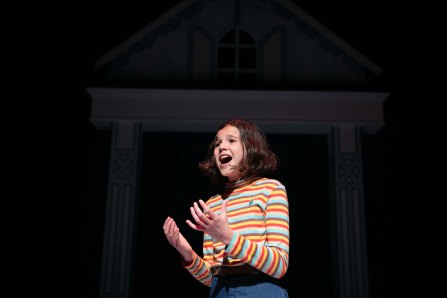
The most fun is when the three Bechdel kids do the big “Come to the Fun Home” song, pretending to cut a TV commercial for the funeral parlor, with choreography by Tod Kubo that captures all the goofy giddiness of the previous productions I’ve seen. Both Allie Joseph and Ryan Campos distinguished themselves at the start of this season in Children’s Theatre of Charlotte’s admirable Matilda, while Donavan Abeshaus has flown a little more under the radar, appearing as the young anti-hero in Bonnie and Clyde at Matthews Playhouse in February 2018. They make a fine set of Bechdel sibs now, though Joseph once again draws the plumiest role.

FUN HOME 7

Joseph is so brash and brilliant as Small Alison that she steals a little of the thunder from Amanda Ortega’s somewhat understated Medium Alison, the collegian who discovers her true sexuality at Oberlin and comes out as a lesbian. Ortega’s “Changing My Major” (to Joan, her first lover) was still an uproarious showstopper for those at opening night encountering it for the first time, though it brought nothing fresh that I hadn’t seen, but Lisa Hatt as our narrating Alison did offer something new, besting even the Tony-nominated Beth Malone as our storyteller.

FUN HOME 1.jpg

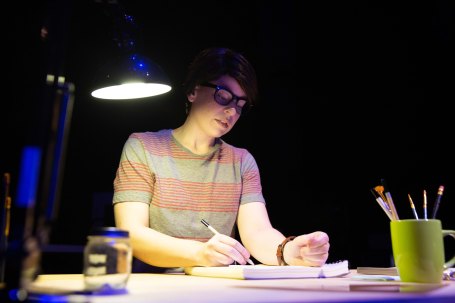
Maybe director Chip Decker believed she could be more than what she was on Broadway and on tour, for liberating Hatt – just by freeing her from the nerdy sketchpad she perpetually carried – is likely the foundation for all the Hatt achieves. Even when focus is elsewhere, on Bruce or one of the other Alisons, Hatt’s reactions matter, and her delivery of the climactic “Telephone Lines” is star quality. Yet there’s less of a feeling that this Alison has it all worked out after coming to terms with her sexuality and the fact that, as a graphic novelist, she isn’t going to join Faulkner and Hemingway in her English teacher dad’s pantheon. Hatt strikes me as a less confident Alison, still searching.

Hatt’s take on Alison allows Rob Addison as Bruce to be a little less formidable – more lifesize – than Michael Cerveris was on Broadway. A little more nuance helps because the ground has shifted somewhat since 2015, when Fun Home premiered, under the issues that Alison’s dad straddles. Though nothing excuses Bruce’s sexual predatoriness, fears of exposure and disgrace as a homosexual may be prime reasons why Dad is so rigid, regardful of others’ impressions, and so virulently bossy. You can believe it when Addison lets down his guard and plays with Young Alison at the start of Fun Home, and you can eventually see why this might be so atypical of Dad that our narrator would cherish the memory.

FUN HOME 8

Of course, the tortured and torturing Bruce can have more empathy with Alison – and be more grimly protective of her – than Helen Bechdel, her mom, and Lisa Schacher delivers a nicely nuanced portrait. Submissive, disapproving, and beneath it all, the caretaker, with a self-loathing to match her husband’s. Maybe a little more nuance from Sebastian Sowell as Joan to go along with her invincible cool would help me see why everyone, especially Medium, is so impressed with her. You can see, however, that a medium-energy Medium Alison is attractive to her.

Rounding out the cast as a couple of Bruce’s trespasses, Patrick Stepp shows enough self-awareness as Roy, the yard boy that Bruce plies with drinks – while Mom is elsewhere in the house! – to let us suppose that all this isn’t as surprising to Roy as it might be to us. Or unprecedented. In a scene that Alison isn’t narrating from her own experience, giving Dad a small benefit of the doubt is probably the perfect path to take. A little more sugar – and a soaring flight of fancy – will help Alison bring an uneasy but upbeat closure to her engaging memoir