Category Archives: Theatre

People Messing With Other People Keep “The Luckiest People” Lively

Review: The Luckiest People

By Perry Tannenbaum

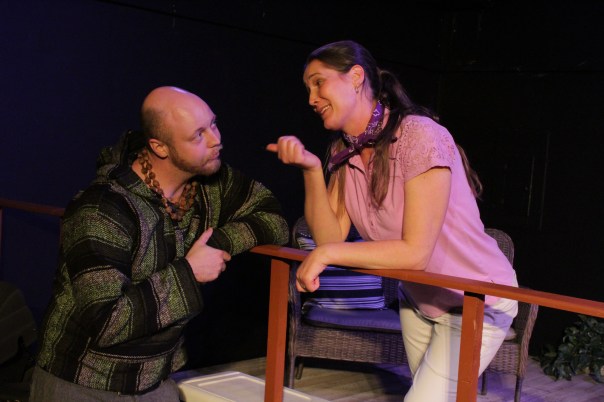
“Grow old along with me, The best is yet to be,” Rabbi Ben Ezra famously says in a Robert Browning poem, but tragic heroes King Lear and Willy Loman would probably have sided with my mom. She keeps telling me: “Young is better.” At Hadley Theatre, tucked away on the Queens University campus, playwright Meridith Friedman significantly compounds the controversy in The Luckiest People. In this Actor’s Theatre of Charlotte production directed by Sidney Horton, Friedman’s charming comedy-drama revolves around Oscar Hoffman, who is stranded by the death of his beloved wife, Dorothy, in a California assisted-living community, deeply lonely with myriad aches, pains, and complaints.

Most of these complaints, some fairly hilarious, are poured into his son Richard’s ears – plus the insinuation that he was responsible for letting his mom die. Oscar’s other child, Laura, has managed to distance herself from the fray, living in Shanghai and delaying her arrival until the funeral because she couldn’t stand to face her mom during her final hours.

So yes, Friedman sometimes seems to hint that caring for your parents as they journey toward their final transition might be at least as agonizing as experiencing it. That impression, however, is undercut by another perspective.

Layered onto all the love-hate friction between Oscar and his children is Richard’s relationship with his partner David. Richard and David are close to adopting a son when Oscar, ignorant of these plans, decides that the time has come for him to leave his place and move in with his son.

One transitioning child is enough for Richard and David to handle in their household, but David watches as Richard uses his father’s needs – and the possibility of his moving in – as excuses to drag his feet on the adoption. Although he himself becomes the target of Oscar’s testiness, David also sees that Richard is more than a little hypertense in dealing with Dad’s needs, complaints, and accusations. Oscar and Richard were born and raised as New York Jews while David is a comparatively mellow California Christian, apparently unacquainted with weaponized guilt.

Because Laura must return to Shanghai, Friedman compresses the bulk of her action into just a few days. That’s long enough for David – and us – to get the notion that Richard and Laura aren’t suffering so much because their dad is really tormenting them. They’re suffering because neither of them is really a grownup. Maybe Richard isn’t ready for parenthood after all.

Leaning over to that point of view can happen if we forget what a handful Oscar can be. Or we can catch ourselves laying the blame on Oscar for his children’s stunted growth. It’s complicated. Fully drawn dramatic families usually are.

Clearly reveling in the height of the Hadley, where Actor’s Theatre has recently inked a deal to be Queens U’s resident theatre for the next five years, executive director Chip Decker has put on his scenic designer hat and built two adjoining rooms at different levels. One of them is Oscar’s modest living room and the other, tellingly larger, is Robert’s kitchen. Of course there’s room for everybody!

Horton has a great sense for how Friedman’s comedy and drama should mix and how the Hoffman family’s humor and anger should suddenly erupt – and there’s a pretty wonderful cast at his command. In this rolling world premiere, Dennis Delamar gets the chance to reprise and further develop his Oscar, a role he originated in staged readings at the NuVoices Festival of 2016. Stooped over, stubborn, selfish, whip smart, and half blind, he is a thorny person to deal with. He’s still holding a grudge over transplanting from Great Neck, New York, to sunny California; yet late in life, Delamar shows us very naturally that Oscar still has possibilities for personal growth.

On the other hand, we might resist the notion that the perpetually tentative or exasperated Richard will ever loosen up, for until the final scene, in a nuanced performance seething with hidden fire, Tim Ross keeps him looking stressed or depressed. Some of that anger even carries over from his scenes with his father and his lover to his scattered tête-à-têtes with his wayward sister. Huddled with little Laura, Ross makes sure we also see an older, wiser brother, with glints of maturity, responsibility, and an aptitude for parenting.

Eventually, both Oscar and Richard emerge as our protagonists. When that happens, we’re likely to realize that Laura and David have both been part of the alchemy. Susan Stein makes an auspicious Charlotte debut as Laura, obviously the loosey-goosey sib from the moment she first enters. Laura is the one who has taken all the leaps into matrimony, motherhood, and now infidelity that Richard is wary of, and Stein makes her self-justifying zingers nearly as memorable as those Oscar aims at his caregivers and over-the-hill neighbors.

All of Friedman’s illuminating edifice probably wouldn’t have collapsed if she had made David a little less perfect, but Scott A. Miller, one of our best, finds a way to texturize him. Mostly, we empathize with David because we see how hurt he is by Oscar’s slights and Richard’s failures to commit, smiling weakly yet persevering with firm resolve. He also has a tête-à-tête or two with Laura, but you can count on Miller to make these more relaxed, conspiratorial, and gossipy.

My only disappointment on opening night was the size of the crowd. The place on Radcliffe Avenue can be a little difficult to find the first time out, but a show this warm and rich is definitely worth the trouble. These are, as the relevant song says, “people who need people,” and you’ll likely never see Delamar or Ross in better form than at the Hadley in The Luckiest People.

The Other Shue Drops at Theatre Charlotte With “The Nerd”

Review: The Nerd

By Perry Tannenbaum

It’s only infrequently that playwright Larry Shue’s name crops up on the Charlotte theatre scene. The New Orleans native, whose comedies were all premiered at the Milwaukee Repertory Theater, died in an airplane crash at the age of 39, while his most familiar work, The Foreigner, was still playing off-Broadway. Charlotte Repertory Theatre staged that backwoods farce during the same year that Shue died, 1985, and it was a huge hit, so huge that when Rep marked its 25th anniversary in 2001, a revival of The Foreigner was part of their celebration.

Yet Shue’s “other” comedy, The Nerd, also figured significantly in Rep’s history, for when the company went from a summertime schedule to year-round status in 1988, The Nerd was the company’s first non-summer production. Thirty years later, the current Theatre Charlotte presentation of The Nerd is actually its Charlotte premiere, for Rep staged this wacky comedy at Davidson College.

Wacky might be considered a gracious description of The Nerd, which premiered in Milwaukee two years before The Foreigner and arrived on Broadway two years after its worthier sibling. Silly, over-the-top, and unfocused might be better ways to describe this belated coming-of-age story of young architect Willum Cubbert. We first encounter the low-key Willum as he’s insufficiently surprised by his 28th birthday party. The surprises have hardly begun, for the party is wildly impacted by the unexpected arrival of the title character, Rick Steadman, who retains Willum’s undying gratitude for saving his life in Vietnam.

Thanks to other guests, excesses abound before Rick’s bodacious entrance. Not only is Willum’s current client, Warnock Waldgrave, insensitive to the niceties of Willum’s architectural drawings, he comes to the party with a neurotic wife and a fiercely obnoxious daughter. The little brat has thrown two or three tantrums, assaulted her dad and other adults, and locked herself stubbornly in the bathroom on multiple occasions a sedate warmup compared to the action after Rick arrives. As you might presume, the extremely starchy Warnock and the preternaturally eccentric and irritating Rick are not destined to get along.

Aside from Willum, whose gratitude toward Rick and dependence on Warnock prevent him from taking a hard line, two of Willum’s friends, Axel Hammond and Tansy McGinnis, try to mediate as the party spirals further out of control. Tansy is particularly sympathetic toward Willum. She’s his girlfriend now but will soon be breaking his heart when she moves from Terre Haute, Indiana, to DC, where she has a job waiting for her as a TV weathergirl. Axel is a drama critic, so he’s more inclined to crack wise than be helpful.

Just when it seems that Willum’s evening can’t get any worse, Rick makes his second entrance, suitcases in hand, intent on moving in. It’s here that Shue begins to misdirect us or lose focus, for everyone onstage except Rick becomes intently preoccupied with expelling Willum’s noxious visitor. We’re likely to forget that Tansy has really set the agenda early on in a conversation with Axel.

With set and lighting by John P. Woodey, this Theatre Charlotte production has a very sharp and detailed look to it, augmented by Sabrina Blanks’ splendid costume designs. Mom Clelia and daughter Thoralee clash like crazy in their party outfits, and Rick, dogged in insisting that this is a Halloween party, is positively unearthly when he arrives. Directing this mayhem, Jill Bloede takes a sensible approach, drawing outré performances from her three most noisome players, Trulyn Rhinehardt as the incorrigible Thoralee, Simon Donaghue as a perpetually outraged Warnock, and Jonathan Slaughter as The Nerd.

Rhinehardt misbehaves with such savage zest that you’ll want to take a stick to her. I don’t mind saying that I most delighted in Thoralee when she fainted from fright. Even if Bloede hadn’t changed Thoralee’s gender – Shue originally saddled Warnock with a Thor – I don’t think that a fainting spell by a bratty boy would have been any more satisfying. Donoghue’s powerful take on Warnock seemed to be the only misguided aspect of Bloede’s approach: why didn’t he take a stick or a belt – or a machine gun – to his unruly daughter, and why didn’t he simply fire Willum on the spot for ruining his day? Whatever softness accounted for Warnock’s forbearance wasn’t visible.

Slaughter’s way with Rick, not far distant in its absurdity from the sound and awkwardness of the Nutty Professor minted by Jerry Lewis, always bordered precariously on the unbelievable. There were times when Rick seemed to be trying to irritate everyone in sight, exactly the impression that Shue would have approved of. A tad too young to be playing Willum, perhaps, Cole Pedigo was a near-perfect foil for Rick’s nuttiness once he conquered his opening-night jitters. Shue wanted us to see a talented desirable man who is kind, grateful, and accommodating to a fault. That was exactly how we saw Pedigo.

Shue’s women weren’t as well drawn here as they would be in The Foreigner, but Bloede probably could have pushed Allison Kranz as Tansy and Audrey Wells as Clelia further toward farce. They also suffer at the epic birthday party from hell, Tansy especially after she slaves over a custom-made dinner and Clelia most memorably when she quizzes Rick about his love life. Perhaps if Shue had made her more decisive, Tansy would have seemed less vanilla as the would-be weathergirl, so Kranz definitely needed to pick her spots to show us that she was worthy of Willum’s adoration. Mostly, Shue and I forgot about her. Of course, Clelia was as much generic comedy material as her child, but Shue gave her some bravura business to perform in her reactions. Bloede should have lit the fire that would have made these diva moments for Wells. We weren’t as close to Carol Burnett as we should have been.

Deep in the weave of Shue’s plot is Axel, whose scheme to exorcise Rick in Act 2 is approximately as disastrous as the birthday party was before intermission. Chip Bradley is sufficiently urbane and snarky as this theatre critic, but I sometimes got the impression that he was a late addition to the cast. Along with a few instances of slow cue pickup, Bradley fumbled a few lines before getting them right. I’ve seen him do better in productions just as fast-paced as this one, so I’m expecting better performances in the nights ahead.

Coping with so many moving parts and quirks, Charlotte Rep also had some rough edges in its opening night performance of The Nerd 30 years ago. You wouldn’t want to tame all of this volatile ball of energy, but a little more energy here and a little sharpening there would help Theatre Charlotte’s production to snap into better shape.


New Plays, New Place, and New Hope at Actor’s Theatre

Preview of The Luckiest People

Maker:L,Date:2017-9-22,Ver:5,Lens:Kan03,Act:Kan02,E-ve

By Perry Tannenbaum

Trashy musicals, irreverent spoofs, and trendy new works by black and feminist playwrights aren’t the only things Actor’s Theatre of Charlotte has done well over the past 29 years. Around the country, when their artistic and administrative staff attend national conferences with their colleagues, they find that a big part of the company’s reputation rests on their commitment to nurturing new plays.

After two years of instability and uncertainty – and two full seasons without reviving their NuVoices Festival – Actor’s Theatre is getting back to that. This week, they’re opening Meridith Friedman’s The Luckiest People, part of a rolling world premiere that began in Denver. In May, the company will be part of another rolling world premiere, presenting David Valdes Greenwood’s The Mermaid Hour.

Both of these new plays were previously presented in reading stage productions at NuVoices 4 in January 2016, with all of the actors performing script-in-hand. No scenery, no costumes, and limited rehearsal.

NuVoices 4 was one of the last events at 615 E. Stonewall Street, ATC’s last permanent home before developers’ wrecking balls demolished the site. After a misadventure in the Belmont neighborhood near Plaza-Midwood, the company was supposed to reopen at 2219 Freedom Drive late in October 2016.

Instead, they had to move Toxic Avenger a block away to the City Center Church, of all places, the first of four unforeseen sites where ATC’s 2016-17 season was staged. Until last fall, when Actor’s Theatre launched their current season with American Idiot, subscribers never knew where the next production would crop up.

That’s when ATC announced that Freedom Drive was still on hold and that their next two productions would remain at Hadley Theatre on the Queens University campus. But after that?

Now we know. Luckiest People, Mermaid Hour, and The Mountaintop will all be at the Hadley. More importantly, ATC artistic director Chip Decker and John Sisko, dean of Queens U’s College of Arts & Sciences, have just inked a deal that will keep ATC on campus as the U’s resident theatre company for the next five years.

From necessity to desperation to near-relief, it’s been quite a rollercoaster for Decker, his board members, and ATC’s loyal fans. “We’re off life support but still in ER,” Decker quips. “In a better hospital.”

Sisko arrived at Queens in the summer of 2016, when all seemed to be going smoothly with ATC’s relocation. After the abortive opening in October and a subsequent revival of The Great American Trailer Park Christmas Musical at the McBride-Bonnefoux Dance Center – a horrid acoustic mismatch for a live musical – Sisko wasn’t hearing any signs of life, so he reached out.

Down at Freedom Drive, one hurdle was following another. Parking had to be upgraded to satisfy the City, architects’ drawings kept getting sent back for tiny inaccuracies. Think about this one the next time you walk through the metal canyons of a parking lot to find your car: Decker and his company had to shell out thousands of dollars to get an engineer to certify that the concrete slab – one that had held up a mechanic’s shop and the building itself for 50 years – could support an audience.

“We were slowly bleeding money to death.”

After Bootycandy ran at Mint Museum, Stupid Fucking Bird was staged at the Hadley last spring, a clear signal that Sisko and Queens U brass were unfazed by ATC’s edgy fare. Decker quickly recognized that this would be the finest venue his company had ever performed in. By far.

Maker:L,Date:2017-9-22,Ver:5,Lens:Kan03,Act:Kan02,E-ve

The lightbulb came on, and Decker invited Sisko out to grab some coffee and chat about the future.

“It took me a long time to quit beating my head against the wall to make Freedom Drive happen,” Decker recalls. “Having the passion for something and wanting it so bad, I kind of started being blind to the writing on the wall. We were at the point, Perry, and I shared this with John, and I said, ‘We’re do or die. We’re either going to close, or something different is going to work.’”

When Sisko saw how well Stupid Bird went, concern about ATC’s struggle gave way to recognizing the opportunities that bringing the company on board could open. ATC could offer technical support for Theatre Department productions during the academic year, they could offer internships to graduating students, they could oversee a summer theatre festival with performances on the quad under the stars, and they could teach courses about theatre production and administration.

“ATC is the backbone of the Queens theatre program, and it’s a mutually beneficial relationship,” Sisko says. “We have parents who are a little worried about their children being an arts major. But when they’re an arts major and they have 30 credits on the business side of the arts as well, then they are in better position when they face post-graduation.”

Talks are already under way on prospects of reviving the NuVoices Festival as early as this summer, and Decker is already salivating at the prospects. At previous festivals, the four playwrights, four directors, and their casts had to rehearse and perform on a single space at Stonewall. On the Queens campus, there will be multitudes of classrooms at ATC’s disposal, playwrights will be able to interact and talk shop, or simply do rewrites – on the quad, in some greenspace, or in a classroom instead of a hotel.

“They can all come together and talk about the process of playwriting, what it takes to get it produced,” says Decker. “Queens can bring in their MFA creative writing students for master classes with the playwrights on how do you get seen, how do you get published, how do you get your word out there, what it literally takes to become a professional writer on the scene.”

With the opening of The Luckiest People this week, ignition for whole process gets revved up again, because NuVoices is one of very few festivals across the country that promises a full production for every winning entry.

Dennis Delamar, a longtime actor and director at ATC, is doubly excited: he’s reprising the central role of Oscar Hoffman two years closer to the irascible old SOB’s actual age, and he’s performing for the first time at the Hadley knowing that the company has their feet back under them.

Under cross-examination, Delamar can catalog why Oscar is so difficult as he seeks to impose himself on his son’s household – just when he and his male partner are adopting a son. There’s the culture shock of moving from Great Neck, NY, to California; the many physical torments of Paget’s disease; the recent death of his devoted wife; and the pure cussedness of a Jewish trial lawyer who revels in disputation. Even his sharp sense of humor is thorny.

NuVoices gives this role an extra charge. “Being on the ground floor of a new piece of theatre is pretty thrilling,” says Delamar, “a professional collaboration that offers one an opportunity to offer one’s own unique interpretation while the playwright is still in the ‘making it better’ stages.”

Participating in NuVoices gave Delamar the opportunity to meet the playwright and learn first-hand how she drew his character from her own Great Neck grandfather. Thanks to Facebook, Delamar stayed in touch, conferring with Friedman when she made further revisions.

“I felt quite comfortable to write to her about a significant moment for Oscar I noticed had been changed,” he confides. “Taking time to explain to me the history and logic of the change, Meridith reminded me how much I appreciate working with this gifted and open minded writer. She listens. She is wise. I agreed with the change and loved that we could confer so openly about it.”

Yes, the thrill is back at ATC – with new plays and new hope.

“All the signs from this last year together suggest that it’s going to work out extremely well,” says Sisko.

“School of Rock” Sports Heavy-Metal Vulgarity

Review:  School of Rock

By Perry Tannenbaum

Dewey Finn is not your model citizen. A wayward adherent to the religion of hard rock and heavy metal, Dewey is vastly self-absorbed. When he gets booted out of his No Vacancy band, presumably for stealing focus from the shirtless lead singer, Dewey sponges contentedly and thanklessly off former bandmate Ned Schneebly. Worse, when an opportunity opens for Ned as a substitute teacher at a prestigious private school, Dewey steals it.

Masquerading as Ned, Dewey remains true to his slovenly egocentric creed, arriving to his first day at work late and hung over. More alert on Day Two, he discards the normal schedule and curriculum, ditching math and social studies in favor of turning his students into a rock band. Dewey remains steadfast in his ambition to qualify for, compete in, and emerge victorious in the upcoming Battle of the Bands.

After heroes and antiheroes that included the biblical Joseph and Jesus, the Phantom of the Opera and Grizabella, Evita Peron and Norma Desmond, you could say that Dewey Finn shattered the mold for Andrew Lloyd Webber protagonists when School of Rock opened on Broadway in December 2015. Although it never became anything like the moneymaker Phantom still is after 30 years, Rock is still running – while subsequent revivals of Cats and Sunset Boulevard are not.

From what I could see at Ovens Auditorium on opening night, word-of-mouth in Charlotte will concur with the Broadway verdict.

What makes Dewey appealing is his sheer vulgarity, which nearly reaches full John Belushi proportions. But there’s more, mainly the unsavoriness of all the other adults onstage, beginning with the No Vancancies who let Dewey go. Ned is preternaturally wimpy, more dependent on his inhaler than a meth addict, and his girlfriend Patty is dominatrix-grade hostile.

At school, Dewey’s colleagues are suburban bland. At home, the students’ parents are variously unloving and/or unsupportive. The principal, Rosalie Mullins, is the essence of by-the-book rigor, believing that this is what those wealthy parents are paying for. Winning Rosalie over is the key to realizing Dewey’s hard rockin’ aspirations, and he hits upon the perfect scheme, asking her out to a local dive and plying her with cheap beer and Stevie Nicks.

Scenic and costume designs by Anna Louizos have the same look on tour as they had on Broadway – as far as Ovens will allow. When the School of Rock band finally gets their shot at the Battle of the Bands showdown, there’s no visible spot for the skeptical parent to sit – like, say, the box seats at Belk Theater? – while the kids prove themselves.

The size of cavernous Ovens, seating over 60% more than the Winter Garden on Broadway, makes it more difficult to hear Dewey’s fifth graders clearly – and more difficult for most ticketholders to see the mutually beneficial relationship developing between them. Really, I couldn’t find any distance between Rob Colletti’s disheveled charm on tour and Alex Brightman’s on Broadway, nor were the kids’ talents any less precocious than those I witnessed at the Winter Garden.

But the mojo that starts happening in the classroom with “You’re in the Band,” as Dewey matches students with their instruments (no, I don’t know how he snuck in a complete drum kit), seems comparatively muted and diluted in the vast Ovens space. Here’s where the kids get their first fix of that you’re-really-good intoxicant their sub is dishing out while Dewey gets his first inkling of how fulfilling it can be to do something for somebody else. On Broadway, this is where I knew that Lloyd Webber was onto something when he decided to adapt the 2003 film starring Jack Black. At Ovens, we’re still unsure.

We never tap in quite as intimately to Dewey’s growth and transformation. It hits us more at big moments that are outsized signposts along the way. Fortunately, there are enough of these broad advances in Julian Fellowes’ adaptation of Mike White’s screenplay to add up to a satisfying jolt when the big crises hit midway through Act 2. The essence of these advances is the beneficial effect he has on the kids, on Rosalie, and even Ned – a medical miracle, since the wimp suddenly tosses away his inhaler and become a mean rockin’ machine – along with new outbreaks of generosity, tact and caring.

Colletti carries the show on his broad sloping shoulders, his big belly, and purest chutzpah, but it’s the kids who give the show its impish, wholesome Monkees energy. Dynamic Phoenix Schuman on guitar, nerdy Theo Mitchell-Penner on keyboard, grumpy Theodora Silverman on bass, and hipster Gilberto Moretti-Hamilton on drums are a cornucopia of musical precocity. The mini character roles have the same Broadway excellence, bossy little Ava Briglia emerging as company manager, effeminate John Mitchell Pitera finding his passion in costume design, and withdrawn Gianna Harris breaking out of her cocoon with a smashing a cappella “Amazing Grace.”

There’s a latent sexiness to Lexie Dorsett Sharp as Rosalie that peeps through early on when she exits Dewey’s classroom after a precise and military left-face. Our principal also displays a formidable soprano in “Queen of the Night” excerpts, though the highest note in the Magic Flute aria is always scaled with the aid of a student tapping a triangle. There’s a certain British delicacy in the way Sharp eventually melts, removing her glasses but never letting her hair down.

Director Laurence Connor allows more latitude to Dewey’s put-upon hosts with only middling results. Patti is a fairly standard-issue shrew, and Emily Borromeo does little to transcend her, pitch-perfectly annoying in her yammering. Matt Bittner, so hopelessly asthmatic early on, does deliver a shocking metamorphosis when he grows a pair. Maybe he could survive in a classroom!

There are no memorable power ballads from Lloyd Webber this time around, but he’s clearly having fun, stealing from Mozart and Deep Purple in the same score – and proving, in case you’ve forgotten, that he really can rock. “When I Climb to the Top of Mount Rock” cooks at medium heat to start things off, and later, “Stick It to the Man” and “You’re in the Band” actually achieve a slight metallic edge.

Implausibly, the climactic title tune misfires. Lloyd Weber’s melody, perhaps to satisfy demands of the plot that don’t need satisfying, doesn’t reach the anthemic stature we’d expect from a revelatory rock band’s signature tune. Glenn Slater’s lyrics, reliable throughout the evening, are dreadful here, incoherent and not at all believably from a fifth grader’s imagination.

Not to worry, Weber hasn’t lost it at the end. Order is restored when he reprises the crowd’s favorite, “Stick It to the Man.”

High-Grade, Homegrown and Professional

Preview:  Three Days of Rain

By Perry Tannenbaum

Maybe you’ve noticed: since the beginning of September, there has been an abundance of high-quality, homegrown and professionally crafted theatre productions around town – from new or returning companies as well as the usual suspects. Brand New Sheriff ignited the upswell with Jitney, the best drama of the year, and the drive continued with scintillating efforts by donna scott productions, OnQ Performing Arts, and The Playworks Group.

And that was just during the first three weeks!

3Days-ART[8]

Within the next two weeks, Actor’s Theatre unveiled a fiery American Idiot, PaperHouse Theatre trailblazed at the Goodyear Arts Center with The Revolutionists, and Children’s Theatre outdid themselves at ImaginOn with a high-flying Mary Poppins. Three Bone Theatre has sustained the seasonal glow with Fahrenheit 451 and the Actor’s Theatre encore, Hand to God, was merely better than the Broadway production.

You have several more chances to experience professional-grade excellence in local theaters before the winter solstice, including reprises by Chickspeare, OnQ, Children’s, and Actor’s of holiday faves. But if you’re itching to get a taste of the grassroots fervor that has gripped the Queen City throughout the fall theatre season – and escape the oncoming blizzard of Christmas repeats – your only choice is to check out Charlotte’s Off-Broadway.

Gestating at the Warehouse PAC up in Cornelius for the past five years in storefront productions, Charlotte’s Off-Broadway is staging an Uptown rebirth with the Metrolina premiere of Richard Greenberg’s Three Days of Rain. For founding producer Anne Lambert and her company, it’s their first presentation at Spirit Square since 2005 – and their first Actors’ Equity production ever.

Lambert isn’t coy about what she hopes will begin sprouting from all the recent professional grassroots action around Charlotte this season – a professional company with the same regional status and prestige that Charlotte Repertory Theatre had before it folded in 2005.

“Yes,” says Lambert, “I do see Three Days of Rain as a project that represents the beginning of a concerted effort to lift Charlotte’s Off-Broadway to a new level, to impact the city’s theatre scene and, yes, to move Charlotte closer to re-establishing ourselves as a logical home for a LORT (League of Resident Theatres) company.”

It begins by consistently producing high-quality shows that the community will continue to come out and see – and continue to hit their wallets and support. Butts and bucks. Part of the push on Lambert’s side is signing Equity contracts with her actors so that they are all treated and paid according to union standards. Two of the three Equity players, Caroline Bower and Brian Lafontaine, are longtime Charlotte favorites.

Lafontaine is also co-producing. He and Lambert last collaborated in 2003 when he acted in The Hotel Project, a pair of one-acts produced by Lambert and Matt Olin while they were, respectively, director of development and managing director at Charlotte Rep during its sunset years. More recently, Lambert and Lafontaine have been attending Creative Mornings, a monthly happening for Charlotte creatives organized by Olin and Tim Miner.

The old mojo began to work again during the supercharged meet-ups. Three Days of Rain was among the scripts that Lafontaine had brought with him from New York when he moved back to Charlotte. He was at a point in his career where he was thinking about producing a show that he wanted to do – at a professional level.

“Anne had told me if I ever wanted to get a show produced, she could get it done for me after we had worked together on The Hotel Project,” Lafontaine remembers. “I know how passionate she is, and how capable she is. She loves theater. She loves actors, and she loves contributing in any way that she can to the artistic community in Charlotte. She’s an incredible partner. There’s no way this would be happening without her.”

There was a notorious Broadway run of Three Days of Rain back in 2006 starring Julia Roberts, so Lambert had heard of the script when Lafontaine brought it to her. But she hadn’t read it. Months of discussions culminated in opting for the Greenberg play.

“It’s a well-written, Pulitzer Prize-nominated script,” Lambert stresses. “It’s sophisticated, it’s funny, it’s compelling, and it’s mysterious, full of Easter Eggs that reward the attentive audience member. It has six completely beguiling characters. I’m excited by the device of the dual roles, where the actors we see portraying Walker, Nan and Pip in Act 1 turn around in Act 2 and play their parents. These three talented actors in our show are so adept, so good at what they’re doing, they really are two different characters for me.”

Notwithstanding all that Roberts hoopla, Walker and Ned, the son and father Lafontaine will play, have always been the core characters at the heart of Three Days. Both are startlingly eccentric – and brilliant. After his dad’s funeral, Walker had vanished so completely that his sister Nan, the sensible branch of the Janeway family, had given him up for dead while he was holed up in Italy for a year. The siblings now meet at an unoccupied loft where, 35 years earlier, Walker’s dad had designed his masterwork, Janeway House.

But wait a second. When they finally read Daddy’s will, the sibs discover that, instead of going to them, the Janeway House has been inherited by their longtime friend Pip, the son of Theo Wexler, who was Ned’s partner at their architectural firm. It’s a mystery. To get to the bottom of it, Walker obsessively pores through his dad’s terse diary, which he discovered soon after he returned to the loft.

Friction, mystery, and brilliant minds are all in the mix.

“The dialogue is fantastic,” Lafontaine enthuses. “It has an almost Aaron Sorkin feel to it. Sure, I think it’s funny in a lot of places. Thank God. Otherwise, I think we’d be driving audience members to therapy after. And the mystery adds another interesting element to the play. But for me, it really is more of [a dramatic] study about the relationship between children and parents.”

Bower, who plays Nan and her mom Lina, burst onto the Charlotte scene in 2007 with starring roles in Thoroughly Modern Millie and The Wizard of Oz. By the time she dropped out in 2014, Bower had drawn acting paychecks from every company in town that cuts them – Actor’s, Children’s, and CPCC Summer Theatre. She became the most persuasive poster child we had for the notion that stage acting could be a viable profession in Charlotte.

Then she took a position as teacher and director at Providence Day School to expand the theatre program there and carry herself from car payment to car payment. She came out of “hiding” this past summer, choreographing Cry Baby at Theatre Charlotte, and now she is acting under her second Actor’s Equity Association contract within the space of two months.

“I am so lucky to have been a part of The Revolutionists and Three Days of Rain. Being a part of two projects that care enough about their actors to jump through the AEA hoops is humbling. Not only do the production teams care about their actors, but both of these scripts are the best of the best.”

Paige Johnston Thomas, who directs, brings an additional chunk of Charlotte Rep DNA to the Lambert-Lafontaine production team. Her first acting gig in the Queen City was in another three-person cast, playing C in Rep’s 1995 production of Edward Albee’s Three Tall Women. Thomas’s most recent paying gigs in theatre have been directing at Theatre Charlotte and Davidson Community Players.

But her most important role on the local scene is as an “anti-relocation advocate,” having founded C&J Casting with Mitzi Corrigan to help local theatre pros get steady work in commercials and film.

Thomas saw Bower’s outing at Goodyear Arts, where she portrayed a vain, charismatic, and bubble-headed Marie Antoinette.

“I texted her this after the show: ‘I couldn’t keep my eyes off you,’” Thomas relates. “Which in real life sounds kinda creepy, but in the acting world, it’s a huge compliment. She has an innocence that is constantly being belied by her quick intellect and emotional depth. It makes for great conflict, which makes great drama.”

Head for Duke Energy Theatre if you want to see it. Then consider hitting your hip if you like what you’ve seen.

Charlotte’s Off-Broadway Poignantly Pieces “Three Days of Rain” Together

Review:  Three Days of Rain

By Perry Tannenbaum

At a pivotal moment in the opening act of Richard Greenberg’s Three Days of Rain, Walker Janeway pounces on a sentence in his dead father’s journal that only becomes visible in a certain slant of light – a stain that turns out to be words. Written by celebrated architect Ned Janeway shortly after the untimely death of his business partner, Theo Wexler, the phrase leads Walker to believe he has found the answer to why his father’s will divided his estate so shockingly.

There’s a bit of a cosmic joke that Walker is playing on himself here, but we don’t get to see it until deep into Act 2, which takes us back 35 years to 1960. In the same loft where Walker pored over Dad’s journal, we encounter Ned, Theo, and Lina, the woman who is torn between them. These are the parents of the people we’ve met at the start – Walker, his best friend Pip, and his sister Nan. And they’re the same actors, so you’ll catch the resemblance.

What Walker gets wrong is the true object of that wee stain of a sentence. He presumes it refers to all the world-famous buildings and homes conceived by the Wexler-Janeway architectural firm with their genius designs. Turns out that Lina, Nan, and Walker himself were more likely at the heart of what Ned was getting at.

“Everything,” you see, can mean a lot of different things.

Probably because all eyes were on Julia Roberts when Three Days of Rain made its Broadway debut in 2006 (nine years after its original run at Manhattan Theatre Club), more than a couple of critics were as off-target as Walker in their suppositions when they sleuthed out the point of it all. Restoring the original balance of the script, which centers its concern on the relationship between Walker and Ned, the current Charlotte’s Off-Broadway production at Spirit Square enables us to see more clearly.

Sure, it might be tempting conclude that Three Days of Rain demonstrates how narrowly children know their parents, flipping the plot of King Lear. Yet this production at Duke Energy Theater, so meticulously directed by Paige Johnston Thomas, reveals all of the pains Greenberg went to in making sure that Walker and Nan are exceptionally ignorant of their parents’ relationship and inner lives. So is Pip, vis-à-vis his dad.

We hear early on from Walker that his dad was nearly mute throughout his childhood, though we don’t learn why until we meet Ned after intermission. As for Lina, she has been strung out on drugs and/or insane since Walker was eight years old. Perhaps Walker could have gained some additional insights if he had attended Dad’s big A-list funeral and listened to the eulogies, but he skipped that, preferring to brood artistically in Italy for a year. Add to those deprivations the usual distance between fabulously wealthy parents and their kids – both of whom are free to globetrot when the impulse hits – and you can see why the journal that Walker discovers at the fateful loft is like a precious canteen filled with water that surfaces in the vast Sahara.

Ryan Maloney’s set design has a loosely precise look, like a blueprint drawn free-hand. Even in its abstractness, the design doesn’t destroy the workshop vibe of the loft. From the moment he appears on these hand-drawn quadrangles, Brian Lafontaine delivers a beautifully calibrated performance as Walker. You might look back, when it becomes obvious that he’s a snooty, shiftless, and irresponsible underachiever – with sprinklings of self-pity and hypochondria– and think that Lafontaine was a little too genial and yielding at the start.

Yet he’s not only speaking to us for the first time, he’s also meeting up with Nan for the first time since he disappeared without telling anyone where he was going. During his yearlong absence, Nan had come to terms with the probability, after hired detectives came up empty, that her brother was dead. So a bit a caution and contrition must be stirred into Walker’s Bohemian mix. Especially since he has forgotten that he was supposed to rendezvous with Nan at the airport. Ooops.

The meanness and arrogance of the man, peppered with resentment and delivered with some nasty sarcasm, come out after the disposition of the estate, when Walker comes back to the loft. Now the brunt of his attention is directed at Pip, who has drawn the one property that Walker cherished most. Pip actually offers a more plausible reason why this has happened: he had actually established a normal speaking relationship with Ned. But watch the seething, stony way that Lafontaine absorbs this and other revelations from his friend. He’s not much of a listener.

As for Lafontaine’s work on Ned, it may stand as the best he has given us in over 25 years on Charlotte stages, surprisingly effortless and touching at the end. Who saw this all winding up like a bittersweet romantic comedy after the fire that brought us to intermission? Restoring Lina to lifesize, Caroline Bower is a huge reason why the Act 2 denouement is so poignant and satisfying. In the opening act as Nan, Bower is far more subtly nuanced, demonstrating how the role can bloom with a real stage actress.

Nan is the offended normal sib who has the right to be absolutely disgusted with her brother’s inconsiderate flights, but if you closely watch her reaction to his blather, you’ll see that she momentarily drops her front of stern reproach, charmed and loving in spite of herself. There’s a parallel ambivalence in her attitude toward Pip, hints thrown our way when he appears in the second scene, fireworks ready to explode when the reason is disclosed in the Act 1 climax.

If Lafontaine and Bower embody one of the chief satisfactions of a vibrant local theatre scene, watching familiar professional performers radically transforming themselves into new roles, Chris Speed personifies the excitement a newcomer brings. After his richly textured accounts of both Pip and Theo, I can hardly wait to see what he does next. Pip realizes that, making his living as a soap opera stud, he is little more than a thin shadow of what his great father was. But he’s cool with that, though he seethes at Walker’s perpetual hypochondria and condescension, helping to bring the 1995 action so nicely to a boil.

Less open to the charge of superficiality – because he has loftier ambitions – Theo is like his son in his charismatic ability to navigate his career path. Yet he’s as undervalued when we see him in 1960 by Ned and Lina as Pip will be by their children 35 years later. We need to piece it together, connecting Theo’s final exit with the story Pip has told about him in Act 1, to realize that he’s really the best person we see, more than worthy of the barely legible tribute that Ned has written to him in his journal.

While Ned was reticent as a father after his disloyalty to his best friend, Theo was devoutly secretive with his wife and son, keeping hurts hidden that only Ned and Lina could have suspected. Speed does an excellent job of making the virtues of both Wexlers mesh together as a family trait. I found that Theo’s last walk into the wings, huddled in a trench coat on the last of Greenberg’s three days of rain, lingered long in my memory.

One other little signpost to catch in Act 2 – one that Greenberg himself pointed to in a 1998 interview with American Theatre magazine – when measuring Ned’s actual attitude toward his son against Walker’s perception. Ned expatiates at length on his desire to abandon architecture and become a flaneur, a loafer who strolls idly around town. “I find it moving,” said Greenberg, “that the father would name him after what he loved.”

And I find it ironic that, in the upshot of Walker’s life until we get our last glimpse of him, a father’s blessing has become a curse.

No, the point isn’t just that we narrowly know our parents. That’s taking Greenberg’s drama rather obtusely, for Pip lost his father at the age of three! Time after time, these young people who are so familiar with each other prove to utterly misjudge one another. They know each other narrowly and, on top of that, know themselves narrowly in different ways. So eventually, Three Days of Rain and old King Lear actually intersect.

Actor’s Theatre Stages a Superior “Hand to God” – In Hilarious Spurts

Review:  Hand to God

By Perry Tannenbaum

There are certainly instances when a touring version of a Broadway hit comes to Charlotte – or when a local company tackles a Broadway or off-Broadway show I’ve previously reviewed – that I’m tempted to tell people that they missed out by not catching this show up in New York. On the other hand, there are stellar productions like the Actor’s Theatre take on Robert Askins’ Hand to God, currently at the Hadley Theater on the Queens University campus, that make me wish to tell all who saw the Broadway version, “You wuz robbed!”

Elements of what director Chip Decker and his Actor’s Theatre cast deliver just make me wish to exclaim “Wow!” because they’re done so well, while others make me think “Of course!” because the Broadway production missed them. The wows begin with Decker’s set, proving once and for all that the Hadley is more than a make-do location until Actor’s settles into its new facility on Freedom Drive. Next year, we hope.

Seating capacity is in the off-Broadway category, but the height and width of the drab Texas church basement, where we meet Jason and his widowed mom, belies any cramped expectations. It’s high enough so that an unexpected entrance from street level can be fairly epic – and risky. When we adjourn to a nearby playground, a pair of swings can smoothly descend from the fly loft so that Jason’s tentative overtures to Jessica, his puppet class classmate, can go freakily awry.

The chief reason why things go wrong all through this dark 80-minute comedy is Jason’s puppet, whom he calls Tyrone. If what I read about Hand to God productions around the country is indicative, props designer Carrie Cranford has created four Tyrones. And maybe some spares. Each one is bigger, more ornate, and demonic than his predecessor. From what I remember – and what I can pull down on YouTube – Cranford’s latter creations are more fearsome than those that terrorized Broadway.

We see a relatively benign incarnation of Tyrone before the action begins, recounting the story of humanity leading up to the invention of the Devil as a convenient excuse for the evil that we do. But couldn’t this disclaimer be a diversionary tactic from the Devil? Bwa-ha-ha!

Askins, of course, wants to have it both ways. There are numerous reasons for us to conclude that Tyrone’s lewd spewings stem from his troubled past, most notably the death of his father, and his mom Margery’s outré way of coping with her grief. She’s still not a great mom, doesn’t have much control over her sexual cravings, and she’s forcing Jason into this whole church-and-puppetry scene.

Pressured by Pastor Greg to present a puppet show at an upcoming Sunday service, Margery is deaf to her son’s desperate pleas to give up puppeteering. So is Tyrone, who has developed a life – and a voice – of his own.

After similar bullied roles at Actor’s Theatre in Bad Jews and Stupid Fucking Bird, we can rely upon Chester Shepherd to be a frailer Jason than the more imposing Steven Boyer was on Broadway in 2015. But the softer Jason is paired in Shepherd with a more vehement, rabid, and guttural Tyrone than Boyer was at the Booth Theatre – a voice that leaves Cookie Monster in the dust, fully worthy of Cranford’s latter puppets. Shepherd’s manipulation of these puppets is as uncanny as the abrupt and violent shifts in his voice when Jason and Tyrone engage in their fiercest showdowns.

I read that one Jason/Tyrone in a regional production steamed his vocal cords after every performance. Not sure if that would be enough to repair the abuse I saw Shepherd inflict on his larynx. At certain points, I had to worry whether Shepherd had gotten carried away – OK, possessed – by his Tyrone. It’s an extraordinary performance, that’s for sure, but never a slick one: though Jason flaps Tyrone’s toothy yap, Askins doesn’t want the lad to attempt ventriloquism.

Nicely aligned with the diminutive Shepherd, Decker has deglamorized the older generation, offering us better assurance that Margery truly is at loose ends, that Pastor Greg might be desperate for her companionship, and that we’re truly in Cypress, Texas, and not Hollywood. Longtime leading man Mark Kudisch and Geneva Carr were less reassuring on Broadway than Brett Gentile and Marla Brown are at the Hadley.

Brown is more than sufficiently attractive to believably draw the attentions of Pastor Greg and Timothy, the resentful delinquent in her puppet class. But she comes at us frumpier, more frazzled and humdrum domesticated. That works so well for the nasty surprises she has in store for us and for the two teenage boys.

From the first time he performed at Actor’s Theatre in 2004 as a domineering cop in Lobby Hero, Gentile has shown the ability to be the tough guy, capable of truly bodacious bellowing if you set him loose. Yet he can turn around and be meek and pastoral, visibly wounded by Margery’s rejection. Unlike Kudisch, with his John Wayne bulk, when Gentile confronts Timothy or the rabid Tyrone, you can wonder what the outcome will be. These were probably the chief “Of course!” moments for me at the Hadley.

Grant Zavitkovsky isn’t as wiry or urban as his Broadway counterpart, so he doesn’t come across at first with quite the same nastiness and menace as Timothy, but his better looks and substantial size are better reasons for Jason to fear him and envy his success with women. There’s also a slight patina of complacency to Zavitkovsky that works very nicely before those instants when Margery and later Tyrone shock him.

Behind the multiple layers of her costume, Lizzie Medlin remains somewhat inscrutable as Jessica throughout Act 1. She recoils from Tyrone’s first breakouts with an utter spontaneity that compounds Jason’s embarrassment. Yet her later actions partially vindicate Tyrone’s contention that his lewd frankness was the best way to go. Nothing she does prepares us for her action heroics in Act 2.

All I’ve got say about that is to congratulate Medlin, Shepherd, Decker, and Cranford on the most hilarious puppet sex I’ve ever seen – and probably the best puppet therapy. Way better than Broadway, though perhaps the elderly ladies in the front row should have been warned that they were sitting in a splash zone.

Amid this unique brew of the bawdy, the violent, and the diabolical, Askins would have us contemplate the ontology of evil, the devil, and saviors. I could see where you might wish to skip that assignment.


Subversive Energy Still Ignites “Fahrenheit 451”

Review:  Fahrenheit 451

By Perry Tannenbaum

Each time Ray Bradbury’s Fahrenheit 451 returns to Charlotte, it seems like a telltale barometer: how much closer have we come to fulfilling its grim dystopian vision – or how much further have we mercifully drifted away? Book burning and other assaults on culture may have been more virulent when the sci-fi classic was last served up at Children’s Theatre in 2005, when Taliban desecrations flamed our anger, or as recently as 2015, when ISIS insanity ruled Mosul and Palmyra.

With Kindle and Google Books, the concern nowadays seems more centered on physical books and booksellers, for notwithstanding the proud illiteracy of the toxic Agent Orange 45 – who still knows words, mind you – reading and literature appear safe for now. The battlefront seems to have shifted to information, reporting, and science. In Charlotte, the culture wars played out at local theatres back in the 90s have been upstaged by anti-LGBT initiatives in the state legislature and racial profiling on the streets.

Because of the complex crisscrossing of events in Charlotte and Charlottesville in the past few months, it gets pretty murky when we attempt to draw a sharp parallel between the firefighters that Bradbury’s hero, Guy Montag, breaks away from and the police of today. It was the protestors, after all, who carried the intimidating torches up in Virginia while police meekly looked on.

Forget the Charlottesville hullabaloo, then, if you go to see the Bradbury combustion up at Spirit Square in a crackling Three Bone Theatre production, for the company surely programmed 451 at Duke Energy Theatre between the Charlotte and Charlottesville riots.

Of course, while times inevitably have changed, productions will add another layer of difference, depending on the company and the director. Compared to the Children’s Theatre productions of 1993 and 2005, we get the full Bradbury stage adaptation now. Three Bone’s adds over 40 minutes, clocking in at 2:21, including intermission. The other big changes are the leading men that director Charles LaBorde has chosen.

With Harry Jones Jr. as Montag facing off against Thom Tonetti as Chief Beatty, we have a clash of physical titans that we haven’t seen before, both firefighters looking more like hard-working enforcers. Greater contrasts are also drawn between youth and age, innocence and experience, ignorance and knowledge. Mark Sutton could do many things onstage as Montag, but looming before us as physically – or vocally – intimidating wasn’t one of them. His early ignorance looked comparatively slack-jawed or nebbishy, slightly endearing.

Now we can see Montag as not only ignorant but also devolved and brutish. When Beatty warns that any influx of knowledge or enlightenment gained from reading will instantly register on Jones’s face, we believe it. He and the mass of mankind have evidently regressed so far that taking the first bite of the contents of a book is like beginning all over again – in a biblical or Darwinian sense.

Tonetti can roar nearly as loudly as Jones, and if he certainly isn’t any more rugged as Beatty than Scott Helm was in 2005, he has the advantage of more years to make him seem more experienced, scruffier, more cynical, and more embittered. Helm’s version of the fire chief was cooler, more inscrutable, while Tonetti is a hot boiling mess. He is erudite, filled with forbidden knowledge, and like God in Eden, able to smell the onset of intellect. But ambivalence rages within Beatty, set in his commitment to firefighting yet never able to fully vanquish the notion that he has made the wrong choice.

Library

Written in 1953, Fahrenheit 451 isn’t prescient about women’s advances in the future, but Bradbury was writing about a dystopian America, so we’re likely to give him a pass. LaBorde plants some women among the firefighters, and Bradbury’s main women, though not in the workforce, are interesting and varied. Mildred Montag, Guy’s wife, is the most conventional, unquestioning in her devotion to pills and brainless TV pap. Lisa Hatt as Mildred is mindless and sedated enough to be a likely source of Guy’s smoldering discontent.

Interestingly, there is a lax acceptance by Mildred and her neighbors of Montag’s predilection toward books. They’ll let it slide until Montag rocks the boat.

Near the Montags, a neighbor lady is found to have a vast home library that must be incinerated. Angie Cee gets a fine cameo as Mrs. Hudson, the library lady willing to burn with her beloved books, playing her with a memorable wild-eyed zeal – and just a trace of motherly love. Her martyrdom certainly gives Montag the inescapable notion that there might be something in books worth dying for.

Montag’s discontents at home and on the job make him vulnerable to the probing and teasing of his rebellious misfit neighbor, Clarisse. It’s a role that works well with the raffish delicacy that Stefani Cronley brings to it. Cronley becomes a dear and lively enough mentor to Montag for us to feel some of the same emptiness he feels when she disappears.

Perhaps the finest character Bradbury created in Fahrenheit 451 was the crazed fugitive outlaw, Faber. Somebody needs to register the horror of what has happened in America, and somebody needs to have an inkling about what can still be done. Bill Reilly brings a wild unkempt fervor to Faber, a catlike cunning wrapped into his cowardice and a divine spark twinkling in his despair. Mankind’s survival hangs on a slender thread, and he’s it – unless Montag and others like him can work out as recruits.

Like the Johann Stegmeir design concept for the 2005 Fahrenheit, Ryan Maloney’s set design and Ramsey Lyric’s costumes for Three Bone are not averse to the idea that we have entered a nuclear winter as well as an intellectual one. Other novelists have played with the idea that nuclear catastrophe might bring about reactionary rejection of science and culture. In Bradbury’s futureworld, nobody seems to know what exactly brought us to this, and that’s part of what makes it so sad.

Soot of Sodom Chases the Joads in “The Grapes of Wrath”

Review: The Grapes of Wrath @ Theatre Charlotte

By Perry Tannenbaum

If you’ve ever read John Steinbeck’s sprawling masterwork, The Grapes of Wrath, you know that it’s framed with a seething anger as a picture of America’s unfulfilled promises, the cruel exploitation of the poor, and the undiminished aspirations of the Joad family. These dispossessed and determined Oklahoma sharecroppers believe in the dream.

But the Okies are tested before they reach the Promised Land of California and once they’ve arrived. Like the Israelites in the Old Testament, they must cross burning desert. Clutching onto the printed handbills promising work and honest wages, they must resist the report of a broken, disillusioned man who found California to be nothing like the handbills’ hype. They must endure attacks from anti-labor thugs who fear the latent strength of worker groups.

Perhaps most difficult of all, they must strive to hold together despite forces of attrition from within – disagreements, defections, and death. Manna doesn’t shower down upon them from heaven to ease the journey.

We easily presume, with their consuming hope of a Promised Land, that the Joads’ journey is an exodus, a liberation from the landowners who have burdened them with sufferings. Another biblical parallel suggests itself on Queens Road, where Frank Galati’s stage adaptation of Steinbeck’s novel is making its local debut at Theatre Charlotte – a mere 37 years in the wilderness after winning the 1980 Tony Award for Best Play.

Since vile bankers and beancounters cannot loom as large on the stage as they do on the vast canvas of Steinbeck’s pages, another biblical parallel emerges clearly. Under Ron Law’s direction, with severely weathered scenery by Chris Timmons, and stark, pitiful costume designs by Chelsea Retalic – Okie clothing and faces equally sooty – I couldn’t help sensing echoes of the destruction of Sodom and Gomorrah in this depiction of Dust Bowl devastation.

One faint echo is the drugging of Grampa Joad when he resists leaving, a parallel to how Lot’s daughters bamboozled their dad. The loudest echo came from Ma Joad, proving that she’s the antithesis of Lot’s Wife. You’ll recall that when Lot’s family was commanded not to look back while God was raining fire and brimstone on the sinful cities, Lot’s wife disobeyed and paid a famous price.

As the Joads embark, one of Ma’s kinfolk asks if she is going to take one last look back. Her no in response, with the aid of modest embroidery, is so emphatic that we take it as a philosophy. Ma Joad looks forward and moves forward. She lives by doing what needs to be done.

It’s an outlook that she successfully hands down to her daughter, Rose of Sharon, in the poignantly perverse pieta that ends the epic story.

With a performance like Paula Baldwin’s as Ma, we readily grasp that Steinbeck wished us to see her as the steadying bedrock of the family. The jut of Baldwin’s jaw and the tightened sinews of her neck were unlike anything I’d seen from her in her numerous leading roles. She’s unrelentingly purposeful, sternly nurturing, with all the patience and endurance of the ground she stands on.

Standing firm isn’t all that simple on the raked stage that Timmons has built. His pared-down design must accommodate campfires, a riverbank, and a ramshackle jalopy able to accommodate the whole clan. The skin-and-bones truck is altogether worthy of the ridicule it draws. Inspiration taken from the Little Engine That Could? You decide.

Vying with Ma for the right to be called the backbone of the family is the second-eldest son, Tom Joad, a volatile straight-shooter who is coming home from prison after serving his time for murder. It is so telling – about Tom and his fellow Okies – that everyone seems disappointed that Tom didn’t break out of jail. Easy to rile when he or his family is threatened, Tom is a seeker of truth, curious to learn how the system works.

Max Greger subordinates Tom’s volatility to his heartland wholesomeness in a promising Charlotte debut, holding his own when he shares the spotlight with Baldwin or the wild-eyed Andrew Tarek, who shambles brilliantly about as Jim Casy, a former preacher who feels like he has lost the calling. Yet in the same way that Tom is branded as an outlaw after killing in self-defense, Casy is branded as a holy man despite his renunciation – with Steinbeck’s approval, we presume, since four gospels were written about a man with the same initials.

Amid a dust cloud of bleakness and hopelessness, these running gags slightly lift the gloom.

And though there are strong unionist sympathies in the framework of Steinbeck’s yarn, you will also find an all-American emphasis on teamwork, which Law’s cast underplays enough to keep us from smelling Hollywood. Chris Melton has an adolescent randiness as Al Joad that augurs trouble and a shotgun marriage, but he also has a way with cars, performing the marvel of getting the Joads’ jalopy going. Between bouts of guilt, discouragement, and drinking sprees, Victor Sayegh as Uncle John often struck me as the most fatherly in the clan with a generous spirit.

With a cast of 23 trafficking back and forth on the sloped stage, Law needed to shape a deep ensemble that bonded together while divvying up two hours and 15 minutes of running time. Nor could he rely on the top tier of players to deliver all the little crevasses of comedy and poignancy that lurk in the wide tapestry.

Annette Gill and Rick Taylor are largely responsible for getting us off to a rousing start as the ever-bickering oldsters, Granma and Grampa Joad, portraying them as loud and slightly doddering. We get an interesting take on Pa Joad from Ryan Dunn, who doesn’t seem broken by his family’s rude displacement but rather gladly retired from the responsibility of it all, a bit dazed by the turn of events.

Zach Radhuber goes light on the simplemindedness of Noah Joad, yielding a touching moment when he sets off on his own, and Cole Pedigo gives a nerdy edge to the befuddlement of Connie Rivers, Rose of Sharon’s husband. In some ways, Ailey Finn represents the best of the new generation as “Rosasharn,” but it’s suffering that strengthens and ennobles her, and the mysterious smile that ends the novel can’t be incorporated into a stage adaptation.

Law keeps the concept of incidental music from the Broadway version but discards the content, switching from a Tin Pin Alley songlist to a folksy Woody Guthrie flavor. “California, Here I Come” steps aside for “This Land Is Your Land.” Strumming an appropriate guitar, Tom Schrachta attacks the material a bit harshly with his robust voice, but I grew fond of that discord. Schrachta also drew the acting chore of donning a rumpled trench coat (a hint of the spy parallel in the biblical exodus story) and delivering the bad news about California to the Joads.

That same harshness remained in Schrachta’s voice. Yet now it was mixing grief, discouragement, futility, and rage – very much what Steinbeck felt about the ruinous actions of America’s bankers when he wrote The Grapes of Wrath.

Miller’s “Crucible” Roars Its Power at CP

Final Dress Rehearsal for The Crucible; Pearse Auditorium, October 26th, 2017

Review: The Crucible

By Perry Tannenbaum

Powerful men abound in the annals of drama, but few can vie with the formidability of Deputy-Governor Danforth in Arthur Miller’s The Crucible. Reminding the petitioning Francis Nurse just exactly whom he’s dealing with, he can honestly claim to have jailed nearly 400 people in various towns across Massachusetts with his signature – and sent 72 to the gallows with that many strokes of his pen.

“We burn a hot fire here,” he warns soon-to-be martyred John Proctor. “It melts down all concealment.”

If those declarations sound to you like they should be spoken softly, you are not reading them the way stage director Tom Hollis did for the current CPCC Theatre production at Pease Auditorium. Panoramic Pease is a challenging place acoustically, often frustrating audience members, especially the elderly, who chance to be seated in one of the side sections, trying to hear what actors are saying at the other end of the stage.

Anybody who has been reluctant to go to Pease, or stayed away because of that frustration is now encouraged to come back. There has never been such a roaring production at Pease – or anywhere else on the CPCC campus. It would be misleading to say that it begins with Tim Huffman, who gives a fearsome account of the Dep Governor in the climactic scene at the Salem Meeting House, ground zero of the infamous Salem Witch Trials. He doesn’t appear in the drama until the second scene after intermission, or Act 3 in the original script.

Final Dress Rehearsal for The Crucible; Pearse Auditorium, October 26th, 2017

We don’t hear anything about the full extent of Danforth’s rampage until he announces it himself, but the steady roar of the panicked citizens of Salem – and the shrieks of the pubescent girls who incredibly become their accusers – testify to the hysteria that has gripped the whole colony. Reverend Samuel Parris intrudes upon his servant Tituba leading a pagan moonlight ritual, with his daughter Betty and his niece Abigail Williams among her acolytes, in a marvelously creepy scene that Miller added to his 1953 script for his 1996 screenplay.

The secret of how that cinematic lagniappe was converted to stage may be locked in a local recipe, since the brief prologue isn’t referenced in the playbill’s rundown of the scenes. When we cut to the original opening scene in an upstairs bedroom of the Reverend’s home, Parris is huddled over the seemingly comatose Betty who will not waken since returning from her midnight revels. As great as Parris’s fears may be for his daughter’s life, his greatest fear is that the word “witchcraft” might be whispered around town about members of his family. His career is at stake.

The fear flips Reverend Parris from his initial condemnation of Betty and Abigail to becoming their staunchest supporter no matter how outrageously they overreach in their reign of terror. Cole Long may be giving us the most chilling performance here as Parris for he is never in the least soft-spoken. This rabid weasel speaks in a passionate, panicky squeal that threatens to shatter glass, most heinously in his waspish attacks upon John Proctor. Long’s high-voltage intemperance makes it easy for Huffman to become mightily annoyed with his zeal.

Final Dress Rehearsal for The Crucible; Pearse Auditorium, October 26th, 2017

Hollis also finds strong – yet sweet – voices for the two most important accusers: Sarah Clifford is the implacably wicked and wanton Abigail, and Ashley Gildersleeve is the ambivalent Mary Warren, the witness Proctor enlists to debunk Abigail’s masquerade. Interestingly, Mary is Abigail’s successor in the Proctor household, hired after Abigail was told to hit the road when she had committed adultery with a now-penitent John.

Clifford gives us a shameless and forceful Abigail. Hollis is wise to include the nocturnal confrontation between Abigail and Proctor, written by Miller for the stage shortly after the original Broadway production, for it reveals Clifford’s full range. Switches between Abigail’s vamping, seductive mode to her imperious affirmations of divine judicial authority can be played so abruptly that the wench can seem to have an insanely split personality. But Hollis and Clifford find the bridge between the two Aby’s in her arrogant self-confidence – she obviously has no doubt that John will ultimately succumb to her charms.

Final Dress Rehearsal for The Crucible; Pearse Auditorium, October 26th, 2017

Gildersleeve proves to us that Mary is also quite a powerful role, pulled ferociously hard in opposite directions by John and Abigail, pivotal in the outcome of the climactic court scene. Hollis is going against the usual impulse to cast Mary as a diminutive mouse who will cower in the proximity of the domineering Abigail. Making her more substantial magnifies the power of both adversaries who tug at her, and Hollis – not withstanding today’s political correctness – does not gloss over John’s abusiveness toward his servant.

The biggest payoff with Gildersleeve is how taut the tension can become before Mary makes her fatal choice. We can see that she isn’t going to break easily. When inevitability sets in, the chaos that breaks out in Danforth’s court is as alarming as you’ll ever see, like a vast cauldron coming to a boil and overflowing.

Nothing less can bring Josh Logsdon down in his hulking, near-Promethean performance as Proctor. There are few mild-mannered moments in his tragic odyssey toward the gallows. If, as he claims, he has walked tiptoe around his own home since his great sin, Logsdon certainly turns the corner when John confronts Elizabeth, raging and roaring at her like a tyrant before her unexpected arrest. Then he turns on the gendarmes with leonine fury as they take her into custody. Then on the quailing Mary, who has brought the incriminating poppet to his house from Salem.

Final Dress Rehearsal for The Crucible; Pearse Auditorium, October 26th, 2017

Torn between taking advantage of Abigail’s affection and risking her fury, Logsdon is comparatively becalmed in their forest scene, but he’s only truly temperate in the presence of the Dep Governor when Elizabeth’s fate hangs in the balance. Even then, we see him as a powder keg, ready to explode in a heartbeat.

The Gothic aspects of such sulfurous action are somewhat muted by the raked and abstract set design by Beth Aderhold and costume designer Jason Estrada’s execution of what could have been Hollis’s most daring concept – transporting the 1692 atrocities to the McCarthy Era 1950s when Miller’s tragedy premiered. But the concept gathers little further momentum. We find no TV in the Proctor home that could be tuned to the HUA or Army-McCarthy hearings, and no projections on the blank upstage wall from contemporary newspapers heralding the anti-Commie hysteria that Miller was obliquely targeting.

It’s Caryn Crye who unexpectedly brought me the strongest flashback to the 50s as Elizabeth. Again and again, Crye’s quietly assertive and judgmental portrayal evoked the Emmy Award-winning Audrey Meadows in her iconic role as Alice Kramden on The Honeymooners (1952-57). This is a cold and grudging Elizabeth who knows a woman’s place yet never backs down. She comes to see her own failings and their causes in the poignant final dialogue with John. Yet when we hear her last words, it’s hard to discard the notion that nothing less John’s march to the gallows could convince her of his complete atonement for his infidelity.

The depth and power of the CP cast helps to shine new light on Miller’s lesser characters. Giles Corey usually comes off as a contentious, litigious, and ultimately harmless old fool, but Tom Ollis – among the loudest actors we have – bellows him to a different place, now fully consistent with the defiant eulogy Elizabeth gives him. Reverend John Hale is also prone to trivializing, apt to be portrayed as a naïve student who needs the books he carries to substantiate his witch-sleuthing credentials.

Tony Wright plops those books down in the Parris bedroom as if he has read and absorbed very word, needing them merely to double-check his vast erudition and point out chapter and verse to the common folk who have hired him. Most Hales seem to be windblown by the dizzying events in Salem, but Wright’s is open-minded and discerning, ultimately bewildered by the insanity that surrounds him, still grasping and feeling the tragedy as deeply anyone.

Final Dress Rehearsal for The Crucible; Pearse Auditorium, October 26th, 2017

My only disappointment was Corlis Hayes, who starts off so spectacularly in her second pass at Tituba at CP, where she also excelled in 2001. Abetted by James Duke’s lighting design and Marilyn Carter’s movement coaching, she’s an object of terror in the opening blood ritual. She “lays low” obsequiously enough, if I might be permitted an Uncle Remus allusion, as cries of witchcraft pursue her like the Eumenides. Hayes breaks so pitifully under the merest pressure that it’s almost comical.

Ah, but when she reaches the prison – the first to be branded a witch – Hayes mangles the words of Rev. Parris’s hapless servant so badly that they are unintelligible. That’s a shame, because Tituba has the freshest, wittiest, big-picture perspective on the whole Puritan catastrophe.

“Devil, him be pleasure-man in Barbados, him be singin’ and dancin’ in Barbados. It’s you folks – you riles him up ‘round here; it be too cold ‘round here for that Old Boy.”

Those who profess to fear and loathe Satan come to rule in 1692 Salem – zealots, scoundrels, and a pack of screaming she-wolves led by a vengeful, slatternly she-devil – wreaking havoc that even Satan might marvel at. Miller wrote The Crucible in 1952 to show postwar Americans that history can repeat itself, destroying us from within. Miller’s message still resonates in post-2016 America, and CP is serving it up scorching hot at maximum volume.