Category Archives: Theatre

“Lizzie” Whacks the Bordens in a Creepy, Hard-Rock Witches’ Brew

Review:  Lizzie

By Perry Tannenbaum

It’s amazing what murdering your mom and dad can do for your outlook, for your self-esteem, and especially for your fashion sense. Back in a radically revisionist 1892, Lizzie Borden took an axe and, in a vigorous aerobic workout totaling 81 whacks, achieved all of these wholesome objectives. Or so Lizzie, a rock musical playing at Queens University in a devoutly raucous Actor’s Theatre of Charlotte production, insists on telling us, piling onto the lurid Lizzie urban legend and her bloody skip-rope rhyme. Steven Cheslik-DeMeyer and Tim Maner began work on this musical a couple of years before the centennial of the infamous axe murders, and between 1990 and 2013, the enterprise grew from four songs to a smallish full-sized rock melodrama, taking in Alan Stevens Hewitt along the way to add in new music, lyrics, and orchestrations.
Victims Andrew and Abby Borden do not appear in this rock retelling. Concepts of calibrated punishment, let alone penance, are righteously bludgeoned here. The stage belongs to Lizzie, her elder sister Emma, the Bordens’ housemaid Bridget Sullivan, and Lizzie’s neighbor friend, Alice Russell. Emma also emerges as homicidally inclined, her animus mostly directed at her stepmom because Abby may be scheming to rob the sibs of their inheritance. That threat layers onto Lizzie’s resentment against her dad: there’s no doubt anymore that he molested Lizzie repeatedly. Similarly, suspicions that Alice was deeply in love with Lizzie are confirmed. Perhaps the most startling character makeover here is Bridget, who takes on Miss Danvers-like malevolence, goading Lizzie to the breaking point and slyly pocketing payoffs along the way.

If all this sounds like the lyricist/composers are leaning towards feminism, anarchy, and decadence, then you should also know that director Joanna Gerdy hasn’t pushed back. The writers haven’t mandated that musicians, directors, and designers all be women. That’s Gerdy’s idea, apparanetly. With the possible exception of set construction personnel, she has kept this production cordoned off as an exclusively Women-at-Work zone. Yet it would be a mistake to suggest that the earmarks of testosterone have been banished. Emily Hunter’s choreography, unmistakably suggesting the Weird Sisters of Macbeth when the time comes to burn Lizzie’s bloodstained dress, at other times evokes the strut of heavy metal rockers. Carrie Cranford’s costume designs, prim and Victorian for the principals throughout Act 1, takes on a definite S&M edge after intermission. From the outset, the musicians’ costumes, hairdos, and makeup telegraphed where we were heading. Nor was there anything lacy or dainty about Kaylin Gess’s tabloid set design and how it synergized with Hallie Gray’s creepy, diabolical lighting.

Gerdy and musical director Jessica Borgnis have skillfully interwoven their respective primary goals, creeping us out and rocking our faces off. The thrust of the creepshow began before Actor’s Theatre executive director Chip Decker welcomed us to the company’s 30th season. Added on to the specified core group of players, Gerdy had Emma Lippiner darting around the mysteriously lit Hadley Theater as Young Lizzie, disappearing into the wings and then returning with a skip-rope. We also watched her ascend to the upper level of the Borden home where, flanked by Mom and Dad’s rooms, she ominously swung on a swing. Lippiner had not been instructed to portray a happy child, that was certain. Turn of the Screw or Stephen King were more likely what Gerdy was going for.

There’s certainly an affinity between Lizzie and the repressed teens of Spring Awakening in terms of the period and the style of the Actor’s Theatre production, which stakes its claim to freewheeling anachronisms with Young Lizzie’s plastic skiprope and continues with microphone stands and hand mikes for the ladies. What separates Lizzie from achieving similar greatness is the writers’ failure, despite all the juicy historical sources and suppositions available to them, to fully embrace the concept of a script – and their resolute insistence on developing only their title character.

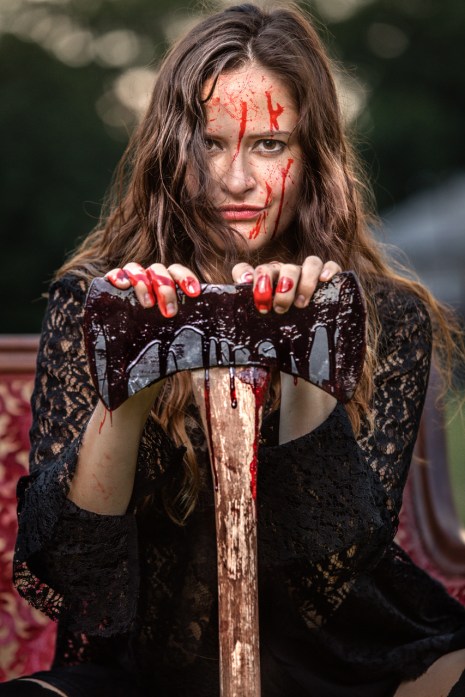
Credit Gerdy and her cast with finding ways to close the gap. Even with her hair up and confined by a full-length dress, Katy Shepherd remained volatile and spellbinding throughout Act 1, a seething cauldron of sexual and homicidal impulses. The pathologically buttoned-down Kristin Jann-Fischer seemed even more likely to snap in the early going as Emma, but Shepherd suddenly leapfrogged her when Emma left Lizzie alone with her parents. Previous productions of Lizzie have established splatter zones in the theaters where they have played – and a patch of comic relief as melons or pumpkins were hacked. Gerdy doesn’t go for that kind of gore, but when we saw Shepherd’s face smeared and spattered red, a radical change had come over her. It was impossible to say whether that change had led to the violence or whether taking in the spectacle of what she had done had triggered that change. Shepherd seemed equally stunned and liberated by the crime.

By the time we returned from the break, Lizzie had let down her hair and totally changed her look, lounging lasciviously on the only stick of furniture that Gerdy allowed on the floor of the set. With the Weird Sisters episode, we realized that bacchanalian delight and wicked diablerie could reach maximum depth. The shaken demeanor that Shepherd switched on toward the end of Act 1 morphed into evil leers and insane eyerolls in Act 2. While some might find Shepherd’s vocal exploits on par with her acting, I’d say they come fairly close, which is high praise.

My reference to Miss Danvers will be clear enough to anybody who has read Daphne du Maurier’s Rebecca or seen the Oscar-winning Hitchcock film. Yes, there was a Judith Anderson dimension to Shea’s performance as Bridget Sullivan as she prodded Lizzie toward catastrophe, and Shea seemed to haunt the Borden house far more than take care of it. She may have the best voice onstage, even if it doesn’t reach Shepherd’s stratospheric heights. Though she doesn’t evolve, she occasionally dominates. My suspicion about Alice Russell is that the writers didn’t consider changing her with the times. CiCi Kromah’s sweet, sweet performance might have seemed more satisfying back in 1990 – or certainly 1892 – when simply being an open lesbian could stamp you as a kind of small town outlaw. Today, Alice’s sincere love for Lizzie just struck me as a sentimental strain in the story, necessary as part of the sequence that triggered Lizzie’s homicidal rage but discarded afterwards during the crime investigation and Lizzie’s court trial.

Piloting from an electric keyboard, Borgnis drew searing vocals from the true lady outlaws onstage and the requisite smashing and slaying from her tight instrumental quintet, which unexpectedly includes a cello for those unexpected mellow moments. Best of the raucous vocal quartets was “Somebody Will Do Something” bringing us to intermission, but there were three or four of nearly equal power after we returned, including “Burn the Old Thing Up” and “Thirteen Days in Taunton.” Yes, it was noisy when everybody onstage was wailing and rocking, but Actor’s Theatre has always been savvy in measuring the difference between loud and deafening. Once again, they have it dialed in just right.

40 Whacks and Some Heavy-Metal Slaying

Preview: Lizzie

By Perry Tannenbaum


When we first learn about Lizzie Borden, it’s through an antique schoolyard rhyme, and there’s no doubt. Miss Borden was an axe murderer – and not a dainty one. Forty whacks for Mom, a pause for reflection… then 41 for Dad. But in the real world back in 1892, Borden was acquitted of the gory double murders that had happened at her home in Fall River, Massachusetts. And the actual number of whacks, for Lizzie’s dad and stepmother combined, was less than 30.

Notwithstanding the uncertainty of her guilt – and the poetic license taken in her song – Lizzie remains legendary and the prime suspect. But the action hero of a hard rock musical? Writer/director Tim Maner and songwriter Steven Cheslik-DeMeyer sorta had that idea in 1990. Putting together four songs and staging their experimental rock theatre production in SoHo, the duo originally called their confection Lizzie Borden: An American Musical.

Over the next 13 years, the work was reworked, fitfully revived, and workshopped. New songs were tacked on, the skeletal storyline was fleshed out, and Alan Stevens Hewitt joined the writing team. As the work grew to a full-fledged two-act musical – or at least a rock concert musical – the title continued to become leaner. Long story short, Lizzie is now rockin’ on the Queens U campus, transitioning from previews to its official Actor’s Theatre of Charlotte opening this week.

From its Borden beginnings, Lizzie has always featured four women in the singing roles. Aside from the legendary slayer, there’s Lizzie’s elder sister Emma, next door neighbor Alice Russell, and housemaid Bridget Sullivan. Actor’s Theatre is taking it way further – presenting an all-woman edition. The sextet of instrumental slayers joining the cast onstage at Hadley Theater will all be women. Ditto the design team, the choreographer, the music director, the stage manager, and the stage director.

Cue Joanna Gerdy. Despite her lofty reputation as an actress, co-founder of Chickspeare, and eminent teaching doyenne, Gerdy has strayed into crass and bloody musicals before, directing Little Shop of Horrors and Bonnie and Clyde. You might think that an actress lauded for her dramatic performances in The Miracle Worker, Macbeth and Our Town would be more powerfully drawn to Joan Baez than Joan Jett.

You’d be right. But the slashing score of Lizzie still grabs Gerdy.

“I love the music in this show,” she gushes. “And what’s not to love? Think Heart, Joan Jett, The Runaways, Stevie Nicks…you get the idea! Lizzie runs the gamut from catchy melodic storytelling, to outrageous punk rock anthems, to evocative ballads. There are head-banging moments juxtaposed with gut-wrenching stillness. There are lyrics straight out of Macbeth, and in fact, a Weird Sister vibe throughout.”

The skip-rope song was all that had ever grabbed Gerdy about Borden when Actor’s Theatre artistic director Chip Decker asked her to take the reins. She was happy to find that the familiar rhyme starts off the evening, setting the creepy tone. But it still wouldn’t be worth the effort for Gerdy if things didn’t get serious before they got gory.

Lizzie unlocks the doors in the House of Borden, shows us what may have been going on behind them, and we can’t help but feel for this trapped, desperate, powerless girl,” Gerdy explains. “Women were living under a harsh Victorian moral code, and Lizzie Borden was likely trapped inside a house hiding even more heinous goings-on. For me, this play gives powerful voice to women in a time when they were often voiceless and powerless.”

So the biggest mystery that Lizzie will explore, with ever-increasing decibels, isn’t the question of if this New Englander committed these horrific crimes but why. What could have brought so much stress and pressure on poor Lizzie that there was only this path forward? Obviously, it will be an accumulation of actions and events.

“From the moment the audience walks in,” says Gerdy, “they should feel totally creeped out, unsettled, off-balance…that feeling that something bad is already happening, and it’s going to get worse. And when it does, it will rock your face off! As the story intensifies and the Patriarchy is smashed, the women are empowered to literally shed the trappings of their Victorian entrapment…and they become rock stars!”

Shedding a walking cane to play the role, Katy Shepherd can closely identify with Lizzie’s feelings of powerlessness. After splashing down sensationally in Charlotte, romping around ImaginOn in the title role of Lilly’s Purple Plastic Purse for Children’s Theatre, following that up with more grownup triumphs in A Woman of No Importance and Rock of Ages (her Actor’s Theatre debut), Shepherd’s sensational 2015 was followed by a nightmarish 2016. Stricken by celiac disease coupled with severe anemia, Shepherd underwent surgery five times, the last on December 29. The surgery before that had left her bedridden for a month – not even allowed to sit. Now that’s trapped.

“Every day I can walk, let alone perform, is such a gift!” Shepherd declares. “American Idiot [with Actor’s Theatre last season] was my first show back with a healthy body, and our wonderful choreographer Tod Kubo even remarked on how my dancing had even improved since our last show together. I feel so present and grateful being healthy, and any role that I play now will have a touch of that.”

Gerdy hadn’t met Shepherd before auditions and had no knowledge of her backstory. Knowing where Katy had come from to get there had nothing to do with why Gerdy was impressed. Seeing her in the moment was enough.

“Katy’s vocal power blew me away!” Gerdy remembers. “At the auditions, I found myself spending a lot of time watching what people were doing when they weren’t singing or performing. And that’s what tipped the scales for me: She was ALWAYS compelling, even, or perhaps especially, in the moments when she was listening and just being. She made me care about Lizzie and want to watch her, listen to her, and root for her. And those eyes! She can shift from vulnerable to vixen in the blink of an eye – literally.”

The spark for Shepherd comes from how different this supposed murderess is from her, the range of emotions she is called upon to project – and some pretty insane vocals.

“Every song is one to brace yourself for,” Shepherd warns. “This music delivers in a way I have never experienced before. From abuse, to murder, to seduction, to betrayal – it’s all there. And it all ROCKS.”

Nor is Shepherd through battering down obstacles that lie in her path. Taking on Lizzie, she had only three off days in July, and before rehearsing seven days a week until 10 or 11pm at night, she’s holding down a full-time day job teaching at Children’s Theatre’s summer camp. Gerdy has been keeping track, imagining the extra time Shepherd devotes to learning lines, absorbing the music, and refining her portrait of a legend.

“And she has done all of this during her first pregnancy!” Gerdy marvels. “She’s a force; I’m in awe of her, honestly, and am incredibly grateful to have had this opportunity to work with and get to know her.”

So we finally arrive at the question no journalist can shirk when confronting an esteemed actor who has penetrated into the deepest recesses of Lizzie Borden’s soul and lived there for over a month. To put it rather coarsely: Was Lizzie a lezzie?!?

“Considering that there are only women in this show,” Shepherd shoots back, “and you’ve always got to have a love story, I’ll let you do the math!”

“Book of Mormon” Remains Spectacularly Hilarious

Review: The Book of Mormon

By Perry Tannenbaum

It’s been quite a run for Mormons over the past 25+ years, beginning with the Pitt family in Angels in America in the early ‘90s and continuing with the Mitt run for the presidency in 2012. Queen City theatergoers had a front row seat for the upswell of Mormon topicality when Charlotte Rep brought Wendy Hammond’s cathartic Ghostman to town about the same time that Tony Kushner’s masterwork was wending its way from LA to London and then to Broadway.

Yet ironically, the most informative emanation from Salt Lake City – the one most fully unfurling the spiritual lineage of Mormon the prophet, the Angel Moroni, Joseph Smith, and Brigham Young – is the most mocking, irreverent, and satirical. Right on schedule for the Romney candidacy, The Book of Mormon hit Broadway in the spring of 2011, instantly affirming that South Park and Avenue Q, the previous successes of its writing team, hadn’t been flukes.

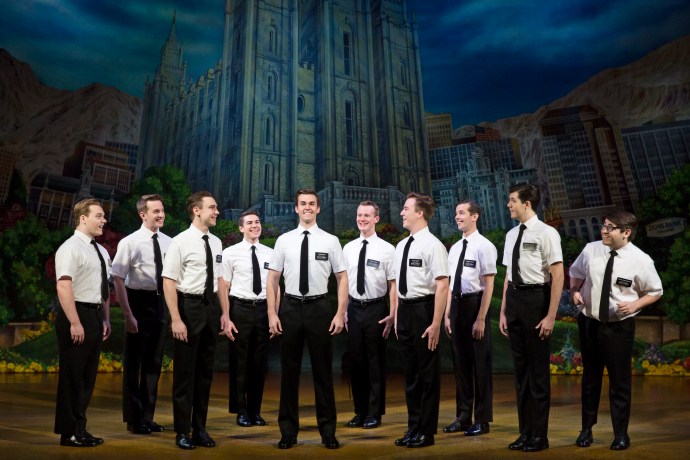
Still running strong at the Eugene O’Neill Theatre in New York, The Book of Mormon is now visiting Belk Theater for the third time in the last five years – and its freshness and outrageousness have hardly faded at all. True, the opening bell-ringing shtick of “Hello!” is starting to lose some of its original sharpness, and the sublime conceit and missionary confidence of Elder Price’s “You and Me (But Mostly Me)” has become less priceless as Romney’s run recedes into memory. On the third time around, the chief pleasure of the “Hasa Diga Eebowai” shtick and the running “maggots” gag is watching them work their vulgar magic on first-timers to the show.

Ah, but that leaves a profusion of vulgarity that still hit me hard on press night. What I see more clearly than ever is that the book of The Book of Mormon was an exuberant explosion of creativity in a writers’ room, when longtime partners in South Park crime, Trey Parker and Matt Stone, teamed up with Avenue Q whiz Robert Lopez for their first mega-collaboration, taking aim at a wondrously vulnerable target. Such a barrage of hilarity doesn’t seem possible from one man alone. This is a trio of jokesters feeding off one another while crafting a storyline that revolves around three fairly rounded characters. A mischievous “what else can we do?” mantra underlies everything.

The Mormon repressions of “Turn It Off” echo the juvenile Avenue Q simplicities of “Hello!” with extra bite, and the first act closer, “Man Up,” conjures up all the signature raunchiness – and bold tastelessness – of South Park. But here’s the thing: the three collaborators layer on a level of pretentiousness that is new to all of them. “Man Up” grows into an operatic trio before the curtain comes down for intermission. Singing over each other, the buffoonish Elder Cunningham primes himself to avoid screwing up for once, Elder Price wrestles with his first failure, and African ingenue Nabulungi longs for freedom, redemption, and Salt Lake.

We get a foretaste of the pretension to come in the illuminated proscenium evoking the stagecraft of Phantom and Wicked, but it doesn’t reach full flower until Elder Price’s “Spooky Mormon Hell Dream” fantasia after intermission, topped off with its caffeinated Starbucks symbolism. It’s funny even if you didn’t know that Mormons must abstain from coffee. So much of Act 2 click because of its generous infusion of Mel Brooks incongruity, which ultimately plunges over the edge of political incorrectness when we reach the anthemic “I Am Africa.” The whole bunch of youthful Mormon missionaries declare their identification with the squalor and barbarity of their new Uganda homeland.

Unable to stick to his missionary script with Elder Price’s verve and fidelity, Elder Cunningham, who hasn’t read any Bible, leans on the mythology of Star Wars, Star Trek, and Lord of the Rings to imaginatively make over scripture and convert the heathen. But perhaps the most irreverent desecration of hallowed culture is the takedown of R&H’s The King and I. Instead of darling Thai tykes performing an adorably distorted Uncle Tom’s Cabin, we’re treated to deluded Ugandans disfiguring holy writ in a playlet doused with lewd acts and ailments not readily associated with either Moses or Joseph Smith. We can see disaster looming as the Missionary President sits down to watch this spectacle, and we can’t wait.

Connor Peirson is as shambling, slovenly, and clingy as any Elder Cunningham we’ve seen before. What sets this pudgy wonder apart are his lightning-fast dance moves, limber feats that disdain gracefulness. His unabashed nerdiness marks him as emphatically as his untucked, wrinkled shirt. His initial puppydog worship of Price and his suggestive shyness toward Nabulungi in the modestly veiled baptism scene would both be so precious and adorable were it not for Pierson’s intractable disorderliness. In the end, it really does take a giant leap of faith to believe in him as a religious leader.

And in the end, with the onset of humility, Kevin Clay as Elder Price turns out to be almost as good as he thinks he is. He’s a bit blander at times than the Romney and Rubio types we’ve seen previously, but he is also the best dancer we’ve seen in this role. Breaking through to individuality in “Spooky Mormon Hell Dream,” Clay’s moves were the key to keeping the ornate nightmare absolutely fresh.

Although I found Kayla Pecchioni’s syllabification of “Sal Tlay Ka Siti” to be a work-in-progress that muted Nabulungi’s warm comedy, she came through nicely in both the mock tender Act 2 “Baptize Me” duet and the more broadly comical “Joseph Smith American Moses.” Other characters are cartoon thin, but there’s often enough there for an actor to excel. Andy Huntington Jones certainly capitalized on his chances as the semi-closeted district leader, Elder McKinley; Jacques C. Smith as Mafala radiated a sunny geniality leading the “Hasa Diga Eebowai” before lowering the boom on its profane meaning, and Corey Jones brought fearsome credibility to warlord General Butt-Fucking Naked.

Wielding the golden tablets handed down to mortals by the Heavenly Father, Ron Bohmer looks appropriately Mosaic as Smith in a costume designed by Ann Roth. If you’ve seen Charlton Heston in The Ten Commandments, you’ll recognize the wig that Bohmer gets to work with. Scenic designer Scott Pask achieves an Emerald City aura at Latter Day’s HQ in Salt Lake before targeting The Lion King for a vicious takedown with his squalid African village.

My most enthusiastic behind-the-scenes kudos are reserved for Casey Nicholaw, who co-directs with Parker and consecrates the spectacle with his zany choreography. Just when I began to find a nick or two in the comedy chassis of The Book of Mormon, the ensemble’s dance exploits helped me discover the polished chrome in the grillwork.


Earthbound “Newsies” Charms With Punk Hero and Youthful Fervor

Review: Newsies The Musical

By Perry Tannenbaum

It wasn’t long after music director Drina Keen cued the opening bars of Newsies that I already knew. This Disney musical fits the CPCC Summer Theatre program like a glove. Largely fueled by singing, acting, and dancing talent fresh out of college and grad school by way of regional Southeastern Theatre Conference auditions, CP’s youthful summer company is exactly what you want for a story about underpaid New York City newsboys who dare to strike against newspaper publisher Joseph Pulitzer.

Look at the scaffolding that rises across the stage at Halton Theater, representing the tenements where the raw, gifted Jack Kelly and his fellow newsies are holed up, and you might also suspect that Robert Croghan’s set design measures up well against those of the Broadway production and the national tour. Having seen both, I can add that Croghan’s costumes and Gary Sivak’s lighting also reach those lofty levels. Differences only begin to emerge when the ensemble of paper hawkers starts to dance.

Whether constrained by the limitations of his dancers or the liability limits of CP’s insurance coverage, Ron Chisholm’s choreography doesn’t begin to compare with the high-flying exploits that brought Newsies a best choreography Tony Award in 2012. I found it illuminating to see how that shortfall reverberated through the rest of the production. Music played by the CP Orchestra seemed less vibrant behind more earthbound dancers, draining the Alan Menken score of a bit of its punch. Even the Harvey Fierstein book seemed thinner, plotlines and characters less fleshed-out.

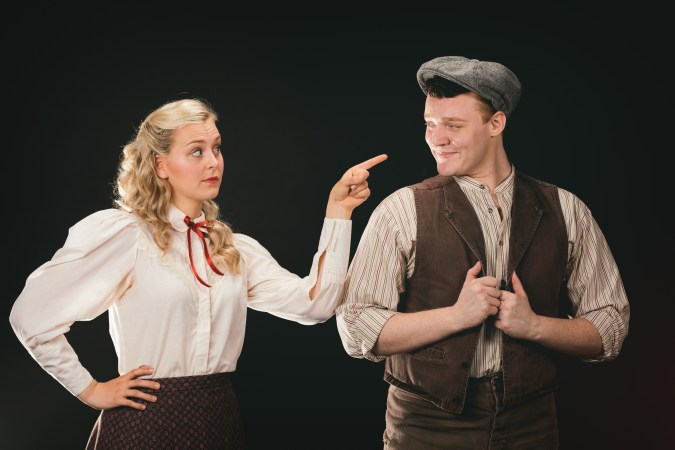
Of course, director Tom Hollis hasn’t trimmed the script, so I’d presume that first-timers may be surprised to discover how mature this Disney product truly is. Sure, the history of the 1899 strike has been tidied up and moved to Manhattan, while the financials are fudged to amp up the drama. Kelly has been installed as the single organizer and leader while Katherine, modeled on an actual newsperson who backed the strike, has been extensively re-engineered, predictably becoming Jack’s love interest.

Jack gets a Jewish newbie named Morris as a sidekick who handles the practicalities of organizing and publicizing the strike, another vague nod toward history; and up in his office, Pulitzer does entice Jack to recant his strike support with a tempting offer. Teddy Roosevelt, then Governor of New York, makes a couple of cameo appearances, adding extra period flavoring, though not nearly as crucial as cousin Franklin was in Annie.

Other factors come into play that could deflect Jack from plunging into full-bore labor agitation. At the top of the show, he and his crippled crony stand on top of their roof, mooning over an escape from the tenements to a cleaner life in “Santa Fe.” Later on, the police raid a newsie gathering and haul Crutchie (what else does a city kid call a crippled crony?) off to jail. Jack feels responsible – and he’s on the lam from the cops himself.

Above all else, our Jack has talent. He could become a visual artist or, more to the point, an illustrator at the newspaper he’s been selling all this time. Jack’s artistic aptitude and the introduction of Katherine are the chief alterations Fierstein makes to the 1992 screenplay by Bob Tzudiker and Noni White. You may shake your head a bit at the end after watching Jack take advantage of both of these exciting opportunities. He’s still waltzing off into the sunset as a newsboy.

With awesome gravity-defying dancing in the jubilant Newsies package, you might easily ignore this gauche resolution, but at Halton Theater, we must fall back on the excellence of Ashton Guthrie as Jack. C’mon, this is all about Jack, isn’t it? Happily, Guthrie delivers. I’ve been watching Guthrie on local stages since high school when he was the evil Zoser in Aïda (from Disney to Disney, right?), and I greeted him back then in 2009 as a triple threat to watch – and keep in Charlotte.

His command of all those skills is fuller now, and the professional polish of his Jack is a constant joy to behold whether he’s speaking, singing, dancing, or simply listening to others onstage. Smoothly, he combines the poise of a natural leader with the roughness of the streets, stirring in the rebellious hormones of a teen. Familiar with much of his past work, I had to chuckle a bit at his pugnacious punk mannerisms.

The elders are so good in this cast that I have to cite them as being the other key reasons why this CP production so enjoyable. Hollis gives every one of these vets free license to give performances that are a wee bit outsized. As Pulitzer, we find that Rob Addison adds a pinch of melodramatic villainy to the brass tacks businessman, and springing off Mount Rushmore as Teddy Roosevelt, Craig Estep adds a Jerry Colonna twinkle to the Rough Rider’s vitality.

Presiding over the newsies’ hangouts, Brittany Harrison and Jonathan Buckner bring us some Big Apple diversity, Harrison as a diva nightclub hostess and Buckner as a deli owner who opens his doors to the boys even when they’re nigh broke from striking. Among the newsie gang, only two pairs of brothers really stand apart to leave as much of an impression as Treston Henderson’s Crutchie. Jalen Walker is just slightly nerdy as Morris Delancey and Patrick Stepp is precociously adorable as little brother Oscar. Collin Newton and Alex Kim are the other bros, Jack’s most enthusiastic boosters and the staunchest militants in his roused rabble.

Looking quite serene and elegant in her prim business attire, Robin Dunavant does get to sketch out a modest storyline of her own, trying to prove that women can be serious journalists long before the suffrage movement prevailed. She’s cool to Jack’s advances at first. Only when she realizes that this déclassé Jack is an upstart labor agitator does she see him as a stepping stone toward professional respectability. And we eventually learn that Katherine isn’t a nobody from nowhere. So that’s why Fierstein has added on Jack’s talents! To justify her affections.

Whatever the right degree of warming up to Jack is required, Dunavant reaches it demurely. She could have turned up the heat a little without endangering Guthrie’s dominance, but this will do.

“Appropriate” Sports Multiple Meanings and Graveyards

Review:  Three Bone Theatre’s Appropriate

By Perry Tannnenbaum

Two graveyards flank the Lafayette home in southeast Arkansas, dating back to its antebellum plantation days. One of these cemeteries preserves the remains of the former owners’ family and the other, receiving less upkeep perhaps, the bones of their slaves. Yet it seems, as we become more and more familiar with the Lafayette siblings in Branden Jacob-Jenkins’ Appropriate, that there are also – figuratively, anyway – at least two more graveyards inside the home. And a malevolent ghost.

As the sibs gather at the old homestead, poring over their dad’s possessions a few months after the funeral, prepping the place for a scheduled auction and liquidation, it’s obvious that the home is a graveyard for blurred childhood memories that don’t align with each other. Old grudges and animosities rise freshly out of their tombs. Just as dramatically, there are damning objects buried among Dad’s salable possessions.

He could have been a virulent segregationist, a KKK member, or even part of organized lynch mobs. Or he could have merely been a collector of such grisly artifacts. Or they may have simply come down unnoticed from the original plantation owners.

Ambiguities abound, and in the Three Bone Theatre production now at Spirit Square, they aren’t shying away from the confusion. If anything, these tantalizing uncertainties are sharpened by director Sarah Provencal and her cast. On the title page of the playbill, definitions for “ap•pro•pri•ate” are offered for both the adjective and the verb, inviting us to be unsure about even how to pronounce the name of what we’re watching.

Thanks largely to Rachael, “Bo” Lafayette’s annoying and judgmental Yankee wife, and Franz his black sheep younger brother, we’re scrutinizing the inheriting generation as much as the deceased. Is the elder sister, Toni, showing her racist colors when she denies knowing of any evidence of Daddy’s bigotry? Or how about when she presumes that River, Franz’s fiancée, is Native American on the basis of her braided hair? Does it count as denial that Bo has been oblivious to the second cemetery outside?

Thanks again to Rachael’s stridency, we also occasionally wonder, as we sit watching this venal spectacle, whether we ourselves are too quick to judge, victims of our own prejudices. Certainly that is a strong component of Jacob-Jenkins’ intent. After we reach preliminary conclusions, we may have to recalibrate when we discover that more than a couple of these people are capable of keen reflection and insight.

What fascinated me even more was what none of the lively folks onstage perceived, for amid the squabbles, the stressing, the venting, the scheming, and the violence, Jacob-Jenkins is exploring what makes families tick or malfunction. The easiest part of all this to convey is the diverging narratives we build from different perspectives – as basic as I-was-there-and-you-weren’t in some cases – and from simple misperceptions, sometimes as simple as taking our eyes off the ball. Or a photo album.

These differences can explode. But more subtly, we can fail to communicate – or screw up when we try.

That’s why it’s tough for me to choose among the three most stellar – and introspective – performances currently on view at Duke Energy Playhouse. For sheer octane and horsepower, nobody surpasses Becca Worthington as Toni for keeping hostilities blazing hot. Toni hates everybody for leaving all the caretaking and dirty work to her (a staple gripe in family sagas like these), but despite all the venom she spews at everyone in sight, she’d like somebody to love her. Quite funny if you think about it, because Toni doesn’t come off as anybody’s doormat.

On the other hand, Leslie Giles actually seems to believe she’s in a comedy as Rachael, jarringly shrill in her perpetual alarm, taking offense so readily that she eventually earns it, and parenting as if every moment were a dire emergency. Things don’t go well between the chronically caustic Toni and the high-strung Rachael. You’ll strain to determine who’s more in the wrong – or more sincere in her self-loathing.

Of the two brothers, I find Franz far more significant, textured, and engaging than Bo. Yet you’ll see that Dan Grogan has plenty to chew on as Bo, trying to fix his siblings’ messes and get the maximum return on the family estate while maintaining peace with his virago wife. He treads fine lines with his steamrolling missus, who feels she has been targeted for anti-Semitic bias by Toni’s precious dad. Bo strives to prevent the inevitable explosions when Rachael pushes her sister-in-law’s limited patience too far. We probably dislike Grogan most for seeming so pragmatic, grounded, and occasionally spineless.
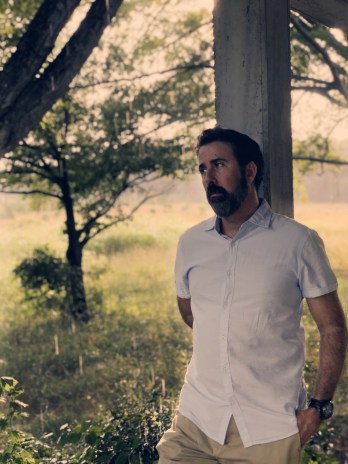
Home after many years of being on the road and out of touch, showing up months after Dad’s funeral just in time for the auction – with a youthful New Age fiancée on his arm who adores him – Franz is the object of suspicion, resentment, and envy. So why did I find myself liking him in spite of his past as a sexual predator? I guess I was as captivated as River was by his mellow, slightly dopey earnestness.

What drills down to the essence of Jacob-Jenkins’ dissection of family life are Franz’s repeated efforts at meaningful communication. Ignoring his sibs’ suspicions, Franz tells the family that he has come home to apologize to them, not completely sure he believes it himself. But he makes a big deal out it, clumsily reading a handwritten apology that is more than a cursory couple of sentences. Tim Hager gets the awkwardness of this man down to the bone, trying to believe he has finally turned the corner to personal redemption. Even more pathetic are Franz’s incoherent efforts to mentor his nephew Rhys – at a vulnerable moment when it might be more prudent to just leave the embarrassed teen alone.

Maybe well-meaning inarticulateness is Franz’s true inheritance from his father and the true reason why his life has so frequently jumped the rails. Very American, this Franz. We’ve had a couple of inarticulate presidents during this blundering century, one of them fairly likable. Hasn’t worked out so well.

The younger Appropriate generation does seem to include River, and all four of them seem to offer us rays of hope. Despite her hippy-dippy spiritualism, Joy White doesn’t gloss over River’s inclination to look after Franz’s financial interests, becoming a rounder, savvier adventuress than we first surmise. There’s a modicum of chemistry between Sean Riehm as Rhys and Siri Patterson as his cousin Cassie, Rachael’s daughter. Clearly, the teens’ parents worry about them more than is necessary. Jamey Helm completes the cast as Cassie’s younger brother, not so much bratty as speedy. His darting sprints from one end of the stage to the other heighten the overall sense of turmoil, clutter, and chaos.

You may be troubled by this Three Bone production, but you won’t be bored. Special perk: Jacob-Jenkins devises a stunning way to end a family brawl.

Lips Are Sealed on Whodunit at CP

Preview:  The Mousetrap

By Perry Tannenbaum

Between the time that Queen Elizabeth II began her reign and the official date of her coronation in 1953, another queen began her ascent to a regal London throne. Late in November 1952, Agatha Christie brought her murder mystery drama The Mousetrap to the Ambassadors Theatre. By the time the show transferred to the larger St. Martin’s Theatre in 1974, Dame Agatha had long since worn the crown for the longest running show in London’s fabled West End – for both plays and musicals.

It’s been there ever since, making St. Martin’s a London landmark.

This week, The Mousetrap returns to CPCC Summer Theatre after a hiatus of 37 years. Paula Baldwin, who directs the whodunit, says she saw a production a few years ago in Mint Hill. Scarcely as popular in Metrolina as it is in the UK, productions have only appeared on the outskirts of Charlotte since the turn of the millennium, popping up in Davidson during the summer of 2004 and again at Fort Mill in 2008.

“I love the script!” says Baldwin. “The characters are well developed and they all have a secret. In many murder mysteries, the audience knows who the killer is and watches for the climactic moment, but in The Mousetrap, the audience makes discoveries as the characters do, and all of the characters appear to be guilty at one point or another.”

That includes Giles and Mollie Ralston (Andrew Tarek and Lisa Hatt), our hosts at Monkswell Manor. On a snowy night, after listening to radio reports of a murder and a police manhunt, the Ralstons welcome four anticipated boarders to their isolated guesthouse – plus two people they hadn’t bargained for. Mr. Paravicini (Charles Laborde) seeks shelter from the storm after his car has overturned in a snowdrift. That’s his story, anyway. After that, Detective Sergeant Trotter (Cole Pedigo) arrives to investigate, believing that the murderer is somewhere in the house.

Don’t bet against it. Nor should we assume that all the killing is over, especially since – hey, we’re back in the ‘50s, and it’s been snowing! – the lights and the phone might go out.

So is it murder and suspense that account for the uncanny success of The Mousetrap? Probably not. Nor is the notorious pact with the audience not to reveal the final plot twists unique to this mystery thriller.

Ticket sales aren’t completely on autopilot midway into the show’s 67th year. Marketing continues long after some might see its necessity. “The mystery lives on!” proclaims the current poster, evidence that somebody might be up late at night worrying about the future.

Truth be told, reputation and tradition are likely more pertinent to the endless run than mundane marketing. Next to Shakespeare and the authors of the Bible, Christie has sold more books than anyone one else in the history of the planet, the best-selling novelist of all time. We can safely declare that Dame Agatha benefits from a build-up of goodwill and adoration. Nor was the Queen of Crime a one-hit wonder on the stage. Productions of Witness for the Prosecution and Ten Little Indians are still done.

If there’s a secret ingredient to the success of The Mousetrap, it’s Christie’s charm.

“Agatha Christie had a lot of fun with this particular play and really pokes fun at murder mysteries with some of the dialogue and actions within the play,” says Baldwin when asked to detect its secret sauce. “I do think that seeing the show in London has become a tradition for tourists, very much like American tourists flock to see shows like Phantom of the Opera or Wicked when they go to New York. Londoners go to see the show when the cast changes or to take their children and later their grandchildren.”

Of course, 37 years after the last CP Summer Mousetrap, people who saw the 1981 production might just come back to refresh their memories – with or without kids and grandkids. Baldwin has no intentions of layering on any updates or retrospective condescension, planning to preserve the suspense built into the script and present the snowbound mystery as a period piece.

The new CP production will sport a not-so-secret sauce of its own, the 15th collaboration between Baldwin and LaBorde since the two met up at Carolina Actors Studio Theatre in 2008 in the CAST production of Foxfire. It was Baldwin’s Charlotte debut and LaBorde’s first acting gig after retiring from his position as principal of Northwest School of the Arts.

“I feel we clicked immediately,” LaBorde recalls. “We each liked the other’s professionalism and commitment to hard work on the process. She is quite firm but nice. She’s often been a strong positive character in shows we have done together – Foxfire, Metamorphoses, Death of a Salesman, To Kill a Mockingbird.”

Ah yes, but then there are all of Baldwin’s mean and nasty roles in Streetcar Named Desire, Who’s Afraid of Virginia Woolf? and The Actress. Maybe meanest of all was August: Osage County, where she usurped the leadership of the Weston family and yelled out at the end of Act 2, “I’M RUNNING THINGS NOW!”

LaBorde has directed Baldwin eight times, if we count Angels in America twice for Parts 1 and 2. Mousetrap really will be the first time in their professional relationship that Baldwin is turning the tables and running things.

“It has been an easy transition to acting for her and being bossed around by her,” LaBorde tells us, diplomatically. “I’ve had the good sense to learn my lines, do the blocking she gives me, and keep my mouth shut at other times.”

After getting cast by LaBorde as Blanche DuBois in Streetcar and Martha in Virginia Woolf, Baldwin couldn’t be blamed if she retaliated by casting LaBorde as Christie’s killer. But did she? Baldwin won’t say.

“Everybody is a suspect!” she exclaims.

We don’t get a full confession from LaBorde, either.

“Paravicini is a mysterious character to be sure,” he evades. “He drops in out of the storm unannounced, he speaks with a French accent – peppering his speech with oui’s, charmante’s, and even soupçon. But he has an Italian name, which he appears to make up on the spot. He is clearly worried about the arrival of the police, but his more obnoxious self gets the better of him and sets him in a battle of wits with the detective.”

Cross-examination proves to be fruitless. Even when we ask a trick question, how many people did Paravicini murder, LaBorde answers ambiguously. Asked whether there’s anything we will like about Paravicini, the wily LaBorde finally divulges some poop.

“He seems to have perverse fun with the subject of murder,” he says wickedly, “always a crowd-pleaser in an Agatha Christie play.”


Long Sufferings Redeemed by Pure Longings – and Bluegrass Music – in Bright Star

Review:  Bright Star

By Perry Tannenbaum

There are plenty of things you can carry in a basket, a handbag, or a satchel, but one of the last you might consider is a baby. Apparently, some moms have gravitated toward the idea without dire consequences. Moses seemed to turn out okay, and the pseudo-title character in Oscar Wilde’s The Importance of Being Earnest weathers the indignity on a slightly bumpy ride to comedy bliss.

In Bright Star, a rustic musical written by Steve Martin with Edie Brickell, Alice Murphy watches this inhumane transport just moments after she has given birth – despite her furious efforts against the more powerful men in the room. It’s the last time she sees the baby, and it becomes a moment that haunts and sours her life for a long, long time afterwards. As vivid as this image is by itself, Martin finds ways to make this satchel moment even more vivid afterwards.

Music and lyrics, mountain-and-bluegrass tinged, sustain this wide-arcing storyline, even if they don’t quite equal it. The way things work out for Alice resembles some of the less popular late Shakespeare plays – The Winter’s Tale, Cymbeline, and The Tempest – where there is too much suffering and regret spread over multiple decades for their happy endings to be giddy and gleeful.

We mostly see Alice during the two main crises of her story, both of them dramatic encounters with Jimmy Ray Dobbs. The first is when they meet in Zebulon, NC, in the early ‘20s, when he becomes her beau – until the spectacular baby-in-the-satchel catastrophe – and the second is after WW2, when they reconnect by fortuitous accident in Raleigh. Jimmy Ray is the mayor’s son, so we readily understand why Mayor Dobbs would object to Alice on greedy, plutocratic grounds. Daddy Murphy’s objections are harder to divine, but they seem virulent and religious. The cogs of Martin’s plot wouldn’t fall perfectly into place if Josiah Dobbs and Daddy Murphy weren’t briefly on the same page.

Daddy is a man of conscience. Mayor Dobbs is a rich politician. Huge difference ordinarily.

All the circles of misfortune begin veering back to bliss when Billy Cane, fresh home after serving in the war, shows up at Alice’s office, where she edits the prestigious Asheville Southern Journal. Even local icon Carl Sandburg finds it difficult to get published there, though Alice admits that Tennessee Williams shows some promise. If Billy can sufficiently polish up just one of the manuscripts he has brought with him, enough that it gets published in the Journal, it will validate him as possessing the gifts – and the individual voice – of a significant writer.

Bitterness has made Alice a stern judge. Yet because of her toughness she’s a valuable mentor if she believes in you. A weirdly powerful alchemy begins to brew as Alice offers Billy scraps of encouragement. It’s something to write home about, and Billy’s correspondent is Margo Crawford, the girl he left behind twice – to soldier in a war and to make his way in the literary world. Finding his voice will bring Billy back home. Improbably, Alice will follow, and she will find that this was the place she needed to be.

There’s plenty emotional territory for Audrey Cardwell to cover as Alice: genial hostess, tough-love mentor, and dad-crossed lover. Yet the only traces of charisma that I found was from the embittered, autumnal woman behind the editorial desk. Her other selves were relatively generic, never really vivacious, as if tragedy had tainted her slightly before it really struck. I liked Henry Gottfried more fully as the slightly naïve, slightly quixotic, slightly self-absorbed and oblivious Billy, an easier role to fill out.

In an old-timey, rusticated story the melodramatic dads played as well as the bluegrass music. John Leslie Wolfe as Daddy Murphy and Jeff Austin as Mayor Dobbs ably demonstrated that a wide spectrum of righteous, indignant, and utterly vile ranting can be plausible reactions to pure innocence. Against these intimidating infernos, the good folk were somewhat overshadowed, but you won’t find Patrick Cummings as Jimmy Ray, Liana Hunt as Margo, or David Atkinson as Daddy Cane hard to like at all.

Of these, I probably enjoyed Daddy Cane the most because he doesn’t take himself seriously up yonder in the backwoods. Allison Briner-Dardenne does well with Mama Murphy, the most conflicted person we see. Strewn through Martin’s story are several hard choices that folks get wrong, but while Martin is gracefully completing circles of love and birth that span decades, he also renders regret, forgiveness, reconciliation, and kindness in fine style.


Break Out the Mindless Nostalgia With CP’s Re-Engineered “Grease”

Review: Grease

By Perry Tannenbaum

People forget that Grease was a huge smash on Broadway for over eight years, the incubator for such hunks as Patrick Swayze, Richard Gere, Barry Bostwick, Peter Gallagher, Treat Williams, and that John Travolta guy. The 1978 film starring Travolta and Olivia Newton-John not only eclipsed the 1972 original, it radically altered the Jim Jacobs and Warren Jacobs book and score. By 2007, the last time it was revived on Broadway, Grease couldn’t be Grease without the two hit songs created for the movie, “You’re the One That I Want,” one of numerous #1 hits that John Farrar wrote for Newton-John, and Barry Gibbs’ “Grease (Is the Word).”

The result at CPCC Summer Theatre, with Carey Kugler directing that 2007 version, will often play like a blurred – or cut – version of the movie. Our summer romance at the beach with its poignant farewells, the second beginning devised for the show, now gives way to a third. Sandy Dumbrowski’s nemesis, Rizzo, is more like a spider lady than a tough punk. Stockard Channing delivered. Sandy’s quest to become part of the Pink Lady clique is forgotten, and there’s no climactic drag race when Danny Zuko reasserts his heroism behind the wheel of Kenickie’s Greased Lightnin’.

With one of the actors absent for the Sunday matinee, confusions compounded. Justin Austin smoothly replaced Aaron Coulson as Teen Angel, singing “Beauty School Dropout” to the disconsolate Frenchy, Sandy’s staunchest ally. But Coulson was also supposed to portray deejay Vince Fontaine at the high school sock hop. Touchy situation. Megan Postle, who terrorized one of Danny’s T-Bird chums as Miss Lynch, his English teacher, had to reappear as the fulsome emcee of the hop, and Ashton Guthrie, who was just learning the rudiments of guitar at the top of Act 1 as Doody (a pretty lame “Those Magic Changes”), now gets to sing Vince’s “Born to Hand Jive,” one of the best numbers in Act 2.

Unless you had recalculated based on CP Theatre Dept. chair Tom Hollis’s pre-show announcements, these were additional head-scratching moments.

Perhaps the most charitable way of looking at the Jacobs-Casey book, substantially overhauled by Allan Carr and Bronte Woodard for the film, is to presume that they were trying to flip Manhattan’s West Side Story into a vaguely Chicago comedy – if they had any idea of what they were doing at all. Otherwise, it’s hard to explain the botched, crisscrossed contretemps at the prom and the abruptly scheduled rumble between the T-Birds and the Scorpions that never happens.

Kugler never seems compelled to plug up any of the plot holes, so Philip Stock as Danny acts like a jerk without any qualms or hesitation. Stopping one time while making your exit doesn’t quite cut it. Robin Dunavant gets more to work with in baring Sandy’s heart – including twice as many songs – but with Danny wavering so capriciously in his affections, her “Hopelessly Devoted to You” feelings seem downright stupid. While Jason Estrada’s costume designs could be more rugged for the T-Birds, the megawatt blond wig he saddles Sandy with throughout her pre-makeover scenes (I’m not sure a single hair moves) made me wonder whether or not a beautiful teen lurked underneath.

Despite these teetering foundations, Stock does project a hard James Dean-like edge and – keeping in mind that this is Rydell High – a lean, sneering arrogance that recalls Bobby Rydell. There really are sparks when Dunavant finally crosses over from Sandra Dee-land to the leather-clad tramp that Danny wants, but the gulf between the two Sandys is so wide that it’s hard to shake the notion that her latter-day self is her creators’ wet dream. The masculinity takeaways from GREASE, that gangster toughness gets you girls and that unprotected sex is cool, are pure ‘50s bull, never questioned.

Amid Danny’s vacillations and Sandy’s pathological primness, the bitchy, predatory Betty Rizzo stands taller with the steadfast power of her slutty convictions. Don’t you dare feel sorry for her! Lindsey Schroeder further accents Rizzo’s outlaw chic with a self-assured swagger that gives her dominion over every scene she appears in, singing or not. The astonishing dancing jolts that Treston Henderson brings to Kenickie’s “Greased Lightnin’” are totally worthy of this spitfire Rizzo, his usual girlfriend. But the garbled speaking parts? Not so much.

Coupling and uncoupling are so unmotivated that the remaining T-Birds and the Pink Ladies threaten to devolve into stock characters. Among the guys, Guthrie as Doody is the only other gang member to leave an impression. Ava Smith as Frenchy is the only Pink aside from Rizzo that I could care a little about, but a beauty school dropout warrants a far more frightful wig. Outside the Pink clique we do better, with Alexis Harder showing some flair as Cha-Cha DiGregorio, the outsider dancing ace that Kenickie brings to the sock hop to spite Rizzo. Patty Simcox is no more scheming or manipulative than Rizzo, but Susannah Upchurch manages to make us dislike her chiefly for her wholesome veneer – and because she doesn’t seem to be enjoying her own wickedness nearly as much.

Fun-loving mindlessness is as much the word at CP as GREASE is. At Rydell High, you are so uncool if you can’t sustain enthusiasm through all the many ram-a-lam-a-ding-dong nonsense phrases that “We Go Together” provides for the ensemble at the end of Acts 1 and 2. The old folk at Halton Theater on Sunday, bobbing their heads to the beats until the lights came up, weren’t looking for any meaning at all in GREASE. They were looking for the sheer joy of youth, and they were finding it.


Three Nights of Resounding Sermons Hit Spirit Square

Preview:  God’s Trombones

godstrombones image

By Perry Tannenbaum

OnQ doesn’t usually perform at McGlohon Theater in Spirit Square, but when it does, it’s big, big, big. So shall it be, brothers and sisters, when God’s Trombonessounds big, doesn’t it? – comes wailing, praising, shouting, and testifying into town next week for a three-night run, beginning next Tuesday. Capping OnQ’s “Redemption Song” season 11, the cast is among the company’s biggest ever, with around 25 actors, singers, dancers, and musicians performing onstage.

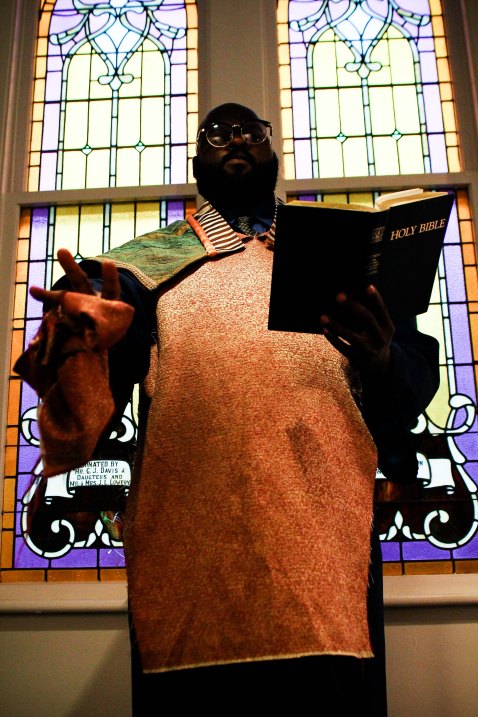
And if you’ve ever attended an event at McGlohon, or you know its recent history as the home of Pastor Stephen Furtick’s Elevation Church – or Spirit Square’s origins as the First Baptist Church – you’ll realize that OnQ has chosen the right place for James Weldon Johnson’s “Seven Negro Sermons in Verse.” McGlohon retains its stained glass, Sunday church vibe to this day.

Johnson was a seminal figure in African-American literature as a poet, novelist, essayist, critic, anthologist, songwriter, and collector of spirituals. Oh yeah, he also served as US consul in Venezuela and Nicaragua under Teddy Roosevelt and as executive secretary of the NAACP. He is best remembered for writing the lyrics to “Lift Ev’ry Voice,” for The Autobiography of an Ex-Colored Man, his novel, and for his most anthologized poem, “The Creation,” from God’s Trombones, first published in 1927.

OnQ artistic director Quentin Talley hasn’t wanted to present this classic for quite that long, but he has loved the piece since he was around 12 years old. That’s when his youth choir participated in a production presented by an association of black Baptist churches in his hometown of Greenwood, SC. It was one of Talley’s formative theatre experiences, and by the time he reached college age, it was foundational.

“I even ended up doing the ‘The Crucifixion’ as my dramatic monologue audition piece for Winthrop [University] and received a First Night Scholarship.”

In his original preface, Johnson said that he’d prefer his verse sermons to be spoken aloud – or “intoned” – so it’s natural that singing and dancing should be added to the package. Costuming will remind us where we are, a mix of pastoral robes, choir robes, and Sunday best.

IMG_0282

“We begin like we are in a church service,” says Talley, “and once the sermons build, we take on various locations and time periods. Our choir is absolutely amazing, and the audience will probably want to stand up, sit down and say amen. All are encouraged to do so, but it’s not mandatory.”

Leading the choir in his first stint with OnQ is Dennis Reed Jr., whose GAP singers have worked with such notables as Fantasia, Bebe Winans, New Kids on the Block, and Shania Twain. On this gig, Reed is also auditioning the singers, picking the songs, and penning the arrangements. So does Reed fire up his newly-formed choir with righteous gospel music played on a hallowed Hammond B3 organ?

“Hahahahaha!” Reed responds. “That’s correct! You’ll hear the B3, piano, bass, and live drums. Much of the black church tradition is rooted in live music. What’s really cool is that we are taking a little liberty with song choice. We will fuse traditional hymns, Negro spirituals, and even new elements of music such as hiphop loops! As far as choreography goes, we’ll see a lot of it come together in practice and much of it happens organically.”

Though he’s never worked with Talley before, Reed is a fan of his work. A proud grad of NW School of the Arts, Reed has numerous musician and singer friends who have collaborated with Talley and OnQ – and his ties to Charlotte are not at all tenuous. He founded Inspire the Fire here more than 15 years ago, when he was 17, to bring the arts to young people between the ages of 10 and 21, earning Community Leader of the Year honors at the 2015 Queen City Awards.

GAP stands for God’s Appointed People, so gospel music and God’s Trombones should as much up Reed’s alley as Talley’s.

Johnson pieced his sermon suite together using “vague memories” of sermons he had heard or collected, and their subjects are familiar church staples. The typical old-time Negro preacher, Johnson recalled, “preached a personal and anthropomorphic God, a sure-enough heaven and a red-hot hell. His imagination was bold and unfettered. He had the power to sweep his hearers before him; and so himself was often swept away.”

Aside from “The Creation,” the poet hearkens back to the Old Testament in sermons on Noah and Moses. Christian themes include the Prodigal Son, the Crucifixion, Judgment Day, and a non-scriptural funeral sermon.

“Each sermon will have a different approach,” Talley promises. “Most are recited, some acted out or sung, some are poetry slam form, but all have down-home preaching undertones.”

A mix of OnQ ensemble regulars – and authentic preachers – will deliver the sermons. Familiar OnQ faces will include Omar El-Amin for the Prodigal and Ron McClelland for the Crucifixion. Slam poet extraordinaire Bluz leads us aboard Noah’s Ark and Q himself orates “The Creation.” Preacher Yolanda Bynum launches the show with Johnson’s “Listen Lord” prayer, and Rev. Madeline Salder leans into “Let My People Go.”

Johnson intended us to hear trombones when his verse was read aloud – if they authentically replicated the preachers he heard in his youth. Listening to the trombone, Johnson heard expressive capabilities beyond any other instrument, approximating “the varied range of emotions encompassed by the human voice – and with greater amplitude.”

Of course, it’s fascinating that Talley, in reviving this Johnson gem, is hearkening back to his own youth, positioning himself to capture some extra flavors of its spirit.

“This show has been on our list for years,” Talley affirms, “but never really fitted with themes we’ve had in the past couple of years. With this season’s theme being ‘Redemption Song,’ it fit perfectly. As artistic director after 11 years of producing ups and downs, this show is a reminder to keep the faith. Running an arts org is taxing physically, emotionally, financially and spiritually, and sometimes you need a reason from a higher power to keep going, especially at the end of a season.”

Sometimes we also need to check out a worthy writer like Johnson who has unjustly fallen from his loftiest esteem, perhaps because he led the NAACP or perhaps because of the folksy, down-home flavor of God’s Trombones. Or perhaps because we prefer to say black or African-American instead of Negro. All these trivial reasons evaporate when you delve into Johnson with any depth.

You could start with The Autobiography of an Ex-Colored Man, or you might begin with Johnson’s actual autobiography, Along This Way. Here is something trenchant that he observes there:

“On occasions, I have been amazed and amused watching white people dancing to a Negro band in a Harlem cabaret; attempting to throw off the crusts and layers of inhibitions laid on by sophisticated civilization; striving to yield to the feel and experience of abandon; seeking to recapture a taste of primitive joy in life and living; trying to work their way back into that jungle which was the original Garden of Eden; in a word, doing their best to pass as colored.”

Now that’s not folksy at all, but it is the keen intelligence embedded in God’s Trombones. More than 20 years ahead of Norman Mailer’s The White Negro and Joni Mitchell’s “Woodstock.”

“Flying Lovers” Tops 2018 Theatre Offerings at Spoleto Festival USA

Reviews: The Strange Undoing of Prudencia Hart, Borders, and The Flying Lovers of Vitebsk

24877437748_a17647a75c_k

By Perry Tannenbaum

Theatre has gotten a looser, more guerilla feel to it at Spoleto Festival USA now that Woolfe Street Playhouse has established itself as one of the festival’s main venues. Unlike the storied Dock Street Theatre, where a flagship production gets 17 performances each season – plus a preview night – Woolfe Street can be reconfigured to accommodate cabaret and theatre-in-the-round presentations. For one-person shows, like a Taylor Mac extravaganza, it’s a better fit than the Emmett Robinson Theatre at College of Charleston.

So it figured that National Theatre of Scotland’s The Strange Undoing of Prudencia Hart would transfer from its off-Broadway haunt at the McKittrick Hotel to Woolfe Street with ease. There’s even a bar at the rear of the Woolfe, so the audience could self-lubricate in the same casual manner they did on W. 27th Street.

But somehow, it didn’t quite work.41872032304_9ec3a7fd92_k

They did apply the cabaret treatment in Charleston, but in New York, the vibe had been more like an Irish pub with sturdy rough-cut tables for the audience. The cocktail tables were smaller, but the larger dimensions and the higher ceiling at the Woolfe conspired to make even Peter Hannah, who repeated his off-Broadway stint as Satan, less audible and intelligible. Worse yet, Melody Grove and her starchy, autumnal, spinsterish charms weren’t aboard for the reprise, replaced by the youthful Jessica Hardwick, who diluted all three of those dimensions.

Prudencia’s starchiness is rather complex because, in her musty academic field of folk ballad studies, she’s a retro romantic. David Grieg’s fanciful script, written substantially in retro rhymed couplets, compounds the complexity by portraying the trendy men who dominate the academic conference Prudencia attends, spouting all sorts of deconstructionist quibbles with the ballads’ sincerity and authenticity, as rather backward in their patronizing, lecherous attitudes toward women.

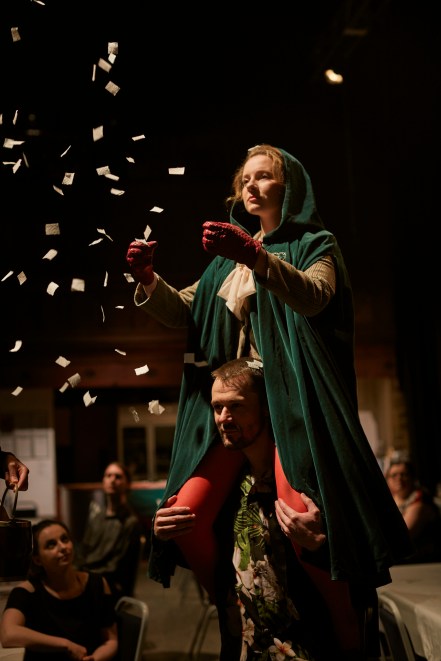
As a rebel against hidebound orthodoxy, Hardwick’s youth serves her well, but when a historic blizzard impacts the action, and the front door of an Airbnb turns out to be a gateway to Beelzebub and eternity, the poignant dimension that Grove brought to Prudencia – of a woman who has missed out on her life – gets buried. The snow, after all, is pieces of paper that the audience has shredded and tossed into the air, and the twilight zone where Pru departs overlooks a Costco parking lot. So comedy is muting the pathos of Prudencia’s strange undoing as well as the National Theatre’s spectacle – which includes a generous helping of bonny Scottish folksinging. At the critical moment that delivers her back to Costco, I missed the strong sense of Hardwick as a late-blooming flower in Hell.27724906267_9642754db7_k.jpgFor the second season in a row, I needed my wife Sue’s assistance in deciphering what Avital Lvova was saying onstage at Woolfe Street in a Henry Naylor drama. Last year, it was Angel, the story of the life and death of a Kurdish sharpshooter, where I was able to move closer to an empty seat near the stage and salvage some of Lvova’s performance. Lvova was back this year in Borders as another action hero, Nameless, a Syrian graffiti guerilla. No closer seats were available this time, so I struggled to comprehend even the basics of Nameless’s narrative as she lurked in a hoodie and thrashed on the floor in evasive actions.
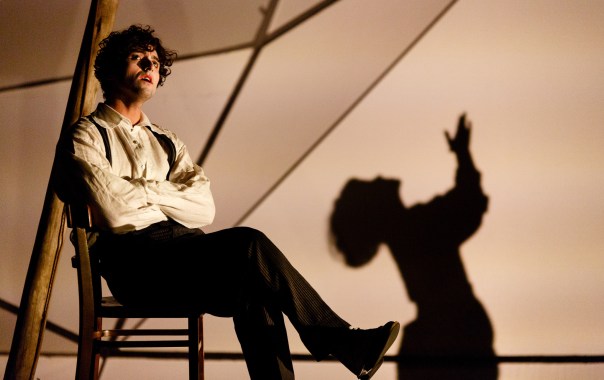
Abandoned by her father, raised by Mom, encouraged and deployed by a paint store patron, ambiguous relationship with boyfriend, unwanted pregnancy, and flight to safety. That was the gist I was able to catch unassisted.

Thankfully, Naylor provides a second narrative that alternates with the Syrian graffiti artist’s – and ultimately converges with it in a fraction-of-a-second shutter snap. If Lvova is showing us the desperate primitive lives of the noblest people enmeshed in the perpetual turmoil of the Middle East, then Graham O’Mara as celebrity photographer Sebastian Nightingale mirrors both the commercialization by the West of that endless strife and our smug indifference to it.

O’Mara, pretty tall and glamorous himself, gave a stunning account of this LA slickster who’s occasionally afflicted by conscience and remorse, maybe just enough to add the gravitas of a three-day beard to his image. Listening to Sebastian’s account, particularly his climactic confrontation with a burnt-out photog who had persisted in Syria, I had a taste of what Naylor’s dramas could be if they were adequately cast.

Directed by Emma Rice, The Flying Lovers of Vitebsk started out by bringing a wisp of nostalgic cabaret ambiance to Dock Street Theatre – eminently appropriate, because Rice had starred in the original production over 25 years ago when she and her newlywed husband, playwright Daniel Jamieson, portrayed over-the-moon lovers Marc and Bella Chagall. Marc Antonin as the beloved painter, entered the darkened theater from the rear serenading us and his bashert – Daisy Maywood, rapturously awaiting him as Bella.

The Kneehigh and Bristol Old Vic remount of what Jamieson originally titled Birthday sported an ultra-versatile band that included James Gow and composer James Gow. Cementing its kinship with Kneehigh’s Tristan & Yseult, directed by Rice at Spoleto in 2006 with bushel baskets of old music, Sophia Crist designed a severely raked set of weathered wood with scaffolding that didn’t look strong enough to hang either of the principals. Like the Chagalls’ love, its survival looked dubious in a storm-tossed world.24877435838_fabbc46c7d_kAll that separates The Flying Lovers from ascending to the pinnacle of towering drama are length, conflict, complications, and plot. Instead, the blissful couple navigates upheavals that decimate their obscure hometown (ironically best known today as Chagall’s birthplace) and threaten to incinerate the Jewish people. Pogroms, the Russian Revolution, and the Holocaust toss the couple back and forth across Europe until they reach the safety of the US. More vividly than these obstacles, we remember the purity of the love that binds Marc and Bella together. This love helps them to soar above the troubles of our world – higher, they seem to levitate, because there are no plots or complications pulling them down.

Both Antonin and Maywood cavort like newlyweds, often replicating those endearing, impossible, gravity-defying poses that Chagall painted of his love. They also sing with that simple, intimate sincerity ushered in by microphones, radio, Crosby, early Sinatra, and Margaret Whiting. Then you realize what distinguishes Chagall’s best work. It’s not the invention of surrealism, which is disputable. It’s the way that joyful music is forever singing in the colors and the flowing design of his paintings.