Category Archives: Theatre

Messing Up Asia, American Style

Review: Miss Saigon

By Perry Tannenbaum

06.MISS_SAIGON_TOUR_9_21_18_5953 r photo by Matthew Murphy“Un bel di,” Cio-Cio-San famously warbled at the 1904 premiere of Giacomo Puccini’s Madama Butterfly, yearning for the return of American Lieutenant Pinkerton from across the Pacific to honor their marriage vows and his responsibilities toward their son. Four score and seven years later, the scene shifted from Japan to Vietnam for Claude-Michel Schönberg and Alain Boublil’s Miss Saigon, where Kim sang, “I Still Believe,” yearning for the return of American Staff Sgt. Chris – for exactly the same reasons.

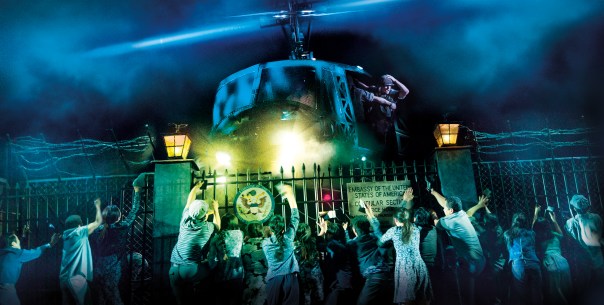
We haven’t seen a touring production of Miss Saigon at Belk Theater in over 15 years. In the meantime, a new production directed by Laurence Connor came to Broadway in the spring of 2017 and folded in less than 10 months. The two key players in the recent remount both had Charlotte connections. Eva Noblezada, who snagged a Tony Award nomination as Kim, won the 2013 Blumey Award at Belk Theater as the best actress in a high school musical. And playing The Engineer, the most electrifying of Boublil’s new characterizations, Jon Jon Briones reprised the role he had played in the low-budget, copter-less production that landed at the Belk in November 2003.

I had to wonder whether the Broadway revival of Miss Saigon had been so short-lived because of the changes Connor had made to the 1991 original or because of changes the show still needed.

08.MISS_SAIGON_TOUR_Thuy's death crop

In the heat of the Vietnam War and the fall of Saigon, both Kim and Chris had noticeably evolved compared with their operatic ancestors. Chris tried to take Kim with him as the Vietcong overran the capital. He sought to locate Kim after he returned safely to Atlanta, and he seemed honestly conflicted between his true love and his wife, Ellen. Kim had also evolved, no longer the shy, passive, pitiful flower Puccini immortalized. There was steel and ferocity in her: she’d murder the Commie who threatened the life of her son.

Yet in some ways, the 1991 Broadway musical was more primitive and insensitive than the 1904 opera.

Schönberg and Boublil were less respectful toward the culture of the Vietnamese than Puccini was toward the culture of Japan in Butterfly or China in Turandot. Except for the costumes and a brief wedding ceremony, there was hardly any indigenous culture in Saigon – and not a whiff of Asian music. Even the piety that Puccini dramatized in his Asian operas has vanished. Bar Girls that we notice in Saigon are scantily clad whores, usually spreading their legs when they aren’t face to face with a GI’s crotch.02.MISS_SAIGON_TOUR_2549


Love as a romantic concept is strictly confined to Kim, and the two Asian men who want her don’t seem to be familiar with the word. Thuy, who returns to Ho Chi Minh City as a conqueror after defecting to the Vietcong, views Kim as his rightful possession – and her son as a repugnant atrocity. Her protector is The Engineer, a slimy pimp who initially installs Kim in his sex stable as a virgin delicacy and subsequently views her and Tam, Chris’s American citizen son, as his passport to the USA.

The most nuanced aspect of Boublil’s book was the opposition he set up between Thuy and The Engineer. Clad in his military uniform, Commissar Thuy was the embodiment of the Communism we were battling to keep at bay. Devoid of warmth, tenderness and humanity, he was a totalitarian gargoyle. The Engineer, on the other hand, was pure venal enterprise, emblematic of the insidious corruption that American capitalism always leaves in its wake.

It was horrifying – and strangely exhilarating – to see how totally The Engineer had absorbed our perverted values in his climactic showstopper, “The American Dream.” Part of the reason that Americans came home feeling that the Vietnamese hadn’t been worth fighting and dying for, after all, stemmed from the unsavory effects of our being there and spreading our influence.

Well, the new Miss Saigon didn’t show me any more empathy toward the Vietnamese than before, nor any more of their indigenous culture. If anything, The Engineer and his Bar Girls seemed raunchier, more mercenary, and more degraded than I had remembered. Downsized to more realistic proportions, Red Concepción’s portrayal of The Engineer is more quietly servile and less flamboyant than Joseph Anthony Foronda’s was in 1997, the first time a prop copter landed at the Belk. So when Concepción suddenly breaks into his “American Dream,” the fantasy isn’t just what The Engineer’s life will be on richer USA soil, it’s also a fantasy about who he will become.

05.MISS SAIGON. Company. Photo Matthew Murphy and Johan Persson (2)

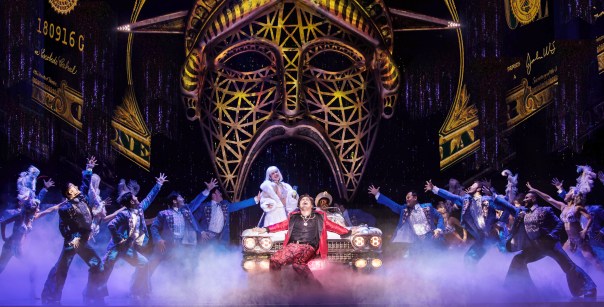
Yes, the copter is back on the Belk stage during the fall of Saigon for the first time in over 21 years, and so is the shiny Cadillac where The Engineer, humping the hood, has an orgasm during his fantasy. The years haven’t been as kind to Kim. We expect more of our female heroes nowadays, so killing a Commie no longer earns Kim an exclamation mark.

Working within the traditional Cio-Cio-San constraints, Emily Bautista is more assertive and less decorous as Kim, getting two duets with the “other woman,” outshining Stacie Bono as Ellen on both occasions. A generic belter, Bono makes Bautista look better than Andreane Neofitou’s bland costumes do. Sprucing up his script, Boublil has added a Trump slogan to The Engineer’s spiel and a Mormon to the rascal’s clientele. Maybe the latter is the inspiration for Adrian Vaux’s design concept, which brings a Third World squalor to Saigon and to Bangkok that reminds me of the Africa where the missionaries of The Book of Mormon were deployed.

Bautista brings the most beauty to Kim when she sings her lovely “The Last Night of the World” duet with Anthony Festa as Chris. Festa gives Chris more texture than I would have thought possible, making me wish that Boublil hadn’t taken Pinkerton’s rehab quite so far. Kim begins as a $50 gift from his best bud John, Chris’s PTSD is all about Kim rather than battle fatigue or horrific warfare. The bravest action Festa gets to perform is filling Ellen in on all he has hidden from her about that last night before he climbed onto the US Marines helicopter – and all the news he has just learned about his son.

Getting the word from J. Daughtry as John certainly doesn’t boost the drama. Another generic belter, Daughtry sings his “Bui-Doi” (“dust of life”) appeal for the stigmatized mixed-race children of Saigon’s streets as if he were a competitor on The Voice rather than a contrite vet in a poignant Broadway show. True, Daughtry came to life nicely later in Act 2, showing what he was capable of dramatically when John, Chris, and Ellen tracked down Kim and The Engineer, now refugees in Bangkok. Before receding into the ensemble (perhaps not as inconspicuously as he should), Jinwoo Jung was a malign force to be reckoned with as Commissar Thuy, especially when Chris wasn’t around in Saigon to protect Kim.

In fairness to the cast, conditions at the Performing Arts Center weren’t ideal for performing – or reviewing – a big-budget Broadway musical. Because of travel and load-in delays, the curtain time was rescheduled from 7:30 pm to 8:00. But the first notes of the overture weren’t played until 8:37, long after we had finally been seated. Intermission lasted over 32 minutes, so when Act 2 started, it was nearly 10:25, past the time when the show would normally end . Maybe that’s why the production fell short of my hopes when the curtain fell an hour later.

Or maybe, just maybe, the clock has struck midnight on a sob story that first opened on Broadway in 1900 as a one-act play by David Belasco. Instead of Belasco, or Puccini’s librettists, or Boublil looking into the heart of a Japanese geisha or a Vietnamese bar girl, maybe it’s time that this story was retold from an Asian viewpoint by an Asian writer.

Bound and Gagged in a Georgia Cabin

Review: Exit, Pursued by a Bear

By Perry Tannenbaum

IMG_9649

It’s been 28 years since I saw a murderous woman binding a man to a chair onstage, and I haven’t forgotten the spectacle of that near rape-victim turning the tables – and a spool of duct tape – on her would-be rapist. Maybe there were other instances after that stunning UNC Charlotte production of Extremities in 1991, one of the top five dramas I critiqued that year. If so, those action she-roes haven’t seared themselves in my memory the way that William Mastrosimone’s did.

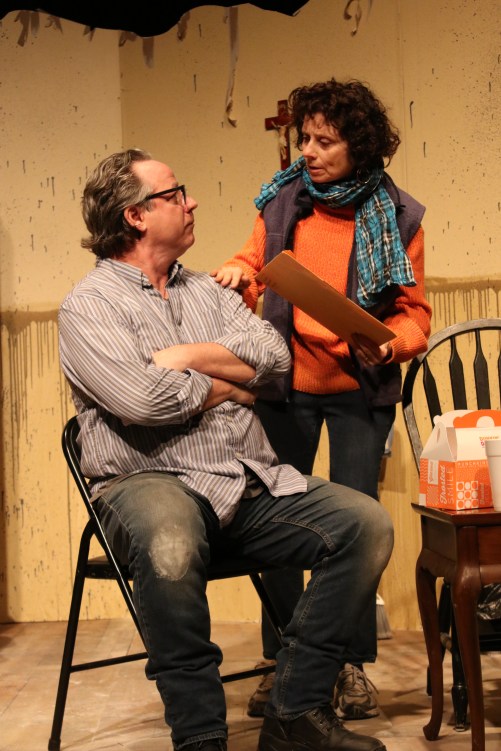
A trail of empty honey bottles greeted us outside the Warehouse Performing Arts Center storefront in Cornelius as we entered upon a similar scene in Exit, Pursued by a Bear, the new Charlotte’s Off-Broadway production directed by Anne Lambert. Once again, three people are deliberating what to do with the captive – Kyle Carter, who has abused his wife Nan for the umpteenth time. Lauren Gunderson’s 2012 play, subtitled “A Southern-Fried Revenge Comedy,” isn’t quite as intent on ratcheting up the tension.

Like Gunderson’s title, derived from Shakespeare, it’s complicated. Often cited as the Bard’s most outré – or hilarious – or expensive – stage direction, “Exit, pursued by a bear” occurs in Act 3, Scene 3, of The Winter’s Tale. The fleeing nobleman is the otherwise forgettable Antigonus, whose mauling is vividly reported a moment later by the curiously named Clown, a shepherd’s son, while the bear is still devouring its kill offstage.

IMG_9912

Nan isn’t intending to give her husband even that sporting chance at survival. She plans to abandon her secluded cabin in the Georgia woods and leave the doors open for any bear in the vicinity to enter. To hurry the process, Nan and her friends Simon and Sweetheart are adding inducements to make Kyle more aromatic and inviting. Some honey, of course, but here’s some luck: Kyle just killed a deer, so they can cut up some fresh meat and strew that around, too. Cool condiments!

Since Conrad Harvey as Kyle is already bound and gagged as we walk by with our tickets and drinks – hey, go ahead and take selfies with Conrad if you like – Gunderson is taking on two conflicting objectives when the lights come up. She’s painstakingly justifying what Nan is doing to her husband, and she’s striving to preserve the murderous unraveling of the Carters’ marriage in a comedy mold. Nan’s accomplices come in handy for both of these objectives.

Sweetheart is a stripper at a local bar who aspires to be an actress – or at least a movie star – and Kyle is Nan’s lifelong best friend. Since he is a bit of a queen in his Georgia Bulldogs cheerleading outfit, the stripper-transvestite combo is inherently comical as soon as it forms, if you’re not going to be offended by stereotyped affronts to political correctness and feminism. Part of the action, you must remember, is Nan overcoming her submissiveness and moving towards feminism. It’s a liberating leap.

IMG_9965

With Kyle as her literally captive audience, Nan will express the anger, frustration, and humiliation she has kept bottled up inside by playing out the key scenes that have pushed her to this drastic homicidal response. Since Kyle is indisposed – and hasn’t learned his lines – Julia Benfield as Sweetheart will step into the role of Nan’s husband in these flashbacks. Lambert has made a cagey casting choice here. Benfield is not only dwarfed by Harvey, you’ll see that Julie Janorschke Gawle towers over her as well. More built-in comedy.

Benfield is trashy in her cinched flannel shirt impersonating Kyle, and a fair amount of that trashiness appears to come naturally, but the more we get to know her, the more clearly we see that she isn’t a slut or a bimbo. With all the two-handed scenes in the flashbacks, you might worry that Simon is simply superfluous. But he’s more than a cheerleader. When Nan wavers, Simon is there to help shore up her resolve.

Not always the subtlest of performers, Ryan Stamey calibrates and balances his bloodthirsty zeal, his genuine affection for Nan, and his flaming outrageousness in such a precise way that he emerges as genuinely human rather than as a cartoon provocateur. With this kind of quirky support, Gawle can explore the serious depths that Gunderson explores in the Carters’ abusive marriage. Nan’s waverings are based in a pathological dependency that develops between an abused spouse and her abuser, ground into the rubble of crushed self-esteem.

IMG_9812

Gunderson also wants us to be ambivalent about the payback Nan is meting out, no matter how many Hollywood revenge flicks we’ve seen. As if he were on trial rather than passively listening to his sentence, Kyle gets his chances to speak and defend himself. More than that, he gets Nan to allow him a temporary reprieve from his bondage, so that he can re-enact the good times they had together before things went sour.

Harvey doesn’t mitigate the fact that Kyle is a boorish hayseed, but he also doesn’t hold back on the sincerity of “getting it” and his intent to be a better man. We’re apt to be a little torn, as Nan is, on the option of giving Kyle a second chance. Gawle is visibly affected by Harvey’s pleas, his evocations of past Kyles, and perhaps his newfound respect for the doormat who has risen up against him. So with the prospect of Kyle suddenly reverting to violence, there’s not only dramatic tension in the air but also multiple layers of give-and-take between Nan and Kyle, Nan and Simon, between the men and inside Nan’s heart.

Feminists will appreciate how this deadlock is broken.

IMG_0106

Gawle does everything right interacting with the other performers. She even gives herself moments when she ponders the enormity of what she’s planning – and to question whether she’s sufficiently calm to proceed after the suddenness and the adrenaline rush of what she has done and how it has changed her. One thing you might question is whether Gawle is as Southern or as trashy as Gunderson imagined her. Hang in there until Nan’s final scene, and you’ll likely see the rationale for the choice Gawle and Lambert have made in crafting her character.

Along with the cast’s work onstage, costume design by Ramsey Lyric, lighting by Sean Kimbro, and Jarvis Garvin’s fight choreography are all indicative of Charlotte Broadway’s professionalism. The only dodgy aspect of this production are the projections flashed on the upstage wall delivering stage directions when we reach Gunderson’s play-within-a-play segments. The lettering doesn’t exactly pop, and efforts to read them can draw attention away from the action. Maybe freezing the action might help solve the problem. Worth a try.

Otherwise, Exit, Pursued by a Bear is all-pro all the way. Consider yourself lucky if you can pursue and snag a ticket.

Two Iconic Singer-Songwriters Collide

Reviews: Nina Simone: Four Women and Ain’t Misbehavin’

By Perry Tannenbaum

With three new theater productions opening last week from Actor’s Theatre, Brand New Sheriff, and Theatre Charlotte – all sporting all-black casts – we have entered a Black History Month in Charlotte that is more about black history than ever before. Some of the African Americans who might be expected to show up for those auditions will be shining in the spotlight somewhere else this weekend as Children’s Theatre of Charlotte opens Bob Marley’s Three Little Birds at ImaginOn.

Unless you count university productions, we haven’t had more than one truly black theater production here in Charlotte during any Black History Month in the past 10 years.

So our Black History Month upgrade – and the stunning amount of local black talent necessary to make it happen – was definitely on my mind as I took in all of these shows. But a couple of times, in Actor’s Theatre’s tribute to Nina Simone and Theatre Charlotte’s Fat Waller revue, I found myself flashing back to January 2003.

That’s when a bi-racial Charlotte Rep production of Let Me Sing featured two black Broadway veterans, Gretha Boston and André de Shields, who boasted five Tony Award nominations and two wins between them.

Nina Simone: Four Women from Actor’s Theatre threw a new perspective on what are usually regarded as Rep’s declining years. The title role, calling for a passionate Black Power advocate and a charismatic singer-songwriter, would obviously benefit from the Broadway star power that Michael Bush, with his Manhattan Theatre Club connections, was able to lure down to our Booth Playhouse during Rep’s latter days.

De Shields was actually one of the original stars of Ain’t Misbehavin’ when it opened at Manhattan Theatre Club and took the Tony for Best Musical in 1978. So my thoughts naturally returned to De Shields, Rep, and Let Me Sing when Theatre Charlotte opened the Fats Waller musical revue two days after Actor’s opened their Simone musical. On this night at least, I had the satisfaction of recalling the Broadway star and feeling that our fair Queen City was getting along just fine without him.

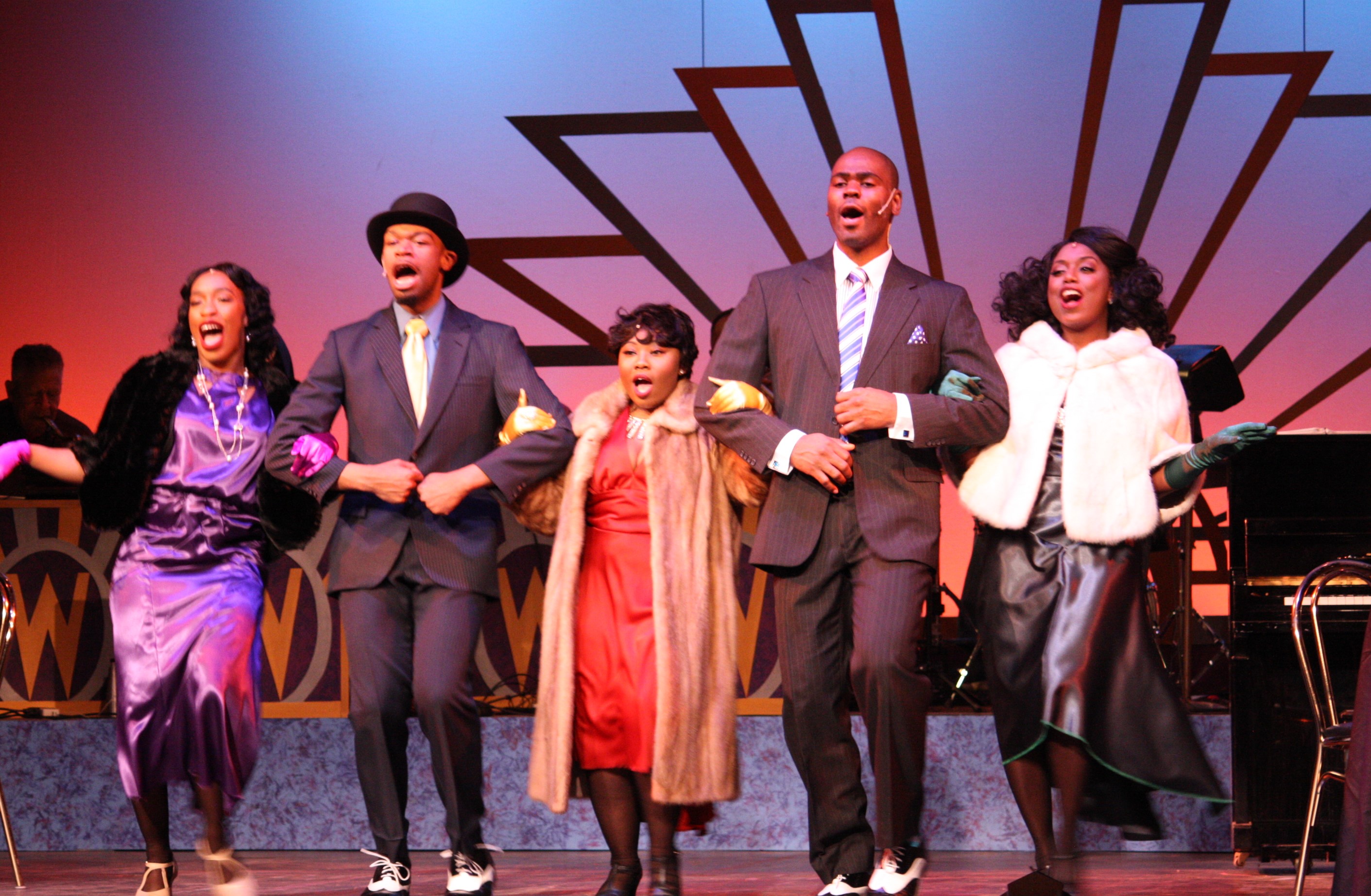
A lot of the credit goes to Charlotte’s own Tony winner, educator extraordinaire Corey Mitchell, who directs this sassy 94-minute show at the Queens Road barn. The cast he culled from auditions is consistently spectacular, whether they’re singing or dancing, but we also need to slice off some accolades to the seven-piece jazz band led by trombonist Tyrone Jefferson, featuring Neal Davenport at the piano. Kudos to choreographer Ashlyn Sumner: with some formidable talents to work with, she has stretched them.

Conceived by Murray Horwitz and Richard Maltby, Jr., Misbehavin’ goes about capturing Waller’s essence by culling the gems from his imposing oeuvre and preserving the pianist’s penchant for interpolating sly comments and wisecracks between his lyrics. Comical gems like “The Viper’s Drag,” “Find Out What They Like (and How They Like It),” and “Your Feet’s Too Big,” all score big. Adapting and orchestrating, Luther Handerson and Jeffrey Gutcheon usually go with the grain of Waller’s merry, mischievous recordings, but occasionally they go against it, slowing down “Honeysuckle Rose” and “Mean to Me” so they sound brand new.

Yet Waller also composed one solemn anthem that belongs in the same elite pantheon as Simone’s “Four Women” and Billie Holiday’s “Strange Fruit.” The introductory chords from the piano were all I needed to tell me that “Black and Blue” was on its way with lyricist Andy Razaf’s indelible refrain: What did I do to be so black and blue?

After delivering more than an hour of pure ebullient joy, it was a powerful question to ask. Lighting designer Chris Timmons dimmed his gels over Tim Parati’s funky nightclub set, Jefferson hushed the band, and Mitchell huddled his entire cast downstage where all five could look us coldly in the eye.

Never afflicted with obliquity. Waller and Razaf answered their own question: My only sin is in my skin.

Keston Steele has the most amazing voice in this cast, and it’s not just her range and volume. Steele may look small, but as “I’ve Got a Feeling I’m Falling” proves, this lady can g-g-growl! Best dancer is more of a toss-up. Look no further than Nonye Obichere kicking “How Ya Baby” if you’re looking for somebody startling and athletic. Tyler Smith is your man if your quest is for someone smooth and sensual.

Smith was the comedy showstopper – and the chief reason why De Shields can stay right where he is – delighting us with his stealth and style in “The Viper’s Drag,” but Marvin King was just as hilarious in the outright insulting “Your Feet’s Too Big.” Danielle Burke’s breakout moments were her mellow “Squeeze Me” solo and her bawdy “Find Out What They Like” duet with Steele.

The songlist is loaded with Fats faves that will get your toes tapping, including “Handful of Keys,” “The Joint Is Jumpin’,” “Fat and Greasy,” and “Keepin’ Out of Mischief Now.” Or you might get into the sway of “Jitterbug Waltz” and “Lounging at the Waldorf.” All in all, another insane overachievement for Charlotte’s community theater. Pass the reefer and the champagne!

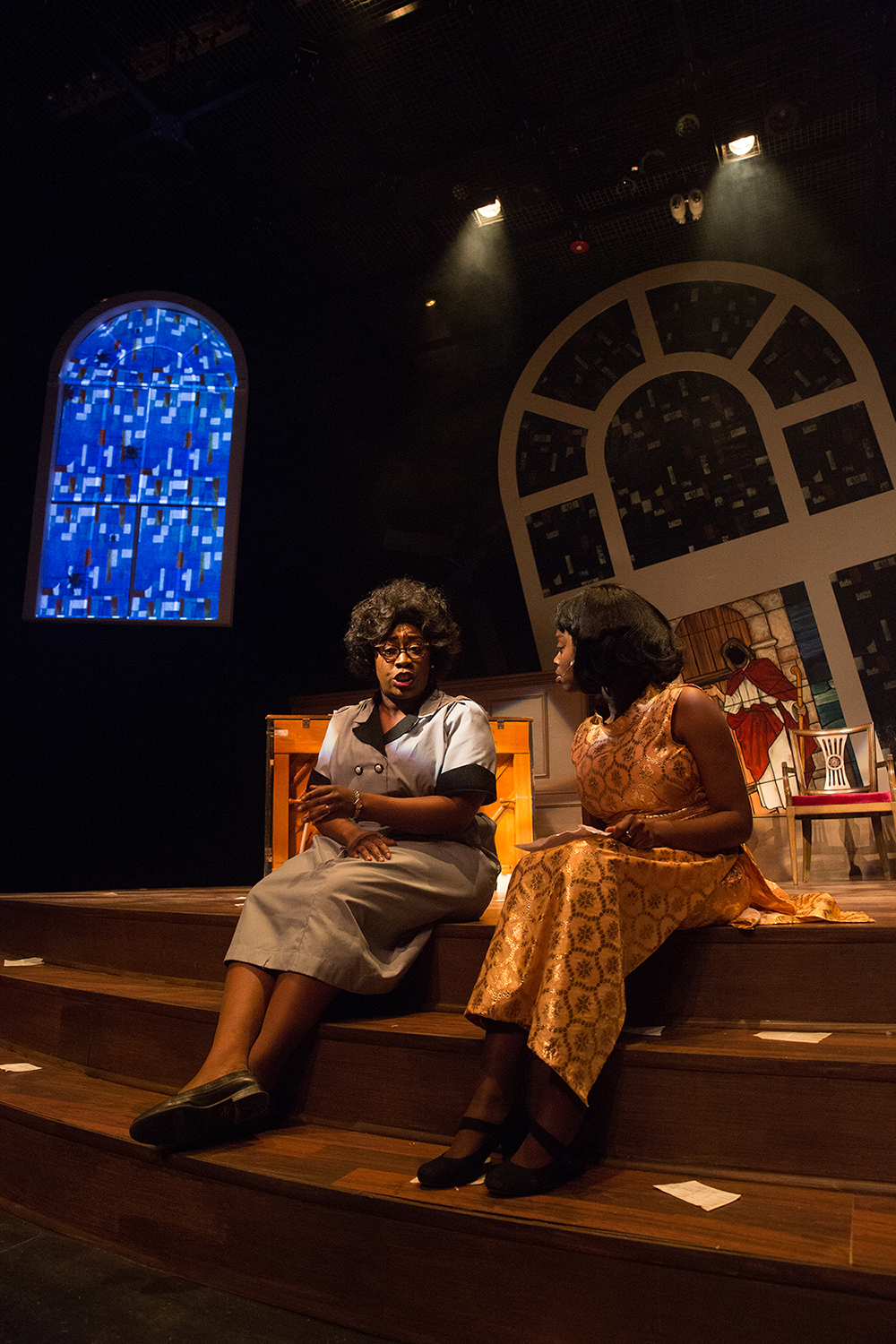
Production values at Hadley Theater looked like they would be up to the usual high Actor’s Theatre of Charlotte standard when we took our seats on opening night of Nina Simone: Four Women. Chip Decker’s set design for the 16th Street Baptist Church in Birmingham, Alabama, is colorful and impressive. And shifty: when Decker detonates his sound design, simulating the bomb blast that killed four black girls on September 15, 1963, the walls twist acutely to register the racist atrocity.

But after Lizzie and American Idiot, two arrestingly loud shows at ATC’s new Queens University home, this Christina Ham drama was often too soft-spoken to be clearly heard – even though I spotted the actors wearing head mics late in the 86-minute performance. That was a major element that can improve as the run continues.

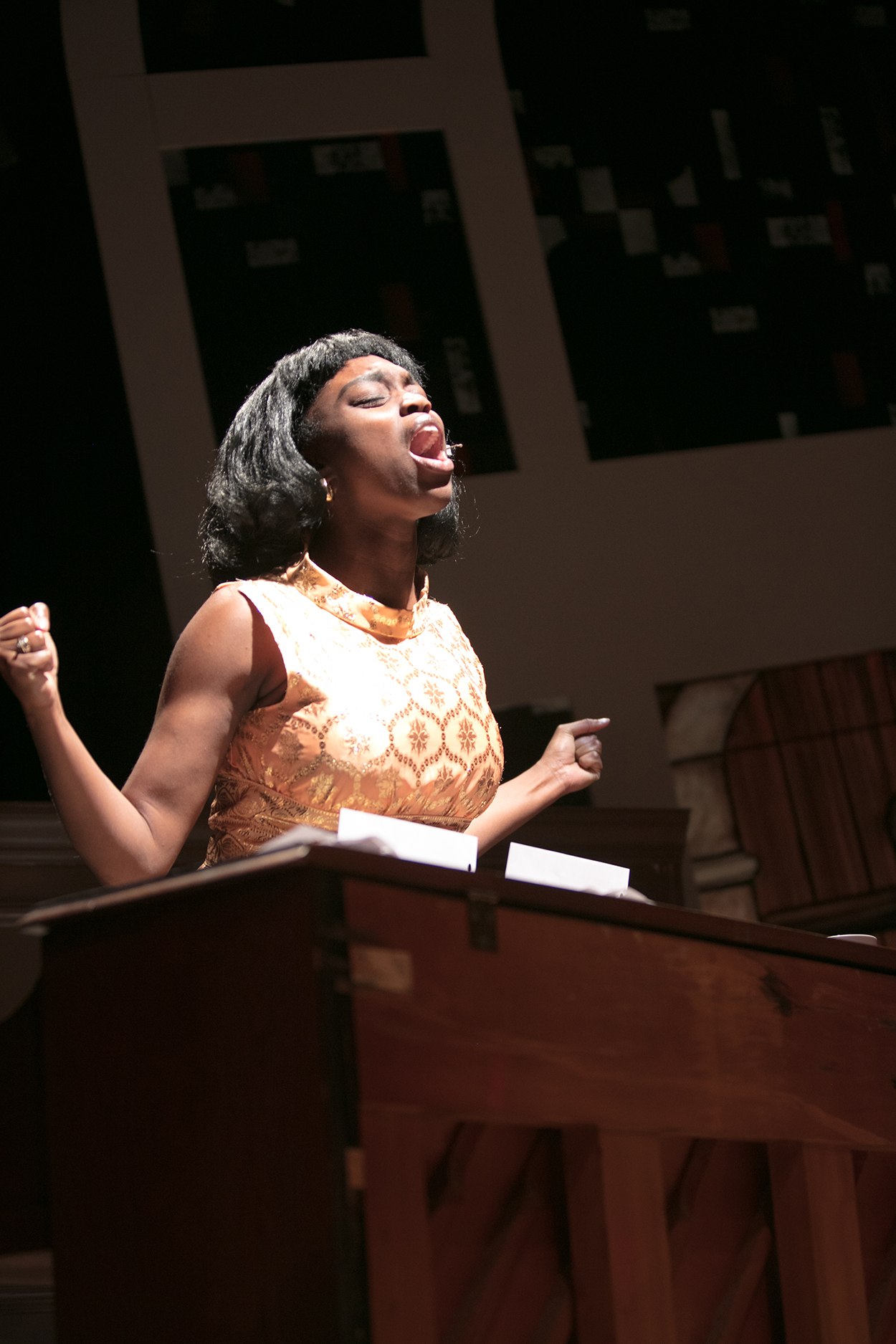
Shortcomings in Ham’s script and Chanel Blanchett’s stage direction are not so easily remedied. I’m sure the playwright didn’t intend to be insulting, but her scenario basically tells us that Simone went down to the 16th Street church, stationed herself defiantly behind the sanctuary keyboard with the intention of completing her livid protest song, “Mississippi Goddam.” While completing her response to the murder of Medgar Evers three months earlier in Mississippi, three of the women who would be immortalized in “Four Women” walked in off the street to take refuge from the violence still raging out on the streets of Birmingham.

Fate basically hands the songwriter one of her most revered compositions, if you take Ham literally.

I’m not sure that Blanchett wants us to take the story that way. Played with stormy intensity by Destiny Stone, Simone is already hostile and militant when she arrives in Birmingham. Nina’s urgent need to get her song finished only begins to catalog the reasons why she antagonizes each of the three women who walk in on her. Sarah is a humdrum housemaid who would rather pursue MLK non-violence than take Malcolm X action. Sephronia is a yellow-skinned socialite who doesn’t struggle at all financially like Sarah, drawing class hatred from the housekeeper for her money and scorn from Simone for her political aloofness.

Further stirring the pot is Sweet Thing, seething because she can’t have Sephronia’s fiancé though she can have his baby. This liquor-swigging streetwalker draws hatred and scorn from all quarters, for how she lives and for entering a holy place. Beware, though, she’s brandishing a knife.

Although the arguments are passionate, Blanchett blunts their sharpness, preferring to space her players rather than getting them in each other’s faces – until Arlethia Friday arrives as Sweet Thing. Stone, Erica Ja-Ki Truesdale as Sarah and Krystal Gardner as Sephronia often face us instead of the person they’re arguing with. Maybe Blanchett doesn’t really believe that Simone and the “intruders” are really there at the Baptist Church. Having these actors appear like they’re reliving the first play they ever performed in grade-school doesn’t solve the problem.

After all the verbal and physical combat, the title song breaks out. It’s surreal: all three women miraculously know their lyric and their order in the song. I’m guessing this dramatic flouting of logic will help distract us from the fundamental flip she burdens Stone with in portraying Simone. For 80 minutes, she has heaped hatred, anger, and scorn upon these women who are interfering with her creative process. Now she’s deeply empathetic toward them all, turning them into emblems of scarred, heroic black womanhood.

With 11 other songs along the way, there are sudden lurches as we move forward, cutting abruptly from argument to song. Stone’s singing, with pianist Judith Porter leading a driving quartet, is the show’s most human element as she channels Simone’s fire into “Sinnerman,” “Mississippi Goddam,” and the last of the “Four Women.” Stripped of the backup singers that sugarcoat Simone’s recordings of “Young, Gifted, and Black,” I liked the crispness of Stone’s even better.

Intensity was never Stone’s problem. What I was looking for was more arrogant self-assurance lifting her rage to a higher plane – a serene majesty that earns you the title of High Priestess of Soul. A few more leading roles, not to mention turning 30, will likely do the trick someday. Probably because she comes in toting a flask and a knife, getting the liberty to stagger around the stage rather than finding a mark and facing front, Friday’s Sweet Thing is the best acting we see. She isn’t Simone’s Sweet Thing until she sings her, but she’s closer to what Nina had in mind than Ham’s housemaid. Darting between the worlds of rock, jazz, blues, folk, and soul, Simone has eluded many who would find excitement and enjoyment in her music. Ham’s writing marshals key facts in this North Carolina native’s life into the dialogue but never really captures her soul. The songs in Four Women and Stone’s singing could be a gateway to that treasure trove.

BNS Productions’ “Two Trains Running” Runs at Full Steam With a Deep Cast

Review: Two Trains Running

By Perry Tannenbaum

DSC05592

Like all of the other plays I’ve seen in August Wilson’s epic Pittsburgh Cycle ­ and I’ve now seen nine of the 10 – Two Trains Running is about community struggle and personal redemption. Each of the dramas digs into one of decades of the 20th century, and after Brand New Sheriff began its Wilson explorations with Jitney and the 1950s, their sophomore effort at Spirit Square takes us into the turbulent 1960s.

With so much memorable social and civil rights upheaval in that decade, not to mention the horrifying Birmingham church bombing and the assassinations of Medgar Evers and MLK, it’s no surprise that community struggles are more at the forefront of this Wilson work than the others. As it was in the ‘50s, when we looked on the city through Jitney, Pittsburgh is continuing its predatory campaign to demolish the predominantly black Hill District in the name of urban renewal. After Becker’s gypsy cab depot in Jitney, the city is moving in on Memphis Lee’s Restaurant.

DSC05659

Another young man is returning from incarceration and trying start a new life – but not quietly this time. Sterling is handing out leaflets for an upcoming Black Power rally and befriending Hambone, a mentally handicapped person who was cheated years ago by the white grocer across the street. At the same time, Sterling is seeking out a job or at least a lead from everyone else he speaks to at the restaurant. Standing up for other black people cheated by a white system – and for himself – Sterling is clearly a powder keg that will soon go off.

Memphis estimates that he’ll be back in prison in three weeks. As the days pass and he sees more of Sterling, who grabs whatever he can, Memphis will revise that estimate downwards.

DSC05797

Sterling teaches Hambone a Black Power slogan, but Memphis isn’t so easily swayed. It’s the central issue for black people of that time, especially here in 1969 after the MLK murder. Do they wait patiently and peacefully for what is rightfully theirs, marching and petitioning to make their wishes known – or do they resort to the same kind of violence that kept their people down? Memphis insists on doing things the right way, holding out for a fair price from the city for his property, firing the craven lawyer who advises him to cave.

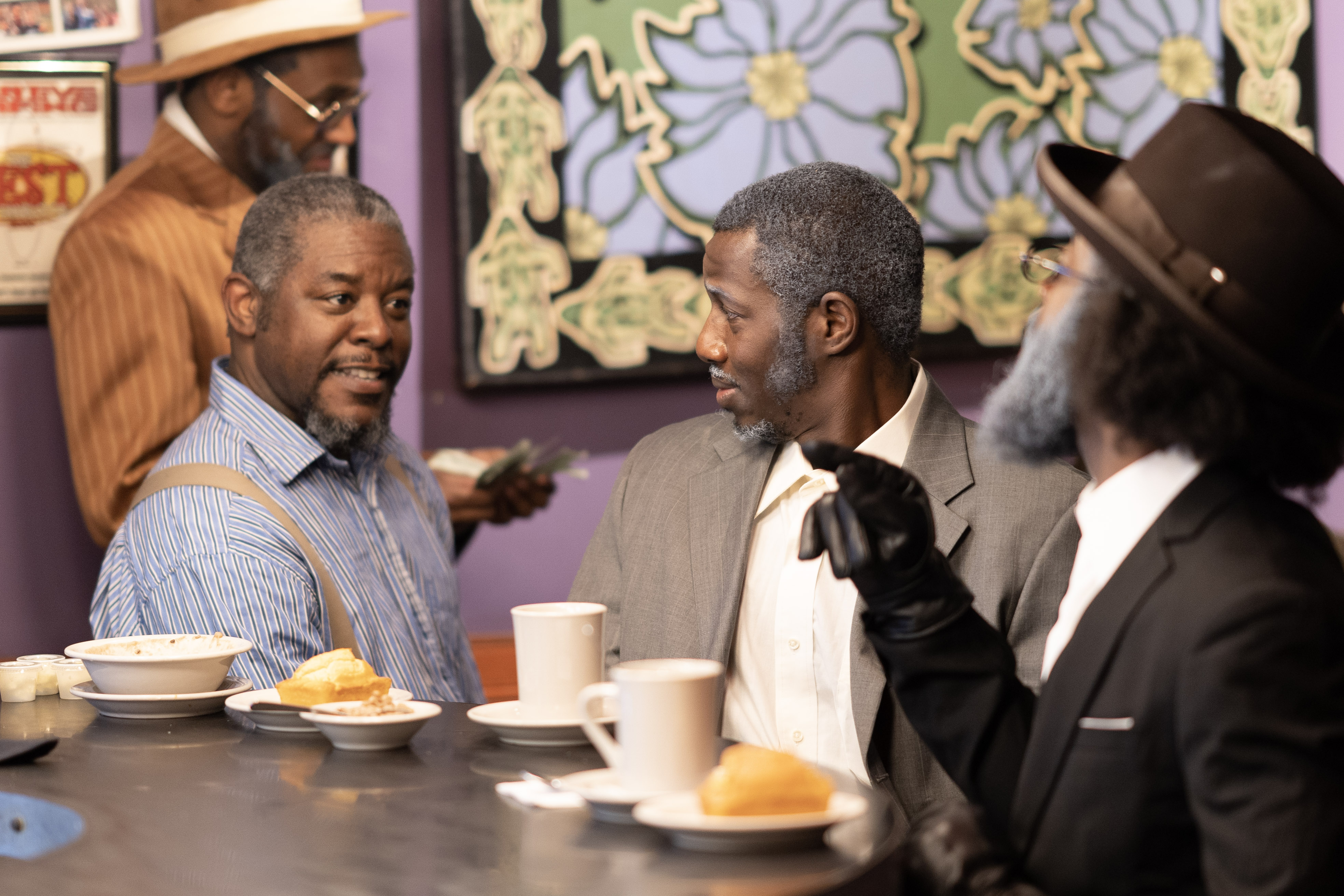
Looking at Memphis’s regular customers, you’ll find additional evidence that MLK’s ideas didn’t die with him. Nobody intends to join the rally. A more popular road to self-fulfillment is winning the daily numbers game at odds of 600-1, and it’s Wolf who haunts the place, taking all bets, often through unauthorized use of the restaurant’s phone. The sagely and cynical Holloway will play a number as readily as Memphis or Sterling, but to change your life, Holloway recommends a visit to Aunt Ester, the 322-year-old soothsayer who lurks behind a faithfully guarded red door in an alley down the block.

Risa, the troubled waitress who has scarred herself, disparages the men who throw their money away on the numbers. To her mind, they’d get a better return from their quarters if they just dropped them in the jukebox. Until recently, she’s been a follower of the Prophet Samuel, but currently her rock and redeemer is lying in state across the street at West’s Funeral Home. She has no desire to see the man in a casket, but Sterling goes through the long lines waiting to see the Prophet and snatches flowers from the site and presents them to Risa, whose head he’s trying to turn.

DSC05549

It’s another illustrative instance of Sterling flouting decorum and convention. Why should her qualms get in the way of enjoying a few beautiful flowers that would die and be trashed in the next couple of days if she weren’t caring for them? West certainly doesn’t notice or mind, Sterling maintains. It’s true. When West comes by every day, he’s looking for Risa to serve him another cup of coffee and Memphis to accept his latest lowball offer for the restaurant.

The parallel rituals are significant, two of the sparkplugs that keep Wilson’s drama humming. The grocer fends off Hambone’s daily demand for the ham that was promised to him, and Memphis refuses to allow West to steal his property away for a bargain price.

BNS and director Corlis Hayes, in their second Wilson outing at Duke Energy Theater, are getting really good at this. Although smaller than the design the playwright describes, James Duke’s set captures the spirit of the time beautifully, perfectly calibrating the restaurant’s waning appeal so that we see it as a warm, welcoming place. Or at least we can imagine it that way, for Tim Bradley as Memphis is not at all the deferential restauranteur, arguing with customers, barking at Wolf for running numbers on his phone, bragging about duping West, bossing Risa unnecessarily, and expressing general disdain for his lazy people.

That’s all very much on the page, so Bradley finds ways to keep us empathizing with Memphis. Hayes and LeShea Stukes have far more latitude with Risa as we watch the waitress going about her job and reacting to various advances. Stukes plays her as sullen and cynical, allowing Risa’s resentment of her boss’s scolding tone to occasionally surface. Seeing her smile late in Act 2 is like seeing the sun come out after fives days of stormy weather. By the time that happens, we may suspect that the jukebox being out of order is troubling Risa as much as Prophet Samuel’s death and her boss’s bossiness.

DSC05563

Devin Clark struts around as Wolf like an arrogant sleazeball, but there are more depths, contours, and vulnerabilities to him than the iconic Sportin’ Life as he talks about himself and strikes out with Risa. Ramsey Lyric’s costume designs certainly help Clark strut his stuff, but they also help us to chart Jonavan Adams’s progress in his portrayal of Sterling, fresh out of prison. Hayes and Adams have worked together before on Wilson’s plays, so they both know the strength, the brashness, and the seething frustrations of these strapping young men. Trust me, Adams’ work as Sterling is even more powerful and nuanced than his 2017 outing as Levee in Ma Rainey’s Black Bottom.

BNS continues to have admirable depth in their Wilson lineups. You can understand why Jermaine A. Gamble would gravitate to a role as salty as Holloway, whose sharp observations are mixed with a strong belief in the supernatural, expressed in an unwavering advocacy of Aunt Ester’s powers. Gamble makes Holloway a reasonable man, good reason for having this kind of restaurant around. He’s the neighborhood. But the disruptive Hambone, restricted to little more than one repeated line, wouldn’t jump out at you as a plum role to audition for. Dominic Weaver makes it one in a performance of astonishing intensity and authenticity.

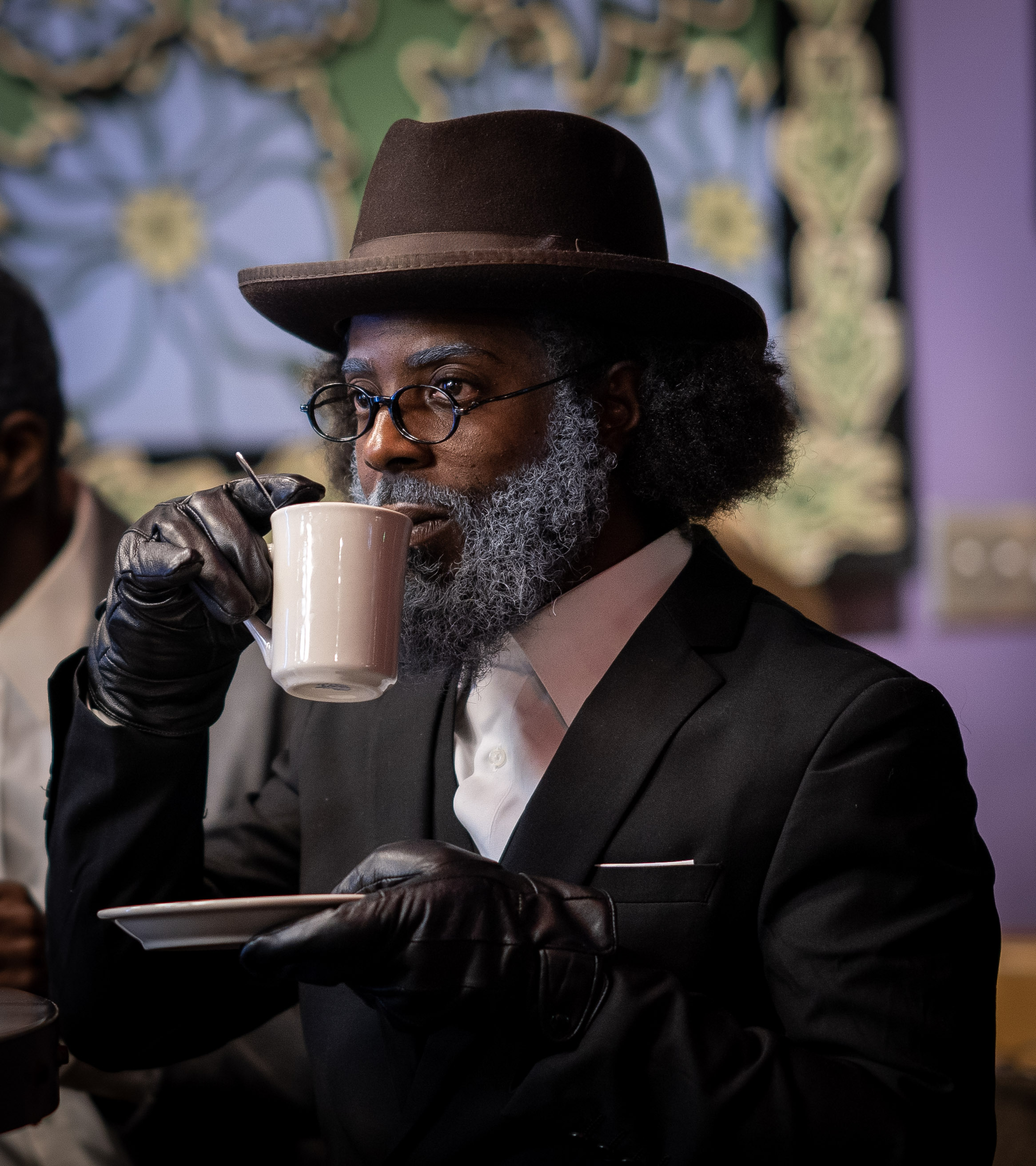
It was probably a group effort to make Weaver look so frightfully grubby as Hambone, but Lyric and Hayes draw my kudos for the sensation West makes each time he enters. Wilson prescribes that the undertaker is always dressed in an all-black outfit, including black gloves that he wears indoors, but designers only add a black hat in about half the productions I’ve tracked on YouTube – and none of them are as imposing as the formal chapeau Lyric chooses for Sultan Omar El-Amin. Hayes layers onto this formality, decreeing that El-Amin must meticulously spread a napkin across his lap at each sitting.

With such outré ammo, El-Amin steals each of his scenes without raising his voice to a level that might lead you to seriously suspect that he doubts his own power. By the manner he holds his cup and saucer, you’d think he was at high tea! From a man who has specialized in portrayals of angry, resentful, and mixed-up young men, El-Amin’s confidently restrained performance as an established 60-year-old widower is a stunner.

Two Trains Running at Spirit Square is a good place to climb aboard the complete Pittsburgh Cycle that BNS is planning to present in coming seasons. You won’t miss a thing because BNS is planning to reprise its previous production of Jitney in May. Then they plan to present Radio Golf, the final drama in the Cycle – and Wilson’s last completed play – next season. Two Trains is not the last stop, but you’ll need to catch it this week before it closes.


New Sheriff Greenlights a Complete Cycle

Preview: Two Trains Running

By Perry Tannenbaum

DSC05583

Rory Sheriff, the founder and producer at Brand New Sheriff Productions – and the author of two works staged at Spirit Square, Be a Lion and Boys to Baghdad – has a special affinity with the work of August Wilson. After presenting Wilson’s Jitney at Duke Energy Theater in 2017, BNS is back this Thursday with Two Trains Running, another drama from Wilson’s acclaimed 10-play Pittsburgh Cycle.

The special appeal of America’s pre-eminent black playwright for Sheriff is twofold – as a writer and as a Pennsylvanian.

“As a playwright myself,” Sheriff explains, “I am fascinated with August Wilson’s style of writing, more so the characters he writes about. Growing up in Reading PA, I can relate to every last character, situation and location he speaks about in Two Trains Running. The beautiful thing is I can now see and understand these people from an adult point of view. They are my dad, his friends, my uncles, my neighbors. I guess what I’m trying to say is I’m reliving my childhood through the works of Mr. Wilson.”

Each of the plays in Wilson’s Cycle is set in a different decade of the 20th century, and all of them are set Pittsburgh’s Hill District, except for one Chicago excursion representing the 1920s, Ma Rainey’s Black Bottom. The only play that predates Ma Rainey was the one Sheriff first plunged into, Jitney, which premiered in 1982 and represents the 1940s. By the time Two Trains, representing the 1960s, premiered in 1990, Wilson had already finished six of the plays in his Cycle.

So Sheriff has honed in on decades that his dad and uncles would recognize, but as he takes us back to the days of Malcolm X and the rise of the Black Panthers, Sheriff is promising that Two Trains won’t be his last stop.

“Yes,” he proclaims, “BNS Productions is committed to producing all ten of Mr. Wilson’s works. We will produce at least one of his works every season. Here’s an exclusive: We will be ending this season with Jitney, and next season we will be doing Radio Golf.”

This extraordinary announcement comes during an extraordinary launch of Black History Month, with three theatrical productions featuring black performers opening in the same week – making some unprecedented Charlotte history. While Theatre Charlotte is waiting until the first of the month on Friday to open Ain’t Misbehavin’, Actor’s Theatre is jumping the gun, officially opening Nina Simone: Four Women on Wednesday.

None of these productions is miniscule, testifying to the depth of black acting and musical talent across the Queen City. So the time is ripe for Brand New Sheriff to be making bolder, more confident and ambitious plans.

Sheriff is definitely packing some high-powered ammunition onstage for Two Trains.

DSC05863

“All of the actors in Two Trains Running have been in at least one Wilson play,” says Corlis Hayes, who will direct. Hayes is no slouch herself. Combined with the four she has directed at CPCC, where she teaches in the drama program, Hayes has now directed six of the 10 Pittsburgh plays, including the two Pulitzer Prize winners, Fences and The Piano Lesson.

Like Jitney, the action in Two Trains Running takes place in a building slated for acquisition and demolition by City of Pittsburgh. The wrongheaded concept of urban renewal evidently had a cancerous grip on black community life for a long time. Here it’s a restaurant rather than a gypsy cab company facing its doom, and the restaurant owner, Memphis, is our protagonist. He’s holding out for a fair price on his property – against the lowball bids of both the city and the ghoulish, rapacious West, who owns West’s Funeral Parlor across the street.

DSC05592

Memphis also has some unfinished business back in his hometown of Jackson, Mississippi, where he was driven off his land many years earlier and not paid a dime. He’s typical of the black men in Wilson’s plays, struggling against a system that white society has rigged against them. Echoing that reality – or responding to it – men in both Jitney and Two Trains Running play the numbers, hoping that luck will supply the boost that honest work doesn’t.

Recently discharged from prison, another recurring Wilson motif, Sterling is trying to interest Memphis and his male customers in attending an upcoming Black Power rally. Jonovan Adams, who has performed in all the Wilson plays that Hayes staged at CP, will portray the restless, volatile Sterling. Activism isn’t his only pursuit: he asks everybody he speaks with for a job or at least a lead, and he’s persistently trying to make headway with Risa, Memphis’s troubled waitress.

DSC05659

Estranged from his wife, Memphis seems to have a blind spot when it comes to women. Debating with Holloway, one of his older customers, about why Risa has mutilated herself, Memphis labels her dangerous while Holloway sees her as searching for someone who will love her true inner self.

“I feel both of these men hit on some truths about Risa,” says actress LeShea Nicole, whose previous venture into Wilson’s world was as Vera in the On Q Performing Arts production of Seven Guitars in 2015.

“Dangerous is definitely not a word I would use to describe Risa, because she never resorts to violence or threats, but I believe she feels ruined from some form or forms of abuse that she encountered in her past that has caused her to shut down socially/emotionally and even distort her appearance. Risa may feel ruined, but not beyond repair. She seeks guidance and solace from Prophet Samuel, which, in my eyes, equals hope.”

Working on her second Wilson drama, Nicole is switching companies and directors. The legendary Lou Bellamy, founder of Penumbra Theatre Company in St. Paul, Minnesota, worked directly with Wilson on multiple occasions. Bellamy not only directed Nicole for On Q, he also directed her as an understudy for the Blumenthal Performing Arts production of The Mountaintop that played at Booth Playhouse in 2014.

In their first-ever collaboration, Nicole says that Hayes measures up.

DSC05797


“I am extremely pleased and energized with her process of directing,” Nicole says. “She’s well versed and makes it her mission to stay true to Wilson’s vision. Dr. Hayes allows actors to explore, find depth in our characters and tap into our creative freedom without jeopardizing the integrity of the production. It is a tricky balancing act that she masters effortlessly. Hayes’ extensive acting career truly makes her an ‘actor’s director’ which is wonderful.”

Whether it’s Prophet Samuel, who lies in state at West’s funeral parlor, or it’s hitting the numbers; whether it’s promoting a Black Power rally or gleaning wisdom from the mysterious Aunt Ester, a 322-year-old soothsayer; the people of Two Trains Running are seekers. The emphasis on ritual especially sets this play apart from other plays in the Pittsburgh Cycle, according to Hayes, but there’s still a common thread.

“Always with Wilson,” Hayes observes, “reunion and reconciliation with the past heals the wounds of the present, bridges gaps between loved ones, and clears the path for a promising future.”

Greek Gods Rock a Comeback

Review: The Lightning Thief: The Percy Jackson Musical

By Perry Tannenbaum


Photo: Jeremy Daniel

Take it from a very hairy satyr – or a prancing centaur: “The gods are real!” That’s the emphatic message Rick Riordan delivered to Percy Jackson, the hero of his young adult novel, The Lightning Thief, in 2005. Five years later, the best-selling saga became a blockbuster movie, and now – after a modest off-Broadway run in 2017 – Riordan’s demigod is on tour in The Lightning Thief: The Percy Jackson Musical, and Knight Theater is one of his first stops.

Joe Tracz’ adaptation of Riordan’s story leans more towards the book than the movie, and Rob Rokicki’s songs add a rocking dimension to Lightning, pushing Percy’s youthful voltage decisively into defiant adolescence – and away from the 12-year-olds who were the original protagonists. But that boost doesn’t compare with the jumpstart this new musical delivers for the Greek gods.

Photo: Jeremy Daniel

You need to remember that these mighty Olympians were already fairly passé in the days of the Roman Empire when Zeus’s name was changed to Jove and Odysseus became Ulysses. Revivals of the Greek gods by 20th century novelists and poets were about the potency of myth rather than the truth of religion – and Homer’s heroes were more likely to be the focus than the immortals on Olympus.

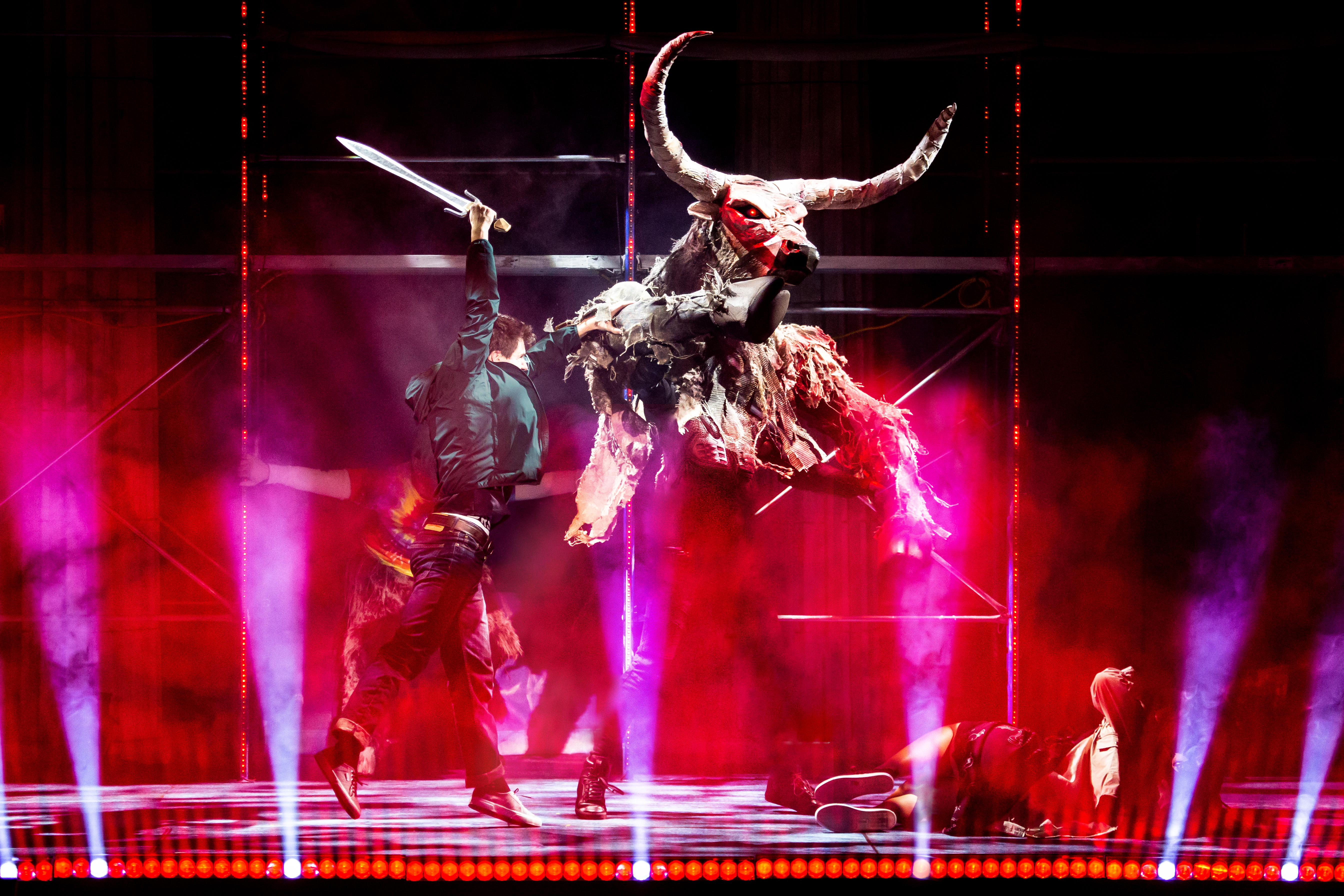
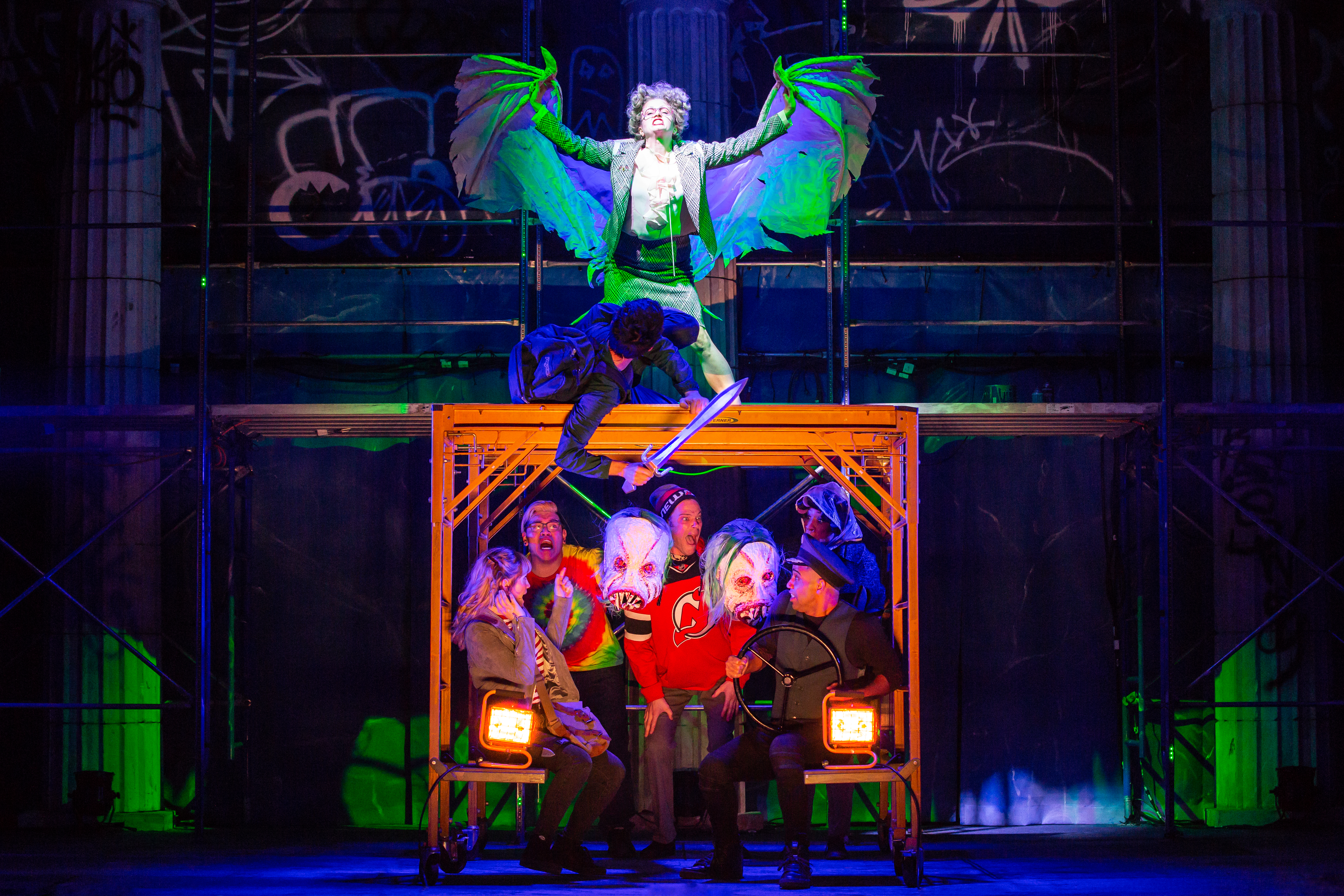
We hear some definite rumblings from Olympus before the action begins at Knight Theater. Before we learn that Zeus’s lightning has been stolen and that Percy is a prime suspect, the lad’s field trip to the Metropolitan Museum – yes, in New York – is punctuated by attacks from a harpy and a minotaur.

Yeah, a very mighty somebody is angry with Percy, and the kid really has a lot to learn. After he gets expelled from school, the long-overdue lessons begin. Mom breaks the news that Dad, if not a great parent, was and is unquestionably great. But before Sally can specify Percy’s divine lineage, his implacable pursuers strike again. Now in hindsight, I could second-guess Zeus and politely assert that it would have been more sensible for him to send a more articulate messenger than a minotaur to ask Percy where he’d hidden the damn lightning.

Photo: Jeremy Daniel

So be advised, action comic book logic often prevails here – which is not very much out of step with the illogic of Greek mythology. When Percy awakens from a coma three days later, he finds himself motherless and enrolled at Camp Half-Blood up in Long Island, together with other kids whose divine parents are equally neglectful. Needless to say, the animus bred among these teenage demigods by their absentee parents chimes well with the Rokicki rock score.

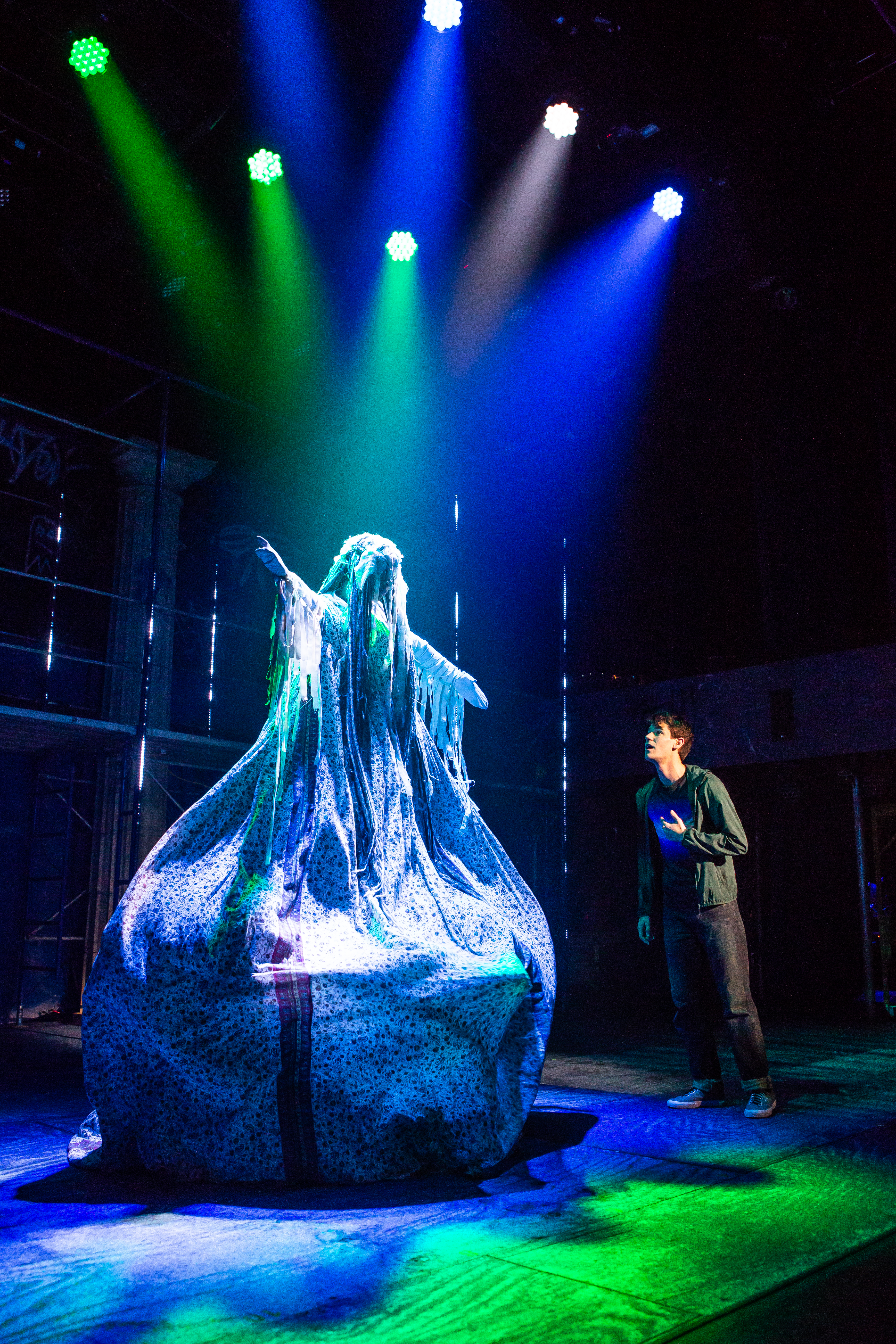
Percy is doubly different from the rest. Until deep into Act 1, he doesn’t know whose son he is. On a dark night, the revelation from Dad will be truly spectacular as Percy and his fellow campers look up in the sky and – amid the obligatory earthshaking tremors – see the god’s signature trident blazoned among the stars. Heavenly signs are the stuff you hear heroes speak about in plays by Aeschylus, Sophocles, and Euripides, a dramatic effect that Shakespeare shrewdly revived.

Photo: Jeremy Daniel

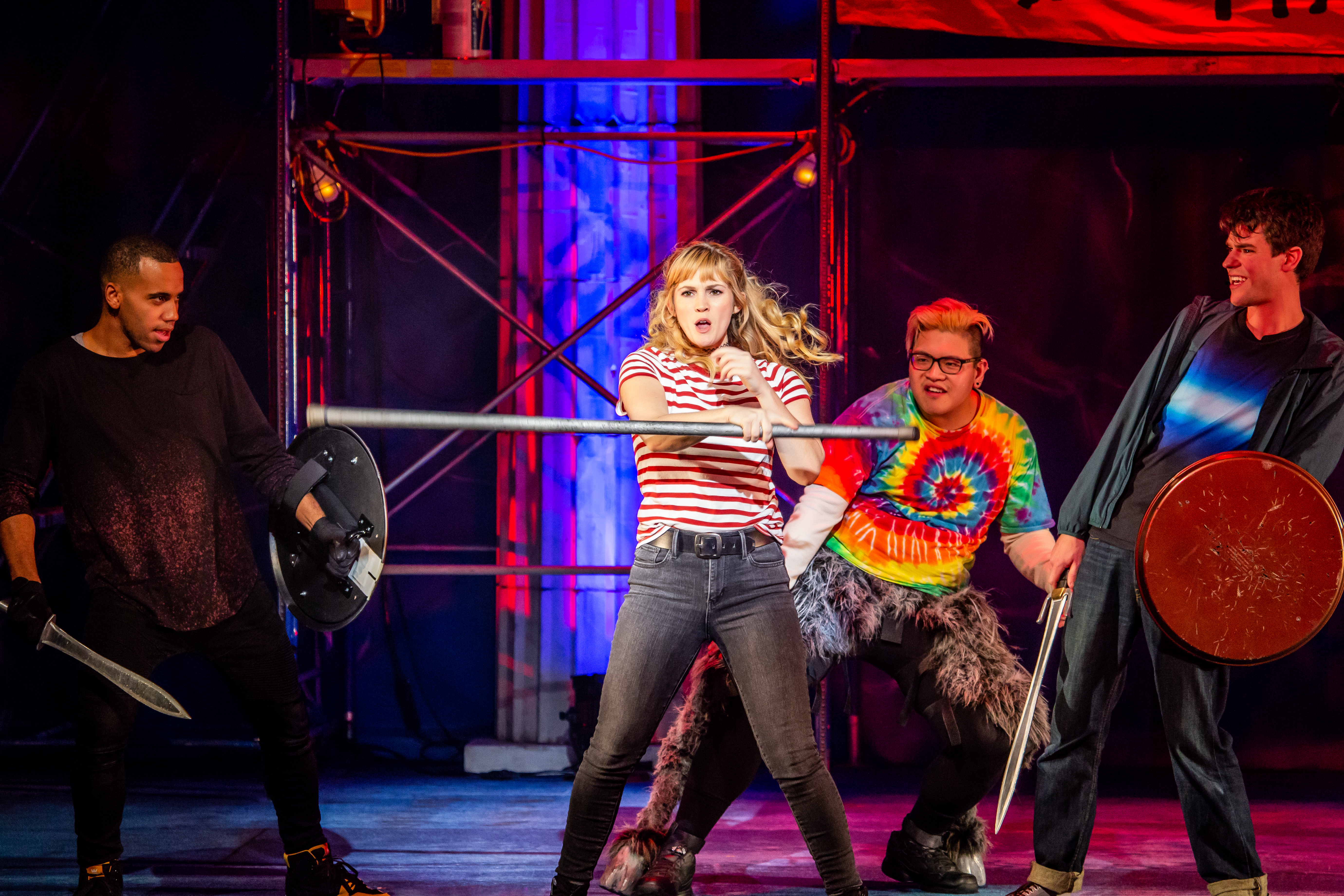
The other distinction that separates Percy is his getting selected to go on the quest to somehow retrieve the stolen lightning and prevent all-out warfare from breaking out among the gods. It’s here that Riordan takes us all the way back to the heroes of Homer’s epics. Just as there was tension and moodiness on the fields of Troy where Achilles, Ajax, Agamemnon, Hector, and Paris trod, there are rivalries and animosities among the half-blood campers. Annabeth, neglected by Mama Athena, wants to join Percy and prove herself. Others channel their jealousy, resentment, and antagonism into undermining him.

Up above, the unseen gods are supporting their neglected children, using them as instruments against one another, very much like Homer described them behind the scenes of the Trojan War. Mars and Mercury, the gods with Roman names, are sponsoring kids at camp who are going to make it tough on the offspring of Zeus and Poseidon. Singing rock songs with amped-up intensity and sincerity amid flashing lights and minimal scenery, these relentlessly energetic teens do occasionally seem like avatars in a video game.

I guess that’s because so much of the energy is channeled into the music.

Kristen Stokes as Annabeth sported the best vocal chops among our protagonists, but the role of Athena’s daughter isn’t nearly as meaty as the lead. Chris McCarrell is your fairly generic rock ‘n’ roll lead, not quite as iconoclastic as the Footloose outsider at his core, but he’s marvelously awed and illuminated by his magic sword and his mission. Somehow his determined edge never grows stale.

Photo: Jeremy Daniel


But as often happens with pure heroes and superheroes, Percy and Annabeth are often upstaged by the more outré characters they pal around with or confront. Three of the five supporting players have multiple roles to feast on, and I still find myself torn about which scene stealer I liked most. Perhaps because he rocked the most costumes, I’m giving the nod to Ryan Knowles as Chiron, Hades, and Poseidon. Knowles starts out as Percy’s teacher and principal before he reveals himself as a centaur – not an unreasonable stretch, since the original Chiron tutored such adventurers as Achilles and Jason.

Likewise, Percy’s classmate Grover reveals himself as a satyr when our hero comes out of his coma, the pagan equivalent of a guardian angel. Yet somehow, he moonlights as Mr. D, the godly camp director who presides over admissions in a manner that suggests a Hawaiian bartender. Jalynn Steele spends the largest chunk of her stage time as Percy’s mom, warmly nurturing and humdrum, but she gets the most startling cameo as Mrs. Dodd, the substitute teacher who turns into a very shrill harpy. Given a couple of chances to sing, Steele proves to have ample reserves of voltage and sizzle.

Okay, so maybe the gods aren’t real. At Knight Theater, in The Lightning Thief, they’re still a lot of fun.

Enormously Powerful “Mother Jones in Heaven” Could Use More Breathing Space

Review: Mother Jones in Heaven

By Perry Tannenbaum

mother jones photo credit brian kasher

Anybody who has walked by a well-stocked newsstand in the past 40 years has heard of Mother Jones, but fewer people can tell you anything about the real-life woman who inspired the magazine. You can now be handsomely schooled at the Warehouse Performing Arts Center by Vivian Nesbitt, who portrays the rabble-rousing labor activist in a fast-moving production of Si Kahn’s musical narrative, Mother Jones in Heaven. A treasured Charlotte resident until he grows restless and sets out for the West Coast, Kahn himself has been a community and labor organizer for over a half century while composing an imposing catalog of songs in a traditional folk style. He is supremely qualified to empathize with the tribulations of Mary Harris “Mother” Jones’s life and to give her pugnacious personality musical expression. In Nesbitt, he has found an actress who is ideally suited to bring us a Mother Jones who is beautifully devoid of acting or singing self-regard.

Unfortunately, the natural instincts of these artists were subjected to the whims of director Alice Jankell, who presented the show, winner of a San Francisco Bay Area Theatre Critics Circle award in 2014, as if it were a work-in-progress sorely in need of workshopping. At the post-performance talkback on opening night, Jankell asked the audience the right questions, namely what worked well and what left us confused – the polite way of asking what didn’t work. But the feedback process was doubly perverted. We were answering these questions about a script that had been severely edited. A production in Canada reportedly ran 90 minutes as recently as a couple of months ago, but the Warehouse version clocked in at under 70. Jankell confided that it had been necessary to abridge Kahn’s script to 60 minutes in order to bring this version to a fringe festival in Asheville, but she was dismissive toward those portions that hadn’t been restored, labelling them as research findings that would be interesting to the playwright and not to us. Further compromising the process, the person who most needed to judge what was working and what was not, Kahn himself, was not in the audience.

It’s hard to say what the missing 20 minutes of playing time would have fleshed out. Perhaps we would have learned the names of all four of Mother’s biological children who died from yellow fever during an epidemic in Memphis. Or we may have sampled some of the rhetoric in Mother’s speeches that inspired her figurative children, most notably the oppressed coalminers of West Virginia. Or maybe, Mother Jones in heaven was emboldened to tell some of the self-mythologizing lies she told on earth in her autobiography, only to come clean in the presence of the angels who make up her audience. Maybe all the factoids we missed might have bored us, just as Jankell feared. Maybe not.

vivian_nesbitt_mother_jones

Aside from the additional texturing that the full script would have provided, it would also have supplied much-needed breathing space between songs. The effect of a couple of them – there are at least 10 songs – was stifled by how soon they followed on the heels of their predecessors, with little substance to feed upon. And more of Nesbitt as Mother Jones would axiomatically be a plus. Confounding the radical working-class preconceptions we might have had about “the most dangerous woman in America,” Jones arrives in heaven rather primly dressed. Yet as much as she is gratified to see us, her fellow angels in heaven, what makes her feel most at home is the old Irish pub that is set up for her, where she picks out a favorite bottle and pours out the libations that will lubricate her tongue. It reminds her of the place where she was fired from one of her prestigious union positions.

The formative events in Mother Jones’s life, the yellow fever epidemic of 1867 and the Great Chicago Fire of 1871, happened earlier than I would have thought, but the celebrated – and somewhat catastrophic – Children’s March on the residence of President Theodore Roosevelt in 1903 took us into the 20th century where I had always placed her. There are subsequent references to Warren G. Harding and the likely apocryphal telegram he sent to her in 1921, so the old firebrand was very much in the thick of the labor movement well into her final decade. Her ascent to the storefront Warehouse stage presumably occurs upon her death in 1930 at the age of 93.

Joining Nesbitt onstage is her husband, John Dillon, on guitar, providing a quiet relaxedpresence. The songs he played; including “Mother Jones’ Farewell to Ireland,” “Silk and Satin,” “The Whiskey Ring and the Railroad Trust,” and the anthemic valedictory, “I Was There”; date back to at least 2004 on CD. Another title, “Tarpaper Shacks,” has been out since at least 2007, so the legacy of Mother Jones and her crusading themes have been aging and maturing in Kahn’s mind for a long time. In the choicest passages of Kahn’s dialogue, Nesbitt gets to describe the injustices, the horrors, and the deformities that enflame Mother Jones’s righteous rage. Even in this capsulized form, Nesbitt’s performance is quite a sight to behold, enormously powerful when she reaches full throttle.


Turning “Nutcracker” on Its Head

Review: The Hip Hop Nutcracker

By Perry Tannenbaum

Hip Hop Nutcracker - Dolby Theatre - November 17, 2017

When Mike Fitelson’s holiday riff on ballet and Tchaikovsky, The Hip Hop Nutcracker, first invaded Charlotte three years ago, it wasn’t quite where it needed to be artistically. The brash pre-show at Booth Playhouse presented by DJ Boo somewhat upstaged the pallid pre-recorded Peter Ilyich score that backed Fitelson’s updated scenario and Jennifer Weber’s choreography. Nocturnal settings by video designer Moe Shahrooz recalled the Washington Heights portrayed in Lin-Manuel Miranda’s In the Heights – moody and occasionally surreal but drained of the Miranda musical’s inner-city vitality and color.

The Fitelson scenario definitely perks up the traditionally moribund Act 2. Instead of sitting his Clara and her Nutcracker down for the better part of an hour to watch a series of decorative dances, Fitelson sends his Maria-Clara voyaging back 30 years where, in Back to the Future style, she encounters her perennially bickering parents back on the night when they first met at the Land of Sweets nightclub – getting to see them freshly at the moment romantic love first sparked between them.

Very promising, but the show needed some extra spark itself.

Produced by the New Jersey Performing Arts Center, the show has returned to the Queen City every year since its forgettable 2015 debut. Yeah, when I booked this year’s reprise at Knight Theater, I’d actually forgotten that we had seen it before. Thankfully, I review stuff. And thankfully, the Knight is exactly where this Nut needs to be.

Memories did not come rushing back when the show began. Kurtis Blow, a founding father of hip hop, hadn’t been part of the Booth Playhouse production, but at the Knight, he rules the pre-show for just over 18 minutes. He’s not the first performer I’ve ever seen who has asked an audience to get up on their feet or to raise their arms and sway back and forth nonsensically, but I’m sure he’s the first who has ever asked me and the rest of the crowd to SCREAM. Over and over.

So audience participation at the Knight has increased exponentially over what I experienced at the Booth. The Knight also has more than twice the Booth’s seating capacity. And since word-of-mouth and repetition have solidified Hip Hop Nutcracker as a holiday tradition, the Knight was sold-out on opening night and enthusiasm stretched to the back row of the balcony.

There is even a subtle tie-in between Blow’s aggressive patter and the dance that follows. Signed in 1979 as the first rapper to land a major-label recording contract, Blow presents his music as unabashedly “old school” and invites his audience to immerse itself in his original vibe, prefiguring the time traveling that Maria-Clara will do before she mends her parents’ dysfunctional relationship.

Things started looking familiar when violinist Jarvis L. Benson took his spot under the neighborhood lamppost and began playing Tchaikovsky’s antique melody line over Boo’s contemporary backbeat and platter scratching. You might say that, as the melody wafts upwards, it infuses the pair of red sneakers slung over the lamppost with magical powers. Our hero, The Nutcracker, sells his namesake merchandise from a ramshackle cart. He’s obviously attracted to Maria-Clara but painfully shy, and when he gallantly steps forward to save her from the unwanted attentions of a local gang, Nutcracker gets his ass kicked.

hiphopnutcracker20171117tn-0988

Big difference when those sneakers improbably fall to the ground and Nutcracker puts them on. What vanquishes the gang is even more improbable: Josue “Beastmode” Figueroa as Nutcracker executes a bodacious spin on his head that lasts longer than you might think humanly possible. Literally turning The Nutcracker on its head during its climactic Act 1 battle.

While there are some dolorous and becalmed moments elsewhere in Act 1 in the ensemble choreography, the Knight Theater sound system is noticeably superior, punchier. So as the Nutcracker soundtrack plays, we never get the sense that the Jerseyites are dancing to elevator music. Although Ann-Sylvia Clark is a holdover from the 2015 edition as Maria-Clara, everyone else besides Boo was new to me and eager to strut their stuff. Weber’s choreography leaves plenty of room for exuberant freestyling.

Beastmode, with his appealing rough edges, was the most impressive newcomer for me, but I also like the pixie exuberance and stealth of Lisa “LBoogie” Bauford as Drosselmeyer. Forget the “Herr.” The Hip Hop Drosselmeyer has been a woman each time I’ve seen Fitelson’s version, symptomatic of the diversity in Weber’s casting. Yes, she choreographs and directs.

Sad to say, Nubian Nene is less seductive and more proper as Mom, draining all the comedy from her strife with Dad, though Micah “Just Jamz” Abbrey is every bit as crotchety as his predecessor. New charm and whimsy are injected into the evening by Dustin Payne, whose solo as Flute deservedly received the most audience approval among the Act 2 set pieces on opening night.

Shahrooz’s animations become livelier after intermission, responding to Drosselmeyer’s conjurations and transporting us back to 1988. The backwards time traveling is done like a subway ride, the years spelt out in the tiling on walls surrounding the track – with an increased amount of graffiti as we reach our destination. Perhaps a nod to Mayor Rudy Giuliani and his unparalleled success in “cleaning up” New York? The trip back to the present day takes us skyward as an elevated train reels in the years across the nighttime cityscape.

Wondering whether Kurtis returns? You can bet on it. Loquaciousness undimmed, he presides over the most elaborate curtain calls you will ever behold at a ballet. Many people left before it became apparent that we would have a full-fledged post-show over eight minutes long. Many more stayed – and obliged the special guest MC by screaming on cue. Not quite 60 years old, Blow even busted some moves.

A Catchphrase Becomes a Mantra in “A Christmas Story”

Review: A Christmas Story, The Musical

By Perry Tannenbaum


Photo 3 - Colton_Maurer_as_Ralphie_and_the_Company_of_A_CHRISTMAS_STORY

Long before it became New York’s AM haven for Rush Limbaugh and Sean Hannity, WOR was the late night hangout of Jean Shepherd, the place where he became something of a cult hero – or maybe a folk hero if you take his roguish, Bohemian homespun manner into account. His holiday idyll, A Christmas Story, recalling his boyhood in an obscure Indiana town, is the chief reason why we remember Shepherd. It’s likely also the reason why 1938 Red Ryder Carbine Action BB Guns are still available at Walmart, Bass Pro Shops, and Dick’s Sporting Goods more than 50 years after the last Red Ryder comic strip appeared in print.

Aside from the fabled Red Ryder air rifle – and the extra trimmings our hero Ralphie never fails to mention – there’s another familiar earmark in A Christmas Story. Whether he expresses his yearning obliquely through a magazine ad strategically placed in his living room, excitedly in front of a store display, panegyrically in a school essay, or confidentially in Santa’s lap, the barrier to Ralphie’s Holy Grail is always the same: “You’ll shoot your eye out!”

As your might fear, for the phrase is already sufficiently repeated, A Christmas Story, The Musical turns the catchphrase into a pervasive mantra – a phantasmagorical one partway into Act 2 after Miss Shields, Ralphie’s teacher, reacts to his essay. Transported to a fantasy speakeasy, even Ralphie’s classmates pronounce the fatal slogan in mocking singsong, fiendishly relishing our hero’s failure to get what he so dearly cherishes.

We’d be fine if this expansion were the worst of Joseph Robinette’s mistakes in adapting the 1983 Turner Entertainment film for the stage. Years after Oliver and Annie had proven a pre-teen’s ability to carry his or her weight in a Broadway musical – and less than two years before Matilda would prove it again – Robinette looks to narrator Jean, Ralphie’s parents, and Miss Shields for avenues to expand his book or let composers Benj Pasek and Justin Paul plump up the songlist.

You might retch at all the geniality that Chris Carsten lavishes on Jean, but it’s an enthusiastic heartland geniality, and he isn’t singing much. We can also allow that the epic stress that Lauren Kent as Miss Shields puts on the “You’ll Shoot Your Eye Out” prohibition siphons away some the ogre aspect that might taint Ralphie’s mom. But that strands Briana Gantsweg as Mother in the deadly realm of being almost entirely understanding and nurturing, toward her husband and her sons – in two of Pasek & Paul’s most sweetly innocuous songs. They stop the show in ways that aren’t helpful.

Most of the true joy that beams out at us at Ovens Auditorium in this show comes from Ian Shaw as the ever-embattled, ever-tenacious Ralphie (alternating with Michael Norman) and Paul Nobrega as The Old Man, a similarly-assailed eccentric who barely takes notice of his pint size buckaroo’s numerous tribulations. Largely ignoring Ralphie, The Old Man’s Herculean challenges include taming the furnace, eluding the next-neighborhoods dogs, and winning recognition in a very silly crossword puzzle contest.

With Pasek & Paul rising to the occasion, perhaps the best musical moments in the show are songs inspired by The Old Man, “The Genius on Cleveland Street” and “A Major Award.” Nobrega’s struggles with the crossword puzzle also give Gantswag her best moments, striving to feed the answers to her intensely dimwitted husband without defiling his self-esteem.

Starting out with Shepherd taking us to his WOR studio A Christmas Story, The Musical takes its time before reaching cruising gear. But times were slower in 1940, when Robinette sets the story, and set designer Walt Spangler and costume designer Elizabeth Hope Clancy create a folksy, slightly cartoonist charm that chimes well with this familiar yarn, which will warm your holiday a little if you’re patient. Playing time, 1:54, is 21 minutes more than the movie, so nobody’s in a rush.


Actor’s Gym Unearths a Gem in “Fallen Angels”

Review: Fallen Angels

By Perry Tannenbaum

When a playwright puts the finishing touches on his or her latest comedy, it’s without any knowledge about how prevailing attitudes and expectations might change out in the audience over the next 93 years. No playwright has ever had the chance to look back that far, and that includes Noël Coward, whose Fallen Angels is playing at Duke Energy Theater in an Actor’s Gym production directed by Tony Wright.

Knowing Noël, I’d say he’d either gasp or laugh out loud. Opportunity knocks for Coward’s protagonists, Julia Sterroll and Jane Banbury, when their husbands head off on a golfing weekend just when an old flame of both ladies, Maurice Duclos, sends them billet-doux saying that he’ll be arriving back in London after an absence of many years –so many years that the husbands, Fred and Willy, have no idea of who Maurice is nor any knowledge of his torrid affairs with their wives.

After Fred’s departure, Julia is momentarily left alone with her new smarty-pants maid, Saunders. That’s when Jane arrives at the Sterrolls’, all aflutter with the news. Julia, who was just a few minutes earlier discussing with Fred exactly how much fire was left in their mellowing marriage, hadn’t yet read her note from Maurice. It quickly becomes evident, as the women discuss Maurice, that those flames still burn brightly, perhaps more brightly than ever. They’re a little scared.What will they do when he arrives?

Their first impulse is exactly what an audience would expect – in 1925: to flee as quickly as they can to protect their honor, which presumably cannot withstand Maurice’s irresistible charms. A mere 35 years after Oscar Wilde had declared, “The only way to get rid of temptation is to yield to it,” such an outlook was still wicked, irresponsible, and risqué.

Nowadays, coaxed by Madison Avenue, amoral leaders, social media, and longstanding American traditions of fierce individuality, we find ourselves – regardless of gender – inwardly urging Julia and Jane, Go for it! Whereas we’re taken aback in 2018 by the ladies’ knee-jerk-prissiness, their eventual decision to stay and face Maurice was immoral enough to give London’s censors pause before allowing Fallen Angels to be performed.

Once Julia and Jane have opted for what we perceive as the road-more-taken, you might expect that attitude adjustment becomes far less necessary. Yet in more subtle ways, the presumption of wickedness works its way deeply to the bones of Coward’s comedy. Instead of building his comedy upon Julia and Jane’s rekindled romances – and their wacky or delicious maneuverings to keep their husbands in the dark – we find an unexpected amount of time devoted to maintaining their wicked resolve. Here our complications arise from the women’s resorting to martinis and champagne to sustain their courage during their excited vigil.

So it’s helpful that Tony Wright and his design team keep reminding us that the people onstage are living indifferent times. While Tim Baxter-Ferguson’s set design isn’t the ultimate in elegance, the requirements of a British drawing room are met, including a baby grand where Saunders will upstage Julia. Davita Galloway’s costumes, particularly the flapper-flavored outfits for the partying ladies as they sip their martinis, stamp the era most decisively.

The women must dominate this comedy,and Wright has found a marvelously varied trio. Originally played by Tallulah Bankhead, Julia is the formidable serenity that is serially agitated by Saunders, Jane, and Maurice to comical effect. Jennifer Barnette takes that serenity to a loftier, more angelic plane, slightly muting her discomfiture and giving more space for the eccentricities of Saunders and Jane to shine. Karina Caporino pounces on her opportunity as Jane with frenetic energy, more brittle and midlife than we’ve ever seen her, which easily makes Jane the most screwball of her trademark neurotics.

Erin Darcy as Saunders is possibly the most vivid period trimming in this whole confection, a servant who is more knowledgeable, widely traveled, and skilled than the mistress she serves, aware of her superiority and maybe a little bit haughty about it. Saunders’ sophistication lays bare the delusion that the Sterrolls or the Banburys are living lives of consequence. Perhaps it’s Darcy’s aplomb at the piano that gives Barnette her best episode of humiliation.

In this context, Emmanuel Barbe is a perfect choice as Maurice. He is suave and self-assured, with a savoir-fair that is unmistakably French, yet he doesn’t quite have the polish and youth that would make knees buckle in high society. Barbe’s down-market elegance is still more than enough to make David Hensley as Fred and Michael Anderson as Willy seem gullible, dimwitted, and humdrum. Hensley as Fred seems to be the sort who feels like he’s fulfilling his destiny by opening a newspaper at the breakfast table, while Anderson, once he reconciles with Fred and Jane, gives Willy exactly the smiling insouciance that Wright wants for his ending.

I have to go back to 2005 and The Tempest to find the last Actor’s Gym production I reviewed. It’s great to have Wright and his Gym back on the scene, especially when the Gym unearths a gem like this.