Category Archives: Theatre

Your Cellphone Must Wear Blinders to Three Bones’ “Oedipus el Rey”

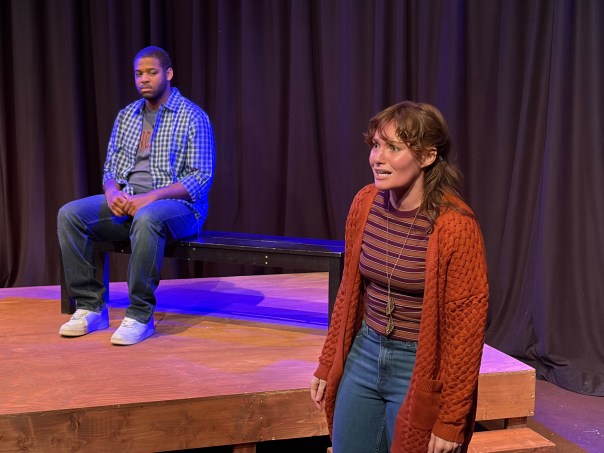
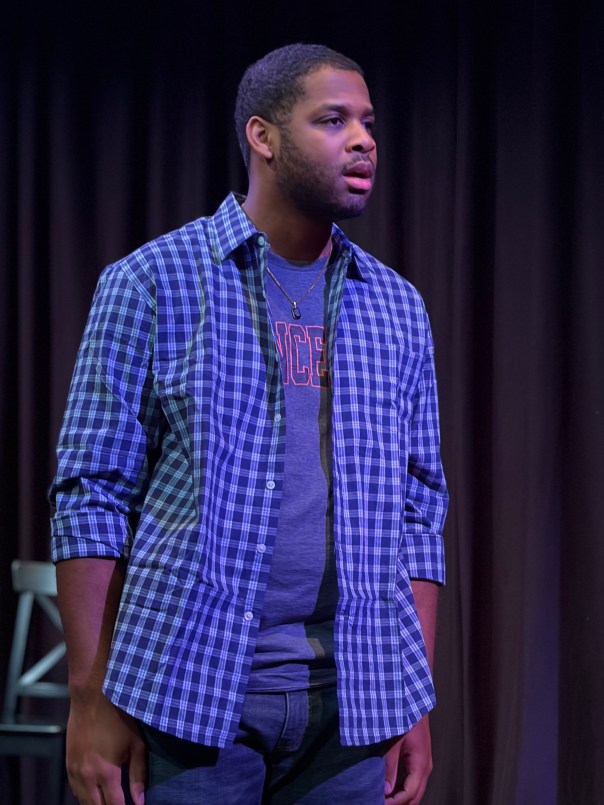
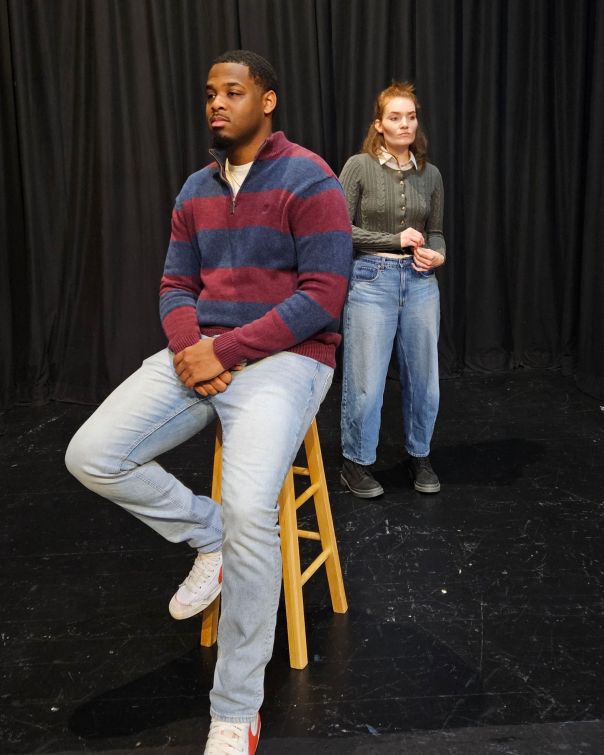
Review: Oedipus el Rey at The Arts Factory

By Perry Tannenbaum

Everybody has a story, but the cruel truth is that an overwhelming majority of them, whether factual or fictional, will be forgotten. So the story of Oedipus, immortalized by the Greek dramatist Sophocles in his Theban Trilogy – and perhaps the cruelest of all stories – is an awesome exception. Not only has this story survived for more than 2450 years, but it has also stood as the Aristotelian model for storytelling.
So part of the wonder of Luis Alfaro’s Oedipus el Rey, now playing at the Arts Factory in a graphic and gripping production from Three Bone Theatre, is how this contemporary Chicano playwright retells the age-old tragedy. The better you know the original Oedipus Rex, the more audaciously you’ll see Alfaro flouting Sophocles’ storyline and Aristotle’s principles of storytelling.

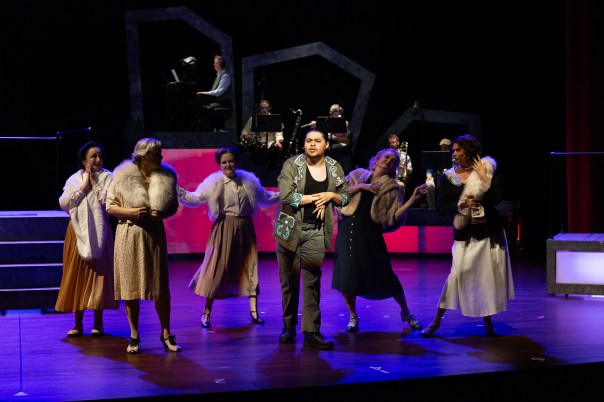
The basic Freudian elements are intact, and Alfaro delightfully retains a Greco-style chorus – but a more shapeshifting group. Even Oedipus is part of the chorus in the prologue, wearing the same orange prison outfit as the other men in our prologue. But the other five guys shuttle in and out of their prison garb, three of them moonlighting in the roles of the prime figures of the Greek myth.

As Alfaro’s tale takes us from prison to LA, from prison across the desert to Vegas and back again to LA, we’ll meet up with King Laius, Oedipus’s dad, and Creon, the king’s brother-in-law. The blind seer, Tiresias, we see from almost the very beginning, elegantly compresses all three of the men to whom Oedipus has been handed off shortly after his birth.

He is a mentor to Oedipus – his father, for all he knows. Hanging out in the prison library, Tiresias is a seer in more ways than one. And if you know how Oedipus winds up, you know that his proving to be King Oedipus’s role model is a fiendish joke.

Now if you know your Poetics, you’ve already deduced that Alfaro has blown Aristotle’s precious unities of time and place to smithereens. This Oedipus doesn’t simply offer us a devastating replay of those final moments when he unravels his own mystery and history, realizing that he has already fulfilled the fate that the oracle has predicted.

In a minor miracle of conciseness that only takes about 90 minutes of stage time – with dollops of Greek chorus, Parliament-of-Owls phantasmagoria, and Chicano voodoo thrown in – Alfaro cleverly dramatizes all the key plot points rather than simply narrating them. The horrible catastrophe of Oedipus fulfilling the fate he has so diligently avoided is once again our crowning moment, but only after we’ve been along for every key step in his story.

The nativity, the abduction, the patricide, the Sphinx riddle, the incest, and the bloody denouement are all part of the action, no less thrilling or shocking than Sophocles of old. Because there is so much more action, so swiftly.

And yet Alfaro compresses some of the tale. The intimate bond between Oedipus and his queenly mother Jocasta happens at the speed of sight, and the new king’s downfall rushes upon him shortly after their wedding. In the Sophocles storyline, there’s a plague afflicting Thebes. He and his queen have two daughters. When the Roman playwright Seneca took up the tale, his timeline was even slacker: the Theban royals had sons and daughters by the time he sent Creon off to consult the oracles.

Vis-à-vis Sophocles, the gains outnumber the losses as Alfaro takes these daring tacks, even if they don’t outweigh them. You get to empathize a little with the monstrous ganglord Laius as the fatal prophecy is delivered to him with the birth of his son. More than two millennia after the Theban royal reigned, there is enough earthiness and superstition to this career bully, crook, and barrio king for him to give credence to the wild prophecy.

And Tiresius, now blindly caught in the merciless net of fate, is doing his best to alter Oedipus’s destiny! Meanwhile, we get to see an earlier phase of Creon, when resentment and jealousy bedevil him as Oedipus makes inroads on his sister and his turf. He doesn’t go forth trying to get info that will help dispel any plague. He’s out there digging for dirt on Oedipus.

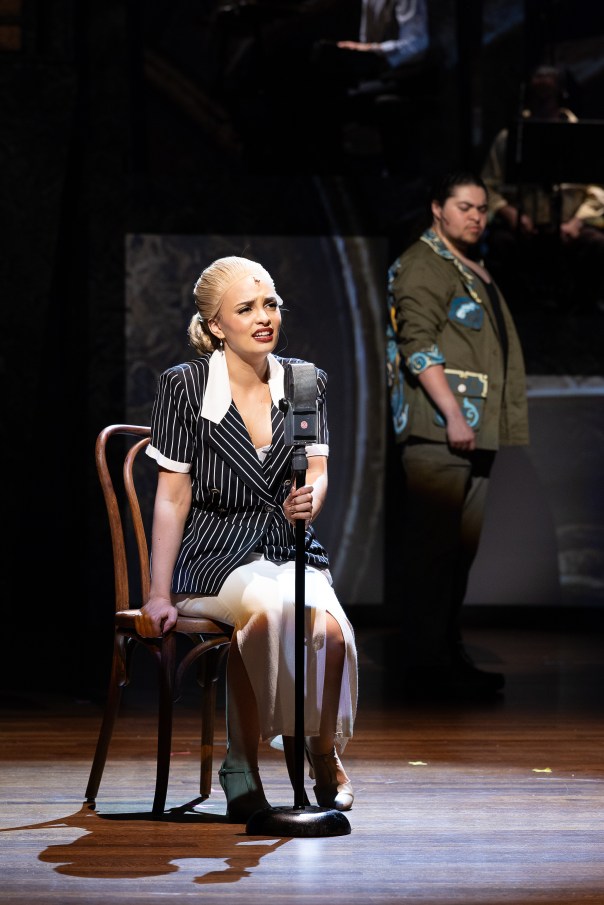
Three Bone’s earlier plunges into Alfaro’s Greek Trilogy, Mojada and Electricidad, resolutely distanced themselves from their Ionic roots, embracing the mystic squalor of the modern-day barrio. But here, the playwright sets us down at Kern County’s California State Prison, and the full Coro sextet enters and forms a square-shaped lineup, where Alfaro calls for “An empty stage stripped of decoration – hollow and hallowed – its emptiness feels religious.”

What director Rod Oden and set designer Jennifer O’Kelly do to capture this ambiance is to stand Ionic pillars along all four walls of the Arts Factory and stage their Oedipus in the round. These are enhanced by projections that O’Kelly deploys to fill the spaces between the ancient columns, beginning with the names of our key players projected vertically on the pillars during the opening Prologue.

Not to complain, but I wish Oden and O’Kelly had also projected Alfaro’s scene titles. Some are spicy and humorous, offering further links to the ancient tragedy.

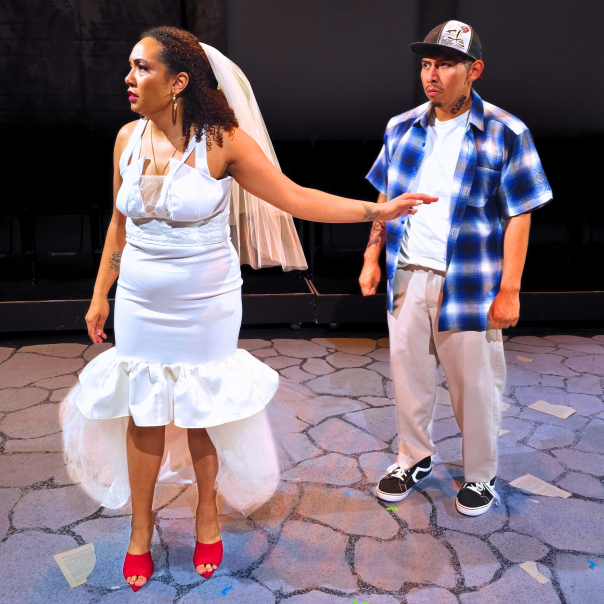
The performances are as classy as the scenery, but without classical pretensions. Never a part of the ritualized action, except when she dons her wedding dress, Stacy Fernandez charms us as Jocasta from the moment we first see her chiding her unborn son, who is kicking her inside the womb. What Alfaro titled “Soliloquy” comes off like a world-weary wisecrack. No less engaging, Fernandez gets to fill us in on Jocasta’s backstory, something Sophocles and Seneca never bothered with.

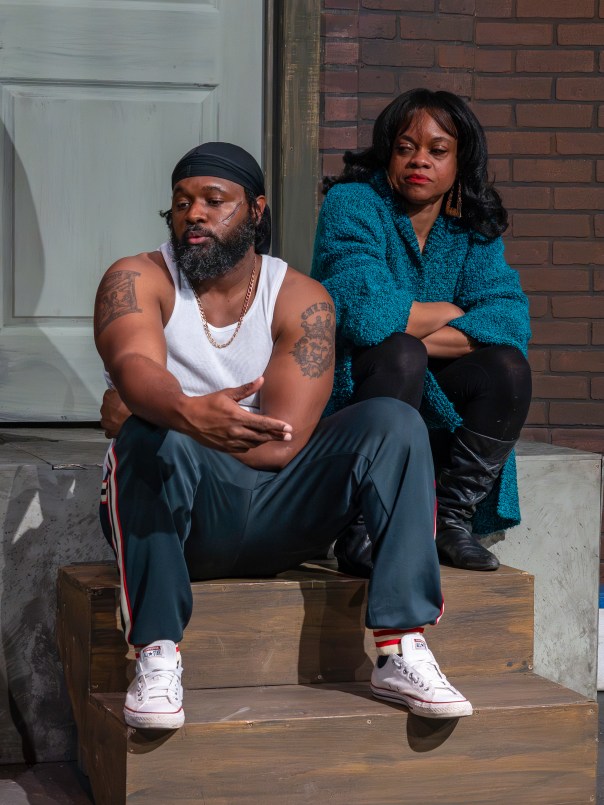
In another auspicious Three Bone debut, Kelvin Jones-Fernandez as Oedipus contrasts nicely with Fernandez’s street-wise worldliness. With a studly innocence and a winsome, toothy smile, Jones-Fernandez had me thinking LaMelo Ball all evening. Less than half as much ink on him as the Hornets star, but enough tats for Laius to instantly recognize him as an ex-con at their fateful nocturnal meeting on a one-lane highway.

Jones-Fernandez brings a big personality to his monologue when Oedipus subsequently tours his dad’s royal territory, reasserting sovereignty and letting former debtors know they’re still on his account book and announcing that the “free trade” days are over when they could do business outside his turf. Yet he’s genuinely wowed by Jocasta, green enough to convincingly ignite their copulation scene by crying out, “Teach me!”

You’re more than warned that this scene is coming when you first enter the space. Ushers will apply stickers to all your cellphone camera lenses to protect the actors.

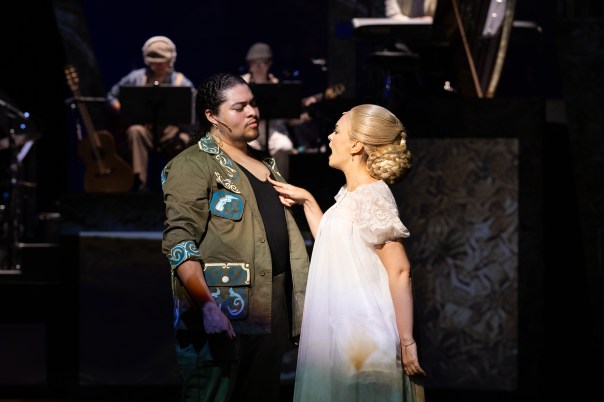
Sipping on a horchata the livelong day, Eduardo Sanchez stylishly delivers Alfaro’s weaselly makeover of Creon, whom Lauis regards as a pretend prince. He’s intimidating as well as sleazy toward Oedipus when he arrives in town, won over easily enough, but obviously a sneaky, underhanded threat. That Oedipus resists his initial overtures to go crooked says something for his character: he’ll succumb because society is rigged against Chicanos and ex-cons.

You may remember that Sanchez was also a bit of a softie – and a bit comical – as Orestes in Three Bone’s flaming Electricidad.Two other standouts from previous 3B installments of the trilogy show their mettle again. Luis Medina, who was Orestes’ mentor and tattoo artist last August, plays a bigger, yet similar role as Tiresias. Laius’s former right-hand man turned prison sage, now masquerading as Oedipus’s dad. Accessorized with dark glasses and a slick fold-up navigation cane.

Although we haven’t seen him since his starring role as Jason in Mojada (based on Euripides’ Medea), Christian Serna brings some of that same swagger to King Laius. After all, Jason was also a bit of a cad, going for the gold, just not as malign as this mobster. It’s fun to get a more intimate look at this character who is usually offed before the action begins.

And it’s newly satisfying to watch his predicted fate come full circle and overtake him. The only big mistake Oden made in directing came at the moment when Laius recognizes who his killer is, how the gods and fate have triumphed. It needs to be bigger, far more emphatic.

Yes, Alfaro’s Oedipus and Laius don’t rise to the royal grandeur of their Theban namesakes, so their falls are not as precipitous. That’s probably why Alfaro leans so hard into amplifying his hero’s hubris. This one doesn’t believe in any God, tears a Bible into shreds, and deifies himself.

It’s excessive rage and arrogance for an ex-con, but not if you accept Oedipus’s underlying anguish as the voice of his people. Three Bone Theatre is the first company anywhere to present all of Alfaro’s Greek Trilogy and give vent to his full anger. Groundbreaking may be an understatement in the presence of such power.

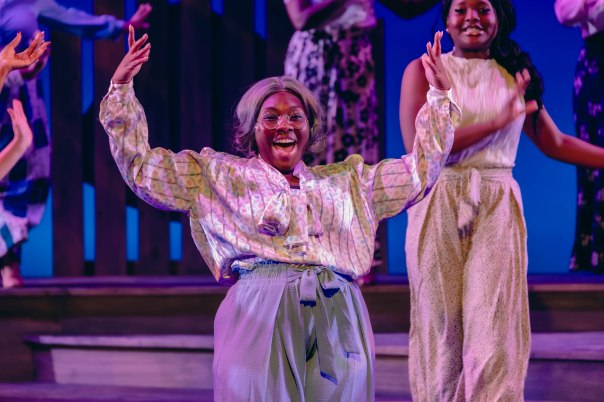
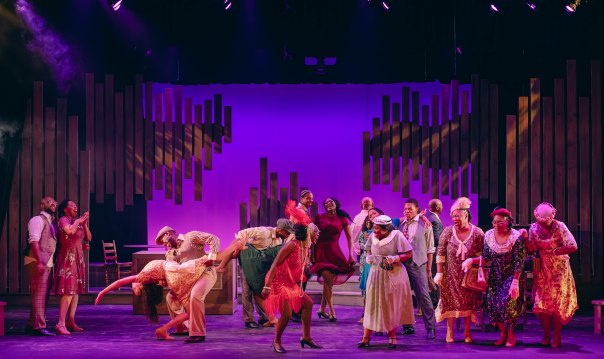
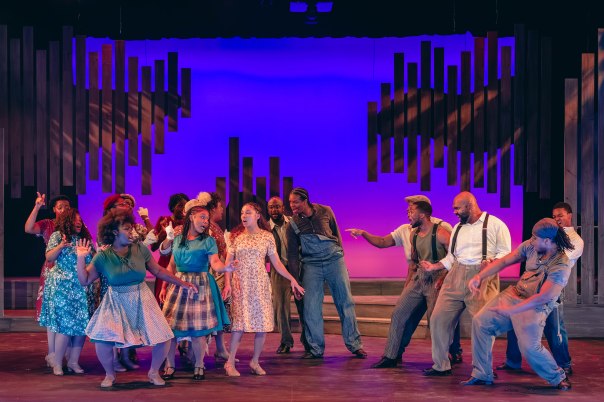
Keston Conquers Again in “The Color Purple”

Review: The Color Purple at Theatre Charlotte

By Perry Tannenbaum

Across the span of nearly 40 years of reviewing, reporting, and pontificating on the performing arts, quite a few events and performances have etched themselves into my mind. On rarer instances, an audience response will be equally unforgettable, such as press night on April 10, 2008, at Ovens Auditorium, the first time Wicked came to town, greeted by a series of deafening ovations that have never been matched.

Every time my Apple Watch notifies me that an audience topped the 100dB mark the previous evening, I wish I’d had one at Ovens that night to know what the high-water mark is.

Even more unique was the night of September 15, 2012, at Dale F. Halton Theater. There, the student actors and musicians of Northwest School of the Arts performed The Color Purple. My wife Sue and I went with a bit of trepidation.

We had already seen this musical on Broadway and in its touring reincarnation at Belk Theater. More to the point, we knew the pitfalls of an all-youth cast colliding with roles that demanded fully mature players. At the Halton, we were already reminded of how wrong that could go when the recent college grads who recruited for CPCC Summer Theatre clashed with the likes of Fiddler or Spamalot.

Of course, we had already built up considerable trust in Corey Mitchell as a stage director nearly three years before he snagged the first Tony Award given to a theatre educator. But there are tough hombres in Alice Walker’s Purple, including poor Celie’s abusive father and husband, Pa and Mister.

And if you remember either the film or the Oprah-produced musical, there are two certifiable divas besides Celie, our tormented protagonist: the hard-headed Sofia and the glamorous Shug Avery. Could Mitchell find all the outsized talents he needed enrolled at Northwest to fill all these roles?

Sure did. And he had more: scenery on loan from the original Broadway production.

But the audience! When Northwest junior Keston Steele, starring as Celie, had finished singing her “What About Love?” solo, Sue turned to me and asked, “Have you ever seen anything like this?”

For the entire audience, it seemed, had sprung to its feet – a standing ovation in the middle of a show! And the answer to Sue’s question is still no.

So you can imagine that when we walked into the old Queens Road Barn on opening night of the current Purple and received my playbill, I was pre-sold. Our Tony Award winner was back directing Theatre Charlotte’s new version, and the name of Keston Gary topped his cast list as Celie.

Had to be the same Keston, right? That’s honestly the only name I had remembered.

While I wasn’t the only person in the Queens Road Barn who remembered Gary’s pre-marital, pre-motherhood exploits at CP, it’s unlikely that anyone else in the crowd was in the same suspense: would history repeat itself?

So there was that unique suspense for me, especially when Gary belted out “What About Love?” as zestfully as Steele. Would the audience rise? Would the Barn’s roof blow off? That same silly suspense struck me once again when Gary followed up with the musical’s supreme affirmation, “I’m Here.”

While Gary’s singing merely equaled Steele’s, her acting – seasoned by marriage and multiple motherhoods – markedly surpasses it. At their depths, Gary’s servility and submissiveness as Celie are borderline cringeworthy. Maybe a few notches beyond what a white director would dare.

It’s a grim reminder, to be sure, that feminism was a more central concern for Walker here than racism, which only affects Sofia’s story. As a result, we can revel more in the light and inspiration that Shug and Sofia bring to Celie with their special brands of savvy and sass. This Celie needed to travel a longer road, in my eyes, to straighten up her hunched shoulders and stand up for herself.

Twenty years after I saw The Color Purple on Broadway, it’s nice to see Mitchell leaning harder into the story’s demeaning subjugation. But it’s harder for me to be sure whether Mitchell is seeing Celie’s sexual awakening as more overtly lesbian than ever before, or if I am.

The rousing “Miss Celie’s Pants” certainly hadn’t landed on me in nearly the same way as it did on Queens Road. Sung by Gary with her mentor Shug, Sofia, and a bevy of other women, you can take this eye-popping number partly as a gay pride celebration or as a proto-Hillary rally.

K. Alana Jones as Shug sports a free-thinking saloon singer’s confidence, seemingly at home with anybody’s body of her choosing. In that respect, Shug’s bisexuality aligned more closely with Walker’s. Shug always got the kind of delayed runway entrance traditionally reserved for Broadway legends, so costume designer Justin Hall, with assistant Beth Killion, needed to be sure that Shug’s rigs radiated class.

With all the fine tunes crafted by Brenda Russell, Allee Willis, and Stephen Bray, the book by Marsha Norman doesn’t get enough space to make the connection between Shug’s fashion sense and Celie’s eventual emergence as a dressmaker. At Theatre Charlotte, we can infer that Shug is Celie’s dressmaking muse.

Once Jones does enter as the blues singer, she scores well in the uplifting “Too Beautiful for Words” and the raunchy “Push Da Button.” One can only smile at the thought of high schoolers rehearsing that latter gem.

As Sofia, Germôna Sharp gives Celie – and any other wallflower in town – a more militant brand of inspiration with her “Hell No!” [my italics]. Fortunately, I had somehow forgotten the battered Sofia’s marvelous dinner-table reawakening, so I could take fresh delight in Sharp’s hallelujah suddenness. Not long afterwards, Sharp gets to team up with Nehemiah Lawson as Harpo, her genially clueless husband, in their raunchy “Any Little Thing” reconciliation.

After his bravura psycho dentist in Little Shop of Horrors, it was nice to see Lawson less crazy and cocksure. Harps is more befuddled and human, actually evolving with the times. Watching this character arc, from “Brown Betty” to “Any Little Thing,” amid more toxic excesses of testosterone was a nice reassurance that not all men are monsters. Or at least, beyond redemption.

You could say Harpo’s leavening presence gives Arnold Grevious as Pa and

as Mister more license to be as monstrous as possible. Yes, there are moments at the beginning of Purple when Walker seems to be taunting us: “You think white patriarchy and misogyny are bad? Come over to my place!”

Neither Grevious nor Williams gives any hint of mellowing toward Celie for a long time. Meanwhile, Mister needs to be appealing to Shug in some way that might surface in his bossy “Big Dog” showcase with his field hands. More to the point, he ought to appreciate Shug’s strength as well as her beauty and talent, so Williams can give promise of evolving as he lays out Walker’s red carpet for her diva in “Shug Avery Comin’ to Town.”

Williams also gets the luxury of penitence, beginning with “Celie’s Curse.” No such epiphanies happen for Pa: we just watch Grevious becoming older and feebler. So don’t give that old rattlesnake a single vocal and see if I care!

No, Tim Parati’s scenic design for Purple, the first we’ve had in Charlotte that was totally missing its Broadway lineage, won’t floor anyone, though J.P. Woodey’s lighting helps us not to mind. But Keston Gary is far from the only onstage luminary capable of knocking you onto your butt.

Apart from Chicago and New York, I’ve been maintaining for years that Charlotte has the vastest store of Black theatre talent around. Purple at the Barn proves me right once again. Call yourself fortunate if there are still seats available.

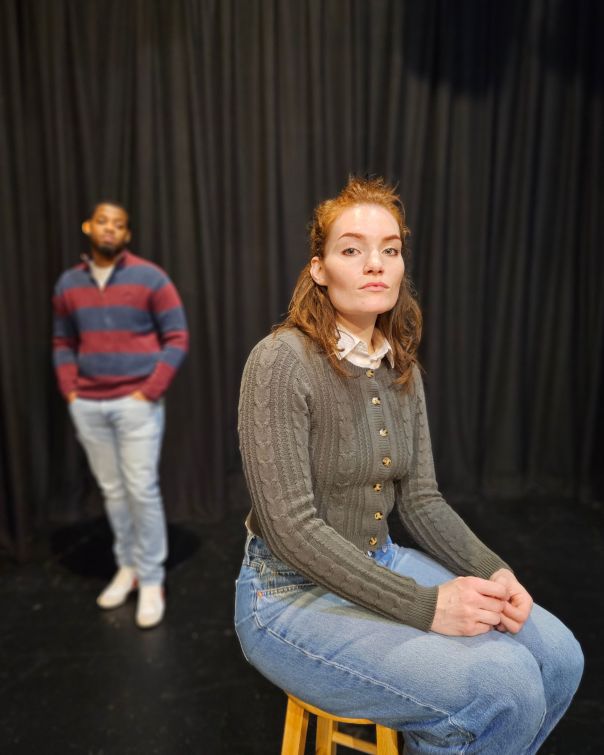
Keggers Answer to Title IX Consequences in “Actually”

Review: Actually at Davidson Community Players

By Perry Tannenbaum

Midway into its sixth decade, Title IX seems to be limping a little, not as top-of-mind as it once was. Among the half million emails still undeleted from my various accounts over the past decade, including those religiously saved from more than a dozen news sources, 145 mentioned the landmark legislation, and just six so far this year.

So when Anna Ziegler’s Actually was first staged in 2017, looking back on a sexual harassment complaint lodged by one Princeton freshman against another in 2015 or 2016, neither of her protagonists, Amber Cohen or Thomas Anthony, could have known much about Title IX that would apply to them. Nor would they have been schooled on implicit consent or what a preponderance of evidence might mean.

Both were born after the legislation went into effect in 1972, outlawing sexual discrimination at federally funded academic institutions, and even after playwright David Mamet probed the consequences and shortcomings of Title IX in his Oleanna twenty years later. That was a combustible two-hander pitting a male professor against his female student. Here, both students are niche admissions at the Ivy League school. We have a young Jewish woman, sufficiently adept at squash to make the University team, filing an action against a Black student who aced his SAT’s and shows considerable prowess at the piano.

This Metrolina premiere, directed by Amy Wada, opened at Armour Street Theatre this past Sunday evening – rather unusual scheduling – just a few hours after The Lifespan of a Fact, Davidson Community Players’ previous production, completed its run. So there was already a rule-breaking ambiance hovering onstage as the lights went up on the two drunken frosh.

Both are blending into Princeton life via alcohol. Pre-date, we later hear, Tom had already knocked down five drinks. By the time we hear this, we’ve learned that reveling at keggers with free beer has been a nightly ritual for Amber, who is also toting a flask of tequila on that fateful first date, both gifted to her by her glamorous mentor, Heather.

Since this is another two-hander, you can rightly presume that Ziegler doesn’t mess with the formality and architecture of Tom’s hearing, adjudicated by three faculty deciding in whose favor the preponderance of evidence – “50% plus a feather” – weighs. Nor do we meet Heather, the rich kid who, in Amber’s telling, comes off like a reprise of the toxic queens of Mean Girls. Or, obviously, Heathers.

Ziegler begins – and ends – with the key moment when Amber may or may not be issuing her implied consent. But she not only dissects the drunken date from first kiss to the condom hitting the floor in Tom’s dorm room (with his roommate in the upper bunk!), she also carefully traces, in confidential monologues, the sexual histories of both players in this disputed escapade.

On Amber’s side (Wada keeps her leads on opposite sides of the stage for most of the action), we learn of a sexual encounter, similarly fueled by drink, after a second Passover seder earlier in the year. We also hear about her insecurities about her body and her tendency to yield to others when she is ambivalent or seeking approval – most crucially when she adopts Heather’s view on whether she was raped.

We get to understand that the attentions of an already notorious campus playboy are more of what Amber truly needs while she’s still unsure, within a more sober self that’s AWOL on a beer-tequila binge, about what she truly wants. At the same time, even more endearing to us, Amber is instinctively aware that something is troubling Tom and wishes to cheer him up.

Tom has been in therapy during his high school days as a result of responding, naturally enough, to the come-ons of his piano teacher sitting beside him on the music room piano bench. Sounds a little trivial compared with Amber’s impulsiveness and insecurity, on view all evening. The guy reveres Mozart and Bartok, for heaven’s sake!

But then Ziegler abruptly swings the scales toward equilibrium. We learn what was troubling Tom before meeting Amber on their date – and his capacities for rage and violence.

Quite worthy of being labelled “foxy,” Luna Mackie isn’t exactly what Ziegler envisioned as Amber, whose self-image as “pretty enough” seems to have stuck since the moment her mom said it. Mackie compensates with her posturing, mostly slouched forward wallflower-style, but occasionally, she goes with oddly arching backwards, as if she’s forgotten to exhale after taking a deep breath.

With admirable ease, Mackie delivers blushing smile after blushing smile, often scrunching her shoulders. It’s only when she straightens up past vertical that we might see those shoulders as belonging to an athlete, one who wields a squash racquet – or if you saw her in She Kills Monsters, a sword. More challenging, Mackie conquers Amber’s neurotic motormouth trait.

But perhaps too decisively. Many are the times when, for me, intelligibility was sacrificed on the altar of speed. Yet living up to Ziegler’s capsule description of her as “charmingly neurotic” is never a prob.

Dionte Darko, on the other hand, tips the unbalanced gulf between Amber’s attractiveness and Tom’s toward equity. He’s also not the quintessence of slickness or arrogance in his demeanor. When he tells us how dearly he loves his mom or how he broke down and cried in the dean’s office, it’s easy to believe every word.

That subtle nonchalance seems to be Wada’s style. For the contrasts in her characters’ looks have been as smoothed out as the differences in their behavior when drunkenly dating or soberly addressing us, or the invisible faculty judging their actions and possible punishment.

Ultimately, this did not seem like laxity on Wada’s part or her actors’. We needed to exercise our imaginations a bit to see this young Don Juan and this charming weirdo in their drunken states as much as we strained to see any big difference in how attractive they were. Once we get past the misalignments of what we see and what we hear, we find ourselves listening more objectively to Tom and Amber’s confessional monologues as testimonies: as evidence we’re weighing and judging.

Yes, saying “actually…” is not the same as saying no. Nor is tacit consent given at 8 pm at a kegger party a contract that is still binding in real life in a dorm bedroom at midnight after a couple has made out all over the Princeton campus.

The more Ziegler piles on complexities, the more we realize that the 37 words that birthed Title IX are ill-equipped to deal with them. That appears more important to the playwright than officially arriving at a verdict up in a New Jersey faculty lounge or library.

Title IX is mostly famed for leveling the playing field in women’s collegiate sports with existing men’s programs, increasing women’s participation tenfold during its first 40 years. At the same time, it stratified procedures for dealing with nuanced interactions between faculty and students, and between male and female students, erecting quasi-judicial architectures and machinery from coast-to-coast, usually manned by people without a jot of legal training.

Guilt could be determined by a feather! As Ziegler points out, the “preponderance of evidence” standard held firm during the time period she addresses – and afterwards until the end of the Obama Administration. It was only in 2017 that the next administration allowed schools to alter their standards to align more closely with civil and criminal courts.

Permission to change, however, wasn’t a mandate.

Evolving Album and Rock Group Shape “Stereophonic”

Review: Stereophonic @ Knight Theater

By Perry Tannenbaum

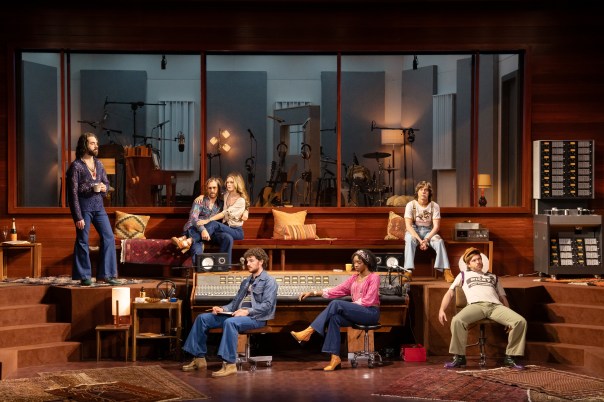
Pressure and deadlines are good for creatives. Or as Duke Ellington famously put it, “Necessity is the mother.” What David Adjmi’s Stereophonic explores – at excruciating length – are the consequences of no time pressure at all. Adjmi’s band, not named and not quite historical, closely tracks with Fleetwood Mac in the 1970s as they returned to their studio to cut what would become their megahit Rumours.

With music by Will Butler worthy of a supergroup, Stereophonic was a megahit in its own right, scoring a record number of Tony Award nominations and winning the top prize. For the ensuing national tour, now at Knight Theater for a rare second week, Adjmi and director Daniel Auken have cut into the show’s notorious four-act, four-hour bulk, so that the tourismo model arrives at a trim, but still overweight, 2:45 running time.

The group’s first album climbs to the top of the charts as they go deeper into hibernation, rehearsing, refining, composing, and crafting their more and more eagerly awaited sequel as expectations climb. But producer and lead singer Peter has no deadline to answer to, no set limit on whether the new release will be a single or double album, so new songs can be added on the fly while others, recorded earlier, can be shelved.

For the 1970’s, that was fairly outré. Such highly produced CTI jazz albums as Milt Jackson’s Sunflower, Airto’s Fingers, Ron Carter’s All Blues, and Hubert Laws’ In the Beginning (a double album), all recorded at the famed Van Gelder Studio, were produced in four days or less. Not enough time for an epic Fleetwood Mac soap opera, though no less music was released.

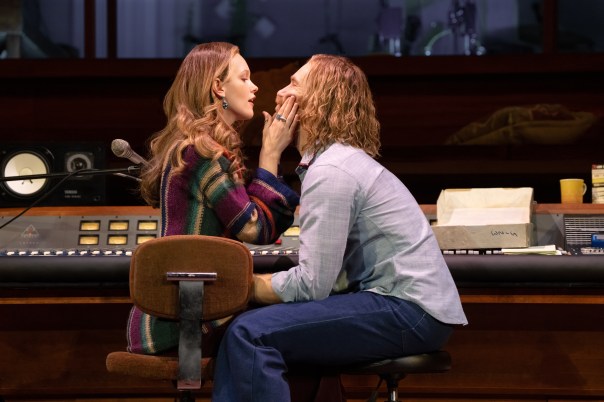
In line with the Sonny & Cher/Ike and Tina Turner/Lindsey Buckingham-Stevie Nicks template, lead singer – and Peter’s life partner – Diana is about to emerge as an industry supernova. That seems to fluster the not-so-subtly controlling Peter, a taskmaster and a perfectionist. Nor is perfectionism confined to the glamor couple. Band manager Simon can obsess for days over a phantom rattle in his drum kit after buck engineer Grover first detects it. And days more after Grover stops hearing it.

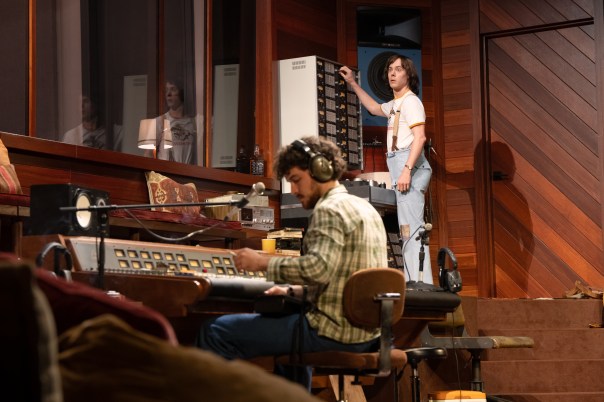
We can see that the claustrophobia of a group recording gig that goes on for over a year can wear on Diana and Peter’s already patched-up relationship. Naturally enough, Simon’s ongoing separation from his family pitches him gradually toward depression and moodiness. Less overtly, we can watch Grover’s growing confidence at the control board and his burgeoning influence over the band.

So yes, songs and takes can grow in polish and cohesion while they wane in energy and spontaneity. Compound that natural entropy with a souring romantic chemistry between two lead singers.

That’s when Grover’s new influence is crucial to the process. After numerous rehearsals and fine-tunings, the engineer at the control board notices that energy, spontaneity, and tempo have all sagged on one of the best tunes. Now Grover, previously a hanger-on who has falsified his resume to land this prestigious gig, grabs the driver’s seat and keeps prodding the band, through retake after retake, towards more authentic fire.

Animosity can be an obstacle or a creative trigger at this point.

By default, another lead singer composer, ace keyboardist Holly, becomes the most stable band member when Simon and his British cool unravel. Her emergence becomes all the more marked as she deals with her husband Reg’s increasing alcoholism, a drag to the whole band since he’s the bassist.

Holly’s relative stability enables Emilie Kouatchou to seize the dubious distinction of being the most consistently under-projecting actor on the Knight stage. Intimate conversations between the women, warmly spotlit by lighting designer Jiyoun Chang, were particularly difficult for me to decipher.

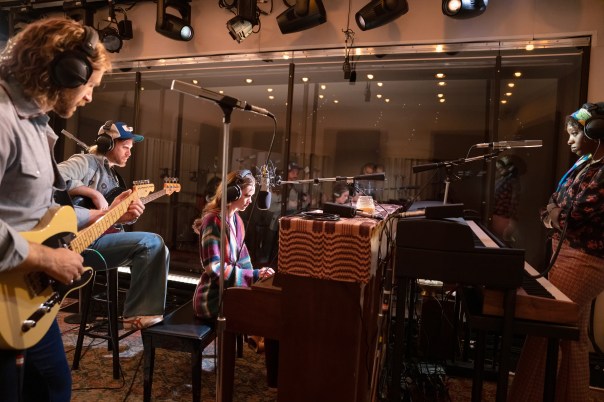
That sets up a bit of a paradox, for the control room/lounge area of the studio is closest to the audience, while the glassed-in recording studio is elevated a third of a flight up behind it. And of course, this actor band is really playing, simulating the 1976-1977 studio conditions, so the music is presumed to be recorded on real 3M reel tape, with multiple tracks mixed down to piddly two-track stereophonic.

Obviously, sound reaching us from that the more distant, highly-controlled electronic environment is cleaner – and more immediate – than the more mundane sound that’s closer to us downstage. You get the feel, since musicians gather there far less frequently than for their more casual, personal, technical, and candid conversations below, that dazzlingly brighter, hazier studio space is a loftier place in every way.

Foremost, because we sense that history is unfolding there.

Leaving the studio for a private argument offstage, Peter and Diana inadvertently demo the improved audibility of the hallowed ground when they leave their mikes on. Not only can Grover and fellow sound engineer Charlie hang on the power couple’s every word, so can we, adding a patina of hilarity to the backstage drama.

Drug use might be considered another bugbear threatening the group’s enterprise, but nobody in the band seems to be worried about the pigs busting in on a raid, despite the readily visible gallon-sized bag of cocaine. The dust makes it inside the studio, where Diana and her bandmates take a snort or three to perk themselves up, but no joints are lit up there. These are professionals.

We wait long enough for this supergroup-in-the-making to begin recording extensively in the studio to be starving for the serious rock we’ll hear – and that enhances the already rich gratification when we finally do. This is one very tight band, both vocally and instrumentally. A slight overlay of suspense when the women began their vocals. With both Kouatchou as Holly and Claire DeJean as Diane facing their respective studio mics in profile, I couldn’t detect whose solo led the take off.

I was more comfortable with the other key undetectables, knowing that virtually all other audience members were equally clueless: about cuts to the script and the playlist that happened in transit from Broadway to the road, and maybe along the road to Charlotte. Neither of the two scripts was available from Blumenthal Arts, so I couldn’t begin to weigh how much Adjmi and Butler’s “Radio Edit” strengthened or weakened the Broadway version that won five of the possible 10 Tony Awards it was up for.

No less than five members of that were nominated for the two Featured Actor laurels, so the record total of nominations was 13.

Sometimes, more is more. At no time would I agree with the NY Times assessment that Stereophonic is “a fiery family drama, as electrifying as any since Who’s Afraid of Virginia Woolf?” Ironic for a drama that dramatizes the pitfalls of an open-ended incubation process, Stereophonic may feel longer because, with so many microaggressions redlined, the “Radio Edit” may never have had the potential of rising to the heights – or rage – of Edward Albee’s masterwork. Or Tracey Letts’ more recent August: Osage County.

Other than their sonic dropouts, a serious matter for me, I couldn’t find any fault with the “Travelin’ Light” cast. They played and sang flawlessly, even on the outtakes. Maybe a blinking metronome, hidden from us, guides those oh-so-gradual increases in tempo. Only the enthusiasm level notches up noticeably when they find the true groove.

As Diana’s confidence, independence, and star power grew, it became more and more difficult to take my eyes off DeJean’s performance. Intermittently, thanks to costume designer Enver Chakartash’s alternating flair and reserve, Diana goes from fretting over the onset of her fame to wearing it. In the studio, there’s a parallel transformation (it may have been more correctly called an evolution in the longer version).

She seemed comparatively glued to the microphone during the first extended studio take. By Act 3 (after the only intermission), Diana roams the studio like the rock diva she has become, deigning to approach the microphone only when she sings. Ascending to rock royalty, she no longer asks Peter what she can do with her hands, no longer pleads with him to pick up a tambourine.

She just does it. From demure to diva, DeJean alluringly navigates all the curves and all the romantic bumps on the road to superstardom as the artistic flame within her burns more and more brightly and defiantly.

To be clear, Peter isn’t nearly as toxic as Ike Turner was in The Tina Turner Musical, so Denver Milord gets to play a far more nuanced role here. Yes, he is more than a little peacock-ish, but from the early moments, if you take notice of his reactions toward the debut album’s continued ascent on the pop charts, he is ambivalent about the band’s success.

This is partly to his credit, though we have more reason to detest Peter’s jealousy. Like Ike, we have to acknowledge that he’s a shrewd judge of talent who fiercely follows his instincts. So that male ambivalence that Milord plays, distasteful as it might be, also stems from his inability to even imagine resorting to Ike-like violence to keep Diana with him.

Ultimately, he sings like a god, she reigns like a goddess, and they produce a masterwork together. We are right to cut Peter some slack, particularly when Milord reveals his ability to earnestly apologize.

Extra kudos go to Milord and Kouatchou, both of whom understudied their touring roles on Broadway. It had to be brain-busting to unlearn so much of the original version while learning the new script and song arrangements.

Otherwise, it’s Christopher Mowod as Reg who garners the most attention, half amusing and half annoying. His pre- and post-alcoholic manifestations were remarkably balanced in drawing my delight and disdain, yet radically different. Even the concept of his character arc had a clever mirror-like reversal.

When he was most boisterous and boozy in the control room, Reg was literally self-effacing in the studio, devoutly facing away from his bandmates and the audience. Flip to the serene Reg 2, with a simplified wardrobe from Chakartash, he’s almost Maharishi-like outside the studio, but much more of a gregarious animal when he straps on his axe.

That’s another advantage of recording a new album within the time pressure of a single week: the same people play on all of it.

Save Your No Kings Protests, “King Hedley II” Remains Defiant

Review: King Hedley II @ The Arts Factory

By Perry Tannenbaum

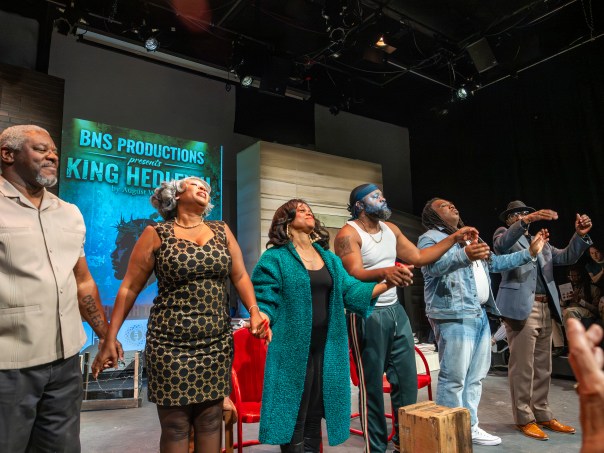
With over 3,300 No Kings protests popping up across the USA and on three other continents last weekend, you can go ahead and call BNS Productions’ local premiere of August Wilson’s King Hedley II an example of serendipitous or awkward timing. But you couldn’t deny that Wilson’s tragedy, the first BNS piece to be staged at the Arts Factory, was timely.

While a record eight million US citizens took to the streets, many reclaiming turf that was only recently terrorized by ICE G-Men chasing down an imaginary alien threat, basic living conditions of the 1980s, shown vividly by Wilson in all their wildness and squalor, still plague our inner cities. Religion, magic, and honest hard work offer no surer cure than guns, crime, and hopelessness.

Wilson’s clear vision and wisdom targeted the Hill District of Pittsburgh, illuminating each of the decades in the 20th century from a distinctively African-American perspective, forming an incomparably epic ten-play Century Cycle. In some ways, The Century (or Pittsburgh) Cycle is also incomparably complex. Some characters appear in multiple decades, while others mentioned in one of the dramas appear onstage in another.

In achieving his Cycle, to further complicate matters, Wilson did not move through the decades of his Century chronologically. Amid this seeming haphazardness, King Hedley II, commemorating the 1980s when it opened in 1999, anchors the most cohesive trio of plays in the whole series.

King’s father appears in Seven Guitars,the 1995 play that Wilson wrote immediately before Hedley II, along with Ruby and Elmore – but we see them four decades earlier in the 1940s, when King Jr is in embryo. Prominently mentioned in Hedley II, Aunt Ester will finally be seen, some 81 years younger, in Gem of the Ocean, the first play in the overall Cycle, premiering unforgettably on Broadway in 2003, starring Phylicia Rashad, depicting the 1900s decade.

If, as Wilson has said, Aunt Ester is a folk priestess who symbolizes the weighty history of African American tragedy and triumph, then her death at age 366 during Hedley II marks an unmistakable low point in the Cycle. The tempest of contention that breaks out at her home in Radio Golf, both the final play in the Pittsburgh Cycle (depicting the 1990s) and Wilson’s final work, can be viewed as piling insult onto injury or as a kind rebirth.

Like Hedley I, King would take it badly if anyone didn’t call him by his regal name. In fact, when we first see him, he is returning home from a seven-year stretch in prison for killing a man named Pernell, who not only slashed King’s face, leaving a permanent scar, but also insisted on calling him Champ. Hedley Sr. also committed murder for the same reason, so if you caught the Charlotte premiere of Seven Guitars in 2015, you would assume, like father, like son, that Hedley II has no regrets.

Not yet.

There’s another side to King that promises a fresh start, for he states concrete ambitions of opening a video store, a venture that cannot fail, and begins planting a garden in his front yard. Both Tonya and Ruby, the wife and mother who have held down this rundown fortress for seven years, are skeptical: they can’t believe King can follow a straight path to success. As sure as that bad dirt in their front yard won’t grow anything, King is bound to take the crooked way and land back in jail.

Hearkening back to Lorraine Hansberry’s A Raisin in the Sun, Wilson sets up a similar situation in the ‘80s to the one the Younger family encountered in the ‘50s. Only Wilson’s is a far bleaker view. Walter Younger held down a job, started a family, and his little sister had middle-class dreams and prospects.

King is more primal and dangerous than Walter, no less easily swayed and played. You’d better not stomp on those seeds King planted, though he sees the common sense of fencing off his little plot to prevent accidental incursions. Barbed wire, a bit aggressive, is his choice for fencing.

We can hope that the GE refrigerators that King and his best friend, Mister, are selling around town came from a legitimate source, but Tonya knows her man better than we do and presumes they’re stolen. An additional reason to trust Tonya’s misgivings comes when Mister proposes a heist at a jewelry store that he has cased.

Meanwhile, smooth-talking gambler Elmore is back in town with an eye toward reclaiming Ruby, getting married, and settling down. Proof of his wiliness comes after he talks King into letting him in on the GE scheme. Smooth operator, but he’s playing with fire. Even Mister knows better than to shoot dice with Elmore until he can bring a crooked set to the game.

Toi Aquila R.J., who also portrays Tonya, has a secure grasp of the costume designs that give each of the major characters his or her own distinctive style. There is black menace for King, a Sporting Life hipness for Elmore, and a diva flair for Ruby, the former big band vocalist. These core four are the strongest performers in director Rory Sheriff’s shrewdly chosen cast.

Much of the power that Jonathan Caldwell generates as King comes from those moments when he is open to reason, yet still seething somehow in these calmer moments. Explosions seem impending and inevitable. Tim Bradley as Elmore, on the other hand, sports a weaponized smile that conquers the ladies and confounds the men. As Ruby, Myneesha King gets to impress by belting a few bars, yet there’s no less sass in how her Ruby sees through both her son’s and her lover’s lies while succumbing to them.

For all that he packs into each of his plays, Wilson is anything but concise. Aquila’s anger as Tonya is as towering as her husband’s, and her monologue arguably encapsulates the passions and grievances that the playwright expresses most powerfully.

Yet there are ancient Greek elements artfully woven into Wilson’s script. Not knowing who you or your parents really are goes all the way back to Sophocles, most famously in Oedipus Rex, but the more overt thread in Hedley, the true prophet cursed with never being believed, goes back to Aeschylus and his pitiful Cassandra. Here in Pittsburgh this time, it’s Stool Pigeon, with Tone X laying heaps of Scripture on us all – and Wilson’s most delicious line:

“God’s a bad motherfucker.”

Now there’s some Greek attitude! Rounding out the cast is Andrew Monroe as Mister, appropriately the most inexperienced actor playing the most ordinary character. Not only does Mister bring King’s plight down to earth and help universalize it, but he also fails to move King with his pleadings – and to match his uncontrollable machismo when the heist goes down.

Deadly conflict between King and Elmore seems as foreordained as a dark storm first viewed on the far horizon. The best and zestiest view is at the Arts Factory through this weekend.

“God of Carnage” Bites but Merrily Refuses to Draw Blood

Review: God of Carnage @ Theatre Charlotte

By Perry Tannenbaum

Human masterworks and monstrosities cover the globe, fly through the air, and reconfigure the sky, bringing breathtaking changes to land, sea, and climate. So it’s rather quaint to spend an evening with a playwright who has built her reputation on the notion that civilization is a thin veneer clothing our innate selfishness and savagery.

Morals, ideals, aesthetics, and manners were all shown to be shams in Yasmina Reza’s Art, her 1994 breakout sensation. Trading in her sharper scalpel for a blunter instrument – a wrecking ball – Reza gleefully bludgeoned the veneers of sophistication, liberalism, reason, consensus, and even adulthood in God of Carnage, an even more smashing Tony Award-winning success in 2009.

It’s an unabashedly macro takedown of humanity and the progress of the race. Yet it’s deeply rooted in the soul of art and in the tradition of drama. For Sophocles and the Greeks, the tragic joke was that, no matter how mighty or regal we might be, or even how brilliant, we were all the playthings of the gods. Modern science reframed the picture, grimly enslaving us to our inner demons while liberating us from external forces. For O’Neill, Albee, and other moderns, the prospects were no less grim.

What’s especially disarming about the new Theatre Charlotte revival is just how lightly this heavy Carnage can play. To say that director Brian Lafontaine takes an impish approach to this adult powwow between parents of two schoolkids would be a grossly misleading understatement. Once disagreements between the two couples, the two genders, and the two husbands and wives escalate, no holds, shticks, or slapstick are barred.

If I had to apportion the hijinks at the Queens Road Barn to Reza’s script and Lafontaine’s embellishment, I’d give a decided edge to Lafontaine’s frou-frou. The recent altercation that precipitated the comedy action, between Henry Novak and Benjamin Raleigh about 30 minutes after sundown at Cobble Hill Park in Brooklyn, NY, was surely more violent than what we will witness onstage, with two of Henry’s teeth broken by Benjamin’s bamboo rod.

But the hostilities that break out between the adults are more epic in length, malice, and pettiness. Outbreaks of empathy, conciliation, appreciation, and apology only compound the impacts of their childishness and breaches of decorum.

So does the sleek neatness of Chris Timmons’ set design, where not a single hair or tulip seems out of place. Our hostess, Veronica Novak, writes about Ethiopian culture and civilization while working part-time at an art history bookshop. Not the expected match for Michael, her husband, a wholesaler who traffics in doorknobs, saucepans, and toilet fittings.

We rightly presume that the neatness, the stylishness, and the tulips emanate from her. On the other hand, both Reza and Lafontaine appreciate the special comedy spark that hostile women can ignite more readily than men. That’s why Reza has Veronica and Benjamin’s mother, wealth manager Annette Raleigh, initiating the most startling fireworks. Lafontaine delights in piling on additional aggressions from his women, Jenn Grabenstetter feasting on Veronica with serial hurler Aimee Thomas on the counterattack as Annette.

The menfolk are mostly on the receiving end of attacks, so Reza fiendishly contrives to make them as supremely irritating as their wives are judgmental. Most outré and obnoxious is Paul Riley as Benjamin’s dad, Alan. Like Veronica, Alan has also spent quality time in Africa – with a radically different, primal takeaway.

Lafontaine has special affinities and insights into Alan Raleigh, since he played the role in the 2012 Charlotte premiere at Actor’s Theatre.

We can only guess that Lafontaine yearned to be even meaner, obnoxious, and amoral than he was. That was my takeaway from Riley’s Alan, as he pokes among the objects in the Novaks’ bookcase and allows himself peeks at the upstairs. Mostly, he infuriates everyone by rudely answering his cellphone every time it buzzes, no matter how involved he should be in deliberations with his wife and hosts.

Unless you find it more irritating that, aside from frankly admitting that he has fathered a savage, he is spearheading damage control for his client, a big pharma company responsible for a widely available drug newly found to cause hearing loss and ataxia. That insider info hits home when Brandon Samples, as Michael, is obliged to take a phone call from his hospitalized mom.

One of the people Alan and Pharma are victimizing is now on the line. The same drug has just been prescribed for Mom.

So maybe Riley is most obnoxious when he arrogantly declares that his hosts shouldn’t be eavesdropping on his privileged attorney-client conversations. There’s a lot to choose from with Alan.

And a blizzard of suffering that the Novaks must endure, especially when Annette barfs all over her hosts’ coffee table and their precious art books. You might say that we’re a bit out of control at this point, belly-laughing at the panic and queasiness that ensues from the phlegmatic deluge. What an odd thing to unite these families in damage control!

Lafontaine decrees that Samples shall be the queasiest of them all, likely taking his cue from Reza, who makes this dealer in doorknobs and toilet fittings surprisingly skittish about handling his daughter’s pet hamster. Quite a different sample of Samples than we saw last October when he portrayed Hercule Poirot.

What makes Michael irritating is subtler than what we readily see in Alan. He seems at first to be the resurrection of Yvan, the conciliator in Art who tries so valiantly to agree with both Serge and Marc despite their wildly differing views on modern art and Yvan’s impending marriage. Similarly, everybody seems to be making a good point in Michael’s view.

Such pliability and ambivalence, under Reza’s merciless scrutiny, prove to be as fundamentally amoral and uncaring as Alan’s jaded pragmatism. That’s what opens the floodgates of Veronica’s fury when the compliant Michael breaks rank with her. Grabenstetter, notwithstanding all her sophistication and empathy for “the tragedy in Darfur,” snaps like an alligator, pursuing her husband around their living room like a rabid wolf. Serves him right after Samples’ scene-stealing response to the massive vomiting.

Aided by some very fine Antigua rum, Thomas also gets a marvelous character arc to track with Annette, overcoming her nausea, attacking her spouse, and avenging herself on Veronica. That pleasure, sad to say, did not quite allow me to forget my earlier difficulties hearing Thomas when she was still in her diffident cocoon.

God of Carnage doesn’t exactly match Hamlet for length and power, but its captivating turbulence stems from the same source: the push-and-pull of visceral urges struggling against societal norms. The Novaks and the Raleighs do lose control like their savage sons, but they lose it like adults rather than 11-year-olds.

So there’s hope for us. That amazing restraint is the heart and conscience of this singularly chaotic comedy. Maybe that’s why we have so much fun. Get ye to the Queens Road Barn!

“The Revolutionists” Mixes Comedy and High Ambition

Review: The Revolutionists @ Warehouse PAC

By Perry Tannenbaum

Badass. That’s how Lauren Gunderson describes all the women in her feminist fantasia, The Revolutionists. On the heels, high and low, of the touring edition of Suffs that premiered at Belk Theater, the Warehouse production of Gunderson’s 2016 script – with a second all-female cast in the same week – underscored one of the subtler achievements of the suffragists who aided the passage of the 19th Amendment 96 years earlier.

Men and women now openly admire all these badasses and cheer them on!

Cheers and laughter were high among Shaina Taub’s aims when she wrote and starred in Suffs as revered feminist Alice Paul. Gunderson feels compelled to diligently remind directors and actresses who bring her historical script to life that this is a comedy. Since all of her women are living during the apocalyptic Reign of Terror in 1793, midway through the French Revolution, the shadow of the fearsome guillotine looms large.

None of them supports that notoriously bloody revolution.

Charlotte Corday, the most badass, actually embraces the guillotine, the likely consequence of her intent to assassinate Citizen Marat, the radical newspaper influencer. Calling for the same liberté and égalité in her native Caribbean that have toppled the monarchy in Paris, Marianne Angelle, a free black spy, hopes to skirt the guillotine while opening the eyes of the Revolution to the hypocrisies of slaveholding and continued colonial power. And Marie Antoinette, “less badass” than the others, is desperately fleeing the chopping block, hoping to rebrand her clueless, free-spending, and heartless reputation on the fly.

They all converge on the feminist playwright of the day, Olympe de Gouges, in urgent need of her eloquence. Corday has the simplest need: a memorable exit line to proclaim at the scaffold, one that will resound for eons to come. Marianne could use a sharply worded manifesto – with a soft touch – that furthers the cause of her homeland. Marie merely needs a total rewrite and makeover: redemption, whether or not she deserves it.

What a godsend de Gouges is! When we first saw the comedy in 2018, produced at Camp North End by PaperHouse Theatre, it was easy enough to see Olympe as a rather transparent surrogate for Gunderson, shaping the comedy she ostensibly tailors for Marie. Directing that production, Nicia Carla decreed that her Olympe discard her quill in favor of an anachronistic BIC ballpoint, letting us perceive Gunderson’s guiding hand throughout.

Historically, it’s even more complicated: de Gouge really wrote a comedy in which she, a character in her own play, taught the downfallen Queen Marie a lesson. She also penned a manifesto, the courageously feminist Declaration of the Rights of Woman and the Female Citizen, punching her ticket to the scaffold. From that perspective, it’s possible to see her, quivering and quailing here as she crafts her Reign of Terror comedy, as the inspirational fountainhead of Gunderson’s fantasia.

With no less than four subtitles: A Comedy, A Quartet, A Revolutionary Dream Fugue, and A True Story.

At the Warehouse Performing Arts Center up in Cornelius, director Reneé Welsh-Noel mutes the anachronisms and the wink-wink meta approach until late in the second act, when Gunderson explicitly decrees that the fourth wall must be broken. Welsh-Noel and scenic designer Chris Tyer utilize the larger space and richer theatre resources at the PAC to offer the playwright’s quartet multiple platforms to declaim, orate, stab, and achieve martyrdom.

One of these doubles as de Gouge’s desk or, if you will, the table in her salon. A glorified picnic table, to be honest. Even her highness deigns to sit herself at this humble furnishing, but a legit settee looms further upstage for Marie’s more regal lounging. Assuring fluidity between scenes, the remaining scenery is sparse: a jut of a snub mantle on the back wall, with a scattering of ornate picture frames.

Except four projections from Jessica Zingher, most of the other frames are blank. They all seem to float apart from the action, though they are preternaturally relevant – like a gallery of images in Gunderson’s mind or her surrogate playwright’s. Making the space more emphatically Olympe’s, sheets of writing paper litter the high-concept floor, a multitude of testimonials to her pathological writer’s block.

Maybe Tyer’s concept mystically correlates the excess of strewn paper below with all the jet blackness inside the empty frames above.

It certainly testifies to the intensity of action from Olympe that yields such a welter of messy futility: the frenzy of the times. Welsh-Noel seeks to keep a vortex of swiftly paced action swirling throughout the evening, spreading her actors across the wide space, amplifying confrontations, with them threatening and lunging at each other. Tension and urgency remain ridiculously high under the shadow of the guillotine. Like a comedy.

Costumes from Welsh-Noel and Zingher add spice and flair, flouncy and beribboned for Marie and continental ninja for Corday. By contrast, Angelle’s outfit pops with Afro-Caribbean color and style, an equally bold statement.

Brave as Olympe may have been in real life in her attempts to champion women’s rights and to reconcile the radicals with the royals, Gunderson infuses her inspiration with her own trepidations over putting your life on the line with your plume. So it’s an ambivalent and bumpy ride for Lisa Schacher as Olympe, one that alternately accentuates the comedy and drama, both of which would suffer if Gunderson’s concoction were more sure of herself.

Jennifer Adams is mostly at the comedy end of the spectrum as the deposed, soon-to-be decapitated Marie: too vain to skulk through the streets in disguise, she materializes in Olympe’s parlor, announcing her own entrance and assuming everybody is talking about her. Yet Gunderson allows her dopiness to vanish at times, giving way to clairvoyance at her brilliant moments and allowing Adams to display maternal feelings – to Marianne, of all people.

Her most charming moments perhaps come when Adams puts aside Marie’s regality and snobbery to become rather childish in her candid enthusiasm, the glue in the quartet’s sisterhood. Sororité!

My chief difficulties with this production came from the eternally serious women, Jane Elvire as Marianne and Marissa Dibilio as Charlotte – though each of them lands a barb or two at the lighter women’s expense. Likely because of her authentic Haitian roots, it took me a few minutes to attune myself to Elvire’s lilting accent, with a couple of relapses later as Marianne’s actions and words become more urgent.

With her bounty of natural dignity and presence, Elvire is exactly what Gunderson had in mind when she described her as “the sanest of them all.” Whether through instinct or through diligent research into Marianne’s historical parallels, Gunderson burdens the free Caribbean black woman with the most adversity to deal with. Ultimately, her sufferings help the playwright pierce Marie’s silly, frilly façade in some of the quietest, most human moments of the evening.

From a dramaturgical standpoint, Dibilio’s dashing outfit may be Welsh-Noel’s most audacious decision. Dressed like that, you multiply your chances of not being admitted to Marat’s bath by his servants and bodyguards. But it helps Dibilio look the part, though paintings of the famed assassin, in action or brooding at the Bastille, opt for more conservative clothes.

At times, Dibilio falls into the trap of sounding too natural in her gripping performance, lowering her voice when she gets really close to other players. When we can hear her, she’s quite compelling.

From the opening, when we hear a falling guillotine and Olympe’s first words are “Well, that’s not a way to start a comedy,” we’re clued in to Gunderson’s aim to mess with us. Talk about audacity, she’s serving us notice that she’s presenting a comedy that writes and rewrites itself before our eyes.

That’s not really possible, is it? But what The Revolutionists accomplishes is nearly as impossible: reminding us that, in horrendously troubled times, the noble words and actions of our finest writers and activists will certainly outlast tyrants, bigots, and bullies. While making us laugh between bloody plunges of the guillotine.

“The Flick” Flip-Flops Audience and Stage

Review: The Flick at Theatre Charlotte and Independent Picture House

By Perry Tannenbaum

From time to time, it’s nice to see Theatre Charlotte showing greater confidence in its audience and extra audacity in its programming. Recent seasons have seen increased excursions beyond bankable fare, such as A Christmas Carol, Misery, Murder on the Orient Express, and Rumors, to more daring and provocative frontiers such as Violet, Every Brilliant Thing, I and You, and Detroit ’67.

God of Carnage is on deck for next month.

Now we’re in the midst of a run that’s even more daring and experimental than their 2016 concert version of Caroline, or Change, which was staged out in the lobby of the Queens Road barn. The current production of Annie Baker’s THE FLICK, directed by Kyle J. Britt, goes even further out on a limb.

It’s very high-concept, for now we go past the theater doors leading to the front and rear of the orchestra, entering instead through the stage door. Instead of heading backstage, we hang a right – and take our seats onstage, looking out into the orchestra where we usually sit and the light booth beyond.

Tonight, that orchestra is the stage and the light booth is a projection room aiming blinding light at us, for Baker’s notorious Pulitzer Prize winner takes place in a movie theater, one of the last in America that still shows movies made on 35mm celluloid. Famed for its epic length, sustained pauses, and glacial pace, The Flick had premiered Off-Broadway in 2013 at Playwrights Horizons and revived, with the original cast, at the Barrow Street Theatre, where I reviewed it in 2015. Avenging myself on that production at my computer turned torture into a bit of a picnic.

Without that mischievous consolation, I presumed that my wife Sue was sufficiently traumatized not to wish to see this faithful sketch of the quotidian a second time. Wrong. Until midway into the second act, she had totally forgotten The Flick.

Nightmare City. Properly braced for the epic slog, I found myself charmed by the Theatre Charlotte version, for Britt goes the extra mile – recalling the greatest Carolina Actors Studio Theatre forays into experiential theatre – in making The Flick a moviegoing adventure. An elegant ramp bordered by chrome railing is slung over the couple of humble steps that normally lead you backstage at the Old Barn.

The new entranceway is draped in black curtains and discreetly spotlit, duplicating the ambiance at a multiplex when you leave its indoor boulevard and plunge into the darkness of one of the theaters. If you’ve seen the movie posters promoting this special Theatre Charlotte presentation, you’ll already be impressed by Britt’s ability to capture the deathless noir flavor of the Pulp Fiction movie poster.

Seeing this sly Tarantino homage, perfectly sized and displayed in that spotlit alleyway, adds a wonderful frisson to the evening. For those who weren’t as thoroughly braced as I was for the inaction and inertia to come – or less advantageously seated than we were – that evening grew very long. In the heart of Greenwich Village in the summer of 2015, I troubled to time the show: playing time clocked in at 2:54 plus a 19-minute intermission.

We can further admire Britt for speeding up the action to narrowly beat those Off-Broadway timings. He’s actually bucking the odds.

Brilliant concepts can start to crumble when they collide with reality. When David Zinn designed the set for the legendary Barrow Street, he could take liberties. His theater could be four rows and achieve reasonable verisimilitude, but Britt must play the hands he is dealt. That’s 13 rows of seats at the Queens Road barn, and if you want your actors within reasonable proximity of the stage, you’ll need them to traverse seven or eight rows to replicate the same intimacy we had at Barrow Street.

Each exit between Baker’s many scenes must traverse that extra distance, threatening to further lengthen our playing time. When we first see Aedan Coughlin, as Sam, schooling John Felipe, as Avery, in the finer points of cleaning up theater trash between ushering stints, Britt wisely spaces them at opposite sides of the aisle. So it’s plausible that both men must raise their voices to be heard.

Even so, Coughlan, as the disgruntled senior usher, is the more consistently audible, showing the newbie the ropes and schmoozing with Felipe. That gap didn’t narrow significantly as Sam continued his chattering and coaching toward the front seats. Avery does seem to emphasize the names of Hollywood stars, compared to the relatively garbled names of the films they were linked to when showing off his cinema geekiness.

Otherwise a bit shy and withdrawn, Avery boasts that he can connect any two Hollywood stars you name in six-degrees-of-Kevin-Bacon style. For all of Sam’s repeated efforts, Avery always makes good on his boasts. While it is likely that Sam begrudges Avery his more substantial education and his more promising future, that’s not where the friction between them peaks.

Enter Destiney Wolfe as Rose: younger, savvier, and sexier than any of her co-workers. So sexy that Sam tells Avery that she’s a lesbian – to clear his lane to Rose. If he ever summons up sufficient courage to make a move. Wolfe isn’t full of herself as Rose, but she’s coolly self-assured. After getting passed over while Rose snagged the promotion to projectionist, Sam may rightly believe that this talented young lady is out of his league.

To look at Coughlin, you would not instantly agree. While not as erudite as Avery – or as snobbish – Sam can propose numerous worthy candidates when the college guy boldly declares that Pulp Fiction (1994) was the last great American film.

Among those candidates, Avatar (2009) draws the most scorn from Avery and is one of Felipe’s best moments before intermission. Thematically, the comparison between classic noir celluloid and digital fantasy gets us to the heart of Baker’s yarn. The Flick, doubling as the name of Baker’s movie house, is an endangered species, treasured by Avery as an analog monument, one of the last-standing rear guards against the onrush of digitality that isn’t film at all.

Surrendering, we shall see, without a fight.

The location of this landmark is in Worcester County, Mass., allowing Coughlan to add on another layer of excellence, intermittently capturing the Southie brand of a Boston accent. As the scholar in the group, Felipe is hardly obligated to attempt the working-class accent, but Wolfe doesn’t even try.

At least, I don’t think she does. Hearing anything she says without her calling across the theater was a pretty rare experience. What really crash-burned Britt’s concept, beyond the usual acoustic difficulties we’re familiar with at the Old Barn, were the problematic sightlines of the temp seating onstage. Further back than a couple of rows, there was no way to hear or see all the action. The lip of the Theatre Charlotte stage got in the way when the actors moved all the way up front because of the problematic sightlines.

Since so much was so hard to take in before the lights came up for intermission, I felt obligated to issue a spoiler to my companions, telling them there was drama on the near horizon. Shit will begin to hit the fan – not at a blinding velocity – when Sam returns from attending his brother’s wedding and discovers that Rose has taught Avery how to work the projector, a favor (not the only one) that Sam has been denied.

Other members of the opening night audience simply defected.

Now the show, fully chastened, continues its run at the Independent Picture House this weekend. Prospects are better at Raleigh Street for fuller enjoyment. None of the movie theaters there has more than 12 rows, almost all are considerably narrower, and none are saddled by an overhanging stage compromising an audience’s sightlines.

One of these houses even allows actors to slickly enter the space behind the fourth row of seats. The express route!

“Over the River” Has Fresh Relevance at the Old Barn

Review: Over the River and Through the Woods at Theatre Charlotte

By Perry Tannenbaum

Back in the days of Woodstock and hippies, my generation spoke solemnly, defiantly, or even sarcastically about the Generation Gap. For a long time, it was sincerely believed to be the most telling division in our country. With the return of Joe DiPietro’s Over the River and Through the Woods to Theatre Charlotte after previous runs in 2002 with Rock Hill Community Theatre, 2004 with Charlotte Rep, 2013 at Fort Mill Community, 2014 with CPCC Summer Theatre, and 2016 with Davidson Community, it’s rather shocking to realize how recently that belief has become so quaint and outdated.

Good thing, then, that Over the Woods is mostly a comedy that doesn’t take itself seriously – for the gap is huge. Our floundering Nick Cristano, career success and social schlub, is two generations younger than his Hoboken elders. The gap is further multiplied by the aggregation of both sets of grandparents, Nunzio and Emma Cristano coming over for Sunday dinner every week chez Frank and Aida Gianelli.

For added zest, the gulf between the grands and the hopelessly outnumbered Nick is more than a little exaggerated. A game of Trivial Pursuit plays a little like an Abbott & Costello shtick, capped by an epic global route to Nunzio’s single correct answer.

In fact, the two scenes we see before intermission at the Queens Road Barn would not feel out-of-place if we encountered them as sketches on classic TV variety shows, ranging from Sid Caesar’s Show of Shows to Saturday Night Live. The first is Nick’s hilariously arduous attempt to break some big news to the grandfolk.

Whether it’s a glib interruption, a conversational detour, a remembered anecdote, a temporary defection to another room, or Aida’s never-ending blandishments of irresistible Italian home cooking, one obstacle after another keeps Nick’s news on perpetual back order until we’ve had to question if it will ever make it off the runway.

Hitting Broadway a year before The Sopranos cemented the connection between Italians and New Jersey, Over the River overflows with ethnicity, thanks to director Elizabeth Sickerman and dialect coach Marilyn Carter. Nor is this pure and delicate spring water. It’s an aromatic sludge with the consistency of Grandma’s legendary marinara. Two dominant flavors: Italiano and Joisey.

More cringeworthy is the folk medicine cure that the elders concoct in the wake of Nicky’s stunning disclosures. Enter Caitlin O’Hare, a nice local Irish girl unafflicted by any ethnic accent and hopefully alluring enough to keep Nick from straying too far from Hoboken. It’s a brash set-up that catches poor Nick unawares, an impromptu first date with unabashed interruptions, interrogations, and interferences from the well-intentioned seniors.

So here is where everything becomes so quaint, halcyon, and naïve. Both of the Gianellis that Caitlin finds so adorable are Italian immigrants. We find ourselves reacting in the same way to both of the elder couples, no matter how far Emma overreaches with her matchmaking and her prying or how much excessive food Aida lavishes upon her young guests, including veal for a vegetarian.

They are truly personable. Speaking directly to the audience before anybody picks up a dinner napkin, Frank genially tells us that he arrived in America with just 200 lira in his pocket (about $10.50 US back in 1930), along with the Hoboken address of a cousin who had already moved to “a faraway land called Brooklyn.” And 65 years or so after reaching our shores, reminiscing about living under a Hudson River pier for six weeks, he’s still speaking with an accent!

“Tengo famiglia!” he and his grandson declaim, the taste of their Italian roots still sweet to their lips.

Before even saying grace, Frank has already checked three of the immigrant boxes that 47 would label as garbage. Yet there’s more ICE bait: Emma remains as proud of her husband as she is of the family she raised here, proud to describe him as a laborer. After all, he built this house with his bare hands!

Ironically, when DePietro was prefacing his 1998 comedy with Frank’s migrant memories, he probably wasn’t trying to score a political point. “What point?” he might have asked. On the day after our Republic’s 288th birthday, when I last saw Over the River at Pease Auditorium, my reaction was likely aligned with the playwright’s.

My 2014 review, “Matchmaking With Veal and Provolone”? Not a single mention of politics or immigration.

That was the first time we encountered Gerald Colbert’s portrayal of Nunzio, the weightiest counterbalance to DiPietro’s comedy. As a second-generation American, Colbert’s Nunzio, with his gray hair slicked down traditionally, tracked extremely close to my dad, who had passed away less than two years earlier, and my Uncle Abe – often mistaken for Dad’s identical twin – who had died just five days earlier.

Looking so much like them that day added to the weight of the mortality that Nunzio was staring in the face, in the grips of terminal cancer and grappling with the question of whether he should weaponize his condition to keep Nicky in Hoboken. Both of my elder Tannenbaums reached their nineties, so there’s plenty of gap left for Colbert to navigate, but his affinity with and empathy toward Nunzio have noticeably deepened.

Nunzio’s climactic valedictory dialogue with Nicky was especially heartbreaking for me, but it also offers new dimensions of topicality for all.

As the lovingly coddled and embattled Nicky, Timothy Hager is almost too perfectly cast. A walking bundle of ambivalence and insecurity, Hager is also sufficiently tall, stooped, and slender to be viewed as crying out to Aida to feed and overfeed him again and again so dear Nicky can finally take shape. He does make an awful impression on Caitlin with his defensiveness, but his awkwardness – and gawkiness – keep him a bit lovable in his discomfiture.

He’s aware that he’s a mess: a work-in-progress.

Quaint and manipulative as these harpies are in their quest to tie Nicky down in Hoboken, they need to be ambivalent because they honestly love him – and because they have previously allowed their sons and daughters to fly the coop. Paula Baldwin isn’t taking on the toughest challenge of her career with Aida, the Einstein of pasta, but she handles the matriarch’s ignorance with a zest that brings fresh life to the g-mama stereotype.

If we hadn’t seen the like with so many stage husbands before, we could say that Baldwin pairs amazingly well with Henk Bouhuys as Frank Gianelli. Can we agree, though, that he delivers the tangiest Italian accent? He must also navigate a preternatural ignorance that matches the blank that Aida draws on vegetarians, for Frank doesn’t know where Seattle is. Notwithstanding Frank’s humble beginnings – and the accent – Bouhuys consistently radiates the well-to-do dignity of an octogenarian enjoying his golden years.

DiPetro’s subtlest move is making sure that Nunzio and Emma Cristano are second-generation Americans with urban accents. This isn’t as crucial for Colbert as Nunzio as it is for Kasey Lathem as Emma. Hers will be the only familiar face that Caitlin expects to see when, politely bearing a bottle of wine, she knocks on the Gianellis’ door.

Lathem must be glib and modernized enough to be a supermarket buddy of Karisa Maxwell McKee as Caitlin O’Hare. Offsetting her laudable sociableness, Emma must also be tactless and tone-deaf enough to introduce this chum to everyone as “the unmarried niece of my canasta partner.” Nunzio and Frank can be counted on to immediately join in with the same high level of unsubtlety.

Sensing the gauntlet that she will have to run, McKee gets to show considerable backbone as Caitlin, though DiPietro would have been more imaginative if he had made her something other than a nurse. Her ultimate effect on Nick, dispensing her objective opinion on his behavior vis-à-vis his grandparents’, is not at all medicinal. She becomes a timely barometer in gauging how much growing Nick still needs to do in his thirties – and paradoxically, how urgent it is for him to strike out on his own.

We’re sort of circling back to Frank getting on that boat with 200 lira, aren’t we? In her digital program intro, Sickerman rightly targets the immigration themes lurking in this script, linking us to a Library of Congress page on “Immigration and Relocation in U.S. History.”

Feeling Like an Outsider at “The Outsiders”… and I Like It

Review: The Outsiders at Blumenthal PAC

By Perry Tannenbaum

Belk Theater will likely still be rockin’ for days after the national tour of THE OUTSIDERS strikes its deceptively simple set and rolls on up to Chicago for a two-week run. If it weren’t Charlotte Symphony already booking the space next weekend, this gritty, steady rocker could have easily played a second week here without losing momentum. And possibly more.

Opening night was an eye-opener for anyone who had never been swept up in the rite-of-passage tidal wave generated by S.E. Hinton’s 1967 novel and Francis Ford Coppola’s 1983 film adaptation. Traffic to the College Street parking garage was so intense that, when we finally found a place on Level 8 to park, we needed to take a down elevator to exit at the bridge across to the Bank of America tower, where Blumenthal PAC has its performing spaces.

Usually, we hit the up button to go two or three floors up to Level 6.

After pausing to validate my parking stub in the lobby, we found that we were just in time as we saw the usher close the theater door behind us. It was only when we took our seats that we realized that the place wasn’t just packed… it was a sell-out. So an usher confirmed when I ambled up to the front of the house, turned around, and beheld eager theatergoers all the way up to the uppermost rows of the top balcony.

This was near-Hamilton fervor, eclipsing the receptions we’ve recently seen for such recent Tony Award-winners as Kimberly Akimbo, The Band’s Visit, Moulin Rouge, and even Hadestown. While we can all quibble and passionately argue which of these distinguished visitors should win a tournament of champions playoff, the production quality of The Outsiders was definitely top-tier, from Cody Spencer’s tight sound design to Jeremy Chernick and Lillis Meeh’s splashy special effects.

While some of the buzz that I was hearing about this Tulsa tale likened the animosities between the Greasers and the Socialites, or Socs, to the Jets and the Sharks of West Side Story, Ponyboy Curtis and his fellow Greasers are far more déclassé than their Hispanic counterparts, let alone the Montagues of Shakespeare’s Romeo and Juliet. There are no Greaser girlfriends in this grim picture, an apt barometer of these dudes’ hopelessness.

Nor is Ponyboy actually poaching on one of the Soc girls. After taking a beating for watching a movie on Soc turf, he escorts the Alpha Soc girl, Cherry, to a concession stand at a drive-in movie on neutral ground. They strike up a long conversation, enjoy each other’s company, but there’s no petting or romance.

Even so, this crosses the line for Cherry’s ultra-possessive boyfriend, Bob, and his chums. They gang up on Ponyboy and his bestie, Johnny Cade, not realizing that Dallas Winston – the Greasers’ spiritual leader and an ex-con – had recently gifted Johnny with a switchblade and taught him how to use it. Like Romeo before him, Ponyboy and Johnny Cade must flee town to avoid the law, Dallas acting as their Friar Lawrence.

The score by Jamestown Revival and Justin Levine is as consistently intense and authentic as Leonard Bernstein’s, but not nearly as varied. Nor with Levine’s arrangement for guitars, keyboard, cello, bass, violin, reeds, and drums, does it aspire to the same amplitude and agony as West Side Story. That’s about right: Amid the gloom and despair of Greaserdom, there’s a glimmer of hope emanating from Ponyboy, who has read Robert Frost and Great Expectations.

After Johnny Cade’s exhortation to “Stay Gold” in the face of Frost’s “Nothing Gold Can Stay,” Ponyboy’s favorite poem, that glimmer is not extinguished.

Unlike the Coppola movie, Nolan White as Ponyboy doesn’t sport the has-it-made Hollywood looks of C. Thomas Howell or the future superstar hunks – Matt Dillon, Patrick Swayze, Rob Lowe, and Emilio Estevez, for starters – surrounding him. More like Micky Dolenz of Monkees fame. That gives this stage version, directed by Dayna Taymor, about a million-mile head start on the film.

The other homies are no less homely (except the stunning Corbin Drew Ross as Sodapop Curtis), which is a good thing. Bonale Fambrini as Johnny Cade and Tyler Jordan Wesley as Dallas never look like they’re slumming. They sing and act as if they’re to-the-gutter-born, dressed accordingly by costume designer Sarafina Bush.

We can also gush over the glamor and drama that Emma Hearn and Mark Doyle bring to Cherry and preppy Bob. Or the family struggles, sacrifices, frustrations, and domesticity that Travis Roy Rogers brings to the action as one-time pro football hopeful Darrel, Ponyboy’s eldest brother.

But as good as Adam Rapp’s book is at capturing the striated inertia of Hinton’s Tulsa, the propulsive electricity of The Outsiders comes from its score and the flair of Rick & Jeff Kuperman’s jagged choreography. Even this isn’t enough for Taymor. The hoofers send up bursts of plastic pellets from the floor, and the climactic rumble between the gangs brings down storm showers from above. Once all of these elements began cranking up, the fanaticism of the pre-sold audience was irresistibly contagious. I listened to the acclaimed original cast album when I returned home, but it wasn’t nearly as exciting as the live