Tag Archives: Rahman Williams

Keston Conquers Again in The Color Purple

Review: The Color Purple at Theatre Charlotte
By Perry Tannenbaum

Across the span of nearly 40 years of reviewing, reporting, and pontificating on the performing arts, quite a few events and performances have etched themselves into my mind. On rarer instances, an audience response will be equally unforgettable, such as press night on April 10, 2008, at Ovens Auditorium, the first time Wicked came to town, greeted by a series of deafening ovations that have never been matched.

Every time my Apple Watch notifies me that an audience topped the 100dB mark the previous evening, I wish I’d had one at Ovens that night to know what the highwater mark is.

Even more unique was the night of September 15, 2012, at Dale F. Halton Theater. There, the student actors and musicians of Northwest School of the Arts performed The Color Purple. My wife Sue and I went with a bit of trepidation.

We had already seen this musical on Broadway and in its touring reincarnation at Belk Theater. More to the point, we knew the pitfalls of an all-youth cast colliding with roles that demanded fully mature players. At the Halton, we were already reminded of how wrong that could go when the recent college grads who recruited for CPCC Summer Theatre clashed with the likes of Fiddler or Spamalot.

Of course, we had already built up considerable trust in Corey Mitchell as a stage director nearly three years before he snagged the first Tony Award given to a theatre educator. But there are tough hombres in Alice Walker’s Purple, including poor Celie’s abusive father and husband, Pa and Mister.

And if you remember either the film or the Oprah-produced musical, there are two certifiable divas besides Celie, our tormented protagonist: the hard-headed Sofia and the glamorous Shug Avery. Could Mitchell find all the outsized talents he needed enrolled at Northwest to fill all these roles?

Sure did. And he had more: scenery on loan from the original Broadway production.

But the audience! When Northwest junior Keston Steele, starring as Celie, had finished singing her “What About Love?” solo, Sue turned to me and asked, “Have you ever seen anything like this?”

For the entire audience, it seemed, had sprung to its feet – a standing ovation in the middle of a show! And the answer to Sue’s question is still no.

So you can imagine that when we walked into the old Queens Road Barn on opening night of the current Purple and received my playbill, I was pre-sold. Our Tony Award winner was back directing Theatre Charlotte’s new version, and the name of Keston Gary topped his cast list as Celie.

Had to be the same Keston, right? That’s honestly the only name I had remembered.

While I wasn’t the only person in the Queens Road Barn who remembered Gary’s pre-marital, pre-motherhood exploits at CP, it’s unlikely that anyone else in the crowd was in the same suspense: would history repeat itself?

So there was that unique suspense for me, especially when Gary belted out “What About Love?” as zestfully as Steele. Would the audience rise? Would the Barn’s roof blow off? That same silly suspense struck me once again when Gary followed up with the musical’s supreme affirmation, “I’m Here.”

While Gary’s singing merely equaled Steele’s, her acting – seasoned by marriage and multiple motherhoods – markedly surpasses it. At their depths, Gary’s servility and submissiveness as Celie are borderline cringeworthy. Maybe a few notches beyond what a white director would dare.
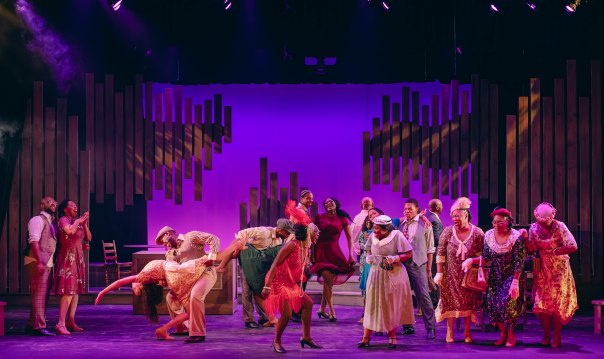
It’s a grim reminder, to be sure, that feminism was a more central concern for Walker here than racism, which only affects Sofia’s story. As a result, we can revel more in the light and inspiration that Shug and Sofia bring to Celie with their special brands of savvy and sass. This Celie needed to travel a longer road, in my eyes, to straighten up her hunched shoulders and stand up for herself.

Twenty years after I saw The Color Purple on Broadway, it’s nice to see Mitchell leaning harder into the story’s demeaning subjugation. But it’s harder for me to be sure whether Mitchell is seeing Celie’s sexual awakening as more overtly lesbian than ever before, or if I am.
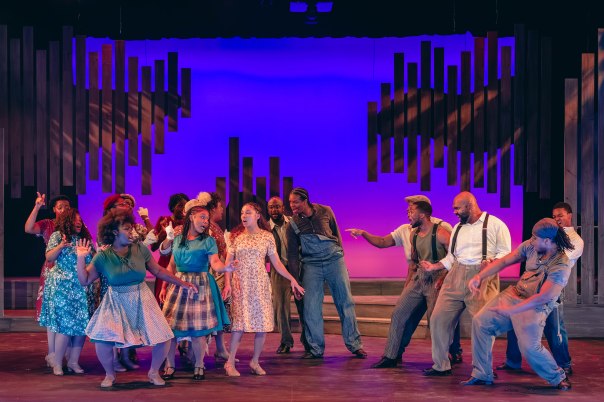
The rousing “Miss Celie’s Pants” certainly hadn’t landed on me in nearly the same way as it did on Queens Road. Sung by Gary with her mentor Shug, Sofia, and a bevy of other women, you can take this eye-popping number partly as a gay pride celebration or as a proto-Hillary rally.

K. Alana Jones as Shug sports a free-thinking saloon singer’s confidence, seemingly at home with anybody’s body of her choosing. In that respect, Shug’s bisexuality aligned more closely with Walker’s. Shug always got the kind of delayed runway entrance traditionally reserved for Broadway legends, so costume designer Justin Hall, with assistant Beth Killion, needed to be sure that Shug’s rigs radiated class.

With all the fine tunes crafted by Brenda Russell, Allee Willis, and Stephen Bray, the book by Marsha Norman doesn’t get enough space to make the connection between Shug’s fashion sense and Celie’s eventual emergence as a dressmaker. At Theatre Charlotte, we can infer that Shug is Celie’s dressmaking muse.

Once Jones does enter as the blues singer, she scores well in the uplifting “Too Beautiful for Words” and the raunchy “Push Da Button.” One can only smile at the thought of high schoolers rehearsing that latter gem.

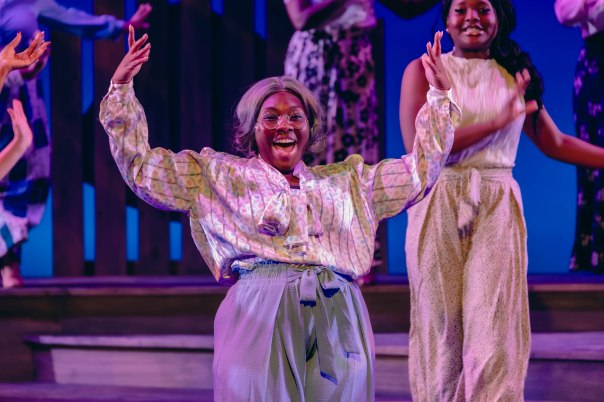
As Sofia, Germôna Sharp gives Celie – and any other wallflower in town – a more militant brand of inspiration with her “Hell No!” [my italics]. Fortunately, I had somehow forgotten the battered Sofia’s marvelous dinner-table reawakening, so I could take fresh delight in Sharp’s hallelujah suddenness. Not long afterwards, Sharp gets to team up with Nehemiah Lawson as Harpo, her genially clueless husband, in their raunchy “Any Little Thing” reconciliation.

After his bravura psycho dentist in Little Shop of Horrors, it was nice to see Lawson less crazy and cocksure. Harps is more befuddled and human, actually evolving with the times. Watching this character arc, from “Brown Betty” to “Any Little Thing,” amid more toxic excesses of testosterone was a nice reassurance that not all men are monsters. Or at least, beyond redemption.

You could say Harpo’s leavening presence gives Arnold Grevious as Pa and

as Mister more license to be as monstrous as possible. Yes, there are moments at the beginning of Purple when Walker seems to be taunting us: “You think white patriarchy and misogyny are bad? Come over to my place!”

Neither Grevious nor Williams gives any hint of mellowing toward Celie for a long time. Meanwhile, Mister needs to be appealing to Shug in some way that might surface in his bossy “Big Dog” showcase with his field hands. More to the point, he ought to appreciate Shug’s strength as well as her beauty and talent, so Williams can give promise of evolving as he lays out Walker’s red carpet for her diva in “Shug Avery Comin’ to Town.”

Williams also gets the luxury of penitence, beginning with “Celie’s Curse.” No such epiphanies happen for Pa: we just watch Grevious becoming older and feebler. So don’t give that old rattlesnake a single vocal and see if I care!

No, Tim Parati’s scenic design for Purple, the first we’ve had in Charlotte that was totally missing its Broadway lineage, won’t floor anyone, though J.P. Woodey’s lighting helps us not to mind. But Keston Gary is far from the only onstage luminary capable of knocking you onto your butt.

Apart from Chicago and New York, I’ve been maintaining for years that Charlotte has the vastest store of Black theatre talent around. Purple at the Barn proves me right once again. Call yourself fortunate if there are still seats available.

Laugh Your Butt Off at “Meet & Greet”

Review: Meet and Greet at The VAPA Center

By Perry Tannenbaum

Auditions are a kind of interview, and interviews are a kind of audition. You enter, drop a résumé on somebody’s desk, and minutes or hours later, you exit elated or deflated. Instant drama. Singularly human. A paradigm of life.

At the VAPA Center, auditions and interviews are the entire evening for three weekends in Meet & Greet, a themed set of three one-act comedies produced by Charlotte’s Off-Broadway in the COB Black Box. Yeah, from the outside looking in on aspirants and applicants who have stressed for weeks preparing, strategizing, dressing, and grooming for the big moment or trial by ordeal, the denouement can be quite entertaining.

We can laugh our heads off at these overinvested humans and empathize at the same time. Imagining we were them or grateful that we are not.

Of course, there are perils for playwrights working within these familiar templates. Skirting predictability is the keenest, particularly if your audience has been exposed to sketch comedy over and over.

You can rest assured that each of the playwrights featured at VAPA contrives to make the familiar ritual different from what we expect, concealing at least one twist and surprise. Neither Susan Lambert Hatem’s Hamilton Audition nor Don Zolidis’s The Job Interview far exceeds the length of a typical TV sketch, so opinions will likely vary on whether they transcend the streaming standard.

Both of them have yummy roles for multiple players, so transcendence becomes less of a factor if you’re seeking comedy simply for escape in these dark days. The incontestable headliner of the evening is the finale, Meet & Greet by Stan Zimmerman and Christian McLaughlin – in terms of length, number of histrionic roles, and prestige. Zimmerman’s fame rests chiefly upon his extensive writing credits, most notably the beloved Gilmore Girls and The Golden Girls.

Meet & Greet clocks in at more than twice the length of most sitcom episodes. Between laughs or afterwards, you may catch yourself pondering why.

COB’s producing artistic director – and VAPA Center co-founder – Anne Lambert has her energetic hands all over this one-act hodgepodge, starring as The Director in her sister’s Hamilton Audition and (what else?) stage directing all that follows.

There may be an inside joke here. Do you really audition for the role of The Director in the play you have programmed by your sister at your own theatre? Do you think director Anna Montgomerie invited Lambert to play the role, or was the inviting done in the opposite… direction? Wouldn’t Lambert, not the shyest person on the Charlotte theatre scene, have leveraged some of her status – and experience – in determining how her character should be written and played?

We’ll never know, unless the saga of putting Hamilton Audition on its feet spawns another script. In the present instance, Lambert has invited the most prodigious voice in town to audition for the lead role in an all-female production of Hamilton, and the diva who has graciously consented is apparently the only person on the planet who has never heard of Lin-Manuel Miranda’s megahit.

More likely, people who come to see Hamilton Audition will not realize that Lambert was a co-founder of Chickspeare, which pioneered all-female productions of Shakespeare in the QC. It is not at all far-fetched to say that Lambert inspired the role she is playing as well as the play her sister has written. Posters on the rear wall touting fictional Chickspeare productions practically shout this in-joke out loud.

From appearances, you might conclude that Lambert is more out of her element directing a hip-hop musical than Nasha Shandri as Shondra Graves is auditioning for the role of Aaron Burr. Just you wait. Although she looks perfect for her dashing Founding Father role, Shondra gives a more atrocious hip-hop reading than you would dare to expect from The Director.

Comedy gold.

Amazingly, Shandri is supposed to be no less ignorant about rap than she is of Hamilton! Suddenly, the whole idea of a pioneering all-female version seems like a certain disaster… with fallout for females and minorities. It’s at this point that Graves and The Director probe the sexism that already lurks in the original gendered Hamilton. So yes, Hatem has put some meat on her hambone dialogue.

Whether or not Zolidis replicates that feat in The Job Interview is more open to question. The bio in the digital program, summoned by your QR code reader, states that Zolidis is one of the most prolific and produced playwrights in the world. Maybe the thuddingly generic blandness of this title explains why Zolidis was so previously unknown to me nonetheless.

Fortunately, his Job Interview playscript proves to be livelier and more imaginative. The basic premise, we will soon find, ensures that the sparks will fly. Both of the applicants waiting to be called into T.J.’s office, Chloe Shade as Marigold and Marla Brown as Emily, will be interviewed at the same time, adding the elements of confrontation and fierce female competition to the drama. For Emily, it’s already life-or-death.

If you’ve inferred that T.J. is eccentric and perhaps sadistic, you’re on the right track. Rahman Williams as T.J. doesn’t ask his applicants a scripted set of questions – or even the same questions. Deepening his aggression and moving us abruptly from interview to audition, he challenges Marigold and Emily to show him how they would handle specific on-the-job situations.

Not only might we say that the difficulty of the questions and roleplay challenges seems to be tipping the scales of fairness way off kilter, but we can also discern radical differences in the temperaments and preparedness of the two candidates. It would be impossible to find an aspect of Emily’s performance where she outscores her rival… aside from how desperately she needs this.

Now anybody interviewing for a job knows that he or she is already facing steep odds, but knowing that you’re outclassed during the interview is a special torture, one that permits Brown to go totally nuclear as Emily. On the other hand, Shade can play with the absurd and ballooning insult that Marigold, in all her perfection, is obliged to keep competing with this loser – and that the outcome still lies in the hands of this outrageous interviewer.

Rahman, in the meantime, gets to play with the disconnect between T.J.’s spit-and-polish military background and his high-level position at Build-a-Bear Toys. Three tasty roles, all well-done. During the run, Nicole Cunningham shares Shade’s chores.

Contrary to what you may be thinking while it plays out, Zimmerman & McLaughlin have aptly named their Meet & Greet. Take it in the same way that the four auditioning actresses do and ride the rollercoaster. To make it all tastier, two of the four have a history together, co-starring long ago during better days on a hit sitcom, Lane Morris as the embittered psycho Belinda and Stephanie DiPaolo as the bimbo Teri.

For my generation, I was thinking Joyce DeWitt and Suzanne Sommers from Three’s Company, but you might hear different echoes. Teri is the airhead who tends to spoil everything, or she is deeply misunderstood and cruelly typecast. Bubbling and pouting seem to be her main forms of expression. Also in the room before Teri’s majestic entrance is Marsha Perry as Desiree White, with some sort of acting experience as the star of the “Real Housekeepers of Palm Beach” reality show.

Contrasting nicely with Desiree and her leopard-skin bodysuit is Joanna Gerdy as the splendiferously monochromatic Margo Jane Mardsden, who has fallen from her regal perch as living Broadway legend due to a combo of drink and disgrace. Being among this gaggle, especially the déclassé Desiree, is already a devastating humiliation.

Yet as we can hear as they emerge from their auditions, both Desiree and Margo are spectacularly successful in their auditions for the role of Andrea, the leading lady of an upcoming series pilot. Leopard Skin draws uproarious laughter from the sanctum within before Diva Nun draws a thunderous ovation. Which one do the showrunners, producers, and writers inside actually prefer?

Every word that Tommy Prudenti utters as the Casting Assistant is a tantalizing clue to what the show and Angela will be, and there is a girlish coyness about him… and a deceptive servility. All through this epic catfight showdown, Zimmerman’s Golden Girls pedigree is on display in a blizzard of quips, taunts, and one-liners. We shall only divulge the maestro’s recipe for “sidewalk pizza” here: you jump out the window of a tall city building.