Tag Archives: Julia Howard

DCP’s “The Cottage” Is a Merry Hideaway for Secret Lovers and Cigarettes

Review: The Cottage at Armour Street Theatre

By Perry Tannenbaum
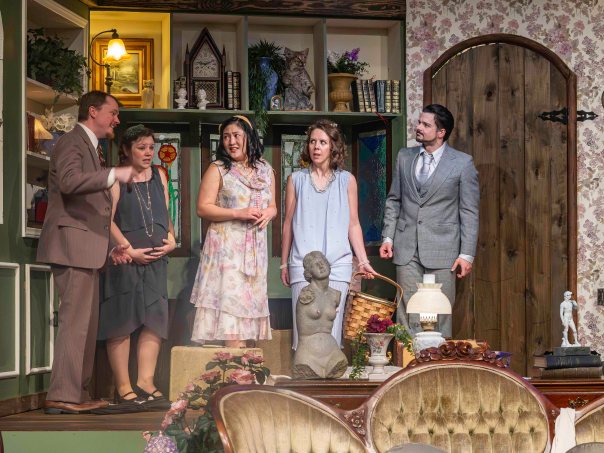
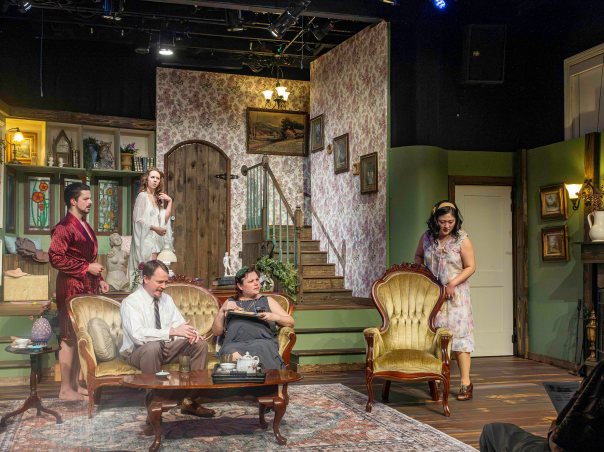
Davidson, NC – One of my late mother’s favorite Yiddish words, ongepotchket, sprang immediately to mind as soon as we walked into the Armour Street Theatre for the local premiere of Sandy Rustin’s The Cottage. Our first glimpses of Kate Baker’s scenic design had that unique tang. Gaudy. Cluttered. Colorful. Ornate. Massively overdone. Impossibly baroque.

That impression only magnified at the other end of the hallway when more of the rusticated clutter of this latest Davidson Community Players production came into view. It deepens further once the farce begins, for in addition to a stairway, two downstairs exits, and an upstage front door, Baker has crafted an invisible entrance that will eventually come into play – and cunning little crevices where Rustin’s characters, all but one of them acquainted with the cottage, will reach in and fob cigarettes.

It’s Monday, June 4, 1923, some 90 minutes from London by train, and this countryside retreat is the perfect place to be naughty. By the end of the show, I wasn’t sure whether half the budget was being frittered away on faux cigarettes.

Nor could I rid myself of the idea, driving home, that this cottage – which takes on a decisive cameo role in the denouement – was an apt metaphor for this whole amorous mismatched group of Brits.

We likely think at the outset that we should be emotionally invested in Beau, who is carrying out his yearly love orgy with Sylvia, his brother’s wife, and juggling multiple illicit affairs. We’re used to seeing such farces written by men, after all. But Rustin’s brand of farce has different beats, a conviction that women should get equal portions of the cake, and sympathies toward Sylvia, who is clearly getting the short end of the stick.
More than reversing our perspective, Rustin explores love: its levels, vacillations, and simultaneities. You may sour on a partner in her bucolic world, but it is not at all axiomatic that you transition to hating them. Throughout all the crossfire of who’s cheating on who, who’s been keeping secrets from who, who’s been wronged by who, and who’s underappreciated by who, none of the six characters rises to a moral high ground or plummets far below.

Except perhaps the monster in the group, who is arguably the most deceitful.

In a rather amazing coup for DCP, their Cottage is directed by Hanley Smith, who originated the role of Deirdre in 2013 at the Astoria PAC in Queens, NYC, before moving up to the triggering role of Sylvia at Florida Studio Theatre in Sarasota, four years ahead of the Broadway premiere in 2023. Not a far-flung coup, to be sure, since Smith is a Davidson College grad who starred in Actor’s Theatre of Charlotte’s production of The Vibrator Play in 2011.

So whether or not she has directed anywhere else before her DCP debut, Smith quickly establishes that she has a sure feel for this script. From the outset, Julia Howard’s performance as Sylvia was at least as extravagant as the scenery that surrounded her – and the sofa where she rehearsed her most alluring poses. This has been her one-time-a-year sex-capade, and it was obvious that she wasn’t planning for it to end, though Beau’s work week was set to begin.

No, no, no. Her plans, executed yesterday evening with a couple of telegrams, are to leave her husband Clark and marry Beau. Thoughtfully, the second wire was sent to Beau’s wife, Marjorie. Part of Sylvia’s kooky charm comes from her not being steadfast in her beliefs or resolutions – a trait that is contagious among Rustin’s creations – for she regrets sending her liberating telegrams as soon as she hears a loud knock on the front door.

Sylvia’s miscalculations will greatly increase Howard’s chances to shine, and still clad in her negligee, she’ll continue to stand out from the parade of visitors. As already hinted, Beau has been busier at the game of love than she anticipated. Ben Allen must merely be “Perhaps the best-looking man in Britain” to match the playwright’s description, so a certain amount of vanity must be coupled with his sexual rascality and his savoir-faire as a deceiver.

When Beau is celebrated repeatedly instead for the beauty of his flaming robe, should Allen act upset? Perhaps not, for Rustin consistently sets aside perfect moments, on the brink of upset or disturbance, for Beau to suggest a cigarette or a spot of tea. Good manners and posture were must-have accessories for Allen’s geniality in the early moments of this unpredictable morning at the cottage. On the spectrum of flappability, he seemed to be permanently perched at the opposite end from Sylvia.
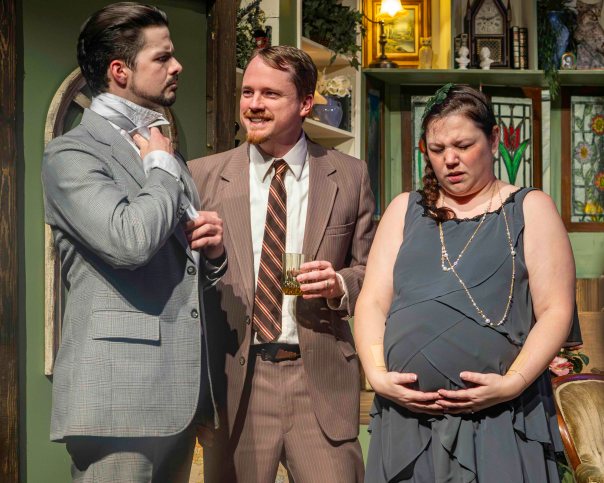
Until he opened the front door, first to his visibly pregnant wife Marjorie and then to brother Clark. Their suspicions have been eradicated by Sylvia’s batch of telegrams. So while it’s unseemly to disclose her hiding place before you see this farce, it’s also unnecessary for Beau to maintain his charade and keep her there.

Sadly, for Amanda Pippin as Marjorie and Andrew Pippin as Clark, neither had the histrionic opportunity to rev up to a towering jealous rage. They have a couple of surprises of their own to reveal. After Sylvia fully digests them, she’s probably correct in thinking that she has more right than Beau to be miffed. Regardless, it was so much fun watching Howard come to that realization and then watching Allen nearly catch up.

The Pippins neatly pull off the trick of being humdrum, wholesome, and deliciously wicked at the same time as their insouciance confounds their fellow adulterers. Nor are they the ones to be ruffled when, one after another, a third couple comes knocking at the door: Cate Jo as the déclassé Deirdre and Andrew Williams as the reputedly murderous Richard.

Like Marjorie, dear Deirdre will have good news and bad news. But nobody seems to react to any news at the cottage in the way the teller anticipates. Howard takes honors as the most thoroughly cheated person onstage as Sylvia, while Allen as Beau, the target of Richard’s wrath, takes cover like all the others. Jo makes for a loopy Deirdre, loopier after guzzling from a gin bottle, and hers turns out to be a rather physical role, what with all the hiding and staggering she must do in varying states of sobriety.
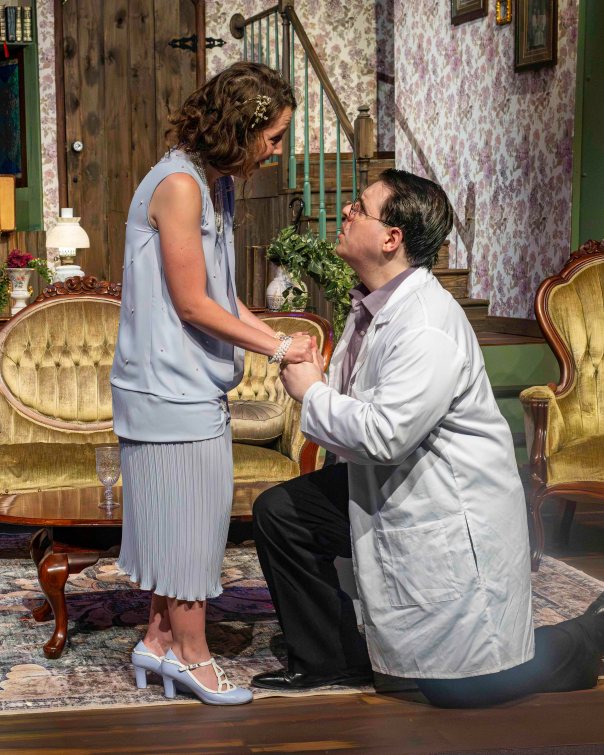
Williams, as Deirdre’s ex, has a past that’s as chequered as Deirdre’s, but all of that came since he and Sylvia last met many years ago. In everyday life, when not boasting of murdering Deirdre’s lovers, he passes for an everyday pharmacist, so the role offers a delicious range for Williams in spite of his late arrival.

To her credit, Sarah Deutsch’s costume designs are only slightly upstaged by the set. If you know who Stanley Baldwin was and his political affiliation, identifying the era of Rustin’s lively farce won’t be a formidable challenge. Otherwise, Hanley doesn’t orient us in either the printed or the digital program. The gorgeous Victrola must be your guide.

But only Rustin is to blame for Richard’s lame excuse for his false beard and mustache, so I’m not blaming anybody at DCP for making these disguises glaringly clumsy. Let the moment pass and richly enjoy the rest. This production is definitely worthy of its pedigree.

Old Barn’s “Orient Express” Is a Clue-ful Poirot Treat

Review: Murder on the Orient Express at Theatre Charlotte

By Perry Tannenbaum

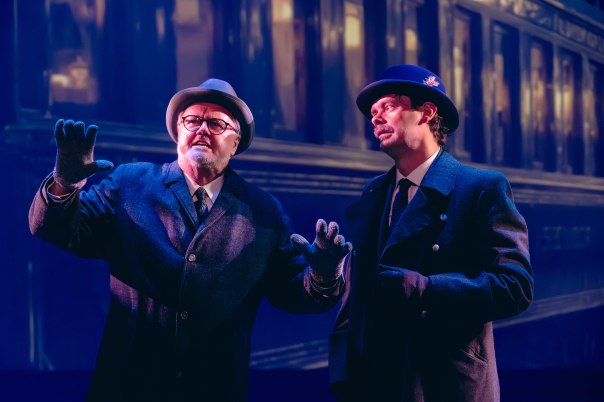
We can thank the Brits for the notion that passenger trains should run with absolute timeliness and precision. Now that Ken Ludwig’s meticulous adaptation has opened at the Queens Road Barn, we can also thank Agatha Christie, Britain’s most avidly read mystery writer, for her Murder on the Orient Express. Layer on Jill Bloede’s bubbly direction – and dialect coaching – and the treacherous trip rattles along with a savory continental flavor.

That soupçon of glitter and effervescence is greatly enhanced by Theatre Charlotte artistic director Chris Timmons’ fleet and fluid set design, an art deco wonder that transitions delightfully from an Istanbul hotel to a smoky train depot to the luxe interiors of the Orient Express. Since the landscape and snowscape outside the legendary train are also moodily conveyed by projections, it’s difficult to draw a precise borderline between Timmons’ scenic exploits and his lighting design.

While the paucity of professional theatre companies in the QC continues to account for the plethora of professional-grade acting talent we behold at the Barn, so does the opportunity to appear in opulent costumes such as those designed by Sophie Carlick – for hotel waiters, train conductors, and various glitterati who can afford a first-class sleeping compartment on a luxury transcontinental train.

Speed is beneficial in a murder mystery, especially as it plods along, contrary to real life, when we’re introduced to a multitude of suspects who have sufficient motive to commit the cold-blooded crime. Anyone who grew up watching the Perry Mason series on TV (or has binged on it more recently) knows the classic drill: the murder victim antagonizes a slew of enemies. So many enemies that we’re unsure who might have done the deed and more than mildly uncaring about the victim, no matter how brutally they were killed.

Ludwig admirably singles out our obnoxious victim-to-be and all the antagonisms he can spark while introducing us to Christie’s heroic protagonists, Constantine Bouc, owner of the Orient Express line, and peerless detective Hercule Poirot. There will be debate about Bloede’s decision to shitcan Poirot’s mustache wax and twirls in favor of a more conventional groom, but Brandon Samples’ initial entrance as the Belgian is star quality.

There’s a bit of aristocracy to Samples’ bearing that allows Poirot to fit in with his fellow passengers, including a princess, a countess, and a colonel. While Timothy Hager zestfully cements his repulsiveness as Samuel Ratchett, it’s also important for us to see that Poirot has sufficient dignity, discernment, and assets to reject Ratchett’s crass job offer.

Poirot also offers Samples a few brief episodes of befuddlement, for the culprit he is hunting leaves a blizzard of clues.

Unlike all of those complacent Perry Mason victims destined for the morgue and a court-ordered autopsy, Ratchett is keenly aware that he is being hunted. He’s willing to retain Poirot for a fabulous amount of money to protect him. Perry, you’ll remember, doesn’t arrive on the scene until after the wrong suspect is accused and arraigned. Here, Poirot is directly involved while the victim is alive. So when Samples shows no guilt or remorse for not accepting Ratchett’s offer after he is murdered, we’ll need further reasons for despising the playboy.

Christie piles them on and, in doing so, makes the bizarre solution to her mystery more plausible, for Ratchett is far more monstrous than he first seems to be.

Yet the elegance, hauteur, and glamor of the leading ladies would seem to instantly eliminate them from suspicion – or any close acquaintance with the vulgar victim. To think that Paula Baldwin as the Russian Princess Dragomiroff would deign to inflict eight stab wounds on the repellent Ratchett seems like sacrilege.

Likewise, Julia Howard as the serene and mysterious Countess Helena Andrenyi from Hungary seems worlds away from the slain playboy. The ethereal Gretchen McGinty as English governess Mary Debenham, also a smashing beauty, seems to live in an entirely different sphere, more involved with Scottish Colonel Arbuthnot (Ben Allen with a brash brogue) than the slain American.

As for Kathryn Stamas, as an esteemed actress traveling under the assumed name of Helen Hubbard, she is sufficiently brash, loudmouthed, and inconsiderate for us to worry whether Ratchett, trying to get some sleep next door and stewing with rage, will burst into her room and murder her. Murdering him would ruin her delight in riling him with her late-night singing.

However laudable it might be to murder Ratchett, three acts of God will prevent the ghoulish plan from eluding discovery: the unexpected arrival on board of legendary unraveller Hercule Poirot, the serendipitous intervention of Orient Express owner Constantine Bouc in securing a first-class compartment for Poirot, adjacent to the victim’s room. After these pieces are in place, with Bouc ready to serve as Poirot’s loyal sidekick, comes the fortuitous storm that halts the regal train in a snowbank out in the wilderness, giving Poirot sufficient time to investigate.

Bouc is obviously a key prong in Christie’s plotcraft, allowing Poirot to board the Orient Express and vesting him with the authority to investigate. Otherwise, our mustachioed sleuth wouldn’t be able to scan all our suspects’ passports or rummage through their luggage. Dramatically, he enables Poirot to interview all the suspects, another ritual of the mystery genre, corresponding to Perry Mason cross-examinations, that cries out for swift pacing.

The venerable Dennis Delamar would seem ideal for bestowing the requisite bonhomie on our gracious host and eager sidekick, except… for all his wholesome triumphs as Henry Higgins, Grandpa Vanderhoff, Kris Kringle, John Adams, Hucklebee, Jacob the Patriarch, and many more, has he ever done a French accent before? Maybe that was the question Delamar was asking himself on opening night when he uncharacteristically stumbled over a few of his opening lines.

Even for a semi-pro like me, those are lines you should be able to say in your sleep. Of course, Double D never broke character during his difficulties, so to neophytes in the audience, it may have seemed like the garrulous pensioner was stumbling over his English. Delamar’s imperturbability in this brief crisis only made Bouc more charming when he righted himself – and real panic was safely in reserve when the unsolved murder, right under his nose, threatened the image and prestige of his company.

Bouc also serves as a buffer between Poirot and the petty annoyances presented by our suspects, allowing Delamar to display his comedic chops. Samples, on the other hand, gets to revel in flipping over innocent façade after innocent façade in revealing the secret underbellies of his artful gallery of suspects. The parade of skeletons emerging from closets can’t help but add to our merriment.

So most of the actors on stage need to be adept not only in erecting their respective façades, but also in carrying off those deliciously satisfying moments when they are so disconcertingly exposed. Joshua Brand as Ratchett’s querulous secretary seems particularly innocent and above suspicion, while Emma Brand as the Princess’s trembling missionary ward is even further above. So pleasant when they fall.

Climb aboard this fatal train, and you’re likely to find the ride more fun than you expect.