All posts by perryt77

Celebrity Pistol-Packing Rogues Deliver Guilty Pleasures in “Bonnie & Clyde”

Review: Bonnie & Clyde

By Perry Tannenbaum

Since the days of his greatest successes, with Jekyll & Hyde (1997-2001) and The Scarlet Pimpernel (1997-2000), most of Frank Wildhorn’s Broadway musicals haven’t run more than a month. That includes a revival of Jekyll, Wildhorn’s longest-running show, in 2013 and Bonnie & Clyde, which somehow couldn’t make it through the end of December – the highest grossing month of the year – in 2011. Hearing that the short-lived Bonnie & Clyde was coming to Matthews Playhouse of the Performing Arts roused a morbid curiosity for me: how could a notorious story that won six Oscars in 1968, including Best Picture, flame out so spectacularly in a musical adaptation? Knowing that Billy Ensley, one of Charlotte’s best, would be directing sealed my resolve to investigate.

With the appearance Bonnie Parker and Clyde Barrow as children at the top of the show, it quickly became apparent that Ivan Menchell’s book was not an adaptation of the sensational film. Unlike the Bonnie portrayed by Faye Dunaway, Menchell’s is a ravishing redhead rather than a blond. There’s never really a Barrow Gang, and though this Clyde aspires to fancy clothes, his dream didn’t come true in Matthews. Most puzzling of all, we don’t see Bonnie and Clyde snapping photos of each other – their most modern trait! – although the authentic period projections go way beyond mugshots. So it’s plausible to me now that the Broadway version of this musical didn’t strictly flop on its merits. Boomers expecting to see the style and gore of the iconic film were disappointed, while it’s very likely that younger theatergoers had never even heard of Bonnie and Clyde.

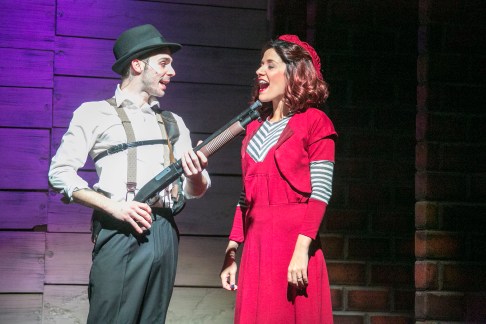
Armed with a reported $6 million budget, there were presumably more costume changes up in New York than Matthews designer Lisa Altieri provides for Bonnie, but with 20 people in the cast, four of them in multiple roles, Altieri is far from idle and contributes some very fine work. What really made this community theatre effort look like a million bucks was the scenic team of designer John Bayless and scenic change artist Beth Aderhold. Weathered wooden slats span the Fullwood Theatre stage, trisected by two sturdy vertical beams. The columns of slats can be raised like window shades, keeping the flow of action going cinematically as the slats rise to reveal new scenes – or slide back downwards to serve as rustic screens for the old-timey projections, mostly of newspaper headlines, mugshots, and snapshots of our celebrity public enemies. At critical moments, a two-seat jalopy showed up in the middle of it all, no less realistic than the photos I’ve seen of the Broadway roadster.

Not only did Ensley brilliantly contrive to keep the action moving, he brought ace talent to the lead roles and beyond. Joe McCourt, who plays Clyde’s vacillating older brother, Buck Barrow, has starred in numerous musicals at Theatre Charlotte in recent years, including Memphis and Avenue Q. Embittering Buck’s every breath, Emily Witte is his very Christian wife Blanche, after playing a similar spoiler role as Amneris in the Disney Aïda at Theatre Charlotte last fall. This bickering pair would have upstaged the title players if Ensley hadn’t found such strong protagonists as Steven Buchanan and Lindsey Schroeder.

Buchanan was definitely in his comfort zone performing edgier fare, for he played prominent roles in Queen City Theatre Company’s The Pride and Actor’s Theatre of Charlotte’s American Idiot last year. Here he sported a hairdo that was halfway between Hitler and punk, looking lean, Brando mean – in a tank top undershirt – and dangerous. Scene work with Bonnie is a tasty mix of tender and raw, but Buchanan is somewhat monochromatic under arrest or during his larcenous, murderous rampage, barking his commands and forsaking the Warren Beatty charm offensive of the film. Ensley should have occasionally reined him in a bit and reminded him that he’s wearing a microphone as well as a pistol.

Opening in the ensemble of Evita at CPCC Theatre the weekend after her last performance as Bonnie Parker, Lindsey Schroeder is the one new find among the principals. She takes to every aspect of Parker, most especially to her thrill-seeking, her narcissism, and her lust for Hollywood and pinup fame. Schroeder can belt too, so watch out for “How ‘Bout a Dance” and “Dyin’ Ain’t So Bad.” Overall, Wildhorn’s score wasn’t nearly as bothersome as you’d expect from an epic Broadway flop, but there are noticeable stretch marks on its beauty. Witte does a fine job on behalf of homebodies with “That’s What You Call a Dream,” but Blanche’s Christianity opens up a whole new sector of Gospelized expression that I didn’t recall from the movie. Church scenes are essentially extraneous to the main storyline, but it gave Wildhorn an excuse to widen the variety of his score. Off my radar since 2009, Phil Fowler came to the rescue for a couple of doses of “God’s Arms Are Always Open.” Even if it was a narrative detour, it was a rousing showstopper in the positive sense of the word.

Holiday Grow and Donavan Abeshaus were both excellent in introducing us to the young Bonnie and Clyde. Carol Kelly and Scott C. Reynolds were winsome as Clyde’s rusticated parents, and Carol Weiner was prim yet warm as Bonnie’s mom, quietly urging her daughter to come to her senses – and choose the hometown sheriff who clearly adores her. Andrew Tarek plays that role beautifully, with seething jealous fury toward Clyde and tender hat-holding deference toward Bonnie. I found myself hating this Sheriff Hinton without a good reason why, and I surprised myself once again by rooting for Bonnie and Clyde here almost as fervently as I did in the 1967 film, despite the trail of crime and bloodshed they insouciantly left in their wake. Celebrity pistol-packing rogues are likely unique to America, more to our shame than our glory.

“The Greatest” Grows Up

Preview: And in This Corner: Cassius Clay

By Perry Tannenbaum

Adam Burke came to Charlotte because of his passion for youth theatre and education. After a stint as founding artistic director of Chicago Theatre for Young Audiences, Burke took a five-year detour into academia at a San Antonio university. When the artistic director position at Children’s Theatre of Charlotte came open, the ImaginOn theater facilities and the strong link with the CharMeck Library system became irresistible lures.

He took over at ImaginOn at the start of the 2013-14 season, concentrating his stage directing efforts on new works. Big new works like The Best Christmas Pageant Ever: The Musical and Ella’s Big Chance: A Jazz Age Cinderella – and richly entertaining extravaganzas like The Reluctant Dragon and The Miraculous Journey of Edward Tulane.

Now in his fifth season of overseeing Children’s Theatre’s programming, Burke knows better than ever that he’s speaking to the community as well as its children, a community that is visibly changing. Or maybe waking up to its true image in the mirror after years of blind complacency.

Opening this week, And in This Corner: Cassius Clay, directed by Aaron Cabell, is the second biographical study of its kind to play at ImaginOn in the past three years. Jackie & Me, about baseball great Jackie Robinson, opened in February 2015. Burke reflected on the challenges of presenting meaningful, impactful plays in our current climate.

Creative Loafing: Children’s Theatre presented Jackie & Me almost exactly three years ago, not long after And in This Corner: Cassius Clay premiered in Louisville, Muhammad Ali’s hometown. So was there discussion at that time about following up Jackie with Cassius, or is this series of Children’s Theatre productions about pioneering black athletes more accidental than intentional?

Adam Burke: We did not specifically intend to follow Jackie & Me with another piece about a pioneering black athlete. I was aware of this play being developed in Louisville when it was happening and was hoping that it would end up being a strong script that we could eventually produce. And in This Corner: Cassius Clay asks some big questions about the world that Cassius Clay lived in during the 1950’s and 1960’s – and equally about the world that we live in today.

In the current local climate, how are you hoping parents and children will process this story? How confident are you that the community will pass the test of hearing the N-word spoken at Cassius Clay?

We live in a very different world today than we did when we produced Jackie & Me three years ago. Both plays, Jackie & Me as well as And in This Corner: Cassius Clay, contain the N-word as written by the playwrights. Three years ago we proactively informed every school that intended to bring students that the playwright had included the word in the script. We did the same this season with And in This Corner: Cassius Clay.

Three years ago, we didn’t have any schools withdraw from coming to see the show due to the use of the N-word by the playwright. To date this season we’ve had several. We as parents, as teachers, and as a community, can’t be afraid to bring students to a play that deals with civil rights issues because of the use of the N-word. It’s a painful word to hear, and we abhor its use in everyday life, but pretending it doesn’t exist won’t help make anything better.

Cassius Clay, before and after he became Muhammad Ali, was brash, boastful and divisive before validating himself as “The Greatest.” How much does Idris Goodwin’s script filter out Clay’s not-so-role-model youthful traits?

In this play, Cassius Clay absolutely is a role model. This is a play about a young African-American boy who is learning some truths about the racism that exists in this community. He speaks his mind openly and confidently and asks big questions. I hope this play inspires all of our young audience members to live with their eyes wide open and to question everything.

Casting Cassius, how locked in were you to Clay/Ali’s signature physical traits? Were you able to find such an actor in Charlotte’s talent pool, or were you forced to reach out regionally or nationwide?

Ideally we wanted someone who looked a lot like Cassius Clay and had the ability to capture the spirit of the man. The director found an actor, Deon Releford-Lee, at our season auditions who he strongly felt could play the role. The directors at Children’s Theatre of Charlotte cast their own shows whenever possible.

Considering how important Children’s Theatre’s voice is in this town, do you feel a certain obligation to continue this series of historical dramas?

It is important that Children’s Theatre continues to support our community and tell stories that reflect our social, cultural and political climate. We have a lot of “irons in the fire” so to speak that we believe speak to our young audience and the world in which they live. We are currently deeply invested in The Kindness Project where we’ve committed to commission, create and produce three new plays based on books that all speak to themes of kindness. They each, in their own way, discuss the difference between feeling sympathy or empathy and committing an act of kindness. You can’t feel kind…you have to actually do something in order to be kind.

People Messing With Other People Keep “The Luckiest People” Lively

Review: The Luckiest People

By Perry Tannenbaum

“Grow old along with me, The best is yet to be,” Rabbi Ben Ezra famously says in a Robert Browning poem, but tragic heroes King Lear and Willy Loman would probably have sided with my mom. She keeps telling me: “Young is better.” At Hadley Theatre, tucked away on the Queens University campus, playwright Meridith Friedman significantly compounds the controversy in The Luckiest People. In this Actor’s Theatre of Charlotte production directed by Sidney Horton, Friedman’s charming comedy-drama revolves around Oscar Hoffman, who is stranded by the death of his beloved wife, Dorothy, in a California assisted-living community, deeply lonely with myriad aches, pains, and complaints.

Most of these complaints, some fairly hilarious, are poured into his son Richard’s ears – plus the insinuation that he was responsible for letting his mom die. Oscar’s other child, Laura, has managed to distance herself from the fray, living in Shanghai and delaying her arrival until the funeral because she couldn’t stand to face her mom during her final hours.

So yes, Friedman sometimes seems to hint that caring for your parents as they journey toward their final transition might be at least as agonizing as experiencing it. That impression, however, is undercut by another perspective.

Layered onto all the love-hate friction between Oscar and his children is Richard’s relationship with his partner David. Richard and David are close to adopting a son when Oscar, ignorant of these plans, decides that the time has come for him to leave his place and move in with his son.

One transitioning child is enough for Richard and David to handle in their household, but David watches as Richard uses his father’s needs – and the possibility of his moving in – as excuses to drag his feet on the adoption. Although he himself becomes the target of Oscar’s testiness, David also sees that Richard is more than a little hypertense in dealing with Dad’s needs, complaints, and accusations. Oscar and Richard were born and raised as New York Jews while David is a comparatively mellow California Christian, apparently unacquainted with weaponized guilt.

Because Laura must return to Shanghai, Friedman compresses the bulk of her action into just a few days. That’s long enough for David – and us – to get the notion that Richard and Laura aren’t suffering so much because their dad is really tormenting them. They’re suffering because neither of them is really a grownup. Maybe Richard isn’t ready for parenthood after all.

Leaning over to that point of view can happen if we forget what a handful Oscar can be. Or we can catch ourselves laying the blame on Oscar for his children’s stunted growth. It’s complicated. Fully drawn dramatic families usually are.

Clearly reveling in the height of the Hadley, where Actor’s Theatre has recently inked a deal to be Queens U’s resident theatre for the next five years, executive director Chip Decker has put on his scenic designer hat and built two adjoining rooms at different levels. One of them is Oscar’s modest living room and the other, tellingly larger, is Robert’s kitchen. Of course there’s room for everybody!

Horton has a great sense for how Friedman’s comedy and drama should mix and how the Hoffman family’s humor and anger should suddenly erupt – and there’s a pretty wonderful cast at his command. In this rolling world premiere, Dennis Delamar gets the chance to reprise and further develop his Oscar, a role he originated in staged readings at the NuVoices Festival of 2016. Stooped over, stubborn, selfish, whip smart, and half blind, he is a thorny person to deal with. He’s still holding a grudge over transplanting from Great Neck, New York, to sunny California; yet late in life, Delamar shows us very naturally that Oscar still has possibilities for personal growth.

On the other hand, we might resist the notion that the perpetually tentative or exasperated Richard will ever loosen up, for until the final scene, in a nuanced performance seething with hidden fire, Tim Ross keeps him looking stressed or depressed. Some of that anger even carries over from his scenes with his father and his lover to his scattered tête-à-têtes with his wayward sister. Huddled with little Laura, Ross makes sure we also see an older, wiser brother, with glints of maturity, responsibility, and an aptitude for parenting.

Eventually, both Oscar and Richard emerge as our protagonists. When that happens, we’re likely to realize that Laura and David have both been part of the alchemy. Susan Stein makes an auspicious Charlotte debut as Laura, obviously the loosey-goosey sib from the moment she first enters. Laura is the one who has taken all the leaps into matrimony, motherhood, and now infidelity that Richard is wary of, and Stein makes her self-justifying zingers nearly as memorable as those Oscar aims at his caregivers and over-the-hill neighbors.

All of Friedman’s illuminating edifice probably wouldn’t have collapsed if she had made David a little less perfect, but Scott A. Miller, one of our best, finds a way to texturize him. Mostly, we empathize with David because we see how hurt he is by Oscar’s slights and Richard’s failures to commit, smiling weakly yet persevering with firm resolve. He also has a tête-à-tête or two with Laura, but you can count on Miller to make these more relaxed, conspiratorial, and gossipy.

My only disappointment on opening night was the size of the crowd. The place on Radcliffe Avenue can be a little difficult to find the first time out, but a show this warm and rich is definitely worth the trouble. These are, as the relevant song says, “people who need people,” and you’ll likely never see Delamar or Ross in better form than at the Hadley in The Luckiest People.

The Other Shue Drops at Theatre Charlotte With “The Nerd”

Review: The Nerd

By Perry Tannenbaum

It’s only infrequently that playwright Larry Shue’s name crops up on the Charlotte theatre scene. The New Orleans native, whose comedies were all premiered at the Milwaukee Repertory Theater, died in an airplane crash at the age of 39, while his most familiar work, The Foreigner, was still playing off-Broadway. Charlotte Repertory Theatre staged that backwoods farce during the same year that Shue died, 1985, and it was a huge hit, so huge that when Rep marked its 25th anniversary in 2001, a revival of The Foreigner was part of their celebration.

Yet Shue’s “other” comedy, The Nerd, also figured significantly in Rep’s history, for when the company went from a summertime schedule to year-round status in 1988, The Nerd was the company’s first non-summer production. Thirty years later, the current Theatre Charlotte presentation of The Nerd is actually its Charlotte premiere, for Rep staged this wacky comedy at Davidson College.

Wacky might be considered a gracious description of The Nerd, which premiered in Milwaukee two years before The Foreigner and arrived on Broadway two years after its worthier sibling. Silly, over-the-top, and unfocused might be better ways to describe this belated coming-of-age story of young architect Willum Cubbert. We first encounter the low-key Willum as he’s insufficiently surprised by his 28th birthday party. The surprises have hardly begun, for the party is wildly impacted by the unexpected arrival of the title character, Rick Steadman, who retains Willum’s undying gratitude for saving his life in Vietnam.

Thanks to other guests, excesses abound before Rick’s bodacious entrance. Not only is Willum’s current client, Warnock Waldgrave, insensitive to the niceties of Willum’s architectural drawings, he comes to the party with a neurotic wife and a fiercely obnoxious daughter. The little brat has thrown two or three tantrums, assaulted her dad and other adults, and locked herself stubbornly in the bathroom on multiple occasions a sedate warmup compared to the action after Rick arrives. As you might presume, the extremely starchy Warnock and the preternaturally eccentric and irritating Rick are not destined to get along.

Aside from Willum, whose gratitude toward Rick and dependence on Warnock prevent him from taking a hard line, two of Willum’s friends, Axel Hammond and Tansy McGinnis, try to mediate as the party spirals further out of control. Tansy is particularly sympathetic toward Willum. She’s his girlfriend now but will soon be breaking his heart when she moves from Terre Haute, Indiana, to DC, where she has a job waiting for her as a TV weathergirl. Axel is a drama critic, so he’s more inclined to crack wise than be helpful.

Just when it seems that Willum’s evening can’t get any worse, Rick makes his second entrance, suitcases in hand, intent on moving in. It’s here that Shue begins to misdirect us or lose focus, for everyone onstage except Rick becomes intently preoccupied with expelling Willum’s noxious visitor. We’re likely to forget that Tansy has really set the agenda early on in a conversation with Axel.

With set and lighting by John P. Woodey, this Theatre Charlotte production has a very sharp and detailed look to it, augmented by Sabrina Blanks’ splendid costume designs. Mom Clelia and daughter Thoralee clash like crazy in their party outfits, and Rick, dogged in insisting that this is a Halloween party, is positively unearthly when he arrives. Directing this mayhem, Jill Bloede takes a sensible approach, drawing outré performances from her three most noisome players, Trulyn Rhinehardt as the incorrigible Thoralee, Simon Donaghue as a perpetually outraged Warnock, and Jonathan Slaughter as The Nerd.

Rhinehardt misbehaves with such savage zest that you’ll want to take a stick to her. I don’t mind saying that I most delighted in Thoralee when she fainted from fright. Even if Bloede hadn’t changed Thoralee’s gender – Shue originally saddled Warnock with a Thor – I don’t think that a fainting spell by a bratty boy would have been any more satisfying. Donoghue’s powerful take on Warnock seemed to be the only misguided aspect of Bloede’s approach: why didn’t he take a stick or a belt – or a machine gun – to his unruly daughter, and why didn’t he simply fire Willum on the spot for ruining his day? Whatever softness accounted for Warnock’s forbearance wasn’t visible.

Slaughter’s way with Rick, not far distant in its absurdity from the sound and awkwardness of the Nutty Professor minted by Jerry Lewis, always bordered precariously on the unbelievable. There were times when Rick seemed to be trying to irritate everyone in sight, exactly the impression that Shue would have approved of. A tad too young to be playing Willum, perhaps, Cole Pedigo was a near-perfect foil for Rick’s nuttiness once he conquered his opening-night jitters. Shue wanted us to see a talented desirable man who is kind, grateful, and accommodating to a fault. That was exactly how we saw Pedigo.

Shue’s women weren’t as well drawn here as they would be in The Foreigner, but Bloede probably could have pushed Allison Kranz as Tansy and Audrey Wells as Clelia further toward farce. They also suffer at the epic birthday party from hell, Tansy especially after she slaves over a custom-made dinner and Clelia most memorably when she quizzes Rick about his love life. Perhaps if Shue had made her more decisive, Tansy would have seemed less vanilla as the would-be weathergirl, so Kranz definitely needed to pick her spots to show us that she was worthy of Willum’s adoration. Mostly, Shue and I forgot about her. Of course, Clelia was as much generic comedy material as her child, but Shue gave her some bravura business to perform in her reactions. Bloede should have lit the fire that would have made these diva moments for Wells. We weren’t as close to Carol Burnett as we should have been.

Deep in the weave of Shue’s plot is Axel, whose scheme to exorcise Rick in Act 2 is approximately as disastrous as the birthday party was before intermission. Chip Bradley is sufficiently urbane and snarky as this theatre critic, but I sometimes got the impression that he was a late addition to the cast. Along with a few instances of slow cue pickup, Bradley fumbled a few lines before getting them right. I’ve seen him do better in productions just as fast-paced as this one, so I’m expecting better performances in the nights ahead.

Coping with so many moving parts and quirks, Charlotte Rep also had some rough edges in its opening night performance of The Nerd 30 years ago. You wouldn’t want to tame all of this volatile ball of energy, but a little more energy here and a little sharpening there would help Theatre Charlotte’s production to snap into better shape.


Two-Thirds of Charlotte Ballet’s “Innovative Works” Are Truly Innovative – and Mesmerizing

Review: Innovative Works

By Perry Tannenbaum

What I especially love about Hope Muir’s first season as artistic director of Charlotte Ballet is the new blood she has infused into the choreography, bringing works by Javier de Frutos and Johan Inger to the city for the first time. So it was with considerable excitement that I went to see the 2018 edition of Innovative Works, premiering pieces by Myles Thatcher and Robyn Mineko Williams, choreographers we haven’t seen here before.

Staged at the McBride-Bonnefoux Center for Dance, where Innovative runs through February 17, both of these new imports triumphed – not only with their bold concepts but in the bravura performances that brought them to life. In between, however, we were subjected to the premiere of “The Weight of Darkness,” a lugubrious and monochromatic work by Sasha Janes that struck me as more inert than innovative. Murky lighting by Burke Brown and all-black costume designs by Aimee j. Coleman didn’t perk things up.

Usually, we can count on Janes to engage us with the sensuous, lyrical, and romantic elements of his work, often with a soupcon of eroticism. But here, commissioned by Angela and Robert McGahan to memorialize Angela’s sister, Irene Ross, Janes goes astray outside his comfort zone. Instead of celebrating Irene’s life, he uses the idea that 4am is the “death hour” as the starting point for his five-part broodings. Of course, the music he has chosen by Nico Muhly and Nico Muhly is neither uptempo nor uplifting.

Chelsea Dumas and Ben Ingel were an attractive couple in the first pas de deux that Janes created for this piece, and the pair of Alexandra Ball James and Josh Hall brought their nonpareil elegance to the second. Trouble was, there was nothing I haven’t seen before in the sequences of ballet moves that Janes doled out to these couples and nothing I’d clamor to see again. In the segments that framed the piece, the four couples of the ensemble only multiplied the tedium.

Perhaps “The Weight of Darkness” wouldn’t have seemed like such a thudding bore if Williams’ “To Clear” hadn’t been so utterly fresh and original. The language of dance movements and the vocabulary of the dancers’ interactions were both striking and new. At the heart of the asymmetrical structure Amelia Sturt-Dilley personified the angularity, restlessness, and urgency of Williams’ concept, appearing at the outset in the most outré of Coleman’s defiantly drab and casual costume designs.

When we first notice Sturt-Dilley perched on a chair, we’re not sure if she’s cautiously settling into it or getting set to flee in terror. Six other dancers, less vividly characterized, ride the wave of the original music score composed by Robert F. Haynes and Tony Lazzera. You might find their synthesis of organic flow with the mechanized pulsations of machines and hip-hop to be a little disconcerting. Fused with the unnatural, yet irresistibly fluid and rhythmic movement of the dancers, it’s just as likely that you will find it mesmerizing and utterly persuasive.

This is who we are, what we’ve become. That’s a strange takeaway from a piece that Williams says started with a thoughtful Bryan Ferry-styled contemplation of a woman, but something else in the choreographer’s filmed intro strikes closer to home. The close, not-quite-connecting interactions between the dancers always seem to deflect them in directions they had not anticipated taking. Totally involving and fascinating.

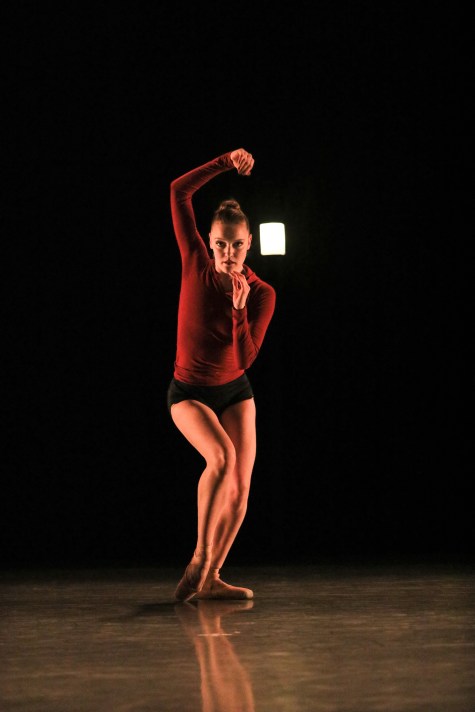
Concluding the program, Myles Thatcher’s “Redbird” remains abstract, but with Sarah Lapointe brilliantly dancing the title role, there are tantalizing suggestions of a storyline. Coleman dresses Lapointe in a bright red blouse – plus red hoodie, completing the cardinal evocation – that distinguishes her from the other seven dancers until the end when she sheds this plumage. In his intro, Thatcher shares that his choreography was a reaction to “a loss,” a way of processing grief.

Lanterns solemnly brought forth by the other dancers toward the conclusion of the piece may be signaling empathy, so when the redbird sheds her plumage, it’s quite possible she’s accepting their consolation and returning to the fold – and to what she looked like before she was aggrieved. Yet as Lapointe lets herself be absorbed into the group, in a gorgeous ritualistic tableau, there’s no telling for sure whether she has been consoled or coerced. Her outsider color may be unacceptable to the others. Or perhaps it is acceptable for a period of time mysteriously established by tradition.

The process may not work perfectly, but there’s comfort in knowing that you and your tribe are honoring it. And maybe an echo of the agony lingers.

New Plays, New Place, and New Hope at Actor’s Theatre

Preview of The Luckiest People

Maker:L,Date:2017-9-22,Ver:5,Lens:Kan03,Act:Kan02,E-ve

By Perry Tannenbaum

Trashy musicals, irreverent spoofs, and trendy new works by black and feminist playwrights aren’t the only things Actor’s Theatre of Charlotte has done well over the past 29 years. Around the country, when their artistic and administrative staff attend national conferences with their colleagues, they find that a big part of the company’s reputation rests on their commitment to nurturing new plays.

After two years of instability and uncertainty – and two full seasons without reviving their NuVoices Festival – Actor’s Theatre is getting back to that. This week, they’re opening Meridith Friedman’s The Luckiest People, part of a rolling world premiere that began in Denver. In May, the company will be part of another rolling world premiere, presenting David Valdes Greenwood’s The Mermaid Hour.

Both of these new plays were previously presented in reading stage productions at NuVoices 4 in January 2016, with all of the actors performing script-in-hand. No scenery, no costumes, and limited rehearsal.

NuVoices 4 was one of the last events at 615 E. Stonewall Street, ATC’s last permanent home before developers’ wrecking balls demolished the site. After a misadventure in the Belmont neighborhood near Plaza-Midwood, the company was supposed to reopen at 2219 Freedom Drive late in October 2016.

Instead, they had to move Toxic Avenger a block away to the City Center Church, of all places, the first of four unforeseen sites where ATC’s 2016-17 season was staged. Until last fall, when Actor’s Theatre launched their current season with American Idiot, subscribers never knew where the next production would crop up.

That’s when ATC announced that Freedom Drive was still on hold and that their next two productions would remain at Hadley Theatre on the Queens University campus. But after that?

Now we know. Luckiest People, Mermaid Hour, and The Mountaintop will all be at the Hadley. More importantly, ATC artistic director Chip Decker and John Sisko, dean of Queens U’s College of Arts & Sciences, have just inked a deal that will keep ATC on campus as the U’s resident theatre company for the next five years.

From necessity to desperation to near-relief, it’s been quite a rollercoaster for Decker, his board members, and ATC’s loyal fans. “We’re off life support but still in ER,” Decker quips. “In a better hospital.”

Sisko arrived at Queens in the summer of 2016, when all seemed to be going smoothly with ATC’s relocation. After the abortive opening in October and a subsequent revival of The Great American Trailer Park Christmas Musical at the McBride-Bonnefoux Dance Center – a horrid acoustic mismatch for a live musical – Sisko wasn’t hearing any signs of life, so he reached out.

Down at Freedom Drive, one hurdle was following another. Parking had to be upgraded to satisfy the City, architects’ drawings kept getting sent back for tiny inaccuracies. Think about this one the next time you walk through the metal canyons of a parking lot to find your car: Decker and his company had to shell out thousands of dollars to get an engineer to certify that the concrete slab – one that had held up a mechanic’s shop and the building itself for 50 years – could support an audience.

“We were slowly bleeding money to death.”

After Bootycandy ran at Mint Museum, Stupid Fucking Bird was staged at the Hadley last spring, a clear signal that Sisko and Queens U brass were unfazed by ATC’s edgy fare. Decker quickly recognized that this would be the finest venue his company had ever performed in. By far.

Maker:L,Date:2017-9-22,Ver:5,Lens:Kan03,Act:Kan02,E-ve

The lightbulb came on, and Decker invited Sisko out to grab some coffee and chat about the future.

“It took me a long time to quit beating my head against the wall to make Freedom Drive happen,” Decker recalls. “Having the passion for something and wanting it so bad, I kind of started being blind to the writing on the wall. We were at the point, Perry, and I shared this with John, and I said, ‘We’re do or die. We’re either going to close, or something different is going to work.’”

When Sisko saw how well Stupid Bird went, concern about ATC’s struggle gave way to recognizing the opportunities that bringing the company on board could open. ATC could offer technical support for Theatre Department productions during the academic year, they could offer internships to graduating students, they could oversee a summer theatre festival with performances on the quad under the stars, and they could teach courses about theatre production and administration.

“ATC is the backbone of the Queens theatre program, and it’s a mutually beneficial relationship,” Sisko says. “We have parents who are a little worried about their children being an arts major. But when they’re an arts major and they have 30 credits on the business side of the arts as well, then they are in better position when they face post-graduation.”

Talks are already under way on prospects of reviving the NuVoices Festival as early as this summer, and Decker is already salivating at the prospects. At previous festivals, the four playwrights, four directors, and their casts had to rehearse and perform on a single space at Stonewall. On the Queens campus, there will be multitudes of classrooms at ATC’s disposal, playwrights will be able to interact and talk shop, or simply do rewrites – on the quad, in some greenspace, or in a classroom instead of a hotel.

“They can all come together and talk about the process of playwriting, what it takes to get it produced,” says Decker. “Queens can bring in their MFA creative writing students for master classes with the playwrights on how do you get seen, how do you get published, how do you get your word out there, what it literally takes to become a professional writer on the scene.”

With the opening of The Luckiest People this week, ignition for whole process gets revved up again, because NuVoices is one of very few festivals across the country that promises a full production for every winning entry.

Dennis Delamar, a longtime actor and director at ATC, is doubly excited: he’s reprising the central role of Oscar Hoffman two years closer to the irascible old SOB’s actual age, and he’s performing for the first time at the Hadley knowing that the company has their feet back under them.

Under cross-examination, Delamar can catalog why Oscar is so difficult as he seeks to impose himself on his son’s household – just when he and his male partner are adopting a son. There’s the culture shock of moving from Great Neck, NY, to California; the many physical torments of Paget’s disease; the recent death of his devoted wife; and the pure cussedness of a Jewish trial lawyer who revels in disputation. Even his sharp sense of humor is thorny.

NuVoices gives this role an extra charge. “Being on the ground floor of a new piece of theatre is pretty thrilling,” says Delamar, “a professional collaboration that offers one an opportunity to offer one’s own unique interpretation while the playwright is still in the ‘making it better’ stages.”

Participating in NuVoices gave Delamar the opportunity to meet the playwright and learn first-hand how she drew his character from her own Great Neck grandfather. Thanks to Facebook, Delamar stayed in touch, conferring with Friedman when she made further revisions.

“I felt quite comfortable to write to her about a significant moment for Oscar I noticed had been changed,” he confides. “Taking time to explain to me the history and logic of the change, Meridith reminded me how much I appreciate working with this gifted and open minded writer. She listens. She is wise. I agreed with the change and loved that we could confer so openly about it.”

Yes, the thrill is back at ATC – with new plays and new hope.

“All the signs from this last year together suggest that it’s going to work out extremely well,” says Sisko.

African Children’s Choir Brings Youthful Exuberance, Wonder, and Hope to Mint Hill

Review:  African Children’s Choir

By Perry Tannenbaum

Unless you’ve seen them before, visited their website, or read their publicity releases, you might assume that the African Children’s Choir, singing at the Arlington Baptist Church in Mint Hill, was a group of inner city Charlotte kids spreading their wings to the edge of Mecklenburg County and into the suburbs. I was quickly disabused of that notion when I walked into the assembly hall, which doubles as a cozy basketball arena. There were three tables at the rear of the hall, on the near side of the sound and video equipment, peddling merchandise and brochures, including one that was selling a generous selection of the dozen CDs that the Choir has recorded over the past 25 years.

It all began in 1984, according to the website – and one of the film breaks in the Children’s Choir concert – during a visit to Uganda by human rights activist Ray Barnett, who was inspired to form the Choir “by the singing of one small boy.” By the end of that year, the first Choir, made up of boys and girls aged 7-10, was touring North America. Many of the choristers had lost one or both parents amid Uganda’s bloody civil war, and the entire 1st Choir had been born during the pernicious reign of Idi Amin. An overarching concern of Music for Life, the group that runs African Children’s Choir, is the education and welfare of the children – and impacting the future of the continent – so Music for Life has established children’s homes across the seven countries they serve.

Mint Hill was the fourth stop – and the fifth concert – on the 48th Choir’s current 34-city, 40-concert tour, their last stop in North Carolina until the penultimate concert in Fayetteville on April 5. With just a couple of exceptions, the performances will be given in churches, so the format I witnessed is presumably typical. It began with lead pastor Rick Whittier offering an invocation and introducing choir director Alice Nambooze, who shifted focus from prayerful thanksgiving to firing up the audience so that we’d greet the 18-member Choir enthusiastically. Enthusiasm was certainly warranted, for the children were clad in unmistakably African costumes, free-flowing prints filled with bright yellow, red, and green accents. Opening with “Rejoice,” the title song of their newest CD, the African Children’s Choir matched the liveliness of their costumes with the joy of their singing.

The ebullient ensemble more than counterbalanced what you don’t ordinarily encounter at adult choir concerts – appeals, collections, testimonials, and infomercials – with a multitude of energetic ingredients we should count on from grownups. All of these kids danced, banged on tin cans, rhythmically clapped hands, and twice changed costumes, a radical departure from the staid and colorless decorum that adult choirs with their dignified directors impose on us. Some of the kids beat on the drums, Africa’s iconic instrument, some of them introduced the songs, some performed solo vocals, some interjected chants or recitations, and others hawked merch during the most charming commercial break. All of them – this was also adorable – introduced themselves. Nor was the music religiously live and a capella. Prerecorded soundtracks for most of the selections helped keep the kids on the same beat.

Seated in front of the stage, Nambooze directed the children with a minimum of fuss, returning to the spotlight on just a few occasions, most notably to sing a lead vocal after launching a wake-up tableau and to preside over the more extended break halfway through the concert, when donations were asked. The head teacher who travels with the group, Timothy Kawuma, identified himself as “Uncle Timothy” and turned out to be the most bodacious drummer we would see. Kawuma and Nambooze also offered personal testimonies, linking themselves with the beginnings of the Children’s Choir – when both were members of Choir 19 – and ending by proudly announcing the college business degrees they had earned, she in administration and he in statistics. Future of Africa.

The present in Mint Hill leaned heavily on tunes from the new CD and familiar old favorites, each of them delightfully Africanized. Very appropriately, “He’s Got the Whole World in His Hands” was punctuated with handclaps – patty-cake style to add an extra childish tang leading into intermission. “Amazing Grace” was deceptively conventional through its opening stanza, but it grew suddenly catchy and I daresay groovy when the arrangement became a gleeful call-and-response. For their encore, the kids sang “This Little Light of Mine” with such celebratory gusto that I have to wonder how much longer it will be missing from their discography.

Songs from the newest album came with a little more zest in live performance, without any loss in choral richness. The glee-club energy of “Rejoice” showed harmonious maturity in its latter stages, but with only drums for accompaniment, the shorter “Njuba” took me more convincingly to Africa with rich harmonies resembling those of the famed Ladysmith Black Mambazo group – and with purely African lyrics. The other two newborns were more anthemic, mixing English and African into their lyric tapestries. “Our God” bounced along more jauntily, with more youthful exuberance, over a simpler soundtrack featuring guitar, keyboards, and percussion. “Cornerstone” started with an African refrain from the full chorus, breaking into English with a boy’s solo vocal after a solemn instrumental vamp. The whole choir repeated the boy’s stanza, presumably translated into African, before we reached the powerful “Christ alone, cornerstone” refrain. The arrangement kept building and, in the final repetitions of the refrain, the choir split in half, as the English “Cornerstone” chants overlapped the original African one. In a way, it capsulized what Barnett had set out to achieve 33 years ago.

With all the bright costuming, African percussion, and synthetic prerecorded sounds, Children’s Choir still carved out a precious moment when the mood became sacred in a purely Western way. I couldn’t find the African Children’s Choir version of Psalm 139, but it’s a very satisfying setting, discreetly stripped of the more bellicose – and unchildlike – verses between 1-18 and 23-24. There are so many lines and songs that sound strange or awkward coming from children. Others sound to us like something we already know, vividly refreshed. But the wonder and youthful hope of these lines, lifted and not let down by the melody and the widely smiling singers, reminded us of what is most unique and cherishable in the hearts of children.

Amid a Record Cold Wave, Nosky Brings the Heat of Vivaldi’s “Four Seasons”

Review:  Vivaldi’s Four Seasons

By Perry Tannenbaum

With only string players on assignment, Charlotte Symphony was a noticeably smaller orchestra at Belk Theater last Saturday night. But with Vivaldi’s Four Seasons on the program and redheaded Aisslinn Nosky both playing the violin solos and guest conducting, the house was as unusually full as the stage was empty. People don’t merely adore Antonio Vivaldi’s signature set of concertos. If WDAV, Charlotte’s notably successful classical FM station, has it right, they also dig all things baroque.

Aside from an excursion into Felix Mendelssohn’s Sinfonia for Strings No. 1 – written when the prodigy was a boy of 12 – that’s what Nosky brought to the podium. Nosky is one of the pre-eminent authenticists on the continent, having served as concertmaster for both Tafelmusik in Toronto and the Handel and Haydn Society in Boston. Historical practices and authentic historical instruments are her customary métier.

So is rocking a punk hairdo, flaming pink or fuchsia on some nights, and anchoring I Furiosi, an avant-garde quartet. With fellow emissaries from H+H, Nosky has gigged at Le Poisson Rouge, one of the hippest clubs in Greenwich Village. An aura of unpredictability shimmers around her.

Of course, Nosky adapted to Symphony by playing a modern violin, but tantalizing stylistic questions needed to be answered on how she would approach the music and Charlotte’s classical audience. Bach’s Violin Concerto No. 1 provided answers at the top of the program.

Nosky’s tone on the modern violin was laser thin and strong, most attractive just before her highest notes and infectiously cheerful with Symphony’s strings. The brisk pace that Nosky called for added to the sunniness of the opening movement, yet there was no superficiality to the lightness. When we moved to the middle Andante movement, Nosky entered with an exquisite pianissimo that was barely audible at first, swelling to full bloom while still allowing the cellos to dominate with their spare accompaniment. Spikey hairdo or not, Nosky subtly sculpted the closing Allegro, achieving a fine balance between her violin and the ensemble, building almost imperceptibly to the climax with gradual acceleration and crescendo.

As her concert-black outfit had signaled, Nosky wasn’t out to create outré sensations. The warmth of her chat with the audience, introducing Georg Philipp Telemann’s Don Quixote Suite, was an extension of principal cellist Alan Black’s earlier intro to the whole baroque program. Nosky reminded us that pianists and violinists, many doubling as famed composers, had led orchestras through most of classical music history, and she dished on the friendly rivalry between Bach and Telemann.

Notwithstanding the spikey punk do, you could bring this redhead home to meet your Republican dad.

I’ve found a CD, played and conducted by Jan Stanienda, that programs The Four Seasons and Don Quixote together, and the pairing makes sense. Both pieces are very imagistic, so the Telemann served as a fine foreshadowing for the Vivaldi. It would have been helpful, especially in the absence of any detailing from Nosky in her intro, to have seen the descriptive titles of the eight segments of the suite on the page with the program listings.

Flip ahead to the program notes, however, and the titles printed there would have better prepared you to fully savor the woeful waking of the Don, his adoration of Princess Dulcinea, Rosinante, Sancho, and the renowned windmills. What came through best without these prompts were the horsey flavors of the suite, the stately cantering of the overture, the quarter horse sprint of the windmill sketch, the sudden crowdpleasing interjections evoking Sancho’s donkey (effects Haydn would perfect), and the farewell gallop of the finale, ending not with a Rossini-like bang but with a surprising, slightly affecting fadeout.

Spearheaded by Nosky, the Symphony strings made an excellent case for the outer movements of Mendelssohn’s C Major Sinfonia, the second Allegro particularly impressive for its precocity. By comparison, the middle Andante in A minor struck me as moribund. Or I should say that it hardly struck me at all.

Nosky jokingly told us that, in view of the record cold weather outside the concert hall, she had considered only playing Vivaldi’s “Summer” concerto to warm us up. Then she promised there would be additional heat in the other Seasons – even in “Winter” – and there was. Written within the framework of four Italian sonnets, conveniently translated in our programs, the musical imagery of Four Seasons is probably best followed by playing a CD with the text in front of you, so Vivaldi’s backtracking refrains and mood-shifting don’t make you lose your place.

Not an absurd expectation at all: Symphony’s pre-New Year’s email blast to subscribers not only offered concertgoers a link to the translated poems, it also provided a Spotify playlist to The Four Seasons and the rest of last week’s Classics concert. Another handy subscription for Symphony supporters. Lack of such prep accounted for the major glitch of the night, when the audience applauded prematurely, forcing Nosky to confide that “Winter” was yet to come.

At the beginning of Four Seasons, “Spring” crests with a thunderstorm in the second half of its opening Allegro, and the onset demonstrated that there was sufficient artillery onstage at Belk Theater for the fireworks and hailstones to come. Nosky was at her most soulful in the middle Largo as the goatherd lay down to sleep in the meadow, and the sweetness lingered into the concluding pastoral dance with a nice attention to the strings’ harmonies.

Forebodings of the ultimate storm in the “Summer” concerto spread dramatic contrasts throughout the first two movements, both of which have fast sections, but it wasn’t until the concluding Presto that Vivaldi and Nosky reached their fullest fury. Here the flaming redhead was clearly torching the Red Priest, finally breaking into her bacchante mode, sustaining the lightning with a sizzling cadenza.

She is too authentic to linger in sensationalism, and there was plenty of artistry to display in the remaining concertos. Soloing in “Autumn,” it seemed to me that Nosky was caricaturing one of Vivaldi’s drunken peasants with a witty twist of her glissandos, and she made sure to emphasize the fadeout at the end of this season, reminding us of the kinship between Vivaldi’s sketchings and Telemann’s.

“Winter” was not only the most shivery season, it was also the darkest, bleakest, and loneliest as Nosky gave us a wan cadenza backed only by Black on cello. North winds howl in the final Allegro, allowing Nosky and Symphony to whip up one last tumult. Maybe the sun didn’t quite shine through this icy gloom, but the joy and warmth of the music did, just as the Red Priest prescribed.

“School of Rock” Sports Heavy-Metal Vulgarity

Review:  School of Rock

By Perry Tannenbaum

Dewey Finn is not your model citizen. A wayward adherent to the religion of hard rock and heavy metal, Dewey is vastly self-absorbed. When he gets booted out of his No Vacancy band, presumably for stealing focus from the shirtless lead singer, Dewey sponges contentedly and thanklessly off former bandmate Ned Schneebly. Worse, when an opportunity opens for Ned as a substitute teacher at a prestigious private school, Dewey steals it.

Masquerading as Ned, Dewey remains true to his slovenly egocentric creed, arriving to his first day at work late and hung over. More alert on Day Two, he discards the normal schedule and curriculum, ditching math and social studies in favor of turning his students into a rock band. Dewey remains steadfast in his ambition to qualify for, compete in, and emerge victorious in the upcoming Battle of the Bands.

After heroes and antiheroes that included the biblical Joseph and Jesus, the Phantom of the Opera and Grizabella, Evita Peron and Norma Desmond, you could say that Dewey Finn shattered the mold for Andrew Lloyd Webber protagonists when School of Rock opened on Broadway in December 2015. Although it never became anything like the moneymaker Phantom still is after 30 years, Rock is still running – while subsequent revivals of Cats and Sunset Boulevard are not.

From what I could see at Ovens Auditorium on opening night, word-of-mouth in Charlotte will concur with the Broadway verdict.

What makes Dewey appealing is his sheer vulgarity, which nearly reaches full John Belushi proportions. But there’s more, mainly the unsavoriness of all the other adults onstage, beginning with the No Vancancies who let Dewey go. Ned is preternaturally wimpy, more dependent on his inhaler than a meth addict, and his girlfriend Patty is dominatrix-grade hostile.

At school, Dewey’s colleagues are suburban bland. At home, the students’ parents are variously unloving and/or unsupportive. The principal, Rosalie Mullins, is the essence of by-the-book rigor, believing that this is what those wealthy parents are paying for. Winning Rosalie over is the key to realizing Dewey’s hard rockin’ aspirations, and he hits upon the perfect scheme, asking her out to a local dive and plying her with cheap beer and Stevie Nicks.

Scenic and costume designs by Anna Louizos have the same look on tour as they had on Broadway – as far as Ovens will allow. When the School of Rock band finally gets their shot at the Battle of the Bands showdown, there’s no visible spot for the skeptical parent to sit – like, say, the box seats at Belk Theater? – while the kids prove themselves.

The size of cavernous Ovens, seating over 60% more than the Winter Garden on Broadway, makes it more difficult to hear Dewey’s fifth graders clearly – and more difficult for most ticketholders to see the mutually beneficial relationship developing between them. Really, I couldn’t find any distance between Rob Colletti’s disheveled charm on tour and Alex Brightman’s on Broadway, nor were the kids’ talents any less precocious than those I witnessed at the Winter Garden.

But the mojo that starts happening in the classroom with “You’re in the Band,” as Dewey matches students with their instruments (no, I don’t know how he snuck in a complete drum kit), seems comparatively muted and diluted in the vast Ovens space. Here’s where the kids get their first fix of that you’re-really-good intoxicant their sub is dishing out while Dewey gets his first inkling of how fulfilling it can be to do something for somebody else. On Broadway, this is where I knew that Lloyd Webber was onto something when he decided to adapt the 2003 film starring Jack Black. At Ovens, we’re still unsure.

We never tap in quite as intimately to Dewey’s growth and transformation. It hits us more at big moments that are outsized signposts along the way. Fortunately, there are enough of these broad advances in Julian Fellowes’ adaptation of Mike White’s screenplay to add up to a satisfying jolt when the big crises hit midway through Act 2. The essence of these advances is the beneficial effect he has on the kids, on Rosalie, and even Ned – a medical miracle, since the wimp suddenly tosses away his inhaler and become a mean rockin’ machine – along with new outbreaks of generosity, tact and caring.

Colletti carries the show on his broad sloping shoulders, his big belly, and purest chutzpah, but it’s the kids who give the show its impish, wholesome Monkees energy. Dynamic Phoenix Schuman on guitar, nerdy Theo Mitchell-Penner on keyboard, grumpy Theodora Silverman on bass, and hipster Gilberto Moretti-Hamilton on drums are a cornucopia of musical precocity. The mini character roles have the same Broadway excellence, bossy little Ava Briglia emerging as company manager, effeminate John Mitchell Pitera finding his passion in costume design, and withdrawn Gianna Harris breaking out of her cocoon with a smashing a cappella “Amazing Grace.”

There’s a latent sexiness to Lexie Dorsett Sharp as Rosalie that peeps through early on when she exits Dewey’s classroom after a precise and military left-face. Our principal also displays a formidable soprano in “Queen of the Night” excerpts, though the highest note in the Magic Flute aria is always scaled with the aid of a student tapping a triangle. There’s a certain British delicacy in the way Sharp eventually melts, removing her glasses but never letting her hair down.

Director Laurence Connor allows more latitude to Dewey’s put-upon hosts with only middling results. Patti is a fairly standard-issue shrew, and Emily Borromeo does little to transcend her, pitch-perfectly annoying in her yammering. Matt Bittner, so hopelessly asthmatic early on, does deliver a shocking metamorphosis when he grows a pair. Maybe he could survive in a classroom!

There are no memorable power ballads from Lloyd Webber this time around, but he’s clearly having fun, stealing from Mozart and Deep Purple in the same score – and proving, in case you’ve forgotten, that he really can rock. “When I Climb to the Top of Mount Rock” cooks at medium heat to start things off, and later, “Stick It to the Man” and “You’re in the Band” actually achieve a slight metallic edge.

Implausibly, the climactic title tune misfires. Lloyd Weber’s melody, perhaps to satisfy demands of the plot that don’t need satisfying, doesn’t reach the anthemic stature we’d expect from a revelatory rock band’s signature tune. Glenn Slater’s lyrics, reliable throughout the evening, are dreadful here, incoherent and not at all believably from a fifth grader’s imagination.

Not to worry, Weber hasn’t lost it at the end. Order is restored when he reprises the crowd’s favorite, “Stick It to the Man.”

A Flaming Redhead Scorches the Red Priest

Preview:  Vivaldi’s Four Seasons

By Perry Tannenbaum

Even in Charlotte, the would-be crown of the New South, you occasionally hear the grumblings backstage – or in the boardrooms of our leading performing arts companies. Our audiences are graying. Who ya gonna call? For Charlotte Symphony, this week’s startling answer is their guest soloist, Aisslinn Nosky, a redheaded violinist – sometimes fire engine red when the mood hits – who usually rocks a punk hairdo.

A blatant appeal, you could say, to younger people who might otherwise be wary of a formal concertgoing experience or just plain classical-averse. But that’s hardly half of the Nosky story. Far from dolling up and dumbing down the music she plays, Nosky is highly regarded as one of today’s prime exponents of music by Antonio Vivaldi, Johann Sebastian Bach, Georg Philipp Telemann, and Franz Joseph Haydn.

Canadian born, Nosky has strong ties to three of the most important groups in North America that specialize in this music. She’s a core member of the Toronto-based I FURIOSI Baroque Ensemble and the concertmaster at Boston’s Handel and Haydn Society. Nosky’s 10 years with the famed Tafelmusik Baroque Orchestra culminated in the 2015-16 season when she toured as their featured soloist.

Although she’ll be playing a modern violin when she teams up this weekend for a concert that will showcase works by Bach, Telemann, and Mendelssohn – while headlining Vivaldi’s Four Seasons – Nosky usually plays authentic period instruments when she performs and records with H+H or Tafelmusik. She dismisses the notion that there’s some kind of disconnect between her punkish stage persona and her punctilious preservation of authentic practices.

“I can see how on the surface it might strike some people as a jarring contradiction,” Nosky admits. “What our current audience may not know is that the idea of classical music being a highbrow/conservative art form was born entirely in the 19th century. In the 18th century, the star singers of the opera world and the most famous instrumental performers were treated like rock stars. One need only read contemporary accounts of audiences’ reactions to someone like the great opera star Farinelli to have a glimpse into the excitement and glamor which was a part of experiencing Western art music in the past.”

Many other classical musicians, conductors, or academicians are on the record with similar observations about classical music’s less stuffy, more spontaneous past. Nosky separates herself from those laments, living that bygone spontaneity right now. Check out the I FURIOSI website if you have any doubts. Or watch Nosky rockin’ out on Bach with Tafelmusik in a YouTube video.

Something unusual there: Nosky is not only playing with the ensemble, she’s directing it. That’s the plan for this weekend at Belk Auditorium. In both the Bach Violin Concerto No. 1 and the Four Seasons, Nosky will be soloing while leading the orchestra. Although the ensemble doesn’t figure to be as small as Tafelmusik’s, with 19 full-time members, you can count on Charlotte Symphony to field a smaller armada of musicians than the one that played Brahms and Beethoven back in November.

Trimming the size of the ensemble performing Haydn and Mozart became a routine practice at Symphony during the aught decade when Christof Perick wielded the baton as music director. But aside from Bach’s B Minor Mass (2002 and 2009), a Vivaldi Piccolo Concerto rearranged by and for percussionist Evelyn Glennie (2005), nothing written before Papa Haydn was presented at the Belk to Symphony’s Classics Series subscribers during those years.

Curiously enough, that Vivaldi Piccolo Concerto was conducted by Christopher Warren-Green, five years before he took over as Symphony’s maestro for the 2010-11 season. So it figured that Warren-Green would be programming more baroque at the Belk than his predecessor.

“Musicians of a symphony orchestra are expected to be extremely versatile and be able to juggle different musical styles,” says Calin Ovidiu Lupanu, Charlotte Symphony’s concertmaster since 2003. “We usually switch from a classical repertoire to a more jazzy or Broadway type of repertoire, from modern classical to baroque. Especially with the arrival of Maestro Warren-Green in Charlotte, the number of baroque programs has increased. I am sure that Aisslinn will bring her own interpretation and expertise to the stage.”

What might seem unusual, a concertmaster leading an orchestra while he or she plays the solos, is often the practice when performing Four Seasons, according to Lupanu. That didn’t happen the last time Symphony presented Vivaldi’s most famous composition in early 2010. Lupanu would know. On that January night, with Michael Christie as guest conductor, Lupanu himself was the soloist.

Oh, and this just in: Lupanu kicked off a new Charlotte Symphony chamber music series in October at Tate Hall on the CPCC campus, leading a “conductorless” concert of works by Elgar, Britten, and Shostakovich. So for the record, he set the precedent.

Nosky has a different perspective on compounding her instrumental work with conducting, reminding us that before the 19th century, concertmaster and director were interchangeable titles.

“Tafelmusik Baroque Orchestra was directed from the concertmaster’s chair by Jeanne Lamon,” Nosky recalls. “It never occurred to me that playing baroque and classical music needed to be done any other way. In fact, after a lot if research into the subject, I can say positively that the majority of orchestra music before the 20th [century] was directed by either the concertmaster or the keyboard player. People may forget that Vivaldi and Telemann and Bach initially achieved their enormous fame as performers!”

Both concertmasters, Lupanu and Nosky, cite chamber music as central to their tastes and training, so both are comfortable in reduced-size ensembles where all the musicians must keep a sharp ear out to blend and synchronize with their colleagues. Where the two seem to part company is in the outré flair that Nosky brings to the task.

“In a culture that is geared towards young performers playing for an older audience,” Lupanu observes, “someone of Aisslinn’s quality can be extremely helpful in bringing more of the baroque and early music repertoire in the concert halls. And – why not? – maybe having the younger audience attracted to this kind of music.”

Nigel Kennedy? Peter Sellars? Peter Pan? Nosky pushes back against the notion that her spiky hairdo is modeled on anybody else’s – or that it’s calculated to position her as a Pied Piper for a new generation of classical audience.

“All I can say is that my inspiration comes completely from what makes me feel comfortable when I perform. I couldn’t possibly try to look like or be anybody other than myself. If I did, I would not be true to myself. Or the music.”

Nonetheless, when Nosky moves from Handel and Haydn to the music of Vivaldi, her spiky red do inevitably takes on the tinge of an homage. Born in 1678 and ordained in 1703, Vivaldi was nicknamed the Red Priest because of his curly red locks.

It’s uncertain how much red Nosky will be sporting onstage as she plays her concertos and leads Charlotte Symphony in a Sinfonia by Mendelssohn and a “Suite from Don Quixote” by Telemann. There’s a 2013 video of Nosky clad in red lapels when she played with an H+H quartet at Le Poisson Rouge in Greenwich Village. On second glance, maybe those silky lapels were fuchsia.

One thing is certain: Just being herself, Nosky will surely be a redhead playing the Red Priest, often at a fiery clip. It will be interesting to see how many other punks show up.