All posts by perryt77

The Young Jewish Girl Who Became a Post-War Icon

Review: The Diary of Anne Frank @ Central Piedmont

By Perry Tannenbaum

The Diary of Anne Frank 

You can sneer and call her the poster child of the Holocaust, or you can marvel at how she continues to be a lightning rod. But 77 years after the last words of her secret diary were written, followed by her death at the Bergen-Belsen concentration camp six months later, nobody can say that Anne Frank has been forgotten – or that she will be in the foreseeable future.

A recent segment on 60 Minutes was devoted to solving the mystery of who betrayed her and her family to the Gestapo in early August 1944 after two years of hiding in the famed “Secret Annex” in Amsterdam. Managing to make even more of an ass of himself than we thought possible, anti-vaxxer Robert F. Kennedy Jr. somehow turned the 13-year-old Dutch immigrant into a talking point, comparing rules enforcing COVID vaccinations to the tyranny of Hitler’s Germany.

“You could cross the Alps to go to Switzerland,” he said of those threatened by the Nazis. “You could hide in an attic, as Anne Frank did.”

Before people had to worry about COVID and those pesky vaccines, the Anne Frank House, where the “Secret Annex” is preserved, attracted well over a million visitors every year.

So with Holocaust survivors thinning out, living memories of the Third Reich growing dim, and misinformation metastasizing, is the time ripe for dusting off and re-examining The Diary of Anne Frank? It has been done before. First published in 1950 and translated into English in 1952, The Diary of a Young Girl premiered on Broadway with its more familiar title in a Pulitzer Prize-winning adaptation by Frances Goodrich and Albert Hackett in 1955. The rebranding stuck after the film, directed on by George Stevens, won the Oscar and Golden Globes for Best Picture in 1960.

All of those originals have been edited, retranslated, or updated – many times, in the case of new graphic novels, children’s book abridgements, TV versions, and movie takes.

But Anne’s text, assembled by Otto Frank from multiple handwritten manuscripts, has only been re-edited a couple of times, once in a critical edition by the Netherlands State Institute for War Documentation in 1989 (revised in 2003), and once revisited by Anne’s father in 1993. The Goodrich-Hackett drama has only been overhauled once, by Wendy Kesselman, in a newly adapted version that opened on Broadway in late 1997.

That’s the version we’re seeing now at Halton Theater in a Central Piedmont Theatre presentation directed by Marilyn Carter. Since 2008, when I reviewed this new adaptation at Theatre Charlotte, it has become the Metrolina standard, with subsequent productions by Matthews Playhouse in 2010 and Davidson Community Players in 2018.

While the Halton isn’t as ideally sized for Anne Frank as Theatre Charlotte or the old Morehead Street location of Children’s Theatre, whose 1996 production remains the Queen City’s gold standard, set designer Robert T. Croghan doesn’t make the mistake of either glamorizing the Annex or expanding it to fill out the capacious stage. Amazingly, the compacted set has four levels without looking at all posh. Yet as we must peer over an unused orchestra pit that becomes a moat between the audience and the stage, our eagerness for a new CP venue, replacing old demolished Pease Auditorium, becomes all the keener.

We won’t have to wait long. They’re promising a spring unveiling.The Diary of Anne Frank

Strikingly fresh and radically different still don’t describe the revamped script, which hit me like it did in 2008 at the Queens Road barn – after previously seeing the original in Charlotte no fewer than three times. Yes, there are substantial differences, some of them welcome improvements and some curiously out of focus if you already know and love the original movie. Some of the signature moments, like Mr. Dussel’s comedy, have dropped out of sight. But the dramatic highlights are pretty much the same as always.The Diary of Anne Frank

What Kesselman has chiefly refreshed is the Holocaust context, deepening it with more frequent references while providing more extensive portrayals of Dussel, the Franks, and the Van Daans as Jews. Carter has Josh Logsdon as the dentist Dussel wearing a tallis and singing a traditional Hebrew prayer. Subsequently, we get pretty good pronunciation from Hannah Sidranski and Summer Schroter as the Frank sisters when they sing the “Maoz Tsur” after the Chanukah blessing.

The most sensible and gratifying change that Kesselman made was upgrading the presence of Otto Frank, who had become a more renowned public figure during the 42 years following the first Broadway premiere of The Diary. It makes a big difference that he no longer greets us at the beginning, discovering the red plaid diary onstage and ushering us into its imperishable contents. Instead of that prologue, Arthur Lightbody as Otto presides over an epilogue, where he can not only reclaim the abandoned diary but also disclose the fates of all the characters we have come to know over the previous 90+ minutes.

Considering how brutally sudden the Gestapo raid is in this newer script, I’ve found that Otto’s return is oddly helpful in processing the final moments of this little makeshift Jewish community. This is a more spasmodic and sobering narrative, less sensitive and romantic in depicting Anne. Sidranski is more energetic, brainy, and immature as Anne. Words gushed out of her so quickly on opening night that we often had only a vague idea what she was saying. At first, I hoped that Sidranski might soon slow down to evince her maturation during her two years in hiding.

That’s not how Kesselman and Carter seem to be thinking. It’s easier to see moodiness among these families than to see any of them evolving. They’re chafing under the restrictions of their survival mode, that’s for sure, and with the passage of time, we’re getting to know them better – and so are they.

Carter also seems to have spearheaded a rethink on Halton’s chronic audio woes. The setup of mics now dangling down from the flyloft yields far clearer – and continuous – sound amplification than we’ve heard in the past, though differences in levels could be detected, especially upstairs on the set, when actors were more directly under the mics.

Adults in the cast were projecting more consistently than the youths, easier to follow overall. But everyone is believable. Croghan’s costume design is as impeccable as his set, and Carter’s casting is always spot-on. Lightbody radiates a leader’s calm and quiet dignity as Otto, oozing warmth toward the youngsters, especially his favorite Anne, and seeming to take the long view while everyone else is caught up in the moment. By contrast, Rebecca Kirby gives us a sterner portrait of Anne’s mother, Edith, not adjusting well to the protracted confinement and never sunny enough to be called bi-polar.

You may feel otherwise about Poppy Pritchett and her flamboyant turn as Mrs. Van Daan, fetishizing her fur coat, worrying herself over what Anne might be writing about her, and flapping her protective wings around her ravenous husband when she isn’t berating him. On the other hand, Daniel Keith keeps a remarkably even keel in excelling as Mr. Van Daan, Otto’s one-time benefactor, perpetually in quest of respect always winding up as the hydrant of the underdog.

The Diary of Anne FrankMalychia Abudu-Clark and Zach Humphrey come by infrequently, essential buffers between the Secret Annex and the Gestapo, delivering needed supplies and news from the outside, never staying long enough to remove their outerwear. That would be risky for a Dutch national harboring Jews. They best demonstrate their caring when they urge the Franks and the Van Daans to accept Mr. Dussel into their company – and it is here that Lightbody is most impressive in his authority as Otto in waving aside all objections.

No doubt about it, Logsdon changes the vibe when he enters as Dussel. For the first time in months, the Franks and the Van Daans get the grim news of what’s happening elsewhere in the Jewish community. About the merciless Nazi raids. About the transports. At the same time, he’s disturbing the settled sleeping arrangements of the Franks and, moving in with Anne, disturbing the budding adolescent’s privacy and social life while consigning Margot, the older sister, to bunking with Mom and Dad.

The Diary of Anne FrankThere is friction between the roommates across the generational divide, but Logsdon never shrinks from it, frankly outraged when Anne wakens him suddenly, shrieking from her latest nightmare. Yet he is an elite force, reveling in Dussel’s standing as household cantor and tooth extractor, not quite as unflappable as Otto because he never has to take charge.

Margot is rather bland compared to her little diva sister, so Dussel’s arrival is rather fortunate for Schroter in playing the role, for she can proceed to establish herself as the family’s good sport, accepting her altered sleeping arrangements to start with and Anne’s intimacy with young Peter later on. Better yet, Margot is one of the two young people, along with Michael Swinney as Peter, that Anne can open up to when she’s ready for more mature conversations.

These conversations – less obnoxious, overamped, and impulsive than those she has with her elders – help to calm Sidranski down a bit as Anne and show herself off at her best. Huddled downstairs in Anne’s bedroom instead of upstairs where Peter resides and gets his private moments with our diarist, Schroter has the advantage over Swinney in being closer to the audience and more readily audible.

Of course, we strain harder to hear Peter’s precious conversations with Anne, thinking they will probably be the happiest she ever has.

Amend or Discard? We, the People, Decide

Review: What the Constitution Means to Me

By Perry Tannenbaum

Cassie Beck in the North American Tour of What The Constitution Means To Me - Photo by Joan Marcus (10)

Charm and wit can help you con your way onto a debating team when you’re a teen, but when you’re competing in front of a panel of sober academic judges, you’ll find that diligent study, ready knowledge, and sharp argumentation will be far more decisive in achieving victory. I learned this lesson the hard way, anchoring a senior class team of wiseguys that was ignominiously defeated by a squad of lowly sophomore nerds in front of a full high school assembly.

Lessons learned leaning over a chessboard or declaiming from a lectern can be every bit as brutal as those learned on a baseball diamond, a hockey rink, or the gridiron. While the excitement of sports makes for better action movies or TV, shows like Chess and The 25th Annual Putnam County Spelling Bee demonstrate that cerebral competitions are better suited for live theatre.Cassie Beck in the North American Tour of What The Constitution Means To Me - Photo by Joan Marcus (7)

But such shows are few and far between. That’s one small reason why What the Constitution Means to Me is so fresh and welcome right now. Written by Heidi Schreck as a chronicle of her experiences as a US Constitution debater when she was a teen – with a sharp re-evaluation of her relationship with that seminal document today – What the Constitution’s finishing touches dovetailed with the rise of the #MeToo movement, its first two productions straddling the Harvey Weinstein uproar in 2017.

By the time the show opened Off-Broadway in 2018, Judge Brett Kavanaugh was dominating the headlines, adding another layer of timeliness.

We need to look back to the Democratic National Convention of 2016 as a more probable inspiration for Schreck’s reassessment. That’s when Khizr Khan, the Muslim father of a U.S. Army Captain who was killed serving in Iraq, waved a pocket edition of America’s foundational document and pointedly asked the newly anointed Republican candidate for president, “Have you even read the United States Constitution?”

Overnight, that little pocket book became a bestseller.

Schreck’s play, now at Knight Theater, is largely a one-woman performance until its exciting and invigorating ending. It isn’t simply a reprise of 15-year-old Heidi’s breathless panegyric to the genius of our Founding Fathers, for even then, when she was earning college scholarship money at American Legion contests around the country, Schreck needed to be original and analytical in her presentations.

Older and wiser, Schreck could look back on her teenage debating years – and on our Constitution – with a more critical eye. Schreck, starring in both the Off-Broadway and Broadway productions, could play both Heidis onstage, the teen and the playwright. As the teen, she could be credulous, enthusiastic, awkward, naïve, and precocious. As the playwright, Schreck can playfully mock her younger self, or interrupt her and point out her quirks. Sharper still, she can not only take a more feminist view of the Constitution, she can flout the authority of the American Legionnaire who emcees young Heidi’s performance, strictly timekeeping her every utterance, and quizzing her on the 14th Amendment.

After all, unless the playwright gives him lines, the poor Legionnaire cannot respond to Heidi’s barbs.

The playfulness of Schreck’s concept nicely counterbalances its seriousness, for her feminist critique centers on her female ancestors – beginning with the immigration of her German great-grandmother to Washington State, purchased from a mail order catalog – and the abuse their husbands could inflict upon them with total impunity. Scenic designer Rachel Hauck’s paneled interior for the Legion Post, where Heidi will relive her debating exploits, unmistakably preps us for the assault to come.Cassie Beck in the North American Tour of What The Constitution Means To Me - Photo by Joan Marcus (5)

From wall to wall, hardly a gap between them, those panels are lined with the headshots of uniformed Armed Services veterans. You could say those photos – and the one thing they have in common – personify what the Constitution means to Schreck. In this legion, four long rows of photos, there is not one woman or one person of color. Our Constitution was written by white males, many of them slaveholders, to codify the rights, privileges, and citizenship of white males – including slave ownership – with the tacit or explicit exclusion of everyone else.

The exclusivity of the US Constitution doubly impacted the immigration of Schreck’s great-grandmother in 1879, who was committed to an asylum for “melancholia” and died at age 36. You see, the “shortage” of women that partially justified her great-grandfather in shopping for a bride was the result of Native American women no longer qualifying as American.

Looping in and out of her various guises, Cassie Beck as the Heidis of the touring production applies a thin gloss to her portrayal of teen Heidi, slightly exaggerated and visibly “acting” for brief moments and slyly self-aware at others. Our encounters with teen Heidi, often punctuated by adult Heidi interjections, are presented in two parts. First, there’s the formal essay comparing the Constitution to a crucible, reconstructed from memory because her proud mother inexplicably lost the original.Cassie Beck and Mike Iveson in the North American Tour of What The Constitution Means To Me - Photo by Joan Marcus

In the next stage, young Heidi picks a random Amendment out of a coffee can, written on a slip of paper, and is quizzed on it. Ushers hand out copies of the Constitution at this point, enhancing our involvement and excitement. She always draws the 14th Amendment and its multiple articles, so here the interaction between Heidi and the Legionnaire, a stodgy and pallid vet in Gabriel Marin’s meticulous portrayal, becomes more intense and entertaining. For here amid the question-and-answer volleys, young Heidi is often supplanted by adult Heidi, flouting the Legionnaire’s authority and steamrolling his prissy time limits – giving this one white male a taste of being bossed and oppressed.

Afterwards, we were done with young Heidi, and both Beck and Marin got the chance to step out of character and be themselves. Marin’s transformation, taking off his Legion hat, offered more contrast, but Beck’s relaxed confidence, talking about herself and how she became acquainted with Schreck – and how she empathized – augured well for the final segment of the show, where she’s called upon to be even more spontaneous and to interact with us.Cassie Beck and Jocelyn Shek in the North American Tour of WHAT THE CONSTITUTION MEANS TO ME - Photo by Joan Marcus

Depending on the performance you attend, Jocelyn Shek or Emilyn Toffler will stride forward to debate the following proposition: The United States Constitution Should Be Abolished. Each night, a coin toss will determine which side of the issue the participants will argue. Shek, who argued for keeping the Constitution, was a different breed of high-schooler than the Heidi we had seen, a little less high-energy, more focus, and abundant self-assurance.

By this time, adult Heidi has sufficiently faulted our Constitution to nearly make the debate over the future of this venerated document a fair fight. But every night, the audience decides which of the two debaters is the winner. How this happens I will not divulge, but I will say that I’m convinced this segment should more fully demonstrate how an imperfect participatory democracy really works.

Obviously, the primacy of our Constitution has been enhanced by last year’s bloody January 6 insurrection, compounding the relevance of Schreck’s script after it was already a 2019 Pulitzer Prize finalist. With its testimonies from the two actors, with its nightly debate, including a rapidfire Q&A when the debaters shot questions at each other contributed by a previous audience, Schreck has provided room for her show to breathe and flow along with the tide of changing events. Like the US Constitution.

As a framer of her own show, Schreck has clearly had more fun than the more famous framers did at the Constitutional Convention in 1787. So will you.

Clara, Kensho, and Clyne – New Names All – Ride in for Daring Charlotte Symphony Concert

Review: Tchaikovsky Symphony No. 6 “Pathétique”

By Perry Tannenbaum

2022~Tchaikovsky Pathétique-19 

February 11, 2022, Charlotte, NC – It was an evening for new faces at Belk Theater – and plenty of unfamiliar music – as Charlotte Symphony welcomed Sara Davis Buechner as guest soloist for Clara Schumann’s Piano Concerto, and Kensho Watanabe appeared for the first time at the podium. Drawing the largest Symphony audience we’ve seen since the start of the pandemic, Tchaikovsky’s ever-popular “Pathétique” Symphony No.6 was not merely the only familiar piece on the program, it was also the only music by a male composer. Even in the absence of music director Christopher Warren-Green, the audience seemed to delight in the balance of adventurous and beloved fare.2022~Tchaikovsky Pathétique-03

Watanabe helped put our minds at ease about Anna Clyne’s “Within Her Arms,” telling us that it was written as a memorial to the composer’s mother. A certain solemnity of the tableau we saw onstage – 15 string players, all standing except the three cellists – also led me to expect harmonies that were respectful and consoling rather than raucous. At the start, the tone actually seemed thin, wan, and weepy, rich with treble. When the lower strings began to assert themselves, the tone veered toward grief and hurt. Repeated six-note phrases briefly put me in mind of Samuel Barber’s funereal Adagio, but Clyne put more variety into her 2009 composition, breaking it into multiple sections.

None of them were at all sunny, but the piece eventually swelled to more passionate, anguished heights and collective grieving. Although concertmaster Calin Ovidiu Lupanu’s voice was the most frequently heard in this community, Clyne doled out poignant asides to other soloists, and her ensemble passages were a controlled combination of harmony, dissonance, and individual lines. In the absence of any tracks on Spotify or Apple, the only performances I could compare this one with were a couple of live videos on YouTube, and Watanabe clearly made more of the dynamic contrasts than I found in either of those.

Schumann’s concerto, written at the age of 14, over six years before her marriage to Robert Schumann, was temporarily known as the Clara Wieck Piano Concerto. It premiered in 1835 with the prodigy herself at the keyboard and Felix Mendelssohn wielding the baton. Buechner wasted little time in demonstrating how sensational Schumann needed to be in performance to play her own concerto. The musical voice of the composer seemed to be heavily influenced by Chopin in the opening Allegro maestoso, more when Buechner played than in the orchestral prelude.2022~Tchaikovsky Pathétique-04

That impression carried over into the ensuing Romanze, played without pause, where a nocturnal solo turned into an ardent cello sonata, Chopin’s preferred chamber music format. Principal cellist Alan Black played with admirably rich tone and expression, and only a couple of foreboding rumbles from principal timpanist Jacob Lipham were necessary to transition us to Schumann’s Allegro finale, probably the most individual of her three movements. Certainly it was the sunniest music of the evening so far, and gave Buechner her best opportunities to show us her power and finesse. A responsive exhilaration thundered back from the orchestra as Watanabe cued the heavy artillery.2022~Tchaikovsky Pathétique-26

Daniele Gatti and Charles Dutoit lead the list of notables who have presided over Tchaikovsky’s “Pathétique” in live Charlotte performances over the past 25 years, so there were plenty stellar quality comparisons that local music lovers could make between Watanabe and what they had heard live or on CD. With this touchstone of the classical repertoire, we could see that this American conductor was a stickler for detail, reveling in the sweep of phrases and subtle – or sudden – changes in dynamics. When Watanabe and Charlotte Symphony reached the sudden sforzando in Adagio-Allegro opening movement, they nearly punched my heart out as thoroughly as Dutoit had done when he led the Royal Philharmonic into Belk Theater in 2006. Aside from the meticulous detailing, pacing, and dynamics from Watanabe, the woodwind principals excelled, beginning with bassoonist Joshua Hood and culminating with Taylor Marino’s wondrous recap of the familiar “Summer Night” melody. The whole cello section gleamed, easing us into the luxurious Allegro con grazia second movement, gliding along in 5/4 tempo.

I had to worry that the wonderful Adagio-Allegro, so resplendently rendered, might draw a premature ovation from Symphony subscribers, but they managed to restrain themselves until the rousing penultimate Allegro molto vivace, which always garners a wild ovation. We could almost hear the march melody, which eventually becomes so overpowering and triumphant, bubbling up in little hints from near the beginning of the movement, so detailed was this performance – and Marino became more festive in his playing, adding some grain to his tone. Of course, the enduring shock and innovation of the “Pathétique” is its dark and somber final movement, a tenebrous descent that begins with three cellos and a tuba calling out; resolving lower, deeper, and softer with the cellos and basses; all treble a distant memory. Remarkable that Charlotte Symphony would program “Pathétique” and the similarly lugubrious Mahler Ninth less than a month apart, but they have now done well by both.

Originally published on 2/12 at CVNC.org

Opera Carolina Finds New Balance in Mozart’s “Don Giovanni”

Review: Don Giovanni at Belk Theater

 By Perry Tannenbaum

220203_OPC_CON_1103

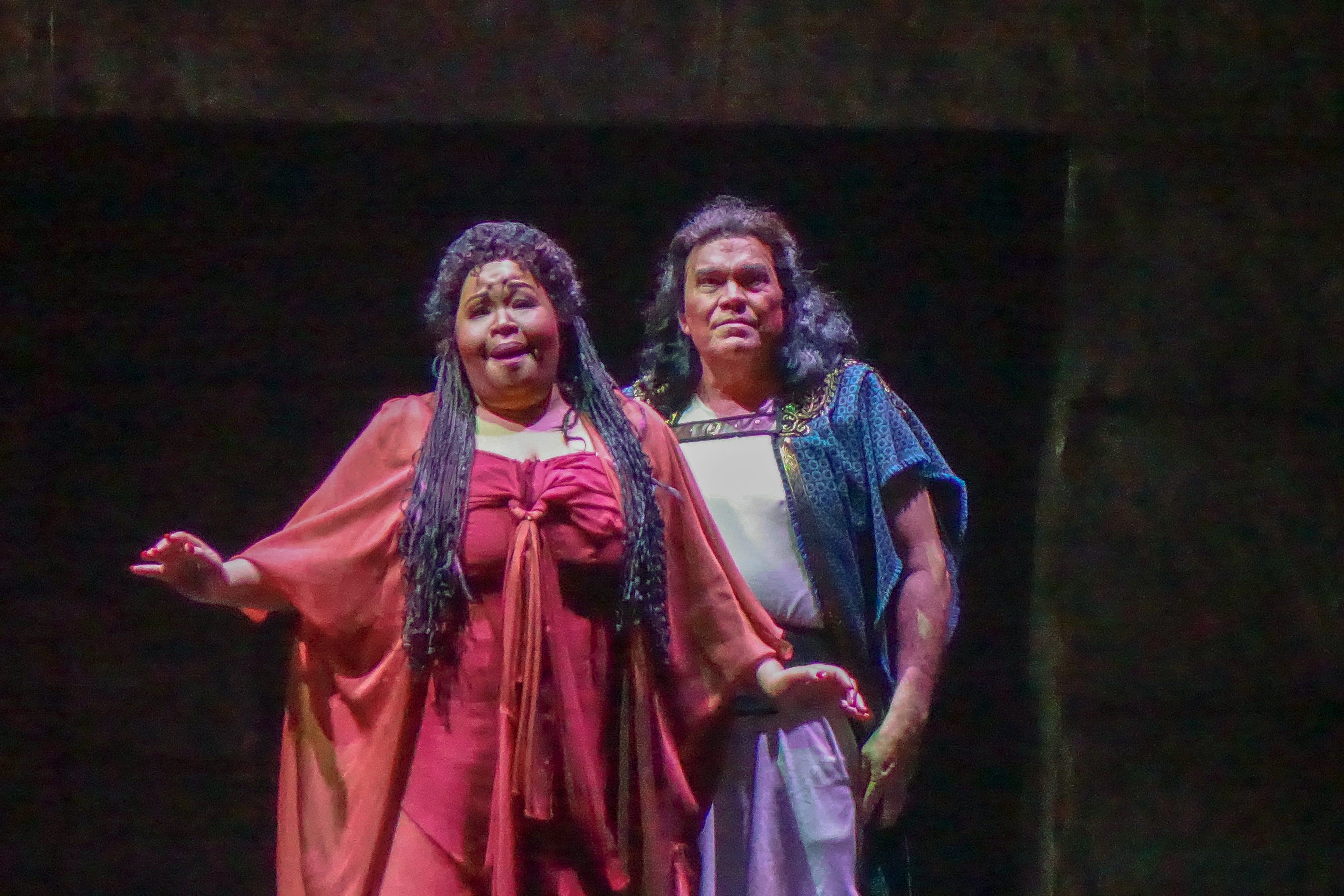
February 3, 2022, Charlotte, NC – Among the lovable scoundrels of Western world literature, surely Don Juan has proven to be the most lovable – Molière, Goldoni, Lord Byron, Shaw, and Mozart are just a few of the notables who have sung the Spanish Don’s sins over the past 400 years. His tale can be seen as a series picaresque escapades and comical conquests, or as a grim and grisly revenge tragedy, or as a stern moral lesson. Armed with a wondrous libretto by Lorenzo da Ponte, Mozart disdained to choose among these alternatives, daring to make his Don Giovanni all of the above. With so much to see and emphasize, it’s no wonder that each of the six productions I’ve reviewed since 1991 has been so different from the others – including a Czech National Theatre production at the Estates Theater in Prague, the venue where Mozart’s masterwork premiered in 1787.220201_OPC_DON_053

In her Opera Carolina debut, stage director Eve Summer pays little attention to scenery, relying on props and Whitney Locher’s costume designs to modernize the action. Donna Anna’s home doesn’t have a façade in the opening scene, where Giovanni flees after raping the noblewoman and is compelled to murder her father before he can escape. Nor is there an exterior, let alone an upstairs, at Donna Elvira’s lodgings in Act 2, when Giovanni serenades milady’s maidservant while Leporello, the Don’s servant masquerading as his master, creates a cunning diversion. Three revolving pods help simulate the places where the swift action unfolds, and Michael Baumgarten’s lighting designs signal the transitions and enhance the drama – especially in the denouement, when the Commendatore, Donna Anna’s murdered father risen from the dead, implacably gets his revenge.220201_OPC_DON_426

Summer hasn’t totally surrendered to modernity in her vision of Giovanni, for she surely could have gone further than equipping Elvira with contemporary luggage as she pursues the Don and turning the pages of Leporello’s book chronicling the rogue’s romantic conquests into an iPad that he scrolls. Balancing these modern touches are the curved tops of the revolving pods, evoking ancient arches, and the presence of harpsichordist Emily Jarrell Urbanak, seated at stage right throughout the evening. In a way, the singers also straddled different eras, always immersing themselves in Mozart’s music, yet the diversity of the casting – and a few of the dance moves they busted at Giovanni’s soiree – returned us to the new millennium. Most anachronistic were Sequina DuBose as Elvira, lugging her rolling stack of suitcases up a couple of stairs and down a ramp, and Alex Soare as Leporello, discarding his sensationally grungy attire only when he impersonated Giovanni (though Locher’s design here may have also been inspired by the Ghost of Christmas Future).220201_OPC_DON_170

Dashing, cruel, and overflowing with conceit, bass-baritone Richard Ollarsaba made a stunning debut as Giovanni, even if the mod dress deprived him of the opportunity to unsheathe a sword. His overtures to Elvira, her maid, and the peasant girl Zerlina were all lusciously seductive. Encounters with Leporello and Masetto, Zerlina’s fiancé, crackled with scornful superiority, sometimes snarling and sometimes nonchalant. The old Commendatore seemed to draw the very best from Ollarsada, cavalierly deferential to his age in resisting his challenges to combat in the opening scene, defiant and fatally unrepentant when Giovanni’s fate was sealed. As rich and appealing as Ollarsaba was when he sang, Alex Soare was startlingly convincing as Leporello when the servant was called upon to masquerade as his master. To bring out the servant’s comic flavor, moments when Leporello was marveling at the gullibility of Giovanni’s victims were underscored more boldly than the disillusion, disgust, and abject fear that the Don’s escapades put him through. Nor was bass-baritone Ashraf Sewailam chiefly onstage as Masetto to clownishly portray the peasant’s malleability, showing us far more of the hothead than the usual hayseed. In the same spirit, tenor Johnathan Stafford White as Don Ottavio, Anna’s staunch and patient fiancé, is more of a noble champion than a feckless chump.27sQMG5Q

Perhaps even more than the men, the excellence of the three sopranos cemented my suspicion that this was the deepest Opera Carolina cast I’ve seen. While Summer didn’t allow Rachel Mills quite as much risqué latitude as I saw in Prague in consoling her battered Masetto, this Zerlina was no less irresistible in her “Vedrai carino,” applying the balm of love on his bruises. Although there were slight chinks in DuBose’s vocal armor, there were no losses in sweetness when there were dips in volume as Elvira sang her woes, and DuBose is such a fine performer that I had second thoughts each time I steered my attention elsewhere – so many of her reactions are worth watching. Most revelatory was Melinda Whittington as Donna Anna, a role I’ve often found annoying in her chaste righteousness. Whittington amped up the feeling of this grieving rape victim while tamping down her outraged fervor. Summer allowed her to wear a color to the Don’s soiree instead of shrouding her in mourning, and those dance moves further humanized her.220203_OPC_CON_1197

The joyous epilogue, celebrating the triumph of justice over wickedness, is scrapped in this new Opera Carolina production. Somehow that enhances the impact of bass Jordan Bisch as the avenging Commendatore. Both at the cemetery accepting Giovanni’s dinner invitation and later at the Don’s banquet hall, Bisch resounds thrillingly as the voice of doom. After blasting my eardrums just three weeks earlier from the Belk Theater stage with Mahler’s Ninth, a discreetly reduced Charlotte Symphony sounded comparatively wan as it wafted the Giovanni overture out of the orchestra pit. But Opera Carolina artistic director James Meena had the ensemble perfectly calibrated for the occasion, and when the curtain rose, the blend of singing and playing gave constant pleasure. As I stepped onto the elevator with another couple, hurrying to beat the Belk crowd out of the parking lot, the husband couldn’t help gushing, “This is the first classical opera we’ve seen!” If future productions are as good as this Giovanni, they will be coming back again and again.

Originally published on 2/5 at CVNC.org

Charlotte Ballet Takes Us Back to the Future in Rousing and Meaningful “Innovative 1970”

Review: Innovative 1970 at Center for Dance

By Perry Tannenbaum

Innov1970 gypsy moths photo by Jeff Cravotta

February 4, 2022, Charlotte, NC – Distorted by delay, the title of Charlotte Ballet’s latest program sounds more like an oxymoron than ever. Innovative 1970 was originally designed to celebrate the company’s 50th anniversary, but COVID intervened in all our lives so that the official celebration couldn’t be staged until October 2021, already 51 years after the original troupe was formed in Winston-Salem as the North Carolina Dance Theatre. That commemoration included an electrifying revival of The Rite of Spring by Salvatore Aiello, who brought NCDT to Charlotte in 1990. Following that program, the company more predictably reprised The Nutcracker for the holidays, choreographed by Jean-Pierre Bonnefoux, who succeeded Aiello as NCDT’s artistic director in 1996 and rebranded the troupe in 2014.

The durably titled Innovative 1970 is thus the first program of all-new pieces since Charlotte Ballet returned to live performances this season and the first to return dancers and subscribers to the Patricia McBride and Jean-Pierre Bonnefoux Center for Dance, doubly appropriate because 1970 was adopted as the creative trigger for all three newly commissioned pieces on the program, choreographed by Andrés Trezevant, Rena Butler, and Ja’ Malik.

Innov1970 What was it for Photo by Jeff CravottaAppropriate to its Vietnam War theming, Trezevant’s “What Was It For?” arrived for its premiere as a partial amputee, for the beginning of the scenario in the printed program, where war protesters make houses out of draft cards, is MIA – along with the conspicuous absence of Elton John’s “Bennie and the Jets (1974).” What remained thrust us into middle of warfare, Julie Ballard’s lighting design turning the floor of the Center for Dance’s black box into camo splotches of green and gray, while a house of cards lingered downstage, now a cryptic relic of the original concept. A quaint portable radio was spotlit near the opposite wing, likely another leftover, but it remained functional, emitting only white noise as five male dancers, dressed as soldiers, populated the stage, simulating scenes of combat, capture, escape, and rescue.

We were clearly – and perhaps angrily – back home, when Maurice Mouzon Jr. subsequently performed a dashing solo to Nina Simone’s “Backlash Blues (1967).” The two women in this piece, Sarah Lapointe and Anna Mains, arrived onstage as healers while the scene brightened somewhat. Now the returning soldiers – Colby Foss, Ben Ingel, James Kopecky, and Rees Launer – were presumably in hospitals and rehab, dealing with mental and physical trauma in the grim aftermath of a futile war. I suspect that the house of draft cards was intended to fall at the end, but it remained standing.

Innov1970 Subliminal Tsunami photo by Jeff Cravotta

Subliminal Tsunami by Rena Butler, with original music by Daniel J. Hoffman, was a more acerbic and satirical piece that took 1970 as a checkpoint on the state of women’s rights and horizons, compared with where they are today. Recorded voices of Gloria Steinem, Nikki Giovanni, and ABC News anchor Marlene Sanders were in the colloquium, intermingled with recorded voices of seven Charlotte Ballet dancers delivering their own personal accounts. Sharply contrasting with this dignified discussion was what we saw onstage, five women dancers coldly confined by Ballard’s lighting into five squares. The stiffness of Lapointe, Raven Barkley, Isabella Franco, Sarah Hayes Harkins, and Amelia Sturt-Dilley, dressed in matching costumes by Kerri Martinsen, clearly identified them as a collection of Barbie dolls, handled dutifully by four men – Foss, Ingel, Launer, and David Preciado.

Only occasionally did the voices compete with the dancers for attention as the piece proceeded, giving the dancers more latitude for movement. No doubting that the black box’s sound system sorely needs an overhaul, OK for rehearsals but not suitable for prime time. It was still a bit stinging to listen to the cautions against following your impulses issued to young girls contemplating a future of homemaking. Lamentably, the pace of progress for women has been mostly subliminal, not at all a tsunami, though cumulatively we have evolved substantially since 1970, and more progress can be perceived if we look back to when women gained the right to vote 50 years earlier. While I was bothered to see the dancers still masked in 2022, Butler had an ingenious way of coping with the situation: Big smiley, lipsticked mouths on Martinsen’s matching flesh-colored masks were clearly and effectively part of the women’s design.Innov1970 gypsy moths 2 photo by Jeff Cravotta

After the traumas of war and the indignities of gender inequality, it was refreshing to return after a second intermission to gypsy moths, Ja’ Malik’s joyous celebration of funk rockers LaBelle and their frequent collaborator Laura Nyro. A teeming cast of five men and five women, all in spangled masks, converged on the floor for “Met Him on a Sunday,” Nyro’s 1971 cover of a song introduced by The Shirelles thirteen years earlier, and “Come Into My Life,” introduced on LaBelle’s Chameleon album in 1976. “Gypsy Moths,” introduced on the same LaBelle album, paired the company into five couples Emily Porter with Kopecky, Harkins with Humberto Ramazinna, Shaina Wire with Josh Hall, Emerson Dayton with Preciado, and Barkley with Mouzon.

It wasn’t until the ensuing three songs that it became clear that Barkley and Mouzon were the alpha couple of Malik’s piece, for Barkley was obviously the lead in “The Wind” and Mouzon was unquestionably the alpha male in “Going on a Holiday,” both backed by the full cast. Neither of these ensemble segments was as special or memorable as Malik’s seething setting of “Been on a Train,” the whole stage cleared for a slithering Barkley-Mouzon pas de deux. “Desiree,” taken from Nyro’s 1971 Gonna Take a Miracle album was only slightly anticlimactic, a glittery showcase for the other four women, and “What Can I Do for You” was a stirring finale for the entire cast, so infectious that it roused rounds of rhythmic clapping from the audience. The ovation when the spectacularly dressed Malik joined the dancers onstage was even more raucous.

Originally published on 2/5 at CVNC.org

“Deadly Sins” Upstage Jazzy Ravel in Fun-Filled CSO Concert

Review: Charlotte Symphony Plays Ravel’s Piano Concerto

By Perry Tannenbaum

2022~Ravel Piano Concerto-07

January 28, 2022, Charlotte, NC – You could arguably call it a facelift. After Charlotte Symphony’s powerful performance of Mahler’s somber, morbid, mercurial, epic, and sometimes phantasmagorical Ninth Symphony, almost everything seemed changed two weeks later. A new conductor was onstage, Australia-born maestra Jessica Cottis, making her Queen City debut. All six guest artists were making their debuts in Symphony’s Classics Series, and even the site of their musicmaking was different, moving southward from Belk Theater at the Blumenthal PAC to Knight Theater at Levine Avenue of the Arts. Most transformative was the music, a kaleidoscopic multinational program connected by a distinct American thread.

The headliner on the program was Maurice Ravel’s Piano Concerto, last performed by Symphony in 2013 when the wondrous Pascal Rogé made his Belk Theater debut at the keyboard. Jesse Montgomery’s folksy, bluegrass-flavored Strum preceded the main event, when Canadian pianist Stewart Goodyear seated himself at the Steinway. Cottis had plenty more excitement in store for us after intermission, plunging into Igor Stravinsky’s Circus Polka, for a Young Elephant – actually written at choreographer George Balanchine’s request in 1942 for Ringling Brothers Barnum & Bailey’s massive troupe of not-yet-controversial young elephants. Uncannily, another Balanchine commission rounded out the program, Kurt Weill’s The Seven Deadly Sins (1932) with lyrics by Bertold Brecht – obviously written for people rather than pachyderms.2022~Ravel Piano Concerto-36

Nearly a year ago, Montgomery’s Starburst aptly keynoted a program that showcased Mozart’s Eine Kleine Nachtmusik (“A Little Night Music”). Longer and decidedly sunnier, Strum set the tone for CSO’s American evening as perfectly as the title readied us for a work written exclusively for strings. Reading Montgomery’s program notes, chronicling the various incarnations of the piece, we get the sense of experiencing its evolution as it unfolds, for it bounces around among three principal string players before beginning its breathtaking ascent to full power and beauty. Laying out the first pizzicatos, violist Benjamin Geller was soon joined by cellist Alan Black, strumming and then bowing. But it was concertmaster Calin Ovidiu Lupanu’s treacherous entrance that truly ignited the fray, triggering Montgomery’s ricochet effects and banjo-like strumming.

Honestly, the performance by CSO became a more massive, lovelier, and less ferocious thing than the studio version by the Catalyst Quartet on Montgomery’s 2015 Strum CD. With a full string orchestra came more majesty when the main melodies were revealed – and extra bite when the piece ended with a collective pizzicato. Nor are “folksy” and “bluegrass” any less flattering in describing Montgomery’s music here than they are in describing many of Aaron Copland’s signature works.2022~Ravel Piano Concerto-01

From the first time I saw him in 2017, playing all of Beethoven’s piano sonatas in a single day at Savannah Music Festival, Goodyear stamped himself in my mind as a prodigious talent. Prior to those three three-hour immersions, Goodyear’s distillation of Tchaikovsky’s The Nutcracker, on his 2015 solo CD, had clued me in. The soloist starts at a disadvantage in the Ravel Piano Concerto, having to follow the famed whipcrack that launches the opening Allegramente. Not to worry, Goodyear showed his mastery of the bluesy and jazzy licks of the movement soon afterwards, and harpist Andrea Mumm Trammell had a lovely interlude.

Inspired by Mozart’s Clarinet Quintet, Ravel’s middle movement drew absolutely mesmerizing lyricism from Goodyear, with English hornist Terry Maskin as stellar behind him as he was for Rogé. Yet everyone on the Knight stage seemed most inspired by the concluding Presto. Goodyear unleashed dazzling intensity and bravura, never easing up on the tempo, and the ensemble didn’t merely keep up: they seemed to be prodding their guest to play faster. Turbulence from the winds, brass, and percussion made the climax even more exhilarating.

Apparently, music for dancing elephant isn’t classified as ballet, since it doesn’t appear on The Robert Craft Edition of The Ballets on the notoriously completist Naxos label. Yet Stravinsky never disavowed his Balanchine bagatelle, conducting “Circus Polka” among his voluminous recordings of his own works, where it clocked in at a modest 3:27 on Columbia. Why this rambunctious crowdpleaser isn’t played more often as a concert appetizer is beyond me. While Cottis and the Symphony may have been a tad helter-skelter where Ravel called for more élan, they were marvelously attuned to Igor’s riotous absurdities, his brassy bombast, and the celebratory glee of his wild, galumphing jamboree. It seemed to start in mid-parade before the dainty spots hilariously evoked the pachyderm pixies.2022~Ravel Piano Concerto-31

The zaniness had hardly begun. Bass-baritone Reginald Powell, dressed in a flowery kitchen apron in order to portray the mother of our tempted/temptress heroine, led a barbershop quartet across the stage, sitting down at the end of their march behind a bank of microphones. Strange accessories for a classical concert. So Seven Deadly Sins was classical with a three-penny Kurt Weill twist. Nor was this an opera, though a cabaret table and some props were set in place before our chanteuse, soprano Lindsay Kesselman as Anna I + II, made her/their noire-ish entrance in a spymaster trench coat.2022~Ravel Piano Concerto-37

More than a hint of decadent vaudeville came with her, since each of the nine sections of Weill’s confection was heralded by an old-timey placard placed onto an easel. Prologue, Epilogue, Greed, and the gang were all embroidered with an apt skull-and-crossbones motif. Sad to say, much of this flavorful creativity was outweighed by Charlotte Symphony’s failure to provide supertitle projections once Anna I + II began vocalizing with her/their Family. A few audience members down with us in the orchestra section had the temerity to fire up their cellphones, where they had previously downloaded Symphony’s digital program, so they could follow along.

Not the best experience when you’re trying to keep up with columns of German and English on your iPhone while there is also action onstage to follow. The magnitude of this blunder would only be compounded if you returned home, flipped through the digital program, and discovered that the translation was written by life partners W.H. Auden & Chester Kallman, esteemed poets and librettists in their own rights – they worked on Stravinsky operas! Not only does their Deadly Sins translation rhyme, the syllable counts of every line meticulously match Brecht’s text. Learning that all five vocalists had North Carolina roots – and afterwards listening on Spotify to a recording with the Auden-Kallman lyrics – only deepened my incredulity.

Everyone at Knight Theater, singers and audience alike, could have been so comfortable, and all Brecht’s wit, irony, and satire could have been so clear!

Stepping up to one of mics, Cottis was helpful in her introductory remarks in laying out Brecht’s storyline, which is basically Anna’s odyssey across seven American cities on a mission to sustain her family back home in Louisiana, encountering one of the deadlies in each locale. Ideally, the Balanchine concept is fulfilled when Anna I is the soprano and Anna II is a sublime dancer. Part of the comedy that got lost when Kesselman was both Annas was in the lopsidedness of the dialogue between them. Anna II has very little to say.2022~Ravel Piano Concerto-28

The staging helped this decadent Weill bauble to upstage Ravel’s merriment – or at least prevented it from being an anticlimax. Kesselman soon peeled off her trench coat, revealing an evening dress as the Family’s Sloth along the Mississippi River transitioned to Pride as Anna II took a job in Memphis as a cabaret dancer. Anna added a flaming red boa encountering Wrath in LA, and an uncredited lighting designer made a similarly lurid choice illuminating the Knight’s acoustic shell. Purple became apropos for Gluttony in Philly, a lighter pinkish red presided over Lust in Boston, and a dark golden hue settled in over Baltimore when she battled Greed. So I had to think that nobody wanted to offend New York during the Great Depression.

Need we say that when Anna’s journeying ended with Envy in San Fran, where Kesselman made her final grand entrance as a rich celeb, totally soused and brandishing a nearly empty bottle of vodka, that the stage was flooded in a deep dark green? Didn’t think so.

A wonderful ending to a melodious, fun-filled, and dance-filled evening. Even without dancers. Facelift and uplift.

Originally published on 1/30 at CVNC.org

Symphony Arrives at Sublimity, Amping Up Mahler to Heavy-Metal Decibels Along the Way

Review: CSO Plays Mahler’s Ninth Symphony

By Perry Tannenbaum

2022~CSO Mahler's Ninth-17

January 14, 2022, Charlotte, NC – When the new Compact Disc digital recordings were first heralded and released in the early 1980s, the mythic story began circulating from Sony and Philips that the dimensions and capacity of the new CD format were determined by its ability to present all of Beethoven’s Ninth Symphony on a single disc. Subsequent refinements to the technology increased the capacity of those discs from 74 minutes of music to 80, leaving Ludwig far out of the equation. The 80-minute capacity we see on today’s prerecorded discs and the recordable CD-Rs we might dub them onto is more suitable for containing Gustav Mahler’s Ninth Symphony – but only if conductor and orchestra are in a hurry. Only the very quickest of the many recordings of Mahler’s last completed orchestral work clock in at 79 or 80 minutes. Completing his Mahler Journey with the Charlotte Symphony Orchestra in his final season as music director, Christopher Warren-Green let it be known that his Ninth would be a more expansive 90-minute experience. There was no intermission at Belk Theater, and program booklets remain a strictly online affair.

Vaccination cards were scrutinized at both the outdoor entrances to the Blumenthal Performing Arts Center and at the indoor entrance from Founders Hall. My mom and I felt very comfortable with the social distancing downstairs in the orchestra section, but no such amenity was granted to subscribers who entered the hall from the lobby – in fact, I’ve never seen the Grand Tier more fully occupied, a gratifying affirmation of the Queen City’s Mahler enthusiasm. The balcony above looked similarly packed. Masking, of course, was compulsory, but ticketholders should chiefly be forewarned that vigilance was strictly enforced at the entrance to the orchestra section. Folks that were late for the first notes of the Mahler performance, between 7:35 and 7:40pm, were obliged to wait in front of TV monitors in the lobby until the conclusion of the opening Andante comodo movement at approximately 8:05.

Each of the outer movements, both preoccupied with mortality and dying, is as lengthy as the two inner movements combined. Only the second movement can be described as lighthearted, and all four are teeming with mood swings. Without adding audible gaps between episodes, recordings conducted by Leonard Bernstein and Herbert von Karajan with the Berlin Philharmonic are divided into 33 and 30 tracks respectively. Those seemed to be very conservative numbers when Warren-Green and Charlotte Symphony immersed themselves in the score, reveling in its seemingly countless contrasts. Emerging with the opening melody from a backdrop of cellos, basses, horns, and harp, the second violins emphatically signaled that all sections of the vast ensemble would have their chances to shine.

2022~CSO Mahler's Ninth-04

This was by far the most extensive instrumentation we had seen at either Belk Theater or Knight Theater since the beginning of the pandemic. From orchestra level, it was difficult to precisely count all the unmasked flute, clarinet, oboe, bassoon, French horn, and trumpet players arrayed behind the masked string sections. But the percussionists were plain enough when they stood up, either singly or as an ominous group, and there was additional space set aside, upstage and on the stage left wing, for the three trombones, two harps, and the tuba. Curving around stage right to the upstage was an armada that included timpani, a mighty bass drum, cymbals, a gong, snare drums, and tubular bells.

So the prospect of high-volume music was apparent before all the Symphony musicians were fully congregated. Yet when these expected Mahler explosions actually occurred, Mom and I were both taken aback by how loud they were. The difference between sitting at the rear of the grand tier late last spring and sitting in Row O below was compounded by the additional troops and artillery onstage. Earplugs weren’t quite necessary for these fortissimos, but rock-concert decibels weren’t far in the distance. Mom may have nodded off for a few seconds during Gershwin’s Lullaby last year or when Branford Marsalis luxuriated in the luscious Larghetto middle movement of Jacques Ibert’s Concertino da camera. Not this year. Onsets of trumpets, trombones, or percussion could be so sudden that, even if she didn’t revere Mahler, Mom wouldn’t dare close her eyes.

There were plenty of less aggressive surprises scattered across the lordly length of this symphony. In the epic Andante, the harpists reached out to pluck a bass line, and the mournful funereal dirge had the backbone of a military march, punctuated by the wan tubular bells. If you’re new to Mahler, the waltzing liveliness of the “Im Tempo eines gemächlichen Ländlers” (in the tempo of leisurely country dances) might catch you pleasantly off-guard – and what plan did the composer have for a triangle and cymbals playing in unison? The third movement Rondo-Burlesk was brimful of contrasts and contradictions as Warren-Green kept us on the lookout for the next twist. A busy, contrapuntal opening suggested a fugue with frolicsome and comical touches, but midway through this Burlesk, each of the orchestra’s sections seemed to have something soulful to say – not at all the path you would expect leading to a screaming conclusion.

2022~CSO Mahler's Ninth-15

Perhaps the biggest surprise of the evening came at the climax of the Adagio finale when a furious pounding of the big bass drum, topping off a majestic crescendo, suddenly gave way to – in the hushed blink of an eye – nearly total silence. This abrupt whisper of weepy violins, proved that Mahler’s precipitous subsidings can be almost as dramatic as his volcanic peaks. Most of Symphony’s principals distinguished themselves over the course of this epic evening, including oboist Hollis Ulaky, clarinetist Taylor Marino, cellist Alan Black, and concertmaster Calin Ovidiu Lupanu, but the final movement underscored the special praise earned by French horn principal Byron Johns and principal flutist Victor Wang. Even Johns’ one little wobble on the horn came at an ideally aching moment, and Wang was merely perfection in the sublime epilogue.

Originally published on 1/15 at CVNC.org

Thorgy Brings Plenty of Christmas Cheer – and Drag Artistry – to the Queen City

Review: Charlotte Symphony Premieres A Very Thorgy Christmas

By Perry Tannenbaum

2021~Thorgy Xmas-37

The first thing to know about Thorgy Thor, a distinguished alum from the eighth season of RuPaul’s Drag Race, is that she is outrageous. If political correctness is your passion, then the next thing to know is that I’ve chosen her pronouns after consulting the program for the world premiere of A Very Thorgy Christmas, performed with the Charlotte Symphony and resident conductor Christopher James Lees. The Wikipedia entry for Thor, née Shane Galligan, is a tossed salad of pronouns that doesn’t conclusively settle the question.

Headlining a Christmas show with a full symphony orchestra, Thorgy proved to have multiple talents. Not only did she serve as a guest violin soloist on three Christmas songs, she performed a standup monologue, screened a self-produced takeoff on an NPR podcast, presided like a gameshow host over a farcical giftwrap contest between four Symphony musicians, sang an autobiographical rewrite of “The 12 Days of Christmas,” and interviewed Lees a la late-night TV.2021~Thorgy Xmas-18

If Thorgy’s debut with Symphony in January 2020 had even half the variety and surprises of her Christmas extravaganza, it’s easy to understand why she was invited back so quickly – to basically do whatever she wished. The only restriction she acknowledged was an imposed limit of one f-bomb, and she certainly detonated that one with maximum impact. Lees and the ensemble began conventionally enough at Knight Theater for a very full house, launching into a merry rendition of “Joy to the World.” But the arrangement of this familiar carol soon became a mashup of several other carols and then an outright Christmas barrage – “Jingle Bells” and “Silent Night” at the same time? – before I began to wonder what few Christmas carols might be left over after this extravagant overture.

Unlike Jack Benny or Henny Youngman, the only other violinist comedians I can reference, Thorgy took herself seriously as she came on to play “O Holy Night.” Her tone was actually quite beautiful when she played, even though the arrangement and tempo didn’t demand impressive dexterity. “Carol of the Bells,” played just before intermission, required fleeter fingering, but even with this more energetic fare, Thorgy was flawless, unstressed, and only wisecracked once or twice over her performance. More of her freewheeling flamboyance came out when she put away the lumber and spoke out. This Very Thorgy Christmas was clearly a 2021 edition if Thor has any intentions of reprising her show as a Yuletide tradition. Not only was the new show silly, as Thorgy herself off-handedly remarked, it was also ephemeral.

Thorgy’s monologue was largely about her upcoming prospects and what she had done during the pandemic. Her pandemic shenanigans were plentiful enough, in fact, to supply prime fodder for her next two comical exploits prior to intermission. In the first, she went through the lowlights of her stint as a cameo celeb, that seemingly wholesome profession of producing customized video greetings for clients’ loved ones. As the smut piled on, we quickly realized that Thorgy didn’t attract a Hallmark Cards clientele. In the NPR video she showed us afterwards, Thorgy and a fellow drag queen, rather sedately dressed for this studio format, interviewed a comparatively blue-collar guy named Chef Schwetty. Judging by the varied colors of the samples he brought with him, I’d say Schwetty was a pastry chef. Without adding flavors or adjectives, Schwetty described his specialty as balls. Needless to say, the two gay interviewers feasted on the possibilities.

2021~Thorgy Xmas-36.jpgMore signals came after intermission that a 2022 edition of Thorgy Christmas would undergo drastic changes, for it was obvious that Thor revels in surprises. Dispensing with the customary concert preludes served up by her symphonic hosts, Thorgy burst onto the stage and kicked things off with a brash “Jingle Bells” spot. Of course, she had changed her outfit during intermission – from an ensemble highlighted by garish red-and-green-striped slacks to a fiery, glittery, fuchsia spectacular. She almost visually jingled in this one-piece caprice, and she discarded her dazzling Dolly Parton white wig in favor of a towering brunette bouffant. Thorgy is rather tall already.

Genial, easygoing, and relaxed, Lees complemented his guest artist handsomely. After the opening overture pillaged a huge chunk of Christmas inventory, Lees allowed the orchestra to stray briefly from holiday fare with an excursion to Grieg’s “Hall of the Mountain King.” When he returned to the podium, after the screening of Thorgy’s cameos, he and his cohort basically coasted along with a couple of snatches from Tchaikovsky’s Nutcracker, rep that they play repeatedly for Charlotte Ballet every December. After Thorgy made her splash to open the second half, Lees engaged with the Knight Theater audience to help him out with the whipcracks in Leroy Anderson’s “Sleigh Ride.” A woman in a lower box seat happened to have a black fan that made a whippier sound than our claps when she opened it, adding to the fun (especially when she was late).

Although the Knight audience was heavily infused with RuPaul devotees, the “12 Days of Christmas” parody was too crammed with obscure references to Thorgy’s misadventures on Drag Race and its All-Stars spinoff – and often too unintelligible – to garner universal laughter. And of course, the repetitions built into the familiar song didn’t help, a lesson for Thorgy to learn for her 2022 edition. After this partial misfire, Thorgy came up with her most hilarious bit of the night, the giftwrap contest with four surprisingly smart-alecky Symphony musicians. With a connoisseur’s unerring judgment, Thorgy chose four gifts for wrapping that offered maximum opportunity for failure and embarrassment: a cluster of inflated balloons, an open umbrella (closing it was strictly forbidden), a toilet plunger, and a broom and dustpan combo.

Like those frenetic cookoffs you may have watched on TV, the four wrappers had to cope with a tight time limit, so Lees and the orchestra timed the competition by performing… something. The action was too engrossing for me to take heed, but the ending and Thorgy’s flamboyant flourish were emphatic enough to signal the sudden frantic finish. The cluster of balloons proved to be disappointingly wrappable and humdrum, but the unopened umbrella was such a colossal fail that I found myself howling with laughter.2021~Thorgy Xmas-29

On the other hand, the wrapping for the plunger, cunningly separated into two pieces, was an absolute triumph. But flutist Jill O’Neill ultimately won the night – via a plurality of audience applause – with her amazing wrapping for the broom and dustpan. Audaciously rolling the merchandise on the floor helped O’Neill execute her design, and I suspect that adopting a witch persona as soon as she first held the broom helped to sway the judges. I was actually impressed by the rapport that Thorgy developed with each of the four contestants as they displayed their handiwork.2021~Thorgy Xmas-31

We gracefully glided homeward after this high-energy highlight, as Thorgy sat down for her cozy interview with Lees, occasionally prompting principal cellist Alan Black to imbibe from a tumbler of alcoholic beverage during the course of the conversation. Things became unexpectedly revelatory when, after a very personal question, Lees suddenly asked his interrogator if they could continue their conversation backstage later on. Some marital history soon followed. Those hilarious moments prevented the sitdown with Thorgy from becoming overly anticlimactic after the madcap giftwrap – and it segued nicely into Thorgy’s closing performance on violin, a beautiful and heartfelt “Silent Night.”

Originally published on 12/25 at CVNC.org

The Road Gets Bumpy, but Theatre Charlotte’s “Christmas Carol” Prevails at CP

Review: A Christmas Carol at Halton Theater

 By Perry Tannenbaum

IMG_9668

Almost a year ago, fire struck the Theatre Charlotte building on Queens Road, gouging a sizable trench in its auditorium and destroying its electrical equipment. Repairs and renovations will hopefully be completed in time for the launch of the company’s 95th season next fall, but meanwhile, actors, directors, designers, and technicians are soldiering on at various venues for 2021-22, their year of exile cheerfully branded as “The Road Trip Season Tour.” Ironically enough, Theatre Charlotte’s Season 94 began in September with a downsized musical, The Fantasticks, at the Palmer Building, a facility that once served as a training ground for firefighters. For their 14th production of A Christmas Carol, Theatre Charlotte has moved along to Halton Theater, the permanent home of Central Piedmont Theatre.

Timing is a bit awkward on the campus of Central Piedmont Community College, where a new theater that will be friendlier to dramatic productions – replacing the demolished Pease Auditorium – is slated to open in April with The Diary of Anne Frank. Graced with a generous orchestra pit, the Halton is more hospitable to big splashy musicals (when its sound system responds favorably to our crossed fingers). In fact, this transplanted production of A Christmas Carol, in Julius Arthur Leonard’s adaptation of Charles Dickens’ iconic novella, reminds us how well-suited the old “Queens Road barn” was for such spooky and creepy fare. Not only were the ghosts of Christmases Past, Present, and Future at home there, but so were such confections as Arsenic and Old Lace, Assassins, Blithe Spirit, and To Kill a Mockingbird. The Halton occasionally seemed oversized when You Can’t Take It With You took up residence there at the beginning of Central Piedmont’s current season, and you can imagine how their spectacular 2015 Phantom of the Opera emphasized the grandness of Andy Lloyd Webber’s grand guignol.

Encountering the vastness of the Halton in transplanting Theatre Charlotte’s cozy Christmas Carol, director Jill Bloede has been characteristically resourceful in executing its many daunting scene changes. At times, we could see cast members whisking set pieces off to the wings in a smooth out-with-the-old, in-with-the-new routine. But there were occasions when changes of scenery necessitated a complete closing and reopening of the stage curtains. Veiling the tediousness of that maneuver, Bloede has summoned repeated parades of a small band of merry carolers, coached by Jim Eddings, to cross the stage while the curtains are closed – so you would probably be right in thinking there are more carols sung this year than in Christmases past on Queens Road. My welcome for the carolers on opening night veered toward the unredeemed Ebenezer Scrooge’s grumpy attitude as the evening progressed, yet opening night is destined to be enshrined in Theatre Charlotte lore as the night of the infamous doorknocker scene fiasco.

One of the first indications that Scrooge’s house will be haunted, after a ghostly “Ebenezer Scrooge!” exclamation blows in on the Halton’s sound system, is the brief scene at the threshold to Ebenezer’s home. Here is where Scrooge sees a fleeting glimpse of his deceased partner, Jacob Marley, bringing his doorknocker to life. The precision needed to carry off such a simple scene only became apparent when it went awry. Either the Halton curtains were tardy in arriving at their centerstage spots, where they would fully frame Scrooge’s front door, or the actor who was to lurk unseen behind that door arrived early – and was very clearly seen, garishly aglow. Portraying Scrooge, Hank West seemed sufficiently poised to extemporize while the stage curtains and the lurking Marley came into proper alignment. But the carolers took their cue and entered before West could properly proceed, and the panicked actor behind the door fled. West finished out the brief scene as well he could without any eerie lights beaming through the doorknocker, but the special effect was lost – the only real reason for that scene.

Legions of Theatre Charlotte veterans – and new initiates in years to come – will no doubt keep the memory of this snafu alive for generations, heartily laughing all the more at the incident because it didn’t typify the production. Scenic design by Chris Timmons and lighting by Gordon Olson didn’t expand quite enough to comfortably acclimate at the Halton, nor did the company splurge on smoke or fog effects during its financial woes, which might have deepened the spell of the spookier Marley and graveyard scenes. Don’t expect any snow to flutter down on the vast Halton acreage, either. With balmy temperatures likely to prevail throughout the opening weekend, it’s Beth Killion’s set of period costumes that most successfully instill a chill into the air.IMG_8525

We’ve seen some of this cast before, notably West as Scrooge, Chip Bradley as Christmas Present, and Mary Lynn Bain doubling as Fred’s wife Elizabeth in the present and Belle, Scrooge’s old flame, in the flashbacks. All of these enlarge on their past performances to some extent, maybe West most of all. His meanness is more startling in person than it was in last year’s video version, streamed online, and his sorrow and penitence are also magnified. The graceful arc of Scrooge’s redemption is only slightly bumpier this year with West’s adjustments to the new space, Bloede’s script edits for this intermission-free edition, and a body mic. Projected into a larger hall, Scrooge’s newly minted intentions needed to sound more like settled resolves and less like agonized pleas. Bradley enlarges to a similar degree upon Present’s outsized cheer, the more the merrier in his case – until he issues his climactic admonitions, now sharper in their contrast. Bain seems most content to let her mic do her amplification, but she is stronger this year in the climactic flashback scene when she returns Ebenezer’s engagement ring.IMG_8694_dcoston

All the newcomers to TC’s Carol are quite fine, a testament to Bloede’s ability to attract talent when she holds auditions. In contrast with the veiled youthful mystery of Anna McCarty last year, Suzanne Newsom brought a nostalgic melancholy to the Ghost of Christmas Past that was quite affecting in its serenity, while Mike Corrigan appeared for the first time as Bob Cratchit – very different with his more muted brand of meekness from Andrea King last year but no less kindly or comical. For richer or poorer, Josh Logsdon and Rebecca Kirby were a fine pairing for the Fezziwigs, Aedan Coughlin doubled well as Young Ebenezer and Ghost of Christmas Future, and Riley Smith brought all the optimism needed for the sanctity of Tiny Tim. With Mitzi Corrigan and Emma Corrigan on board as Mrs. Cratchit and daughter Belinda, there’s plenty of family authenticity around the humble Cratchit hearth – or there will be when Mitzi returns from personal leave due to a death in her real family. Vanessa Davis spelled ably for Corrigan as Mrs. Cratchit at the premiere performance, augmenting her regular role as Mrs. Dilbur.

Assuming that Thom Tonetti was already in character as Jacob Marley during the notorious doorknocker scene, I’ll say his opening night adventures most typified the Theatre Charlotte crew’s tribulations in acclimating to a new space. Marley’s entrance into Scrooge’s home wasn’t dramatized with smoke and lights, and Tonetti didn’t enjoy the benefit of having his prophecies and imprecations magnified with thunderous jolts from the soundboard. During the flashbacks, the actor certainly earned some sort of sportsmanship award, appearing as the younger Jacob opposite the truly younger Coughlin.IMG_8645_dcoston

Steadying this production and assuring that its professional polish never deteriorated into community theatre chaos for long, West ultimately triumphed over all missteps and obstacles, bringing us the compelling Scrooge we expect in all his goodness. It’s still a strong story, and 24 of its most ardent Theatre Charlotte believers are moonlighting at Central Piedmont, giving this 87-minute production the old college try. A drama within a drama, to be sure, both ending happily.

Originally published on 12/18 at CVNC.org

New Techni-Colorful “Velveteen Rabbit” Struggles to Retain Its Aching Soul

Review: The Velveteen Rabbit at ImaginOn

 By Perry Tannenbaum

2122 The Velveteen Rabbit

Beginning with a musical version in 1992, I’ve now seen at least eight productions of The Velveteen Rabbit at Children’s Theatre of Charlotte, four at their former location on Morehead Street and four at their pioneering ImaginOn facility near Seventh Street Station. Scott Davidson’s dramatic adaptation of Margery Williams’ classic 1922 book, long a mainstay at Children’s Theatre after the musical version was discreetly discarded, was actually the first show staged in the smaller theater, now named the Wells Fargo Playhouse, when ImaginOn opened in 2005.

The company’s 2021 edition of the story, arguably more relevant for children in the midst of a pandemic, takes us in new directions – with a new stage adaptation by Michelle Hoppe-Long, CTC’s director of education. Hoppe-Long’s Rabbit hopped from page to screen last December with a different cast, a worldwide debut that was still viewable online back in March. Now it’s in its premiere live run.

Over the years, CTC’s Rabbit is likely the company’s most widely-known piece, since it has often travelled across the state in pint-sized portable productions with its travelling troupe, known once upon a time as the Tarradiddle Players. So perhaps the biggest shift between the former Rabbit and the new one is only becoming obvious now, as the ImaginOn staging leaps from the Wells Fargo to the larger McColl Family Theatre. Logically enough, Andrew Gibbon’s scenic design concept has discarded the simple, drab, intimate, and pastel look of the vagabond Rabbit in favor of a sweeping, eye-popping, and technically dazzling spectacle, abetted by Robyn Warfield’s bold lighting design. These flamboyant Disney fantasy elements are offset by Magda Guichard’s earthbound costume and puppet designs.2122 The Velveteen Rabbit

That same tension between imaginative extravagance and minimalist simplicity is evident in Hoppe-Long’s script and Melissa Ohlman-Roberge’s stage direction. These discordant elements may be viewed as indecision, but it seemed to me that this new hourlong Velveteen Rabbit was consistently plagued with wrong, illogical, and perverse decisions. Most incomprehensible and disastrous was the transformation of the title character from a woman in an outsized bunny suit into a puppet, visibly wielded by an actress bravely striving to deflect attention away from herself.

Why reduce the size, expressiveness, personality, and lovability of your lead character in transit from a small venue to a larger one? Portraying the Rabbit by proxy, Margaret Dalton never gets the chance to equal the exploits of Claire Whitworth-Helm, Lesley Giles, and Nikki Adkins, past greats in the role. And Dalton must also moonlight, without changing her costume, as the household Nana! Occasionally, Dalton’s double duties became awkward and confusing, if not cringeworthy.2122 The Velveteen Rabbit

In a story about a boy’s toy aspiring to become real, all of this wrongheaded simplification makes it more difficult for toddlers to see that the Velveteen Rabbit is real – and for them to empathize with its aspirations. A whole franchise of Toy Story films is descended from Williams’ story, but Hoppe-Long and Ohlman-Roberge not only change the Old Skin Horse to a less cuddly Rocking Horse, they eliminate or downgrade all the toys and real rabbits that torment our protagonist. These abridgements of the Velveteen Rabbit’s world seemed to compound the audience’s struggle to empathize with her – it certainly compounded mine – because we never felt her pain keenly. And when the family Doctor was also removed from the cast, the Boy’s tribulations were also muted at the dramatic climax when he fell sick. Yes, even the size of the cast was smaller at this bigger venue.2122 The Velveteen Rabbit

Ironically, simplifying and purifying the Boy also diverts our attention away from the Rabbit. More human stupidity and callousness from Lexie Wolfe as the Boy would have reminded us that the Rabbit should be our primary concern, though she does underscore those moments when the Boy disregards his cherished toy. Surrounded by such Technicolor splendor, it’s hard for Wolfe to break through and impress upon us that the Boy is not completely wholesome – and that his life before he falls ill is not totally idyllic. Instead, Wolfe diverts us with her charm as the Boy roams about with the Rabbit, pretending to be a warrior and pirate while immersing his cuddly toy in his fantasies.

This is the most vivid magic we get, yet Hoppe-Long has contrived to add a little more magic to the Williams yarn, expanding the role of the nursery magic Fairy. The sudden blooming of her presence in the midst of the Velveteen Rabbit’s most extreme desolation is beautifully conceived and splendidly staged, with Reneé Welsh-Noel’s lithe dancing skills adding to the wonder. Yet this new adaptation drops the Fairy into the beginning and middle of the story, where she has never appeared before, somewhat blunting the surprise of her climactic deus ex machina appearance at the end.2122 The Velveteen Rabbit

Welsh-Noel also moonlights as the Rocking Horse and the Boy’s distant but understanding Mom. There’s a delightful surprise cameo at the end of the show, buried in the playbill credits, when stunt rabbit Brambles replaces the puppet protagonist. Parents and toddlers can decide for themselves whether a live rabbit that must be protectively caged at odd intervals – to prevent it from romping around forever in the audience – enhances or diminishes the nursery magic. For me, it was cute at first, but the benefits didn’t last.

Originally published on 12/6 at CVNC.org