Tag Archives: Amanda Pippin

DCP’s “The Cottage” Is a Merry Hideaway for Secret Lovers and Cigarettes

Review: The Cottage at Armour Street Theatre

By Perry Tannenbaum
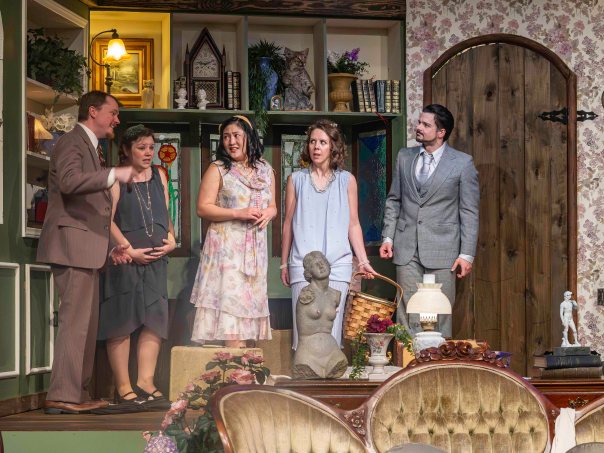
Davidson, NC – One of my late mother’s favorite Yiddish words, ongepotchket, sprang immediately to mind as soon as we walked into the Armour Street Theatre for the local premiere of Sandy Rustin’s The Cottage. Our first glimpses of Kate Baker’s scenic design had that unique tang. Gaudy. Cluttered. Colorful. Ornate. Massively overdone. Impossibly baroque.

That impression only magnified at the other end of the hallway when more of the rusticated clutter of this latest Davidson Community Players production came into view. It deepens further once the farce begins, for in addition to a stairway, two downstairs exits, and an upstage front door, Baker has crafted an invisible entrance that will eventually come into play – and cunning little crevices where Rustin’s characters, all but one of them acquainted with the cottage, will reach in and fob cigarettes.

It’s Monday, June 4, 1923, some 90 minutes from London by train, and this countryside retreat is the perfect place to be naughty. By the end of the show, I wasn’t sure whether half the budget was being frittered away on faux cigarettes.

Nor could I rid myself of the idea, driving home, that this cottage – which takes on a decisive cameo role in the denouement – was an apt metaphor for this whole amorous mismatched group of Brits.

We likely think at the outset that we should be emotionally invested in Beau, who is carrying out his yearly love orgy with Sylvia, his brother’s wife, and juggling multiple illicit affairs. We’re used to seeing such farces written by men, after all. But Rustin’s brand of farce has different beats, a conviction that women should get equal portions of the cake, and sympathies toward Sylvia, who is clearly getting the short end of the stick.
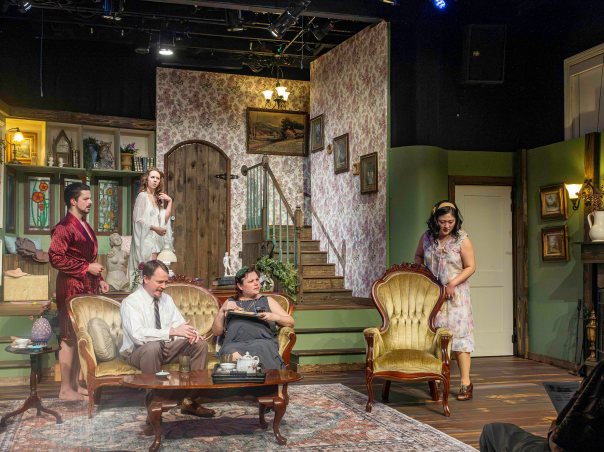
More than reversing our perspective, Rustin explores love: its levels, vacillations, and simultaneities. You may sour on a partner in her bucolic world, but it is not at all axiomatic that you transition to hating them. Throughout all the crossfire of who’s cheating on who, who’s been keeping secrets from who, who’s been wronged by who, and who’s underappreciated by who, none of the six characters rises to a moral high ground or plummets far below.

Except perhaps the monster in the group, who is arguably the most deceitful.

In a rather amazing coup for DCP, their Cottage is directed by Hanley Smith, who originated the role of Deirdre in 2013 at the Astoria PAC in Queens, NYC, before moving up to the triggering role of Sylvia at Florida Studio Theatre in Sarasota, four years ahead of the Broadway premiere in 2023. Not a far-flung coup, to be sure, since Smith is a Davidson College grad who starred in Actor’s Theatre of Charlotte’s production of The Vibrator Play in 2011.

So whether or not she has directed anywhere else before her DCP debut, Smith quickly establishes that she has a sure feel for this script. From the outset, Julia Howard’s performance as Sylvia was at least as extravagant as the scenery that surrounded her – and the sofa where she rehearsed her most alluring poses. This has been her one-time-a-year sex-capade, and it was obvious that she wasn’t planning for it to end, though Beau’s work week was set to begin.

No, no, no. Her plans, executed yesterday evening with a couple of telegrams, are to leave her husband Clark and marry Beau. Thoughtfully, the second wire was sent to Beau’s wife, Marjorie. Part of Sylvia’s kooky charm comes from her not being steadfast in her beliefs or resolutions – a trait that is contagious among Rustin’s creations – for she regrets sending her liberating telegrams as soon as she hears a loud knock on the front door.

Sylvia’s miscalculations will greatly increase Howard’s chances to shine, and still clad in her negligee, she’ll continue to stand out from the parade of visitors. As already hinted, Beau has been busier at the game of love than she anticipated. Ben Allen must merely be “Perhaps the best-looking man in Britain” to match the playwright’s description, so a certain amount of vanity must be coupled with his sexual rascality and his savoir-faire as a deceiver.

When Beau is celebrated repeatedly instead for the beauty of his flaming robe, should Allen act upset? Perhaps not, for Rustin consistently sets aside perfect moments, on the brink of upset or disturbance, for Beau to suggest a cigarette or a spot of tea. Good manners and posture were must-have accessories for Allen’s geniality in the early moments of this unpredictable morning at the cottage. On the spectrum of flappability, he seemed to be permanently perched at the opposite end from Sylvia.
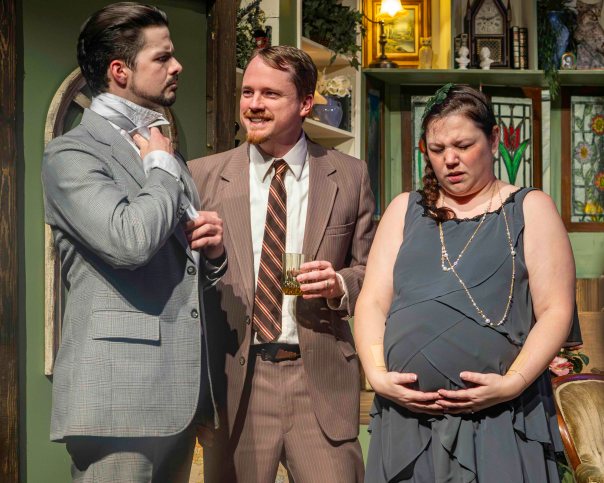
Until he opened the front door, first to his visibly pregnant wife Marjorie and then to brother Clark. Their suspicions have been eradicated by Sylvia’s batch of telegrams. So while it’s unseemly to disclose her hiding place before you see this farce, it’s also unnecessary for Beau to maintain his charade and keep her there.

Sadly, for Amanda Pippin as Marjorie and Andrew Pippin as Clark, neither had the histrionic opportunity to rev up to a towering jealous rage. They have a couple of surprises of their own to reveal. After Sylvia fully digests them, she’s probably correct in thinking that she has more right than Beau to be miffed. Regardless, it was so much fun watching Howard come to that realization and then watching Allen nearly catch up.

The Pippins neatly pull off the trick of being humdrum, wholesome, and deliciously wicked at the same time as their insouciance confounds their fellow adulterers. Nor are they the ones to be ruffled when, one after another, a third couple comes knocking at the door: Cate Jo as the déclassé Deirdre and Andrew Williams as the reputedly murderous Richard.

Like Marjorie, dear Deirdre will have good news and bad news. But nobody seems to react to any news at the cottage in the way the teller anticipates. Howard takes honors as the most thoroughly cheated person onstage as Sylvia, while Allen as Beau, the target of Richard’s wrath, takes cover like all the others. Jo makes for a loopy Deirdre, loopier after guzzling from a gin bottle, and hers turns out to be a rather physical role, what with all the hiding and staggering she must do in varying states of sobriety.
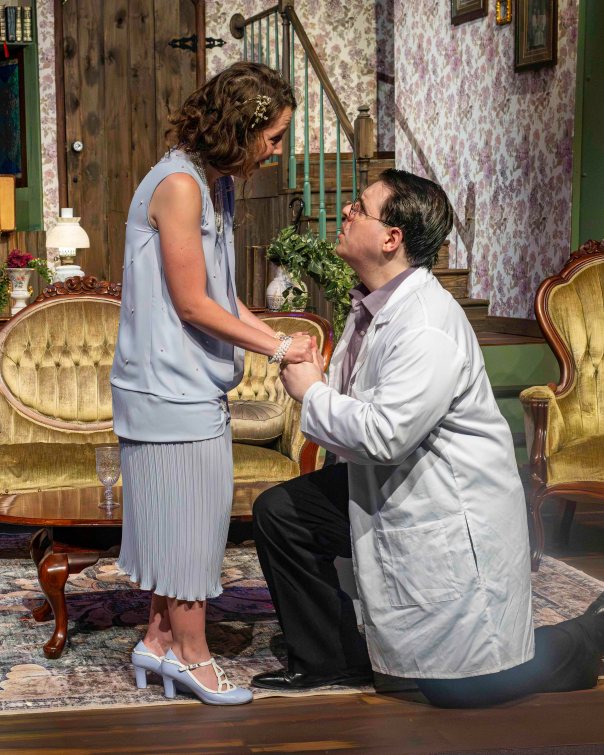
Williams, as Deirdre’s ex, has a past that’s as chequered as Deirdre’s, but all of that came since he and Sylvia last met many years ago. In everyday life, when not boasting of murdering Deirdre’s lovers, he passes for an everyday pharmacist, so the role offers a delicious range for Williams in spite of his late arrival.

To her credit, Sarah Deutsch’s costume designs are only slightly upstaged by the set. If you know who Stanley Baldwin was and his political affiliation, identifying the era of Rustin’s lively farce won’t be a formidable challenge. Otherwise, Hanley doesn’t orient us in either the printed or the digital program. The gorgeous Victrola must be your guide.

But only Rustin is to blame for Richard’s lame excuse for his false beard and mustache, so I’m not blaming anybody at DCP for making these disguises glaringly clumsy. Let the moment pass and richly enjoy the rest. This production is definitely worthy of its pedigree.

Off-Course “Noises Off !” Eventually Malfunctions Like Clockwork

Review: Noises Off! by Davidson Community Players

 By Perry Tannenbaum

Noises-116[4]_edited-1

July 21, 2022, Davidson, NC – I’m not sure that a single American comedy has been produced as often in the Metrolina area in recent years as Noises Off, the wild door-slamming farce by Britisher Michael Frayn. What makes this particularly astounding is the monumental effort needed to mount this insanely high-energy, fast-paced work – and the time and effort it requires from audiences, stretching out to over two hours in length with two intermissions. There are folks in my family circle who groan at the prospect of one intermission. The sheer height, size, sturdiness, and swivel-ability of the scenic design – none of which can be compromised – make the comedy virtually impossible to stage at some venues.

Yet the adamantine laws of physics have not deterred some of our local companies from giving Noises Off a go. The production at Central Piedmont’s Halton Theater in 2012, for example, was penance for an ill-advised effort at panoramic Pease Auditorium in 1994. Likewise, it would have been foolhardy for Davidson Community Players to even attempt this two-story Everest of a comedy back in 2010 – or now in their encore – if they had been confined to their customary HQ at Armour Street Theatre. Fortunately, DCP had the good sense on both occasions to indulge their ambitions in the summertime, when Duke Family Performance Hall is available to them on the Davidson College campus. A ramp takes you up to the balcony level of the Duke if you arrive at the front entrance of the five-floor Knobloch Campus Center, which also houses the Alvarez Student Center. The fly loft of the theater extends to the full height of the building, so director Matt Webster can decree that the stage curtain be lowered halfway for a spectacular culminating technical gaffe.

Of course, theatre gaffes are the coin of the realm as this comedy-within-a-comedy unfolds so delightfully badly, starting with a calamitous dress rehearsal of “Nothing On” that extends past midnight into the morning of the day when it’s scheduled to open. Gleeful Instagrams and Facebook posts were broadcast to the wide world web by elated audience members at the Duke who were able to take cellphone pix of real printed programs after a hiatus of more than two years. It might be deflating, then, to recall that in the old days, we received additional fake programs from “Nothing On” with side-splitting fake bios of Lloyd Dallas, Dotty Otley, and the gang. With a charming ad for sardines, the most important of props. That’s part of a dizzying confusion we experience as we simultaneously track what’s happening in the badly-performed “Nothing On” – in a calamitous rehearsal and two calamitous performances – and the whirl of intrigue and contretemps between these endearing incompetents and their despairing director.

How do we see the personal trials, attachments, and antagonisms of these actors while they rehearse and perform a play? This is the riddle that Frayn solves so brilliantly. Because dress rehearsal is so epically bad, there are numerous pauses when the actors, stagehands, and director can interact or gossip. Then after the first intermission, Frayn obliges everyone who stages Noises Off to revolve their mammoth two-story sets a full 180 degrees so we can witness the last moments of the run-up to a second performance of “Nothing On” two months later and the performance itself – from backstage, where our actors interact as “themselves.”

Noises-274

From the opening words of Act 1, when we could barely hear the venerable Jill Bloede as Dotty, it was obvious that opening night could turn into a harrowing misfire. Brandon Samples as Lloyd was usually far more audible to us, but that may have been because, in directing this dress rehearsal of “Nothing On,” Lloyd was sitting amongst us in the audience, mostly on our side of the hall. When Andrew Pippin entered from upstage as real estate agent Roger Tramplemain, and Tate Clemons followed as Vicki, the incredibly seducible girl he’s trying to seduce, my worst fears threatened to come true. Clemons was usually more audible than Pippin, but her Vicki was totally unintelligible as well. It would be hard to overstate how thankful I was, as five more performers made their fitfully audible appearances, that I had seen Noises Off at least six times before.

For newbies, welcome relief came during intermission, when I spotted empty seats and ruthlessly moved to the front row. What else happened during the break to salvage the evening cannot be reported conclusively. Surely, with a judicious visit backstage, stage director Webster would be a prime suspect in perpetrating the onset of fresh energy throughout Acts 2 and 3. Or maybe Samples, after playing Lloyd throughout Act 1, sounded the alarm backstage when he couldn’t hear his castmates during the poor director’s rambles around the hall. My wife Sue, loyal to her ticket stub and Row F, confirmed that audibility improved markedly back there for the rest of the evening.

Of course, the full benefits of increased volume don’t occur in Noises Off until Act 3. With so much of the wondrous Act 2 happening backstage, behind a monumentally delayed live performance on “Nothing On” that proceeds on the other side of the set, the principals we see are religiously hushed, adhering to actors’ etiquette. So most of the communication in Act 2 – whether amorous, angry, stealthy, jealous, urgent, frustrated, or diabolically mischievous – is delivered in earnest, energetic pantomime. You not only marvel at the synchronization between the torrid action backstage and the unseen staging of “Nothing On” which we can still hear droning and faintly exclaiming in the background, but in the precision of the hubbub in front of us as flowers, a whiskey bottle, a menacing fire axe and more keep moving in blurry rapidity across the stage, in and out of sight. Webster has all this mayhem malfunctioning like clockwork.

Most of what was missing in Act 1 arrived most emphatically in the final act, where we watch a performance of “Nothing On” some 10 weeks into its travels – discipline gone, tempers worn to a frazzle, animosities fully ripened, and the set itself needing repairs. Bloede was back on top of her game as the disillusioned and despairing Dotty, who can let all her grudges and inebriation run roughshod over her performance as Cockney housemaid Mrs. Clackett, since she is the producer bankrolling this stinkbomb.

Pippin and Clemons also showed marked improvement. All we needed from Pippin, it turns out, was a little more energy and clarity to sharpen the self-important dopiness of his Garry Lajeune and the starchy amorality of his Roger, now frazzled by too many jealousies to keep track of. Clemons is only marginally more intelligible than before as she continues her adventures with the slutty squeakiness of Vicki while attempting – probably attempting – a British accent. But we don’t need to really know what Vicki is saying anymore to appreciate the comedy of Brooke’s maddening insouciance, never varying from Vicki’s scripted lines and never thinking to improvise no matter how things have changed and disintegrated all around her.

Justin Thomas is absolutely disarming as the frail and squeamish Frederick Fellowes, the actor who portrays tax dodger Philip Brent, owner of the property that realtor Roger is seeking to rent. If there was ever even an attempt by Thomas of an English accent, I’ll confess that I missed it, and his dual role in “Nothing On” as the sheikh seeking to rent Brent’s hideaway was too brief for me to say how he handled it. We could be thankful that neither of his shticks, nosebleeds and dimwittedness, demanded an accent. Amanda Pippin doesn’t get a proportional share of the comedy as the cast gossip, Belinda Blair, the least frazzled and dysfunctional member of the troupe and their show. As Philip’s wife Flavia, Pippin does reliably abscond with various props and wardrobe, most notably Vicki’s dress.

Noises-15

This allows Vicki to bustle around the two-story set and its eight doors in her underwear through most of the staged action we see. This wantonness gave us the notion that Vicki would ultimately become the title character of the “Nothing On” we never see, while justifying the aging Lloyd Dallas’s enduring backstage lust and devotion toward Brooke Ashton. He’s supposed to be away somewhere in Act 2 rehearsing Richard II, but he returns to see his dear nymphet. Emerging from hiding, Lloyd is outraged and distracted by all the chaos of the production. Then he becomes the excruciating victim in one of the most comical climaxes we’ll ever see. Much of Samples’ pantomimed sufferings are caused by Lloyd’s traveling stage crew, Jack Bruce as the inept and overworked handyman, Tim Allgood, and Jenna Tyrell as Poppy, the competent and frowzily attractive stage manager who doesn’t realize she’s been dumped by Dallas.

This oddball trio of Allgood, Poppy, and Dallas unite surprisingly in the comedy climax of Act 3 when Fellowes performs his crowning feat of dimwittedness. Suffice it to say that Jonathan Ray as the aging alcoholic actor, Selsdon Mowbray, is supposed to make a surprise appearance in “Nothing On” as a septuagenarian burglar. But he’s too deaf to reliably catch his cue line – and too frequently soused to reliably be there, ready to break in. The hilarious catastrophe far exceeds even a doomsayer’s expectations. You might be surprised to learn that I auditioned for Selsdon way back in 1992, when Theatre Charlotte brought Noises Off to town. That’s too long ago for me to remember how I intended to play Selsdon, but I suspect that my performance would have more soused, more crotchety, and more devious than what you will behold at Duke Family Performance Hall. Maybe that’s why I found myself cherishing Ray’s mellower, more natural portrayal.