Tag Archives: Cate Jo

DCP’s “The Cottage” Is a Merry Hideaway for Secret Lovers and Cigarettes

Review: The Cottage at Armour Street Theatre

By Perry Tannenbaum
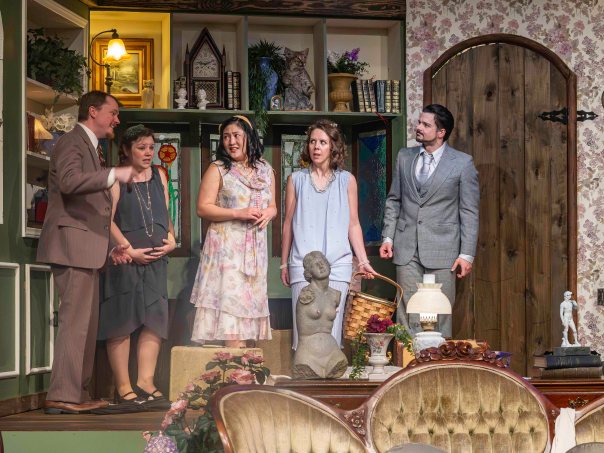
Davidson, NC – One of my late mother’s favorite Yiddish words, ongepotchket, sprang immediately to mind as soon as we walked into the Armour Street Theatre for the local premiere of Sandy Rustin’s The Cottage. Our first glimpses of Kate Baker’s scenic design had that unique tang. Gaudy. Cluttered. Colorful. Ornate. Massively overdone. Impossibly baroque.

That impression only magnified at the other end of the hallway when more of the rusticated clutter of this latest Davidson Community Players production came into view. It deepens further once the farce begins, for in addition to a stairway, two downstairs exits, and an upstage front door, Baker has crafted an invisible entrance that will eventually come into play – and cunning little crevices where Rustin’s characters, all but one of them acquainted with the cottage, will reach in and fob cigarettes.

It’s Monday, June 4, 1923, some 90 minutes from London by train, and this countryside retreat is the perfect place to be naughty. By the end of the show, I wasn’t sure whether half the budget was being frittered away on faux cigarettes.

Nor could I rid myself of the idea, driving home, that this cottage – which takes on a decisive cameo role in the denouement – was an apt metaphor for this whole amorous mismatched group of Brits.

We likely think at the outset that we should be emotionally invested in Beau, who is carrying out his yearly love orgy with Sylvia, his brother’s wife, and juggling multiple illicit affairs. We’re used to seeing such farces written by men, after all. But Rustin’s brand of farce has different beats, a conviction that women should get equal portions of the cake, and sympathies toward Sylvia, who is clearly getting the short end of the stick.
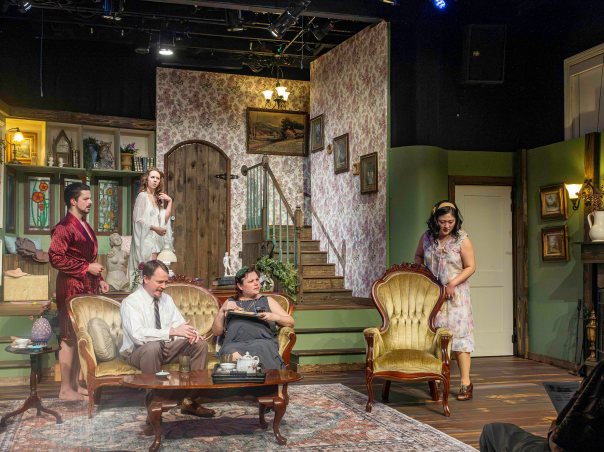
More than reversing our perspective, Rustin explores love: its levels, vacillations, and simultaneities. You may sour on a partner in her bucolic world, but it is not at all axiomatic that you transition to hating them. Throughout all the crossfire of who’s cheating on who, who’s been keeping secrets from who, who’s been wronged by who, and who’s underappreciated by who, none of the six characters rises to a moral high ground or plummets far below.

Except perhaps the monster in the group, who is arguably the most deceitful.

In a rather amazing coup for DCP, their Cottage is directed by Hanley Smith, who originated the role of Deirdre in 2013 at the Astoria PAC in Queens, NYC, before moving up to the triggering role of Sylvia at Florida Studio Theatre in Sarasota, four years ahead of the Broadway premiere in 2023. Not a far-flung coup, to be sure, since Smith is a Davidson College grad who starred in Actor’s Theatre of Charlotte’s production of The Vibrator Play in 2011.

So whether or not she has directed anywhere else before her DCP debut, Smith quickly establishes that she has a sure feel for this script. From the outset, Julia Howard’s performance as Sylvia was at least as extravagant as the scenery that surrounded her – and the sofa where she rehearsed her most alluring poses. This has been her one-time-a-year sex-capade, and it was obvious that she wasn’t planning for it to end, though Beau’s work week was set to begin.

No, no, no. Her plans, executed yesterday evening with a couple of telegrams, are to leave her husband Clark and marry Beau. Thoughtfully, the second wire was sent to Beau’s wife, Marjorie. Part of Sylvia’s kooky charm comes from her not being steadfast in her beliefs or resolutions – a trait that is contagious among Rustin’s creations – for she regrets sending her liberating telegrams as soon as she hears a loud knock on the front door.

Sylvia’s miscalculations will greatly increase Howard’s chances to shine, and still clad in her negligee, she’ll continue to stand out from the parade of visitors. As already hinted, Beau has been busier at the game of love than she anticipated. Ben Allen must merely be “Perhaps the best-looking man in Britain” to match the playwright’s description, so a certain amount of vanity must be coupled with his sexual rascality and his savoir-faire as a deceiver.

When Beau is celebrated repeatedly instead for the beauty of his flaming robe, should Allen act upset? Perhaps not, for Rustin consistently sets aside perfect moments, on the brink of upset or disturbance, for Beau to suggest a cigarette or a spot of tea. Good manners and posture were must-have accessories for Allen’s geniality in the early moments of this unpredictable morning at the cottage. On the spectrum of flappability, he seemed to be permanently perched at the opposite end from Sylvia.
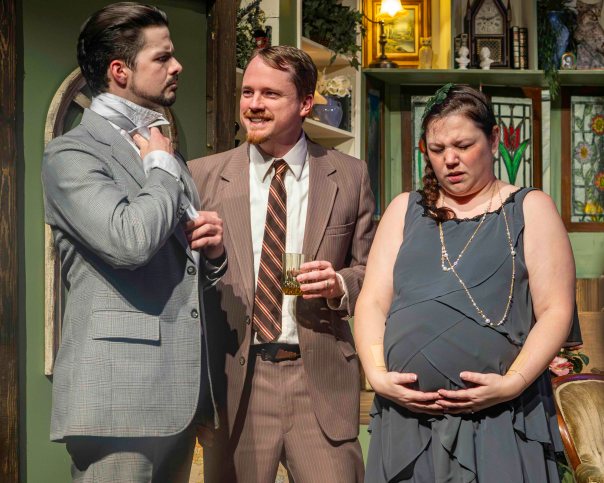
Until he opened the front door, first to his visibly pregnant wife Marjorie and then to brother Clark. Their suspicions have been eradicated by Sylvia’s batch of telegrams. So while it’s unseemly to disclose her hiding place before you see this farce, it’s also unnecessary for Beau to maintain his charade and keep her there.

Sadly, for Amanda Pippin as Marjorie and Andrew Pippin as Clark, neither had the histrionic opportunity to rev up to a towering jealous rage. They have a couple of surprises of their own to reveal. After Sylvia fully digests them, she’s probably correct in thinking that she has more right than Beau to be miffed. Regardless, it was so much fun watching Howard come to that realization and then watching Allen nearly catch up.

The Pippins neatly pull off the trick of being humdrum, wholesome, and deliciously wicked at the same time as their insouciance confounds their fellow adulterers. Nor are they the ones to be ruffled when, one after another, a third couple comes knocking at the door: Cate Jo as the déclassé Deirdre and Andrew Williams as the reputedly murderous Richard.

Like Marjorie, dear Deirdre will have good news and bad news. But nobody seems to react to any news at the cottage in the way the teller anticipates. Howard takes honors as the most thoroughly cheated person onstage as Sylvia, while Allen as Beau, the target of Richard’s wrath, takes cover like all the others. Jo makes for a loopy Deirdre, loopier after guzzling from a gin bottle, and hers turns out to be a rather physical role, what with all the hiding and staggering she must do in varying states of sobriety.
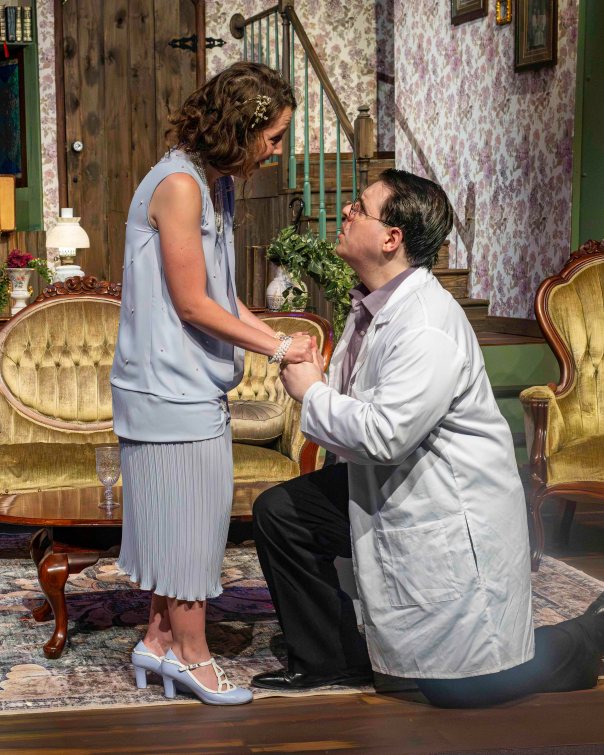
Williams, as Deirdre’s ex, has a past that’s as chequered as Deirdre’s, but all of that came since he and Sylvia last met many years ago. In everyday life, when not boasting of murdering Deirdre’s lovers, he passes for an everyday pharmacist, so the role offers a delicious range for Williams in spite of his late arrival.

To her credit, Sarah Deutsch’s costume designs are only slightly upstaged by the set. If you know who Stanley Baldwin was and his political affiliation, identifying the era of Rustin’s lively farce won’t be a formidable challenge. Otherwise, Hanley doesn’t orient us in either the printed or the digital program. The gorgeous Victrola must be your guide.

But only Rustin is to blame for Richard’s lame excuse for his false beard and mustache, so I’m not blaming anybody at DCP for making these disguises glaringly clumsy. Let the moment pass and richly enjoy the rest. This production is definitely worthy of its pedigree.

“Sister Mary Ignatius” Takes Dogma and Certitude to the Limit

Review: Sister Mary Ignatius Explains It All for You at CATCh

By Perry Tannenbaum

2023-04-20#015

For playwright Christopher Durang and now for the Queen City, Sister Mary Ignatius Explains It All for You has a special historical significance. When it premiered in 1979, Sister Mary was presented Off-Broadway in an evening of one-act plays that included works by Tennessee Williams, David Mamet, Marsha Norman, Romulus Linney, and Murray Schisgal – a pretty decent lineup.

Just that billing would have put Durang on the map. More distinctions swiftly followed: Not only was Durang’s satire proclaimed the best of that distinguished group, he and Elizabeth Franz (who would ultimately play the title role in three separate productions) won Obie Awards for that season.

While the Innovative Theatre production of 1989, directed by George Brown and starring Barbara Hird (of Lost Colony fame), may not have been a Charlotte premiere, it marked the auspicious debut of Brown’s company. Over the next five years, as actor/director wunderkind Alan Poindexter moved into the Innovative orbit, critically acclaimed productions gushed forth, including The Illuminati, The Chairs, Old Times, and The Search for Signs of Intelligent Life in the Universe. Innovative is also fondly recalled for its laugh riots at the legendary Pterodactyl Club, chiefly Psycho Beach Party and the imperishable Vampire Lesbians of Sodom.

Although Comedy Arts Theater of Charlotte or CATCh has been around since 2017, presenting standup and improv comedy most weekends at their South Boulevard location, Sister Mary Ignatius is their first foray into scripted live theatre. Perhaps it shouldn’t be that surprising that two Charlotte companies would begin with this same outrageous satire.

“The stage is fairly simple,” Durang has said. “There should be a lectern, a potted palm, a chair to the side for Sister to sit on.” Find a nun’s habit and a couple of Nativity play costumes – could be as simple as a bathrobe, a towel, and a couple of bedsheets – and your stage director can start thinking about holding auditions.

Kevin Shimko, a co-founder of CATCh with Abby Head, has been fitfully involved in the Charlotte theatre scene before – and with storefront theatre production. Interestingly enough, Shimko’s storefront outing at the former SouthEnd location of the Charlotte Art League was a semi-improv experience. Eight actors rehearsed all seven roles in Eat the Runt, and the audience decided who would play each of the unisex roles.

So none of the actors was sure he or she would go on! On the night we attended the performance on Camden Road, Shimko was the last actor selected, barely avoiding being left out. Among those preceding him in the casting that night were Andrea King and Jenn Grabenstetter, both of whom are on the Sister Mary team. King is in charge of lighting and sound while Grabenstetter as Diane Symonds, is the bitterest of Sister Mary’s former students, playing the virgin in the Christmas play.

The CATCh location off South Boulevard, visible only when you reach their parking lot, is more clubby than quaint. Beyond the lobby space, the theater within has black-box dimensions and ambiance comparable to the performing venues at the VAPA Center on Tryon Street. So Shimko goes a little high-tech at the outset. Instead of the simple pointer and easel that Durang envisioned Sister working with, Joanna Gerdy gets a retractable projection screen – one that opens and closes electronically via remote control – and she picks on a front-row audience member to help her extend a more business-like collapsible pointer to its full, slightly obscene length.Sister I

Shimko himself greets us in clergy robes and prepares us for Sister’s lecture. These added touches of formality and presentation polish make the childish simplicities of the first two projected slides and Sister’s remarks about them all the more surprising. First slide, world: Earth, sun, and moon. Second slide, universe: Heaven, Purgatory, and Hell. From these simplicities, we plunge into the incomprehensible absurdity of Limbo, where unbaptized babies were sent before Vatican 2 and Pope John XXIII.

Like the Earth and moon, all that follows from Sister Mary is to be accepted as fact, not merely belief. This is Catholicism, boys, and girls, so theory and uncertainty have no place here. To underscore this point, Gerdy introduces us with twinkling pride to Thomas, Sister’s prize seven-year-old student. With a curly head of hair you could easily mistake for a wig, Sydney Kai Qualls will not so easily be mistaken for seven, particularly when Gerdy braces herself in inviting him to sit on her lap.

Thomas is Sister Mary’s echo chamber, acolyte, and mouthpiece. He’ll bring Sister water on command, and Sister will reward him with little cookies when he answers her questions correctly – as he invariably does. Correct may not adequately describe the precision of Thomas’s answers, which emerge from Qualls as three-quarters angelic, one-quarter robotic, with a bit of space given over to beaming teacher’s-pet pride.

More Q&A format follows as Gerdy picks up a little wicker basket that Shimko has left near the lectern, with little index cards supposedly containing personal and religious questions submitted by the audience. Gerdy’s answers have a smug cordiality to them, curt in matters of Jesus and nuns, a bit more spontaneous when asked about Sister’s family, yet somehow always rigidly doctrinaire. If she has no answer to a question, she calmly goes on to the next. If you ask her about Sodom, she will get a bit upset.

While Hird was ever-insouciant and imperious as Sister Mary, Gerdy gives her more latitude, allowing some slippage in her equipoise and then regaining it. Things will gradually change as four of Sister’s former students from her 1959 class, all adults now, come in without any introduction, to perform the same Christmas pageant they performed annually when they were classmates. The pageant’s Joseph recalls that the script was written in 1948 by one of Mary’s star pupils.Sister

It’s amazing how much of what we’ve heard earlier in Sister’s lecturing is recycled into the pageant of Jesus’s birth, crucifixion, and resurrection. Just as Sister can’t remember for sure whether she actually invited these former students, we can’t be sure how Sister’s quirky pronouncements made their way into the pageant. They could have been part of the 1948 script and approved by Sister Mary, or they could have been inserted by former students when they reviewed and rehearsed their old routine. Or maybe they just now overheard Sister’s bromides as they lurked in the shadows, waiting to appear, and decided to repeat them.

Regardless of how – or when – Sister’s quirky gospel was intermixed with the traditional story, we may wonder why. Either these passages are heartfelt tributes to the ordained teacher or irreverent mockery.

After witnessing all of Gerdy’s fulsome dogma and certitude, all of Thomas’s recitations (he’s so well-trained that he can answer a handful of Sister’s index-card queries so she can take a catnap), you will likely find these outbreaks of ambiguity refreshing. Surely they are forebodings of more insane comedy or a flip to drama. Or both.

When the darling little pageant wraps up, Sister begins to learn about her former students. One of 26 children herself, Mary begins with a progeny count. It’s not promising: children barely outnumber abortions.

Matthias Burrell as Gary Sullivan quickly becomes the pageant emcee, wearing a terry cloth robe to introduce the story before becoming St. Joseph. Having heard Sister’s thoughts on Sodom earlier in the evening – and likely many times before – Gary will be hesitant about explaining why he isn’t married. He has had the most benign memories of Sister Mary until now, merely scared of her.Sister

Durang may have intended all the bygone abuse of the other three 1959 seminary grads as a comical exaggeration when he penned his 1979 satire. He certainly doesn’t insist, in his 1995 intro to Sister Mary, that the prevalence of abuse at Catholic schools hinted at here is simply based on fact or his own Catholic upbringing. So a little of the sharp satiric impact that hit me when I first saw Sister in 1989 has been dulled by subsequent scandals and revelations.

Cate Jo as Philomela Rostovich and Joe Watson as Aloysius Benheim are the front and rear ends, respectively, of Misty, Joseph and Mary’s talking camel. Philomela remembers being banged around a bit, worse than Diane (the Virgin Mary) was, but we quickly sense that Sister Mary was crueler by far to Aloysius. With two children, Sister can readily forgive Aloysius’s shortcomings, which are no worse than wife-beating.

Grabenstetter gets the best supporting role as Diane. After sharing the pageant narrative with Burrell, Grabenstetter draws the only truly lengthy and impactful monologue aside from Gerdy as she catalogs the torments of her life. It rather sticks out because it’s not part of the pageant script and breaks free of Sister’s ensuing interrogation. Going overboard in blaming Sister for all her life’s mishaps, Grabenstetter triggers the unpredictable denouement.

All of the absurdity and mayhem, Gerdy assures us with sacramental calmness, accords perfectly with Vatican teachings and logic, which makes it all the more delicious.

One last historical footnote: after the second successful Off-Broadway run of Sister Mary in 1982, a small St. Louis company planned to stage Durang’s play at the Mayfair Hotel in January 1983. The local chapter of the Catholic League for Religious and Civil Rights made enough of a fuss, asserting that the play was anti-Catholic, that the St. Louis Archbishop got involved and the hotel withdrew their hospitality.

When Washington University and the University of Missouri offered to host the play, the state senate became involved, threatening funding repercussions. Two daily newspapers in St. Loo took opposite sides in the controversy. The brouhaha received national attention, including spots on CBS Sunday Morning, Phil Donohue, and Entertainment Tonight. Defunding threatened against the universities never happened. The little professional outfit that staged Sister, Theatre Project Company, felt the full financial consequences.

If that sounds a bit parallel to Angels in America and Charlotte Repertory Theatre, listen up. Theatre Project bit the dust in 1991, eight years after they succeeded in staging Sister Mary, just like Rep, which folded in 2003, eight years after Angels.

So belatedly, Charlotte can take a couple of bows. Between the St. Louis dust-up – followed by a string of Sister Mary controversies in Boston, Detroit, Erie, and Coral Gables – and our own Angels humiliation, George Brown and Innovative Theatre opened up Sister Mary in our Uptown without a murmur of protest. And now, Kevin Shimko and CATCh have followed suit. In fine style.