Review: The Cottage at Armour Street Theatre
By Perry Tannenbaum
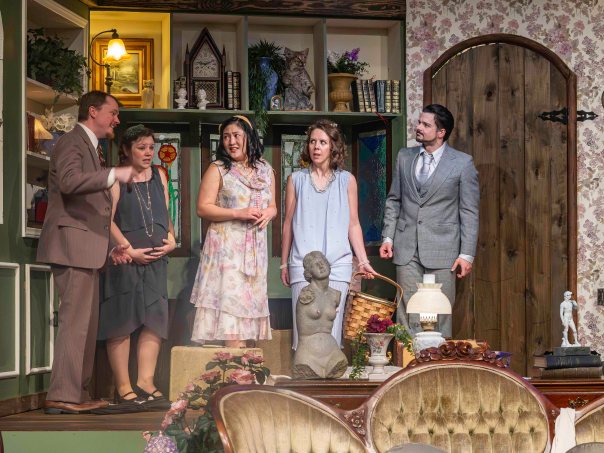
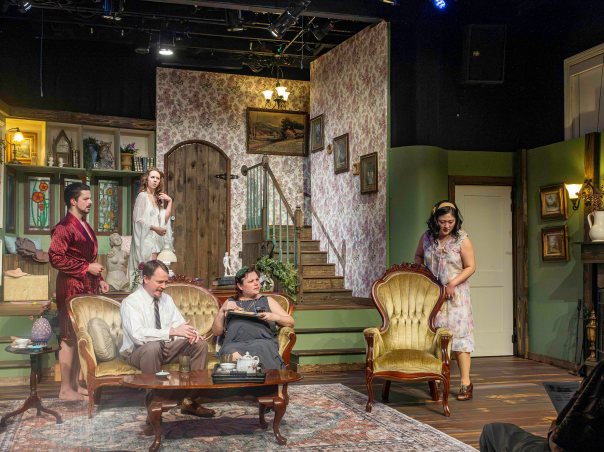
Davidson, NC – One of my late mother’s favorite Yiddish words, ongepotchket, sprang immediately to mind as soon as we walked into the Armour Street Theatre for the local premiere of Sandy Rustin’s The Cottage. Our first glimpses of Kate Baker’s scenic design had that unique tang. Gaudy. Cluttered. Colorful. Ornate. Massively overdone. Impossibly baroque.
That impression only magnified at the other end of the hallway when more of the rusticated clutter of this latest Davidson Community Players production came into view. It deepens further once the farce begins, for in addition to a stairway, two downstairs exits, and an upstage front door, Baker has crafted an invisible entrance that will eventually come into play – and cunning little crevices where Rustin’s characters, all but one of them acquainted with the cottage, will reach in and fob cigarettes.
It’s Monday, June 4, 1923, some 90 minutes from London by train, and this countryside retreat is the perfect place to be naughty. By the end of the show, I wasn’t sure whether half the budget was being frittered away on faux cigarettes.
Nor could I rid myself of the idea, driving home, that this cottage – which takes on a decisive cameo role in the denouement – was an apt metaphor for this whole amorous mismatched group of Brits.
We likely think at the outset that we should be emotionally invested in Beau, who is carrying out his yearly love orgy with Sylvia, his brother’s wife, and juggling multiple illicit affairs. We’re used to seeing such farces written by men, after all. But Rustin’s brand of farce has different beats, a conviction that women should get equal portions of the cake, and sympathies toward Sylvia, who is clearly getting the short end of the stick.
More than reversing our perspective, Rustin explores love: its levels, vacillations, and simultaneities. You may sour on a partner in her bucolic world, but it is not at all axiomatic that you transition to hating them. Throughout all the crossfire of who’s cheating on who, who’s been keeping secrets from who, who’s been wronged by who, and who’s underappreciated by who, none of the six characters rises to a moral high ground or plummets far below.
Except perhaps the monster in the group, who is arguably the most deceitful.
In a rather amazing coup for DCP, their Cottage is directed by Hanley Smith, who originated the role of Deirdre in 2013 at the Astoria PAC in Queens, NYC, before moving up to the triggering role of Sylvia at Florida Studio Theatre in Sarasota, four years ahead of the Broadway premiere in 2023. Not a far-flung coup, to be sure, since Smith is a Davidson College grad who starred in Actor’s Theatre of Charlotte’s production of The Vibrator Play in 2011.
So whether or not she has directed anywhere else before her DCP debut, Smith quickly establishes that she has a sure feel for this script. From the outset, Julia Howard’s performance as Sylvia was at least as extravagant as the scenery that surrounded her – and the sofa where she rehearsed her most alluring poses. This has been her one-time-a-year sex-capade, and it was obvious that she wasn’t planning for it to end, though Beau’s work week was set to begin.
No, no, no. Her plans, executed yesterday evening with a couple of telegrams, are to leave her husband Clark and marry Beau. Thoughtfully, the second wire was sent to Beau’s wife, Marjorie. Part of Sylvia’s kooky charm comes from her not being steadfast in her beliefs or resolutions – a trait that is contagious among Rustin’s creations – for she regrets sending her liberating telegrams as soon as she hears a loud knock on the front door.
Sylvia’s miscalculations will greatly increase Howard’s chances to shine, and still clad in her negligee, she’ll continue to stand out from the parade of visitors. As already hinted, Beau has been busier at the game of love than she anticipated. Ben Allen must merely be “Perhaps the best-looking man in Britain” to match the playwright’s description, so a certain amount of vanity must be coupled with his sexual rascality and his savoir-faire as a deceiver.
When Beau is celebrated repeatedly instead for the beauty of his flaming robe, should Allen act upset? Perhaps not, for Rustin consistently sets aside perfect moments, on the brink of upset or disturbance, for Beau to suggest a cigarette or a spot of tea. Good manners and posture were must-have accessories for Allen’s geniality in the early moments of this unpredictable morning at the cottage. On the spectrum of flappability, he seemed to be permanently perched at the opposite end from Sylvia.
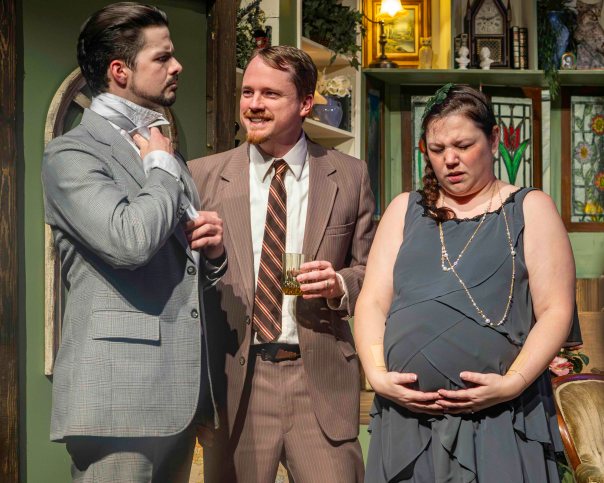
Until he opened the front door, first to his visibly pregnant wife Marjorie and then to brother Clark. Their suspicions have been eradicated by Sylvia’s batch of telegrams. So while it’s unseemly to disclose her hiding place before you see this farce, it’s also unnecessary for Beau to maintain his charade and keep her there.
Sadly, for Amanda Pippin as Marjorie and Andrew Pippin as Clark, neither had the histrionic opportunity to rev up to a towering jealous rage. They have a couple of surprises of their own to reveal. After Sylvia fully digests them, she’s probably correct in thinking that she has more right than Beau to be miffed. Regardless, it was so much fun watching Howard come to that realization and then watching Allen nearly catch up.
The Pippins neatly pull off the trick of being humdrum, wholesome, and deliciously wicked at the same time as their insouciance confounds their fellow adulterers. Nor are they the ones to be ruffled when, one after another, a third couple comes knocking at the door: Cate Jo as the déclassé Deirdre and Andrew Williams as the reputedly murderous Richard.
Like Marjorie, dear Deirdre will have good news and bad news. But nobody seems to react to any news at the cottage in the way the teller anticipates. Howard takes honors as the most thoroughly cheated person onstage as Sylvia, while Allen as Beau, the target of Richard’s wrath, takes cover like all the others. Jo makes for a loopy Deirdre, loopier after guzzling from a gin bottle, and hers turns out to be a rather physical role, what with all the hiding and staggering she must do in varying states of sobriety.
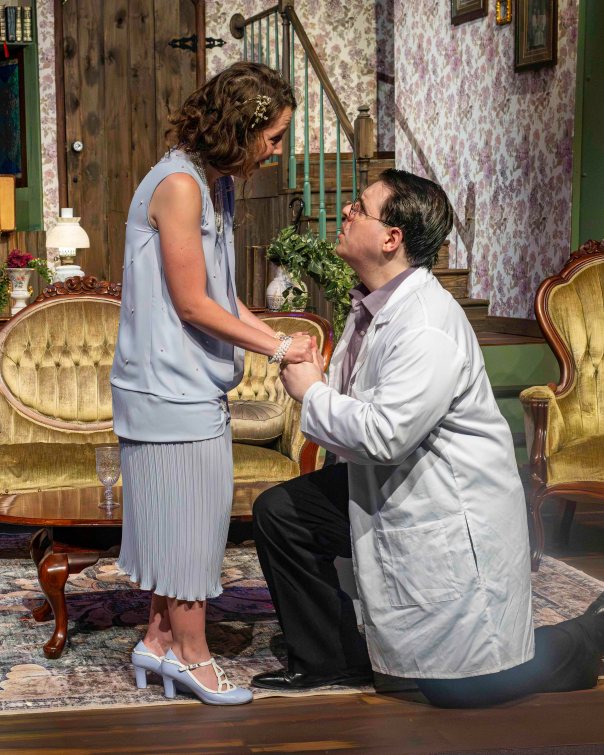
Williams, as Deirdre’s ex, has a past that’s as chequered as Deirdre’s, but all of that came since he and Sylvia last met many years ago. In everyday life, when not boasting of murdering Deirdre’s lovers, he passes for an everyday pharmacist, so the role offers a delicious range for Williams in spite of his late arrival.
To her credit, Sarah Deutsch’s costume designs are only slightly upstaged by the set. If you know who Stanley Baldwin was and his political affiliation, identifying the era of Rustin’s lively farce won’t be a formidable challenge. Otherwise, Hanley doesn’t orient us in either the printed or the digital program. The gorgeous Victrola must be your guide.
But only Rustin is to blame for Richard’s lame excuse for his false beard and mustache, so I’m not blaming anybody at DCP for making these disguises glaringly clumsy. Let the moment pass and richly enjoy the rest. This production is definitely worthy of its pedigree.