Tag Archives: Oliver Oguma

“Flip” Is Charlotte Ballet’s New Lab and Launching Pad

By Perry Tannenbaum

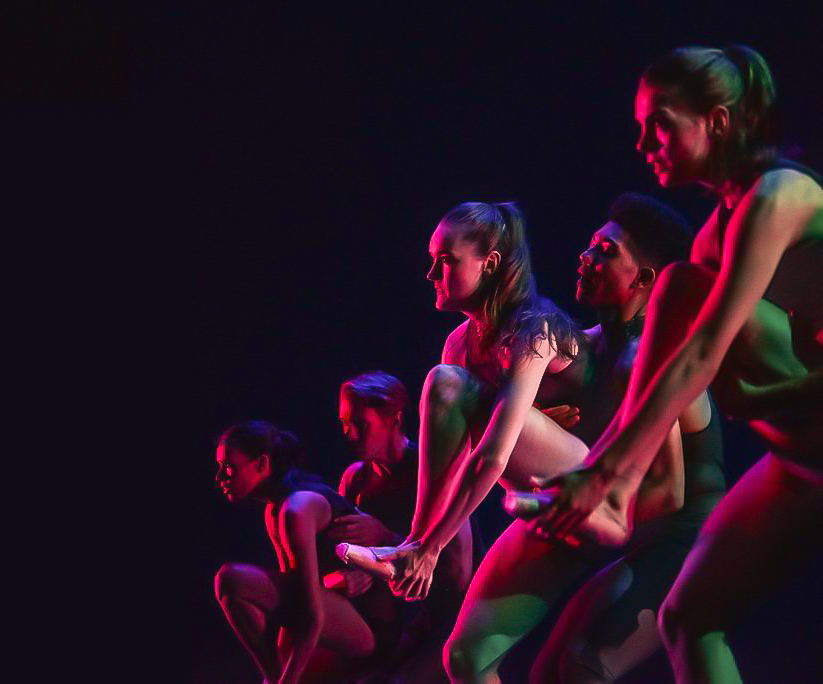
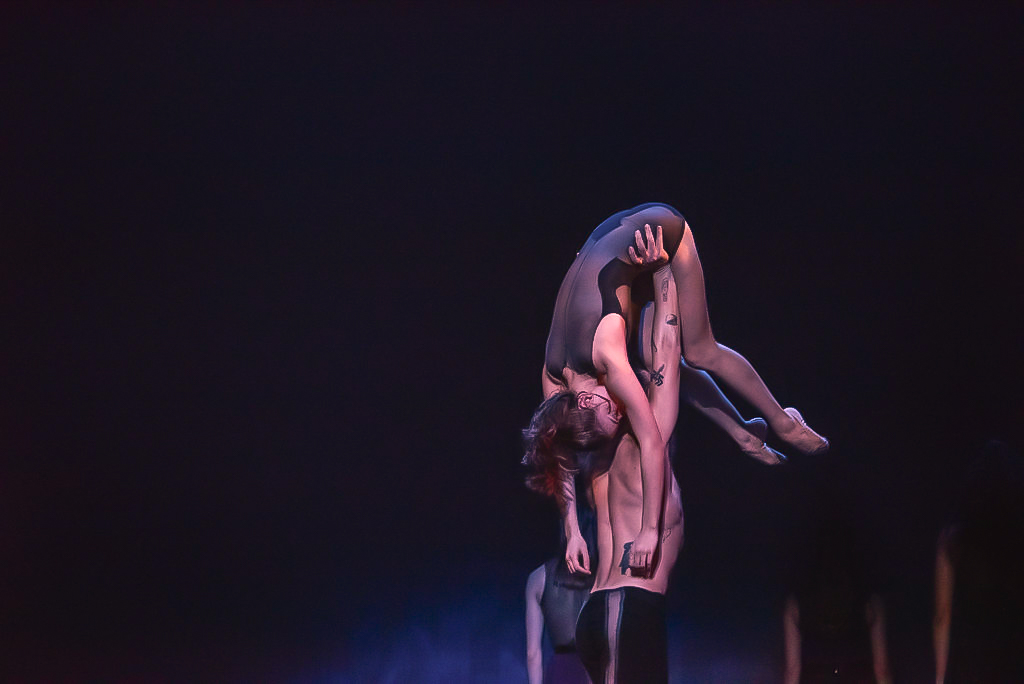
Whenever you see a Charlotte Ballet performance at Knight Theater or the mighty Belk, you’re going to see talent, grace, athleticism, imagination, and dancers in abundance. At the McBride-Bonnefoux Center for Dance, however, only the first three of those wondrous plenitudes are guaranteed. Formality is loosened. Scale is often reduced. And over the past few years, Charlotte Ballet’s season has concluded with evenings of homegrown choreographies by members of the troupe, many of them new to the art.

The title of these venturous, experimental evenings has evolved from Choreographic Lab, when Hope Muir established them in 2018, to the current Flip – as in flipping the script – when Alejandro Cerrudo took over as artistic director. Moving from the big venues to the double-studio layout of the McBride-Bonnefoux, one studio accommodating the audience and the adjacent studio (partition opened) serving as the dancers’ stage, you feel like you’ve abandoned Broadway for a black box.

But without sacrificing the swank factor: the façade and lobby of the Center for Dance are more like a modern museum than a ballet school. So there’s an elegant patina layered onto the funky ambiance of briefer, smaller budget pieces, often reduced to solo performances or pas-de-deuxs. You might expect two or three pieces at most before an intermission at the Knight or Belk Theater. This year at Flip, there were nine, with five more in the lineup after the break.

So you can conclude that, among the 20 dancers in the Charlotte Ballet troupe, 70% can now affix the profession of choreographer to their résumés. Not quite. At this year’s Flip, members of the secondary Charlotte Ballet II troupe also participated in performing and choreographing the program. Six of the eight CB2 members profiled at the charlotteballet.org website danced in the program, with David Anthony Scheuerman-Saucedo also among the choreographers.

What happens behind the scenes must be a fascinating process, as the dancers choreograph for their comrades, teaming up by preference, negotiation, or random assignment. Two lighting designers, Jenni Propst and Rick Moll, split the 14 pieces between them, another negotiation or lottery.

Normally, two solo dances would be two too many for me. But at Flip, Raven Barkley’s “Groove” and Clay Houston’s “Nuit tombante” both transcended the norm. Set to Jackie Wilson’s cover of “(Your Love Keeps Lifting Me) Higher & Higher,” Barkley’s choreography put little demand on her athleticism and was hardly unique. She was: lithe and charismatic in a vivid red dress.
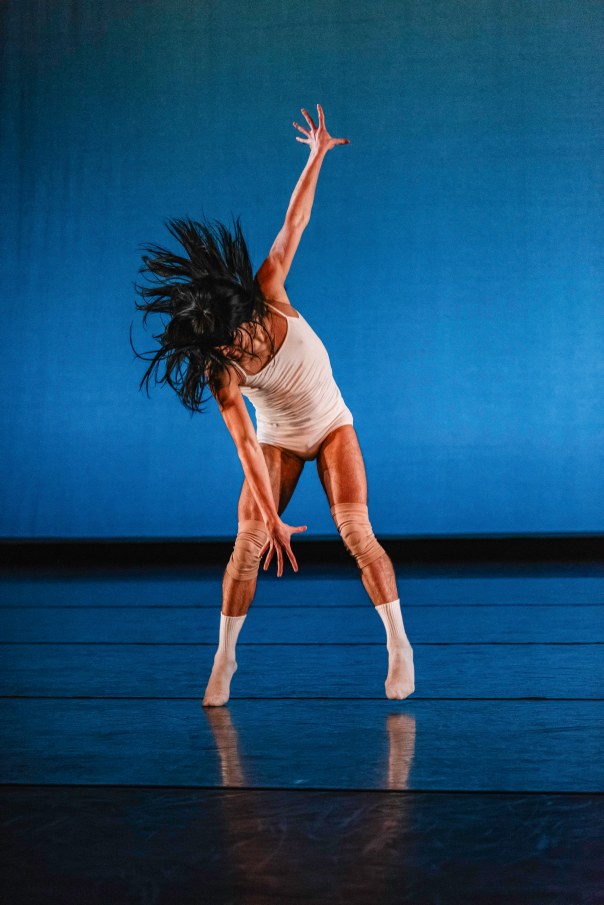
In a sense, Houston’s piece wasn’t a solo at all. When night fell, he not only switched soundtracks, he also switched genders, discarding a wig and assorted paraphernalia and becoming more himself. At first, the transformation hit me as surprising and comical, but the mood – and the choreography – deepened and became touching.

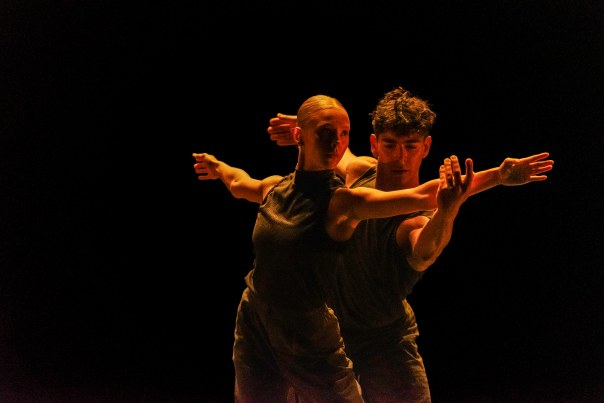
Between these two solos, two of the best duets were programmed: Anna Owens’ “That’s all” and Adriana Wagenveld’s “Tethered.” Owens’ piece, set to a couple of non-Tiny Tim versions of “Tip Toe Thru the Tulips,” actually offered a rather comical reason for all the tiptoeing. At the climax, Owens in the female role gets Oliver Oguma to assist her in reaching a tulip that dangles temptingly from above. That’s when the “That’s all” came into play, as Owens departed instantly afterwards, without according Oguma the thanks he deserved.

Oguma, in the comical spirit of the music, looked more bewildered than pissed by the brush-off.
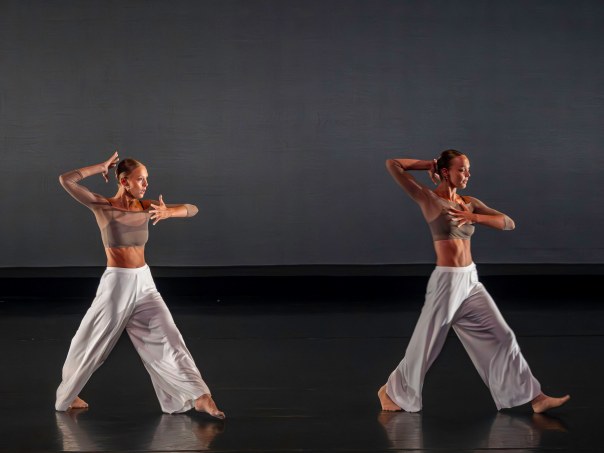
Wagenveld spliced two favorite Sebastian Plano tracks together for her soundtrack, recruiting her sister from CB2, Serafina Wagenveld, to join her in the project. Fortunately, Adriana’s tethering concept isn’t carried out literally. Though neither of their bios suggests that the siblings are twins, the matching costumes for the piece only encouraged that conjecture.

At times, Plano’s minimalist style seemed mated with the Wagenvelds’ walk-like-an-Egyptian grace and their stolid serenity. The sisters’ intertwinings, beautifully timed and carefully composed, might also take on a hieroglyphic look. Their costumes were sleek and timeless, sheer taupe tops with tight half-sleeves – think nylons – over flowing white slacks.

Two other duets stood out for me. Rees Launer’s “Kinetikos” was appropriately pulsating and percussive in opening the evening, set to a mashup of a couple of Aphex Twin tracks for Scheuerman-Saucedo and Serafina Wagenveld, growing more lyrical and nostalgic when the music transitioned to an Emile Mosseri piece. Most unique of all, perhaps, was Isaac Aoki’s “Topaz,” set for himself and Remi Okamoto to Mark Izu’s “Mermaid in a Silent Sea.”
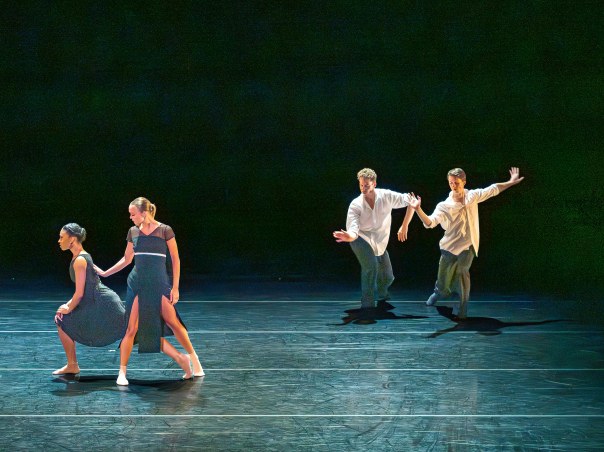
With Aoki’s videography, we were taken more explicitly to desert lands in “Topaz” than we were by “Tethered.” The torrid climate fit hauntingly with the plodding tempo of the music, caravan-like when the whining Japanese shakuhachi dominated. Or the flute. Or the bass clarinet. The loneliness of the dark-clad Asians contrasted starkly with the sun-drenched hilly terrain, justifying that whining sound. Unlike “Tethered,” there was little connection at first between the two dancers. The piece was the antithesis of festive – until the tabla began to bubble underneath, gradually emerging and quickening the pace.

Of the remaining pieces, I found that the love-triangle narrative shape of Scheuerman-Saucedo’s “you and me and me and you” overcame my misgivings about listening to yet another setting to Jules Massenet’s “Meditation from Thaïs.” Although Part 1 of Mario Gonzalez’ “Fever Dream” struck me as a generic piece for four dancers, never once reminding me of Geppetto’s search for Pinocchio (let alone “Chapter 35”), Part 2, “25%,” enabled Stephen Myers to deliver one of the most vivacious solos of the evening, set to “Orchestra” by Labrinth.

Both his costume and charisma rivaled Raven’s. Nor was “Chapter 35” a waste, for it prodded me to investigate the insane “Big Hammer” video by James Blake. A cinematic masterwork!

You may disagree, but discovering new music is a key part of the adventure that Charlotte Ballet’s labs or Flips has to offer me. That was not the case with the closing offering of the evening, Maurice Mouzon Jr.’s “Ne Me Quitte Pas,” set to the Nina Simone recording. It’s been done before – and before that.

Mouzon’s setting, for four dancers, doesn’t stop at the threat of separation. It crosses over into the agony of it when it happens. So two couples is the right choreographic choice, for Mouzon allows ample opportunities for the two women, Barkley and Adriana Wagenveld, and the two men, Launer and Luke Csordas, to suffer and commiserate with one another in alternating segments.

Nor does Mouzon send the women off, an annoying choreographic tic, when the spotlight shifts to the men. Instead, he freezes them in a sad attitude while Moll dims their light. Why should they be out of sight if they’re not out of mind? Since the Simone track peters out in pitiful pleas, seemingly repeated after being irrevocably denied, Mouzon can only offer us a wan hope of reconciliation.
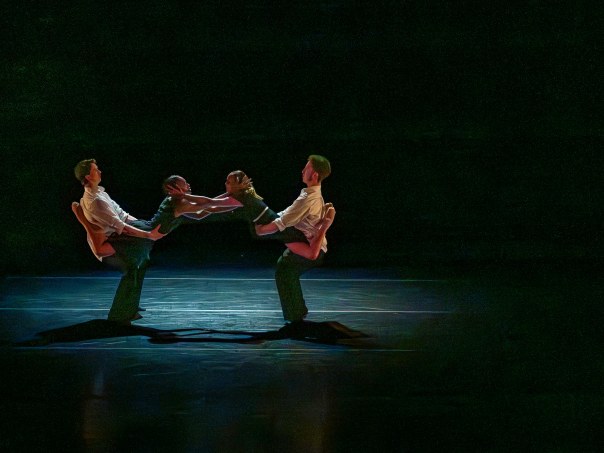
Hugged from the rear by their partners, their legs bent and suspended in air, Barkley and Wagenveld reached across the void between them and embraced with their arms fully extended, forming a poignant bridge. What a wonderful closing tableau.

Newsflash: Printedprograms for Flip and Charlotte Ballet’s previous show, One Thousand Pieces back in early May, contained announcements of the company’s 2026-27 season and a slate of touring engagements, an exciting new dimension for the troupe. A couple of new developments since Flip concluded its run on June 20.

The company has already appeared at the American Dance Festival in Durham for the first time since 2017, bringing with them a work by Israeli choreographer Ohad Naharin once again later in June. Then, less than a week ago, they fulfilled their promise to add to their announced touring dates.

Newly augmented, here’s the slate:

  • Sept. 25-26, 2026: Ballet Bend – Fall Dance Festival (Bend, OR)
  • Oct. 29-30, 2026: Brooks Center for the Performing Arts at Clemson University (Clemson, SC)
  • Nov. 7, 2026: Dance Cleveland (Cleveland, OH)
  • Jan. 27-31, 2027: The Joyce Theater (New York, NY)

The 2027 rendezvous at The Joyce Theater will be the first time Cerrudo has brought them there during his tenure. Jean-Pierre Bonnefoux, who died in the spring of 2025 at age 82, was still the artistic director when the company last wowed New York audiences at The Joyce in 2004. Ten years later, he would rebrand his troupe, but back then, they were known as the North Carolina Dance Theatre.

Breathtaking Perfection Makes Charlotte Ballet’s “Swan Lake” Premiere a Dazzler

Review: Swan Lake at Knight Theater

By Perry Tannenbaum

May 3, 2024, Charlotte, NC – For generations, budding ballerinas around the globe have aspired to be a member of the gaggle who dance to the primeval strains of Pyotr Ilyich Tchaikovsky’s Swan Lake. The best of them dare to dream of dancing the roles of Odette, Queen of the Swans, and her evil, seductive doppelganger, Odile. Yet more than 50 years elapsed in the life of Charlotte Ballet before the company brought Odile, Odette, and Swan Lake to the Queen City. To many, including millions of those budding ballerinas, Swan Lake and ballet are synonymous. So in a town that has a reputation of resisting the new and clinging blindly to proven classics, you have to wonder why this premiere – a quite glorious one at Knight Theater – has taken so long to happen.

Although scenery, costumes, and props are on loan from the ballet troupes of Cincinnati, Arizona, and Atlanta, the mélange is quite impressive. Choreography by Ib Anderson, based on the definitive 1895 overhaul by Marius Petipa and Lev Ivanov, and the work of CharBallet dancers, Charlotte Ballet II, members of the pre-professional program, and students of the Ballet Academy are more than enough to stamp this marvel as homegrown. Extra freshness and vivacity rose from the orchestra pit as the Charlotte Symphony, directed by Gavriel Heine, performed the full score for the first time – with the ardor of an orchestra that has been waiting over 90 years for a living, breathing ballet corps to partner with on this mammoth venture.

Those little-girl aspirations are freshly recalled by the glittery merch in the Knight lobby, so the anticipation in the audience before curtain-rise was akin to the excitement that greets the CharBallet-Symphony collaboration each December as Belk Theater fills up for The Nutcracker. Even after opening night, you are at a special event. While the Cincinnati scenery can be improved upon (rather easily, I’m afraid); especially in and around Prince Siegfried’s castle; the courtiers, the servers, and the ladies in waiting regally create a teeming spectacle that fulfills expectations in Act 1. Oliver Oguma, the first of three leading men who will rotate during the 12-performance run, is a soulful Prince Siegfried with a bonus of brawn. Some heavy lifting lies ahead, but before lifting Odile up high Oguma had to be able to shine solo in the opening scene, where he basically rejects every eligible maid in the kingdom. The Queen Mother is royally chagrined – a triumphant comeback for Ayisha McMillan Cravotta, more beautiful than ever.

Anderson discreetly subtracts some courtiers from the Petipa scenario, but there’s enough dazzle remaining for them not to be terribly missed. The dozen courtiers beguile us in varying configurations, and the pas de trois sequence with Bridget Fox, Humberto Ramazzina, and Samantha Riester is endearing elegance and charm. Dancing the Page’s solos, Academy student Russell Abel struck me as a prodigy, able to leap and land squarely on the beat. Yet as the act climaxed, viewers who are accustomed to seeing Prince Siegfried flanked by noble chums might feel that Oguma gradually becomes excessively forlorn in spite of all his solo exploits.

Yet it’s justified to view the sparsity of plot and companionship in the opening scene as a perfect way to magnify the éclat of Act 2, where the evil sorcerer Von Rothbart and his enchanted flock finally take the stage – a bevy of 24 Cygnets and Swans plus one sublime Queen. You might even be tempted to laugh at the triteness of the choreography that precedes Odette’s first entrance – until you realize that Ivanov and Swan Lake likely fashioned the familiar template that Hollywood, Broadway, TV, and Vegas have turned to ever after in innumerable dancing build-ups to the entrances of their stars. James Kopecky, in a spectacularly hideous bird costume of his own – with poles to extend his wingspan – is magnificently malign in his various poses and flourishes, adding magic and menace to the big moment.

Evelyn Robinson was more than equal to it. She was divine perfection: fearlessness, symmetry, balance, musicality, and supple flow were all absolute to an inhuman degree. Only the little expressive flutters of her head and face subtly reassured us that a tortured soul hovered above her pluperfect point work. Later, when Robinson invaded Prince Siegfried’s surprisingly drab ballroom as Odile, you kind of wondered whether she would dramatically vary or eclipse what has gone before. Seemingly responding to more spellbinding sorcerer gestures from Kopecky, a bit like a taunting pro wrestling baddie in his taunts, Robinson softened ever so slightly. Her seductiveness trickled naturally from her added liquidity, and her expressions became more worldly and knowing, like a Vogue supermodel shoot. Or Melania.

In sum, Robinson was all I could hope for and occasionally more. But the swans! I hadn’t even begun to imagine what they can be in live performance. Whether it was the composer’s masterstroke in the original 1877 score premiered by the Bolshoi or the brainchild of ballet specialist Riccardo Drigo, who revised the score for its successful 1895 resuscitation in St. Petersburg, the music hushes so much that the en pointe work of flock is clearly audible – not only audible but a chief element of the music’s fluttery percussion. Over the course of the 2 hour 17 minute epic, it wasn’t only principal harpist Andrea Mumm who excelled. Concertmaster Calin Ovidiu Lupanu came to the fore with some fine solo work in Act 3 and acting principal oboist Erica Cice was gold all evening long on the haunting big tune.

What floored me most, after watching Charlotte Ballet ever since it arrived here (from Winston-Salem) as North Carolina Dance Theatre in 1990, was the unprecedented synchronicity of this bevy of fluttering Swans. For decades, the individuality of each NC or Charlotte dancer was the company’s trademark. Let Miami and what’s-his-name do synchronicity! Yet here in an instant, the phenomenon of a perfectly calibrated ensemble of 24 women, dancing on point to the same heartbeat, had arrived in Charlotte, North Carolina. It was eerie and breathtaking. Historic.

Will CharBallet fully possess Swan Lake in the future with their own scenery, props, and costumes? Hope so. This is one you’ll want to see again.

Cerrudo Revives Innovative Works With Fresh Excitement

Review: Innovative Works at Center for Dance

By Perry Tannenbaum

The Deatils Are the Meaning by Helen Simoneau - full cast - photo by Taylor Jones Charlotte Ballet’s reveal wasn’t as dramatic as the recent return of the renovated Old Barn on Queens Road with a full-fledged Theatre Charlotte musical. But after the COVID shutdowns, postponements and cancellations, and the abrupt departure of artistic director Hope Muir after barely five years – the last two during the pandemic – it was hard to feel that Charlotte Ballet was all the way back until last weekend. Until we had seen some choreography by the new AD, Alejandro Cerrudo. Extra frustrating for me, since I had declared his work a perfect fit for CharBallet when I had first seen it at Spoleto Festival USA in 2014, had been the absence of his imprint on the Fall Works program at Knight Theater last October.

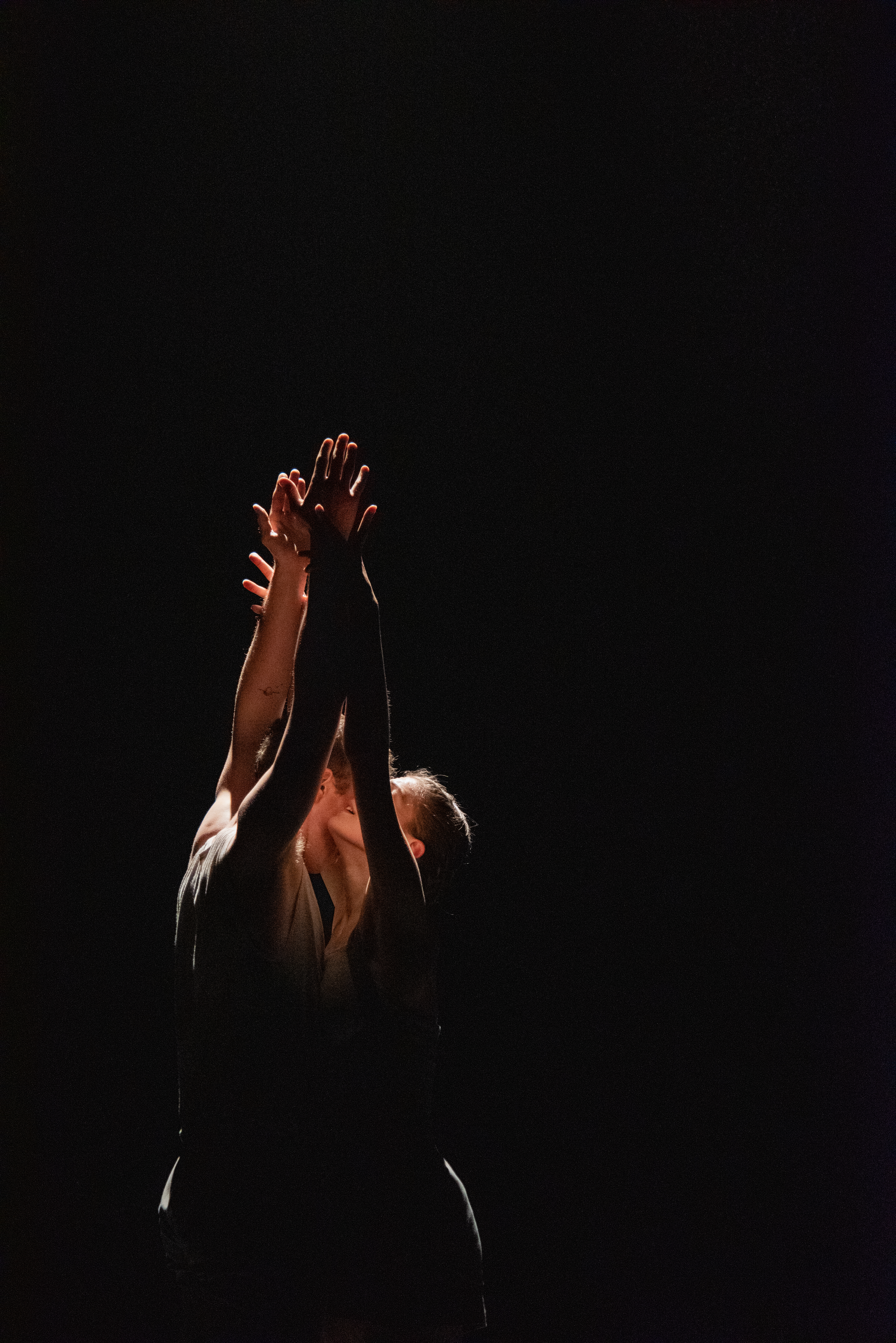
With Cerrudo now hosting the annual Innovative Works wintertime program, contributing a fine piece that crowns an invigorating evening at the McBride-Bonnefoux Center for Dance, we can let it all seep in. A new era has emphatically begun at the Center for Dance, with a new AD starting to reshape the company’s identity, working with a mix of familiar dancers, new dancers, and dancers who have matriculated to the varsity through the satellite Charlotte Ballet II troupe.

The state of Charlotte Ballet, to coin a phrase, is strong.HdrM by Jennifer Archibald - Olivr Oguma and Amelia Sturt-Dilley - photo by Taylor Jones

Jennifer Archibald’s vowel-starved HdrM and Helen Simoneau’s The Details Are the Meaning, both world premieres, preceded Cerrudo’s no-less-cryptic Silent Ghost. Silence was a subtle motif: It’s been awhile since Charlotte Ballet presented an entire evening of dance works that were devoid of storyline, song lyrics, or voiceovers. Taking on the hosting chores, Cerrudo recalled his takeaway from the first time he squired his daughter to a set of modern dance pieces. Comprehension was no problem at all, as it turned out. Just let it seep in was the core of his message.

On this occasion, anyway, Cerrudo discarded the introductory videos that have enhanced the studio ambience at past Center for Dance programs, where the evening’s choreographers, projected on screens flanking the audience, would talk about their works before we saw them, or dancers would give us their insights. Instead of those slick videos – all three “Behind the Ballet” videos are available at Charlotte Ballet’s website – we contented ourselves with Cerrudo’s remarks and a strange, mysterious welcome from CharBallet dancer Maurice Mouzon Jr. in a flowing black costume. Three quarters bacchante conjuration and one quarter airline steward pantomime, the conjuration was so absorbing that I really didn’t pay attention to the voiceover until Mouzon pointed out the exits to us.

That shtick was another great ice breaker, arguably the most amusing of the night.HdrM by Jennifer Archibald - Nadine Barton and Oliver Oguma - by Taylor Jones (1)

Like the other dances that followed, HdrM didn’t readily disclose its intentions, but Archibald offers a couple of useful hints in our program booklets. Her subject is environmental psychology, questioning whether society has a responsibility to humanize architecture. What the choreography takes aim at is “hard architecture,” as explored in Robert Sommer’s Tight Spaces: Hard Architecture and How to Humanize It (1974). Since there is no scenery with the fledgling piece, nor any projections, we can decide among several kinds of hard architecture that Sommer was concerned with: prisons, classrooms, asylums, hospitals, or zoos.

Kerri Martinson’s drab costumes seem to narrow that field to secure buildings for human adults, with no further clues provided by the music of Federico Albanese, Ludwig Ronquist, and Heilung. What I found most enjoyable here was Archibald’s struggling, yet never agonized, language of movement – a mixture of sensual interaction between the eight dancers and self-absorbed precision. Likewise, there were episodes when the dancers connected intimately with the flow of the music, interrupted by abrupt mechanical disconnects from the soundtrack.Silent Ghost - Anna Mains and Luke Csordas - photo by Taylor Jones

While the eight dancers never evoked a prison or an asylum, they brought us a dark, broken world. The moments of trauma were less common and affecting than the flow of brave, resolute striving. If the other choreographies reached these levels of intensity and artistry, I knew that the evening’s experience would be unforgettable.

Dressed in a different set of Martinson costumes, these in various colors with sheer unisex skirts, Simoneau’s The Details Are the Meaning showcased six fresh dancers whom we hadn’t seen in the previous piece. Though collections of Caroline Shaw compositions played by the Attacca Quartet have won two Grammy Awards since 2019, the music that Simoneau had selected was badly overmiked on Saturday night – far past the point of clarifying detail, if that was the point.

Movements in Simoneau’s setting were more classical and conventional than Archibald’s had been, with a greater tendency toward traditional partnering: Anna Mains with newcomer Oliver Oguma, Sarah Hayes Harkins with Rees Launer, and Isabella Franco with Mouzon. Beautifully executed lifts were no more lively or original, and I missed the point of the static, I-could-also-do-that poses in the middle of the piece. Combined with the wayward potting of the audio and the unsexy unisex outfits, this piece struck me as calling for more time in the workshop and more polish.Silent Ghost - Sarah Hayes Harkins and Sarah Lapointe - photo by Taylor Jones

Silent Ghost felt very consonant with the two premieres that had preceded it, so Cerrudo had been judicious in calling upon Michael Korsch to provide lighting design for the new works after serving as Cerrudo’s original designer back 2015, when Ghost premiered in Santa Fe. Saving his own work for last was also a sensible idea, for it presented more CharBallet dancers for our scrutiny and delight than either Simoneau or Archibald had engaged.

Yet as Cerrudo’s numinous title indicates, the mood was far from celebratory or triumphant, as you might expect capping an Innovative program. The ambiance hinted at in the ghostly title was perhaps best approximated by the music of Jon Hopkins and Kenny Anderson (King Creosote) – a dimly recorded household conversation mixed over New Age piano. The opening track, by Dustin Hamman, presented a similar profile with fuzzy guitar chords strummed over intermittently intelligible vocals. Additional tracks were by Ólafur Arnalds and Nils Frahm.

Costumes by Branamira Ivanova were even more monochromatic than Martinson’s for HdrM, but smarter somehow and more fun to wear and dance in. While Cerrudo’s style of movement never struck me as either edgy or outré, which Archibald’s choreography definitely had, the style was markedly individual, comfortably at odds with tradition rather than defiant of it. Silent Ghost flowed no less naturally than HdrM. There was no perceivable strain on the ensemble in clothing themselves with the choreographer’s movements, and they were all perpetually wedded to the soundtrack, no matter what combination was onstage.

These combos were often pas de deuxs pairing Sarah Hayes Harkins with Oguma or Mains with newcomer Luke Csordas, always excellent. To my understanding, past ADs at Charlotte Ballet haven’t given new company members so much spotlight so soon, tending to give the impression that there was an unofficial hierarchy. I applaud Cerrudo’s audacious impulse: it makes his new era of leadership feel more exciting and unpredictable.

Charlotte Ballet Roars into a New Era With FALL WORKS

Review: Fall Works by Charlotte Ballet

By Perry Tannenbaum

Under the Lights_Taylor Jones

Knight Theater should have been abuzz last Friday night. Yet somehow, a year after Charlotte Ballet’s 50th-anniversary celebration – celebrated a year after the company’s actual 50th anniversary – my excitement wasn’t reflected by the community at large. A night after Opera Carolina had opened its 2022-23 season at Belk Theater to an empty upper balcony and a disappointing crowd, the curtain went up on Ballet’s new era with a similarly sparse turnout.

Our takeaways from this phenomenon need not be terribly dire, for it may be up to OpCar and CharBallet to learn a simple lesson: don’t open your seasons on the same night! Or on the night that a megahit like Hamilton – or the NBA season – is opening down the block. Your two companies collaborate every December on The Nutcracker, so you ought to be able to ace October.

It can be disheartening for performers to see the curtain rise on a hall pocked with vacant seats, but the effect seemed more noticeable on the soloists singing Tosca than on the dancers bringing us FALL WORKS. Understandable. Charlotte Ballet is a more resident company, devoid of prima donnas who swoop into town for one rehearsal and one weekend, they’ve worked hard perfecting their moves at their own studio, and nearly 40% of them have been in the company for less than two years.

They can be as excited to be working with new comrades and new partners as we are to see the diverse new faces. Implacable prerecorded music – synced to crucial interactions with other corps members – keeps them in step, and they don’t need to worry whether their voices will betray their nerves. Or hold up through Act III.

We can question the wisdom of reprising two works that premiered here within the past three years. Both Helen Pickett’s IN Cognito and Crystal Pite’s A Picture of You are fascinating, edgy pieces, neither one saddled with music we might readily recall months or years afterward. Although the choreographies jogged my memory, the freshness of the experiences was enhanced by watching different dancers perform them, especially after missing opening night to attend the opera.

OK, so I must admit a little frustration that, more than six months after he was named CharBallet’s new artistic director, we still haven’t seen any of Alejandro Cerrudo’s choreography here in Charlotte. After all, it’s over eight years since I lobbied specifically for our most prestigious performing arts company to take up Cerrudo’s work when I first saw it at Spoleto Festival USA, tabbing it a “winner” after witnessing Hubbard Street Chicago’s staging. Nor have I yet seen Cerrudo onstage to address his company’s loyal audience.Anna Mains_Ben Ingel_UTL_by Taylor Jones

Instead, we could take consolation in getting the local premiere of Under the Lights by Christopher Stuart, the new director of Charlotte Ballet II. After the heaviness and intensity before intermission, Stuart’s medley, set to nine tunes by Johnny Cash and June Carter Cash, was a light and lively chaser. A couple of dancers from Ballet II occasionally infiltrated the frontliners in this entertaining suite, adding their youth to the bustle and effervescence onstage.

Similar incursions occurred over the course of Pickett’s IN Cognito, which proved to be the most free-flowing work of the evening, hardest to follow, and by far the easiest to forget. As a result, the impact for me was almost as fresh as Stuart’s piece, a good thing, and I didn’t find myself comparing the dancers of 2022 with those who gave the world premiere performance in 2019. Only one of the nine I saw on Friday had danced it two years ago. I hardly ever knew what was coming next, but when it came, it usually struck me as familiar – and the flow of the piece seemed far more organic this time.

So much was going on with the dancers, in multitudinous permutations moving hither and thither, that I often lost track of the props and furnishings whisked onto the stage and then off to the wings. One of the two table lamps would suddenly be missing, lounge chairs might multiply while the sofa exited, or a quartet of mismatched chandeliers might arrive randomly from the fly loft without reason. The dancer hiding behind the shrub – incognito? – would exit elaborately, crossing the entire upstage to the opposite wing, making herself absurd.

Sarah Lapointe_Ben Ingel_UTL_by Taylor JonesDancers communicated and coordinated. They partnered, interacted, and created beauty together. Yet they never connected, perhaps incognito to each other and to everyone else. Busy and beautifully baffling, very much like the modern world.
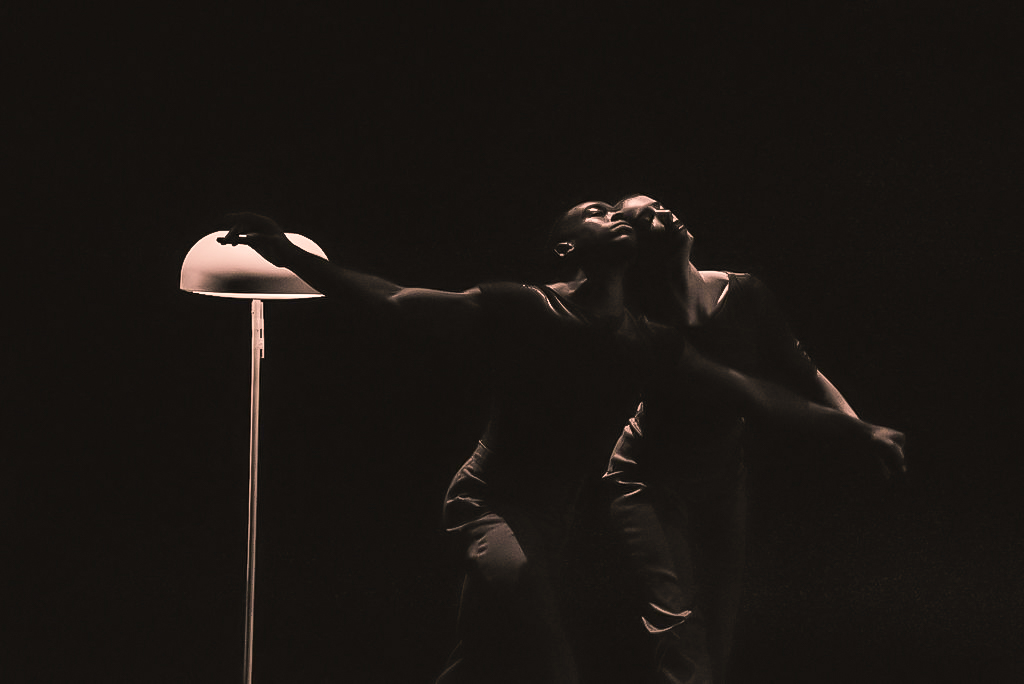
A Picture of You Falling, with choreographer Pite also supplying the biting prerecorded text, was edgier, more satirically impersonal. At times catatonically repetitive, this strange pas de deux imprints itself readily and deeply – an almost sinful delight, since it lays bare the careless ways we talk about love and romance. Sarah Lapointe and Ben Ingel first connect by accidentally bumping into one another. We’re speaking literally here, as they walk in opposite directions across a geometrical space outlined at regular intervals by strobe lights.

When Ingel falls, he literally falls, and his heart literally hits the floor when he is smitten and when the makeshift couple breaks apart. Unlike the score that Pickett cobbled together to move and regulate her dancers, the original music by Owen Belton never seems to register as a pulse or an emotional coloring, particularly when Pite tells us “This is the place” and “This is how it happens” – over and over.

What lighting designer Robert Sondergaard creates with his symmetrical formation of strobes is emphatically not a space. Nor can we be sure whether Pite is telling us again and again and again that this is how this ephemeral intimacy happens or whether – in some kind of condensed or looping timeframe – it’s actually happening again and again. Focus does shift for a while from Ingel to Lapointe in the moments of intimacy leading to the breakup, but this is ultimately the man’s story. Or a picture of what men have made out of love.Maurice Mouzon Jr_Shaina Wire_IN Cognito_by Taylor Jones

We confronted a couple of filters between ourselves and the music of the Cashes in Under the Lights. The least discordant of these was Stuart’s choreography, which briefly stumbled with his blithe setting for “Folsom Prison Blues,” when his five men carried on merrily during the vocalist’s confession that he “shot a man in Reno just to watch him die,” a jarring disconnect. More problematic were the recordings of The Man in Black’s signature songs by Sugar + the Hi-Lows, most egregiously lightweight when they missed the gravitas and drama of “Hurt,” leaving Nadine Barton little to work with, though she worked it well.

James Kopecky got us off to a charismatic start with “I Walk the Line” as it dawned on us what we would have to cope with from the Bi-Los. Anyone who had heard a definitive rendition of “Ring of Fire” or “Jackson” could empathize with the struggles Stuart faced, but Sarah Hayes Harkins didn’t flinch at all as she joined Kopecky for the coolish “Fire,” and a couple of winsome couples, Isabella Bertolotti with Humberto Ramazzina and Meredith Hwang with Oliver Oguma, redeemed the Mississippi superficiality.

Sugar plus or minus the Hi-Lows was hard for me to swallow, which may account for my liking Stuart’s settings best for songs I was least familiar with. “Two Day High” offered us three dynamic duos, Isabella Franco with Maurice Mouzon Jr., Shaina Wire with Luke Csordas, and Olivia Parsons with Juan Castellanos. With “I’ve Got You Covered,” we got a glimpse of Amelia Sturt-Dilly partnered with Kopecky, just one night after she danced A Picture of You, the CharBallet commission she premiered a year ago. Stuart’s best pas de deux by far.

“Tennessee Quick” was the most attractive track I heard from Sugar +, complemented by some really rousing ensemble work from Stuart and a swarm of 14 dancers. Couldn’t imagine Johnny singing that one. That harmonious taste of “Tennessee” was a perfect setup for Stuart’s stomping ensemble finale, “God’s Gonna Cut You Down,” fronted by Kopecky, the hardest-working man in Charlotte that night. Johnny didn’t get to that golden nugget until late in his career, so it wasn’t among his best recordings, but to hear the Hi-Lows attacking that traditional come-to-Jesus song with an electric guitar was almost as much of a kick as Kopecky and his backups.