Tag Archives: Clay Houston

“Flip” Is Charlotte Ballet’s New Lab and Launching Pad

By Perry Tannenbaum

Whenever you see a Charlotte Ballet performance at Knight Theater or the mighty Belk, you’re going to see talent, grace, athleticism, imagination, and dancers in abundance. At the McBride-Bonnefoux Center for Dance, however, only the first three of those wondrous plenitudes are guaranteed. Formality is loosened. Scale is often reduced. And over the past few years, Charlotte Ballet’s season has concluded with evenings of homegrown choreographies by members of the troupe, many of them new to the art.

The title of these venturous, experimental evenings has evolved from Choreographic Lab, when Hope Muir established them in 2018, to the current Flip – as in flipping the script – when Alejandro Cerrudo took over as artistic director. Moving from the big venues to the double-studio layout of the McBride-Bonnefoux, one studio accommodating the audience and the adjacent studio (partition opened) serving as the dancers’ stage, you feel like you’ve abandoned Broadway for a black box.

But without sacrificing the swank factor: the façade and lobby of the Center for Dance are more like a modern museum than a ballet school. So there’s an elegant patina layered onto the funky ambiance of briefer, smaller budget pieces, often reduced to solo performances or pas-de-deuxs. You might expect two or three pieces at most before an intermission at the Knight or Belk Theater. This year at Flip, there were nine, with five more in the lineup after the break.

So you can conclude that, among the 20 dancers in the Charlotte Ballet troupe, 70% can now affix the profession of choreographer to their résumés. Not quite. At this year’s Flip, members of the secondary Charlotte Ballet II troupe also participated in performing and choreographing the program. Six of the eight CB2 members profiled at the charlotteballet.org website danced in the program, with David Anthony Scheuerman-Saucedo also among the choreographers.

What happens behind the scenes must be a fascinating process, as the dancers choreograph for their comrades, teaming up by preference, negotiation, or random assignment. Two lighting designers, Jenni Propst and Rick Moll, split the 14 pieces between them, another negotiation or lottery.

Normally, two solo dances would be two too many for me. But at Flip, Raven Barkley’s “Groove” and Clay Houston’s “Nuit tombante” both transcended the norm. Set to Jackie Wilson’s cover of “(Your Love Keeps Lifting Me) Higher & Higher,” Barkley’s choreography put little demand on her athleticism and was hardly unique. She was: lithe and charismatic in a vivid red dress.
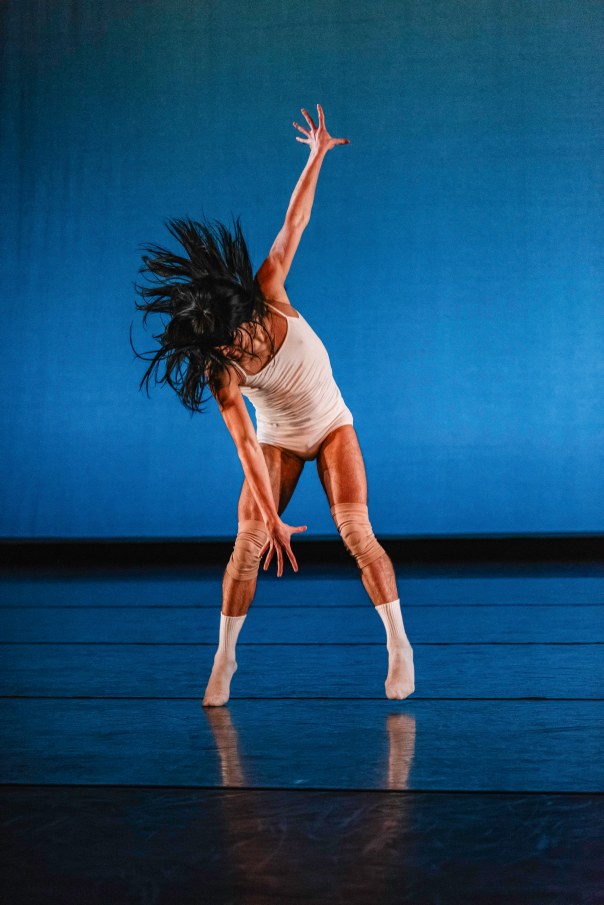
In a sense, Houston’s piece wasn’t a solo at all. When night fell, he not only switched soundtracks, he also switched genders, discarding a wig and assorted paraphernalia and becoming more himself. At first, the transformation hit me as surprising and comical, but the mood – and the choreography – deepened and became touching.

Between these two solos, two of the best duets were programmed: Anna Owens’ “That’s all” and Adriana Wagenveld’s “Tethered.” Owens’ piece, set to a couple of non-Tiny Tim versions of “Tip Toe Thru the Tulips,” actually offered a rather comical reason for all the tiptoeing. At the climax, Owens in the female role gets Oliver Oguma to assist her in reaching a tulip that dangles temptingly from above. That’s when the “That’s all” came into play, as Owens departed instantly afterwards, without according Oguma the thanks he deserved.

Oguma, in the comical spirit of the music, looked more bewildered than pissed by the brush-off.
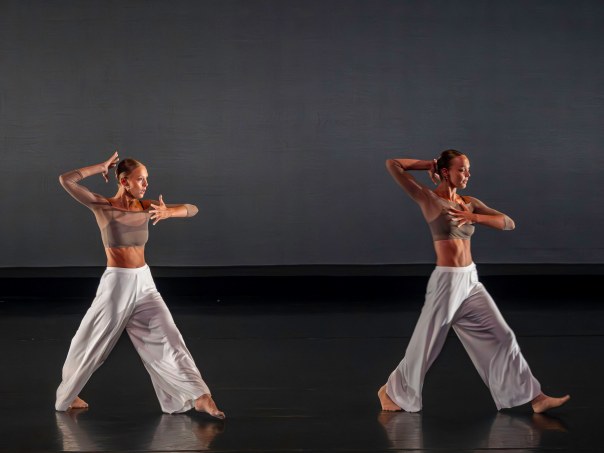
Wagenveld spliced two favorite Sebastian Plano tracks together for her soundtrack, recruiting her sister from CB2, Serafina Wagenveld, to join her in the project. Fortunately, Adriana’s tethering concept isn’t carried out literally. Though neither of their bios suggests that the siblings are twins, the matching costumes for the piece only encouraged that conjecture.

At times, Plano’s minimalist style seemed mated with the Wagenvelds’ walk-like-an-Egyptian grace and their stolid serenity. The sisters’ intertwinings, beautifully timed and carefully composed, might also take on a hieroglyphic look. Their costumes were sleek and timeless, sheer taupe tops with tight half-sleeves – think nylons – over flowing white slacks.

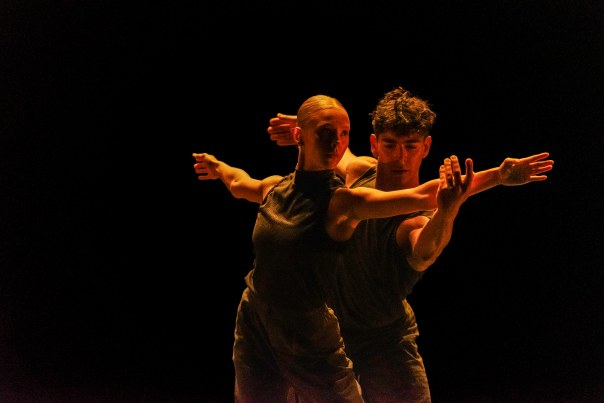
Two other duets stood out for me. Rees Launer’s “Kinetikos” was appropriately pulsating and percussive in opening the evening, set to a mashup of a couple of Aphex Twin tracks for Scheuerman-Saucedo and Serafina Wagenveld, growing more lyrical and nostalgic when the music transitioned to an Emile Mosseri piece. Most unique of all, perhaps, was Isaac Aoki’s “Topaz,” set for himself and Remi Okamoto to Mark Izu’s “Mermaid in a Silent Sea.”
With Aoki’s videography, we were taken more explicitly to desert lands in “Topaz” than we were by “Tethered.” The torrid climate fit hauntingly with the plodding tempo of the music, caravan-like when the whining Japanese shakuhachi dominated. Or the flute. Or the bass clarinet. The loneliness of the dark-clad Asians contrasted starkly with the sun-drenched hilly terrain, justifying that whining sound. Unlike “Tethered,” there was little connection at first between the two dancers. The piece was the antithesis of festive – until the tabla began to bubble underneath, gradually emerging and quickening the pace.

Of the remaining pieces, I found that the love-triangle narrative shape of Scheuerman-Saucedo’s “you and me and me and you” overcame my misgivings about listening to yet another setting to Jules Massenet’s “Meditation from Thaïs.” Although Part 1 of Mario Gonzalez’ “Fever Dream” struck me as a generic piece for four dancers, never once reminding me of Geppetto’s search for Pinocchio (let alone “Chapter 35”), Part 2, “25%,” enabled Stephen Myers to deliver one of the most vivacious solos of the evening, set to “Orchestra” by Labrinth.

Both his costume and charisma rivaled Raven’s. Nor was “Chapter 35” a waste, for it prodded me to investigate the insane “Big Hammer” video by James Blake. A cinematic masterwork!

You may disagree, but discovering new music is a key part of the adventure that Charlotte Ballet’s labs or Flips has to offer me. That was not the case with the closing offering of the evening, Maurice Mouzon Jr.’s “Ne Me Quitte Pas,” set to the Nina Simone recording. It’s been done before – and before that.

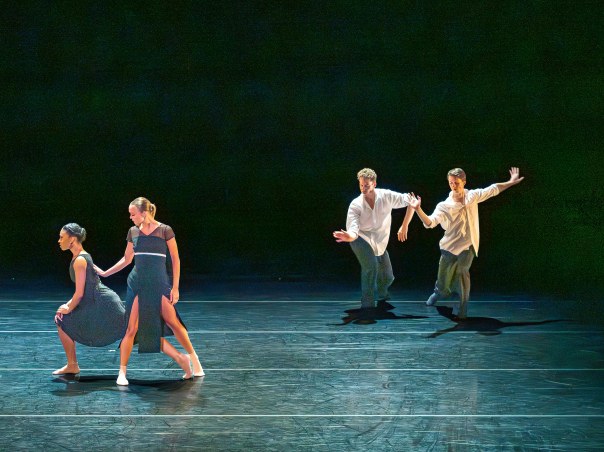
Mouzon’s setting, for four dancers, doesn’t stop at the threat of separation. It crosses over into the agony of it when it happens. So two couples is the right choreographic choice, for Mouzon allows ample opportunities for the two women, Barkley and Adriana Wagenveld, and the two men, Launer and Luke Csordas, to suffer and commiserate with one another in alternating segments.

Nor does Mouzon send the women off, an annoying choreographic tic, when the spotlight shifts to the men. Instead, he freezes them in a sad attitude while Moll dims their light. Why should they be out of sight if they’re not out of mind? Since the Simone track peters out in pitiful pleas, seemingly repeated after being irrevocably denied, Mouzon can only offer us a wan hope of reconciliation.
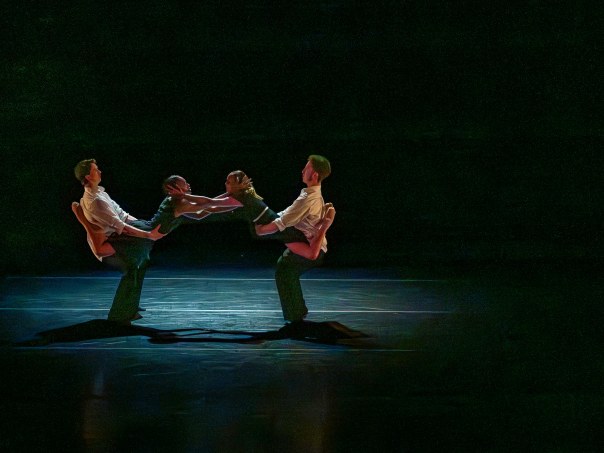
Hugged from the rear by their partners, their legs bent and suspended in air, Barkley and Wagenveld reached across the void between them and embraced with their arms fully extended, forming a poignant bridge. What a wonderful closing tableau.

Newsflash: Printedprograms for Flip and Charlotte Ballet’s previous show, One Thousand Pieces back in early May, contained announcements of the company’s 2026-27 season and a slate of touring engagements, an exciting new dimension for the troupe. A couple of new developments since Flip concluded its run on June 20.

The company has already appeared at the American Dance Festival in Durham for the first time since 2017, bringing with them a work by Israeli choreographer Ohad Naharin once again later in June. Then, less than a week ago, they fulfilled their promise to add to their announced touring dates.

Newly augmented, here’s the slate:

  • Sept. 25-26, 2026: Ballet Bend – Fall Dance Festival (Bend, OR)
  • Oct. 29-30, 2026: Brooks Center for the Performing Arts at Clemson University (Clemson, SC)
  • Nov. 7, 2026: Dance Cleveland (Cleveland, OH)
  • Jan. 27-31, 2027: The Joyce Theater (New York, NY)

The 2027 rendezvous at The Joyce Theater will be the first time Cerrudo has brought them there during his tenure. Jean-Pierre Bonnefoux, who died in the spring of 2025 at age 82, was still the artistic director when the company last wowed New York audiences at The Joyce in 2004. Ten years later, he would rebrand his troupe, but back then, they were known as the North Carolina Dance Theatre.

Charlotte Ballet’s New $1 Million Nut Is Everything It Was Cracked Up to Be

Dance Review :  Nutcracker

By Perry Tannenbaum

Many of the people who jammed into Belk Theater on Saturday afternoon, nearly filling the top balcony to the rafters, were wondering the same thing as I was. Just how much can $1 million do to improve Charlotte Ballet’s already stellar production of Tchaikovsky’s Nutcracker? There weren’t any gaping holes that needed to be filled in when it came to the live music. Charlotte Symphony has played the ballet score beautifully ever since Salvatore Aiello transplanted the dance troupe, originally known as North Carolina Dance Theatre, from Winston-Salem in 1990.

Many of the musicians – and many of the orchestra’s principals – who accompanied Aiello’s setting for Nutcracker in the early years have played on through the many iterations of Jean-Pierre Boonefoux’s choreography, which premiered in 2006. Every one of the players works up the same zest for the music as the year before. Nor can money buy a much finer array of dancers to fill the stage with agility and grace. Calling the dancers in Charlotte Ballet and Charlotte Ballet II – not to mention the various levels of apprentices, trainees, and students from the company’s Academy – the best in North Carolina may actually be an understatement.

Of course, the unprecedented gift had garnered plenty of positive publicity for the donors, the McColl family of Bank of America fame, and the worthy recipients. Unless you had completely ignored the Charlotte Observer for the past three months, you already knew that the McColl makeover would bring new Nutcracker costumes and new scenery to the Belk stage – and to lavishly renovated Gaillard Center in Charleston, where the Christmas classic will sojourn on December 10 and 11 before returning to Charlotte on December 13-23 for an additional 13 performances. I probably wasn’t alone in bringing a show-me attitude to the unusual matinee premiere, for the costumes, the scenery, and the spectacle of Bonnefoux’s Nutcracker, incrementally upgraded in its early years, had already proven to be quite formidable in their elegance and wit.

6_charlotte-ballet_jean-pierre-bonnefouxs-nutcracker_-rosie-morrison-as-clara-and-mark-diamond-as-herr-drosselmeyer-_photo-by-peter-zay_web-1024x682

Holly Hynes’s new set of costume designs gobbled up most of the prepublicity. Taking her inspiration from the Belle Epoque (1871-1914), Hynes and a team of 300 dressmakers in 15 states created 208 new costumes, each one costing as much as $6000. As she confessed in one of the two infomercials I’ve seen, Hynes often had to rely on a bunch of polyester to offset the extravagance of the dancers’ silks. The new scenery by Alain Vaës obviously took its inspiration from Bonnefoux’s traditional Nutcracker scenario and Steven Rubin’s set designs, seeming to depart more radically from Rubin’s concepts as the story moved from the Stahlbaums’ Christmas party to Clara’s dreamy fantasies, developing a whole new motif of whimsy – lifesize cutouts! – along the way.

Vaës wasn’t working with a paltry budget, either. A whole new trim, teeming with red, covered the entire arc of the proscenium. The backlit scrim of the Staulbaums’ town, more brightly lit by the lamplight gleaming through the windows of the homes than by the moonlight, greeted us like the frontispiece of a storybook.

In its nocturnal grayness, the first exterior view of the Staulbaum home was very similar to Rubin’s, but we were looking from a greater distance, seeing all that can be seen instead of merely the front façade. There was a little more humor in the gradual reveal of the magnificent interior, for the first of the new cutouts, a housemaid, was wheeled out to centerstage to greet the guests. Onto its outstretched arms, the parade of guests flung coats, stoles, and scarves until this cunning portable closet was rolled away.

7_charlotte-ballet_jean-pierre-bonnefouxs-nutcracker_-george-bokaris-nutcracker-michael-menghini-mouse-king_photo-by-peter-zay_web-1024x682

Imagery in the new Vaës scenic designs is bolder, more calculated to appear colossal, and the designer’s drawings evoked for me two of the great masterworks of the Belle Epoque, War and Peace and Alice in Wonderland. Probably by sheer accident, the bold muscularity and the florid curves in some of the scenery reminded me of Fritz Eichenberg’s memorable illustrations for the Heritage edition of Tolstoy’s epic. But the evocation of Alice was quite intentional. After the party, when Clara nodded off, the Mouse King entered the scene on a broken teacup for his royal battle with the Nutcracker. Once Clara assisted her champion in his victory, the set changed briefly to a surreal and magical toyland, where the head of Clara’s doll was as large as the castle. Very Alice.

The new scenery also brings fresh emphasis to numerous arrivals. Drosselmeyer’s amazing gifts, Clara’s Toy Doll and her brother Fritz’s Toy Soldier, arrive on carts where each of them is flanked by two lifesize cutouts of the same toy. Instead of lifting her massive skirts to reveal her periwigged Marzipan brood, Mother Ginger arrived on the second floor of her own gingerbread house, opening the front doors to let them out. But aside from the Mouse King’s teacup and the flying balloon-boat that carries Clara off to the Land of Sweets – a galleon now large enough to transport two honeymooning couples – the most significant entrance was created for Herr Drosselmeyer. He arrived at the Stahlbaum soirée in his own clock tower!

Mark Diamond may hold onto his annual stint as Drosselmeyer even after he’s forced to arrive clutching a walker, for he still revels in reminding us with his comical antics that he himself is program director of Charlotte Ballet II and, more importantly, one of the company’s potent line of resident choreographers. The Drosselmeyer shtick always looks like Diamond is doing his own thing, altering the routine every year – maybe every performance.

3_charlotte-ballet_jean-pierre-bonnefouxs-nutcracker_-juwan-alston_toy-soldier_photo-by-jeff-cravotta_web-1024x683

The new clock draws the spotlight in Mary Louise Geiger’s new lighting design when Tchaikovsky’s score tolls the midnight hour chez Stahlbaum. Using his new cutouts, Bonnefoux completely alters this segment in his choreography. In past years, spotlights flashed on a different costumed kid each time the bell tolled, unpredictably scanning the full width of the stage. Now there was simply a single-file parade of various cutouts, their manipulators hidden behind them. As we approached the final chiming, we had our first glimpse of the lifesize girl doll that would enlarge to supernatural Alice-size in the yet-unseen scenery.

Geiger also teamed up with Hynes on some of the new magic. Like the opening cityscape, Vaës’s new Land of Sweets builds on Rubin’s previous concept of candy canes and gumdrops by putting us at a greater distance and increasing its scale. We could now see a huge skylight window in the rooftop dome opening up on a starry evening sky. At floor level below, the view also opens up to the outdoors, directing our gaze toward the horizon. Initially, there was a marked difference between the two views: it was still twilight on the horizon while it was already evening above.

9_charlotte-ballet_jean-pierre-bonnefouxs-nutcracker_elizabeth-truell-juwan-alston-as-chocolate_photo-by-peter-zay_web-1024x716

In this unflattering light, we had our first glimpse of the newly minted backup dancers for the Coffee segment. Their bright red skirts, contrasting sharply with their dark blouses, seemed garish under the bright light between the little Marzipan and Candy Cane groups. But Geiger would dramatically lower the lights for Raven Barkley and Ben Ingel, so it was now (briefly) nighttime both on the horizon and above when they performed their sinuous Coffee pas de deux – and the perfection of the six backup dancers’ glowing red skirts in this dimmed light redeemed them from the first impressions they had made. Their pink capes also made a difference.

In little ways and in big ways, Bonnefoux and his design team have heightened the wow factor in staging their spectacle. Just for the Tea segment in Act 2, a Chinese dragon drops down from the flyloft for a visit, and the Stahlbaums’ Christmas tree no longer stops it miraculous growth when its piney peak hits the ceiling. Now when Drosselmeyer cast his spell, that growth continued on the upstage backdrop until the entire upstage wall was filled with what we imagined was a wee portion of the fabulously gigantic tree. You need not worry that such awesome stagecraft at all diminishes the exploits of the dancers. Aided by their revamped costumes, Charlotte Ballet still measured up to the superabundance surrounding them.

10_charlotte-ballet_jean-pierre-bonnefouxs-nutcracker_alessandra-ball-james-as-sugar-plum-fairy-james-kopecky-as-cavalier_photo-by-peter-zay-_web

Rosie Morrison as Clara and Clay Houston as Fritz may be the most personable Stahlbaum kids I’ve seen. The precision and perfection of Sarah Hayes Harkins as the Sugar Plum Fairy will surely inspire little ballerinas who see Nutcracker for the first time. Harkins hits every beat with her elegant movements exactly on the nose, and her new partner, Drew Grant, is the picture of chivalry as her Cavalier, though the rookie needs to loosen up a bit. Chelsea Dumas and Ben Ingel were a similarly ideal couple at the premiere as the Snow Queen and King, and Alessandra Ball James was luminous in her musicality as Rose in the “Waltz of the Flowers.” Below tea green tops, Rose’s dozen dancing flowers sported frilly three-tiered skirts, each tier a different tint of pink or fuchsia. Even a child could recognize the stems and petals of the flowers for what they were.

Except for Fritz, who is merely doublecast, there’s a dizzying rotation of four dancers for each of the major roles I just named. It would take an astronomer to predict when, where, and if this exact alignment will occur again, so let me merely add the names of the other dancers who will figure in the dizzying mix: Jamie Dee Clifton, Elizabeth Truell, and Sarah Lapointe among the ladies, James Kopecky and Juwan Alston among the gentlemen.

8_charlotte-ballet_jean-pierre-bonnefouxs-nutcracker_humberto-ramazzina-as-tea_photo-by-peter-zay_web-1024x695

The athleticism of the Charlotte Ballet men did shine through during the Act 2 procession of divertissements, counterbalancing the dominance of the ballerinas. Newcomer Peter Mazurowski sparkled in the Gopak section and, under that dragon, Humberto Ramazzina from the II troupe served charmingly – and deferentially – in Tea. Both of these men are in a rotation of three men who will dance their roles. So will Ryo Suzuki, whom I wasn’t seeing for the first time as Candy Cane. I don’t think I’ve seen Ryo’s match in performing Candy’s joyously asymmetrical leaps, but I’m sure parents and children of all ages will be satisfied when Suzuki rotates to Tea and Gopak.