Tag Archives: Germôna Sharp

Keston Conquers Again in “The Color Purple”

Review: The Color Purple at Theatre Charlotte
By Perry Tannenbaum

Across the span of nearly 40 years of reviewing, reporting, and pontificating on the performing arts, quite a few events and performances have etched themselves into my mind. On rarer instances, an audience response will be equally unforgettable, such as press night on April 10, 2008, at Ovens Auditorium, the first time Wicked came to town, greeted by a series of deafening ovations that have never been matched.

Every time my Apple Watch notifies me that an audience topped the 100dB mark the previous evening, I wish I’d had one at Ovens that night to know what the high-water mark is.

Even more unique was the night of September 15, 2012, at Dale F. Halton Theater. There, the student actors and musicians of Northwest School of the Arts performed The Color Purple. My wife Sue and I went with a bit of trepidation.

We had already seen this musical on Broadway and in its touring reincarnation at Belk Theater. More to the point, we knew the pitfalls of an all-youth cast colliding with roles that demanded fully mature players. At the Halton, we were already reminded of how wrong that could go when the recent college grads who recruited for CPCC Summer Theatre clashed with the likes of Fiddler or Spamalot.

Of course, we had already built up considerable trust in Corey Mitchell as a stage director nearly three years before he snagged the first Tony Award given to a theatre educator. But there are tough hombres in Alice Walker’s Purple, including poor Celie’s abusive father and husband, Pa and Mister.

And if you remember either the film or the Oprah-produced musical, there are two certifiable divas besides Celie, our tormented protagonist: the hard-headed Sofia and the glamorous Shug Avery. Could Mitchell find all the outsized talents he needed enrolled at Northwest to fill all these roles?

Sure did. And he had more: scenery on loan from the original Broadway production.

But the audience! When Northwest junior Keston Steele, starring as Celie, had finished singing her “What About Love?” solo, Sue turned to me and asked, “Have you ever seen anything like this?”

For the entire audience, it seemed, had sprung to its feet – a standing ovation in the middle of a show! And the answer to Sue’s question is still no.

So you can imagine that when we walked into the old Queens Road Barn on opening night of the current Purple and received my playbill, I was pre-sold. Our Tony Award winner was back directing Theatre Charlotte’s new version, and the name of Keston Gary topped his cast list as Celie.

Had to be the same Keston, right? That’s honestly the only name I had remembered.

While I wasn’t the only person in the Queens Road Barn who remembered Gary’s pre-marital, pre-motherhood exploits at CP, it’s unlikely that anyone else in the crowd was in the same suspense: would history repeat itself?

So there was that unique suspense for me, especially when Gary belted out “What About Love?” as zestfully as Steele. Would the audience rise? Would the Barn’s roof blow off? That same silly suspense struck me once again when Gary followed up with the musical’s supreme affirmation, “I’m Here.”

While Gary’s singing merely equaled Steele’s, her acting – seasoned by marriage and multiple motherhoods – markedly surpasses it. At their depths, Gary’s servility and submissiveness as Celie are borderline cringeworthy. Maybe a few notches beyond what a white director would dare.
It’s a grim reminder, to be sure, that feminism was a more central concern for Walker here than racism, which only affects Sofia’s story. As a result, we can revel more in the light and inspiration that Shug and Sofia bring to Celie with their special brands of savvy and sass. This Celie needed to travel a longer road, in my eyes, to straighten up her hunched shoulders and stand up for herself.

Twenty years after I saw The Color Purple on Broadway, it’s nice to see Mitchell leaning harder into the story’s demeaning subjugation. But it’s harder for me to be sure whether Mitchell is seeing Celie’s sexual awakening as more overtly lesbian than ever before, or if I am.
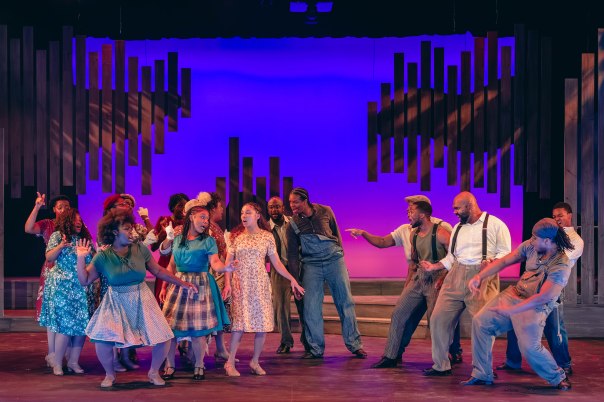
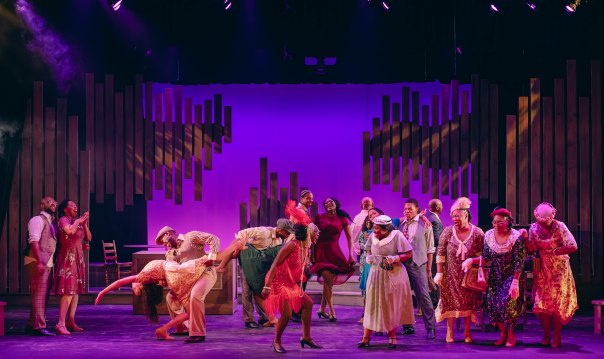
The rousing “Miss Celie’s Pants” certainly hadn’t landed on me in nearly the same way as it did on Queens Road. Sung by Gary with her mentor Shug, Sofia, and a bevy of other women, you can take this eye-popping number partly as a gay pride celebration or as a proto-Hillary rally.

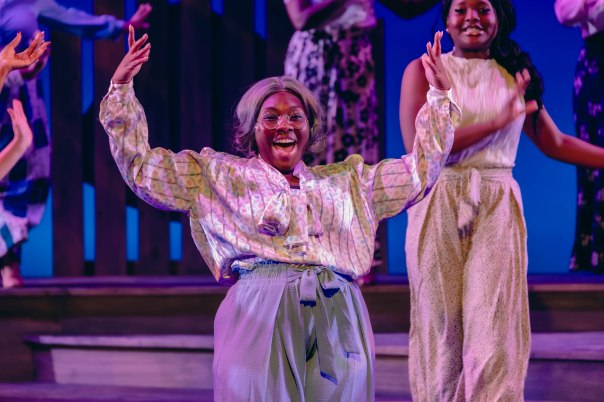
K. Alana Jones as Shug sports a free-thinking saloon singer’s confidence, seemingly at home with anybody’s body of her choosing. In that respect, Shug’s bisexuality aligned more closely with Walker’s. Shug always got the kind of delayed runway entrance traditionally reserved for Broadway legends, so costume designer Justin Hall, with assistant Beth Killion, needed to be sure that Shug’s rigs radiated class.

With all the fine tunes crafted by Brenda Russell, Allee Willis, and Stephen Bray, the book by Marsha Norman doesn’t get enough space to make the connection between Shug’s fashion sense and Celie’s eventual emergence as a dressmaker. At Theatre Charlotte, we can infer that Shug is Celie’s dressmaking muse.

Once Jones does enter as the blues singer, she scores well in the uplifting “Too Beautiful for Words” and the raunchy “Push Da Button.” One can only smile at the thought of high schoolers rehearsing that latter gem.

As Sofia, Germôna Sharp gives Celie – and any other wallflower in town – a more militant brand of inspiration with her “Hell No!” [my italics]. Fortunately, I had somehow forgotten the battered Sofia’s marvelous dinner-table reawakening, so I could take fresh delight in Sharp’s hallelujah suddenness. Not long afterwards, Sharp gets to team up with Nehemiah Lawson as Harpo, her genially clueless husband, in their raunchy “Any Little Thing” reconciliation.

After his bravura psycho dentist in Little Shop of Horrors, it was nice to see Lawson less crazy and cocksure. Harps is more befuddled and human, actually evolving with the times. Watching this character arc, from “Brown Betty” to “Any Little Thing,” amid more toxic excesses of testosterone was a nice reassurance that not all men are monsters. Or at least, beyond redemption.

You could say Harpo’s leavening presence gives Arnold Grevious as Pa and

as Mister more license to be as monstrous as possible. Yes, there are moments at the beginning of Purple when Walker seems to be taunting us: “You think white patriarchy and misogyny are bad? Come over to my place!”

Neither Grevious nor Williams gives any hint of mellowing toward Celie for a long time. Meanwhile, Mister needs to be appealing to Shug in some way that might surface in his bossy “Big Dog” showcase with his field hands. More to the point, he ought to appreciate Shug’s strength as well as her beauty and talent, so Williams can give promise of evolving as he lays out Walker’s red carpet for her diva in “Shug Avery Comin’ to Town.”

Williams also gets the luxury of penitence, beginning with “Celie’s Curse.” No such epiphanies happen for Pa: we just watch Grevious becoming older and feebler. So don’t give that old rattlesnake a single vocal and see if I care!

No, Tim Parati’s scenic design for Purple, the first we’ve had in Charlotte that was totally missing its Broadway lineage, won’t floor anyone, though J.P. Woodey’s lighting helps us not to mind. But Keston Gary is far from the only onstage luminary capable of knocking you onto your butt.

Apart from Chicago and New York, I’ve been maintaining for years that Charlotte has the vastest store of Black theatre talent around. Purple at the Barn proves me right once again. Call yourself fortunate if there are still seats available.

Harlem Gets Braided at Jaja’s

Review: Jaja’s African Hair Braiding at The Arts Factory

By Perry Tannenbaum

My dear old Mom was born and raised in Harlem over a century ago, when a massive African-American cultural and literary Renaissance named for Harlem had already begun, long after the fabled Manhattan district with its storied 125th Street had been a major destination for Northern Migration after Lee surrendered to Grant. Even then, it would hardly be respectful to change Harlem’s name to Little Africa after all these years.

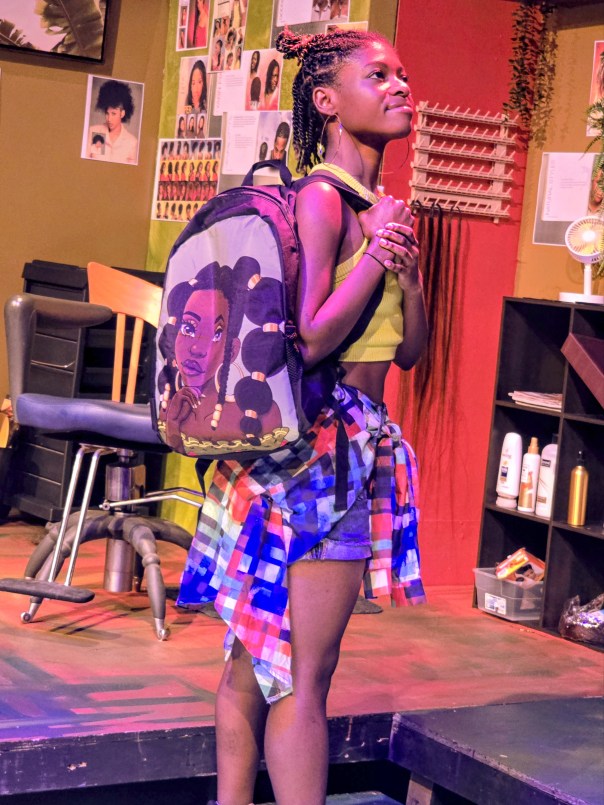
Yet playwright Jocelyn Bioh in her 2023 drama, Jaja’s African Hair Braiding,set on the corner of 125th Street, had me considering whether Bioh would rather call her Harlem – or at least this salon – Little Africa. The vibe and culture of Jaja’s, in Three Bone Theatre’s outstanding QC premiere at The Arts Factory, had me feeling that I was in another country while it was unmistakably my own.

Staffed and patronized by locals who hail from Senegal, Ghana, Nigeria, and Sierra Leone, neither Harlem nor Africa were the best places for Jaja’s craftswomen to be on a hot summer day of 2019 when Bioh’s action takes place. Aside from a breakdown in the braiding shop’s air conditioning, ICE lurks in the background as another of the women’s worries. Our own US President, the most powerful man on Earth, has bunched their homelands into the dismissive category of “shithole countries.”

Jaja’s daughter Marie, a brilliant bundle of chaotic energy, is running the salon today because Mom is getting married later this afternoon to an unpopular landlord who will provide her – and Marie – with the shelter of citizenship. That will free Marie, a valedictorian at her high school using a borrowed identity, to apply to an Ivy League school worthy of her energy, talent, and potential.

From the deluge of Marie’s opening monologue onwards, we realize that Jaja’s is a place bustling with life. Music is in the air, sometimes compelling the women to dance. There’s bickering, jealousy, hostility, vanity, teasing, and earthy humor. Not a murderer or a rapist in sight among the immigrants. Not even a pet eater.

About the only big mistake we can accuse director Donna Bradby of making is not helping us to observe Bioh’s signposts – via a wall clock and/or projections – of the time of day and the specified year this long, hot workday unfolds. Otherwise, Jennifer O’Kelly’s scenic design, Toi Aquila R.J.’s costumes, and Rod Oden’s lighting immerse us completely in Jaja’s humdrum-yet-exotic world for all of the show’s 95 minutes.

A clock on the wall, for instance, would help us to appreciate how long young Jennifer, an aspiring reporter, is willing to sit at Miriam’s station in order for the patient artisan to outfit her with a full head of microbraids. And how long does the bossy, rude Vanessa fall asleep at Aminata’s stand before waking to her new look?

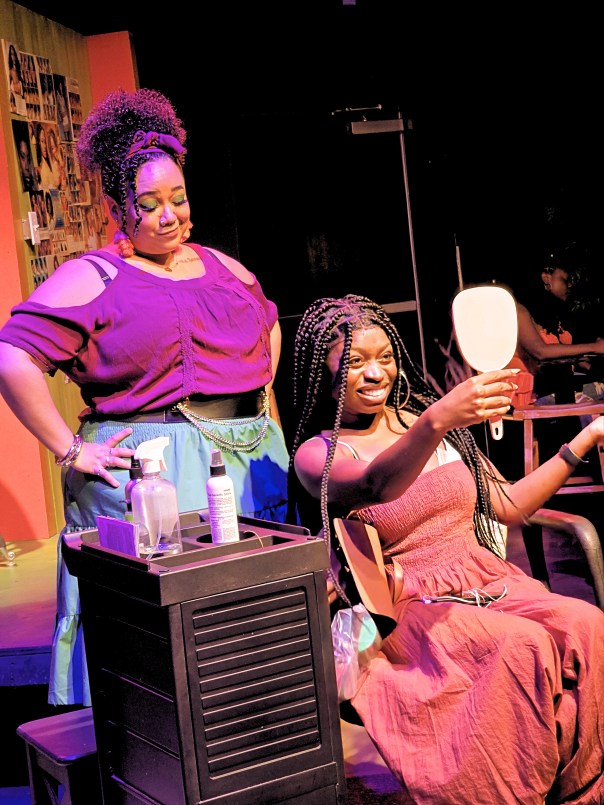
The visible excellence of Bradby’s cast is matched by the variety of Deborah Whitaker’s pre-, post-, and mid-weave hair designs. When blackouts happen between scenes, stage manager Megan Hirschy must have a huge chore in the small Arts Factory space helping the scurrying players reappear with the right hair when the lights come back up. We never just sit there tapping our feet during transitions. They’re almost lightning-quick.

Nor does it trouble Bradby that it’s impossible to keep track of who’s from Senegal, Ghana, or Sierra Leone. Venecia Boone was assigned the task of dialect coach anyway, a really nice touch.

Of Ghanaian descent and native to nearby Washington Heights, Bioh obviously knows her characters as much as she loves them. She is also a performer, so Deity Brinson as Marie will not be the last of her players to be gifted with a juicy monologue. Like Marie and the braiders, we will wait a long time before Myneesha King appears as Jaja – in wedding white, of course, with a queenly crown of braids – and delivers the most powerful monologue of all.

Meanwhile, it’s Valerie Thames as Bea, the most fashionable and contentious of Jaja’s employees who fuels the liveliest action, seemingly able to hatch a new grudge at the drop of a spray bottle. The salon was her idea, not Jaja’s. Should have been a full partner in the biz. Refugee newcomer Ndidi is stealing her customers rather than customers just dropping Bea. Thames seethes, fumes, and makes scenes with a steely righteous dignity that sets us up for the turnabout that reveals her deep-down goodness and sense of community.

Until then, the human warmth of the shop emanates from Kellie Williams as Miriam and Vanessa Robinson as Aminata. Williams, rightly stationed upstage at the Arts Factory black box, is mostly distanced from the main sparring during her morning-to-night transformation of Jennifer’s tresses. But there’s a distant man on Miriam’s mind throughout her labors, and she’s spending enough time in Jennifer’s hair to become quite chummy with the 18-year-old by evening’s end.

While her bestie and gossip buddy Bea seethes and sneers, Robinson mostly effervesces as Aminata. She knows that she doesn’t have the patience for a daylong immersion in microbraiding, so she’ll have none of Jennifer despite her youthful sunniness. But EJ Williams as Vanessa riles her almost to the point of losing her cool, a comical series of shticks that begins with the pushy customer objecting to house rules that require her to step outside the shop to negotiate Aminata’s fee. Then Vanessa insists that she be braided with the implements and spray she has brought from home.

Aminata’s man troubles are nearer-to-hand than Miriam’s, for her wayward ne’er-do-well husband James only circles back to the nest to take advantage of her. Righteously divorced, Bea insists that Aminata drop this loser, dismissing the love factor that keeps her from following through with her resolve. Can’t help it when Graham Williams as James drops by and pushes his wife’s buttons.

So these skirmishes between Thames and Robinson, before and after James’s invasion, are the most delicious that we witness. Aside from her dreamer worries, Brinson as Marie is occasionally thrust into the middle of disputes, laying down the law for the prissy Vanessa and stepping into the middle of Bea’s various tussles with Ndidi, Aminata, and her defecting customer, Michelle. At one point, Marie even exiles the incorrigible Bea to the street!

The younger folk are calmer and more acclimated to post-truth America than their diva elders. Before we know it, Aminata is asking Marie how to tune the smart TV to YouTube. Sarah Oguntomilade as Ndidi, the highest-grossing braider in the shop, is especially cool – thoughtfully equipped by Bioh with headphones and loud music to tune out Bea’s accusations and tirades. There’s a really nice interlude when Graham fawns over and flatters her as the Jewelry Man, lavishing her with freebies. This Nigerian cameo as Olu was at least as crowdpleasing as his subsequent turn as the roguish Ghanaian, James.

Graham’s most impactful role is as Eric, the DVD man, who serves as the caring eyes and ears of the community. But it would be cruel to divulge any more.

Things happen quickly at Jaja’s. Notwithstanding the oppressive summer heat, each new character changes the temperature in the shop. Less obtrusively than Graham, Germôna Sharp brings in a variety of flavors as three different customers. The most dramatic of these is the diffident Michelle, who thought she would be switching to Ndidi when Bea wasn’t there. Most comical is Sharp as Chrissy, wanting braids that will make her look like Beyoncé.

As if.

“Detroit ’67 Spins Motown Into History

Review: Detroit ’67 at Theatre Charlotte

By Perry Tannenbaum

Baked into many great American plays is the notion that dreaming big, striving for the golden apple of success, is a kind of latter-day hubris – sure to be tragically quashed and beaten down. Walter Lee Younger in Lorraine Hansberry’s A Raisin in the Sun was a grim example of such a tragic hero, dreaming of owning a liquor store in Chicago during the 1950s. It was hard for me not to think of Walter Lee’s beatdown – and paradoxically, the soaring success of Sidney Poitier, the breakthrough actor who portrayed him – as Dominique Morisseau’s Detroit ’67 unfolded at Theatre Charlotte.

Tautly directed by Ron McClelland and superbly designed by Chris Timmons, Morisseau’s work is darker and bloodier than Hansberry’s classic but emphatically more hopeful. Even with the background of the Detroit race riots of 1967, the pride of Black culture never leaves our eardrums for long as a clunky old record turntable, replaced by a slicker 8-track player and a pair of bookshelf loudspeakers, cranks out the hits of Motown’s famed music machine.

Come on, David Ruffin! The Temptations! Smokey Robinson and The Miracles. Mary Wells. Martha and the Vandellas. The Four Tops. Gladys Knight and the Pips. Marvin Gaye.

Morisseau’s protagonist, Lank, and his sister Chelle are trying to upgrade their unlicensed basement bar so that it will become more competitive with other after-hours speakeasies – when Sly, Lank’s best friend and a numbers runner, offers him an opportunity to buy into a legit bar. History lesson: a police raid on one of the unlicensed bars Lank and Chelle are seeking to emulate triggered the Detroit riots, the worst in 20th century America until another shining example of policing, the Rodney King riots in LA, eclipsed them in 1992.

While the riots rage and Michigan guv George Romney is calling in the National Guard, Lank and Sly are striving to scout out their hoped-for property and close on a deal – against Chelle’s wishes. Meanwhile, a second hubris slowly develops as Lank shelters a lovely white woman, Caroline, who has been battered and is mysteriously linked with the white underworld. She’s actually in more mortal danger than Lank.

Despite mutual suspicions, Caroline and Lank are drawn to each other. But they bond over Motown music, and they are both capable of busting a dance move.

The rioting in the Motor City was a prelude to the Black Power demonstrations at the Mexico City Olympics in 1968. We can also view them as a precipitating factor leading to the pride-filled Summer of Soul celebrations in Harlem and the rapprochement between the races on the musical scene that accelerated at the gloriously chaotic and inspiring Woodstock Festival of 1969, for so many of us the decade-defining event of the ‘60s.

So Detroit ’67 not captures a city in turmoil, it echoes the prime crosscurrents of that era, the struggle of Black people for their legitimate rights, the backlash from white people and government, and the mainstreaming of Motown as it breaks into pop culture. And by the way, Sidney Poitier’s To Sir With Love and Guess Who’s Coming to Dinner were both released in 1967. The question of whether Blacks were making significant progress, suffice it to say, was very much up in the air as we watch this action at the Queens Road barn.

Running an underground business together, Lank and Chelle are more advanced in their autonomy, street smarts, and connections than Walter Lee and his sister Beneatha were, still living under their mother’s roof with Walter Lee’s wife and child. Pushback against Lank’s feasible but difficult dream comes entirely from Chelle, who can realize deep down that continuing to run an illegal operation is also a risky choice.

Morriseau, McClelland, and Shinitra Lockett, making her acting debut as Chelle, all seem to have made this same calculation. So Lockett seems noticeably more vehement in her opposition toward Lank’s romance with Caroline than in her objections toward his business venture with Sly. On the business end, Sly’s persistence and charm in pursuit of Chelle’s affections bodes well for his deal-making prospects, another softening factor, for Lockett occasionally shows us that the slickster is making headway.

Because we see Graham Williams is so composed and self-assured as Sly, we can begin to see Lank as acting audaciously and responsibly. Yet there’s enough shiftiness mixed with Williams’ confidence for us to retain Walter-Lee misgivings about their venture, especially when the riots and the National Guard are thrown into the mix. Devin Clark, one of Charlotte’s best and most consistent performers for more than nine years, gives Lank a stressed and urgent edge. He’s not as regal and commanding as he was portraying Brutus last summer, but he’s far more spontaneous and charismatic.

Chandler Pelliciotta, in their Theatre Charlotte debut, brings a bit of shy diffidence to Caroline that meshes well with her story. Her worldly swagger has obviously been dealt a severe blow as she wakens, bruised and disoriented, in the basement of a Black man’s home she has never seen before. While Lank is drawn to her and wishes to protect her – we aren’t always sure which of these impulses is in play – Chelle has a couple of good reasons to wish her gone.

Not the least of these is the trouble Caroline is in with people who have battered her with impunity. The trouble might pursue her and find her at this fledgling underground speakeasy. It’s an awkward position tinged with risqué allure, but Pelliciotta’s performance leans more into the awkwardness, their glamor far less in the forefront than their fearfulness – for Caroline herself and for her protectors.

You can probably name 15 Black sitcoms that have characters like Chelle’s mismatched chum, Bunny: sexy, flirty, quick-witted, and imperturbable. Germôna Sharp, in her bodacious Charlotte debut, takes on her life-of-the-party role with gusto and sass. Sharp makes sure we’re not getting a PG-17 version of Bunny: slithery, regal, carnal, and militantly unattached. She will dance with anybody – Lank, Sly, or Chelle – but not for long, totally neutral amid the sibling fray.

Costume designer Dee Abdullah helps turn on the glam, more flamboyant for Sharp and more elegant for Pelliciotta. Morriseau withholds from her characters any sententious awareness that they are standing at Ground Zero of anything historic, now or in the future, but she clearly wishes that awareness on us. A distinctive black fist is prominently painted on one of the basement walls, right above the record player and the 8-track, and its presence is meaningfully explained.

Nor should we consider evocations of Hansberry’s classic urban drama as accidental. Morriseau’s script tells us that her protagonist’s name, Lank, is short for Langston. It cannot be a coincidence that the poet Langston Hughes wrote “Harlem,” the iconic poem from which Hansberry drew the title of her masterwork, A Raisin in the Sun.