Daily Archives: June 16, 2026

Three Times a Lady Sparks THE NOTEBOOK The Musical

Review: The Notebook at Belk Theater

By Perry Tannenbaum
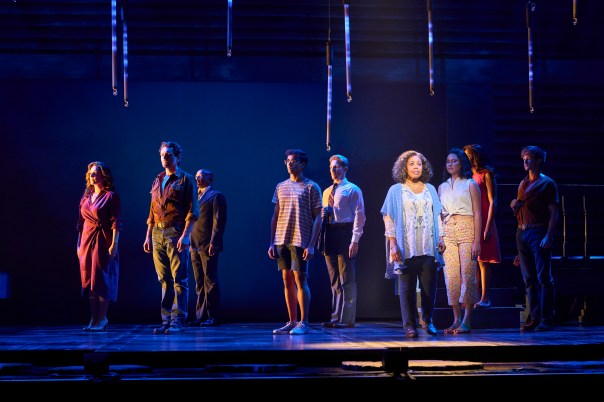
If necessity is the mother, maybe expectation is the grim reaper. Rescued from a slush pile of literary agency manuscripts, Nicholas Sparks’ THE NOTEBOOK became a #1 New York Times bestseller in 1996, the first of more than a dozen, and adapted for the big screen in 2004 – with such established and future marquee stars as James Garner, Gena Rowlands, Rachel McAdams, and Brian Gosling.

When Bekah Brunstetter adapted the novel for the stage in 2022, she was collaborating with composer/lyricist Ingrid Michaelson and the Chicago Shakespeare Theater. So when this Chicago manuscript hit my desk that same year, in judging for the Steinberg Awards (given to the best play premiered outside Broadway), I could presume that Brunstetter and Michaelson were thinking that their work was small and intimate.

It had been five years since I’d seen Fun Home at Circle in the Square in New York, and three years since it had toured here in Charlotte with our own Corrigan as Middle Allison at Knight Theater. That musical and that scale seemed to be the template for The Notebook, which sports three Allies and tacks on three Noahs. The script delighted me as I mentally restaged it at Circle in the Square, where Fun Home had smitten me.

My enjoyment of the script was enhanced by my unfamiliarity with Sparks’ novel and Nick Cassavetes’ film. Call it snobbery, but I’d devoutly avoided both of them. So the simplicities of the script were actually charming, though I’ve since learned that the flavorings of the novel, grounding it specifically in the Carolinas, were neutered to “A Coastal American Town.”

By the time The Notebook The Musical opened at Belk Theater earlier this week, all memory of Brunstetter’s book had also vanished, leaving me as I was when it first flashed onto my computer monitor: vaguely averse to what little I knew about the Sparks novel and the Hollywood film. Recognition only peeped in when we reached the scene where Allie sees Noah’s photo in a newspaper, standing proudly in front of the old house he had promised to renovate for her.

At that point, I had the advantage of not knowing how the story would end, though I did care. What do doctors know, right?

But I was still vaguely floating around mentally amid the non-specific David Zinn & Brett J. Benakis – and feeling more and more irritated that the story hadn’t touched down in the Carolinas or any other identifiable location. The triple Noahs and Allies, reminding me of Fun Home, didn’t help either.

Notwithstanding the vertical fluorescent lights shuttling up and down from the fly loft to chandelier height, or the repeated, random scurryings and mimed replays of previous scenes, The Notebook kept looking like a charming little musical trying so, so hard to balloon into Broadway-extravaganza dimensions. In reality, even our Knight Theater isn’t quite as small as the Broadway theater where it was staged. The Yard at Chicago Shakespeare was even smaller.

While the pretensions and non-specifics of The Notebook were deflating, threatening to snuff itself out, directors Michael Greif & Schele Williams worked their chief wonders with their finely selected cast. Beau Gravitte was the essence of avuncular as Older Noah, our narrator, even though his own medical tribulations were inexplicably minimized. Opposite him, Sharon Catherine Brown was a noli me tangere termagant, hard-wired to the brink of explosion – and if Gena Rowlands was half as dislikable, good for her!
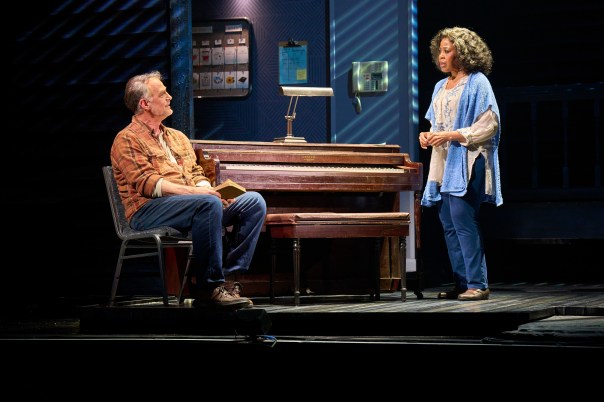
As pleasant as Michaelson’s songs were, they never lifted the story. This was especially telling when the moment demanded a soaring, searing climax for Brown, but only yielded her an “I Know” duo with Gravitte.

The youthful energy and chemistry between Chloe Cheers and Kyle Mangold were nearly as powerful and volatile as their ultimate evolutions. You can see what they see in each other and why they might last: Mangold’s persistence and healthy self-image presage the crusty, battle-scarred man whose steadfastness we’ll mildly admire later. More importantly, Cheers’ caprice and spontaneity fill in the blanks to the mystery of why Old Noah still adores Old Allie.

In playing time, Ken Wulf Clark and Alysha Deslorieux draw the short straws among our protagonists as the Middles. Yet in teaming together for Allie and Noah’s epic reunion – and splashing around the stage in the iconic downpour scene that fronts the movie’s PR and DVD cover – they are undeniably gifted with the juiciest bits.
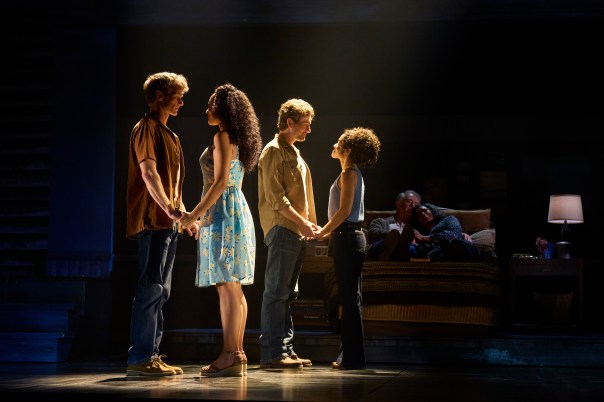
Clark even gets to receive Anne Tolpegin’s lukewarm apology for all the patrician prejudice and underhandedness of Allie’s Mother towards him. Jerome Harmann-Hardeman portrays Allie’s dad with equal hauteur and greater honesty.

Call me back when a local company decides to mount this musical at an appropriate scale. We can match the talent. No slights intended.

Queen City Concerts Presents the Music of Queen: How Could Anything Go Wrong?

Review: We Will Rock You at Booth Playhouse

By Perry Tannenbaum

May 1, 2026, Charlotte, NC – It may be an inborn genetic trait, as eternal as gender: you either love the music of Queen or, if you can, you shun it. Coming from the latter camp to Queen City Concerts’ latest conquest, We Will Rock You at Booth Playhouse, I could boast a near-total ignorance of the mighty metal band. To the distress of true believers, I was able to positively identify nothing in the Queen realm beyond Freddie Mercury, the twin trademarks of stadium rock – “We Are the Champions” and “We Will Rock You” – and the twin incarnations of “Bohemian Rhapsody”: as the apex of heavy metal pretension and as a motion picture.

Deciding to review Queen City’s new production was a cruel test of how far this wondrous company, with its breathtaking range, could take me out of my comfort zone. Beginning as a streamed series of Quarantine Concerts during the COVID pandemic in 2020, founder Zachary Tarlton rechristened his enterprise in 2022 when it went live with Tick, Tick…BOOM! – and remained true to its concert format and its exclusive devotion to relatively small and obscure Off-Broadway musicals for little more than a year.

With Kinky Boots and Titanic, they gradually discarded their music stands and playscripts, along with their disdain for lighting, costumes, and choreography. By sticking with their Concerts branding, they likely stunted the growth of their audience and community awareness of what they were really about. “Concerts” became truly obsolete as a description of the company in 2023, when QC Concerts presented Tony Kushner’s Angels in America, Parts 1 and 2, in May and a rather dazzling Sunset Boulevard in November. Like special concert revivals up in New York, the typical non-Angels runs were preciously short, three performances at most, so you still left with that concert feeling of having experienced something unique, live, and never to be replicated.

By 2026, events at Booth Playhouse or the Stage Door at Blumenthal Performing Arts seem to have developed a cult following. At We Will Rock You, only the front-and-center seats were strangely vacant, either bought up by plutocrat subscribers who hate Queen or avoided by people like me who were wary of the sound pressure levels likely to be generated by a seven-piece electric band and a cast of more than twenty.

Notwithstanding the trendiness of the 2018 biopic title set the revert to live concert form, my opening night audience was older than the demographic you might expect. Occasional outbreaks of leather and glitter were to be found, but more prevalent was my own impulse in readying myself for the music of Queen: dressing down and casual. Torn between getting decked out in a T-shirt and a golf shirt, I had opted for the more conservative apparel, yet I found the rest of the audience similarly torn. Nobody was confusing this concert with a Charlotte Symphony event.

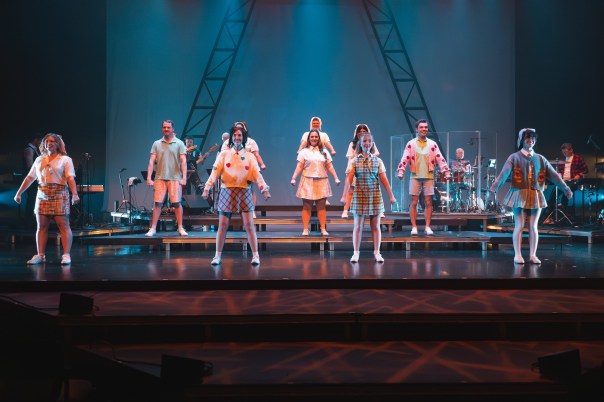
So there was a palpable, cult-like fellowship in the packed orchestra seats, even before the slacker musicians sauntered in and Tarlton took his conductor position behind one of the two keyboards. A key part of the test, for me, was going to be how empathetic Tarlton was intending to be in reasonably taming those fearsome high decibel levels. Seeing drummer Michael Charlton behind a plexiglass enclosure was not reassuring.

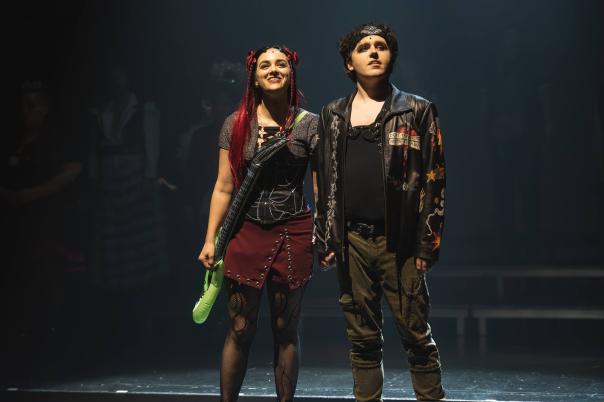
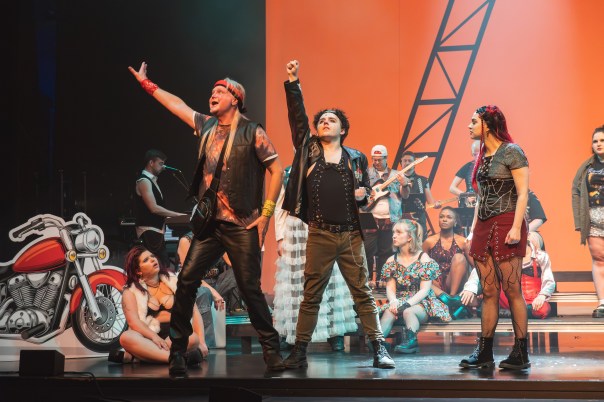
As it turned out, Tarlton was even kinder to my aging eardrums than I’d hoped. This was like middleweight metal behind reasonably amped vocalists, preeminently Patrick Stepp as Galileo, the far-in-the-future rebel/prophet reincarnation of Freddie Mercury in Ben Elton’s delightfully silly script. Until we reached the dreaded “Champions” and the stultifying title song (or is it rap?), Stepp was inevitably paired with Ally Teeples as Scaramouche, played with Gothic stolidity. Scaramouche, it seemed rather early, was fated to do Galileo and the fandango.

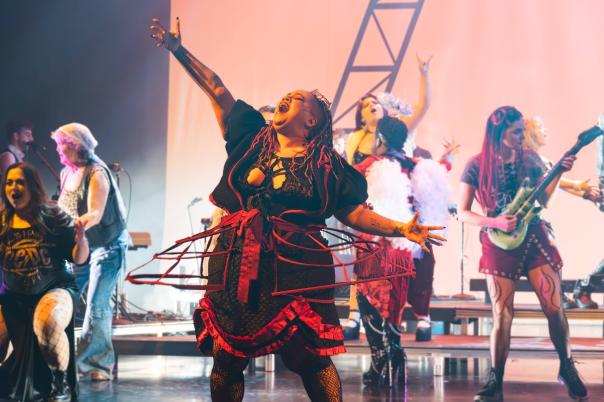
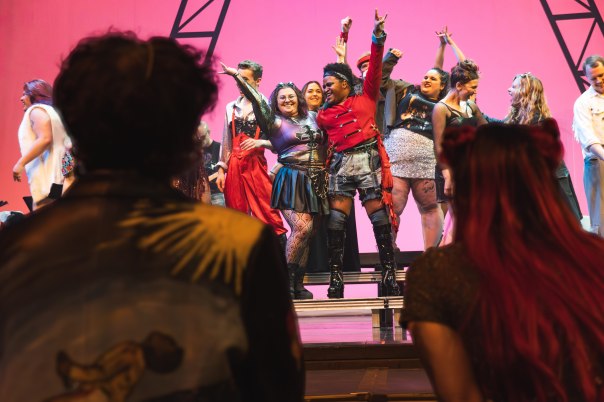
The duo introduced me pleasantly enough to “I Want to Break Free,” “Intuition,” “Headlong,” and “Hammer to Fall.” Yet Galileo and Scaramouche’s internet cloud oppressors, Vanessa Robinson as Killer Queen and Lamar Davis as Khashogi, were another vocal power couple, together on “A Kind of Magic” or apart: Robinson most notably on “Don’t Stop Me Now” and her namesake song, Davis on “Seven Seas of Rhye.” Really, the epic length of We Will Rock You nearly sped by with Kacy Connon’s stage direction (and uncredited choreography?), Kel Wright’s rockin’ lighting design, and Sarah Deutsch’s kaleidoscope of costumes: glad rags, punk, militant glitter, and breakouts of Bowie androgyny and leather. Boots, vests, and pants.

Most people will be amused by Elton’s futureworld, where Globalsoft, presumably a metastasizing Microsoft, has basically uploaded all life and soul to the cloud and banned music worldwide to the robotic humans below. Only a distant colony of Bohemians is a threat to rediscover the lone remaining musical instrument left on the planet and revive whatever rock once was. Like Buddy, Galileo and Scaramouche are almost totally clueless. But in his dreams, Galileo receives emanations from the dead, usually in the form of lame and hackneyed lyrics we all readily recognize.

In addition to not-bad-at-all discoveries like “Seven Seas” and “Under Pressure,” there was a new reason for me to harbor affection for Queen when “Crazy Little Thing Called Love” closed Act 1. Never knew it was theirs. And Darren Spencer, as Buddy, a Buddy Holly soulmate, caught me by surprise with “These Are the Days of Our Lives,” never on my radar before. On the other hand, when Robinson reached “Another One Bites the Dust” and Kasie Patlove as Oz exhumed “No One But You (Only the Good Die Young),” my reasons for despising Queen took on fresh fuel. Overall, QC Concerts’ journey through their songbook was quite worth taking and delightful, thanks  to Elton’s whimsy, Connon’s dynamic theatricality, and Tarlton’s spirited, unerring musicianship.

For those of you who love those Brits, do not hesitate!

Cerrudo’s One Thousand Pieces Celebrates Glass With Glass

Review: One Thousand Pieces at Knight Theater

By Perry Tannenbaum

May 7, 2026, Charlotte, NC – Amid the war and surging gasoline prices, you’ve probably heard: it’s time to celebrate! Our semi-quincentennial is just around the corner, and when Charlotte Ballet artistic director Alejandro Cerrudo went about crafting his troupe’s 2025-26 season, he had no idea that his quite appropriate celebration – and his first evening-length choreography to be presented in the Queen City – would be clouded by blood, smoke, anguish, and official federal lies and hypocrisies. Or maybe he had a brilliant premonition about the eerie July 4th now looming before us, to be glorified by a leader who openly flouts the US Constitution. For Cerrudo’s One Thousand Pieces, first unveiled in Chicago when the Spanish-American artist was the resident choreographer at the prestigious Hubbard Street Dance in 2012,is unexpectedly dark, monochromatic, and hypnotic.

Credit the darkness and monochromaticity to Thomas Mika’s costume design, and to the dark background of his scenic design, which, at its liveliest, obscures or reflects the 24 dancers shuttling on and offstage, with numerous 8-foot-tall mirrored windows sliding along the floor. Redeployed after a curtain drop, three of these windows are suspended in air, gently swaying and revolving. All of this moving glass is eminently suited to the minimalist music of Philip Glass, whose famously repetitive arpeggios produce the hypnotic effect, though Cerrudo has curated his choices discerningly into a delicious mixtape of what sounded like a couple of dozen different Glassworks.

But it wasn’t a tape. We were treated to the Charlotte Symphony performing live, led by resident conductor Christopher James Lee, who mirrored Cerrudo’s enthusiasm for Glass through the zest of his players. Whether or not Glass grabs you, his music definitely attacks in Lee’s hands. Nor was the texture unflaggingly orchestral as guest pianist Phillip Bush fronted a string quartet of Symphony worthies, including first violinist Kari Giles, second violinist Kathleen Jarrell, violist Benjamin Geller, and cellist Jon Lewis.

Glass will be celebrating his 90th birthday next January, so One Thousand Pieces is nearly as appropriate as a celebration of his music as it is of America. Maybe more so, depending on how successfully you feel Cerrudo’s choreography evokes his original inspiration, Marc Chagall’s America Windows. The 2012 debut of One Thousand Pieces coincided with the 25th anniversary of Chagall’s work, unveiled a year after America’s bicentennial as a gift to the Art Institute of Chicago. Though there is dispute about exactly how to interpret the windows, AIC’s official description says that the three window panels, measuring a total of 258 square feet, “merge symbols of US history, the Chicago skyline, and the arts; read from left to right, the panels represent music, painting, literature, architecture, theater, and dance.”

If Cerrudo’s choreography seems surprisingly dark, so do Chagall’s Windows, notwithstanding their Chicago skyline, New York’s Statue of Liberty, assorted birds, musical instruments, and flying people. It was a must-see for me and my wife, Sue, when we visited Chicago, coincidentally in 2012.We were not disappointed, but we were certainly not overwhelmed. In terms of brightness, cheer, and scale, Claude Monet’s epic Water Lilies painting at MOMA is brighter-hued and marginally larger, while each of Chagall’s two murals at opposite ends of the Met Opera lobby, one in rosy red and the other in sunny yellow, is more than four times the size of his America, visible across the Lincoln Center campus from distant Columbus Avenue.

Celebrating a stained-glass masterwork with music by Philip Glass seems like a natural impulse, no matter how dark the original and the tribute may be. Yet there are unforgettable moments of whimsy, joy, and wonder lurking within Cerrudo’s staging and choreography that break free of the prevalent darkness and monochrome.The first of these comes promptly at curtain rise when the lower lip of the curtain lifts one of the dancers off the floor. He lets go before Charlotte Ballet needs to worry about hiking their insurance payments, destined to reappear from an even loftier perch between Scene 1 and Scene 2 before intermission. Lowered from the ceiling of the orchestra section of the hall, he will tell us a brief tale of eternal love – wearing a harness that enables him to float without worry.

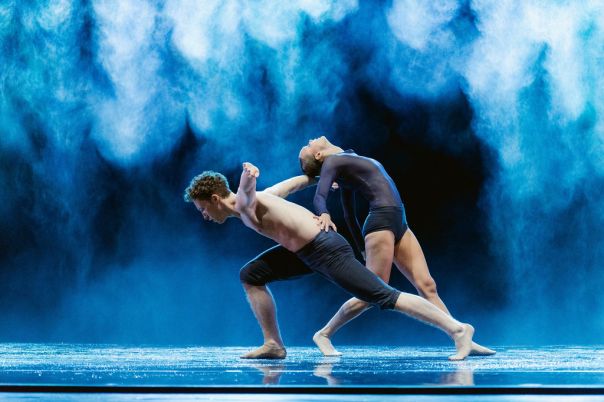
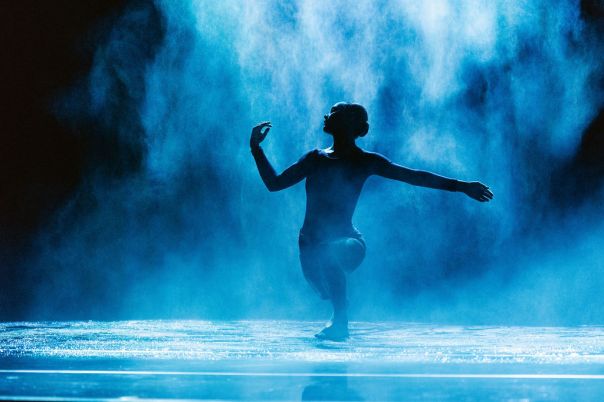
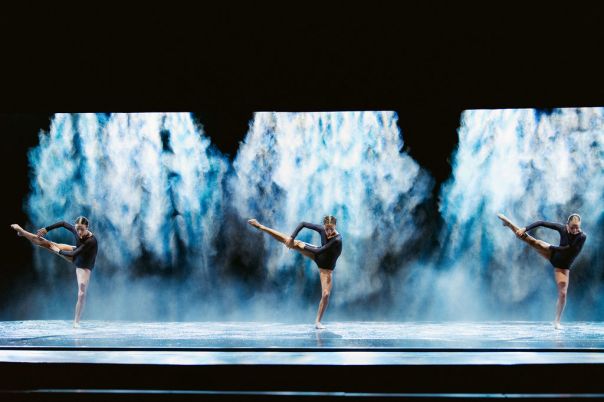
The last curtain rise before intermission revealed Cerrudo’s most joyous scene as three sections of streaming mists formed behind the dancers, lit in multiple shades of green, blue, purple, and white, merging and remixing in midair as they fell to the floor. Matching this sudden shower of color, the style of the choreography also perked up. Until now, the default mode of partnering lowered the dancers’ bodies toward the floor as they tugged at each other or slinged one another, without jumps or lifts. Adding the water to the stage floor, Cerrudo certainly didn’t risk sending his dancers airborne over the damp, but he freed his troupers to frolic in the water, sending gleaming dewdrops merrily into the air as they splashed around the floor. Occasional kicking motions jubilantly affirmed that there was nothing incidental or accidental about the waterdrops flying across the stage.

It could have been my imagination, but Glass’s music grew jazzier here, especially when played by Bush and his quintet. The catchy curlicues of melody that erupted here were certainly not a mirage.