Tag Archives: Spoleto Festival USA

O’Rowe’s “The Approach” Isn’t Quite Reaching Us

Review: The Approach at Spoleto Festival USA

By Perry Tannenbaum
51896456148_7a4362edbf_o

It’s tempting to declare Mark O’Rowe’s new play, THE APPROACH, a retro or even misogynistic drama. Now in its US premiere at Spoleto Festival USA through June 12, from the Dublin-based Landmark Productions, O’Rowe’s elegantly circular piece – which he himself directs – does little to push against the stereotyped notion that women chatter endlessly about their men, their family, old times, how wonderful they still look, and how happy or unhappy they are.

Except for the endless part: we peep in on a revolve of five or six dialogues between Anna, Cora, and Denise within the compact space of about 65 minutes. With the exception of a reconciliation scene between Denise and Anna, who turn out to be long-estranged sisters, all the meetings seem to have begun with two of the women bumping into one another by accident. All the scenes, except the last, end with effusions on how wonderful it was to get back together and earnest promises to be back in touch soon – always preceded by abrupt sorry-gotta-goes and never followed with any follow-up.

Not that the caring for their men goes any deeper. In three of the dialogues, the women are asked to cite examples of their special man’s special thoughtfulness. Anna tells Cora about the time Oliver surprised her by creating a crossword puzzle with clues that unlocked intimacies that only the two of them could know. We laugh when Cora passes this story along to Denise as exemplifying her special man’s specialness. And when this running joke completes its cycle after a number of years, when Denise gets back together we’re a little surprised that Anna has little reaction – and no recognition – when her sister tells the crossword tale.51897018530_a375cd359b_o
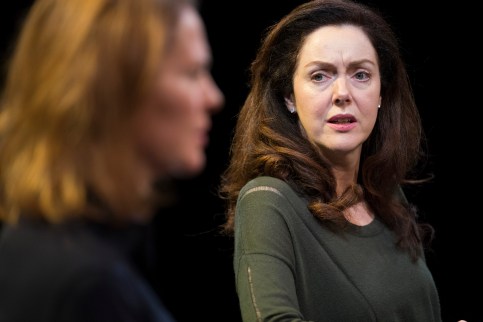
The joke is on us at that point, for the adorable crossword anecdote didn’t begin with Anna, either. Anna is the touchstone in the other repeated motif as O’Rowe completes the circle of his story. The final scene between Cora and Anna, like the opening scene between the same women, begins with Cora admiring Anna’s bracelet and Anna taking it off to give Cora a closer look. O’Rowe subtly emphasizes that this is the same bracelet as before, for not only is the store where Anna says she bought it the same, but so is the other place where she saw it. Neither of the women realizes that she is repeating herself.

Yet it is exactly here that the playwright has exposed himself, for it’s obvious that he is more interested in neatly tying up his design than in delving into the truth of his characters. At 65 minutes, his “approach” to his characters is even more superficial than how he shows theirs to be to one another. As a failure of the imagination, The Approach seemingly exposes a failure of a male playwright to visualize women discussing their careers and our world, a failure that might be said to typify all men – as easily as the shallowness and deceit he depicts in Anna, Cora, and Denise can be said to typify all women.

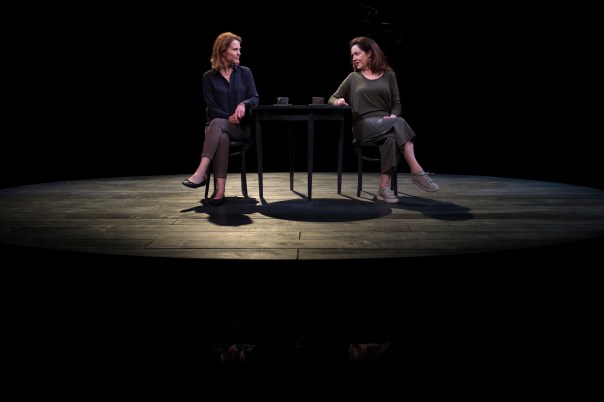
At a murky and rundown coffee shop, around a drab table where two pairs of colorless cups and saucers are never touched, designed and dimly lit by Sinéad McKenna, the nebulous unreality of the women is accented by their surroundings. The width of the table is enough to establish an unbridged distance between the women as they converse. Although the action spans years, I can’t be sure that O’Rowe required designer Ciara Fleming to provide the cast with any changes in attire – or hairstyle – as the actors sojourned backstage and fictional time was elapsing. These are staple embellishments in American comedies that follow similar cyclical formats.51896708539_0dac4e5b31_o
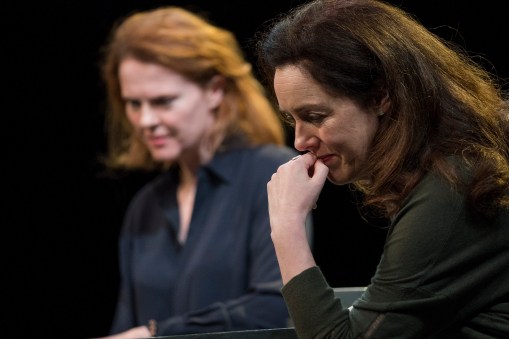
With a steady undercurrent of dolor that O’Rowe constantly spreads so close to its surface, The Approach never threatens to become a laugh-fest. Nor does the distance between the women at this café prompt O’Rowe to demand that his players speak loudly enough to counteract the inevitable din of a public place. So like previous Irish imports staged at Dock Street Theatre, we struggle to hear and understand these women.

As Denise, Derbhle Crotty emerges as the most consistently audible and scrutable of the cast, which makes sense since this sib professes to be the blithe spirit in this bunch. She liked Oliver before he ditched Anna, but the estrangement persisted past his funeral when his ex pointedly refused to attend. Now that she’s blissfully remarried – to that thoughtful soul who customized a crossword puzzle to their relationship – and carrying this paragon’s second child, she doubts that she ever truly loved the man she stole away from her sister. Naturally, that makes the rift between the two exes more painful and gives Crotty a wider spectrum of feelings to explore.

Adding irony to the rift, along with some scathing satire, Aisling O’Sullivan as Anna has already revealed that she has similar doubts about her love for Oliver. So O’Sullivan’s portraiture is the darkest and most resentful by far, dimly lit up by her superficial friendliness towards Cora and her belated willingness to reconcile with Denise and assuage her sister’s pain and guilt. It’s a pianissimo portrait that also enables us to imagine why Oliver drifted away from this darkness to Denise’s comparative sunniness. He could be unloved by the cheerier sister.

Sketched as the most superficial of the three women, Catherine Walker as Cora could easily have chosen to be the most boisterous. Instead, Walker recedes into the nebulosity of her surroundings at least as completely as the siblings do. Cora has never really sustained a relationship with a man, it would seem; nor is there any enduring closeness with either of the sisters, for all their shared memories. With the blandly wholesome path Walker has chosen, we can assume that the reason Cora’s relationships fail to cement isn’t that she’s clinging or annoying. No, it’s because Cora is so indistinct, so uncaring, and so forgettable that her relations are so tenuous.

She could have been a liaison between the sisters instead of merely another acquaintance they had in common, and she could have become instrumental in their reconciliation. As their sounding board, Cora is our gateway into the hearts of Anna and Denise – our connection with the sisters – meeting infrequently enough with them to keep us informed as they catch up. No other need for her can be discerned.

A couple of days after I witnessed THE APPROACH at Dock Street Theatre, I overheard a couple of women at another Spoleto event describing the struggles they had experienced in hearing and understanding the play. “But at least you put it all together eventually,” their sympathetic listener consoled. If O’Rowe in directing, and his cast in acting, had served O’Rowe the playwright more diligently and energetically, most of those struggles would have been avoided. And the experience would be far more pleasurable – and what the script deserves.

“Until the Flood” Overflows With Inner City Insights

Review: Until the Flood at Spoleto Festival USA

By Perry Tannenbaum

2022~Spoleto-159

Conceived and acted by Dael Orlandersmith, UNTIL THE FLOOD is an amazing, transformative theatre experience, briefly at Spoleto Festival USA through June 6. You quickly got the feeling that it was even more transformative for the playwright while she was interviewing the people she portrays – and likely transformative for the actress inhabiting those people before you. Commissioned by The Repertory Theatre of St. Louis in 2016, Orlandersmith was tasked with crafting a response to the shooting of Michael Brown by policeman Darren Wilson in nearby Ferguson, Missouri, on the night of August 9, 2014.

In carrying out her mission, Orlandersmith’s inquiry was an examination and a diagnosis of the effects of Brown’s shooting – not an investigation of the fatal event seeking to determine culpability. Her fundamental, open-ended question to many Ferguson and St. Louis residents, Orlandersmith told us in a public conversation at Spoleto during her run, was How did this event affect you?2022~Spoleto-161

Out of the answers she received – some of them stunning, no doubt – Orlandersmith forged eight composites, each of whom delivers a monologue until we circle back to retired English teacher Louisa Hemphill in completing our 75-minute visit to Ferguson. Set designer Takeshi Kata is sharply focused on making us feel like we are truly in Ferguson, with nearly antique objects such as a lamppost, an easy chair, a floor lamp, a coat stand, and a barber’s chair strategically strewn across the Festival Hall stage. This simple layout was surrounded by the sort of grassroots memorial that always seems to sprout up at the site of heart-rending American murders, a profusion of flowers, candles, cuddly stuffed animals, scribbled cards and messages, framed photos, and liquor bottles.2022~Spoleto-176

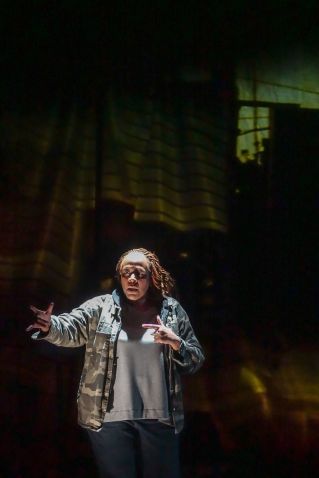
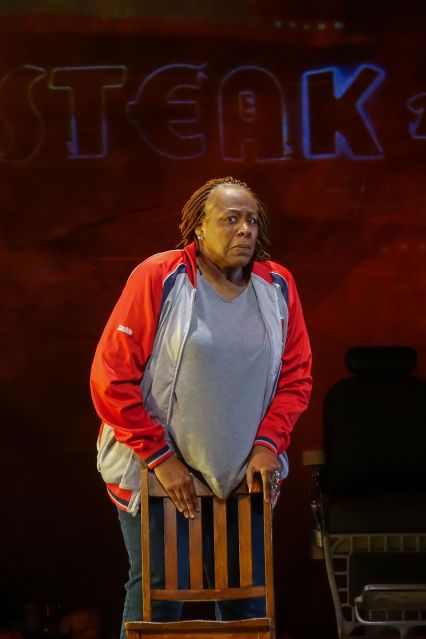
Kaye Voyce’s costume designs, all that Orlandersmith really needed to quickly change character, echoed the inner-city decrepitude. A couple of shawls and a few jackets – including a camo hoodie and a St. Louis Cardinals warmup – partially signaled the changes, while Nicholas Hussong’s video designs darkly completed the settings for the monologues. Helpfully, they were impressionistic depictions of building exteriors rather than realistic indoor depictions, so we knew we were at a steak house for retired policemen Rusty Harden, a wine bar for high school teacher Connie, and Reuben Little’s barbershop. The scene only brightened a little when minister Edna Lewis draped herself in a clerical shawl and we saw a rather photographic representation of her church.

So all of these Orlandersmith composites are rather specific and sharply drawn, usually memorable for at least one vivid anecdote in each monologue. We get to know the backgrounds of Hassan, the fluid rapper, racist electrician Dougray Smith, and aspiring high school student Paul, for in delving into how these people became who they are, the playwright was exploring how we became who we are.2022~Spoleto-171

Orlandersmith sought to be objective in order to be revelatory. She is keenly selective in what she relays to us and artful in how she orders her materials and lifts her respondents’ words imaginatively into the hallowed realm of theatre. Resisting the urge to layer on subsequent racial and political episodes as she continues traveling with her show, she has let UNTIL THE FLOOD accrue an aura of authoritative prophecy with the passage of time. The flood has only deepened since 2016.

2022~Spoleto-166

Even though Orlandersmith steps out of character to offer a brief coda at the end, she never tips off her point of view. But we can detect patterns. The three women are cordial and rational while, with the exception of the soft-spoken Paul, toxic masculinity runs riot among the five men. Reuben and Rusty are the most workaday specimens while Hassan and Dougray are the most dangerous and explosive. Mary Louise Geiger’s lighting is darkest and bleakest when these menacing men are before us.

About the only time I found Orlandersmith gently manipulating her monologues, so that we saw what she saw in Ferguson, was in the sequence of confessionals from the retired cop and the rapper who followed immediately afterwards. Rusty, the retired white cop, still remembers the wild look of in the eyes of Black youths, approaching him or at close quarters, seeming to be daring him to fire his gun – sometimes wanting him to. Working himself into a fury, the cool fluid rapper Hassan loudly proclaims that he had such feelings. Yes, that exact death wish that had just astonished me when the cop spoke of it.2022~Spoleto-163

Could there really be such desperation rampaging through our cities and ghettos? Orlandersmith confirmed her viewpoint the following afternoon in her conversation Martha Teichner, casually turning to the audience during the Q&A and asking us, “Have you ever heard of suicide by cop?”

I had not – which capsulizes why it was so vital for me to hear and heed UNTIL THE FLOOD.

The Cookers Heat Up the Cistern

Review:  The Cookers at Spoleto

By Perry Tannenbaum

Dive In by Leigh Webber leighwebber.comAfter a pandemic-induced hiatus that canceled last-year’s 17-day event, Spoleto Festival USA is back in Charleston for 2021 – but not all the way. Opera, symphony, and choral presentations remain in lockdown, Spoleto’s indoor jazz venue remains shuttered, and the long-anticipated premiere of Rhiannon Gidden’s Omar remains on hold until 2022. The festival’s general director, Nigel Redden, who has announced that he will be stepping down in October after a 26-year stint at the helm, admitted that the efficacy of COVID vaccines and the speed of recovery had wrong-footed Spoleto in their scheduling.
The only indoor events at Spoleto this year were The Woman in Black, on loan from its epic 30-year run in London’s West End, and the daily series of lunchtime chamber music concerts at historic Dock Street Theatre, always the bedrock of the festival. Live dance and music events are otherwise outdoors. With necessity as their mother, a whole brood virtual events, presented online or on your cellphone, has been invented.

Deep in the heart of Trump Country, Spoleto does impose social distancing in arranging seating, and they ask ticketholders to be properly masked until they are isolated in their seating pods. These hardships didn’t seem to dampen the rush on the festival box office, creating a quandary for omnivores like me. Press comps were unavailable for the first 12 chamber music concerts, forcing us to miss the opening weekend with its combo of New Orleans celebrations on successive nights at The Cistern. The first of these featured the Preservation Hall Jazz Band and the second, a tribute to the life and music of multi-instrumentalist Danny Barker, offered Catherine Russell as its featured vocalist.

Dive In by Leigh Webber leighwebber.com

Since I had reviewed performances by both Preservation Hall and Russell in recent years, I punted on the first weekend and opted for The Cookers on the middle weekend of Spoleto, when access to the chamber music series would also open up. Allowing us to catch up with such heavyweights as George Cables, Cecil McBee, Eddie Henderson, and Billy Hart, all of whom I knew well from recordings but had never seen live, The Cookers were anything but a consolation prize. Then there was also an opportunity to reconnect with Billy Harper and Donald Harrison, two sax greats whom I hadn’t seen on a bandstand in well over 10 years.

If the weather cooperated.

Over and over, I had checked on the forecasts. No wavering from predictions of thunderstorms slated to plague that second weekend – and no contingency plans, the press office told me, if the Saturday night concert were to be rained out. It was a nail-biter, especially after what happened to us on Friday night. My wife Sue and I were nearly finished with dinner when my iPhone beeped with a text telling me that Ballet Under the Stars had been cancelled. By then, rain was pouring down so ferociously that, after paying our bill, we told our waitress to open a dessert tab.

We could be thankful that we made it back to our hotel that night, because the floodwaters near where we had parked reached the tops of our tires at one of the intersections. We soon passed police barricades barring traffic to the streets we had just left moments before.

Ominous clouds loomed overhead as we walked past The Cistern on the night of the concert. Spoleto crew were obviously no more confident than we were. Tentpoles surrounded the bandstand where The Cookers were scheduled to perform, with a white carnival-like canopy protecting the electronics. We speculated that maybe they would perform in a light rain and let the audience fend for themselves. Or maybe The Cookers were merely having a cookout.

As we took our seats underneath one of The Cistern’s live oaks, the stage crew moved the tentpoles and canopy off the staging platform minutes before the 9:00pm start. Apparently, local radar had given the band a green light. But for how long? We’ve seen scenarios – including just two years ago, when Carla Bley brought her trio to The Cistern – when festival officials, citing an oncoming storm, forced the performers to curtail their program.

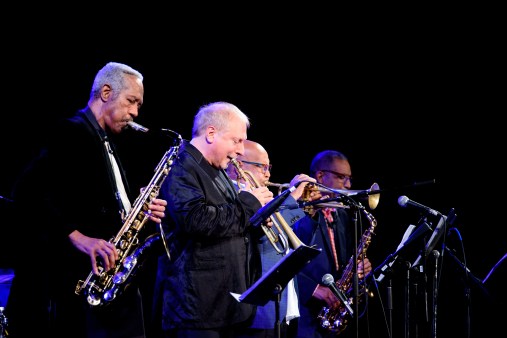
Fortune smiled on us, for the band not only stayed onstage for the scheduled hour-and-a-quarter, they overstayed, lingering longer than 90 minutes. Some might also say they overcooked, for these were mostly searing, incendiary performances. The only mellowing agents all evening long were bassist McBee, who merely smoked on his solo in his own “Peacemaker,” and trumpeter David Weiss, organizer of the group and its spokesman, whose sizzling hot solos actually seemed to cool things down amid this torrid zone of horns.Dive In by Leigh Webber leighwebber.com

Tenor saxophonist Harper, brooding by the keyboard near Cables and playing a gruff, disconnected cadenza, clued us into how it would be. This turbulence was before Harper joined the other horns downstage for the four-barreled launch of his “Call of the Wild and Peaceful Heart,” the title tune of the band’s most recent release. Within moments of this brash and brassy opening salvo, Harper seemed to have the stage all to himself, totally possessed as he unleashed a snarling, squealing, epic rant that announced he was ready for more than a cutting contest – he was geared-up for a knife fight.

When Henderson returned to his mic with his trumpet, and when Harrison followed with his alto sax, each man soloed as if Harper’s gauntlet had been tossed at him, dueling with the tenor great and with each other. After Henderson answered Harper’s fury with some awesome flame throwing, Harrison didn’t flinch, firing off a face-melting solo of his own. Arrangements for this and three other Cookers tunes from past CDs were looser live than in their studio versions, encouraging all this calculated fury and derangement. If you caught the body language of whoever was blowing and the next man up, you were hip to the fact that there was no ironclad limit to the solos.Dive In by Leigh Webber leighwebber.com

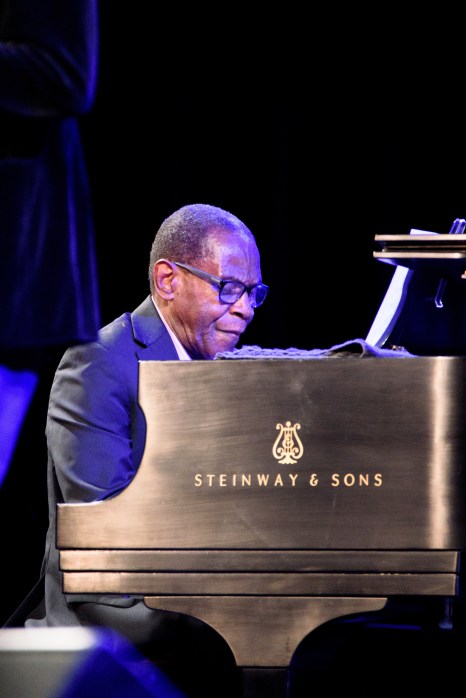
With relative subtlety, the rhythm section of Cables, McBee, and Hart seemed relegated to timekeeping toward the rear of the bandstand as the men with the horns jousted in the foreground. Like McBee in “Peacemaker,” both the pianist and drummer got their shots. Cables set up his own composition, “The Mystery of Monifa Brown,” which was the only tune in the set not previously recorded by the septet. On the Cistern stage, the group totally transformed the tune from what it was on the 2016 Songbook album with Cables’ trio. Not only did the addition of the horns bring fresh fire, Cables himself thundered in a way that came far closer to the sound and percussive fury of McCoy Tyner.

Dive In by Leigh Webber leighwebber.com

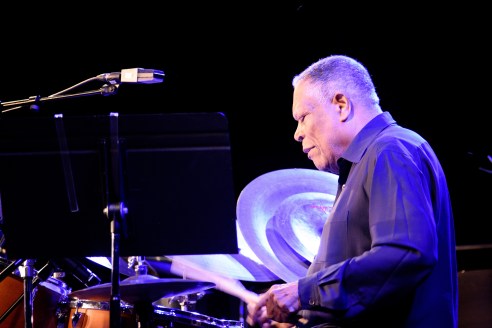
As often happens in live concerts, drummer Hart got his chance to shine in the finale, Wayne Shorter’s “The Core,” after yet another searing peroration from Harper’s tenor. The sizzle of Billy’s cymbals and the barrage on his toms left scorched earth in his wake.

Paradoxically, Henderson may have received the most precious gift of the night as the Harper tune of the set, “If One Could Only See,” gave the trumpet ace an opportunity to slow the tempo – an oasis of meditative calm amid the livid flame-broiling at The Cistern. For many in the crowd, the change of pace may have come as a revelation, but for those of us who have followed the group since their genesis in 2010, it was a reminder that The Cookers can still deliver when they turn down the heat.

Jazz at Spoleto culminates this weekend with Jason and Alicia Moran’s co-production, Two Wings: The Music of Black America in Migration. Instead of Reconstruction, the Morans will be focusing on the music of 1910-1970 – and the key moments that forged so much of modern American music afterwards. Aside from the Morans, Wycliffe Gordon and the Imani Winds are among the talents gathered under the live oaks at The Cistern for this musical narrative.