Tag Archives: Etienne Charles

Spoleto’s 2025 Jazz Lineup Cements the Festival’s Place Among America’s Finest Jazz Showcases

Reviews: Phillip Golub, Cécile McLorin Salvant, Branford Marsalis, Vijay Iyer, Etienne Charles, and Ambrose Akinmusire

By Perry Tannenbaum

June 6, 2025, Charleston, SC – Jazz roots run deep in the Carolinas, where such international jazz ambassadors as Thelonious Monk, Dizzy Gillespie, Nina Simone, and John Coltrane were born. Though we’re usually not mentioned in the same breath as Newport, Monterey, SFJazz, DC, or Montreal, the Carolinas are home to significant festivals worth celebrating in High Point, Columbia, and – in years when we get our act together – Charlotte. Yet our most significant jazz festival has been hiding in plain view for nearly 50 years: Spoleto Festival USA. From its first year in 1977; when the headliners included Phil Woods, Urbie Green, and Louis Bellson; jazz has been a constant at Charleston’s international performing arts revels. Unlike visual arts, country music, puppetry, or circus, jazz has been on the bill at every Spoleto.

Of course, so much more besides jazz is offered at Spoleto. Any of the staple components of the festival – opera, theatre, chamber music, choral music, or dance – can find itself hiding in plain view amid the prodigious entirety of the festival, 120+ performances this year over 17 days. Strip away that mass of other stuff and it isn’t really hard to see that the 2025 lineup down in Charleston measures up with the best in North America. Cécile McLorin Salvant, Branford Marsalis, Vijay Iyer, Ambrose Akinmusire, Phillip Golub, and Etienne Charles not only match up well with the most elite festivals on the continent. Two of them, trumpeter Akinmusire and keyboardist Golub, lingered at multiple festival sites for three-day residencies, giving four and six performances respectively.

Thanks to the efforts of general director Mena Mark Hanna to make the massive festival more navigable, the jazz artists were listed on consecutive pages in the festival’s promotional brochure and the free – and comprehensive – festival program books for the first time. Scheduling was also conveniently compressed so that you could sample all of these jazz giants within the space of 10 days. Mavis Staples and Arooj Aftab, headliners at multiple jazz festivals around the country, were also slotted into Spoleto’s Front Row pop/country/rock/folk series, and accessible during that same timeframe.
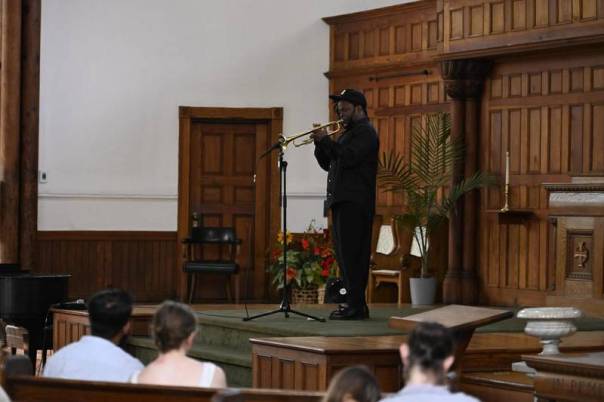
My own jazz feast started on Day 5 of the festival with Golub’s quintet, his final program at the Circular Congregational Church. My fondest memory of the Circular dates back to 1997 when Spoleto’s production of Benjamin Britten’s moody Curlew River was staged there in dim gilded light. As a jazz venue, the Church was most unkind to Golub’s piano, which seemed to emerge from its corner as a somewhat muffled echo, though the bandleader’s perch was fortified with a Rhodes synthesizer. Neither Alec Goldfarb’s electric guitar nor Daniel Hass’s cello was spooked by the hall’s acoustics, and the remainder of the rhythm, Sam Minaie’s bass and Adriano Vicentino’s drums, may have actually been enhanced.

The quintet played Golub’s Abiding Memory Suite in its entirety, with Vicentino as the only newcomer to the ensemble that recorded the studio album released in 2024. Once the piece, played without significant pauses, drifted away from the piano, it proved to be nicely varied and unpredictable. After Goldfarb’s guitar pierced the hall with its ethereally thin and silvery timbre in “Threads Gather,” the oddest, most scattered and modernistic episodes, “A Regrouping” and “Unspooled (Waiting Quietly),” cast a quiescent spell. “In a Secret Corner” carried that irregular flow forward, building gradually before breaking back into metrical jazz. Though he played provocatively in spots, Hass seemed underemployed until late in in the suite, when he at last justified his presence with some memorable solo work in “At the 11th Hour.”

It was fascinating to see and hear various configurations of the Spoleto Festival USA Orchestra throughout our 12-night stay. Massenet’s Thaïs, a Mozart symphony, Britten’s The Turn of the Screw, the Sibelius Violin Concerto, and Cécile McLorin Salvant each had a uniquely configured ensemble – led by three different conductors. It was a bit surprising for me, nonetheless, that the ensemble playing behind Alexi Kenney in the Sibelius underperformed compared with the superb support Salvant received three nights earlier in the same hall, Gaillard Center.

There was a sense, after three previous appearances at Spoleto, that both the festival and Salvant were wanting to try something different and reach higher. And until the festival premiered its production of The Turn of the Screw, Salvant was incontestably the highlight. We haven’t seen a new album from Salvant in two years, but none of Darcy James Argue’s orchestral arrangements were from that mostly French Mélusine release. Neither of the songs in the set that the diva has recorded, her own “Left Over” and Noël Coward’s “Mad About the Boy,” had orchestral arrangements before Salvant brought them to Charleston, and she sat down at the piano to replace the esteemed Sullivan Fortner (cover boy on the February 2025 issue of DownBeat) for her own original.

The highlights of the set were Salvant and Argue’s fresh takes on Duke Ellington’s “Sophisticated Lady” and Billy Strayhorn’s “Lush Life,” perhaps their most beloved ballads. But the audience showed even more enthusiasm for Stephen Sondheim’s “Send in the Clowns” and Michel Legrand’s “I Will Wait for You” from The Umbrellas of Cherbourg. With a disdain that would have pleased Parisians, Salvant sang the original French lyrics, “Je ne pourrai jamais vivre sans toi,” without a single interpolation of the English lyric. Salvant’s “Send in the Clowns” reminded us of the quirkiness that charmed the world from the outset of her career, flouting the usual 3/4 groove, speak-singing some of the familiar lyric, and wiping away some of the usual nostalgia and sentimental goo. Best version I’ve heard since Carmen McRae.

Naturally enough, since Branford Marsalis was on the May cover of DownBeat, he and his quartet surely do have a new album out there to tour with, Belonging. Marsalis didn’t lean on the recent release as heavily as Golub leaned on his, but he certainly referenced his magazine celebrity with the two titles he did pluck from that CD, “’Long as You Know You’re Living Yours” and “Blossom.” Both were Keith Jarrett compositions, chiming well with the front page May headline, “Marsalis Tackles Keith Jarrett.”

Branford was pretty cool as a bandleader, usually slipping away after his soprano or tenor sax solos were done – often abruptly – behind Justin Faulkner and his drumkit when others were soloing. Pianist Joey Calderazzo not only had ample chances to shine in the Jarrett pieces, but he also had two of his compositions, “The Mighty Sword” and “Conversation Among the Ruins,” prominently featured on the setlist.

With past stints jammin’ with Sting and leading The Tonight Show band, it would appear Branford’s appetite for celebrity has long since been satisfied. Bassist Eric Revis also got some love when Marsalis called for his “Nilaste” toward the end of the concert. Lighter gems – and more popular with the Charleston Music Hall crowd – were Jimmy McHugh’s “On the Sunny Side of the Street” and the rousing encore, “My Bucket’s Got a Hole in It” (more likely by Buddy Bolden or Clarence Williams than Hank Williams).

Iyer took over Sottile Theatre with his supertrio two nights after Marsalis. Like Iyer, bassist Linda May Han Oh and drummer Tyshawn Sorey (a fellow MacArthur Fellow) had both headlined at Spoleto in past festivals. As a group, they’ve put out two albums in the past four years, but in live performance, it was hard to see them as close-knit. Whether they wished to simulate a recording studio ambiance or someone in the group wished to remain unmasked despite COVID fears is anyone’s guess. But they sat and stood at more than the customary distance away from each other. When I last saw Iyer play at the Jazz Standard in New York, my wife Sue and I were seated closer to Iyer than either Sorey or Oh.

Despite the trio’s separation, their chemistry and interaction were all the more amazing. Each appeared to be in his or her own world, yet they were constantly interconnected. If one of them was not playing, he or she seemed to have peeled off at a predetermined or spontaneously signaled moment. Intensity didn’t wane in those moments when balances shifted among the players. Sorey could assert himself with a single stroke anywhere in a measure and take complete control with a sudden flurry, endlessly inventive and colorful. Oh showed us once and for all that she is a composer/improviser who can easily hold her own in the presence of two major virtuoso composers – even though her bass didn’t penetrate at the Sottile like it does on the trio’s recent Compassion recording, where it’s as intimate as your heartbeat.

As for Iyer, he once again proved nonpareil. In the space of a single piece or solo, he could build to the epic force of McCoy Tyner, jet through that thunderous cloud he and Sorey stirred up, and emerge with all the purposefulness, lyricism, and freedom from mannerism of Bill Evans. “Overjoyed,” a very inventive and angular cover of Stevie Wonder’s tune, was probably the easiest for newcomers to Iyer’s music to latch onto. The “Free Spirits/Drummer’s Song” pairing was far more exciting for me because Sorey was so much sparer, explosive, and creative than he was on the Compassion track. Other trios might have swung harder, but since the great Evans trios, none I’ve heard was more beautiful or compelling.

Since I had seen him live at the Seixal Jazz Festival in Portugal with his quartet less than three years earlier, Akinmusire’s residency was by far the most intriguing for me. But we had to find out what “An Evening with Isaac Mizrahi” was all about – the festival brochure and program book seemed to imply that Mizrahi was everything – so we had to miss out on Akinmusire’s quartet and trio concerts, both of which overlapped. It was especially brutal for me not to attend what would have been my first jazz concerts at Dock Street Theatre after more than 30 years of attending Spoleto, but Sue’s reactions to the giddy Mizrahi and the cutting-edge trumpeter vindicated my choice.

Akinmusire’s gig at the Sottile, our last event in the Holy City this year, was likely the most unique and accessible of his residency, though I’m still bemoaning my lost opportunity to behold an Akinmusire-Fortner-Sorey trio at the Dock. The nine performers in the Honey from a Winter’s Stone concert, including the PUBLIQuartet and vocalist Kokayi, were spread out across the Sottile stage even more widely than the Iyer Trio. Boundaries between what was written by Akinmusire for the string quartet and what was improvised by his quartet were more distinct, but it seemed like Kokayi’s rap rants, rhythmic and melodically on key, straddled those boundaries as the speed of the spewed verbiage increased. Most infectious rap performance I’ve ever experienced, even though most of the words weren’t clear.

Reggie Washington on electric bass and Justin Brown on drums counterbalanced the strings and Kokayi by sticking to their jazz rhythms, but keyboardist Sam Harris brought an acoustic and an electric instrument to the stage, another straddler. Through the course of the evening, as the group traversed their 2025 honey from a winter’s stone recording – with nearly identical personnel – Harris might lay down a vamp on his synthesizer or trigger a modulating drone as frequently as he soloed. Generous space was also set aside for Brown’s thrashings.

Akinmusire had little to say between selections, usually pointing to and naming one of his bandmates, but his horn said plenty, with judicious electronic alterations here and there. You could argue that Akinmusire had somehow synthesized the earliest electronic explorations of Bitches Brew Miles Davis with the two acoustic periods that preceded that revolution, the Kind of Blue period and Davis’s playing with the quintet he led that introduced Herbie Hancock and Wayne Shorter to the universe. But the living trumpeter is undoubtedly building upon that legacy.
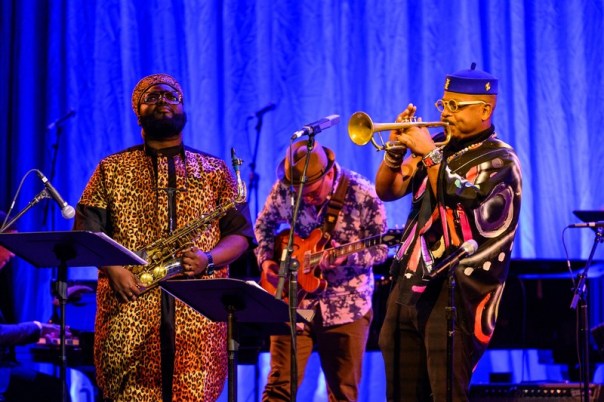
None of this year’s jazz events took place outdoors at Cistern Yard, the temple of Spoleto jazz in years gone by. Like last year, when Trombone Shorty had to move his show to the College of Charleston’s TD Arena, weather intervened between us and seeing Etienne Charles and his Gullah Roots band under the live oaks. By now, such last-minute schedule switches are almost routine at the festival: the sound system is tight and the lurid outdoor lighting arrives somewhat intact. Charles’s show was not quite as rambunctious or gaudy as Shorty’s extravaganza had been, but his suite – soon to be officially released on CD – was far more profound, moving, and relevant.

Nor was there any lack of showmanship in the presentation of this epical suite, which traversed the arrival of the Gullah in the New World via the Middle Passage to the morning when Lincoln’s Emancipation Proclamation took effect. In three stages, the Gullah Roots ensemble grew from six to seven, seven to eight, and eight to 14 as the massiveness of Charles’s concept enlarged. Those two historical watersheds were both marked with two-part compositions, “Igbo Landing” and “Watch Night.” After the foundational “Gullah Roots” piece, special guest Quentin Baxter, a longtime Charleston-and-Spoleto fixture, joined the group as a second percussionist for the dramatic “Landing.” Later for “Bilali,” Samir LaGus came forth in more striking African garb than we had seen before, bringing with him a guembri, a three-stringed lute-like instrument that merited its own introduction from Charles.

For “Watch Night,” taking us back to New Year’s Eve on December 31, 1862, a four-woman choir (The Wives), vocal soloist Quiana Parker, and organist/choir conductor Damian Sneed joined the solemn vigil and ultimate jubilation. Visually the spectacle was as grand as the music as Sneed and his singers filled the side of the stage opposite LaGus and the percussion. Issued on September 22, the iconic Proclamation would become law at midnight, the beginning of Freedom Day. One day after Juneteenth 2025, Charles brought his Gullah Roots to the Stage Door at Blumenthal Center for what promised to be a very special Jazz Room concert presented by JazzArts Charlotte.

Down at Spoleto USA, the Vibe Is Shifting

Review: Spoleto Festival USA in Charleston

By Perry Tannenbaum

‘Song of Rome’ at Spoleto Festival USA in Charleston. (Photo by William Struhs)

Looking down benignly at his Dock Street Theater audience, the newly anointed host of Spoleto Festival USA’s chamber music series, Paul Wiancko, gave us a slight ceremonial nod. “You have chosen wisely,” he said sagely.

But he wasn’t exactly speaking to me, since this was already the fifth program in the noonday series – the backbone of Spoleto – that I was attending this year. Nor was he speaking to the “eleven-ers” in the audience who were signed up for the complete set of programs down in Charleston through June 9.

He was speaking directly to those in the audience who would only attend one of the concerts. Today. And he would go on to ask us all to participate in making the experience special and unforgettable.

It would be very special – beginning with a Beethoven piano trio that showcased Amy Wang at the keyboard, Benjamin Beilman on violin, and Raman Ramakrishnan on cello. How’s that for diversity? My love affair with Wang’s artistry and demeanor had begun just two hours earlier when she played the Schumann Violin Sonata, teamed up with the Slavically expressive Alexi Kenney.

Enough to mightily crown most concerts, the Beethoven was merely a satisfying appetizer. For Wiancko had cooked up a powerful combo, calling upon two living composers that I was barely familiar with, Jonathan Dove (b. 1959) and Valentin Silvestrov (b. 1937).

Our contribution to the magic would be to withhold our applause between the two pieces. It was easy enough to maintain stunned silence after In Damascus, Dove’s heartfelt setting of Syrian poet Ali Safar’s grieving – and aggrieved – reaction to a senseless car-bombing in his nation’s war-torn capital.

The prose poems were achingly and angrily sung by tenor Karim Sulayman, perhaps most indelibly after an extended instrumental interlude, turbulently delivered by a string quartet that included Kenney, Beilman, Wiancko (on cello), and violist Masumi Per Rostad.

“We will be free,” Sulayman sang in Anne-Marie McManus’s ardent translation, “of our faces and our souls – or our faces and our souls will be free of us. And the happy world won’t have to listen to our clamor anymore, we who have ruined the peace of this little patch of Earth and angered a sea of joy.”

Sulayman was visibly in tears as the lights went down on In Damascus and pianist Pedja Mužijević entered with his iPad and sat down at the Steinway. In the dimness, Mužijević played Silvestrov’s Lullaby, an appropriate coda to a song sequence that began with the children of the Zuhur neighborhood in Damascus who would never wake from their sleep – or survive a bogus “holiday truce” – and ended with the evocation of mothers and loved ones who would always await their return.

Amazingly enough, this isn’t the only instance where Sulayman is singing about children caught in the web of brutal war and barbaric terror, for his wondrous voice also figures at Spoleto in the world premiere of Ruinous Gods, a new opera with exotic music by Layale Chaker and libretto by Lisa Schlesinger.

Co-commissioned by Spoleto, Nederlandse Reisopera, and Opera Wuppertal, Ruinous Gods is a fantastical deep dive into the mindworld of Uppgivenhetssyndrome, a rare traumatic response to living in the limbo of displacement. It was first observed in children detained in Sweden, but the syndrome has now been observed in refugee camps around the world. Hopeless children simply go to sleep in reaction to their endlessly unresolved status. Some die, others lapse into coma – sustained only by a feeding tube.

Encased in a surreal bubble over a grassy bed from scenic designer Joelle Aoun, that is how we find our sleeping-beauty protagonist, Teryn Kuzma as H’ala, when the opera begins. Mezzo-soprano Taylor-Alexis DuPont as her mom, Hannah, is stressing and blaming herself while two doctors, Overcast and Undertow, hover over their patient, unsympathetic researchers hoping to analyze and classify the disease.

Meanwhile, Sulayman is decked out in a feathery all-black outfit as Crow, the mentor who, like Dante’s Virgil, guides all these comatose children from around the globe into a common underworld dreamscape where all are free. Is that a spaghetti rainbow dropping down across the Sottile Theatre stage from the fly loft as the imprisoning globule lifts off H’ala, or is there an unfathomably large jellyfish floating above?

Sinuous, jazzy, and sensuously obsessive, Chaker’s music resurfaced in the jazz sector of Spoleto 2024 – at Charleston Music Hall, a venue never used by the festival before. Bigger than Spoleto’s customary hall for chamber jazz (and eccentric modern music), the Emmett Robinson at the College of Charleston, the Music Hall was an acoustic revelation and a welcome escape from the Robinson’s clean-room sterility. Bonus points for the stars that lit up on the black backdrop.

Attendance was astonishing, more than could ever be seated at the Robinson, as Chaker, leading her Sarafand quintet on violin – with an occasional vocal – delved into her two most recent albums, Radio Afloat (2024) and Inner Rhyme (2019). Having worked with Daniel Barenboim and his West-Eastern Divan Orchestra, Chaker has created a jazz equivalent in Sarafand with Phillip Golub on keyboards, Jake Charkey on cello, John Hadfield on drums, and Sam Minaie behind the bass.

Compared to her opera, Chaker’s jazz and her Sarafand personnel made subtler political points. But this wasn’t the only jazz gig that came loaded with extra cargo. Terri Lyne Carrington returned to Cistern Yard for a pointedly themed concert under the moon and the live oaks – with political firebrand diva (and NEA Jazz Master) Dianne Reeves as her special guest.

Carrington’s cargo was collected into her Grammy-winning album of 2022, New Standards, Vol. 1, the first studio sprouting of her pathfinding songbook collection, New Standards: 101 Lead Sheets by Women Composers. So without much preaching, her set was a celebration of Geri Allen, Gretchen Parlato, Eliane Elias, and – at a high summit where Reeves duetted for the first time with Christie Dashiell – the great Abbey Lincoln and her mesmerizing “Throw It Away.”

All these greats joined together again on Allen’s “Unconditional Love,” with Kris Davis on piano, Matthew Stevens on guitar, and trumpeter Etienne Charles all getting in their licks, plus spoken and dance stints from Christiana Hunte. Wow.

Theatre at Spoleto this season is densely messaged. Or not. The Song of Rome was deeply immersed in issues of immigration and sexism, with an overarching interest in the fate of republics, in ancient day Rome and 21st century USA. Cassette Roulette, on the other hand, was pure frivolity, barely deeper than its title and whole lot bawdier.

After starring in An Iliad last season, Denis O’Hare could be logically expected to follow up that one-man conquest with An Odyssey. Well, he has, sort of. O’Hare co-wrote A Song of Rome with Lisa Peterson, his Iliad writing partner, but this time he doesn’t appear onstage, handing over the acting chores to Rachel Christopher and Hadi Tabbal.

Christopher is Sheree in modern times, a grad student striving to learn Latin, and Octavia, Emperor Augustus’s sister at the dawn of the Roman Empire. Tabbal is Azem in present day, Sheree’s immigrant Latin tutor – and our overall storyteller – and the poet Virgil during the reign of Augustus.

So O’Hare is skipping over the rest of Homer to engage with Rome’s great epic, The Aeneid, knowing full well that Virgil based the first six books of his masterwork on The Odyssey and the last six on The Iliad. As a thematic bonus, O’Hare and Peterson discovered during their research for this world premiere that Virgil himself was a refugee, forced out of his ancestral home in Northern Italy by Roman avengers of Julius Caesar who got Dad’s estate for their prize.

Although Virgil’s epic was likely commissioned by Emperor Augustus, aka Octavian, doubt remains whether The Aeneid is a work of propaganda justifying the Roman Empire as divinely ordained – tracing Octavian’s ancestry back to Aeneas and Venus as meticulously as the New Testament traces Jesus back to King David, son of Jesse – or a subversive work by an immigrant genius settling a score. While getting handsomely paid to do it.

Octavia and Virgil go back and forth on this point because the Emperor’s sister is both an admirer and a keen reader, but both are critical of Octavian, who is hell-bent on buttressing the legitimacy of Rome while closing off its path back to a glorious Republic.

“The Republic is over,” they agree. And how about ours?

While Sheree is learning about the Roman issue that comes up as Virgil delivers more and more manuscript pages to Octavia over the years, Sheree must face the issue in American terms when Azem receives a deportation notice. Does she instantly jump to his defense and rescue, or does she immediately suspect him of criminal activity?

Meanwhile, Sheree is reading The Aeneid differently from Azem and Octavia. Why is Octavia left out of literary history if she played such a key role? Why are Virgil’s women, particularly Dido and Lavinia, so passive and pathetic while the strong woman, Camilla, is a she-devil?

Finding this insidious neglect and defamation rampant in literary history and beyond, Sheree comes up with a radical, shocking solution that she announces on her podcast. She will pour fuel over every single book piled on the Dock Street stage and burn them all.

When will all this vicious animosity end? Citing the end of Virgil’s epic, where Aeneas, the immigrant from far-off Troy, killed the vanquished Turnus instead of offering peace, conciliation, and mercy, Sheree answers us curtly lighting the flame: it won’t. Opting for chaos, she almost says it aloud – to hell with the immigrants. (Or give it to the immigrants, if you’ve heard of the Goths.)

Moments like that land hard at Spoleto. Deep in Trump Country, at the Sunday matinee of Ruinous Gods, there was a loud boo among all the lusty cheering as the singers took their bows. Good. The nurturing point of the opera, gushing with empathy toward immigrants worldwide, had hit home, no matter how you feel about it.

Depending on whether you were attuned to John Cameron Mitchell’s Hedwig and the Angry Inch cache, or whether you resonated with Amber Martin’s worship of Reba McIntyre, Bette Midler, and Stevie Nicks, Cassette Roulette was hit-and-miss, redeemed or further cheapened by Martin’s bawdiness. Nicks’ “Rhiannon” was the crowd fave and mine on the night I attended, getting a far more epic performance that you’ll hear on AM radio or an elevator. But neither David Bowie nor Midler got much of a rise. The diet of ‘70s and ‘80s hits didn’t draw much of a youth crowd to Festival Hall, which was made over to a quasi-cabaret setup.

Trombone Shorty slayed far more decisively at TD Arena, where his outdoor revels with Orleans Avenue were abruptly moved when rain threatened. At the height of the indoor bacchanale, Shorty paraded through the audience at the home of College of Charleston basketball with key members of the band (none of whom were named in Spoleto’s fabled program book). They slashed up the rear aisle of the stadium, swung around to the side of the gym and came down along the side.

Snaking through the stadium, Shorty & Orleans reigned over the reigning pandemonium. The prohibition against photography was washed out to sea in a riptide of glowing cellphones.

Shoot, the band was taking selfies! And through it all, the sound remained perfect, Shorty and his brass perfectly aligned with the rhythm section on the TD stage, absolutely distortion-free. Sure, a few dissenters and defectors also trickled through the aisles, accompanied by true believers seeking and returning with beverage.

The most pathetic sufferer sat right across the aisle from my wife Sue and me, hunched over, elbows on kness, with his hands tightly cupped over his ears. Probably needed a ride to escape. Maybe he would have fared better in the open air, where at least some of the sound could have escaped skyward through the live oaks of Cistern Yard.

Final week highlights: Bank on it, the Bank of America Chamber Music series has four more different programs to offer – and a dozen performances – before Spoleto wraps up on Sunday. The Wells Fargo Jazz lineup continues strong, with an all-star Latin twist. Puerto Rican saxophonist Miguel Zenón and Venezuelan pianist Luis Perdomo bring their Grammy-nominated El Arte Del Bolero albums to life at the Dock Street Theatre in a three-day, five-performance engagement (June 6-8) while Cuban percussionist extraordinaire Pedrito Martinez lights up Cistern Yard with an Afro-Cuban stewpot of infectious rhythm, Echoes of Africa (June 7).

After distinguishing themselves in Mahler’s Fifth, the Spoleto Festival USA Orchestra returns to Gaillard Center with Beethoven’s Third (June 5), plus a Rachmaninoff concerto for piano + trumpet and composer-in-residence Reena Esmail’s “Testament” for tabla and orchestra. Upstaged by a visitation from the Charles Lloyd Sky Quartet this past weekend, the Spoleto Festival USA Chorus rebounds with a two-performance run of The Heart Starts Singing (June 6-7), sporting another Esmail piece that will feature Wiancko’s cello – and an eclectic mix of works by Tomás Luis de Victoria, Rachmaninoff, Irving Berlin, and more.

The Festival Finale of yore is gone this year, but there’s more folk, funk, Americana, and alt-country in this year’s Spoleto lineup. Still to come are Andrew Marlin and Emily Frantz’s latest partnering, Watchhouse (June 5), with their own band-backed experiments in folk-rock playing at Cistern Yard; Grammy Award winner Aiofe O’Donovan (June 7) returns with the SFUSA Orchestra to Sottile Theatre; and Jason Isbell (June 8-9) headlines the final weekend with a two-night stint at the Cistern.

Theatre continued during Spoleto’s second weekend with sharply contrasting shows, the wholesome Ugly Duckling from Lightwire Theater and the savagely satirical send-up of the American West, Dark Noon, from the Danish fit + foxy company in its US Premiere. A similar dichotomy prevails this week as Australian company Casus Creations takes over Festival Hall with Apricity (June 6-9), a family-friendly mix of aerial and acrobatic astonishment, with sprinklings of comic shtick and moody music.

On the edgy side, RuPaul’s Drag Race fans can rejoice greatly as Season 9 champion Sasha Velour deigns to bring her presence to Gaillard Center with The Big Reveal Live Show! (June 6). Is Charleston’s big house big enough for drag’s Queen of Queens? The Holy City and Spoleto haven’t been so sensationally desecrated since Taylor Mac ruled the festival.

Trumpet and Organ Summits Top Jazz Week at Savannah Music Festival

Review:  Savannah Music Festival

By Perry Tannenbaum

Jazz is always prominent when the Savannah Music Festival cranks up its eclectic springtime assortment of classical, country, Americana, rock, folk, and world music vibes. But diehard jazz fans will want to land at the festival during Jazz Week, culminating in the epic Swing Central Finale celebration and concert at Lucas Theatre of the Arts. Before the top three ensembles lead off the festivities, 12 high school bands play for a panel of jazz notables, once at the Lucas and once along the Savannah riverfront.

Workshops and clinics make Swing Central as much an educational experience as a competitive one. In the second half of the Finale, the awesome array of mentoring musicians gets to come out – after the winners’ placings are announced and the supersized checks presented – and strut their stuff. With the likes of Marcus Roberts, Ted Nash, Terrell Stafford, Stephen Riley, Ron Westray, Jason Marsalis, and Marcus Printup in their number, you can bet it’s a glorious march.

Celebrating the centenaries of both Thelonious Monk and Dizzy Gillespie, Swing Central 2017 was particularly splendid.

Until that culmination happened, the Charles H. Morris Center was the workhorse venue for jazz concerts. On successive nights, SMF executive and artistic director Rob Gibson pleasurably introduced a pair of organ and trumpet aces. Ike Stubblefield and Joey DeFrancesco presided over the rare sight of two vintage Hammond B-3 organs on the same stage. Next night, on the eve of the Swing Central Finale, Rodney Whitaker and MSU Professors of Jazz showcased the estimable Etienne Charles blowing his horn after Printup teamed up with a quintet of Youngbloods.

Festivalgoers could choose between pairs of sets beginning at 5:30 or 8:30. If you missed the back-to-back organists at night, you could partially atone with a set by the Ike Stubblefield Trio the following afternoon at 12:30, while Printup & Youngbloods did the afternoon honors the following day. With a little creativity – and a media pass – I was able to negotiate a 6pm classical piano recital on organ night, stop out for dinner, and arrive at the Morris Center just before intermission so I could scope out empty seats for my wife Sue and me when Joey DeFrancisco took over the stage.

DeFrancesco isn’t a shy or contemplative personality, and I first heard how he wails in live performance shortly after his first Columbia recording, at the tender age of 17, in 1989. So I thought I knew what to expect from him and The People who back him up. But Joey has piled an electronic keyboard on top of his B-3 console, and he brings a trumpet with him these days when he comes onstage.

A new electronic bent manifested itself immediately in DeFrancesco’s percolating intro to “So Near, So Far,” nodding to the middle acoustic and later electronic periods of Miles Davis at the same time. Yet that track remains fairly mellow on the new Project Freedom recording, while here Troy Roberts signaled on tenor sax that it was time to fasten our seatbelts as he finished playing the line. DeFrancesco turned up the heat to a temperature that surpassed the studio version, and Troy kept the flame high – while Joey and drummer Jason Brown became very busy underneath. For anybody who might be sleeping on Roberts: he is not your generic sideman, and both of his most recent recordings as a leader are well worth checking out. Dan Wilson was also a treat on guitar taking his choruses, never distorting his silky tone, and Roberts roughened his outro with a pedal I hadn’t noticed on the floor near his mic.

There was no reprise of the floor pedal as the quartet reverted to the trad grooves usually heard at the Morris. “Bluz ‘n’ 3” brought to mind the funky flavoring Cannonball Adderley brought to hard bop when Bobby Timmons played with him – except on the opening solo when Wilson’s crystalline work on guitar conjured up Kenny Burrell. Roberts took us into rough turbulence with his solo, though there was a calm eye to the storm at its center where he quoted Monk. DeFrancesco seemed to relish the challenge of following in the wake of this bravura, prudently dialing back the intensity as he began. As he reached what seemed to be full throttle, Joey snuck in a sustained bass chord to play over, so he could take his two-fisted attack to an even greater sizzle. Brown quieted things down at the start of his solo, ably shuttling from sticks to brushes in the ebb and flow of his solo.

Compared to this eruption, the next two selections were relatively light – but with plenty of fresh colors. “Better Than Yesterday,” another track from the new CD, also shed its studio mellowness, taking on a “Parisian Thoroughfare” élan in live performance with more rim work from Brown at the kit, more intense crosstalk between Joey and Troy, and more quirky rhythms all around. Then a DeFrancesco spot like none I’d seen live before: he sang “Around the World” in a surprisingly effective hipster style and, after the choruses by Wilson and Roberts, returned with a trumpet solo, the first half of which he played with a mute. Not content with these novelties, Joey D traded fours with Troy, firing scat lines on all his vocal salvos.

As caught in the studio, the intro and outro of the righteous “Lift Every Voice and Sing” caught in the studio were very much like what we heard live, with Wilson and Roberts splitting the opening chorus. Roberts and Brown added a little extra lift to the release into the solos and there was more real blowing in the middle. Toward the end, just before the last gospel explosion, Wilson drew a little more space to clear the way with an unaccompanied rumination. Enough funk was added to the live version of “Karma” for DeFrancesco to solicit audience hand claps behind his own solo and those by Wilson and Roberts.

We seemed to be building to a predictable finale, but DeFrancesco surprised us by calling Ike Stubblefield back onto the stage to join in on the second B-3. Two organ giants then paid tribute to a third as the ensemble dug into Jimmy Smith’s “The Sermon.” Things became loose and joyous like a jam session when Stubblefield’s drummer, Herlin Riley, slid into Brown’s chair midway through the tune. Yet there was additional polish to the backup behind Ike as Joey picked up his trumpet for a second time and formed a horn section with Roberts, playing harmonized riffs.

A longtime sideman who has gigged with storied rock and R&B bands, Stubblefield is equally comfortable in backup or take-charge modes. Like the earth before an earthquake, he is always there, with no compelling need for finger-busting displays, but always capable of them. In his afternoon gig at the Morris, Ike broke loose most memorably on Richard “Groove” Holmes’s “Groove’s Groove,” a tune very much in the vein of “The Sermon” with perhaps a little more hop in its step. First his guitarist, Detroit Brooks, worked the tune from a relaxed groove to such a lather that, for the one time in the entire set, he felt compelled to stand up while he played. Stubblefield also stirred the line upwards from a simmer, until he was wailing, clawing at the sky before an abrupt halt giving way to Riley.

Like Holmes and Jimmy Smith, Stubblefield has a winning way with pop tunes whose tempos might seem set in stone. Back in 2011, he put some extra jump in “Misty,” as Holmes was fond of doing, but this time he took on Little Willie John’s “Fever,” which has resisted loudness, speed, and even instrumentation since Peggy Lee waxed her chart-topping cover in 1959. After Ike grooved on it, Detroit showed there’s plenty to be done with this line at a peppy pace. Then Ike proved there’s joy at the very heart of it.

Excitement always peaks for the second set on Thursday night of Jazz Week, because the house is filled to overflowing with an influx of Swing Central high schoolers – most of them enthusiastic jazz fans – on the eve of their final competition. With two sextets crammed with instruments you actually find teens playing (no B-3’s here), the festival was definitely keeping their audience in mind. Featuring arrangements with heads that always blended two or three horns, Marcus Printup & Youngbloods served up music the young crowd could identify with.

“Peace in the Abstract” kicked off jubilantly, featuring entirely different personnel behind Printup from those behind him in his 2006 CD with that same title. Nor were there any holdovers from Printup’s 2015 Young Bloods recording on Steeplechase. The group label lingers, but the personnel move on, a la Blakey and the Jazz Messengers. Printup roared into his opening solo as if this were the first time he was playing on this tune, and young trombonist Corey Wilcox brought equal fire to his follow-up. Alto saxophonist Mercedes Beckman dialed it back a little before rapidly ramping up, but pianist Michael King aimed unerringly for a change of pace, almost Monkish in his initial relaxation. Yet drummer Henry Conerway III implacably picked up the intensity underneath King’s action, and the pianist’s solo soon swelled to rhapsodic density. This in turn was a perfect launching pad for Conerway’s pyrotechnics.

“Soul Vamp” was another trip back to 2006, but Printup gave the catchy tune a choppier, more energetic arrangement and added some vocal call-and-response to the out chorus. I was beginning to wonder whether the leader would be promoting his newer work when the next two selections, Printup’s own “The Bishop” and Dave Brubeck’s “In Your Own Sweet Way,” were plucked from the Young Bloods disc. Of all the tunes on this set, “The Bishop” probably showed off the whole group best, with Beckman blowing her finest solo and King unveiling a tasty Basie quality, again acting as a mellowing agent. Yet King was most distinctive, pointedly not Brubeck, in his freaky solo on “Your Own Sweet Way.”

With the finale, “The New Boogaloo,” the tune became something of a family heirloom as Wilcox had one more chance to shine in taking the first solo after the three-horn head. Wilcox’s father, Wycliffe Gordon, was the trombone sideman on the 2002 CD that was named after this Printup composition. Hidden in plain view for the last two years among the Swing Central mentors, Wilcox announced he was a force to contend with at the 2016 latenight jam, dueling with his dad and other greats. He’s be at Dizzy’s Club Coca-Cola for a five-night stint – also latenight – on April 18-22 if you care to judge for yourself.

Printup and Beckham would follow the same basic path as the 2002 arrangement, soloing over a shuffle pattern laid down by Conerway until he provided a stop-time break for them to blow on. It was Wilcox – with King’s spikier accompaniment – who actually cooked up something new for “New Boogaloo.” After the horns, King took a modest but tasty solo, revving up his momentum with the first stop-time break and yielding gracefully on the second to bassist Eric Wheeler, who knew exactly what to do. Wheeler got into such a compelling groove that the audience spontaneously joined in clapping it out.

I loved the way that Rodney Whitaker and his drummer, Dana Hall, casually took the stage for the MSU Professors set, jamming quietly together as if they were doing a soundcheck. Before we knew it, Etienne Charles and tenor saxophonist Diego Rivera were in place, wailing out the melody of “In Walked Bud.” Twenty-four hours ahead of schedule, the Monk celebration had begun with an all-Thelonious songlist.

Unlike most of the Monk selections announced for the following evening, none of these were rarities, and all of Whitaker’s colleagues proved to be able professors of the repertoire. Randy Napoleon broke out on “Bud” with the first solo on guitar, pianist Bruce Barth demonstrated that the line could turn in a barrelhouse direction, and Hall returned with a series of explosions from the drum set before the horns took the out chorus.

Charles was no doubt the most powerful of the frontliners, but he didn’t really start firing off his arsenal until the ensuing “Monk’s Dream.” Rivera charged hard in his solo, but Charles’s had more arc and build, ending with an elegant handover to Napoleon. Solos by Whitaker and Hall established a similar mold, regularly marking each measure – until Hall broke that mold, mixing things up and splattering them like a textbook Max Roach fireworks display.

You couldn’t ignore Charles on the final three tunes, each of his stints halved in a different way. Quieting things down after a Rivera roar on “Evidence,” Charles meandered softly for a while before abruptly turning up the burners. On “Ask Me Now,” he took two pieces of the opening chorus, one muted after Rivera kicked things off and another wide open after Barth handled the bridge. Not only did Charles play quite tenderly in his solo, but Rivera also proved to have an affecting soft side to complement his hard-charging mode – underscored later when he delivered a mellow coda.

The two sides of Charles in the closing “Blue Monk” were both irresistibly ebullient as the trumpet ace started off with a mute plunger, expostulating the line in tandem with Rivera. Napoleon delivered his most burning work of the set and Rivera reverted to his leonine mode before Charles cooled the bluesy blowing down, fanning the low flame with his plunger. The plunger work became progressively louder and more playful until the time was ripe to Charles to discard the rubber and go all-exclamatory in Dizzy Gillespie style.

MSU’s rhythm section was a constant delight. Barth was the most chameleonic among them, channeling Dave McKenna in “Bud,” Thelonious in “Monk’s Dream,” and Horace Silver in “Evidence” before coolly quoting a mess of Monk in the bluesy closer. Aside from their stellar work on “Monk’s Dream,” Whitaker and Hall asserted themselves most memorably on their intros, whether it was Hall clunking on wood blocks leading us into “Evidence” or Whitaker misdirecting us at the top of “Blue Monk,” invoking the familiar bass-line of “A Love Supreme.”

Nothing was routine or hackneyed about the big band performances by Swing Central finalists Byron Center Jazz Orchestra (Byron Center, MI), Agoura High School (Agoura Hills, CA), and Douglas Anderson School of the Arts (Jacksonville, FL) – not when the titles included “Easy Money,” “Buddha,” and the winning Douglas Anderson’s “At the House, In Da Pocket” by Jason Marsalis. So I didn’t grow impatient for the all-star team to take the stage after the winners’ checks were distributed. The playing was consistently precocious and the vibe at Lucas Theatre, with so many young musicians and their families in attendance, was special.

The Monk-Diz centennial celebration lifted the evening even higher. Music directors Marcus Roberts and Ted Nash, both of whom with longtime links to Wynton Marsalis and Jazz at Lincoln Center, split emceeing chores while their set list took a singular approach to each of the honorees. Long acknowledged as a bandleader, showman, and innovative instrumentalist, Gillespie hasn’t gotten nearly as much recognition as a composer. So it’s altogether fitting that the Jazz at Lincoln Center Orchestra is taking a compendium of Diz’s greatest hits on the road and making the case at selected concerts.

On the other hand, albums by younger artists devoted completely to Monk’s works are not so hard to find. It makes sense, then, to reprise Monk pieces we hear too rarely or to unearth new gems – expanding our appreciation of his compositional range. While shuttling between familiar and unfamiliar tunes, we also zigzagged between big band charts and tight combo presentations, always with plenty of space for band members to blow.

Signaling that this would all be fun, the band started out with Diz’s “Oop Bop Sh’ Bam,” a pretty grand display of the composer’s exuberance and the musicians’ firepower. You couldn’t say it was the full orchestra because there were two rhythm sections, starting out with pianist Bill Peterson, bassist Whitaker, and drummer Bryan. When we shifted to small combo mode for Gillespie’s “Groovin’ High,” the Marcus Roberts Trio took over the rhythm, Rodney Jordon on bass and Jason Marsalis on drums, while David L. Harris on trombone, Ricardo Pascal on tenor, and Terrell Stafford on trumpet stepped forward to form an impromptu horn section. With the flare and assurance of his solo, Stafford gave us our first indication that he would be the designated stand-in for Diz on this night.

Nash returned, alto in hand, with trumpeter Alphonso Horne and the Peterson rhythm to do “Con Alma.” From this third iconic Diz title, we switched to lesser-known Monk and big band format as the Roberts Trio took its first turn with the full ensemble on “Blues Five Spot.” While it isn’t Monk’s most familiar work, “Five Spot” is obviously a Roberts fave, since he has now played it three years in a row in Savannah. The piece certainly distills Monk’s essence and lent itself to nice round of blowing, with Roberts, Stafford, and trombonist Ron Westray standing out.

Roberts and his rhythm stayed aboard for the next two Monk morsels, “Coming on the Hudson” and the delicious “Little Rootie Tootie.” Two of my favorite Gillespie compositions followed as we reverted to combo format: “Manteca,” the fine co-composition with Chano Pozo, and “Woody ‘n’ You.” As Peterson returned to the keyboard, Marsalis switched to vibes on “Manteca,” making for an interesting new palette when altoist Joe Goldberg and trumpeter Jim Ketch came down to join them. Perhaps because the Cuban percussion and vocal shouts were missing from “Manteca,” I was more pleased when Wilcox, trumpeter Randall Haywood, and tenorist Stephen Riley lit into “Woody ‘n’ You.”

They found two more opportunities to put four rhythm players onstage at the same time, featuring both of the bassists on Monk’s “Light Blue” and fielding Marsalis on vibes once more for “Ugly Beauty,” a pretty ballad that served nicely to clear the way for a rousing finish. That one-two-three punch began with “Two Bass Hit,” Gillespie’s collaboration with John Lewis, with Printup and his plunger mute making a punchy cameo.

Monk’s “We See,” and “A Night in Tunisia,” Diz’s most familiar piece, closed things out. “Tunisia” was particularly potent on this night. One by one, the solos poured forth from the band members, a effervescent anthology of bebop. Surprisingly, we were able to scale one more pinnacle. After all the glorious blowing, after the whole band had repeated the anthemic theme, Stafford launched into a lonely cadenza, working it until he ended on a long, jubilant high note that could make a grown man weep.

It was emblematic of all that jazz can say and do.