Tag Archives: Alyson Cambridge

Alyson Cambridge Turns Up the Voltage Reprising the Sass and Savagery of Carmen

Review: Opera Carolina’s Carmen at Belk Theater

By Perry Tannenbaum 
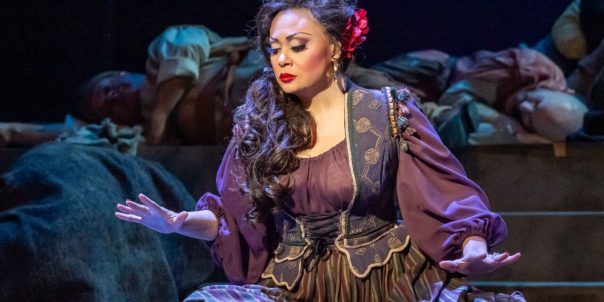
“Prends garde à toi!” You better watch out when la Carmencita gazes at you lovingly. The queen of Seville’s cigarette girls proclaims this insolent challenge – to the men she slinks past in the town square and a detachment of lascivious soldiers lazing on guard duty – almost as soon as we see her in Bizet’s Carmen. Differences between her and Micaëla, Corporal Don José’s fiancée, are artfully shown to go much deeper than city-girl brunette and country-girl blonde. When the drooling men in uniform offer their hospitality to Micaëla while she awaits Don José’s arrival, the chaste damsel skitters away in distress, promising to return later. Carmen quickly proves to be much different: shameless, seductive, and fearless, a wicked brew of beauty, passion, playfulness, and gypsy flair.

And yet we’ve still haven’t seen all the colors and facets of her portrait – or realized the full depths of what we’ve already seen in the eleven French scenes of Act 1. Alyson Cambridge, striking in appearance and lithe as ever in her movement, satisfied almost instantly at Belk Theater on opening night in reprising her Opera Carolina triumph of 2019, igniting and seething sooner as she built to the frenzy of the “Chanson Bohème” (“Les triangles des sistres tintaient”) that torches the opening of Act 2. Cambridge is as much the temptress now as she was in 2016 when she took on a title role in the special 40th Anniversary production of Porgy and Bess at Spoleto Festival USA. If anything, she’s more brazen and confident than she was as Tosca late in 2022, when she also seemed to be saving her strength for the more tempestuous final acts.
Certainly, stage director Dennis Robinson, Jr. deserves some of the credit for this higher-voltage Carmen, but so does the contrast so vividly framed by soprano Melinda Whittington as the sweetheart Micaëla, quaintly relaying a kiss to Don José from his dear ailing mother back home. Each of Whittington’s plaintive arias in the first three acts is a gem, wafting an anthemic lyricism from Micaëla’s native countryside over the stage and threatening to steal Carmen’s thunder. Cambridge must respond! Yet the new dimension for me came from the men who capture Carmen’s flitting fancy, tenor Jonny Kaufman as Don José and baritone Daniel Scofield as Escamillo, the dashing bullfighter.

No disrespect to tenors Ramón Vargas and the charismatic Roberto Alagna, both extremely capable vocalists that I’ve seen at the Metropolitan Opera as José, but neither was a hulking or intimidating presence. With or without his pearly smile, Kaufman does stand out among his fellow dragoons. Discarding the smiling ease of his welcome to Micaëla for the torments of love and passion that Carmen arouses, Kaufman is already anguished by the end of Act 1, two months before the deeper agonies of Act 2. Between this José and this Carmen we saw a battle between fidelity and wanton caprice. That’s what we expect from Bizet’s masterwork, and it escalated through Act 4 when Carmen’s fatal presentiments were fulfilled.
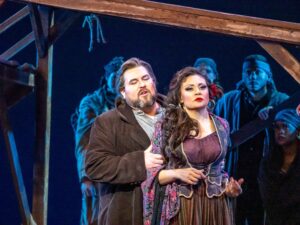
What comes into focus more sharply in this Opera Carolina revival, on top of the palpable danger of loving a woman who flouts soldiers, hangs out with smugglers, and dishes out a mean lap dance, is that Carmen is drawn to formidable strong men – able to see the violence lurking within before we do. She embraces the scent of danger. She loves the hunt, the capture, the freedom, the risk, and the danger of a wild predatory life. We saw a Carmen bent on living life on her terms, willing to die for it.

Scofield delivers the goods better than most of the Escamillos we’ve seen at the Belk parading into Pastia’s Tavern with his torchlit “Toreador Song,” but while all Josés we’ve seen are credible as the great matador’s fans, none have been as formidable as adversaries. That makes the outcome of the Act 3 knife fight between the rivals, by far the best of Dale Girard’s fight choreography here, as credible as José’s candid admiration. Carmen can see what this soldier is capable of in this production, believe in the terrible fate that her deck of cards predicted, and spit in his face anyway.

A production this well-staged, acted, and sung deserves a grander set design than the one we see here from Annabelle Roy, but the costumes by Susan Memmott Allred – on loan from Utah Opera – go far in making up for the colorlessness of this Seville. In fact, the yellow-gold of the dragoons’ uniforms vividly reminded me of the amazing clay surface of the Plaza de Toros and its dazzling buttery hue, where bulls and bullfighters shed their blood, more like Seville for me than Roy’s standard-issue arches.
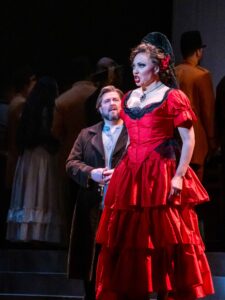
When performances are this committed and intense, whether from conductor James Meena and the Charlotte Symphony or from Cambridge as the Gypsy temptress, even a moment of slackness can be instantly telling. Such a moment happened on opening night when the trumpets’ retreat was sounded – seemingly from backstage – summoning José back to his barracks right in the middle of Carmen’s quiet, sexy, up-close dance for him alone. Riled up by Kaufman’s impulse to depart in mid-enchantment, Cambridge yielded up to Carmen’s full insulted fury – except when she took off her castanets and carefully set them down on a nearby café table instead of flinging or slamming them down, breaking character for nearly a full second. By the time she flung José’s saber and hat to the floor, she was fully returned to raging diva mode. Kaufman was just one among multitudes in the house who would now follow Cambridge anywhere.

Stunning and Grand, Opera Carolina Recreates the Original Designs of “Tosca”

Review: Opera Carolina Presents Puccini’s Tosca

By Perry Tannenbaum

2022~Tosca-40 

October 13, 2022, Charlotte, NC – Even in an Opera Carolina production with merely eight solo vocalists in the cast, it was easy enough to see what makes grand opera so grand. Most of the musicians on Charlotte Symphony’s payroll were in the orchestra pit when we entered Belk Theater, tuning up or rehearsing. The program booklets handed to us at the door had the size and stylishness of a glossy fashion magazine, and when the curtain rose on Giacomo Puccini’s Tosca, we saw the interior of a Roman cathedral, the first of Adolph Hohenstein’s three diverse set designs. By the end of the opening act, the stage was filled with clergy, a cardinal, and a throng of Opera Carolina choristers, all celebrating a mistaken report of a royalist victory over Napoleon’s invading army.

All of these blandishments – and extras – spell out expensive in big, bold capital letters. So it was particularly disappointing to see the Belk’s uppermost balcony completely empty and so many unclaimed seats below. If Hohenstein’s name rings a bell, we can multiply our disappointment, because he designed the sets, the costumes, the props, and the poster art for the original Milanese production of Tosca in January 1900. We can thank the New York City Opera for this meticulous recreation of Hohenstein’s handiwork – by heading out to the Belk Theater and seeing it.2022~Tosca-13

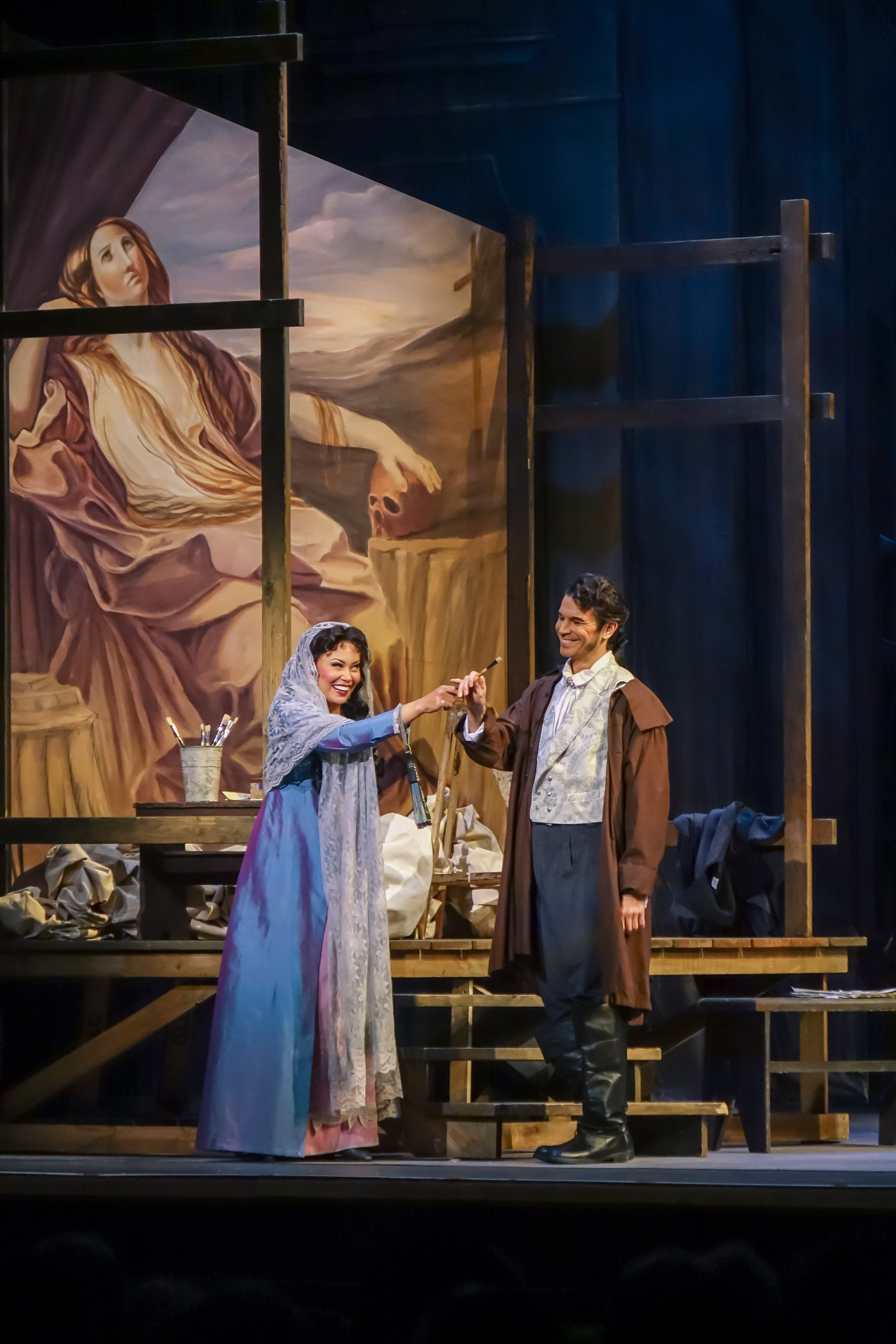
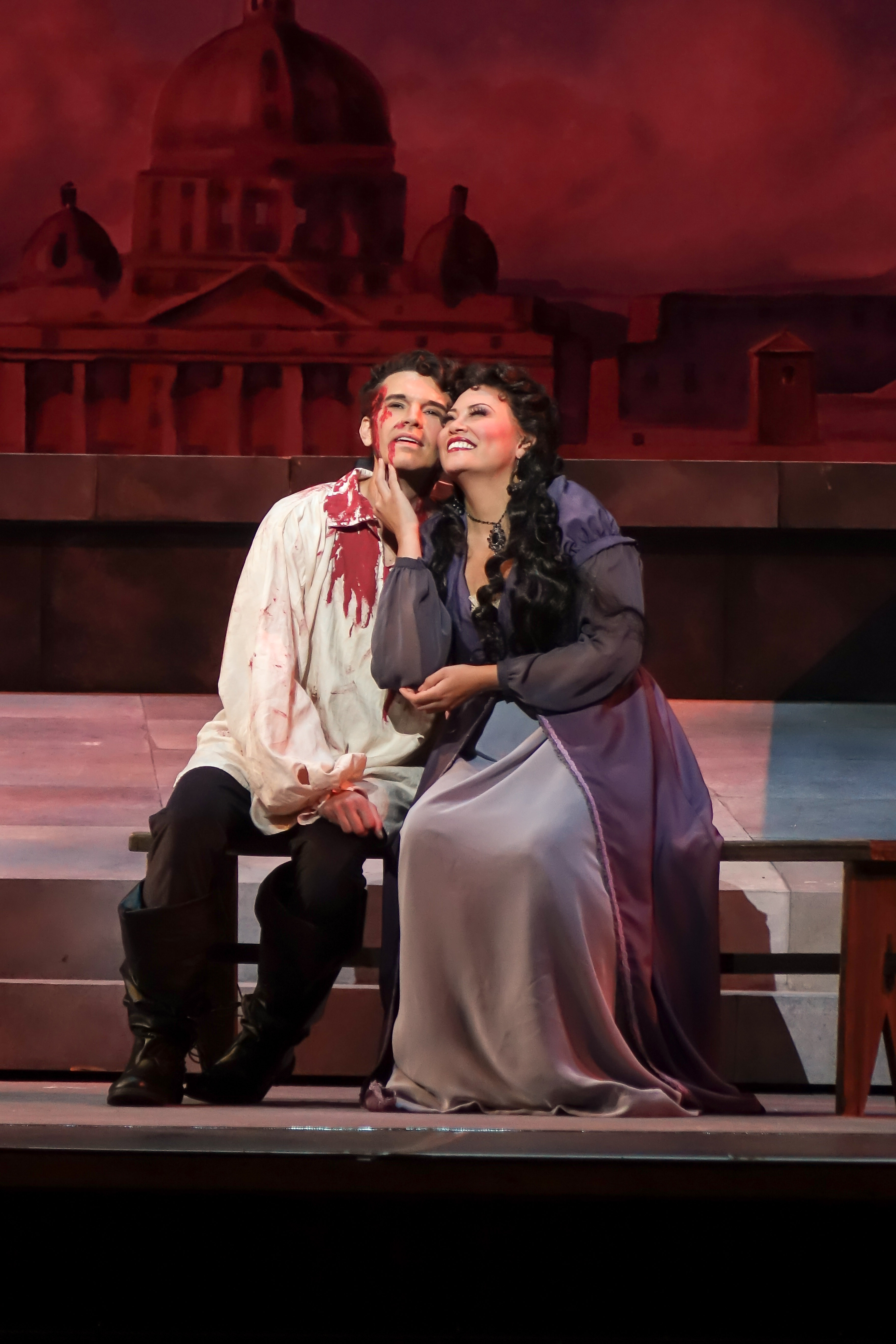
Opera Carolina lighting designer Michael Baumgarten certainly helps to capture the melodramatic spirit of Puccini’s deft adaptation of Victorien Sardou’s La Tosca, written for Sarah Bernhardt in 1887. But perhaps disheartened by all those empty seats, the opening night performance didn’t attain its full potboiler heat until late in Act 1 when bass baritone Steven Condy entered as Baron Scarpia, the cruel, lascivious, and unscrupulous chief of Rome’s city police. Until then, soprano Alyson Cambridge as opera diva Floria Tosca and tenor John Viscardi as principled painter Mario Cavaradossi hadn’t belittled the love, intrigue, jealousy, and playfulness of their relationship. Not at all. But against the backdrop of the Charlotte Symphony Orchestra, tempestuously conducted by OpCar artistic director James Meena from the opening bars onwards, both sounded somewhat underpowered, though they were clearly gifted as actors.2022~Tosca-10

Chasing after former Roman Republic consul Cesare Angelotti, who has escaped from prison and has already been secreted into hiding by Cavaradossi, Condy as Scarpia quickly injected menace and urgency into the drama. Then he cunningly worked on Tosca’s unfounded jealousy to freshen the trail to her paramour’s hideout before the curtain fell. In his tense confrontation with Tosca, Condy seemed to kindle some of the spark we would see unceasingly from Cambridge in the two acts that followed.

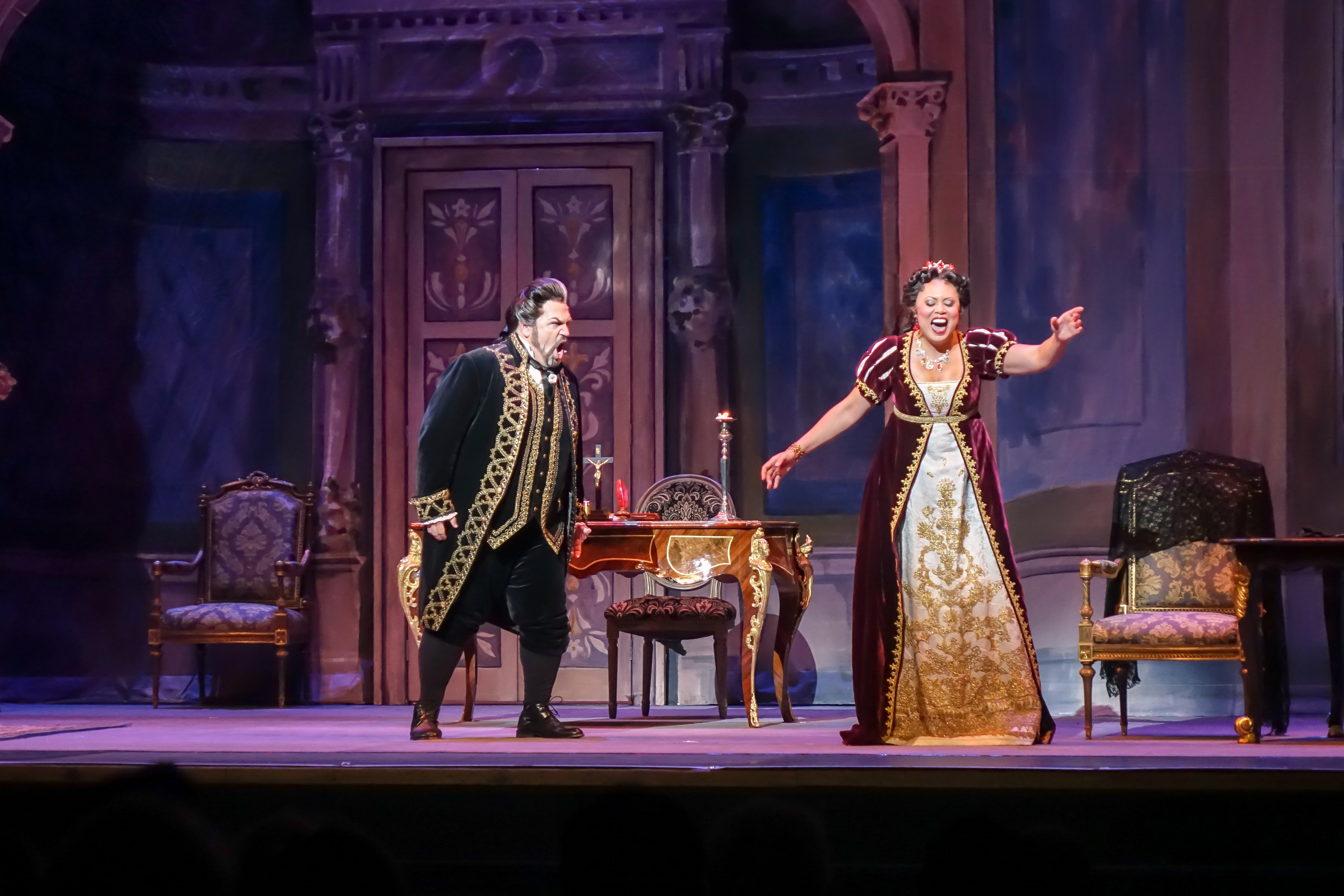
Stage director James Marvel takes full advantage of his principals’ gifts as the intricacies of Sardou’s plot come brutally to fruition in Act 2. Tosca has led Scarpia’s spies to Cavaradossi’s hideout, and soon the painter will be in custody while Angelotti has once again escaped. Scarpia dispatches his prisoner to a torture chamber adjoining his lavish apartment, hoping to extract information about Angelotti’s whereabouts. He and his thugs cannot break Cavaradossi, but they don’t have to. Tosca is with him, ruefully aware that her jealousy was baseless, and able to hear her beloved’s outcries as Scarpia’s men inflict their torture. Where the fiend has failed with Cavaradossi, he succeeds with Tosca, breaking her twice. In exchange for stopping the torture, Tosca gives up Angelotti, and to barter for Cavaradossi’s freedom, the price will be Tosca’s virtue.

2022~Tosca-16Beyond having doubted her true love’s fidelity, there was so much more for Tosca to regret now. In singing the famous “Vissi d’arte” aria before nodding her consent to Scarpia, Cambridge drew upon all the additional anguish Puccini had written for her. All of the art she had lived for, all of her passionate love, all her charitable deeds, and all her fervent prayers have been for naught in the face of this perverted monster. God has shortchanged her. With all the grim delight that Condy took in tormenting her in their crackling duets, it certainly seemed so. But Marvel was no less cold-blooded in staging “Tosca’s kiss,” where the diva settles all her debts with the Baron and appends a chilling religious ceremony.2022~Tosca-35

Courageous and bloodied in his brief appearances, Viscardi’s energy jumped nearly as much as Cambridge’s after the first intermission, but he didn’t reach his zenith until he staggered onto the rooftop battlements of the Sant’Angelo Castle in the pre-dawn light of Act 3, sentenced to face a firing squad. Maybe not quite as electrifying as Cambridge’s signature aria, Viscardi filled Cavaradossi’s “E lucevan le stelle” with sweet lyrical despair that soared upwards into the dawn appointed for his death. Alone for an extended conspiratorial duet, when both lovers grew joyous at the prospect of their coming bliss, Cambridge and Viscardi poignantly lit up the stage one last time before fate cruelly closed its fist on them. Stunning – and grand.

Reboot of “I Dream” Reminds Us How True Heroes Fight for the Right

Review: I Dream from Opera Carolina

 By Perry Tannenbaum

I Dream.

After repeated efforts to capture the essence of Martin Luther King in his twice-revised I Dream, opera composer and librettist Douglas Tappin must keenly appreciate the biblical frustration of Moses on Mount Nebo – and of MLK behind a Memphis lectern on his final night. He has seen the Promised Land, but he cannot get there. For the life of this civil rights hero/icon/martyr is inextricably intertwined with his words, unforgettably spoken in Washington, in Memphis, from his Atlanta pulpit, and written from a Birmingham jail, yet hardly a trace of them can be found in Tappin’s script.

Opera Carolina’s latest remount of I Dream, which premiered in 2010 in Atlanta and reappeared in Toledo and Charlotte in 2018, newly revised for the 50th anniversary of MLK’s assassination, is a more strategically refined and focused dance around the rhetoric with new stage direction – and considerable dramaturgical input – by Tom Diamond. James Meena, now entering his twentieth season as Opera Carolina’s artistic director, once again directed the orchestra, arguably with more ardor than ever for Tappin’s score.

If the music brings Porgy and Bess to mind, your concept likely chimes with Meena’s, for two of his principals, Alyson Cambridge as Coretta Scott King and Victor Ryan Robertson as Hosea, figured prominently in the storied revival of George Gershwin’s opera at Spoleto Festival USA in 2016. Kenneth Overton as Ralph Abernathy and Lucia Bradford as MLK’s Grandma are also steeped in that Gershwin masterwork. Yet it’s equally apt to note the influence of Broadway-style musicals on Tappin, whether it’s the revolutionary fervor of Les Miz or Andrew Lloyd Weber’s notion of opera in his Phantom. Certainly, Tappin’s music disarms any fear of being assaulted by discordant recitative and parched in a desert where no melody or aria is to be heard. On the contrary, ticket holders should brace themselves for a superabundance of power ballads.

The musical climax of the show, in the Birmingham jail, is a duel of power ballads. Robertson challenges the whole non-violent ethos of King’s movement with a spirited, militant “No Victory by Love,” and Derrick Davis as MLK answers – still triumphantly, if audience reaction was any indication – with the anthemic title song. Davis and Tappin are at their best in showing us the visionary MLK and the staunch courage of his non-violent philosophy, but the libretto needlessly attempts to deepen our impression of King as a prophet. Repeatedly, Davis must dwell on a foreboding dream in which he sees the balcony of the Memphis motel where he will be shot.

We must assume that Tappin believes this device cements King’s credentials as a prophet, though it actually undercuts them, for Davis must keep puzzling about the meaning of this dream – which is emphatically not the dream we associate with King – and Overton as Abernathy, instead of all the substantial issues and concerns he might be discussing, must waste his time (and ours) by counseling his leader to confide Tappin’s invention to his dear wife Coretta.

One might quibble over whether MLK really dedicated his career to his Grandma, but Bradford’s rendition of “Sunday Is the Day” was certainly powerful enough to inspire dedication. If Coretta is also a formative presence in MLK’s career, there’s a place for Cambridge to be singing “I Have Love to Give,” since it dovetails with her husband’s story and core beliefs, but “Midnight Moon” merely detains us in generic romance. While repeating a song with new meaning is a traditional Broadway device, it’s a bit problematical in Tappin’s hands. Late in the show when Cambridge sings “Queen Without a King,” she memorably expresses a steely determination to continue her martyred Martin’s work and assume a leadership role, a wisp of Evita that should take firmer root in Tappin’s score. Earlier, the song simply types Coretta as a weepy wife wishing her husband would stay home with family instead of pursuing a noble cause.

Sounding like a swaggering song that Crown might sing in Porgy, “No One’s Gonna Keep Us Down” took us deepest into Gershwin’s bluesy groove, and “Count to 10” worked surprisingly well in espousing MLK’s turn-the-other-cheek credo. “Top of the World,” a song of risqué celebration like “Masquerade” in Phantom, hinted at the danger of celebrity for King that could have made him vulnerable to the scheming of FBI director J. Edgar Hoover, who gets a sadly superficial airing that is also symptomatic of Broadway. He’s not an implacable Javert, that’s for sure.

If Martin’s womanizing or Hoover’s scandal mongering could have been shown as jeopardizing MLK’s greatest enterprises – the March on Washington, the march on Selma, or the Voting Rights Act – they would have rewarded deeper exploration. But in circling King’s greatest speeches, Tappin barely grazes what Memphis meant and almost completely ignores the March on Washington. That’s nothing short of astonishing vis-à-vis the expectations of an audience coming to see I Dream – until we consider that Tappin is skirting the actual quote, “I have a dream.” Gaping hole there as well.

To be fair, Tappin’s last two revisions were pre-pandemic, when the freshest take on King’s legacy was the Oscar-nominated Selma. No doubt about it, the march on Selma and its aftermath, in a presidential address by Lyndon B. Johnson, are the dramatic high points in Tappin’s revision, in Diamond’s staging, and Michael Baumgarten’s lighting and video design, climbing majestically on the shoulders of the Birmingham sequence. Meena was strong throughout the evening, all through the two hours and 18 minutes that Tappin’s music flowed through him, perhaps strongest when he was needed most, after Davis climbed the ramp to the Memphis motel balcony for the last time.

Before the pandemic, George Floyd, the 2020 landslide election, and January 6, I Dream was more on target than it is today. If he had rewritten his opera after last November, Tappin would likely have sharpened his libretto’s emphasis on the importance of voting rights. A revision after January 6 might have further prompted a reawakening to the significance of the August 28, 1963, March on Washington. For we do need reminding now what peaceful protest really is, how powerful and transformative non-violence can be, and how much more civil “I have a dream” and “We shall overcome” are as rallying cries than “fight like hell or you won’t have a country anymore.”

Sadly, we also need to be reminded that Martin Luther King hoped to move us toward “that day when all God’s children, Black men and white men, Jews and Gentiles, Protestants and Catholics, will be able to join hands and sing.” The “you” that Donald J. Trump was addressing on January 6, 2021, belonged to only one of those groups, preferably those willing to march into the Capitol with a Confederate flag.