Tag Archives: Aaron Diehl

Spoleto Roars Back, Honoring Africa, Arabic, and Alice (Coltrane)

Review: Jazz @ Spoleto Festival USA

 By Perry Tannenbaum
2022~Spoleto-132

It’s difficult to imagine what the stage and the audience would have looked like at Gaillard Center if Rhiannon Giddens’ new opera, Omar, had premiered as scheduled at Spoleto Festival USA in May 2020. #BlackLivesMatter and the COVID-19 pandemic have affected the trajectory of our lives since then, also deflecting the course of the Festival. Leadership of the Festival has changed, with Mena Mark Hanna replacing retired general director Nigel Redden, while Giddens added a half hour to her new work and ditched her stage director over artistic differences.

So when we saw more masks and dashikis in the audience than we had ever seen at Gaillard before – and more Arabic script on the scenery and costumes of Omar than I could remember in all my previous 29 years at Spoleto – it really felt like the Festival had taken a hairpin turn under Hanna’s leadership. But if you look at the past three Festivals dispassionately, including the canceled 2020 edition, you must also realize that the past two years have also been, to a large extent, a timed-release rollout of the Festival that didn’t happen two years ago.2022~Spoleto-202

At the abbreviated Festival last year, held mostly outdoors, the Preservation Hall Jazz Band, The Cookers, and the Two Wings retrospective on The Music of Black America in Migration produced by Jason and Alicia Moran were all rainchecks from the previous year. Similarly, this year’s concerts by Linda May Han Oh and Fabian Almazan, Giddens and Francesco Turrisi, and The War and Treaty were all holdovers from 2020, as were the appearance of Machine de Cirque and the staging of Dael Orlandersmith’s Until the Flood.

If the back-to-back appearances Youssou N’Dour and Nduduzo Makhathini during the Memorial Day weekend at The Cistern seemed like a spirited invocation of Mother Africa in response to #BlackLivesMatter, it should be remembered that Abdullah Ibrahim and Eyaka were also signed up for Spoleto 2020 months ahead of their scheduled June 2 concert, which would have happened a mere eight days after George Floyd’s murder.

Since Redden had cited #BlackLivesMatter as a key reason why he had decided to resign after Spoleto 2021, it really did feel like opening weekend in 2022 – with the opening of Omar followed by back-to-back-to-back concerts by Giddens, N’Dour, and Makhathini – was both an endorsement of that movement and a delayed, but still powerful, denunciation of the 2017 Muslim Ban. Giddens’ Omar dramatized The Autobiography of Omar ibn Said, the only known account by an African slave written in Arabic, placing special emphasis on Omar’s Islamic faith, his spirituality, and the Christian proselytizing he was subjected to by even his most benign master.

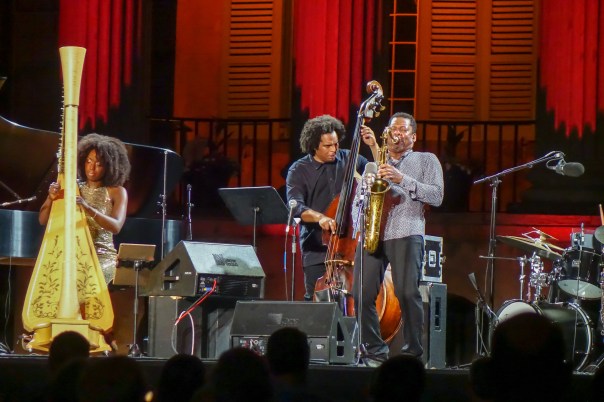
Another layer of Black spirituality graced the Festival during its second weekend when Ravi Coltrane paid tribute to his mother, Alice Coltrane, and her pathfinding Universal Consciousness album of 1971. That universality embraced India, Egypt, continental Africa, and the Holy Land according to the original Turina Aparna (Alice Coltrane) liner notes, and the all-star quintet assembled by the son included harp sensation Brandee Younger and keyboardist David Virelles as the chief conjurers of the mother.2022~Spoleto-139

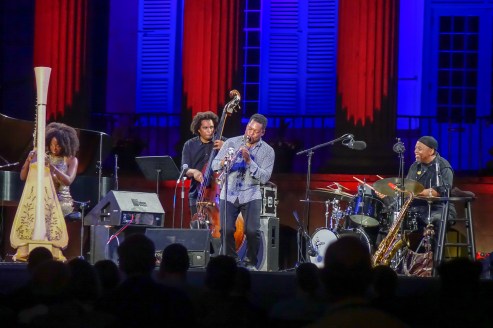
What a wondrous concert that was at Cistern Yard, concentrating on the seminal works the elder Coltrane composed and released in the 1970s, including the title pieces from Universal Consciousness and Journey in Satchidanada (1971) served up with prime cuts from Ptah, The El Daoud (1970) and Eternity (1976). Perhaps the summit of that experience was when Ravi extended his mom Alice’s ethereal “Journey in Satchidanada” with a reverent excursion into John Coltrane’s “Alabama” from 1963, saluting his dad.

Younger was a constant delight, especially sublime when she was spotlighted in Alice’s “Turia & Ramakrishna,” while Virelles at the piano reminded us that the Coltrane matriarch’s sound at the acoustic keyboard was not that distant from McCoy Tyner’s, the pianist in her husband’s famed quartet. While there was no organ onstage to fully replicate the range of instruments that Alice played on Universal Consciousness, Virelles did double with an electric piano, occasionally playing both keyboards simultaneously.
2022~Spoleto-143

Raindrops kept falling intermittently during the concert, becoming an issue near the end, when Ravi allowed the audience to coax him into playing an encore, “Los Caballos.” Stagehands did not appear panicked about the sound system, but it looked like Virelles turned off his electric to be extra careful. Meanwhile, Coltrane switched from tenor to soprano sax for the closer and gave the other members of his rhythm section, bassist Rashaan Carter and the ebullient Jeff “Tain” Watts on drums, extra space for some fine soloing. Carter cooled us off after Ravi and Virelles brought their fire, and then Watts turned back the heat.

It was Younger, of course, who made the concert experience so unique, the sprinkling of her runs and glisses more refreshing than the raindrops.

There was no downpour the following night when we showed up early at Cistern Yard, but this time Spoleto officials decided to be more cautious with percussionist/composer Tyshawn Sorey, the second big star at the Festival – and, following Giddens, the second MacArthur Genius. Two days after his jazz gig, Sorey was slated to conduct a symphony orchestra at Sottile Theater in a program completely devoted to his classical compositions, so the abundance of caution was warranted, and the backup site, TD Arena, proved to be perfectly calibrated sound-wise.Screenshot 2022-06-27 at 19-27-22 The Spoleto Festival USA Roars Back
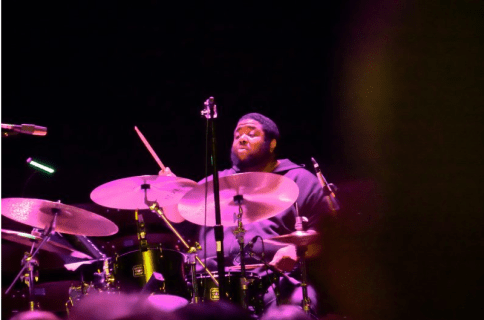
Sorey’s jazz trio, featuring bassist Matt Brewer and the estimable Aaron Diehl on piano, linked the pieces on their program together more frequently than Coltrane had done the night before. For those of us who didn’t pick up Sorey’s new Mesmerism release after the concert, already sold-out in its first limited vinyl edition, we can only guess whether the performance differed significantly from the recording in its length and nearly seamless format. Diehl marked the borderline between Horace Silver’s “Enchantment” and Bill Evans’ “Detour Ahead” clearly enough, but the hand-offs between Diehl and Brewer, who took an epic-length solo, piled detour upon detour, so it was difficult to determine when – or if – we had crossed over to “Autumn Leaves.”

2022~Spoleto-2102022~Spoleto-207

Diehl barely grazed the familiar Joseph Kosma melody, so it was helpful that, after Sorey paused – “Are you still with us?” – he let us know where we were amid the titles he had announced at the start. The boundary between Paul Motian’s “From Time to Time” and Muhal Richard Abrams’ “Two Over One” was far more easily discerned, yet the onset of Duke Ellington’s “REM Blues” was like coming out of an impressionistic tunnel into sunshine, Diehl reveling in his mastery of a totally different idiom and Sorey at last unleashing his full artillery.

Linda May Han Oh had actually recorded with Sorey on a Vijay Iyer session for ECM just before Spoleto’s 2020 slate was announced, so the separate appearances of bassist and the percussionist over the same weekend could be seen as serendipitous. Or merely premature, for they will be touring with Iyer in Europe – and playing Newport – during July. It sounded like parenthood happened for Oh and her pianist husband Fabian Almazan sometime between the date their debut was supposed to take place and when it actually did. Oh described herself and Almazan as new parents – just not brand new.

While their household might have been changing, the venue where they would perform – six sets over five days – definitely changed, moving them from the Simons Center, on the College of Charleston campus, to Festival Hall. A welcome shift for most festivalgoers, since the setup now included cocktail tables, changing the vibe from clinical to cabaret.

Bracing myself for the “postmodern sonic disruption” touted in Spoleto’s 2020 season brochure, in its pull quote from The Boston Globe, I happily found – attending two of the six sets – that NPR’s description in the 2022 preview, citing Oh’s “gift of liquid dynamism” was far more apt. Though Almazan had installed some electronics on Spoleto’s house piano that could alter the sound, it would be a gross exaggeration to declare that they were employed more than 5% of the time – or that the disruptions he created were more virulent than the sounds of a growling ogre the first time we heard him playing on “Una Foto.”

2022~Spoleto-191

Almazan proved to be rather charming and self-deprecating as he introduced another of his originals, “Pet Steps Sitters Theme Song,” freely admitting that it was rejected within his own family for advertising purposes, “and for good reason.” That good reason turned out to be the ample chops he lavished upon his melody in embroidering it, not as dark or thundering as McCoy Tyner but definitely devoid of saccharine.

Playing electric bass as well upright, Oh would have surprised those on hand who were only familiar with her through tracks that are readily searchable on Spotify. YouTube followers are more likely to have experienced Oh’s liquid on her Fender Jazz Bass and her original songs. Oh’s notably vibrato-less vocals certainly covered a broad topical spectrum, ranging from anchovy innards in “Ikan Billis” to “Jus ad Bellum,” dedicated to people who find themselves caught up in the Ukraine conflict.

Almazan’s compositions were mostly instrumental, which Oh usually played on acoustic bass, “Sol Del Mar” and “The Vicarious Life” impressing me as much as the composer’s abortive foray into advertising. He also challenged Oh with an original song of his own, “Everglades,” which resulted in a pleasing overall balance of Oh vocals and instrumentals.

Programmed midway during the Memorial Day weekend celebration of Africa and Islam, Youssou N’Dour was closer in spirit to the true jazz of pianist-composer Nduduzo Makhathini, who followed him the next night, than he was to Rhiannon Giddens singing and playing banjo, with the spare accompaniment of Jason Sypher on bass and her husband Francesco Turrisi on accordion and piano. Nearly 40 years into his career, N’Dour’s voice is still sensational and strikingly expressive. The interplay between his incantatory chants and the mbalax rhythms of his percussion-heavy 12-man band often paralleled the sound of Latin jazz vocalists volleying back and forth with their orchestras – minus the brass.

Dive In by Leigh Webber leighwebber.com

With Lonnie Plaxico filling in as his bassist on short notice, Makhathini and his quartet seemed buoyed and refreshed rather than tentative or nervous, bringing noticeably more energy to their performances at Cistern Yard than you’ll hear on his recent studio recording, In the Spirit of Ntu, which isn’t exactly tame. The percolating Bitches Brew aspects of that new release, along with the coolness of Robin Fassie-Kock’s flugelhorn and trumpet, were dispelled by this more compact combo, with alto saxophonist Jaleel Shaw vying for dominance with the leader’s powerful keyboard style, a meshing of Ibrahim and Tyner.

No less than three tunes came from Spirit of Ntu, including “Emlilweni,” “Amathongo,” and “Unonkanyamba.” Going back a couple of years, Makhathini unearthed “Umyalez’oPhuthumayo,” a jagged gem from Modes of Communication: Letters from the Underworld, and gave it a fresh polishing so that it no longer sounded influenced by Ornette Coleman, though Francisco Mela’s pounding and thrashing on drums retained plenty of bite.

2022~Spoleto-070

Tenderest of the selections was “For You,” reaching back to Makhathini’s 2015 album, Listening to the Ground, and offering Plaxico his best opportunity to shine. Among the three vocals in the set, “Amathongo” was probably the leader’s most impressive, his quicksilver soloing on piano as delightful as his incantatory singing while Shaw switched briefly to soprano sax. As for the most prodigious face-off between Shaw on alto and Makhathini, that was “Ithemba” from the 2017 Ikhambi album, a groovy powerhouse noticeably influenced by the John Coltrane Quartet.

In. the wake of last year’s abbreviated jazz lineup, headlined by Preservation Hall and The Cookers, this year’s not only felt vaster but also younger, more audacious. Spoleto was resoundingly back in 2022, appealing to a newly energized audience, with Sorey, Ravi, and Makhathini especially demonstrating they have more to give us in years to come.

Photos by Perry Tannenbaum and Leigh Webber

Swinging and Singing Summits Highlight SMF Jazz Week

Review:  Savannah Music Festival’s Annual Jazz Week

By Perry Tannenbaum

SMF2019_DafnisPrieto_FrankStewart

Call it the Jazz at Lincoln Center influence, but the Savannah Music Festival’s annual Jazz Week had a little bit more of an educational tinge this year. Not only was the Jazz at Lincoln Center Youth Big Band one of 12 finalists in the annual Swing Central playoffs, SMF’s nationwide high school big band competition, some of the jazz headliners took an overtly pedagogical approach to their sets at the Charles H. Morris Center.

SMF2019_AaronDiehlTrio_FrankStewart

Warming up for Kat Edmonson on Sunday afternoon, pianist Jon Cleary offered a personal primer on New Orleans piano style, with pithy disquisitions on – and evocations of – Professor Longhair, Fats Domino, and Mac Rebennack. The following evening, Chris Pattishall and his quintet crossed the frontier into jazz piano with a full-length presentation of Mary Lou Williams’ Zodiac Suite. On the second half of that bill, Aaron Diehl dipped into Dick Hyman’s Jazz Etudes in the Styles of Jazz Masters with his trio, a foretaste of a complete traversal that would cap his solo set the following afternoon.

Since Swing Central already includes intensive workshops and clinics with such luminaries as Marcus Roberts, Wycliffe Gordon, Stephen Riley, Jim Ketch, Dave Stryker, Jason Marsalis, and Pattishall, concerts like these further enrich the program’s academic nourishment. Toss in an additional three yet-to-be-mentioned vocalists and the Grammy-winning Dafnis Prieto Big Band, and you may assume that non-student jazz enthusiasts had plenty to enjoy over the first six days of SMF 2019.

SMF2019_DaymeArocena_ElizabethLeitzell

Havana native Daymé Arocena led off the jazz lineup, backed by a fine trio headed by keyboardist Jorge Luis Lagarza. Prompted by Arocena’s recent recordings, Cubafonía and Nueva Era, I expected to see a singer who aimed mainly for Latin audiences with side glances toward R&B and jazz. With backup singers, brass sections, and overdubbing stripped away, quite a different artist emerged in live performance. The R&B dimension surfaced with a drive and vitality to her vocals that reminded me of Stevie Wonder’s breakthrough years. Her scat singing on “Maybe Tomorrow” no longer sounded like four bars sight-read in a studio but more like the free flights of Flora Purim, and there was more to come in “Mambo No Ma.”

More surprisingly, thanks to the wide spectrum of sounds offered by percussionist Marcos Morales, there were times when the full-throated beauty of Arocena’s voice – never really captured at all in the studio recordings I’ve heard – took me back to the sound of John Coltrane’s quartets during his early Impulse years. Adding to Arocena’s live electricity, she’s an engaging and involving entertainer, compelling us all to clap or sing along with her and holding her encore hostage unless we all got up and danced to “La Rumba Me Llamo Yo.”

Paying the ransom was definitely worth it, for the encore, “Don’t Unplug My Body,” began with an electric bass solo from Rafael Aldama and heated up to an intensity that you wouldn’t have thought possible on her tame recording – nothing short of an Cuban orgasm. Lagarza widened the palette of the backup trio when he turned away from the house Steinway and played his portable electric, bringing a rock guitar vibe to “Minuet Para un Corazon” and a B3 organ-like soul to “Negra Caridad.”

SMF2019_DafnisPrieto_ElizabethLeitzell

Dafnis Prieto Big Band drew the coveted Saturday night slot, playing two sets at the Morris. Remembering past Latin Dance Parties at the Morris, the deafening Eddie Palmieri of 2009 and the still uncomfortable Palmieri encore in 2014, I was wary of sitting too close for this year’s Best Latin Jazz Album winner. So I’m truly gratified to report that, handling this 17-man ensemble, the Morris sound crew had decibel levels dialed in to perfection. Or so it felt from the side of the hall opposite to the four trumpets, four trombones, and five reeds.

The winning CD, Back to the Sunset, supplied five of the six tunes that the band performed at their second set. “Una Vez Mas” was certainly a very rousing, very Latin way to start both the album and the concert. More colorful and adventurous charts lay ahead, especially in the second half of the program. Expanding upon his recorded intro to “Danzonish Potpourri,” Prieto unleashed an awesome display at the drum kit. After some nicely blended saxes and an Alex Brown fill at the keyboard, Michael Thomas swooped in with a majestic soprano sax solo that eased its tempo after being partially inundated by the brass. A tasty Brown piano solo gave way to some pithy work from Michael Blake on melodica, not well-heard until the band dropped out.

Switching to flute and then alto, Thomas was even more impressive on the ensuing “Song for Chico.” At the crest of this chart, Thomas stood with his sax and counted out two successive sudden stops to the horns behind him. Then out of the second silence, he crafted a beautiful acapella solo, with numerous multiphonics strewn along the way. “Two for One” closed out this magnificent set, with high-energy exchanges between the brass and reeds, extended solos by Blake on tenor and Thomas on alto, and heavy workouts for Prieto and percussionist Roberto Quintero. Brown tucked in his loveliest piano solo in the calm before the leader’s parting shots.

SMF2019_KatEdmonson_ElizabethLeitzell

There are plenty of retro elements in Edmonson’s singing style, a pinch of Peggy Lee sultriness, the occasional Lady Day phrasing, and abundant echoes of Blossom Dearie. In the songwriting style, you might instantly recall the utmost despondency of Joni Mitchell – but you suddenly realize that Edmonson time travels farther back, dabbling in verses! If that weren’t enough, Edmonson testified to hearing the voice of Nancy Wilson when she composed “What Else Can I Do,” a song she proceeded to perform with an extended scat outro.

Like Arcena, Edmonson often verges on pop when she’s embellished at recording studios – and transitions effortlessly to jazz at Savannah with the right backup. If you feel her singing on recordings is too precious, coy and calculated, your opinion would likely improve seeing her live. The Blossom Dearie parallels certainly emerged quickly as Edmonson reined in her studio style for her opening “Champagne.” “Old Fashioned Gal,” the title tune on her latest release, was a frank and quirky instance of a verse that seemed to last the full length of the song.

Kat’s spoken intros took us to Europe, through a despondent breakup, on tour and at the studio with Lyle Lovett – dishy reveals that meshed well with her less-mannered live singing. Despite the Nancy Wilson channelling, “Nobody Knows That,” the song Edmonson sang immediately after “What Else Can I Do,” was the more diva-worthy composition, with drummer Aaron Thornton’s brushes and Al Street’s guitar adding gravitas. Admitting that the duet she wrote for Lovett was modelled after “Baby, It’s Cold Outside” before that hit became a toxic template, Edmonson did a solo version of “Long Way Home” that had a cheery post-party feel, slightly buzzed, with some solo space carved out for bassist Bob Hart.

Though “Sparkle and Shine” can be credited with an authentic verse, the best of the rest was definitely “Whispering Grass,” with an intro and outro that were no less outré and spacey than the studio version, and glimmering work from Roy Dunlap at the Steinway. Dunlap doubled on electric piano in “Lucky,” and Hart whipped out a guitar from behind his bass, turning Kat’s band for “All the Way” into a two-guitar quartet – remember The Ventures? – with a more novel electric sound than the studio cut.

While a songwriter who moans “if I had a voice” must be speaking for somebody else when her own top 10 songs on Spotify have been streamed over 22 million times, Edmonson’s rendition of “A Voice,” prefaced by another touching intro from Dunlap, was suffused with breathtaking beauty. “Summertime,” Kat’s most-streamed cut, was her encore, the Gershwins’ original comfort replaced by downcast commiseration. With nearly nine million plays, it’s working for her.

SMF2019_ChrisPattishallQuintet_FrankStewart

It’s been nearly five years since Pattishall brought a quintet to Dizzy’s Club Coca-Cola and played Williams’ Zodiac Suite with the same frontline, Alphonso Horne on trumpet and Ricardo Pascal on reeds. The 1944 composition, first recorded by Williams and her trio in 1945 and reissued in 1995, does not suffer from overexposure: Dizzy Gillespie brought the pianist to the stage at the Newport Jazz Festival in 1957 and played three of the 12 astrological signs with his big band, comprising one track on the resulting Verve CD. in 2006, Geri Allen recorded a Zodiac Suite: Revisited tribute with her trio.

So it’s safe to assume that the sheet music strewn across Pattishall’s piano and distributed among his cohorts was penned by the pianist for his quintet. Doubling back to the YouTube videos from the 2014 Dizzy’s gig, I’m even more sure that head arrangements have been in flux. Horne plays with far more individuality and self-assurance now than he did at the Dizzy’s date, where he looked so young, but he was supplanted at the Morris by Pascal on tenor in the volatile “Virgo” section.

Choosing to begin with “Taurus” instead of “Aries,” which he saved for his closer, Pattishall immediately shone the spotlight on Horne, trading full solos twice with the young trumpeter, who put plenty of growl into his Bull with and without his plunger mute before yielding to Roland Guerin and his five-string bass. “Leo” was the next true burner after Pattishall’s ruminative soloing figured prominently in the next two signs. Bryan Carter launched “Leo” with a fine drum solo and fired another fusillade later in the piece after the horns. Pascal, who had roared moments on “Cancer,” switched from tenor to soprano on “Leo,” a nice prelude to Horne and his first extended unmuted solo.

With a walking bassline in his piano intro that reached under the horns when they layered on, “Scorpio” became the sign where Pattishall most intently replicated the Williams style, though a listen to Dizzy Gillespie at Newport will convince you that Williams was pretty eclectic herself, with plenty of chops. Starting off by introducing each astrological sign – and asking us to make noise if we were born under it – Pattishall thankfully tired of this routine and played through. That’s why the “Capricorn” segment, adding two or three other signs before coming to a halt, was the most satisfying in the set, with tasty parts for Horn, Guerin, and Carter.

Somebody should sign these guys besides SMF, which lists all five quintet members as Swing Central faculty. A studio recording would help more people to catch up with Mary Lou’s chef d’oeuvre – in a full-throated style that would make Dizzy and Wynton proud.

Quite a composer and technician in his own right, Diehl proved more exciting performing his own compositions and interpretations than in curating others’. The pianist’s interplay with drummer Quincy Davis got “Uranus” off to a provocative start, releasing into an Oscar Peterson-like romp than ended with a playful “In a Small Café” quote before each of the three trio members took turns in the spotlight. During Diehl’s meditative intro to “A Story,” Davis switched to brushes and layered on. Then bassist David Wong made his entrance and soloed gorgeously, setting the stage – and maybe the tone – for the leader.

Gillespie’s “Con Alma” was another prime delight after the long immersion into Hyman’s Etudes, heavily inflected with Latin rhythm and percussion when we released into the familiar line. But the double layer of pedagogy when Diehl delved into the Etudes was distracting for me. Unlike the signs of the Williams Zodiac, which might be dedicated to such non-jazz heroes as FDR, each of Hyman’s exercises was an homage to a seminal 20th century jazz pianist.

So when “Portrait,” taken at a nice lively tempo, sounded more to me like Hyman in Diehl’s hands than the original dedicatee, John Lewis, my response was conflicted. Nor did I see much point in the “Ivory Strides” homage to Fats Waller, way too close to “Ain’t Misbehavin’” for comfort. Much better was “Onyx Mood,” dedicated to Art Tatum. After a couple of obligatory Tatum runs, Diehl administered a torrid pounding and just went off, no confusion at all about whose style was on display.

Two other problems often plagued the project, one of which carried over to the lunchtime solo concert the following afternoon. Hyman’s Etudes are noticeably shorter than Chopin’s, sometimes less than a minute on Hyman’s own renditions – so Davis and Wong tended to disappear in the trio versions, especially since Diehl usually refrained from embellishment.

Both problems were neatly solved when Diehl ended with “Passage,” dedicated to Bill Evans, and followed with a huge surprise, Philip Glass’s “Etude No. 16.” Not only did Diehl expand on this piece as he had previously with the Tatum etude, he showed an unmistakable affinity for Evans that enhanced the tribute vibe. No less important, Davis became newly involved – against the grain of Diehl’s playing, occasionally dropping bombs on the Glass and applying both sticks and brushes to his inspired efforts.

Diehl’s solo disquisition, “Blues & the Spanish Tinge,” ended in very much the same fashion as the trio gig, with a complete traversal of the Hyman Etudes and the Glass 16. But it began very much on-topic, tracing a lineage of piano styles starting just before the turn of the 20th century with Ignacio Cervantes’ Six Cuban Dances, published in 1899, followed by samplings of Jimmy Yancey and – after circling back to Louis Moreau Gottschalk, a New Orleans native who actually taught Cervantes – Jelly Roll Morton.

The antique simplicity of the Cervantes suite, with hints of Chopin waltz and premonitions of Scott Joplin rag, grew livelier in the fourth dance, nearly a march in Diehl’s hands. Other highlights in the set included Diehl’s take on “Jelly Roll Blues” and the frenzied stride romp he applied to Fats Waller’s “Viper’s Drag” before its customary élan became discernible. In a more formal vein, Diehl’s rendition of Aaron Copland’s “Piano Blues for John Kirkpatrick” was a charming little bonbon.

SMF2019_JohnPizzarellCatherineRussell7_ElizabethLeitzell

Riding high on top of Jazz Week’s airplay charts, Catherine Russell didn’t return to Savannah to promote Alone Together, her current release. Instead, she joined in a concept concert, “Billie & Blue Eyes,” with the John Pizzarelli Trio – a concept that wasn’t far distant from the “Ladies Sing the Blues” sets she sang in 2014 with Charenée Wade. As Pizzarelli pointed out in his warmup segment, Sinatra and Billie Holiday pretty much traversed (some might say defined) the Great American Songbook between them with many overlaps.

Of course, Pizzarelli is well-known in Savannah, his appearances at SMF dating back to at least 2011. Singing in a relaxed style, Pizzarelli is also a personable, self-deprecating, and humorous host – and he has obviously gotten to know Savannah well. After starting out in Sinatra’s effervescent postwar style with “I’ve Got the World on a String” and “You Make Me Feel So Young,” Pizzarelli carved out a segment devoted to Savannah’s iconic songwriter, Johnny Mercer. While the first Mercer tune, “Goody Goody,” remained squarely on the Sinatra Highway, the two scat choruses Pizzarelli added on signaled that he didn’t feel obliged to stay there. Both the beloved “Skylark” and the outré “Jamboree Jones” took the offramp, never recorded by either Ol’ Blue Eyes or Lady Day.

Cy Coleman’s “Witchcraft,” on the other hand, brought us emphatically back to recognized Sinatra hits, though Pizzarelli’s singing style still chimed best with “Skylark” collaborators Mercer and Hoagy Carmichael. “The Way You Look Tonight,” a solo with John’s own simple guitar accompaniment, was a nice way to segue into Russell’s regal entrance. There were still 14 songs to go in the 21-song set, so Russell’s brassier contributions felt quite ample as Pizzarelli and his trio stuck around.

Naturally they started off together really big with “All of Me,” Russell singing two choruses, Pizzarelli on a scat vocal and pianist Konrad Paszkudzki splitting the next chorus, and Russell harmonizing with John to take it out. Handoff accomplished, Russell took over for three songs in Billie’s bag, Pizzarelli relegating himself to a half chorus on guitar for “You Go to My Head” while both Paszkudzki and bassist Mike Karn took full choruses between the vocals on “Love Me or Leave Me.”

SMF2019_JohnPizzarellCatherineRussell8_ElizabethLeitzell

Pizzarelli’s return to the vocal mic was even more rousing than Russell’s initial arrival, as the whole ensemble dug into “Them There Eyes,” both singers pushing the tempo, John strumming four-to-the-bar and Karn laying down two choruses of calm before Russell and John roared home together. Back and forth the vocalists went, almost in medley style, for the next five songs. Pizzarelli’s best in this cluster was his lithe and nonchalant account of “Polka Dots and Moonbeams,” which nearly stood up to the Russell gem that preceded it. Evoking Billie’s 1952 session recorded for Verve, Russell’s “Everything I Have Is Yours” was suffused with sufficient ache to have me in tears.

Yes, this was truly a taste of what Billie was all about. More treats were in store as Russell and Pizzarelli hooked up on one last burner, “What a Little Moonlight Can Do,” which Catherine refrained from kicking into high gear until midway through the opening chorus. John’s scat vocal then led a barrage of single choruses by his trio, and the guitarist comped furiously under Russell’s outchorus. The most exquisitely soulful moment followed as Pizzarelli duetted with Russell on “God Bless the Child,” tucking a pensive instrumental between the diva’s two vocals.

Both sets at the Morris were sellouts on the night I attended. With good reason. SMF knew what they were doing when they brought them back for another pair the following night.