You might say the stars have aligned. Last week, reviewing Fly by Night at Actor’s Theatre of Charlotte, I wrote that the writing team of that musical was playing with the idea that everything that has ever happened was pre-ordained from the moment that the Big Bang birthed the star stuff we are made of. Well, now Nick Payne’s Constellations has opened at the Warehouse PAC in Cornelius, and one of its two protagonists is a Cambridge University cosmologist. At one point, she floats that same idea to her beau.
But Payne is playing differently, more elaborately, with Marianne and Roland, leaning on string theory to present their love story with multiple beginnings and middles, concluding with one last U-turn and never really giving us an ending. Or a simple way to understand what we have witnessed. We could be glimpsing multiple outcomes playing out in multiple universes. But despite the fancy quantum theory, every scene bears a kinship with the “Sure Thing” skit from David Ives’s All in the Timing, where another man and woman play out all the things that can go wrong on a first encounter before the couple clicks.
In this 80-minute show, Payne takes us beyond the first meeting to moving in together, possible infidelities, a breakup, reunion and marriage, and a possible cancer diagnosis. You could say they’ve shared a lifetime as their relationship unfolds in echoing and overlapping vignettes. Yet along the way, Marianne sends out the idea that time doesn’t really exist, loosing the possibility that everything happens simultaneously – and dealing hammer blows to the vaunted dating of the Big Bang (and the title of Ives’s potpourri).
Luckily, such nonsense is refuted by the play itself, which starts out with seeming frivolity as Roland repeatedly misfires with Marianne but grows more and more serious as their shared history develops – whatever we might imagine that to be, since each stage has many variants. Credit director Marla Brown’s finely gauged pacing and her stars, Cynthia Farbman Harris and Michael Harris, for making sure this Constellations evolves so gracefully from cute triviality to profundity.
Often over-the-top and old fashioned when he first turned up in Moving Poets and CAST productions – or more recently as the heavy in Arsenic and Old Lace at Theatre Charlotte – Michael proves once again at the Warehouse (where he shone in Stones in His Pockets four years ago) that he can do intimate and natural just as effectively. Here he’s subdued and awkward enough for us to believe he truly is a humble countrified beekeeper, and the midlife aspects that he brings to Roland texturize his romance rather than twisting it askew.
Married offstage as well as on, the Harrises have obviously benefited from the extra rehearsal time that their protracted proximity enables. Not a single line was bobbled last Saturday night as rain pelted the building. Even in radically different takes of the same scene, Michael and Cynthia managed the paradoxical feat of remaining the same people even if they were different from one blackout to the next. No, there weren’t multiple continuities in their multiple universes, but previous versions of the Roland-Marianne romance couldn’t be altogether discarded as we moved along.
The other benefit of the marriage is Michael’s Brit upbringing, obviously rubbing off onto Cynthia with a very convincing accent. Not a stranger to cold, cocksure roles, Cynthia adroitly mixes the intellectual superiority of a Cambridge cosmologist with Marianne’s vulnerabilities, both in her health and sociability. So there’s rich complexity when Marianne fends Roland off, when she yields to him, and when she drifts into dependency.
Individually, I don’t think either of the Harrises has been better onstage. Together, they’re quite special in a fascinating piece.
Co-sponsored by Davidson College’s music department and their radio station, Classical Public Radio 89.9 WDAV, the 2016 Young Chamber Musicians Competition was judged in two separate divisions: juniors aged 14-18 and seniors 19-25. Now in its third year, the competition has grown in audience interest, in the number of youth ensembles vying for the prizes, and in the prize money they’re playing for: $2500/1500 in the junior division for the top two groups, and $4000/2000 for the seniors. The event was not only moved from Tyler-Tallman Hall to the Duke Performance Hall but it was also broadcast live on WDAV for the first time.
Finalists were selected from video submissions, assured not only of second place prize money in each division, but also flown into Davidson with complimentary hotel accommodations. In the junior division, the Noctis Quartet from New York City faced off against a Los Angeles outfit, the Chimera Quartet, hailing from the Coburn School. Their elders came from university programs that the juniors might be aspiring to: the Von Quartet from Jacobs School of Music at the University of Indiana and the Onyx Quartet from the Cleveland Institute of Music, which is affiliated with Case Western Reserve University.
The judging panel included Charlotte Symphony’s principal cellist, Alan Black; Wake Forest University’s composer-in-residence, Dan Locklair; and the Western Piedmont Symphony’s music director, John Gordon Ross. I doubt that the judging panel’s august expertise was truly necessary in determining the winners in each of the two divisions, but the question of which ensemble was the best overall turned out to be unexpectedly challenging, calling upon some true discernment. It was fortunate that a new prize had been added to the competition – a $2000 People’s Choice Award.
Votes were cast via cellphone texts by members of the live audience and by WDAV’s listeners. Each of the four finalists had a distinctive code listeners could text to a phone number that was shown online and in the hall – one vote per cell phone. The line did not open until all the competitors had performed, and listeners had three minutes to submit their choices while they listened to a recorded performance by a past winner. While it was possible to game this voting system, it was nothing like the vote-early-and-vote-often travesties promoted by American Idol or Major League Baseball’s All-Star Game.
Each of the auditions submitted to the competition had to be comprised of complete movements from two separate chamber works selected from two different periods of classical music history – Early or Baroque (pre-1770), Classical (1770-1810), Romantic (1811-1900), Modern (1900-50), or Contemporary (1950-present).
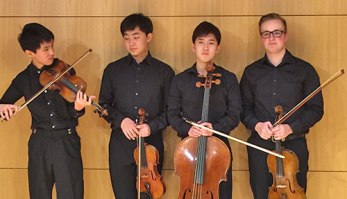
Opening the finals, Noctis was unique among the quartets in performing their two movements in reverse chronological order, beginning with the famed “Death and the Maiden” second movement of Schubert’s String Quartet No. 14 (1826) and continuing with the final movement of Beethoven’s String Quartet No. 9, the last of the three Op. 59 “Rasumovsky” quartets (1806). Although the “Death and the Maiden” tempo seemed a notch too slow at first, I was very impressed by the sound in the hall, where I’d never heard a classical concert before. I’d seen numerous stage musicals in the hall, by the Theatre Department and the town’s Community Players, with musicians placed either upstage or in the orchestra pit, so it was a bit revelatory to hear how warm, clear, and full-bodied a string quartet sounded from center stage not too far forward from the proscenium.
Helping the hall to shine, first violinist Kevin Zhu coaxed very sweet sounds from his instrument from the start, playing with praiseworthy élan particularly in the low and midrange. If the sluggish tempo at the outset seemed somewhat misjudged, the sudden acceleration and increase in volume were that much more startling when they came, and if Zhu seemed less assured in his first ascents into the treble, he clearly improved when the music sped into triplets, though there was lingering thinness even in his most assured playing. Behind Zhu, cellist Chase Park, second violinist Andrew Kim, and violist Jacob van der Sloot were unexceptional in the Schubert, but van der Sloot leapt into Beethoven’s Allegro Molto fearlessly at an uncompromised tempo, followed by Kim and Park on the same fugal path – all three of them more characterful than before. The effect was thrilling even before Zhu layered onto the fugue, absolutely on fire from his first notes. No doubt about it, the strategy of flipping the chronology of their pieces allowed the Noctis Quartet to leave with a very positive impression.
The other junior finalists, the Chimera Quartet, had nearly as much of a prodigy factor going for them as their rivals. Their first violinist Geneva Lewis, like Zhu, had logged two appearances on Christopher O’Riley’s From the Top, the NPR program showcasing young classical musicians – but Lewis hadn’t been showcased there until the ripe old age of 16 while Zhu had scored his first nationwide airtime when he was 12. From the start of Haydn’s String Quartet Op. 77/2 in F, Lewis was the more completely polished performer, and she enjoyed more impressive backing from cellist Tomsen Su amid the shifting tempos and dynamics of the opening Allegro Moderato. The ensemble’s program was also better calculated to show its range, shifting from Haydn’s F Major to the spirited Allegro vivace from Bartók’s String Quartet No. 1 in A minor. Su once again excelled and, though violist Emma Wernig was unexceptional in the brief moment when she took the lead, Cameron Alan-Lee showed some solid potential when he took the spotlight. Yet it was Lewis who raised her level most impressively in Bartók’s second movement, immersing herself in the tempo and mood changes, wowing the audience and inspiring her collaborators.
After the Chimera Quartet lifted my expectations for the senior division, the Von Quartet let me down, beginning their pairing with the opening Allegro assai appassionato from Mendelssohn’s E minor String Quartet No. 4. In the wake of Lewis’s polished work – and Zhu’s rich tone – Von’s first violin, Jisun Lee, sounded surprisingly pinched and tinny, not as impressive as she sounds on the ensemble’s YouTube video. Lee steadied noticeably when the movement calmed for a second time, just past the midpoint, but Joanne Yesol Choi’s sound remained richer and surer as she played the cello. While the Icelandic second violinist, Gudbjartur Hakonarson, evidently had input into the Von’s Icelandic name, he didn’t have enough say in the music-making for me to pass a meaningful judgment. On the other hand, Ursula Steele demonstrated the fire that Ginastera calls for when the ensemble came to the Furioso fifth movement of his String Quartet No. 2, and Choi continued to assert herself effectively. The churning astringency of the movement was also friendlier to the washboard aspect of Lee’s thin tone.
The Onyx Quartet had little difficulty eclipsing their senior rivals, but they committed a strategic misstep in competing for the People’s Choice Award. Starting out with Beethoven’s String Quartet No. 11 in F minor, they didn’t put their best foot forward in parrying the exploits of first violinists Zhu and Lewis. Taking the first violin chair for the Allegro con brio opening movement, Michael Siess was underpowered and unexceptional. However, cellist Noah Krauss was a steady force in accompaniment, and Genevive Smelser was unquestionably the best second violinist I had heard all afternoon – so much so that I wondered whether better results might have been achieved if she and Siess had switched places. Sure enough, when Onyx moved along to Debussy’s G minor String Quartet, Smelser took over the first violin chair for the opening Animé et très decidé movement. Although the music didn’t match the excitement of the Noctis “Rasumovsky” or the Chimera assault on the Bartók, the performance was easily their equal. Not only was the first violin richer and more forceful, the ensemble harmonies were exquisite as Krauss warmed to Smelser’s leadership, adding more gusto.
While the judges’ decisions, awarding the top prizes to Chimera and Onyx, were predictable enough, I wondered whether they would have had the temerity to pick the junior winners as the best overall. Audience members and broadcast listeners who voted on their cell phones had sufficient discernment to choose Chimera as the People’s Choice winners – an upset victory as surprising to the audience as it was to members of the quartet. There was one more delicious surprise for the audience that wasn’t detailed in our program booklets: the senior winners earned the opportunity to perform an encore. As Smelser resumed the first violin chair, we got another taste of their Debussy from Onyx, this time the Andantino third movement. Not only did Siess surpass himself here on second violin while Krauss contributed some really fine work on the cello, violist Spencer Ingersoll emerged from obscurity with some noteworthy input. All four members of this quartet can return to Cleveland with their heads held high.
Is everything pre-ordained by a higher power? Or might everything that happens simply be the inevitable outcome when the algorithms of time and space work upon the star stuff that materialized in the wake of the Big Bang? If not, might a lucky ring or a soothsayer’s gaze into a crystal ball shift the gears of an oncoming fate? These are a few of the notions that Kim Rosenstock was playing with when she conceived Fly by Night, the last musical Actor’s Theatre of Charlotte will ever stage at 650 E. Stonewall Street.
Will Connolly and composer Michael Mitnick joined Rosenstock’s writing team, producing a storyline that revolves around two South Dakota sisters who fall in love with the same New York slacker, Harold McClam, a full-time sandwich maker and songwriter. Daphne and Miriam are as radically different as sisters can be. Daphne is impatient to leave Hill City behind and become a Broadway star, while Miriam is perfectly content to stick around home and pour coffee for the townsfolk at her waitressing job.
But Miriam already is a star in the sense that, listening to her dearly departed dad, she has absorbed the notion, during fondly remembered stargazing sessions, that we all come from that star stuff they were counting in the nighttime sky. Aspirationally, there is a link between Harold and Daphne, who meet first at the clothing shop where she clerks and again across his sandwich counter. Vocationally and temperamentally, Harold has a kinship with Miriam. They spark more instantaneously, more intensely, and more lastingly. Trouble is, they meet at the Brooklyn diner where Miriam works when Harold is already engaged to marry Daphne.
Hovering over the action, as a kind of providential presence with avuncular Our Town overtones, the Narrator frequently shape-shifts into some of the orbiting characters in his tale, including both of the sisters’ parents and the eccentric soothsayer. We actually begin the main story on November 9, 1964, with the funeral of Harold’s mother – exactly one year before his dad’s abortive suicide attempt.
There will be a certain providence in Mr. McClam’s survival, to be sure, but until then, his morose appearances can be somewhat trying and tedious. Each of the three central characters is being tormented by a livelier, more interesting nemesis. Daphne has Joey, a commercially successful playwright who’s getting serious about his craft by writing a play just for her. With plenty of revisions, stretching out the rehearsal process. Harold is bedeviled by the sandwich shop owner, Crabble, a quintessentially cranky New Yorker. The only inkling we get that Crabble has a heart is his chronic hesitation to fire Harold for all his delinquencies and screw-ups.
Miriam has the most important tormentor, that kooky soothsayer who gives her the most improbable set of omens for determining her destined true love, wrapped into a prophecy that promises bliss and catastrophe. All of them begin to recur when Harold walks into her life, sending Miriam scurrying back to South Dakota when the two are on the verge of connecting.
Fleeing fate is no less futile for Miriam than it was for Macbeth or Oedipus. She holds out the hope that her doom isn’t settled until time stands still. That will happen on November 9, 1965 – twice.
Three significant events will happen on that date, only one of them anticipated: the postponed opening of Daphne’s play. Ironically, the only stars shining on Broadway that night will be those that twinkle mockingly in the sky.
With Chip Decker directing and Jerry Colbert narrating, Fly by Night moves along briskly with plenty of verve and heart. Colbert has aged gracefully into the paternal wisdom that the Narrator and Miriam’s dad deliver, yet there is comical extravagance each time he becomes the Brooklyn soothsayer or the South Dakota mom. This Narrator seems to become most personable when he stops the action to guide us into a prefatory flashback, so we appreciate Colbert more and more as these time loops proliferate.
Colbert himself loops back to his heydays, flying by night to some fairly high notes and singing with an ease we haven’t heard from him since, oh, maybe 1997 in the 1940’s Radio Hour. Perhaps he’s inspired or rejuvenated by his co-stars. The sisters, Cassandra Howley Wood as Daphne and Lisa Smith Bradley as Miriam, are aptly cast, already ablaze in their early pair of star songs. Wood repeatedly chants “I’m a star!” with Broadway conviction belting out her anthemic “Daphne’s Dream” as she begins navigating the New York rat race, and there’s a cute Avenue Q silliness to her “More Than Just a Friend” duet with Harold.
Bradley simply torches her calling card, “Stars I Trust,” creating a wider gulf between the sisters than you’ll find on the original cast album, and there’s a greater maturity to her lighter “Breakfast All Day” sequel as she settles into Brooklyn, with less of a shuffling rock beat from the three-piece band directed by Ellen Robison. So easily grooved into a humdrum rut, it’s surprising how unnerved Miriam becomes when the soothsayer sings his “Prophecy” – in two parts – and when her eyes first meet Harold’s. Bradley, Colbert, and Christopher Ryan Stamey make it all work.
Stamey cut his teeth at Actor’s Theatre as their go-to wild man in trashy treasures like Slut and The Great American Trailer Park Musical, so to watch him mellowed into the relatively colorless Harold could be jarring to those who have witnessed his vintage exploits. But he actually nails it as both the nerdy Romeo and the mistake-prone sandwich drone. Best of all, he’s the adult in the room in his ultimate showdown with Miriam, “Me With You,” tapping into who he is and what we all believe must be right in the face of implacable destiny.
Supporting roles all draw superb performances. Stephen Seay is wonderfully hyper as Joey when he first pursues his muse Daphne in “What You Do to Me” – and still spoiled rotten, revision after revision. James K. Flynn captures the working class vulgarity of Crabble with a poifect accent, combining with Stamey in “The Rut,” a paean to workplace hopelessness and drudgery. Perpetually toting a wee record player and a vinyl recording of La Traviata in his pathological grief, Rob Addison eventually gets to break out of his stonefaced depression as Mr. McClam. Toward the end, he decides to actually go see that opera and later, when someone finally has the time to listen, he pours out his sad, sad love story, “Cecily Smith.” Which just happens to rhyme with one of the best lines of the night: “Who cares what you are listening to? It’s who you’re listening with.”
The design team, Dee Blackburn for the set and Carley Walker for the lights, give us a nice off-Broadway sense of the various locations, efficiently transporting us to Miriam’s yard and front porch in South Dakota, the seedy nightclub where Harold tries out his song, Crabble’s misspelled sandwich shop, and McClam’s bathtub.
When we get to Penn Station and Times Square, however, an SOS goes out to our imaginations. After “At Least I’ll Know I Tried,” a tasty quintet ushering in the eventful denouement, I prophesy you’ll answer that SOS willingly.
Papa Roberto dabbles in magic, to the delight of his kids, Tito and Milagro. His most treasured father-and-son moments are spent building and flying kites – until Papa goes off to work and never returns. How Tito reacts to his dad’s sudden deportation to Mexico is the heart of The Magic Kite, now in its world premiere production at ImaginOn. Children’s Theatre of Charlotte commissioned the new work by José Cruz González because artistic director Adam Burke was moved by artist-activist Rosalia Torres-Weiner’s paintings and her Papalote Project here in town.
At the same time that this project gives children of deported parents the opportunity to vent some of their anguish through artistic expression, classmates, teachers and parents become more aware that families fractured by deportation are living right here in Charlotte. Staging this new play at the Wells Fargo Playhouse is a great way to extend that worthy mission to an even wider audience.
González, whose adaptation of Tomás and the Library Lady was staged at the same venue five years ago, seems a bit rushed here when establishing the kite and magic strands of his plot at the beginning and when he ties them together at the end. There’s plenty going on in just over 45 minutes as Burke directs the four members of the Children’s Theatre Resident Touring Company, since each of the performers communicates with us through at least one puppet – and a few sprinklings of Spanish.
Although Mark Sutton’s puppet designs have a nice folksy quality to them, narrowing our attention is a bit challenging with Torres-Weiner’s paintings flanking the stage while we jump back and forth from the magic scenes to the kite scenes. Scott Miller presides over these early scenes warmly and authoritatively as Papa with officious, worried support from Veda Covington as Mama Esperanza. It turns out that it’s really important for Roberto to get his taillight fixed.
When Papa gets picked up and deported, the weight of the story falls upon Tito, and Rahsheem Shabazz moved me in making Tito’s transition from awestruck child to the little man of the house. Leslie Ann Giles seems shortchanged at first, drawing the role of littler Milagro, but she soon gets her hands on a couple of other puppets. The most significant of these is Tito’s school chum Jamal, aggrieved by the loss of his mother, but Giles also gets the choicest cameo as the pet cat.
As often happens in children’s literature, wounds and losses that two kids have in common help in bridging their differences and cementing their friendship. González poignantly employs magical realism when Tito takes his family skyward on his kite, journeying to Mexico where they can be reunited with Papa. But an invisible barrier prevents them from crossing the border, so Tito and his family can see his beloved Papa, but they cannot join him.
At such fantastical moments, puppets can facilitate wonders. It’s just the aftermath that González bungles, loosening his grip on the tiller as we sail toward a consoling affirmation. I’m reminded of my teaching days, when I’d notice the class bell sneaking up on me. I’d rush through – or even skip over – the crucial ending of my lesson to assign the homework before the students rushed out.
Pretty much the same thing happens here as González tells us that more kites fly upwards after Tito’s sadly lands. We just don’t get a satisfying account of how that happens or what it means. The Magic Kite could easily unfold all its potential magic if González could add 10-15 minutes to it. Meanwhile, it was very useful to have Torres-Weiner hanging around after last Sunday’s matinee to answer kids’ questions in the talkback. They asked some really good ones.
Misdeeds in Shakespeare come in dark and light hues: they are prankish and trivial when the Bard smiles, malign and fatal when he glowers. Misunderstandings follow a similar pattern, absurd and accidental when they aren’t horrifying and purposeful. When such complications are resolved at the end of Shakespeare’s earlier plays, all is mended in the comedies and all is lost in the tragedies. But a new curvature enters the Bard’s storylines toward the end of his career, when he begins to concoct the bittersweet confections that became classified as romances. These include The Tempest, Cymbeline, Pericles and – now at Spirit Square in an outstanding Shakespeare Carolina production –The Winter’s Tale.
In these plays, tragedy strikes. But it’s survived, and we veer towards mirth. Keats may not have understood Shakespeare best among the romantic poets, for Coleridge had the finest critical mind among them, but he was best attuned to this mellowed, autumnal Shakespeare when he referred to life as “a vale of soul-making.” The protagonists in these plays reach wisdom and contentment only through great and prolonged suffering.
Before we reach these romances, Shakespeare strives to compress time as much as possible. Factions and countries seem able to raise armies and launch wars overnight in Caesar and Lear. When we reach The Winter’s Tale, Time is not only a prime element in the story, he or she is an actual character. At Duke Energy Theatre, he comes out at the end of Act 3 in the script, dressed very much like Dickens’ last Christmas ghost, to announce the intermission, leaving an hourglass on a stool.
When we come back, Time properly names himself to start Act 4, tells us that 16 years have passed while we were gone and, cued by the Bard’s blank verse, flips the hourglass to launch the continuation in Bohemia. Back in Sicilia, King Leontes has royally messed things up. Outdoing Othello in jealousy, Leontes has decided that his virtuous Queen Hermione is having an affair with his longtime buddy King Polixenes of Bohemia. Flouting all common sense, he is equally certain that Polixenes has fathered the child she is on the verge of delivering.
Stubborn and decisive, Leontes imprisons his wife, orders his most trusted servant to murder Polixenes, and sends his most valued courtier overseas to dispose of his newborn daughter. Now why was he so sure Hermione is an adulteress? When Polixenes refused Leontes’ entreaties in the opening scene to stay an extra week in Sicilia, Leontes asked Hermione to try – and she succeeded.
Polixenes and the servant escape together, and by the time Leontes discovers his folly, he has lost his wife, his son, his best friend, and his newborn daughter. And according to the Delphic oracle, whose declarations he ignored when they vindicated Hermione and Polixenes, he will remain childless and lose his kingdom unless he finds his lost daughter. Instead of tracking the infant’s scent while it is still fresh, Leontes goes to the opposite extreme of his previous bellicosity, cloistering himself with his sufferings and sorrows, mourning the true wife he wronged.
Not only does the wintry action in Sicilia turn to springtime in Bohemia when the hourglass is flipped, a whole new generation seizes the spotlight. The action blows in the opposite direction, on the wings of two young lovers who will be true to one another. Taking advantage of the new time and place, director Tony Wright flips a large portion of the cast into new roles during intermission.
Perhaps the most significant of these changes occurs just before the break when S. Wilson Lee as Antigonus, the Sicilian courtier who brings the king’s unlucky child to Bohemia, makes one of the most famous exits in theatre history, “pursued by a bear.” Lee comes back almost immediately in a new costume as a new character, the Shepherd who hears of the courtier’s grisly mauling and discovers the babe in the basket. Clearly things have turned toward comedy when a rustic illiterate marvels at his clone’s demise.
And it makes eminently good sense for Faith Benton to reverse the gender deployment that was routine in Elizabethan times, when women were barred from acting, playing Leontes’ son Mamillius in the opening act and his lost daughter Perdita after the break. Benton has a nicely understated elegance that works well for a noble who is ignorant of her nobility, and she projects virginal purity at the heart of the Bohemian scenes that artfully parallels Katie Bearden’s maternal and wifely purity at the center of the Sicilia drama.
It’s quite remarkable that Bearden can bring so much freshness to a role that reminds us of so many Desdemonas and the falsely accused Hero in Much Ado About Nothing. But it’s certainly helpful for Russell Rowe to be deceiving himself so powerfully as Leontes, a lion who creates his own dreary winter out of an apparently loving marriage.
Lowe’s overbearing authority makes Bearden’s steadfast truth and devotion all the more poignant, but it also sparks other forms of opposition. Amy Hillard as the vanished Antigonus’ tart-tongued widow is unsparing in her denunciations of the King, granting him her special clemency only when the Delphic oracle’s prophecy is fulfilled. Just as useful in the wide arcs of this storyline is Kevin Sario as Leontes’ trusted servant Camillo, an anti-Iago who saves his King from himself, ultimately engineering his redemption.
Camillo and Polixenes bridge the two halves of this Tale, so it’s interesting to watch the subtle imperfections that Charles Holmes brings to the King of Bohemia. He probably is a little more affectionate toward Hermione than is strictly proper, and when his family hurtles into crisis, his aversion toward hearing out his son Florizel parallels Leontes’ deafness toward Hermione. In this sunny new comedy world, Polixenes’ faults are more fortunate.
With his bushy hair, Cole Pedigo as Florizel strikes me as more rustic than Benton, but they do make an adoring – and adorable – couple. He actually gets to dress down when Florizel and Perdita decide to elope. Or seek asylum? Obliging him gladly is Ted Patterson as the thieving con-artist Autolycus, who will gladly favor us with a song when he’s not swindling the Old Shepherd and his Clown (Michael Anderson). Like other Shakespeare rascals, Autolycus is luckier than he is smart. Until he isn’t.
In the cavalcade of reunions that closes out this romance, the last is by far the most moving because it redeems so much lost time. A bit of a downer throughout the evening, the scenic simplicity of the production becomes most effective in this tenderest of moments, but Robert Jaeger’s costumes also lift us out of visual poverty along the way. Turns out that it has been a novel idea in Charlotte to do a Shakespeare play – rather than a riff on one – to celebrate the 400th anniversary of the Bard’s death.
One expects a knowing selection from a company that takes the Bard’s name in vain, and Winter’s Tale, a work that resonates with Shakespeare’s final years, proves to be a very apt choice. With this current crop of newcomers and seasoned veterans, this is the best serious Shakespeare this company has done. Shakespeare Carolina really is a mature Shakespeare company now, knowing what they mean and meaning what they, Both the comedy and the drama come at us with the swagger of assured confidence. If only somebody would give them a few bucks!
Should I say the dog ate my homework? No, after returning home from assignment at the Savannah Music Festival, I plum forgot about The Taming amid the bustle of BOOM and Sensoria, and Opera Carolina’s U.S. premiere of Aleko. Even when I caught up with the latest from Donna Scott Productions at the Charlotte Art League this Wednesday, I was less vigilant than I should be.
I came into the funky South End gallery aware that there was a connect between Lauren Gunderson’s wacky political fantasia and Shakespeare’s The Taming of the Shrew. But by intermission, I’d completely forgotten about tracking the parallels. That’s because the storylines are so different in this all-female script, and where there are parallels, Gunderson has totally flipped the script.
Katherine is no longer the clawing, curst hellcat who scares away every sensible man in the kingdom except the opportunistic Petruchio. Here she’s charming, brainy, and talented – so charming, brainy, and talented that she’s Miss Georgia, for crying out loud, on a trajectory to become our President and reframe our cherished Constitution. Goodbye, Electoral College!
Nor is she kidnapped after any shotgun wedding. Katherine is in control as she kidnaps Patricia, the brains behind a powerful GOP Senator, and Bianca, a leftwing one-cause blogger and provocateur. This latterday Kate has not only drugged the diametrically opposed politicos, she’s locked them inside of her hotel suite, and – most devastating of all – confiscated their cellphones! If she can get these Red State and Blue State zealots to pull in the same direction with her, Kate reasons, revolution is possible.
Both of these high-energy women remain equally obdurate, but if you pay more attention to their names than I did, you’ll divine that Patricia is our Petruchio. So when Katherine has to drug everybody to calm them the hell down – including, oops, herself – it’s Patricia who wakes up after intermission as James Madison during the original Constitutional Convention of 1787. Bianca is now South Carolina’s Charles Pinckney, the South’s chief proponent of slavery, and Kate is now George Washington, still gushing with charm and still urging compromise.
So yes, mea culpa. By the time the three women had conked out on ether and time-travelled to Philadelphia, birthing constitutional government while switching genders, I had long-forgotten The Taming of the Shrew. When the women returned to present day and Kate triumphed as Miss America, only then did Gunderson conk me over the head: for Patricia, acknowledging Katherine’s superiority, pretty much parrots the scolding that the “tamed” Kate delivers to the other newlyweds in Shakespeare’s Act V.
Now you can go to The Taming without having to backtrack like I did to decode it. Donna Scott makes a wonderfully infuriating Republican as Patricia, and Glynnis O’Donoghue, armed with her righteous pout, is equally apt as the deviously myopic liberal. No surprises there, but Katherine Drew, stunningly slick and sufficiently gorgeous as Kate, is completely new to me. Gunderson drops a couple of lesbian hints into her lines, so it’s a treat to see how excellently Drew personifies this gorgeous George.
All of this frothy comedy would run 79 minutes without the intermission, but director Tonya Bludsworth, who does so much so right, needs to take her foot off the accelerator. Not only did the frantic pace cause the normally infallible Scott and O’Donoghue to bobble lines in the third week of this production, the dialogue zoomed by so fast that I missed stuff. Superfast or not, there are plenty of goodies here, and Gunderson’s crosshairs are trained more on us than on the Bard.
Monty Alexander and Cécile McLorin Salvant (Photo: SMF/Frank Stewart)
Two things I can say after witnessing a good chunk of the 27th Savannah Music Festival: they’re still making it a better experience for jazz lovers, and thank heavens they’ve created such a haven for shy performers. This year’s cavalcade of luminaries included star turns by Freddy Cole and René Marie on opening night; Joey Alexander, Julian Lage, and Dr. John in the closing week; and Etienne Charles, Catherine Russell, The Hot Sardines, Monty Alexander, Eric Alexander, Marcus Roberts, Terell Stafford, and Wycliffe Gordon in between.
But I’ll remember the shy folk most fondly. First there was Cécile McLorin Salvant admitting she had always wished to sing with Monty Alexander but was too shy to ask, even when they were headlining the same double bill. So the pianist in her trio, Aaron Diehl, had asked on her behalf. Near the end of Salvant’s set, Diehl eased away from the piano and brought Alexander in from the wings, and the wish was fulfilled – with one last touch of suspense.
“What do you want me to play?” Monty asked.
“Do an E-flat blues,” Cécile coyly responded.
So what emerged, from a haze of tantalizing mystery, was an epic version of “Fine and Mellow.” It wasn’t destined to achieve the legendary status of the TV version sung by its composer, Billie Holiday – with solos by a string of immortals including Ben Webster, Lester Young, Gerry Mulligan, Coleman Hawkins, and Roy Eldridge – but it unfolded in the same majestic vein, with multiple solo spots by both Salvant and Alexander.
And then, the following afternoon and evening, there was Harold Mabern. Just past his 80th birthday, the versatile pianist professed to be uncomfortable when his peers make a fuss over him when he tallies another year. Not an easy claim to swallow when Mabern delivered some of the most engaging introductions and anecdotes you’ll hear at an afternoon solo concert; when he solicited and answered questions from his audience at length; and when, as a sideman in Eric Alexander’s quartet, he pretty much took over emceeing chores. With no complaints.
My guess is that Harold will be invited back.
I always show up in Savannah when the jazz scheduling is most intense, so my first taste in 2016 was the “Swing that Music” double bill featuring Russell and The Hot Sardines, their last performance in a two-shows-a-night, three-day run. Russell’s definition of swing may have been of a slightly more ancient vintage, but it certainly wasn’t any less hot, risqué, or sassy than the Sardines’. Her set was a little more blues-tinged, taking us back nearly a century with “Darktown Strutters’ Ball”; nodding to her own father, Luis, with the “Lucille” he wrote for Satchmo; and sending us out with the legacy of Bessie Smith’s “Kitchen Man” and its wicked Andy Razaf lyric.
Catherine Russell (Stewart)
Before that final “he can use my sugar bowl” bravura, Russell checked in with a couple of Lady Day delights, “Swing! Brother, Swing!” and “Please Don’t Talk About Me When I’m Gone.” She leapt out of the era of swing, stride, and rags entirely with nods to Dinah Washington (“My Man’s An Undertaker”), Esther Phillips (“Aged and Mellow”), and her special reclamation, Wynonie Harris. Feeling ran deepest in Harris’s “Quiet Whiskey,” a late-night blues that seems to have acquired new relevance.
With so much going on with the Sardines, it was wise not to follow them. Not many jazz bands throw a tap dancer at you who doubles on ukulele. Or a trumpet paired with a cornet. Or a bass player who doubles on sousaphone. Or a hot singer who can do serious percussive damage with a washboard. Plus the old-timey costumes and attitude – Dixie, honky-tonk, or vaudeville, label it as you choose.
One of the things that made the Sardines’ self-titled 2014 CD the best vocal album of the year for me was its live, spontaneous looseness and playfulness, even though it was a studio effort. Well, they were even looser and more playful live at the Morris Center in their Savannah debut following Russell’s high-energy set. None of the songs came off that 2014 CD and only “Summertime” was even in their discography. So a new batch of Sardines could in the can – or headed there soon.
Although she also turns out to be a personable emcee, it’s largely about what “Miz Elizabeth” Bougerol sings with her unique and alluring sense of style. Starting off with a French version of Louis Prima’s “I Wanna Be Like You” (yep, from Disney’s original Jungle Books) over “Fast Eddy” Francisco’s uke, Miz Elizabeth seemed to have a predilection toward the strumming sound of Django Reinhardt’s swinging combos. But there were other styles in the Sardines’ roux, for Jason Prover on trumpet, Mike Sailors on trombone, and Nick Myers on clarinet combined for some New Orleans-style chaos in the accompaniment.
Elizabeth Bougerol – “Miz Elizabeth” – and her washboard (Photo: SMF/Elizabeth Leitzell)
The Hot Sardines, Savannah Music Festival 2016
By Courtesy of Savannah Music Festival/Elizabeth Leitzell
Miz E continued with another fascinating French concoction, “Weed,” that she called a Gallic variant of Peggy Lee’s “Why Don’t You Do Right?” Sure enough, the horns sounded like the Benny Goodman brand of swing behind her and in the instrumental jamming. The eclecticism was only beginning, for during Fats Waller’s “Ain’t Misbehavin’,” Francisco stood up from his chair and showed us what he could do with those tap shoes, trading licks with pianist “Bibs” Palazzo. Underscoring the kitschiness of “People Will Say We’re in Love,” the brass had the temerity to emulate a mariachi band on the way to a “Surrey With the Fringe on Top” coda.
The final three pieces sidled back to establish common ground with Russell. Miz Elizabeth did her washboard business in the final ensemble of “Jelly Roll” after her vocal and a spray of solos, including Francisco’s flying feet. “Summertime” built from a quiet Palazzo intro on piano to a brassy roar with Sailors switching to cornet, and “Everybody Loves My Baby” was pure jubilation, all the soloists including Francisco strutting their stuff one last time and Miz Elizabeth pulling out a tambourine.
After this colorful profusion of swing, the Aaron Diehl Trio was bound to seem comparatively mundane the following afternoon. While the heart of the set was a triptych of tracks from Diehl’s fine new Space Time Continuum recording – “Flux Capacitor,” “Organic Consequence,” and “Broadway Boogie Woogie” – the live performances were barely a shadow of what was achieved in the studio.
Aaron Diehl (Stewart)
Shrunk by the absence of the horns that livened the studio sessions, sapped of the drive and exploratory energy of Diehl’s recorded solos, and numbed by the listless vamping of the leader behind bassist Paul Sikivie – hoping he’d suddenly morph into Scott LeFaro? – “Organic Consequence” was especially diminished. Even “Broadway Boogie Woogie,” a trio arrangement on the album, lacked the same fire from Diehl, with his current drummer, Lawrence Leathers, outshining the leader where an exchange of 4s was tacked onto the chart.
Toward the end, Diehl perked up somewhat in a two-tune Horace Silver tribute. “Opus de Funk” swung for three or four choruses, with a strong Leathers solo and a tasty Ellingtonian outro. Best of all was “Melancholy Mood” and its ruminative piano intro over Sikivie’s bowed bass before Diehl broke into a mid-tempo lope, with the bassist sheathing his bow and digging in. A moodiness echoing the intro took us out as Sikivie retrieved his bow and Leathers switched to his mallets.
With a recording career that spans more than 40 years – and impressive jazz, pop, and reggae outings – Monty Alexander shows no signs of slowing down. In fact, listening to his trio set – with Hassan Shakur on bass and Jason Brown on drums – I found it hard to believe the native Jamaican ever had more enthusiasm for music and more restless energy than he has now.
Monty Alexander isn’t slowing down (Stewart)
Onto the spare framework of Ahmad Jamal’s “Night Mist Blues,” Alexander wove an epic solo that included threads of “Don’t Get Around Much Anymore” and a swatch of Bach that I didn’t have time to jot down before he was onto – improbably – “It Takes a Worried Man.” Then you wouldn’t have suspected that “The Battle Hymn of the Republic” was a separate item on his set list, for Alexander drifted into that finale so smoothly that it seemed like just another prank played on the Jamal line.
Alexander was more apt to change moods on his own originals rather than troubling to drape new clothes on them. “Look Up” tried on “Take the A Train” momentarily but was more notable for its sojourns in the realms of ballad, Latin, and boogie-woogie on its odyssey. The trio heated up “You Can See Me” from a Garner-esque lope to a full-fledged boil before Alexander faded it out. There was even some experimentation in the lab during “Hope,” with Monty reaching under the lid of the Steinway during this most delicate piece, as Brown checked in with his strongest work, coaxing atmospheric pings and metallic washes from his kit.
With her heavy emphasis on drama, Salvant doesn’t instantaneously line up with the shy profile she suggested. But there’s something to it when you scrutinize her songlist, with choices that included “The Trolley Song,” “Nothing Like You Has Ever Been Seen Before,” “Mad About the Boy,” and “Jeepers Creepers.” All of these are awestruck, admiring, and a bit giddy. There was a coy and flirtatious take on Bob Dorough’s “Nothing Like You” and touches of Sarah Vaughan as Noël Coward’s “Mad About the Boy” heated up.
Cécile McLorin Salvant is “Growlin'” (Stewart)
Far more histrionics were lavished upon the “Trolley” that Judy Garland made famous, starting off with the verse sung over a sympathetic Diehl vamp and Leathers’ puttering drums. But we didn’t reach deep waters until Salvant exhumed the traditional “John Henry” – with a gravitas you won’t find on the 2013 WomanChild album. The live vocal began without her microphone, with Diehl more about foot stomps than piano when Cécile went back on mic and Leathers marking time with handclaps. Cuteness discarded and pace slowed to a more solemn gait, Salvant’s low notes bore a previously unsuspected resemblance to the great Odetta.
After the magnificent hookup with Alexander, Salvant closed with the two opening tracks from latest CD, For One to Love, my pick for best vocal album of 2015. Her original “Fog” came off with notably more confidence and depth as Salvant took herself more seriously, and “Growlin’ Dan” was a high comedy tour de force. Salvant explained the whole lineage of this song that Blanche Calloway wrote as a sequel to little brother Cab’s famed “Minnie the Moocher.” Diehl’s solo has grown into a more emphatic jazz march, and Salvant’s singing – it’s hard to fathom how her long drawn-out growling could be the match for anything Wycliffe Gordon does on trombone when she’s pouring out all that sound and volume at the tail-end of her second set of the evening.
Harold Mabern (Leitzell)
When he talks about Lee Morgan, Phineas Newborn, Frank Strozier, Clifford Brown, the Philadelphia jazz scene, or his students at William Paterson University, Mabern seems like a pretty mellow soul. But it’s usually a different matter, even at the age of 80, when Harold attacks the keyboard. So a solo concert makes for a nice balance, rigorous playing interspersed with relaxed storytelling.
There was so much finesse in Mabern’s interpretations of “Moody’s Mood for Love” and “Dahoud,” so much soulfulness in his rendition of “It’s a Wonderful World,” that I found it somewhat odd that this genial man would be explaining the difference between his style and McCoy Tyner’s. Then he finished with “My Favorite Things,” and the pounding majesty of it made the comparison inevitable.
Mabern and Eric Alexander evoke the Coltrane songbook (Stewart)
More Tyneresque moments occurred during the evening’s “Tenor Titans” double bill, though you could call it Harold being Harold behind a powerful tenor saxophonist, Eric Alexander. The beast came out in Mabern’s first solo on “Summertime,” and after Alexander and bassist John Webber had their say, the pianist dropped another snippet from the Coltrane songbook, “My Shining Hour,” into his second solo, as drummer Joe Farnsworth went to his brushes. Mabern’s original, “Rakin’ and Scrapin’,” probably swung the hardest, Alexander dipping into “Fever” during his frenetic solo, but the most beautiful piece – of the whole evening, really – was Jule Styne’s “I Guess I’ll Hang My Teardrops Out to Dry.”
With a much softer sound and a far more unassuming manner, tenor man Stephen Riley was the antithesis of Alexander’s suave command and bold playing style. Backed by a rhythm section that was none other than the Marcus Roberts Trio, the similarities and contrasts between the two tenor sets were pretty cool. Not at all imitating the Coltrane sound, Riley opened and finished with Trane compositions, “Moment’s Notice” for starters and – more impressively – “Bessie’s Blues” to close.
Stephen Riley and the Marcus Roberts Trio (Stewart)
There was a Monk composition in the middle of the set, “Blues Five Spot,” but Roberts couldn’t wait that long to do his Thelonious impression. Right after the opener, Robert’s applied a Monk fantasia to “Lulu’s Back in Town,” virtually stopping the tune – and clearly stopping the show as Jason Marsalis cracked up behind his drum set. Riley and Marsalis collected themselves enough to follow with their solos, but Roberts returned to take it out at a snail’s pace. Was he perhaps telling Riley that he’d taken “Moment’s Notice” too slowly?
Whatever the message, Riley proceeded to return fire on Cole Porter’s “What Is This Thing Called Love?” slipping some “Bemsha Swing” into his solo. When the Monk line actually came up, only bassist Rodney Jordan messed with it, dousing his solo spot with “Old Man River.” The “Bessie’s Blues” was truly fine sending us home, but Riley himself clicked best just before that in “Takin’ a Chance on Love,” carving out a solo intro over Marsalis’s deft brushes, diving into three gorgeous choruses, and appending a lovely cadenza after the all-star rhythm section had its say.
With a late night ahead of me, I skipped out on the Brianna Thomas Quartet concert the following afternoon. I’d never heard of her. Well, I learned my lesson that night at Lucas Theatre. Thomas turned up in Wycliffe Gordon’s big band as the trombonist’s original score for Oscar Micheaux’s Within These Gates, the oldest known film by an African American director, was presented for only the second time. Thomas and Milton Suggs, another singer I‘d never heard of, were both exemplary.
Brianna Thomas gets on my radar (Stewart)
But the band was fairly star-studded, with a trumpet section that included Terell Stafford and Etienne Charles, chairs for Adrian Cunningham and Riley among the reeds, and Diehl at the keyboard. Quite a pit band for a silent movie, and Gordon’s score doled out plenty of opportunities for all the prime horns to rise and shine. Forgive me if I didn’t catch every one of the instrumental exploits – hey, I was watching a movie!
Yet all these stars would emerge from the darkness and contribute to the Late Night Jam hosted by Gordon back at the Morris Center. Stafford got the featured billing and pretty much ruled over anyone who shared the stage and vied for supremacy. Suggs was only briefly in the spotlight, but he got my pulse racing with his driving vocal on Nat Adderley’s “Work Song.” Thomas created no less of a sensation with her riffs on “All of Me.”
Kudos also go out to the flawless SMF sound crew. All during the week, I saw just one or two musicians discreetly asking the guys to tweak their monitor settings, imperfections that were remedied in the blink of an eye.
January 28, 2016, Charlotte, NC – Although Sergei Rachmaninov wrote some formidable vocal, choral, and orchestral music, his opera inventory was rather paltry compared with his gifts. Recent recorded sets of his complete operatic output – Aleko, Francesca de Rimini, and The Miserly Knight – are comfortably contained on three CDs. So it was surprising for me to discover that Rachmaninov’s first opera, Aleko, had never been given a fully professional production in the US with its original score. It must have surprised James Meena as well when he saw a reorchestrated version up at the Boston Early Music Festival in 2013, for Opera Carolina’s general director and principal conductor has rectified the oversight with admirable haste, truly championing the neglected work.
The US premiere at Belk Theater hasn’t merely introduced new repertoire to Opera Carolina subscribers. Members of the Charlotte Symphony Orchestra might have known some of the dance music at most; members of the Opera Carolina Chorus – total strangers to Russian except for the 2011 production of Eugene Onegin – certainly hadn’t set eyes on their parts before. It’s also likely that none of the far-flung featured players assembled for this production had ever sung these roles before. Paired with this unfamiliar fare is an old favorite with Charlotte operavores, Ruggero Leoncavallo’s Pagliacci, presented for the fifth time in the company’s history – with three of the same featured vocalists who learned Aleko for us.
The two operas, presented in one-act format (Pagliacci was composed in two), have numerous similarities. Both protagonists are jealous husbands who kill their adulterous wives and their illicit lovers – “Double feature. Double murders,” say the PR flyers. More intriguingly, these double murders are ghoulish alterations of stories we already know. In Canio’s case, it’s the commedia story he and his wife Nedda do on their vagabond tour, where she as Columbina meets with Harlequin and outwits Pagliaccio, the clown-face role Canio plays. But in the more rugged setting that Rachmaninov and librettist Vladimir Nemirovich-Danchenko take from The Gypsies, an Alexander Pushkin poem, the parallel story is told by Aleko’s father-in-law. By the nocturnal firelight, The Old Gypsy recalls how his true love, Mariula , deserted him for another, leaving behind their daughter, Zemfira, whom he has raised. Aleko is furious that the Old Man did not pursue his treacherous wife and take vengeance upon her and the man she had chosen.
Already tired of her husband – and attracted to a Young Gypsy – Zemfira has uncomfortable forebodings when she sees Aleko’s reaction to her father’s story. Both Aleko and Canio have unenlightened ideas about their prerogatives as wronged husbands, but they’re matched with wives who are not resigned to the notion of being diffident doormats. Zemfira forthrightly defies Aleko and his threats, a true spitfire, while Nedda’s defiance lasts until she receives her mortal wound, keeping Silvio’s name a secret until she involuntarily cries out to him in her agony.
With Aleko clocking in at 51 minutes and Pagliacci at 71, the main difference between the two pieces is the relative lack of plot and character development in Aleko. Nedda, you may remember, is pursued by the loathsome Tonio, who salves the wound of his rejection by bringing in Canio to watch his wife’s intimacy with Silvio. Two jealous guys figure in that scenario. Beyond expressing his torment in the famed “Vesti la giubba,” Canio also gives us the backstory of his relationship with Nedda in the tense moments before he kills her, adding to the clown’s complexity even if it doesn’t mitigate his crime. We had a representative Italian male point of view for 1892 – and long afterwards in the Opera Carolina version – but the conversation that needed to begin might be sparked by Pagliacci.
While the brevity of the libretto helped make it it possible for Rachmaninov to complete his Aleko score in 17 days (for a competition at the Moscow Conservatory), its thinness prevented the opera from remaining truly airborne. But what an exemplary beginning! Meena and the Charlotte Symphony gave the orchestral introduction a brooding propulsion as projections of snowy mountain ridges and forests fade-dissolved across the full expanse of the stage. The music softened as the scrim lifted on the Gypsy chorus, greeting us blithely as they sweetly extolled their freedom in harmonies that reminded me of Borodin’s “Polovtsian Dances.” Making a hairpin turn as the men supplanted the women as the dominant voice, they reignited the agitated turbulence we had heard in the orchestral intro. Then the beauty of the chorus trailed away for the vocal highlight of the Opera Carolina premiere, “The Old Gypsy’s Tale,” performed by Kevin Thompson in a magnificent Charlotte debut. Thompson’s rich bass conveyed the melancholy, the peasant nobility, and the sheer passionate broken-heartedness of the Old Gypsy more richly and beautifully than either the Chandos or the Deutsche Grammophon recordings I’ve referenced.
From there, the passions and drama of the younger trio replicating this bygone love triangle of their elders barely rise to that same level. In fact, they frequently dip below. Baritone Alexey Lavrov can’t be faulted for the power shortage. As Aleko, his disgusted reaction to the Old Gypsy’s passivity had plenty of snap. After absorbing Zemfira’s defiant mockery, there was gravitas aplenty in Aleko’s lonely midnight meditation at the sleeping Gypsy camp – but no tragic power. In her Charlotte debut, soprano Elizabeth Caballero didn’t seek sympathy as Zemfira, almost spitting her spite as she mocked her husband, not giving ground when Aleko found her on the verge of making her getaway with her new lover.
More than Aleko, the Young Gypsy seems to be caught in the cogs of a recurring cycle, and James Karn barely makes an impression in the role, though it’s a good one. In the wake of all the bloodshed, there is a reckoning. Once again, Thompson as the Old Gypsy is mysteriously powerful in these final sobering moments, more potent and resolute than Aleko had realized, his leadership affirmed by the Gypsy chorus.
Pagliacci offered a glimpse of what Aleko could have become if 20 minutes of muscle – and a hit tune – had been added to its bones. Stage director Michael Capasso was even more decisive here than he was with Rachmaninov, transporting the action to 1951 and decreeing a boxcar concept. The colorful logotype spanning the scrim during the lively, folksy overture was curved across a drawing of a brick-colored freight car, and when the scrim rose on the opening scene, a smaller version of that railroad car was already upstage. Eventually, that car opens up to become the stage where Columbina cheats on her Pagliaccio one last time. After considerable heraldry, Canio and Nedda arrive in a compact vehicle that might be described as a covered wagon tricycle, with hand lettering on the side of the canvas. Yes, it makes a comical barnstorming impression.
A somewhat heightened verismo seems to be what Capasso and Meena are after, and tenor Jeff Gwaltney, singing the title role, effectively obliged in his Opera Carolina debut. The moderation in the staging of the climactic “Vesti la giubba” typified the approach. Lights didn’t dim melodramatically, Canio didn’t drop down to one knee as if he were Al Jolson singing a showstopper to his mammy, and the broken-hearted clown’s sobs weren’t potted up to fortissimo. On the other hand, Gwaltney didn’t simply remain self-absorbed with his mirror and his makeup. He gradually made his way from a modest, makeshift dressing table off to stage left, winding up face down and sobbing in the centerstage area. Along the way, Gwaltney was at least as committed to Canio’s words as he was to the big tune.
He’s a strapping lad, to be sure, so Caballero isn’t straining credulity at all to be afraid of him as Nedda. The whole surprise of the commedia suddenly turning into a husband’s deadly vendetta gets beautiful play from the soprano, easily her best work of the night as she mixes terror and insolence into her final moments. Helping to make Nedda even more sympathetic is baritone Giovanni Guagliardo, easily the most chilling and repellent Tonio that I’ve ever seen.
Reviews: Rosencrantz and Guildenstern Are Dead and BOOM
By Perry Tannenbaum
If you’re playing Rosencrantz or Guildenstern in Hamlet, you’re not exactly one of the Danish Prince’s most formidable adversaries. On the contrary, you’ve been specially chosen by King Claudius to spy on your old friend Hamlet, who sees through your treachery rather quickly. You’re not exactly peripheral, either: you come on early in Act 2, lurk fairly often onstage until late in Act 4, and the pair of you have nearly 5% of the tragedy’s lines.
But the most telling comical point that Tom Stoppard makes about you in Rosencrantz and Guildenstern Are Dead, the playwright’s 1966 riff on Shakespeare’s text, is that neither of you has enough personality to distinguish yourself from the other. Winner of the 1968 Tony Award, the play is a centerpiece of the current Sensoria celebration of the arts at Central Piedmont Community College, a natural in the month and year marking the 400th anniversary of the Bard’s death.
With a title that telegraphs the fate of its protagonists, there are easier scripts to produce. Other than the UNC Charlotte staging in 1992 directed by Bill Morrison (#12 on my list of best shows for that year), I can’t recall a single local production that truly satisfied. On the contrary, each of the three revivals I’ve seen in the past eleven years, including this one at Pease Auditorium piloted by Tom Hollis, has come freighted with enough confusion and incoherence to make most audience members wonder: why?
To be fair, Hollis is working with the most inexperienced CPCC Theatre cast that I can recall. Yet at the same time, he and scenic designer James Duke try to keep things simple. There’s usually an upstairs-downstairs distinction between the royals who dominate Shakespeare’s stage and Stoppard’s flunky protagonists. Costumes by Jamey Varnadore aren’t lavish – down-market Elizabethan for the royals and courtiers, and a touch of commedia for The Player and his acting troupe.
Fifty years ago, it was only a slight exaggeration to declare that the pervasive influence of Hamlet in modern literature and culture was overbearing. Responding to all that was obviously a part of Stoppard’s agenda in his offstage retelling. But 50 years ago, Stoppard could be fairly sure that nearly everyone in the audience – on both sides of the pond – was in on the joke. In Stoppard’s native England, that’s probably still true. In 2016 Charlotte, after overhearing someone in the lobby confess that she’d never read Hamlet, I’d have to concur that it would have been helpful.
Quick quiz: what was The Murder of Gonzago? You might want to brush up on that stuff before you spend two hours and 40 minutes with Rosie, Guildy, and the gang.
Of course, it helps to have Shakespearean actors playing those portions that Stoppard swipes from the Elizabethan master. Yet what I saw from Jacob D. Page as Hamlet, Cara Cameron as Ophelia, Nick Southwick as Horatio and Polonius, Dwayne Helms as King Claudius, and Kristina Blake as Queen Gertrude didn’t convince me that any of them could give a credible full-length performance of any of those roles.
I did detect some promise in this group of nobles and even more in the actors that Hollis found for his leads, particularly Tyson Hamilton as Guildenstern, usually the straight man in the comedy. If Kyle Willson had delivered more broadly and confidently as the simple-minded Rosencrantz, the chemistry might have worked better. Similarly, I saw plenty to praise in Larry Wu’s animation as The Player, but his scenes with the title characters lost traction as inevitably as the duo’s dialogues.
A familiarity with the absurdist chitchat between Vladimir and Estragon in Beckett’s Waiting for Godot is also recommended for all who plan to see or perform in R&G. Curiously, it was when the chitchat paused and Page appeared on the scene as the troubled Prince that my interest perked up. These are islands of realism in Stoppard’s world, for our bumbling antiheroes actually behave differently when confronted with their betters.
In the bustle of Friday evening in Plaza-Midwood, I wasn’t sure how many of the people crowding the nightspots were even aware of the new BOOM festival in their midst, and its special vibe. My wife Sue and I took in two events that night, On Q’s Mo’ Bettaand Taproot’s DinnerBell, and two more the following afternoon, Sinergismo’s Not a Cult and Sarah Emery’s Threads of Color.
It was far easier to find parking on Saturday afternoon. Yet the shows we saw were just as well-attended.
All the fare I sampled was delightful. My favorite was the spoofery of Not a Cult: the True, Unbiased, Authentic History of Sinergismo at Petra’s Piano Bar & Cabaret. Mat Duncan was the Sinergismo Scholar, Dr. Reginald Haephestus Winterbottom, our guide to the sacred birth, copulation, sickness, celebration, and funeral rites of the ancient Gismo society, performed by re-enactors from Charlotte, their only known descendants.
Duncan likely concocted and directed all this fakery, including the first pair audience questions after the Winterbottom lecture. But who fleshed out the archeological spoof with the re-enactors’ costumes, choreography, and ceremonial masks is open to conjecture. The artisan who sculpted the sacred mound from whence all Gismo life issued and to whence it returned is also shrouded in mystery. Likewise the bogus, cheesy props, including a dispenser for the healing mound squeezings, a mound flower, and a severed head.
Probably the best aspect of Duncan’s performance was its lack of polish. Challenged by the planted audience member on why the mating ritual had omitted the jingling turtles, Winterbottom responded with the bluster of a true mountebank.
Mo’ Betta was an old-timey mix of jazz, stand-up comedy, and improv poetry hosted by Quentin Talley. Jazz vocalist Kenya Templeton, backed by pianist Tim Scott Jr. and his trio, was the standout. Freed of the scripted constraints of last January’s Children of Children retrospective, where Marian Anderson and Ella Fitzgerald were her primary inspirations, Templeton floated beyond strict 4/4 time, sounding more like Betty Carter in an exemplary rendition of “Afro-Blue.”
DinnerBell may add an “e” to its mealtime compound before long, since it was a compendium of feminine grace, hospitality, beauty pageantry, and genial racism that comprise the heritage of Southern belles. Brianna Susan Smith was the singer/narrator steering this “Field Guide to Impolite Southern Conversation” on its chameleon path – sometimes campy, sometimes satirical, and sometimes bluntly direct. There were biscuits, deviled eggs, collard greens, and bread pudding served up by the same ensemble that vied in the Ms. Georgia Cow beauty contest. The Q&A at the end of that contest was the best part.
For her suite of seven dance pieces, Emery took her inspiration from the paintings of local ArtPop Street Gallery artists, each of them projected on a huge wall at Open Door Studios as the dancers performed. With Emery taking a solo in “Sixth Season” and former Charlotte Ballet standout Emily Ramirez included in three other pieces – and taking a cameo in yet another – the ensembles and soloists were consistently proficient. Wrapped into the community feel that Emery orchestrated in her show was a dazzling array of costume designers who diverted my eyes as excitingly as the dancers and the projected paintings.
A great start for Boom and a great boost for Plaza-Midwood, where Actor’s Theatre of Charlotte plans to open early in 2017. You can help make that happen at atcharlotte.org.
SAVANNAH — Until recently, operatic singing was rarely a component at the Savannah Music Festival. Vocalists from other sectors – including jazz, folk, Americana, and world music – were heard far more frequently at the festival. SMF executive and artistic director Rob Gibson had connections to these musical realms through his stellar associates: pianist-composer Marcus Roberts for jazz, violinist Daniel Hope for chamber music, and mandolinist-composer Mike Marshall for much of the remainder of the festival’s wide-ranging offerings.
During my first four seasons at this 17-day festival, which continues this year through April 9, only two classical singers graced the bill, Nicolle Cabell (2010) and Christine Brewer (2011). There was a wisp of opera at Brewer’s recital but none at all at Cabell’s. American musicals got even shorter shrift, represented only by Andrea Marcovicci and her tribute to Savannah icon Johnny Mercer in 2009.
The pendulum began to swing – dramatically – toward opera in 2011, when renowned baritone Sherrill Milnes and his wife, soprano Maria Zouves, came into the picture. Operating their Milnes VOICExperience program, a series of workshops for promising artists, they were approached by one of their New York students, Rebecca Flaherty, who believed that this program would be perfect for her hometown of Savannah.
“We came to cultivate in 2011 to see whether there was a possibility of doing a program,” says Zouves, “and Rob Gibson was one of the first people that Rebecca called.” So the seeds for an eventual team-up between the operatic couple and SMF were planted early.
It became clear to Gibson that Milnes could fill the SMF’s opera void when VOICExperience took root with three programs in 2012, including one with the Savannah Philharmonic, giving rise to the Savannah VOICE Festival in August 2013, a two-week explosion of teaching and performing.
With the advent of the VOICE Festival, Savannah became the nerve center of the Milnes-Zouves enterprises, expanding even further when VOICE landed a prominent spot at last year’s Savannah Music Festival. Two-thirds of Puccini’s Il Trittico was staged at the Lucas Theatre, with Verónica Villarroel and Mark Delavan in the title roles of Suor Angelica and Gianni Schicchi, respectively. Gibson counts the production as one of the festival’s proudest moments during his 14-year tenure.
But neither of the performances at the Lucas sold out,and Angelica/Schicchi was fated to be a losing proposition even if they had. So there’s agreement on both sides of this SMF-SVF collaboration that cultivating an appreciation – and a following – for opera in Savannah remains a work in progress.
“Southerners are slow to grasp on to something,” says Milnes. “Fair enough. You’ve got to invest time. I think we’re perhaps showing them that there’s a difference between hamburger and filet mignon. If you don’t know the difference, and you love hamburger – you’ve never had a filet mignon – you don’t know that you’re missing something.”
In a sense, both of the programs devised for the 2016 festival were “filets” of opera, prime cuts of operatic repertoire served up invitingly. The first, “Arias & Encores” on March 31, was a freewheeling mix of operatic selections and Broadway fare. Two nights later came “Mozart in Prague,” distillations of The Marriage of Figaro and Don Giovanni.
The first ensemble of “Arias and Encores” genially telegraphed what we were in for. Lyrics of Sondheim’s “Comedy Tonight” were re-purposed for the occasion as “Opera Tonight” and peppered with familiar soundbites from Pagliacci, Carmen, and Lakmé. The ensuing potpourri included such staples as the “Sempre libera” from La traviata or the “Una voce poco fa” from The Barber of Seville, offset by novelties including “Canción del Arlequin” from Amadeo Vives’ La Generola or “Meine Lippen, sie küssen so heiß” from Lehár’s Giuditta.
Milnes hosted the concert while Zouves provided the stage direction at Christ Church Episcopal, moving the seven singers on and off the chancel, deploying them artfully down the center and side aisles of the sanctuary, extending the stage and lubricating the flow. In his pedagogy and programming, Milnes believes that American singers should be prepared to explore the best of Broadway’s musical theater. So opera novices and cognoscenti had the chance to savor songs from Evita, Les Misérables, Kismet, and South Pacific.
When my wife and I arrived for “Arias and Encores,” it was already packed to near capacity, consigning us to one of Episcopal’s side sections – and acoustic grief. Only two of the performers were impervious to the eroding effects of the overhanging balcony, which turned a couple of other voices into distant echoes.
The two mightiest, soprano Amy Shoremount-Obra and baritone Edward Parks, were fortuitously paired as John and Magda Sorel in “Now, O Lips, Say Goodbye” from Gian Carlo Menotti’s The Consul – for me, the meatiest discovery on this program. Standing well behind this husband and wife, mezzo-soprano Jessica Ann Best as John’s mother was virtually inaudible in this trio.
But Best harmonized exquisitely with Shoremount-Obra in “Mira, o Norma” from the Bellini opera and had some luminous moments in the Broadway bonbons, starting with “Don’t Cry for Me, Argentina.” Best also teamed up with baritone Marco Nisticò on a three-tune sequence from South Pacific, starting with “Cock-Eyed Optimist.” Nisticò gamely tackled his half of “Twin Soliloquies,” and there was less than once-in-a-lifetime passion in his “Some Enchanted Evening.” Additional instrumentation beyond Dan Gettinger’s ardent piano might have helped.
Although he didn’t sound like he belonged on the same stage with Shoremount-Obra when he briefly peeped in on her bravura account of “Sempre libera,” tenor Chad Johnson was quite personable as Tonio in “Ah, mes amis, quel jour de fête” from Donizetti’s La fille du regiment, straining only slightly at the end. The most intense emotion came from soprano Elizabeth de Trejo in “Alerte! Alerte!” from Gounod’s Faust. But the space ravaged her voice more noticeably than anyone else’s, leaving the top of her range powerfully secure but making unpredictable inroads as she went down. It was the sustained coloratura at the end of the “Poco fa” that redeemed the bumpy ride to get there.
Most enigmatic of the vocalists was soprano Micaëla Oeste, subtly seductive in the Vives and Lehár trinkets. Or was that merely the beauty and that red dress? After her unimpressive role in the “And This Is My Beloved” quartet from Kismet, I found myself asking that same questions I occasionally ask myself on the subject of Renée Fleming.
My concerns that Oeste was little more than a pretty songbird would be dispelled in the “Mozart in Prague” program at Trinity United Methodist Church by the enchantment of her Susanna in Le Nozze di Figaro. Since Milnes was the first American to play the title role of Don Giovanni at the same Prague theater where Mozart premiered it in 1787, the baritone’s fondness for the place clearly parallels the composer’s.
Milnes didn’t fritter away this unique advantage by taking his role as Narrator too literally. His words in this multimedia event were far less about the story lines of Figaro and Giovanni than about Mozart and Prague. A modicum of space in the projections shown behind the players was devoted to the supertitles, but what was otherwise visible on screen didn’t merely simulate the rooms and outdoor scenes where the operas unfold. Time after time, they showed us Prague, taking up Milnes’ cues. When a close-up filled the screen, showing the plaque marking the spot where Mozart stood when he conducted the first performance of Giovanni, it obviously became personal for the 81-year-old baritone.
At Trinity, the relative strengths of the voices were still faintly evident, but the sound was smoother and more pleasant than it had been at Episcopal. There was also more polish to this production, which included projections, lighting changes, and co-stage director Andrew Bisantz conducting from the harpsichord, accompanying some of the recitative but more often cuing pianist Caren Levine.
Most importantly, there was more operatic immersion in the stage direction from Zouves and Bisantz, beginning with Nisticò as Figaro pacing off the measurements of the marriage bed he and Susanna will share perilously close to the lecherous Count Almaviva. We could luxuriate more extensively in Parks’ power and manliness in the farcical Act 1 trio in which Almaviva discovers Cherubino hiding in a chair – and later in the evening when he returned as the wily and devilish Giovanni.
Johnson was more secure on this night as Don Basilio in Figaro and even better as the good-hearted Don Ottavio in Giovanni. De Trejo was also far better suited for Donna Elvira than she had been two nights earlier for Rossini’s Susanna, and she was nicely nettlesome as the elderly Marcellina opposite Oeste in the duettino with Mozart’s Susanna.
Huddled in the chair as Cherubino, Best’s outing was comically pleasing but noticeably abbreviated, relegated to an impetuously delivered “Non so più cosa son.” The more familiar “Voi che sapete” remained on the proverbial cutting-room floor alongside Figaro’s delicious “Se vuol ballare.”
Nisticò’s performances as Figaro and Leporello were still the most revelatory of the evening, eclipsing all the mediocrity I’d heard from him before. He was absolutely commanding in his mocking military send-off to Cherubino, the familiar “Non più andrai farfallone amoroso” aria. Leporello suited his temperament even better. Borrowing the loose-leaf book from Milnes’ lectern, Nisticò went through Giovanni’s lengthy journal of conquests for Elvira, “Madamma, il catalogo è questo,” and his subsequent impersonation of Giovanni in the “Ah, taci, ingiusto core” was the comic highlight of the evening.
Oeste chimed in all too briefly as Zerlina in the Giovanni distillation, a charming and sensual “Là ci darem la mano” with Parks, but she had already been superb as Susanna. Bringing us the only snippet from the epic garden scene that closes Figaro so satisfyingly, Oeste was most characterful and impressive, teasing her unjustly jealous Figaro with the “Deh, vieni, non tardar”and demonstrating a fine strand of gravitas woven into her mischief – with some captivating pianissimos.
Milnes’ warmth toward Prague parallels his growing affection for Savannah. He feels the community’s love and has the rewarding sense of filling a void – and he sees the synergy between his other VOICExperience enterprises and his contributions to SMF. Unlike the efforts we’re reviewing here, with paid professionals, opera productions at the Savannah VOICE Festival are more of a showcase for Milnes’ and Zouves’ students.
“Our desire is that every singer we work with, we bump them up a notch or more, and they have a career,” says Milnes. “We want to keep doing professional dates with the singers who emerge and improve.” Clearly, the new operatic component at the Festival can serve as a platform for those aspirations.
And the Savannah Music Festival itself serves as a calling card for the upcoming Savannah VOICE Festival on August 7-21. Milnes promises to launch that festival with a two-hour-and-15-minute reduction of Roméo et Juliette that eliminates the choruses and preserves the sinew of Gounod’s opera, August 7 and 9. Operatic highlights also include a reprise of Michael Ching’s new Alice Ryley, a Savannah Ghost Story on August 16.
Gibson succinctly summarizes what Milnes and Zouves have brought to the arts here: “Really, they’re godsends for Savannah and for the festival.”
Photos by Frank Stewart, Dario Acosto, and Elizabeth Leitzell




![FLY 4[11]](https://artonmysleeve.net/wp-content/uploads/2016/04/fly-411.jpg?w=519&h=346)


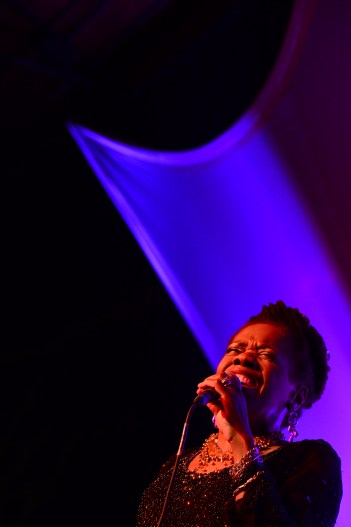


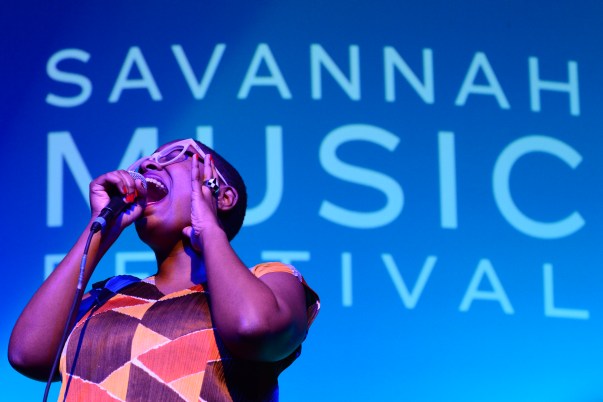


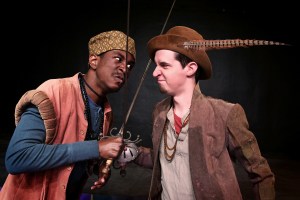 If you’re playing Rosencrantz or Guildenstern in Hamlet, you’re not exactly one of the Danish Prince’s most formidable adversaries. On the contrary, you’ve been specially chosen by King Claudius to spy on your old friend Hamlet, who sees through your treachery rather quickly. You’re not exactly peripheral, either: you come on early in Act 2, lurk fairly often onstage until late in Act 4, and the pair of you have nearly 5% of the tragedy’s lines.


 The pendulum began to swing – dramatically – toward opera in 2011, when renowned baritone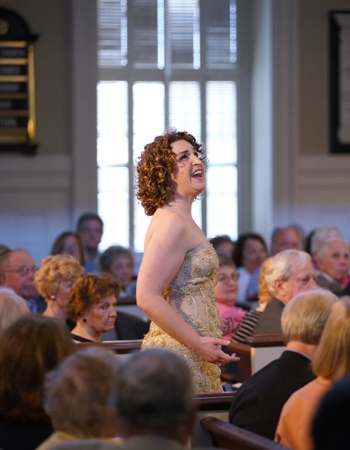
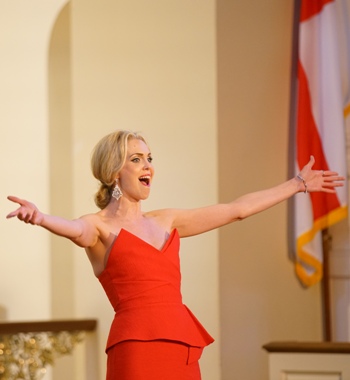


 Art on My Sleeve
