Tag Archives: Giovanni Guagliardo

A Fine Old-Timey “La Bohème” Comes Sprinkled With Youthful Energy and Fun

Review: La Bohème

By Perry Tannenbaum
200116_OPE_LAB_0097

Whether it’s tuberculosis or AIDS, Paris or Greenwich Village, La Bohème or Rent, 1896 or 1996, death and disease are intertwined in our imaginations with the struggling, impoverished lifestyles of Bohemian artists and intellectuals. What lifts these shivering, starving folk from seediness and squalor to the nobility of poetry, never upgrading their threadbare garments, is the music of Giacomo Puccini and his rock apostle, Jonathan Larson. Come to Belk Theater and the Opera Carolina production of Puccini’s seminal work and you may get an inkling of how inseparable the two composers’ works can become.

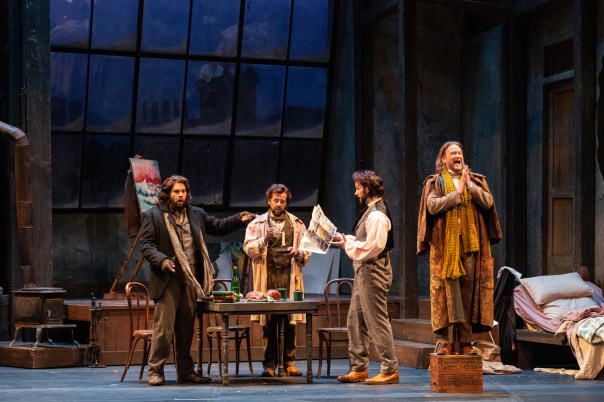
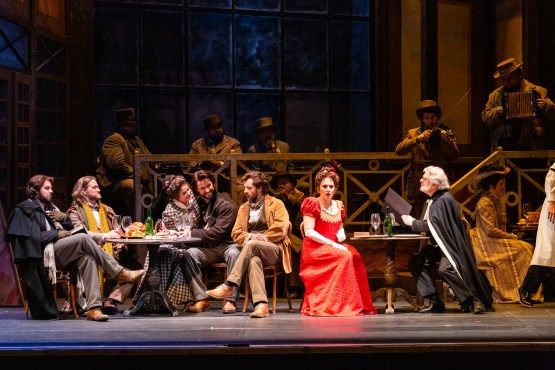
Scenic designer Peter Dean Beck has not updated the loft where we first meet the poet/playwright Rodolfo, his painter chum Marcello, musician Schaunard, and philosopher Colline. The boulevard bustle of the Latin Quarter and Café Momus is not on the awesome Franco Zefferelli scale of the beloved Metropolitan Opera production, but the spirit and colorfulness of Act 2 are also faithfully captured, where temptress Musetta and toyseller Parpignol highlight the broadened palette. Down in the pit, maestro James Meena and the Opera Carolina Orchestra are no less devoted to the shifting moods of the score, whether lovers are pining or Christmas-crazed children are running wild.
200116_OPE_LAB_0397

No, it’s director Aldo Tarabella in his Opera Carolina debut who bridges the gap between the 1830s, the actual setting specified in the Giuseppe Giacosa-Luigi Illica libretto, and the AIDs-plagued 1990s. From the outset through the intermission between Acts 2 and 3, Tarabella dispenses with subtlety in accenting the comedy of the first two scenes – the cavalier badinage between Rodolfo and Marcello as they cope with the cold, the successful conspiracy of the four tenants at the loft to thwart their landlord Benoit’s attempt to collect the rent, and the hoodwinking of Alcindoro, Musetta’s wealthy old sponsor, at Café Momus. There’s a certain amount of incorruptible idealism that infuses the Bohemians’ high spirits and deceptions, but with four performers making Charlotte debuts in this production, Tarabella also underscores the youthfulness of the Bohemians’ camaraderie and pranks.

Nor does Tarabella hold back when the mood shifts from mirth to tenderness, anguish, and heartbreak. When Alcindoro receives the bill at Café Momus after the Bohemian scamps have absconded, the old coot literally falls over backwards as the curtain comes down, and at the sad climax of Act 4, when Mimi has coughed her last, the impact on British tenor Adam Smith literally brings him to his knees as Rodolfo. In both instances, the direction is so flamboyant that we might feel like we’re watching a silent movie. Neither played like an overreach to the capacity crowd on opening night.
200116_OPE_LAB_0193

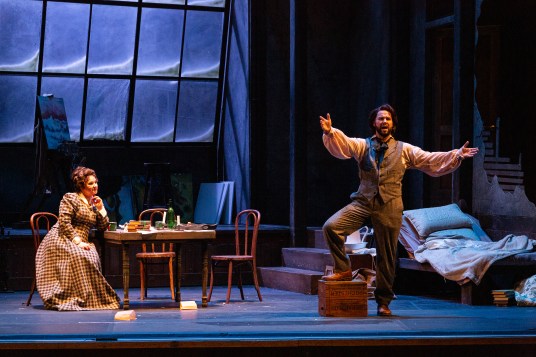
If Tarabella seemed to be persuaded by Rent of the efficacy of emphasizing the youthfulness of Puccini’s opera, then the singers onstage must certainly have exerted a persuasive power over youths in the Belk audience who were experiencing the source of Rent for the first time. Smith in particular didn’t merely touch your heart when he sang the famed “Che gelida manina (Your tiny hand is frozen)” to Mimi as he responded to her plea for him to light her candle. When Smith ascended to the blazing summit of this aria, his rich, full-bodied tenor sent a bloody stake through your heart. It would be an understatement to say that Smith equaled the Rodolfo of tenor Ramón Vargas when I reviewed him at the 1205th performance of Bohème at the Metropolitan Opera in December 2008. Vargas was past his 48th birthday when I saw him, and he could no more match Smith’s sheer vocal power than he could match his youth and freshness.

Smith’s singing ought to be sufficient incentive for snapping up what few tickets might be available for the remaining three performances of this Bohème, but he also delivered the frivolity and nerdiness of Rodolfo when needed. The other Charlotte debuts had more to recommend them than merely their youth. Italian soprano Stefanna Kybalova, though not ideally suited to the exquisite fragility of Mimi, poignantly delivered the seamstress’s consumptive weakness. Kybalova was more effective as a soloist in Acts 3 and 4, during Mimi’s final decline and when she repeated her signature “Mi chiamano Mimi (They call me Mimi)” theme, but the duets with Smith were always gorgeous, including the two fadeouts which seem to crystallize the whole opera.
200116_OPE_LAB_0534

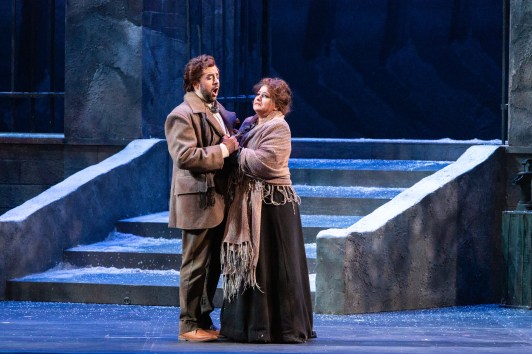
Sicilian baritone Giovanni Guagliardo is considerably mellowed as Marcello compared with his previous Opera Carolina appearances as Tonio in Pagliacci and Sonora in La Fanciulla del West, joking and commiserating with Rodolfo in the loft scenes and sympathizing with the forlorn Mimi in the Act 3 snow scene. Yet he also flashed some fire dealing with the flirtatious, manipulative Musetta. The heat of their quarreling formed an effective counterpoint to Rodolfo and Mimi’s snowy reconciliation in the quartet that took us to the second intermission. For her part, soprano Corey Lovelace had all the sultry fire you could wish for in her Charlotte debut as Musetta, giving Guagliardo as much as he gave her in the fire department. She also had sufficient arrogant majesty to captivate us and dominate a stage full of people in front of Café Momus delivering “Musetta’s Waltz,” though Tarabella didn’t ask for Carmen-grade vamping from her.

200116_OPE_LAB_0848

Outside of the two main couples, I didn’t much notice bass baritone Peter Morgan’s debut as Colline – or, for that matter, Keith Harris’s return as Schaunard – until Act 4. But to help clear the stage for Mimi and Rodolfo’s last deathbed tête-à-tête, Puccini masterfully has Colline sing a tender valedictory to his coat, which he resolves to pawn in order to provide food and medicine for the invalid. Morgan gave the aria a near-Russian solemnity, yet the eccentricity of this episode still resonated with the more blithe and high-spirited action of the opening act, when Rodolfo made a similar sacrifice, feeding his playscript to the stove to keep the Bohemians warm. Not so comical after all, despite the jibes of his companions.

Before Meena took his place in the orchestra, there was a filmed fundraising appeal aimed at boosting contributions from 23 to 30 percent of the company’s budget. Explicitly occasioned by the failure of the Charlotte sales referendum on behalf of arts and parks last November, just two days before a poorly attended opening of Verdi’s Macbeth, the appeal was aptly timed. The production that followed, in front of a packed house, affirmed what Opera Carolina is capable of when it gets the robust support it deserves.

Opera Carolina – and Six International Collaborators – Present a Top-Drawer La Fanciulla del West

Review: Charlotte Opera The Girl of the Golden West

By Perry Tannenbaum

When Opera Carolina general director and principal conductor James Meena walked out onto the Belk Theater stage to introduce the Charlotte premiere of Puccini’s La Fanciulla del West, he was appropriately sporting a black Western-style Stetson. That hat nearly grew old before our eyes as Meena delivered his curtain speech, for he had so much more to say than usual – even when he’s enumerating the generous sponsors of a production and capping off a season by announcing next year’s lineup. Not only was the New York City Opera a collaborator on this production (as they were for last season’s American premiere of Rachmaninoff’s Aleko), so were five new co-producing companies from Italy, including Teatro del Giglio in Lucca, Puccini’s hometown.

That was just the first leg of the extras from Meena. One of the sponsors, Wells Fargo, is actually represented in the opera – and in the David Belasco melodrama, The Girl of the Golden West, from which Puccini took his storyline – by Ashby, the Wells Fargo agent on the trail of Dick Johnson, our hero. So the storied San Francisco company has contributed some memorabilia to the design of this production, dating back to its iconic stagecoach days during the California Gold Rush. Finally, if there were some in the audience who weren’t already aware of it, tenor Marcello Giordani, who was about to sing the role of Johnson (alias the outlaw Ramerrez), has brought his international vocal competition to Charlotte. The four sessions of preliminary rounds, semifinals, and finals are interlaced with the three performances of La Fanciulla at Belk Theater. All in all, quite a week for Meena and Opera Carolina.

Although Sheriff Jack Rance broods among the miners at the Polka Saloon in the opening moments, impatiently awaiting the arrival of Minnie, La Fanciulla doesn’t zero in on its core story and characters as efficiently as Puccini’s Tosca, Butterfly, and Bohème. That’s not a problem if you have strong singers in the secondary roles carrying the early action. Most of the singers in minor roles gave first-rate performances. Jeff McEvoy as camp minstrel Jake Wallace gave a fine account of the homesick “Che faranno I vecchi miei” aria, justifiably launching an empathetic men’s chorus after him. Baritone Giovanni Guagliardo was such a powerful presence onstage that you could think he was one of the leading players until he was identified as Sonora, and bass-baritone Dan Boye slid ably from bravado to pathos as Sid when the card dealer was caught cheating. But all of the aspirants to Minnie’s regard didn’t sound as formidable as Sonora, and tenor Gianluca Bocchino was shockingly underpowered when he appeared as Nick, the Polka’s sly barkeep. Bocchino must have been pretty alarmed himself, for he sang much more effectively later on.

The poignant homesickness of the minstrel and the collection Sonora takes up on behalf of the disillusioned miner are well worth keeping in mind when Minnie pleads for Johnson’s life in Act 3. Similarly, the miners’ rage against Sid’s duplicity – and Rance’s authoritative intervention on behalf of the cardsharper, meting out punishment that is less than a noose – also foreshadows what we’ll see from them after intermission. While the overall design is artful, there was a welcome intensification of the drama when Minnie, Johnson, and the outlaw’s chief pursuer, Agent Ashby, showed up. As Sheriff Rance, baritone Aleksey Bogdanov is a powerful, menacing presence – Scarpia-like in his driving urges, with feelings and morals layered on. But until he was alone with Minnie, past the midpoint of Act 1, Rance could not reveal his soul. Singing the “Minnie, dalla mia casa son partito” aria, Bogdanov showed it to us, a wisp of tenderness mixed into his gruffness. Although they don’t come into play nearly as dramatically, Ashby also seems to have feelings for Minnie, and baritone Jason McKinney has a powerful presence that matches up well with the other lawman.

Stage director and production designer Ivan Stefanutti has responded well to the demands of this drama in casting and directing these two imposing baritones, but there is an extra measure of flamboyance to this pioneering spaghetti Western. Set in the foothills of the mighty Sierra Mountains, this Western emphatically separates itself from the Cactus League of the genre by including a massive blizzard at the climax of Act 2. So the men don’t merely sport boots, buckskins, vests, and a panoply of brimmed and furry hats. They also wear a variety of coats. In a wonderful array of costumes – including a turquoise suit for Rance – Steffanuti has gone with fur coats for both Rance and Johnson. Ashby’s rakish raincoat, on the other hand, is worthy of the Flying Dutchman.

Maybe a couple of words should be said about the projections designed by Op Carolina’s Michael Baumgarten. Setting the scene in the Sierras, the animated views of the mountain are tastefully dark and monochromatic, maybe a little too aggressively varied for their purpose. The animated backdrops, when the Polka interior becomes established, also changed a little too busily for my taste, but the emphasis on the Ramerrez wanted poster pointed up a prime advantage of animation. One second, the poster can be many times lifesize; the next moment, it can diminish to insignificance. In Act 2, as we reached the pivotal poker game between Minnie and Rance – with Ramerrez’s life as the stakes – the backdrop filled with supersized playing cards. But do they really need to crazily flip around like we’re in a living slot machine? Again the background changes at Minnie’s cabin were too busy, at one point seeming to suggest that Minnie lives inside a tree, and later implying that either Ramerrez’s gang or the Sheriff’s posse was outside guarding the cabin. Mercifully, Baumgarten was more restrained in Act 3, and the dawn of Ramerrez’s redemption came with more subtlety.

Giordani measures up well physically against his imposing antagonists, but the tenor has a noticeably gentler demeanor as Johnson, more convincing as an ardent lover than as a cunning and ruthless bandit on the run. Since he’s tracked down, shot, and strung up, banditry wasn’t a particularly strong aptitude for Ramerrez, so a name change followed by a career change would be sensible directions that he could see for himself in Act 2. Puccini’s music certainly pulls Johnson toward romance, redemption, and domesticity, and Giordani responds best in the heartfelt “Io non ti lascio più” duet in Act 2, before his past dalliances with a certain Nina are confirmed. Listening to Giordani deliver the “Ch’ella mi creda” in Act 3 when the jig is up, I really did feel like this was a penitent and reformed Ramerrez.

Making her Opera Carolina debut, soprano Kristin Sampson brings a stocky presence to Minnie that seemed, upon a few minutes of reflection, to be as right as Ethel Merman singing the gun-toting Annie Oakley. While I’d be leery of seeing Sampson as the fragile Mimi in Bohème, there was Tosca-like power for her to work with here as she made her dynamic entrance with a good-sized firearm holstered on her hip. She decisively resisted Rance and did not melt easily when Johnson started wooing, so her half of the Act 2 love duet came with a delicious onrush of amorous passion we hadn’t heard before. Yet she far surpassed herself in Act 3, pleading for Ramerrez’s life – one miner at a time – in Minnie’s “Non vi fu mai chi disse ‘Basta!’” The plaint built powerfully in its conviction, and as the miners gradually joined in, became a chorus of communal forgiveness and kindness that I found unexpectedly moving. Never having seen La Fanciulla performed live before, I hoped I’d be seeing a first-rate production of second-rate Puccini. Leaving Belk Theater, I had the distinct feeling that this opera deserves top-drawer status. I suspect many other longtime Opera Carolina subscribers felt the same.