The Queen City Has a Regal New Bach Festival to Call Its Own

42857183534_3fc07101fe_kReview: Charlotte Bach Festival~Opening Celebration

By Perry Tannenbaum

Boasting unmistakable DNA from the Oregon Bach Festival, at the podium and in its administrative offices, the new Bach Akademie Charlotte has launched its first annual Charlotte Bach Festival in grand style, heralding national ambitions. The Festival Opening Celebration filled the chapel at Christ Church Charlotte with listeners eager to hear Bach’s vocal music performed by a professional choir and to see Johann Sebastian’s orchestral music played on authentic baroque instruments. Conducted by Scott Allen Jarrett, the combined forces of the Akademie’s Cantata Choir and the North Carolina Baroque Orchestra obliged, filling the room with robust, cleanly sculpted sound. All hands were on deck for Cantata 147, “Herz und Mund und Tat und Leben” including guest instrumentalists and vocalists. This centerpiece was preceded by the Orchestra Suite No. 1 in C Major, where we made the acquaintance of the fullest assembly of the NC Baroque Orchestra that I’ve ever seen. Concluding the concert, the “Singet demrrn ein neues Lied” motet showcased the Choir with light accompaniment from keyboardist Nicolas Haigh, violone player Sue Yelanjan, and NC Baroque executive director, cellist Barbara Krumdieck.

Jarrett is not merely a guest conductor at Oregon Bach Festival. He directs the Vocal Fellows Program there, and he is slated to deliver the lecture concerts of their Discovery Series this summer. Adam Romey, the new managing director, is the son of Kathy Romey, longtime assistant of OBF founder Helmuth Rilling; and the Bach Akademie president, Michael H. Trammell, has sung with Rilling at festival in Europe. In welcoming the audience and in introducing the pieces, Jarrett reminded me of how Helmuth Rilling engaged his OBF audiences when he was artistic director there. He isn’t as sparing, concise, gnomic, or orotund as Charlotte Symphony’s Christopher Warren-Green in making his remarks. There is a more relaxed informality and a gentle pedagogical touch. Jarrett didn’t walk off into the wings between pieces and, since he had served as music director of the Oratorio Singers of Charlotte from 2004 to 2015, he could address us with a familiarity that must have taken Rilling years to achieve in Eugene, Oregon.

Intimacy between the audience and the musicians was sustained by the compact size of the ensembles, a mere 14 musicians taking the stage for the Orchestral Suite. Yet it did not take long for these members of NC Baroque to prove they could produce a roar in the opening Ouverture movement. Deceptively stately, for the oboes are doubling and quadrupling the pace with embellishments, the movement is far longer than any one of those that follow, with a slow-fast-slow-fast-slow structure that is most satisfying when the tempo contrasts are emphatic. Not only were the wind players on point – oboists Margaret Owens and Sung Lee backed by bassoonist Allen Hamrick – but the string players, led by concertmaster Martha Perry, were also up to the task, sounding effortless in the swift episodes. There was a nice balance later on in the Gavotte movements when strings and winds veered off in different directions and a delicious blend afterwards between the sections in the Menuets. The paired Bourées were also impressive, the strings showing their nimbleness in the fleet outer portions of this movement and, in the middle, Owens and Sung interweaving nicely over Hamrick’s continuo.

Glorious was a better description of the Cantata 147 performance than merely impressive, for all of the forces at Jarrett’s command were at their shining best – and the music includes the familiar “Jesu, Joy of Man’s Desiring,” one of Bach’s greatest hits, played twice to conclude each of its two parts. Here Josh Cohen made his first appearance with his valveless natural trumpet, launching the cantata with some stunning flourishes. Most of the vocal soloists were drawn from the Charlotte Cantata Choir, underscoring the fact that Jarrett has chosen the crème de la crème of Charlotte’s plentiful choral talent. I was most delighted by Edmund Milly’s renditions of the bass recitative (“Stubbornness can blind the mighty”) and the bass aria in the penultimate song (“I shall sing of Jesus’ miracles”), both ringing with power and authority, yet there was also considerable power from soprano Margaret Carpenter Haigh in her aria (“Prepare now, O Jesus, the way”).

With native talent of that caliber, the imports figured to be outstanding, and they were. Countertenor Charles Humphries was definitely a highlight in the alto aria (“Be not ashamed, O soul”), with a lovely obbligato from Owens over Hamrick’s bassline. Tenor Patrick Muehleise had the earnest warmth that his aria demanded (“Help me, Jesus, to acknowledge Thee”), giving Krumdieck, who is so often relegated to continuo at local concerts, a chance to show her true mettle in the cello obbligato. Among the obbligatos, I don’t think any outshone the paired oboes of Owens and Sung behind alto Elizabeth Eschen’s sweet recitative (“The wondrous hand of God’s omnipotence”). For sheer luminosity, however, nothing could compare with the live performances of the “Jesu” movements, numbers 6 (“I am blest to have Jesus”) and 10 (“Jesus remains my joy”). The familiar melody is played by the orchestra, but it’s the stately choral singing that elevates the music heavenward. Which melody is accompanying the other? Part of what nearly brought me to tears, besides the sheer beauty of the performance, were the realizations of how rarely such music is heard in a live concert and the foretaste of how much this new festival could mean to this community. Jarrett delivered an additional foretaste in his introduction to this cantata, explaining its architecture, a glimpse of what he would be doing later in the Festival when will clone his work at OBF’s Discovery Series and bring it Charlotte as The Bach Experience, exploring and then performing Cantatas 75 and 76 at Myers Park United Methodist Church in separate midday concerts.

Concluding the Opening Celebration, the Cantata Choir sounded relaxed and celebratory in their motet after scaling to the pinnacle of this concert. Jarrett didn’t let up on the ensemble in the opening movement (“Sing a new song to the Lord”), calling for a slightly brisker tempo than I’ve usually heard, and I’ve certainly encountered more hushed and reverent accounts of the choruses in the middle movement. Yet there was still a definite éclat when the ensemble lit into the final “Lobet den Herrn in seinen Taten” (“Praise the Lord in His works”), similar to the opening movement in its ecumenical return to the mother of us all, the Psalms of the Old Testament. Once more, Jarrett and the Choir accelerated with effortless speed, producing satisfying layers of melody, rich textures and counterpoint, building to what many people would call a cathedral of sound. Less pretentious folk could simply – and rightly – call this concert a grand opening.

“Flying Lovers” Tops 2018 Theatre Offerings at Spoleto Festival USA

Reviews: The Strange Undoing of Prudencia Hart, Borders, and The Flying Lovers of Vitebsk

24877437748_a17647a75c_k

By Perry Tannenbaum

Theatre has gotten a looser, more guerilla feel to it at Spoleto Festival USA now that Woolfe Street Playhouse has established itself as one of the festival’s main venues. Unlike the storied Dock Street Theatre, where a flagship production gets 17 performances each season – plus a preview night – Woolfe Street can be reconfigured to accommodate cabaret and theatre-in-the-round presentations. For one-person shows, like a Taylor Mac extravaganza, it’s a better fit than the Emmett Robinson Theatre at College of Charleston.

So it figured that National Theatre of Scotland’s The Strange Undoing of Prudencia Hart would transfer from its off-Broadway haunt at the McKittrick Hotel to Woolfe Street with ease. There’s even a bar at the rear of the Woolfe, so the audience could self-lubricate in the same casual manner they did on W. 27th Street.

But somehow, it didn’t quite work.41872032304_9ec3a7fd92_k

They did apply the cabaret treatment in Charleston, but in New York, the vibe had been more like an Irish pub with sturdy rough-cut tables for the audience. The cocktail tables were smaller, but the larger dimensions and the higher ceiling at the Woolfe conspired to make even Peter Hannah, who repeated his off-Broadway stint as Satan, less audible and intelligible. Worse yet, Melody Grove and her starchy, autumnal, spinsterish charms weren’t aboard for the reprise, replaced by the youthful Jessica Hardwick, who diluted all three of those dimensions.

Prudencia’s starchiness is rather complex because, in her musty academic field of folk ballad studies, she’s a retro romantic. David Grieg’s fanciful script, written substantially in retro rhymed couplets, compounds the complexity by portraying the trendy men who dominate the academic conference Prudencia attends, spouting all sorts of deconstructionist quibbles with the ballads’ sincerity and authenticity, as rather backward in their patronizing, lecherous attitudes toward women.

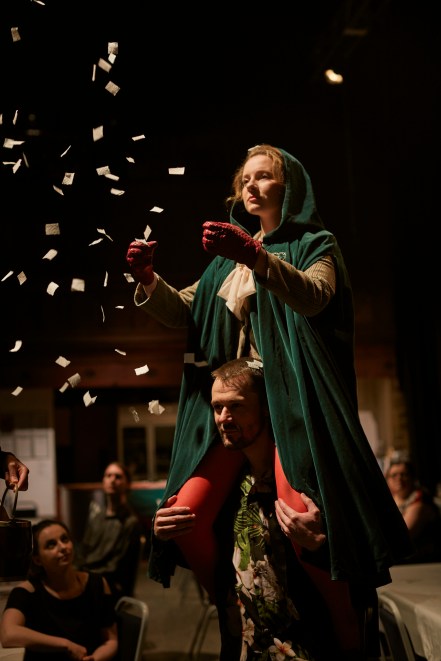
As a rebel against hidebound orthodoxy, Hardwick’s youth serves her well, but when a historic blizzard impacts the action, and the front door of an Airbnb turns out to be a gateway to Beelzebub and eternity, the poignant dimension that Grove brought to Prudencia – of a woman who has missed out on her life – gets buried. The snow, after all, is pieces of paper that the audience has shredded and tossed into the air, and the twilight zone where Pru departs overlooks a Costco parking lot. So comedy is muting the pathos of Prudencia’s strange undoing as well as the National Theatre’s spectacle – which includes a generous helping of bonny Scottish folksinging. At the critical moment that delivers her back to Costco, I missed the strong sense of Hardwick as a late-blooming flower in Hell.27724906267_9642754db7_k.jpgFor the second season in a row, I needed my wife Sue’s assistance in deciphering what Avital Lvova was saying onstage at Woolfe Street in a Henry Naylor drama. Last year, it was Angel, the story of the life and death of a Kurdish sharpshooter, where I was able to move closer to an empty seat near the stage and salvage some of Lvova’s performance. Lvova was back this year in Borders as another action hero, Nameless, a Syrian graffiti guerilla. No closer seats were available this time, so I struggled to comprehend even the basics of Nameless’s narrative as she lurked in a hoodie and thrashed on the floor in evasive actions.
Abandoned by her father, raised by Mom, encouraged and deployed by a paint store patron, ambiguous relationship with boyfriend, unwanted pregnancy, and flight to safety. That was the gist I was able to catch unassisted.

Thankfully, Naylor provides a second narrative that alternates with the Syrian graffiti artist’s – and ultimately converges with it in a fraction-of-a-second shutter snap. If Lvova is showing us the desperate primitive lives of the noblest people enmeshed in the perpetual turmoil of the Middle East, then Graham O’Mara as celebrity photographer Sebastian Nightingale mirrors both the commercialization by the West of that endless strife and our smug indifference to it.

O’Mara, pretty tall and glamorous himself, gave a stunning account of this LA slickster who’s occasionally afflicted by conscience and remorse, maybe just enough to add the gravitas of a three-day beard to his image. Listening to Sebastian’s account, particularly his climactic confrontation with a burnt-out photog who had persisted in Syria, I had a taste of what Naylor’s dramas could be if they were adequately cast.

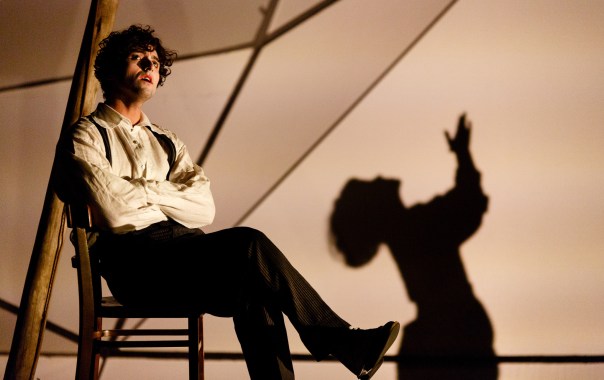
Directed by Emma Rice, The Flying Lovers of Vitebsk started out by bringing a wisp of nostalgic cabaret ambiance to Dock Street Theatre – eminently appropriate, because Rice had starred in the original production over 25 years ago when she and her newlywed husband, playwright Daniel Jamieson, portrayed over-the-moon lovers Marc and Bella Chagall. Marc Antonin as the beloved painter, entered the darkened theater from the rear serenading us and his bashert – Daisy Maywood, rapturously awaiting him as Bella.

The Kneehigh and Bristol Old Vic remount of what Jamieson originally titled Birthday sported an ultra-versatile band that included James Gow and composer James Gow. Cementing its kinship with Kneehigh’s Tristan & Yseult, directed by Rice at Spoleto in 2006 with bushel baskets of old music, Sophia Crist designed a severely raked set of weathered wood with scaffolding that didn’t look strong enough to hang either of the principals. Like the Chagalls’ love, its survival looked dubious in a storm-tossed world.24877435838_fabbc46c7d_kAll that separates The Flying Lovers from ascending to the pinnacle of towering drama are length, conflict, complications, and plot. Instead, the blissful couple navigates upheavals that decimate their obscure hometown (ironically best known today as Chagall’s birthplace) and threaten to incinerate the Jewish people. Pogroms, the Russian Revolution, and the Holocaust toss the couple back and forth across Europe until they reach the safety of the US. More vividly than these obstacles, we remember the purity of the love that binds Marc and Bella together. This love helps them to soar above the troubles of our world – higher, they seem to levitate, because there are no plots or complications pulling them down.

Both Antonin and Maywood cavort like newlyweds, often replicating those endearing, impossible, gravity-defying poses that Chagall painted of his love. They also sing with that simple, intimate sincerity ushered in by microphones, radio, Crosby, early Sinatra, and Margaret Whiting. Then you realize what distinguishes Chagall’s best work. It’s not the invention of surrealism, which is disputable. It’s the way that joyful music is forever singing in the colors and the flowing design of his paintings.


Confused and Abused Teens – With Unmistakable Talent

Preview:  Spring Awakening

By Perry Tannenbaum

For over a century, playwright Frank Wedekind was best remembered as the creator of Lulu, the libertine protagonist in two of his erotically charged dramas, Earth Spirit (1895) and Pandora’s Box (1904). Alban Berg combined the two works into one Lulu (1937), an opera that stands as one of the sexiest of the 20th century.

Then came 2006.

Wedekind’s notoriety was refueled for a new millennium when Steven Sater adapted the German’s first script, Spring Awakening, for an off-Broadway production. If Lulu was risqué and amoral, Spring Awakening was angry, raw, and a bit shocking – teen chaos rather than salon decadence. The score, composed and orchestrated by Duncan Sheik, certainly wasn’t opera. It was a wicked mix of sensuous, anguished ballads like “Touch Me” and “The Word of Your Body” juxtaposed with raging frenetic rockers like “The Bitch of Living,” “My Junk,” and “Totally Fucked.”

Schoolkids standing up rebelliously on their desks, dancing and stomping catatonically. Vilifying parents and teachers. Ecstatically screwing just before intermission. Even liberal newspapers had to tiptoe around the song titles, lyrics, and actions.

The Atlantic Theatre Company production was an instant sensation, picking up an armful of awards before transferring to Broadway that same year. Eleven Tony nominations and eight Tony Awards were added to the haul, including Best Musical. Somehow the Victorian repression, the withholding of sex education, and the perils of unprotected sex, backstreet abortions, and teen suicide of Wedekind’s 1891 script had leapfrogged into the 21st century in a theatrical triumph – with no mealy-mouthed concessions whatsoever to the older generation.

Underscoring the generic, unsympathetic nature of Wedekind’s adults, all 14 of them were portrayed by one male and one female actor. This was not merely a tragedy of star-crossed lovers. It was an explosively presented nightmare scenario of what can go wrong when adults refuse to discuss sex with their children.

And now this scorching musical hits Charlotte this Friday, barreling into our community theatre for a three-week run – including three Sunday matinees and two Saturday performances on June 1 at 8:00 and 11:30pm. Somebody at the Queens Road barn believes they’re going to sell a whole bunch of tickets. Nobody seems worried that we’ll experience a repeat of the Angels in America uproar that rocked the city in 1996, with aftershocks that ultimately capsized Charlotte Repertory Theatre in 2003.

“We have no trepidation about Spring Awakening being a bridge too far,” says executive director Ron Law. “Many young performers and audience members have lobbied for it, and it has always performed strongly in our show selection survey.”

Touring versions of the show came here in 2010 and 2011, but of course, these weren’t shows with local artists funded by local dollars. The feeling was, even then, that the city had changed and audiences had matured since the Angels debacle. But there is likely another factor at work. Theatre Charlotte has better prepped its audience than Rep.

Oleanna, Falsettos, and Miss Evers’ Boys were as far as Rep pushed the envelope before fielding Tony Kushner’s gay fantasia. At 501 Queens Road they’ve pushed further with its more diverse audience, bringing us The Full Monty, Rent, Hair, and La Cage aux Folles in recent years. One way or another, the unholy trinity – nudity, foul language, and homosexuality – have all been addressed.

“All those shows were huge box office successes for Theatre Charlotte, with little pushback,” Law reports. “For this show, we even offered season ticket buyers the opportunity to buy a package that did not include Spring Awakening. A very small number took us up on this.”

Caution was not altogether thrown to the winds in scheduling this potential powder keg. Some niceties were also observed on the production end, beginning with auditions for the roles of the kids crossing the threshold of puberty. Nobody was allowed to audition unless he or she would be 18 on opening night.

“There were many disappointed 15 and 16 year olds who love the show and couldn’t audition,” Law confirms.

Most of the teens who did audition were savvy theatre students, according to Law. Some have participated in Theatre Charlotte’s youth-oriented summer stock productions, and others have been groomed in the robust theatre programs of our local high schools.

Nominated for the prestigious Blumey Awards for high school musicals across metro Charlotte, three of the major players in Spring Awakening are so accomplished that they put a major crimp in director Billy Ensley’s rehearsal schedule.

Seniors at NW School of the Arts, Renée Rapp (Best Actress), Liam Pearce (Best Actor), and Maya Sistruck (Best Supporting Actress) all earned Blumey Award nominations for their work in the school’s presentation of Big Fish, which is nominated for Best Musical honors. As finalists, all three were spirited away to Belk Theater, rehearsing for multiple segments of last Sunday night’s award ceremonies, where they performed individually and together.Rapp first landed a role at Theatre Charlotte when she was 10 and transferred to Northwest in her junior year. “They are both truly such talented and good-hearted human beings,” she says of Pearce and Sistruck. “Working amongst them all these years has helped me grow as a performer watching the dedication they put into what they do. We have so much love amongst the three of us that even in this especially stressful time with the Blumeys, Spring Awakening and graduation, they make every day and every rehearsal feel like a celebration for me.”

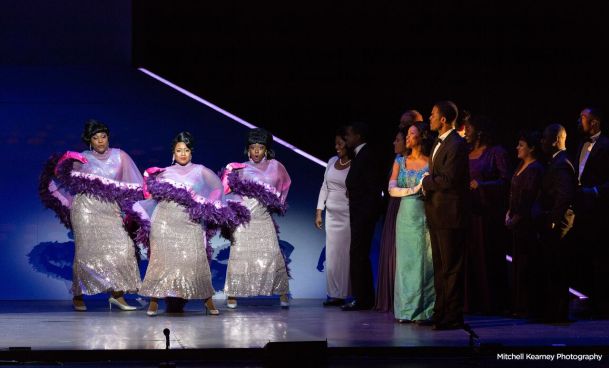
As Wendla Bergmann, Rapp launches the horrific scenario of Spring Awakening when she asks her mom how babies are made and gets a bogus answer. The only teen around who seems to have the lowdown is Melchior Gabor, a voracious reader who quietly shares the news with his shy neurotic bestie, Moritz Steifel – with explicit illustrations and written descriptions. But the atheistic, amoral Melchior does not share the facts of life with Wendla before he deflowers and impregnates her.

Dire consequences all around.

“Melchior has many layers to him,” says Pearce of this charismatic troublemaker. “He clearly wants to experience all of these activities he has read about but may not necessarily be ready to deal with the aftermath of what they may lead to. While he is extremely intelligent, he is still a teenager who has not completely grasped all of the knowledge he needs to be a functioning adult in society.”

Pearce isn’t altogether sure why he landed this plum role, but he has worked with Ensley – and choreographer Lisa Blanton – before at Theatre Charlotte in Jesus Christ Superstar. Ensley saw Pearce as a clear choice at his auditions, both as a singer and as an actor.

“Melchior needed to be a double threat actor singer,” Ensley says, “who could understand the commanding ‘big man on campus’ ego and the broken-hearted lover.”

In love with the misfit Moritz and abused by her father, Martha Bessell takes us to other dark regions of Wedekind’s story. “I always thought that her character arc was one of the strongest and most complex of the girls in the show, and I thought it’d be a wonderful challenge for me to take on,” Suskind says of Martha. “As for being nominated for Blumeys, it was quite nice to be able to link up our busy schedules and have a little ‘buddy’ looking out for any missed rehearsals or information. We were always on the same page.”

All three are also on the same page about delving into their troubled teen characters. They all give props to Ensley. Rapp offers the most detailed insights.

“I have heard countless people tell me how amazing working with Billy is,” she begins, “but it wasn’t until I had a one-on-one with him that I truly understood the depth of what they meant. He puts his heart into this production 100%, and that is so evident and inspiring for me. We sat and talked about myself and my character, and he really helped me break down what this show will mean. His direction is unmatchable. He works and tweaks things with such a specific eye, and I absolutely love it.”

Update: Renée Rapp took honors for Best Actress at the Blumey Awards on Sunday night, winning a trip to Broadway with Ethan Holtzman from Charlotte Latin School for a chance the national Jimmy Award on June 25. So who else won? Check it out here. Ceremonies will be rebroadcast on WTVI on May 29 at 8:00pm.


Tappin Music Carries the Night – at the Knight – in Opera Carolina’s I Dream

Review:  I Dream

By Perry Tannenbaum

Douglas Tappin has composed approximately half of a very fine rhythm-and-blues opera, an extensively revamped I Dream that originally premiered in 2010, honoring Rev. Martin Luther King in his hometown of Atlanta. The two-act work has now been revived serendipitously to coincide with the 50th anniversary of Dr. King’s assassination, premiering in Toledo at 7:01pm on April 4, the exact minute of the crime a half century earlier, and getting a reprise in Charlotte in an Opera Carolina production at Knight Theater.

Showcasing Tappin’s music, Opera Carolina is presenting its first fully-staged production at Knight Theater, a venue they have only used previously for special concert events.

The unfortunate thing is that Tappin also wrote the lyrics and the libretto for I DREAM. We’re saddled with a script that slinks its way circuitously through MLK’s last 36 hours, guided by a dubious premise and punctuated by flashbacks that aren’t always dramatic. This civil rights icon doesn’t merely have a premonition that longevity isn’t to be his; he has recurring dreams about the balcony where he will be shot.

In a bizarre twist, these specious dreams become the dream of Tappin’s title, because all of King’s famed oratory – his “I Have a Dream” speech and his “Mountaintop” prophecy – are never spoken. You better know who Ralph and Hosea are, too, for in steering far away from any copyright recriminations from King’s heirs, Tappin omits their full names. Coretta and Martin aren’t blessed with their last names on the cast listings, either.

And who are Martin’s historic adversaries in his heroic struggle for civil rights? Never anyone more important than an anonymous cop wielding a billy club.

Instead of DC or Memphis, Tappin takes us to Montgomery, Birmingham, and Selma. Prudent choices if we’re seeking action rather than copyrighted oratory, but Tappin’s libretto also takes us to Boston, where he met Coretta during his student days, and to a hospital bed, where a duet is sung over his recumbent form. Perhaps in a previous draft of the libretto, King was stabbed in the chest with a letter opener as he actually was at a 1958 book signing. Not anymore: here he simply collapses.

A better playwright would have tiptoed more skillfully through the copyright minefields and woven a more dramatic and compelling narrative. Tappin’s great strength is in his music. If Andrew Lloyd Webber learned profitably from the great operatic masters, I’d say that Tappin has learned profitably how to create a propulsive non-classical score from Lloyd Webber.

When we finally get to Birmingham and Selma in Act 2, the lunch counter arrest and the time in jail signal a melodic climb to King’s victory in Selma that is truly majestic and inspiring. Tappin sustains this momentum through the rendezvous with fate on the balcony of the Lorraine Motel and afterwards, when Coretta leads Martin’s people in mourning.

Although the steeply raked set design by Kevin Depinet, in placing the fatal balcony dead center, reminds me of a TV test pattern, stage director Daniel Goldstein keeps the action between scenes moving fluidly, and the singers have been more than sufficiently rehearsed to move surefootedly on the sloped surface. Musical director and orchestrator Carl Marsh seems to favor Broadway over the Metropolitan Opera in his instrumentation, including an electric guitar and electronic keyboards in the mix, but there is plenty classical heft in the 35-person ensemble with 13 musicians from Charlotte Symphony.

Opera Carolina’s frontline cast also straddles the realms of musical theatre and opera in their impressive résumés. Derrick Davis has sung an admirable range of baritone roles on Broadway and on tour, from Mufasa in Lion King to the title role in Phantom of the Opera, and his OC debut as MLK has moments of peacemaking mellowness and warrior ferocity.

Although the roles of Ralph Abernathy and Hosea Williams aren’t noteworthy for their historical accuracy or even their individuality, the voices we hear, both returning OC artists, bring the heat. Baritone Kenneth Overton as Ralph seems to be the voice of prudence and pragmatism, yet solid and formidable. As Hosea, Victor Ryan Robertson is the voice of passionate principle, his wild tenor bridling against the discipline of non-violence. The bi-play between Robertson and Davis in the jail scene is simply riveting.

Victimized by the static scenes in Boston and at the hospital, Laquita Mitchell is further disadvantaged by her divine soprano voice. I wouldn’t blame Jeremy J. Lee’s sound design or even Tappin’s libretto here, but to be understood, Mitchell needs supertitles more than anyone else onstage. As a result, mezzo Lucia Bradford upstages Coretta as Grandma in her Charlotte debut. Her maxim, movingly sung to Young Martin (Byas Yasan Monroe), ultimately becomes the most effective frame for King’s sequence of flashbacks.

With this powerhouse lineup of singers armed with Tappin’s consistently lively music, we easily weathered the lulls and inexplicable blind alleys of the composer’s script. The opening night audience for I Dream entered with plenty of enthusiasm for the legacy of Martin Luther King, the rhythm-and-blues idiom of Tappin’s opera, and Opera Carolina’s audacity in taking subscribers to new places – including Knight Theater for a refreshing change. From the buzz in the Knight lobby afterwards, I’d say the performance had clearly sustained the audience’s enthusiasm in all respects.

Homespun “Barbecue Apocalypse” Improves With Age

Reviews: Barbecue Apocalypse, The Sherlock Project, Life Is a Dream, and Madagascar

By Perry Tannenbaum

IMG_5740

In a year that included Lucas Hnath’s The Christians, Robert Schenkkan’s The Great Society and Rebecca Gilman’s Luna Gale among the top contenders, I could only give Matt Lyle’s Barbecue Apocalypse a lukewarm endorsement for best new play of 2015, ranking it #13 among 27 eligibles that I read for that year’s Steinberg Awards. Nor did colleagues from the American Theatre Critics Association strongly disagree with my verdict, since Lyle’s dystopian comedy didn’t make the cut for the second ballot, when we considered our consensus top 10.

But before Charlotte’s Off-Broadway decided to stage this show at The Warehouse PAC up in Cornelius, they did some reading and balloting of their own. From January through March, the company offered monthly “Page to Stage” readings presenting two different plays on each occasion. Then they asked ticketholders to vote on which of the six plays they would like to see in a fully staged production. Less than two months after the votes were counted, Barbecue is back for my reconsideration as the audience favorite.

And on further consideration, I must credit director Anne Lambert and her professional cast for convincing me that Barbecue Apocalypse is even better than I thought it would be – far more to my liking than real barbecue.

IMG_5885

Lyle would probably concur, since his patio hosts, Deb and Mike, are only grilling and basting because they want to avoid the embarrassment of having their friends – who are more trendy, stylish, and successful – see the interior of their home, decorated with lame movie posters. Deb succinctly describes her strategy as lowering expectations for the cuisine and the ambiance. Outdoors, she can point with pride to the fact that Mike has built the rear deck himself. Yet the barbecue event has obligated Mike to buy a propane grill off Craig’s List, and he’s afraid to light it.

He would also like Deb not to mention that he’s a professional writer, for his career earnings, after one published short story, now total 50 bucks.

All four of the guests feed the hosts’ sense of inadequacy. Deb is a decorator, foodie, and gourmet cook who makes sure to bring her own organic meat, and her husband Ash is a gadget freak, armed with the best new smartphone equipped with the most awesome apps. Win pretty much embodies his name, a former high school QB, now a successful businessman with Republican views. He lives to put Mike down and can seemingly get any woman he wants. Even his bimbo of choice, Glory with her Astrodome boobs, can claim formidable accomplishments, arriving late to the barbecue after nailing her Rockette audition.

What ultimately happens to this insulated suburban group reminds me of The Admirable Crichton, the excellent James M. Barrie tragicomedy I came across a couple of times during TV’s golden age, when colleges had core curriculums. A perfect butler to the Earl of Loam in Mayfair, London, Crichton and his betters were shipwrecked on a desert island in the Pacific, where his natural superiority emerged.

There are two basic differences between Barrie’s back-to-nature tale and Lyle’s. The shipwreck situation was reversible with rescue. Apocalypse isn’t. More to the point, Barrie was clearly targeting the blind rigidity of class distinctions. Here if we consider the implications of Barbecue Apocalypse, Lyle seems to have modernity in his crosshairs – how our world warps our aspirations and our self-worth, how it channels us into modes of living that are far from our authentic selves.

In the cramped storefront confines of the Warehouse, Lambert doesn’t attempt to design a deck that lives up to Mike’s pretensions, and Donavynn Sandusky’s costume designs are similarly déclassé, especially for the nerdy Ash. This robs Lyle’s concept of much of its slickness, which for me turned out to be a good thing. Aside from the Craig’s List mention, Lambert also dropped in a couple of local references that added to the overall homespun flavor.IMG_6440

Becca Worthington and Conrad Harvey were nearly ideal as our hosts, keenly aware of each other’s limitations and their own, yet visibly crazy for one another. Worthington with her status-conscious rigidity and stressing was clearly the closest actor onstage to Lyle’s vision, beautifully flipping her “We suck” persona after intermission and the apocalypse, when a full year of roughing it has elapsed. Harvey was more than sufficiently cuddly and self-deprecating – but credulity is stretched when a man of such size and stature is repeatedly dominated by his adversaries.

If you can accept that Greg Paroff was ever on a football field, let alone as a QB, you’ll be quite pleased with how he handles Win’s asshole antics. He is confident, he is arrogant, and if he’s possibly past 40, that only increases the disconnect between Win and his limber Rockette. Julia Benfield is absolutely adorable as Glory, and I absolutely adore how she’s still mincing around in high heels when she makes her disheveled entrance in Act 2. We totally believe that her familiarity with Tom Wopat doesn’t extend to The Dukes of Hazard in the ‘80s.

Probably not the best moment for Lambert when she cast Cole Pedigo and Jenn Grabenstetter as Ash and Lulu. They should remember the ‘80s, but I needed to stifle my doubts. Wardrobe and just the way he’s absorbed in his iPhone might help Pedigo out – and make him less wholesome, winsome, and juvenile before the apocalypse. Grabenstetter overcomes all objections when free-range Lulu gets snockered on generic canned beer, and both Pedigo and his scene partner truly click when adversity brings Ash and Lulu to a new lease on life in Act 2. I believe that’s an antler dance.

I won’t disclose what happens when Maxwell Greger walks on for his cameo deep in Act 2, but I do respect how Lyle makes him earn his paycheck with a sizable monologue. Greger does the denouement with a slight manic edge, and the technical aspects of his departure are impressively handled.

So it’s fair to say that apologies are in order for rating Barbecue Apocalypse in the middle of the pack when I first read it. Or excuses, since a rational man resided at the White House in 2015, and apocalypse seemed so fantastical.

But hold on. Charlotte’s Off-Broadway has already programmed two other plays from their “Page to Stage” readings for two fully-staged productions in the near future, Susan Lambert Hatem’s Confidence (and The Speech) for September and Lauren Gunderson’s Exit, Pursued by a Bear for next February. Maybe when these runner-ups get fleshed out, supporters of Lyle’s winning script might reconsider their votes!

A Catch-All Catch-Up

Our recent travels to Greece, Israel, and Jordan compelled us to miss a bunch of high-profile openings after we reviewed the reinvented Rite of Spring at Knight Theatre on April 6 and CP’s On Golden Pond the following evening. Even before we left, we had to pass on the Charlotte Dance Festival and CP’s Elixir of Love so we could adequately prepare for our trip. To see the birthplace of theatre, the Holy Land, and Petra, we had to miss out on the BOOM Festival, the reprise of Beautiful: The Carol King Musical, and the opportunity to host a pre-show preview of The Marriage of Figaro for Opera Carolina.

New openings when we returned were a must, so we hit the ground running with Charlotte Ballet’s Spring Works and Symphony’s Brahms-and-Bartok program. But our need to catch up with Carolina Shakespeare’s Life Is a Dream made us put off seeing PaperHouse Theatre’s Sherlock Project until it second week. It gets complicated. But I’ve tried to get up to speed while working on more reviews and features. File these under gone but not forgotten:

The Sherlock Project So a dozen actors and writers collaborated on PaperHouse Theatre’s mash-up of Sir Arthur Conan Doyle’s short story gems, producing a script that follows three guiding principles: keep it funny, keep it moving, and don’t, don’t, don’t ever explain how the great Sherlock Holmes arrives at his incredible deductions. Going back to their roots at the Frock Shop on Central Avenue, PaperHouse and director Nicia Carla found a frilly complement to the Victorian chronicles of Dr. John Watson.

But the frame of the story was wholly new, telling us that the deadeye detective in the deerstalker cap is a woman. Watson protects the woman who should be credited with all the purported exploits of Scotland Yard’s Inspector Lestrade because he knows that Sherlock is right: The general public is even less prepared to believe a female is capable of such brilliancies than Watson is.

Besides all of the Sherlockian brilliance and nonchalant arrogance, Andrea King reveled in all of the detective’s eccentricities, whether it was shooting up a 7% solution of cocaine, tuning up a violin, or lighting up a calabash pipe. Opposite King’s insouciant self-confidence, Chaz Pofahl wrung maximum comedy from Watson’s wonder and timidity – a phenomenon compounded by the gender factor as Pofahl switched from paternal protectiveness to awe or terror while King wryly twinkled and smiled.

The two main supporting players slipped into multiple roles, Angie C as a cavalcade of damsels in distress and Berry Newkirk in the plumiest cameos, ranging from the dull-witted Lestrade to the razor-sharp Professor Moriarty, mythically uncatchable. Apart from directing behind the scenes, Carla conspired in the action as Mrs. Hudson, Holmes’s discreet housemaid. Carla not only ushered in Sherlock’s distraught clientele or evil adversaries, she also presided over scene changes, when audience members had to exit the Frock Shop’s parlor to a murder scene in the adjoining room or out on the porch when Sherlock was pursuing… something. Had to do with fire.

Or when it was intermission, time for little cucumber sandwiches.

The whole show was a wonderful diversion. PaperHouse had to add another performance to their run, which we caught last Wednesday, and the remaining nights were already sold out. Like the PaperHouse faithful, I couldn’t get enough of The Sherlock Project. I wanted lots more – beginning with how did Sherlock deduce that Watson had just come from Afghanistan when they first met?

Life Is a Dream – Convinced it was a comedy rather than a political melodrama, Shakespeare Carolina and director S. Wilson Lee kidnapped Pedro Calderón de la Barca’s classic, written during Spain’s Golden Age, and transported it more than three centuries forward from a mythical Poland to a mythical Las Vegas. There in a seedy club on the strip, the two factions with their eyes on the throne were Frank Sinatra’s Rat Pack and Marlon Brando’s Wild Bunch.

Lee’s wild conceit didn’t do nearly as much harm as I thought it would, mainly because ShakesCar didn’t have the budget to carry it too far at Duke Energy Theatre, and the strong cast mostly played their roles as the text, sensibly adapted by Jo Clifford, said they should. So much depended on the broad shoulders of David Hayes as Segismundo. Heir to the throne of Poland, Segismundo has been locked away Prometheus-like in a mountain dungeon for his whole life by his father, King Basilio, who is foolishly trying to ward off the dire destiny predicted by an astrologer.

A boiling rage seethes inside of Segismundo, and a less mightily built actor than Hayes might need to strain himself to encompass it. Hayes projected the mighty rage rather naturally, which made it easier for him to flow convincingly into Segismundo’s softer emotions when – before he has even suspected his royal lineage – he is handed the Polish throne and the power to act on his newly awakened sexual urges as he sees fit.

Called upon to give a far more nuanced performance as Basilio, Russell Rowe delivered. Yes, he was cruel, but also conflicted, with a lifelong dread deftly mixed into his forcefulness. Though I feared the convoluted plot might be abridged or simplified, the intrigue, the complexity, and the epic monologues were almost entirely intact. As the vengeful Rosaura, Teresa Abernethy brought forth the masculine-feminine blend that the transgendered Clifford was aiming for in her translation, and James Cartee, an actor who often keeps nothing in reserve, showed unusual probity and maturity as Clotaldo, even as he tried to figure out his long-lost child’s gender.

Nobody was more suavely dressed by costume designer Mandy Kendall than James Lee Walker II as Astolfo, the successor that Basilio wanted if the true heir didn’t pass his test. But if anybody was victimized by Lee’s Rat Pack concept, it was Walker. I have no idea why he persisted in speaking so rapidly and unintelligibly, unlike any work I’d seen from him before. Was he attempting a Sammy Davis Jr. imitation? Couldn’t figure out what accounted for this curious outing.

Betrothed to this strange hipster, Maggie Monahan beautifully brought out the agonies of queen-to-be Estrella. Maybe the most Shakespearean role in this ShakesCar production was Ted Patterson as Clarin, who tags after the disguised Rosaura from the opening scene, as either her companion or servant – but definitely our clown.

On the strength of this effort, theatergoers can be excited about ShakesCar’s next invasion of Spirit Square, The Tragical History of the Life and Death of Doctor Faustus at Duke Energy from June 28 to July 7.

DSC03442

Madagascar – Okay, so I’ll grant that the musical adaptation of the 2005 Dreamworks film didn’t have the gravitas of the greatest Children’s Theatre of Charlotte extravaganzas of the past like their Boundless Grace and The Lion, the Witch, and the Wardrobe – or the bite of Ramona Quimby and Tales of a Fourth-Grade Nothing. But this confection was nearly perfection. Under the direction of Michelle Long, Madagascar hit a family-friendly sweet spot, straddling the realms of cartoon silliness, cinematic adventure, and theatrical slapstick and dance. I just didn’t like the deejay, everybody-get-up-and-act-stupid thing.

Scenic design by Jeffrey D. Kmiec never lost its freshness thanks to a slick stage crew and the eye-popping lighting by Gordon W. Olson, while the animal costumes by Magda Guichard probably made the strongest case for live theatre against multiplex animation. Choreography by Tod A. Kubo chimed well with Long’s direction, which used areas of McColl Family Theatre that rarely come into play.

Centering around four animals that break out of Central Park Zoo, Madagascar introduced us to Marty the zebra and his wanderlust. We moved swiftly from there. Following the lead of four penguins bound for Antarctica, Marty escaped the zoo, seeking a weekend in Connecticut. Not only are police, animal control, and TV bulletins on his trail, so were his pals Gloria the hippo, Alex the lion, and Melman the giraffe. Embarking underground in the Manhattan subway, Marty hardly stretched credulity much further by winding up off Africa.

Deon Releford-Lee was a spectacular triple-threat as Marty, but what dazzled most was the multitude of gems in this supporting cast, beginning with an intimidating Alex from leonine Traven Harrington and – on stilts, of course – a timorous Melman from Caleb Sigmon. Dominique Atwater disappointed me as Gloria, but only because we didn’t get enough of our hippo after her first big splash. Olivia Edge, Allison Snow-Rhinehart, and Rahsheem Shabazz fared better, drawing multiple roles.

While the book by Kevin Del Aguila shone more brightly than the musical score by George Noriega and Joel Someillan, I was amazed that so much story and song could be squeezed into barely more than 60 minutes. Combined with last October’s Mary Poppins, the exploits of Madagascar prove that musical production is an enduring strength at Children’s Theatre. I can’t think of a season at ImaginOn that had sturdier bookends than these musicals that began and concluded 2017-18. The crowd that turned out for the final performance affirmed that the 7th Street fantasy palace has perfected the craft of producing family fare.

Not only that, it showed me that Charlotte families have spread the word.

Charlotte’s Ace Comedienne Takes on a Touchy-Feely Challenge

Preview:  Every Brilliant Thing

By Perry Tannenbaum

Written by two Brits, Duncan Macmillan with Jonny Donahoe, Every Brilliant Thing began life in 2013 in a little English town and didn’t achieve any kind of renown until Donahoe brought the one-man show across the pond in an off-Broadway production the following year. An HBO movie in 2016, a coveted engagement at Spoleto Festival USA last season, and numerous productions across the country have spread the word.

To an uncommon degree, this one-man show relies on audience participation to tell the story. When a vet comes by to put down the young narrator’s dog, Sherlock Bones, a person from the audience is picked to play the vet. When Mum is taken “to hospital,” an audience member helps deliver the scene where Dad explains that the boy’s mother has made her first suicide attempt.

And when the boy draws up his list of “everything brilliant in the world. Everything worth living for,” in a lifelong effort to cheer Mum up and keep her alive, audience members who are given hand-written scraps of paper before the show call out items on the epic list. #1, Ice cream, #2, Water fights, and so on.

But Every Brilliant Thing doesn’t have to be a one-man show. Or British. At Spirit Square, where the Three Bone Theatre production opens next week, it won’t be.

“One of the exciting things about the script is that the playwright has specified that this story can be told by any actor, any gender identity, any race, any age,” says Three Bone artistic director Robin Tynes.

Rehearsals started back in December. There were no auditions. With so much emceeing, audience interaction, and stand-up comedy skill required, your garden-variety audition wouldn’t help a director to make her choice. Tynes just handed the script to Tania Kelly.

Tynes needed someone who could draw an audience to Duke Energy Theater, somebody with proven improv chops. “Tania was an obvious choice to me. She has extensive emcee experience, comedy experience through Robot Johnson and other shows, and people love watching her on stage. We worked with Tania in our production of Five Women Wearing the Same Dress, so I knew she had the dramatic chops for the piece. I think she’s an excellent actress who often times gets pigeonholed into solely comedic roles.”

Kelly offers a slightly different account of getting the script from Tynes. “I read it,” she recalls, “and then immediately sent her a message that said, ‘WHAT DO I NEED TO DO TO BE IN THIS?’ We had a meeting and then I got to do the best thing ever. I wanted to do this show so bad because I immediately related to the story. But then on top of that, the writer also gave a lot of freedom in the casting of the Narrator with all those really interesting footnotes. So, I don’t think anything super drastic needed to be changed.”

Recently named the recipient of A Seat at the Table’s inaugural “She Is Dope” Award, Kelly is best known for how smart, brainy, snarky, and caustic her performances have been. She was the worst psychiatrist ever in Beyond Therapy in 2011 and a prodigiously misinformed humanities professor last year in Women Playing Hamlet. But Kelly’s dopiest exploit remains her stint as both Dromios in the 2016 Chickspeare presentation of The Comedy of Errors.

Tynes plans to give Kelly a more intimate and clubby atmosphere to work in at Duke Energy Theater, reducing seating capacity to around 100 people and putting her star to work before the action begins, working and engaging the crowd. Kelly agrees that her unique résumé has been invaluable.

“Robot Johnson has definitely been a master class in ‘Just roll with it, trust your friends, and man these drunks are loud,’” Kelly quips. “Also I was a DJ/Emcee for tweens for Radio Disney for like five years, and I feel like that skill has really helped lately. But also yes, this is still, for real, absolutely terrifying.”

With all the unpredictable audience participation that Kelly is called upon to cope with, the rehearsal process had to be re-engineered. It wasn’t altogether private, one-on-one, or hush-hush.

“Danielle Melendez, our stage manager, and Robin have worked really hard to organize a series of test audiences for me to interact with for just those scenes. Which has made this such a fun and unique process for all of us. We’ve been essentially running a series of experiments. It’s been pretty cool.”

Kelly doesn’t mention that a recent performance at Catawba College earned her a standing ovation, but Tynes does. There’s still some polishing going on behind the scenes as opening night approaches. Yet the object has never been to make the Three Bone version anything like the off-Broadway production that won Every Brilliant Thing its acclaim. Tynes has devoutly avoided watching any other version of the show, including the HBO special.

“It was also thrilling for us,” says Tynes, “to interpret and mold this script that was crafted by a white British man to fit an African-American woman. While casting Tania was not intentionally political – she was hands-down the best person for the job – it has inherently changed how I view the script. We’re discussing and diving into mental health, and the demographic in the United States with the least access to mental health care is women of color. I love that by having Tania play this role, a woman of color is at the forefront of this discussion about mental health care and support systems.”

Davidson’s pudgy cuddliness will vanish when Kelly takes over his role, but the heavy moments – and the touchy-feely ones – will be part of the challenge that she’s embracing. Kelly dismisses any talk of the larger significance of the event. “This is a really funny show about depression,” she insists. “I’m just telling a really gorgeously written story.”

Fair warning: you might feel otherwise. With all its shtick and spontaneity, Every Brilliant Thing becomes something of a ritual when different audience voices chime in, a ritual of empathy, celebration, and healing.

“Actually, we are all telling this story together,” Kelly agrees. “The audience is creating this with me every night. I have never done anything like this before. I can’t wait for y’all to see it!”

Oh, and don’t be surprised if Sherlock Bones is renamed Chuck Barkley. He’s Kelly’s dog now, and it’s Kelly’s show.


Egg-spressive Brothers Cook Up “Something Rotten!” for Elizabethan Stage

Review:  Something Rotten!

RottenTour_1487

By Perry Tannenbaum

The more you know about Shakespeare – and the more you know about Broadway musicals – love ‘em or hate ‘em – the more you’ll laugh out loud at Something Rotten. Conceived by songwriter Wayne Kirkpatrick and funnyman Karey Kirkpatrick, who teamed up on the music and lyrics (with a book by Karey K. and John O’Farrell), Rotten smells a lot like The Producers exported to Elizabethan England. Very much like the Mel Brooks classic, two partners hatch an impossibly bad idea for a hit show.

Big difference: the Bottom brothers, Nick and Nigel, aren’t trying to birth the biggest bomb of all time. Fueled by an intense jealousy of William Shakespeare, a bard of rockstar celebrity who shamelessly steals all of Nigel’s best lines, Nick seeks out a soothsayer to help him beat Shakespeare to the next big thing in theatre – and to Shakespeare’s greatest hit.

The soothsayer, Nostradamus, can hardly believe what he sees himself when he peers into the future. That’s because the seer doesn’t exactly see it with 20/20 vision. Through a glass foggily, Nostradamus sees that musicals are the future, isn’t quite sure how and why they work, and his divinations are sprinkled with inklings of Cats, Fiddler, Annie, Phantom, Lion King, tap dance, kick lines, and much more. Using his own imagination, Nick’s “The Black Death” isn’t quite the artistic abortion that “Springtime for Hitler” would be, but the showman realizes he’s in trouble.RottenTour_9089

So he returns to Nostradamus, reasoning that he can produce a musical version of the greatest tragedy Shakespeare hasn’t yet written. Once again, the soothsayer can’t quite read the eye chart. He confidently outlines the scrambled story of “Omelet.” Egg-citedly, Nick launches into an even more misbegotten concept, trying to whip up Nigel’s enthusiasm for “Omelet: The Musical.” You can write some truly rotten stuff when eggs are your inspiration.

That’s where the score manages to shine most brightly – in the Kirkpatricks’ intentionally rotten songs. There’s also a certain mean animus to Nick’s “God, I Hate Shakespeare” that I liked, contrasted with the panache of Shakespeare’s “Will Power” and the pampered idol’s excessive pouting in “Hard to Be the Bard.” But the opening “Welcome to the Renaissance,” severely overmiked on opening night, is gratifyingly transformed into the evening’s prime showstopper, “A Musical.” A bit of self-satire creeps in at the end of the show when the oh-so-familiar tune outwears its freshness with one last permutation.

On the other hand, the clever script provides a bounty of hambone for the cast to sink its teeth into – and a lot for Shakespeare to keep stealing, for besides Bottom, there is a Yorick, a Peter Quince, a Portia, and even a Jewish Shylock roaming the stage. While Adam Pascal offers us a glitzier gloss on Shakespeare than Christian Borle’s on Broadway, it plays well, and Blake Hammond’s Nostradamus is very much in the gonzo footsteps of Brad Oskar.

RottenTour_1502

Nick’s sponsorship problems open the door for Jeff Brooks’ comical antics as Shylock, and Nigel’s budding love life meets some funny, latently gay opposition from Scott Cote as Brother Jeremiah, Portia’s puritanical dad. While the female roles aren’t much to feast on, both Autumn Hurlbert as Portia and Maggie Lakis as Nick’s wife Bea show signs of modernity and liberation. Admiring Nigel’s talent, Portia proves to be familiar with contemporary Elizabethan poets, and worried that their future dreams might be hobbled by Nick’s financial woes, Bea goes out and gets a job.

A shitty job, but it’s a job.

The Kirkpatricks manage to conceive a satisfying pair of brothers with different outlooks and solid loyalties – a mundane verisimilitude that allows the more outré supporting cast members to repeatedly steal the show from them. Josh Grisetti as Nigel charms us with his purity and his shyness while Rob McClure as Nick brims with all the right energy you need to hawk the rotten ideas that drive Something Rotten. Ah, but when it’s a foregone conclusion that you’ll never be as funny as the Nick Bottom that Shakespeare created, a certain amount of flop sweat comes with the gig.


Time’s Up for Heavy Drama in “The Mermaid Hour,” but the Lyricism Lingers On

Review: The Mermaid Hour

By Perry Tannenbaum

Two years ago, when The Mermaid Hour first came to town as a reading stage production at Actor’s Theatre of Charlotte, the David Valdes Greenwood script seemed fresh, urgent, and dramatic. In the binary world of 2016, the 12-year-old child at the heart of this story, Vi, née Victor, was pressuring her parents to let her start taking hormone blockers, the first step in transitioning to womanhood. Coping with a transgender child felt like heavy stuff for Vi’s parents, Bird and Pilar, working-class Bostonians. Freaking out seemed a reasonable reaction when your child, dressed as a mermaid, launches a YouTube video that gets 20,000 views.

Today, it’s a world where binary and non-binary gender concepts coexist, and while there’s a good chance that you haven’t quite gotten the new terminologies down, you’ve probably gotten a helpful memo or two – and very likely gotten the drift. Sexual freedom doesn’t merely imply a wider latitude of accepted actions, it also signifies identifying as each of us sees fit.

So in a beautifully designed full production by Actor’s Theatre of Greenwood’s drama, it’s not surprising to discover that the 9th grader playing Vi, Toni Reali, is a non-binary actor who prefers they as their pronoun of choice. That will be a lot for many who are seeing The Mermaid Hour for the first time to wrap their heads around. But for those like me who have already accomplished that, I’m not sure that the expiration dates for the story’s peak freshness, urgency, and drama haven’t already passed.

It’s fortunate, then, that the Actor’s Theatre reprise directed by Laley Lippard layers on so much visual lyricism, a magical mix of set and sound design by Chip Decker, costumes by Carrie Cranford, and lighting by Hallie Gray. Adults and even Vi’s best friend Jacob look comparatively humdrum, and so do their surroundings. But when we ascend to Vi’s bedroom, the aqua colors glow and the mermaid couture glitters – worn by both Vi and her hermaphroditic online inspiration, Merperson/Crux.


Merperson seems to float in a rainbow ether as they declaim the “Mermaid Hour” podcasts that enflame Vi’s ambitions, taking up the space of what ordinarily would be the child’s window onto the outside world. Of course, Vi’s bedroom is also the studio where she records her YouTube manifesto, her mermaid outfit more basic and makeshift than the splendor that Alex Aguilar gets to model as Merperson.

Part of the impression the podcast star and their prodigy make is a shared aspiration to transcend everyday life. The exotic, the outrageous, the risqué, and the enchanting are in exquisite balance in these scenes, but the consternation caused by the 20,000 views garnered by Vi’s video now strikes us as an overreaction. When YouTube, Twitter, Facebook, and crowdfunding sensations regularly make the Nightly News, Vi’s surprise that her video would elicit such a massive response seems just as yesterday as her parents’ shock.

Though Decker could probably pot down his microphone a couple of notches, Aguilar strikes an important balance of his own, clearly connecting with Vi over the web with his urgings and yearnings yet adult and archly artificial in ways she couldn’t understand. Reali heightens this dimension of the mermaids’ chemistry with a wonderful lack of artifice, so spontaneous and unaffected that Crux’s protectiveness toward them late in the show seems perfectly natural, even though the mermaid reemerges on a city street dressed in leather.

Two of my fave Charlotte performers disappointed me a little as Vi’s confounded folks. Adyana de la Torre-Brucker had to shoulder the burden of being the most stubborn obstacle to Vi’s urges, but her take on Pilar’s irritation at discovering that maybe she didn’t quite rock being a mother struck me as too energetic. A little more heart and a little less stressing would work wonders. Meanwhile, Jeremy DeCarlos, who has previously demonstrated the ability to be cast as anything, was flunking working class cluelessness as Bird – sorry, the man radiates too much savvy – until he fairly nailed a lengthy monologue toward the end, earning a respectable grade.

As Jacob’s mom, Mika, Amy Wada had a clearer, more interesting path to credibility. What alarms Mika is that her Asian relatives across the Pacific now know about Vi’s video – and that their grandson is adored by a pink-haired boy who identifies as a mermaid. Laughing off your elders isn’t so easily done in ancient civilizations, and Wada carries off her globalized dilemma well.

With a cast this diverse, I doubt anyone will mind that nobody has a New England accent, despite the fact that Bird’s monologue makes it clear they’ve resided in Beantown for quite a while. At the calm center of all this specious uproar is Alec Celis as Jacob, the gay object of Vi’s adulation. He firmly tells Vi that they can be friends, nothing more, but doesn’t give her grief over the video. The fact that he and Vi have exposed themselves to each other in his bedroom hardly earns a shrug when Mama Mika freaks. What ticks him off – mildly – is when Mika tells him that he and Vi can’t associate.

By default, Jacob may be the best role model we see onstage, because he rolls with the post-binary gender tide rather than pushing either way. Anyone expecting high excitement from The Mermaid Hour might do well to follow his example. Although Greenwood’s script doesn’t sizzle with drama, it provides powerful affirmation for trans and non-binary people in the audience who don’t often see themselves portrayed onstage. It also injects some remedial education into theatergoers who have slept on their trans neighbors’ existence or their worth until now. With some fabulous color and lighting.


Comedy and Dread Haunt “The Humans” in Lower Manhattan

Review:  The Humans

By Perry Tannenbaum

Richard Thomas made his first appearance on Broadway in the late ‘50s, when he was still six years old, and he’s still in the biz 60 years later, touring with The Humans. These days, Thomas appears as one of the elders in Stephen Karam’s portrait of the Blake family, nothing at all like the paragon he once was starring as John-Boy Walton back in the ‘70s. Here he is crotchety, embittered, careworn, a bit paunchy, and – as we learn late in this 2016 Pulitzer Prize winner – disgraced.

Joining Erik on a Thanksgiving visit to their daughter Brigid’s Manhattan apartment is his wife Deirdre, his elder daughter Aimee, and his wheelchair-bound mother, “Momo” Blake. All of the visitors have their problems. Nobody in the family seems to like the grumpy, nagging, fanatically religious Deidre. Aimee has lost her girlfriend, formerly bright career prospects have slipped from her grasp, and a digestive infection sends her repeatedly to the toilet. “Momo” is stricken with Alzheimer’s, babbling rather than articulate, with a tendency to throw tantrums or wander off unexpectedly.

“Momo” also supplies us with the best affirmation of religion that we’ll see at this Thanksgiving dinner.

Our hosts, Brigid and her boyfriend Richard, actually seem better adjusted than their guests. She’s struggling as a musician, not earning as much as her lawyer sister, but she and Richard have managed to move into a two-story apartment in Chinatown, and he’s expecting a windfall of trust fund money in two years when he turns 40.

Amid the bickering, the joshing, and Deirdre’s irritating nagging about Brigid’s loss of faith and her apartment’s lack of windows and light, there are undercurrents of comedy and dread that would resonate most keenly with New Yorkers. Typical Pennsylvanians, Erik and Deidre have the aversions to living in Manhattan that have made Broadway theatergoers laugh for over a century.

Yet they manage to hit a couple of sore points. Erik recalls driving Aimee up to New York for a job interview on 9/11 and surviving the attack on the Twin Towers by sheer luck. Deidre’s worries about her daughter’s basement apartment flooding referenced an even more recent trauma, the devastation in Lower Manhattan in the aftermath of Hurricane Sandy in 2012. Under attack by terrorists and climate change, the end-of-days atmosphere at Brigid’s adopted home is augmented by lightbulbs that go out in her new apartment and jarring, unexplained booms from the floors above.

Thomas captures the whistling-in-the-dark fate of the Blakes best, sensing that you need to work harder at projecting to the balcony at the other end of the shoebox-shaped Knight Theater. Only slightly outdone, Pamela Reed is superbly nettlesome as the mom we love to hate, while her daughters, Daisy Eagan as Brigid and Therese Plaehn as Aimee, are more agreeable but less characterful. Luis Vega as Richard was the only member of the cast who seemed to miss the memo that you need to project more forcefully at the Knight.

Each time Momo startles us, it’s important, yet Lauren Klein orchestrates these eruptions beautifully. Momo’s violent outburst had an unexpected effect on how I saw Erik toward the end. Confessing how he had let his family down, Thomas actually succeeded in making me hate him momentarily despite his 60+ years of stage and TV wholesomeness. But when Momo began flailing, Erik became her firm, patient, and dutiful son – and this John-Boy aspect that Thomas still does so well encouraged me to give Erik a second look. The mysterious ending of Karam’s drama calls forth yet another reconsideration.

“Rite of Spring” Showcases the Best of Charlotte Symphony and Ballet

Review:  Rite of Spring: Reinvented

By Perry Tannenbaum

As scarce as modern music was in Charlotte Symphony’s classics concerts last fall – or anything that wasn’t by Beethoven – subscribers can be delighted (or appalled) by the cavalcade of moderns this spring. Sibelius, Ravel, Prokofiev, and Bernstein were all beautifully represented at Belk Theater in March, encouraging Charlotte’s staunch traditionalists to discard their modern music trepidations at the beginning of April and come out en masse for Rite of Spring: Reinvented, an evening of Stravinsky.

Further enticement to come and hear Christopher Warren-Green leading the orchestra came from Charlotte Ballet. Newly led by Hope Muir in her first season as artistic director, the company would not only reprise George Balanchine’s setting for Apollon musagète, they would also be premiering a new choreographic setting by Peter Chu for the seminal Rite of Spring.

The proven excellence of Symphony in modern repertoire, the excitement of a collaboration with Charlotte Ballet, and the lure of a world premiere probably all contributed to filling the hall with subscribers and newcomers. Yet there was another element in play. While the Apollon served as a calling card for the company’s magisterial authority in all things Balanchine, the world premiere of Chu’s Rite served as a showcase for their backup Charlotte Ballet II troupe, as well as their company apprentices, youth ballet participants, and students in the Charlotte Ballet Reach program.

Serving children 7-13, Reach is obviously an impressive program with branches at the Ivory Baker Recreation Center, the Albemarle Road Recreation Center, and the Hickory Grove Recreation Center. Of the 67 performers involved in Rite of Spring, 48 were from the Reach program, all performing for the first time at Belk Theater. Some of these kids had never attended any event there before.

Such an event would be a big deal for parents and relatives – as it is when Charlotte Youth Ballet performs Ovens Auditorium or Knight Theater elsewhere in town. Conceiving his Rite of Spring as a community event, Chu didn’t hurt ticket sales at all, for those friends, parents, and relatives certainly came out to see these students perform.

What they saw raised Symphony and Ballet to a higher plateau, even in the Apollon reprise. Because Symphony had been reduced to approximately 30 players for the most recent run of Ballet’s annual Nutcracker, it had been awhile since the full ensemble had performed from the orchestra pit in their collaborative relationship. And because Opera Carolina seats the press down at stage level, this may have been the first time I’d heard them performing in the pit from the vantage point of the grand tier.

From the downstairs level, the sound of the Charlotte Symphony can be slightly constricted from the pit, although our main attention in opera is always on the stage. Up in the grand tier, where my Symphony tickets are, I found that the confines of the pit added a warm glow to the sound, a welcome aura for patrons who might find the Belk’s acoustics too clinical and in-your-face when the orchestra plays from the stage.

Performing Apollon to live music also had a gratifying effect on the Charlotte Ballet performance. Strumming on Apollo’s lyre, Josh Hall seemed to be playing the instrument for the first time, precisely in sync with Stravinsky’s score instead of vaguely going through the motions. The newfound synergy between Balanchine’s choreography and Stravinsky’s helped to make the reprise of Hall’s performance fresh again.

So did the continuing grace and charm of his three muses, Chelsea Dumas as Calliope, Sarah Hayes Harkins as Polyhymnia, and Alessandra Ball James as Terpsichore. Even the iconic sun-god tableau, perhaps the most compelling Balanchine image that Jean-Pierre Bonnefoux and Patricia McBride gave to us when they took the reins of Charlotte Ballet, was freshened by the live music. Hearing the delighted surprise of so many ballet newbies in the crowd to this famous ending freshened it more.

Depicting a human sacrifice, Stravinsky’s scenario was definitely communal – but also barbaric, no more heartwarming than Shirley Jackson’s classic, “The Lottery.” Yet in setting this oftentimes harsh music for a large group of children who hadn’t finished middle school, Chu and costume director Aimee Coleman weren’t aiming to turn this scenario into pure sunshine.

On the contrary, the most haunting images Chu and Coleman created with their large cast was of waves of migration – poor peoples under stress, fleeing war and tyranny, caring deeply for their children, and looking for a peaceful homeland. Exactly the kind of people that America’s ruling party doesn’t want to think about, let alone welcome. Chu and his large cast, to put it another way, turned the primitive barbarity of Stravinsky’s original scenario for the Ballet Russes in 1913 into a more modern barbarism – showing the effects of tyranny, war, and callous indifference upon unmistakably good people.

I’m not sure Chu’s scenario needed to be quite as inchoate as the refugees’ lives that he depicts. Showing us the tyrants, the jackboots, or the marauders that the good folk were fleeing might have given a more substantial shape to what we were witnessing. Nor did I feel that the Charlotte Ballet II dancers were stretched anywhere near to their fullest. Yet Chu’s images of mass migration and parents fretting their children’s survival were more than sufficiently powerful to make the big audience at the Belk feel involved in this community happening.

The event also seemed to be special for Warren-Green and the Symphony musicians. Apollon is more sedate than you expect Stravinsky to be, and the ensemble called forth all its beauties. But when we reached barbarities of Stravinsky’s Rite, nobody in the pit was holding back, and the essence of the music came through with all its primal force.