Review: Martha Graham Dance Company and Scottish Ballet at Spoleto Festival USA
By Perry Tannenbaum
Opera at Spoleto Festival USA is not especially grand this year, with just two one-acts on the 2026 roster, but there are celebrations galore: nods to the nation’s semi-quincentennial, Miles Davis’s and John Coltrane’s 100th birthdays, and the Martha Graham Dance Company’s centennial. And with the return of Spoleto founder Gian Carlo Menotti to the opera lineup – as a librettist and composer – after a hiatus of 15 years, the opera lineup made up in charm and inventiveness for what was lacking in length.
From the standpoints of technical excellence, choreographic creativity, and musical inspiration – including another serving of Menotti, his rarely performed Errand Into the Maze – the Martha Graham celebration was a triple treat. If anything, the other two works on the program, Graham’s Chronicle and Jamar Roberts’ We the People, had even broader historical significance than the Menotti score.
All of the music, not only Menotti’s, was stellar, helping the company to meet the moment. After Graham Dance rejected Adolf Hitler’s invitation to perform at the 1936 Olympics in Berlin, the all-female Chronicle spewed forth as a more extended and pointed response. Leslie Andrea Williams, with the assistance of three other women attending her outsized black dress, carefully sat herself down centerstage.
Patience sitting at her monument, but not exactly smiling. Technical difficulties obliged officials to announce a delay, and Williams, assisted by her entourage, to abandon her vigil and return. When the piece finally began with its first segment, “Spectre – 1914,” we could discover the reason for Williams’ careful, stealthy entrance. The underside of her outsized black dress was a fiery red, destined to be fanned into flames by Williams’ movements, taking flight via her arms.
After the three parts of Williams’ solo, “Drums-Red Shroud-Lament,” Graham’s costume designs became more conventional, though barely less outré. Laurel Dalley Smith soloed in the middle segment, “Steps in the Street,” which depicted “Devastation-Homelessness-Exile,” with an ensemble of nine other women. And Williams, in a more liberating costume, returned with Smith to front the two parts of the “Prelude to Action” finale, “Unity-Pledge to the Future.”
Compared to Menotti’s fantasia, Wallingford Riegger’s score for Chronicle was more formal and ornate – appropriately stately and declamatory. But it would be hard for me to dispute that the Errand piece, loosely retelling the myth of Theseus in the labyrinth confronting the Minotaur, wasn’t the most fascinating dance of the evening, with Xin Ying dancing the remade female protagonist and Ethan Palma portraying the beast of fear.
Scenery by Isamu Noguchi was stark and memorable: a long rope winding its way lazily and maze-ily forward from an upstage V-shaped wooden sculpture, representing either “the crotch of a tree or the pelvic bones of a woman,” according to the Graham Dance Company website. So the absorbing journey was either a heroic adventure or a dark inward probe.
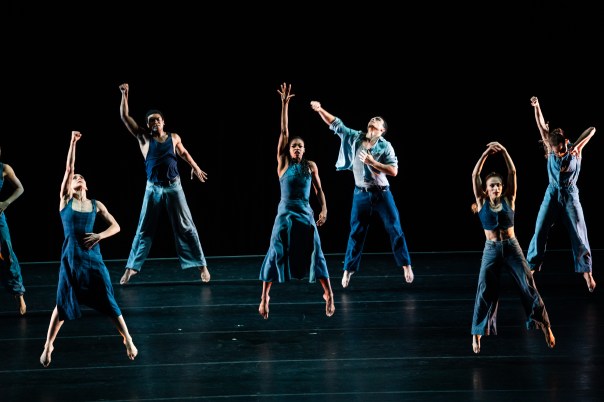
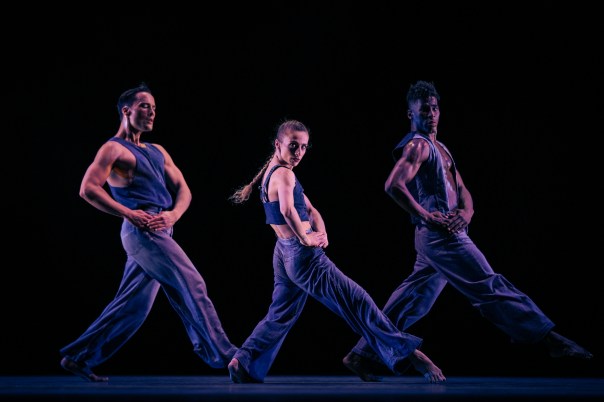
The Graham site traces We the People back to Agnes de Mille, though the new score by Rhiannon Giddens, denim-colored costumes by Karen Young, and the martial-artsy touches in Roberts’ choreography signal a comprehensive makeover. With the delayed start of Chronicle and an overlong intermission, Giddens threatened to compete with Giddens, as Michael Abels’ Rhapsody on “Omar” (the Pulitzer Prize-winning opera he wrote with Giddens) was about to receive its world premiere on the other side of town.
So my response to We the People, remade to reflect American life in 2024, was not as stress-free as I would have liked. Yet even if viewing conditions had been ideal, the Graham program would not have rivaled the US premiere of Scottish Ballet’s Mary, Queen of Scots as the most spectacular event at Spoleto so far, likely to remain its artistic pinnacle.
Spoleto Festival USA 2026 Scottish Ballet CHARLESTON, SC – MAY 28, 2026 – Spoleto Festival USA 2026 Scottish Ballet
The original score by Mikael Karlsson and Michael P Atkinson is nearly as breathtaking as the costumes and scenery by Soutra Gilmour. But the co-creation by choreographer Sophie Laplane and director James Bonas lifts Queen of Scots to its heights, in a staging that hoisted the three walls of the set to the rafters at Gaillard Center. With the inrush of dancers below – royals, courtiers, spies, and guardsmen – it appeared that an epic Rembrandt painting was materializing before our eyes.
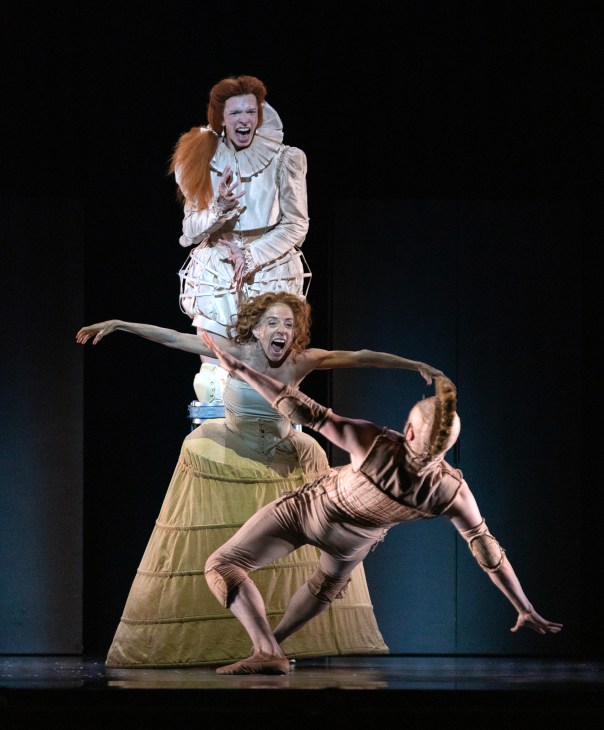
Queen Elizabeth is intertwined with Mary throughout the Laplane/Bonas scenario, as the soon-to-die Virgin Queen recollects their lifelong rivalry. This aging and decrepit Elizabeth is danced by Charlotta Öfverholm, who often lurks unseen as Mary’s story unfolds, like a Gothic horror Tinkerbell. We see Roseanna Leney as the future Queen Mary emerge from the loins of Catherine de’ Medici, a metallic dress worn by Madeline Squire that could become a cage.
Dressed in a chic black dress, Leney contrasted dramatically with towering redhead Harvey Littlefield as Younger Elizabeth, dressed in gleaming white, striding as majestically as a heron. Littlefield’s deliberate gait made for an untouchable Liz, while the lithe Leney cycled through at least three men as the flapper-like Mary, accompanied by four other Marys when obliged to flee France.
Arguably, the essence of the Laplane/Bonas concept was Kayla-Maree Tarantolo as the Jester, who moonlighted as Death. The staging weaved between humor or beauty and brutality as the Jester, only lacking a wand to be a second Tinkerbell, brought on one death after another.
Three moments were most indelible. Mary “transforms,” according to the printed scenario, when the last of her lovers, Nicol Edmonds as Darnley, “is consumed.” Leney was joined by a group of other dancers – maybe the other Marys? – who lined up in front of her and, facing the upstage scrim, became a monstrous shadow insect who devoured Darnley.
Shortly afterwards, the pregnant Mary gave birth, a rather hilarious process. When she was showing, a large white ovoid covered her abdomen, which morphed into a large egg or a delicate white balloon, depending on the fate of the fetus. The sturdier egg could be labelled “James” prior to birth. The lad moved horizontally across the stage, obscured momentarily like luggage being scanned at an airport, and emerging as Squire in an all-white costume, still labelled James.
The most stunning effect was saved for the last blackout. With Laplane/Bonas’s narrative framework, elder Elizabeth could die at the same moment that her recollections of Queen Mary ended – with the sound of three vicious chops of an axe resounding through the hall as the queens perished. Our last glimpse of Leney could stay with you for a lifetime.
Although family-friendly Alvin Sputnik: Deep Sea Explorer ran over the Memorial Day weekend at Spoleto, serious non-puppet, non-animation theatre is backloaded into the schedule. George + George ran as a work-in-progress during the middle week, and Patrick Page’s All the Devils Are Here, originally slated for the 2025 fest, runs during the final weekend.
So the best theatre at Spoleto this year will likely remain director Daisy Evans’ remarkable reclamation of festival founder Gian Carlo Menotti’s 1939 radio opera, The Old Maid and the Thief, for the Dock Street Theatre stage. The old-timey Dock seemed like the perfect place for this retro comedy, not so much adapted for the stage as quaintly preserved there.
Walt Spangler’s set design is a hybrid radio studio and rudimentary theatre space, with Timothy Myers and his Spoleto Festival USA Orchestra upstage from the diminutive cast of four singers. Flanking our players, who are never saddled by microphones, are spaces for Foley operator, Amelia Hawke, and for our emcee, Patti O’Furniture.
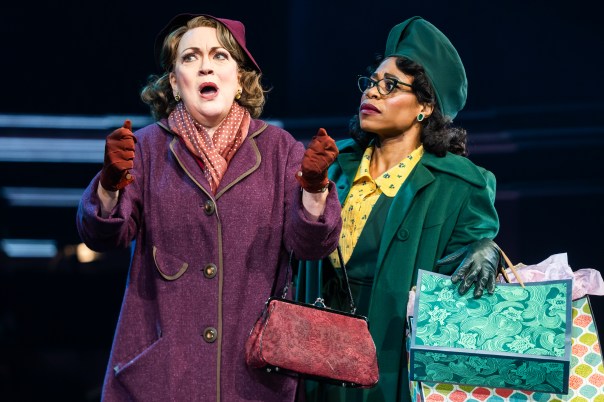
Any excuse for including Charleston’s own extraordinary female impersonator, O’Furniture, in a show is good enough for me. His talents are multifold: aside from announcing and helping with scene shifts, aiding the two ninja supernumeraries, he can be the scenery, most memorably when, assisted by the end of a brass bed, he holds up two flashlights and becomes the grille of a luxury car.
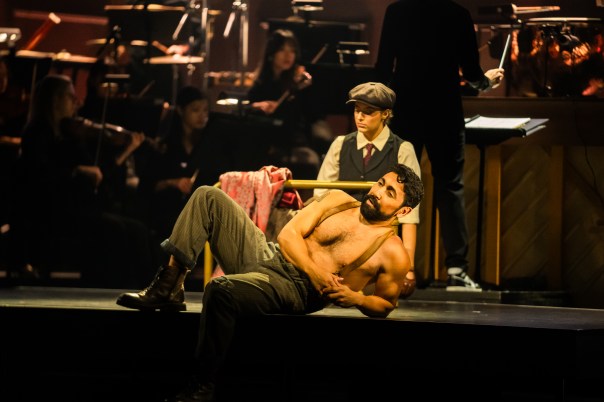
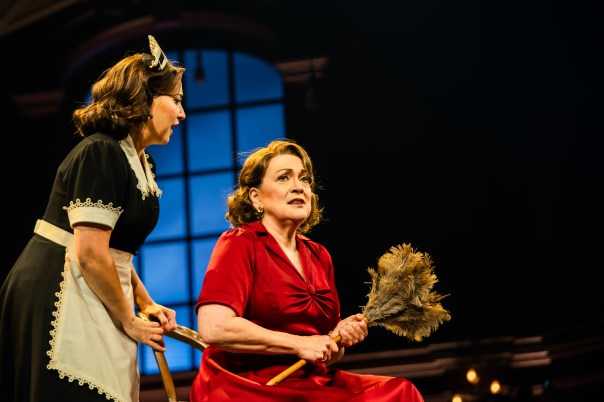
Other players strive to snatch the spotlight from O’Furniture, often succeeding. We initially empathize with mezzo soprano Katharine Goeldner as the old maid, Miss Todd, playing her as decidedly more maidenly than elderly. When Efraín Solís, as Bob, a drifter, comes knocking at Miss Todd’s invisible front door asking for a handout, Goeldner is immediately smitten, willing to open up in more ways than one.
Helped by her maid, Laetitia, Miss Todd entices Bob to linger awhile, with free room and board.
Is soprano Rachel Blaustein as Miss Todd’s maid also smitten before Bob takes off his shirt? Can’t remember. At any rate, it’s unseemly for Miss Todd to be asking a vagabond to be her guest, so Laetitia is quickly involved. Secretly competing.
Bob’s sexual leanings may run parallel to his creator’s, but Menotti’s libretto only offers a faint hint. The drifter’s failure to show his appreciation of his benefactress by making a move on her gradually wakes up Miss Todd’s sleeping passions to the point of desperation. She becomes the thief in Menotti’s title, eventually knocking off a liquor store in the middle of the night.
All this while, there are newspaper and radio reports that a notorious escaped criminal is on the loose and on a thieving rampage. This romanticizes Bob to his hostess, further inflaming her and Laetitia. But augmenting these media bulletins is mezzo soprano Chrystal E. Williams as the neighborhood snoop and gossip, Miss Pinkerton, whose visits at Miss Todd’s become progressively less welcome as the ballyhooed criminal rampage rages on. The strait-laced chatterer becomes a nemesis.
Of course, Bob is perfectly innocent. It becomes progressively more unlikely that the drifter would trouble himself to leave Miss Todd’s for a criminal caper when he’s living in the lap of luxury! That need was clearly Miss Todd’s.
Throwing a veil over Menotti’s denouement, I’ll leave it to opera companies and producers to seek out The Old Maid and the Thief, so they can deliver the goods to audiences that have missed out for nearly 90 years. Evans’ way of doing it could conceivably be improved upon, but it should remain the model.
It’s been a tumultuous year for Mena Mark Hanna in his second season as the new general manager at Spoleto Festival USA. Chamber music director Geoff Nuttall, the festival’s most recognizable personality – the charismatic violinist who convinced Hanna to come aboard at Spoleto – died in mid-October at the age of 56 while undergoing treatment for pancreatic cancer.
Amid all his antics and flamboyance, Nuttall never seemed to be that old.
Then as all the pieces of Spoleto 2023 fell into place, including the memorial concert for Nuttall scheduled on the opening holiday weekend, last year’s centerpiece, the world premiere of Omar, won the Pulitzer Prize for composers Rhiannon Giddens and Michael Abels. That opera, rooted in the festival’s Charleston home, would stand as the signature achievement of Nigel Redden, Hanna’s predecessor. Redden handed over final alterations and trimmings to the new GM, who piloted the grand project into port.
So this year’s festival will likely be remembered as Hanna’s first true lineup, though Scottish Ballet, mandolin sensation Chris Thile, and iconic jazz artist Abdullah Ibrahim will be the last holdovers to file into Spoleto from the 2020 event that never happened. Yet without a replacement for Nuttall, a key member of Hanna’s hiring committee as well as an engaging host and performer, there’s a feeling that the festival remains in flux.
Even as I spoke to Hanna, a week before this year’s Spoleto began, he wavered between declaring he was in no hurry to replace Nuttall and assuring me that considering his successor was definitely on his to-do list during the festival and in the summer ahead.
It’s safer to say that sustaining the momentum for opera is an urgent priority for Hanna. Programming Samuel Barber’s Vanessa in 2023 is certainly a major statement, since its strong libretto was written by Spoleto founder Gian Carlo Menotti, and for 2024, the festival is commissioning a new opera. Announced at the same time the curtain was rising for the final performance of Vanessa, the new piece, Ruinous Gods by composer Layale Chaker and librettist Lisa Schlesinger is ballyhooed as “another bold project with powerful themes” in the mold of Omar. Opera Wuppertal and Nederlandse Reisopera will be co-commissioners and co-producers of the new chamber opera.
Menotti hasn’t been regularly involved at Spoleto since 1993, when he stage-directed one of his weakest works, The Singing Child. True, there was a revival of Menotti’s most heralded opera, The Medium, in 2011, but that production has come to seem like an obligatory celebration of the composer’s 100th birthday. Twelve years later, Vanessa feels like a whole-hearted embrace: bolder and more contemporary with Rodula Gaitanou’s daring stage direction, more searching with Timothy Myers wielding the baton.
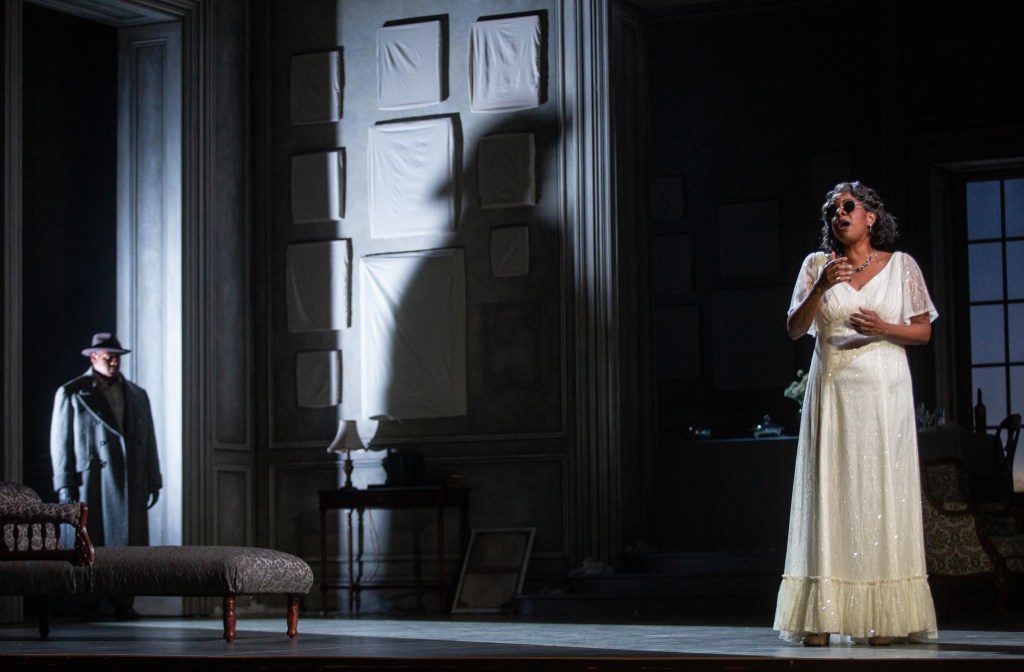
A long pandemic after Gaitanou’s vision of Vanessa was first presented in 2016, the loneliness and isolation of Vanessa resonated more keenly in its US premiere, the effect only enhanced because her icy-cold vigil is self-imposed. The entire household seems to be in suspended animation, The Old Baroness mother perpetually painting at her easel, daughter Vanessa faithfully awaiting her former lover’s return after 20 years, and Vanessa’s niece Erika as much on auto-pilot as the maids and butlers.
All the many paintings and mirrors on the walls are covered, adding to the surreal atmosphere. It’s as if Vanessa were protecting herself from a raging plague, or as if this were a summer home about to be abandoned until next year. The futile circularity of the Baroness painting pictures that will be covered up as soon as they are hung up on the wall subtly prefigures what will happen when Vanessa’s beloved Anton arrives.
As Hanna had promised, the cast was killer. Nicole Heaston brought a neurotic hauteur to Vanessa, a steely cold soprano in her rendering of the tense “Do Not Utter a Word” aria that weirdly echoed Rosalind Plowright’s iciness as the Baroness, a role that the English mezzo originated at the Wexford Festival premiere of this production – before she reprised the role at Glyndebourne in 2018 (available on DVD and Blu-Ray). Compared to the stony and unwavering Plowright, Heaston’s Vanessa proved to be vulnerable, capricious, malleable, and oblivious in a quietly disturbing way.
If Heaston personified the creepiness and the supernatural tinge of Menotti operas, mezzo Zoie Reams as Erika inclined more to Barber’s sad and wistful Romanticism. More emotion poured out of her in “Must the Winter Come So Soon” than on any of the full-length recordings this side of the original live recording conducted by Dmitri Mitropoulos in 1958. Heaston ably gets across to us that her attraction to the second-generation Anton is a rekindling of her youthful ardor, but Reams shows us that Erika’s love for Anton is a first flowering, with a more hormonal heat and fire.
Yet Erika never wears her heart on her sleeve. Perhaps because of her more precarious finances, there’s a secretive and withdrawn aspect to Reams’ performance that marks her as a member of the family. So self-denying and self-destructive are they all that it becomes richly ambiguous whether tenor Edward Graves as young Anton is a ruthless fortune hunter or an idealistic romantic. It was rather wonderful, when Graves engaged Heaston in the slowly cresting “Love Has a Bitter Core” duet, how Anton and Vanessa could be seen triggering spontaneous passion in each other.
The denouement was a walloping “To Leave, To Break, To Find, To Keep” quintet with baritone Malcolm MacKenzie, a welcome presence as The Old Doctor, completing the fugal fabric. It all sounded so present and powerful at Gaillard Center, the singing perfectly balanced with Myers’ ardent work in the pit, while ever-present, precisely synced supertitles projected above facilitated transmission of Menotti’s text.
For those of us who were fortunate to attend Vanessa and the big orchestral performances of Spoleto 2023 – John Kennedy conducting The Rite of Spring, Mei-Ann Chen navigating the New World Symphony, and Jonathon Heyward reveling in the Symphonie Fantastique – the Gaillard and its fine acoustics were arguably the center of the festival. Both the Spoleto Festival Orchestra and the Spoleto Chorus, recruited in nationwide auditions, are rather awesome. And fortunate: not only do they get to perform at the Gaillard, they individually and collectively get to perform edgy, outré, and contemporary pieces at other Spoleto venues that you’re unlikely to experience anywhere else.
Chen, the music director at Chicago Sinfonietta, dug into her wide-ranging repertoire to greet us with Florence B. Price’s Ethiopia’s Shadow in America, a three-movement work that likely begins a mile or two away with an Introduction and Allegretto depicting the arrival of slaves in America. The brief yet solemn middle movement vividly evoked the famous New World Largo we would hear later in the evening, and the concluding Allegro, “His Adaptation,” had the urbane Ellingtonian strut of the Jazz Age.
Delights and Dances, gleaned from Chen’s 2013 Cedille CD that gathered three different concertos for string quartet and the Sinfonietta, was a welcome dive into an earlier Abels work in the wake of his Pulitzer. Nor was it difficult for me to exit the Gaillard feeling that the New World was Antonín Dvořák’s fantastic symphony, for the onset of the trombones in the final movement brought on goosebumps.
The lesser-known Heyward, the music director designate at the Baltimore Symphony, was not to be upstaged – not by Chen, at any rate. A native of Charleston, Heyward received a hearty greeting from the hometown crowd that puzzled the out-of-towners sitting behind me. Heyward began his grand homecoming with the US premiere of Nymphéa, a 2019 work by Doina Rotaru inspired by Borin Vian’snovel, L’écume des jours, with a sprinkling of Duke Ellington’s “Chloe,” the namesake of Vian’s heroine.
What the music evokes, partly through a delicate combo of piano and muted trumpet that grows fearsome and awesome – embroidered by plentiful percussion – is the growth of a huge destructive water lily (nymphéa) inside Chloé. Call it a 19th-century tone poem written with a 21st-century quirkiness, with a rubbed oriental gong, a plucked Steinway, and a stray mallet head that accidentally bounced into the front row of the audience.
Yet all of this spookiness was upstaged in an instant by the return of another local musician, pianist Micah McLaurin. With a glittery, androgynous, and otherworldly David Bowie aura, the slender McLaurin strutted onstage to a huge ovation in a blinding fuchsia jumpsuit with a lowcut back and a single silver sleeve. He proceeded to pound out the opening chords of Grieg’s Piano Concerto once the startled crowd had quieted, working the pedals with platform shoes, which had only increased his considerable height and the éclat of his entrance.
The outer Allegro movements showed off McLaurin’s strengths better than middle Adagio. Even there, the soft and loud passages were gorgeously shaped until late in the movement when his tone grew too steely for maximum effect. But the latter stages of the final movement were irresistible, crackling with authentic thunder.
When he reached Hector Berlioz’s Symphonie, Heyward benefited from the luck of the draw in delivering a more consistently satisfying account than we had of the New World. All 100 members of the Festival Orchestra don’t appear together, and the principals who performed featured solos with Heyward outperformed Chen’s chosen.
Not only did Heyward send his principal oboist offstage in the wondrous countryside movement, he deployed tubular bells to the wings for the closing “Witches’ Sabbath” movement to chilling effect. The drumbeats and sforzandos in that movement and in the preceding “March to the Scaffold” were nothing short of electrifying. Audience buzz after the Fantastique was every bit as enthusiastic as it had been at intermission in the wake of McLaurin’s exit.
The other Spoleto venues were rich in talent and adventurous spirit. At Dock Street Theatre, countertenor Anthony Roth Costanzo performed an outrageous hybrid lark, Only an Octave Apart, with cabaret icon Justin Vivian Bond, nary a male outfit in their wardrobes. Otherwise, we could compile an epic review of the 11 lunchtime chamber music programs that rocked the Dock, though my wife Sue and I only witnessed seven – enough for us to see 11 different hosts standing in for Nuttall introducing 25 pieces (nine by living composers), including an original score by pianist Stephen Prutsman for 7 Chances, the most hilarious Buster Keaton film we’ve ever seen.
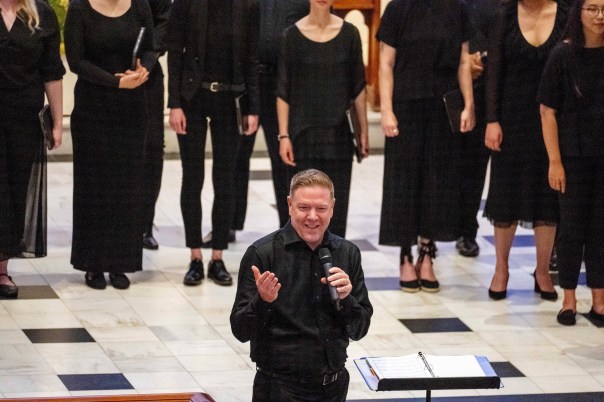
St. Matthews Lutheran Church and Sottile Theatre were both graced with concerts led by director of choral activities director Joe Miller. Surprisingly, the Festival Chorus program at the church, Density 40:1, was more secular than the one two blocks south, a precedent-breaking concept from beginning to end. Miller and his 32+8 voices all ascended to the organ loft in order to spread out over us and perform the 40 parts of Thomas Tallis’s Spem in alium. More earth-shattering, the choir did not perform “Danny Boy” or an encore. Instead, we all sang “Over the Rainbow” together.
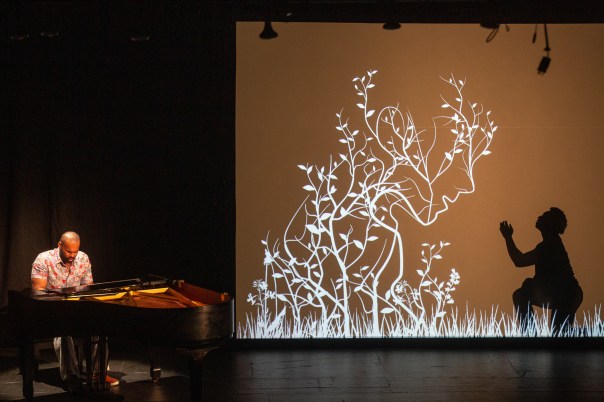
A new venue, the Queen Street Playhouse, was added to the Spoleto portfolio with mixed success. Artistically, A Poet’s Love was a resounding triumph for tenor Jamez McCorkle, powerfully following up his exploits of last season in the title role of Omar by singing Robert Schumann’s Dichterliebe – while accompanying the entire song cycle by himself at the piano. Designer and choreographer Miwa Matreyek made this a completely immersive experience with animated projections, shadow puppetry, and the movement she designed for Jah’Mar Coakley.
But the staging was badly bungled. Once McCorkle sat himself behind the Steinway, I never saw more of him than his scalp from my second-row seat. Fortunately, Matreyek and Coakley combined on a magnificent performance I didn’t miss.
After a rather bizarre foray at Festival Hall (formerly Memminger Auditorium) for his first Music in Time concert, Kennedy made better use of Queen Street Playhouse for Sanctum, a wild collection of contemporary pieces, concluding with the 2020 work by Courtney Bryan that gave the program its title.
That piece was decisively upstaged by Everything Else, a 2016 composition that I will likely never forget. For this novelty, 15 members of the Spoleto Festival USA Orchestra laid aside their instruments and drove the everyday concept of music to new frontiers most of us had never pondered before. One musician sat with a newspaper, turning the pages at leisurely intervals, another put on a jacket and zipped it up, three of the women passed around and munched a bag of chips, and another tapped obsessively on the keyboard of a laptop while, across the stage, another blew bubbles.
All of this low-volume action – and a multitude of louder acts – continued simultaneously. There were pennywhistles, a kazoo, somebody blowing on the rim of a bottle, two guys slapping cards down on a table in a game of war, and balloons blown up, shaped, and worn as comical crowns. Of course, there was the obligatory popping of balloons near a woman who insouciantly demonstrated how many different things can be done with a bottle of water without hardly making a sound.
Kennedy had seated himself with us in the audience so he could join us. Yet every musician onstage seemed to know exactly what to do onstage, when exactly it was time to launch into a new action, and when exactly to initiate interactions with other musicians. Anyone who thought about it had to wonder how such a multifarious sea of chaos could be taught, rehearsed, and performed – so precisely that the entire ensemble, without a conductor in front of them, stopped at the same instant.
I still can’t decide whether or not I wish to know.
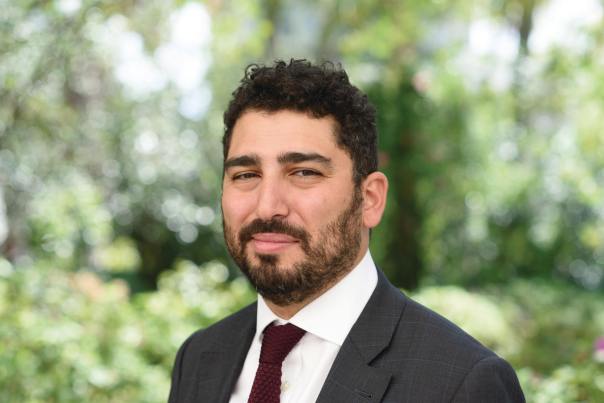
I first ran into Mena Mark Hanna at last year’s Spoleto Festival USA, when he was sitting near to us at Sottile Theatre, enthusiastically selling the merits of the festival to a total stranger. Almost immediately, I walked up to him and filed a complaint: my wife Sue and I couldn’t see everything! Again and again, we were forced to choose between missing the end of one performance or missing the beginning of another. Hanna, the new incoming general director at Spoleto, empathized, having faced the same dilemma.
So we were off to a good start, good enough when the calendar circled around for me to call up the Spoleto office and ask for 15 minutes of Hanna’s time after I received the green light from Queen City Nerve to write up a festival preview. To my surprise and delight, he gave me 40 and far more prime insights, experiences, and hype than I needed.
This edit of the complete interview contains all the overflow.
Perry Tannenbaum: How are you doing?
Mena Mark Hanna: Very well. Happy to have the conversation.
Yeah, this is really a treat for me too. So tell me how Spoleto is doing this year financially.
Well, knock on wood, we seem to be doing pretty well with ticket sales. And you know, we’re working to create a culture of belonging with the institution that goes into some of our accessibility efforts, like Pay What You Will and Open Stagedoor.
So I’m looking at that Pay What You Will initiative, looking into it a little bit more in terms of which events will be eligible, and it’s a pretty impressive list.
Thank you.
I was worried at first about the timing, but now I’m understanding that the timing may not have been in response to wanting to fill up houses so much as the fact that somebody, some anonymous somebody, wanted to launch this initiative.
Yeah. When you think about our society, right, we’ve got three types of institutions. We’ve got public institutions, local governmental you bodies and things like that. We also have private for-profit entities, publicly traded companies, and then we have nonprofits that kind of sit in between that public and private space.
And to me, we sort of fill in the gaps that our public sector cannot extend to our community and our private sector cannot compensate for. What that means is that we should be holders, we should be generators, we should be engendering public value for our community.
So Spoleto is not just one of the preeminent performing arts festivals. It’s also a place where people can have transformational experiences. We want to make that shared to a wider segment of our audience. We want to share to a wider segment of the public and a wider slice of the community of the Lowcountry in the greater Charleston area.
I believe very deeply in that mission. And I also think that that leads to a healthier understanding of some of the principles and values that are at the center and core of the art that we produce and create at Spoleto – principles of diversity, of access, of inclusivity. Those principles are really about engendering and creating a culture of belonging through the festival.
What art can do is that it can endow you with a new experience, an experience that you did not have before you took your seat. It can help create an understanding of another side that is normally seen by one perspective as socially disparate, as highly politicized, as a discourse that’s just way too far away. And it can break down that barrier through the magic and through the enchantment of performance.
Having those artists on stage representative of a demographic we wish to serve only takes us so far. We also have to lower the barrier of entry so that we can actually serve that demographic.
So is that a kind of a flowery way of hinting that you were in search of such an anonymous donor and pitching it in the way you were explaining it to me just now?
Well, this anonymous donor is someone whos also very passionate about these principles and about these core values at the festival. We can only do so much in order to make something like this offer to a wide range of our audience. I mean, it’s a significant amount of ticket inventory. It’s about $50,000 of ticket inventory.
Not only is that a significant amount of ticket inventory, but we have to create our own private landing page for it. There’s community outreach and initiatives that go into it. There is a whole set of staff and human resources that go into creating a program like this and running a program like this effectively. And that also takes money. So it’s not just the ticket inventory that takes money. It’s running the program.
And the hope is that we would be able to do this in a way where we would be able to offer this to our community without really losing money on it. And that’s where the generosity of this anonymous donor really shone through. And it’s someone that I think is an incredible person to be supporting the festival.
Yeah, it must be. I mean, kudos. And many thanks, I should say.
Thank you.
Is this something that even comes too late to be a part of the festival program booklet? Or is there like a special place that will be set aside for acknowledging this new program?
I don’t know if it’s going to be in the program booklet, but it’s definitely a program that we will keep up in future years.
Ah, OK! That’s through the same anonymous donor, or are you just going to carry the torch from here on in?
Well, carry the torch from here on in. I haven’t spoken with the anonymous donor about future years.
So is this like a combination of you and this donor putting your heads together and coming up with this concept or is this something that was brought fully to you, concepted by him or her?
No, no. We brought this idea to the donor.
Ah, okay. That sounds terrific. So are you feeling a certain kind of anxiety about actually coming out with a festival that has no more legacy elements in it, especially after Omar won the Pulitzer Prize?
You know, the great thing about 2022 is that it really was a collaborative effort between myself and Nigel [Redden]. And even Omar was a collaborative effort between myself and Nigel. When I came in in 2021, we had a significant production consortium of co-producers and co-commissioners for the piece.
And there were things about the piece that really needed to be addressed because the piece had sort of been in this kind of COVID stasis. So the way, you know, we think about it that even there, there was kind of a handover from Nigel to me about making sure that Omar can really work for 2022 – and that was exciting.
I mean, it’s kind of incredible to be someone who comes from Egyptian parentage, speaks Arabic, grew up sort of fascinated by opera and stage work, and spent their career in opera and was a boy soprano, to then have this opportunity to bring to life the words of an enslaved African in Charleston, South Carolina.
And those words are Arabic!
That’s a remarkable, strange serendipity for me to have been in that position of helping steward that piece to life. So it really was very much a collaborative effort in 2022. Even 2023 will have some things that are kind of holdovers from the pre-pandemic era or the canceled season of 2020. I mean, the idea of bringing Jonathon Heyward down was something that Nigel had worked on for the 2020 season as well.
So I don’t think you can point at one thing and say this is Nigel, this is Mena, this is Nigel, this is Mena. I think that there are a lot of different sorts of personalities and curators and thinkers that touch something like Spoleto Festival. It’s very, very much a collaborative entity, the way we create and curate the season.
I have expertise in music, and I have a lot of expertise in opera and maybe I have some secondary expertise in theater, but I certainly do not know enough about all of the performing arts to know every single thing so intimately wherein I would be able to curate every single chamber concert performance, every single orchestral performance, every single jazz performance.
It’s very, very, very diverse and we have a great team at the festival with our lead producer, Liz Keller-Tripp, our jazz curator, Larry Blumenfeld, our director of orchestral activities, John Kennedy, and our choral director Joe Miller. Between all of us, we curate together and try to come up with a spectacular entity that is Spoleto Festival USA.
I mean, there’s a reason why you don’t see many producing multidisciplinary festivals. They don’t really exist.
Because it’s really hard to create something like this collaboratively and source all of the right expertise in all of these different disciplines and then kind of find the right artists who could work in between those disciplines. Someone like Jamez McCorkle, for example, who’s doing A Poet’s Love this year, which is wonderful.
It’s a difficult, strange operation. It’s different from an opera company, a dance company, a theater, so on and so forth. It’s all of these things combined, and then it’s sort of event-oriented and time-delimited. So to bring these things together, it’s really about, you know, all of this being greater than the sum of its parts and that’s due to some great expertise that we have at the festival.
Yeah. I have two questions about the formatting of the festival. One is whether the clearly discernible thematic structure of last year’s festival, bringing the East or Middle East to the West, has been repeated in any way that I have not been able to so far discern in this year’s festival. And second, whether the position that Geoff Nuttall held is just being kept vacant for this one festival or whether he’ll be replaced by next year?
So let me tackle the first question first. I am not a fan of really obvious themes that kind of are pedantic and hit you over the head. Last year was a unique case insofar as it was the first festival coming out of the pandemic, and there was a lot in that festival that also addressed some of the concerns that were raised in the pandemic that have to do with our own societal dissensus and our own inability to reckon with our past culturally, historically, politically as a country.
And Omar is a part of that, but it was only a part of that. It was maybe the centerpiece of that, but a lot of that just kind of overflowed outside of Omar. The idea of centering Africa as also an origin point of the United States is something that will always be a particular concern of the Spoleto Festival because we’re in Charleston. And Charleston was the port of entry for the Middle Passage.
Charleston has at its core an incredibly rich Gullah-Geechee-West African-American tradition that is part of the reason this is such a special, beautiful place to live in with its baleful history. So I think that you see that this year, you see that with Kiki [Gakire] Katese and The Book of Life, you see that with Dada Masilo and the Sacrifice, you see that with Abdullah Ibrahim and Ekaya.
You see that these are also artists from Africa that are engaging in their own social, cultural and political discourses. That Kiki is engaging with how a country tries to reconcile with its recent, terrifically horrific past of the Rwandan genocide as someone who grew up Rwandan in exile. You see that in the work of Abdallah Ibrahim, who was really one of the great musicians of the anti-apartheid movement, who composed an anthem for the anti-apartheid movement, was in a kind of exile between Europe and North America in the 80s.
Then when he finally came back to South Africa for Nelson Mandela’s inauguration, Nelson Mandela called him our Mozart, South Africa’s Mozart. So you see that with these artists, how they are engaged in their own social, cultural and political discourse, and how they are trying to reckon with their own past. And that’s something that is an important lesson that we want to take on and learn in a place like Charleston.
We can look to African artists and understand that they are also part of this place and that they are also part of America’s origin story. It’s not just about Europe and North America. So I think that’s always going to be something that’s on prominent display at the festival.
But even more so than that, this is a festival that, if you look at a kind of undercurrent thematically, there is unity there. I always want the festival to kind of have a cohesiveness, a cogency, without necessarily saying, “This year we are talking about crime and punishment,” or “this year we are talking about love’s labour’s lost” or something like that.
No, I want there to be a kind of cohesiveness without necessarily us being able to see what the theme is. That’s what is kind of exciting and unifying about putting all of these different pieces together. If there is something that unifies a lot of these pieces, it’s about us understanding that we are telling stories from our past, some of them the most ancient stories that we have in our intellectual heritage. We are looking at these stories with a different sense that takes on the reverberations of today’s social discourse.
I mean, An Iliad going back to the Trojan War is as much about war and plague then as it can be today with the reverberations of Ukraine and the pandemic. Vanessa, which is an opera that was premiered in 1958 and then brought back to the festival in 1978, is reinterpreted here through the lens of a remarkable female director, Rodula Gaitanou. And there is a quite strange ambiguous moment in the opera of either an abortion or a miscarriage.
What does that mean now when we are looking at a renewed political assault on female autonomy? So these stories take on new messaging, new reverberation in 2023. And we need to retell these stories with the new lens of today.
You look through all of these pieces, The Crucible, The Rite of Spring, Vanessa, An Iliad, even Dichterliebe by Schumann, and it’s all about taking those stories and kind of having a renewed understanding of how we tell those stories and who we are telling them to, and who is telling those stories.
About the second point, chamber music. Yeah, I think all in due time, there will be new leadership in the chamber music series. I mean, Geoff was this remarkable figure who, speaking of storytelling, was perhaps one of the most incredible practitioners of his practice insofar as making chamber music accessible and having us sort of like look at Brahms, Beethoven, and Haydn – maybe not Brahms, he didn’t like Brahms very much – with a renewed sense of understanding, and he did that by sort of giving the story of chamber music in America a completely new life and a new understanding.
I became really close to Geoff over the last two years. He was actually on the hiring committee for me, and he was one of two people that would report to me on the hiring committee, and it was a committee of ten people. I largely took this position because Jeff convinced me to. He convinced me to because he was so excited about what we could invent, what we could create together.
He was so excited by the interdisciplinary-ness of the festival and how that could actually spill over into chamber music. We at least got one festival together. We started to make changes.
At least we had one festival together, but it’s tough, man. This has been a really, really tough year without Geoff. It’s been a year of enormous highs and lows. It’s been a year where the festival won, helped to produce and create an opera that did win the Pulitzer and a year where it lost its lodestar in Geoff.
It’s been a very, very, very difficult year. We are making sure that we are celebrating Geoff through the festival. The festival opens with a celebration of all the music that he loved and in the grandest statement possible at the Gaillard with orchestra and chamber music members and so on and so forth and different soloists.
Then all through the chamber music series, it’s going to be a celebration of Geoff through the people who loved him the most, his chamber music family. People that you know: Paul Wiancko, Pedja Muzijevic, Livia Sohn, Alisa Weilerstein, Anthony Roth Costanzo. That was his family. They will all have an opportunity – of course, also the St. Lawrence String Quartet will be here – they will all have an opportunity to celebrate him and live and love what Geoff was so great at by performing and playing together.
So will there be chamber music at the festival in the future? Of course. The music will continue to rock at the Dock.
I was more specifically interested in who will replace Geoff in his hosting chores, and I guess attached to that question, whether or not it might be time to step back and ask yourself if there isn’t a lot of room for improving the diversity of the people who are in charge of the various music departments at Spoleto, who seem to be conspicuously white and male, and remembering that Nigel stepped down because he felt he was part of that pattern.
Yeah, at the very least, I’m Arab. No, I think Perry, you’re 100% right. To me, the important thing is that we don’t put someone in a place out of a sense of performative duty. We put someone in that place because they are going to be of great accretionary value to the festival, because they espouse the ideals of the festival, and because they are the best person to be in that position.
I’m the first to say that I would balk at any kind of jingoistic declaration that I’m in such and such position because I’m an Arab American. I think people of color want to be recognized for the work that they do and often, the structural sort of biases that they have to overcome in these imperfect institutions in order to get to those positions.
To me, it’s about the best person, and of course, making sure that we look extra hard to find some of those people that may have been swept under the rug by these implicit biases that exist in our imperfect institutions. We’re definitely going to take a keen look at chamber music over the next few years. Well, actually, through this festival, let me say, and into the summer.
And yeah, there will be some structure that will replace Geoff. Additionally, it’s important to mention that this year, we did not want to put someone in place immediately to replace Geoff. We didn’t think that was appropriate.
We wanted to make sure that this was a celebration of Geoff, and that the people who were celebrating him and honoring him were doing so by performing at the Chamber Music Series, helping to co-curate the Chamber Music Series, and helping to emcee the Chamber Music Series. This year, we decided to make that a collective effort in his honor.
But if there is a template in the Chamber Music Series about who does host, until now, 2023, the hosts have all been people who occasionally perform on the Dock Street stage. So do you feel locked into that?
Oh yeah, I don’t think we’ll peel that back. No, no, no, no, no. Because I think one of the important things is actually the ability to host Chamber Music and make it feel approachable and intimate. That should come from a practitioner of Chamber Music, someone who could actually perform it on stage.
Yeah, bravo. I was hoping I wasn’t misinterpreting what you were saying. Like you could have done a nationwide search for somebody else.
No, no. Thank you for the clarifying question. There’s no way we’re going to hire John Malkovich to host Chamber Music. That’s not the vibe.
And the great thing about Geoff is that he was able to demonstrate the pieces effectively as such a great performer. And that’s what made that Chamber Music Series, and that’s also true of Charles Wadsworth, and that’s also true of Leonard Bernstein. That’s what makes the great communicators in classical music great, is that they can sit there, they can communicate it, they can perform it, and they can do so without any compunction or any sense of superiority.
For sure, the people who will be hosting Chamber Music this year and into the future will be practitioners of Chamber Music and people who are playing in the Chamber Music Series.
Hooray. So what do you think, or is it dangerous to say what you think the highlights of Spoleto 2023 are?
Well if you allow me a kind of punchy suggestion as a general director, which is very carefully branded and thought through, my suggestion for a first-time participant would be to see two things you like and feel comfortable about seeing, maybe that’s Nickel Creek and Kishi Bashi, and two things that are really pushing the envelope for you. So maybe that’s Dada Masilo and Only an Octave Apart.
Personally, I’m extremely excited about A Poet’s Love, which is a world premiere project we’re doing with Jamez McCorkle, who was Omar in Omar last year. And it’s partly exciting because you have the sheer unadulterated joy of seeing this piece be performed by a single accompanist and vocalist.
You know, I’m a pianist by background and trade, and I’ve accompanied Dichterliebe before, and it’s enormously difficult to perform. And the fact that Jamez can just kind of do it in one essence – it’s just like music incarnate. It’s totally, totally insane that he can do that. I mean, he’s one of the most spectacular artists that I’ve ever come across.
He’s doing it with collaboration with Miwa Matreyek, who does this kind of like shadow puppetry, moving image art that’s kind of like in a gothic whimsy that feels very appropriately 19th century, but also with this kind of magical technology through projection and shadow work. So it’s a really cool, strange project and I assure you that you will never have seen anything like it before.
I’m also extremely excited about this production of Vanessa. I mean, the cast is just killer.
You have Nicole Heaston as the lead with Zoie Reams and Edward Graves and Malcolm MacKenzie and Rosalind Plowright. I mean, that is just a world class cast at the very, very top. And it’s also really cool to see these roles, which are traditionally sung by Caucasian people, being sung by people of color. I think that’s also an incredible sort of sense of joy and interpretation in this piece. And it’s conducted with absolute precision and aplomb by Tim Myers. So I’m excited about that.
I’m very excited about Only an Octave Apart. You could only have seen it publicly in either New York or London. So to have it here, it shows sort of how prominent Spoleto is on the world stage – that even if we’re not producing something and we’re presenting something, most of the time, if you’re going to see something here, it’s going to be very, very difficult for you to see it at a local theater or in a place other than New York or London.
So it’s cool to see that. I’m extremely excited about Scottish Ballet and The Crucible. I mean, that’s a new score by a composer named, believe it or not, Peter Salem.
That is unbelievable. I’ll give you that.
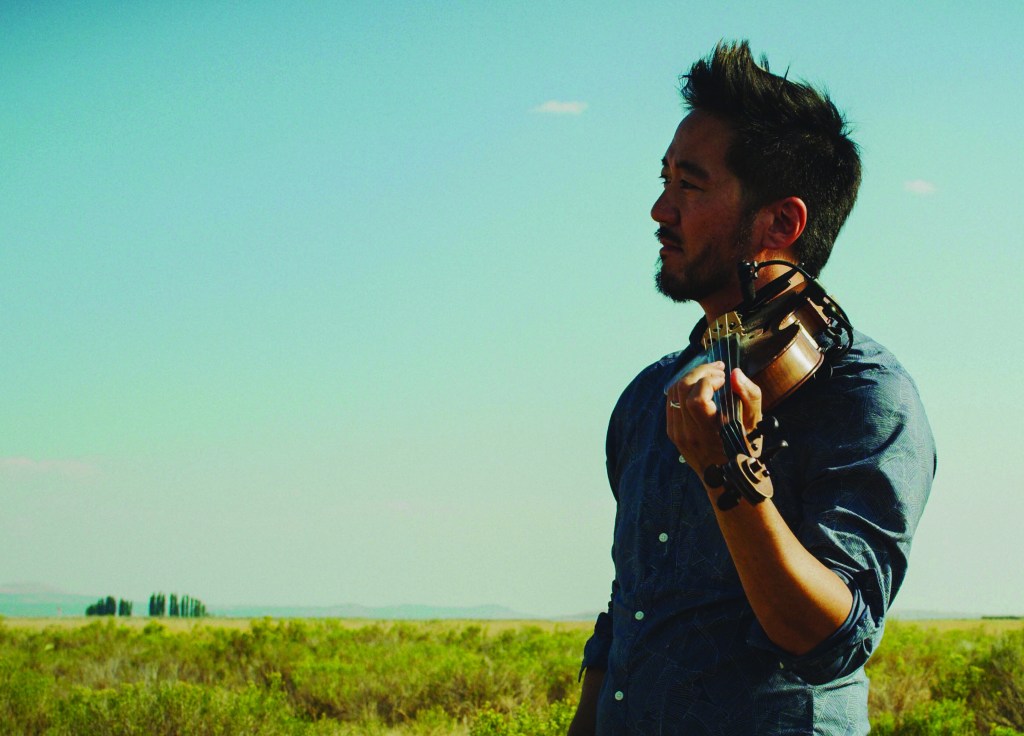
It is hard for me to say: I’m also excited about Kishi Bashi. That’s something you’re going to start seeing a little bit more in the festival on the popular music side, an expansion of what we normally do in our genres. We want to try to find these artists that are like pivot artists that occupy these interstitial spaces between dance and theater and classical music and jazz and folk music. And Kishi Bashi is one of those.
He plays the violin on stage. He has all of these violinists on stage with him, but it’s this kind of strange, hallucinatory, intoxicating music that’s like somehow trance music and Japanese folk music, but using sort of Western classical instruments. But it’s very much in an indie rock tradition as well.
And to kind of see us expand and experiment a little bit more and try to widen the tent of what the festival does is exciting in 2023. And you’re going to see a little bit more of that in ‘24, ‘25, and ‘26.
That’s definitely promising. Are we also experiencing or witnessing at Spoleto something of a reconciliation with Gian Carlo Menotti beginning?
Hooo!
You didn’t expect that one, did you?
I did not expect that one. All I can say about Gian Carlo is that he had great vision in founding the Spoleto Festival and was a spectacular impresario. I never knew him personally. And you know, if you’re talking about a reconciliation or reckoning artistically, I’m very happy to speak about that, because I think that Vanessa is a work that was premiered in 1958 at the Met, it won a Pulitzer that year, it was then done in Spoleto in 1978. I think Barber lived until 1991.
So that moment when Vanessa was done in 1978 was not just a moment for the festival. Because it was a Great Performances capture that was syndicated throughout the country on PBS. It was a great moment of national recognition for the festival. But it was a great moment of re-evaluating Samuel Barber as a composer nationally.
And it was really when people started to look at Samuel Barber. You know, in 1978 there was a great decade-and-a-half of serious intellectual academic ultra-serialism in classical music, the likes of not just Boulez but on the American side with Milton Babbitt and so on. The work of Samuel Barber in his kind of neo-romantic lyricism had fallen out of fashion and out of favor by the late ‘70s, especially also with the rise of the minimalism movement with the likes of Terry Riley, Steve Reich, and Philip Glass and now John Adams.
So it’s really a moment of recognizing Samuel Barber and Gian Carlo Menotti in the creation of this work of Vanessa, and I think that Vanessa is a great American opera that has truly been underappreciated. It tells a story that is urgent, is psychologically harrowing, is about reclusion in a way, which is very appropriate after the pandemic, perhaps kind of scarily so. It tells a story about love and about the blurriness and ambiguity that can happen in love.
It’s a harrowing kind of weird story that is told on stage, especially in this setting, through a very Ingmar Bergman-like production that has such spectacular force perception, such great theatrical ambiguity onstage, such depth where you can sort of see through one wall, see through past another wall, and then see through a third wall, and you have this sense that the stage is never ending. It’s just a sense of false prosceniums.
I think if we’re going to reevaluate Gian Carlo Menotti, let’s do so from an artistic perspective and look at what he had given to us, not just as a great impresario, but as a librettist and as a director, as well as a composer, but as a librettist and a director through the work of Vanessa by Samuel Barber.
Yeah, I think it might be overdue for us all being reminded just how talented he was as a writer.
Yeah, I agree. And also how important he was for opera in North America. I mean we have not just one of the great festivals in this country due to him. We have one of the great producing opera festivals in this country due to him. He was a key figure not just as an impresario, but as a composer and a librettist and a director working in American opera and creating a voice for American opera on both sides of the Atlantic.
So yes, I think that’s correct.
In terms of being underappreciated, I would look at Spoleto itself in addition to Barber from the standpoint of becoming maybe the most important force for new music that we have right now.
I don’t know if we can say we’re underappreciated. I mean, we put on Omar, and it’s going all over the place, and we’ve certainly received recognition through the incredible work of Rhiannon [Giddens] and Michael [Abels] and their work being recognized for a Pulitzer. But I think the festival has always been recognized as a great center for new music and new opera specifically.
Especially in the last five, 10 years, you’ve seen some works, Quartett by Luca Francesconi and Das Mädchen [The Little Match Girl] by [Helmut] Lachenmann, and Tree of Codes by Liza Lim, which were either North American premieres or world premieres. And in those cases, you see a real sense that there’s an internationalism to the festival, that the festival is promoting work that is truly importing from Italy, Germany, Australia, and so on, putting it on here and doing so at the highest sort of caliber of creative excellence.
But I also think that the festival is about creating new work and creating new American work. And that was something that you see more in the Menotti years in the ‘70s and ‘80s, where this is the center of new American opera and new American work.
That’s something that we’re going to be looking at over the next few years: How can Spoleto be a sandbox of creative ingenuity, not just in opera, but across multiple disciplines? How can it be an incubator, an accelerator of new ideas when we are in a city with a tragic past and an incredible outward beauty? What does that mean for the creation of work here and how that work can potentially have national and international reverberations?
So I think that this is a center of new work, generally speaking, and it’s really going to lean into that over the next few years.
Reviews: Jon Batiste & The Dap-Kings, Jazzmeia Horn, Artifacts, Trio 3 Plus Vijay Iyer, and Chucho Valdés Quartet
By Perry Tannenbaum
Two years ago, there was a changing of the jazz guard in Charleston as Spoleto Festival USA swung into its 40th anniversary celebration – with a revival of Porgy and Bess distilling the essence of the city and the festival, bringing jazz to the forefront. With Wells Fargo jazz director Michael Grofsorean replaced by jazz advisor Larry Blumenfeld, the lineup turned noticeably toward more domestic, New World performers, and the trend has continued for the two seasons after the big celebration.
Meanwhile Blumenfeld’s programming is pushing the envelope in two directions away from Spoleto’s former mainstream, straight-ahead groove. With Jon Batiste and the Dap Kings, we moved to the pop music realm. At the other end of the spectrum, the Artifacts ensemble’s tribute to AACM repertoire spearheaded by Nicole Mitchell and the set by Trio 3 + Vijay Iyer threw the doors wide open to off-the-rails experimental jazz. Wells Fargo hung in with their sponsorship, but they didn’t increase the number of jazz concerts to accommodate Blumenfeld’s push. Seven remained the magic number, leaving the Fred Hersch Trio, Jazzmeia Horn, the Chucho Valdés Quartet, and Craig Taborn in the mainstream, a noticeable shift in the balance.
Of course, there was a move towards pop last season, seemingly unanticipated, when Dee Dee Bridgewater strode onto the stage at Cistern Yard with the Memphis Soulphony and declared that we were out of luck if we expected a jazz concert from the newly anointed NEA Jazz Master. But there was nothing coy or unanticipated about Batiste appearing with the Dap-Kings on the first weekend of the 2018 festival, teaming up with the funk royals on the second night of his two-night stand at the Cistern.
Contrasting with his solo gig the night before, when Batiste included “St. James Infirmary,” “What a Wonderful World,” and Monk’s “‘Round Midnight,” on his set list, the Daps turned the Cistern into a no-jazz zone. Fats Domino’s “Ain’t It a Shame” and Ray Charles’ “Hallelujah I Love Her So” took me back to my youth, and “I Don’t Need No Doctor” was the bluesiest selection from the bandleader on The late Show With Stephen Colbert. Keenly ruing that I’d missed the solo concert, I found sizable solace in the revelation of Batiste’s singing prowess, which I’d never stumbled across during my occasional viewings of Colbert. If you thought “Sunny Side of the Street” from his Jazz Is Now CD was anywhere close to Batiste’s outer limits, guess again.
No such surprises were forthcoming when Jazzmeia Horn took the stage at Gaillard Center, mostly singing tunes from her scintillating debut CD, A Social Call. The opening song on both the 2017 release and the concert was Betty Carter’s “Tight” – in pretty much the identical arrangement, with Victor Gould leading the rhythm section and Marcus Miller stepping in to supply the alto sax solo. Both Gould and Miller traded potent 4’s with Horn before her outchorus. When she veered from the studio versions, she expanded on them. “East of the Sun” gave space to bassist Barry Stephenson for a solo, an opportunity for drummer Henry Conerway III to return fire during after extra scat volleys from Horn, and for the audience to go “East” and “West” in further exchanges.
“The Peacocks (A Timeless Place)” and “I Remember You” followed the same order as the album, but with trumpeter Josh Evans on hand to reprise his spots on the Jimmy Rowles line, he lingered onstage to add some extra tang to the Johnny Mercer tune, where he’s absent on the studio cut. With all hands on deck, including Corey Wallace on trombone, Horn’s live rendition of “Lift Ev’ry Voice/Moanin’” was the most enhanced – and improved – sampling of A Social Call. For starters, the James Weldon Johnson anthem wasn’t as lame and humdrum as it is on the recording, but it was the Bobby Timmons standard, with the late Jon Hendricks’ lyrics, that really perked things up, drawing lively solos from everyone, including a bowed gem from Stephenson.
The cumulative excellence of the band prodded Horn to surpass herself, no mean exploit, as she weighed in on the last of the horn solos by Wallace and jubilantly traded licks with him. Nor was she done after this crossfire, for after the rhythm section folk took their solos, Horn did special things with the “Lord, I’ve tried” release in the Hendricks lyric, playing with it, ascending to the stratosphere of her vocal range, and turning it into a personal chant that hearkened back to the “Lift Ev’ry Voice” theme. It was quite stunning. Uplifting.
Three things seemed to incline my wife toward favoring Artifacts above all other jazz groups we saw at Spoleto this year: the trio was mostly women, they brought music stands with them to the Simons Center Recital Hall, and we had front row seats. After watching their Jazz Talk with Blumenfeld, also from front row seats, we could also feel a rapport with the artists before they played the last of their six concerts in this cozy, somewhat clinical space.
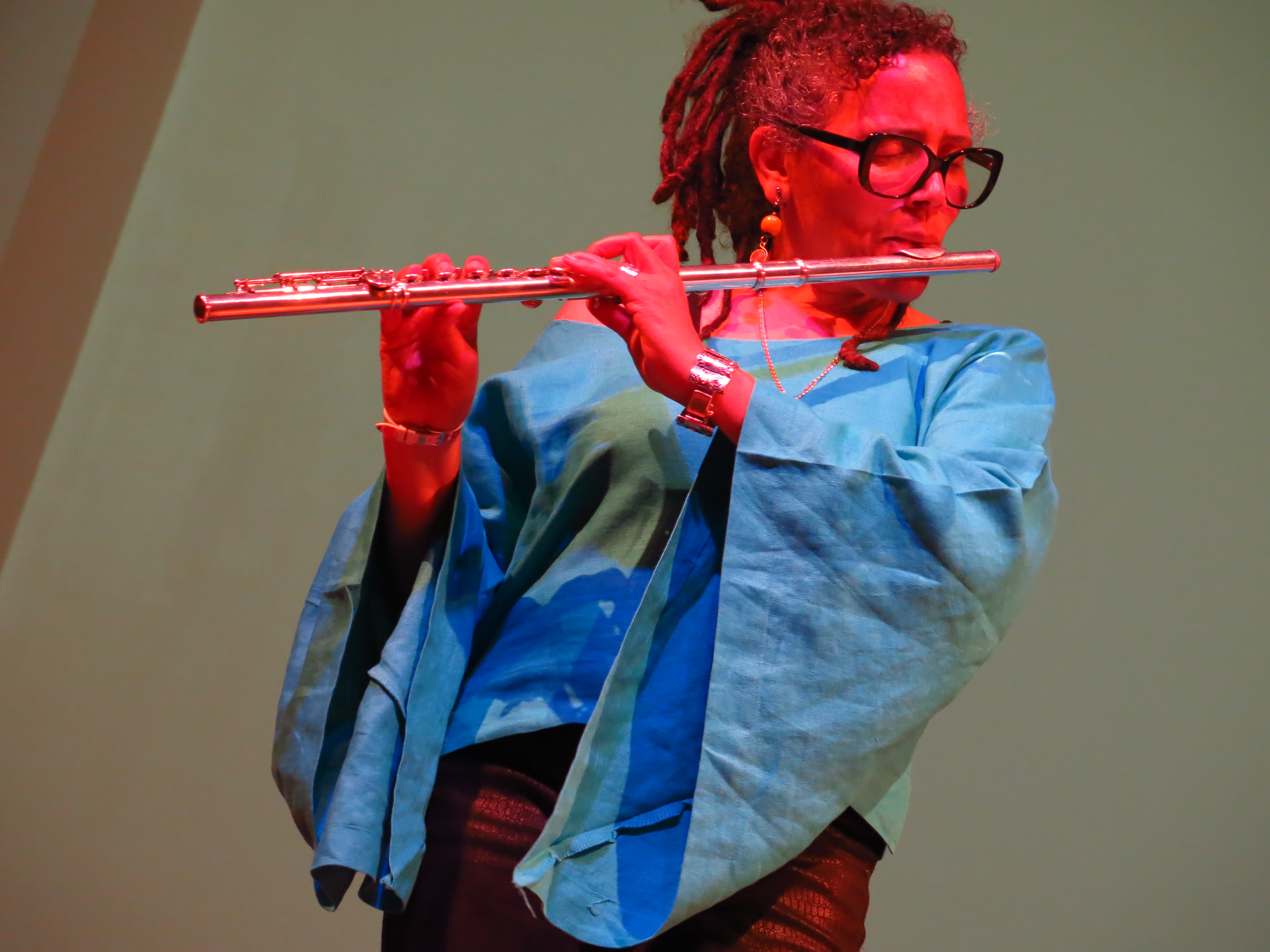
Interaction between the trio members was quite special, Nicole Mitchell on flute the benevolent leader, drummer Mike Reed the earnest provocateur, and cellist Tomeka Reid the serene mellowing agent. Or so you might have described their chemistry after witnessing their symposium with Blumenfeld. At the beginning of their set, each of the players had a chance to sparkle, Reid setting the tone for Reed’s “Pleasure Palace” with a plucked intro, Mitchell navigating the tune, and Reed returning friendly fire before the leader had the final say. Reid pulled out her bow for the next tune, playing together with Mitchell at the outset, and the hypnotic vamp that ensued might be the primary reason Mitchell named this composition “Reflections.”
Reid’s “Song for Helena” had the most interesting texture in the set, the composer partnering with Mitchell in laying down a medium groove and later shedding her bow. Meanwhile Reed shuttled from brushes to sticks, winding up with one in each hand. Steve McCall’s “I’ll Be Right Here Waiting,” more fully explored here than on the 2013 Artifacts recording, also brought out some interesting texturing as Mitchell vocalized while she played, both Reid and Reed agitating against her tranquility to poignant effect. They closed with Ed Wilkerson’s “Light on the Path,” the same infectious line that was the Artifacts finale, with Mitchell exploring her mix of flute and vocalese far more extensively. Intensity ricocheted between the musicians, Reed working himself into a lather and pushing tempo behind his kit and Reid radiating the joy that bound them all together.
The initial vibe at Gaillard Center as Trio 3 Plus Vijay Iyer strode onto the stage might be described as defiance. Not only did the group start late, they had no intentions of easing us into venerable saxophonist Oliver Lake’s toolbag low barks, midrange squonks, and high squeals. Although the Charleston City Paper rightly railed against walkouts at a wide spectrum of Spoleto events, I have to admit that fears of a mass exodus began mushrooming in my gut after just 20 seconds of listening to Lake on “Flow.” Pounding on the keyboard after Lake desisted, Iyer seemed intent on being equally offputting at the piano.
Maybe the leaders were disgruntled because of the sound setup. There are grating moments on the group’s 2014 Wiring recording, to be sure, but the sound captured in the studio was far sweeter and better balanced. Reggie Workman’s bass, so forward and integral in the studio, was virtually lost in the hall, treble was on leave at Andrew Cyrille’s drums, and the overmiking of Lake’s sax was further underscored because Iyer was relegated to the background, volume and flavor not picked up from his keyboard. Acoustically speaking, Simons Center would have been much kinder to this group.
The assault didn’t let up, for the most strident track on the Wiring CD, Workman’s “Synapse,” would come third on the playlist, a performance that triggered the first sizable defections. “Ode to Von” was more quietly weird, Lake at his most fluid so far, Vijay reaching under the piano’s lid, with Reggie and Andrew thoughtfully taking time off from timekeeping. With Lake laying out, “Navigator” abruptly sounded rather tame, as Iyer inserted something different at the start – chords!
Accessibility was back for the remainder of the evening as the quartet meditatively leaned into Workman’s “Willow Song,” inspired by Desdemona’s lament in Othello. Iyer was relatively quiet, layering onto a Cyrille solo, Lake showed his soulful side at last, and the composer eloquently used the space carved out for his bass solo. The stage belonged entirely to Cyrille as he played his drum fantasia, “For Girls Dancing,” further reviving audience enthusiasm. Then Vijay stepped forward and introduced what would be the pinnacle of the evening, the third movement “Adagio” from his Suite for Trayvon (and Thousands More). This time, Iyer struck a chord within the audience, referencing the carnage perpetrated by a white supremacist at the A.M.E. Church, just a block away, in 2015. The performance must have struck many as a peace offering, sanctifying what had often been a raucous program.
Too bad so many who came, perhaps hoping for such balm and healing, had bailed and wound up missing it.
Founder of the seminal Irakere band in the early 1970s, Chucho Valdés was way overdue for a Spoleto debut, whatever musical category you might pigeonhole him in. All those voices, all those horns, all that percussion, and all that jazz/rock electric guitar and bass on the early Irakere CDs tended to conceal the prodigious beast who sat at the keyboards. Valdés’ own talents as a composer and arranger were additional diversions, along with his light touch on electric piano. A brief glimpse of the monster occurred in Chucho’s “Misa Negra (The Black Mass),” when the composer dug in for a solo at the acoustic piano.
Without the likes of Arturo Sandoval’s trumpet on hand – or Paquito D’Rivera’s reeds – Valdés was inclined to fill in the blanks as he led the Chucho Valdés Quartet into Gaillard. Any expectations of a purely Latin-flavored evening or of frequent rock infusions were swiftly dispelled in the opening “Obatala.” After a meandering intro, Valdés built to a dense fantasia with textures worthy of McCoy Tyner before cuing the drums, finishing later with a snatch of Brubeck’s “Blues a la Turk.” In between, there was a light-fingered rumination that could remind you of Red Garland’s treble delights – except that Valdés had a second melody line percolating at the same time in his left hand.
“Son 21” took an approach that we’ve seen from European artists at past Spoletos, moving from one tune to another during the space of a single piece. This medley was of styles as well as melodies, starting off in a jazz groove and, after a Slam Stewart-style bass solo from Yelsy Heredia (accompanying himself vocally an octave higher than he played), returning in a classical rhapsodic vein that flowed into Latin territory. In both of these latter modes, Valdés showed the chops to turn up the heat and make them more torrid and turbulent.
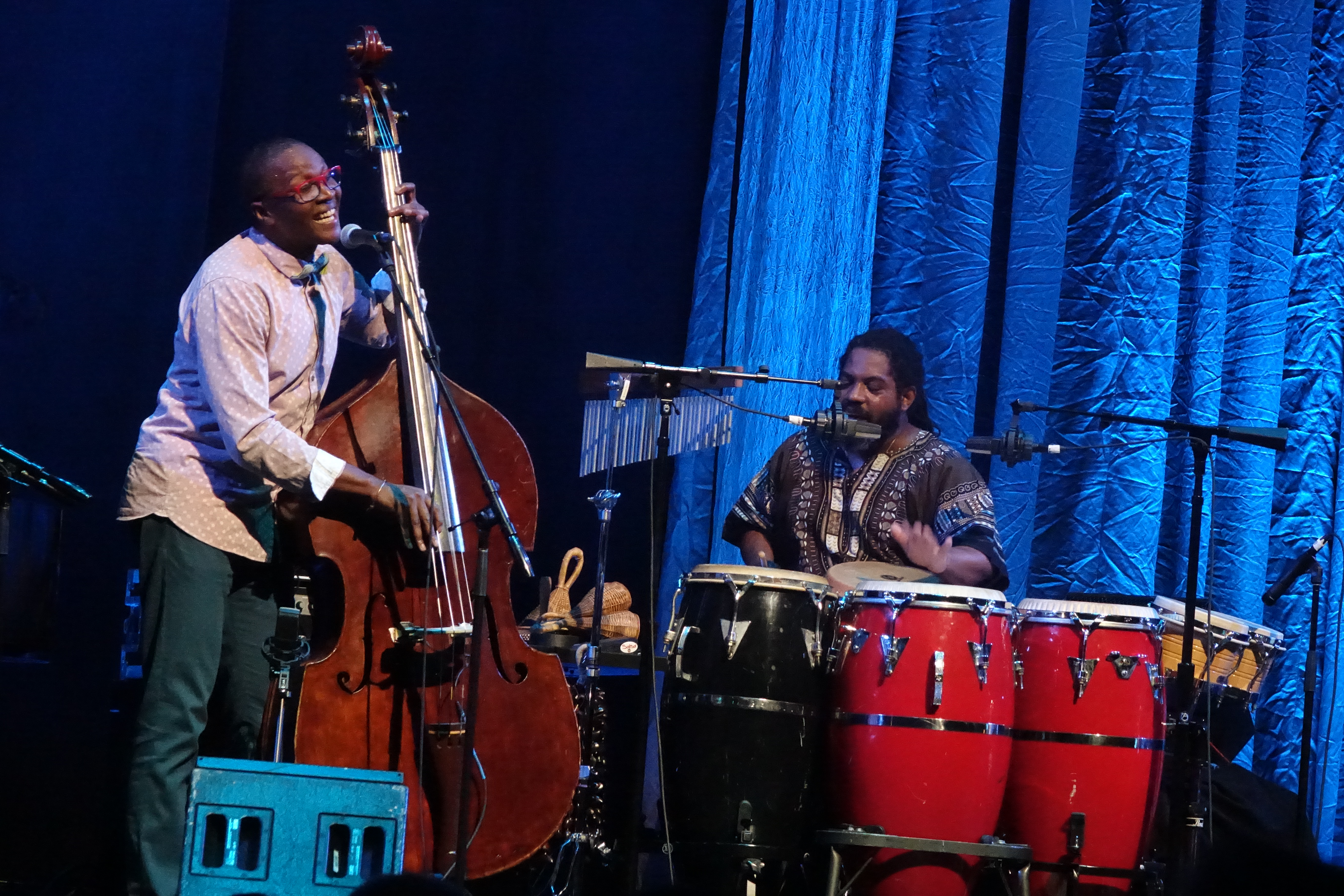
“Ochun” started out a bit like a gospel tune or a jazzy spiritual, and Valdés’ “Chopin Adaption” further widened the palette, veering towards a samba sway before circling back to classical, more like Rachmaninoff than Chopin, over Heredia’s bowed bass. “Mambo in Heaven” was as Latin as you could ask from its opening keyboard vamp onwards, moving towards a pounding piano solo and culminating in a pitched percussion battle, with drummer Dafnis Prieto and percussionist Yaroldy Abreu Robles both getting lathered up at the kit and on the congas.
Our true jazz audience with Valdés came in the concert finale as the 76-year-old treated us to his personal Tin Pan Alley travelogue. We didn’t land at “But Not for Me” until Chucho spent some quality time with “If I Should Lose You,” “Night and Day,” “My Foolish Heart,” and “Waltz for Debby.” Even when we kicked into the Cole Porter tune with full rhythm, there were cameo appearances from Duke Ellington’s “A Train” and Jimmy Van Heusen’s “Swinging on a Star.” For anyone who felt he or she hadn’t heard enough Latin sounds, the “El Cumbanchero” encore provided plentiful consolation, with one more epic drum battle.
With Arturo O’Farrill, Pedrito Martinez, and now Chucho Valdés, there has been a welcome infusion of Afro-Cuban rhythms into the jazz lineup at Spoleto, and with Artifacts and Trio 3, there has been what some might view as an unwelcome addition of experimental jazz. Taking the long view, however, I have to say it’s about time – even for people who hated the new sounds. Ever since the festival began in 1977, there have been many theatre, dance, chamber music, opera, orchestral, and contemporary music performances that have drawn the ire of audience members and sent people fleeing to the exits. Perhaps because festival founder Gian Carlo Menotti was so famously jazz-averse, programming has hewn to a safe mainstream, occasionally pushing the envelope but never too hard.
Not anymore. At Spoleto, jazz has joined the club.