Review: Oedipus el Rey at The Arts Factory
By Perry Tannenbaum

Everybody has a story, but the cruel truth is that an overwhelming majority of them, whether factual or fictional, will be forgotten. So the story of Oedipus, immortalized by the Greek dramatist Sophocles in his Theban Trilogy – and perhaps the cruelest of all stories – is an awesome exception. Not only has this story survived for more than 2450 years, but it has also stood as the Aristotelian model for storytelling.
So part of the wonder of Luis Alfaro’s Oedipus el Rey, now playing at the Arts Factory in a graphic and gripping production from Three Bone Theatre, is how this contemporary Chicano playwright retells the age-old tragedy. The better you know the original Oedipus Rex, the more audaciously you’ll see Alfaro flouting Sophocles’ storyline and Aristotle’s principles of storytelling.

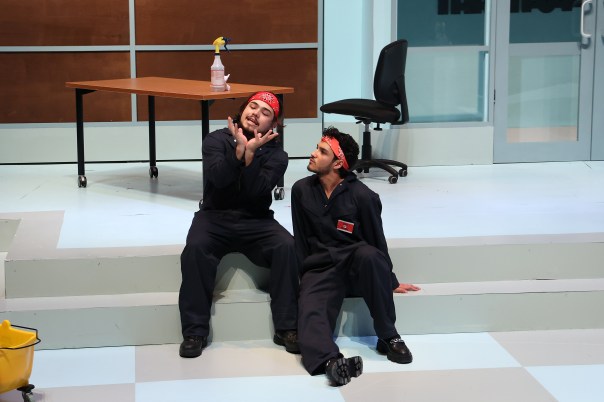
The basic Freudian elements are intact, and Alfaro delightfully retains a Greco-style chorus – but a more shapeshifting group. Even Oedipus is part of the chorus in the prologue, wearing the same orange prison outfit as the other men in our prologue. But the other five guys shuttle in and out of their prison garb, three of them moonlighting in the roles of the prime figures of the Greek myth.
As Alfaro’s tale takes us from prison to LA, from prison across the desert to Vegas and back again to LA, we’ll meet up with King Laius, Oedipus’s dad, and Creon, the king’s brother-in-law. The blind seer, Tiresias, we see from almost the very beginning, elegantly compresses all three of the men to whom Oedipus has been handed off shortly after his birth.

He is a mentor to Oedipus – his father, for all he knows. Hanging out in the prison library, Tiresias is a seer in more ways than one. And if you know how Oedipus winds up, you know that his proving to be King Oedipus’s role model is a fiendish joke.
Now if you know your Poetics, you’ve already deduced that Alfaro has blown Aristotle’s precious unities of time and place to smithereens. This Oedipus doesn’t simply offer us a devastating replay of those final moments when he unravels his own mystery and history, realizing that he has already fulfilled the fate that the oracle has predicted.
In a minor miracle of conciseness that only takes about 90 minutes of stage time – with dollops of Greek chorus, Parliament-of-Owls phantasmagoria, and Chicano voodoo thrown in – Alfaro cleverly dramatizes all the key plot points rather than simply narrating them. The horrible catastrophe of Oedipus fulfilling the fate he has so diligently avoided is once again our crowning moment, but only after we’ve been along for every key step in his story.
The nativity, the abduction, the patricide, the Sphinx riddle, the incest, and the bloody denouement are all part of the action, no less thrilling or shocking than Sophocles of old. Because there is so much more action, so swiftly.

And yet Alfaro compresses some of the tale. The intimate bond between Oedipus and his queenly mother Jocasta happens at the speed of sight, and the new king’s downfall rushes upon him shortly after their wedding. In the Sophocles storyline, there’s a plague afflicting Thebes. He and his queen have two daughters. When the Roman playwright Seneca took up the tale, his timeline was even slacker: the Theban royals had sons and daughters by the time he sent Creon off to consult the oracles.
Vis-à-vis Sophocles, the gains outnumber the losses as Alfaro takes these daring tacks, even if they don’t outweigh them. You get to empathize a little with the monstrous ganglord Laius as the fatal prophecy is delivered to him with the birth of his son. More than two millennia after the Theban royal reigned, there is enough earthiness and superstition to this career bully, crook, and barrio king for him to give credence to the wild prophecy.

And Tiresius, now blindly caught in the merciless net of fate, is doing his best to alter Oedipus’s destiny! Meanwhile, we get to see an earlier phase of Creon, when resentment and jealousy bedevil him as Oedipus makes inroads on his sister and his turf. He doesn’t go forth trying to get info that will help dispel any plague. He’s out there digging for dirt on Oedipus.
Three Bone’s earlier plunges into Alfaro’s Greek Trilogy, Mojada and Electricidad, resolutely distanced themselves from their Ionic roots, embracing the mystic squalor of the modern-day barrio. But here, the playwright sets us down at Kern County’s California State Prison, and the full Coro sextet enters and forms a square-shaped lineup, where Alfaro calls for “An empty stage stripped of decoration – hollow and hallowed – its emptiness feels religious.”
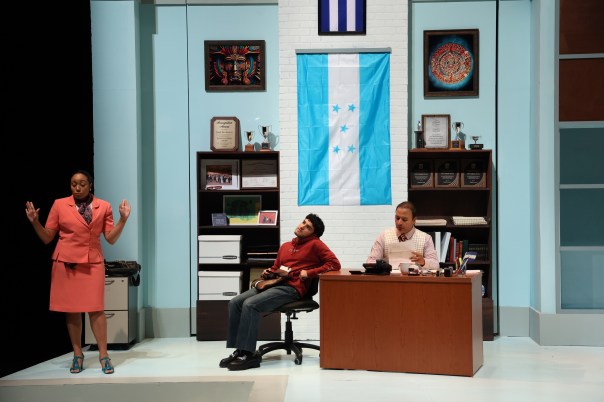
What director Rod Oden and set designer Jennifer O’Kelly do to capture this ambiance is to stand Ionic pillars along all four walls of the Arts Factory and stage their Oedipus in the round. These are enhanced by projections that O’Kelly deploys to fill the spaces between the ancient columns, beginning with the names of our key players projected vertically on the pillars during the opening Prologue.
Not to complain, but I wish Oden and O’Kelly had also projected Alfaro’s scene titles. Some are spicy and humorous, offering further links to the ancient tragedy.

The performances are as classy as the scenery, but without classical pretensions. Never a part of the ritualized action, except when she dons her wedding dress, Stacy Fernandez charms us as Jocasta from the moment we first see her chiding her unborn son, who is kicking her inside the womb. What Alfaro titled “Soliloquy” comes off like a world-weary wisecrack. No less engaging, Fernandez gets to fill us in on Jocasta’s backstory, something Sophocles and Seneca never bothered with.
In another auspicious Three Bone debut, Kelvin Jones-Fernandez as Oedipus contrasts nicely with Fernandez’s street-wise worldliness. With a studly innocence and a winsome, toothy smile, Jones-Fernandez had me thinking LaMelo Ball all evening. Less than half as much ink on him as the Hornets star, but enough tats for Laius to instantly recognize him as an ex-con at their fateful nocturnal meeting on a one-lane highway.
Jones-Fernandez brings a big personality to his monologue when Oedipus subsequently tours his dad’s royal territory, reasserting sovereignty and letting former debtors know they’re still on his account book and announcing that the “free trade” days are over when they could do business outside his turf. Yet he’s genuinely wowed by Jocasta, green enough to convincingly ignite their copulation scene by crying out, “Teach me!”
You’re more than warned that this scene is coming when you first enter the space. Ushers will apply stickers to all your cellphone camera lenses to protect the actors.

Sipping on a horchata the livelong day, Eduardo Sanchez stylishly delivers Alfaro’s weaselly makeover of Creon, whom Lauis regards as a pretend prince. He’s intimidating as well as sleazy toward Oedipus when he arrives in town, won over easily enough, but obviously a sneaky, underhanded threat. That Oedipus resists his initial overtures to go crooked says something for his character: he’ll succumb because society is rigged against Chicanos and ex-cons.
You may remember that Sanchez was also a bit of a softie – and a bit comical – as Orestes in Three Bone’s flaming Electricidad.Two other standouts from previous 3B installments of the trilogy show their mettle again. Luis Medina, who was Orestes’ mentor and tattoo artist last August, plays a bigger, yet similar role as Tiresias. Laius’s former right-hand man turned prison sage, now masquerading as Oedipus’s dad. Accessorized with dark glasses and a slick fold-up navigation cane.
Although we haven’t seen him since his starring role as Jason in Mojada (based on Euripides’ Medea), Christian Serna brings some of that same swagger to King Laius. After all, Jason was also a bit of a cad, going for the gold, just not as malign as this mobster. It’s fun to get a more intimate look at this character who is usually offed before the action begins.
And it’s newly satisfying to watch his predicted fate come full circle and overtake him. The only big mistake Oden made in directing came at the moment when Laius recognizes who his killer is, how the gods and fate have triumphed. It needs to be bigger, far more emphatic.
Yes, Alfaro’s Oedipus and Laius don’t rise to the royal grandeur of their Theban namesakes, so their falls are not as precipitous. That’s probably why Alfaro leans so hard into amplifying his hero’s hubris. This one doesn’t believe in any God, tears a Bible into shreds, and deifies himself.
It’s excessive rage and arrogance for an ex-con, but not if you accept Oedipus’s underlying anguish as the voice of his people. Three Bone Theatre is the first company anywhere to present all of Alfaro’s Greek Trilogy and give vent to his full anger. Groundbreaking may be an understatement in the presence of such power.