Review: Opening Weekend at Spoleto Festival USA 2026
By Perry Tannenbaum
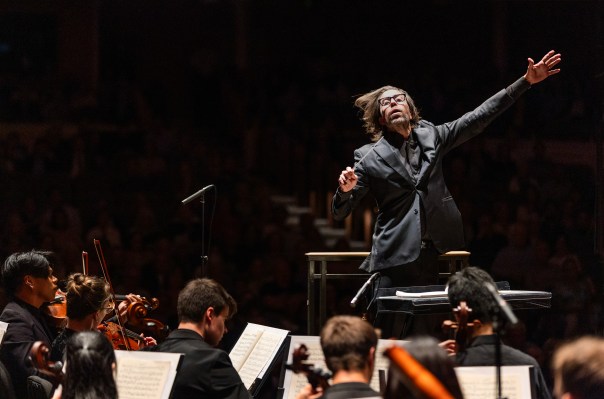
CHARLESTON, SC – MAY 23, 2026 – Spoleto 2026 Tchaikovsky Symphony No. 5 with the .Spoleto Festival USA Orchestra and maestro Timothy Myers.
May 26, 2026, Charleston, SC – The semi-quincentennial edition of Spoleto Festival USA has begun in Charleston with a roar, a momentum, and a dizzy effervescence that I’ve never seen before in my 33 years of covering America’s preeminent performing arts festival. Performing together, Renée Fleming and Béla Fleck led the parade of international stars converging on the Holy City for the opening weekend of the annual 17-day festival.
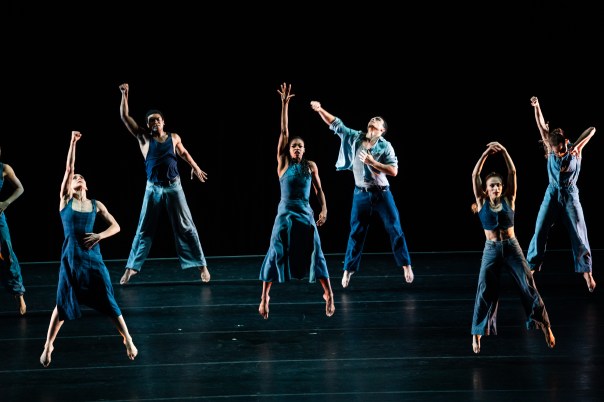
In this procession were the Martha Graham Dance Company, celebrating their centennial; rising jazz-rockstar Mali Obomsawin; and cellist Zuill Bailey with a new concerto written for him, Rhapsody on “Omar,” by Michael Abels. That opera, with libretto by co-composer Rhiannon Giddens, premiered at Spoleto in 2022 and won the Pulitzer Prize the following year. So the climax of Abels’ final movement, “O People of North Carolina,” reprised Giddens’ shoutout to the Tarheel State.
Another Tarheel tribute follows shortly: Terence Blanchard + The E-Collective’s Miles Davis & John Coltrane at 100. Coltrane, of course, hailed from Hamlet, NC, ascending to jazz fame as a member of the first Miles Davis Quintet – and beyond in the landmark Kind of Blue album and with his own legendary quartet, peaking in A Love Supreme. We didn’t expect anything less than a sellout for The Fiddle and the Drum, the Fleming-Fleck tribute to Appalachian folk traditions and the nation’s 250th anniversary. Besides, we saw the Fleming gala with the Charlotte Symphony less than three years ago, so it seemed greedy to grab another pair of reviewer freebies. Our virtue vis-à-vis la Renée, however, did not reward us with reviewer seats at Charleston Music Hall for the Blanchard tributes.
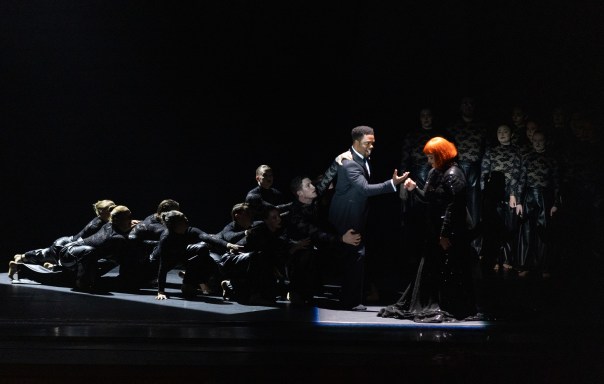
CHARLESTON, SC – MAY 22, 2026 = Spoleto 2026 Dido and Aeneas dance opera.
The Abels-Bailey concert seemed to be a sellout as well. So did the charming Gian Carlo operetta, The Old Maid and the Thief at Dock Street Theatre, at its second performance on Memorial Day. All of this frenzied ticket-buying, the likes of which I haven’t seen in many years, caught the Spoleto box office off stride. This was keenly evident at the first event we attended, Opera Queensland’s ultra-lavish production of Henry Purcell’s Dido and Aeneas, replete with flying acrobatics and aerial silks. Outside at Will Call, we were expecting to receive our tickets in a prepared envelope as in previous years, only this time they would be issued one event at a time.
The plan changed. Our names triggered a protracted computer search for our tickets, which led to our tickets getting printed out on the spot. But these weren’t merely tickets for now or for today’s events. While people waited behind us and the line steadily grew, piling onto our embarrassment, tickets came spewing out of the printer that seemed to cover the remainder of our 12-day sojourn at Spoleto. Then two or three Spoleto employees had to set about folding this perforated ribbon of tickets into pairs and packing them into a pocketable envelope.
Inside the Sottile Theatre, we saw and heard more. Acquaintances of ours from Charlotte told us about their tribulations, which included not receiving the tickets that were purportedly mailed to them and then being sent to the Charleston Visitor Center to extend their pickup adventure. Curtain time was still at least 15 minutes away, but the size of the crowd seemed slightly anemic for an opening night. When magic time came, there was still a steady inrush of ticketholders, definitely more than the usual trickle of latecomers, yet not quite as populous or herd-like as large groups who might have been bused. We could only imagine what their ticket tales may have been. Whispers of a bumpy transition to digital ticketing were heard a couple of days later.
If you’re booked for as many events as we are at Spoleto, snafus, delays, and recalculations are occasionally part of the experience. A technical glitch at the Martha Graham centennial delayed its start for more than 15 minutes, and the intermission felt like it was dragging, imperiling the half-hour cushion we had left for driving from Festival Hall to the Gaillard Center and the Abels premiere. A quick glance at the festival program book disclosed that the Abels premiere, as hoped, would be preceded by a musical aperitif, in this case, Hector Berlioz’ Beatrice and Benedict Overture. So seeing the Martha Graham celebration to its end would only mean sacrificing the Berlioz at most.
Two amazing parking-spot finds helped validate my assumption. I dropped my wife Sue off near the rear entrance to the Gaillard and miraculously found parking out front on Calhoun Street. She was able to be seated for the Berlioz while I was obliged to stand at the rear of the hall. Of course, there were people in the Martha Graham crowd who had made the opposite calculation from ours, leaving before the final “We the People” piece – or, more awkwardly, in the middle – with music by Giddens!
Gifted with an aisle seat, my pathway to joining the crowd was simple and direct. Others in the queues at the rear were counterintuitively shy, holding back until I took up the lead, since they needed to act more expeditiously to squeeze themselves into a full house while trying the patience of those already seated and settled.
My assumption that Spoleto’s conducting fellow at the Gaillard podium for the Berlioz, Mariana Corichi Gomez, is a woman was shaken when her ponytail disappeared and music director Timothy Myers took her place for the remainder of the concert. The gender switch escaped me as I hurried down the aisle to my seat. The stubble on Myers face was likely visible enough when he looked at Bailey, but my attention, like everyone else’s, was riveted to the guest cellist – not only because he is reputed as a handsome and charismatic performer, but because of the extreme demands of Abels’ Rhapsody.
More reminiscent of Tchaikovsky’s Rococo Variations than the typical concerto, Rhapsody is hardly a dialogue between cello and orchestra. Rather, it’s an extended series of accompanied episodes of ardent lyricism and cadenza dazzle with some merciful orchestral interludes that allowed Bailey to regather his strength and focus. Quickly, the memory of Gautier Capuçon’s amazing performance with the Czech Philharmonic came to mind, shaping my expectations. Since three of the four Omar Rhapsody movements have multiple episodes (3., for example, is marked “The Whirlwind / His Mercy / Psalm 23,” and the concluding movement has the Carolina shoutout flanked by “Tell Your Story” and “Oroborus”), I gradually reached the conclusion that Myers, Bailey, and the Spoleto Festival USA Orchestra were playing the four movements attaca, without pause.
Modern composers, after all, tend to be taciturn in comparison with their ancestors. Compound that gnomic tendency with the minimalist practice of numbing repetitiveness, and you reach the presumption that new classical works will have little to say and be over quickly. Whether or not Abels’ first movement, “Futa Toro / Middle Passage,” actually timed out as longer than Tchaikovsky’s full Rococo, I had fallen into the error of presuming that Piotor Ilych had provided the template. Two or three times, I was confident that Bailey had transitioned into “Julie’s Aria,” Abels’ second movement – and had moved beyond!
We can therefore excuse the audience for breaking into an appreciative ovation when Bailey raised his bow for the first time. They were witnessing an unprecedented outpouring of catchy, contemporary, and contemplative sound along with me. With three more movements to follow! Hopefully, Abels’ magnificent eye-opener, commissioned by Spoleto Festival USA, will be allowed to tour with Bailey as Omar did, giving North Carolina a shot at seeing it live.
As thoroughly as my tardiness shielded me from a fair hearing of the Berlioz overture (and recognition of Gomez’s departure), Bailey’s dominance kept me in the dark in assessing Myers and his orchestra. After intermission, there would be Tchaikovsky’s Symphony No. 5 to shed conclusive light.
What a treat! From the first notes, it was obvious that this performance would not pale in comparison with the stunning Tchaikovsky Fifth that Kwamé Ryan delivered with the Charlotte Symphony just three months ago. To say that the Spoleto Orchestra made no missteps would be discounting their flair and confidence. No doubt about it, Spoleto ranks among the most elite youth orchestras on the planet, a yearly spring benchmark for the youth ensembles that flower internationally at music festivals across America and Europe. Make no mistake about Myers, either: this Tchaikovsky 5 reaffirmed that he is also top-tier.
Still to come on the Festival slate is most of the Live at the Cistern series, outdoors under the College of Charleston live oaks, including Mountain Goats, Indigo Girls, Pedrito Martinez Group, Molly Tuttle, Emmylou Harris, Colin Meloy, and Brandi Carlile. Maybe then, audiences will start trending younger than we’ve seen so far.
Aside from the giddiness of Spoleto at its best, the audacious cutting edge still rears its head occasionally. And bites. That was what happened with Mali Obomsawin on our first night in Charleston. The Odanak First Nation artist started out mainstream enough on her upright bass, prefacing “Lineage” softly before the remainder of her pianoless quintet sounded like the classic ECM new age albums led by John Abercrombie, Pat Metheny, or Jan Garbarek back in another century. But then tenor saxophonist Yuma Uesaka exploded into “Reverse Wawasint8da,” with alto sax player Alfredo Colón barely less raucous afterwards. People began gathering their stuff, standing up, and retreating from the hall, not worrying about disturbing their neighbors. When something like that happens, you can be sure you’re at Spoleto!


