Tag Archives: Timothy Myers

Amid Multiple Celebrations – and a Shoutout to NC – Spoleto USA Regains Its Giddiness and Swagger

Review: Opening Weekend at Spoleto Festival USA 2026

By Perry Tannenbaum
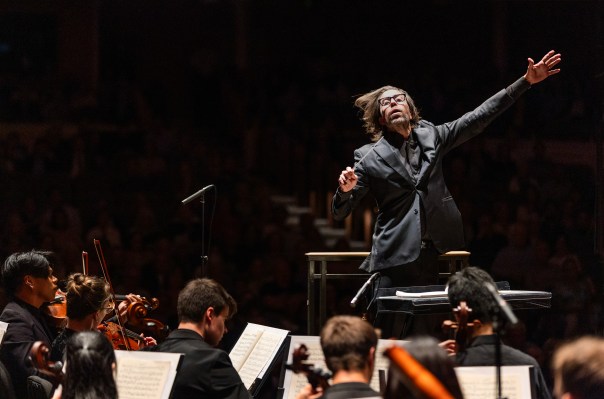
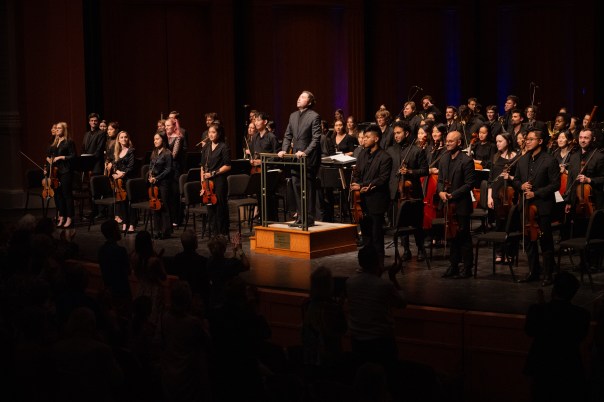
Spoleto 2026 Tchaikovsky Symphony No. 5
CHARLESTON, SC – MAY 23, 2026 – Spoleto 2026 Tchaikovsky Symphony No. 5 with the .Spoleto Festival USA Orchestra and maestro Timothy Myers.

May 26, 2026, Charleston, SC – The semi-quincentennial edition of Spoleto Festival USA has begun in Charleston with a roar, a momentum, and a dizzy effervescence that I’ve never seen before in my 33 years of covering America’s preeminent performing arts festival. Performing together, Renée Fleming and Béla Fleck led the parade of international stars converging on the Holy City for the opening weekend of the annual 17-day festival.
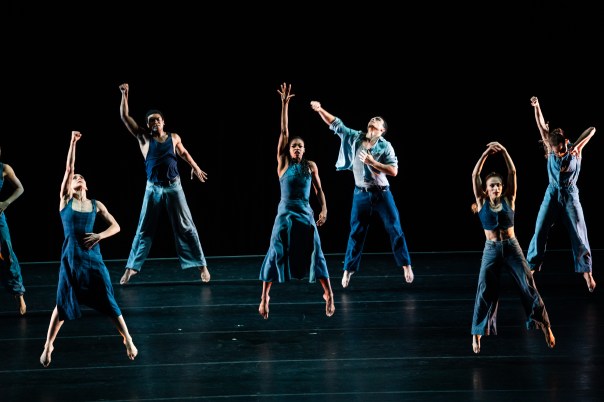
In this procession were the Martha Graham Dance Company, celebrating their centennial; rising jazz-rockstar Mali Obomsawin; and cellist Zuill Bailey with a new concerto written for him, Rhapsody on “Omar,” by Michael Abels. That opera, with libretto by co-composer Rhiannon Giddens, premiered at Spoleto in 2022 and won the Pulitzer Prize the following year. So the climax of Abels’ final movement, “O People of North Carolina,” reprised Giddens’ shoutout to the Tarheel State.

Another Tarheel tribute follows shortly: Terence Blanchard + The E-Collective’s Miles Davis & John Coltrane at 100. Coltrane, of course, hailed from Hamlet, NC, ascending to jazz fame as a member of the first Miles Davis Quintet – and beyond in the landmark Kind of Blue album and with his own legendary quartet, peaking in A Love Supreme. We didn’t expect anything less than a sellout for The Fiddle and the Drum, the Fleming-Fleck tribute to Appalachian folk traditions and the nation’s 250th anniversary. Besides, we saw the Fleming gala with the Charlotte Symphony less than three years ago, so it seemed greedy to grab another pair of reviewer freebies. Our virtue vis-à-vis la Renée, however, did not reward us with reviewer seats at Charleston Music Hall for the Blanchard tributes.
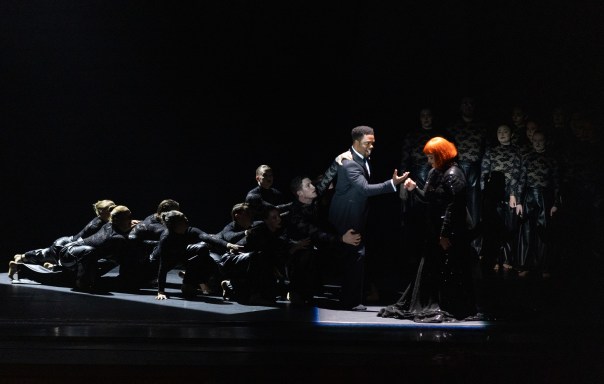
Spoleto 2026 Dido and Aeneas dance opera.
CHARLESTON, SC – MAY 22, 2026 = Spoleto 2026 Dido and Aeneas dance opera.

The Abels-Bailey concert seemed to be a sellout as well. So did the charming Gian Carlo operetta, The Old Maid and the Thief at Dock Street Theatre, at its second performance on Memorial Day. All of this frenzied ticket-buying, the likes of which I haven’t seen in many years, caught the Spoleto box office off stride. This was keenly evident at the first event we attended, Opera Queensland’s ultra-lavish production of Henry Purcell’s Dido and Aeneas, replete with flying acrobatics and aerial silks. Outside at Will Call, we were expecting to receive our tickets in a prepared envelope as in previous years, only this time they would be issued one event at a time.

The plan changed. Our names triggered a protracted computer search for our tickets, which led to our tickets getting printed out on the spot. But these weren’t merely tickets for now or for today’s events. While people waited behind us and the line steadily grew, piling onto our embarrassment, tickets came spewing out of the printer that seemed to cover the remainder of our 12-day sojourn at Spoleto. Then two or three Spoleto employees had to set about folding this perforated ribbon of tickets into pairs and packing them into a pocketable envelope.

Inside the Sottile Theatre, we saw and heard more. Acquaintances of ours from Charlotte told us about their tribulations, which included not receiving the tickets that were purportedly mailed to them and then being sent to the Charleston Visitor Center to extend their pickup adventure. Curtain time was still at least 15 minutes away, but the size of the crowd seemed slightly anemic for an opening night. When magic time came, there was still a steady inrush of ticketholders, definitely more than the usual trickle of latecomers, yet not quite as populous or herd-like as large groups who might have been bused. We could only imagine what their ticket tales may have been. Whispers of a bumpy transition to digital ticketing were heard a couple of days later.

If you’re booked for as many events as we are at Spoleto, snafus, delays, and recalculations are occasionally part of the experience. A technical glitch at the Martha Graham centennial delayed its start for more than 15 minutes, and the intermission felt like it was dragging, imperiling the half-hour cushion we had left for driving from Festival Hall to the Gaillard Center and the Abels premiere. A quick glance at the festival program book disclosed that the Abels premiere, as hoped, would be preceded by a musical aperitif, in this case, Hector Berlioz’ Beatrice and Benedict Overture. So seeing the Martha Graham celebration to its end would only mean sacrificing the Berlioz at most.

Two amazing parking-spot finds helped validate my assumption. I dropped my wife Sue off near the rear entrance to the Gaillard and miraculously found parking out front on Calhoun Street. She was able to be seated for the Berlioz while I was obliged to stand at the rear of the hall. Of course, there were people in the Martha Graham crowd who had made the opposite calculation from ours, leaving before the final “We the People” piece – or, more awkwardly, in the middle – with music by Giddens!

Gifted with an aisle seat, my pathway to joining the crowd was simple and direct. Others in the queues at the rear were counterintuitively shy, holding back until I took up the lead, since they needed to act more expeditiously to squeeze themselves into a full house while trying the patience of those already seated and settled.

My assumption that Spoleto’s conducting fellow at the Gaillard podium for the Berlioz, Mariana Corichi Gomez, is a woman was shaken when her ponytail disappeared and music director Timothy Myers took her place for the remainder of the concert. The gender switch escaped me as I hurried down the aisle to my seat. The stubble on Myers face was likely visible enough when he looked at Bailey, but my attention, like everyone else’s, was riveted to the guest cellist – not only because he is reputed as a handsome and charismatic performer, but because of the extreme demands of Abels’ Rhapsody.

More reminiscent of Tchaikovsky’s Rococo Variations than the typical concerto, Rhapsody is hardly a dialogue between cello and orchestra. Rather, it’s an extended series of accompanied episodes of ardent lyricism and cadenza dazzle with some merciful orchestral interludes that allowed Bailey to regather his strength and focus. Quickly, the memory of Gautier Capuçon’s amazing performance with the Czech Philharmonic came to mind, shaping my expectations. Since three of the four Omar Rhapsody movements have multiple episodes (3., for example, is marked “The Whirlwind / His Mercy / Psalm 23,” and the concluding movement has the Carolina shoutout flanked by “Tell Your Story” and “Oroborus”), I gradually reached the conclusion that Myers, Bailey, and the Spoleto Festival USA Orchestra were playing the four movements attaca, without pause.

Modern composers, after all, tend to be taciturn in comparison with their ancestors. Compound that gnomic tendency with the minimalist practice of numbing repetitiveness, and you reach the presumption that new classical works will have little to say and be over quickly. Whether or not Abels’ first movement, “Futa Toro / Middle Passage,” actually timed out as longer than Tchaikovsky’s full Rococo, I had fallen into the error of presuming that Piotor Ilych had provided the template. Two or three times, I was confident that Bailey had transitioned into “Julie’s Aria,” Abels’ second movement – and had moved beyond!

We can therefore excuse the audience for breaking into an appreciative ovation when Bailey raised his bow for the first time. They were witnessing an unprecedented outpouring of catchy, contemporary, and contemplative sound along with me. With three more movements to follow! Hopefully, Abels’ magnificent eye-opener, commissioned by Spoleto Festival USA, will be allowed to tour with Bailey as Omar did, giving North Carolina a shot at seeing it live.

As thoroughly as my tardiness shielded me from a fair hearing of the Berlioz overture (and recognition of Gomez’s departure), Bailey’s dominance kept me in the dark in assessing Myers and his orchestra. After intermission, there would be Tchaikovsky’s Symphony No. 5 to shed conclusive light.

What a treat! From the first notes, it was obvious that this performance would not pale in comparison with the stunning Tchaikovsky Fifth that Kwamé Ryan delivered with the Charlotte Symphony just three months ago. To say that the Spoleto Orchestra made no missteps would be discounting their flair and confidence. No doubt about it, Spoleto ranks among the most elite youth orchestras on the planet, a yearly spring benchmark for the youth ensembles that flower internationally at music festivals across America and Europe. Make no mistake about Myers, either: this Tchaikovsky 5 reaffirmed that he is also top-tier.

Still to come on the Festival slate is most of the Live at the Cistern series, outdoors under the College of Charleston live oaks, including Mountain Goats, Indigo Girls, Pedrito Martinez Group, Molly Tuttle, Emmylou Harris, Colin Meloy, and Brandi Carlile. Maybe then, audiences will start trending younger than we’ve seen so far.

Aside from the giddiness of Spoleto at its best, the audacious cutting edge still rears its head occasionally. And bites. That was what happened with Mali Obomsawin on our first night in Charleston. The Odanak First Nation artist started out mainstream enough on her upright bass, prefacing “Lineage” softly before the remainder of her pianoless quintet sounded like the classic ECM new age albums led by John Abercrombie, Pat Metheny, or Jan Garbarek back in another century. But then tenor saxophonist Yuma Uesaka exploded into “Reverse Wawasint8da,” with alto sax player Alfredo Colón barely less raucous afterwards. People began gathering their stuff, standing up, and retreating from the hall, not worrying about disturbing their neighbors. When something like that happens, you can be sure you’re at Spoleto!

Must-See Classical Abounds at Spoleto Festival USA

Reviews: Opera, Chamber Music, Orchestral Music, and Alisa at Spoleto

By Perry Tannenbaum

Three different sea changes have reshaped Spoleto Festival USA since Nigel Redden, responding to the WSYWAT turmoil that followed in the wake of George Floyd’s brutal murder, departed after the 2021 season. Redden saw himself in the crosshairs of the 2020 We See You White American Theatre manifesto, though he wasn’t strictly a theatre person, and felt that steeping as aside was the honorable thing to do.

Diversity has never been inimical to Spoleto, which has always looked more Euro and Afro than American. Yet as Spoleto 2025 concludes, a near-total change of artistic leadership has transpired – with an unmistakable lean toward diversity. Mena Mark Hanna has replaced Redden as general director. Paul Wiancko has filled the void left by the charismatic Geoff Nuttall’s sudden death, taking over the reins of chamber music programming. When John Kennedy was abruptly dismissed after the 2023 season, Timothy Myers became music director, wielding the Spoleto Orchestra baton.

And Joe Miller, after 20 seasons as director of choral activities, is resigning to lead the Vocal Arts Ensemble in Cincinnati. His Spoleto farewell, Bach’s Mass in B Minor, will be followed soon by an announcement of his successor in Charleston.

Conversely, Spoleto is responding to fiscal, box office, and government funding pressures to be more self-sufficient. While Kennedy’s programming arguably made the  festival America’s chief hub for 21st century classical music composition, his afternoon Music in Time programs were as much box office poison as they were cutting edge. That experimental ghetto has disappeared while Wiancko and Myers have integrated more infusions of contemporary, new, and world premiere music into the festival’s chamber music and orchestral offerings.

Beyond shrinking the outré and avant garde, Spoleto is expanding its pop, punk, folk, and R&B presentations to no less than a dozen Front Row events with Patti Smith, Band of Horses, Mavis Staples, Lucinda Williams, and Jeff Tweedy among the headliners. The strategy is to “expand the aperture” in Hanna’s words, offset the losses of more adventurous fare, and make Spoleto more accessible to a wider audience. Hopefully, these newbies may be tempted into tasting the 17-day festival’s higher protein offerings.

Other belt-tightening measures include offering 15%-off discount packages of tickets to multiple events, and ending of the longstanding tradition of inviting a theatre company from abroad to co-tenant the Dock Street Theatre with the lunchtime chamber music series. Wilder still, two of the Dock Street chamber music concerts were staged during evening hours! Sacrilege.

Finally, little touches in the festival brochure and the program booklet underscored a deepset commitment to making Spoleto more navigable and customer-friendly. Jazz fans could gorge on all the Spoleto headliners within the space of 10 days, while theatre lovers could get their fill in seven.

While both of these lineups were tilted toward the latter half of the festival; opera, dance, and orchestral music could be largely traversed within the first 10 days; along with seven of the eleven chamber music programs. As compacted as the scheduling was for festivalgoers devoted to one genre, omnivores like me who preferred a mix found themselves stretched. For us, the scheduling was scattered and fragmented.

How appropriate, then, that the most awesome classical music event this season, intertwining 27 new works by living composers with J.S. Bach’s Six Cello Suites, was Alisa Weilerstein’s FRAGMENTS. Conceived during the global pandemic, FRAGMENTS has some of the randomness and the quirky, curated individuality of a mixtape. Weilerstein did not commit herself to playing the Suites in their entirety or – within each Suite – in their traditional order. Or tempo.

Beyond that, in commissioning 27 three-part compositions roughly 10 minutes long, Weilerstein obtained the right to shuffle the order of the parts and to slice and dice the new works to create smooth transitions into each other and the Bach. Layering on stage direction at Sottile Theatre by Elkhanah Pulitzer, scenic and lighting design by Seth Reiser, and costumes by Molly Irelan, Weilerstein crafted her FRAGMENTS into a creation you literally had to see.

As revealed in an interview event moderated by Martha Teichner, Weilerstein has no intentions of releasing an audio recording of FRAGMENTS. Video only. However, the cellist will honor the composers she commissioned by recording their works as written. All in all, Weilerstein was onstage soloing and fielding interview questions for more than seven hours spaced over six days, capped with world premiere performances of FRAGMENTS 5: Lament and 6: Radiance on her final day.

Still in Flux, Spoleto USA Runs Brash Gamut From Barber To Balloon Pops

Review: Spoleto Festival USA

By Perry Tannenbaum

Photo by Leigh Webber

It’s been a tumultuous year for Mena Mark Hanna in his second season as the new general manager at Spoleto Festival USA. Chamber music director Geoff Nuttall, the festival’s most recognizable personality – the charismatic violinist who convinced Hanna to come aboard at Spoleto – died in mid-October at the age of 56 while undergoing treatment for pancreatic cancer.

Amid all his antics and flamboyance, Nuttall never seemed to be that old.

Then as all the pieces of Spoleto 2023 fell into place, including the memorial concert for Nuttall scheduled on the opening holiday weekend, last year’s centerpiece, the world premiere of Omar, won the Pulitzer Prize for composers Rhiannon Giddens and Michael Abels. That opera, rooted in the festival’s Charleston home, would stand as the signature achievement of Nigel Redden, Hanna’s predecessor. Redden handed over final alterations and trimmings to the new GM, who piloted the grand project into port.

So this year’s festival will likely be remembered as Hanna’s first true lineup, though Scottish Ballet, mandolin sensation Chris Thile, and iconic jazz artist Abdullah Ibrahim will be the last holdovers to file into Spoleto from the 2020 event that never happened. Yet without a replacement for Nuttall, a key member of Hanna’s hiring committee as well as an engaging host and performer, there’s a feeling that the festival remains in flux.

Even as I spoke to Hanna, a week before this year’s Spoleto began, he wavered between declaring he was in no hurry to replace Nuttall and assuring me that considering his successor was definitely on his to-do list during the festival and in the summer ahead.

It’s safer to say that sustaining the momentum for opera is an urgent priority for Hanna. Programming Samuel Barber’s Vanessa in 2023 is certainly a major statement, since its strong libretto was written by Spoleto founder Gian Carlo Menotti, and for 2024, the festival is commissioning a new opera. Announced at the same time the curtain was rising for the final performance of Vanessa, the new piece, Ruinous Gods by composer Layale Chaker and librettist Lisa Schlesinger is ballyhooed as “another bold project with powerful themes” in the mold of Omar. Opera Wuppertal and Nederlandse Reisopera will be co-commissioners and co-producers of the new chamber opera.

Menotti hasn’t been regularly involved at Spoleto since 1993, when he stage-directed one of his weakest works, The Singing Child. True, there was a revival of Menotti’s most heralded opera, The Medium, in 2011, but that production has come to seem like an obligatory celebration of the composer’s 100th birthday. Twelve years later, Vanessa feels like a whole-hearted embrace: bolder and more contemporary with Rodula Gaitanou’s daring stage direction, more searching with Timothy Myers wielding the baton.

A long pandemic after Gaitanou’s vision of Vanessa was first presented in 2016, the loneliness and isolation of Vanessa resonated more keenly in its US premiere, the effect only enhanced because her icy-cold vigil is self-imposed. The entire household seems to be in suspended animation, The Old Baroness mother perpetually painting at her easel, daughter Vanessa faithfully awaiting her former lover’s return after 20 years, and Vanessa’s niece Erika as much on auto-pilot as the maids and butlers.

All the many paintings and mirrors on the walls are covered, adding to the surreal atmosphere. It’s as if Vanessa were protecting herself from a raging plague, or as if this were a summer home about to be abandoned until next year. The futile circularity of the Baroness painting pictures that will be covered up as soon as they are hung up on the wall subtly prefigures what will happen when Vanessa’s beloved Anton arrives.

As Hanna had promised, the cast was killer. Nicole Heaston brought a neurotic hauteur to Vanessa, a steely cold soprano in her rendering of the tense “Do Not Utter a Word” aria that weirdly echoed Rosalind Plowright’s iciness as the Baroness, a role that the English mezzo originated at the Wexford Festival premiere of this production – before she reprised the role at Glyndebourne in 2018 (available on DVD and Blu-Ray). Compared to the stony and unwavering Plowright, Heaston’s Vanessa proved to be vulnerable, capricious, malleable, and oblivious in a quietly disturbing way.

If Heaston personified the creepiness and the supernatural tinge of Menotti operas, mezzo Zoie Reams as Erika inclined more to Barber’s sad and wistful Romanticism. More emotion poured out of her in “Must the Winter Come So Soon” than on any of the full-length recordings this side of the original live recording conducted by Dmitri Mitropoulos in 1958. Heaston ably gets across to us that her attraction to the second-generation Anton is a rekindling of her youthful ardor, but Reams shows us that Erika’s love for Anton is a first flowering, with a more hormonal heat and fire.

Yet Erika never wears her heart on her sleeve. Perhaps because of her more precarious finances, there’s a secretive and withdrawn aspect to Reams’ performance that marks her as a member of the family. So self-denying and self-destructive are they all that it becomes richly ambiguous whether tenor Edward Graves as young Anton is a ruthless fortune hunter or an idealistic romantic. It was rather wonderful, when Graves engaged Heaston in the slowly cresting “Love Has a Bitter Core” duet, how Anton and Vanessa could be seen triggering spontaneous passion in each other.

The denouement was a walloping “To Leave, To Break, To Find, To Keep” quintet with baritone Malcolm MacKenzie, a welcome presence as The Old Doctor, completing the fugal fabric. It all sounded so present and powerful at Gaillard Center, the singing perfectly balanced with Myers’ ardent work in the pit, while ever-present, precisely synced supertitles projected above facilitated transmission of Menotti’s text.

For those of us who were fortunate to attend Vanessa and the big orchestral performances of Spoleto 2023 – John Kennedy conducting The Rite of Spring, Mei-Ann Chen navigating the New World Symphony, and Jonathon Heyward reveling in the Symphonie Fantastique – the Gaillard and its fine acoustics were arguably the center of the festival. Both the Spoleto Festival Orchestra and the Spoleto Chorus, recruited in nationwide auditions, are rather awesome. And fortunate: not only do they get to perform at the Gaillard, they individually and collectively get to perform edgy, outré, and contemporary pieces at other Spoleto venues that you’re unlikely to experience anywhere else.

Chen, the music director at Chicago Sinfonietta, dug into her wide-ranging repertoire to greet us with Florence B. Price’s Ethiopia’s Shadow in America, a three-movement work that likely begins a mile or two away with an Introduction and Allegretto depicting the arrival of slaves in America. The brief yet solemn middle movement vividly evoked the famous New World Largo we would hear later in the evening, and the concluding Allegro, “His Adaptation,” had the urbane Ellingtonian strut of the Jazz Age.

Delights and Dances, gleaned from Chen’s 2013 Cedille CD that gathered three different concertos for string quartet and the Sinfonietta, was a welcome dive into an earlier Abels work in the wake of his Pulitzer. Nor was it difficult for me to exit the Gaillard feeling that the New World was Antonín Dvořák’s fantastic symphony, for the onset of the trombones in the final movement brought on goosebumps.

The lesser-known Heyward, the music director designate at the Baltimore Symphony, was not to be upstaged – not by Chen, at any rate. A native of Charleston, Heyward received a hearty greeting from the hometown crowd that puzzled the out-of-towners sitting behind me. Heyward began his grand homecoming with the US premiere of Nymphéa, a 2019 work by Doina Rotaru inspired by Borin Vian’snovel, L’écume des jours, with a sprinkling of Duke Ellington’s “Chloe,” the namesake of Vian’s heroine.

What the music evokes, partly through a delicate combo of piano and muted trumpet that grows fearsome and awesome – embroidered by plentiful percussion – is the growth of a huge destructive water lily (nymphéa) inside Chloé. Call it a 19th-century tone poem written with a 21st-century quirkiness, with a rubbed oriental gong, a plucked Steinway, and a stray mallet head that accidentally bounced into the front row of the audience.

Yet all of this spookiness was upstaged in an instant by the return of another local musician, pianist Micah McLaurin. With a glittery, androgynous, and otherworldly David Bowie aura, the slender McLaurin strutted onstage to a huge ovation in a blinding fuchsia jumpsuit with a lowcut back and a single silver sleeve. He proceeded to pound out the opening chords of Grieg’s Piano Concerto once the startled crowd had quieted, working the pedals with platform shoes, which had only increased his considerable height and the éclat of his entrance.

The outer Allegro movements showed off McLaurin’s strengths better than middle Adagio. Even there, the soft and loud passages were gorgeously shaped until late in the movement when his tone grew too steely for maximum effect. But the latter stages of the final movement were irresistible, crackling with authentic thunder.

When he reached Hector Berlioz’s Symphonie, Heyward benefited from the luck of the draw in delivering a more consistently satisfying account than we had of the New World. All 100 members of the Festival Orchestra don’t appear together, and the principals who performed featured solos with Heyward outperformed Chen’s chosen.

Not only did Heyward send his principal oboist offstage in the wondrous countryside movement, he deployed tubular bells to the wings for the closing “Witches’ Sabbath” movement to chilling effect. The drumbeats and sforzandos in that movement and in the preceding “March to the Scaffold” were nothing short of electrifying. Audience buzz after the Fantastique was every bit as enthusiastic as it had been at intermission in the wake of McLaurin’s exit.

The other Spoleto venues were rich in talent and adventurous spirit. At Dock Street Theatre, countertenor Anthony Roth Costanzo performed an outrageous hybrid lark, Only an Octave Apart, with cabaret icon Justin Vivian Bond, nary a male outfit in their wardrobes. Otherwise, we could compile an epic review of the 11 lunchtime chamber music programs that rocked the Dock, though my wife Sue and I only witnessed seven – enough for us to see 11 different hosts standing in for Nuttall introducing 25 pieces (nine by living composers), including an original score by pianist Stephen Prutsman for 7 Chances, the most hilarious Buster Keaton film we’ve ever seen.

St. Matthews Lutheran Church and Sottile Theatre were both graced with concerts led by director of choral activities director Joe Miller. Surprisingly, the Festival Chorus program at the church, Density 40:1, was more secular than the one two blocks south, a precedent-breaking concept from beginning to end. Miller and his 32+8 voices all ascended to the organ loft in order to spread out over us and perform the 40 parts of Thomas Tallis’s Spem in alium. More earth-shattering, the choir did not perform “Danny Boy” or an encore. Instead, we all sang “Over the Rainbow” together.

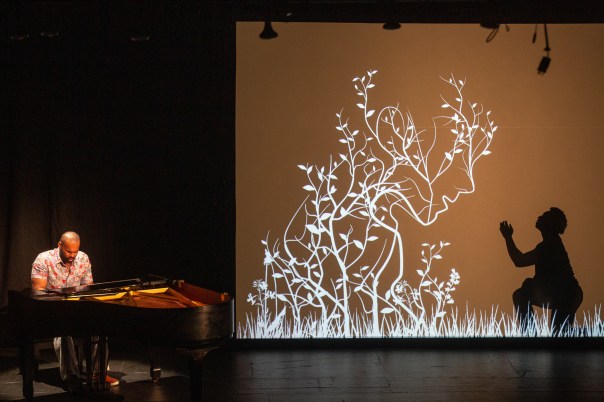
A new venue, the Queen Street Playhouse, was added to the Spoleto portfolio with mixed success. Artistically, A Poet’s Love was a resounding triumph for tenor Jamez McCorkle, powerfully following up his exploits of last season in the title role of Omar by singing Robert Schumann’s Dichterliebe – while accompanying the entire song cycle by himself at the piano. Designer and choreographer Miwa Matreyek made this a completely immersive experience with animated projections, shadow puppetry, and the movement she designed for Jah’Mar Coakley.

But the staging was badly bungled. Once McCorkle sat himself behind the Steinway, I never saw more of him than his scalp from my second-row seat. Fortunately, Matreyek and Coakley combined on a magnificent performance I didn’t miss.

After a rather bizarre foray at Festival Hall (formerly Memminger Auditorium) for his first Music in Time concert, Kennedy made better use of Queen Street Playhouse for Sanctum, a wild collection of contemporary pieces, concluding with the 2020 work by Courtney Bryan that gave the program its title.

That piece was decisively upstaged by Everything Else, a 2016 composition that I will likely never forget. For this novelty, 15 members of the Spoleto Festival USA Orchestra laid aside their instruments and drove the everyday concept of music to new frontiers most of us had never pondered before. One musician sat with a newspaper, turning the pages at leisurely intervals, another put on a jacket and zipped it up, three of the women passed around and munched a bag of chips, and another tapped obsessively on the keyboard of a laptop while, across the stage, another blew bubbles.

All of this low-volume action – and a multitude of louder acts – continued simultaneously. There were pennywhistles, a kazoo, somebody blowing on the rim of a bottle, two guys slapping cards down on a table in a game of war, and balloons blown up, shaped, and worn as comical crowns. Of course, there was the obligatory popping of balloons near a woman who insouciantly demonstrated how many different things can be done with a bottle of water without hardly making a sound.

Kennedy had seated himself with us in the audience so he could join us. Yet every musician onstage seemed to know exactly what to do onstage, when exactly it was time to launch into a new action, and when exactly to initiate interactions with other musicians. Anyone who thought about it had to wonder how such a multifarious sea of chaos could be taught, rehearsed, and performed – so precisely that the entire ensemble, without a conductor in front of them, stopped at the same instant.

I still can’t decide whether or not I wish to know.