The Blumeys Turn 5, Loud and Spirited as Ever

IMG_0062

By Perry Tannenbaum

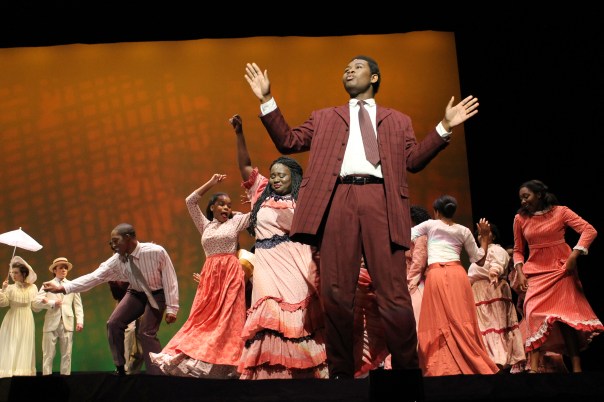
I suppose that I should begin by saying that Central Academy of Technology and Arts swept the top trophies last Sunday evening at the 5th Annual Blumey Awards. Their production of Ragtime won the Wells Fargo Best Musical for high-budget productions, and the show earned two of its stars tickets to New York for the Jimmy Awards, which recognize, mentor, and present the top high school performers in the nation in fine Broadway style. Our reps up in the Big Apple on June 27 will be Justin Rivers, who was Coalhouse Walker, and Amina Faye, who was his wife Sarah.

And hey, if you didn’t know, Central Academy of Technology and Arts is in Monroe.

Even if you were at the live ceremonies in Belk Theater, you might have assumed that Central Academy was a Charlotte school: the partisan screaming for them when they performed the “Prologue” from Ragtime was that loud. The almost universal standing ovation they drew validated it.

But Central wasn’t the only finalist from out of town to bring spirit, excitement, and enthusiasm at high decibels. Nation Ford High brought their “Under the Sea” sampling of The Little Mermaid from down in Fort Mill. Butler High, presenting “Brotherhood of Man” from How to Succeed in Business Without Really Trying, rode in from Matthews. And cfa Academy, singing the dum-diddle-eyes of “Supercalifragilisticexpialidocious” from Mary Poppins, hailed from Concord.

Their parents, teachers, and schoolmates were as loudly supportive as the winners’. Nor did these faraway schools go away empty-handed. Butler High’s Rickey-Levon Burch II was Best Featured Performer, and cfa took home top honors for Best Choreography, Best Set Construction, and Best Tier 1 Musical (budget under $10K). Other out-of-towners who were gleeful on their rides home were Hickory Ridge High from Harrisburg for Best Costume Creation (A Funny Thing Happened on the Way to the Forum) and Libby Hatfield, from Arborbrook Christian Academy in Matthews, who took the Best Supporting Actress laurels (You’re a Good Man, Charley Brown).

Oh, and Central Academy added to their haul of trophies with Best Overall Direction honors.

Charlotte high schools had less to cheer about. Ethan Holtzman’s yeoman work as the Pirate King in The Pirates of Penzance brought the glory of Best Supporting Actor to Charlotte Latin School, and Ardrey Kell High won a pair of prizes, for Best Ensemble/Chorus and Best Student Orchestra (Mary Poppins).

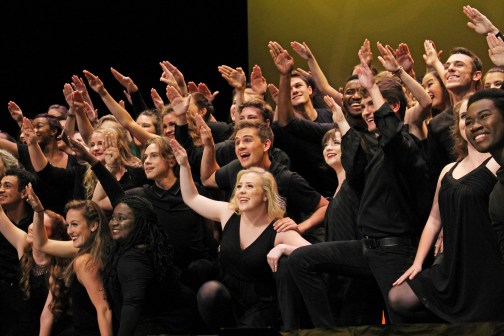
Yet cheer they certainly did. All 43 of the competing schools were involved in the opening number and the finale, with two representatives from each school plus the Best Actor/Actress and Best Supporting Actor/Actress nominees. When they sang “We’re on the Air” to kick off the ceremonies and “Don’t Be Surprised” to conclude them, the cheering was so loud that you couldn’t really hear the 19-piece Blumey Awards Orchestra or the nearly 100 voices onstage.

IMG_9600_dcoston

Either you bask in this pandemonium or add to it. As you’d expect, jolts of the same electricity came when ensembles performed and winners were announced – but partisans also punctuated the evening with raucous cheers almost every time a nominee’s name flashed onto the huge projection screen over the Belk stage. I’ve witnessed similar outbursts at the defunct Metrolina Theatre Awards and when Creative Loafing’s Charlotte Theatre Awards were briefly a live event.

Multiply that by about 25 and you’ll get the idea of how big and how electric the Blumey Awards have become. You can get a taste of it next month: WTVI jumped aboard this year, their Amy Burkett co-hosting with WBT’s Maureen O’Boyle, and the PBS affiliate will rebroadcast the whole shebang on June 14 at 8pm.

Concentrating on the Belk stage and hall, WTVI may not capture the full impact of the live event. As a judge for both the MTA and CL Awards, I found that the presentation ceremonies had an Oscar Night vibe, with folks I’d normally bump into – or review – at local theaters all dressed-up and in their sophisticated red-carpet mode. There was a lot of that at Belk Theater last Sunday – just three weeks before the Tony Awards, after all. But with those special infusions of high school pep, hormonal frenzy, and hysteria, the Blumeys are more like Oscar Night and Prom Night rolled into one.

Forgot to mention: These kids have talent to burn. You’ll discover that in the rebroadcast.

A Mad Tea Party at the Frock Shop

Theatre Review: Much Ado About Nothing

By Perry Tannenbaum

Much Ado1For a second straight spring, PaperHouse Theatre is using the Frock Shop on Central Avenue as a backdrop for an English comedy, but you can be sure that this year’s Much Ado About Nothing is far more freewheeling and lighthearted than last year’s A Woman of No Importance. Oscar Wilde’s work was about class, privilege, loyalty, and ideals, while Shakespeare’s is very much about misconceptions and manipulation.

Last June, the prissiness of Frock Shop and its charming hominess were upheld in the Victorian finery worn by the cast. Now as we arrive at June 2016, we can observe that formality has been largely relaxed, the better for all the cast to not only change costumes but also to change characters. Even the saltiest and wittiest of the lovebirds, Beatrice and Benedick, get to moonlight as buffoons. Hero and Claudio, the more ardent and tedious couple, also get in their comic licks, Hero working for her own destruction as Borachio, a sleazy stoner, and Claudio crossdressing as Ursula, Hero’s maidservant.

Nicia Carla adds deftly to the lightheartedness of the comedy in her first attempt at directing a Shakespearean script. Both the cuts she has applied to the script and the clarity that survives despite those hefty splices testify that she’s quite good at it. Several of the players on hand have experience with the Bard, and it shows.

The barbs Beatrice and Benedick exchange in Much Ado hearken back to the strife between Kate and Petruchio in The Taming of the Shrew, while the malicious scheming against Claudio prefigures the work of Iago in Othello and Edmund, the bastard noble in King Lear. So when Carla lightens the comedy, there’s a risk of diluting the drama. Yet the church scene where the wedding goes awry is one of the best of the evening.

Whether benign or virulent, manipulation is hard to pull off perfectly. In Much Ado, both plots are unmasked, but there are provocative contrasts in how each is resolved. Order is restored as the plot against Beatrice and Benedick exposes the love that both were hiding deep within – lingering from a liaison that had been broken off before the action begins, before Benedick marched off into battle. But the haze of the catastrophe that could have been hovers over the happy resolution of the deception practiced upon Claudio.

In the PaperHouse production, that darkness adds poignancy to the ultimate happiness Claudio and Hero achieve. After bringing so much youth and vitality to Annie Sullivan at Theatre Charlotte back in March, Sarah Woldum is softer and shyer as Hero with the same lurking buoyancy of youth, and it’s hard to believe that Deven Ginyard is a college freshman playing Claudio – unless we assume he has taken about seven gap years after high school.

Much Ado2

Chester Shepherd was at the heart of the success of last year’s Woman of No Importance when he was paired with Katy Shepherd. Now Shepherd is fencing with Alexandria White, whom I previously encountered last June as a glamorous gallery of discards in The Picture of Dorian Gray. Yet I can’t say these Shakespearean lovebirds are noticeably less wholesome than the romantic fledglings we followed around The Frock Shop last June when PaperHouse also tackled Wilde.

Curiously, the jousting lovers’ lack of sharpness doesn’t throw this Much Ado off-kilter because of all the zaniness that Carla strews around them. Andrea King and Shawna Pledger are the chief perpetrators of the low comedy, King as a Dogberry who’ll remind you of a backwoods highway trooper and Pledger in a trio of crossdressing roles, recycling the same crappy hair scrap as The Friar’s eyebrows and Don John’s mustache. Or vice versa? The thing just hangs like a sorry backwards necklace when not in use.

As I’ve mentioned, the lovers also moonlight as lowlifes. Woldum gets the juiciest opportunities when she crossdresses as Borachio, but Ginyard’s matronly bustle as Ursula is also a hoot. King upstages them all when she must appear simultaneously as both her characters, Hero’s father Leonato and the bumbling Dogberry. On these occasions, King produces a Dogberry puppet and converses with herself. Not great puppetry, but it is great fun.

Adding to the merriment, PaperHouse serves up tea, hot and soft beverages, and finger foods at various intervals before and during the show. A Pavlovian bell signals those times when you’ll move among the downstairs rooms during the production as well as the front porch, lawn, and rear parking lot. All in all, a pretty mad tea party.


Festival Singers Tune Up for Charleston With a Lively, Mostly Modern “Elements” Concert

By Perry Tannenbaum

Most music lovers would probably be bracing themselves at the prospect of sitting through a classical concert of 10 pieces if they were told that nine of them would be by composers born since 1939. But modern choral music isn’t at all the atonal, minimalist minefield we’ve come to dread in the instrumental and electronic repertoire by contemporary composers. So after “Fire, Fire” by Thomas Morley (1557-1602) opened the “Elements: Earth, Water, Air & Fire” concert by the Carolina Voices’ Festival Singers, the pieces that followed weren’t a plunge into the abyss.


Performed at St. John’s Baptist Church, the concert also skirted undue formality thanks to director Donna Hill’s affable introductions and her resourceful staging. Donna Clark accompanied the Singers on most of the selections from the keyboard, but Hill was also open to support from percussionist Stephanie Wilson and soprano saxophonist John Alexander. The acoustic at St. John’s is not at all like an echo chamber, further preventing a mood of sanctified solemnity from setting in.

With the Singers deployed to the sides of the hall, flanking the audience, “Fire, Fire” was a lot to take in with its five different parts and its cascades of fa-la-la’s. Frankly, I never penetrated the dense foliage of voices to the clearing where an antique rhyme – “I sit and cry me, and call for help. Alas, but none comes nigh me” – was running in continuous overlapping loops. Eventually, the framing fa-la-la’s consoled me that I hadn’t missed much verbally, and I simply luxuriated in the effervescence of this polyphonic madrigal.

The choristers then gathered at the front of the sanctuary to sing David L. Brunner’s far more decipherable “Song of the Earth Spirit.” The lyrics are more of a chant than a poem, written by Stephen C. Jett, a specialist in Navajo culture from the point of view of the Earth Spirit. As you might surmise from its refrain, “It is lovely indeed,” the song’s harmonies are soothing. There was a whiff of inchoate chromaticism toward the end when the Singers lingered on the word “lovely,” all the more satisfying when the final repetitions of the word resolved into a sunny major.

Title #1

Both of the pieces on the program by Eric Whitacre were set to poems by Octavio Paz, but in “Water Night,” he worked with a beautiful translation by Muriel Rukeyser, though the lyric was still occasionally difficult to decipher. A more echoey acoustic would have slurred the lyrics even more, but it would also have enhanced the sense of misty moonlit night that the composer was seeking. The other Whitacre work, “Cloudburst,” was clearly the showpiece of the concert, employing handbells and percussion along with an assortment of finger snaps, handclaps, and thigh slaps. Hill brought the Singers up front, nearer to the audience, as she introduced the piece as a “celebration of unleashed kinetic energy.”

Although the lyrics were printed in the program with a translation, Hill had one of her choristers read them to us to sample the sound before the singing began. The performance was very much about sound from its opening words, “La lluvia,” as the choir sounded like the rain they were singing about. A strangely soothing meditation preceded the grander storm, which was foreshadowed by the tingling of the bells and a whoosh of brushed cymbals. Then the full fury was let loose by a large kettledrum, a thunder sheet, fortissimo singing, and the various body sounds generated by hands, fingers, and thighs. Adding to the wonder of this spectacle was the realization that the Singers had to abandon their scores and memorize this piece before they could adequately perform it.

Stephen Paulus was the second composer on the program to celebrate fire with his “Hymn to the Eternal Flame,” though its incantatory lyric more closely echoed the spirit of Brunner’s earth song. I’m not absolutely sure which of the elements James Kevin Gray’s “My Gift” celebrated, but since Gray is a minister at St. John’s, he was present to introduce his song along with the recipient of the “Gift,” his wife Alison, who was sitting by his side. The lyric is rather touching, voicing the composer’s feeling that only the gold of the moonlight would be a fitting gift for his beloved – yet he can only truly give himself. After the ardor and atmosphere Gray evoked here, he might consider moving on to Matthew Arnold’s “Dover Beach.”

Having just turned 38, Ola Gjeilo was the youngest composer on the program, represented in two titles. The first of these, “Tundra,” has an English lyric by Charles Anthony Silvestri that was inspired by photos of Gjeilo’s native Norway. While the poem is about earth and sky, it was written exclusively for women’s voices, so I rarely understood the earthly and skyey words that had bounced back to Gjeilo. Heavenly sounds definitely predominated in the stratosphere of the vocal haze he composed.

The words of Gjeilo’s “The Ground” proved to be more intelligible as the full chorus performed them – and understandable for anyone already familiar with the liturgical Latin. The opening verses of “Osanna” praise and “Benedictus” thanks were sweet and pleasant, but the “Agnus Dei” passages were striking, as powerful when the Festival Singers sang them as any “Lamb of God” setting I’ve ever encountered.

The remainder of the concert was given over to choral settings of familiar African American spirituals, first an Anders Paulsson arrangement of “Deep River.” Already rich in feeling, the performance was enhanced by Alexander’s solos on soprano saxophone. When the ensemble came forward a second time for the concluding “Wade in de Water” arranged by Allen Koepke, they brought their scores with them – mostly looseleaf notebooks but also a couple of iPads.

After the formidable “Ground” by Gjeilo, this finale was not at all anticlimactic, for it burst with celebratory energy and came adorned with finger snaps and foot stomps. The Festival Singers were alert and precise throughout their program, a worthy tune-up for their upcoming concert in Charleston. As you may know, the name of this chamber choir isn’t accidental, for they have sung at the Piccolo Spoleto Festival on 27 occasions. They will reprise their “Elements” program for their 28th appearance in Charleston on May 29 at 2pm at the Bethel United Methodist Church.

Charlotte Symphony Spotlights the Balcony in “Romeo and Juliet” Tribute

et-romeo-juliet-maria-kochetkova-joan-boada-end_1000

By Perry Tannenbaum

May 20, 2016, Charlotte, NC – A distinguished scholar who taught my undergrad Shakespeare course once told us that a precious folio edition of the Bard’s plays was on display at one of England’s most prestigious libraries, available to all to peruse, and that the most well-worn page in the whole book – by far – was the balcony scene from Romeo and Juliet. “Rightly so,” she added after a brief pause, defusing my presumption that she was about to sneer at popular taste. Charlotte Symphony Orchestra musical director Christopher Warren-Green might very well agree with my professor’s sentiments, for at the latest KnightSounds concert, he programmed that scene twice in succession, underscoring the fact that we still haven’t tired of that balcony 400 years after Shakespeare’s death.

Helping the demonstration at Knight Theater were emissaries from UNC Charlotte’s Theatre Department and Charlotte Ballet. Charlotte-based soprano Melinda Whittington helped to similarly double-underline the appeal of two other prime Juliet moments. So in the space of a mere 70 minutes, 50 less than the “two hours’ traffic of our stage” promised in the tragedy’s prologue, we not only had orchestral and operatic works inspired by Shakespeare’s first great tragedy, we had the lovers themselves speaking the lines of their most memorable scenes.

Tchaikovsky, Gounod, Prokofiev, and Nino Rota all took their cues from the blank verse and rhymed couplets in different ways. Of course, Tchaikovsky’s famed Fantasy-Overture wasn’t written for any specific production of Romeo and Juliet. With three fully developed themes for Friar Lawrence, the Montague-Capulet strife, and the R&J romance, the flavor of the piece is more like a Liszt tone poem than a true overture. About half the size of a Tchaikovsky symphony, the KnightSounds performance quickly offered us opportunities to savor the work of the clarinets, the double basses, the violins, the French horns, the cellos, the flutes, and harpist Andrea Mumm.

At the same time, the performance was streamed outdoors to the plaza at the nearby plaza on the Levine Avenue of Arts, and the screen hovering above the Knight Theater stage gave us the pleasure of seeing what the outdoor audience saw with the added thrill of the live sound. There were more than enough cameras deftly at work to prove that this video production had been nearly as meticulously rehearsed as the music. We didn’t cut to the French horns or the cellos in the early going, and the cameras later settled on the second violins too late and missed English hornist Terry Maskin entirely. Yet overall, direction was quite polished.

Romeo & Juliet 'Plazacast' Closes KnightSounds Sitting toward the front of the orchestra, I found that the cameras consistently revealed who was playing upstage when the musicians in front of them blocked my sightline. My fears of being overwhelmed by the sheer loudness of the orchestra were also allayed: the acoustic shell that graces the Knight stage gathers in the orchestral sound while still allowing it to breathe. This was different from the old school presentation that the CSO brought us of the Fantasy-Overture at Belk Theater in 2011, and while there was little to prefer musically at either performance, I have to say that the camera work lifted the current experience above the one I praised five years ago, enriching what I saw and heard then with occasional close-ups of Warren-Green’s expressions.

I had little hopes for the UNC Charlotte segments of the evening, with Jennifer Huddleston appearing as Juliet and Sammy Hajmahmoud as Romeo. When their stage director, Professor Andrew Hartley, appeared onstage to recite Shakespeare’s prologue, he didn’t exactly fire up my hopes. Nor was I initially impressed with Hajmahmoud when he initially came onstage to launch the party scene where the masked Romeo first meets Juliet. But Huddleston was pure luminosity as Juliet, instantly proving the advantage of casting the role as youthfully as possible. The glow of her performance magically turned Hajmahmoud’s halting awkwardnesses into virtues and he gradually relaxed into Romeo, further igniting their chemistry. Together they grew irresistibly charming, somewhat upstaging their elders when they followed.

13263907_1718667768397005_7712306438347482717_nAfter Huddleston, Whittington seemed woefully mature as Juliette singing the bubbly “Je veux vivre” from Gounod’s opera. The costume she wore was comparatively formal and neither the suppleness of her coloratura nor the lightness of her tone matched what we hear from elite sopranos in this showpiece. But she returned later in the concert and absolutely scorched Juliette’s “Potion Aria,” demonstrating the power that opera can add to turbulent moments of indecision. Huddleston and Hajmahmoud do all the potions and suicides as well, but their most glorious moments – and Hartley’s as well – come when they do the balcony scene.

Romeo initiates the scene onstage, but a spotlight cues us to the likelihood that Juliet will appear in the box seat section of the Knight’s balcony. It’s absolutely sublime when she does. Part of the magic is sculptural, after all, for the moonlit Juliet is not only more divine at a height, Romeo is more ardent and worshipful below her with his upward gaze. Hartley played around with the usual blocking and Romeo’s climbing up and down, but somehow he contrived to have Juliet down at the orchestra level and onstage for the latter half of the scene and its exquisite farewells.

The “Balcony Scene Pas de Deux” from Prokofiev’s ballet score had to follow this sublimity, and the presence of two eminent Charlotte Ballet principals, Josh Hall and Alexandra Ball, helped to ease the descent. Hall and Ball were so impressive, in fact, that I fairly well ignored Prokofiev’s music and the excellence of the orchestra. But as majestic as the lifts were – Ball’s hands as she rises have a musicality that most ballerinas can only envy – the sculptural advantages of the theatrical staging we had just seen were surrendered, along with Hajmahmoud’s touching awkwardness and Huddleston’s youth. An impossibly acrobatic final kiss partially compensated for those missing elements

After the stunning sequence of balcony scenes and potion scenes, the concert grew more somber with Rota’s “Romeo and Juliet: A Renaissance Timepiece” and Hartley’s pronouncement of the tragedy’s concluding lines. Until I heard CSO’s performance, I’d assumed that the Rota melody most familiar to me was his “Theme from The Godfather.” As often as I’ve heard that tune over the years, I wouldn’t be surprised if I’d heard Rota’s Romeo and Juliet melody even more often. The familiar melody nestles nicely in a composition that has more to offer, with some gorgeous work from Mumm, oboist Hollis Ulaky, and flutists Amy Orsinger Whitehead and Erica Cice.

An evening that I expected to be pleasantly light and superficial turned out to be rich and deeply satisfying. Programs were in the funky style that usually characterizes the KnightSounds series, but they are augmented by the Charlotte Symphony app that can be downloaded to your smartphone. You can get bios of the featured professionals from this app as you ease into your seat – it’s general admission, so early arrival can be recommended. While I couldn’t confirm my suspicion that Charlotte Ballet artistic director Jean-Pierre Bonnefoux was the choreographer, the app did supply translations of the Gounod arias.

Charlotte Symphony ends its classics season seductively

Review of Carmina Burana

By Perry Tannenbaum

When the Charlotte Symphony Chorus was known as the Oratorio Singers of Charlotte, they hooked up on numerous occasions with the Charlotte Symphony Orchestra in the most popular piece in the classical repertoire, Beethoven’s Symphony No. 9. More often than not, those collaborations would happen at the end of a season – or even at the end of a music director’s tenure with the company.

Sure, it’s as important to end your season with a bang as it is to start that way, for it’s your last shot at convincing fence-sitting newbies in the hall – as well as existing subscribers who haven’t yet renewed – to pony up for next season’s concerts. But you can’t trot out the “Choral Symphony” every year, can you? Lately, the CSO has found another winning warhorse in their stable, Carl Orff’s Carmina Burana.

Last week’s trio of Carmina concerts marked the third time in the past eight years that Symphony programmed Orff’s settings of mostly Latin poems. Not one of these poems, dating back to the 11th-13th centuries, has the chaste plainsong flavor of the church or Christianity, except perhaps for the most famous – and fearsome – “O Fortuna.” The worship of Fortune and her wheel surfaces in the works of Chaucer and lingers on in the tragedies of Shakespeare, a medieval oddity if ever there was one. Orff’s music restores its primal, superstitious force.

Lawrence Zazzo

But you need to hear it and see it live to get the full power that movie scores, CD recordings, and TV commercials only hint at. Some of the 24 songs are bawdy, others lyrical, some sensuous, and still others festive and carousing, as the section names suggest: “Springtime,” “In the Tavern,” and “The Court of Love.” The weirdest of the songs, “Olim Lacus Colueram” (“Once I Dwelt in the Lakes”), always sounded Oriental to me when I was growing up, listening to my dad’s vintage vinyl. I never suspected that the narrator was a swan getting roasted on a rotisserie!

Delaying his entrance onto the Belk Theater until this song began, countertenor Lawrence Zazzo literally made a meal out of it. Emitting a high-pitched lament bordering on sobs, Zazzo compounded the weirdness of his torment in way I would never have anticipated. As he reached the song’s final stanza, beginning “Now I am lying in a serving dish,” he pulled out a large handkerchief. Instead of dabbing his wounds or his tears, he stuffed the handkerchief into his shirt collar, turning it into a napkin. Then he reached into another pocket, fetched out what must have been a succulent duck leg, and began munching on it contentedly as he made his exit.

Hard to top that little cameo. But I’d say that Javier Arrey, shouldering most of the solo chores, was the best baritone we’ve had here in Carmina – and his alcoholic Abbot of Cockaigne wasn’t altogether anticlimactic in the wake of Zazzo’s roast duck. I wasn’t especially wowed by soprano Klara Ek’s initial efforts, but when she reached “In Trutina” (“My Feelings Alternate”) and its wavering between chastity and erotic enslavement, she was sublime.

Clocking in at slightly more than an hour, CSO’s Classics Series finale was more like a KnightSounds event at Knight Theater. Indeed, the last time Symphony and Chorus combined on Carmina in 2012, it was a KnightSounds event. At the Belk, when Christof Perick last conducted Carmina in 2008, the program was fortified with a Mozart Violin Concerto served up as an appetizer.

Marketing was also cleverer. After crowning her performance of “Dulcissime” with an orgasmic “Ah!” that topped all the hedonism we had heard before, soprano Heidi Meier didn’t simply vanish into history. Nope, she had already been announced as a guest performer for the season to follow.

That’s not to say that the audience was let down by the relative scarcity of music and promotional tie-in. When I heard various people in the grand tier humming “O Fortuna” as we exited to the lobby – or singing that Latin out loud – I sensed total satisfaction in the air.

Still Creepy and Kooky

Theater Review: The Addams Family at Theatre Charlotte

The Addams Family runs through May 29 at Theatre Charlotte.

By Perry Tannenbaum

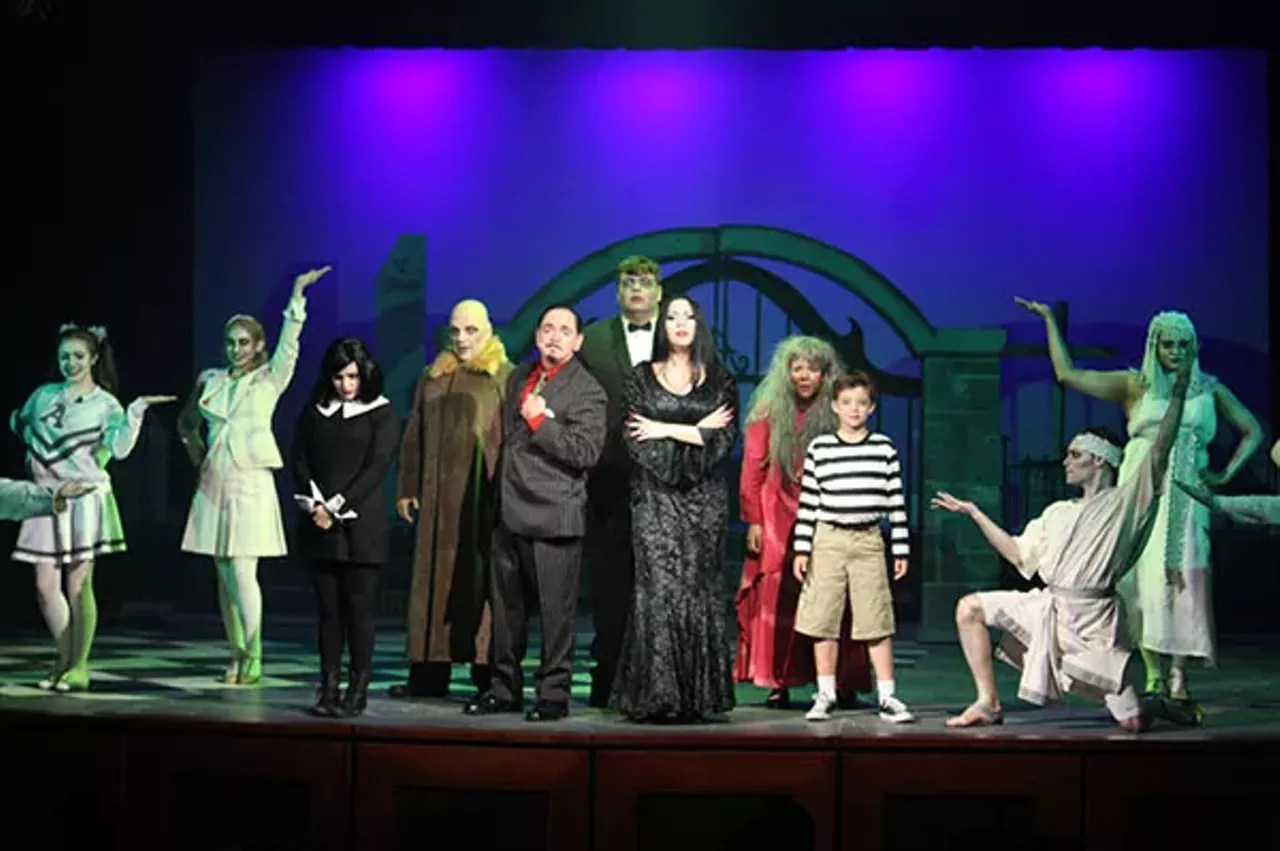
Gloomy lighting and cobwebs. Raging thunderstorms and decrepit dungeons. The whole Gothic horror thing, on screen or onstage, is a carnival of special effects — the bizarre compounded by the supernatural. Vampires, ghosts, werewolves, and monsters don’t often wear jeans and T-shirts. Costumers, wigmakers, prosthetic manufacturers, and makeup artists work overtime to get the right look. Buckets of blood must spew on cue, get mopped up, and spew again for the next take.

Even though fangs and gore aren’t factors in The Addams Family, there was sufficient tech wizardry in the 2010 Broadway musical to give Theatre Charlotte pause. Past springtime hits at the Queens Road barn like Rent, Hair, and Jesus Christ Superstar haven’t required fog, fangs, or extensive set changes. As we reported back in 2011 when Charlotte was the third city it visited, the national Addams Family tour cut back significantly on the tech pizzazz because it was so daunting. On Broadway, the curtain was so active, talented, and amusing that a Tony nomination wouldn’t have surprised me.

There’s a vestige of that precocity before the curtains part, but don’t expect it to last. On opening night, the raging storm that sound designer Erik Christensen concocted to assail the Addams mansion was mighty enough, but it inexplicably subsided in a matter of seconds. Morticia’s flaming red tango skirt peeped through her funereal black evening gown at least a minute too early, spoiling the surprise. And the apple that Wednesday Addams was destined to split with her crossbow on her fiance’s head fell apart when Lucas Beineke first brought it in from the wings, half of it popping hilariously into the first row of the orchestra.

Perhaps because the script by Marshall Brickman and Rick Elice seemed more akin to the Addams Family sitcom on TV than the darkly comical Charles Addams cartoons in the pages of The New Yorker, the musical drew no more respect from New York critics than its Mel Brooks cousin, Young Frankenstein. That lack of critical cachet may explain why there are so many relatively unfamiliar names in the cast. Rest assured, the uptick in no-shows at Addams auditions hasn’t been replicated at the box office. Locals filled the house pretty well for the opening and brought plenty of enthusiasm with them. Throughout the hall, finger snaps came resoundingly on cue during the overture.

Audience enthusiasm is the main thing stage director Jill Bloede, music director Zachary Tarlton, choreographer Lisa Blanton and the title characters keep going, earning almost every bit of the fervor with their high energy. With a storyline that echoes You Can’t Take It With You, the Addams family has a license to be every bit as weird as George S. Kaufman’s Sycamores. Each of these families has a mutant daughter who wishes to couple with a normal person, each of the daughters’ beaus has parents who are conspicuously boring and respectable, and each of the hosts launches a game at the dinner table that causes the guests to reveal a deep-set fissure in their marriage.

Wednesday is the new wrinkle in the old formula, which most recently recurred on Queens Road in La Cage aux Folles. This mutant child is not as normal and wholesome as previous defectors who fled their kooky coops. No, our rockin’ culture has overtaken the Addamses to the extent that Goths like them have established themselves on the fringes of high school life. Only those who enter the hall with black lipstick will fully recognize Wednesday as a kindred spirit. Yet the crossbow keeps her securely outré for everyone.

As a result, Wednesday can rock when the whole William Tell scene circuitously makes its point in the “Crazier Than You” duet. This role is not at all as humdrum as Alice Sycamore, and Emily Roy takes full advantage of Wednesday’s weird glamor. Standing next to Morticia, Roy looks puritanical and punkishly pugnacious at the same time — and she can definitely belt her half of the duets. In his debut, Christian Regan is noticeably underpowered as Lucas the apple-bobbler, but his shortcomings are poignantly effective. After all, he and his family hail from Ohio.

“A swing state!” is how the horrified Gomez describes the unfathomable gulf. But you look at how sloppily Lucas is dressed and you already see that he is more than meeting Wednesday halfway. Regan talks his talk far better than he sings it.

Challenged by Blanton’s choreography and a Morticia decades younger than he is, Kevin Roberge surpasses himself as Gomez, even if he is visibly panting at the finish line. He may not have the essence of this unctuous patriarch as thoroughly as Nathan Lane did on Broadway, but he has the Gomez sound perfectly, and there is such fatherly pathos when Roberge sings “Happy/Sad” in Act 2 that the power of it took me by surprise. Followed by “Crazier Than You” before Gomez teams up with Morticia for “Tango de Amor,” the hits do keep coming as Roberge gasps for breath.

Nor is Aubrey Young less than breathtaking as the preternaturally tensile Morticia, though her dress is disappointingly less revealing than Bebe Neuwirth’s was on Broadway. Young is also less Zombie-like than Neuwirth, further altering the icy marital chemistry. Ah, but when Morticia pines for the sewers of Paris, Young is just as wry. I was every bit as impatient as the red skirt for the tango to begin, and when Young stretched herself into its most extreme choreography, her youth provided ample rewards.

With the Addamses’ pet squid axed from the script, Mal Beineke is no longer the sort of role that would warrant Terrence Mann’s bravura. Instead of being asked to sing the bodacious “In the Arms of a Squid” in the Act 2 denouement, Jonathan McDonald merely piggybacks onto the “Crazier Than You” duet playing Mal with Jenn Grabenstetter as Alice Beineke. There is no diminution of the éclat Grabenstetter is allowed to make in Act 1 after Alice drinks the misdirected potion in the “Full Disclosure” game. She’s a pure undersexed animal in the “Waiting” showstopper.

Delicacies are doled out deeper into the cast. After stomping around inarticulately on platform shoes for nearly the entire evening, Johnny Hohenstein makes good on his liberation as the family’s Zombie butler Lurch. And who could possibly have a more ardent crush on the moon than Vito Abate as Uncle Fester? Abate was simply born for this role and the epic passion of “The Moon and Me.” The lightbulb prop he messes with was still a work-in-progress on opening night, but his rocket backpack was pure bliss.

The wig and costume Vanessa Davis wears as Grandmama and the grimy makeup sported by Jackson Davis as Pugsley, Wednesday’s masochistic little brother, help to make their Theatre Charlotte debuts successful. Up on Broadway, if you were buried in the Addams Ancestors ensemble, you went home with a paycheck. Down here in Charlotte, it’s nice to find that the eight members of our ensemble are individualized in the cast bios with such identifiers as stewardess, baseball player, and Greek.

Make no mistake, there’s plenty of authentic Charles Addams embedded in the script, nowhere more effectively than at the end. What Gomez and Morticia say to one another in the closing dialogue is quoted verbatim from an Addams cartoon. It still worked the third time I heard it.

A High School Queen Drinks Drano

Reviews of Heathers: The Musical and Motherhood Out Loud

IMG_9919

By Perry Tannenbaum

Then the movie first came out in 1989, Heathers was already raunchy enough for an R rating. But after the musical revels of Bat Boy, Spring Awakening, Reefer Madness, and Evil Dead have already pushed the envelope, raunchy in 2016 is an altogether different proposition. Three of the first six songs in the new Queen City Theatre Company production of Heathers: The Musical take us to places where the movie feared to tread.

“Candy Store” is fairly ballsy as the three Heathers — Heather Chandler, Heather McNamara, and Heather Duke — lay down the rules for admission into their elite clique. But it’s Veronica’s “Fight for Me” that tells us ballsy is just the beginning. Newcomer J.D. shows her there’s somebody else to be impressed with at Westerburg High School. Yes, the backup singers are chanting “holy shit, holy shit, holy shit!” Pretty soon, J.D. is encountering Veronica at a 7-Eleven and enticing her with the mind-numbing effects of Slurpees in “Freeze Your Brain,” comparing a deep sip to a hit of cocaine.

IMG_3561

But when “Dead Girl Walking” climaxes, it’s a full-blown copulation song of animalistic force. And unlike the movie, where J.D. is always breaking into Veronica’s bedroom, here it’s Veronica hungering for J.D. and hunting him down. “Shut your mouth,” she commands, “and lose them tighty-whities!”

With Laurence O’Keefe and Kevin Murphy combining on the book, music, and lyrics, Heathers is actually the lovechild of the mischief-makers who had separately brought us Bat Boy and Reefer Madness. Besides Bat Boy, O’Keefe can claim the musicalized Legally Blonde on his résumé, while Murphy was head writer on Desperate Housewives. That should adequately preface my declaration that the musical, which rocked the off-Broadway scene in 2014, outclasses the movie in every way.

The music certainly does rock, and with KC Roberge and Matt Carlson as our leads, it’s rocking harder here in the QC than it does on the original cast album. Directing the show, Glenn T. Griffin steers us quickly away from Glee territory, with Carlson’s highly-amped and punkish read on J.D., a brilliant move when the dreamboat turns out to be a raving psychotic.

But while Veronica mulls over the relative merits of staying in the Heathers’ good graces or killing them off — an ambivalence Roberge sustains earnestly — it isn’t all sex, drugs, and rock. There are three pointed ballads in Act 2, one by a surviving Heather who is contemplating suicide, another by the cruelly shunned Martha Dunnstock (nicknamed Dump Truck) about her halcyon days in kindergarten, and a wistful Veronica-J.D. duet, “Seventeen,” on the charms of being ordinary humdrum high schoolers.

When they aren’t plotting date rape, footballers Ram and Kurt are the clowns you expect jocks to be, but the unexpected jolt of new comedy happens at their funeral when their dads deliver their eulogies. Time after time, J.D.’s acts of homicidal mayhem result in unlikely epiphanies. The Heathers Band, led at the keyboard by Mike Wilkins, gives rousing support to “My Dead Gay Son” and all the other showstoppers, but it’s Tod Kubo’s choreography that pushes the big ensembles over the top.

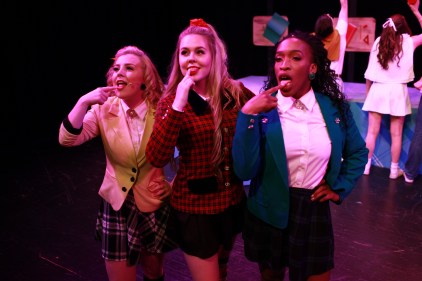
IMG_5097The three Heathers retain their iconic croquet mallets from the film, but costume designers Beth Killion and Ramsey Lyric get Griffin’s drift and take their outfits in a more dominatrix direction. Together in various synced poses, they are sensational — all in major roles for the first time.

Tessa Belongia, a senior at Northwest School of the Arts, has the requisite queen bee regality for Heather Chandler, a bitch that O’Keefe and Murphy just couldn’t bear putting to sleep. She appears just once after J.D. offs her with Drano in the film, but here in the musical, she haunts Veronica repeatedly.

You wonder which Heather will be top dog after Chandler’s demise, and Nonye Obichere proves to be a worthy successor as Duke, not at all the dimwit of the movie but a lingering villainess until the finale.

Ava Smith, who also auditioned for the Blumey Awards last Saturday, was McNamara, the most sensitive of the Heathers, but she doesn’t give away her softness too soon.

Martha is a conflation of two of Veronica’s classmates in the film, making for a more satisfying stage character than either of her film components, and Allison Andrews capitalizes big-time on her anguished moment in the spotlight, “Kindergarten Boyfriend.” Griffin’s casting, Liam Pearce as linebacker Ram and Kaleb Jenkins as quarterback Kurt, cures the Tweedle-Dee and Tweedle-Dum aspect of the film — Pearce is far taller — helping us to feel that Martha is smitten by a real person rather than a generic jock in a school jacket. The horny pals are also a pretty effective comedy team.

Notwithstanding Carlson’s spiked hairdo, there’s a thread of 80’s nostalgia that lingers on. J.D. has this Paleolithic, Oklahoma City notion of destroying his high school by planting remotely controlled dynamite packs throughout the building and setting them off with a detonator hidden down in the basement. Pretty lame compared with today’s hip style of grenades and assault weapons, right?

Adults are all as clueless as we remember from teen films immemorial, if not a bit eccentric. Here they’re interchangeable enough for three elders to play multiple roles. Alyson Lowe is funniest as Ms. Fleming, the hippy-dippy teacher who wants the student body to assemble and ventilate after each murder. Steven Martin and Nathan Crabtree split four Dads between them, but their gay moment at the church funeral is unforgettable — and so very 2016.

Fast Birth Hi-Res-1

What a wonderful idea Susan R. Rose and Joan Stein had for a Mother’s Day theatre event: a group of monologues and brief sketches, mostly by women playwrights, called Motherhood Out Loud. Turns out the brilliance of this idea largely belongs to Three Bone Theatre which staged the Charlotte premiere at McBride & Bonnefoux Center for Dance Studio last weekend. Nearly every other production that came up in my Google search, dating back to Fall 2011, opened during some month other than May.

The timing helped, for some of the 22 stories were sappy, and the five “fugues” that prefaced the five chapters — “Fast Births,” “First Day,” “Sex Talk,” “Stepping Out,” and “Coming Home” — were unnecessary. The best segments were those that confounded expectations.

Although she perpetrated all those fugues, Michele Lowe also wrote “Queen Esther,” narrated by a Jewish mother whose son refuses dress up as any of the customary male characters for his school’s Purim party.

“If We’re Using a Surrogate…,” by Marco Pennette, was a gay father’s account of arranging — and attending — his daughter’s birth, two very awkward meetings with an obliging lesbian. Theresa Rebeck’s “Baby Bird” brought us the experience of an American mother adopting a Chinese baby, and “Michael’s Date,” by Claire LaZebnik, was a mother’s account of chaperoning her autistic son on his first date.Group Hi-Res

Perhaps the most unexpected piece was “Elizabeth,” where a divorced man goes home to his elderly mom and finds that he needs to mother her.

A cast of 18, sensitively directed by Kim Parati, helped us over the rough spots. So did that timing when we came to Jessica Goldberg’s “Stars and Stripes,” about a military mother, and Annie Weisman’s concluding “My Baby,” an unabashed description of the joy and pain of childbirth. No better time for these than Mother’s Day.


Searching for an Italian Iowan

Theatre Review: The Bridges of Madison County

Madison County

By Perry Tannenbaum

The problems with this show really began before the first note. I’ve never read The Bridges of Madison County nor seen the movie that was adapted from Robert James Waller’s bestseller. What I vaguely remembered was that it centered on an Iowa housewife who was beguiled by a charismatic photographer, and that Meryl Streep was that housewife romanced by Clint Eastwood in the movie.

But I never knew she was Italian. So when Elizabeth Stanley began to sing as Francesca in the touring version of the Broadway musical, I only intermittently understood a word that she was saying. None of those words, unfortunately, was Napoli. Albany, Cleveland, and Osceola, yes I understood those, but by then I’d missed the boat.

Even when I caught on to the idea that this Iowa housewife was Italian – and what the target accent was that I needed to decipher – it was of little use when Stanley sang. The James Robert Brown lyrics were hopelessly pureed even though the James Robert Brown music was quite lovely.

I’m not sure I’ve ever seen a touring Broadway show so thoroughly massacred by its leading lady.

On the other hand, Andrew Samonsky was all of the lanky dreamboat you could hope for as Robert, the easygoing National Geographic photographer who bounces around the globe with his camera and tripod, hunting down the perfect light and angle for every scenic subject. When Samonsky says Stanley is beautiful, you can momentarily believe it.

I’d seen Samonsky seven years ago as a moody, racist Lt. Cable in the Broadway revival of South Pacific, and I could see why director Bartlett Sher wanted him back. Now his hair has grown long, the mellow opposite of the tightly wound Cable. Even on Broadway, you rarely hear a voice of such astonishing clarity and power. No struggle at all to get to the core of Robert’s restless, yearning soul.

Noisy kids, snoopy neighbors, and a humdrum husband all circle around the vortex of the great Francesca-Robert passion, swelled to Broadway size in the Marsha Norman book but not really overstuffed. We don’t feel like we’re watching a big Broadway extravaganza at Knight Theater. Scenery by Michael Yeargan has the spare fantasy feel of the dream sequence from Oklahoma, and Brown’s orchestrations have a matching classic simplicity, thinning out at times to a lone piano or even a cello.

So for the music and the soulful Samonsky, the trip to Madison County may be worth it. But before you go, it would be wise to catch hold of Francesca’s lyrics on the cast recording. If your Spotify subscription allows you to punch the lyric tab, that’s the quickest way.

Ballet’s Last Dance Ranges from Grief to Orgy

Dance Review: Charlotte Ballet’s Spring Works

By Perry Tannenbaum

Finishing Jean-Pierre Bonnefoux’s penultimate year as artistic director, Charlotte Ballet served up an evening of Spring Works that carved a graceful arc from sorrow to celebration. Musically, the program could be described as all-American, though sticklers would consider that a stretch. Resident choreographer Sasha Janes’s We Danced Through Life, premiered at Chautauqua last summer, is set to Dvorak’s Symphony No. 9, “From the New World,” written in 1893 while the Czech composer was living in America.

No ambiguity about music that followed. George Balanchine’s Who Cares? was set to a sheaf of Gershwin tunes when it premiered in 1970, pared down to eight selections by associate artistic director Patricia McBride, who introduced three of the original 17 pieces back in the days when she was a star of the New York City Ballet. Capping the evening was the world premiere of Dwight Rhoden’s Bop Doo Wah, danced to eight jazz standards by the likes of Duke Ellington, Billy Strayhorn, Louis Prima, Irving Berlin, and George Benson.

Although Janes scrapped the opening movement of “New World” in condensing it to 20 minutes, he retained a fast-slow-fast (or dense-light-dense) structure by tucking the lovely Largo second movement – and its memorable “Goin’ Home” tune – in between the third movement Molto vivace and the concluding Allegro. That showcased the fearless elegance of Sarah Hayes Harkins in an achingly tender pas de deux with David Morse, along with a move I’d never seen before.

Charlotte Ballet_Sasha Janes_We Danced Through Life_Sarah Hayes Harkins_...[2]

Starting from upstage right and running diagonally toward downstage center, Harkins took one of those leaps that flings a ballerina’s arms and legs out parallel to the floor an instant before a sure-handed guy catches her in midair. But there was no guy standing there to catch Harkins in Janes’s choreography. Instead, two guys somehow overtook her and caught her two arms at the same moment, one under each arm.

Clearly, Harkins and Morse were the tragic couple Janes had in mind as his most pointed evocation of Terrie Valle Hauck, who commissioned the dance at Chautauqua for her late husband Jimmy – particularly at that instant when Morse wasn’t there to catch his partner. But another couple shone in the outer movements, Alessandra Ball James and Josh Hall, amid busier action with four other couples. At the end of one set of lifts, the men didn’t put their partners down on the ground. Instead they maintained their lifts and trotted upstage, placing each woman on her own pedestal.

Well done, Jimmy!

Aside from McBride, James and her pink flapper dress was the living link between this presentation of Who Cares? and the company’s previous revival in 2008. She’s still musical and precise in “The Man I Love,” her duet with Hall, and she’s still youthfully jazzy in “Fascinatin’ Rhythm,” the other piece that McBride originated. There was a tinge of poetry in the title tune, Jamie Dee Clifton’s duet with Hall, and a touch of Fred-and-Ginger sophistication in “Embraceable You,” the Hall-Harkins pairing.

I just felt that this Balanchine was unnecessarily musty compared to the newer pieces bookending it. Couldn’t we get a recording of Hershey Kay’s orchestrations that sounded like they were recorded in stereo, let alone digitally? And the costumes, recreated by Aimee J. Coleman, could stand a refresh. Clifton’s looked like it should have been discarded five washings ago, and Harkins’ – when cutie pie Anna Gerberich danced “My One and Only” eight years ago, it was teal, but now it seemed faded to turquoise.

Yep, it’s challenging to nitpick a Charlotte Ballet program. Everyone is so damn good, but in Rhoden’s Bop Doo Wah, we could lament seeing Addul Manzano, David Morse and Gregory Taylor for the last time. While I wasn’t particularly impressed with his singer, Gloria Reuben (more different in her interpretations than delightful), guitarist Marty Ashby’s jazz band could definitely swing and bop. But come on, man: “Teenie’s Blues,” ostensibly written by trombonist Jay Ashby, had more of Dizzy Gillespie’s “Oop Bop Sh’Bam” than anything else.

Charlotte Ballet_Dwight Rhoden_Bop Doo Wah_Sarah Hayes Harkins_Josh Hall_photo by Jeff Cravotta[10]

That’s why the tune stood up to those that surrounded it, Ellington’s “It Don’t Mean a Thing (If It Ain’t Got That Swing)” and Berlin’s “Steppin’ Out With My Baby.” The piece intensified with Strayhorn’s “Blood Count” as James partnered with Morse and Harkins reconnected with Hall, and “How High the Moon,” one of five pieces set by Rhoden for the full cast of 16, fired up with an alto sax solo that I considered the best of the whole suite.

With James partnering Morse one last time, the full cast turned it up another notch as the women let their hair down for Benson’s “My Latin Brother.” But Rhoden knows the value of turning up the intensity to its fullest when his dancers ought to be nearing exhaustion. That’s what a dance orgy is, and Louis Prima’s classic “Sing, Sing, Sing” was the perfect vehicle to take us there, arranged to evoke the Benny Goodman band’s landmark 1939 invasion of Carnegie Hall – and the legendary set of LPs that emerged from it.

Instrumental solo followed instrumental solo in this epic performance, with the guys, previously clad in punkish black costumes by Christine Darch, adding on matching androgynous skirts as they intensified the furious celebration. Not the way Manzano envisioned ending his career, I’m sure – his was the only farewell performance signaling retirement – but he looked as hot as ever in his valedictory appearance. Darch’s costumes for the women were equally sensuous, but due to the shifting hues of Michael Korsch’s lighting design, I never could determine exactly what three or four deep colors the ladies wore.

Reunited and It Plays So Good

Theater review: Constellations

By Perry Tannenbaum

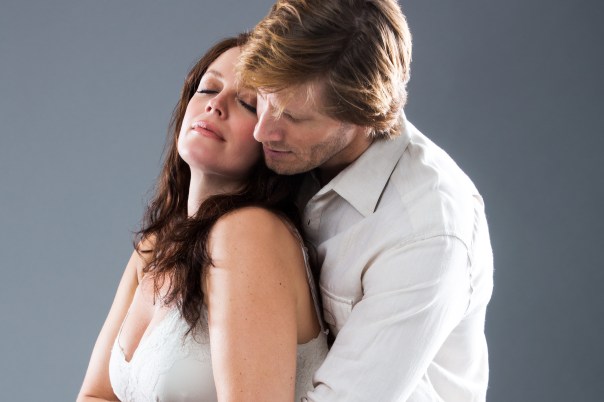
You might say the stars have aligned. Last week, reviewing Fly by Night at Actor’s Theatre of Charlotte, I wrote that the writing team of that musical was playing with the idea that everything that has ever happened was pre-ordained from the moment that the Big Bang birthed the star stuff we are made of. Well, now Nick Payne’s Constellations has opened at the Warehouse PAC in Cornelius, and one of its two protagonists is a Cambridge University cosmologist. At one point, she floats that same idea to her beau.

But Payne is playing differently, more elaborately, with Marianne and Roland, leaning on string theory to present their love story with multiple beginnings and middles, concluding with one last U-turn and never really giving us an ending. Or a simple way to understand what we have witnessed. We could be glimpsing multiple outcomes playing out in multiple universes. But despite the fancy quantum theory, every scene bears a kinship with the “Sure Thing” skit from David Ives’s All in the Timing, where another man and woman play out all the things that can go wrong on a first encounter before the couple clicks.

In this 80-minute show, Payne takes us beyond the first meeting to moving in together, possible infidelities, a breakup, reunion and marriage, and a possible cancer diagnosis. You could say they’ve shared a lifetime as their relationship unfolds in echoing and overlapping vignettes. Yet along the way, Marianne sends out the idea that time doesn’t really exist, loosing the possibility that everything happens simultaneously – and dealing hammer blows to the vaunted dating of the Big Bang (and the title of Ives’s potpourri).

Luckily, such nonsense is refuted by the play itself, which starts out with seeming frivolity as Roland repeatedly misfires with Marianne but grows more and more serious as their shared history develops – whatever we might imagine that to be, since each stage has many variants. Credit director Marla Brown’s finely gauged pacing and her stars, Cynthia Farbman Harris and Michael Harris, for making sure this Constellations evolves so gracefully from cute triviality to profundity.

Often over-the-top and old fashioned when he first turned up in Moving Poets and CAST productions – or more recently as the heavy in Arsenic and Old Lace at Theatre Charlotte – Michael proves once again at the Warehouse (where he shone in Stones in His Pockets four years ago) that he can do intimate and natural just as effectively. Here he’s subdued and awkward enough for us to believe he truly is a humble countrified beekeeper, and the midlife aspects that he brings to Roland texturize his romance rather than twisting it askew.

Married offstage as well as on, the Harrises have obviously benefited from the extra rehearsal time that their protracted proximity enables. Not a single line was bobbled last Saturday night as rain pelted the building. Even in radically different takes of the same scene, Michael and Cynthia managed the paradoxical feat of remaining the same people even if they were different from one blackout to the next. No, there weren’t multiple continuities in their multiple universes, but previous versions of the Roland-Marianne romance couldn’t be altogether discarded as we moved along.

The other benefit of the marriage is Michael’s Brit upbringing, obviously rubbing off onto Cynthia with a very convincing accent. Not a stranger to cold, cocksure roles, Cynthia adroitly mixes the intellectual superiority of a Cambridge cosmologist with Marianne’s vulnerabilities, both in her health and sociability. So there’s rich complexity when Marianne fends Roland off, when she yields to him, and when she drifts into dependency.

Individually, I don’t think either of the Harrises has been better onstage. Together, they’re quite special in a fascinating piece.