Tag Archives: Jamie Dee Clifton

Two Pieces by Sasha Janes Highlight Charlotte Ballet’s Innovative Works

Review Dance: Charlotte Ballet’s Innovative Works and Its Tribute to Jean-Pierre Bonnefoux
By Perry Tannenbaum


Twenty years is a long time in the history of a dance troupe – four or more generations for Charlotte Ballet if you calculate how long the typical dancer remains before moving along or retiring. Charlotte Ballet’s artistic director, Jean-Pierre Bonnefoux, is taking the latter route after 20 seasons at the helm, an era during which excellence was admirably sustained while the organization grew in strength, most notably in its facilities and educational programming. So it was appropriate to dedicate the latest iteration of Innovative Works as a special tribute to Bonnefoux, not only because this annual showcase of new, exciting, and intimate works was his brainchild but because its current home has been the Patricia McBride and Jean-Pierre Bonnefoux Center for Dance since 2011. There’s no better place for Charlotte Ballet to celebrate.

When Bonnefoux first divulged his imminent fadeout to emeritus status a couple of years ago, he told me that he wouldn’t be choreographing any new pieces, although some new wrinkles were evident in the million-dollar makeover of his Nutcracker last fall. There were no surprises in the 2017 crop of Innovative pieces. The in-house feel of the programming still remains intact, all of the choreographers hailing from within the Charlotte Ballet orbit without any unexpected debuts.

The program began and ended with pieces by associate artistic director (and resident choreographer) Sasha Janes, whose pieces continue to grow more intriguing every year. In between, there were works by Mark Diamond, director of Charlotte Ballet II, Sarah Hayes Harkins, a longtime principal in the company, and David Ingram, a fondly-remembered alum. Continuing the tradition of recent years, each of these choreographers cut an intro that was projected on the side walls of the McBride-Bonnefoux studio before each dance began. Since Janes’ “Hallejujah” was a reprise from last year, Bonnefoux took the opportunity of subbing for Janes, reflecting back on his Innovative series while introducing a piece that was well worth its revival.
170126-peterzay48-web

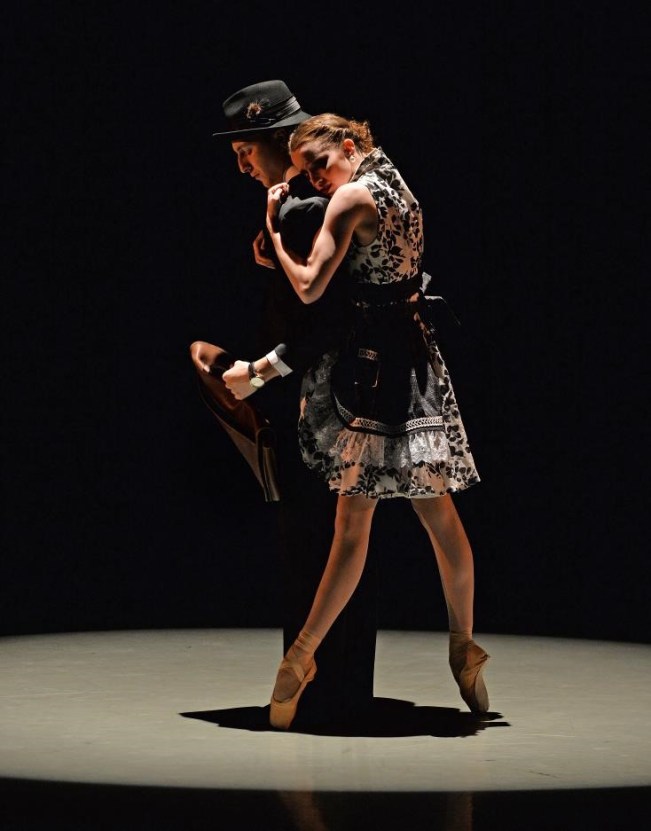
Opening the program, Janes’ “Utopia” was a startling piece to come from a man who spent his formative years in Australia, born more than a decade after the songs on his playlist – by The Platters, Link Wray, Patience & Prudence, and The Teddy Bears – found their way to jukeboxes on 45 rpm discs. The Aussie’s erudition with The Platters is particularly impressive in his sardonic look at 1950’s American domesticity, where everything wasn’t the Father Knows Best bliss that Eisenhower voters would have us recall. “No Matter What You Are,” the song that bookends Janes’ piece, isn’t at all among The Platters’ greatest hits. For over a half century, it has been hidden in plain view on the flipside of “Smoke Gets in Your Eyes” – a clever hint that we’re watching the flipside of the Ike Era. With Elizabeth Truell as the Wife and Josh Hall as the Husband, we watch the typical morning scene of seeing the family breadwinner off to work. Only there was some visible desperation from Truell as she clung to her husband, handing him his hat and briefcase, the devoted housewife gone slightly berserk. Hall was visibly impatient and eager to go, irritated with all the affectionate blandishments, but as we adjourned to his office with “The Great Pretender” (The Platters’ breakthrough hit), we could see that the Husband was suffering from frustrations – and neuroses – of his own.

170126-peterzay150-web-1024x774

Enter Jamie Dee Clifton as the Secretary, to the beat – and power chords – of Wray’s “Rumble.” Her attempts at seduction got a far more welcome reception from the Husband, though there were definitely some signs of distress as he absorbed the vamping. Yet with Patience and Prudence’s “Tonight You Belong to Me,” there could be no doubting Secretary’s conquest, though the necking session was interrupted by a phone call from the patiently waiting Wife back home. Truell’s ensuing solo, begun on the couch of her Psychiatrist (Michael Menghini) was the most sensational segment of the suite for me, savagely contrasted with the cuddlesome harmonies of The Teddy Bears’ “To Know Him Is to Love Him.” The frenetic energies that preceded this therapy session came to full boil, overflowing into a primal scream that Truell delivered into the unresponsive shrink’s face (before he presented his bill). As Janes predicted in his intro, the repetition of “No Matter What You Are” and the bizarre morning send-off took on an added level of irony as we saw so much more clearly how the lyrics applied to the married couple’s daily ritual.

fix_1008-5717-web-1024x683

The other works that preceded intermission weren’t as daring, ambitious, or satisfying. Set to a Chopin favorite, Harkins’ “Gemini” never convinced me that we were seeing two aspects of the same individual, and the promised improvisation element eluded me altogether though the performances by Drew Grant and Ben Ingel were certainly intriguing. Part of the problem was the damage that the McBride-Bonnefoux acoustics did to Ingel’s monologue when he ventured into the audience. Not sitting in the center sections, I hardly understood a word. Nor could I tell what it was that Grant replied from the stage or determine whether it echoed what his partner had just spoken. In this one respect, Booth Playhouse, where Innovative was staged 1998-2009, was a better venue, though it was no better for pre-recorded music and less hospitable for lobby receptions. “Ever After” by Diamond was a better showcase for Harkins’ talents as she partnered with Hall in an abstract piece about the transition to afterlife, set to music by J.S. Bach, Ivan Spassov, and Karl Jenkins. Destined to partner in the program finale later in the evening, the Harkins-Hall duo stole most of what was left, in the wake of Rose Nuchims’ lighting design, of the focus that could have gone to the three other couples onstage. Another barrier to full appreciation was the language barrier, Bach’s German and Jenkins’ Latin.

fix_1008-4071-jeff-cravotta-web-1024x682

Following the hypnotic ecstasy of Diamond’s piece, Ingram’s new “Flamouriá” after the break was rousing and refreshing, set to the music of Luigi Boccherini, which deserves to be heard more often. The modern visuals – huge balloons suspended over the action, projections on the rear wall – clashed provocatively with the 18th century score, and a certain amount of sloppiness was built in to the concept. Movement by four couples, led by Alessandra Ball James and James Kopecky, was by the dancers, “curated” by Ingram. This sparked numerous questions as I watched. Like the other works on the program, “Flamouriá” will be danced by multiple sets of dancers as Innovative continues it run through February 18. So, will the movement change to accord with the other set of dancers – and did Ingram allow his performers any latitude, or multiple choices, in their movements? Unfortunately, some of the sloppiness I witnessed was layered on by the new projection technology that was lavished on the piece. Most of the video was blurry and, at times, edges of the projections cut randomly and inelegantly on the rear screen, stealing focus from the dancers. I’d also thought that those massive white balloons might double as projection surfaces – a potential that went unfulfilled. There were some special moments when Nuchims’ lighting was uncluttered by the new gadgetry, most notably when the dancers became silhouettes against the ginormous backlighting of the rear screen.

1454643066_crop

Little needs to be added to the raves I posted at my own website a year ago when Janes’ “Hallelujah” was first unveiled as the penultimate segment of his “Sketches from Grace,” especially since Harkins and Hall danced it last January as well. Okay, maybe not as well as they did this year after living another year with the piece and their dance partnership. The “Sketches,” originally intended by Janes as a tribute to Leonard Cohen, was deflected from its original purpose when the choreographer heard Jeff Buckley’s cover of “Hallelujah” and turned the suite into a Buckley-based sequence. But if Janes had introduced this year’s reprise instead of Bonnefoux, I suspect that he would have mentioned the Canadian troubadour’s death (on the eve of our momentous Election Day). Pared down to the originating essence of  became a fitting tribute to Cohen, with Harkins and Hall sensuously evoking the darkness of his vision through their memorial flame.

Charlotte Ballet’s New $1 Million Nut Is Everything It Was Cracked Up to Be

Dance Review :  Nutcracker

By Perry Tannenbaum

Many of the people who jammed into Belk Theater on Saturday afternoon, nearly filling the top balcony to the rafters, were wondering the same thing as I was. Just how much can $1 million do to improve Charlotte Ballet’s already stellar production of Tchaikovsky’s Nutcracker? There weren’t any gaping holes that needed to be filled in when it came to the live music. Charlotte Symphony has played the ballet score beautifully ever since Salvatore Aiello transplanted the dance troupe, originally known as North Carolina Dance Theatre, from Winston-Salem in 1990.

Many of the musicians – and many of the orchestra’s principals – who accompanied Aiello’s setting for Nutcracker in the early years have played on through the many iterations of Jean-Pierre Boonefoux’s choreography, which premiered in 2006. Every one of the players works up the same zest for the music as the year before. Nor can money buy a much finer array of dancers to fill the stage with agility and grace. Calling the dancers in Charlotte Ballet and Charlotte Ballet II – not to mention the various levels of apprentices, trainees, and students from the company’s Academy – the best in North Carolina may actually be an understatement.

Of course, the unprecedented gift had garnered plenty of positive publicity for the donors, the McColl family of Bank of America fame, and the worthy recipients. Unless you had completely ignored the Charlotte Observer for the past three months, you already knew that the McColl makeover would bring new Nutcracker costumes and new scenery to the Belk stage – and to lavishly renovated Gaillard Center in Charleston, where the Christmas classic will sojourn on December 10 and 11 before returning to Charlotte on December 13-23 for an additional 13 performances. I probably wasn’t alone in bringing a show-me attitude to the unusual matinee premiere, for the costumes, the scenery, and the spectacle of Bonnefoux’s Nutcracker, incrementally upgraded in its early years, had already proven to be quite formidable in their elegance and wit.

6_charlotte-ballet_jean-pierre-bonnefouxs-nutcracker_-rosie-morrison-as-clara-and-mark-diamond-as-herr-drosselmeyer-_photo-by-peter-zay_web-1024x682

Holly Hynes’s new set of costume designs gobbled up most of the prepublicity. Taking her inspiration from the Belle Epoque (1871-1914), Hynes and a team of 300 dressmakers in 15 states created 208 new costumes, each one costing as much as $6000. As she confessed in one of the two infomercials I’ve seen, Hynes often had to rely on a bunch of polyester to offset the extravagance of the dancers’ silks. The new scenery by Alain Vaës obviously took its inspiration from Bonnefoux’s traditional Nutcracker scenario and Steven Rubin’s set designs, seeming to depart more radically from Rubin’s concepts as the story moved from the Stahlbaums’ Christmas party to Clara’s dreamy fantasies, developing a whole new motif of whimsy – lifesize cutouts! – along the way.

Vaës wasn’t working with a paltry budget, either. A whole new trim, teeming with red, covered the entire arc of the proscenium. The backlit scrim of the Staulbaums’ town, more brightly lit by the lamplight gleaming through the windows of the homes than by the moonlight, greeted us like the frontispiece of a storybook.

In its nocturnal grayness, the first exterior view of the Staulbaum home was very similar to Rubin’s, but we were looking from a greater distance, seeing all that can be seen instead of merely the front façade. There was a little more humor in the gradual reveal of the magnificent interior, for the first of the new cutouts, a housemaid, was wheeled out to centerstage to greet the guests. Onto its outstretched arms, the parade of guests flung coats, stoles, and scarves until this cunning portable closet was rolled away.

7_charlotte-ballet_jean-pierre-bonnefouxs-nutcracker_-george-bokaris-nutcracker-michael-menghini-mouse-king_photo-by-peter-zay_web-1024x682

Imagery in the new Vaës scenic designs is bolder, more calculated to appear colossal, and the designer’s drawings evoked for me two of the great masterworks of the Belle Epoque, War and Peace and Alice in Wonderland. Probably by sheer accident, the bold muscularity and the florid curves in some of the scenery reminded me of Fritz Eichenberg’s memorable illustrations for the Heritage edition of Tolstoy’s epic. But the evocation of Alice was quite intentional. After the party, when Clara nodded off, the Mouse King entered the scene on a broken teacup for his royal battle with the Nutcracker. Once Clara assisted her champion in his victory, the set changed briefly to a surreal and magical toyland, where the head of Clara’s doll was as large as the castle. Very Alice.

The new scenery also brings fresh emphasis to numerous arrivals. Drosselmeyer’s amazing gifts, Clara’s Toy Doll and her brother Fritz’s Toy Soldier, arrive on carts where each of them is flanked by two lifesize cutouts of the same toy. Instead of lifting her massive skirts to reveal her periwigged Marzipan brood, Mother Ginger arrived on the second floor of her own gingerbread house, opening the front doors to let them out. But aside from the Mouse King’s teacup and the flying balloon-boat that carries Clara off to the Land of Sweets – a galleon now large enough to transport two honeymooning couples – the most significant entrance was created for Herr Drosselmeyer. He arrived at the Stahlbaum soirée in his own clock tower!

Mark Diamond may hold onto his annual stint as Drosselmeyer even after he’s forced to arrive clutching a walker, for he still revels in reminding us with his comical antics that he himself is program director of Charlotte Ballet II and, more importantly, one of the company’s potent line of resident choreographers. The Drosselmeyer shtick always looks like Diamond is doing his own thing, altering the routine every year – maybe every performance.

3_charlotte-ballet_jean-pierre-bonnefouxs-nutcracker_-juwan-alston_toy-soldier_photo-by-jeff-cravotta_web-1024x683

The new clock draws the spotlight in Mary Louise Geiger’s new lighting design when Tchaikovsky’s score tolls the midnight hour chez Stahlbaum. Using his new cutouts, Bonnefoux completely alters this segment in his choreography. In past years, spotlights flashed on a different costumed kid each time the bell tolled, unpredictably scanning the full width of the stage. Now there was simply a single-file parade of various cutouts, their manipulators hidden behind them. As we approached the final chiming, we had our first glimpse of the lifesize girl doll that would enlarge to supernatural Alice-size in the yet-unseen scenery.

Geiger also teamed up with Hynes on some of the new magic. Like the opening cityscape, Vaës’s new Land of Sweets builds on Rubin’s previous concept of candy canes and gumdrops by putting us at a greater distance and increasing its scale. We could now see a huge skylight window in the rooftop dome opening up on a starry evening sky. At floor level below, the view also opens up to the outdoors, directing our gaze toward the horizon. Initially, there was a marked difference between the two views: it was still twilight on the horizon while it was already evening above.

9_charlotte-ballet_jean-pierre-bonnefouxs-nutcracker_elizabeth-truell-juwan-alston-as-chocolate_photo-by-peter-zay_web-1024x716

In this unflattering light, we had our first glimpse of the newly minted backup dancers for the Coffee segment. Their bright red skirts, contrasting sharply with their dark blouses, seemed garish under the bright light between the little Marzipan and Candy Cane groups. But Geiger would dramatically lower the lights for Raven Barkley and Ben Ingel, so it was now (briefly) nighttime both on the horizon and above when they performed their sinuous Coffee pas de deux – and the perfection of the six backup dancers’ glowing red skirts in this dimmed light redeemed them from the first impressions they had made. Their pink capes also made a difference.

In little ways and in big ways, Bonnefoux and his design team have heightened the wow factor in staging their spectacle. Just for the Tea segment in Act 2, a Chinese dragon drops down from the flyloft for a visit, and the Stahlbaums’ Christmas tree no longer stops it miraculous growth when its piney peak hits the ceiling. Now when Drosselmeyer cast his spell, that growth continued on the upstage backdrop until the entire upstage wall was filled with what we imagined was a wee portion of the fabulously gigantic tree. You need not worry that such awesome stagecraft at all diminishes the exploits of the dancers. Aided by their revamped costumes, Charlotte Ballet still measured up to the superabundance surrounding them.

10_charlotte-ballet_jean-pierre-bonnefouxs-nutcracker_alessandra-ball-james-as-sugar-plum-fairy-james-kopecky-as-cavalier_photo-by-peter-zay-_web

Rosie Morrison as Clara and Clay Houston as Fritz may be the most personable Stahlbaum kids I’ve seen. The precision and perfection of Sarah Hayes Harkins as the Sugar Plum Fairy will surely inspire little ballerinas who see Nutcracker for the first time. Harkins hits every beat with her elegant movements exactly on the nose, and her new partner, Drew Grant, is the picture of chivalry as her Cavalier, though the rookie needs to loosen up a bit. Chelsea Dumas and Ben Ingel were a similarly ideal couple at the premiere as the Snow Queen and King, and Alessandra Ball James was luminous in her musicality as Rose in the “Waltz of the Flowers.” Below tea green tops, Rose’s dozen dancing flowers sported frilly three-tiered skirts, each tier a different tint of pink or fuchsia. Even a child could recognize the stems and petals of the flowers for what they were.

Except for Fritz, who is merely doublecast, there’s a dizzying rotation of four dancers for each of the major roles I just named. It would take an astronomer to predict when, where, and if this exact alignment will occur again, so let me merely add the names of the other dancers who will figure in the dizzying mix: Jamie Dee Clifton, Elizabeth Truell, and Sarah Lapointe among the ladies, James Kopecky and Juwan Alston among the gentlemen.

8_charlotte-ballet_jean-pierre-bonnefouxs-nutcracker_humberto-ramazzina-as-tea_photo-by-peter-zay_web-1024x695

The athleticism of the Charlotte Ballet men did shine through during the Act 2 procession of divertissements, counterbalancing the dominance of the ballerinas. Newcomer Peter Mazurowski sparkled in the Gopak section and, under that dragon, Humberto Ramazzina from the II troupe served charmingly – and deferentially – in Tea. Both of these men are in a rotation of three men who will dance their roles. So will Ryo Suzuki, whom I wasn’t seeing for the first time as Candy Cane. I don’t think I’ve seen Ryo’s match in performing Candy’s joyously asymmetrical leaps, but I’m sure parents and children of all ages will be satisfied when Suzuki rotates to Tea and Gopak.