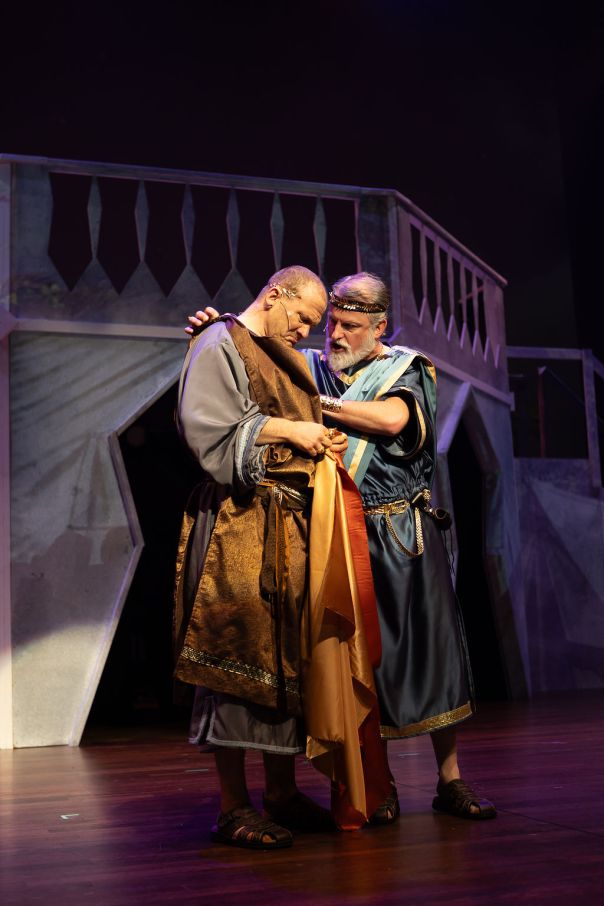
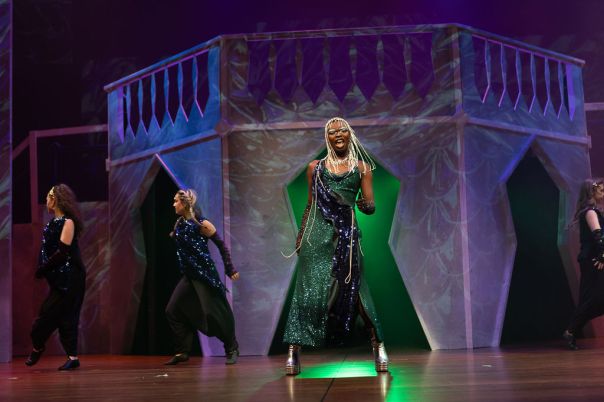
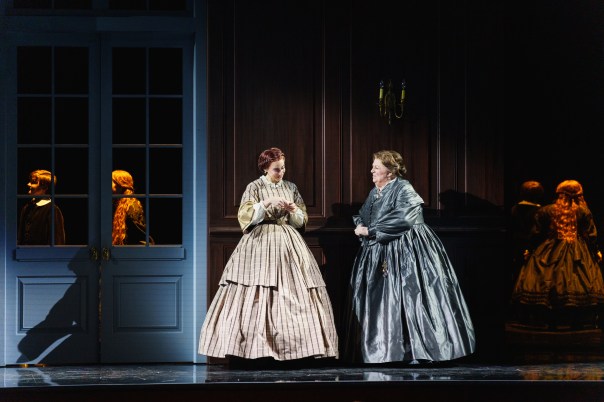
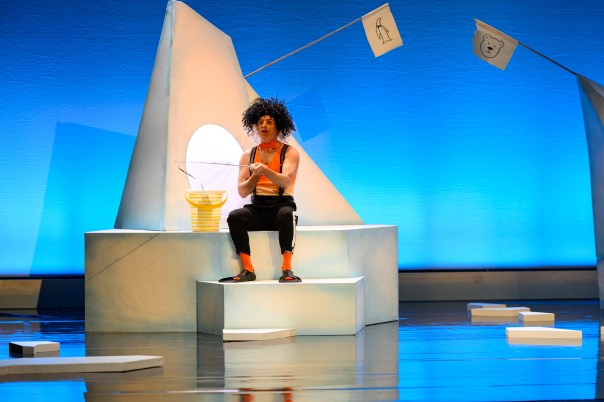
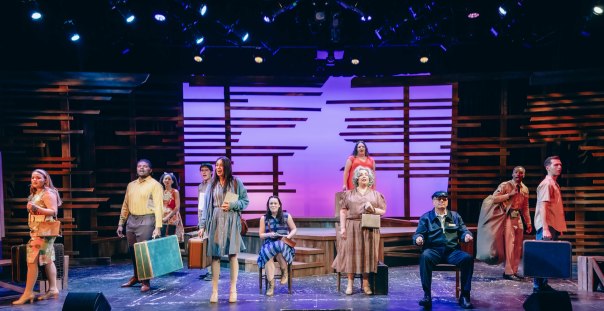
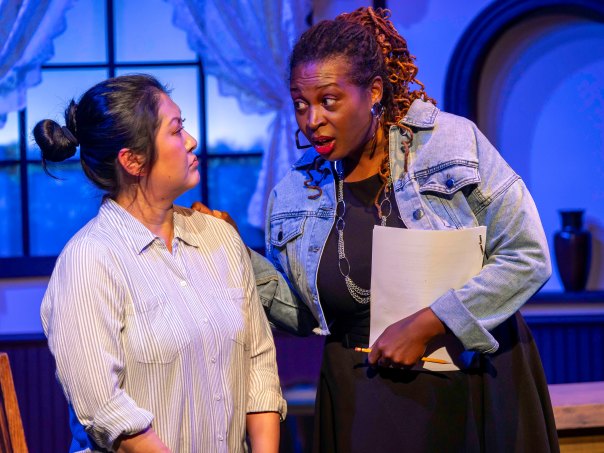
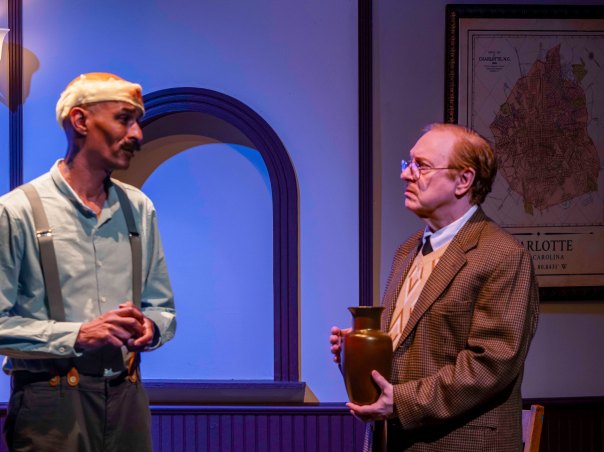
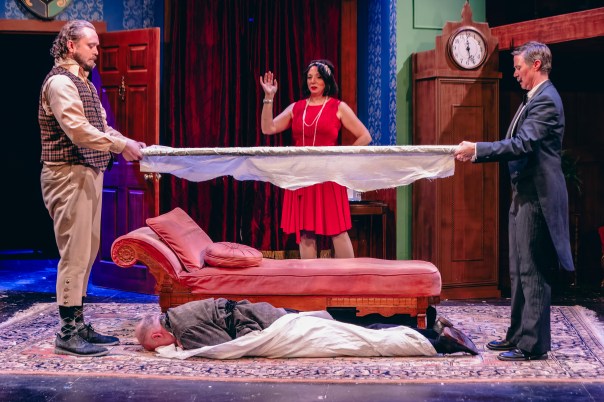
September 13, 2024, Charlotte, NC – Over a lazy Duke Ellington piano riff that becomes indelible almost as soon as you hear it, John Coltrane layers on the melody of “In a Sentimental Mood,” recorded 62 Septembers ago. Although we’re in a kitchen at a truck stop that doesn’t look nearly that old, somewhere along the highway in Berks County PA, it’s a fitting intro to the new BNS production of Clyde’s. Along with the mean and sassy owner of this diner, Clyde, we meet her star employee, the zen-like Montrellous, also described by two-time Pulitzer Prize winning playwright Lynn Nottage as “the John Coltrane of sandwich making.”
Nottage’s newest comedy-drama originally premiered in Minneapolis as Floyd’s in 2019, less than a full year before George Floyd was killed by local police – so it was prudent to change the title before the Broadway opening in 2021. Yet a police state haze still hovers over the action, since all the employees at Clyde’s are ex-convicts or parolees, including the owner. She’s not a criminal now, but something or someone has clearly hardened her. Montrellous believes that Clyde’s could be a smashing success if it served up extraordinary sandwiches. She wants to stick to basics, lay low, keep a low profile, and lower her costs on the ingredients her drones drop between two slices of bread.
Limiting ourselves on food analogies, let’s say Clyde is one tough cookie, tightly wound to match the tight-fitting outfits costume designer Aneesah Taylor has tailored for her. You do not smile around Clyde, Montrellous warns newbie Jason, a recent parolee. He doesn’t listen. To his distress, he will learn the hard way that Clyde is the Captain Bligh or Queeg aboard this ship. Ah, but there is deeper wickedness to this boss: there is a Jezebel gene in her DNA, for Clyde is a toxic temptress. On a couple of occasions, the owner’s forays into her kitchen reminded me of Curley’s luscious wife sashaying among the farmhands in John Steinbeck’s Of Mice and Men.
The mice here mostly get to play when the boss isn’t peeping through the pickup station, hanging a barely legible order on a little carousel, and banging a bell. Director Dee Abdullah has her kitchen staff reveling in those moments when they aren’t wrapped up in a food prep frenzy. transforms the place. For him, sandwich making should never be drudgery. It is more like a mission, a calling, a crusade, an artform…or a lifelong quest for the perfect sandwich. Suffering and anger can seep into the food you make.
This ministry is not for Montrellous exclusively. When the pace in the kitchen slackens, all four workers lean over their prep stations and take turns chanting the ingredients of sandwiches never built before, swooning collectively over their imaginary deliciousness. In these moments, the kitchen is more like a studio or a writers’ room as the creators brainstorm ideas. And when the coast is really clear, Montrellous reaches into a low cabinet upstage center and extracts his latest masterwork, placing it reverently in the exact middle of the three prep stations. Since James Dukes’ lighting design accentuates the gleam of the Saran wrap around Montrellous’ newborn brainchild, the radiance turns Clyde’s kitchen into a holy temple of sorts. Epicures looking at the three stations centerstage at the Parr Center can be excused if they’re reminded of the Last Supper by Jennifer O’Kelly’s set design.
With this sacred imagery in mind, it’s hardly surprising that Montrellous’s precepts begin to transcend food preparation as we get to know more about him and about Clyde, Jason, slicer-and-dicer Letitia, and the man with the pans at the stove, Rafael. As much as Montrellous wants to convince Clyde to be more enterprising and adventurous – and less dogmatic and stingy – the adoring and adorable Rafael wants Letitia, forever stressed by her infant and her ex, to just give him and chance. Really, this romantic subplot occupies more space and time than the overarching struggle between Clyde and Montrellous, so we don’t think we’re watching supporting players when we see Lisandro D. Caceres-Zelaya in action as Rafael propositioning and wooing Toi Aquila R.J. as Letitia.
“Not enough salt, the flavor doesn’t come out; too much salt, it’s inedible,” Montrellous pronounces. Both women, taught by their past experiences, fend off new ideas and intimacies, fearing all because they’ve had too much before. Both are skeptical that being asked out could be motivated by any other reason than sexual exploitation, whether tender or forceful. Fortifying her resistance to anything Montrellous creates, Dominica Ivey as Clyde turns down every simple invitation to give it a taste. She wields her ever-present cigarette like a dagger, and her every exit is a devastating kiss-off, somewhat comical because she’s so decisive. You begin to wonder whether Ivy has any empathy for her ex-cons: maybe Clyde hires them because they can be bought cheaply.
To be sure, Ivy can string any male along in her wanton mode, but it’s Aquila as Letitia who gives off the most bi-polar vibes. When she isn’t sullenly brooding or crazily hacking lettuce as if she were Lizzie Borden, Aquila is shaking some fine booty and boogeying, reminding us of the charisma she radiated as Eartha Kitt last September. We have no difficulty understanding what Rafael sees in her, and Caceres-Zelaya lights up the stage with his sunny energy, evoking for me the irrepressible verve of Usnavy in Lin Manuel Miranda’s In the Heights.
When he isn’t presiding over the sacrament of sandwich making – and his apostles’ efforts to reach his lofty level – Zach Humphrey as Montrellous is largely a peacemaker. He intervenes with calm authority when Clyde and Jason come close to blows, and he’s a guiding light for both Letitia and Rafael as they gravitate toward one another. “Trust your ingredients,” he sagely says more than once. Everyone is different. People’s possibilities are as infinite as the varieties of sandwiches you can imagine.
Making his professional debut, Anthony Lonzo as Jason presents special challenges that audience members might struggle with, for the tats on his face and spew barbarity and hatred. Onstage, the tats are chiefly repellent to Latitia, but since Jason doesn’t speak much at first, we also need to delve beyond skin depth to grasp what he’s all about. Nottage gives each of the kitchen workers a juicy monologue to reveal what’s inside and in their rearview mirrors, and we’ll likely remember Lonzo’s nearly as vividly as Humphrey’s. But an unspoken maxim sprung to mind as Duke’s lighting finally sanctified Clyde in her memorable epiphany. It’s a wonderful little saying from the Psalms of David that I first learned from a book title by Denise Levertov: O Taste And See. At times the lesson is merely culinary. But ultimately, the message is experiential, about adopting an empirical attitude instead of hardening our prejudices. Above all, it’s an injunction to fully live our lives.
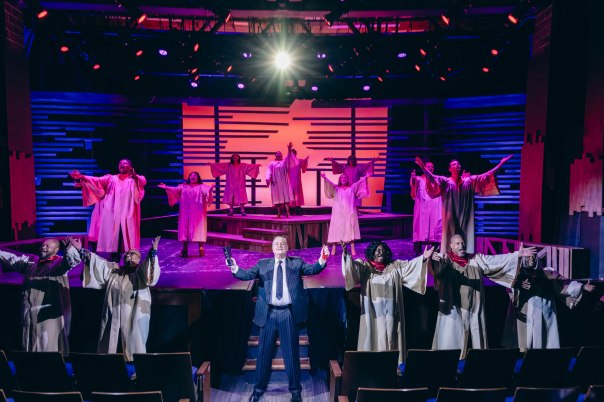
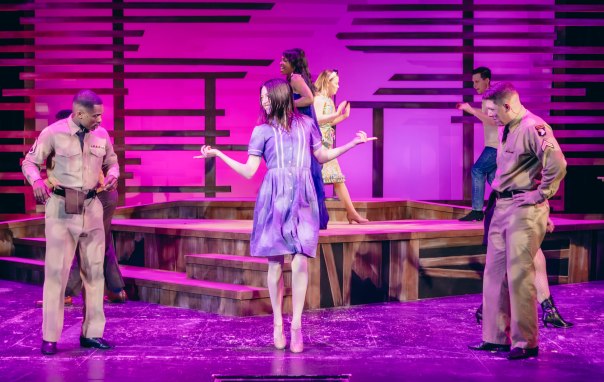
My advice for best enjoying The Drowsy Chaperoneat Theatre Charlotte is to listen to the Man in the Chair – and yield to his pitch-dark hypnosis. Yes, before the lights even go up at the old Queens Road barn, he’s in his chair speaking to his audience and conjuring up what we should hope and pray for: “I just want to be entertained. Isn’t that the point?”
As the show unfolded, brilliantly directed by Billy Ensley with what must be the local cast of his dreams, I realized that, as a critic, I shou
ld heed that hypnotic suggestion devoutly. Discard my usual pointy critical and analytical tools. What’s more, I came to believe more and more strongly that, if actors and directors of previous Drowsy Chaperones I’d seen had followed that simple mantra, I would have fallen in love with the show long before last Friday night.
When the lights came up a few minutes deeper into the Man in Chair’s monologue, we saw him locking the front door of his humdrum apartment with four or five assorted deadbolts and chains. It’s a bit of an abrupt swerve, but we’re suddenly aware that this Broadway musical devotee is a recluse and a bit paranoid. Each time the phone rings, we’ll see that the Man in Chair fails to answer, yet another confirmation of these traits.
By the time the title character of the fictional “Drowsy Chaperone” is a few wobbly notes into her showstopping “As We Stumble Along,” we already should know that the Man in Chair is gay, which accounts for Lisa Smith Bradley delivering the song as a living fetishization of Ethel Merman and Judy Garland – Merman’s vibrato wedded to Garland’s glitter, slacks, and drug dependency.
Yet when we’re watching Kyle J. Britt as our genial host, we need not attribute his reclusiveness or paranoia to being a gay man. As a Broadway musical fanatic, this Man in Chair identifies more readily as a New Yorker with Innerborough hangups. Meanwhile, Bradley is sufficiently over-the-top as both gay icons – especially Merman – to be accused of impersonating a female impersonator.
We might say that Ensley & Co. have decided that being gay in 2024 isn’t nearly the leaden weight it was in 2006 when Drowsy Chaperone premiered in the Big Apple or in 1996 when Angels in America tore the QC apart and made us a laughingstock. Pretentiousness, solemnity, and subtlety really are inimical to this delicate relic. Britt handles it with audiophile care as removes the vinyl disc – a rare original cast recording of his favorite 1928 musical – from its LP sleeve and gives both sides a loving once-over with a Discwasher brush before lowering his treasure onto a turntable.
The same can be said of size and scale, which may also have muffled my enjoyment of productions at Belk Theater in 2007 and Halton Theater. There’s something so right about our little séance in the dark at the Old Barn on Queens Road that it cannot attain in a more modern and spacious hall where the Man in Chair must project his spell into a distant balcony. The homeliness of the Man’s urban dwelling also sits better on Queens Road than in the bowels of a bank building on Tryon Street.
To be honest, it’s Broadway Lights and the late CP Summer Theatre that should apologize for not matching the unpretentiousness of Josh Webb’s scenic design. Of course, it would be nice if Webb’s scenery could transform spectacularly into Broadway splendor when the stylus of our host’s turntable comes down – with its signature thump – onto the vinyl and the mythical “Drowsy Chaperone” comes to life. In the less-is-more world on Queens Road these days, these shortcomings are comedy assets, part of the overall charm.
On the other hand, our time travels to 1928 get a softer landing thanks to the costumes by Beth Killion, notable for their flair, their formality, and their discreet dashes of color. We’re awaiting the wedding of Robert Martin and Janet van de Graaf, so there are actually multiple levels of time travel here, for Bob Martin actually co-wrote the Drowsy Chaperone book with Don McKellar – and starred in the original Broadway production as Man in Chair – while he was married to the real-life Van de Graaf.
In fact, this originally Canadian work, which eventually layered on music and lyrics by Lisa Lambert and Greg Morrison, was gestated at Martin’s stag party in 1997, nearly 70 years after these fictional nuptials. More reasons not to view this lark as a gay cri de cœur.
Rare as his vinyl treasure may be, Britt comes across less as a scholar or a critic than as a fanboy, occasionally panting like an eager puppy as he presumes to approach his fantasy idols more and more closely. More than once, the principals will obligingly freeze for him. Nor does this Man in Chair seem to favor the men over the ladies with his adoration, only tipping the scales just before the final bows. Charmingly enough, there are overtones of scholar and critic as he dishes tasty trivia about the fictitious “Drowsy” cast members or advises us to be on the lookout for some truly dreadful lyrics.
These glamorous, theatrical, servile, and criminal characters are all blissfully ignorant of the nerd who has conjured them up, preoccupied with their conflicting efforts to carry off the planned wedding or ruin it. The bride herself, Lindsey Schroeder as Janet, seems to be grandly ambivalent about becoming Robert’s wife, sacrificing her glittery stage career and the adoration of millions, while suppressing her basic instinct to “Show Off.” Love is at comical war with vanity. Carried away by the swiftness of this whirlwind romance, Andy Faulkenberry as Robert also has his doubts.
Aside from Janet’s drunken chaperone, politely labelled as Drowsy, there are a butler Underling, an eccentric Mrs. Tottendale, and Robert’s best man George shepherding the loving lambkins to the altar. Only Zach Linick as George seems to be afflicted with any degree of competence or reliability. More importantly, he and Faulkenberry make up a formidable tapdancing duo. (Thank-yous to choreographer Lisa Blanton.) Allison Rhinehart as a frilly, bustling Tottenham and Darren Spencer as the gray and starchy Underling are no less inevitably channeled toward blithe entertainment.
Counterbalancing the fragile determination of the bride and groom, compounded by the flimsy protection of their good friends, we have an exquisite mix of bumbling baddies trying to sabotage the wedding. These are led by Joe McCourt as Broadway producer Mr. Feldzeig (Feldzeig Follies ring a bell?), under pressure from his mobster backers, who consider Janet to be the cash cow of the Feldzeig franchise. The sneering McCourt is bedeviled by Gangster 1 and Gangster 2, armed emissaries – Titus Quinn and Taylor Minich – masquerading as hired chefs to ensure a catastrophe.
Ah, but it isn’t simply muscle aimed at swaying the maiden and returning her to showbiz. Somehow, a predatory Lothario is among the wedding guests – although he has never met anyone else there. Mitchell Dudas is this egotistical Adolpho, far more arrogant than Feldzeig, a mixture of Erroll Flynn and Bela Lugosi with a thick Iberian accent. Feldzeig has no trouble at all convincing Adolpho that he was born to seduce the bride-to-be.
Equally dumb, Autumn Cravens as Kitty is a ditzy chorine, constantly nagging her boss and wedding escort Feldzeig to let her fill Janet’s shoes in his next Follies. Effortlessly, Dudas will outperform Cravens in thwarting Feldzeig’s schemes. Love conquers all, but it would be a huge spoiler to say how many times when we reach this very happy ending.
Just one more wild card is needed to tie up all the festivities. Be on the watch for Trinity Taylor as Trix the Aviatrix, who descends from the skies at just the right moment with a voice of thunder. For a few moments, she even upstages Britt and Schroeder who are so fabulous.
It would be a mistake to miss the craftmanship lavished on this plot with its stock characters by Martin and McKellar, brought out so brilliantly by Ensley and his dream cast. For instance, think how perfectly 1928 was chosen: between Lindbergh’s transatlantic flight, Babe Ruth’s 60 homers, The Jazz Singer of 1927 and the Wall Street Crash of 1929. A brief last window of bliss before global misery. In the real world, the parade of yearly Ziegfeld Follies revues would be halted after 1927 – until 1931.
Review: The Mystery of Irma Vep – A Penny Dreadful at VisArt Video
By Perry Tannenbaum
My first hints that PaperHouse Theatre’s new production of The Mystery of Irma Vep would be truly unique came when I glanced at a hidden nook of the set and saw a little half-hidden bar napkin that read “Homo Sweet Home.” Shortly before or afterwards, my first peep at the playbill revealed that there were more directors on this project than players. Two more.
Then before intermission, the aluminum loading dock closure at VisArt Video was raised by the entire cast of two, Nicia Carla and Andrea King, while we joined them on the other side, exiting through the front door to the outside alleyway – the al fresco part of the store. The final Egyptian scene was played out on a second stage, facing out to a few seats, under the shadow of a Wicked Weed Brewing sign. With a nifty little Egyptian tapestry and a fairly gaudy, full-sized sarcophagus.
What really clinched it for me was rolling pin in Act 2 – deployed for a purpose you’d never dream of. That settled it: the new Irma Vep, a Charles Ludlum gem not seen in Charlotte since 1993, is far more than a loving revival. Far more than a couple of hambone actors led by an unusually comical director.
No, this is pure out-of-this-world madness, a starburst of hysteria fueled by a team of four directors feverishly brainstorming in the merciless grip of writer’s room giddiness. Who can possibly care about a three-inch square napkin? Who would conceive of taking the one underground scene in Vep outdoors? And the rolling pin: I can barely imagine the uproarious laughter when that touch was unveiled. Perfect.
Some of the zaniest futzing could have happened spontaneously during rehearsals, since Carla and King, splitting eight roles between them, are also part of the directorial team, joined by Kevin Lorms and Chaz Pofahl. So scenic designer Kel Wright may have lavished so much attention on her precious sarcophagus that she didn’t notice when that homo napkin got slipped into the wicker basket back at Mandacrest.
That’s where theatre legend Lady Enid Hillcrest, newly married to Lord Edgar Hillcrest, will feel oddly ill-at-ease in the library as a portrait of her predecessor, Milady Irma Hillcrest, stares down at her. Greeting her as maidservant Jane Twisden, King ought to be scornful and sepulchral, since she is replicating Judith Anderson’s role as Mrs. Danvers in Rebecca opposite Carla while she resurrects the Joan Fontaine naif.
Yet by the time Lady Enid sashays into view, numerous other parodies have already been set into motion in Ludlam’s wicked mockery of the “penny dreadful” style of Victorian England. Sleuthing, sarcophagi, werewolves, vampires, witches, and a Wuthering Heights heath are all mixed into this undeadly brew. Plus the obligatory mummy. So why not give King the freedom to jubilantly shatter the Dame Judith mold, sporting a bright red wig and occasionally breaking a smile?
Anderson may never have even slightly bared her teeth before she set Hitchcock’s Manderley ablaze.
Squinting her eyes like a savvy sleuth in the opening scene, Carla as the swineherd Nicodemus quickly references the nearby heath and his determination to hunt down the werewolf suspected in the death of Lord Edgar’s son. As the action speeds up and the creepy creatures proliferate (inspiring Carla’s more outré costume designs), we need to be watchful in keeping track, not only with who’s who but with who’s what. Once the thunder stops, the full moon will have its effect, so we can be on the lookout for the kindred of Lon Chaney, Bela Lugosi, Sir Laurence Olivier, Lady Macbeth, and Edgar Allen Poe.
Ludlam wrote all the roles that Carla plays in this quick-change romp for himself and the others for Everett Quinton, his partner in the Ridiculous Theatrical Company and in life. And Ludlam also directed the 1984 premiere. Small wonder, then, that legendary actor/director Alan Poindexter was actually dissatisfied with Innovative Theatre’s storied 1993 production at the fabled Pterodactyl Club – for he merely starred in that historic riot. He told me in 1995 that he was itching to revisit the script.
Where he didn’t say, but presumably, Poindexter yearned to act and direct next time around, the dual roles that both Carla and King are fulfilling now. The fun they’re having with it was unmistakable almost from the start last Friday. Those many costume changes certainly quicken the heartbeat and release the adrenalin when these gifted players are switching outfits backstage – often speaking lines of dialogue while they do.
It’s gotta be dark back there, so in a small space where so many costumes are parked, Lorms must be especially adept as he switches hats and takes on the stage managing. If there’s an additional person hanging up the hastily discarded clothes, it must really be mayhem back there!
While Carla is shuttling between her Nicodemus and Lady Enid costumes, King is shedding her maidservant uni – and that wig – whenever the Lord Edgar returns from his various adventures. Tortured soul! After losing his ex to a vampire and his son to a werewolf, noble Edgar tasks himself with tracking down both supernatural monsters, with only Nicodemus for backup. Poor choice.
Leaving a beautiful lady alone on a lonely manor; especially near moors, heaths, mists, and hail; is never a good idea, confirmed by even a smattering of familiarity with Hollywood horror. After discovering that an Intruder has left telltale teeth marks around his beloved’s jugular, Lord Edgar proves that he has learned his lesson by immediately traipsing off to Egypt to solve this mystery. Thoughtfully, he checks Lady Enid into a sanatorium.
While Milady convalesces, Carla can transform into two Egyptians, Lord Edgar’s turbaned guide and his royal quarry, the remarkably well-preserved Princess Pev Amri. More hilarity for us; more heartbreak for Lord E.
An easier mystery for us to solve was why the Egyptian scene was moved back from the beginning of Act 2 to the end of Act 1. That sarcophagus appears on both stages, so Carla and King can rely on outside help in schlepping it. In its wake, we’re left facing a handy cantina where we can line up for refreshment during intermission.
No doubt the respite is a godsend for Carla, King, and the hidden crew as they regroup, relax, and hydrate. Action is noticeably more frenetic after the break. Masks appear more frequently, and we’re treated to cameos by vampires and various werewolf body parts, far eclipsing the wolf’s carcass tossed into Act 1. In the hurly-burly, all the mysteries and who’s-whats are solved – but you’d better be alert if you want to catch all the solutions.
By then, you may have been laughing too hard to care.
Rarely mentioned among Shakespeare’s best comedies, let alone among his best works, The Tempest maintains an enviable popularity within the Bard’s celebrated canon. The current Free Reign Theatre presentation at the The Gettys Center in Rock Hill marks the seventh local production to appear in the Charlotte metro within the past two decades – Actors from the London Stage visited with an eighth in 2011 at UNC Charlotte.
Upstairs in the Getty courtroom turns out to be a perfect backdrop for this masterwork of measured retribution. In the misty annals of Shakespearean scholarship and criticism, The Tempest has often been singled out as the Bard’s final and most perfect work. More important to most theatergoers are the notions that Shakespeare places himself in the role of Prospero and that Prospero’s renunciation of the magic arts is the playwright’s farewell to theatre at the same time.
Under the direction of David Hensley, with costumes by Gina Brafford, it often looks like the retiring Bard had a notion to syndicate his valedictory work as an ancestor of Gilligan’s Island. Though Prospero was presumably shipwrecked in the Aegean or the Mediterranean, his most distinguished guest, King Alonso of Naples, seems to be outfitted with hand-me-downs that Gilligan or The Captain will don centuries later.
Not the first to impress upon his audience that Prospero is the main architect of the action that ensues on his tropic isle, Hensley has his protagonist, played by Russell Rowe, waving a magical illuminated staff to summon up the mighty winds, rains, and seas. Now we can adjourn to Shakespeare’s opening scene as a panicking Master and Boatswain stand on a ship’s deck trying to right their way in this tempest with a ridiculously puny captain’s wheel.
Prospero’s power on his island is vast, for he holds the fairy Ariel and the deformed monster Caliban as his slaves. Since all the action we see follows Prospero’s basic design, it’s not too outlandish for Victor Hugo to have claimed that through Caliban, Prospero rules over matter, and through Ariel, over the spirit. His sovereignty certainly extends beyond his island to the seas he sets in turmoil.
With Ariel’s help, Prospero can separate the arrivals of the servants from the shipwrecked seamen and the corrupt nobility of Naples and Milan from Prospero’s chosen heir, the virtuous Prince Ferdinand of Naples. He plans to match Ferdinand with his daughter, Miranda. On hand to help Ariel keep Prospero’s fugal design flowing smoothly are Juno, Ceres, Iris, and numerous other nymphs and spirits.
But omniscience is far from Prospero’s grasp, so Shakespeare can artfully engage us with wisps of drama and suspense. Prospero cannot be sure that Miranda and Prince Ferdinand will take to one another. Furthermore, Prospero must be on guard against Ariel and Caliban, both of whom chafe under his dominion – respectively capable of escape and rebellion.
Watch carefully, and you’ll notice how Shakespeare flips these prospects for suspense and drama into comedy.
Armed with Prospero’s vatic powers and steeled with the usurped Duke’s determination to restore rightful rule in distant Milan and Naples, Russell Rowe is slightly above the action, never clownish or fully mundane. He participates in the romantic comedy by scheming to inflame Miranda’s ardor for Ferdinand by subjecting the Prince to the humiliations of enchantment and daylong labor.
Smitten by each other almost as soon they meet, Hannah Atkinson as Miranda and KJ Adams as Ferdinand convincingly demonstrate the needlessness of Prospero’s stratagems – Ferdinand is promising to make Miranda the Queen of Naples less than 75 lines after he first appears. To be frank, the old magician, for all his learning and wisdom, has nearly forgotten his own youth. So the joke in also on him! Of course, it does take a little imagination to conjure up a virginal 15-year-old who has never seen any other man than her aging father and the “mooncalf” Caliban. As a result, Atkinson gets more unique traits to distinguish herself with.
With Caliban, played by the versatile Robert Brafford, Prospero can take a more laid-back and confident attitude, relying on the weird mutant to make a fool of himself in his rebellion. Latching on with his blue paws to Bronte Anelli as the drunken jester Trinculo and Spirit Craig as the marginally more sober butler Stephano – and mooching an occasional gulp from their ample bottle of booze – Brafford wastes no opportunity to subtly reassure us that, despite his mighty grievances, Caliban is foredoomed to failure.
Ariel, the vivacious Rebecca Viscioni, does confound the help, pulling out an invisible voice imitation shtick that, to my mind, James Barrie poaches in Peter Pan. Regardless, it is curious to note that both Ariel and Peter were written for men and usually played by women.
The “airy spirit” has more urgent places to intervene after wrecking the ship and sorting its survivors. Chiefly, she is needed – seemingly more than Prospero knows – to keep things flowing properly among the shipwrecked royals. Complacent on his throne, which is now reduced to a collapsing chair with cupholders, Nathan Stowe as King Alonso seems blissfully unaware of the treachery up in Milan. Stowe’s discomfort and disorientation in Shakespearean pentameters adds a light patina of comedy to Alonso and helps us to believe that he’s oblivious to the lurking threat in his own family.
Adding very little to the comical aura of Alonso’s complacency, Ross Chandler as the King’s brother needs a bit of cajoling from Antonio, the usurping Duke of Milan, to act on his designs on the Neapolitan throne. Fortunately, David Eil has a superabundance of shiftiness and malignity, enough malignity to be noticed not only by Alonso but by every citizen from Naples to Milan. Or by satellite.
Also on board the foundering ship, fortunately enough, is Emmanuel Barbe as a rather slick Gonzalo – former councilor in service of Prospero, who supplied the usurped Duke with necessary provisions, plus the cream of his precious library, when Antonio cast him off to sea 12 years earlier. Rejoining him onshore, we see that Gonzalo now serves King Alonso, so Gonzalo is now ironically saving his own life as well as his monarch’s with those mystic books.
For Sebastian and the never-sated Antonio mean to slay them both, not with ancient sword blades drawn from waterlogged hilts but with a 9-iron and a wedge extracted from a golf bag, a bit more slapstick. Bludgeoning rather than stabbing or beheading seems to be the plan and we are in some suspense – less with golf clubs than with drawn swords – as to whether Prospero has foreseen this impromptu assassination plot.
There is one whispering considerably earlier between the rightful Duke and Ariel in the unusually detailed stage directions, so if we’ve remembered that brief moment, there’s hope that help is on the way for the feckless King and Prospero’s loyal benefactor. But as those swords/clubs are held high over the sleeping heads of Alonso and Gonzalo, suspense mounts, thanks chiefly to Eil. So if Prospero doesn’t have the smarts to anticipate what’s happening, we must trust his Ariel to save the day.
The oft-hailed perfection of The Tempest is two-fold: aside from artistic perfection acclaimed by critics, it is also Shakespeare’s most perfectly preserved script, the lead-off play in the famed 1623 First Folio collection of 36 plays, meticulously edited by the Bard’s fellow actors, Philip Heminges and Henry Condell. Hence the unusual profusion of stage directions when you encounter the text.
Hensley and his cast do a fine job in making those generous stage directions disposable, and his careful cuts in the script, though occasionally robbing us of its full lyric pleasures, are laudably protective toward the multiple storylines. Having seen The Tempest five times before and having read/studied it more than once, I’m not bowled over by the blizzard. My worries are for those plunging into The Tempest for the first time. That little prelude with Prospero is helpful, but quite a deluge of entrances ensues.
So it was disappointing not to find any roles named in the printed program on opening night, only the alphabetized names of the actors. Clicking on the QR code is helpful, pairing faces with their roles, but again in alphabetical order – without the helpful capsule descriptions Shakespeare provided. Those would be valuable at intermission for newcomers who might still be struggling to sort out Alonso, Antonio, Sebastian, Gonzalo, and their positions at court.
Fortunately, the residents of this prehistoric Neverland or Gilligan’s Island are instantly differentiated, thanks to Gina Brafford’s florid costume designs – beginning with Atkinson wholesome Oklahoma farmgirl look as Miranda. Hard to say which is more outré, the winged Viscioni evoking the gladrags of the ‘60s or Robert Brafford as Caliban, looking like he’d been freshly belched from the belly of a whale.
Maybe the flowery Ariel outfit should get the nod because she’s so sassy and blithe all evening long. So: Calling on Hensley to give Viscioni a sassier final exit. She deserves it no less than Rowe, who asks for it in the touching Epilogue.
Review: Mojada: A Medea in Los Angeles at The Arts Factory
By Perry Tannenbaum
When Euripides took first place for the first time at the Dionysia Festival, Athens’ five-day playwrights showdown celebrating Dionysius, it was so long ago that theatre scholars aren’t sure whether he won an ivy wreath or a goat. Ten years later, when his Medea took third place, we can’t say what the Greek master took home as a reward. It wasn’t gold or bronze, but Olympic champions and runners-up back then didn’t win medals, either. Nor can anyone remember the titles of the tragedies that finished ahead of Euripides’ masterwork.
Now that Luis Alfaro’s Mojada: A Medea in Los Angeles has premiered in an excellent Three Bone Theatre production at the Arts Factory, we can say – 2455 years and five months later – that we are a giant step closer to seeing a premiere of Euripides’ white-hot spectacle in Charlotte. Until now, the closest approach of the charismatic adventurer Jason and his sorceress consort Medea to the Queen City was a 2004 Gardner-Webb U production in Boiling Springs.
That production, one might presume, came in the wake of the sensational 2003 Broadway revival of Medea starring Fiona Shaw. But was there also a connection between that Media and Alfaro’s?
Could be! For the Broadway sizzler also transported Euripides’ hellcat to Los Angeles. But there’s also a huge difference: Shaw’s Medea was a Hollywood superstar who capriciously craved a Garbo-like solitude. Alfaro’s is a mojada, or wetback, who needs to lay low because she’s an illegal – and mostly because, during their treacherous migration from Mexico, she suffered far more severe trauma than the rest of her family and their longtime viejita, Tita, who is always seething over the indignity of being considered a “housekeeper” in America.
She considers herself a curandera, a healer, so she tracks with the Nurse in Euripides’ tragedy. After winning the 1948 Tony Award for Medea – and recreating the role for a 1959 TV movie – Judith Anderson was content in 1982 to take on the role of the Nurse in another Broadway revival, earning a second Tony Award nomination with the same Robinson Jeffers adaptation.
So you can expect Banu Valladares as Tita, Christian Serna as Hason, and Sonia Rosales McLoed as Medea all to have potent roles to play in Alfaro’s explosive retelling. Unlike Euripides, Alfaro flashes back to the treacherous journey that brought Hason and Medea to the Rio Grande, with enough hardships, suffering, and trauma to suggest a parallel to the Middle Passage from Africa. And of course, Medea’s barrio lifestyle also tracks with Langston Hughes’ “dream deferred” in Harlem – both of them pulsating toward an explosion.
Alfaro shakes up Euripides’ cast as well, replacing both kings, Creon and Aegeus – and the unnamed, offstage daughter Creon expects Jason to marry – with the sassy, bossy Armida, Hason’s employer and benefactor. We might also say that Alfaro has replaced the Euripides’ Chorus of Corinthian Women with Josefina, a bread-peddling gossip making her daily rounds.
Confronted with a rich mixture of Spanish and English, spoken with authentic Hispanic accents by an all-Latine cast, we may feel as disoriented in this Chicano world as Hason’s family are in LA. Seeing a quiet Medea, burdened by an oppressive workload and timidly tethering herself to her sewing machine, we further struggle to connect Alfaro’s protagonist with Euripides’. Back in Corinth, the royal Medea was outraged, suicidal, and wildly vengeful from the moment she first appeared, a volatile dynamo of shifting, fiery emotions.
Since we come into Alfaro’s story a little earlier, it will take a little while for his tragedy to overlap the Greek’s, even if you read it the night before. And if, like me, it’s been over 20 years since you’ve seen the work live or read a translation, you may miss some of what Alfaro has preserved from Euripides’ telling. For Euripides, it wasn’t such a big deal that Jason and Medea were immigrants, but they were. For me, I hardly noticed that Jason and Medea weren’t legally married, but they weren’t.
For Alfaro, these are central plot points. Just don’t think he’s changing those parts of the story. It’s really brilliant how they’re elevated to top-of-mind when we watch Mojada at the Arts Factory. Complementing their all-Latine cast, most of whom are making their first appearances with Three Bone, are directors Carlosalexis Cruz and Michelle Medina Villalon, also in their Three Bone debuts. They don’t always listen to their players with helpful Yankee or Dixie ears, but they deftly quicken the heartbeat of this drama as it climaxes.
More importantly, when they reach the spectacular ending, what they concoct – with Jennifer Obando Carter’s most unforgettable costume design – hits the spot. We could feel that viscerally on opening night.
Obviously, Latine theatre wants to happen in the Queen City. With Three Bone committed to producing Alfaro’s complete Greek Trilogy, Electricidad next August and Oedipus El Rey slated for 2026, it’shappening.
Because Alfaro is messing with both the story and Euripides’ character, those who know the Medea myth can experience the suspense at nearly the same high intensity as audience members who have never come across this Mom-of-the-century before, in Greece or in this LA rewrite. Over and over, as memories of the Euripides’ came flooding on me from past encounters with the live Shaw, the TV Anderson, and the text, I found myself wondering, Is he really going all the way?
After all, part of the reason Euripides’ Medea hasn’t played in Charlotte for at least the 37 years that I’ve been on the beat could be that Queen City theatre companies were protecting us from its full barbaric force. Could be some blowback in Bank Town.
Thanks in large measure to the harrowing flashback sequence, McLoed is able to traverse the wide gulf between the semi-catatonic Medea we confronted at the beginning of the evening and the flaming red raptor we see at the end. That’s Medea!? I found myself wondering during Scene 1, so the development arc from there is nothing less than astonishing. There’s a haunting connection between the catatonia we see at the beginning and the vengeful glare that comes some 90 minutes later. She’s actually relatable most of the time!
Precisely because this LA Medea lacks the fire and wicked glamour of her Corinthian counterpart in the early scenes, we can effortlessly empathize with Serna’s ambitious Hason as he pursues the American Dream. She won’t leave the house! Family outings with their son cannot happen, she’s too traumatized for sex even when she’s in the mood, and. He wants to get ahead while his Medea is a poster girl for inertia.
And considering the huge difference between an immigrant’s status in modern-day America and his relative safety in ancient Corinth, Hason has many pragmatic reasons to accept the predatory Armida’s business and marriage proposals, no matter how much he may still love Medea. Giving us earlier access to the story – before the breakup – not only allows Alfaro to add fuel to the drama, it allows him to show us that there is fault on both sides.
Serna’s performance isn’t quite as wide-ranging as McLoed’s, but it is no less nuanced, for he is navigating this new American world and trying to provide for his family’s future. We see that he’s a far better parent to his son, Acan, than Medea, and it’s not just because he kicks a soccer ball around with him in the front yard. Citizenship for him, no matter how heartlessly he betrays Medea, will mean citizenship for the boy.
In her venomous cameo, delivered with a wondrous mix of elegance and malignity, Marianna Corrales is magnificently resistible as Armida, Hasan’s childless employer and Medea’s implacable landlord. Hard to say whether Armida wants Acan as a son more than she wants Hasan as a husband, but with knowledge of Medea’s immigrant and marital status, she knows she is invincible and will have her way. Corrales is cool. Ice.
Alfaro not only gives Leo Torres more to say and do in his story as Acan than any of Jason’s children have ever had before, he makes him a key part of the tale. Torres will not only tell his mom about visiting Armida’s swank house with Dad, he will also – huge new dramatic irony – suggest that she make the rich lady a dress.
Further igniting Medea’s suspicions and jealousy is Isabella Gonzalez as Josefina, bringing her signature vitality along with her cartful of bread as she shares gossip with Tita. Yet she is also eager to make friends with Medea, especially if a certain amount of freebie loaves will convince the artful seamstress to make her a smashing new outfit. So it makes sense, out of friendship, that she tells Medea what the buzz is around town about Hason and Armida.
We never learn how long Hason has actually been married – or how far custody proceedings have gone – when Medea gets the newsflash. This point in Alfaro’s LA comes late in the drama, but in Corinth all this has happened before we first see the sorceress. No wonder the rest of the evening was such a feverish whirl.
In hindsight, after dipping back into the original 431 B.C. playscript, methinks it was far crueller that Alfaro’s Medea sends Tita – instead of Jason and the child – to deliver her bridal gift. Cruel as it is to make the viejita a witness, it gives Valladares a monologue that even Judith Anderson would have loved to sink her teeth into. As the eternally griping Tita, Valladares seems to hate everybody, beginning with us, whom she addresses directly after Alfaro’s incantatory opening.
But she has crossed rivers, faced outlaws and starvation, because of her loyalty to Medea, the one person she adores. And now Medea sends her off with a giftbox to Armida and tells her that she herself is a second gift for Hason’s benefactor. Discarded like an old rag!
Plenty of steam to work with. Valladares does not misfire. Nor does McLoed, though we hear an ominous helicopter overhead.
We’ve had more than a couple of engaging David Lindsay-Abaire moments in the Charlotte metro over the years, beginning with the Actor’s Theatre production of Fuddy Meers in 2002. Wonder of the World continued the company’s love affair with Lindsay-Abaire in 2004, and when the playwright’s Rabbit Hole took the 2006 Tony Award and the 2007 Pulitzer, Actor’s Theatre took full custody for the 2008 Charlotte premiere.
Since then, the edgy Lindsay-Abaire has largely disappeared, along with – not coincidentally, I’d contend – Actor’s Theatre of Charlotte. The exception proved the rule when Carolina Actor’s Studio Theatre mounted a fine production of L-A’s Good People in 2013, for CAST made its exit years before ATC’s demise.
Tiding us over until the current run of Ripcord in a Davidson Community Players productionat Duke Family Performance Hall, Lindsay-Abaire has graced us with numerous softer, cuddlier visitations. For he wrote the book for the musicals that brought the animated Shrek to life in a trinity of darling fluff, beginning with Shrek the Musical before hatching its twin afterbirths, Shrek Jr. and Shrek TYA. A full-length revival was staged at ImaginOn by Children’s Theatre as recently as 2022.
With the touring edition of Lindsay-Abaire’s newest Tony Award winner, Kimberly Akimbo,due for a Knight Theater rendezvous next April, many Charlotte theatergoers may rightly feel that the time is ripe for catching up with this notably successful writer. They will find a very fine production at the Duke, nestled inside the Davidson College student center, although Ripcord isn’t Lindsay-Abaire at his edgiest.
On the other hand, Ripcord isn’t nearly as humdrum as its main locale, Bristol Place Senior Living in New Jersey, would lead you to presume. That’s because roommates Abby and Marilyn have radically clashing temperaments, turning the apartment into a tinderbox. Fundamentally, Abby is misanthropic grouch who treasures her privacy – but instead of forking out the extra cash that would put her in a private apartment, she has pragmatically made herself impossible to live with.
Sunny, cheerful, and chatty, Marilyn is totally averse to the quiet and solitude Abby thrives on, breezing into the suite in a jogging outfit while her sedentary counterpart vegetates on an easy chair. She doesn’t see Abby as a mortal enemy. She’s oblivious to most of the insults that Abby hurls at her and impervious to the rest. Marilyn needs to play with others and blithely treats Abby’s hostility as playful banter.
Such insouciance totally flabbergasts and infuriates Abby, opening avenues to comedy and drama. Lindsay-Abaire slyly chooses both. So do director Matt Webster and his cast, decidedly tipping the scales toward comedy. You can easily despise both Pat Langille as the Pollyanna senior Marilyn and Karen Lico as her adversary.
Abby’s inability to dim Marilyn’s sunniness is frustrating enough for her to enlist the assistance of eager-to-please Scotty, the resident aide who cares most about the women. You can definitely empathize with Scotty when Abby confides in him and keeps pestering him to get Marilyn transferred to a single apartment that has become vacant downstairs.
Strangely enough, Scotty’s patience isn’t as boundless as the saintly Marilyn’s, which gives Lowell Lark some leverage to work with in the role. As a peacemaker, he gently informs Abby that she likes it upstairs, where it’s sunnier and there’s a nice view of the nearby park. As a dealmaker, he won’t commit to speaking to management on Abby’s behalf about moving out her roomie, but he could get in a word for her about serving up some chicken and dumplings – instead of the usual tasteless gruel – if she’ll buy a ticket and come to a show he’s acting in.
Actually, “Beelzebub’s Den” is a haunted house, liberating us from the ladies’ institutional humdrum bedroom and bath on an excursion to the first of three breakaway scenes, two of them obliging set designer Kaylin Gess to create living quarters that quickly stow away in the Duke’s commodious wings. Lots of work for the seven-person set crew. Doubling as DCP’s lighting designer, Gess gets to supply the phantasmagoria at Beelzebub’s while Beth Killion provides the outré costume designs. Technical director Shawn Halliday also gets in on the fun, here and in the signature skydiving scene.
There’s fun for us watching the haunted house antics, but Abby is neither impressed with Scotty’s acting nor scared by any of the spookiness. Abby matter-of-factly tells that she doesn’t scare. Period.
Enjoy the fun, then, but the prime takeaway from Beelzebub’s is Abby’s pride in her fearlessness. In the very next scene back at assisted living, Marilyn will insist with equal certitude that nothing Abby can do will make her angry. Resistant to all the previous bets her quirky roomie has proposed, including whether she can balance a slipper on her head, Abby sees a betting opportunity here. If Abby can make Marilyn angry, she wins. If Marilyn can scare Abby, victory!
The high stakes are predictable: if Abby wins, Marilyn leaves; if Abby loses, Marilyn gets to take over the coveted bed near the window. Game on!
And no holds barred. Lico and Langille aren’t at the high end of Lindsay-Abaire’s specified age range for their roles, so the patina of seeing ancient biddies acting like kiddies isn’t happening in Davidson. But it is definitely the playwright’s intent for Langille to exceed expectations with her imaginativeness and for Lico to shock us with her meanness and cruelty.
With stakes set this high, this is war, and the warfare escalates each time an attack fails. Bombarding your roomie with phone calls and fake messages or drugging your roomie are not out of bounds as the battles begin. Enlisting your relatives and pranking your opponents’ kin are also legit strategies as the Abby-Marilyn War escalates. The avenues of comedy and drama widen along the way.
Langille and Lico obviously revel in hatching their devilish schemes and flouting our presumptions of senior citizens’ dignity and decorum. So the Odd Couple comedy, seasoned with a half century of aging, works well. But there’s also a theme of bonding that Lindsay-Abaire plants deeply in his script from the moment his antagonists strike their bet. Reviews of the 2015 Manhattan Theatre Club premiere indicate that director David Hyde Pearce missed it with his sitcom reading, and Webster also misses some of the early hints.
Yeah, Scotty the peacemaker and dealmaker subtly evolves into the common enemy – inevitably, the uniter, if both women survive! – when Abby and Marilyn solemnly agree to keep their bet a secret from him. Lark has his best moments when he suddenly appears at an inopportune time, threatening to blow the renegade gamblers’ cover.
The deeper mojo is in the bond formed between the two combatants, a literary staple stretching past Robin Hood and Little John all the way back to the Homeric epics. We’ve all seen two boxers sincerely hugging one another after pummeling each other for 12 or even 15 rounds. That’s genuine emotion, the rawest kind, not ritual or fakery. It comes from a gradually growing appreciation of your opponents’ gifts and grit as the battle grinds on. At its keenest, the upswell of emotion also comes from the realization that your mortal enemy has pushed you to a level that you never believed possible – and that part of extra specialness of your opponents’ performance comes partly from you.
So there are many fine moments that Lico and Langille have once the game is on, though digging into them would disclose too many comical and dramatic spoilers. Equal to any one of them is the spot where, the bet having been won, the combatants begin praising each other for their devilish deeds. At that point, Webster, Lico, and Langille are all catching Lindsay-Abaire’s drift.
Supporting actors are also a treat, starting with Rigo Nova as the Zombie Butler, our host at Beelzebub’s. Transforming into Derek, Marilyn’s son-in-law, Nova is almost as surreal in his geniality and self-doubt. Victimized by one of Marilyn’s pranks, John Pace wears his victimhood well as Abby’s drifter son after donning a clown suit back at the haunted house.
Kimberly Saunders is also spectacularly silent at Beelzebub’s as the Woman in White, but her surprise appearance as Colleen, Marilyn’s daughter, is an immediate joy – for she is foiling Abby’s first wicked prank just by walking through the doorway. Soon she’ll be rubbing her hands with glee at the prospect of joining her Mom in some awesome payback. Mischief is more fun when the whole family is in on the plot.
Review: Back to the Future The Musical at Belk Theater
By Perry Tannenbaum
The stars aligned – and Hollywood’s star system functioned flawlessly – when Michael J. Fox and Christopher Lloyd, both proven TV commodities, came together in 1985 to star in the year’s top-grossing blockbuster, Back to the Future. You could easily “see” Fox as Marty McFly if you tuned into Family Ties, where the diminutive 23-year-old was already starring as a son who was more grounded, pragmatic, and strait-laced than his hippy dad. Likewise, the lean and bony Lloyd was perpetually disheveled and long-haired enough on Taxi to ace an audition for the pivotal role of Doc Brown, the eccentric nuclear physicist who unlocks the secret of time travel.
Doc and Marty live in Hill Valley, a town that is perfectly rigged to enable time travel back-and-forth from 1985 to 1955, according to the unique formula concocted by screenwriters Robert Zemeckis and Bob Gale The writing/directing team clearly liked wheels: they put Marty on a skateboard and put wheels into time travel – in a customized DeLorean that was as fuel hungry as a space rocket. No less than the force of an atomic bomb was required to achieve lift-off at the magical speed of 88mph.
Anybody remember Oldsmobiles?
Stolen plutonium fuels the DeLorean in its maiden flight to 1985, but if you don’t already know, it’s Hill Valley and its highest, most visible landmark that powers the kooky, suspenseful journey back. More than 30 years after the box office smash – and a franchise that includes two film sequels, video games, amusement park rides, and a lunchbox – Gale wasn’t going to hand over his story to anyone else when the time was ripe for Back to the Future The Musical.
As fans of the film will soon discover at Belk Theater, Gale’s parental care for his brainchild hasn’t prevented him from tinkering extensively with its workings. Doc’s DeLorean is now equipped with voice recognition, with a smart-ass voice that tells McFly he can no longer change its settings. In other vehicular news, Marty’s grandpa will no longer run into him with his jalopy and the lad’s skateboard usage will be seriously curtailed. Nor is there any traffic onstage from Libyan terrorists, so Marty’s letter to Doc, to be acted upon 30 years later, now has a different safety warning.
The magical family snapshot that Marty carries along with him to 1955, providing useful updates on whether he and his sibs still exist in 1985, is gracefully finessed. No, we can’t see closeups of the photo at the Belk like we could on a big screen, but Doc’s lab is thoughtfully outfitted with an overhead projector so we can track changes on a smaller pulldown screen.
While the telltale snapshot is upscaled, so is the buffoonery of Marty’s dad, George McFly. A conspicuous loser in both time slots, carrying over a Jerry Lewis gawkiness into each, Burke Swanson feasts on George’s timid nerdiness, threatening to steal the show whenever he appears. Next to her clownish husband, Zan Berube suffers some shrinkage in 1985 as Lorraine, Marty’s long-suffering mom, but she conspicuously flowers as the younger teen in 1955, evidently the queen bee of Hill Valley High.
There she is glamorous as the ideal of both George and his nemesis, Biff Tannen*, the town bully – and she is dangerous because she fancies Marty, a mortal threat to the space-time continuum and his existence. Aided by a bodacious Campbell Young Associates wig, Ethan Rogers makes for wonderfully cartoonish Biff, looking like a monstrously morphed Archie Andrews, with flecks of Bluto, Curly from Oklahoma, and The Donald. This Biff ought to be the toast of the town in New York.
With so many delicious distractions – and so many, many, many songs by Alan Silvestri and Glen Ballard – Don Stephenson as Doc and Caden Brauch as Marty struggle to stay at the forefront throughout Act 1, where pacing reaches cruising speed but never really sustains it. We pine, we ache for the DeLorean whenever it’s parked out of sight.
But the payoff for the increased development of Mom and Dad, before and after marriage, lands nicely as Act 2 accelerates to its finale. We’re not assailed with frantic jumpcuts or chases, but so many difficulties and complications remain to be resolved as 10:04pm inches closer at the fateful courthouse clock tower. Before the lightning strikes, hopefully lavishing its gigawatts on the DeLorean at its magical speed, Biff must be thwarted, Mom and Dad – with nothing to build on yet in their relationship – must consummate their first kiss, and Marty must take fond leave of all the key people in his life.
Preferably, with his own survival assured. Then all he needs to do, in the dark of night in a high wind driving his DeLorean at 88mph, is thread a needle at precisely the right moment. Piece of cake.
It’s easy to forget the emotional weight of the film’s relationships and time-traveling farewells 35 or more years after savoring its pulsating adventure, so they all came back forcefully for me on opening night. Although they aren’t Rodgers & Hammerstein, the songs by Silvestri & Ballard mystically magnified that weight – even if I sometimes wished the revving-up sounds of the DeLorean might drown them out.
While his headgear and goggles still brand him as a mad scientist, Stephenson as Doc veers more toward personifying the physicist as a visionary. His vision of the “21st Century” impacts comically as cockeyed optimism rather than eccentricity, and his “For the Dreamers,” an anthem for losers, resonates rather poignantly with the sorry loser futures faced by George and his present-but-unborn son.
Fox’s fidgety acting style, his three little jumps before making an exit – or simply moving – have become avatars for seemingly every leading man on tour or on Broadway in a musical. Those hiccups are intact in Brauch’s embodiment of Marty McFly, punctuated with all his skateboard and DeLorean business, but he also recaptures Michael J’s anguish and urgency as he counsels his own dad on how to be a man. Yes, that’s the knack that Fox brought to movies from his stint on Family Ties, but here the stakes are immensely higher – as high as they can be – in a cosmic comedy!
At times, the time traveling intervention with Dad is cringeworthy. Marty is basically telling Dad how to bed his mom so he can be born. But with music, Brauch can heighten his role from advisor to motivator. Brauch’s powers of inspiration are magnified when he plants idea of running for mayor in the mind of the kid sweeping the floor at the diner where Marty first encounters his dad-to-be (a fine “Gotta Start Somewhere” cameo for Cartreze Tucker as Goldie Wilson).
When he sings “Put Your Mind to It” to Dad in Act 2, Marty must skirt the Scylla and Charybdis of phoniness or peppiness. We don’t want him sounding like huckster Max Bialystock singing “We Can Do It” in The Producers or evoking a Richard Simmons workout session.
So yeah, besides those hops, Brauch also needs to have that youthful brashness we associate with Fox and McFly. Elevating a shallow and tepid rock song into a motivating “We Can Do It” mantra, Brauch pours on all the energy and earnestness needed to make Marty take flight.
July 12, 2024, Matthews, NC – Just turned 98, Mel Brooks has overachieved in every way possible, including longevity. Yes, he wrote the music and lyrics in adapting his own Oscar-winning script, The Producers, into a Broadway musical. If that 2001 megahit was the most prodigious and successful transformation of his career – already past 50 years as a writer, comedian, and actor – then his 2007 follow-up, Young Frankenstein, was the most natural.
Mel had already stolen Irving Berlin’s “Puttin’ on the Ritz” and Victor Herbert’s “Ah, Sweet Mystery of Life” to gild two of the most shining moments of the original film, shot in retro black-and-white. Composing his musical adaptation, Brooks stole some more, changing the ardent lyrics of “One Song” from Disney’s Snow White into a deliciously salacious “Deep Love” after the Broadway edition’s third coital climax.
There are some rather filthy connotations strewn throughout our horrific romp through Transylvania, enough for Matthews Playhouse to caution parents against bringing youngsters under 13 to the current production. But stage director Jill Bloede presents each granule of this glorious filth with bawdy, bodacious, and childish glee at Fullwood Theater. Scenic designer Marty Wolff, costume designer Yvette Moten, lighting designer Jeffrey Childs, and choreographer Emily Hunter are all let loose to fashion fresh layers of excess and glitz.
A whole second stage opens up behind the teeming downtown Transylvania downstage when we reach Victor Frankenstein’s secret laboratory hidden behind the mad scientist’s library – an installation that permits special effects designer Roy Schumacher to make the moments of creation and coition inside the lab more spectacular.
Brooks’s venerated comedy reputation and Bloede’s every-shtick-in-the-book approach have drawn a bounty of professional grade talent to this cast. Wearing a frizzy Gene Wilder hairdo, Neifert Enrique cements his elite credentials as Dr. Frederick Frankenstein, grandson of Mary Shelley’s “Modern Prometheus,” bringing a youthful wonderment to the role that makes all the lead women’s roles a little plumier. If you missed Nick Culp’s outdoor exploits as Columbia in The Rocky Horror Picture Show during the pandemic, one of Actor’s Theatre’s valedictory efforts, his Matthews debut as Igor will likely come as a revelation, though he looked way closer to Fester Addams than to a hump-backed Marty Feldman. Lungs of steel and a wicked comedy flair.
With Mary Lynn Bain as noli-me-tangere New York socialite Elizabeth Benning and Gabriella Gonzalez as Inga, the cheery and buxom Transylvania peasant, the contrast between “Please Don’t Touch Me” and “Roll in the Hay” is as radical as any horny Frankenstein could wish. Bridging this chasm is The Monster, endowed by Brooks with a super-virility that surely would have drawn a polite giggle from Ms. Shelley. Hulking Matthew Corbett, roaring and bellowing with the best, makes Elizabeth’s deflowering a special joy, for while he is melting Bain’s ice maiden inhibitions, Brooks cooly has him overcoming his fear of fire.
Now we easily can find on YouTube that Peter Boyle actually danced in the Hollywood version, but the “Ritz” extravaganza concocted by Hunter is arguably more demanding, with Moten outfitting a good chunk of the Transylvanian peasantry in white tuxes. Top hats and canes for all the gents! We can’t call him Bojangles just yet, but Corbett contributes handsomely to the tap segments.
With leading roles in The Producers, La Cage aux Folles, Cabaret, and Ruthless! over the past 30 years, the charismatic Steve Bryan is a bit of overkill for his cameo as the Hermit. Decked out like a medieval monk, with a wig worthy of Joan Crawford in her dotage, Bryan is perfection as The Monster’s blind and bumbling host, not a trace of a smirk as he scalds his starving guest with soup – a comical affirmation of the beast’s docility as we delight in Corbett’s bellowing. Typical of his elegance, Bryan didn’t milk the last drop of deathless pathos out “Please Send Me Someone” before Corbett’s on-cue arrival answered his lonely prayers. True, Bryan got down on his knees begging, but he never once cried out for his mammy. Maybe next week.
Review: Common Thread Theatre’s Fat Ham @ Davidson College
By Perry Tannenbaum
Thanks to the inclusion of fat-shaming in our officially accepted roster of politically correct taboos, we have all evolved far beyond the days of Fats Domino, Fats Waller, and good old Fatty Arbuckle. So you may wonder how award-winning playwright James Ijames manages to avoid explicitly calling the hero of his Fat Ham by that unholy adjective. Well, Ijames’s latter-day Hamlet, Juicy, is never called that word by any of the modern-day nobles who gather in his backyard to celebrate his mom Tedra’s marriage to Uncle Rev at a good old-fashioned barbecue.
As you’ll soon see in the Common Thread Theatre Collective production up in Davidson, Rev is roasting a piglet on his barbecue spit, providing Juicy with extra cover. Even in his script, Ijames describes his leading man as “thicc, 20-21, Black. He’s beautiful. He is lonely. He is smart. A kind of Hamlet.”
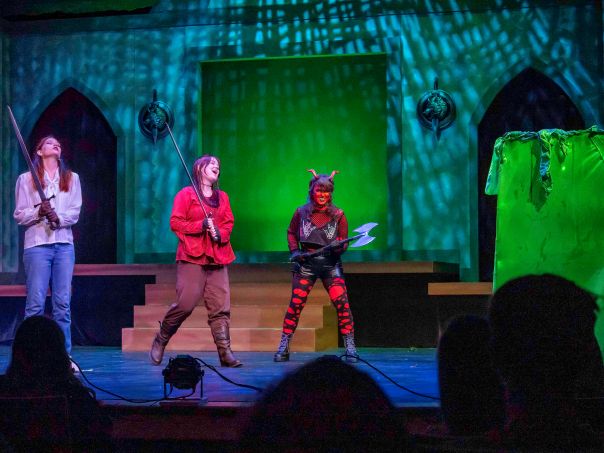
If you remember Hamlet, then you’ll understand that Mom marrying his uncle a week after Dad’s death rubs Juicy the wrong way. Now Juicy’s dad wasn’t as worthy a dude as Prince Hamlet’s: Pap was murdered in prison, where he was serving a sentence for… murder. Boogie, the victim, apparently had bad breath. That was enough.
We begin pondering the differences between Shakespeare’s Hamlet and Ijames’s Juicy as soon as Pap returns as a ghost – not on the battlements of the royal castle in Elsinore to Hamlet and Horatio but to Juicy and his cousin Tio (“A kind of Horatio”) from underneath the back porch, likely somewhere up in Caldwell County. With a Casper the Ghost bedsheet over his head before we see Pap’s orange prison suit.
Of course, if you’re not torn and ambivalent, you’re not really doing Hamlet, so Ijames would allow his neo-tragedy to occur in Virginia or Tennessee, across the border, or even Maryland. But not Alabama, Mississippi, or Florida. Different Southern vibe. And although Tio is watching porn on his cellphone when we first see him, Juicy’s world sits vaguely between the ‘60s and ‘80s “aesthetically.”
King Hamlet and Pap are also alike in getting briefed on the pertinent details as they transition into ghostliness. That’s how Pap knows that Brother Rev ordered the hit, though he may have been on his guard. Shakespeare’s king needed the info more, since he was offed in his sleep.
Do Tio and Juicy believe in ghosts – particularly when Ijames has Pap “doing ghost shit” in broad daylight instead of past midnight? Apparently, they do, for Tio divines with the same perceptiveness of Horatio that Pap’s ghost is silent towards him because he wishes to speak only with his son.
Ambivalence goes beyond Shakespeare when it comes to the key father-son relationship, for Pap abused both Juicy and his mom when he could lay his hands on them. In his current incorporeal state, abusing Juicy is no longer possible, so he can taunt Dad’s powerlessness all he wants – over what is obliquely a fat-shaming issue, for Pap tries to get his son to drop his candy bar. We likely join Juicy in his gleeful emancipation as he stokes Pap’s anger. He can still yell like hell, that’s for sure.
Even though Pap is calling for him to avenge his murder on a man who disgusts and bullies him, Juicy pushes back. Dad’s track record not only includes cruel abuse but also the tendency to show up on the front doorstep at odd intervals when he needs to ask a favor. Offing your brother is a pretty big ask, particularly when you yourself have served jail time for murder.
And Pap just might have a credibility problem. Even after Rev bullies him and punches him in the gut, Juicy wavers. The ocean of difference between King Hamlet and King Claudius is shrunk to less than a millimeter, for Ijames has decreed that the same actor will portray both Pap and Rev.
As it was in Elsinore, so it must be in humble Caldwell County: the play’s the thing to catch Rev’s conscience. Since Juicy doesn’t have the budget to hire a theatre troupe to perform a play – in fact, Mom just pulled his tuition money from the online university where he’s enrolled for a Human Resources degree – Juicy will play a game of charades with the newlyweds and their wedding guests specially concocted to grab Rev’s attention.
Naturally, the guests at Tedra and Rev’s backyard wedding reception are all “kind of” Hamlet characters, namely Tio and the revamped Polonius family. The two sibs, Ophelia and Laertes, are now Opal and Larry, their sententious dad is usurped by Rabby, a sententious mom. There are also episodes that further parallel Shakespeare, including one where Juicy must refrain in all good conscience from killing Rev while he’s saying grace, a soliloquy or five here and a nod to Yorick there. Other episodes curiously twist the original, most notably Juicy’s strife with Larry. It’s not about Opal at all.
While Ijames dodges and weaves in landing his punches and playing his games, he drops savvy references throughout his dialogue offering sharp reminders that he knows what he’s about. Telling Juicy how to cope with his new situation, Tio references Oedipus before we’ve even met the folks. Not only does this reference aptly describe Juicy’s feelings toward his dear mum and daddy, it subtly evokes the model that Aristotle uses in his Poetics in laying out his famed doctrine of the unities in tragic drama.
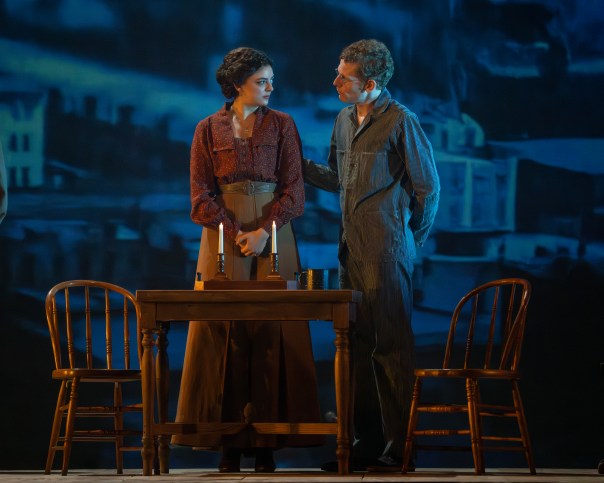
Yes, there are episodes in Fat Ham, not scenes.Ijames succeeds in reinventing his Hamlet by compressing it into a single day of action in seemingly real time, fulfilling the grand Aristotelian formula. The Bard, in typically five-act form, stretched his tragedy over at least five months, maybe nine. Ijames even works in three costume changes, two of them startling and one of them absolutely unbelievable. He will bend reality his way if he wants.
Each of the roles Ijames has lampooned is a plum, especially for Shabaza Vaird as Juicy and Brandon Johnson as Pap/Rev. Teaming with costume designer Gregory J. Horton, director Xulee Vanecia J makes this Juicy more gender-fluid than the playwright probably imagined, with Vaird amply going with the flow. There’s a wonderful tenderness to him, yet none of the defiance is missing from Vaird’s portrayal of a man who insists on wearing black to his mom’s wedding.
Johnson certainly feasts on both brothers’ vileness, not without some comical moments, and works well with fight choreographer Garrad Alex Taylor to spice up the action and ratchet up the dramatic tension. Both of him have the look of ex-cons, but Rev also has the swagger, complacency, and greed of a true snake. Completing the Oedipal trio, Mya Brown sparkles and effervesces as Tedra, flirting or subtly pouting, depending on whether she gets her way, with enough high energy for Juicy to wonder whether she’s actually happy.
In its third summer, Common Thread is an innovative and inspiring partnership between the theatre departments at Davidson College and North Carolina A&T University. Since it embraces both students and faculty in its productions, the company is perfectly constructed to deliver on a script like Fat Ham, which could easily be tainted by seasoned actors bending over backwards to simulate confused teens.
That doesn’t happen in this all-Black marvel, and it’s heartening that Thread’s best effort to date will also run up in Greensboro for the first time on the NCA&T campus. It could be a painful to experience an effortful attempt at what Kaia Michelle and Jeremiah Dennis accomplish so naturally in projecting the awkwardness and insecurity of Rabby’s spawn, Opal and Larry. Michelle is bold yet apprehensive in proclaiming Opal’s sexual orientation, while Dennis is somehow proud and sheepish in his military uniform. That will miraculously change.
Meanwhile, let’s not omit the exploits of La’Tanya Wiley as Rabby. Unlike Polonius, she isn’t channeling Cicero or Marcus Aurelius. Good lord, it’s all about Jesus.
Certainly all involved were consumed with making the epigraph on the front page of the program come hilariously to life. “What a piece of work is a man!” As the Nigga-Negro taunts at the top of the play faded from memory, Fat Ham delighted me – and concerned me – more and more. Why was Ijames doing what he was doing, and why must all these people be Black? What should the differences between Shakespeare’s noble Danes and Ijames’s common folk be saying to us?
I’m not sure I would have come up with any conjecture during the long ride home if my wife Sue and I hadn’t seen the superb US Premiere of Dark Noon at Spoleto Festival two weeks earlier. The Danish fix+foxy company uses a mostly Black cast – South African actors pointedly putting on “white face” makeup – to tell the mighty tale of western migration and the white man’s racist conquest of our native population.
Ah, but this time it was from the viewpoint of the victims. Among many other revelations, including our shameless greed for land and gold, the show helped me understand the intimate connection between the White America’s racism, their sense of superiority and entitlement, and their worship of the gun.
Such a sardonic view of whites doesn’t fully surface in Fat Ham. But please pay special attention from the moment Juicy looks at us and then at all who are left standing on the Barber Theatre stage, saying, “You know what they think ‘bout to happen right?” A few seconds later, he hammers it home: “We tragic.”
Can these contemporary North Carolinians truly commit to that?
‘Song of Rome’ at Spoleto Festival USA in Charleston. (Photo by William Struhs)
Looking down benignly at his Dock Street Theater audience, the newly anointed host of Spoleto Festival USA’s chamber music series, Paul Wiancko, gave us a slight ceremonial nod. “You have chosen wisely,” he said sagely.
But he wasn’t exactly speaking to me, since this was already the fifth program in the noonday series – the backbone of Spoleto – that I was attending this year. Nor was he speaking to the “eleven-ers” in the audience who were signed up for the complete set of programs down in Charleston through June 9.
He was speaking directly to those in the audience who would only attend one of the concerts. Today. And he would go on to ask us all to participate in making the experience special and unforgettable.
It would be very special – beginning with a Beethoven piano trio that showcased Amy Wang at the keyboard, Benjamin Beilman on violin, and Raman Ramakrishnan on cello. How’s that for diversity? My love affair with Wang’s artistry and demeanor had begun just two hours earlier when she played the Schumann Violin Sonata, teamed up with the Slavically expressive Alexi Kenney.
Enough to mightily crown most concerts, the Beethoven was merely a satisfying appetizer. For Wiancko had cooked up a powerful combo, calling upon two living composers that I was barely familiar with, Jonathan Dove (b. 1959) and Valentin Silvestrov (b. 1937).
Our contribution to the magic would be to withhold our applause between the two pieces. It was easy enough to maintain stunned silence after In Damascus, Dove’s heartfelt setting of Syrian poet Ali Safar’s grieving – and aggrieved – reaction to a senseless car-bombing in his nation’s war-torn capital.
The prose poems were achingly and angrily sung by tenor Karim Sulayman, perhaps most indelibly after an extended instrumental interlude, turbulently delivered by a string quartet that included Kenney, Beilman, Wiancko (on cello), and violist Masumi Per Rostad.
“We will be free,” Sulayman sang in Anne-Marie McManus’s ardent translation, “of our faces and our souls – or our faces and our souls will be free of us. And the happy world won’t have to listen to our clamor anymore, we who have ruined the peace of this little patch of Earth and angered a sea of joy.”
Sulayman was visibly in tears as the lights went down on In Damascus and pianist Pedja Mužijević entered with his iPad and sat down at the Steinway. In the dimness, Mužijević played Silvestrov’s Lullaby, an appropriate coda to a song sequence that began with the children of the Zuhur neighborhood in Damascus who would never wake from their sleep – or survive a bogus “holiday truce” – and ended with the evocation of mothers and loved ones who would always await their return.
Amazingly enough, this isn’t the only instance where Sulayman is singing about children caught in the web of brutal war and barbaric terror, for his wondrous voice also figures at Spoleto in the world premiere of Ruinous Gods, a new opera with exotic music by Layale Chaker and libretto by Lisa Schlesinger.
Co-commissioned by Spoleto, Nederlandse Reisopera, and Opera Wuppertal, Ruinous Gods is a fantastical deep dive into the mindworld of Uppgivenhetssyndrome, a rare traumatic response to living in the limbo of displacement. It was first observed in children detained in Sweden, but the syndrome has now been observed in refugee camps around the world. Hopeless children simply go to sleep in reaction to their endlessly unresolved status. Some die, others lapse into coma – sustained only by a feeding tube.
Encased in a surreal bubble over a grassy bed from scenic designer Joelle Aoun, that is how we find our sleeping-beauty protagonist, Teryn Kuzma as H’ala, when the opera begins. Mezzo-soprano Taylor-Alexis DuPont as her mom, Hannah, is stressing and blaming herself while two doctors, Overcast and Undertow, hover over their patient, unsympathetic researchers hoping to analyze and classify the disease.
Meanwhile, Sulayman is decked out in a feathery all-black outfit as Crow, the mentor who, like Dante’s Virgil, guides all these comatose children from around the globe into a common underworld dreamscape where all are free. Is that a spaghetti rainbow dropping down across the Sottile Theatre stage from the fly loft as the imprisoning globule lifts off H’ala, or is there an unfathomably large jellyfish floating above?
Sinuous, jazzy, and sensuously obsessive, Chaker’s music resurfaced in the jazz sector of Spoleto 2024 – at Charleston Music Hall, a venue never used by the festival before. Bigger than Spoleto’s customary hall for chamber jazz (and eccentric modern music), the Emmett Robinson at the College of Charleston, the Music Hall was an acoustic revelation and a welcome escape from the Robinson’s clean-room sterility. Bonus points for the stars that lit up on the black backdrop.
Attendance was astonishing, more than could ever be seated at the Robinson, as Chaker, leading her Sarafand quintet on violin – with an occasional vocal – delved into her two most recent albums, Radio Afloat (2024) and Inner Rhyme (2019). Having worked with Daniel Barenboim and his West-Eastern Divan Orchestra, Chaker has created a jazz equivalent in Sarafand with Phillip Golub on keyboards, Jake Charkey on cello, John Hadfield on drums, and Sam Minaie behind the bass.
Compared to her opera, Chaker’s jazz and her Sarafand personnel made subtler political points. But this wasn’t the only jazz gig that came loaded with extra cargo. Terri Lyne Carrington returned to Cistern Yard for a pointedly themed concert under the moon and the live oaks – with political firebrand diva (and NEA Jazz Master) Dianne Reeves as her special guest.
Carrington’s cargo was collected into her Grammy-winning album of 2022, New Standards, Vol. 1, the first studio sprouting of her pathfinding songbook collection, New Standards: 101 Lead Sheets by Women Composers. So without much preaching, her set was a celebration of Geri Allen, Gretchen Parlato, Eliane Elias, and – at a high summit where Reeves duetted for the first time with Christie Dashiell – the great Abbey Lincoln and her mesmerizing “Throw It Away.”
All these greats joined together again on Allen’s “Unconditional Love,” with Kris Davis on piano, Matthew Stevens on guitar, and trumpeter Etienne Charles all getting in their licks, plus spoken and dance stints from Christiana Hunte. Wow.
Theatre at Spoleto this season is densely messaged. Or not. The Song of Rome was deeply immersed in issues of immigration and sexism, with an overarching interest in the fate of republics, in ancient day Rome and 21st century USA. Cassette Roulette, on the other hand, was pure frivolity, barely deeper than its title and whole lot bawdier.
After starring in An Iliad last season, Denis O’Hare could be logically expected to follow up that one-man conquest with An Odyssey. Well, he has, sort of. O’Hare co-wrote A Song of Rome with Lisa Peterson, his Iliad writing partner, but this time he doesn’t appear onstage, handing over the acting chores to Rachel Christopher and Hadi Tabbal.
Christopher is Sheree in modern times, a grad student striving to learn Latin, and Octavia, Emperor Augustus’s sister at the dawn of the Roman Empire. Tabbal is Azem in present day, Sheree’s immigrant Latin tutor – and our overall storyteller – and the poet Virgil during the reign of Augustus.
So O’Hare is skipping over the rest of Homer to engage with Rome’s great epic, The Aeneid, knowing full well that Virgil based the first six books of his masterwork on The Odyssey and the last six on The Iliad. As a thematic bonus, O’Hare and Peterson discovered during their research for this world premiere that Virgil himself was a refugee, forced out of his ancestral home in Northern Italy by Roman avengers of Julius Caesar who got Dad’s estate for their prize.
Although Virgil’s epic was likely commissioned by Emperor Augustus, aka Octavian, doubt remains whether The Aeneid is a work of propaganda justifying the Roman Empire as divinely ordained – tracing Octavian’s ancestry back to Aeneas and Venus as meticulously as the New Testament traces Jesus back to King David, son of Jesse – or a subversive work by an immigrant genius settling a score. While getting handsomely paid to do it.
Octavia and Virgil go back and forth on this point because the Emperor’s sister is both an admirer and a keen reader, but both are critical of Octavian, who is hell-bent on buttressing the legitimacy of Rome while closing off its path back to a glorious Republic.
“The Republic is over,” they agree. And how about ours?
While Sheree is learning about the Roman issue that comes up as Virgil delivers more and more manuscript pages to Octavia over the years, Sheree must face the issue in American terms when Azem receives a deportation notice. Does she instantly jump to his defense and rescue, or does she immediately suspect him of criminal activity?
Meanwhile, Sheree is reading The Aeneid differently from Azem and Octavia. Why is Octavia left out of literary history if she played such a key role? Why are Virgil’s women, particularly Dido and Lavinia, so passive and pathetic while the strong woman, Camilla, is a she-devil?
Finding this insidious neglect and defamation rampant in literary history and beyond, Sheree comes up with a radical, shocking solution that she announces on her podcast. She will pour fuel over every single book piled on the Dock Street stage and burn them all.
When will all this vicious animosity end? Citing the end of Virgil’s epic, where Aeneas, the immigrant from far-off Troy, killed the vanquished Turnus instead of offering peace, conciliation, and mercy, Sheree answers us curtly lighting the flame: it won’t. Opting for chaos, she almost says it aloud – to hell with the immigrants. (Or give it to the immigrants, if you’ve heard of the Goths.)
Moments like that land hard at Spoleto. Deep in Trump Country, at the Sunday matinee of Ruinous Gods, there was a loud boo among all the lusty cheering as the singers took their bows. Good. The nurturing point of the opera, gushing with empathy toward immigrants worldwide, had hit home, no matter how you feel about it.
Depending on whether you were attuned to John Cameron Mitchell’s Hedwig and the Angry Inch cache, or whether you resonated with Amber Martin’s worship of Reba McIntyre, Bette Midler, and Stevie Nicks, Cassette Roulette was hit-and-miss, redeemed or further cheapened by Martin’s bawdiness. Nicks’ “Rhiannon” was the crowd fave and mine on the night I attended, getting a far more epic performance that you’ll hear on AM radio or an elevator. But neither David Bowie nor Midler got much of a rise. The diet of ‘70s and ‘80s hits didn’t draw much of a youth crowd to Festival Hall, which was made over to a quasi-cabaret setup.
Trombone Shorty slayed far more decisively at TD Arena, where his outdoor revels with Orleans Avenue were abruptly moved when rain threatened. At the height of the indoor bacchanale, Shorty paraded through the audience at the home of College of Charleston basketball with key members of the band (none of whom were named in Spoleto’s fabled program book). They slashed up the rear aisle of the stadium, swung around to the side of the gym and came down along the side.
Snaking through the stadium, Shorty & Orleans reigned over the reigning pandemonium. The prohibition against photography was washed out to sea in a riptide of glowing cellphones.
Shoot, the band was taking selfies! And through it all, the sound remained perfect, Shorty and his brass perfectly aligned with the rhythm section on the TD stage, absolutely distortion-free. Sure, a few dissenters and defectors also trickled through the aisles, accompanied by true believers seeking and returning with beverage.
The most pathetic sufferer sat right across the aisle from my wife Sue and me, hunched over, elbows on kness, with his hands tightly cupped over his ears. Probably needed a ride to escape. Maybe he would have fared better in the open air, where at least some of the sound could have escaped skyward through the live oaks of Cistern Yard.
Final week highlights: Bank on it, the Bank of America Chamber Music series has four more different programs to offer – and a dozen performances – before Spoleto wraps up on Sunday. The Wells Fargo Jazz lineup continues strong, with an all-star Latin twist. Puerto Rican saxophonist Miguel Zenón and Venezuelan pianist Luis Perdomo bring their Grammy-nominated El Arte Del Bolero albums to life at the Dock Street Theatre in a three-day, five-performance engagement (June 6-8) while Cuban percussionist extraordinaire Pedrito Martinez lights up Cistern Yard with an Afro-Cuban stewpot of infectious rhythm, Echoes of Africa (June 7).
After distinguishing themselves in Mahler’s Fifth, the Spoleto Festival USA Orchestra returns to Gaillard Center with Beethoven’s Third (June 5), plus a Rachmaninoff concerto for piano + trumpet and composer-in-residence Reena Esmail’s “Testament” for tabla and orchestra. Upstaged by a visitation from the Charles Lloyd Sky Quartet this past weekend, the Spoleto Festival USA Chorus rebounds with a two-performance run of The Heart Starts Singing (June 6-7), sporting another Esmail piece that will feature Wiancko’s cello – and an eclectic mix of works by Tomás Luis de Victoria, Rachmaninoff, Irving Berlin, and more.
The Festival Finale of yore is gone this year, but there’s more folk, funk, Americana, and alt-country in this year’s Spoleto lineup. Still to come are Andrew Marlin and Emily Frantz’s latest partnering, Watchhouse (June 5), with their own band-backed experiments in folk-rock playing at Cistern Yard; Grammy Award winner Aiofe O’Donovan (June 7) returns with the SFUSA Orchestra to Sottile Theatre; and Jason Isbell (June 8-9) headlines the final weekend with a two-night stint at the Cistern.
Theatre continued during Spoleto’s second weekend with sharply contrasting shows, the wholesome Ugly Duckling from Lightwire Theater and the savagely satirical send-up of the American West, Dark Noon, from the Danish fit + foxy company in its US Premiere. A similar dichotomy prevails this week as Australian company Casus Creations takes over Festival Hall with Apricity (June 6-9), a family-friendly mix of aerial and acrobatic astonishment, with sprinklings of comic shtick and moody music.
On the edgy side, RuPaul’s Drag Race fans can rejoice greatly as Season 9 champion Sasha Velour deigns to bring her presence to Gaillard Center with The Big Reveal Live Show! (June 6). Is Charleston’s big house big enough for drag’s Queen of Queens? The Holy City and Spoleto haven’t been so sensationally desecrated since Taylor Mac ruled the festival.