Category Archives: Theatre

Triumphant “Aïda” Cast Slogs Through Tedious Sir Elton Score

Review: Aïda

By Perry Tannenbaum

Strip away the triumphal march, the trumpets, and the whole processional parade – complete with elephants, if you’re lucky enough to see the famed outdoor productions in Verona – and we discover that Verdi’s Aïda is a rather compact story. The captured Ethiopian princess is at one corner of the love triangle, opposite her slavemistress, Princess Amneris. Both of them love Radamès, the dynamic Egyptian general who is ordained by the goddess Isis to lead the Pharaoh’s army against the forces led by King Amonasro, Aïda’s father.

Pulling against the strong Aïda-Radamès chemistry are their loyalties to their warring countries, the jealousy of Amneris, and the obedience that Aïda owes to her father. Sealing their fates, Pharoah rewards Radamès for capturing Amonasro in battle by promising his daughter’s hand in marriage to the victorious chieftain.

It’s fascinating to watch how Linda Woolverton modernizes the 1871 libretto in her book for the Disney version currently running at Theatre Charlotte – with a couple of deft feminist touches layered on.

Raised on soaps and romcoms, modern audiences could never abide a torrid relationship between romantic leads already established before the curtain rises. So Woolverton efficiently wedges a mini-courtship into her storyline, with Radamès giving Aïda to Amneris as a gift to lighten his beloved’s sufferings in captivity.

Verdi and librettist Antonio Ghislanzoni were perfectly content to portray Amneris as a cunning, vicious shrew from beginning to end. Not Woolverton. She gives the beautiful princess a slick character arc in a thorough makeover, starting her off as a vain and pampered clothes horse on loan from Legally Blonde. Amneris evolves into a peace-loving reformer who not only empathizes with the martyred lovers but also narrates their story, three or more millennia later, returning in mummified form, a shining presence in a gooey stew of museum mystery and reincarnation.

If composer Elton John and lyricist Tim Rice had done their jobs as well as Woolverton, Aïda would be a masterwork. It’s often amusing to see what John, Rice, and Theatre Charlotte do to compensate for the absence of Verdian spectacle – but it’s never thrilling, despite the collection of talent that director Corey Mitchell has assembled at the Queens Road barn. John’s parade of power ballads grows tedious as the evening wears on, and the longueurs are compounded by unnecessary outbreaks of dance that, notwithstanding choreographer Ashlyn Summer’s exertions, display little precision and less sensuality.

Mitchell previously directed this show for Northwest School of the Arts with a little more sparkle, orchestra, and budget – a production that ran briefly at Booth Playhouse in 2009. Maybe Sir Elton’s Aïda works better in the hands of high schoolers. The one holdover from the NWSA edition, Emily Witte as Amneris, is even more stunning this time around, most notably when she hits us with the full force of her arrogance in her “My Strongest Suit” showcase. It’s the kind of superficial villainy that will deeply satisfy fans of Wicked, Glee, and Kristin Chenoweth.

There is a slight country twang to Witte’s singing that would have added a bit of unique abrasiveness to Amneris, but music director Zachary Tarlton encourages the same style from Ron T. Diaz as Radamès, so that twang becomes an Egyptian trait – as if, in Disneyworld, everybody who hails from Memphis, whether it’s Egypt or Tennessee, sounds alike.

Further detracting from the gravitas Diaz should be aiming for is Radamès’ bizarre confrontation with his father, the evil priest Zoser. You wonder just how seriously we can take either adversary when costume designer Hali Hutchison seems to be mimicking Disney’s Aladdin in designing the mighty general’s costume and Zoser’s ministers brandish glowing fuchsia staves.

Diaz never gets a shot at a passionate solo, so he shines brightest in “Elaborate Lives,” sharing the best of the power ballads with his darling Aïda. They sing it full out, face-to-face, no frills, near the end of Act 1, Victoria Fisher’s lighting dimming around them to augment the drama. Maya Sistruck does nearly the whole evening as Aïda with a simple resolute dignity, allowing herself the luxury of discernable facial expressions only at peak moments when she is romantically consumed or royally pissed.

Other than taking radical precautions not to reveal her royal origins, I’m not sure what justifies Hutchison’s humble sackcloth design for a captive princess. We do upgrade to red in the palace, but why Amneris would tolerate such a plainly dressed servant is still baffling. Yet the illogic does pay off in an enduring dramatic contrast, first in the climactic tête-à-tête duet before intermission and shortly afterwards in the “Step Too Far” trio, the most self-consciously operatic moment in the John-Rice score.

Aïda is simply better and purer than these Egyptians are – not Memphis or Nashville at all! – and just knowing her ultimately makes them better and purer.

While Josh Webb’s set design is no more impressive than the costumes or the choreography, budgetary constraints may have been holding him back. The cut-rate budget and the lackluster score might obscure the fact that the excellence of the cast runs deep. Aside from most of the dancers, Howl Cooper makes the only inauspicious debut as Amonasro, though he definitely has a warrior’s demeanor.

Jason Hickerson makes a wonderfully scruffy Pharaoh, a Charlotte debut only slightly eclipsed by Carlos Jimenez’s usefully cheerful depiction of Mereb, the perfect Disney servant. Implausibly, Mereb draws more solo spotlight than Radamès, yet Jimenez is decisively upstaged among the supporting players by the steely-voiced Paul Leopard, fulminating melodramatically as the murderous, conniving Zoser.

Thank heaven for vampires, witches, and pagans. Otherwise, there would be no class of people left for all of us to wholeheartedly hate.


Fire, Fury, and Painful Memories Drive Wilson’s “Jitney”

Review: Jitney


By Perry Tannenbaum

Allowing for inflation and cost-of-living increases since 1977, fares at Becker’s Car Service seem to be fiercely competitive – so competitive that the five cab drivers at the core of August Wilson’s Jitney all seem to be barely scraping by. The drivers’ lounge, adorned with a decaying Ali-Frazier poster, has a ramshackle look to it with a dust-colored couch held together by generous swaths of duct tape.

We never see whether the drivers’ jitneys (slang for gypsy cabs) are in any better repair than this crumbling HQ, but the idea seeps in that the struggling black customers in the Hill district of Pittsburgh are in no position to press the point. Early on in this fine BNS Productions effort at Spirit Square, director Corlis Hayes pushes the pace hard enough for us to assume that we’re in the midst of an urban rush hour.

These are men in a hurry – who aren’t necessarily getting anywhere. Pretty much the same can be said for Wilson’s story until Becker himself arrives. He takes off a fedora hat and lays down a satchel, signs that he’s better off than his employees, but he takes turns answering the phone – a pay phone – and giving rides. Still not rushing his story along in his flurry of driver entrances and exits, Wilson has Becker announcing two key strands of the plot.

After keeping it from his drivers a little longer than he should, Becker tells Doub, his steadiest driver, that the city has earmarked the property for urban renewal. The Car Service office will be boarded up in a matter of weeks. If that weren’t enough upheaval, Becker’s son Booster is getting out of the slammer after serving 20 years for murder. Becker never visited his son even once during his incarceration, so this does not figure to be a joyous reunion.

If you’ve seen Wilson’s Fences recently, you will likely find echoes of Troy Maxson in the elder Becker’s sternness and stubbornness. If anything, the father-son chemistry will prove even more important here. But Becker is more of a people person, as he would need to be in running a business, and he has a few soft spots beneath his tough hide.

We see one of those when he gives Fielding, a former tailor who has destroyed himself with drink, yet one more chance to come back on the job and straighten himself out. Becker also shows strength and courage defusing a heated confrontation between Vietnam War vet Youngblood and the gossipy Turnbo, who has meddled in the younger driver’s domestic affairs, frustrated at not stealing his girlfriend Rena.

There’s a fascinating range of personalities and back stories among the core quintet of drivers plus the boss’s son. Baring their souls – and their motives – everybody seems to get a monologue. Nor do Hayes and lighting designer Tony Wright veil the kinship between these monologues and long, lyrical jazz solos. Hayes usually directs her actors to blow their solos straight into the Duke Energy Theater audience, while Wright intensifies the light where they deliver.

During the passionate showdown between Youngblood and Rena, where both have been right and wrong, each of the combatants has a heartfelt monologue. Yet Wilson had even more pure audacity in a casual scene where the often-comical Fielding meets the tightly-wound Booster. The playwright brashly showcases his virtuosity by unleashing two consecutive monologues, one by the rueful Fielding recalling his better days when he tailored suits for Billy Eckstein and Count Basie, followed by Booster’s recollection of his first hard lesson in life when, as a child, he had a vivid dream about riding a red bicycle.

With so many monologues so evenly distributed, you need a cast that’s strong, deep and – when Wilson digresses – engaging. Hayes and producer Rory D. Sheriff have definitely produced with this ensemble. Though he isn’t given free enough rein in the opening scene as Fielding (we should be sure that the $4 he borrows from Doub will go toward refilling his whisky flask), Gerard Hazleton shoulders enough of the drunkard’s comedy without letting us lose our warm feelings toward him.

There’s a little more comedy squeezed from the gossipy Turnbo by Tim Bradley, probably because his sleaziness and nosiness are so outrageous, but he also forces us to take him seriously when he goes ballistic on Youngblood. More on the periphery, James Lee Walker II gives the local numbers runner, Shealy, a dandified flair though we still empathize with his romantic difficulties. On the other end of the cunning spectrum, Danius Jones makes Philmore a singularly quirky and clueless passenger, attaining full dopiness only when he returns in his bellhop uniform.

Partly because they subtly echo the central father-son relationship, Doub and Youngblood are closer to the heart of Wilson’s drama than the men who garnish it with comedy or the colorful aspects of city life. Both of them are war vets, but Youngblood – if not as senseless as Turnbo makes him out to be – has been slightly warped by his Vietnam experience. Doub, traumatized and shaken to his core in the Korean War, has retained a stone-cold outlook beneath his cheery, avuncular demeanor.

With Keith Logan delivering Doub’s Korea monologue, it becomes the warmest moment of the evening, transcending its payload of advice for Youngblood. In its tacit acknowledgement of Youngblood’s essential goodness – and his confidence in Youngblood’s ability to benefit from sound advice – he’s a perfect model of the parenting skills that Becker lacks. Ironically, there are times when Logan’s acting is similarly exemplary for Jonathan Caldwell. While Caldwell brilliantly projects Youngblood’s immaturity and confusion, he could use a tip or two on either quickening his cue pickup or timing his delayed reactions.

Caldwell’s occasional awkwardness may slightly mar Youngblood’s scenes with Doub and Turnbo, but it meshes very well with Juanita Green in the confrontations with Rena. Hayes decrees a more conciliatory rapport between the lovers when we last see them than you might find in other productions, but Green keeps this becalmed closure from becoming saccharine.

Although Becker isn’t quite the perfect boss, he deals empathetically with his drivers, so there needs to be a powerful reason why he is so cold and cruel toward his son. John W. Price provides it indelibly in the most electrifying monologue of the night. The fire and thunder from Price as he’s excoriating Booster are unlike anything I’ve seen or heard from him before, fueled by white-hot fury and pain.

It’s an earthquake, and you can see Jermaine Gamble as Booster trembling amid the seismic shock. We get the idea from Gamble that Becker’s boy has grown up, hardened by prison, a fully formed yet scarred individual. Booster does fire back at his dad, but Gamble acutely calibrates the restraint and the hope that are wrapped into his resentments, almost like he’s still an adolescent in his father’s presence. It’s simply respect – all the more moving for its futility.

Within the space of two weeks, we’ve heard from two playwrights, Jeff Talbott in The Submission and August Wilson in Jitney, who have ignited their peak moments with the N-word. This one is far more unexpected – and shattering.

Playwright Imposter Goes Off-Script in “The Submission”

Group1_HiRes

Review: The Submission

By Perry Tannenbaum

A gay white playwright and a black actress walk into a bar… Not a promising lead-in to a joke, because nothing funny or violent should happen. Writers who pen scripts about racists or homophobes for theatre, film, and TV usually draw a free pass when we ask ourselves if they might be harboring prejudices of their own. Same with the actors who appear in such productions. Surely they are as progressive and tolerant as the authors who create their roles.

Maybe more progressive and tolerant than we are.

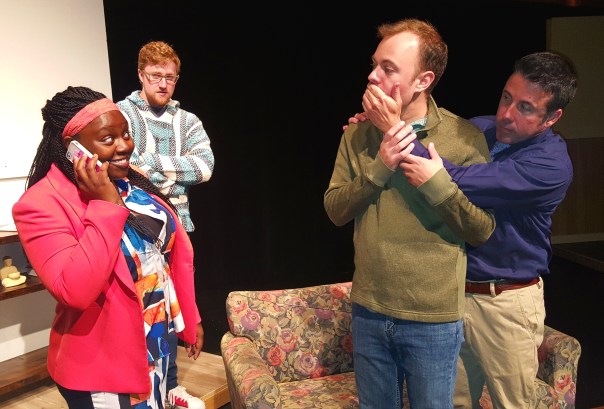
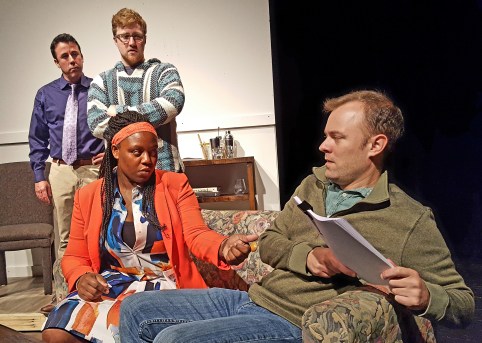
In Jeff Talbott’s The Submission, currently at Spirit Square in a Three Bone Theatre presentation, we can trash those presumptions – under circumstances that would ordinarily strengthen them. Talbott’s protagonist, white gay playwright Danny Larsen, has written a drama about a black alcoholic mom, her cardsharping son, and their struggles to escape the projects. Takes some empathy to do that, right?

Danny has never had a play of his produced before, but he thinks this one might be special. His best friend Trevor agrees, so Danny submits his street saga to the prestigious Humana Festival, hoping that he will be among the elite few whose work will be premiered at the annual New Play Festival in Louisville. But to make sure his whiteness doesn’t become an obstacle in recognizing the merits of a play with black leads, he invents the African name of Shaleeha G’ntamobi to become its author.

When Humana phones to tell Danny that his script has been selected for the New Play Festival, he could own up to his subterfuge right then. But – reasonably or not – Danny is afraid that the prize will be withdrawn of he comes clean. So he temporizes, saying the playwright isn’t at home, and hurries out to hire an actress to impersonate Shaleeha.

It takes a few moments before the chosen actress, Emilie, can grasp Danny’s intentions – and for Danny to convince her that there’s no kinkiness involved. Wile Danny has demonstrated considerable empathy toward black people, Emilie is honestly impressed with the play, despite the playwright’s fears that he has trespassed onto forbidden territory. Plenty of goodwill on both sides.

Yet things go badly after the first meeting. Danny has a number of personal insecurities, more than a little buyer’s remorse, but worst of all, casual prejudices against black artists that he hasn’t faced up to. They begin to pour out during a second meeting – at a coffee shop, not a bar – when Danny refers to black actors as “blactors” and the awards they win as “blawards.” The unsavoriness of that viewpoint is compounded for me by the signals I get from Danny that feels entitled to speak his mind so brusquely because he’s Emilie’s employer.

Emilie doesn’t listen to these slurs passively – unless you construe a response like “You’re so full of shit your eyes are brown” as deferential. What began as a mutually beneficial relationship has already degraded into an uneasy détente. As the pre-production process unfolds in Louisville, with Danny missing out on all the little perks of close contact and communication with the big-name artists converging on the festival, Danny’s resentments and jealousies heat up and his attitude toward Emilie becomes more toxic. Dropping the director’s nickname can set him off.

No doubt about it, the balance of my sympathies went out to Emilie as she kept drawing Danny’s scorn for merely doing what he hired her for. Even when some of Emilie’s anti-gay attitudes surfaced, things didn’t even out for me, because some rational thought verifiable observation was actually mixed in with her resentment – and because Danny goes nuclear in their final verbal faceoff.

If you can see this explosion coming, the venomous crossfire may feel a wee bit overlong, and I was not very convinced by the way Talbott has Danny handling the aftermath of his festival acclaim. But director Sidney Horton keeps the action as taut as possible, and Scott A. Miller keeps us fascinated with each new slimy twist of Danny’s personality. We can believe that the same insecurities inside Danny that produce such aberrant attitudes might also produce great art.

On the other hand, Talbott has incorporated some entertaining – and dramatic – complexities into Emilie. In her Charlotte debut, Lechetze D. Lewis captures all that’s engaging and spontaneous about Emilie and all that’s strong. Not only does she deliver a groupie’s euphoria while she’s mingling with theatre royalty, she adds an extra dollop of giddiness as romance blossoms between her and Trevor. You don’t really marvel that a free spirit like this would go off-script when she’s supposed to read Danny’s acceptance speech.

But is she more cunning and All-About-Eve than she first appears? That’s a big question Talbott keeps nicely float, helped by Lewis’s pugnacity.

Trevor is caught in the middle of the crossfire as he becomes more seriously involved with Emilie. He’s somebody who readily grasps Danny’s blind spots, and Daniel Henry perfectly calibrates his weakness as a right-minded peacemaker – so I completely bought his allowing himself to be told to shut up while the main battle raged.

I’m not sure that Talbott didn’t intend Pete, Danny’s CPA-like partner, to be more of a clueless hunk. Yet Horton’s somewhat outré casting choice, Dan Grogan, keeps things very real during the marital infighting. Though Pete remains a needless appendage in the plot, he’s a stuffy outsider who makes our badly behaving protagonists seem more palatable. There’s an intentional poetic justice when Grogan’s best moment happens while he’s offstage. He’s that untheatrical.

Talbott is appealing with his self-regarding cleverness, particularly when Danny’s play mirrors his own. But more often, he seems intent on wearing the David Mamet mantle for faithfully transcribing Generation X. Sentences from these 28-year-olds repeatedly proceed after multiple false starts and loose fragments, often getting tangled in multiple detours before reaching a period – particularly when Miller deftly navigates as Danny. Every person onstage, especially the artists, seems compelled to drop at least two f-bombs with every breath.

Peppered with fucks and the occasional shit, the dialogue at Duke Energy Theatre doesn’t shock me so much as irritate me as The Submission barrels along. If this tedium and annoying effect are the crux of Talbott’s point, he’s making it too obliquely. And if he’s trying to assert that effing Gen-Xers really effing talk this way, I do not effing agree.

But selfies of a hot actress’s boobs messaged to her boyfriend? In the age of Anthony Weiner (and Snapchat), I wouldn’t be shocked to learn it’s happening right now.

A Farce That Turns Fierce

Preview :  Three Bone Theatre’s The Submission

By Perry Tannenbaum

We’re right to be suspicious of leaders who loudly spout their righteous certitudes. Thoughtful people know that moral rectitude, ethnic traditions, civil liberties, and political correctness can often crisscross into bewildering tangles and conundrums.

Sidney Horton, who is directing Three Bone Theatre’s The Submission, puts it more bluntly: “We all are clumsy when we deal with race and sexual orientation.”

Opening at Spirit Square this Thursday, Jeff Talbott’s comedy drama goes one better than holding up a mirror to our clumsiness. The playwright turns his mirror back around from his audience and shows that the same clumsiness – and assorted prejudices – also afflict theatre artists.

Talbott’s protagonist, Danny Larsen, has written a play about an African American mother and her cardsharping son striving to escape the projects to build a better life. Trouble is, Danny is white, which could seriously hurt his chances of getting produced at the prestigious Humana Theatre Festival, where he submits his manuscript. At an ill-advised moment, Danny decides to overcome this liability by submitting his playscript under the very African name of Shaleeha G’ntamobi.

Getting selected for the festival compounds Danny’s woes, because he can’t come clean about his true race and gender. Instead, he decides to hire a black actress to bring Shaleeha to life. But Danny is in for a lot more blowback than he bargains for: Emilie isn’t buying Danny’s premise that, just because he’s gay, he can understand the challenges of growing up black in America.

Horton’s choice to play Danny isn’t exactly surprising. Tackling Talbott’s playwright, Scott Miller is playing his second writer in the past four months after his role as Trigorin in Stupid F@#%ing Bird, an Anton Chekhov knockoff staged by Actor’s Theatre. It’s also déjà vu for Miller with Three Bone at Duke Energy Theater, where he was Martin, the most promising writing student in the acerbic Seminar last August.

“Trigorin in Stupid F@#%ing Bird was a joy to play because he’s one of those characters that knows how sleazy he is and revels in it,” Miller says. “Danny is the most troubling to play, and the most challenging in many regards. He justifies his prejudices and thinks his self-appointed victimhood gives him license to do more-or-less whatever he wants.”

Standing up to such insidious entitlement is a formidable task, and Horton has made a bold choice in casting his Emilie. After returning to the Carolinas from Emerson College in Boston, where she earned a graduate degree in publishing, Lechetze D. Lewis has circled the QC in three previous outings – two in Concord, one in Mooresville – but her role in The Submission will mark her Charlotte debut.

“Lechetze had a fire about her in auditions,” Horton recalls. “I knew I had to have someone strong that could more than hold her own against Scott. I took a chance with Lechetze, and boy did it pay off.”

Needing to ensure that all four of his cast members felt comfortable with one another at rehearsals, Horton made sure there was plenty of discussion about the issues that Talbott’s script addresses. Yes, there were disagreements as the cast talked things out, but professionalism has prevailed.

“The play deals with LGBT rights, racism, discrimination, affirmative action, non-traditional casting and who has the right to say or do things when it comes to someone else’s identity or culture,” Horton declares. “All of these issues are pretty hot right now in America – we are more divided now that we have been in recent years. The thing that strikes me most, and one of the main reasons I wanted to do this play, is it deals with these issues in the arts community. We as artists like to think of ourselves as being all-accepting and non-judgmental. Are we really?”

With such questions floating in the air, rehearsals can be stressful. In the heat of the moment, hurtful comments hurled in your face by a fellow actor addressing your fictional character can still hurt. Identifying with Emilie as a black artist, as Lewis must, she can hardly be invulnerable when the conflict with Danny has so much relevance to her daily life and self-image.

“Something that really gets to me is his idea that black actors who win awards don’t deserve to win what was created for whites,” Lewis says. “As an artist, I hope that any awards I receive will be acknowledged as something that my hard work has earned… but Danny doesn’t see it that way. Scott is an amazing actor to work with and he definitely doesn’t hold these views, but he’s talented enough to make those words sting. I am so lucky to be working with an actor who takes the time to check in on how we’re both feeling and if we’re okay to move forward.”

Horton has also been helpful for Lewis, frequently reminding her that she does win in the end. Conversations with Miller and the other two cast members, Dan Grogan and Daniel Henry, about how the script has affected them personally have been doubly beneficial for Lewis – not only soothing her emotions but helping her to shape her performance.

Of course, Emilie also dishes out a harsh word or two.

“I will admit to having a bit of fear regarding how she’ll be perceived,” Lewis confides, “because so much of what she says is hypocritical. But it doesn’t mean that, in some aspects, she’s completely wrong.”

Horton has another succinct comment about the intensity of the crossfire in The Submission: “Thank God for the comedy in this show – it makes it palatable.”

Talbott doesn’t turn on the heat immediately. There’s a certain point, says Miller, when the tone begins to change. Even then, there’s a gradual crescendo leading up to the inevitable fireworks between Danny and Emilie. Along the way, we realize that Talbott’s farcical plotline isn’t going to play out strictly for laughs.

At the same time, the playwright is turning his telltale mirror toward us. There will likely be a recoil factor when we recognize ourselves.

“While watching The Submission,” Miller cautions, “many people will agree with some of the controversial things the characters say. I predict several lines will get a chuckle before the audience realizes the inappropriateness of the character’s comment. The play is not out to condemn or chastise anyone in the audience. But I think – or hope – it will make many think about their implicit and explicit biases.”


ShakesCar Puts Women Behind “The Iron Mask”

Review:  The Man in the Iron Mask

By:  Perry Tannenbaum

Hand it to Shakespeare Carolina and Amy Schiede. Producing their own adaptation of Alexandre Dumas’s The Man in the Iron Mask outdoors at the Winthrop University Amphitheatre, they haven’t stinted on the swordplay or the fighting. Even though two of the major swashbuckling roles – identical twins who take turns ruling France as Louis XIV – have been handed over to women (including Schiede herself), the hostile action sustains a high standard.

Better yet, in choosing the final installment of the epic Three Musketeers saga, they’ve also maximized the drama and the suspense. Some of our heroes didn’t survive when Dumas closed the book on Aramis, Porthos, Athos, and D’Artagnan. Like the film and TV series before it, Schiede’s adaptation takes a free-range approach in incorporating plot points, assigning actions to various characters, and determining their fates. Perhaps the most suspenseful element is Schiede’s choice of which identical twin, Louis or Phillipe, ultimately sits on the throne.

The 1937 Hollywood version had it differently than the novel, serialized between 1847 and 1850.

There’s no hurry in unveiling Aramis’s plot to unseat King Louis as he brings Athos to a tailor to be measured for evening attire worthy of a reception that superintendent of finances Fouquet is hosting at his home for the conceited monarch. Aramis will need both Athos and Porthos to help free Phillipe from the Bastille, where he has been imprisoned since birth, unaware of his own royal origins. But we won’t learn the motives for Aramis’s machinations until much later. Needless to say, only lofty ambitions would justify such risk.

Fellow musketeers, Athos and Porthos don’t question Aramis closely at the outset, After all, didn’t they originate the famous gung-ho “All for one, and one for all!” slogan? But Aramis is sly enough not to divulge his scheme to D’Artagnan, who is fiercely loyal to the king despite reservations about Louis’s character. So with finance minister Colbert intriguing against Fouquet, D’Artagnan protecting Louis, and Phillipe totally ignorant about all that reigning as the king of France entails, there is plenty of suspense surrounding the success of the three musketeers’ plot.

Obviously, the perils won’t be over if Phillipe is secreted onto the throne.

With straight-arrow D’Artagnan on the royalist side of the conflict, you might experience some ambivalence about whom to root for as the moon rises over this production. David Hensley is rather starchy and subdued as D’Artagnan at the outset, making it easier for us to lean toward Aramis and Philippe, but Hensley does perk up when his king imperils his pals.

Tom Ollis makes sure that we see Aramis as more rascally and duplicitous than noble, but Schiede epitomizes naïveté and nonchalant regality as Philippe. She is surely the more righteous and beneficent claimant to the throne, especially since Katie Bearden revels in Louis’s arrogance, even when the monarch is cast into the Bastille and encased in the iron mask.

Charles Holmes directs at a near-galloping pace, which accounted for some bobbled lines on opening night and some audibility dropouts, particularly from a couple of the women. Nobody will find Holmes’s set designs particularly lavish when Louis holds court, nor do we descend into dim dreariness when we shift to the Bastille. Yet I liked the overall concept, placing the kings’ dungeon up a flight of stairs and above the action rather than below or in a dingy corner. Homage is paid to the idea that royals are imprisoned in towers awaiting their fates – and angelic Phillipe’s early monologue about being content with the daily sight of the skies plays better there.

Holmes also lurks onstage as Athos, sufficiently lighthearted to be carried along in the perilous drift of the musketeers’ plot, yet tender enough to be broken by the death of his son. David Hayes is even more rightfully cast as Porthos, the Ajax among the musketeers. Unfortunately, the prop fashioned for him at a climactic moment – the barrel of dynamite that he hurls into a tunnel – doesn’t sufficiently emphasize his preternatural strength.

A richer script from Schiede would have given Chris O’Neill more to work with in evoking Fouquet’s corrupt tendencies, but that opens the door for Gina Belmont to come off all the more wicked as his rival, Colbert. More detail might have helped us determine whether Anne, the queen mother, was duped by Colbert or strategically taking his side. Amy Hillard is so icily imperious as Anne that she’s also mysterious. Watch her faint when she sees the two twins standing in front of her for the first time. You’ll never know whether she’s shocked to learn she has two sons – or shocked to find that her evil plot against one of them has failed.

Chicklet Is Back – All Five of Her!!

Preview: Psycho Beach Party @ The Warehouse PAC

PsychoBeachParty5[5]

By Perry Tannenbaum

Odd juxtapositions like ketchup and cantaloupe don’t always work on your taste buds. But in comedy, the results can be spectacular. Ranging far beyond the incongruities of The Odd Couple, actor/playwright Charles Busch created a sea of contrasts and hairpin turns for himself, bridging the gap between Gidget and Alfred Hitchcock in Psycho Beach Party.

Combining the sunny surfboard innocence of Gidget with the multiple personalities that marked Marnie, the title character of a Hitchcock thriller, Busch became Chicklet in 1987, tossing flamboyant cross-dressing into the mix. Four years later, Alan Poindexter brought the role to Charlotte at the Pterodactyl Club under the direction of George Brown, a prime reason why the future artistic director of Children’s Theatre took CL’s Actor of the Year honors for 1991.

Fast-forward to 2017 as The Warehouse brings Psycho Beach to Cornelius for a three-week run starting on Friday. The most recent sighting of a Busch lampoon in Charlotte was The Divine Sister in 2013, preceded by Queen City Theatre Company’s Die Mommie Die in 2008. Psycho Beach hasn’t washed ashore anywhere in the Metrolina region since BareBones Theatre Group produced it – for a second consecutive season – in 2005.

Busch pretty much surrendered his enfant terrible status when he crafted a Broadway hit, The Tale of the Allergist’s Wife, in 2002. In an age when importance is gauged by what’s on people’s tongues and in their tweets, Busch’s trusty Hollywood targets – Gidget, Hitchcock, Psycho, Joan Crawford – have also lost traction.

You have to explain a lot of the once-familiar references to today’s audiences. Same goes for today’s actors. Jesse Pritchard, who takes on the role of Chicklet, admits to a learning curve.

“I was not familiar at all with the play,” he says. “It seemed funny, and so I wanted to try it out. I did have a bit of a brain blast looking into all of the different cultural references that the play portrays, but other than that, it all came over pretty well.”

PsychoBeachParty2[13]

Chicklet is your basic beachcombing ingénue, innocent and wholesome, hoping to capture the eye of ace surfboarder Kanaka. Embedded within the demure Chicklet is the personality of dominatrix Ann Bowman, whose desires go far beyond The Great Kanaka, all the way to world dominance.

And there’s far more lurking inside of Chicklet, expanding the diva role.

“I don’t even think I know all her personalities yet,” Pritchard confides. “Tylene is a bit of a stretch, a strong black woman in a loving relationship. She may be the biggest stretch because it’s hard for me to embody her truthfully. Doctor Rose Mayer is like the mom of the group. The accent is a bit much, but I feel like I’ve made headway with her. Steve is also fun, the male model.”

Behind all this pathology? That’s where Joan Crawford gets layered on, channeled into Chicklet’s harpy mother, Mrs. Forrest. Two divas will dominate Warehouse’s diminutive storefront stage, with Mara Rosenberg taking on the Mommie Dearest allusions.

Presiding over the auditions, director Vito Abate liked Pritchard’s stage presence and his ability to capture Chicklet’s girlish innocence. But of course, the comedy needs to go nuclear.

“I was fortunate enough to have Mara and Jesse audition together,” Abate reveals, “and there were instant fireworks and a connection between them. I’ve had the pleasure of working with Mara before, as an actor and director. I knew she would be good fit for the role. She captured the passive-aggressive nature of Mrs. Forrest, and I knew she’d enjoy taking on the different ages and aspects of the character.”

A mainstay at Theatre Charlotte, where he originated the Just Do It series, Abate’s most recent wallow in trashiness came when he directed Sordid Lives at Spirit Square last fall. That production featured Ann Walker as LaVonda, reprising the role she played onscreen and in the TV series.

PsychoBeachParty3[14]

Both of those stages dwarf the storefront in Cornelius where Abate will be bringing his Beach. That suits him fine.

“The intimacy of the Warehouse really lends itself to the fluid nature of this show,” Abate insists. “Every time I see a production in this space, I have a sense of being part of something quite special happening between the actors and the audience, and it’s a unique theatre experience. The title of the play strongly suggests a party and that’s exactly what we plan on delivering!”

Abate got a taste of that intimacy as a performer when he appeared in Fuddy Meers three years ago. In the eight-year history of Warehouse Performing Arts Center, Fuddy Meers, along with Wonder of the World and Mr. Marmalade, has been as edgy as it gets. Red, Sylvia, Road to Mecca, Last of the Red Hot Lovers, and An Empty Plate at the Café du Grand Boeuf are the more customary style of wares at 9216-A Westmoreland Road.

Boomer nostalgia and the silly summer season may prove that the time – and the tide – are right for bringing the smuttiness and perversion of Psycho Beach to Cornelius. America has evolved so much in the 30 years since Busch introduced Chicklet & Co. that’s it’s likely politically incorrect to call anything in Psycho Beach smutty or perverted anymore.

“The first group sale [of tickets] was several weeks ago and it was from a senior community in Davidson!” says Abate. “It’s summertime and in my opinion it’s always time to laugh, and this is a perfect show for both. I’m sure many who come will be fans of the movie, some of Charles Busch, and others just out to see a comedy.”

Pritchard’s Charlotte debut back in February, as the Clybourne Park emissary in A Raisin in the Sun, didn’t exactly give him the chance to show off his comedic talents. But he feels like Chicklet is nearer to his wheelhouse than Karl Lindner. Down at Winthrop University, where he earned his Performing Arts degree, Pritchard did some cross-dressing as the sidekick in Leading Ladies, and he logged additional comic turns at Rock Hill Community Theatre, including Hillbilly Hankerin’.

He takes direction well, according to Abate. But there’s a reason for that: “Vito definitely has a vision and a keen eye to detail,” says Pritchard, “and so I’m working to make it just as he sees it.”

Abate has been very satisfied with his cast as opening night approaches, and he’s confident that his dueling divas will shine brighter afterwards. “I expect their chemistry to grow during the course of the run, with a mix of typical teenage mother-daughter relationship stuff with some severe psychological and behavioral problems thrown in.”

More Empathy for a Barbaric Monarch in the Touring “King and I”

Review: The King and I

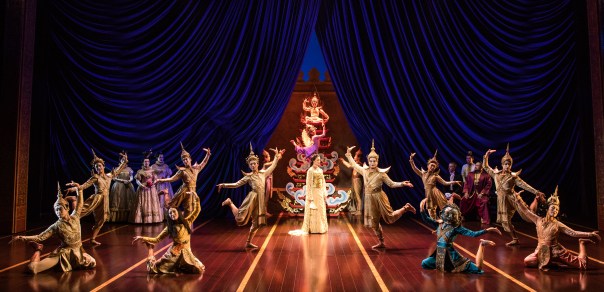
Laura Michelle Kelly, Baylen Thomas and Graham Montgomery in Rodgers & Hammerstein's The King and I. Photo by Matthew Murphy

By: Perry Tannenbaum

When I saw The King and I presented on a thrust stage at the Stratford Festival of Canada in the summer of 2003, I struggled for superlatives, convinced that this was the best production of the Rodgers & Hammerstein classic that I’d ever see. While the Asian spectacle and the beloved R&H hit parade were given their due, both were subordinated under Susan Schulman’s direction to the conviction that this is a theatre classic, presented on a thrust stage at Stratford’s marvelous Festival Theatre.

Though I heard wonderful things about the recent Lincoln Center production at the Vivian Beaumont Theatre – another thrust stage – I was reluctant to risk disappointment in comparing Bartlett Sher’s direction to Schulman’s. Well, the touring version that has just touched down in Charlotte dispels my doubts. Leaning more toward spectacle and theatricality, unafraid of a cliché or two, Sher’s King and I took me by surprise with its emotional power.

Wonders begin early, with the prow of a large ship sailing onto the stage, surely astonishing when it docked at the Vivian Beaumont in New York and no less amazing as part of the touring production now at Belk Theater. A few minutes later, when Anna Leonowens and her young son Louis debark in Bangkok for their adventures in the royal palace of Siam, we realize that getting the ship off the stage gracefully is a feat that easily equals bringing it on. Doing it while simulating the bustle of Bangkok adds to the delight.

Laura Michelle Kelly as Anna and the Royal Children of Rodgers & Hammerstein's The King and I. Photo by Matthew Murphy

One of the enduring hallmarks of Hammerstein’s book is the culture clash between the starchy propriety of the British teacher, Anna, and the silky sensuality of the Siamese. Catherine Zuber resplendently represents the clash in her costume designs – whether it’s the eye-popping colors worn by the King’s wives and children or the frilly hoop skirts that give Anna her aura. Yet there’s a political undercurrent that widens the gulf: Anna hails from an empire ruled by a woman, Queen Victoria, while the King claims superiority over all his subjects and expects absolute submission from all his wives.

Laura Michelle Kelly and Jose Llana in Rodgers & Hammerstein's The King and I. Photo by Matthew Murphy

Constantly reminding him of his promise to house her outside the palace while she teaches his wives and children, Anna astounds the King with her uppity-ness and tenacity. Were it not for the efforts of the King’s chief wife, Lady Thiang, to hold things together, this doomed relationship would quickly disintegrate. Sher deftly underscores Thiang’s subterranean feminism, so Joan Almedilla’s “Something Wonderful,” usually sung as a desperate supplication, emphasizes Thiang’s nobility – easily the most emotionally shattering moment of the show.

Raw realism is at the heart of this appeal. You can guide him to self-fulfillment. I cannot.

The most dramatic moment occurs where the three main plotlines converge. Early on, Tuptim is presented to the King as a gift wife from the ruler of Burma – by Lun Tha, the Burmese emissary whom Tuptim actually loves. The third storyline, the King’s attempt to impress British officials and debunk reports that he is a barbarian, propels much of the action, elevating Anna’s usefulness to the King and hatching the famed “Small House of Uncle Thomas” play-within-the-play.

After this triumphant presentation, Tuptim is caught trying to run away with Lun Tha, and we get the most forceful denouement I’ve ever seen in any production of this musical. When chief minister Kralahome (a wonderfully stolid Brian Rivera) tells Anna, “You have destroyed the King,” we can believe it.

Jose Llana is stern and imperious enough as the King of Siam when he needs to be, but he infuses more hearty mischief into navigating his difficulties with Anna, adding to the notion that, yes, she could be a little more indulgent and understanding. Complementing that portrayal, Laura Michelle Kelly never stints on Anna’s primness, firmly distancing herself from intimacy and sexuality until the moments when the charming rapprochement between the schoolmarm and the King reach peak temperature in “Shall We Dance?”

Kelly’s “Hello, Young Lovers” reads as a matronly approval of love from someone who has renounced it for herself, so it’s delicious to discover that old friend Sir Edward Ramsey – a veddy British Baylen Thomas – perceives this renunciation so much more readily than the King. Deflecting the question of whether the King is a blindly driven barbarian in his lusts, Hammerstein skirted the tender issue of whether the Siamese monarch ever took advantage of Tuptim.

The cast of Rodgers & Hammerstein's The King and I. Photo by Matthew Murphy_edited-1That opens a path for Manna Nichols to sing her solos and duets as Tuptim with liberated strength, expanding upon the intelligence that was always hers when she presided over the “Uncle Thomas” ballet. Kavin Panmeechao adjusts beautifully as Lun Tha in the duets, not quite as regal as his lover but admirable in his steadfastness.

All the silky cutesiness of the small fry is retained in “The March of Siamese Children,” but the two prime youths both count as the story unfolds. Each in his own fashion, Graham Montgomery as Louis Leonowens and Anthony Chan as Prince Chulalongkorn, the heir to the throne, is modeling the aristocratic discipline we expect of a first-born. More than Montgomery, Chan gets to model the realization that our parents aren’t perfect – and that we must move on from there.

The lessons are more meaningful for the Prince, who is the last of Anna’s students to show his appreciation for the very best in her, her maternal love. It’s a key reason why this edition of The King and I ends up feeling so warm and satisfying when all the fundamental disagreements between the title characters have played out and the Prince sets forth on a new path.


CPCC’s Comedy of Tenors Has Plenty of Doors and Plenty of Farce

Review: Comedy of Tenors

By: Perry Tannenbaum

Ken Ludwig has written over 20 plays and musicals over the past quarter of a century, nine of which have now been presented in Charlotte. While the books for his two Gershwin musicals, Crazy for You and An American in Paris, display his craftsmanship, Ludwig’s most enduring comedy is undoubtedly his first Broadway hit, Lend Me a Tenor. First produced in 1989, Tenor was converted to a London musical in 2011, after a Broadway revival the previous season. So why shouldn’t the playwright entertain the notion of recycling his Tenor characters into a sequel? The idea evidently seems so natural to Central Piedmont Community College Summer Theatre, an organization that rarely produces a musical or a comedy that isn’t at least a decade old, that it has brought A Comedy of Tenors to Pease Auditorium less than two years after it premiered in Cleveland.

Ludwig brings back the arrogant and flamboyant Italian tenor Tito Merelli and his wife Maria, both highly passionate and usually squabbling. Impresario Henry Saunders, formerly the GM of the Cleveland Grand Opera, is now bringing the greatest concert in the history of opera to Paris, still as nervous, domineering, and hot-tempered as before. Saunders is provoked, but it isn’t by his son-in-law and former assistant Max, whose singing prowess was discovered in Cleveland a farce ago. Max is now on the bill as one of the four tenors who will wow Paris, but his father-in-law feels free to yank him out of rehearsals anyway to deal with the crisis du jour.

Fresh blood stirs up the fresh complications and misunderstandings. Back in Cleveland, it was Saunders’ daughter who was the victim of mistaken identities. Now she’s back in Cleveland, married to Max, and on the verge of delivering his first child. Instead, it’s Tito’s daughter Mimi who is our ingénue, embarking on a similar path of confusion. She’s in love with the third tenor on the bill, Carlo, but they haven’t yet summoned the nerve to divulge their marriage plans to her parents. In the hurly-burly of evading discovery by the Merellis, Carlo tells Maria of his plans to marry her daughter, but the eavesdropping Tito gets a vivid impression that his wife has become Carlo’s sex slave. On the flipside of this specious reason for jealousy, a real one happens to be in town, Russian soprano Tatiana Racon, Tito’s old flame. Almost forgot: on the day of the performance, the fourth tenor, Jussi Björling, cancels to attend his mother’s funeral. They will need to replace him.

Besides the repeating characters, the hotel suite setting, performer dropouts, and the last-minute frenzy of preparing to go onstage, there are other holdover motifs that link Ludwig’s Tenor farces. Both of them have pesky bellhops, both have fast-forward mashups of the entire show before the final bows, and whether your access route is Shakespeare or Verdi, there are comical uses of Othello to watch out for in both pieces – more subtly done in this newer farce. Under the direction of Carey Kugler, that’s about all the subtlety you will find, for the script offers an abundance of physical comedy. Slapping, frantic hiding, broad suggestions of sexual activity, and a plateful of tongue are all on the menu. There is scurrying galore during the countdown to the concert, and Biff Edge’s scenic design provides four doors plus a patio looking out on the outdoors for farcical entrances and exits.

This is 1936, so Ludwig could easily be forgiven for making his operatic saga all about the men. Yet the women aren’t altogether objectified, and they certainly aren’t marginalized. The Russian temptress Racon can carry herself like an established diva, and we sense that Mimi isn’t destined to be a hausfrau either, since she is embarking on a movie career – a happenstance that enables costume designer Rachel Hines to expand the fashion gallery beyond eveningwear, formalwear, and lingerie. Nor is Maria, Ludwig’s Desdemona, the same pure and worshipful seraph we find in Shakespeare. In addition to the vamping, it’s the women who have the lionesses’ share of the slapping and straddling.

Drugged and suicidal in the previous Lend Me a Tenor, Tito emerges as our hero in the sequel, supplanting Max. Surely this is Craig Estep’s finest hour in straight comedy as Tito and his lookalike, the pathologically talkative bellhop, though a couple of provisos might be added. First, he does sing here, since the three tenors are destined to rehearse the “Libiamo!” from La Traviata, and Estep’s previous hookup with James K. Flynn in Monty Python’s Spamalot was certainly a CPCC Summer Theatre gem in 2013. Flynn could have been eyeing the Tito role for himself, yet he’s perfectly cast as Saunders, just sympathetic enough in panic mode to prevent us from finding him loathsome in his overbearing moments. Winston Smith doesn’t have as much to do as Max as he would have had in Lend Me, but when it came time to sing the trio, he proved capable of holding his own with Estep. As it turned out, Max wasn’t in total eclipse. Eventually, he’s the one who untangled all the twists that Ludwig had put in the plot. Gabe Saienni got far more of a workout as Carlo, hiding from his future in-laws and fleeing from Tito’s deluded jealousy, so he had to sustain his terror of Tito while remaining worthy of Mimi’s love. The only real problem in Saienni’s performance was in the trio, where he was vocally a weak link.

If I could have heard them better, I would probably find myself saying that Taffy Allen as Maria and Amanda Becker as Mimi were marvelous. Loudness wasn’t the issue. I’m leaning toward my wife Sue’s theory on Allen: the thickness of her Italian accent was probably the main barrier between Maria and me. Allen has crossed over into midlife just enough to make her credible as Tito’s wife, and her aggressive attempts to reconcile with her husband were even funnier than her previous fawning on Carlo. Deep into Act 2, when sexual activity runs rampant, Allen got a chance to be jealous that she definitely didn’t waste. Becker’s audibility problems seemed to stem from a rush to adhere to Kugler’s snappy pacing. But I found her attitude delectable, both as a daughter and future bride, and her jealousy, punctuated by right-handed and left-handed slaps, could hardly have been better when Mimi suspected Carlo of carrying on with her mom.

Caroline Renfro didn’t enter the fray as Racon until Act 2, but it was pretty funny when she did, since the glamorous diva instantly devoured the incredulous bellhop with her pent-up passion, mistaking him for Tito. Old flame or not, Renfro had the moves and the looks to make that old flame new. Still in a generous mood, Racon agrees to add her soprano voice to the concert, presumably because the bellhop will be a new-made star after it’s over. I’m not sure that this extra episode was as savvy as the rest of Ludwig’s script, since it required a pair of hurried scene changes. At Pease Auditorium, this final segment literally hit a snag when the curtain that had been drawn over the hotel suite to simulate the backstage scene at the opera house got stuck before we reverted to the hotel for the fast-forward rehash of the entire play. When frantic actors and stagehands finally freed to curtain so it could slide back into the wings, the audience burst into applause. More laughter ensued as Kugler’s recap, even faster than the pace that had previously prevailed, was tossed off with an overacted style truly befitting a silent film.

“Fun Home” Strikes a New Balance on Tour

Fun Home

Review:  Fun Home

By Perry Tannenbaum

Every show that wins a Tony Award for Best Play or Best Musical doesn’t necessarily bowl me over when I head to New York to critique it. Fun Home was one winner that proved itself worthy of all its accolades – five Tonys – and more. The biggest differences between that Broadway production and the current touring version in Charlotte are Knight Theater and Charlotte native Abby Corrigan.

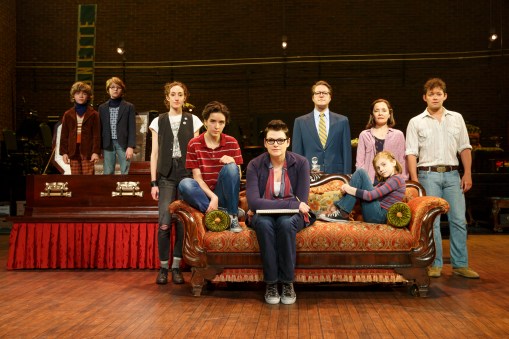
Tightly adapted by Lisa Kron from Alison Bechdel’s autobiographical graphic novel, with an exceptionally varied and emotional score by Kroon and Jeanine Tesori, Fun Home revolves around two complex characters: Alison and her troubled, multi-faceted dad. Bruce is a charismatic English teacher, a visual artist, a restorer of dilapidated houses, a connoisseur of antiques, and owner of the family business, the Bechdels’ funeral home. On the other side of the ledger, Alison’s dad is a neatness-and-control freak.

He’s also a closeted homosexual who preys on underage boys, not above taking advantage of his own students.

So while Alison, played by a succession of three actors, is on a path to discovering her own gay sexuality and becoming a cartoonist, she’s also on a collision course with the truth about her father. Bruce, the meticulous and domineering dad, is on a more fearsome path – to isolation, self-loathing, and suicide.Fun Home

Mostly used for symphony and dance, Knight Theater is probably the best place in town for replicating the Broadway musical experience, markedly better than Belk Theater. But Fun Home wasn’t at a typical Broadway theater for its New York run. At Circle in the Square, the audience surrounded the stage, and when Alison and her two brothers sang “Come to the Fun Home,” a singing advertisement for the funeral home that is the antithesis of solemnity, the three siblings seemed to explode out towards us.

At the Knight, all the action is flattened, and the Bechdel kids merely circle around each other. David Zinn’s scenic pieces seem disappointingly unchanged at first, two-dimensional and cramped on the Knight stage, but during the latter half of the show (there’s no intermission), Zinn exploits the resources of a proscenium stage. Medium Allison’s homecoming becomes more of an event when we see the funeral parlor again.

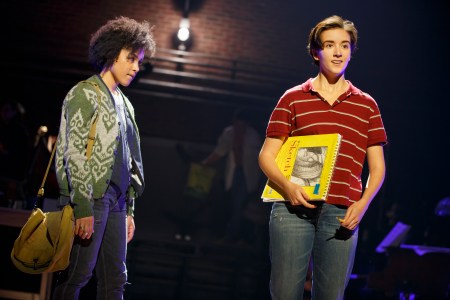
Corrigan plays the pivotal Middle Allison, flanked by tomboyish Carly Gold as Small Alison and Kate Shindle as the mature, emphatically butch Alison who narrates, often with sketchpad in hand. Gold is every bit as exuberant and appealing as her Broadway counterpart, but it’s Shindle who brings new life – and heartache – to our narrator with a more powerful, penetrating voice.

While both Small Allison and mature Allison are recognizably in the same Broadway mold that won director Sam Gold his Tony Award, Corrigan strikes me as a notably different transitional figure between her younger and older selves. On Broadway, Emily Skeggs leaned more toward the sunny exuberance of Small Allison grown to college age. Corrigan is more of an awkward foreshadowing of the comparatively subdued and serious elder Allison.09FunHomeTour0126r.jpg

As a result, when Medium Allison quickly succumbs to the attractions of Joan and liberates her lesbian leanings, Corrigan gets the same comedy mileage from her anthemic “I’m changing my major to Joan,” but with less raucous exuberance in her delivery. There’s more in-the-moment pragmatism to Corrigan’s take, as if she’s afraid of waking the object of her adoration as she lies sleeping on her bed – or just afraid of breaking an unbelievable magic spell. It’s very effective, and theatergoers seeing Fun Home for the first time will find it hard to imagine “Changing My Major” sung any other way.

With the three touring Allisons more than holding their own versus the original Broadway cast, there’s a further gravitational shift when Robert Petkoff as Bruce doesn’t match the bigger-than-life dimensions of Tony winner Michael Carveris. Amplitude is the difference with Petkoff, not detail, for he expertly navigates all the twists and turns of Bruce’s complexity. In a way, this is beneficial, for the importance of his character and Allison’s development are more evenly balanced on tour.

Further diluting Bruce’s dominance is the steely performance of Susan Moniz as his stoical wife, Helen. It was Moniz who opened my eyes to the Chekhovian dimensions of Kron’s book, for her silences were the first that spoke loudly to me on opening night, and her “Days and Days” had a martyred nobility. Moments later in the show, silence is very much the point when Alison is alone with Bruce in their climactic confrontation, where Shindle suddenly shifts from narrator to actor in the devastating “Telephone Wire” drive.

As Joan, Kally Duling seduces with a self-confident swagger, and Zinn’s costume design underlines her casual sophistication. But Duling never gets a solo, either to comment on Alison or the Bechdels. That’s symptomatic of the only problem I have with the show. Clocking in at 92 minutes on Tuesday, Kron’s script is too tight. It needs to breathe more, maybe as far as – danger ahead! – examining Alison’s feelings about her dad more closely. Yet there’s no denying that Fun Home is truly fun while it lasts, with plenty to mull over afterwards.


Music to a Mother’s Ears

Preview: Abby Corrigan Comes Home in Fun Home

Abby_MediumAlison_edited-1

By Perry Tannenbaum


There’s an unforgettably wanton, lascivious, and joyful song nearly halfway through Fun Home, the Tony Award-winning musical that rolls into town next week. Based on cartoonist Alison Bechdel’s autobiographical graphic novel, Lisa Kron’s script splits our hero in three, the middle-aged Alison who tells us the story and the two younger Alisons, Small and Medium, who live it out.

Small Alison absorbs the first, often misleading impressions of her parents, Bruce and Helen. It’s Medium Alison who discovers the revelatory truths – about her own lesbian leanings and about her dad’s sexual pathology – after she goes off to college. The bold, beautiful, and seductive Joan sets Alison straight about herself, so it’s Medium Alison who gets to jubilantly proclaim, “I’m changing my major to Joan!” as her first and most important college lesson.

Charlotte native Abby Corrigan gets to sing this showstopping song beginning on Tuesday at Knight Theater in what figures to be a triumphant homecoming.

Abby_BestChristPageant

It’s certainly a sudden change in fortune for the young actress, who turned 19 in February – but not a surprise to those of us who have seen Corrigan perform. She leapt onto the local scene in 2008, while she was still a 10-year-old, as the incorrigible Gladys Herdman in the Children’s Theatre production of The Best Christmas Pageant Ever.

Corrigan remained on our radar, playing prominent roles in 25th Annual Putnam County Spelling Bee down in Rock Hill, Next to Normal at Queen City Theatre Company, and delivering a riveting epileptic seizure to climax The Effect of Gamma Rays at CPCC. As the daughter of Mike and Mitzi Corrigan, both of whom acted in Charlotte Repertory Theatre productions, Abby figured to have acting talent.

But Mom, a talent agent and casting director who has a professional’s detachment, saw vivid signs of Abby’s gifts long before she became the Herald Angel shouting “Shazzam!” as Gladys.

“The first time I knew that she had something really special to offer,” says Mitzi, “was when she was 6 years old and we did a backyard production of The Lion King. She was Nala, and when she sang ‘Shadowland,’ I was bowled over by how she became that character and I thought to myself, ‘Wow, where did that come from?!’”

Knowing full well that you need intense passion and inner drive to survive in showbiz, Mitzi never pushed. Abby did plenty of that. At the age of 12, Abby and friend Matt Mitchell started their own theatre company, Treehouse Acting Company, mounting their first production at CAST in NoDa. The following year, Abby, Matt, and two other collaborators staged an original musical, Cybersoul, tackling a range of issues that included drug addiction, bullying, suicide, and homophobia.

You hear about precocious actors – many have paraded in and out of the Children’s Theatre of Charlotte spotlight over the years. But have you heard of anyone else who started a theatre company and co-wrote a mature musical before the age of 15?

“It really was off the charts,” Mitzi agrees. “I became good friends with Matt’s mom and we wanted to help them find ways to pursue their dreams. Because producing backyard plays had become such a regular occurrence in our existence, it seemed like a natural step to encourage them to produce their own plays.”

Of course, Abby didn’t think about measuring her ambitions against any norms. According to her mom, acting must be something you have to do in order to breathe if you wish to succeed. That’s how it has always been with Abby. She remembers loving to imitate animals when she was very young, convincing herself that she was truly what she pretended to be. Mom and Dad tried to deflect her into sports, but tee-ball never took.

Abby_Matt_Treehouse

“I wanted to show people that I could become anything,” Abby recalls. “As a kid, I would’ve played all the parts if I could have, and I wanted other kids to want to play along with me. I also think Matt and I wanted to play parts that we were too young to play. We would design sets and cast shows we wanted to do for fun, but we wanted to really do the work and make it happen.”

Inevitably, Abby’s talents and drive took her to Northwest School of the Arts, where her theatre exploits – starring in Cabaret, Shrek, and Peter Pan – took her on a rollercoaster ride. At her peaks, Abby was a finalist for Best Actress honors two years in a row at the Blumey Awards, winning a trip to New York for her Princess Fiona in Shrek and a chance to compete against winners from across the country at the national Jimmy Awards, the holy grail of high school theatre prizes.

Just as that brass ring was within sight, the opportunity to perform in front of top Broadway professionals vanished. Initially misdiagnosed in ER, Abby’s appendix ruptured, sending her back into the hospital, and she had to give us her spot at the Jimmys to the Blumey runner-up. Opportunity lost, but Abby was happy just to be alive. She returned to Belk Theater the following season, once again performing onstage as one of the Blumey finalists, but she didn’t win.

“I didn’t want to win that year,” Abby says. “I just wanted to do ‘Ugg-a-Wugg’ with my cast because it was so much fun to scream and bang the ground with sticks onstage as Peter Pan. I mean, come on. That’s what should matter. Not an award.”

Peter_TigerLilyAbby wasn’t totally exiled from New York because of her misfortune and subsequent defeat. For a couple of summers, she participated in a Destination Broadway theatre camp where the musical director was conductor Michael Rafter. So happens that Rafter is the ex-husband of Jeanine Tesori, who wrote music for the “Changing My Major” song – and the entire Fun Home score. When Mitzi invited Rafter to be the keynote speaker at a NW School of the Arts fundraiser, he informed her about Fun Home auditions.

Opportunity was knocking again, but how ready was Abby for it? Medium Alison doesn’t merely participate in this touring version of Fun Home, she drives the action.

“Yes, I about peed myself walking in the audition room those three times,” Abby confesses. The last two of those auditions were in front of three Tony Award winners – Kron, Tesori, and stage director Sam Gold. “I’d never wanted anything more in my life. After my first audition, the casting director gave me tickets to see it on Broadway, and I knew I had to do the show. I just wanted to eat the script/score whole.”

There are easier people to reach than Gold, especially during this year’s Tony Awards weekend, when he was up for a second Best Director trophy for his work on A Doll’s House, Part 2. Busy as he is, he had no trouble remembering Abby’s audition from a year ago, when she was still 18.

“Abby’s audition was one of the best and most memorable of my career,” Gold tells me. “It was like seeing the character of Medium Alison in front of me. She had worked very hard on the material and it was deeply felt, full of detail and comic timing, and she exuded confidence. When we spoke after, she said she was about to graduate, and I said, ‘What college do you go to?’ She said, ‘from high school!’ I couldn’t believe the poise and professionalism I saw was coming from an actor who would barely be of age for the tour.”

Both the poise and the professionalism are somewhat paradoxical in an actor who says she’s constantly striving to maintain the curiosity, fearlessness, and joy of a kid when she works – but her mom finds that onstage poise is just as genuine offstage. Time and again, Mitzi has come across the rejection, the ugly desperation, the deformed egos, and the over-swelled sense of entitlement that stalk theatre people – and she has seen the beauty and happiness it brings to Abby.

“Letting her go has been the hardest thing in the world for me,” Mitzi admits, “but she continually reassures me by saying, ‘Don’t worry mom. I’ve got this!’ Those words are like music to a mother’s ears.”