Category Archives: Dance

Ballet’s Last Dance Ranges from Grief to Orgy

Dance Review: Charlotte Ballet’s Spring Works

By Perry Tannenbaum

Finishing Jean-Pierre Bonnefoux’s penultimate year as artistic director, Charlotte Ballet served up an evening of Spring Works that carved a graceful arc from sorrow to celebration. Musically, the program could be described as all-American, though sticklers would consider that a stretch. Resident choreographer Sasha Janes’s We Danced Through Life, premiered at Chautauqua last summer, is set to Dvorak’s Symphony No. 9, “From the New World,” written in 1893 while the Czech composer was living in America.

No ambiguity about music that followed. George Balanchine’s Who Cares? was set to a sheaf of Gershwin tunes when it premiered in 1970, pared down to eight selections by associate artistic director Patricia McBride, who introduced three of the original 17 pieces back in the days when she was a star of the New York City Ballet. Capping the evening was the world premiere of Dwight Rhoden’s Bop Doo Wah, danced to eight jazz standards by the likes of Duke Ellington, Billy Strayhorn, Louis Prima, Irving Berlin, and George Benson.

Although Janes scrapped the opening movement of “New World” in condensing it to 20 minutes, he retained a fast-slow-fast (or dense-light-dense) structure by tucking the lovely Largo second movement – and its memorable “Goin’ Home” tune – in between the third movement Molto vivace and the concluding Allegro. That showcased the fearless elegance of Sarah Hayes Harkins in an achingly tender pas de deux with David Morse, along with a move I’d never seen before.

Charlotte Ballet_Sasha Janes_We Danced Through Life_Sarah Hayes Harkins_...[2]

Starting from upstage right and running diagonally toward downstage center, Harkins took one of those leaps that flings a ballerina’s arms and legs out parallel to the floor an instant before a sure-handed guy catches her in midair. But there was no guy standing there to catch Harkins in Janes’s choreography. Instead, two guys somehow overtook her and caught her two arms at the same moment, one under each arm.

Clearly, Harkins and Morse were the tragic couple Janes had in mind as his most pointed evocation of Terrie Valle Hauck, who commissioned the dance at Chautauqua for her late husband Jimmy – particularly at that instant when Morse wasn’t there to catch his partner. But another couple shone in the outer movements, Alessandra Ball James and Josh Hall, amid busier action with four other couples. At the end of one set of lifts, the men didn’t put their partners down on the ground. Instead they maintained their lifts and trotted upstage, placing each woman on her own pedestal.

Well done, Jimmy!

Aside from McBride, James and her pink flapper dress was the living link between this presentation of Who Cares? and the company’s previous revival in 2008. She’s still musical and precise in “The Man I Love,” her duet with Hall, and she’s still youthfully jazzy in “Fascinatin’ Rhythm,” the other piece that McBride originated. There was a tinge of poetry in the title tune, Jamie Dee Clifton’s duet with Hall, and a touch of Fred-and-Ginger sophistication in “Embraceable You,” the Hall-Harkins pairing.

I just felt that this Balanchine was unnecessarily musty compared to the newer pieces bookending it. Couldn’t we get a recording of Hershey Kay’s orchestrations that sounded like they were recorded in stereo, let alone digitally? And the costumes, recreated by Aimee J. Coleman, could stand a refresh. Clifton’s looked like it should have been discarded five washings ago, and Harkins’ – when cutie pie Anna Gerberich danced “My One and Only” eight years ago, it was teal, but now it seemed faded to turquoise.

Yep, it’s challenging to nitpick a Charlotte Ballet program. Everyone is so damn good, but in Rhoden’s Bop Doo Wah, we could lament seeing Addul Manzano, David Morse and Gregory Taylor for the last time. While I wasn’t particularly impressed with his singer, Gloria Reuben (more different in her interpretations than delightful), guitarist Marty Ashby’s jazz band could definitely swing and bop. But come on, man: “Teenie’s Blues,” ostensibly written by trombonist Jay Ashby, had more of Dizzy Gillespie’s “Oop Bop Sh’Bam” than anything else.

Charlotte Ballet_Dwight Rhoden_Bop Doo Wah_Sarah Hayes Harkins_Josh Hall_photo by Jeff Cravotta[10]

That’s why the tune stood up to those that surrounded it, Ellington’s “It Don’t Mean a Thing (If It Ain’t Got That Swing)” and Berlin’s “Steppin’ Out With My Baby.” The piece intensified with Strayhorn’s “Blood Count” as James partnered with Morse and Harkins reconnected with Hall, and “How High the Moon,” one of five pieces set by Rhoden for the full cast of 16, fired up with an alto sax solo that I considered the best of the whole suite.

With James partnering Morse one last time, the full cast turned it up another notch as the women let their hair down for Benson’s “My Latin Brother.” But Rhoden knows the value of turning up the intensity to its fullest when his dancers ought to be nearing exhaustion. That’s what a dance orgy is, and Louis Prima’s classic “Sing, Sing, Sing” was the perfect vehicle to take us there, arranged to evoke the Benny Goodman band’s landmark 1939 invasion of Carnegie Hall – and the legendary set of LPs that emerged from it.

Instrumental solo followed instrumental solo in this epic performance, with the guys, previously clad in punkish black costumes by Christine Darch, adding on matching androgynous skirts as they intensified the furious celebration. Not the way Manzano envisioned ending his career, I’m sure – his was the only farewell performance signaling retirement – but he looked as hot as ever in his valedictory appearance. Darch’s costumes for the women were equally sensuous, but due to the shifting hues of Michael Korsch’s lighting design, I never could determine exactly what three or four deep colors the ladies wore.

New Costumes and Scenery Heighten the Wonder of Charlotte Ballet’s “Little Mermaid”

By Perry Tannenbaum

March 11, 2016, Charlotte, NC – Everything seems to be going so well at Charlotte Ballet as Jean-Pierre Bonnefoux stands on the verge of his final year as artistic director. During his tenure, Bonnefoux has seen his dance troupe establish residence in the trendiest theater in town on South Tryon Street while the company strengthened its educational program at its new administrative HQ on North Tryon Street. Two days before opening night of a nine-performance run of The Little Mermaid, choreographed by Mark Diamond, news broke that the McColl family – the BofA billionaires – had given the company $1 million to revamp Bonnefoux’s version of The Nutcracker, leaving little doubt about what the company’s most spectacular production will be for years to come. That announcement may have upstaged the new sets and costumes adorning the Diamond remount in the eyes of newspaper readers, but for the horde of little girls who helped fill Knight Theater to near capacity on opening night, the light in their eyes came from the new undersea wonders lavished upon The Little Mermaid.

There was definitely a fresh dazzle in the new costumes by Aimee J. Coleman, and their iridescence wasn’t confined to the rig Alessandra Ball James wore as the Mermaid before shedding her tailfins for legs. Three Little Mermaid Friends and a matching pair of Seahorses also gleamed, and there was a Day-Glo phosphorescence to the costumes of the Eels, the Undertow group, and the Fish. This new Little Mermaid signals that the extensive use of youthful dancers at Charlotte Ballet will no longer be confined to the annual Nutcracker extravaganza. No less than 20 kids are listed as Fish in the program, and they actually began the show with an extensive dance of their own, fluttering in formation and seemingly gliding across the stage in a manner that simulated black-light puppetry. Diamond had them admirably schooled to resemble a school of fish at multiple points in their dance.

Costumes that aren’t aglow are frequently marvels. Parents will no doubt need to dip into their program booklets to inform their princesses that Ryo Suzuki is an Anemone, but there’s no mistaking Raven Barkley for anything but a Sea Turtle. The sheer plenitude of sea creatures that have nothing to do with the story is a constant delight, not in the least Rylie Beck, making her way up the orchestra aisle at a snail’s pace and lurking onstage as the Hermit Crab – though she could easily be mistaken for a Mary Poppins’ old rucksack. As enchanting as all these costumes were, the new wow factor came from Michael Baumgarten’s lighting projections, functional when the Mermaid’s destined Prince gets thrown overboard during a storm but truly spectacular as we glide through undersea corals and canyons.

The low tech, held over from previous Mermaid productions of 2008 and 2011, mixes charmingly with the high tech as we watch the scene where the Prince is tossed by the tempest and the Mermaid rescues him. Three linen ribbons that stretched across the stage were the sea, and I’m sure that the sailboat James Kopecky fell out of wasn’t even half-built. Throughout the opening act, while the Mermaid remains a finned sea creature, Diamond solves the Mermaid’s mobility problem by having her transported in the sort of sledge the crippled Porgy might use, drawn by the same invisible hands that ripple the linen ocean from the wings. When Ball James rises from floor level, she remains horizontal thanks to the ministrations of her Friends and the rolling Undertow crew.

Although Addul Manzano makes a dashing appearance as the Sea King, Diamond hasn’t integrated him into the drama. Aside from the Mermaid, who occasionally appears on the verge of being heaved onto a dinner platter, it’s Jamie Dee Clifton who makes the biggest splash as the Sea Witch. Beyond pointing upwards, the Mermaid doesn’t articulate what she’s yearning for in the climactic encounter with the Witch, but the real exposition gap that Diamond leaves parents to fill in for their kids is the particulars of the bargain that the Mermaid agrees to when the Witch grants her the ability to walk on land. Clifton’s movements – and her saturnine costume – make it clear enough that goodwill and charity aren’t motivating the Witch as she grants the Mermaid’s wishes, and there’s a wondrous fairytale foreboding when Clifton hands Ball James the magic potion that effects her metamorphosis.

Thanks to the last of Baumgarten’s projections, the Mermaid awakens on a beauteous seashore with her newfound legs. Diamond doesn’t skip over the most absurd aspect of the Mermaid’s transformation, so we get an endearing, comical incongruity that no parent will be able to explain. After the Mermaid marvels at her feet and toes, she stands up tentatively on her legs like a newborn foal – and within seconds is dancing like the Princess Grace Fellowship winner that Ball James truly is. Even without the same undersea magic afterwards, Diamond constructs a second act that intertwines the Mermaid/Prince romance with a couple of strands of comedy and a couple of explosions of pure dance.

Along with two Charlotte Ballet II troupe members, namely Suzanna Duba and the hunched-over Ben Youngstone, Beck sheds her shell to become one of three Gossips. Singly, they snoop and scurry about in various corners and alleys of the set as the Mermaid glows, blushes, and plain shows off in response to all the attentions that the Prince lavishes upon her. Collectively, they engage in effusive sessions of head-bobbing, mouth-flapping gossip. But it’s a military trio, no more pertinent to the action than the Turtle before them, who provide the greatest comic delight. David Morse is pomposity itself as the General, head tilted back and sporting an imposing belly bulge. Yet he begins bickering lustily as soon as Josh Hall appears as the Admiral, topped with the appropriate seafaring hat. It becomes so heated – and of course, silly – that Amand Pulaj as the Secretary General is hard-pressed to keep them for pawing each other to death.

When he isn’t bickering, the General reviews a small brigade of Officers whose uniforms are colorfully unalike. But in her costumes for Suzuki, Juwan Alston, Iago Bresciani, Ben Ingel, Thel Moore, and Gregory Taylor; Coleman makes sure that each of the designs registers as unmistakably Russian, matching the spirited music by Glière that they dance to. Nearly all these soldier dances are solos where each of the men vies with the others in acrobatic éclat. But the Russian flavor only crystallizes what has gone before. There is some Debussy wedged into the score Diamond has chosen, but with the generous selections from Borodin’s chamber and orchestral works, the overall musical texture is decidedly Russian. When we adjourn from the Prince’s garden to the ballroom in his palace (the most impressive of Howard Jones’s new set designs), we could be at any Russian ballet, for Diamond’s dance stylings are as retro as the music.

During this formal cotillion, Sarah Hayes Harkins comes into full flower as the Prince’s Fiancée, a vision of cold elegant perfection as she dances with Kopecky, hardly deigning to notice her rival skulking in the corner in her damp rags. The tension between the supple, skittish, and vulnerable Ball James and the serene and imperious Harkins seems so ideal that I wondered how they could be switching roles for four of the nine performances. But they are merely the tip of a general shuffle of principals including Kopecky, Manzano, Hall, Morse, Clifton, and Chelsea Dumas. Diamond could easily shuffle a few more members from the main troupe and the satellite Ballet II dancers without marring the overall effect. The company that Bonnefoux has built is that strong.

© 2016 CVNC

Production Values Continue to Evolve at Charlotte Ballet’s Innovative Works

Innovative Works_Yamato_Dancer Ryo Suzuki

By Perry Tannenbaum

January 29, 2016, Charlotte, NC – Ever since the event was created in 2003, when Charlotte Ballet was known as North Carolina Dance Theatre, Innovative Works has been a special event in the company’s season, performed at a special venue that further set it apart. The size of these venues, the length of the pieces on the program, and the number of dancers in each work were all smaller than the big ensemble pieces staged at Belk Theater and, more recently, at Knight Theater. Charlotte Ballet artistic director Jean-Pierre Bonnefoux was not only providing a platform for edgier, lapidary pieces, he was also establishing an incubator for new choreographers, usually dancers or former dancers in the company, to expand their creativity and pave a pathway to their afterlives when they were no longer onstage.

Works first seen at Innovative have not only enriched the repertoire of Charlotte’s pre-eminent performing arts group, they have served as springboards for further choreographic creations and for the formation of new companies outside Charlotte established by the former fledglings. This year’s collection of miniatures, running at the Patricia McBride and Jean-Pierre Bonnefoux Center for Dance through February 20, presents the brainchildren of current and former troupe members wedged among works by the company’s resident choreographers. Included on the bill are pieces by Dwight Rhoden, Mark Diamond, Sasha Janes, David Ingram, Sarah Hayes Harkins, David Morse, Gregory Taylor, and Josh Hall.

That’s a bunch, to be sure, but three of the works choreographed by current dancers – the “Dancer Spotlight” – are presented in rolling rep, so each evening consists of six pieces. The first two, Rhoden’s “Ballad Unto” and Ingram’s “Omologia,” are staples in every performance of the run. Taken together, they exemplify how Innovative has evolved. Intimacy and chamber size are no longer requisites of new choreography unveiled at the McBride. Both of these pieces were long enough to present on the Knight Theater mainstage, and by the time they were done, we had seen 18 dancers perform, including three up-and-comers from the satellite Charlotte Ballet II company.

Although scenery is still outlawed in this studio setting, lighting has become very sophisticated. In fact, the hard-edge lighting designs by Jennifer Propst are very much at the forefront of both experiences. Further blurring the difference between Knight and McBride presentations, the previously filmed “Behind the Dance” segments, where the choreographers talk about either their aesthetic or the genesis of the piece we’re about to see, are now as much a part of Innovative as they were last October in Fall Works at the Knight.

Innovative Works_Dwight Rhoden_Ballad Unto

Photos by Peter Zay

Rhoden’s “Ballad Unto” sets Bach’s famed Chaconne, prerecorded on violin, upon five couples, yet this destination is preceded by a setting to assorted sounds, textures, and rhythms that seemed equally long and substantial. Jamie Dee Clifton and Josh Hall were the couple that grabbed my attention most dynamically, but Ben Ingel and Raven Barkley were also charismatic standouts. All ten of the performers delighted in both the high-speed handwork and the footwork that Rhoden challenged them with, consistently accenting the beat with precision. Rhoden himself had fresher, livelier ideas than you might expect from him this deep into his career responding to Bach. Propst had a fairly a fairly stunning reaction to the choreography, setting five squares on the floor in an M formation for the five couples, occasionally replacing them with – or superimposing them on – an inverted V.

Interaction between the dancers and Propst’s lighting design was even more salient in Ingram’s “Omologia.” As the eight dancers advanced toward us at the outset of the piece, set to Corelli’s “La Follia,” a bright illuminated line across the stage seemed to daunt their progress. Once the dancers took possession of the stage, we discovered that there would be two more lines of lights connected to the first – and that each of the three lines was actually comprised of three adjacent squares. So while the dancers danced in close sync with the music, the nine pre-programmed squares, blinking on and off, were similarly wed to the movements and the shifting tableaus of the dancers. Numerous permutations of the nine squares flashed before us, including U shapes formed by seven of the squares that opened out at various moments to all four points on the compass.

From these lengthy baroque abstractions, we suddenly transitioned to a very real subject with Harkins’ “#Hatehurts,” the sort of high-concept piece that has typified Innovative in the past. Diagonally across the stage from each other when the lights came up, Sarah Lapointe in the foreground and Ingel upstage sat in front of laptop computers, reacting to online bullying and its fatal consequences. Of the six dances, this was the only one that didn’t come to us paired with a filmed introduction. Sure, it was the piece that least required explanation, but it was also so short that a prelude may only have drawn further attention to the piece’s brevity. Perhaps if the seated opening tableau didn’t seem to be such a substantial portion of the piece, the effect would have been more powerful, for the dance seemed to end as it was just getting started once the couple converged at the middle of the stage. The ratio between the prerecorded bullying and suffering we heard about and the anguish we saw live from the dancers ultimately struck me as too message-rich, an effective presentation for middle schoolers, perhaps, but artistically too thin for me.

John Adams’ “Short Ride in a Fast Machine” served as both title and soundtrack for David Morse’s piece, brilliantly danced by Harkins and Hall. In costuming, lighting, and choreography, Morse divides his work in two. The dancers come on in dim light, Hall in a waistcoat and Harkins in a long flowing blouse. Turning up their intensity, the dancers shed these upper garments as the lights come up fully. This moment of liberation is amplified by the ensuing choreography, which utilizes the entire stage. Morse’s piece returns to the rotation during the evenings of the final weekend of the run, February 18-20. Next weekend, Morse’s spot is taken by Gregory Taylor’s “Requiem of a Meaning,” and Hall shows off his “Social Butterfly” on the third weekend.

Hall will be borrowing rookie dancer Ryo Suzuki for his solo piece. Meanwhile, he is featured in “Yamato, earth/nature/drum,” a three-part celebration of Japan by Diamond, demonstrating that he’s no less eager to pursue new directions than Rhoden. The 12 people in this piece form a spherical mass as Propst’s shimmering lighting comes up, with Suzuki slapped across it horizontally. Then the ball explodes in big-bang fashion to an original score arranged by Rocky Iwashima, heavy with taiko pounding. Ultimately, the group regathers downstage in a tableau that is analogous to the spherical beginning but with Suzuki in an uplifted, triumphal posture. Inside of this effective framing, Suzuki and Addul Manzano are the dominant presences, although Barkley is hard to ignore whenever she’s involved.

Charlotte Ballet Innovative Works by Christopher Record

Photo by Christopher Record

For his new work, “Sketches from Grace,” Janes veered from his intent to create settings for works by Leonard Cohen, opting instead for a four-piece suite of settings to cuts by Jeff Buckley – including his cover of Cohen’s “Hallelujah,” which became a posthumous #1 hit for Buckley in 2008. The work showcases a punkish set of costumes by Katherine Zywczyk with faint, silvery highlights, beginning with Buckley’s most distinctive original, “You and I,” a brooding, floating, dreamy song that would seem to defy choreography. Yet Chelsea Dumas and James Kopecky fully conveyed the smoldering energy lurking in the lyric. Once covered by Nina Simone, “Lilac Wine” took the tempo up to a bluesy dirge, given an aching elegance by Ingel partnering with Alessandra Ball James. Bringing the tempo further up to a lethargic shuffle, “Hallelujah” was undoubtedly the climax of the suite, danced with such heartbreaking perfection by Hayes and Hall that the audience applauded as if it were the finale, although Janes’s video intro had promised us that all three couples had a concluding segment together. That closing ensemble was a more driven Buckley original, “Lover You Should Have Come Over,” very appropriate for the hubbub of three couples strutting their stuff simultaneously. Those last pushes in tempo, spectacle, and animation gave the audience one more reason to cheer.

Drosselmeyer Takes It to the Hood, Yo

By Perry Tannenbaum

On a nighttime set projected onto the back wall of Booth Playhouse that evokes the setting for Lin-Manuel Miranda’s In the Heights, Mike Fitelson has made over a Christmas classic produced by the New Jersey Performing Arts Center. Aside from Drosselmeyer’s Toy Shop and the tumescent fir tree that sprouts up deep in Act 1 on an empty moonlit playground, The Hip Hop Nutcracker makes few references to Christmas or the E.T.A. Hoffman story that inspired Tchaikovsky’s wondrous ballet.

But a lithe and versatile 11-member dance troupe certainly reminds us of the Russian composer’s music, dancing to a conventional pre-recorded performance of the score with live lagniappe provided by violinist Mathew Silvera and DJ Boo. Here in Washington Heights, with the mighty GW Bridge looming behind the tenements, Maria-Clara is our protagonist. The teenager’s quarreling parents and an assortment of neighborhood characters, some of them gang members, precede her onstage.

Surrounded by such seedy strife, Maria-Clara could use a Prince Charming coming to her rescue. Enter The Nutcracker in the appropriate artist-formerly-known-as-Prince costume, wheeling a pushcart that bears his nutty name. He’s promptly thrashed by the gang when he tries to come to the aid of our damsel in distress. So perhaps it’s more accurate to say that Drosselmeyer is her prince – except, in this instance, it’s Frau Drosselmeyer, since the impish Miki Michelle dances the role.

As in the traditional Nutcracker, Drosselmeyer flamboyantly doles out gifts, and once again, it’s ambiguous whether Frau Drosselmeyer sends Maria-Clara off on a magical journey or lulls her into a fabulous dream with a hypnotic watch chain. In either case, no Flying by Foy is necessary to convey Maria-Clara to this magical realm – as it is when Charlotte Ballet sets up its traditional Nutcracker downstairs at Belk Theater. No, the gateway to this journey is a graffiti-strewn storefront façade that lifts like the garage door of a loading dock (such protection is required by Upper West Side shopkeepers), revealing a deeper more amazing vista than you would ever have suspected inside a neighborhood Candyland store.

There are more blandishments to the new scenario that you’ll enjoy, most notably the pair of red sneakers slung over the lamppost where we first see the violinist play, and Fitelson does attack the problem that besets most traditional Nutcracker productions – the fact that nothing really happens in Act 2 besides a pleasant parade of luscious melodies and dances.

What chiefly pleased me was choreography of Jennifer Weber, a marvelous fusion of hip-hop and traditional ballet. Perhaps because Weber, who also stage directed, allows for so much of the dancers’ freestyling to be incorporated into the dance, the lead characters positively gush with charisma. Leading the ensembles, Ann Sylvia Clark gives Maria-Clara a definite Janet Jackson wickedness and flair, yet in the pas de deux, there’s an innocence and grace that recalls Mia Cunningham’s sweetheart exuberance during the many years that she was NC Dance Theatre’s Clara. In the title role, Gabriel Alvarez is as proper and deferential as his starchy military costume would imply, but he can also bust some prodigious moves.

In the holiday spirit, the strife between Mom and Dad is more comical than mean, with Myriam Gadri and Alain “Hurrikane” Lauture establishing a winsome contrast. Gadri is long, leggy, and wanton, a Mom who wants to dance; while Lauture is crotchety, jealous, and hypochondriacal. Another side to the old folks emerges in Act 2 when we behold the couple back in 1984, before Marie-Claire was a gleam in Dad’s eye, so these are two juicy roles. Among the minor players, I’d call attention to Brandon Rosario, as the gang leader and the Mouse King, and Sophia Lavonne as Drosselmeyer’s toy marionette, perhaps the most classical episode of the entire evening.

My only disappointment was in the music coming languidly out of the Booth’s sound system. I wish they had done more with it. Duke Ellington was able to record a whole CD of jazzy Nutcracker hits, making them over into his inimitable big band idiom. I think a funkified Tchaikovsky would be more to the point here, at least interspersed with the orchestral score. Except for one charming moment when his soundboard ministrations mimic a blizzard wind, DJ Boo devolves into virtual insignificance after his overloud preshow and break, and the lonesome forlorn Silvera merely plays the tunes as written.

A fiddler under a pair of sneakers. Sounds crazy, no?” Okay, that was a bad joke, but I couldn’t resist throwing it out there.

Jamie Laval Injects Wassail, Bagpipes, Poetry, and Highland Dancing into His Scottish Christmas

Jamie-&-Dancers-Christmas-5-Low-res

By Perry Tannenbaum

Unconvinced that Charlotte was a hotbed for competitive fiddling enthusiasts, I was a little doubtful that a U.S. National Scottish Fiddle Champion would attract a substantial crowd to a “Christmas in Scotland” concert on a Monday night three days after the holiday. But as we drew up to the Great Aunt Stella Center on a sloppy evening, we noticed that the outdoor parking lot was full. So was the lower level of the nearby parking deck, and there was a bit of a crowd in the lobby, where we picked up our tickets. Jamie Laval last appeared in the Metrolina area back in October at Belmont Abbey College, more than two years after participating in a Classical Idol fundraiser on behalf of the Charlotte Symphony – perhaps on the strength of the Asheville-based violinist’s previous Metrolina foray at Davidson College in 2011. This Christmas gift from the mountains had no precedent, but there is no doubt that the Great Aunt Stella Center has established an enviable folk music cachet in Charlotte due to the series of free concerts that Charlotte Folk Society stages there monthly.

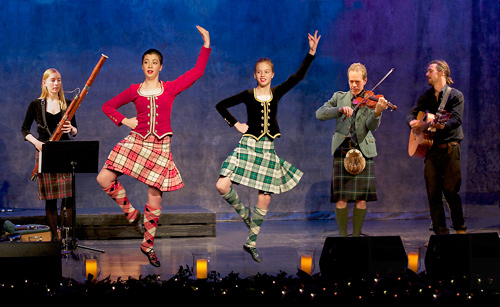
Ensuring that the event would be nothing if not colorful, Laval brought plenty of artillery to the occasion, including four instrumentalists, a budding young vocalist, and four dancers, who changed costumes at least four times during the concert. Further diversifying the musical palette, most of the musicians played multiple instruments. Both McLeod brothers, David and Michael, played bagpipes and the less punishing smallpipes, with Michael adding a drum and a pennywhistle along the way. For the most part, Rosalind Buda supplied a fluid obbligato and continuo on bassoon, but she also wended her way through a couple of bombards, a recorder, and an odd percussion instrument that could have begun life as a black canteen. Above all else, Buda read all the poetry selections beautifully, adorning them with a warm expressiveness and just a faint touch of dramatic flair. When he wasn’t flashing his championship fiddling bravura, Laval switched less impressively to strumming a guitar. But Laval was also a relaxed and personable host – his intros, anecdotes, and stories flowing so effortlessly that I sometimes lost track of when he crossed over from one type of spiel into another.

Yet there was nothing offhand about this concert. Laval’s craftsmanship was immediately apparent in the arrangement of the opening medley. Kelly Brzozowski began it with a lovely solo on the Celtic harp, introducing the “Wexford Carol,” and reminding me what a marvelous acoustic the Great Aunt Stella offers – something I’d quite forgotten since I last heard music there in 2001. We savored the sweet-sounding Ana Carolina Scott soon enough as she sang the ensuing “Angelus ad Virginem,” where we also heard our first sampling of the smallpipes. By the time we galloped into the fifth and final tune in this medley, “The Flagon,” we had seen most of the musical arsenal. With three wind instruments blowing simultaneously, the dynamic difference from the opening quiescence was startling.

The variety, contrasts, and unpredictability of the opening medley were mirrored by the entire program, which eventually covered more than 30 songs. Scott returned for three more vocals before intermission, beginning with a quiet rendition of a pre-Christian version of “The Holly and the Ivy,” accompaniment by harp and guitar with a couple of bassoon fills between stanzas. Assembling his program, Laval took a special interest in Celtic materials, melodies and lyrics that were eventually commandeered by Christianity – altering traditions rather than superseding them. That didn’t prevent Laval from utilizing a trio of young women from Atlanta’s Glencoe School of Highland Dance in further exploring Scottish folkways or from sneaking into North American tradition for a taste of Cape Breton step dancing with Amy Mooney.

After Buda and the McLeod brothers demonstrated how loud and make-it-stop irritating just three smallpipes could be on “Ding Dong Merrily on High,” things quieted down for the no-less-lively “Cape Breton Step Dance” featuring Laval’s infectious fiddling and Mooney’s percussive stepping. Mooney’s dancing was actually so percussive that she and Laval would trade two-bar solos with each other as Brzozowski accompanied on harp (with a few foot stomps of her own). All three Glencoe dancers then appeared in bright plaid skirts for their “Highland Dance Set,” accompanied by Luval’s fiddle and the McLeods’ smallpipes.

Return visits by the quaint trio didn’t wear out their welcome. The Glencoes next appeared in black outfits that were bedecked with colorful strips of fabric. Shaking bell sticks in both hands as they danced, they simulated a pair of wassail ceremonies designed to waken the apple orchards in the dead of winter and ensure the hard cider for the coming year. The next costume change was even more surprising as the Glencoe gals shuffled back onto the stage after intermission in sailor suits, doing mock battle with one another as the two bagpipers played the “Sailor’s Hornpipe” behind them.

While the smallpipes’ wind is supplied entirely by a small bellows pumped under the armpit, the bagpipes are fueled by both breath and bellows. Two of them, as was proven by the ensemble’s “Bessie Brown” just before intermission, can be even more make-it-stop loud than three smallpipes – with a rougher, more irritating sound at full blast. A rock concert sensibility would have been helpful, but I found that I’d acclimated well enough by the time we reached the evening’s final medley, finishing with the “Break Your Bass Drone” and “Flett from Flocca.” Meanwhile, Laval pursued his musical travelogue even more extensively than the ladies’ dance rounds, taking us to Orkney, Brittany, Coventry, Sussex, and Gloucester before we were done.

Most engaging of all was Laval’s extended excursion to Iceland, from where he brought us some diverting Yuletide legends and anecdotes along with three very entertaining songs. Withholding them until the end of the evening, Laval obviously knew the value of what he had. But he also edited prudently, beginning the “Icelandic Yule Lada,” the local equivalent of “The Twelve Days of Christmas,” on Day 8. There are actually 13 days in the Icelandic tradition, and how that evolved was another narrative. Laval hadn’t sung audibly during the evening, and when he duetted with Scott in “The Wren in the Furze,” we could hear why, for his vocals were chiefly effective in contrasting with the beauty of Scott’s. The backstory of this song, traditionally sung on St. Stephen’s Day after Christmas, meandered into Icelandic history and how the wren became an icon for military betrayal before taking on a radically different meaning for the holidays. Basically, “The Wren” was the weirdest begging song I’ve ever heard.

The final medley began with the “Boar’s Head Carol” and ended with the entire audience clapping rhythmically as the musicians and dancers took their bows, both bagpipes blaring once again. Even that wasn’t a sufficiently emphatic return to Scotland, but Laval wasn’t guilty of an oversight. For an encore, the pipers and the harpist accompanied Scott as she sang “Auld Lang Syne.” I didn’t recognize Scottish laureate Robert Burns’ words – or his brogue – in the stanzas Scott sang, but when the ensemble answered with the refrain, all hearts were in the Highlands.

Hip-hop, the Blumenthal, and the Queen City Are Breakin’ Convention

By Perry Tannenbaum
The Ruggeds from the Netherlands (Photo by Belinda Lawley)

BirdGang Dance Company from the UK. (Photo by Belinda Lawley)

BirdGang Dance Company from the UK. (Photo by Belinda Lawley)

Strange things are brewing in Uptown. In the shadow of buildings named for Wells Fargo, Duke Energy and Hearst, there will be dancing in the streets. In the lobby of a building blessed by our most PC philanthropists, the Knight Theatre, they’re decking the hall with graffiti, setting up for our dopest DJs.

There’s more. The president of Blumenthal Performing Arts, that Brooks Brothers-ish man about town — yes, Tom Gabbard, y’all! — is spouting words like cypher, poppin’, waacking and the whole beatboxing vocabulary of hip-hop.

Of course, Charlotte’s hip-hop community is already hip to what’s happening. But whoa. Those folk who spin on their heads, float like robots across floors, move their arms impossibly behind their backs, and thoughtfully shake spray cans? They’re also changing: embracing the challenges of storytelling and theater.

Bro, it’s Breakin’ Convention, spinning into town this weekend — indoors at Knight Theater and Spirit Square. Spilling into the outdoors at Levine Avenue of the Arts Plaza and the old Goodyear Tire parking lot. Scissoring Spirit Square in its parking lot and alleyway. You, your parents and maybe your parents’ parents — and definitely your kids — need to check this festival out.

Hip-hop began some 50 years ago on the streets of New York, in the borough of the Bronx, without any theatrical aspirations. Twelve years ago, the Breakin’ Convention brand of hip-hop took shape in London at Sadler’s Wells, arguably the pre-eminent dance presenter in the world, where they added the elements of narrative and drama while framing it all with the prosceniums of their three stages.

Breakin’ Convention first crossed the pond and returned to its birthplace in 2013, expanding the mission and outreach of the legendary Apollo Theatre on the sacred ground of Harlem’s 125th Street. This year, Blumenthal Performing Arts is partnering with the Apollo in bringing the international artists who will headline the Breakin’ Convention premiere here this week and at next week’s encore in and around the Apollo.

The big-name crews on the Knight Theater stage this Friday and Saturday include The Ruggeds (Netherlands), BirdGang Dance Company (UK), Antoinette Gomis (France) and Compagnie Phorm (France/Argentina). On each of these nights, local crews from Charlotte and the USA will share the bill, including Street Kingdom, Aquaboogy, Breakers for Life, collectiveUth, NCDanceDistrict, the Nouveau Sud project, Queen City Bittys, Reliablebrother #TwinNation and The Vongolas.

You’ll need tickets to see all these proscenium performances, but everything outside Knight Theatre — including the Knight’s lobby — is open and free to the public. Breakin’ Convention breaks out at a bunch of locations, so here’s an overview.

Friday and Saturday

Beginning at 5 p.m. — Obey Your Verse Stage at Levine Avenue of the Arts.

5-7:15 p.m. — Graffiti Jams at the former Goodyear service station at the corner of N. Tryon and E. Stonewall.

6-7:15 p.m. — Tiny Totrock sessions, DJ and Dance Cyphers and a Graffiti Zone at the Lower, Main and Upper Lobbies of Knight Theater, respectively.

7:30-10:15 p.m. — The main stage performances at Knight Theater, punctuated by a 45-minute intermission at 8:30.

8:30-9:15 p.m. — The bodacious intermission: Totrock, Cyphers and Graffiti Zone resume in the Knight Lobbies while food trucks invade Levine Avenue of the Arts outside the Knight.

Saturday only

10 a.m. to 4 p.m. — Street Jam at Spirit Square: Graffiti Jam, Dance Cyphers, Drum Circle, food trucks, instructional sessions presented by Zulu Nation and workshops piloted by Gomis and The Ruggeds.

This massive project is really the first true arts festival to hit town since JazzCharlotte left the Uptown in 1994 and ignominiously bit the dust in the swamps of Carowinds. There was plenty of trepidation, preparation and mutual scouting in London and Charlotte before the new Blumenthal-Sadler’s Wells partnership was forged. Without hip-hop artist and entrepreneur Jonzi D, the Sadler’s visionary who pioneered the idea of elevating the art form with narrative and drama, the deal would not have been done.

“We brought him here,” says Gabbard, “about a year and a half ago to spend four days — to evaluate the hip-hop community, the size of it, what it was and their willingness to work with us. And we found out that there was a lot of enthusiasm for partnering with Blumenthal on this. Then this last May, Jonzi came for 10 days, and it was really just to work with the local community developing relationships.”

The 2015 Breakin’ Convention is just the beginning — for both the Blumenthal and Sadler’s Wells. Upstaging the Apollo, which is bringing the festival to Harlem in alternate years, Gabbard has signed on with Sadler’s for three consecutive years to see if Breakin’ takes with the public. He envisions transplanting a chunk of the festival to Romare Bearden Park for 2016, and he’s optimistic that other cities’ performing arts centers, after scoping out our event, will climb aboard and share costs for a 2016 Breakin’ tour. In the meanwhile, Jonzi will be staying in touch with the Queen City, performing Open Art Surgery, a weeklong workshop that will create a new hip-hop dance theatre piece.

Local hip-hoppers are already impressed.

Best remembered as the DJ narrator of Children’s Theatre’s wild, wild production of The Red Badge of Courage in 2013 — and, oh yeah, the winner of Best Rapper honors in Creative Loafing’s Best of Charlotte that same year — Mason “Quill” Parker raps again this Friday, performing his latest project, Loose Leaf vol 2.

Booked by Boris “Bluz” Rogers, the poetry slam guru who will emcee Obey Your Verse, Parker appreciates the creative energy that Jonzi is bringing to town: “the ideal he represents has helped mold four generations of hip-hop here in Charlotte and the world over. It is pivotal that it be promoted properly across cultural lines in order to flourish in the full fruition of the vision.”

Ana Ogbueze and NCDanceDistrict burst upon the scene about three years ago when the company she founded, The Dance District, was asked to perform at Taste of Charlotte. They began with seven dancers, have grown to 30, and will be featuring 13 onstage at the Friday show at Knight Theater.

She first met Jonzi last year when he came to a meet-and-greet with Charlotte hip-hop choreographers and teachers at the Blumenthal PAC, where he presented an already-completed Open Art Surgery piece.

“That really opened my eyes to this emerging world of hip-hop theater,” says Ogbueze. “I distinctively remember parts of the piece that made the entire room pause with a slightly perplexed sigh, followed by, ‘Did he just do what I thought he did?’ I loved it. From that moment on, I knew I had to see what this whole Breakin’ Convention was about. Honestly, I left feeling so crunk to learn more about the movement, Jonzi actually invited me up to London that following month to check out Breakin’ Convention first-hand! Thanks to the Blumenthal, I had the privilege of attending, and it was absolutely amazing.”

The rest of us get to see the Promised Land this week.

Charlotte Ballet Reboots!

Image result for Charlotte Ballet Fall Works pictures

Charlotte Ballet’s Alessandra Ball James and James Kopecky share a moment in Jiri Kylian’s Forgotten Land.

By Perry Tannenbaum

Turnover is a reality in most businesses, sometimes a necessity. In recent years, it hasn’t been at all unusual for Jean-Pierre Bonnefoux’s Charlotte Ballet to welcome three or four new dancers into its ranks after watching an equal number land a jeté into other troupes around the country – or into teaching, choreography, retirement, or parenthood. Transitions became so smooth at the Queen City’s pre-eminent performing arts troupe that I could view the newcomers as reinforcements. And the process? I called it reloading rather than rebuilding.

This season is different. Less than 18 months after changing its name from NC Dance Theatre, Charlotte Ballet opened its 2015-16 season with nine new dancers that weren’t on its roster last year. On top of that, the opening night of Fall Works came less than three weeks after Bonnefoux announced that he would fading away to emeritus status at the end of next season, with a new artistic director to be named next spring or summer.

Pardon me, but I’d call all of that a reboot.

Last week’s program gave us another preliminary chance to compare the new company with the old in revivals of Bonnefoux’s well-traveled Shindig, last presented here in 2009, and Jiří Kylián’s Forgotten Land, which was first brought to Charlotte in April 2014, the day before NCDT changed its name. Set to Benjamin Britten’s Sinfonia da Requiem and inspired by an Edvard Munch painting, Forgotten Land benefited from a simpler pre-recorded intro that was shown on a retracting projection screen.

Instead of navigating through the connections between Kylián’s choreography, Britten’s elegy for the receding East Anglia coastline, and Munch’s imagery – not closely matched by the costume designs – we could concentrate on the colors of John F. Macfarlane’s costumes. These three basic colors, worn by three different couples, represented the progression of youth to old age: white, red, and black. We actually saw these couples in reverse order, but each couple had a paler, less vivid, and less energetic couple in the sequence – fainter echoes in gray, pink, and eggshell.

After an extended dance of innocence from the dancers in white, we didn’t circle back to the reminiscing dancers in black. Instead, the entire 12-person ensemble gathered for what I’d call an anguished celebration of life. Then in a moving coda, the three vividly clad women were all alone onstage, faced away from us, moving toward McFarlane’s somber set design, a wide ocean wave eternally poised to break onshore in semi-darkness. Seeing it all for a second time, I found the quiet emotional acceptance of Kylián’s women reminiscent of the haunting resignation that suffuses John Millington Synge’s poetic drama, Riders to the Sea.

Pete Leo Walker was at his charismatic apex when he partnered with the sensuous Melissa Anduiza as the black-clad protagonists two years ago, but there was no lack of command or flair at Knight Theater when 10-season veteran Alessandra Ball James and newcomer James Kopecky replaced the escapees. Half of the couples were partnered exactly as they had been in 2014, Sarah Hayes Harkins with Addul Manzano, Chelsea Dumas with Josh Hall, and Jamie Dee Clifton with David Morse. So aside from the richer perspective provided by the intro, differences between the two performances were not at all cataclysmic.

No, the difference between now and then was most pronounced when we reached the elbows-up, kick-up-your-heels Shindig, Bonnefoux’s most frequently performed work after his annual Nutcracker. There’s a high-spirited yee-ha merriment to this piece, a shedding of balletic formality, that this 16-person ensemble didn’t quite capture on opening night. Jitters? I’m not sure whether the abandon that’s needed is attained until you reach the point when counting the beats and remembering the steps is no longer a chore.

Fortunately, between the two ensemble segments there are five smaller tableaux where one to four dancers are called upon to shine, and the live bluegrass music of the Greasy Beans quintet – featuring the hot fiddling exploits of Cailen Campbell and the unflagging bonhomie of guitarist/vocalist Josh Haddix – was a constant exhilaration. Extra musical helpings came with the curtain down as the Forbidden Land scenery was dismantled.

In the smaller Shindig segments, Clifton, James, Hall, and Harkins reasserted themselves. Among the newcomers, Amelia Sturt-Dilley aced her showcase, and in an all-male hoedown quartet, Kopecky and Ryo Suzuki flashed some more of their personality alongside Manzano and Morse.

If the rebooted company hasn’t completely acclimated to Bonnefoux’s festive Appalachia, they showed no such discomfort with Sasha Janes’s new setting for Vivaldi’s Four Seasons. It’s an intriguing collaborative effort that we’re likely to see again in years to come. While some of Christopher Ash’s seasonal projection designs were hackneyed animations from Stock Photoville, Aimee J. Coleman’s costume concepts became more and more amazing, peaking in the final “Fall” and “Winter” sections.

All 15 of the dancers were dressed in autumnal orange as we headed into “Fall,” but the women’s outfits were highlighted by what would normally be called tear-away skirts. These skirts were capable of standing by themselves and forming wee cone-like dwellings, becoming part of the scenery when guys weren’t wrapping them around the shoulders of their partners.

Coleman’s crystalline winter costumes were hardly anticlimactic, the most formal of her designs. The women’s dresses were regally white, fit for a palace in a traditional Russian ballet, and newcomer Raven graced the most regal of them all. Barkley made her spectacular entrance mounting a flight of stairs that rose from the orchestra pit. Nor were the men’s costumes any less spectacular – long thin full-sleeved coats, that were even more Russian in flavor, military in their formality, and sacramental in their white purity.

Vivaldi’s winter may have been Italian, but Janes and Coleman were clearly adding some Russian dressing. When snowflakes began fluttering down on the ensemble from the flyloft, Janes and the 2015-16 edition of Charlotte Ballet managed to magically transform the Venetian Vivaldi into a Yuletide Tchaikovsky.