Category Archives: Dance

Bourne’s Stylish “Red Shoes” Misses the Train

Marcelo Gomes

Review: The Red Shoes

By Perry Tannenbaum

When Matthew Bourne decided to adapt The Red Shoes for the stage, he had to confront the fact that the unique film was about ballet but was itself neither a ballet nor a musical. Musicals are Bourne’s métier as a director, but nobody sang in the film except for an operatic soprano in the background for a moment or two. Taking the more obvious route and making a Red Shoes musical would mean putting himself – as a director and choreographer – in the service of largely new score with a leading lady who would have an exhausting load of singing and dancing.

THE RED SHOES

In practical terms, then, Bourne and his New Adventures company took a more prudent path, turning The Red Shoes into a full-length ballet. That meant scrapping all of the original dialogue from the Emeric Pressburger screenplay and filling out the scant instrumental score. If you’ve seen the film, you know that “The Red Shoes” is the ballet within the story that makes Victoria Page a star for the jealous impresario god of ballet, Boris Lermontov, and his world-renowned company.

When Victoria leaves Lermontov Ballet for the man who composed the “The Red Shoes” – because Boris has decreed that she must choose between the man she loves and the man who will make her a great artist – the impresario refuses to allow the composer, young Julian Craster, to take with him the work he wrote under contract. Boris also refuses to allow the ballet that made Victoria a star to be performed again unless she performs it.
THE RED SHOES

Shedding the dialogue doesn’t allow Bourne to communicate the niceties of the breakup between Victoria and Lermontov. Nor can he cut away to show us Julian afterwards when he’s about the premiere an opera at Covent Garden while Victoria has snuck off to Monte Carlo to return to Lermontov Ballet and “The Red Shoes.” My wife Sue, who hadn’t seen the film, couldn’t figure out where the train came from – or why – any better than I could before I reacquainted myself with the film.

Confronted with the scarcity of ballet music in the film, Bourne turned to the film music of prolific composer Bernard Herrmann and scores he wrote for Citizen Kane, The Ghost and Mrs. Muir, and Fahrenheit 451, avoiding his troves of Hitchcock scores. The result seemed very tepid to me in Act 1 as both Victoria and Julian strove to win Boris’s esteem. Nuances of Lermontov’s character, including his seeming indifference to artists he prizes just to make them work harder, were drained from Bourne’s scenario. And that charming episode in the film that inspired the climactic selection moment in A Chorus Line has also been axed.

THE RED SHOES

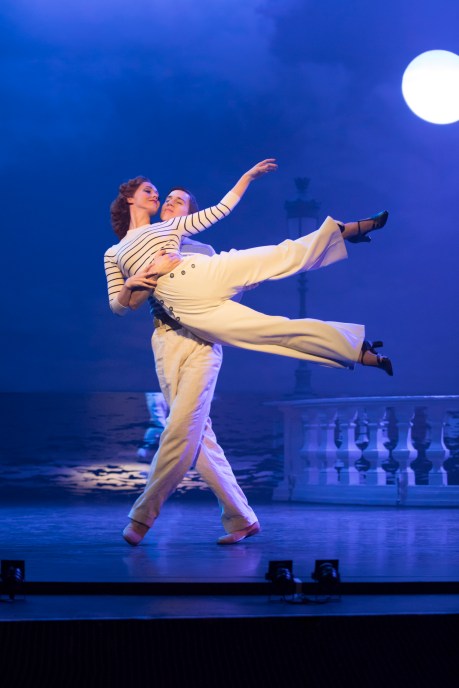
Lez Brotherston’s set and costume designs compensate for the early drabness of the music and the steamrolling of character contours, but they are ultimately a mixed blessing. The revolving proscenium that Brotherston has framing the action could become a thing in future theatre tech, smoothing transitions between scenes. It is especially effective – and cinematic – when Victoria and Julian are on the skids after breaking with Lermontov. She’s sitting on a bed at some flophouse, quietly bemoaning the career she threw away, while he’s in his posh bedroom lounging in a maroon smoking jacket, brooding over the marquee attraction he pushed away.

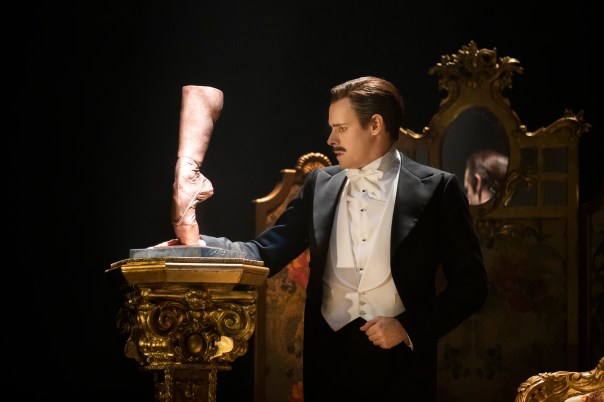
Really, it’s after the breakup that the drama and the music perk up, even if we veer towards melodrama. That smoking jacket is also the first strong echo of the film. We never see anything of the suave fedora Boris frequently wears onscreen nor the harlequin face painting that especially distinguishes Grischa, the ballet master who dangles the fatal red shoes. Costumes for Victoria and Julian are a triumph, notably in the blithe seaside scene that starts Act 2, but harlequin excess isn’t the brand of horror Brotherston goes for. When Grischa turns into a dancing Mephistopheles, Brotherston favors the Addams Family type of suit that a Dick Tracy villain might wear. Red pinstripes on midnight blue.

THE RED SHOES

Not all the abridgements of the film plot misfire, and some additions and substitutions make sense for a ballet conversion. My favorite substitution, though it belies Victoria’s aristocratic pedigree and her artistic prestige, is in the degradation she experiences in the sleazy show she hooks up with during her self-imposed exile. The lowbrow choreography that Bourne inserts here, augmented by some lascivious leering from Victoria’s co-workers, makes for a precipitous and affecting fall from grace. But you basically need to know what goes on in the film’s denouement to have a clue about Bourne’s botched staging of it. For no reason that I can fathom, he has both Julian and Boris running out on Victoria.

All of the major roles are at least double-cast, with four different dancers possible for the role of Irina, the ballerina Victoria replaces. Despite the fact that he isn’t allowed to appear even slightly artistic, I was most impressed by Sam Archer as Boris – partly because, for two-thirds of the evening, I thought he was transforming into the Mephisto tempter dangling the red shoes. No, that credit belonged to Leon Moran as Grischa, the ballet master, with a lightning-bolt streak of white through his hair when he turned sinister. Did I mention the Addams Family motif in the design? Or was that Young Frankenstein?
THE RED SHOES

The lovebirds, Ashley Shaw as Victoria and Dominic North as Julian on the night we went, were quite adorable. That says something for the depth of the Red Shoes company, since press night came a day after we attended. Complementing Brotherston’s stagecraft, projections by Duncan McLean were an airy atmospheric counterbalance to the mechanical artifice of the revolving proscenium. Although frequently deflected and derailed from telling its mutated Hans Christian Anderson fairytale in the fashion revered by balletomanes since 1948, Sir Matthew’s new adaptation is always a handsome one.

Levi, Hope and Pope Triple-Team Cole Porter

Charlotte Ballet_Javier de Frutos_ Elsa Canasta_ Singer Levi Kreis with cast_photo by Jeff Cravotta fix_1092-2585 (1)

Preview: Charlotte Ballet’s Fall Works

By Perry Tannenbaum

Over the past 20 years, Jean-Pierre Bonnefoux and Patricia McBride have left an indelible mark on dance in Charlotte. Principal dancers when they worked together at New York City Ballet, the couple brought their invaluable experience with legendary choreographer George Balanchine to our own NC Dance Theatre, eventually re-branding the company as Charlotte Ballet.

When Knight Theater opened in 2009, their troupe became the resident company, and when Charlotte Ballet dedicated a stunning academy for dance at their new HQ on N. Tryon Street, their names were engraved on the building. Bonnefoux and McBride brought nationwide recognition to the Queen City with repeat performances by Charlotte Ballet at the Kennedy Center in DC, where McBride was decorated with Kennedy Center Honors at their 2014 gala.

Now that Bonnefoux has retired, Hope Muir is the new artistic director as Charlotte Ballet launches their 2017-18 season this week with Fall Works at the Knight, October 19-21 at 7:30, plus a 2pm matinee on October 21. If you look at the dance card, you’ll see Muir signaling her intentions loud and clear: honoring the past while venturing forth in bold new directions.

Bonnefoux and McBride will both be on the dancers’ minds as the company performs Balanchine’s seminal Apollo for the first time since 2010. Bonnefoux was one of the City Ballet principals that Balanchine chose to dance the title role, and McBride, still associate artistic director at Charlotte Ballet after her husband’s retirement, is staging it once again.

Apollo also makes sense because it’s referenced in Elsa Canasta by Javier de Frutos, the first major work that Muir is premiering in Charlotte. It’s personal for her. Muir was one of the dancers onstage in London with Rambert Dance Company when the piece was first performed in 2003. And when Elsa was recently restaged – in altered form – at Scottish Ballet in 2015, Muir was serving as assistant artistic director until Charlotte Ballet came calling.

There are new wrinkles for the Charlotte debut, too. Benjamin Pope has freshened his orchestrations, transposing keys and rearranging transitions, and for the first time, Pope will be conducting his own score live. Three Cole Porter songs are integral to the de Frutos scenario, “So In Love,” “Down In The Depths,” and “Ridin’ High.”

De Frutos had the Ethel Merman recording of “Ridin’ High” in mind when he conceived his choreography, so a female singer delivered the Porter songs at the London premiere. Not anymore. Levi Kreis will be the vocalist this time. If that name sounds vaguely familiar, it’s because Kreis won the Tony Award in 2010 – as a sensational Jerry Lee Lewis in Million Dollar Quartet, replicating all The Killer’s piano pounding, stool kicking, mic straddling antics.

When he isn’t mimicking the iconic rocker, Kreis can do jazz.

Levi Kreis

“I personally love singing jazz,” Kreis says. “I thought it was a very exciting and bold move for Javier and the Charlotte Ballet to bring me forward for this part. There is no way for me to accurately express how fulfilling it is for me to wrap my voice around this material. I think most actors enjoy taking on roles that are outside the narrow box the industry tends to put us in.”

Kreis isn’t just coming to the Knight for a singing gig. There is acting for him to sink his teeth into as he interacts with the dancers. The lyrics Kreis sings are key elements of the scenario, and there is no mystery now about the role de Frutos is casting him in.

It’s the composer himself – Cole Porter. The back-story behind the choreography tells us how.

Back in the 1920s, when Porter would rent a villa in Venice, the Ballet Russes and its famed impresario Sergei Diaghilev were caught trying to skip out on their bill at a swank Venetian hotel. Jump out, actually, for they all rented ground-floor and second-floor rooms so they could jump out together on cue.

Didn’t work this time, and Porter bailed them all out – with one condition, that they give a private performance in the villa’s ballroom for their benefactor and select friends. Then the composer ventured further, thinking that this might be a chance to be taken seriously in the symphonic realm. He presented Diaghilev with a brand new ballet score, “Within the Quota,” groundbreaking because it fused classical music with jazz, and it was still four months before Gershwin’s Rhapsody in Blue saw the light.

The Russian didn’t see it as an offer he couldn’t refuse. Here’s how de Frutos summed it up, writing to Kreis:

“And famously Diaghilev said, ‘Thank you! But I don’t like jazz!’ So, this is the back story of Elsa Canasta. The singer is sort of a modern day Cole Porter. Gifted in so many ways and musically a triple threat as a singer, songwriter and lyricist.”

As the title implies, evoking the canasta parties thrown by famed hostess Elsa Maxwell (who indeed lured Porter and other celebs to the Lido in Venice), de Frutos took an unexpected path in bringing his back-story to life. Switching from an Ethel Merman vocalist to a Cole Porter persona takes us emphatically back on course. Getting a Broadway star to take on the role has Muir enthused as she takes charge at Charlotte Ballet.

“Each new cast member brings with them a new focus to the narrative of the ballet,” Muir was saying last week. “Levi brings a freshness and new perspective that we are still negotiating in the rehearsal process. His input as a cast member is essential to the core of the piece.”

So is “Within the Quota,” of course. But the original orchestral score has remained elusive. De Frutos tells us that the jazz ballet was staged by a less prestigious company than Diaghilev’s, but only a piano score survived with few details on tempo. Pope was called upon to do the detective work – and for his arranging skills, since Rambert Dance needed a trim score that could play in London and on tour.

Pope tracked down the original manuscript a long way from Venice, in the archives at Yale University, Porter’s alma mater.

“I worked directly from printouts of the microfiche,” says Pope, recalling the thrill. “Porter wrote for piano, and if he needed more notes than could be comfortably written on one piano part, he’d add another! So some pages had three or four pianos, and the next page it would drop back to one piano, then to two, and so on. I was fascinated by his musical language, quasi-minimalist but way before its time, mixed with Gershwin-meets-Darius Milhaud.”

The current score, marked “Charlotte Ballet 2017” on the front page of the sheet music, will feature piano, string quartet, two woodwinds, three brass, and percussion. Those woodwind players need to be fluent on three instruments apiece, and the percussionist needs to play at least two different pairs of instruments simultaneously at different points. The Merman recording of “Ridin’ High” – or just the Porter lyric – hints at what we’ll be hearing. And when.

Pope is obviously excited about conducting his score for the first time, but other firsts factor in – collaborating with the musicians of the Charlotte-based Jazz Arts Initiative, and interacting with the dancers. Each live performance is unique, after all, so the dancers will feel the music slightly differently each time they perform.

But for the orchestrator who has undoubtedly seen this dance, it’s the drama – and what Kreis brings to it – that will be most revelatory.

“Each singer has brought something of themselves to the production,” says Pope.  “The role, though, has grown in dramatic importance, and Javier always wanted it to be more integral to the drama, rather than just someone singing songs on stage while dancers dance. Levi’s voice, and his acting and physicality will bring a totally different perspective to this piece.   Charlotte really does have its own Elsa Canasta.”

Calouche and Crossroads Take Flight Outdoors

PeterZay151023CC-806_wide_trees

Preview: Crossroads Festival

By Perry Tannenbaum

A new dance festival is leaping into the QC, touching down at First Ward Park for the Labor Day weekend, September 1-3. Pretty interesting idea, right? But the new Crossroads Festival isn’t merely an outdoor dance festival. It’s free, it features aerial dance classes and performances, and the main event starts just after sundown.

Now that’s pretty wild.

Caroline Calouche has been the queen of aerial dance in Charlotte for more than a decade. Her usual haunts have been Booth Playhouse; where Caroline Calouche & Co. offers its annual Clara’s Trip, an aerial Nutcracker; and Spirit Square, where she organizes a festival in early spring.

So what lured Calouche to the great outdoors?

“I was inspired by many great outdoor shows like Boston’s Shakespeare in the Park and Montreal’s Annual Circus Festival,” Calouche says. “Creating an outdoor show for the Charlotte community that reflects who we are has been a dream of mine for quite some time. Thankfully, the Knight Foundation helped make this dream come true.”

Though there are precedents in San Francisco, Boulder, and Victoria, bringing aerial dance outdoors – along with the Cirque du Soleil flavorings Calouche sprinkles into her choreography – is a fairly unique undertaking. Even Cirque doesn’t go all the way, opting for a bigtop on its famous tours.

“I did look into a circus tent so we can have the show rain or shine, but – whew! – that was crazy expensive!” Calouche confides. “Plus I would like the performance to take place under the stars with Uptown Charlotte as the backdrop to connect more to the location.”

Connecting with Charlotte was clearly a major factor in Calouche & Co.’s winning support from the Knight Foundation. Buy-in from Charlotte Center City Partners was also key before moving on to Mecklenburg Parks and Recreation to secure the festival’s location. Calouche’s Crossroads concept digs deep into Charlotte’s historical DNA.

Long before Charlotte became the crossroads for America’s most corrupt megabanks, it was a crossroads of commerce. If the Cherokee or Chippewa had named our city instead of the British, that name would likely mean crossroads. While the Uptown’s main crossroad is on Trade Street, Calouche’s event and choreography will remind us how Charlotte has also evolved into a crossroads for culture as well.

Each of the festival’s three days will begin with a potpourri of free dance and fitness classes. You can browse the online schedule and choose from hour-long sessions in samba, salsa, tap, hip-hop, capoeira, or aerial silks. Fitness freaks can contort themselves into the yoga and Pilates they truly deserve.

At 6pm, the pre-shows begin, also with various lineups of performers each evening. Constants in the lineup will be the MILA Dance Team, Mrudani School of Performing Arts, and the CC&Co. Youth Ensemble. If you’re itching for the NC Brazilian Arts Project, No Limits Dance Company, Hope of Israel, Maha’s Dances of IndiaHope of Israel, MufukaWorks Dance Company, or the Jazz Arts Initiative TrioMufukaWorks Dance Company,, consult the same handy webpage to see who’s up Friday, Saturday, and Sunday.

All of those evenings will conclude with Crossroads, starting at 8pm. Yes, it’s also free, and Calouche promises that there will be no letup in variety when she and her company take to the air. On the contrary:

“The show includes contemporary dance, breakdancing, tap, zapeando, shag, capoeira, aerial silks, trapeze, bungee, partner acrobatics, aerial rope, Cyr wheel, and aerial hoop,” Calouche reveals. “My artistic idea is to either cross history with dance and/or circus arts or cross cultural dances that are represented in Charlotte’s community today. Crossroads is designed as an event for unity and the opportunity for people to learn about Charlotte’s history and culture.”

Guest unifiers will include artists from an exciting mix of disciplines, including actress Iesha Hoffman, percussionist Tim Scott, and slam poet extraordinaire Boris “Bluz” Rogers. Hoffman will narrate, knitting the various segments together and maybe providing cover during aerial apparatus changes.

Scott will be featured during the segment where tap meets zapeando dance and during what promises to be a wild breakdance battle on aerial rope. Rogers takes Calouche’s unifying fantasia to a whole new dimension with an original poem inspired by a great unifier, Thaddeus Tate. During Rogers’ spot, he’ll connect with the entire Crossroads cast on the floor.

Tate was an African American leader in Charlotte from the 1880’s to the 1940’s. Instrumental in establishing a library branch, an insurance company, and the Grace A.M.E. Zion Church – while rubbing elbows with the Uptown elite as owner of the Uptown Barber Shop – Tate is particularly pertinent because he resided on the block that is now First Ward Park. So Rogers’ tribute will definitely strike home.

With its unifying and educational components, Calouche tells us to expect a casual atmosphere rather than a carnival one, more like Symphony in the Park or Shakespeare on the Green than Speedweeks. There definitely will be food trucks, and D9 Brewery will be on the scene to help keep beer bellies properly bloated.

Like Clara’s Trip, which tends to shuffle its Nutcracker mix from year to year, Calouche expects to vary the content of Crossroads each time the festival rolls around. It’s not just a title – it’s a theme.Dominique jump color Michael Church

“Crossroads is the name of the event, and the theme will remain the same,” Calouche explains. “There might be some scenes that stay the same, but there is still more research I can do and other collaborators I would love to work with.”

Aerial dance is difficult enough to stage indoors, requiring a fly loft (ordinarily used to drop scenery from above) that’s sturdy enough to suspend up to four dancers on a dangling apparatus. Don’t try this at home. Or at Theatre Charlotte or Pease Auditorium.

So how exactly do you stage aerial dance outdoors? It sounds like CC&Co. will borrow from the big top concept and strip away the canvas.

“JHE is our production company who is building our stage, trussing, audio and lights,” Calouche says. “The stage will two feet from the ground on the grass near the 7th Street side of the park with four legs of truss crossing in the center at 25 feet high. Essentially we are building a theater in the round outside.”

Visualize a one-ring circus where 20 dancers, circus artists, musicians, and poets will perform under the stars – if the weather holds. So what happens if it rains?

“We wait it out and start when it passes,” Calouche replies.

Come to think of it, when most of your dancing is up in the air, you really don’t have to worry as much when the dance floor gets slick.

“A Chorus Line” @ CP Remains as Fresh as Ever – in Spots

CENTRAL_THEA_AChorusLine(Cyrus_Performance)_005

Review:  A Chorus Line

By Perry Tannenbaum

Simple and realistic – while obeying the classic theatre unities of ancient Greece – Michael Bennett’s A Chorus Line, with music by Marvin Hamlisch, was the coolest Broadway musical around, keeping its cachet for years after it opened in 1975. Part of the “singular sensation” was that it dispensed with the fripperies of musical theatre and humanized the quixotic kids auditioning for a precious few slots in the dancing chorus of a new Broadway show.

With the director, Zach, stepping out into the audience as he fires interview questions at the 17 finalists for the eight slots, the “singular sensation” dissolves the make-believe world of musicals – if we’ll only believe that each finalist is speaking directly to us as he or she responds to Zach. A whole new generation immersed itself in Bennett’s choreography, Hamlisch’s music, and the book by James Kirkwood and Nicolas Dante. Keeping step with Edward Kleban’s lyrics for the iconic “One” became a rite of passage.

CENTRAL_THEA_AChorusLine(Cyrus_Performance)_145

As the show sidles into Halton Theater for the first time, we can see the many spots in the simple fabric that are showing their wear in this briskly-paced CPCC Summer Theatre production directed by choreographer Tod A. Kubo. Much of the wear possibly comes from the success of Chorus Line. If the show didn’t exactly invent audition jitters and drama, it certainly helped open the floodgates for the more frequent depictions we see nowadays.

While simple candor may have been an edgy concept 40+ years ago, we can see easily enough that Kirkwood and Dante didn’t go overboard in their script. “I Can Do That,” “Sing,” and “Dance: Ten; Looks: Three” all seem to fit comfortably into the twinkling heyday of Neil Simon, rather cutesy and glib for many who are plunging into the Glee world of today. The format simulates candor, but the content takes a while arriving at depth.CENTRAL_THEA_AChorusLine(Cyrus_Performance)_090

So despite the effervescence that Kubo infuses into this production with his direction and choreography, I found myself only lightly engaged until we had skated through most of the narratives about the dancers’ past. When we arrive at the present drama between Zach and his former love, Cassie – drama happening right before our eyes – even first-timers may experience that jolt reminding them how mundane an audition is compared to real conflict and drama.

Or maybe not: I’ve heard that American Idol and America’s Got Talent, glorified auditions both, are fairly popular.

While the three previous productions that I’ve seen during this century alone have eroded my susceptibility, I did find Tony Wright – the one performer who doesn’t sing – freshly compelling as Zach. Doubling as the production’s dance captain, Meredith Fox has more than enough dancing individuality as Cassie to match the arc of her character, and the embers of past flames spark as she and Zach struggle to arrive at some kind of romantic closure while she reboots her aspirations and career.

CENTRAL_THEA_AChorusLine(Cyrus_Performance)_135Paul, another role that doesn’t draw a solo vocal, is the other finalist who brings the action forcefully into the present – thanks to Tyler Dema’s affecting vulnerability as he uncovers the reasons why Paul finds it impossible to open up in front of his fellow dancers. Zach’s private huddle with Paul is another highlight in Wright’s performance as well. Eleni Demos, new this season to CP, deserves a shout-out as Diana. Answering Zach’s most disturbing question, she ably leads “What I Did for Love” – the enduring anthem of A Chorus Line.

So many newcomers play out their auditions on the Halton stage, an encouraging omen for the future. Even more heartening, the house was filled, up to and including the top row in the balcony. Best reminders of the stalwarts who have matriculated at CP Summer in previous seasons were Susannah Upchurch as the tone-deaf Kristine and Lexie Wolfe as the pint-sized Val, saddled with all those “tits and ass” refrains.

There were murmurs in my row that the fit of the iconic Chorus Line uniforms wasn’t as tack-sharp as it should be. Too bulky or wrinkly? Perhaps, but Barbi Van Schaick’s costumes certainly had sufficient dazzle teamed with Biff Edge’s scene design and Gary Sivak’s lighting. More concerning was the relapse in the Halton sound system. Levels never seemed to be right for long, too loud for the singing, too soft for the speaking, and often unclear for both. More equipment and more sound techs might have helped.


“Wuthering Heights” Dances Madly to the End of Love

Review: Wuthering Heights

By Perry Tannenbaum

In the epigraph to his new ballet, choreographer Sasha Janes spread out one of Emily Brontë’s most lurid quotes over a full page in the program booklet for Charlotte Ballet’s production of Wuthering Heights. Contemplating her love for the elegant Edgar Linton and the mysterious Heathcliff, Catherine Linton likens her love for Edgar to the leaves of a forest, decorous and mutable, while her love for Heathcliff resembles the rocks below – short on delight, but necessary and eternal.

“I am Heathcliff!” Catherine famously tells Nelly Dean, the narrator of the novel.

Janes was not merely going to tell the story of Wuthering Heights, he was signaling that he would be trying to replicate its towering emotions, manias, and passions.

Incredibly, he largely succeeds.

It helps, of course, that the technical team behind him get the atmospherics right, most notably the lighting and projection designs by Christopher Ash and the costumes by Jennifer Janes. The Janeses are obviously on the same page conceptually, for the costumes designed for Catherine and Heathcliff are folksy and flowing, while the Lintons and Earnshaws tend toward genteel formality, starchiness, and pastels. Choreography magnifies those contrasts, controlled and elegant at Catherine’s wedding to Edgar, wild and athletic in her youthful frolics with Heathcliff.

Charlotte Ballet_Sasha Janes Wuthering Heights_Josh Hall and Chelsea Dumas_1_photo by Christopher Record

As the plot thickens and the protagonists mature, the pas de deuxs between Catherine and Heathcliff become darker and more sensual – and the costumes more diaphanous and scanty. Even uncannier than his choreography, the rightness of Janes’s musical choices assures that you can hardly tear your attention away from the dancers until the overwhelming final scene.

With his dark curly hair and his robust, muscular torso, Josh Hall (alternating with Ben Ingel) was the perfect blend of savagery and beauty as Heathcliff on opening night. After the intermission interval, Hall carried off Heathcliff’s astounding transformation from unrefined rusticity to steely, seething gentility marvelously well, and his partnering in the unique final pas de deux was both powerful and heartbreaking.

Working opposite the power and virility of Hall, Chelsea Dumas very likely convinced a hefty chunk of the opening night crowd that Catherine was the role in Wuthering Heights. Hers were the moves that gave the pas de deuxs with Heathcliff their wildness. Hers were the anguish and madness when the transformed Heathcliff married her sister-in-law Isabella, avenging himself for her betrayal of their love. Through it all, she stands up for Heathcliff against her abusive brother Hindley and her jealous husband Edgar.

Charlotte Ballet_Sasha Janes Wuthering Heights_ Chelsea Dumas_photo by Peter Zay

Both Janes and Dumas seemed to grasp that Brontë thought of Catherine as a woman whose fierce spirit and vitality were too much for her frail frame – particularly when pregnancy and parturition were added to her stresses. In the novel, Catherine’s death is a halfway mark, where our attentions begin to shift to a new generation after a raging, grieving Heathcliff curses his beloved and calls upon her spirit to haunt him the rest of his days.

Following the lead of the 1939 film, starring Laurence Olivier and Merle Oberon, Janes makes Catherine’s death his denouement. Yet cursing and conjuring aren’t things that ballet does well. So Janes elaborates brilliantly on Heathcliff’s graveside vigil: here Hall clawed at the still fresh mound of dirt over Catherine’s body and actually pulled Dumas out of her grave. Then he danced a pas de deux with Dumas’ lifeless body, lifting and carrying her all over the stage, pouring out his love, his rage, and his grief.

Dumas remained inert as the music and the passion swelled, coming back to life for just a few precious moments, her second death intensifying Hall’s anguish and devastation. Tears flowed freely throughout Knight Theater.

Action before intermission, though clearly distinguishing the protagonists from the others, wasn’t always as brilliant. Janes tells the story well in theatrical vignettes, but there needed to be more real dancing from the supporting players. There could be more ensemble work when Catherine and Heathcliff first spy on the Lintons. By the time we do reach the outbreak of dance at the Catherine-Edgar wedding, it feels overdue and overlong.

Drew Grant as foster brother Hindley and James Kopecky as Edgar had unique dancing spots, Grant in a high-stakes card game with Heathcliff and Kopecky vying with Heathcliff for Catherine’s affections. Other supporting players – most notably Mark Diamond as Heathcliff’s foster father and Sarah Hayes Harkins as his wife Isabella – further demonstrated the depth of the Charlotte Ballet company with their exemplary dramatic work.

Though a final tribute to Jean-Pierre Bonnefoux has been hurriedly arranged for next month, Wuthering Heights was to be the last program in Bonnefoux’s 21-year tenure as Charlotte Ballet’s artistic director. Fittingly enough, the last ballet commissioned for the company under Bonnefoux’s leadership was paired with the first new work commissioned during Bonnefoux’s years, Alonzo King’s MAP, premiered when the company was still known as North Carolina Dance Theatre.

Bridging 1996-2017, the two works were a handsome frame for an impressive artistic director, president, and choreographer. Bonnefoux strengthened a company that was already excellent and made it more prominent in the city’s life. With its powerhouse educational and apprentice programs, Charlotte Ballet now plays a more important role in the city’s future. My turn to lead the cheers, Jean-Pierre. Bravo!

Two Pieces by Sasha Janes Highlight Charlotte Ballet’s Innovative Works

Review Dance: Charlotte Ballet’s Innovative Works and Its Tribute to Jean-Pierre Bonnefoux
By Perry Tannenbaum


Twenty years is a long time in the history of a dance troupe – four or more generations for Charlotte Ballet if you calculate how long the typical dancer remains before moving along or retiring. Charlotte Ballet’s artistic director, Jean-Pierre Bonnefoux, is taking the latter route after 20 seasons at the helm, an era during which excellence was admirably sustained while the organization grew in strength, most notably in its facilities and educational programming. So it was appropriate to dedicate the latest iteration of Innovative Works as a special tribute to Bonnefoux, not only because this annual showcase of new, exciting, and intimate works was his brainchild but because its current home has been the Patricia McBride and Jean-Pierre Bonnefoux Center for Dance since 2011. There’s no better place for Charlotte Ballet to celebrate.

When Bonnefoux first divulged his imminent fadeout to emeritus status a couple of years ago, he told me that he wouldn’t be choreographing any new pieces, although some new wrinkles were evident in the million-dollar makeover of his Nutcracker last fall. There were no surprises in the 2017 crop of Innovative pieces. The in-house feel of the programming still remains intact, all of the choreographers hailing from within the Charlotte Ballet orbit without any unexpected debuts.

The program began and ended with pieces by associate artistic director (and resident choreographer) Sasha Janes, whose pieces continue to grow more intriguing every year. In between, there were works by Mark Diamond, director of Charlotte Ballet II, Sarah Hayes Harkins, a longtime principal in the company, and David Ingram, a fondly-remembered alum. Continuing the tradition of recent years, each of these choreographers cut an intro that was projected on the side walls of the McBride-Bonnefoux studio before each dance began. Since Janes’ “Hallejujah” was a reprise from last year, Bonnefoux took the opportunity of subbing for Janes, reflecting back on his Innovative series while introducing a piece that was well worth its revival.

170126-peterzay48-web

Opening the program, Janes’ “Utopia” was a startling piece to come from a man who spent his formative years in Australia, born more than a decade after the songs on his playlist – by The Platters, Link Wray, Patience & Prudence, and The Teddy Bears – found their way to jukeboxes on 45 rpm discs. The Aussie’s erudition with The Platters is particularly impressive in his sardonic look at 1950’s American domesticity, where everything wasn’t the Father Knows Best bliss that Eisenhower voters would have us recall. “No Matter What You Are,” the song that bookends Janes’ piece, isn’t at all among The Platters’ greatest hits. For over a half century, it has been hidden in plain view on the flipside of “Smoke Gets in Your Eyes” – a clever hint that we’re watching the flipside of the Ike Era. With Elizabeth Truell as the Wife and Josh Hall as the Husband, we watch the typical morning scene of seeing the family breadwinner off to work. Only there was some visible desperation from Truell as she clung to her husband, handing him his hat and briefcase, the devoted housewife gone slightly berserk. Hall was visibly impatient and eager to go, irritated with all the affectionate blandishments, but as we adjourned to his office with “The Great Pretender” (The Platters’ breakthrough hit), we could see that the Husband was suffering from frustrations – and neuroses – of his own.

170126-peterzay150-web-1024x774

Enter Jamie Dee Clifton as the Secretary, to the beat – and power chords – of Wray’s “Rumble.” Her attempts at seduction got a far more welcome reception from the Husband, though there were definitely some signs of distress as he absorbed the vamping. Yet with Patience and Prudence’s “Tonight You Belong to Me,” there could be no doubting Secretary’s conquest, though the necking session was interrupted by a phone call from the patiently waiting Wife back home. Truell’s ensuing solo, begun on the couch of her Psychiatrist (Michael Menghini) was the most sensational segment of the suite for me, savagely contrasted with the cuddlesome harmonies of The Teddy Bears’ “To Know Him Is to Love Him.” The frenetic energies that preceded this therapy session came to full boil, overflowing into a primal scream that Truell delivered into the unresponsive shrink’s face (before he presented his bill). As Janes predicted in his intro, the repetition of “No Matter What You Are” and the bizarre morning send-off took on an added level of irony as we saw so much more clearly how the lyrics applied to the married couple’s daily ritual.

fix_1008-5717-web-1024x683

The other works that preceded intermission weren’t as daring, ambitious, or satisfying. Set to a Chopin favorite, Harkins’ “Gemini” never convinced me that we were seeing two aspects of the same individual, and the promised improvisation element eluded me altogether though the performances by Drew Grant and Ben Ingel were certainly intriguing. Part of the problem was the damage that the McBride-Bonnefoux acoustics did to Ingel’s monologue when he ventured into the audience. Not sitting in the center sections, I hardly understood a word. Nor could I tell what it was that Grant replied from the stage or determine whether it echoed what his partner had just spoken. In this one respect, Booth Playhouse, where Innovative was staged 1998-2009, was a better venue, though it was no better for pre-recorded music and less hospitable for lobby receptions. “Ever After” by Diamond was a better showcase for Harkins’ talents as she partnered with Hall in an abstract piece about the transition to afterlife, set to music by J.S. Bach, Ivan Spassov, and Karl Jenkins. Destined to partner in the program finale later in the evening, the Harkins-Hall duo stole most of what was left, in the wake of Rose Nuchims’ lighting design, of the focus that could have gone to the three other couples onstage. Another barrier to full appreciation was the language barrier, Bach’s German and Jenkins’ Latin.

fix_1008-4071-jeff-cravotta-web-1024x682

Following the hypnotic ecstasy of Diamond’s piece, Ingram’s new “Flamouriá” after the break was rousing and refreshing, set to the music of Luigi Boccherini, which deserves to be heard more often. The modern visuals – huge balloons suspended over the action, projections on the rear wall – clashed provocatively with the 18th century score, and a certain amount of sloppiness was built in to the concept. Movement by four couples, led by Alessandra Ball James and James Kopecky, was by the dancers, “curated” by Ingram. This sparked numerous questions as I watched. Like the other works on the program, “Flamouriá” will be danced by multiple sets of dancers as Innovative continues it run through February 18. So, will the movement change to accord with the other set of dancers – and did Ingram allow his performers any latitude, or multiple choices, in their movements? Unfortunately, some of the sloppiness I witnessed was layered on by the new projection technology that was lavished on the piece. Most of the video was blurry and, at times, edges of the projections cut randomly and inelegantly on the rear screen, stealing focus from the dancers. I’d also thought that those massive white balloons might double as projection surfaces – a potential that went unfulfilled. There were some special moments when Nuchims’ lighting was uncluttered by the new gadgetry, most notably when the dancers became silhouettes against the ginormous backlighting of the rear screen.

1454643066_crop

Little needs to be added to the raves I posted at my own website a year ago when Janes’ “Hallelujah” was first unveiled as the penultimate segment of his “Sketches from Grace,” especially since Harkins and Hall danced it last January as well. Okay, maybe not as well as they did this year after living another year with the piece and their dance partnership. The “Sketches,” originally intended by Janes as a tribute to Leonard Cohen, was deflected from its original purpose when the choreographer heard Jeff Buckley’s cover of “Hallelujah” and turned the suite into a Buckley-based sequence. But if Janes had introduced this year’s reprise instead of Bonnefoux, I suspect that he would have mentioned the Canadian troubadour’s death (on the eve of our momentous Election Day). Pared down to the originating essence of  became a fitting tribute to Cohen, with Harkins and Hall sensuously evoking the darkness of his vision through their memorial flame.