Tag Archives: Johnny Hohenstein

Hohenstein Gets Greedier in His Second Go-Round With “Peter and the Starcatcher”

Review: Peter and the Starcatcher at Matthews Playhouse

By Perry Tannenbaum

July 12, 2025, Matthews, NC – Though their names are similar and they’ve both written about Peter Pan, the temperamental gap between James M. Barrie and Dave Barry would seem to be as wide as oceans. Barrie created Peter in 1904 as an embodiment of eternal youth and the spirit of noble adventure. A century after Peter made his stage debut (played by a woman, of course), Barry teamed up with Ridley Pearson to write a novel-length prequel, Peter and the Starcatchers, keeping the non-fantasy base of the story in Victorian England while snatching Neverland from up among the stars and plopping it down on an earthly ocean.

What Rick Elice seems to have done, in returning the Barry-Pearson preteen page-turner to its stage origins, is to worshipfully replicate all the seagoing pirate action of Starcatchers along with Barry’s choicest quips. Then to supercharge the effect, Elice seems to concentrate it all so that it flies by in a blizzardy blur, all the more frenetic because scenery is stripped so bare – people become doors, ropes become ocean waves, and flag streamers are crocodile teeth – that we’re exercising sizable hunks of imagination to fill out what’s actually happening before our eyes.

Barrie fairies were jubilantly diced and desecrated by Barry’s mischief and mirth: or so it seemed the first three times I saw Elice’s Peter and the Starcatcher – on Broadway, on tour, and at Theatre Charlotte, directed by Jill Bloede. Having read Barry’s Pulitzer Prize-winning humor pieces for decades, I was so sure of my familiarity with America’s beloved joke-and-quip machine that I never bothered to read a single page of his Starcatchers. My naïve conclusion was that Elice had simply let the Barrie-Barry mashup work its magic with as little intervention – and budget – as possible.
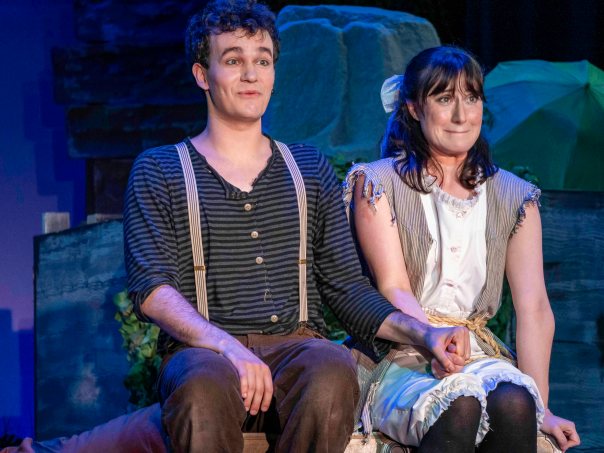
My fourth encounter with Starcatcher at Matthews Playhouse, once again directed by Bloede, helped to enlighten me. In her previous work with the script, the evanescence of the budding relationship between Peter and Molly Aster – and the poignancy of their parting – felt more touching to me than previously. That’s significant compensation for anyone who adores Barrie’s original story, whose magic can seem drowned in humor, wit, and shtick when first encountering Starcatcher.

This time around at Matthews Playhouse, another thematic thread struck me for the first time: Elice’s orphaned Peter reaches puberty without ever having a first or last name. By now, it will only come with his consent. At the other end of the moral spectrum, Black Stache has been searching throughout his pirate career for a hero antagonist who will perpetuate his fame.
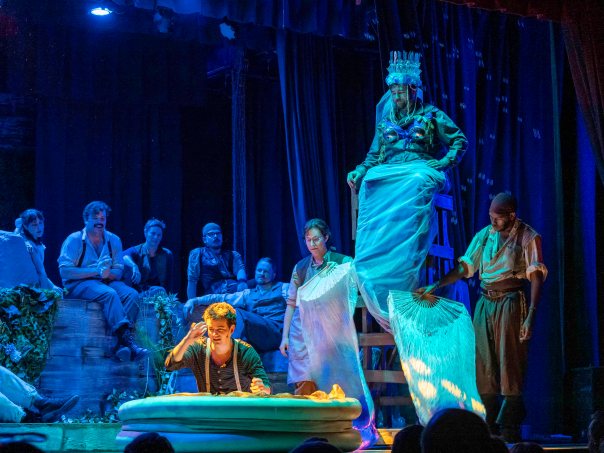
So their first grand meeting and tussle have biblical Israel-Angel proportions and consequences, or Robin Hood-Little John echoes if you prefer a secular, literary parallel. Two combatants become permanently linked and one of them emerges with a new name. Bloede’s staging here, when Peter gets his name from Stache – and later when Pan is added on – brought a new aura to those moments.

That’s what sent me to the web in search of Barry-Pearson’s actual text. Elice’s wit and humor seemed to chime with the belly laughs Barry’s newspaper columns repeatedly deliver. But is the class clown who grew up no less jokey truly capable of such yiddishe flavor and mythic depth? My suspicions were confirmed in the very first sentence of Barry’s saga: it already includes Peter’s name! An even more amazing revelation awaits if we read on. The jokey Barry tone we know and love is nowhere to be found in the opening chapters we can sample at Amazon. Instead, Barry and Pearson were following along on the dark gallows humor path that Lemony Snicket had pioneered with his Series of Unfortunate Events books for kids.

Deep breath. In my previous reviews of Starcatcher, I repeatedly gave Barry too much credit and blame for what I had seen and much too little to Elice. Both the jokiness and the mythic dimensions of Starcatcher can be credited to Elice – with additional bravos for how thoroughly he convinces us that this is how Barry would tell the origin story of Peter Pan.

Meanwhile, community theatre in Davidson, Charlotte, and Matthews continue to reap the dubious benefit of having so little professional-grade theatre in the Queen City. What a cast Bloede has assembled! Before the show began, representatives from the North Carolina Theatre Conference presented artistic director Sarah Bumgardner with their Theatre of the Year Award for 2024. So the folks backstage with their costumes on, waiting overtime for the ceremonies to conclude, were obviously under extra pressure to deliver. Even Bloede was nervous!

No matter how good your cast is, there’s plenty of stage business to be nervous about in running Starcatcher.Actors must move all the props and furniture around and keep track of all the many Yvette Moten costumes they must find and change in and out of as we move from a London dock to two sailing ships to a faraway island with a beach, a mountain, and a jungle. Stage manager Jessie Hull had to be preternaturally adept. Molly must float in the air. Peter and some nameless alley cat must fly. A lot going on while the quips shoot out at us, many of them newly minted to mock Myers Park and nearby country clubs.

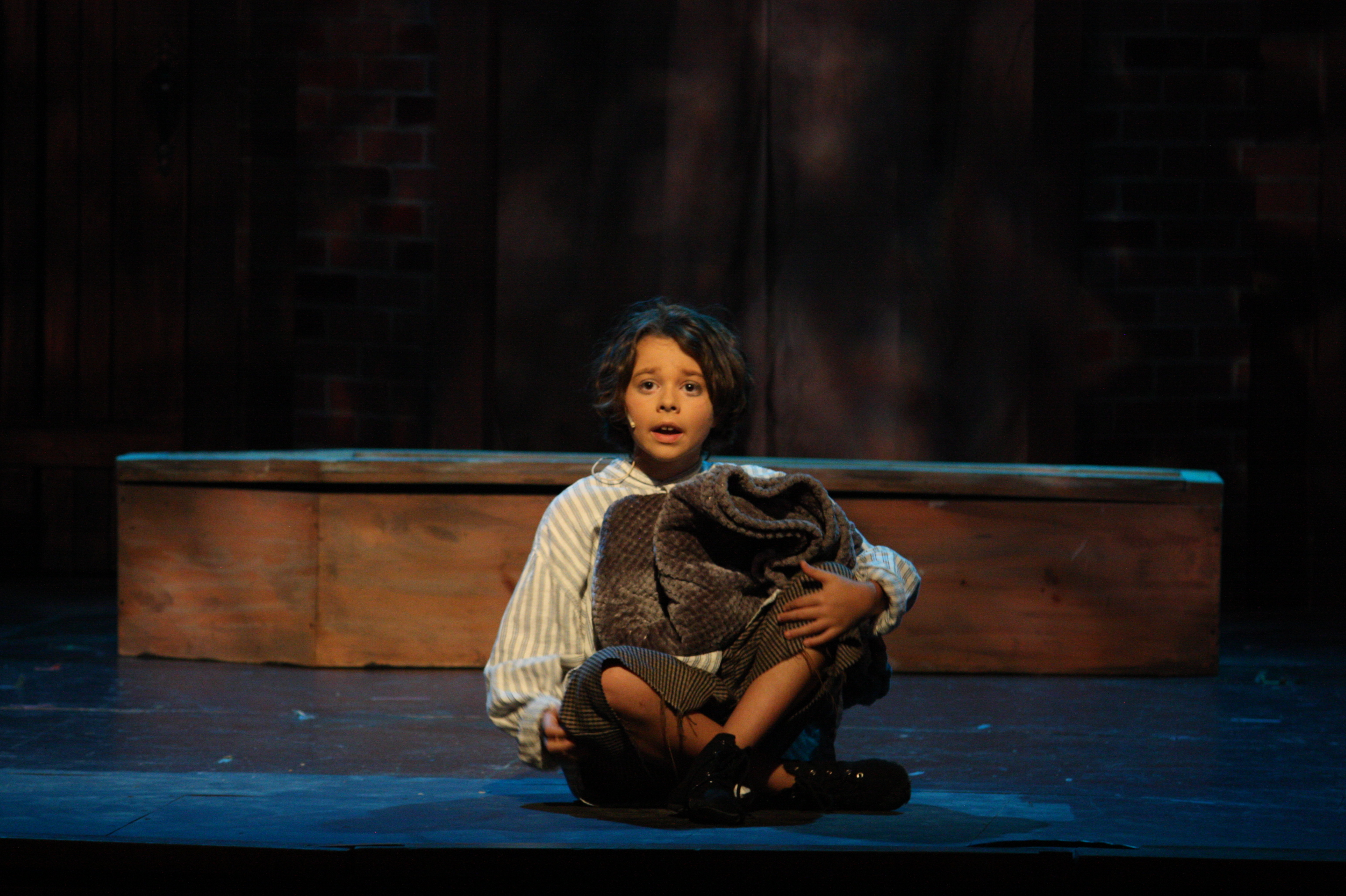
Nearly all of these players were newcomers to Starcatcher, beginning with Joshua Brand as Peter and Emma Brand as Molly, presumably arriving on the Fullwood Theater stage with ready-made chemistry. Their boy-girl antipathy is no less charming than their tentative stabs at intimacy, and both can seem fueled by the promise of adventure and ignited by its thrill. The only holdover from Bloede’s 2018 cast is Johnny Hohenstein, who in bygone days crossdressed to portray Mrs. Bumbrake, Molly’s flirtatious nanny.

With even more liberties, including more than a slight leftover effeminacy from Bumbrake, Hohenstein burst into full flower as the carnivorous Black Stache, heartily devouring the scenery in Stache’s emblematic amputation scene. His eyes shone greedily as he attacked the hambone bits, and yet a queer kind of avuncular calmness came over him as he finally met his predestined antagonist and named him. For some reason, Hohenstein drew the only problematic microphone on opening night but remained unflustered by its fussiness.

Of course, one of the glories of Peter Pan is its superabundance of meanies and piratical buffoons, and we do not lack them here. In her latest crossdressing exploit, Andrea King was the perfectly servile and supercilious Smee, with glints of valor and wickedness. Chip Bradley was the wily Slank, Captain of the Neverland,who steals the precious trunk full of starstuff from under the nose of Lord Aster, the Queen’s devoted ambassador and most eminent Starcatcher. Andrew Pippin portrayed the austere Aster with sufficient British crust, entrusted with the mission of transporting the precious starstuff cargo to Rundoon, where the trunk can be dumped into a nearby volcano and kept out of evil hands.

When we reach the faraway island where Peter and the trunk of starstuff serendipitously wash ashore, we will find that Neifert Enrique is the outré and eccentric King Fighting Prawn, monarch of the Mollusk natives. Was this the wildest of Moten’s costumes, or was it Hohenstein’s at the start of Act 2 during his brief song-and-dance as one of the Mermaids? Maybe Ryan Caulley snatches the prize toward the very end as Teacher, a salmon magically transformed into a Mermaid sage atop a lifeguard’s chair. It was a fitting reward for Caulley after a full evening gagged as Captain Scott from the first moment we saw him aboard his ship, the Wasp.

Ben Allen as Prentiss and Alijah Wilson as Ted were more individualized than Peter’s fellow orphans had been in previous productions I’d seen, and Miles Thompson was more rounded and nuanced as Alf, the smelly sailor who woos and distracts Molly’s nanny. Davis Hickson wasn’t as giddy and over-the-top as Hohenstein had been as Bumbrake at Theatre Charlotte in days of yore, so the Alf-Bumbrake thing (with Alf breaking most of the wind) was less orgiastic now and more genuinely warm.

“Next to Normal” Is Alive at the Barn!

Review: Next to Normal at Theatre Charlotte

By Perry Tannenbaum

July 4, December 7, September 11, and October 7 are all dates we remember for their historic meaning to the nation and the world. A similar earthshaking significance can descend on a single day in the life of a relationship, a marriage, or a family that can reverberate for generations – whether you were at the event or even alive at the time.

That’s essentially what we’re watching in Brian Yorkey’s Next to Normal with music by Tom Kitt, winner of the Pulitzer Prize for Drama in 2010 after winning Tony Awards for Best Musical, Best Book, and Best Orchestrations the previous year. Instead of doing things the traditional way, setting up the location and the situation in a big opening number that stages or recaps the prime catastrophe, Yorkey fast-forwards us more than 17 years, when the original hurt in the Goodman family has marinated and metastasized – a fissionable maelstrom that will soon explode.

With a fresh set of seismic events.

Diana is at the vortex of the mushrooming crises, so it’s both interesting and wickedly deceptive that Yorkey brings us into her drugged and delusional mind for much of the opening action. We still see the basic outlines of the family turmoil clearly enough. Her husband, Dan, keeps trying to go with the flow of Diana’s bi-polar mood swings. She navigates a series of therapists, looking for either a therapeutic epiphany or the perfectly calibrated cocktail of meds.

Meanwhile, Diana’s teen daughter Natalie feels neglected and unappreciated, living in the shadow of Mom’s obsessive devotion to her older brother Gabe. Warily, Natalie navigates her self-worth issues as schoolmate Henry tries to get closer and establish a relationship. When Natalie overcomes her shame and allows Henry, after much hesitation, to meet her family, we seem to have arrived at a breakthrough.

It’s a brave move and all goes swimmingly at the Goodman dinner table between Natalie and Henry until Diana walks in with a birthday cake, all smiles, candles lit. Yorkey’s sleight-of-hand has worked so beautifully that we wonder which of the two teens is the target of the birthday surprise. Suddenly things are going downhill – off a high cliff.

Like we’ve been overdosing on the meds so far.

Yorkey is very good at these slow build-ups where we see budding new hopes dashed by a sudden disappointment and fresh Diana relapses. After portraying Dan, the long-suffering husband in Queen City Theatre Company’s fine production in 2013, Billy Ensley takes the reins at Theatre Charlotte’s slightly slicker version. His suffering, grimly stoical, was very different from Johnny Hohenstein’s unfiltered and uncontrolled anguish. It’s easier to breathe at the old Queens Road barn when emotions get a space to release.

On the other hand, the Broadway edition starring Alice Ripley in 2009 (which toured here with Ripley in 2011) took a dimmer, more skeptical view of psychiatry and pharmacology, giving those productions directed by Michael Greif a darker, satirical, mad scientist edge. Around the corner from a cluster of medical centers and hospitals, Josh Webb’s set design on Queens Road is easily the brightest and most antiseptic I’ve seen. The usual two-story scaffolding that adorns rock operas is outfitted with colorful fluorescent lighting, though some flickering occasionally marred the serene pastels (intentionally?) inside the translucent fixtures.

So in transit to Charlotte, the emphasis continues to shift more emphatically away from the quackery to the suffering. Hohenstein’s broadened performance now rivals Melissa Cook’s bipolarity as Diana, for he’s still a domesticated dad to Natalie and a cheerful host to Henry between bouts of stressing and losing it in private and with his wife. In its fits and starts, Hohenstein helps us to balance the toll mental illness takes on its victims and on their loved ones. Easily the best of Hohenstein that I’ve seen and the most intensely consistent performance of the night.

Cook’s performance as Diana is as genuine and riveting as any I’ve seen in Charlotte or on Broadway – except when it isn’t. Whether you call it resistance or retreat, there are whole songs where she is suddenly no longer a cri-de-coeur rock singer and becomes a more traditional Broadway belter: sweeter voice with noticeably less emotion and intelligibility. Suddenly, it isn’t about how sensationally Cook is acting but about the singing, likely more in her comfort zone.

I can’t say for certain that the duality was there from the start, but there should be no turning back after the big birthday reveal.

And the words here are important – I could almost hear Ensley stressing this at rehearsals – for we get the best sound in a musical production, local or touring company, since MJ stormed the Belk last September at the beginning of the season. Kudos to Ensley for his pertinacity and, if there was any acoustic work or equipment upgrades in the mojo, glory to the staffers involved in the push, beginning with artistic director Chris Timmons and managing director Scot P J MacDonald. The old barn is sounding better than ever.

It needed to. In contrast with Spirit Square’s more intimate Duke Energy Theatre, where Glenn Griffin directed Normal, a musical on Queens Road requires ample decibels to reach the back of the house. Keeping with Theatre Charlotte wisdom, music director Ellen Robison trims her rock band to six musicians while placing them behind the singers.

Instinctively, Ensley finds a perfect pathway for his cast to turn up the volume. As if inspired by grand opera, he dials up the melodrama past suburban proportions so that most of the characters are wearing their hearts on their sleeves. Craig Allen as Drs. Madden and Fine, allows himself to be callous and ghoulish for the blink of an eye when the script absolutely demands it. Otherwise, he is the throbbing soul of earnest concern – moonlighting as a rock star in Diana’s delusions.

As Natalie, the only lonely daughter, I found Cornelia Barnwell to be more shut-down and compulsive than Abby Corrigan was on her express route to stardom in 2013. Barnwell’s voice is purest rock, piercing as a poignard with no blade. She seems to be the studious type in her scenes at school or alone with Henry. But she can flip and go rogue as soon as she sings. Very appropriate for Natalie, so anti-meds at the beginning because she has seen the wreck of her mom – before following in her footsteps. At the same upstairs medicine cabinet.

If a stoner-slacker can be seen as an oasis of calm, then that’s how Zach Linick will appear as Henry, faithfully devoted, non-judgmental, discreetly giving Natalie her space. There aren’t too many laugh-out-loud moments on this bumpy road to tentative stability, but when Natalie, resistant at first to Henry’s weed, leapfrogs him into wanton pill popping, Linick’s reaction bears watching.

Melodramatic or not, Ensley’s read on Next to Normal is more in tune with our chaotic times than the 2013 original, when Yorkey likely turned to the mad laboratory aspects of pharmacology and electroshock therapy to provide a counterweight to the suffering and gloom. Everybody is wronged here as if the world were all MAGA malcontents, but the uplift and electricity of Kitt’s score have always been there to supply lightning, spirit, and zest. Ensley relies on Robison’s band to deliver and their chemistry with all the suffering Goodmans is fire.

It’s especially white-hot in the stunning performance of Joey Rising as the disembodied Gabe. What a wonderful nuisance he is, impervious to all who ignore him! Over and over, he quashes the best hopes of his mom and dad, and he’s hardly less devastating to our own. If you find it hard to imagine a mad-scientist horror movie strain in this musical, the chill of hearing Rising’s defiant, jubilant “I’m Alive” will convince you that Yorkey believes devoutly in melodrama after all.

We in audience become like the frenzied villagers in Frankenstein, collectively yearning for Gabe’s destruction while wondering at Rising’s fire. But after he beats a full retreat, he returns, fierier than before. And then he multiplies!

Ensley and Schroeder Check All the Beautiful Boxes in Matthews

Review: Beautiful The Carol King Musical at Matthews Playhouse

By Perry Tannenbaum

When you think of singer/songwriter Carole King and Broadway musicals, there’s an instant disconnect: the humble simplicity of King’s Tapestry album cover clashing with the glitz and blare of the Great White Way. So a Broadway musical about King’s career is more of a stylistic stretch than a biomusical about most rock stars, pop stars, or jazz & blues divas. Everyone involved behind the scenes of the original 2014 production of Beautiful The Carol King Musical seemed keenly aware of the dichotomy, including director Marc Bruni, orchestrator/arranger Steve Sidwell, and scriptwriter Douglas McGrath.

Their idea of coping with the problem was by leaning into it. Not too subtly, they conspired to make the early stages of King’s career seem crass and commercial, as if she were trapped in the dog-eat-dog maw of the pop music industry. King and her writing partner, lyricist Gerry Goffin, write the songs while producer Don Kirshner finds the singers and the groups who will cut the singles – the likes of Bobby Vee, Little Eva, The Drifters, and The Shirelles. Yet somehow the hierarchy is flipped in the famed Brill Building in NYC.

Carole and Gerry are slaving for Kirshner, a genial industry mogul and taskmaster, and the couple’s best early music loses a lot of its luster when it’s farmed out, especially when “Up on the Roof” falls into the hands of The Drifters and “Will You Still Love Me Tomorrow?” is butchered by The Shirelles, thanks to excessively ornate Sidwell arrangements that would be more at home on Broadway or Vegas than Motown. These excesses helped Jessie Mueller to shine all the more brightly in the original cast – and for her sister, Abby Mueller, to shine equally when the touring version hit the QC in April 2016.

So a downsized production, like the one currently running at Matthews Playhouse, actually has the potential to be better than the Broadway and touring versions – with the right personnel and sufficient pizzazz. With Billy Ensley directing and Lindsey Schroeder leading a heavyweight cast, both those boxes are checked. The Broadway ensemble sheds two of its three keyboards nestling into Matthews, one its two guitars, and one of its percussionists. The slimming helps. No longer smothered by their orchestrations, Neil Sedaka’s “Oh! Carol,” Gene Vincent’s “Be Bop a Lula,” and Little Eva’s “Loco-Motion” sound more like rock music and less like mockeries.

Ensley targets the megahit by the King-Goffin duo’s friendly rivals, Barry Mann and Cynthia Weil, for his most farcical treatment. Not only is the arrangement of “You’ve Lost That Lovin’ Feelin’” garishly distorted, amped up from the swampy-echoey-churchy vibe of the original single, but the gulf between the bass and tenor voices of the Righteous Brothers is greatly emphasized, exaggerated, and comically exploited by Johnny Hohenstein and Zach Linick.

McGrath’s book is most affecting when it deals directly with King, though there’s bold poetic license in his voodoo, historically speaking. Pressured by Kirshner to come up with a new hit overnight for The Shirelles (in real life, they only had one hit record so far), King writes the music and goes to bed with Goffin. Perfect setup. Wouldn’t you like to wake up in the morning and find the handwritten lyrics for “Will You Still Love Me Tomorrow” perched on your piano – and be the first person on Earth to read and sing them?

No disrespect to the great Bobby Vee, but we’ve suddenly ascended more than a few notches above “Take Good Care of My Baby.” This moment still grabs me, but there are more moments like this after intermission, when “You’ve Got a Friend” and “A Natural Woman” are unveiled, that choke me up even more – as King breaks away from the Brill Building and starts to do her own thing. Schroeder replicates the sandy sound of Carole’s voice from the beginning, but as she transforms from a demo singer behind an upright piano to a chart-topping performer, watch out.

Schroeder can not only belt – she can tear your heart out.

McGrath’s dramatization heightens the magic most memorably when “You’ve Got a Friend” is reframed as a not-quite-farewell song, when King embarks for her solo career in LA with Kirshner’s blessing, and both Barry and Cynthia gather round the old upright with her to sing this newborn masterpiece. The song didn’t really come out until her second album, but who’s counting, right?

Nick Southwick as Barry and Sophie Lanser as Cynthia (get that woman a more reliable mic!) deliver polished performances all evening long, but they also grow more gravitas after intermission. Lanser sheds the frivolity of a “Happy Days Are Here Again” parody and “He’s Sure the Boy I Love” and joins Southwick – previously mired in the silliness of “Who Put the Bomp” and the wrong-key version of “You’ve Lost That Lovin’ Feelin’ – in a heartfelt “Walking in the Rain” duet.

Then if you haven’t started weeping with Schroeder’s “It’s Too Late,” you’re at the mercy of “You’ve Got a Friend” when Lanser and Southwick join in on the quivering-lip goodbyes. After playing Kirshner with avuncular savvy throughout King’s formative years, Ryan Dunn sprinkles some welcome laughter into this maudlin scene with a (purposely) bad attempt at vocalizing.

I’d forgotten that Carole had Aretha’s 1967 hit in her hip pocket when she cut Tapestry out on the Left Coast in 1971, so I found myself suddenly suppressing sobs when “A Natural Woman” began. Here it felt very right that Sidwell’s arrangement brought added vocalists and brass to beef up the simplicity of King’s version – and freed Schroeder to narrow the gap between Carole and the Queen of Soul with some fervent belting.

Marty Wolff’s simple two-story set design, with four wide strips of stained-glass paneling running vertically upstage in front of the eight-piece band led by Ellen Robison from the keyboard, needs only JP Woodey’s lighting to give it a rockin’ modernistic zing. Lisa Blanton’s choreography is devout doo-wop, most praiseworthy for how well the groups stay in sync, and Chelsea Retalic likely cranked out between 75 and 100 costumes for this large cast – all of them, from the sleekest to the grungiest, on point.

And the wigs! The only misfire here, among dozens of triumphant coifs – several for Schroeder – was the oceanic profusion of waves that perched on Joe McCourt’s head as Gerry Goffin, making him virtually unrecognizable. McCourt, a musical mainstay in the QC since his debut in 2008 as the lead in Godspell, has suavity to spare to spare and, in contrast with Southwick’s quirky neuroses as Barry, gets a nice and bumpy character curve as the only troubled soul we see.

This image has an empty alt attribute; its file name is beautiful24-139.jpg

As for the Afro-American doo-woppers… my, oh my! By bringing Nehemiah Lawson aboard to take over “Some Kind of Wonderful” from Schroeder and McCourt and then to bring him back again and again to sing “Up on the Roof” and “On Broadway,” the latter one of Weil & Mann’s best, Ensley and Robison signal that they have no plans of dissing The Drifters. Meanwhile, two lead singers are embedded among Ensley’s Shirelles. As Janelle Woods, the Shirelle who denigrates “Will You Still Love Me” as “too country” before fronting the breakthrough single (first Billboard #1 for an African-American girls’ group), Brianna Mayo gets a chance to show that her acting chops are as strong as her singing skills.

Shortly afterwards, Raven Monroe emerges from the backup Shirelles to become Little Eva and ignite “The Loco-Motion.” Until then, she moonlights as King’s babysitter during the leading lady’s brief marriage to the restless Goffin.

There’s a formulaic circle to McGrath’s storytelling that’s not at all displeasing, starting and ending with King as a star behind a grand piano singing a song from Tapestry. We flash back to her youth in Brooklyn and eventually touch down at Carnegie Hall, surely a kind of Jerusalem for a humble Jewish girl. Alongside her at the beginning and at the end is Carol Weiner as Genie Klein, King’s mother. Both were abandoned by her no-good father, steeled by adversity. Along the way to Carnegie, Weiner peeps in with a couple of overprotective warnings, a few salty quips, and a proud Mama’s lie.

If McGrath can embellish a good story, why shouldn’t she

“Clue” Reaches New Heights of Silliness at Matthews Playhouse

Review: Clue at Matthews Playhouse of the Performing Arts

By Perry Tannenbaum

2023~Clue~18

Apparently, I didn’t have much of a clue about CLUE, a new comedy by Sandy Rustin based on the 80-year-old board game and its 1985 screen adaptation. I presumed that Matthews Playhouse would be staging the musical version that has periodically skulked around regional and community theatres after ignominiously posting its closing notice a week after it opened Off-Broadway in early December 1997.

Our playbill, listing “Original music composed by Michael Holland,” kept me in the dark a bit longer until the show began without an overture or an opening number. While we waited, we had the chance to fill out a form and predict which of the “usual suspects” would be revealed as the culprit – or culprits – at the end of the show. It’s a pretty simple form since, unlike the board game, we don’t have to sniff out where the murder takes place and which of six lethal weapons is used. Simpler than the movie, too, which was famously released with three different endings.2023~Clue~4

After directing a nearly sublime Book of Will at Belmont Abbey College back in February, Jill Bloede shows that she and her sure comedy instincts can lift up the utterly ridiculous in Matthews. She and set designer Marty Wolff aren’t going to let us forget that Clue is a board game. With sliding wood panels for walls and cunning little swinging gates for doors, we can see three rooms at a time on each side of the stage simultaneously, with a corridor representing the Boddy Mansion’s hallway completing the symmetry – seven of the nine rooms depicted (even more primitively) by the humble game board’s overhead view.

Flimsy as those thin walls may appear sliding in and out of view, they must be sturdy enough to accommodate the workings of secret panels that either flip their graphics or open and shut widely enough for the comings and goings of arms visibly wielding weapons. If your Clue erudition has stuck with you since childhood, you’ll remember that those weapons are a candlestick, a lead pipe, a monkey wrench, a dagger, a rope, and a revolver.

It’s with the entrance of our prime suspects that the plot of Jonathan Lynn’s screenplay and Rustin’s script, mimicking the film’s plot setup, swerve from the classic simplicities of the Parker Brothers’ game. Each of the six guests who have been invited to the Boddy Mansion is given one of the aliases bestowed on the iconic game pieces. Each now has a colorful – but compromising – back story that he or she is being blackmailed for. Serious enough misdeeds lurk beneath all our guests’ respectable facades for a murder motive, and their sophisticated enough for them to apply for membership among the avatars of more evolved adult board games.2023~Clue~19

So Colonel Mustard does have a military background, and Mrs. Peacock, a US Senator’s wife, has reason to be prideful. Mr. Green has a gay bent that could be costly as news of the McCarthy un-American hearings, circa 1954, seep through in radio broadcasts, and Miss Scarlet’s flame seems to be fueled by undercover stints as a high-priced madame. Professor Plum was apparently disgraced in another profession before finding refuge in academia, and Mrs. White… why is she dressed in black? Presumably because one or more of her late husbands could be the skeleton in her closet.

Now if you or I were anonymously blackmailing six evildoers with DC connections, you might think twice – or 700 times – before inviting even one of those cash cows for dinner, blowing your cover and, in a faraway secluded manor, endangering your own life. Ah, but the Lynn-Rustin silliness has just begun. Let’s distribute the six iconic murder weapons among the six color-schemed guests! And after all, if six possible murderers are gathered for an evening of killing and sleuthing – and dinner! – why limit the victims to just the ever-ready Mr. Boddy?2023~Clue~10

The whole Boddy household staff might be available to boost the body count: the maid, the cook, and the butler. Maybe we could liven (or deaden?) things up with a stranded motorist, a snoopy cop, or even a singing telegram girl? Hey, it’s a party!

With Allen Andrews as the suave and mysterious butler Wadsworth greeting mutton-chopped Jeremy Cartee as the pompous Colonel Mustard, the ball gets rolling nicely as the pair let us in on the rules of the game. Andrews as Wadsworth is so slick of a host greeting all of our suspects that he manages, through sheer brass and sliminess, to cast suspicion on himself. Cartee, meanwhile, must vie with longtime local diva Paula Baldwin as Mrs. Peacock for the distinction of being the most arrogant and pretentious of the suspects. Baldwin makes up for lost time by being the most outgoing, neurotic, and loquacious guest.2023~Clue~17

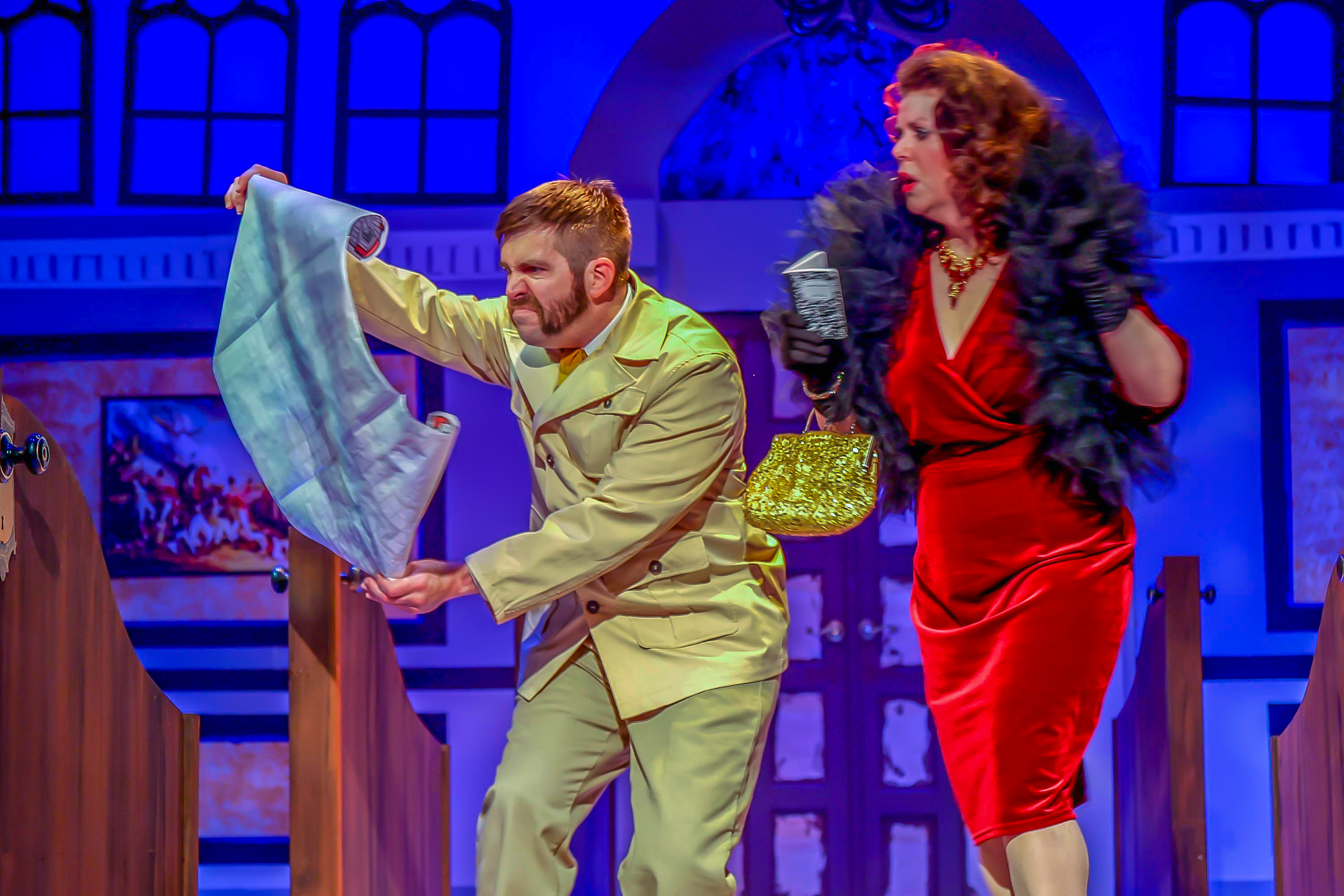
Clad in a screaming red dress, red hair garishly beribboned, and wrapped in a boa, Vanessa Davis as Miss Scarlet is the polar opposite of the cool Mary Lynn Bain as the semi-funereal Mrs. White. While Davis shoots seductive glances everywhere, Bain seems to be in perpetual mourning.

Yvette Moten’s costume designs are predictably color-coded, but they are not altogether studded with solid hues. While Andrew Pippin as the reserved Mr. Green gets to wear the most stylishly coordinated and urbane ensemble in harboring the deepest secret, Moten allows herself to go fairly wild over Johnny Hohenstein’s outfit as Mr. Plum: a cringeworthy maroon plaid jacket striped with deep purple and sky blue, a weirdly coordinated motley bowtie, and the loudest purple argyle sweater she could find.

Kathleen Cole is most notable for all the costumes – and phony eyebrows – that she wears, changing from the Cook to the Singing Telegram Girl before resurfacing as police backup. That glittery delivery girl outfit would liven any costume ball.2023~Clue~1

Bloede obviously takes much delight in maneuvering her game pieces. Sometimes they scurry around so swiftly that we lose track of them, and at other times, Wadsworth and staff parade them from room to room with a ceremoniousness that actually does evoke silly avatars moving around the squares of a game board. Yet there wasn’t a single missed beat during all the hectic scene changes at the Saturday matinees, never a missed cue, and never a flubbed line.

We seem to all get nine different rooms with all the back-and-forth of the sliding walls, so efficiently whisked in and out of sight from the wings. But I don’t remember seeing a ballroom, so I’m sure we don’t see more than eight.

Eight is enough.

“And Then There Were None” Keeps Us Guessing as the Body Count Mounts

Review: Dame Agatha Christie’s And Then There Were None

By Perry Tannenbaum

IMG_1656

Theatre audiences love mysteries. Action, intrigue, plot twists, murder, and maybe a jolt of romance – they deliver an intoxicating brew and demand your heightened attention. Yet there aren’t nearly enough theatre mysteries to satisfy audience demand. The big names in the field are Christie and the Holmeses – Sherlock and Rupert. Either purloined from Arthur Conan Doyle’s stories or cynically refashioned and rebranded for commercial consumption, Sherlock is the mystery detective personified. Rupert Holmes has had the chutzpah to craft two mystery musicals, Drood and Curtains, as well as two mystery dramas that premiered here in Charlotte, Accomplice and Thumbs.

Whether onstage or in bookstores, Dame Agatha Christie is the unchallenged queen of mysteries. A trio of Christie titles are constantly making the rounds: The Mousetrap, renowned as the longest-running stage production of all time since 1952; Witness for the Prosecution, especially after Billy Wilder’s Oscar-nominated film in 1957; and, first presented as Ten Little N-Words back in 1943, And Then There Were None.

Christie’s zero-sum mystery is based on the most beloved of her 72 novels and one of the six best-selling novels of all time. There’s absolutely no problem with name recognition at Theatre Charlotte, where few seats were left on opening night. Nor was there any sign that director Dave Blamy had any difficulty attracting sufficient local talent to fill his cast of 10 suspects/victims who arrive on Soldier Island, all claiming to have been invited by the same person they’ve never met. An eleventh cast member ferries the guests, the butler, and the maid from the mainland and then departs.

Or does he?

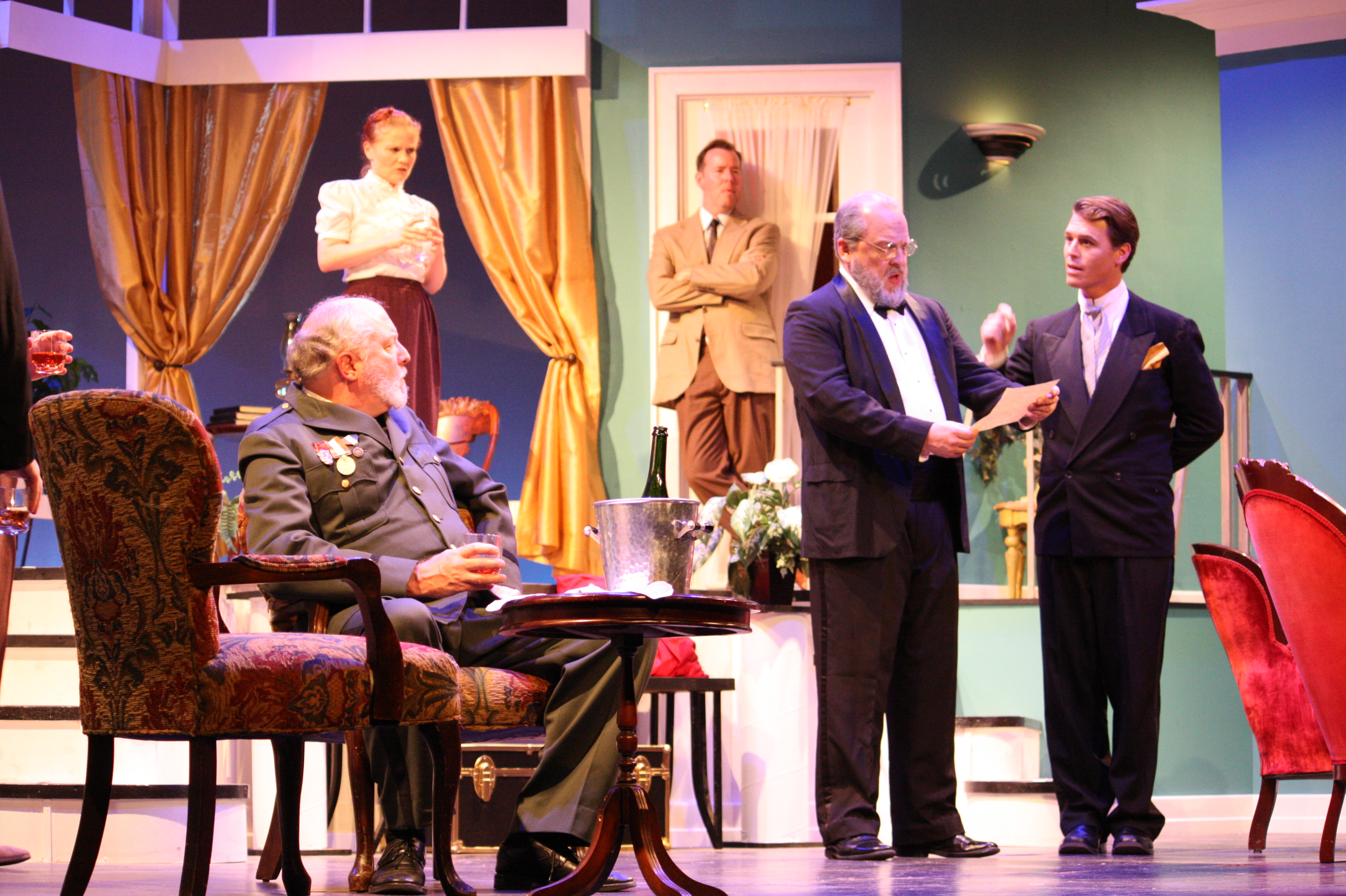
Whoever sent out the invitations was selective, choosing only people who were responsible for other people’s deaths. They will all be victims, in the killer’s mind, who deserve to die. A recording that the butler has been instructed to play calls out each of the guests’ names and tells the group whose death he or she is responsible for. Justice is to be meted out to them all, for there is no escaping to the mainland.IMG_1674

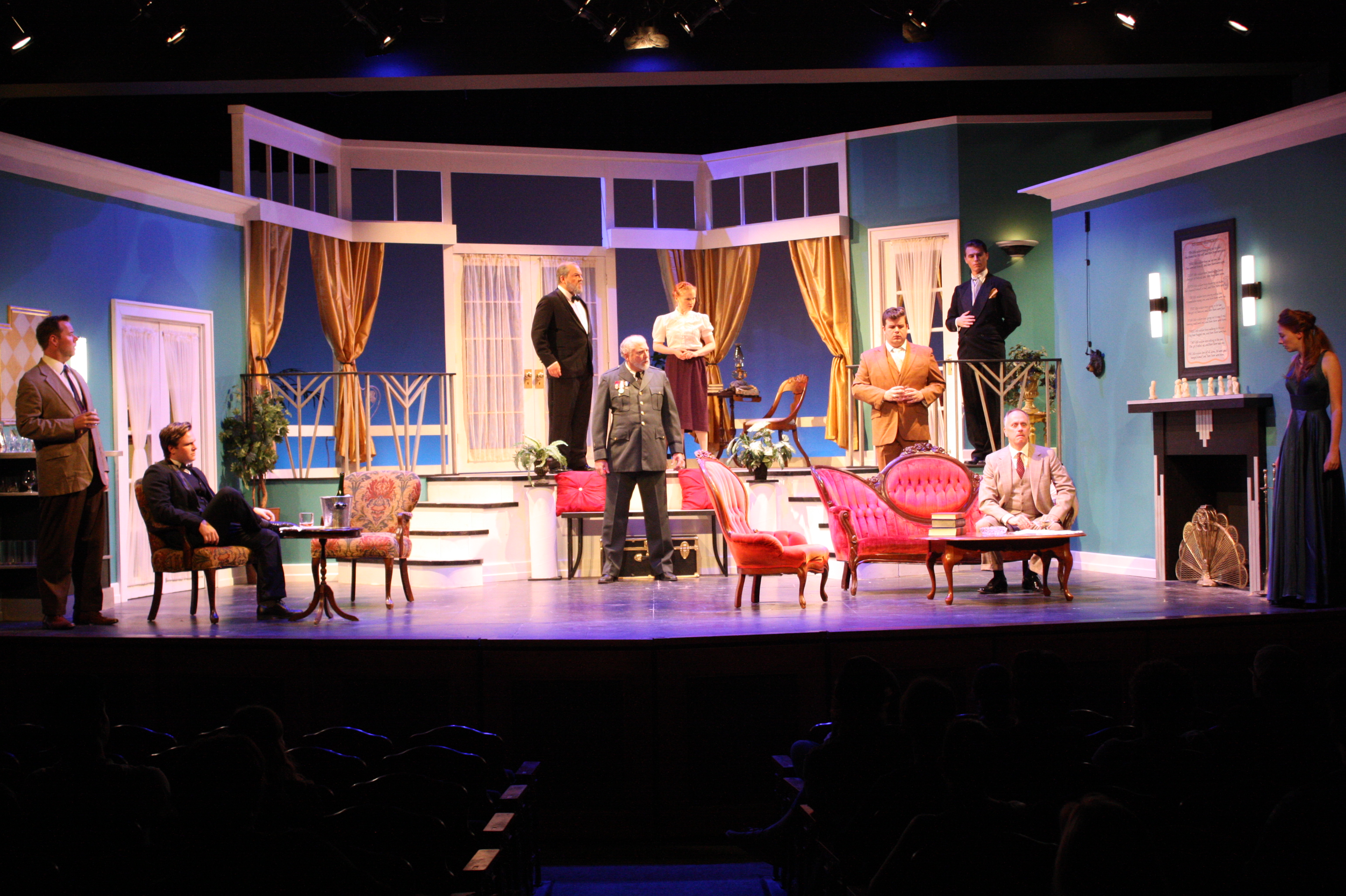
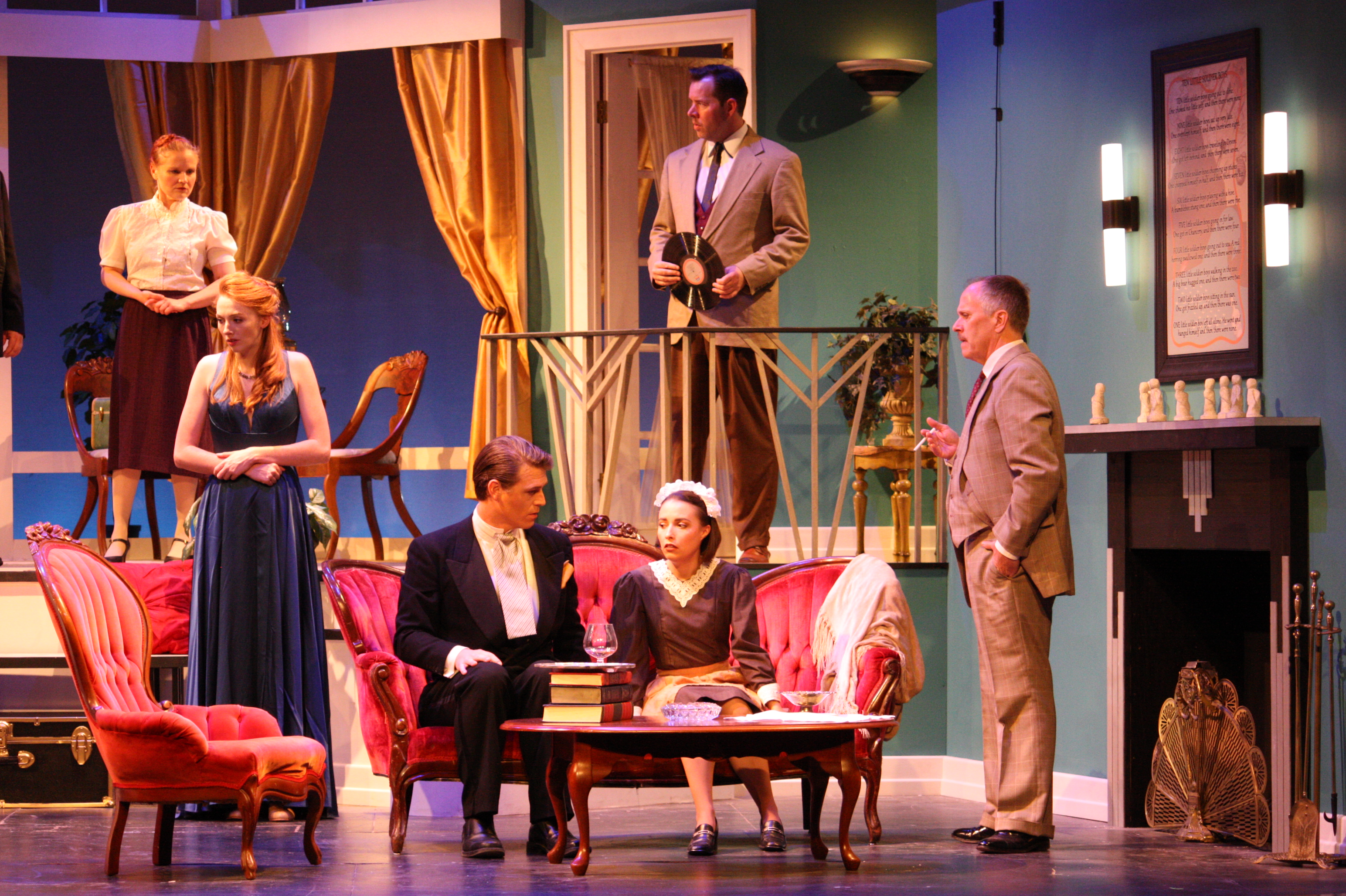
That only begins to describe the fiendishness and arrogance of the killer who is on the loose, probably hiding in plain sight. Hanging over the mantle – and printed as an insert in our programs – is a poem, “Ten Little Soldier Boys,” chronicling how the group dwindled until “there were none.” As the dwindling survivors of the murderous rampage soon figure out, the poem has become a template for how the killer will snuff out each of them, following the order of the poem. The first “choked his little self,” the second “overslept himself,” the third “got left behind,” and so on.

Each time one of the guests is murdered, a soldier boy figurine sitting on the mantle disappears or falls to the floor.

It’s an elegant touch, an impressive sleight-of-hand, another affirmation that the killer is in control and always one or two steps ahead of his victims – another way he or she is toying with the ineffectual survivors who remain, mocking their efforts. And ours.

Chris Timmons’ set design, one of the best and most beautiful he has built during his 13-year tenure at the Queens Road barn, has four exits on its two levels, allowing a certain amount of bustle and confusion as we track the whereabouts of our chief suspects. We’re also rubbernecking where the next victim is, for we never know who that will be until late in the game – this is a diabolical game, right? – and only vaguely how the next murder will be done.IMG_1668

Blamy keeps the action flowing masterfully, varying his pacing, and getting Christie’s suspects to engage with each other intensively. Once the game is afoot, we must believe that each one’s demeanor – suave, artless, judgmental, analytical, scientific, or dignified – hides the heart of a maniacal murderer.

The Theatre Charlotte veterans are as reliable as we expect them to be. Caryn Crye drips piety and primness as spinster Emily Brent, saving her most severely moralizing barbs for young Vera Claythorne, whom she views as scandalously immodest. Johnny Hohenstein, not always on his best form on opening night, was sleazy and obnoxious as retired policeman William Blore when he hit his stride, both deceitful and maybe a little stupid. Timothy Huffman was actually a little less commanding than we’ve seen him before as retired General Mackenzie, perhaps too overcome by guilt and senility to be a serious threat.

On the other hand, Philip Robertson emerges as a natural leader and investigator as Sir Lawrence Wargrave, a retired judge who gets all the guests to respond to the crimes they’re accused of, rousing suspicions and animosities among the group. Thanks to him, we see the rogues’ gallery we’re dealing with fairly clearly.

Among the Queens Road newcomers, Peter Finnegan takes top-of-the-class honors as adventurer Philip Lombard. After a startling local debut as Bottom in Actor’s Theatre’s Midsummer Night’s Dream in August, Finnegan turns the pistol-toting Lombard from a semi-romantic hero into an Indiana Jones rascal, absorbing multiple rejections and altering the chemistry between him and Vera. Jonathan Stevens’ breakout performance at CPCC came even more recently as Lord Wessex in Shakespeare in Love. Some of that same aristocratic conceit and bearing transfers well to Rogers the butler, and his toxic superiority to Mrs. Rogers also has a familiar ring.

IMG_1662

As Mrs. Rogers, Cadie Pittman comes closer to a breakout role, giving the overworked maidservant a nice resentful edge. We keep guessing about Vera and her past because newcomer Quincy Stanford keeps her so unpredictable as she establishes bumpy relationships with both Lombard and Emily. It’s hard to surpass Finnegan for reckless swagger, but newcomer Carson Edwards gives it a try as inconsiderate daredevil Anthony Marston. He’s somewhat thwarted by the playboy outfit designed for him by costumer Chelsea Retalic, more apt to drink champagne than bourbon, and too carefree to carry a gun.

Rounding out our primary suspects, Will Lampe makes an interesting study as Dr. Armstrong. He might be a truly timorous, harmless, and useful physician, but Lampe’s fearfulness could be a façade if he’s furtively dealing out death with his medicinal syringes. Then he disappears! Dead? Lurking? The tension ratchets up suspensefully as we puzzle out whether he’s the “red herring” in the “Ten Little Soldier Boys” poem or the latest addition to the body count.


Dangerous and Delicious London – With a Twist

Review: Oliver! at Theatre Charlotte

By Perry Tannenbaum

IMG_1349

Ron Law will be retiring when his 15th season as executive director at Theatre Charlotte comes to an end next spring, but he sure isn’t retiring – or even receding into the background – right now. The spotlight will shine brightest on Law in December when he stars for the first time ever as Ebenezer Scrooge in the annual revival of A Christmas Carol at the Queens Road barn. Meanwhile he’s had other things besides bookkeeping on his mind for the past month or so, since the 92nd season at Theatre Charlotte is kicking off with a different Dickens, Lionel Bart’s Oliver! and Law is the stage director.

Thanks to some impressively weathered scenic design by Josh Webb and a juicy mix of dignified and low-life costumes by Melody Branch, the current production looks vibrant and fetching before we even reach the title song, though purists will recoil at the sound of the prerecorded orchestra. Your first favorable impressions will be sustained by the fine set of adult principals that Law has gleaned from the rich Queen City talent trove that showed up for auditions. Yet the mean rigidity of Mr. Bumble, the terror of Bill Sikes, the acquisitive cunning of Fagin, and the conflicted kindness of Nancy would be largely wasted if they were directed at an Oliver who didn’t win us over.

IMG_1318

Atticus Ware passes his first key test as Oliver Twist simply by standing up after dinner has been served at the workhouse and having the cheek to say, “More, please!” We’ve actually seen an Oliver at Children’s Theatre long ago who looked the very antithesis of orphaned malnourishment, and it was hard to suppress a laugh. Easily two years younger than any Oliver to appear in a local production – except for Andrew Kenny in 2001 – Ware also passes muster when Bumble reassures the Sowerberrys, morticians he has sold Oliver to, that the lad will surely grow bigger.

There are prudential reasons past directors haven’t opted for an Oliver as young and small – and maybe considered cutting Bumble’s room-to-grow remark. Without a body mic, it’s hard for a middle-schooler to sing Oliver’s angelic “Where Is Love?” or his wonderstruck “Who Will Buy?” and make himself heard across an orchestra and an audience. Nicely miked-up, Ware holds up as beautifully as Andrew Griner did in Theatre Charlotte’s last Oliver! in 2007, and he adds palpable charm when he takes his turns in “I’ll Do Anything.”

Of course, the main reason why Oliver! is being offered in the metro Charlotte area for the sixth time this century is Bart’s amazing score. No fewer than a dozen of the songs have engraved themselves in my mind so that I can agreeably recall their main hooks without assistance. Familiarity can tempt directors and actors to deviate from established Oliver Twist expectations – or, in the practice of casting girls at the workhouse and in Fagin’s band of thieving urchins, widening our expectations.

Law has presented enough iterations of Christmas Carol to value and preserve the Dickensian spirit of Oliver while loosening casting requirements where the envelope has already been pushed. Johnny Hohenstein immediately stands out as a fierce and booming Mr. Bumble, while Geof Knight as Fagin and William Kirkwood as Sikes are among the best we’ve seen. Together they form an adult triumvirate who remind us that greed and corruption aren’t simply confined to the underworld.

Hohenstein is as titanic as a beleaguered husband as he is when he’s a tyrannical beadle, a definite asset. I find ample menace and intimidation in Sikes when Kirkwood delivers his growling “My Name,” and I like the sliminess that Knight brings to “You Got to Pick a Pocket or Two” – and the grim calculation of his “Reviewing the Situation.” You couldn’t get me to dispute that any of these three gave the best auditions for their respective roles.

It’s just that I want to see a craven factor, a fear of Sikes’ violent volatility that would give an extra dimension to Fagin’s craftiness. From there, the chemistry between the two rogues can be further textured by their one-time mentor-apprentice relationship. Knight just doesn’t have the appearance of a cerebral weasel, which would make these layers relatively easy and self-evident. Here it needs work.

When it comes to Sikes’ abusive relationship with Nancy, Bart gives Kristin Graf Sakamoto all that she needs to get to its heart. Even if Nancy isn’t liberated, she’s spirited, best seen in Sakamoto’s interactions with the youngsters and in her lusty, boozy rendition of her “Oom-Pah-Pah” polka. Nancy faces some grim choices with Oliver, yet Sakamoto makes it clear that fidelity to Sikes is infused with fear – propped up by fear, you could say – when she repeats her signature “As Long as He Needs Me.”

So the Sikes-Nancy-Oliver drama and suspense develops beautifully from the first moments that we see Sakamoto. There’s already a glint of welcoming light when the Artful Dodger accosts Oliver after he has escaped Bumble and the Sowerberry mortuary. Bailey Wray ignites a “Consider Yourself” welcome as Dodger, assisted by Lisa Blanton’s choreography, that seems to engulf the whole city of London. Wray himself radiates a city-sized energy all by himself. Dodger’s precocious top hat is a couple of sizes too large, a plausible wardrobe choice, but I suspect that Law has elected to keep it that way in order to keep Wray’s hyperactive hands partially occupied.

Later there’s lively bustle in Fagin’s lair when the master puts his kids through their pickpocketing drill, and a new flowering of Blanton choreography when Oliver awakens at the home of his benefactor, Mr. Brownlow. the greatness of Britain beams at us like a sunshiney day, for Ware isn’t the only vocalist in “Who Will Buy” as it swirls with increasing anthemic force. Consonant with this cornucopia of wholesomeness, Rick Taylor is upright and trusting, a quiet affirmation that goodness and kindheartedness can rise above the miasma that swallows up Bill and Nancy.

Aside from the cloudy Sikes-Fagin chemistry, Law only loses focus at the end when Fagin and Dodger make their final exits – seemingly without any emphasis or attitude. Maybe bringing them downstage would help, but it’s a moment that deserves more fiddling with and agonizing over. Last impressions are as important as our first.

IMG_1338

It’s still quite sensible to hurry over to Queens Road, where the corruption and goodness of humanity are as exquisitely balanced as night and day. At its core, Oliver’s journey is a progression from secluded, deprived oppression to the centers of opportunity and civilization. Performances are almost universally fresh and decisive among over 40 onstage participants, and it’s hard to overpraise the work of musical director Ryan Deal in keeping his singers fresh and precise through a long rehearsal process.

Of course, the excitement of opening night added a jolt of energy to the performance, especially for the 13 actors – plus a dog – who were making their Theatre Charlotte debuts. If you’ve never experienced Oliver! before, you will likely feel a similar jolt of discovery.


“The Philadelphia Story” Bides Its Time Before Detonating

Review:  The Philadelphia Story

By Perry Tannenbaum

One of the wonderful things about Philip Barry’s The Philadelphia Story is that, yes, it really is about class distinctions and peculiarities, but the playwright remains ambivalent and tolerant of them all. Beneath their upper or lower crust exteriors, all of these Philadelphians – young and old – are recognizably human. You rarely see so many fully-fleshed characters onstage in the course of a single evening. I wouldn’t be terribly surprised to see a premier professional company repeatedly reviving this witty, effervescent comedy, but it’s absolutely astounding that Theatre Charlotte, our community theatre, has revived Philadelphia Story twice in the new millennium, now and back in 2000.

Both productions showed the pitfalls. The cast needs to be nine deep, alert to the amount of polish and roughness Barry expects of them, and aware of the energies and pacing required at each point of Barry’s intricate plot. The story revolves around “virgin goddess” socialite Tracy Lord – as you might expect, since Katharine Hepburn, the original Tra on Broadway and on celluloid, matched the 25% investment that the playwright plowed into the original production. Tracy is sensibly engaged to the cold and ambitious George Kittredge, impetuously divorced from the dapper C.K. Dexter Haven, and estranged from her father, whose indiscretions have brought the Lords unwanted publicity.

While Tracy is resolving these relationships, her brother is focused on suppressing a magazine exposé that will be published about their wayward father, dangling the prospect of exclusive access to the wedding as an enticing alternative for the publisher. The reporter and the photographer assigned to the Kittredge-Lord nuptials, Mike Conner and Liz Imbrie, bring another level of complications to the scene. She’s been secretly carrying a torch for him for years, but when spirits rise and champagne flows on the night before the wedding, Mike finds that he has fallen – hard – for Tracy, a prelude to their both enjoying an illicit, drunken midnight dip together in the Lords’ swimming pool.

While Barry is at work on how the wedding, the magazine story, and multiple alienated affections – past and present – will ultimately resolve, director Tonya Bludsworth and her cast must deal with all of the reactions and repercussions along the way. Making all of this bubbly complexity even harder for Bludsworth and Theatre Charlotte to achieve is the relative lack of enthusiasm for the project. Turnout for auditions was likely as tepid as audience turnout. Compared with opening night for Peter and the Starcatcher in September, there were conspicuously more empty seats at the back of the house – and a bit less confidence onstage.

Ten of the 14 cast members are new to Theatre Charlotte, including most of the key characters. We started off strong back in 2000 with a Tracy who had the look, the patrician manner, and sometimes even the sound of Hepburn, but that newcomer’s imperial highness never became sufficiently ruffled when the plot thickened. In Bella Belitto, we have another newcomer as Tracy, and on opening night, her serene highness was conspicuously lacking in the early going and – like others onstage – she was often underpowered and inaudible.

Without that serene aura and grace, the splintering of Tracy’s goddess élan isn’t as poignant as it should be in Belitto’s account of her re-education. Yet when she’s assailed by complications, catastrophes, and intensifying adoration, she faces it all very convincingly, her spirits and energies rising. Waking up on the climactic morning after, her decibel level also crescendos spontaneously. We feel that she is learning her lesson and actually benefiting from the indiscretions that brought on her fall – and that the lesson runs deep to her core. Her epiphany detonated effectively for me.

A lot of that depends on Nick de la Canal radiating a rakish upper-crust urbanity as Dexter with enough of that crust trimmed away to make room for tolerance and forgiveness – the two key qualities Tracy needs to acquire. De la Canal’s insouciance also contrasts nicely with the stuffiness that Will Millwood brings to George Kittredge. Barry doesn’t completely hide his disdain for George’s commercial outsider status, so Millwood makes a prudent choice in stressing his judgmental bent.

Dexter also comes off finer than Mike Conner, but by a significantly smaller margin. Here the nuanced class distinctions are no less telling. Christopher Long reminds us that Mike starts out fairly judgmental himself before Tracy bewitches him, but we indulge his pre-judgments more readily in the same spirit that we’re inclined to forgive his boyish, impulsive trespasses. Our best verdict on him vis-à-vis George is much like Barry’s: he’s more deserving, in spite of his depressed finances, of being called a gentleman.

What gives The Philadelphia Story its screwball slant is that everybody up onstage and down in the audience seems to know who the best fit for Tracy is – except for the goddess herself. This includes her mischievous younger sister, Dinah, who attempts some telephone matchmaking. Helena Dryer makes little sis pesky and likable in the right proportions. She’ll be an utter triumph once she makes herself consistently intelligible.

Tracy’s mom isn’t the most pivotal role here, though Margaret does point the way for her daughter in forgiving her husband’s infidelity. What makes Heather Place’s debut so auspicious as Margaret Lord is her clear bubbly delivery and her effortless projection of warmth and class, richly portending her reconciliation with the dashing, slightly over-the-hill Seth Lord. Victor Sayegh is mildly and earnestly supplicating toward Margaret and his disapproving daughter, as befits a Philadelphia patriarch, another cue for Tracy to accept people’s imperfections, including her own.

Sayegh and Place draw two of Chelsea Retalic’s most stylish costume designs in evoking high society elegance, but it’s an uphill battle to project prosperity amid Josh Webb’s drab and dour set design. Two Ionian columns fail to provide uplift, and there’s no longer a visible hint of the swimming pool in the wings. Portraying the eccentric Uncle Willie in a delightful debut, Dan Kirsch gets my nod as the plutocrat most at home in this down-market mansion, lovable for all his pomposity.

Fresh from his crossdressing exploits in Starcatcher, Johnny Hohenstein is mostly responsible, as Tracy’s scheming brother Sandy, for the PR intrigue that lurks beneath the romantic comedy. Good luck following – or caring about – all the Act 2 twists in that sector of the plot. For that reason, Anna Royal as Liz turns out to be more important for me. Ultimately, she’s modeling the patience, forbearance, and forgiveness toward Mike that Tra should have toward Dex. Royal gives Liz just enough edge to update her and elevate above the cliché she must have been in 1939 when THE PHILADELPHIA STORY first hit Broadway.

Here she isn’t just a working-class woman who knows her place, meekly deserving Tracy’s discards. Wielding her Contax camera, she’s Mike’s professional partner, biding her time for a natural upgrade.

Fleet Buffoonery Conquers Enchantment in “Peter and the Starcatcher”

Review: Peter and the Starcatcher

By Perry Tannenbaum

As a fairly frequent reader of Dave Barry’s newspaper work, still recycling in Miami Herald newsletters a full 13 years after he left, I’ve developed a healthy skepticism about whether the humorist is capable of being serious about anything. I was optimistic that I might witness a breakthrough back in 2012 when I realized – as I was preparing to review the original Broadway production – that Rick Elice’s Tony Award-nominated Peter and the Starcatcher was adapted from a novel by Barry and Ridley Pearson.

Surely a prequel to Peter Pan, the most adulated and beloved story of the 20th century, would give Barry the incentive to see beyond his next one-liner, especially with a collaborator on board to keep him from jumping the rails. The giddy acclaim buzzing around the show and its five Tony wins for acting and design further fueled my optimism. On a July evening, I entered the Brooks Atkinson Theatre with the wild expectation of seeing a play that artfully, joyfully, and humorously dovetailed with James M. Barrie’s indelible fantasy.

My expectations were badly misaligned with the clever deconstruct of storytelling that I saw. Elice and Barry were equally tone-deaf to the sense of enchantment that Barrie brought to Peter Pan and to the Englishman’s flavorful zest for the primitive. In its belated rush to chime with the story so many of us grew up with, Starcatcher plopped Neverland in the middle of the ocean rather than up in the stars, Peter remained far from the heartless arrogant joy we all remember, and we were left to figure out that Barry’s Molly was Barrie’s Mary, Wendy’s elegant mom.

Unhindered by my former expectations, I found the touring version of Starcatcher far more enjoyable than the Broadway version when it came to Charlotte in 2014. A lot of credit went to the players. There was more chemistry at Knight Theater between Peter and Molly than I saw on Broadway, therefore more heart emerging from Elice’s script, and unlike the fellow who tried so hard to please as Tony Award winner Christian Borle’s replacement, John Sanders seemed to be having a great time as Black Stache, alias Captain Hook.

Yet I must have still been searching for Barry-Barrie links that I might have missed two years earlier, because I found myself even more pleased last week when Theatre Charlotte opened their 91st season with Jill Bloede directing a strong cast in Peter and the Starcatcher. Adept at zany comedy and slapstick, Bloede knows what this piece is – and what it isn’t. She has prodded Dave Blamy to the top of his game as Stache, no less funny here than in his award-winning turns at Actor’s Theatre in The 39 Steps and The Scene, eight years ago and more. How far can Blamy go over-the-top? The climactic amputation scene will be your delightful answer. Part-time foil and part-time torment, Jeff Powell as Smee outbumbles his master, perpetually aflutter and the perfect complement for Blamy,

Prime yourself for buffoonish villainy rather than hapless wicked cunning to get the full effect of Blamy Stache. The other wicked captain onstage, Tim Huffman as Captain Slank, takes up some of the slack on wickedness and menace – not a surprise if you saw Huffman in his Queens Road debut in The Crucible. Two piratical seamen have gotten wind of the treasure that Lord Leonard Aster is transporting to India. Getting both vessels to sea obliges us to accept that Lord Aster would want her Molly to sail separately from her father with one of the two treasure chests.

With Troy Feay making his Theatre Charlotte debut as milord, there was plenty starchy British propriety on board one of the ships, and with Johnny Hohenstein crossdressing as Mrs. Bumbrake, there was plenty of bawdy bustle aboard the other. Bowen Abbey woos her with intermittent success as Alf, allowing Hohenstein some comical vacillations – and partially explaining her slack supervision of Molly. Hey, they’re all kidnapped anyway, so Mrs. B has some cover for her negligence.

Also kidnapped – sold into slavery, if you want to get picky – are three orphan boys whom Molly befriends. By the process of elimination, we can figure out that the urchin with no name, played with a soft chip on his shoulder by Patrick Stepp, will eventually emerge as Peter. In the spirit of adventure, Molly seeks them out in the bowels of the pirate ship, and in the spirit of Barrie’s Wendy, she takes on the burden of educating the Lost Boys. Fifteen-year-old Ailey Finn is more than sufficiently precocious to portray both the tomboy and maternal dimensions of Molly. Why not? She was Rose of Sharon nearly a year ago in Theatre Charlotte’s Grapes of Wrath!

Stepp and Finn both render their roles like they’re on the cusp of puberty, so their mutual awakening comes moments before they must part forever. With Bloede at the helm, this is the most poignant ending I’ve seen in any Starcatcher production.

We seem to get there at warp speed, even though Bloede manages to sharpen Captain Slank and Mrs. Bumbrake more than I’ve previously experienced. Yet the sensory bombardment is so constant that I can admit without shame that, while I can tell you that Jesse Pritchard and A.J. White played the orphans creditably, I can’t say for sure whether Prentiss was the ornery one or Ted. Likewise, a peep into Wikipedia was necessary to nail down which character wooed Mrs. B.

Somebody remarked to me in the lobby at intermission that Peter and the Starcatcher is like children’s theatre for adults. If you’ve seen ensembles in children’s productions who break away from their characters and directly narrate to the audience, you’ll see the truth of that comment hand-in-hand with Elice’s deconstructing mischief. We are taking in a lot of information here. Listening to the players is often a more reliable indicator of where we are than following the changes in Chris Timmons’ spare set design, nicely coordinated with Gordon Olson’s lighting.

Keeping pace with all that happens is hard enough without worrying how Elice’s play connects with Barrie’s. So don’t. It was only on my third go-round that I realized how important the sound designer’s contributions are to making Starcatcher work. No sound designer is listed in the Theatre Charlotte playbill, so I’ll cite Ben Sparenberg and Rick Wiggins, listed jointly as light and sound board operators. Bloede and her cast certainly keep them busy, and I wouldn’t be surprised to learn that both of them might be cuing sounds together when tensions intensify.

You won’t find much enchantment in this 91st season launch, but there’s some magic aboard one of the ships when we land in Neverland. The journey is roaring good fun at its best, and it’s running with professional polish and precision.

Forget All That Money Stuff and Be Happy

Review:  You Can’t Take It With You

By Perry Tannenbaum

When it first came to Broadway, just after the 1936 election, Moss Hart and George S. Kaufman’s You Can’t Take It With You was steeped in the Great Depression – and a deep suspicion of the efficacy of government. Twenty elections later, as the audience favorite returns to Theatre Charlotte yet again in a truly sharp production directed by Mitzi Corrigan, the anti-government sentiments of the Sycamores and family patriarch Martin Vanderhof may strike some longtime subscribers as more virulently right wing than they remember.

Previous revivals of the show that I’ve seen tended to portray the whole extended family – except for Alice, who has ambitions and craves normality – as lovably eccentric, even borderline daffy. With the pandemonium that cuts loose at the end of the first two acts, that’s certainly a major part of the impression that Kaufman & Hart sought to convey.img_5635But the wonderfully avuncular Dennis Delamar as Grampa Vanderhof has a bit of an edge to him when an IRS agent comes calling about those income taxes he has never paid. There’s a “government of the people” tinge to his reaction as he demands to know how his money will be spent, but there’s also a saintly element of renunciation – for he has willfully abandoned the hustle-and-bustle of capitalism outside his home and devoted himself completely to doing as he pleases in and about his own roost.
Although there’s plenty of hustle-and-bustle inside the home, all except Alice fit the same mold: busy and industrious though they are, none of them has a job. How pleasant and agreeable such a bunch must have seemed to Depression Era Americans! Not only aren’t they competing with anybody in the jungle of a desperately shrunken job market, they’re genially and energetically coaxing us to toss aside all our anxieties about getting and spending. Forget all that stuff and be happy.

Corrigan softens the usual daffiness just enough for us to see the eccentricities of the Sycamore household winking at us as the sunny side of American individualism rather than principled silliness. This puts Alice in a somewhat different light, more akin to the disagreeable hetero son in La Cage aux Folles than we usually see. Cora Breakfield takes nicely to these fresh shadings of her role, subtly aided by costume designer Chelsea Retalic. The dresses she changes into for dates with her beau Tony Kirby are darkly elegant, but the clothes she wears coming home from work are less flattering.

Set design by Chris Timmons is uncommonly handsome, further discouraging our impulse to view the household as a clown car. Della Knowles is less outré as Essie, Alice’s hopelessly bad ballet dancing sister, and Stephen Peterson is mellower than most versions of their father Paul, the fireworks enthusiast. Johnny Hohenstein mostly lurks contentedly in the background as Paul’s lab assistant, Mr. De Pinna, briefly taking the spotlight when he models for Penny Sycamore’s long-unfinished painting of a Greek athlete.

These finely judged touchups allow Alice’s mom, Penny, and Russian dance teacher Boris Kolenkhov to emerge more emphatically from the general hullaballoo. When Tony’s parents unexpectedly arrive to meet their prospective daughter-in-law’s family, these emphases pay off. It’s Penny, after all, who scandalizes Mrs. Kirby by declaring spiritualism an obvious fake, shortly before Boris shocks Mr. Kirby by wrestling him to the ground.

Jill Bloede makes Penny a blithe short-attention-span spirit, while Frank Dominguez turns Boris into a spectacularly bellicose poseur – with some brash assistance from costumer Retalic. The Kirbys are nicely matched to absorb these indignities, John Price as the orchid-cultivating plutocrat and Corlis Hayes as the delicate Mrs. Kirby. Price especially traces a graceful character curve, ultimately receptive to Vanderhof’s soft sermon – and itching for a rematch with Boris! Armie Hicks cuts a fine figure as Tony, well mannered yet susceptible to the charms of both Alice and her family.

Standing out among the unwelcome intruders, Mike Carroll brings a starchy persistence to the IRS agent, while Rick Taylor layers on a New York vulgarity to the Head G-Man. The aging waifs that the Sycamores embrace during this farce are closer to caricature and more delectable. Zendyn Duellman has a regal tipsiness to her as the soused actress who wanders into the scene, and Suzanne Newsom is superbly compromised as the Russian royal, Olga Katarina, exiled to waiting tables at a Child’s restaurant.

I waited and bussed tables at multiple Child’s locations around Times Square during one memorable summer break. There were 45s by the Four Tops playing on the jukebox and no aristocrats sitting down for dinner. So I can personally vouch for Olga’s humiliation.

Still Creepy and Kooky

Theater Review: The Addams Family at Theatre Charlotte

The Addams Family runs through May 29 at Theatre Charlotte.

By Perry Tannenbaum

Gloomy lighting and cobwebs. Raging thunderstorms and decrepit dungeons. The whole Gothic horror thing, on screen or onstage, is a carnival of special effects — the bizarre compounded by the supernatural. Vampires, ghosts, werewolves, and monsters don’t often wear jeans and T-shirts. Costumers, wigmakers, prosthetic manufacturers, and makeup artists work overtime to get the right look. Buckets of blood must spew on cue, get mopped up, and spew again for the next take.

Even though fangs and gore aren’t factors in The Addams Family, there was sufficient tech wizardry in the 2010 Broadway musical to give Theatre Charlotte pause. Past springtime hits at the Queens Road barn like Rent, Hair, and Jesus Christ Superstar haven’t required fog, fangs, or extensive set changes. As we reported back in 2011 when Charlotte was the third city it visited, the national Addams Family tour cut back significantly on the tech pizzazz because it was so daunting. On Broadway, the curtain was so active, talented, and amusing that a Tony nomination wouldn’t have surprised me.

There’s a vestige of that precocity before the curtains part, but don’t expect it to last. On opening night, the raging storm that sound designer Erik Christensen concocted to assail the Addams mansion was mighty enough, but it inexplicably subsided in a matter of seconds. Morticia’s flaming red tango skirt peeped through her funereal black evening gown at least a minute too early, spoiling the surprise. And the apple that Wednesday Addams was destined to split with her crossbow on her fiance’s head fell apart when Lucas Beineke first brought it in from the wings, half of it popping hilariously into the first row of the orchestra.

Perhaps because the script by Marshall Brickman and Rick Elice seemed more akin to the Addams Family sitcom on TV than the darkly comical Charles Addams cartoons in the pages of The New Yorker, the musical drew no more respect from New York critics than its Mel Brooks cousin, Young Frankenstein. That lack of critical cachet may explain why there are so many relatively unfamiliar names in the cast. Rest assured, the uptick in no-shows at Addams auditions hasn’t been replicated at the box office. Locals filled the house pretty well for the opening and brought plenty of enthusiasm with them. Throughout the hall, finger snaps came resoundingly on cue during the overture.

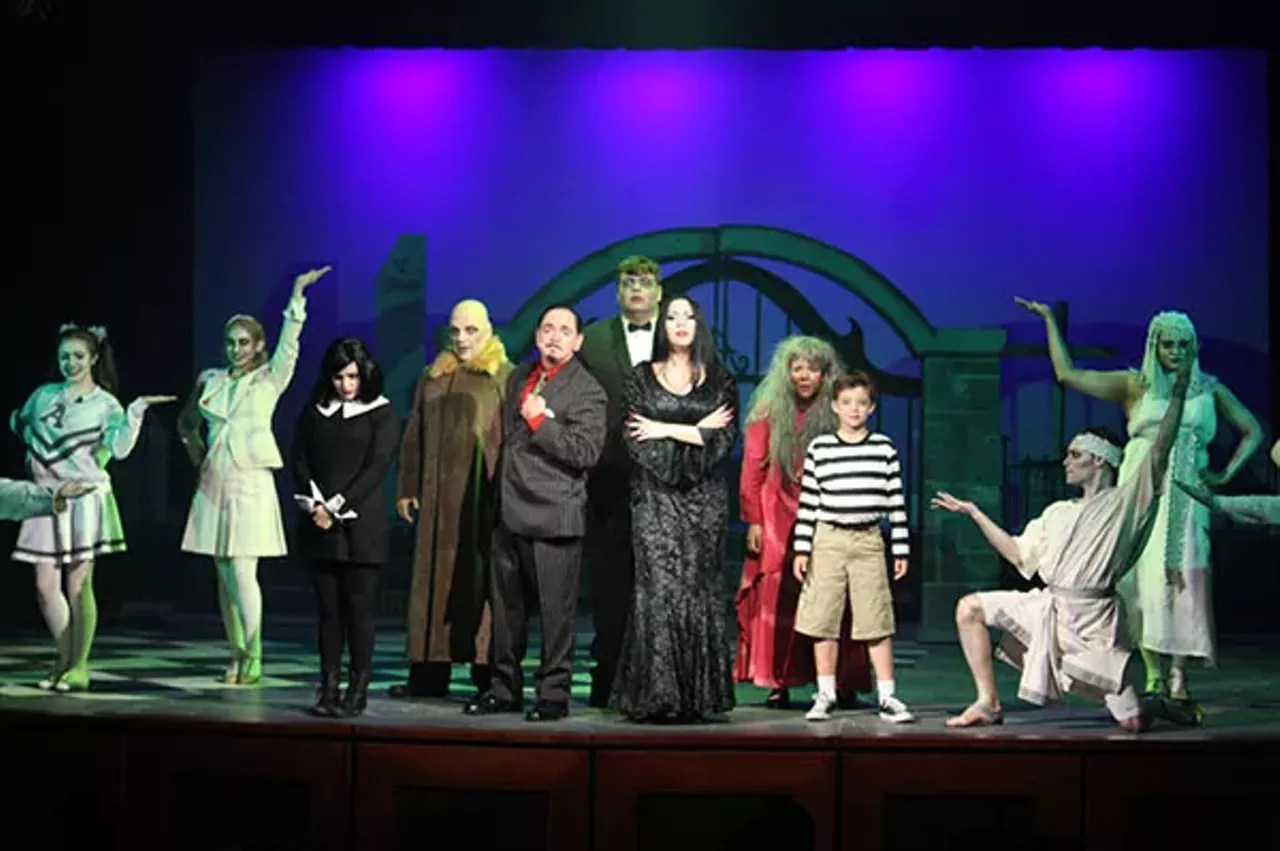
Audience enthusiasm is the main thing stage director Jill Bloede, music director Zachary Tarlton, choreographer Lisa Blanton and the title characters keep going, earning almost every bit of the fervor with their high energy. With a storyline that echoes You Can’t Take It With You, the Addams family has a license to be every bit as weird as George S. Kaufman’s Sycamores. Each of these families has a mutant daughter who wishes to couple with a normal person, each of the daughters’ beaus has parents who are conspicuously boring and respectable, and each of the hosts launches a game at the dinner table that causes the guests to reveal a deep-set fissure in their marriage.

Wednesday is the new wrinkle in the old formula, which most recently recurred on Queens Road in La Cage aux Folles. This mutant child is not as normal and wholesome as previous defectors who fled their kooky coops. No, our rockin’ culture has overtaken the Addamses to the extent that Goths like them have established themselves on the fringes of high school life. Only those who enter the hall with black lipstick will fully recognize Wednesday as a kindred spirit. Yet the crossbow keeps her securely outré for everyone.

As a result, Wednesday can rock when the whole William Tell scene circuitously makes its point in the “Crazier Than You” duet. This role is not at all as humdrum as Alice Sycamore, and Emily Roy takes full advantage of Wednesday’s weird glamor. Standing next to Morticia, Roy looks puritanical and punkishly pugnacious at the same time — and she can definitely belt her half of the duets. In his debut, Christian Regan is noticeably underpowered as Lucas the apple-bobbler, but his shortcomings are poignantly effective. After all, he and his family hail from Ohio.

“A swing state!” is how the horrified Gomez describes the unfathomable gulf. But you look at how sloppily Lucas is dressed and you already see that he is more than meeting Wednesday halfway. Regan talks his talk far better than he sings it.

Challenged by Blanton’s choreography and a Morticia decades younger than he is, Kevin Roberge surpasses himself as Gomez, even if he is visibly panting at the finish line. He may not have the essence of this unctuous patriarch as thoroughly as Nathan Lane did on Broadway, but he has the Gomez sound perfectly, and there is such fatherly pathos when Roberge sings “Happy/Sad” in Act 2 that the power of it took me by surprise. Followed by “Crazier Than You” before Gomez teams up with Morticia for “Tango de Amor,” the hits do keep coming as Roberge gasps for breath.

Nor is Aubrey Young less than breathtaking as the preternaturally tensile Morticia, though her dress is disappointingly less revealing than Bebe Neuwirth’s was on Broadway. Young is also less Zombie-like than Neuwirth, further altering the icy marital chemistry. Ah, but when Morticia pines for the sewers of Paris, Young is just as wry. I was every bit as impatient as the red skirt for the tango to begin, and when Young stretched herself into its most extreme choreography, her youth provided ample rewards.

With the Addamses’ pet squid axed from the script, Mal Beineke is no longer the sort of role that would warrant Terrence Mann’s bravura. Instead of being asked to sing the bodacious “In the Arms of a Squid” in the Act 2 denouement, Jonathan McDonald merely piggybacks onto the “Crazier Than You” duet playing Mal with Jenn Grabenstetter as Alice Beineke. There is no diminution of the éclat Grabenstetter is allowed to make in Act 1 after Alice drinks the misdirected potion in the “Full Disclosure” game. She’s a pure undersexed animal in the “Waiting” showstopper.

Delicacies are doled out deeper into the cast. After stomping around inarticulately on platform shoes for nearly the entire evening, Johnny Hohenstein makes good on his liberation as the family’s Zombie butler Lurch. And who could possibly have a more ardent crush on the moon than Vito Abate as Uncle Fester? Abate was simply born for this role and the epic passion of “The Moon and Me.” The lightbulb prop he messes with was still a work-in-progress on opening night, but his rocket backpack was pure bliss.

The wig and costume Vanessa Davis wears as Grandmama and the grimy makeup sported by Jackson Davis as Pugsley, Wednesday’s masochistic little brother, help to make their Theatre Charlotte debuts successful. Up on Broadway, if you were buried in the Addams Ancestors ensemble, you went home with a paycheck. Down here in Charlotte, it’s nice to find that the eight members of our ensemble are individualized in the cast bios with such identifiers as stewardess, baseball player, and Greek.

Make no mistake, there’s plenty of authentic Charles Addams embedded in the script, nowhere more effectively than at the end. What Gomez and Morticia say to one another in the closing dialogue is quoted verbatim from an Addams cartoon. It still worked the third time I heard it.