Tag Archives: Andrea King

Hohenstein Gets Greedier in His Second Go-Round With “Peter and the Starcatcher”

Review: Peter and the Starcatcher at Matthews Playhouse

By Perry Tannenbaum

July 12, 2025, Matthews, NC – Though their names are similar and they’ve both written about Peter Pan, the temperamental gap between James M. Barrie and Dave Barry would seem to be as wide as oceans. Barrie created Peter in 1904 as an embodiment of eternal youth and the spirit of noble adventure. A century after Peter made his stage debut (played by a woman, of course), Barry teamed up with Ridley Pearson to write a novel-length prequel, Peter and the Starcatchers, keeping the non-fantasy base of the story in Victorian England while snatching Neverland from up among the stars and plopping it down on an earthly ocean.

What Rick Elice seems to have done, in returning the Barry-Pearson preteen page-turner to its stage origins, is to worshipfully replicate all the seagoing pirate action of Starcatchers along with Barry’s choicest quips. Then to supercharge the effect, Elice seems to concentrate it all so that it flies by in a blizzardy blur, all the more frenetic because scenery is stripped so bare – people become doors, ropes become ocean waves, and flag streamers are crocodile teeth – that we’re exercising sizable hunks of imagination to fill out what’s actually happening before our eyes.

Barrie fairies were jubilantly diced and desecrated by Barry’s mischief and mirth: or so it seemed the first three times I saw Elice’s Peter and the Starcatcher – on Broadway, on tour, and at Theatre Charlotte, directed by Jill Bloede. Having read Barry’s Pulitzer Prize-winning humor pieces for decades, I was so sure of my familiarity with America’s beloved joke-and-quip machine that I never bothered to read a single page of his Starcatchers. My naïve conclusion was that Elice had simply let the Barrie-Barry mashup work its magic with as little intervention – and budget – as possible.
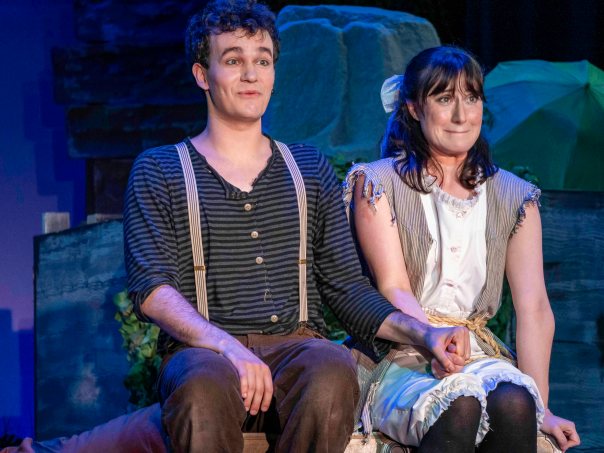
My fourth encounter with Starcatcher at Matthews Playhouse, once again directed by Bloede, helped to enlighten me. In her previous work with the script, the evanescence of the budding relationship between Peter and Molly Aster – and the poignancy of their parting – felt more touching to me than previously. That’s significant compensation for anyone who adores Barrie’s original story, whose magic can seem drowned in humor, wit, and shtick when first encountering Starcatcher.

This time around at Matthews Playhouse, another thematic thread struck me for the first time: Elice’s orphaned Peter reaches puberty without ever having a first or last name. By now, it will only come with his consent. At the other end of the moral spectrum, Black Stache has been searching throughout his pirate career for a hero antagonist who will perpetuate his fame.
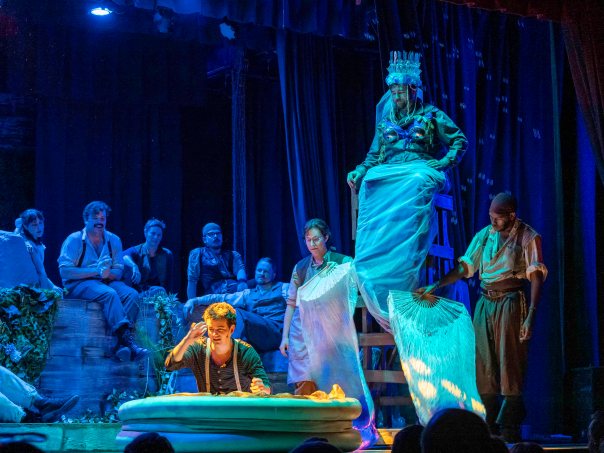
So their first grand meeting and tussle have biblical Israel-Angel proportions and consequences, or Robin Hood-Little John echoes if you prefer a secular, literary parallel. Two combatants become permanently linked and one of them emerges with a new name. Bloede’s staging here, when Peter gets his name from Stache – and later when Pan is added on – brought a new aura to those moments.

That’s what sent me to the web in search of Barry-Pearson’s actual text. Elice’s wit and humor seemed to chime with the belly laughs Barry’s newspaper columns repeatedly deliver. But is the class clown who grew up no less jokey truly capable of such yiddishe flavor and mythic depth? My suspicions were confirmed in the very first sentence of Barry’s saga: it already includes Peter’s name! An even more amazing revelation awaits if we read on. The jokey Barry tone we know and love is nowhere to be found in the opening chapters we can sample at Amazon. Instead, Barry and Pearson were following along on the dark gallows humor path that Lemony Snicket had pioneered with his Series of Unfortunate Events books for kids.

Deep breath. In my previous reviews of Starcatcher, I repeatedly gave Barry too much credit and blame for what I had seen and much too little to Elice. Both the jokiness and the mythic dimensions of Starcatcher can be credited to Elice – with additional bravos for how thoroughly he convinces us that this is how Barry would tell the origin story of Peter Pan.

Meanwhile, community theatre in Davidson, Charlotte, and Matthews continue to reap the dubious benefit of having so little professional-grade theatre in the Queen City. What a cast Bloede has assembled! Before the show began, representatives from the North Carolina Theatre Conference presented artistic director Sarah Bumgardner with their Theatre of the Year Award for 2024. So the folks backstage with their costumes on, waiting overtime for the ceremonies to conclude, were obviously under extra pressure to deliver. Even Bloede was nervous!

No matter how good your cast is, there’s plenty of stage business to be nervous about in running Starcatcher.Actors must move all the props and furniture around and keep track of all the many Yvette Moten costumes they must find and change in and out of as we move from a London dock to two sailing ships to a faraway island with a beach, a mountain, and a jungle. Stage manager Jessie Hull had to be preternaturally adept. Molly must float in the air. Peter and some nameless alley cat must fly. A lot going on while the quips shoot out at us, many of them newly minted to mock Myers Park and nearby country clubs.

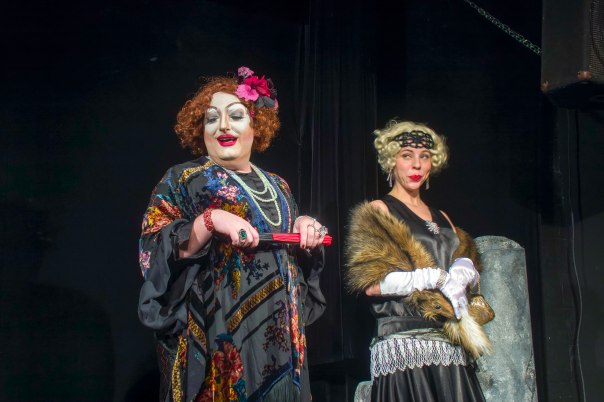
Nearly all of these players were newcomers to Starcatcher, beginning with Joshua Brand as Peter and Emma Brand as Molly, presumably arriving on the Fullwood Theater stage with ready-made chemistry. Their boy-girl antipathy is no less charming than their tentative stabs at intimacy, and both can seem fueled by the promise of adventure and ignited by its thrill. The only holdover from Bloede’s 2018 cast is Johnny Hohenstein, who in bygone days crossdressed to portray Mrs. Bumbrake, Molly’s flirtatious nanny.

With even more liberties, including more than a slight leftover effeminacy from Bumbrake, Hohenstein burst into full flower as the carnivorous Black Stache, heartily devouring the scenery in Stache’s emblematic amputation scene. His eyes shone greedily as he attacked the hambone bits, and yet a queer kind of avuncular calmness came over him as he finally met his predestined antagonist and named him. For some reason, Hohenstein drew the only problematic microphone on opening night but remained unflustered by its fussiness.

Of course, one of the glories of Peter Pan is its superabundance of meanies and piratical buffoons, and we do not lack them here. In her latest crossdressing exploit, Andrea King was the perfectly servile and supercilious Smee, with glints of valor and wickedness. Chip Bradley was the wily Slank, Captain of the Neverland,who steals the precious trunk full of starstuff from under the nose of Lord Aster, the Queen’s devoted ambassador and most eminent Starcatcher. Andrew Pippin portrayed the austere Aster with sufficient British crust, entrusted with the mission of transporting the precious starstuff cargo to Rundoon, where the trunk can be dumped into a nearby volcano and kept out of evil hands.

When we reach the faraway island where Peter and the trunk of starstuff serendipitously wash ashore, we will find that Neifert Enrique is the outré and eccentric King Fighting Prawn, monarch of the Mollusk natives. Was this the wildest of Moten’s costumes, or was it Hohenstein’s at the start of Act 2 during his brief song-and-dance as one of the Mermaids? Maybe Ryan Caulley snatches the prize toward the very end as Teacher, a salmon magically transformed into a Mermaid sage atop a lifeguard’s chair. It was a fitting reward for Caulley after a full evening gagged as Captain Scott from the first moment we saw him aboard his ship, the Wasp.
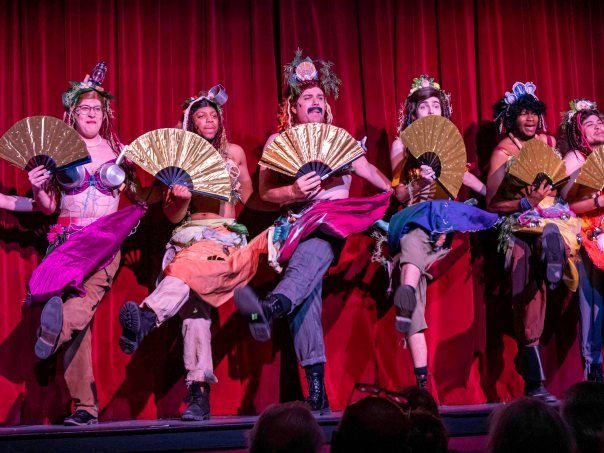
Ben Allen as Prentiss and Alijah Wilson as Ted were more individualized than Peter’s fellow orphans had been in previous productions I’d seen, and Miles Thompson was more rounded and nuanced as Alf, the smelly sailor who woos and distracts Molly’s nanny. Davis Hickson wasn’t as giddy and over-the-top as Hohenstein had been as Bumbrake at Theatre Charlotte in days of yore, so the Alf-Bumbrake thing (with Alf breaking most of the wind) was less orgiastic now and more genuinely warm.

“The Play That Goes Wrong” Fits Perfectly at The Barn

Review: The Play That Goes Wrong at Theatre Charlotte

By Perry Tannenbaum

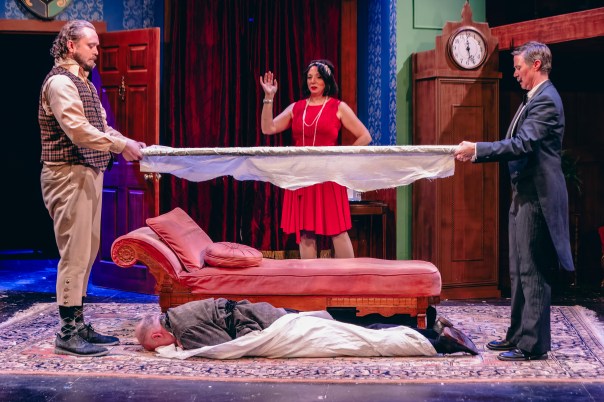
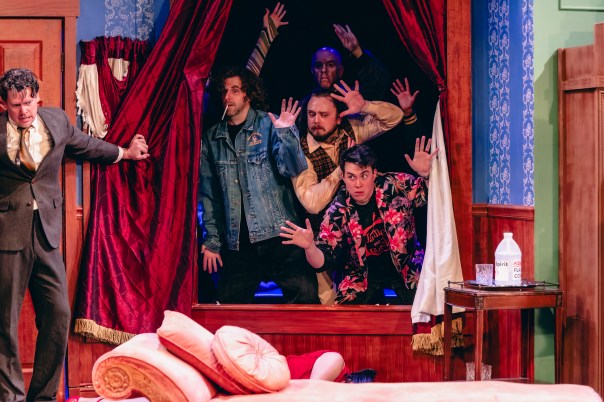
Every time Inspector Carter declares his determination to solve “The Murder at Haversham Manor,” lights at Theatre Charlotte suddenly turn a lurid red to triple-underline the melodrama. This may be the only technical element that consistently goes right in The Play That Goes Wrong, now running – and decomposing before our very eyes –through February 23.

The mantelpiece over the fireplace in Charles Haversham’s study remains a work-in-progress long after the master is murdered. The painting above the mantle – clearly the wrong painting – doesn’t stay where it belongs, and a pesky door stubbornly resists efforts to unlock it when it isn’t wandering off its hinges. In similar disrepair, we may count the phone, the intercom, the elevator leading up to the second-floor office, and the walls themselves.

It is a precisely flimsy set, lovingly put together by Theatre Charlotte artistic director Chris Timmons, so precisely flimsy that it must conform to approximate dimensions to accommodate the cast. So active that the set predictably won the Tony and Drama Desk Awards for best scenic design in its 2017 Broadway debut. Like Michael Frayn’s famed Noises Off, another British play-within-a-play that goes comically wrong and wronger – but on a stage that revolves a full 180ᵒ – the set is like a machine. It could be packaged like an Ikea kit.

Written by Henry Lewis, Jonathan Sayer & Henry Shields, The Play That Goes Wrong nestles more naturally at the Old Queens Road Barn than at Knight Theater, where the national tour touched down in the QC six Novembers ago. The basic concept is that a small-time community theatre, perennially understaffed and underfunded, has suddenly received a grant that will finally enable it to present a full-fledged production.

No longer will Chekhov’s classic Three Sisters be reduced to Two Sisters at the Cornley University Drama Society. Nor will Lloyd Webber’s resplendent Cats be shrunk to Cat. It’s the birth of a new era!

But unfortunately, the new era hasn’t ushered in an influx of fresh acting talent and technical know-how. Dennis struggles with her lines and usually mispronounces the tough words written on her hands. Jonathan repeatedly re-enters the action before he’s supposed to. Sandra has an unfortunate knack of being in the wrong place at the wrong time; and her understudy, Annie, after subbing for Sandra when she’s knocked unconscious, reads terribly. Yet she refuses to yield back her role when Sandra revives.

Props aren’t reliably placed in their assigned locations by the incompetent crew. When they are properly placed or deployed, like the stretcher needed to carry the corpse through the finicky front door, they may not function properly. The Duran Duran CD, sought after by lighting-and-sound man Trevor before the play begins, will turn up inconveniently onstage deep into Act 2.

Which reminds me: even though those redlight cues are absolutely reliable, the portentous sound cues accompanying them are not.

Tonya Bludsworth directs all this carefully calibrated chaos with an able assistant director, Brian Lafontaine. Together, they and Brandon Samples as Chris bring out a key point that didn’t strike home for me as forcefully when I saw the touring version in 2019. Chris not only plays the plum role of Inspector Carter in The Murder at Haversham Manor, but he also serves as the stage director, prop maker, box office manager, and PR rep – totally responsible for this catastrophe, and obviously overstretched.

On the smaller Theatre Charlotte stage, Samples is closer to us and we can focus on him more sharply than if his flop sweat were dripping down at Knight Theater. Makes a difference when one protagonist seems to be especially invested in the worsening outcome, valiantly trying to cover up the metastasizing miscues, and gaping at the sheer scale of his own mismanagement and incompetence.

For me, Sample’s visible struggles – from his nervous shit-faced grins on up to his hissy fits – made Chris a little more poignant for me. Here is a man who cares so much about theatre, and he’s watching all his multiple shortfalls in artistry and management implode so spectacularly. We can feel for the rest of this woeful team, but not nearly as much.

Lee Thomas earns a distant second place in our sympathies just for the physical punishment he takes as Charles Haversham, the stepped-on, sat-on, and mishandled murder victim. Or for the dismal ratio of abuse absorbed to dialogue delivered. When he finally does speak, maybe for the first time at Theatre Charlotte since 2020, it is as an actor of mind-boggling incompetence, eclipsing nearly all of his castmates. Thomas is rather good at looking quietly embarrassed, confused, and discombobulated.

Jenn Grabenstetter as Sandra starts off in a sympathetic slot, cast as Florence Colleymore, the murder victim’s bride-to-be. Our empathy for her slackens when we learn that Charles’s brother, Cecil Haversham, is Florence’s true love. Or when we see how stylized Sandra is as a performer. Or when she skips ahead one line, answering Inspector Carter’s questions before he asks them. But we feel for her – a little bit, anyway – when the front door flattens her and her castmates prop her up inside a clock. When Florence revives, she has to battle Annie to reclaim her role with some fine screwball fight choreography by Allison Collins.

The character arc for Rachel Mackall as Annie is even more transformational, for her Florence starts off in a near-catatonic monotone until she does the first of her pratfalls, scattering the pages of her script and maybe dislodging a contact lens. That raises Annie’s energy level, leading to the subsequent miracle where, battling Grabenstetter for the spotlight, she suddenly has her lines memorized while becoming a vicious gladiator.

More WWWF-style action would not have been amiss, but there’s still plenty.

Like Selsdon in Noises Off, Dennis’s prime reason for existing in The Play That Goes Wrong is to roundly muck things up. Lewis, Sayer & Shields seem to be indicating that he’s inept, miscast, or over-the-hill. What the hell, Bludsworth casts a woman in the role, the venerable Andrea King, who may have actually portrayed more women on QC stages than men and describes herself like a cute puppy for sale in the digital playbill.

With so much incompetence surrounding the Haversham Murder production, it’s a bit cruel to arraign her as the sole culprit for substituting turpentine when a decanter of adult beverage is served to guests at the Manor. Or it is when that happens for the first time. It’s on her when the screwup is repeated, sparking a prolonged series of spit-takes because she has also forgotten a line that would propel the action forward instead of casting it into a never-ending loop.

King maintains a cheery insouciance no matter what kind of havoc she causes, enabling Cody Robinson as Robert to become king of the spit takes as the bride-to-be’s brother, Thomas Colleymore. With a preternatural Joe Belushi energy, Robinson demonstrates that Robert’s distaste for “White Spirit” can actually increase with each sip! When we think Robinson’s frustration and rage have peaked or even exceeded expectations, he still turns it up a couple of notches.

Adam Peal as Robert and Roman Michael Lawrence as Trevor fill out the roster of actors implicated in the murdering of The Murder at Habersham Manor. Robert is not only amateurish but also a carefree hambone, so naturally Chris gives him two roles to botch. Initially, Peal appears as Cecil Haversham, Charles’s scheming brother and Florence’s true love. But there’s more to butcher when Robert resurfaces as Arthur the gardener, laying on some eyewitness evidence.

Did I mention that Trevor, after losing track of his Duran Duran treasures, must abandon his functions as lighting and soundman when Annie, replacing Sandra, is also stricken? That script-scattering pratfall was just the beginning of her misadventures. While Lawrence has already shown us – and will continue to show us – how badly Trevor performs at his chosen specialties, we can brace ourselves for his slaughter of Florence Colleymore, postponed only by his reluctance to play the role.

On my second viewing, it was possible to pay more attention to the convoluted mystery plot by “Susie H. K. Brideswell.” Now I can confidently proclaim that Habersham Manor is a masterpiece of implausibility. Doesn’t work at all.

Woefully, Theatre Charlotte doesn’t seem to have experienced a financial windfall that parallels Cornley University’s. That would have enabled them to append a faux playbill for the Habersham Manor production to the conventional Play That Goes Wrong program. Then we could learn the last names of the players and the Habersham roles they play with less fuss and bother. A few tidbits about the players also enriched the experience of the touring production.

Apparently, when the playwrights founded their Goes Wrong franchise (Peter Pan and The Nativity are among the spin-offs), they must have been focused on crafting three of the roles for themselves to perform in London and Broadway – and meshing with Nigel Hook, their mad genius set designer. So they didn’t insist that their faux playbill must be printed to accompany the show.

That lack of detailing serves to emphasize where The Play That Goes Wrong doesn’t measure up to Noises Off! Frayn’s work fleshes out relationships between the actors onstage when they’re backstage and, with its first-act rehearsal scene, gives us a more vivid idea of how the play-within-a-play is intended to go. For that reason, despite all the hilarity that Lewis, Sayer & Shields deliver, I’d hesitate to recommend The Play That Goes Wrong to anyone who is new to theatre – or hasn’t experienced a play that goes right.

But for sheer fun in frightening times, this show is welcome medicine for everyone else. TikTok & Friends may have brought nostalgia for America’s Home Videos to a screeching halt, but this latest romp at the Queens Road Barn revives the special pleasure – and laughter – of similar train wrecks large and small running right at us, non-stop, on a live stage.

Joe Turner’s Come and Gone, directed by Corlis Hayes, last came and went at Central Piedmont Community College in 2015. Back then, the production demonstrated how ill-suited even a renovated Pease Auditorium was for the best of August Wilson’s dramas. Panoramic Pease has now been demolished, so it will be interesting to see Hayes come back again to the CP campus, along with Jonavan Adams reprising his role as Herald – at a real theater in the fledgling Parr Center. Dominic Weaver, also in the mix ten years back, gets a juicier role this time as Bynum, the conjuring root doctor.

Turner, the second play in Wilson’s decade-by-decade traversal of the 20th century, The Pittsburgh Cycle, is set at a Pittsburgh boarding house in 1911. Rather than hinting at WW1 later in the decade, the drama hearkens back to slavery, the Civil War, and their aftermath, both glorious and sad.

“Every character has a story, and every story has a song,” says Hayes. “The play explores African American identity, healing from trauma, and the power of community and self-discovery. More significantly the play is an examination of Black people in transition during The Great Migration.”

This weekend only!

“Irma Vep” Brings Giddiness to VisArt

Review: The Mystery of Irma Vep – A Penny Dreadful at VisArt Video

By Perry Tannenbaum

My first hints that PaperHouse Theatre’s new production of The Mystery of Irma Vep would be truly unique came when I glanced at a hidden nook of the set and saw a little half-hidden bar napkin that read “Homo Sweet Home.” Shortly before or afterwards, my first peep at the playbill revealed that there were more directors on this project than players. Two more.

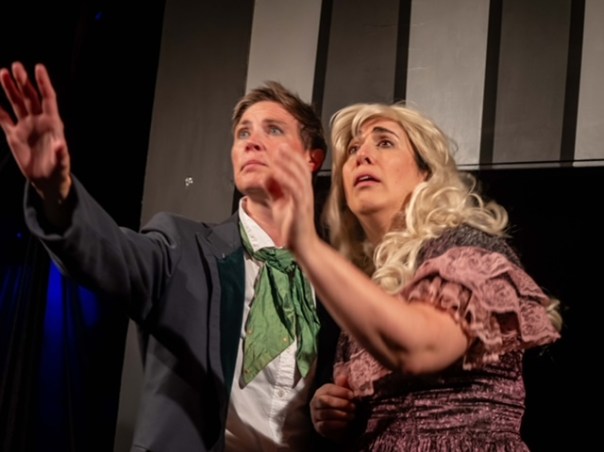
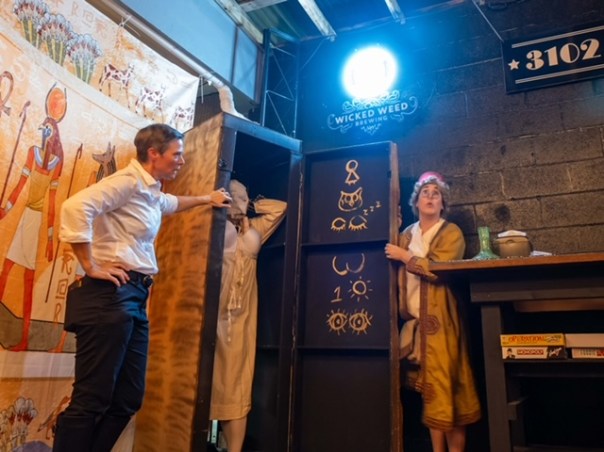
Then before intermission, the aluminum loading dock closure at VisArt Video was raised by the entire cast of two, Nicia Carla and Andrea King, while we joined them on the other side, exiting through the front door to the outside alleyway – the al fresco part of the store. The final Egyptian scene was played out on a second stage, facing out to a few seats, under the shadow of a Wicked Weed Brewing sign. With a nifty little Egyptian tapestry and a fairly gaudy, full-sized sarcophagus.

What really clinched it for me was rolling pin in Act 2 – deployed for a purpose you’d never dream of. That settled it: the new Irma Vep, a Charles Ludlum gem not seen in Charlotte since 1993, is far more than a loving revival. Far more than a couple of hambone actors led by an unusually comical director.

No, this is pure out-of-this-world madness, a starburst of hysteria fueled by a team of four directors feverishly brainstorming in the merciless grip of writer’s room giddiness. Who can possibly care about a three-inch square napkin? Who would conceive of taking the one underground scene in Vep outdoors? And the rolling pin: I can barely imagine the uproarious laughter when that touch was unveiled. Perfect.

Some of the zaniest futzing could have happened spontaneously during rehearsals, since Carla and King, splitting eight roles between them, are also part of the directorial team, joined by Kevin Lorms and Chaz Pofahl. So scenic designer Kel Wright may have lavished so much attention on her precious sarcophagus that she didn’t notice when that homo napkin got slipped into the wicker basket back at Mandacrest.

That’s where theatre legend Lady Enid Hillcrest, newly married to Lord Edgar Hillcrest, will feel oddly ill-at-ease in the library as a portrait of her predecessor, Milady Irma Hillcrest, stares down at her. Greeting her as maidservant Jane Twisden, King ought to be scornful and sepulchral, since she is replicating Judith Anderson’s role as Mrs. Danvers in Rebecca opposite Carla while she resurrects the Joan Fontaine naif.

Yet by the time Lady Enid sashays into view, numerous other parodies have already been set into motion in Ludlam’s wicked mockery of the “penny dreadful” style of Victorian England. Sleuthing, sarcophagi, werewolves, vampires, witches, and a Wuthering Heights heath are all mixed into this undeadly brew. Plus the obligatory mummy. So why not give King the freedom to jubilantly shatter the Dame Judith mold, sporting a bright red wig and occasionally breaking a smile?

Anderson may never have even slightly bared her teeth before she set Hitchcock’s Manderley ablaze.

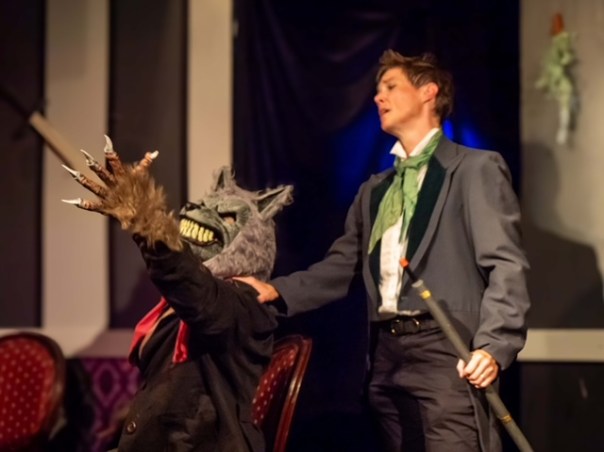
Squinting her eyes like a savvy sleuth in the opening scene, Carla as the swineherd Nicodemus quickly references the nearby heath and his determination to hunt down the werewolf suspected in the death of Lord Edgar’s son. As the action speeds up and the creepy creatures proliferate (inspiring Carla’s more outré costume designs), we need to be watchful in keeping track, not only with who’s who but with who’s what. Once the thunder stops, the full moon will have its effect, so we can be on the lookout for the kindred of Lon Chaney, Bela Lugosi, Sir Laurence Olivier, Lady Macbeth, and Edgar Allen Poe.

Ludlam wrote all the roles that Carla plays in this quick-change romp for himself and the others for Everett Quinton, his partner in the Ridiculous Theatrical Company and in life. And Ludlam also directed the 1984 premiere. Small wonder, then, that legendary actor/director Alan Poindexter was actually dissatisfied with Innovative Theatre’s storied 1993 production at the fabled Pterodactyl Club – for he merely starred in that historic riot. He told me in 1995 that he was itching to revisit the script.

Where he didn’t say, but presumably, Poindexter yearned to act and direct next time around, the dual roles that both Carla and King are fulfilling now. The fun they’re having with it was unmistakable almost from the start last Friday. Those many costume changes certainly quicken the heartbeat and release the adrenalin when these gifted players are switching outfits backstage – often speaking lines of dialogue while they do.

It’s gotta be dark back there, so in a small space where so many costumes are parked, Lorms must be especially adept as he switches hats and takes on the stage managing. If there’s an additional person hanging up the hastily discarded clothes, it must really be mayhem back there!

While Carla is shuttling between her Nicodemus and Lady Enid costumes, King is shedding her maidservant uni – and that wig – whenever the Lord Edgar returns from his various adventures. Tortured soul! After losing his ex to a vampire and his son to a werewolf, noble Edgar tasks himself with tracking down both supernatural monsters, with only Nicodemus for backup. Poor choice.

Leaving a beautiful lady alone on a lonely manor; especially near moors, heaths, mists, and hail; is never a good idea, confirmed by even a smattering of familiarity with Hollywood horror. After discovering that an Intruder has left telltale teeth marks around his beloved’s jugular, Lord Edgar proves that he has learned his lesson by immediately traipsing off to Egypt to solve this mystery. Thoughtfully, he checks Lady Enid into a sanatorium.

While Milady convalesces, Carla can transform into two Egyptians, Lord Edgar’s turbaned guide and his royal quarry, the remarkably well-preserved Princess Pev Amri. More hilarity for us; more heartbreak for Lord E.

An easier mystery for us to solve was why the Egyptian scene was moved back from the beginning of Act 2 to the end of Act 1. That sarcophagus appears on both stages, so Carla and King can rely on outside help in schlepping it. In its wake, we’re left facing a handy cantina where we can line up for refreshment during intermission.

No doubt the respite is a godsend for Carla, King, and the hidden crew as they regroup, relax, and hydrate. Action is noticeably more frenetic after the break. Masks appear more frequently, and we’re treated to cameos by vampires and various werewolf body parts, far eclipsing the wolf’s carcass tossed into Act 1. In the hurly-burly, all the mysteries and who’s-whats are solved – but you’d better be alert if you want to catch all the solutions.

By then, you may have been laughing too hard to care.

Vampires and Trumpers

Reviews: Vampire Lesbians of Sodom and Thanksgiving: 2016

By Perry Tannenbaum

For devout upstanding citizens who had decided way back in the hippie ‘60s that Greenwich Village was an abominable den of sin, Charles Busch’s Vampire Lesbians of Sodom was a flaming and perverse poke in the eye. Or an argument clincher when it landed on Macdougal Street in 1985. The New York Times raved, the extravagant little trio of sketches became a cult obsession, and Vampire Lesbians had a five-year run.

Busch slipped away from his castmates when the review came out in the early morning after the Provincetown Playhouse premiere and had a good cry. Why did this diva desecrate his mascara? His career in theatre was now assured. He would write more outrageous comedies and send-ups that he, as the prima donna, could cross-dress and slay in, most famously Psycho Beach Party.

Vampire Lesbians made it to Charlotte at the Pterodactyl Club in 1991, after the slightly wholesomer Psycho Beach had paved the way during the previous year. George Brown directed this orgy of sacrilege with fiendish glee, while Innovative Theatre co-founder Alan Poindexter starred with Keith Bulla as the titular vamps.

With the Rev. Joe Chambers carrying the torch for fundamentalism in the wake of Jim Bakker’s disgrace, Banktown was still a very Christian place. It was my sacred duty to bring my daughter, not yet bat mitzvahed, to see Poindexter in all his counter-culture glory. After beholding the kinky wonders of Psycho Beach, my Ilana would have kissed Alan’s feet.

Flash forward to 2023. Poindexter is gone and the Pterodactyl Club, the one-time cultural capital of Freedom Drive, is goner. But thanks to Nicia Carla and her PaperHouse Theatre, Hollywood antagonists La Condesa and Madeleiné Astarté (a Succubus and a Virgin Sacrifice back in their Sodom days) are undead again!

Taking on Busch’s mantle, Carla directs and stars in this stunning revival at VisArt Video, tucked into the nether region of a strip mall on Eastway Drive – I’m trying to make this little suburban dive sound as risqué as the Pterodactyl! Walls are black as you walk inside, and hostesses in Goth attire and makeup are there to greet you. Whatever Google Maps has told you (it misled both me and my wife Sue on separate occasions), you can now be sure you’re in the right place.

Small as it is, the inner sanctum of VisArt is perfectly sized for Busch’s secret forbidden rites. The seats are soft enough to keep butt burnout at bay for 90 minutes, even if you don’t stretch for intermission and fall prey to the treats in the lobby. Yet sightlines are not ideal according to Sue’s scouting report.

The PaperHouse cast multitasks even more than Busch’s original ensemble, just six players covering the 14 roles instead of seven. All six are battle-tested in madcap comedy, so this outrage is hardly outside their comfort zones. Nicia probably hasn’t had this much fun onstage since Poindexter directed her as The Witch in Hansel & Gretel. She minces and manipulates here as the Virgin Sacrifice, growing regal and stentorian as theatrical megastar Astarté as she assaults the Left Coast. Opposite her, Ashby Blakely is a steely, sneering diva bridging four millennia as The Succubus, aging gracefully into La Condesa and crossdressing in costume designer Beth Levine Chaitman’s most outré couture.

That isn’t to say that Josh Looney and Charlie Carla are anything less than visions of decadence as Sodomite musclemen Ali and Hujar in complementary S&M outfits and Wagnerian wigs. Nicia is already fairly slutty in the opening sketch despite her somewhat revealing white dress, willing to break her hymen with Ali or cut a deal with the cave monster Succubus. Subsequent scenes in Hollywood and Sin City climax in a couple of startling onstage costume changes, most improbably by Tanya McClellan who snoops into La Condesa’s boudoir as gossip columnist Oatsie Carewe.

Gosh, it’s good to see McClellan back onstage in manic comedy mode. Squinting her snoopiness, she sniffs out the ungodly acts performed by Nicia as Astarté on La Condessa’s protégée, luminous Sarah Molloy as flapper Renee Vain, and her meddlesome boy toy, Looney as matinee idol King Carlyle.

Hard times for a vampire? You’ll need to come back after intermission for Blakely’s final transformations. Andrea King’s choreography, on loan from Jane Fonda, elegantly shows off McClellan’s dancing prowess.

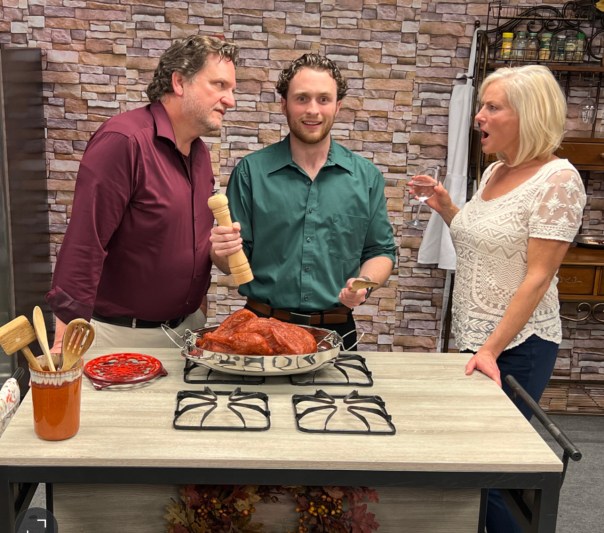
Anyone who reads advice columns or cruises social media at this time of year will have an accurate inkling of what Thanksgiving: 2016 might be about. Millions of Turkey Day hosts are wondering how they will keep opposing family factions from shouting their lungs out or coming to blows while the sharp cutlery is still on the table. Playwright Elaine Alexander smartly calculates that the situation is prime fuel for a dining room comedy – or tragedy – but the world premiere of Charlotte’s Off-Broadway production now at VAPA also reveals that the NC native had a tough time deciding which way to go.

Ground Zero for the annual onset of hosting panic was clearly in November 2016 when Hillary Rodham Clinton resoundingly won the popular vote for the US presidency while Donald Jefferson Trump won the Electoral College – and the White House – just as resoundingly. Liberals, Democrats, and rational folk are still in shock. Yet as Alexander deftly reminds us along the way, they are all blissfully unaware of the betrayals of good sense, rationality, rule of law, and democracy to come.

As the West family up in the liberal Northeast prepares to host young Eric’s girlfriend, riding up the highway from Alabama, the aroma of crisis already fills the suburban kitchen. Papa Harry, after diligently knocking on hundreds of doors crusading for Clinton, was hospitalized – either for a nervous breakdown or a heart attack – immediately after watching CNN declare Florida for Trump. The chief Turkey Day watchword from Harry’s physician is for wife and son to prevent the shell-shocked Hillary soldier from indulging his CNN addiction.

Taking to drink in the wake of her husband’s collapse, either out of worry or guilt, Renee has pretty much abandoned any serious intent to impress Brittany, the Southern belle she’ll be meeting for the first time. So it has fallen to young Eric to try to cook a luscious feast for his beloved, even though Mom hasn’t properly shopped for the occasion. Some improvising and substitution will need to be done. Worse, frozen will occasionally need to stand in for fresh.

Worst of all, Brittany voted for Trump, so Eric desperately hopes to keep talk of politics – the subject Dad is obsessed with and still agonizing over – away from the holiday dinner table. Harry has enough difficulty digesting that his son would date a girl from Alabama. Nor does Dad have enough self-awareness to realize that, in a reflexive action stemming from his years in community theatre, he mocks every Southern drawl he comes in contact with.

Finding out she’s a Trump voter could send him over the edge. Getting Dad to refrain from talking politics promises to be even tougher than steering him away from CNN. Finessing how to keep Brittany off the touchy subject is a bridge Eric hasn’t crossed yet.

As a director, Alexander casts father and son perfectly. Matthew Howie is a master of timorous anxiety as Eric. He can craft crescendos of panic and befuddlement while doing a hilariously awful job of warding off disaster with a shit-eating smile. Nor could we improve much on Tom Ollis as Harry. Since his 1997 debut at Theatre Charlotte in Arsenic and Old Lace, Ollis has grown into the most visible volcano on the Metrolina theatre landscape. Whether as Mr. Blonde in Reservoir Dogs, Sweeney Todd, or Titus Andronicus, Ollis is peerless at seething, suspecting, and erupting into towering, raving rages.

Since Harry is also a trial lawyer recently dismissed from his law firm because of his excessive zeal, Ollis can feast on numerous opportunities to cross-examine everyone in sight, bullying and browbeating every witness. Alexander’s women don’t get nearly as much scenery to chew, but her casting choices are nearly as impeccable.

Donna Norcross seemed to be battling opening night jitters early in Act 1 as Renee, but as Mom yielded to a multitude of wine refills, Norcross also relaxed, becoming quite powerful in the Act 2 denouement. Quite ripe for stereotyping, Michelle Strom as Renee entered the West home like a sudden ray of sunshine, without the preamble of a knock or a doorbell chime, her drawl as wide as the Mississippi. No, Dad could not restrain himself, nor could I blame him.

As you can imagine, the setup of Thanksgiving: 2016 is almost pure comedy – until the Trumper truth finally comes out, as an announcement rather than a shy confession, with the proud flourish of a cheerleader’s somersault. Looking from Strom to Ollis as we reach intermission, we can only wonder whether Dad will clutch his head or his heart.

But what can come afterward from our host, our hostess, and from poor Eric? Admirably enough, Alexander lets her characters carry her along across Act 2. But her impulse to bludgeon Harry with more secrets and uncomfortable turns this comedy upside-down. We transition, not very gradually, from a Neil Simon comedy of futile secret -eeping to an impactful series of revelations that conjures up Sophocles’ Oedipus, Strindberg’s The Father, or Albee’s Virginia Woolf. Those revelations are topped off by a  couple of increasingly jaw-dropping ideological rebukes to Harry’s smug liberalism that might shake you up a bit.

We seem to fall over a cliff here, with too little before intermission to prepare us for the high drama afterward. By the time the cast is taking their bows, Renee has radically transformed from a borderline bimbo into a pieta resembling Steinbeck’s Rose of Sharon on the final pages of The Grapes of Wrath. Instead of dumping us off a high cliff, I’d advise Alexander to lay down more track that would guide us around the mountain: a sudden dramatic swerve – not too sudden – would be more satisfying than this swan dive.

A visit to VAPA for Thanksgiving: 2016 is still worth it, delivering hearty laughs and a gasp or two. By all means, dig in!

“Sister Mary Ignatius” Takes Dogma and Certitude to the Limit

Review: Sister Mary Ignatius Explains It All for You at CATCh

By Perry Tannenbaum

2023-04-20#015

For playwright Christopher Durang and now for the Queen City, Sister Mary Ignatius Explains It All for You has a special historical significance. When it premiered in 1979, Sister Mary was presented Off-Broadway in an evening of one-act plays that included works by Tennessee Williams, David Mamet, Marsha Norman, Romulus Linney, and Murray Schisgal – a pretty decent lineup.

Just that billing would have put Durang on the map. More distinctions swiftly followed: Not only was Durang’s satire proclaimed the best of that distinguished group, he and Elizabeth Franz (who would ultimately play the title role in three separate productions) won Obie Awards for that season.

While the Innovative Theatre production of 1989, directed by George Brown and starring Barbara Hird (of Lost Colony fame), may not have been a Charlotte premiere, it marked the auspicious debut of Brown’s company. Over the next five years, as actor/director wunderkind Alan Poindexter moved into the Innovative orbit, critically acclaimed productions gushed forth, including The Illuminati, The Chairs, Old Times, and The Search for Signs of Intelligent Life in the Universe. Innovative is also fondly recalled for its laugh riots at the legendary Pterodactyl Club, chiefly Psycho Beach Party and the imperishable Vampire Lesbians of Sodom.

Although Comedy Arts Theater of Charlotte or CATCh has been around since 2017, presenting standup and improv comedy most weekends at their South Boulevard location, Sister Mary Ignatius is their first foray into scripted live theatre. Perhaps it shouldn’t be that surprising that two Charlotte companies would begin with this same outrageous satire.

“The stage is fairly simple,” Durang has said. “There should be a lectern, a potted palm, a chair to the side for Sister to sit on.” Find a nun’s habit and a couple of Nativity play costumes – could be as simple as a bathrobe, a towel, and a couple of bedsheets – and your stage director can start thinking about holding auditions.

Kevin Shimko, a co-founder of CATCh with Abby Head, has been fitfully involved in the Charlotte theatre scene before – and with storefront theatre production. Interestingly enough, Shimko’s storefront outing at the former SouthEnd location of the Charlotte Art League was a semi-improv experience. Eight actors rehearsed all seven roles in Eat the Runt, and the audience decided who would play each of the unisex roles.

So none of the actors was sure he or she would go on! On the night we attended the performance on Camden Road, Shimko was the last actor selected, barely avoiding being left out. Among those preceding him in the casting that night were Andrea King and Jenn Grabenstetter, both of whom are on the Sister Mary team. King is in charge of lighting and sound while Grabenstetter as Diane Symonds, is the bitterest of Sister Mary’s former students, playing the virgin in the Christmas play.

The CATCh location off South Boulevard, visible only when you reach their parking lot, is more clubby than quaint. Beyond the lobby space, the theater within has black-box dimensions and ambiance comparable to the performing venues at the VAPA Center on Tryon Street. So Shimko goes a little high-tech at the outset. Instead of the simple pointer and easel that Durang envisioned Sister working with, Joanna Gerdy gets a retractable projection screen – one that opens and closes electronically via remote control – and she picks on a front-row audience member to help her extend a more business-like collapsible pointer to its full, slightly obscene length.Sister I

Shimko himself greets us in clergy robes and prepares us for Sister’s lecture. These added touches of formality and presentation polish make the childish simplicities of the first two projected slides and Sister’s remarks about them all the more surprising. First slide, world: Earth, sun, and moon. Second slide, universe: Heaven, Purgatory, and Hell. From these simplicities, we plunge into the incomprehensible absurdity of Limbo, where unbaptized babies were sent before Vatican 2 and Pope John XXIII.

Like the Earth and moon, all that follows from Sister Mary is to be accepted as fact, not merely belief. This is Catholicism, boys, and girls, so theory and uncertainty have no place here. To underscore this point, Gerdy introduces us with twinkling pride to Thomas, Sister’s prize seven-year-old student. With a curly head of hair you could easily mistake for a wig, Sydney Kai Qualls will not so easily be mistaken for seven, particularly when Gerdy braces herself in inviting him to sit on her lap.

Thomas is Sister Mary’s echo chamber, acolyte, and mouthpiece. He’ll bring Sister water on command, and Sister will reward him with little cookies when he answers her questions correctly – as he invariably does. Correct may not adequately describe the precision of Thomas’s answers, which emerge from Qualls as three-quarters angelic, one-quarter robotic, with a bit of space given over to beaming teacher’s-pet pride.

More Q&A format follows as Gerdy picks up a little wicker basket that Shimko has left near the lectern, with little index cards supposedly containing personal and religious questions submitted by the audience. Gerdy’s answers have a smug cordiality to them, curt in matters of Jesus and nuns, a bit more spontaneous when asked about Sister’s family, yet somehow always rigidly doctrinaire. If she has no answer to a question, she calmly goes on to the next. If you ask her about Sodom, she will get a bit upset.

While Hird was ever-insouciant and imperious as Sister Mary, Gerdy gives her more latitude, allowing some slippage in her equipoise and then regaining it. Things will gradually change as four of Sister’s former students from her 1959 class, all adults now, come in without any introduction, to perform the same Christmas pageant they performed annually when they were classmates. The pageant’s Joseph recalls that the script was written in 1948 by one of Mary’s star pupils.Sister

It’s amazing how much of what we’ve heard earlier in Sister’s lecturing is recycled into the pageant of Jesus’s birth, crucifixion, and resurrection. Just as Sister can’t remember for sure whether she actually invited these former students, we can’t be sure how Sister’s quirky pronouncements made their way into the pageant. They could have been part of the 1948 script and approved by Sister Mary, or they could have been inserted by former students when they reviewed and rehearsed their old routine. Or maybe they just now overheard Sister’s bromides as they lurked in the shadows, waiting to appear, and decided to repeat them.

Regardless of how – or when – Sister’s quirky gospel was intermixed with the traditional story, we may wonder why. Either these passages are heartfelt tributes to the ordained teacher or irreverent mockery.

After witnessing all of Gerdy’s fulsome dogma and certitude, all of Thomas’s recitations (he’s so well-trained that he can answer a handful of Sister’s index-card queries so she can take a catnap), you will likely find these outbreaks of ambiguity refreshing. Surely they are forebodings of more insane comedy or a flip to drama. Or both.

When the darling little pageant wraps up, Sister begins to learn about her former students. One of 26 children herself, Mary begins with a progeny count. It’s not promising: children barely outnumber abortions.

Matthias Burrell as Gary Sullivan quickly becomes the pageant emcee, wearing a terry cloth robe to introduce the story before becoming St. Joseph. Having heard Sister’s thoughts on Sodom earlier in the evening – and likely many times before – Gary will be hesitant about explaining why he isn’t married. He has had the most benign memories of Sister Mary until now, merely scared of her.Sister

Durang may have intended all the bygone abuse of the other three 1959 seminary grads as a comical exaggeration when he penned his 1979 satire. He certainly doesn’t insist, in his 1995 intro to Sister Mary, that the prevalence of abuse at Catholic schools hinted at here is simply based on fact or his own Catholic upbringing. So a little of the sharp satiric impact that hit me when I first saw Sister in 1989 has been dulled by subsequent scandals and revelations.

Cate Jo as Philomela Rostovich and Joe Watson as Aloysius Benheim are the front and rear ends, respectively, of Misty, Joseph and Mary’s talking camel. Philomela remembers being banged around a bit, worse than Diane (the Virgin Mary) was, but we quickly sense that Sister Mary was crueler by far to Aloysius. With two children, Sister can readily forgive Aloysius’s shortcomings, which are no worse than wife-beating.

Grabenstetter gets the best supporting role as Diane. After sharing the pageant narrative with Burrell, Grabenstetter draws the only truly lengthy and impactful monologue aside from Gerdy as she catalogs the torments of her life. It rather sticks out because it’s not part of the pageant script and breaks free of Sister’s ensuing interrogation. Going overboard in blaming Sister for all her life’s mishaps, Grabenstetter triggers the unpredictable denouement.

All of the absurdity and mayhem, Gerdy assures us with sacramental calmness, accords perfectly with Vatican teachings and logic, which makes it all the more delicious.

One last historical footnote: after the second successful Off-Broadway run of Sister Mary in 1982, a small St. Louis company planned to stage Durang’s play at the Mayfair Hotel in January 1983. The local chapter of the Catholic League for Religious and Civil Rights made enough of a fuss, asserting that the play was anti-Catholic, that the St. Louis Archbishop got involved and the hotel withdrew their hospitality.

When Washington University and the University of Missouri offered to host the play, the state senate became involved, threatening funding repercussions. Two daily newspapers in St. Loo took opposite sides in the controversy. The brouhaha received national attention, including spots on CBS Sunday Morning, Phil Donohue, and Entertainment Tonight. Defunding threatened against the universities never happened. The little professional outfit that staged Sister, Theatre Project Company, felt the full financial consequences.

If that sounds a bit parallel to Angels in America and Charlotte Repertory Theatre, listen up. Theatre Project bit the dust in 1991, eight years after they succeeded in staging Sister Mary, just like Rep, which folded in 2003, eight years after Angels.

So belatedly, Charlotte can take a couple of bows. Between the St. Louis dust-up – followed by a string of Sister Mary controversies in Boston, Detroit, Erie, and Coral Gables – and our own Angels humiliation, George Brown and Innovative Theatre opened up Sister Mary in our Uptown without a murmur of protest. And now, Kevin Shimko and CATCh have followed suit. In fine style.

2020 or Not 2020

Review: A Half-Masked Christmas Carol at Theatre Charlotte

By Perry Tannenbaum

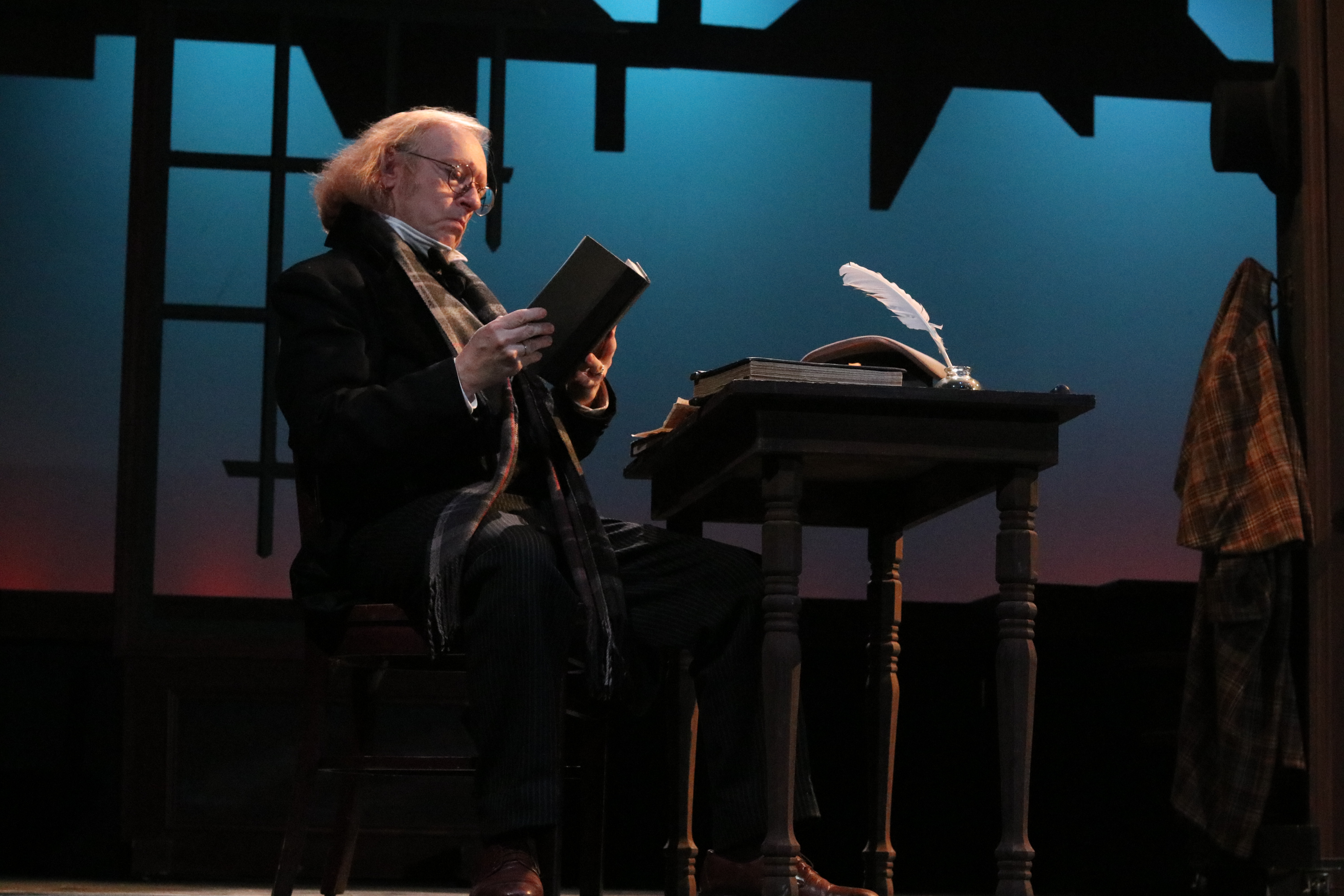
2020~A Christmas Carol-28 

Luckily, the Ghost of Christmas Present in Charles Dickens’ A Christmas Carol, so friendly and jolly with his glowing torch, was more than 175 years removed from 2020 when he made his first oxymoronic appearance in print. Christmas of 1843 may not have been the best ever as it greeted Dickens’ original readers, but it had to be more festive than 2020, the gloomiest in centuries.

While it’s possible to retreat into the nostalgia of numerous movie and TV adaptations of the Yuletide classic, Charlotte is one of hundreds of cities where watching live theatrical adaptations has become a holiday tradition. So it’s fascinating, even revelatory to see how Theatre Charlotte is adapting to the unprecedented circumstances of 2020 in presenting its 14th annual production of A Christmas Carol.

It’s a remarkable chameleon, adapted by Julius Arthur Leonard and co-directed by Stuart Spencer and Chris Timmons. This is truly a to-be-or-not-to-be effort: Live and virtual, at Theatre Charlotte on Queens Road and not, set in Dickens’ London in the 19th century and unmistakably invaded by COVID-19 and the constraints of the pandemic. 2020 or not 2020.

2020~A Christmas Carol-21

Watching the virtual version recorded at the Queens Road barn, I was surprised to find how Dickens’ characters, in period costumes designed by Chelsea Retalic, replicated daily life today. While Marley and the three famous Christmas Ghosts wore masks, others – including Scrooge, his nephew, and the Cratchits – did not. No wonder poor Tiny Tim is dying!

Live outdoor performances of Theatre Charlotte’s pandemic edition of Dickens premiered at Christ South’s Old Dairy Farm in Waxhaw on Reid Dairy Road, which may account for some of the anomalies we see when we tune in to the indoor version. Outdoors, winter is upon us, so Spencer and Timmons may not have wished their Scrooge to change into his jammies. Besides that, an outdoor shift in scene from the Scrooge & Marley counting house to Ebenezer’s bedroom may have been unwieldy out on the farm.

So all of the action, aside from the Ghosts’ travels, is confined to Scrooge’s office until he sallies forth on Christmas day. To achieve this economy and consistency, Spencer and Timmons alter the plot just a little, sending Scrooge outdoors for dinner and having him realize that he has forgotten his pocket watch at his office. That’s where Marley and the Ghosts will now do their haunting. Nor do our directors forget about Ebenezer’s watch or his watch chain, elegantly transforming it into a fresh plot point without changing any of the dialogue.

IMG_0654

The uncredited set design, likely by Timmons, is very spare, silhouettes of city and government buildings in the background, connected to the Scrooge & Marley firm by a stunted staircase and a front door. No walls or windows obscure our view of the sidewalk outside the office or the silhouetted figures that traverse it. Inside, we never need more at Scrooge’s HQ than desks for Ebenezer and his oppressed drone Bob Cratchit. Bedtime is never observed, so there’s no longer any need for a bed. When we visit the Cratchits or Scrooge’s nephew Fred, as much as a cushioned chair and a wee table are necessary, so that Fred’s wife may have a glass of wine and a decanter nearby, but that is all.

Sound design by Timmons and Vito Abate only blunders with the opening and closing of Scrooge’s front door. Opening it lets in a hullabaloo of street sounds and closing it silences the noise – except we can clearly hear the footsteps of whoever departs on the sidewalk. Grander and more successful are the sounds heralding the supernatural entrances of Marley and the three Christmas Ghosts, while lighting by Rick Wiggins brashly suggests that all three of Scrooge’s guides have celestial origins.

2020~A Christmas Carol-07

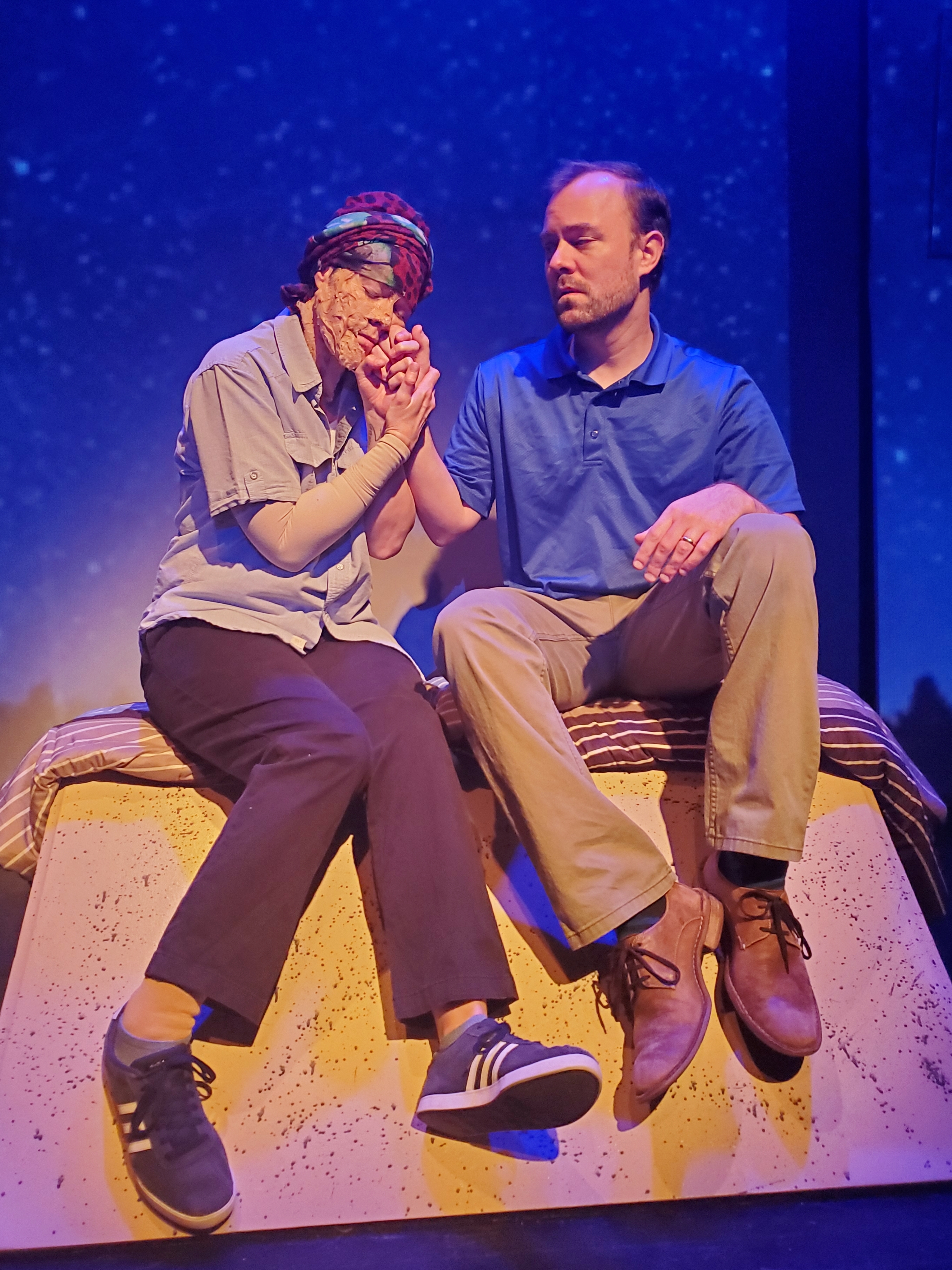
Hank West, mostly prized around town for his comedy exploits, is not a complete stranger to mean roles, having portrayed the Marquis de Sade in 2003. There’s nothing missing of Scrooge’s flinty cantankerousness in the opening scene. West’s rebuffs of a charitable solicitor (just one this year instead of two) and his nephew Fred are even more repellent than his tyranny and resentment toward Cratchit. It’s when we approach West’s comedic wheelhouse where we find him woefully hamstrung. Deprived of Scrooge’s bedclothes and his dopey nightcap – the lone accessories that make Ebenezer vulnerable or adorable through five-sixths of the story – West must accompany the Ghosts in business attire.

Worse than that, West must give us a Scrooge who dances with glee, realizing that he hasn’t missed Christmas morning, dressed up like an adult going to work rather than as a child waking from – and to – a fabulous holiday dream. Missing this parcel of Dickens’ visual genius, we can appreciate it more, for the nightcap and bedclothes are also as indispensable to the distinctive flavor of Scrooge’s supernatural journeys as the Ghosts’ personalities.
2020~A Christmas Carol-39

West’s comedy isn’t totally eclipsed, peeping out in his retorts to Cratchit and the Solicitor, in his timing of remarks after visitors exit, and in his sunny sallies around town making his many amends. Of course, the final prank on Cratchit when he comes in late on the 26th is handsomely done, though I was a little surprised by West’s decision to underplay Scrooge’s mischievousness and glee as he did Ebenezer’s playacting.

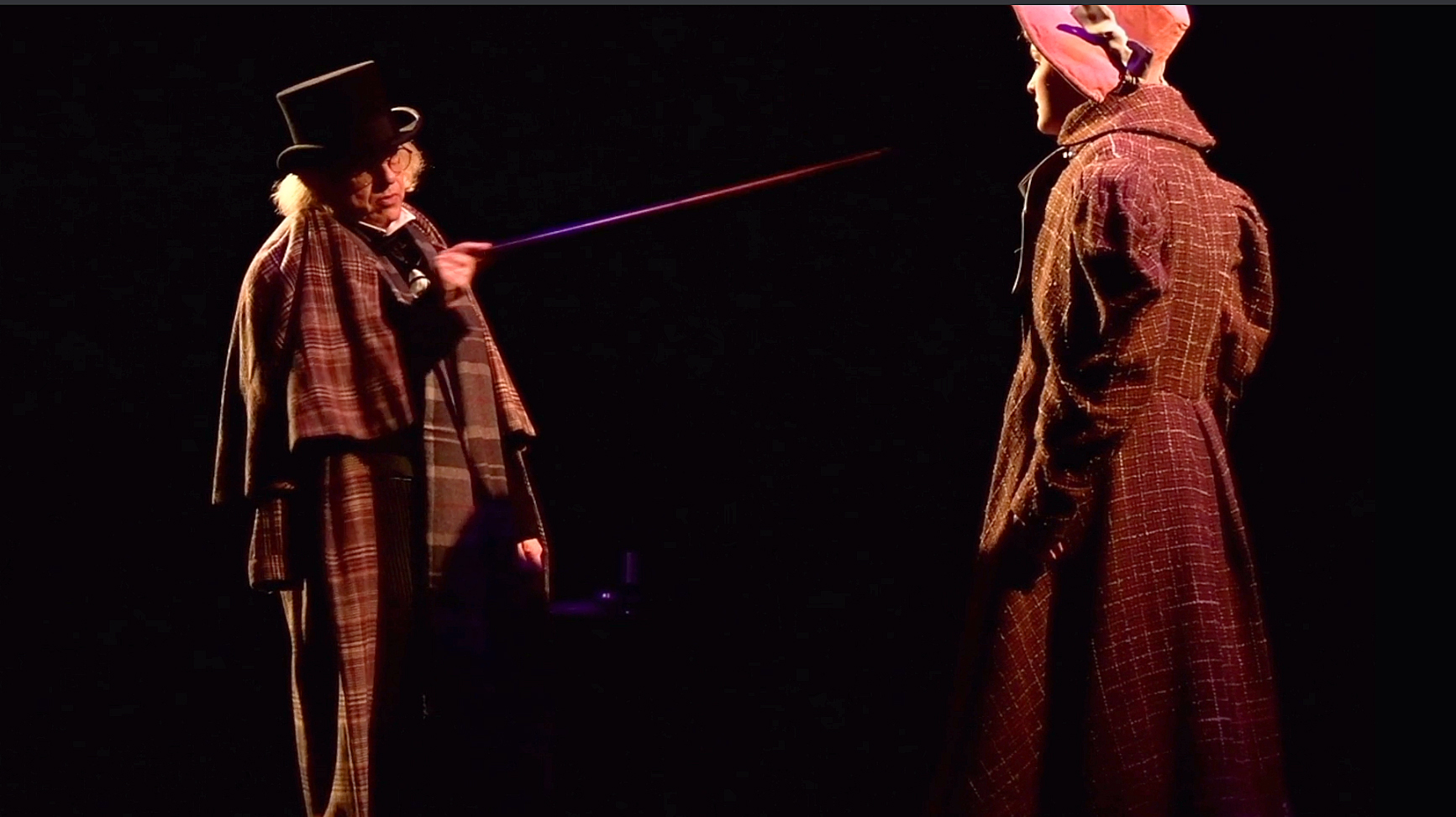
More women than men are seen onstage here, with Andrea King tipping the balance as Bob Cratchit. At work, she is purely deferential toward Scrooge, and King’s entrance on the 26th has a stealth worthy of Chaplin or Lucille Ball. We probably notice that at home, King’s Cratchit as a husband and a father comes off as less of a patriarch than we’re accustomed to. Can’t say that I minded much – am I becoming too evolved?

2020~A Christmas Carol-11

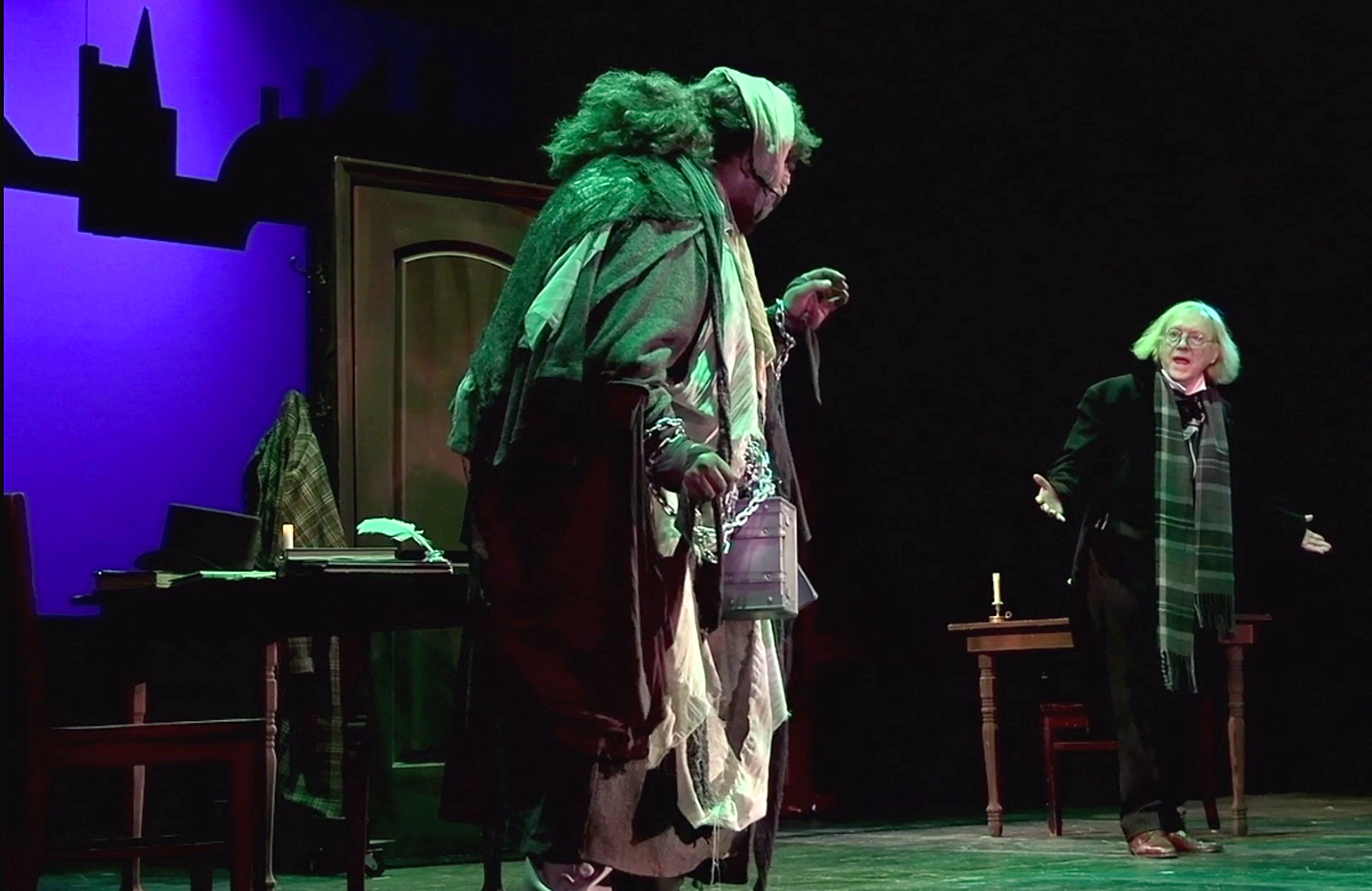
Seeing both Allen Andrews as Christmas Yet to Come and Josh Logsdon as Marley’s Ghost wearing masks hardly detracted from their portrayals. Logsdon’s mask had an orifice that seemed rimmed with teeth, he was bundled up with enough rags under his chains to look like a leper, and a huge gray wig affixed to his head with a shroud-like kerchief made him even more loathsome. Notwithstanding Scrooge’s doubts, when Logsdon bemoaned his fate and issued Marley’s warnings, there was far more grave than gravy in this ghost.

More noticeable were the alterations that masks imposed on the women Ghosts. Reprising her role as Christmas Past, Anna McCarty had a veiled look in her gleaming white gown, Arabian or ecclesiastical in its modesty. Yet when she needed to be strong and authoritative, McCarty didn’t disappoint, even though she seemed more socially-distanced than her castmates. Lechetze Lewis as Christmas Present was free to mingle more in her garrulous London tour. Her lively interaction with Fred and his wife, Andrews and Mary Lynn Bain, offered the most spectacular display of Retalic’s costume designs this side of Marley.

Andrews’ entreaties that Uncle Scrooge come dine with Fred were nearly as foundational in establishing the Christmas spirit on Queens Road as Cratchit’s sufferings and goodwill. Bain was also more impactful when she doubled as Belle, Scrooge’s sweetheart in the flashback, particularly when she returns her engagement ring, releases Ebenezer from his obligations, and decries his worship of Mammon.

2020~A Christmas Carol-22

Little moments like this, Cratchit applauding Fred’s advocacy of Christmas, and the perfect view we get of Cratchit sneaking in late after the holiday are among the many testaments we get to the work of Megan Shiflett and Nick Allison behind the cameras – delivering the best angles from the best distances. Theatre Charlotte may not have the resources that CPCC can boast in video gear, but they’re outstripping every live video I’ve seen from the college, because Spencer and Timmons are so deftly cuing their cameras where to be and when.

Amid the special hardships of 2020, local theatre companies are substantially sharpening their video techniques and their cinema savvy, good tidings that will pay dividends when COVID-19 is conquered.

With Jill Bloede executing the Narrator’s role in such a ceremonious British style, and with the likes of Tom Ollis and Rebecca Kirby as the Fezziwigs, quality runs deep in this cast – as deep as you’d expect with productions running twice the five performances this one is getting. There’s plenty of mileage left in the virtual version, which continues its on-demand run through January 2.

A Disfigured War Vet Struggles to Find – and See – Herself

Review: Ugly Lies the Bone

By Perry Tannenbaum

Jess-Kacie-Mom

When Jess returns to her Florida hometown from her third deployment in Afghanistan, there are multiple obstacles littering her path to reintegrating into family and community life. Mentally, she’s suffering from PTSD. Physically, she’s tormented by the aftereffects of injuries inflicted by an exploding IED: she gets around – slowly – with help from a walker, her face is disfigured by burns and skin grafts, and she’s constantly in excruciating pain from burns and grafts all over her body.

That’s just the beginning in Lindsey Ferrentino’s Ugly Lies the Bone, now at Spirit Square in a Three Bone Theatre production. There’s a certain amount of friction between Jess and her sunny sister, Kacie, that reads like ingratitude for all the help and care Kacie is trying to give her. Jess also reflexively despises Kacie’s vulgar, tactless, and boisterous boyfriend, Kelvin, and she doesn’t express that feeling daintily. Nor does it help that Jess’s former boyfriend, Stevie, didn’t religiously wait for her to come back home. Instead, he went on with his life and got married.

Located near Cape Kennedy, Jess’s hometown of Titusville offers additional challenges. Not only do the sands on the nearby beaches trigger Jess’s PTSD, so will the earthshaking tremors from rocket launches at the Kennedy Space Center. True, NASA’s space shuttle program is about to end, minimizing the obstacles posed by future launch events. But layoffs have already struck the Space Center, reducing job opportunities in the citywide. Stevie was one of the impacted NASA workers, and Jess finds him behind the counter at a local gas station, making change, selling lottery cards, and wearing a dopey space beanie.

But wait a second. Jess had to run and conquer obstacle courses just to earn the dubious privilege of being deployed to Afghanistan in the first place, right? This nasty, bitter, and disfigured woman has grit. We also get hints from both Kacie and Stevie that, once upon a time, Jess had vitality and appeal. And notwithstanding all her current pain, disability, and orneriness, Ugly Jess gets meaningful help.

Jess2

The most intriguing – and theatrical – form of help is a form of VR therapy that Ferrentino tells us, in a program note, was actually the inspiration for her play. You can google “Snow World” therapy and find that its use with severely injured soldiers dates back to 2008, though it seemed pretty cutting-edge to me. Each time Andrea King as Jess puts on her VR goggles and immerses herself in a fabricated 3D snow-world, the Duke Energy Theater fills with dreamy projection designs by Ryan Maloney – so we’re fairly immersed as well.

Since the theory of the therapy is as much sensory bombardment as fantastical escape, the second ingredient of the treatments is music. Jess gets to choose between patriotic soldiering music and Paul Simon. The treatment is curiously impersonal: we never see Jess’s therapist; we only hear her voice. Amid the sensory overload, Jess’s sufferings subside sufficiently for the therapist to prompt her to move her legs through the snowdrifts and lift her arms – movements that would normally exacerbate her terrible pain by stretching her newly grafted skin.

For us as well as for Jess, these dreamy cinematic episodes are oases of calm that punctuate the stresses and occasional comedy of her readjustment to civilian life. She momentarily abandons her walker as she grabs the videogame controls, almost straightens up, and we find ourselves relaxing with her in the dimmed light.

Jess-Kelvin

Perverse as it was, I enjoyed the oafishness of Peter Finnegan as Kelvin and the nerdiness of Scott Tynes-Miller as Stevie. Anyone who saw Finnegan last summer as he feasted on the role of Bottom in the outdoor production of A Midsummer Night’s Dream at Queens University will need no further incentive to behold his Kelvin, which is nearly that far south of normal. And who better for director Dee Abdullah to turn to than Tynes-Miller for the wishy-washy, conflicted, and adorably humbled Stevie? We’ve watched his auditions for years.

Abdullah can allow both Finnegan and Tynes-Miller to go slightly overboard in making asses out of Kelvin and Stevie because Ferrentino eventually brings them back to conscience and virtue. Becky Schultz as Jess’s sister Kacie may seem too wholesome at first to go the distance with Kelvin. With only a trace of trashiness from Schultz, Finnegan’s loutishness startles us all the more, so we tend to empathize with Jess a little bit when she explodes on him early – and later on when she harbors darker suspicions.

Jess-Stevie1

Before singing King’s praises as Jess, I’d be remiss if I didn’t insert some prefatory kudos to makeup designer Gregory Hewett and makeup artist Natasha Kay, unsparing in showing us what Jess is dealing with. You don’t need to imagine much of the pain when King slowly makes her first entrance with her walker. The pain really does seem to permeate every inch of her as she struggles to move and the endure the ocean of ache. When King declares that three operations were necessary to restore one eyelid, you believe it. Vulnerability, bitterness, anger, need, and an all-powerful doggedness course through her, slackened only when Jess dons those transporting goggles, or when she joins Stevie – again in relative darkness – for their climactic rooftop rendezvous.

We get to know Debbie Swanson as the voice of the therapist strictly from her performance up in the Duke’s soundbooth, so it’s gratifying to see her at last when she doubles as Jess and Kacie’s mom as the drama concludes. Swanson’s disembodied voice isn’t tough love so much as clinical care for Jess at the VR sessions. Sometimes soothingly, she patiently counsels Jess to move forward instead of looking back, following procedures with firm military precision.

Eventually, the voice from the booth warms up to Jess just enough to bend the rules. All this time, even before she appears, mom is adding to Jess’s stress and our suspense. Suffering from dementia, Mom may not recognize her own daughter anymore, another devastating blow for Jess. Or she might recognize Jess and freak out, which would hurt them both.

For Jess, avoidance of that confrontation brings little relief. Looking into the mirror, Jess is struggling to recognize herself.

Homespun “Barbecue Apocalypse” Improves With Age

Reviews: Barbecue Apocalypse, The Sherlock Project, Life Is a Dream, and Madagascar

By Perry Tannenbaum

IMG_5740

In a year that included Lucas Hnath’s The Christians, Robert Schenkkan’s The Great Society and Rebecca Gilman’s Luna Gale among the top contenders, I could only give Matt Lyle’s Barbecue Apocalypse a lukewarm endorsement for best new play of 2015, ranking it #13 among 27 eligibles that I read for that year’s Steinberg Awards. Nor did colleagues from the American Theatre Critics Association strongly disagree with my verdict, since Lyle’s dystopian comedy didn’t make the cut for the second ballot, when we considered our consensus top 10.

But before Charlotte’s Off-Broadway decided to stage this show at The Warehouse PAC up in Cornelius, they did some reading and balloting of their own. From January through March, the company offered monthly “Page to Stage” readings presenting two different plays on each occasion. Then they asked ticketholders to vote on which of the six plays they would like to see in a fully staged production. Less than two months after the votes were counted, Barbecue is back for my reconsideration as the audience favorite.

And on further consideration, I must credit director Anne Lambert and her professional cast for convincing me that Barbecue Apocalypse is even better than I thought it would be – far more to my liking than real barbecue.

IMG_5885

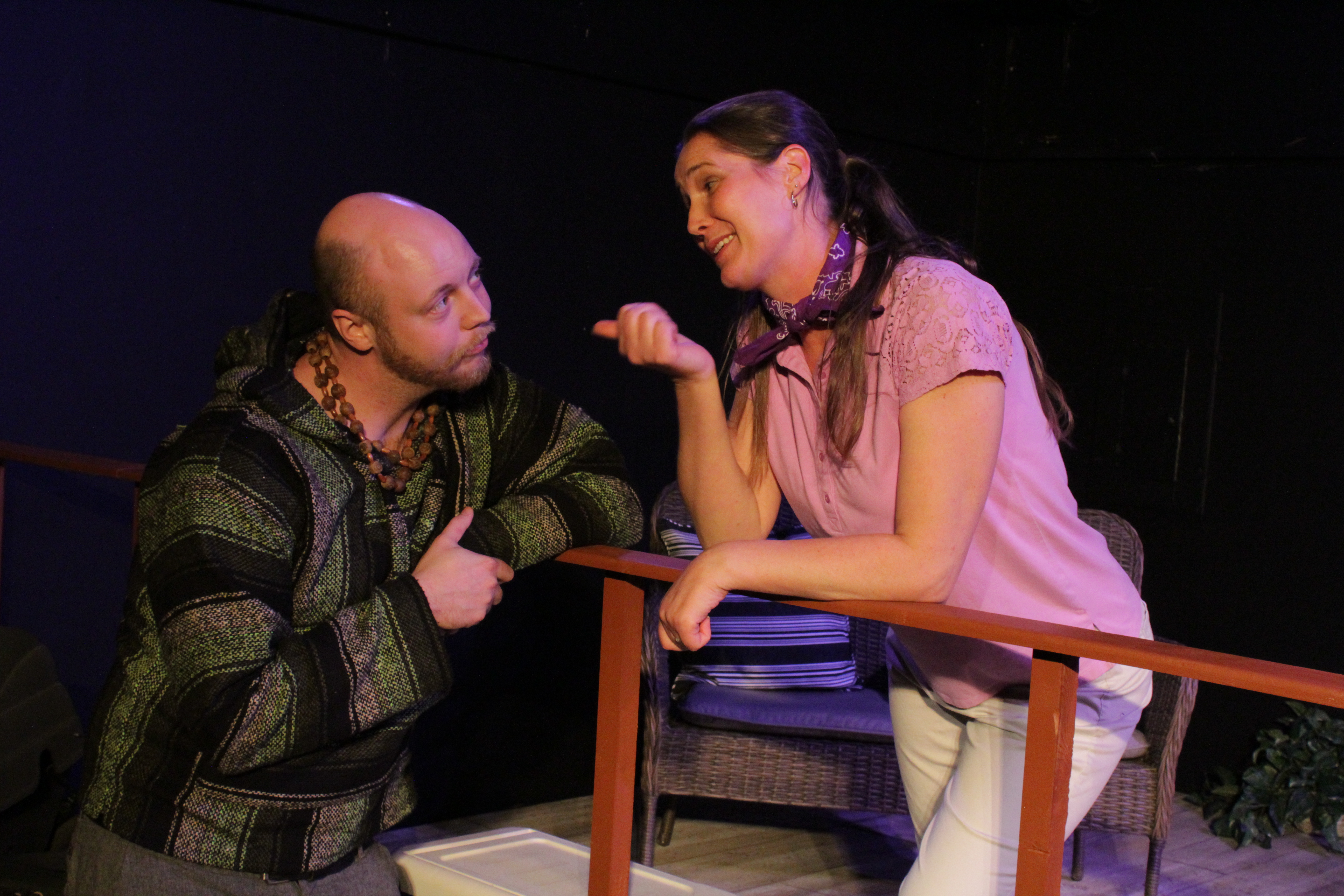
Lyle would probably concur, since his patio hosts, Deb and Mike, are only grilling and basting because they want to avoid the embarrassment of having their friends – who are more trendy, stylish, and successful – see the interior of their home, decorated with lame movie posters. Deb succinctly describes her strategy as lowering expectations for the cuisine and the ambiance. Outdoors, she can point with pride to the fact that Mike has built the rear deck himself. Yet the barbecue event has obligated Mike to buy a propane grill off Craig’s List, and he’s afraid to light it.

He would also like Deb not to mention that he’s a professional writer, for his career earnings, after one published short story, now total 50 bucks.

All four of the guests feed the hosts’ sense of inadequacy. Deb is a decorator, foodie, and gourmet cook who makes sure to bring her own organic meat, and her husband Ash is a gadget freak, armed with the best new smartphone equipped with the most awesome apps. Win pretty much embodies his name, a former high school QB, now a successful businessman with Republican views. He lives to put Mike down and can seemingly get any woman he wants. Even his bimbo of choice, Glory with her Astrodome boobs, can claim formidable accomplishments, arriving late to the barbecue after nailing her Rockette audition.

What ultimately happens to this insulated suburban group reminds me of The Admirable Crichton, the excellent James M. Barrie tragicomedy I came across a couple of times during TV’s golden age, when colleges had core curriculums. A perfect butler to the Earl of Loam in Mayfair, London, Crichton and his betters were shipwrecked on a desert island in the Pacific, where his natural superiority emerged.

There are two basic differences between Barrie’s back-to-nature tale and Lyle’s. The shipwreck situation was reversible with rescue. Apocalypse isn’t. More to the point, Barrie was clearly targeting the blind rigidity of class distinctions. Here if we consider the implications of Barbecue Apocalypse, Lyle seems to have modernity in his crosshairs – how our world warps our aspirations and our self-worth, how it channels us into modes of living that are far from our authentic selves.

In the cramped storefront confines of the Warehouse, Lambert doesn’t attempt to design a deck that lives up to Mike’s pretensions, and Donavynn Sandusky’s costume designs are similarly déclassé, especially for the nerdy Ash. This robs Lyle’s concept of much of its slickness, which for me turned out to be a good thing. Aside from the Craig’s List mention, Lambert also dropped in a couple of local references that added to the overall homespun flavor.IMG_6440

Becca Worthington and Conrad Harvey were nearly ideal as our hosts, keenly aware of each other’s limitations and their own, yet visibly crazy for one another. Worthington with her status-conscious rigidity and stressing was clearly the closest actor onstage to Lyle’s vision, beautifully flipping her “We suck” persona after intermission and the apocalypse, when a full year of roughing it has elapsed. Harvey was more than sufficiently cuddly and self-deprecating – but credulity is stretched when a man of such size and stature is repeatedly dominated by his adversaries.

If you can accept that Greg Paroff was ever on a football field, let alone as a QB, you’ll be quite pleased with how he handles Win’s asshole antics. He is confident, he is arrogant, and if he’s possibly past 40, that only increases the disconnect between Win and his limber Rockette. Julia Benfield is absolutely adorable as Glory, and I absolutely adore how she’s still mincing around in high heels when she makes her disheveled entrance in Act 2. We totally believe that her familiarity with Tom Wopat doesn’t extend to The Dukes of Hazard in the ‘80s.

Probably not the best moment for Lambert when she cast Cole Pedigo and Jenn Grabenstetter as Ash and Lulu. They should remember the ‘80s, but I needed to stifle my doubts. Wardrobe and just the way he’s absorbed in his iPhone might help Pedigo out – and make him less wholesome, winsome, and juvenile before the apocalypse. Grabenstetter overcomes all objections when free-range Lulu gets snockered on generic canned beer, and both Pedigo and his scene partner truly click when adversity brings Ash and Lulu to a new lease on life in Act 2. I believe that’s an antler dance.

I won’t disclose what happens when Maxwell Greger walks on for his cameo deep in Act 2, but I do respect how Lyle makes him earn his paycheck with a sizable monologue. Greger does the denouement with a slight manic edge, and the technical aspects of his departure are impressively handled.

So it’s fair to say that apologies are in order for rating Barbecue Apocalypse in the middle of the pack when I first read it. Or excuses, since a rational man resided at the White House in 2015, and apocalypse seemed so fantastical.

But hold on. Charlotte’s Off-Broadway has already programmed two other plays from their “Page to Stage” readings for two fully-staged productions in the near future, Susan Lambert Hatem’s Confidence (and The Speech) for September and Lauren Gunderson’s Exit, Pursued by a Bear for next February. Maybe when these runner-ups get fleshed out, supporters of Lyle’s winning script might reconsider their votes!

A Catch-All Catch-Up

Our recent travels to Greece, Israel, and Jordan compelled us to miss a bunch of high-profile openings after we reviewed the reinvented Rite of Spring at Knight Theatre on April 6 and CP’s On Golden Pond the following evening. Even before we left, we had to pass on the Charlotte Dance Festival and CP’s Elixir of Love so we could adequately prepare for our trip. To see the birthplace of theatre, the Holy Land, and Petra, we had to miss out on the BOOM Festival, the reprise of Beautiful: The Carol King Musical, and the opportunity to host a pre-show preview of The Marriage of Figaro for Opera Carolina.

New openings when we returned were a must, so we hit the ground running with Charlotte Ballet’s Spring Works and Symphony’s Brahms-and-Bartok program. But our need to catch up with Carolina Shakespeare’s Life Is a Dream made us put off seeing PaperHouse Theatre’s Sherlock Project until it second week. It gets complicated. But I’ve tried to get up to speed while working on more reviews and features. File these under gone but not forgotten:

The Sherlock Project So a dozen actors and writers collaborated on PaperHouse Theatre’s mash-up of Sir Arthur Conan Doyle’s short story gems, producing a script that follows three guiding principles: keep it funny, keep it moving, and don’t, don’t, don’t ever explain how the great Sherlock Holmes arrives at his incredible deductions. Going back to their roots at the Frock Shop on Central Avenue, PaperHouse and director Nicia Carla found a frilly complement to the Victorian chronicles of Dr. John Watson.

But the frame of the story was wholly new, telling us that the deadeye detective in the deerstalker cap is a woman. Watson protects the woman who should be credited with all the purported exploits of Scotland Yard’s Inspector Lestrade because he knows that Sherlock is right: The general public is even less prepared to believe a female is capable of such brilliancies than Watson is.

Besides all of the Sherlockian brilliance and nonchalant arrogance, Andrea King reveled in all of the detective’s eccentricities, whether it was shooting up a 7% solution of cocaine, tuning up a violin, or lighting up a calabash pipe. Opposite King’s insouciant self-confidence, Chaz Pofahl wrung maximum comedy from Watson’s wonder and timidity – a phenomenon compounded by the gender factor as Pofahl switched from paternal protectiveness to awe or terror while King wryly twinkled and smiled.

The two main supporting players slipped into multiple roles, Angie C as a cavalcade of damsels in distress and Berry Newkirk in the plumiest cameos, ranging from the dull-witted Lestrade to the razor-sharp Professor Moriarty, mythically uncatchable. Apart from directing behind the scenes, Carla conspired in the action as Mrs. Hudson, Holmes’s discreet housemaid. Carla not only ushered in Sherlock’s distraught clientele or evil adversaries, she also presided over scene changes, when audience members had to exit the Frock Shop’s parlor to a murder scene in the adjoining room or out on the porch when Sherlock was pursuing… something. Had to do with fire.

Or when it was intermission, time for little cucumber sandwiches.

The whole show was a wonderful diversion. PaperHouse had to add another performance to their run, which we caught last Wednesday, and the remaining nights were already sold out. Like the PaperHouse faithful, I couldn’t get enough of The Sherlock Project. I wanted lots more – beginning with how did Sherlock deduce that Watson had just come from Afghanistan when they first met?

Life Is a Dream – Convinced it was a comedy rather than a political melodrama, Shakespeare Carolina and director S. Wilson Lee kidnapped Pedro Calderón de la Barca’s classic, written during Spain’s Golden Age, and transported it more than three centuries forward from a mythical Poland to a mythical Las Vegas. There in a seedy club on the strip, the two factions with their eyes on the throne were Frank Sinatra’s Rat Pack and Marlon Brando’s Wild Bunch.

Lee’s wild conceit didn’t do nearly as much harm as I thought it would, mainly because ShakesCar didn’t have the budget to carry it too far at Duke Energy Theatre, and the strong cast mostly played their roles as the text, sensibly adapted by Jo Clifford, said they should. So much depended on the broad shoulders of David Hayes as Segismundo. Heir to the throne of Poland, Segismundo has been locked away Prometheus-like in a mountain dungeon for his whole life by his father, King Basilio, who is foolishly trying to ward off the dire destiny predicted by an astrologer.

A boiling rage seethes inside of Segismundo, and a less mightily built actor than Hayes might need to strain himself to encompass it. Hayes projected the mighty rage rather naturally, which made it easier for him to flow convincingly into Segismundo’s softer emotions when – before he has even suspected his royal lineage – he is handed the Polish throne and the power to act on his newly awakened sexual urges as he sees fit.

Called upon to give a far more nuanced performance as Basilio, Russell Rowe delivered. Yes, he was cruel, but also conflicted, with a lifelong dread deftly mixed into his forcefulness. Though I feared the convoluted plot might be abridged or simplified, the intrigue, the complexity, and the epic monologues were almost entirely intact. As the vengeful Rosaura, Teresa Abernethy brought forth the masculine-feminine blend that the transgendered Clifford was aiming for in her translation, and James Cartee, an actor who often keeps nothing in reserve, showed unusual probity and maturity as Clotaldo, even as he tried to figure out his long-lost child’s gender.

Nobody was more suavely dressed by costume designer Mandy Kendall than James Lee Walker II as Astolfo, the successor that Basilio wanted if the true heir didn’t pass his test. But if anybody was victimized by Lee’s Rat Pack concept, it was Walker. I have no idea why he persisted in speaking so rapidly and unintelligibly, unlike any work I’d seen from him before. Was he attempting a Sammy Davis Jr. imitation? Couldn’t figure out what accounted for this curious outing.

Betrothed to this strange hipster, Maggie Monahan beautifully brought out the agonies of queen-to-be Estrella. Maybe the most Shakespearean role in this ShakesCar production was Ted Patterson as Clarin, who tags after the disguised Rosaura from the opening scene, as either her companion or servant – but definitely our clown.

On the strength of this effort, theatergoers can be excited about ShakesCar’s next invasion of Spirit Square, The Tragical History of the Life and Death of Doctor Faustus at Duke Energy from June 28 to July 7.

DSC03442

Madagascar – Okay, so I’ll grant that the musical adaptation of the 2005 Dreamworks film didn’t have the gravitas of the greatest Children’s Theatre of Charlotte extravaganzas of the past like their Boundless Grace and The Lion, the Witch, and the Wardrobe – or the bite of Ramona Quimby and Tales of a Fourth-Grade Nothing. But this confection was nearly perfection. Under the direction of Michelle Long, Madagascar hit a family-friendly sweet spot, straddling the realms of cartoon silliness, cinematic adventure, and theatrical slapstick and dance. I just didn’t like the deejay, everybody-get-up-and-act-stupid thing.

Scenic design by Jeffrey D. Kmiec never lost its freshness thanks to a slick stage crew and the eye-popping lighting by Gordon W. Olson, while the animal costumes by Magda Guichard probably made the strongest case for live theatre against multiplex animation. Choreography by Tod A. Kubo chimed well with Long’s direction, which used areas of McColl Family Theatre that rarely come into play.

Centering around four animals that break out of Central Park Zoo, Madagascar introduced us to Marty the zebra and his wanderlust. We moved swiftly from there. Following the lead of four penguins bound for Antarctica, Marty escaped the zoo, seeking a weekend in Connecticut. Not only are police, animal control, and TV bulletins on his trail, so were his pals Gloria the hippo, Alex the lion, and Melman the giraffe. Embarking underground in the Manhattan subway, Marty hardly stretched credulity much further by winding up off Africa.

Deon Releford-Lee was a spectacular triple-threat as Marty, but what dazzled most was the multitude of gems in this supporting cast, beginning with an intimidating Alex from leonine Traven Harrington and – on stilts, of course – a timorous Melman from Caleb Sigmon. Dominique Atwater disappointed me as Gloria, but only because we didn’t get enough of our hippo after her first big splash. Olivia Edge, Allison Snow-Rhinehart, and Rahsheem Shabazz fared better, drawing multiple roles.

While the book by Kevin Del Aguila shone more brightly than the musical score by George Noriega and Joel Someillan, I was amazed that so much story and song could be squeezed into barely more than 60 minutes. Combined with last October’s Mary Poppins, the exploits of Madagascar prove that musical production is an enduring strength at Children’s Theatre. I can’t think of a season at ImaginOn that had sturdier bookends than these musicals that began and concluded 2017-18. The crowd that turned out for the final performance affirmed that the 7th Street fantasy palace has perfected the craft of producing family fare.

Not only that, it showed me that Charlotte families have spread the word.

Best of Charlotte, 2017

Best of Charlotte, 2017

By Perry Tannenbaum

                                           Best ActorJeremy DeCarlos


Among local performers, there are strong candidacies from Brian Logsdon (Pride and Prejudice and Ragtime), Jonavan Adams (Ma Rainey’s Black Bottom and The Christians), Scott A. Miller (Stupid F@#%ing Bird and The Submission), Jermaine Gamble (A Raisin in the Sun and Jitney) and Tyler Smith (Ragtime and Memphis). All of them sparkled on multiple occasions. But the runaway victory goes to Jeremy DeCarlos, who laps the field – in range and productivity – with four scintillating outings. Draped in a braided Hussar jacket, DeCarlos just finished channeling his inner Jimi Hendrix as the devilish St. Jimmy in American Idiot. That was the last of his Actor’s Theatre gems over the past year, including some cross-dressing preaching in Bootycandy, his insouciant devotion in Stupid F@#%ing Bird, and his amazing transformation – from Jerry Lewis nerd to Incredible Hulk-ish monster – in The Toxic Avenger.

Best Actress – Shar Marlin

The field of contenders is larger among the ladies, but the roles were more thinly distributed, eliminating productivity as a decisive criterion. But which other benchmark should override all others? If it’s flesh-crawling menace, Sarah Woldum gets the edge, bringing Sheridan LeFanu’s Carmilla to life in She Who Watches. Leslie Giles was the funniest as the blind librarian in The Toxic Avenger, Lucia Stetson the most revelatory as Mother in Ragtime, and Allison Snow Rhinehart was better than her Broadway counterpart as Mama in Memphis. And how can I forget the sizzling dominatrix arrogance of Nonye Obichere as Whatsername in American Idiot? I’m turning instead to Shar Marlin for her sheer power and imperial dominance in Ma Rainey’s Black Bottom, a dramatic stunner that also showed Shar’s blues singing chops. Dignity in the face of exploitation and discrimination. Diva!

Best Comedy – Women Playing Hamlet


Theatre Charlotte’s You Can’t Take It With You and the Citizens of the Universe farewell, The Hitchhiker’s Guide to the Galaxy, were arguably the zaniest productions of the 2016-17, while the Chekhov knockoff from Actor’s Theatre, Stupid F@#%ing Bird, was surely the most poignant. And what about OnQ Productions’ A Brown Tale from James T. Alfred, maybe the funniest one-man show I’ve ever seen? All were worthy candidates, but I’m going to let Chickspeare split this prize with Donna Scott Productions for their joint production of Women Playing Hamlet. Glynnis O’Donoghue starred as the soap queen saddled with the lead role in the Mona Lisa of tragedies, and the galaxy of comediennes – all in multiple roles – offering her questionable advice included Tania Kelly, Andrea King, Vivian T Howell, and Sheila Snow Proctor.

Best Musical – Ragtime

Ragtime Promo Photos

Folks who confine their diet of musicals in Charlotte to touring productions at the PAC are missing out bigtime on the locally-produced blockbusters playing out at smaller venues around town. Actor’s Theatre scrambled to produce a marvelous Toxic Avenger at a storefront church because this city doesn’t have the vision to see the arts flourish on Freedom Drive without a needless morass of red tape. Still in exile, they just brought the noise of American Idiot to Queens University for a face-melting month. After reminding us how finely they can produce A Year With Frog and Toad, Children’s Theatre astonished with the world premiere of The Best Christmas Pageant Ever: The Musical. With more than one Broadway-level performance, Theatre showed us their mettle with Memphis, and CPCC re-emphasized that their musical excellence isn’t confined to summer anymore. Maybe it was sheer luck, but CP’s wintertime production of Ragtime was the most timely of the year, underscoring the sad fact that institutional racism, police brutality, and prejudice against immigrants aren’t quaint relics of the Jazz Age. As the martyred Coalhouse Walker, Tyler Smith’s impassioned “We are all Coalhouse!” reverberated through a city in turmoil.

Best Drama – Jitney

Early last season, PaperHouse Theatre proved that The Frock Shop on Central Avenue was the perfect site for a creepshow with a dazzling She Who Watches, and early this season, a legend made a comeback when Steve Umberger and his Playworks Group brought a sterling production of The Christians to Booth Playhouse. In between, as Charlotte was fully wakening to how badly we have neglected and mistreated our underclass, theatergoers may have finally been zonked by the realization that our city is exceptionally rife with African American acting and directing talent. Kim Parati made an auspicious directorial debut at Theatre Charlotte with a freshened-up Raisin in the Sun, but this was a vintage year for August Wilson – in two dramas directed by Corlis Hayes, Ma Rainey’s Black Bottom at CPCC and Brand New Sheriff’s Jitney at Spirit Square. Hayes brought out the best in John W. Price and Jermaine Gamble as the father-son antagonists in Jitney, with Gerard Hazelton adding a mix of comedy and poignancy as the gypsy cab company’s resident lush. Move over OnQ Productions, there really is a brand new black company in town – our second! – producing professional-grade work.

Best Night @ Symphony – Mahler’s “Resurrection”

While a well-played Beethoven symphony, a Rossini overture, a Strauss tone poem, or a Mozart concerto might be the secret sauce to get newcomers to become Charlotte Symphony subscribers, longtime concertgoers like me wish to dismount the warhorses and hear something off the beaten trail. There’s plenty out there that will please both camps: big, unfamiliar orchestral works that will instantly grab you by the lapels even if Symphony hasn’t reprised them within the last decade. Armed with an audacious orchestra and choir, plus two soloists who have sung with Opera Carolina, Davidson College showed the way with a rousing performance of Ralph Vaughan Williams’ A Sea Symphony, set to poetry by Walt Whitman. That’s the sort of daring we hope for from Charlotte Symphony’s British maestro, Christopher Warren-Green. We did get a British Isles-themed evening when pieces by Edward Elgar and Peter Maxwell Davies, spiced up with a bagpiper, were served with Mendelssohn’s “Scottish.” Utilizing the Symphony Chorus and distinguished guest vocalists, Warren-Green turned up the power with a pair of Bruckner chorales last November and Mendelssohn’s Elijah last March. If you wanted to sample the full capabilities of Symphony, their chorus, and the guest vocalists Warren-Green can summon to Belk Theater, you had to hear them introducing the wonders of Mahler’s “Resurrection” Symphony No. 2 to an astounded audience.

Best Night @ the Opera – The Girl of the West

Under maestro James Meena, Opera Carolina does the oldies better than ever, as their uproarious Barber of Seville and their vivacious, ultimately anguished La Traviata amply proved. There was even some audacity in the 2016-17 programming as OpCar partnered with Warehouse Performing Arts Center and the D9 Brewing Company to produce an evening of three short operas – including the world premiere of Scott Joiner’s “Connection Lost (The Tinder Opera)” – at the brewery in Cornelius. Yes, a world premiere on Treynorth Drive! But most exciting was the Charlotte premiere of Puccini’s The Girl of the West, as Meena collaborated with six other international companies, including New York City Opera and Teatro del Giglio in Lucca, Puccini’s hometown. Singing was exemplary, persuading me that this second-tier Puccini opera was actually a first-rate work, and staging was anything but stodgy or conservative: much of the scenery was animated and bold, with authentic relics evoking the Wild West supplied by our own dearly beloved Wells Fargo. An appreciable, if infinitesimal, atonement for all the bank’s Wild West chicanery.


One-Two Punch of Surprises Powers “Eat the Runt”

Review: Eat the Runt

By Perry Tannenbaum

Even before you set out for the Charlotte Art League, the quest for parking, and the unique Eat the Runt from Donna Scott Productions, you need to remember one key preparation: bring your smartphone. Yes, you’ll be asked to turn off or silence the device when the action is set to begin, but before that, you’ll be asked to join the remainder of the audience in choosing the cast for that evening’s performance.

Eight actors vie for the seven roles listed in your program. The audience goes through the cast list one by one, voting their choice for each role on a group texting setup by punching the number assigned to each actor. Playwright Avery Crozier gives each of the characters at his (or her) second-tier art museum a unisex name, so any member of the ensemble directed by Tonya Bludsworth might play any of the roles on a given night.

To execute all of the possible 40,320 casting permutations, each actor must be prepared to play all of the roles, wear all of the costumes, and pounce on cues from all his or her castmates. That not only multiplies what each character has to memorize and the number of costumes designer Luci Wilson has to create, it also multiplies the amount of time that the ensemble must devote to rehearsal – even though they can’t begin to cover all the possible scene partners they will have during the actual run of Runt performances.

On the Saturday night that I attended, I voted with the audience on four of our choices: Ericka Ross as grantwriter Chris, Stephen Seay as human resources coordinator Jean, Tracie Frank as curator of modern art Hollis, and Kevin Shimko as museum director Pinky. Andrea King won the juiciest – and most demanding – role as Merritt, interviewing for a vacant position at the museum. Kevin Aoussou as director of development Royce and Jenn Grabenstetter as museum trustee Sidney rounded out the cast.

Somehow Stephen West-Rogers’ previous exploits in theatrical versions of Fight Club and Trainspotting had escaped the notice of Donna Scott fans. Nor did his new clean-shaven look bring fresh evocations of his ruggedness. As a result, West-Rogers was the odd man out, sent away to take the night off when Shimko snagged the last remaining role.

After this poignant moment, presided over by Scott, we were asked to give the cast a few minutes to sort things out, a reasonable enough request, I thought. When they returned, it was virtually impossible to find any indication that this wasn’t the fixed cast that had rehearsed Eat the Runt every night. King especially was a delight as Merritt, deftly bringing out the applicant’s uncanny ability to take the ideal approach for each museum official who interviewed her.

Merritt’s chameleonic shifts bespoke either a dangerously unstable personality or a cunning Machiavel – one perhaps gifted with psychic powers. Whether it’s the hemorrhoidal HR coordinator, the horny development director, the coke-addicted curator, or the defensive trustee, Merritt always seems to pounce on the perfect approach without any need for probing. It’s only when she’s spouting Ayn Rand to the museum director that Merritt drops hints of a supernatural gift.

Forget about the gimmickry at the top of the evening, it’s very rare for any playwright to be able to detonate a walloping surprise at the end of Act 1 and at the end of Act 2. Crozier not only achieved that, but the surprise at the end of the evening slickly explains away much of the puzzlement we may experience as the series of job interviews metastasizes and explodes.

A few days later, some of the deception that had been played on me became clearer. By then, I couldn’t regret the fun ride that Eat the Runt had taken me on. It may be radically different for you if your casting choices turn out to be more incongruous, risqué, or preposterous. That may increase the already plentiful comedy.