Category Archives: Theatre

A Georgia-Born Playwright Reappraises Carter – in the Age of Trump

Preview: Confidence (and The Speech)

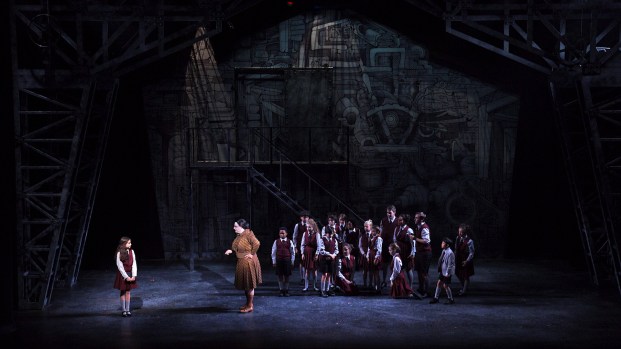
CATS cast photo + Anne + Susan #1[4]

By Perry Tannenbaum

Oceans are rising. California keeps burning. Women are still facing stalkers, abusers, detractors, and depressed wages. Innocent blacks are beaten and shot in the back by rogue cops – or point blank by vigilantes. Wouldn’t it be great to be led by a President who cares? While Obama nostalgia and Hillary regrets are keenest, all other past commanders in chief and presidential hopefuls – except maybe Bush 43 – seem to be more palatable alternatives than the racist boor who now sits so empty-headedly at his empty Oval Office desk.

Even Jimmy Carter? Why yes, says playwright Susan Lambert Hatem, whose Confidence (and The Speech) premieres at Duke Energy Theater this week. Growing up in Decatur, GA, a three-hour drive from the famed Plains presidential peanut farm, Hatem has been fascinated by the Carter presidency and his exceptional post-presidency since childhood. Her impulse to reappraise Carter began before the 2016 election.

Among Carter’s signature achievements were establishing the Departments of Education and Energy and successfully bringing Israeli prime minister Menachem Begin and Egyptian president Anwar Sadat together to the peace table for the Camp David Accords. Hatem has made a pilgrimage to attend Carter’s Sunday preaching at his plain Plains church and has extensively researched the record.

“He appointed more women justices and more minority justices than all previous administrations – put together,” she points out. “Carter paved the way to something. There is no Obama presidency without Carter’s presidency. His administration never dropped a bomb. Never started a war. Eight American soldiers were killed on his watch.”

When Confidence began taking shape in 2015, Hatem had good reason to expect that she would also be able to claim that Carter’s presidency paved the way to Hillary Clinton. Equipped with sound theatrical sense, Hatem knew that showing Carter establishing government agencies or appointing women and minorities wasn’t a dramatic pathway to resuscitating his stature.

Instead, she decided to focus on his pivotal “Crisis of Confidence” speech of 1979 addressing America’s energy crisis. She learned that Carter had cancelled the energy address he had originally scheduled for July Fourth and sequestered himself at Camp David for 10 days before emerging with what Hatem calls “The Speech.” Those 10 days were an attempt to change the course of our history.

“I discovered that the initial reaction to that speech was intensely positive,” Hatem recalls. “It was the best public reaction to a speech the White House had ever seen – there were phone calls and letters praising the speech. Later, the speech was used against him and became known as the ‘malaise’ speech – though he never said malaise.”

Before moving into his policy decisions and recommendations, Carter described an ingathering and reaching out.

“I invited to Camp David people from almost every segment of our society,” he told the nationwide TV audience, “business and labor, teachers and preachers, governors, mayors, and private citizens. And then I left Camp David to listen to other Americans, men and women like you. It has been an extraordinary ten days, and I want to share with you what I’ve heard.”

Hatem not only examines the domestic summit that Carter held at Camp David, she flips the script with her narrative structure. Young Jonathan Rollins approaches 60-year-old college professor Cynthia Cooper, a former Carter aide, and asks her to recall the leadup to the “Crisis of Confidence” speech. Cooper consents – on condition that Young Jonathan plays Young Cynthia in the retelling. Professor Cooper will play President Carter.

Why? Because Hatem is not just interested in how history is made. She’s concerned with who gets to make it. Set in 2019, when President Hillary would presumably declare her candidacy for a second term, Confidence (and The Speech) would be a look back at how we began to evolve toward this landmark of feminist progress.

And then came the shock of Election Night, November 8…

“After the 2016 election – I didn’t know what to do,” Hatem admits. “I had to put the play down for a bit. I couldn’t work on it. I didn’t know how the play would make any sense any more. Then January 2017 was the Woman’s March, and I was re-inspired. I knew I had to finish it. So many women were stepping up. So many LGBTQ activists. So many black women and men. So many voices were rising. I wrote a new ending – a cathartic ending to me. An ending that I think will excite some, and confuse others. It is purposefully somewhat ambiguous… and not.”

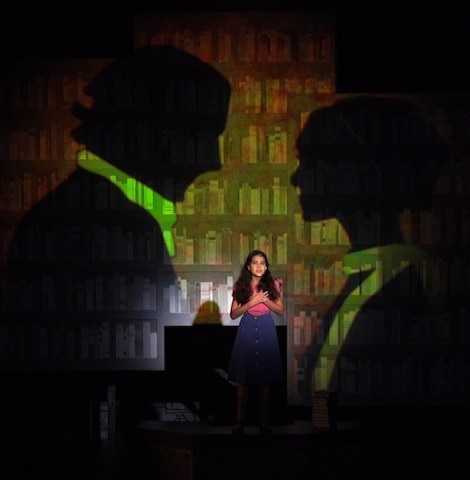
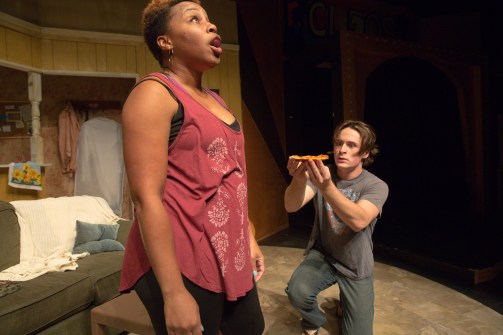
The road from re-inspiration to this week’s Charlotte premiere ran through Hatem’s sister, Anne Lambert, who already had two significant production projects in the works during 2017. Last summer, she was on the producing team at Children’s Theatre of Charlotte that presented a staged reading of Bend in the Road, a musical adaption of the beloved Anne of Green Gables. Then in late fall, Lambert’s own company, Charlotte’s Off-Broadway, presented a fully professional local premiere of Richard Greenberg’s Three Days of Rain.

Lambert had co-founded the all-female Chickspeare theatre troupe at a local brewery 20 years ago, so her sister’s gender-bending concept was right up her alley. Confidence was one of six plays that were read at Camp North End this past winter as part of the Charlotte’s Off-Broadway “Page to Stage 2018” series. Of the six works read script-in-hand from February through March, Hatem’s will mark the third to receive a full production.

This time around, Lambert is wearing two hats, producing and directing. Hatem especially values her sister’s experience with dark Shakespearean plays – where the Chickspeare gender-bending wasn’t done for cheap laughs or sexual effect.

“What I’m trying to do is explore how the cross-gendering can reveal another layer to the play’s themes,” says Hatem. “That’s where Anne and her direction have been so great.”

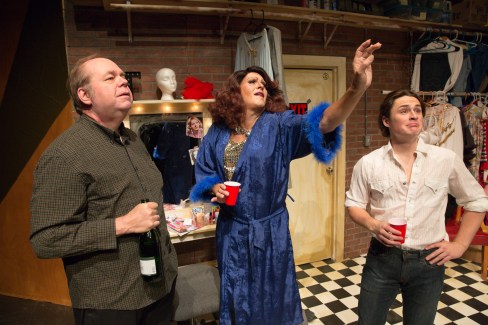
The Lambert Sisters tapped Josephine Hall for the challenging roles of Professor Cooper and President Carter – in an unusual three-way FaceTime audition with the playwright in LA, the producer in Charlotte, and their star in Greensboro. We haven’t seen Josephine Hall in a local production since she prowled Stonewall Street in Cougar: The Musical, the last of her three Actor’s Theatre appearances during the 2014-15 season. Though she teaches acting and voice at Greensboro College, Hall hasn’t totally disappeared from view. Some of us saw her at Belk Theater when the first national tour of The Curious Incident of the Dog in the Night-Time came to town in February 2017.

Hatem knew some people who had worked with Hall on that tour, and Lambert had been impressed with her performance in Vanya and Sonya and Masha and Spike at Actor’s Theatre. You could say they were pre-sold before they hooked up via their iPhones.

After starring as the discontented daughter of a former Reagan ambassador in the 2014 Actor’s Theatre production of Other Desert Cities, you also might say that Hall was serendipitously unsold on President Ronald Reagan. The Hollywood actor successfully pinned the malaise label on Carter’s watershed speech and wrested the presidency from him in 1980.

“I believe The Speech is a missed opportunity,” Hall says after living with it through months of study and rehearsals. “Most people – not just Americans – don’t want to think too deeply or like to change their daily habits. Carter was asking for both. It’s really no wonder that most people chose the ‘all is well, just spend more’ approach offered by Reaganomics. It is very sad, however. I try to imagine a world where America had paid attention and led the world down a more sustainable path.”

Pride Rock Remains Strong in “Rafiki Tour” of “The Lion King”

Review:  THE LION KING

By Perry Tannenbaum

Among the multitude of musicals they have brought to Broadway, Disney proclaims The Lion King as the world’s #1 musical, not just theirs. Very likely, more people around the globe have seen the show than any other Broadway musical in history. Yet as the megahit reaches its 21st Broadway birthday, the key question we ask each other about it is evolving. As generations grow up and older, we’re less inclined to ask each other if we’ve seen The Lion King. Now in its fourth Charlotte run at Belk Theater, we’re apt to ask each other how many times we’ve seen the tour or, more nostalgically, “Do you remember your first time?”

With all the massing of puppetry for its curtain-raising “Circle of Life,” Lion King wasn’t built to start on time. It’s a bit like a Carowinds ride that doesn’t begin until seatbelts are fastened or doors are locked. Of all beginnings, you don’t want to miss this beginning.

A significant part of why I keep coming back is to be wowed by that opening, of course, but that wow factor diminishes a tad during the five-year intervals between tours. Watching newbies respond to the legendary puppet parade is what keeps the experience fresh for me. My wife Sue has ceded her usual seat for the last two iterations, giving me the opportunity to be up-close when a granddaughter and a great-grandmother took it all in for the first time.

In aisle seats.

Come to think of it, I don’t remember anybody arriving late on press night or taking a seat after the great procession. When a show becomes a family heirloom, as LION KING undoubtedly has, somebody in each group must know the score – and the necessity of arriving before lockdown.

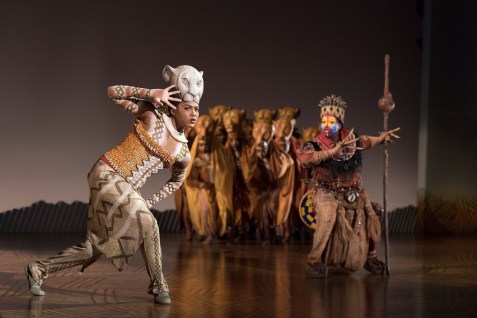
The magic of the puppets, particularly the tall giraffes and the gargantuan elephant, has often been cited as triggering the unique theatricality of director/designer Julie Taymor’s inspired adaptation. But since this company has been designated the “Rafiki Tour,” it’s fitting to direct our attention toward the shaman who greets us and summons the animals to Pride Rock. Not only has Rafiki been favored with a gender switch from the 1994 animated Disney original, she has also discreetly shed her baboon origins. From the outset, we get the message that this unparalleled ceremony is humans paying homage to the animal kingdom – and life itself – in the most respectful and beautiful ways we can devise.

On top of that, there’s percussion, singing, and later even birds in the upper levels of the hall, a cathedral effect. The spectacle envelopes us and uplifts us. Of course you’d want to come back!

Elements of the story echo biblical and Shakespearean motifs that resonate deep within us. What we also treasure about Lion King is how it manages to celebrate both liberty and responsibility as Simba, the future Lion King, matures – always maintaining a firm grasp on which of those values is most important. Delaying justice until Simba gets his priorities sorted out makes it all the more satisfying when he ascends to his rightful throne. Yet the long arc of his drama is punctuated with low, low comedy along the way.

Mukulisiwe Goba as Rafiki and Mark Campbell as Simba’s usurping uncle, King Scar, have traveled long and far on multiple tours of this show, very much a part of its fabric. Crying out her “Nants’ Ingonyama” chant to the kingdom, Goba seems to be as much the soul of Taymor’s Africa as the ginormous sun that rises over the savannah or the iconic baobab tree than spans it. Campbell’s tigerish costume looks weathered from its epic journeying, equally emblematic of Scar’s wickedness and old age. He also wields a cane, adding a dimension of Richard III decrepitude to his seniority and immorality. The 2013 Scar labored with that same limitation – so I can’t continue to overlook the clumsiness of the climactic fight choreography. Clean it up, Diz, especially the last reversal.

Nick Cordileone as the chattery meerkat Timon and Ben Lipitz as the stinky warthog Pumbaa repeat their 2013 stints at Belk Theater, so the comedy in the carefree tropics has never been better. Back at Pride Rock and at the Elephant Graveyard, Greg Jackson is the model of punctilious British servility – and timidity – as Zazu, a high-pitched hornbill with a hilarious puppet.

Nia Holloway returns as Nala, Simba’s destined queen, as lithe and graceful in her movements as ever. Chemistry between her and the new adult Simba, Jared Dixon, isn’t as torrid as it was five years ago. Holloway is more regal and commanding than before, while Dixon is more naïve, exuberant, and happy-go-lucky than his predecessor. It’s as if the mystic grace of Holloway’s cat movements rubs off on Dixon, imparting the gravitas that he has lacked. Goba also intercedes magically in her most dramatic moment as Rafiki.

Only in his afterlife does King Mufasa succeed with his wayward son, and Gerald Ramsey has exactly the right combination of regal strength, fatherly forbearance, and tragic stoicism. Young Simba, who lingers onstage throughout the first act, is the sort of role that could launch a future Michael Jackson. Two youngsters on the cusp of adolescence rotate in the role on tour, keeping with the Broadway practice. Charlotte native Ramon Reed certainly didn’t disappoint on press night, with ebullience to burn. Understandable, since he’s also listed in the current Broadway cast at ibdb.com.

Straddling Broadway, Black Panther and Black Diamond

Preview: Eclipsed

By Perry Tannenbaum

Few writers who have brought a script to the Broadway stage have also had a major acting role in a major Hollywood film. Mae West, Orson Welles, Sam Shepard, Mel Brooks, Maya Angelou, and Woody Allen have legit claims. Perhaps the stealthiest addition to this very short list happened this summer when Danai Gurira emerged in the Marvel universe as Okoye, the spear-wielding generalissimo of Wakanda in The Black Panther. You’ll look long and far for a review that reminds us that Gurira’s Eclipsed not only came to Broadway in 2016, it scooped up six Tony Award nominations, including one for Best Play.

Of course, the record was set straight when Panther became a megahit and Gurira, already a star of The Walking Dead series on AMC, rose even higher in the firmament. Feature stories about Gurira consistently cited Eclipsed among her accomplishments. Additional light reflected back on Eclipsed from Lupita Nyong’o, the glam spy of Panther. Nyong’o was nominated for a Tony as the leading lady in Gurira’s play after her Oscar-winning performance in 12 Years a Slave.

Gurira’s rare achievement is definitely drawing the spotlight now that Eclipsed is making its rounds among regional theatres. Bringing Eclipsed to Spirit Square this week, Brand New Sheriff Productions certainly isn’t ignoring the playwright’s Walking Dead and Panther connections as it spreads the word.

You won’t find any zombies at Duke Energy Theater, but connections between Black Panther and Eclipsed are substantial. Both dramas are set in Africa. While Wakanda is a fantastical high-tech kingdom in Marvel geography, Gurira’s Liberia is quite real – but no less dramatic. After spending a good chunk of her childhood in Zimbabwe, Gujira returned to the continent on a grant from the prestigious Theatre Communications Group in 2007 and interviewed more than 30 women who had been victimized by Liberia’s civil war.

Among these women – some of whom were serially raped, others whose daughters had been kidnapped and turned into sex slaves – Gujira took four of their names for her characters. Three are wives of the unseen Commanding Officer, a brutal rebel leader against president Charles Taylor, and the other is a peace activist seeking to bring the war to an end.

The fifth woman, at the heart of this drama, is unnamed. “The Girl” is CO’s most recent captive, and two of his wives, Helena and Bessie, are hoping to shield her from him.

Yes, Eclipsed was the first play to hit Broadway with an all-black female cast. Just don’t get the idea that Gujira’s script is all about victimhood and peacemaking. CO’s other wife, Maima, is a freedom fighter with the Liberian rebels, and she returns from the battlefield with some serious weaponry strapped to her shoulder.

Maima is not only an action figure vaguely akin to Okoye in Black Panther, she’s modeled after Col. Black Diamond, a female Liberian freedom fighter. Guijira saw a picture of the warrior in a New York Times feature in 2003, the year that the Second Liberian Civil War ended. Black Diamond was the inspiration for Gujira’s mission to Liberia – and for Eclipsed. The way Maima sees it, men aren’t going to rape you if you’re toting an AK-47.

That’s where actress Tracie Frank comes in. A self-confessed blerd, she knew about Marvel and Black Panther long before she knew about Eclipsed, and she knew Gujira as Okoye before she realized that the film’s action hero was also playwright. She has done major roles around town in A Trip to Bountiful and the title role of Caroline, or Change. But nothing like Wife #2, Maima.

“Truthfully, I didn’t even see myself in that role when it did come along,” Frank admits. “As I read the script to prep for the audition, I decided to read for the two ‘motherly’ roles. I remember absently thinking, ‘wow, whoever plays Maima will have to be tough!’”

Director Dee Abdullah thought differently, handing Maima’s lines to Frank after her first reading.

“I was surprised,” Frank recalls, “but I went out and read her again – not as an impartial observer, but as a version of myself… and I knew it was right. I guess I feel like Wife #2 chose me.”

Well, so did Abdullah after a hiatus from directing of five full years. A co-founder of Carolina Actors Studio Theatre with Ed Gilweit, Abdullah was no longer at the core of CAST when the company folded in 2014, but she was devastated by the loss. Corlis Hayes shoved a life raft towards her when she directed August Wilson’s Jitney for BNS last summer, asking Abdullah to design the costumes.

That gig positioned her for Eclipsed. Another BNS blerd, Abdullah has been on board as a Black Panther fan before the film but only slightly acquainted with Eclipsed because of the Nyong’o connection. After researching the story, she knew this was the project to get her back into directing.

“As you might remember,” Abdullah says, “I am not one to shy away from difficult subject matter. This play gave me all the complications a human spirit could endure and still survive. It is about women and their courage to survive under the worst circumstances that life could hand them. It is also based on real stories of the Liberian civil wars, which made it more compelling for me.”

Away from the scene for five years, Abdullah had grown out of touch with the local talent that would show up for auditions. Three of her five choices – Toni Oliver as Helena, Racquel Ena Mae Nadhiri as Bessie, and Gbale Allen as The Girl – are new to the Charlotte scene. Aside from Frank, Ruby Edwards as Rita, the peace negotiator, will be the only familiar face.

“All of the women had a special quality about them that make me want to look at them on stage,” Abdullah recalls. “Tracie has a power that came across much more grounded than the others. Her character makes a choice that takes her on a much more difficult journey than the other women – I needed someone who could convey that energy while staying grounded in truth. The Girl is the only character that goes through a transformation during the course of the play. Gbale gave the innocence as well as the confident toughness that this character needed to pull this role.”

Getting the roles was just the beginning of this ensemble’s journey. Casting by Abdullah was done four months in advance, with rehearsals beginning in late April, so the performers could research the culture, learn the civil war history, bond with one another and learn a Liberian accent. Oh yeah, there’s also some footage online of Frank and Allen wielding their firearms.

“Dee has been quite unique,” Frank affirms, “and I can’t imagine anyone else directing this play. She’s intuitive and observant – she sees what’s under the surface – and that’s vital in a story like this one.”

Abdullah is pleased with the dedication her cast has put into their work, and Frank believes the results will show.

“There’s a natural rhythm to our interactions,” she explains, “one that comes from knowing each other, caring for each other, being annoyed by one another! We’ve formed a sisterhood that won’t end when the [show] closes on September 1st. We’ve learned and experienced so much over this spring and summer. It has been unforgettable.”

“Sex With Strangers” Is a Steamy, Brainy Brew

Review:  Sex With Strangers

By Perry Tannenbaum

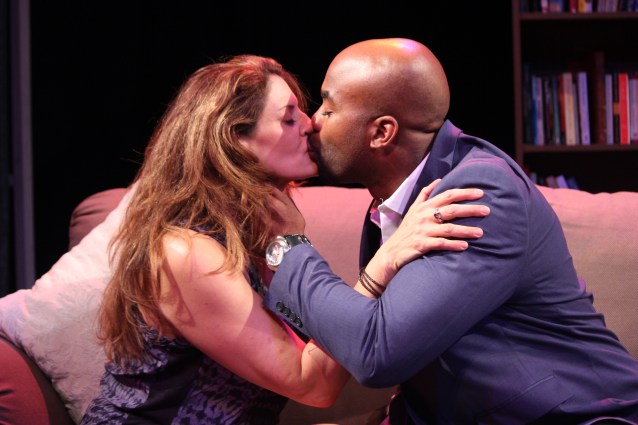
I can’t tell you exactly how many scenes in Sex With Strangers end with heavy petting and preludes to lovemaking, but the number seemed to me sufficient to ensure that playwright Laura Eason wasn’t misleading or overpromising in her title. In case you thought otherwise when you saw this Warehouse Theatre production at Spirit Square, Eason had a hedge.

The title turns out to be the brainchild of one of her characters, author-entrepreneur Ethan Kane, who has parleyed a series of blog posts into a bestselling book and an upcoming movie version that he’s hurrying to complete a screenplay for. Sealing the slick commerciality of his burgeoning franchise, Kane has written them all under the penname of Ethan Strange.

Kane’s serial posts stem from an idea that likely struck him at a bar: to have sex with 50 strange women over the course of a year – and write up each of his conquests in vivid, imaginative detail. Naturally, all of these escapades began, approximately weekly, at a bar. This wheeling-and-dealing serial seducer shows up in a Northern Michigan cabin, ostensibly seeking the peace and quiet needed to finish his screenplay but actually stalking Olivia Lago, who is already occupying this Airbnb retreat in the middle of a fierce winter blizzard.

While the blizzard makes it more difficult for Olivia to turn Ethan away, plowing ahead through it is the first tip-off we get about Ethan’s powerful persistence. Through a mutual friend, he has heard about Olivia’s work as an author and sincerely admires the single book she has published – enough to think that posting her unpublished work on his new website could be a pathway to redeeming himself from his smutty, unsavory past.

Olivia is not nearly as complex. Or adventurous. After her first novel received mixed reviews, she became pathologically discouraged, retreating into teaching and thinking of her more recent writing as a hobby. She balks at the idea of Ethan even seeing her new work, let alone exposing it to the scrutiny of the worldwide web. Ah, but you don’t serially seduce 50 women without possessing charms and attractions, right? And Ethan can also offer literary and Hollywood connections.

Louise Robertson last directed for the Warehouse in 2010, when their production of The Road to Mecca capped the company’s first season at their Cornelius storefront and put them firmly on the Charlotte theatre map. She casts and directs no less adroitly here, calling forth layered performances from Cynthia Farbman Harris and Dominic Weaver. There are numerous types of contrasts and conflicts to mull over in Eason’s script, but perhaps the most precisely nuanced clash is the generation gap. Olivia is older than Ethan, not at all savvy about eBooks and uploading files to Amazon, yet she isn’t so much older that a sexual spark between them cannot quickly ignite.

There are other frictions roiling in their relationship. Ethan’s excess of sexual experience – some of it made up for his posts, some of it callous – and his penchant for publicizing his intimacies make Olivia suspicious. On the other hand, Ethan suspects that Olivia has a condescending attitude toward his writing talents, yielding to him physically only because of what he is giving her professionally. There’s enough manipulation and betrayal on both sides to keep us guessing – and ambivalent about rooting for them as a couple.

Harris isn’t exactly delicate or fragile, so her vulnerability as Olivia isn’t instantly obvious when she lets Ethan enter out of the cold. There is also considerable depth to her artistic discouragement, mixed with a lingering sense of embittering self-worth, that makes her more accessible to Ethan’s physical advances than to his professional outreach. It’s quite a study as Harris more gradually allows Weaver to awaken Olivia’s self-esteem and daring.

Weaver shows us an Ethan who can be viewed as the polar opposite of Olivia: cocky, confident, and articulate on the surface; bitter, brooding, and self-doubting at his core. The best of Weaver emerges when Ethan discovers just how high he has enabled Olivia to fly. But then, I’m a guy. For the women at Duke Energy Theatre, the best of Weaver may well have come across when he ripped off his shirt. Happened more than once.

For the second week of their run, Warehouse returns to their storefront home in Cornelius, where Sex With Strangers might nestle a little more comfortably. At their final Spirit Square performance last Saturday, they ran out of playbills, evidently unprepared for the heavier turnout at the larger venue. Dealing with the larger stage also seemed slightly problematical, with scene changes eating up more clock than I’m accustomed to. Ben Pierce’s lighting design traveled well, but I was less satisfied with his sets. A glance at the playbill was necessary to inform me that, during intermission, we had moved from that Michigan cabin to Olivia’s Chicago apartment. Although the painting we saw in Act 1 had changed, it was hanging in the exact same spot.

Overall, I found it a pleasant surprise to encounter as much brains as body heat in Sex With Strangers. The shoptalk won’t be above the heads of theatergoers decently schooled in lit and mildly attuned to contemporary authors. Those who don’t know that FSG stands for Farrar, Straus and Giroux will at least get that Olivia and Ethan are talking about a prestigious publisher that prints honest-to-goodness hardbound books.

It’s refreshing to see protagonists onstage who still care about such things – to see writers shown as emotional, impulsive, and even hormone-driven. We often are.

“Corteo” Wows, Charms, and Sweetly Dazzles in Arena Remount

Review: Corteo

Corteo oppening act_Lucas Saporiti Costumes Dominique Lemieux 2015 Cirque du Soleil Photo 1

By Perry Tannenbaum

In the early days, when Quidam came to Lowe’s Motor Speedway in 2002, I was fairly besotted by everything Cirque du Soleil produced. That summer, my wife Sue and I took in two more Cirque spectaculars in Las Vegas, including my all-time favorite, the water-logged O at the Bellagio, still running 16 years later. We saw Varekai twice in 2005 under Cirque’s signature Grand Chapiteau big-top, up in the Jersey Meadowlands and at another Lowe’s Speedway engagement, before the Montreal-based company proved they could go wrong.

Going for a new kind of audience in a new kind of venue, Cirque brought Delirium to the Bobcats Arena in 2006 – a bombardment of loud music and projection screens targeted at rock concert enthusiasts. That abortion soured me on Cirque for a long time, keeping me away until they explored a new frontier in 2016 when they brought Paramour to Broadway, a Cirque du musical set in Hollywood. Pretty godawful.

Enter Corteo, now at the Spectrum Center. Or is it more accurate to say re-enter Corteo? For this show began life in the vintage year of 2005 under the Grand Chapiteau before its original director of creation, Line Tremblay, teamed with new creator and director Daniele Finzi Pasca to reincarnate Corteo as an arena spectacle in 2016. Pasca’s creds included the closing ceremonies at Winter Olympics in Torino and Sochi before he signed on with Cirque, so his addition was hardly a leap of faith.

The fusion is a smashing success, and I can declare Corteo fits as handsomely into the home of the Bobcats as any previous Cirque effort has fit into the big-top or a big Vegas hotel. Pretty impressive for an extravaganza that sets up, stages seven shows in five days, and eases on down the road. The acrobats, jugglers, and assorted other performers may fluff a stunt or two, but the show moves along with well-oiled perfection technically. Sound levels, lighting cues, projections, curtains, and various electronics never misfired on opening night.

Instead of bisecting the arena with a runway, as we saw in Delirium, Pasca and Tremblay plant a circular stage in the middle of the arena that flares out to the wings for entrances and exits. Up above, there are three railways handling more traffic: angels floating in the air, acrobats making dramatic exits, or even a clown riding a bicycle in his heavenly afterlife. Down below, there are concentric circles in the stage that can be triggered to revolve; people and objects that are standing still can glide across the stage or completely circle it. In the middle, there’s a circular trapdoor for sudden disappearances – or in one comical episode, the emergence of an elusive human golfball.

Plot is unabashedly zany. Along with quaint townsfolk and fluttering archangels, not to mention flowers and flickering candles, we gather around the bedside of an ailing Mauro the Dreamer Clown, who imagines – with absolutely no modesty at all – his own grand funeral cortege, his ascension to the heavenly spheres and, since he is a clown, a whole slew of circus acts and comedy shticks that punctuate the proceedings. The mock solemnity of it all had me thinking of the opening of Puccini’s Gianni Schicchi, to be honest. Beds and a trio of overhanging chandeliers quickly turn into acrobatic apparatuses as the gauzy curtains rise from the opening tableau. Amazingly, the more impressive exploits are performed on the beds and their fairly elevated side railings.

Of course, there are numerous other apparatuses waiting in the wings or up in the loading docks of those skyrails. Newcomers to Cirque will no doubt be enchanted by the multiple manifestations of the company’s signature aerial silks. The graceful climbing, the ritual wraps around the waist and legs, the precipitous fall from a great height, halted just before the acrobat can hit the stage and break her head, delights the crowd without fail – the younger the spectator, the better.

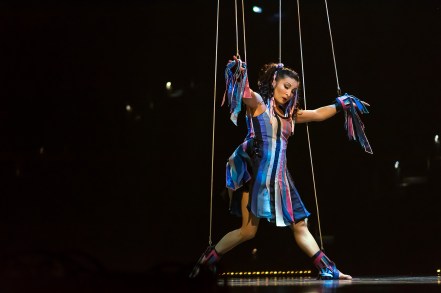
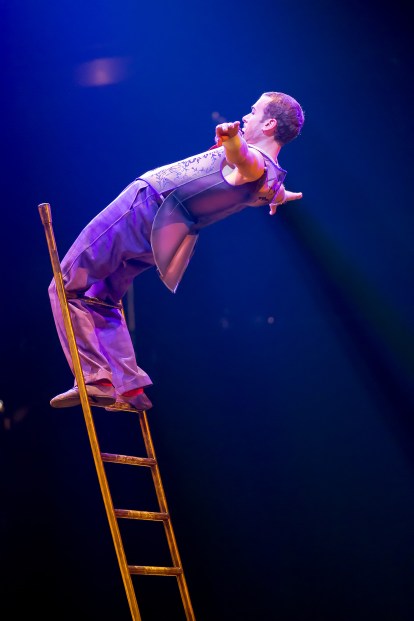
Simplicity and novelty are more likely to wow me now that silks and cirque have become synonymous. So the simpler solo on the suspended pole, upon which the supple acrobat levitated herself from seemingly impossible positions, including a sitting lotus (grasping the pole with only her crossed legs), captured my fancy more freshly. The flopsy artist marionette was another charmer, and I liked the novel couple plying the aerial ring. She occasionally held him up and kept him from falling. Or how about the man who entered with a ladder and nowhere to lean it? He climbed up anyway.

There were surreal and fanciful moments, of course, disembodied shoes clomping across the stage, a recalcitrant robot or two, and a panto Romeo and Juliet with midget lovers. Undoubtedly the oddest and most unexpected segment was when The Clowness, one of those adorable midget clowns, floated in with a cluster of ginormous helium balloons. Mauro, presiding over this apparition, flung her out into the audience, encouraging us to bop her back and forth for a while before calling on us to return her.

It wasn’t as easy as it looked, I can tell you that. Grabbing hold of her shoes by the toes and launching them back toward the stage, I only succeeded in bending The Clowness’s legs as her momentum carried over my head and deeper into the crowd. During the split second that it was in my hands, the whole rig felt heavier than it looked. Much heavier. I wasn’t surprised when Mauro told the other side of the arena, when it was finally their turn, that it had taken 20 minutes to get The Clowness back onstage the previous night.

Suspended Pole_Lucas Saporiti Costumes Dominique Lemieux 2015 Cirque du Soleil Photo 5

Though the inevitable accordion hasn’t been banished from their circus vibe, music by Jean-François Cote, Philippe LeDuc, and Maria Bonzanigo widens the palette compared with the soundtracks I had collected from Quidam and Varekai. There are outbreaks of Dixieland ensembles now with a wailing soprano sax, a quiet Spanish guitar accompanies the impassioned vocal behind the suspended pole solo, and the ringmaster, Mr. Loyal, is as likely to sing a snippet from Rigoletto as he is to display his whistling talents – while percussionists on crystal glass and Tibetan bowls circle around him. Kudos to the composer or composers who joined the team for this arena remount.

Through misdirection and precise timing, Pasca and lighting designer Martin Labrecque utilize the darkness of the arena to create sudden dramatic entrances, where performers suddenly materialize in plain sight. Whether the Little Angel is teaching Mauro how to fly or the dreaming clown is bicycling through the clouds, Pasca and Labrecque also nail the heavenly episodes.

Many of the plot points and character sketches that I found in Cirque du Soleil’s press kit are wishful thinking rather than faits accomplis in terms of playing to a real-world audience. Doesn’t matter. In its own sweet way, Corteo is epic.

“Lizzie” Whacks the Bordens in a Creepy, Hard-Rock Witches’ Brew

Review:  Lizzie

By Perry Tannenbaum

It’s amazing what murdering your mom and dad can do for your outlook, for your self-esteem, and especially for your fashion sense. Back in a radically revisionist 1892, Lizzie Borden took an axe and, in a vigorous aerobic workout totaling 81 whacks, achieved all of these wholesome objectives. Or so Lizzie, a rock musical playing at Queens University in a devoutly raucous Actor’s Theatre of Charlotte production, insists on telling us, piling onto the lurid Lizzie urban legend and her bloody skip-rope rhyme. Steven Cheslik-DeMeyer and Tim Maner began work on this musical a couple of years before the centennial of the infamous axe murders, and between 1990 and 2013, the enterprise grew from four songs to a smallish full-sized rock melodrama, taking in Alan Stevens Hewitt along the way to add in new music, lyrics, and orchestrations.

Victims Andrew and Abby Borden do not appear in this rock retelling. Concepts of calibrated punishment, let alone penance, are righteously bludgeoned here. The stage belongs to Lizzie, her elder sister Emma, the Bordens’ housemaid Bridget Sullivan, and Lizzie’s neighbor friend, Alice Russell. Emma also emerges as homicidally inclined, her animus mostly directed at her stepmom because Abby may be scheming to rob the sibs of their inheritance. That threat layers onto Lizzie’s resentment against her dad: there’s no doubt anymore that he molested Lizzie repeatedly. Similarly, suspicions that Alice was deeply in love with Lizzie are confirmed. Perhaps the most startling character makeover here is Bridget, who takes on Miss Danvers-like malevolence, goading Lizzie to the breaking point and slyly pocketing payoffs along the way.

If all this sounds like the lyricist/composers are leaning towards feminism, anarchy, and decadence, then you should also know that director Joanna Gerdy hasn’t pushed back. The writers haven’t mandated that musicians, directors, and designers all be women. That’s Gerdy’s idea, apparanetly. With the possible exception of set construction personnel, she has kept this production cordoned off as an exclusively Women-at-Work zone. Yet it would be a mistake to suggest that the earmarks of testosterone have been banished. Emily Hunter’s choreography, unmistakably suggesting the Weird Sisters of Macbeth when the time comes to burn Lizzie’s bloodstained dress, at other times evokes the strut of heavy metal rockers. Carrie Cranford’s costume designs, prim and Victorian for the principals throughout Act 1, takes on a definite S&M edge after intermission. From the outset, the musicians’ costumes, hairdos, and makeup telegraphed where we were heading. Nor was there anything lacy or dainty about Kaylin Gess’s tabloid set design and how it synergized with Hallie Gray’s creepy, diabolical lighting.

Gerdy and musical director Jessica Borgnis have skillfully interwoven their respective primary goals, creeping us out and rocking our faces off. The thrust of the creepshow began before Actor’s Theatre executive director Chip Decker welcomed us to the company’s 30th season. Added on to the specified core group of players, Gerdy had Emma Lippiner darting around the mysteriously lit Hadley Theater as Young Lizzie, disappearing into the wings and then returning with a skip-rope. We also watched her ascend to the upper level of the Borden home where, flanked by Mom and Dad’s rooms, she ominously swung on a swing. Lippiner had not been instructed to portray a happy child, that was certain. Turn of the Screw or Stephen King were more likely what Gerdy was going for.

There’s certainly an affinity between Lizzie and the repressed teens of Spring Awakening in terms of the period and the style of the Actor’s Theatre production, which stakes its claim to freewheeling anachronisms with Young Lizzie’s plastic skiprope and continues with microphone stands and hand mikes for the ladies. What separates Lizzie from achieving similar greatness is the writers’ failure, despite all the juicy historical sources and suppositions available to them, to fully embrace the concept of a script – and their resolute insistence on developing only their title character.

Credit Gerdy and her cast with finding ways to close the gap. Even with her hair up and confined by a full-length dress, Katy Shepherd remained volatile and spellbinding throughout Act 1, a seething cauldron of sexual and homicidal impulses. The pathologically buttoned-down Kristin Jann-Fischer seemed even more likely to snap in the early going as Emma, but Shepherd suddenly leapfrogged her when Emma left Lizzie alone with her parents. Previous productions of Lizzie have established splatter zones in the theaters where they have played – and a patch of comic relief as melons or pumpkins were hacked. Gerdy doesn’t go for that kind of gore, but when we saw Shepherd’s face smeared and spattered red, a radical change had come over her. It was impossible to say whether that change had led to the violence or whether taking in the spectacle of what she had done had triggered that change. Shepherd seemed equally stunned and liberated by the crime.

By the time we returned from the break, Lizzie had let down her hair and totally changed her look, lounging lasciviously on the only stick of furniture that Gerdy allowed on the floor of the set. With the Weird Sisters episode, we realized that bacchanalian delight and wicked diablerie could reach maximum depth. The shaken demeanor that Shepherd switched on toward the end of Act 1 morphed into evil leers and insane eyerolls in Act 2. While some might find Shepherd’s vocal exploits on par with her acting, I’d say they come fairly close, which is high praise.

My reference to Miss Danvers will be clear enough to anybody who has read Daphne du Maurier’s Rebecca or seen the Oscar-winning Hitchcock film. Yes, there was a Judith Anderson dimension to Shea’s performance as Bridget Sullivan as she prodded Lizzie toward catastrophe, and Shea seemed to haunt the Borden house far more than take care of it. She may have the best voice onstage, even if it doesn’t reach Shepherd’s stratospheric heights. Though she doesn’t evolve, she occasionally dominates. My suspicion about Alice Russell is that the writers didn’t consider changing her with the times. CiCi Kromah’s sweet, sweet performance might have seemed more satisfying back in 1990 – or certainly 1892 – when simply being an open lesbian could stamp you as a kind of small town outlaw. Today, Alice’s sincere love for Lizzie just struck me as a sentimental strain in the story, necessary as part of the sequence that triggered Lizzie’s homicidal rage but discarded afterwards during the crime investigation and Lizzie’s court trial.

Piloting from an electric keyboard, Borgnis drew searing vocals from the true lady outlaws onstage and the requisite smashing and slaying from her tight instrumental quintet, which unexpectedly includes a cello for those unexpected mellow moments. Best of the raucous vocal quartets was “Somebody Will Do Something” bringing us to intermission, but there were three or four of nearly equal power after we returned, including “Burn the Old Thing Up” and “Thirteen Days in Taunton.” Yes, it was noisy when everybody onstage was wailing and rocking, but Actor’s Theatre has always been savvy in measuring the difference between loud and deafening. Once again, they have it dialed in just right.

40 Whacks and Some Heavy-Metal Slaying

Preview: Lizzie

By Perry Tannenbaum


When we first learn about Lizzie Borden, it’s through an antique schoolyard rhyme, and there’s no doubt. Miss Borden was an axe murderer – and not a dainty one. Forty whacks for Mom, a pause for reflection… then 41 for Dad. But in the real world back in 1892, Borden was acquitted of the gory double murders that had happened at her home in Fall River, Massachusetts. And the actual number of whacks, for Lizzie’s dad and stepmother combined, was less than 30.

Notwithstanding the uncertainty of her guilt – and the poetic license taken in her song – Lizzie remains legendary and the prime suspect. But the action hero of a hard rock musical? Writer/director Tim Maner and songwriter Steven Cheslik-DeMeyer sorta had that idea in 1990. Putting together four songs and staging their experimental rock theatre production in SoHo, the duo originally called their confection Lizzie Borden: An American Musical.

Over the next 13 years, the work was reworked, fitfully revived, and workshopped. New songs were tacked on, the skeletal storyline was fleshed out, and Alan Stevens Hewitt joined the writing team. As the work grew to a full-fledged two-act musical – or at least a rock concert musical – the title continued to become leaner. Long story short, Lizzie is now rockin’ on the Queens U campus, transitioning from previews to its official Actor’s Theatre of Charlotte opening this week.

From its Borden beginnings, Lizzie has always featured four women in the singing roles. Aside from the legendary slayer, there’s Lizzie’s elder sister Emma, next door neighbor Alice Russell, and housemaid Bridget Sullivan. Actor’s Theatre is taking it way further – presenting an all-woman edition. The sextet of instrumental slayers joining the cast onstage at Hadley Theater will all be women. Ditto the design team, the choreographer, the music director, the stage manager, and the stage director.

Cue Joanna Gerdy. Despite her lofty reputation as an actress, co-founder of Chickspeare, and eminent teaching doyenne, Gerdy has strayed into crass and bloody musicals before, directing Little Shop of Horrors and Bonnie and Clyde. You might think that an actress lauded for her dramatic performances in The Miracle Worker, Macbeth and Our Town would be more powerfully drawn to Joan Baez than Joan Jett.

You’d be right. But the slashing score of Lizzie still grabs Gerdy.

“I love the music in this show,” she gushes. “And what’s not to love? Think Heart, Joan Jett, The Runaways, Stevie Nicks…you get the idea! Lizzie runs the gamut from catchy melodic storytelling, to outrageous punk rock anthems, to evocative ballads. There are head-banging moments juxtaposed with gut-wrenching stillness. There are lyrics straight out of Macbeth, and in fact, a Weird Sister vibe throughout.”

The skip-rope song was all that had ever grabbed Gerdy about Borden when Actor’s Theatre artistic director Chip Decker asked her to take the reins. She was happy to find that the familiar rhyme starts off the evening, setting the creepy tone. But it still wouldn’t be worth the effort for Gerdy if things didn’t get serious before they got gory.

Lizzie unlocks the doors in the House of Borden, shows us what may have been going on behind them, and we can’t help but feel for this trapped, desperate, powerless girl,” Gerdy explains. “Women were living under a harsh Victorian moral code, and Lizzie Borden was likely trapped inside a house hiding even more heinous goings-on. For me, this play gives powerful voice to women in a time when they were often voiceless and powerless.”

So the biggest mystery that Lizzie will explore, with ever-increasing decibels, isn’t the question of if this New Englander committed these horrific crimes but why. What could have brought so much stress and pressure on poor Lizzie that there was only this path forward? Obviously, it will be an accumulation of actions and events.

“From the moment the audience walks in,” says Gerdy, “they should feel totally creeped out, unsettled, off-balance…that feeling that something bad is already happening, and it’s going to get worse. And when it does, it will rock your face off! As the story intensifies and the Patriarchy is smashed, the women are empowered to literally shed the trappings of their Victorian entrapment…and they become rock stars!”

Shedding a walking cane to play the role, Katy Shepherd can closely identify with Lizzie’s feelings of powerlessness. After splashing down sensationally in Charlotte, romping around ImaginOn in the title role of Lilly’s Purple Plastic Purse for Children’s Theatre, following that up with more grownup triumphs in A Woman of No Importance and Rock of Ages (her Actor’s Theatre debut), Shepherd’s sensational 2015 was followed by a nightmarish 2016. Stricken by celiac disease coupled with severe anemia, Shepherd underwent surgery five times, the last on December 29. The surgery before that had left her bedridden for a month – not even allowed to sit. Now that’s trapped.

“Every day I can walk, let alone perform, is such a gift!” Shepherd declares. “American Idiot [with Actor’s Theatre last season] was my first show back with a healthy body, and our wonderful choreographer Tod Kubo even remarked on how my dancing had even improved since our last show together. I feel so present and grateful being healthy, and any role that I play now will have a touch of that.”

Gerdy hadn’t met Shepherd before auditions and had no knowledge of her backstory. Knowing where Katy had come from to get there had nothing to do with why Gerdy was impressed. Seeing her in the moment was enough.

“Katy’s vocal power blew me away!” Gerdy remembers. “At the auditions, I found myself spending a lot of time watching what people were doing when they weren’t singing or performing. And that’s what tipped the scales for me: She was ALWAYS compelling, even, or perhaps especially, in the moments when she was listening and just being. She made me care about Lizzie and want to watch her, listen to her, and root for her. And those eyes! She can shift from vulnerable to vixen in the blink of an eye – literally.”

The spark for Shepherd comes from how different this supposed murderess is from her, the range of emotions she is called upon to project – and some pretty insane vocals.

“Every song is one to brace yourself for,” Shepherd warns. “This music delivers in a way I have never experienced before. From abuse, to murder, to seduction, to betrayal – it’s all there. And it all ROCKS.”

Nor is Shepherd through battering down obstacles that lie in her path. Taking on Lizzie, she had only three off days in July, and before rehearsing seven days a week until 10 or 11pm at night, she’s holding down a full-time day job teaching at Children’s Theatre’s summer camp. Gerdy has been keeping track, imagining the extra time Shepherd devotes to learning lines, absorbing the music, and refining her portrait of a legend.

“And she has done all of this during her first pregnancy!” Gerdy marvels. “She’s a force; I’m in awe of her, honestly, and am incredibly grateful to have had this opportunity to work with and get to know her.”

So we finally arrive at the question no journalist can shirk when confronting an esteemed actor who has penetrated into the deepest recesses of Lizzie Borden’s soul and lived there for over a month. To put it rather coarsely: Was Lizzie a lezzie?!?

“Considering that there are only women in this show,” Shepherd shoots back, “and you’ve always got to have a love story, I’ll let you do the math!”

“Book of Mormon” Remains Spectacularly Hilarious

Review: The Book of Mormon

By Perry Tannenbaum

It’s been quite a run for Mormons over the past 25+ years, beginning with the Pitt family in Angels in America in the early ‘90s and continuing with the Mitt run for the presidency in 2012. Queen City theatergoers had a front row seat for the upswell of Mormon topicality when Charlotte Rep brought Wendy Hammond’s cathartic Ghostman to town about the same time that Tony Kushner’s masterwork was wending its way from LA to London and then to Broadway.

Yet ironically, the most informative emanation from Salt Lake City – the one most fully unfurling the spiritual lineage of Mormon the prophet, the Angel Moroni, Joseph Smith, and Brigham Young – is the most mocking, irreverent, and satirical. Right on schedule for the Romney candidacy, The Book of Mormon hit Broadway in the spring of 2011, instantly affirming that South Park and Avenue Q, the previous successes of its writing team, hadn’t been flukes.

Still running strong at the Eugene O’Neill Theatre in New York, The Book of Mormon is now visiting Belk Theater for the third time in the last five years – and its freshness and outrageousness have hardly faded at all. True, the opening bell-ringing shtick of “Hello!” is starting to lose some of its original sharpness, and the sublime conceit and missionary confidence of Elder Price’s “You and Me (But Mostly Me)” has become less priceless as Romney’s run recedes into memory. On the third time around, the chief pleasure of the “Hasa Diga Eebowai” shtick and the running “maggots” gag is watching them work their vulgar magic on first-timers to the show.

Ah, but that leaves a profusion of vulgarity that still hit me hard on press night. What I see more clearly than ever is that the book of The Book of Mormon was an exuberant explosion of creativity in a writers’ room, when longtime partners in South Park crime, Trey Parker and Matt Stone, teamed up with Avenue Q whiz Robert Lopez for their first mega-collaboration, taking aim at a wondrously vulnerable target. Such a barrage of hilarity doesn’t seem possible from one man alone. This is a trio of jokesters feeding off one another while crafting a storyline that revolves around three fairly rounded characters. A mischievous “what else can we do?” mantra underlies everything.

The Mormon repressions of “Turn It Off” echo the juvenile Avenue Q simplicities of “Hello!” with extra bite, and the first act closer, “Man Up,” conjures up all the signature raunchiness – and bold tastelessness – of South Park. But here’s the thing: the three collaborators layer on a level of pretentiousness that is new to all of them. “Man Up” grows into an operatic trio before the curtain comes down for intermission. Singing over each other, the buffoonish Elder Cunningham primes himself to avoid screwing up for once, Elder Price wrestles with his first failure, and African ingenue Nabulungi longs for freedom, redemption, and Salt Lake.

We get a foretaste of the pretension to come in the illuminated proscenium evoking the stagecraft of Phantom and Wicked, but it doesn’t reach full flower until Elder Price’s “Spooky Mormon Hell Dream” fantasia after intermission, topped off with its caffeinated Starbucks symbolism. It’s funny even if you didn’t know that Mormons must abstain from coffee. So much of Act 2 click because of its generous infusion of Mel Brooks incongruity, which ultimately plunges over the edge of political incorrectness when we reach the anthemic “I Am Africa.” The whole bunch of youthful Mormon missionaries declare their identification with the squalor and barbarity of their new Uganda homeland.

Unable to stick to his missionary script with Elder Price’s verve and fidelity, Elder Cunningham, who hasn’t read any Bible, leans on the mythology of Star Wars, Star Trek, and Lord of the Rings to imaginatively make over scripture and convert the heathen. But perhaps the most irreverent desecration of hallowed culture is the takedown of R&H’s The King and I. Instead of darling Thai tykes performing an adorably distorted Uncle Tom’s Cabin, we’re treated to deluded Ugandans disfiguring holy writ in a playlet doused with lewd acts and ailments not readily associated with either Moses or Joseph Smith. We can see disaster looming as the Missionary President sits down to watch this spectacle, and we can’t wait.

Connor Peirson is as shambling, slovenly, and clingy as any Elder Cunningham we’ve seen before. What sets this pudgy wonder apart are his lightning-fast dance moves, limber feats that disdain gracefulness. His unabashed nerdiness marks him as emphatically as his untucked, wrinkled shirt. His initial puppydog worship of Price and his suggestive shyness toward Nabulungi in the modestly veiled baptism scene would both be so precious and adorable were it not for Pierson’s intractable disorderliness. In the end, it really does take a giant leap of faith to believe in him as a religious leader.

And in the end, with the onset of humility, Kevin Clay as Elder Price turns out to be almost as good as he thinks he is. He’s a bit blander at times than the Romney and Rubio types we’ve seen previously, but he is also the best dancer we’ve seen in this role. Breaking through to individuality in “Spooky Mormon Hell Dream,” Clay’s moves were the key to keeping the ornate nightmare absolutely fresh.

Although I found Kayla Pecchioni’s syllabification of “Sal Tlay Ka Siti” to be a work-in-progress that muted Nabulungi’s warm comedy, she came through nicely in both the mock tender Act 2 “Baptize Me” duet and the more broadly comical “Joseph Smith American Moses.” Other characters are cartoon thin, but there’s often enough there for an actor to excel. Andy Huntington Jones certainly capitalized on his chances as the semi-closeted district leader, Elder McKinley; Jacques C. Smith as Mafala radiated a sunny geniality leading the “Hasa Diga Eebowai” before lowering the boom on its profane meaning, and Corey Jones brought fearsome credibility to warlord General Butt-Fucking Naked.

Wielding the golden tablets handed down to mortals by the Heavenly Father, Ron Bohmer looks appropriately Mosaic as Smith in a costume designed by Ann Roth. If you’ve seen Charlton Heston in The Ten Commandments, you’ll recognize the wig that Bohmer gets to work with. Scenic designer Scott Pask achieves an Emerald City aura at Latter Day’s HQ in Salt Lake before targeting The Lion King for a vicious takedown with his squalid African village.

My most enthusiastic behind-the-scenes kudos are reserved for Casey Nicholaw, who co-directs with Parker and consecrates the spectacle with his zany choreography. Just when I began to find a nick or two in the comedy chassis of The Book of Mormon, the ensemble’s dance exploits helped me discover the polished chrome in the grillwork.


Earthbound “Newsies” Charms With Punk Hero and Youthful Fervor

Review: Newsies The Musical

By Perry Tannenbaum

It wasn’t long after music director Drina Keen cued the opening bars of Newsies that I already knew. This Disney musical fits the CPCC Summer Theatre program like a glove. Largely fueled by singing, acting, and dancing talent fresh out of college and grad school by way of regional Southeastern Theatre Conference auditions, CP’s youthful summer company is exactly what you want for a story about underpaid New York City newsboys who dare to strike against newspaper publisher Joseph Pulitzer.

Look at the scaffolding that rises across the stage at Halton Theater, representing the tenements where the raw, gifted Jack Kelly and his fellow newsies are holed up, and you might also suspect that Robert Croghan’s set design measures up well against those of the Broadway production and the national tour. Having seen both, I can add that Croghan’s costumes and Gary Sivak’s lighting also reach those lofty levels. Differences only begin to emerge when the ensemble of paper hawkers starts to dance.

Whether constrained by the limitations of his dancers or the liability limits of CP’s insurance coverage, Ron Chisholm’s choreography doesn’t begin to compare with the high-flying exploits that brought Newsies a best choreography Tony Award in 2012. I found it illuminating to see how that shortfall reverberated through the rest of the production. Music played by the CP Orchestra seemed less vibrant behind more earthbound dancers, draining the Alan Menken score of a bit of its punch. Even the Harvey Fierstein book seemed thinner, plotlines and characters less fleshed-out.

Of course, director Tom Hollis hasn’t trimmed the script, so I’d presume that first-timers may be surprised to discover how mature this Disney product truly is. Sure, the history of the 1899 strike has been tidied up and moved to Manhattan, while the financials are fudged to amp up the drama. Kelly has been installed as the single organizer and leader while Katherine, modeled on an actual newsperson who backed the strike, has been extensively re-engineered, predictably becoming Jack’s love interest.

Jack gets a Jewish newbie named Morris as a sidekick who handles the practicalities of organizing and publicizing the strike, another vague nod toward history; and up in his office, Pulitzer does entice Jack to recant his strike support with a tempting offer. Teddy Roosevelt, then Governor of New York, makes a couple of cameo appearances, adding extra period flavoring, though not nearly as crucial as cousin Franklin was in Annie.

Other factors come into play that could deflect Jack from plunging into full-bore labor agitation. At the top of the show, he and his crippled crony stand on top of their roof, mooning over an escape from the tenements to a cleaner life in “Santa Fe.” Later on, the police raid a newsie gathering and haul Crutchie (what else does a city kid call a crippled crony?) off to jail. Jack feels responsible – and he’s on the lam from the cops himself.

Above all else, our Jack has talent. He could become a visual artist or, more to the point, an illustrator at the newspaper he’s been selling all this time. Jack’s artistic aptitude and the introduction of Katherine are the chief alterations Fierstein makes to the 1992 screenplay by Bob Tzudiker and Noni White. You may shake your head a bit at the end after watching Jack take advantage of both of these exciting opportunities. He’s still waltzing off into the sunset as a newsboy.

With awesome gravity-defying dancing in the jubilant Newsies package, you might easily ignore this gauche resolution, but at Halton Theater, we must fall back on the excellence of Ashton Guthrie as Jack. C’mon, this is all about Jack, isn’t it? Happily, Guthrie delivers. I’ve been watching Guthrie on local stages since high school when he was the evil Zoser in Aïda (from Disney to Disney, right?), and I greeted him back then in 2009 as a triple threat to watch – and keep in Charlotte.

His command of all those skills is fuller now, and the professional polish of his Jack is a constant joy to behold whether he’s speaking, singing, dancing, or simply listening to others onstage. Smoothly, he combines the poise of a natural leader with the roughness of the streets, stirring in the rebellious hormones of a teen. Familiar with much of his past work, I had to chuckle a bit at his pugnacious punk mannerisms.

The elders are so good in this cast that I have to cite them as being the other key reasons why this CP production so enjoyable. Hollis gives every one of these vets free license to give performances that are a wee bit outsized. As Pulitzer, we find that Rob Addison adds a pinch of melodramatic villainy to the brass tacks businessman, and springing off Mount Rushmore as Teddy Roosevelt, Craig Estep adds a Jerry Colonna twinkle to the Rough Rider’s vitality.

Presiding over the newsies’ hangouts, Brittany Harrison and Jonathan Buckner bring us some Big Apple diversity, Harrison as a diva nightclub hostess and Buckner as a deli owner who opens his doors to the boys even when they’re nigh broke from striking. Among the newsie gang, only two pairs of brothers really stand apart to leave as much of an impression as Treston Henderson’s Crutchie. Jalen Walker is just slightly nerdy as Morris Delancey and Patrick Stepp is precociously adorable as little brother Oscar. Collin Newton and Alex Kim are the other bros, Jack’s most enthusiastic boosters and the staunchest militants in his roused rabble.

Looking quite serene and elegant in her prim business attire, Robin Dunavant does get to sketch out a modest storyline of her own, trying to prove that women can be serious journalists long before the suffrage movement prevailed. She’s cool to Jack’s advances at first. Only when she realizes that this déclassé Jack is an upstart labor agitator does she see him as a stepping stone toward professional respectability. And we eventually learn that Katherine isn’t a nobody from nowhere. So that’s why Fierstein has added on Jack’s talents! To justify her affections.

Whatever the right degree of warming up to Jack is required, Dunavant reaches it demurely. She could have turned up the heat a little without endangering Guthrie’s dominance, but this will do.

“Appropriate” Sports Multiple Meanings and Graveyards

Review:  Three Bone Theatre’s Appropriate

By Perry Tannnenbaum

Two graveyards flank the Lafayette home in southeast Arkansas, dating back to its antebellum plantation days. One of these cemeteries preserves the remains of the former owners’ family and the other, receiving less upkeep perhaps, the bones of their slaves. Yet it seems, as we become more and more familiar with the Lafayette siblings in Branden Jacob-Jenkins’ Appropriate, that there are also – figuratively, anyway – at least two more graveyards inside the home. And a malevolent ghost.

As the sibs gather at the old homestead, poring over their dad’s possessions a few months after the funeral, prepping the place for a scheduled auction and liquidation, it’s obvious that the home is a graveyard for blurred childhood memories that don’t align with each other. Old grudges and animosities rise freshly out of their tombs. Just as dramatically, there are damning objects buried among Dad’s salable possessions.

He could have been a virulent segregationist, a KKK member, or even part of organized lynch mobs. Or he could have merely been a collector of such grisly artifacts. Or they may have simply come down unnoticed from the original plantation owners.

Ambiguities abound, and in the Three Bone Theatre production now at Spirit Square, they aren’t shying away from the confusion. If anything, these tantalizing uncertainties are sharpened by director Sarah Provencal and her cast. On the title page of the playbill, definitions for “ap•pro•pri•ate” are offered for both the adjective and the verb, inviting us to be unsure about even how to pronounce the name of what we’re watching.

Thanks largely to Rachael, “Bo” Lafayette’s annoying and judgmental Yankee wife, and Franz his black sheep younger brother, we’re scrutinizing the inheriting generation as much as the deceased. Is the elder sister, Toni, showing her racist colors when she denies knowing of any evidence of Daddy’s bigotry? Or how about when she presumes that River, Franz’s fiancée, is Native American on the basis of her braided hair? Does it count as denial that Bo has been oblivious to the second cemetery outside?

Thanks again to Rachael’s stridency, we also occasionally wonder, as we sit watching this venal spectacle, whether we ourselves are too quick to judge, victims of our own prejudices. Certainly that is a strong component of Jacob-Jenkins’ intent. After we reach preliminary conclusions, we may have to recalibrate when we discover that more than a couple of these people are capable of keen reflection and insight.

What fascinated me even more was what none of the lively folks onstage perceived, for amid the squabbles, the stressing, the venting, the scheming, and the violence, Jacob-Jenkins is exploring what makes families tick or malfunction. The easiest part of all this to convey is the diverging narratives we build from different perspectives – as basic as I-was-there-and-you-weren’t in some cases – and from simple misperceptions, sometimes as simple as taking our eyes off the ball. Or a photo album.

These differences can explode. But more subtly, we can fail to communicate – or screw up when we try.

That’s why it’s tough for me to choose among the three most stellar – and introspective – performances currently on view at Duke Energy Playhouse. For sheer octane and horsepower, nobody surpasses Becca Worthington as Toni for keeping hostilities blazing hot. Toni hates everybody for leaving all the caretaking and dirty work to her (a staple gripe in family sagas like these), but despite all the venom she spews at everyone in sight, she’d like somebody to love her. Quite funny if you think about it, because Toni doesn’t come off as anybody’s doormat.

On the other hand, Leslie Giles actually seems to believe she’s in a comedy as Rachael, jarringly shrill in her perpetual alarm, taking offense so readily that she eventually earns it, and parenting as if every moment were a dire emergency. Things don’t go well between the chronically caustic Toni and the high-strung Rachael. You’ll strain to determine who’s more in the wrong – or more sincere in her self-loathing.

Of the two brothers, I find Franz far more significant, textured, and engaging than Bo. Yet you’ll see that Dan Grogan has plenty to chew on as Bo, trying to fix his siblings’ messes and get the maximum return on the family estate while maintaining peace with his virago wife. He treads fine lines with his steamrolling missus, who feels she has been targeted for anti-Semitic bias by Toni’s precious dad. Bo strives to prevent the inevitable explosions when Rachael pushes her sister-in-law’s limited patience too far. We probably dislike Grogan most for seeming so pragmatic, grounded, and occasionally spineless.

Home after many years of being on the road and out of touch, showing up months after Dad’s funeral just in time for the auction – with a youthful New Age fiancée on his arm who adores him – Franz is the object of suspicion, resentment, and envy. So why did I find myself liking him in spite of his past as a sexual predator? I guess I was as captivated as River was by his mellow, slightly dopey earnestness.

What drills down to the essence of Jacob-Jenkins’ dissection of family life are Franz’s repeated efforts at meaningful communication. Ignoring his sibs’ suspicions, Franz tells the family that he has come home to apologize to them, not completely sure he believes it himself. But he makes a big deal out it, clumsily reading a handwritten apology that is more than a cursory couple of sentences. Tim Hager gets the awkwardness of this man down to the bone, trying to believe he has finally turned the corner to personal redemption. Even more pathetic are Franz’s incoherent efforts to mentor his nephew Rhys – at a vulnerable moment when it might be more prudent to just leave the embarrassed teen alone.

Maybe well-meaning inarticulateness is Franz’s true inheritance from his father and the true reason why his life has so frequently jumped the rails. Very American, this Franz. We’ve had a couple of inarticulate presidents during this blundering century, one of them fairly likable. Hasn’t worked out so well.

The younger Appropriate generation does seem to include River, and all four of them seem to offer us rays of hope. Despite her hippy-dippy spiritualism, Joy White doesn’t gloss over River’s inclination to look after Franz’s financial interests, becoming a rounder, savvier adventuress than we first surmise. There’s a modicum of chemistry between Sean Riehm as Rhys and Siri Patterson as his cousin Cassie, Rachael’s daughter. Clearly, the teens’ parents worry about them more than is necessary. Jamey Helm completes the cast as Cassie’s younger brother, not so much bratty as speedy. His darting sprints from one end of the stage to the other heighten the overall sense of turmoil, clutter, and chaos.

You may be troubled by this Three Bone production, but you won’t be bored. Special perk: Jacob-Jenkins devises a stunning way to end a family brawl.