Category Archives: Theatre

“Electricidad” Electra-fies!!

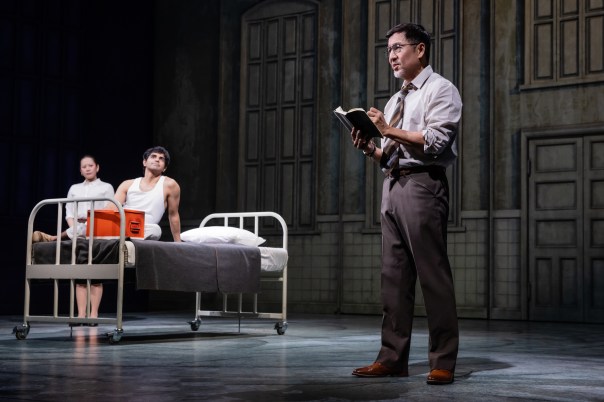
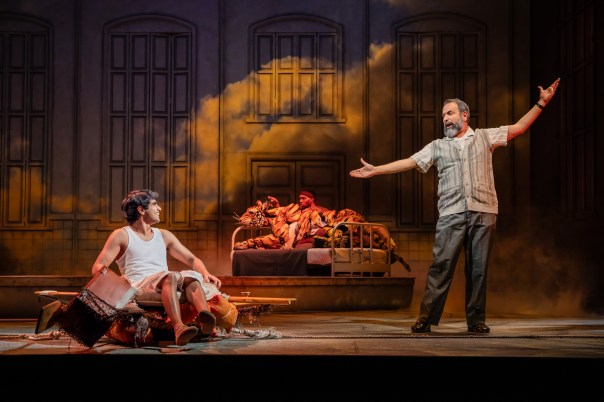
Review: Three Bone Theatre’s Electricidad at The Arts Factory

By Perry Tannenbaum

Maybe by now we’re numbed to the truth. You know how it is: 30 dead, 57,000 acres burned, 18,000 homes and buildings burned to the ground, and 200,000 people evacuated. Not enough problems already in California? Let’s call in masked men from ICE and the National Guard!!

The upheavals out West are almost enough to deflect our attention away from the all-important Jeffrey Epstein files. Los Angeles is on fire! And we shrug it off.

From what I’ve seen so far in Three Bone Theatre’s first two installments of The Greek Trilogy by Luis Alfaro, Mojada: A Medea in Los Angeles last August and Electricidad now, the plan is to keep the flames burning high and out of control from beginning to end. At peak visceral heat.

Alfaro grew up as a queer Chicano in LA and came of age before Rodney King and the infamous 1992 riots. Electricidad was actually the playwright’s first dip into Sophocles in 2003, six years after he won the MacArthur “Genius” Fellowship. So you might expect this youngest Greek modernization to be Alfaro’s angriest, fieriest, and most rebellious.

You would be right, but watch out: so far, Electricidad is also the funniest.

That can be a problem for director Glynnis O’Donoghue and her powerhouse cast at the intimate JCSU Arts Factory on West Trade. When Electricidad, Alfaro’s reincarnation of Sophocles’ Electra, describes her chola quarter of the LA barrio as the recognized pharmacy of the area, I was able to hear the air-quotes that surround the playwright’s text and laughed out loud.

Portraying the title princess, Melissa Lozada seemed a bit surprised and perturbed at the laughter. But her father, the venerated Agamenón (“El Auggie”), whose corpse lies enshrined in the front yard of Electricidad’s home, was the drug lord of the barrio. Her kingdom, which she plans to somehow usurp from her murderous mother, Clemencia, is built on drugs and community “protection.”

Or as one of the gossipy local Greek Chorus members puts it, “We don’t dial the 911 no more.”

More than in last year’s Mojada, the pretensions of our protagonists are repeatedly mocked and deflated. Ifigenia, E’s younger sister, is now a born-again Christian because she discovered that the meals served at her convent are far better than those she got in jail. Having taken over her abusive husband’s kingdom, Clemencia wants to sell rather than rule. She has Century 21 on speed dial and hopes to move to Pasa-fucking-dena.

In place of the ancient Greek gods, we have the modern monoliths: Target, Sears, 7-Eleven, Payless, and Oprah. Agamenón’s grieving mother, Abuela, exemplifies the warrior chola pride handed down through the generations, boasting that she pulled off her first shoplifting exploits from her baby carriage.

Brooding and vengeful, Electricidad stands apart from her family, even in her religiosity. You won’t find her praying to Jesus or the Blessed Virgin. To her, Auggie’s corpse is a sacred object, defiled by Forest Lawn, which would allow her father’s body to lie in state overnight with nobody watching.

She and Abuela whisked the body to the front yard, where she stands vigil, a squatter on her own property. E prays to her father’s spirit and talks to it, occasionally lifting her prayers to the severed head of ancient Aztec daughter Coyolxuahqui, better known as the moon.

No, Electricidad doesn’t think her devoted vigil, her seething rage, or any of her impassioned ravings are funny. Nor is she looking for a good laugh, even if her fanatical love for her father may be more than a little pathological. So Lozada’s glaring, combustible intensity is Electra, whether it’s Sophocles’, Hugo von Hofmannsthal’s, Jean Giraudoux’s, Jean Paul Sartre’s, or Eugene O’Neill’s. The laxity and corruption that surround her only increase Electricidad’s saturnine glow.

And a supremely hopeless mourning it is, for the bloody vengeance she is craving is unseemly for a woman – and Electicidad is as faithful to the old cholo ways as she is to her papá.She doesn’t realize that her brother Orestes, after being exiled to Las Vegas, where dear Clemencia ordered a hit on him, is still alive. His mentor, Niño, has thwarted the hit and is carrying on with his mission to toughen the kid up so he can take over the House of Atridas and continue in the king’s footsteps.

Although Jennifer O’Kelly’s lurid set design and projections combine with Madison King’s lighting to give the impression that LA’s el barrio is ablaze 24-7, the Arts Factory space is too limited to back up the idea that Clemencia’s check from Century 21 will be a huge fortune. It is Isabel Gonzalez as Clemencia who makes the House of Atridas formidable in a towering performance to savor every moment she’s onstage.

Even in the opening scene, as the speechless Electricidad dominates our attention sitting next to the shrine she has fashioned from Agamenón’s shrouded remains, Gonzalez lurks restlessly in the shadows in the corner of the room, a dynamo of nervous energy. The arrogance and majesty only emerge later when she paces the front room, caged in her own castle, chain-smoking, and unable to purge the terror squatting in her front yard.

Coming out to confront her sleek, gimlet-eyed daughter, Clemencia has a robust arsenal of tactics, from sweet cajoling and bribery to fierce, defiant, threatening, screaming, thundering rage. What a pair! For in retelling the fall of the House of Atreus, Alfaro has not only resurrected Agamemnon’s sacrificed daughter, Iphigenia, but he has also blotted out Aegisthus – Clytemnestra’s lover, protector, and partner in crime, ruler of Argos while the original Auggie was out of town, winning the Trojan War.

For feminists and progressives, Clemencia is unquestionably the strongest Clytemnestra of all that have been presented onstage since Aeschylus fathered the Greek rep that has survived the ages. When Gonzalez faces off against Lozada, as she did last week at the VIP dress rehearsal, we can also crown Alfaro’s Clemencia as the best of the Clytemnestras conceived for stage or opera (Hofmannsthal’s script became the libretto for Richard Strauss’s Elektra).

She certainly stands on higher moral ground than any of her predecessors, and if you hadn’t recognized Gonzalez as the diva of Hispanic actors in the QC until now, your mind will likely be changed by this hot gem. Lozada’s “Electra-fying” debut will stamp the Venezuelan spitfire no less convincingly as this year’s most exciting QC newcomer. Yes, there is spitting in el barrio.

Just don’t overlook the quieter, nuanced magnificence of Eduardo Sanchez in capturing Orestes’ mix of innocence, steely nobility, and self-doubt – prodded along by Luis Medina’s sometimes proud, sometimes slightly exasperated Niño patiently punching and tattooing his pupil into manhood. Sanchez is more than soft enough when we first encounter him to justify his skepticism about filling his father’s shoes and wearing his crown.

Matricide?!? That’s a terrifying prospect when he returns from Vegas to LA and learns what’s what. Even Mom understands his hesitance, calling him “My most sensitive one.”

O’Donoghue was still tinkering with pacing on the night we attended. Too fast and you can miss Alfaro’s choicest quips, especially with Mariana Corrales, Allison Graham, and Marcella Pansini as the Chicano chorus of street sweepers, not the best players in the lineup. Slow it down, and the comedy threatens to take over.

But when it comes to the key moment, that spark-gap instant when Orestes becomes who he was destined to be, O’Donoghue nails it with hardly a single prompt from Alfaro’s script. It’s a kind of magic, a key superpower Alfaro also preserves from ancient times for his Medea in Mojada.

As Orestes returns to Clemencia’s living room, where mamá is smoking and watching TV, she begins chanting: “Find the courage. Find the rage. Find the darkness.” This chant becomes a background incantation as Celemencia deals with the shocking reunion and Orestes copes with the enormity of his mission.

Until Electricidad screams out. It’s as if the live-wire transformer decreed by Alfaro at the top of his script, humming and crackling in the background all evening long, bursts into flame. As if Electricidad is triggering Orestes’ actions by remote control.

There’s only scant proof for my theory about O’Donoghue’s concept. Aside from The Penguins’ “Earth Angel,” specified by name in the playscript, sound designer Neifert Enrique inserts Santana’s “Black Magic Woman” as a perfect foreshadowing. You did not live the ‘70s if you don’t know it.

The pesky and complaisant sister usually assigned to irritate Electra is most often named Chrysothemis, so Michelle Medina Villalon is drawing a fairly thankless role as Ifigenia. But Alfaro perks her up a bit as Ifi really is iffy to the core, trying to get her elder sister and her mom to make peace, let bygones be bygones, and trying out Christianity as an alternative to whatever kept landing her in jail. Still sporting vivid tattoos from her past, Ifi carries around a little statue of the Blessed Virgin as a security object: to pray to, to purify her living, and maybe to mark her territory if she decides to move back permanently.

Villalon also carries around a distinctively blank and traumatized look about her – maybe a prophecy of what Orestes and Electricidad will soon become. The earth here seems to be so scorched that both the sanitation department and the police stay clear. There’s no more likelihood that the siblings will face legal consequences for their crime than Clemencia faced for hers.

As one of the street sweeper gossips tells us, this is the wild, wild ouest. The only repercussions to assail the Atridas family for all their crimes are inward – the pains of guilt, regret, and that mark that has branded our species since the days of Cain. Drugs? Expelled from the equation.

Abuela remembers the good old days, reminiscing with Niño briefly upon his return before luring him to her place. With Banu Villadares embodying the tough and pragmatic Abuela, who didn’t weep at her son’s funeral because it would mar her makeup, we can understand why she is the only person on the planet who can make Electricidad laugh. Or momentarily rescue her from her own darkness.

You just gotta love her indomitable sass. Especially in a world that’s on fire.

“Sex, Lies, and a Sycamore Tree” Almost Goes for the Jugular

Review: Sex, Lies, and a Sycamore Tree

By Perry Tannenbaum

Away somewhere in Sycamore Grove, a subdivision in the burbs of a certain fast-growing New South city in the Carolinas, there’s a diversity problem. For the McLeans and the McDaniels, lily-white next-door neighbors in playwright Elaine Alexander’s new comedy, Sex, Lies, and a Sycamore Tree, there’s still too much of it.

Owners of an ostentatious year-old McMansion that the pushy missus already plans to expand, the McLeans project an image of wealth that clearly intimidates Tracy McDaniels as she enters her neighbor’s posh patio for the first time. She’s an English teacher who has lived in Sycamore Grove with her carpenter husband, Rick, since long before Hugh and Ali arrived next door, refugees from California’s wildfires, mudslides, and property taxes.

They don’t fit in.

The McDaniels can remember when the subdivision actually resembled its name, with more modest ranch houses like theirs and many more trees. On one memorable occasion, Tracy cussed out the greedy real estate developers who were heartlessly bulldozing the signature sycamores at a city council meeting. Now their sycamore is the only one left.

Alexander herself is directing the world premiere of her new script at The VAPA Center in the Charlotte’s Off-Broadway black box – a perfect vantage point for the playwright to gauge what’s working and what isn’t. She also designed the set. On opening night, Alexander could be seen among us in the front row, scrutinizing her brainchild. Likely, she discerned some needed touchups, but she could hardly have been dissatisfied with her sharp cast.

I’m not sure we had ever seen Elyse Williams in a role as declassee as Tracy before, so I was instantly wary. Her slacks and her wig, the flamboyant antitheses of down-to-earth, were not going to help me overcome my qualms. Keith Hopkins as the rugged and grizzled Rick, on the other hand, instantly clicked with his apt attire and Alexander’s crafty characterization.

For Rick, the McLeans’ invite is a bit of a godsend, a chance to visit one of these neighborhood McMansions as a guest rather than as a laborer or a handyman. Yet he comes armed with defenses against his hosts’ possible pretensions, carrying with him a six-pack of craft beer and a bag of Doritos – in case he is offered anything he can’t pronounce.

As we can quickly divine from the stemmed glassware and the spigot-less bar on Alexander’s set, Rick is right on-target with his premonitions. After a year in the neighborhood and their recent trip to Portugal, the McLeans will ply their dear neighbors with Portuguese wine, gazpacho, and a sprinkling of Portuguese idioms. The gallant Hugh has even saved a pocket-sized book of Portuguese poetry for the occasion.

Hugh’s gallantry and savoir-faire are driven by a fairly active libido, so Tom Schrachta has quite a juicy role in counterbalancing Rick’s savvy, crafty vulgarity. In addition to his newly acquired Portuguese, Hugh can hurl some choice Freudian jargon at Mr. Six Pack. Yet Hopkins can parry with choice verses from the King James Bible and the occasional Shakespearean quote on loan from his wife’s teaching curriculum.

The collision between California and the Carolinas – Old and New South – is sharply delineated in the men’s lifestyles. Yet Alexander has crosswired their presumed political leanings.

It’s that lone sycamore lurking behind the scenes that triggers the plot and unveils the main conflict.

Fran Kravitz gets to drive the plot as the fiendishly scheming Ali. She hasn’t belatedly invited her neighbors over to make friends, but rather to make amends for their tree’s trespasses. Nor does she wait until the first bottle of Alvarinho is emptied or the first beer can is crushed. Instinctively, both of the McDaniels come to the defense of their innocent centuries-old sycamore – earning Ali’s patrician scorn and the stigma of liberals.

Yeah, we get to hate Kravitz quickly, and the hits keep coming. Her initial hospitality at the beginning of her opening night performance was too big and loud for the room, so I had misgivings, but her subsequent belligerence and deceit were nicely calibrated, on par with Williams’ righteousness and occasional moral lapses. Kravitz meshed well in the Lies and Sycamore components of Alexander’s plot.

Plausibly motivated and ruthless, Kravitz was also the most convincing in the Sex sector. But Alexander layers on more sex, and it’s here where she is less artful than in the more compelling legal and moral struggles. It looks very early like Hugh and Tracy have a prior history – and that both are taken aback at encountering each other so close to home.

How this is possible after living as neighbors for a year is just the first thing we ought to have explained. By not fleshing out the details, Alexander allows these elements of the comedy and drama to remain noticeably slapdash. Although the playwright does contrive to set aside quality time for Hugh and Tracy, most of the meatiest time they have alone together happens during intermission.

When Hugh’s gallantries and jovial deflections ignite Rick’s jealousy, opening the gates to his choicest Scripture and Shakespeare, the sexual chemistry layered onto the conflict really does turn up the heat in a delightful way. As soon as we see Hopkins stalking in with the axe that Rick has discovered in the McLeans’ backyard, we can see comedy and drama beginning to teeter on the tip of the blade.

Furthermore, Hugh’s roving eye gives some common cause for Rick and Ali, providing extra leverage when she litigates and negotiates a mutually beneficial resolution to the matter of the McDaniels’ pesky sycamore. With so much lying, scheming, and betrayal going on around him, will Rick be the last to succumb?

No less suspenseful, we wonder if the two families can become good neighbors and if the two couples can remain intact. Slapdash or not, this is complicated.

Alexander’s instincts seem to tell her not to get too bogged down in the moral, political, economic, and environmental issues she brings up – no to be too dogmatic or preachy. That allows her drama, her comedy, and her audience to breathe more easily. It allows her to favor dramatic and comic impact over message and allows her plot and her characters to have more sway.

All to the good, especially with this cast in Alexander’s directorial hands. Yet I still wish for more eloquence and passion from both sides of the Sycamore controversy. I’m never sure that the playwright quite realizes the magnitude of what she has accomplished here.

She has greatly levelled the playing field in a debate that usually pits big business, real estate developers, grasping politicians, and banks in a one-sided battle against private homeowners and brainy conservationists. Here we have two families with these conflicting interests – with the McLeans retaining enough monetary advantage to keep it real. Let’s have Tracy, Rick, and Ali all fervently pleading their cases as if their futures depended on it, OK? And keep the sex (plus backstory) intact.

It’s hard to deny that if George S. Kaufman were working this material, now or 90 years ago, his slant would have ultimately been more progressive. Why should we be more cautious and regressive now?

Yes, we are in purple North Carolina rather than blue California, but who are we convening in these seats at this world premiere? Overwhelmingly, we are progressives and liberals who still get the gist of the US Constitution, the Bill of Rights, and settled science. That is the reality now and that will be the reality in the foreseeable future: whether or not PBS, NEA, CBS, and Stephen Colbert survive this disgusting decade.

Upsized “Immediate Family” Has the Buzz, Needs More Heat

Review: Immediate Family at Booth Playhouse

By Perry Tannenbaum

Anyone who saw the fine Theatre Charlotte production of Lydia R. Diamond’s Stick Fly this past spring can be forgiven if they feel a vague sense of déjà-vu at Booth Playhouse, where a revival of Paul Oakley Stovall’s Immediate Family has been launched with ultra upscale production values by Blumenthal Arts.

Both of these family dramadies are hiding a long-ago infidelity that led to left-out stepsisters, both gatherings may shortly involve two impending marriages, and both center around prosperous Black families about to be surprised by the race of their prospective in-laws. In both, there’s a brother on the brink of publishing or finishing his first novel – and talk of ordering in Chinese food.

Before we discover any of this at Booth Playhouse, there’s the set design of Immediate Family. It is almost the mirror image of the three productions of Stick Fly that I’ve seen on Broadway in 2012, at Actor’s Theatre in 2015, and at the Queens Road barn this May – with stage right and stage left reversed. Both plays were initially presented in Chicago, Diamond’s in 2006 and Stovall’s in 2012.

While there is no blood relationship between Diamond and Stovall, there’s a definite family link between the two most famous exponents of their scripts. As the left-out stepsister in the Broadway production of Stick Fly, Condola Rashad became a breakout star in 2012, and her two-time Tony Award-winning mom, Phylicia Rashad, is now directing Immediate Family for the third time (previously at the Mark Taper Forum in 2015 and at the Goodman Theatre in 2012).

Chicago, LA, and Charlotte. We’re in good company, for Rashad has been on the QC scene tweaking the production while Stovall is also in the mix. The playwright, who was in the national tour of Hamilton as George Washington, was fine-tuning his script as the Blumenthal Arts extravaganza was previewing and gathering media publicity, already extended to September 7 before its official opening. In multiple ways, this run is upsizing the norms of locally-produced theatre.

Previews? Press events? Tuesday, Wednesday, and Thursday night performances? It’s happening. We haven’t seen this much buzz over a local attraction at Booth Playhouse since Charlotte Repertory Theatre was at the height of its ambitions in 2003. Rep planned to take its production of The Miracle Worker, starring Hilary Swank,to Broadway.

Never mind the buzz and, if you’re still pondering Stick Fly, don’t worry about the déjà-vu. Immediate Family has its own story to tell, turbocharged with one big issue that Diamond never addressed.

Still, I’d say that Stovall should definitely bulk up his script – and strengthen his exposition – if he plans to fulfill his Broadway aspirations. For her part, Rashad needs to get more power and sharpness from key players.

All of this proves easier for me to summarize than it was for a press night audience to see and hear. In real time, determining how Evy is related to Tony takes way more time than it should, partly because Evy is bossy – and starchy – enough in the opening scene with Tony to be his mom. Or evil stepmother. And since the fancy Blumenthal Arts playbill departs from the playwright’s practice of listing his characters in order of appearance, you may wind up confusing Ronnie and Evy until intermission. Or beyond.

There are no strangers onstage until after intermission, so everybody in Immediate Family already knows everyone else – as the title implies. There is a next-door neighbor, described as the Bryants’ “play sister” in the script, who could catch up with returning family and new arrivals. To his credit, Stovall introduces her early on in the second scene, conveniently toting in trays of food that she’s cooked up for the rehearsal dinner just as Jesse arrives.

They greet each other loudly enough: “…BLACK FAGGOT!” “…LESBIAN!” But the actors playing Jesse and Nina, Elijah Jones and Kai Almeda Heath, don’t speak nearly as loudly or clearly afterwards, trimming off too much and making it too real for me to consistently understand them in Row H. When Jones and Heath cruised through the siblings’ birth order and legitimacy, it was a blur.

As the inside outsider, Nina becomes a juicy role, so it was a shame that Heath zipped through so many of her sassy one-liners so unintelligibly. That’s a problem that Rashad may have already fixed.

But the more consequential bulking up of the action is unfinished work that only Stovall can do. With their loud greetings after Evy’s first exit, Nina and Jesse foreshadow the big issue that the Bryants will confront before the night is done, one that Stick Fly never tackled. There’s a disconnect that Stovall will expose between the widespread homophobia in the African American community and the prominent roles that gays have played in their cultural heritage.

He needs to do it more often and more aggressively. Ronnie and Evy, who will tangle more heatedly in Act 2, sideswipe the issue of homophobia before intermission. Preparing to teach a summer school class to young Blacks, Evy plans to blow their hip-hop TikTok minds by introducing them to the pillars of their heritage, one inspiring biography at a time.

Malcolm X, MLK, Medgar Evers, Harriet Tubman, Thurgood Marshall, Sojourner Truth, and Booker T. Washington are already written up. So Evy wants Jesse, the best writer in the family, to help her fill out her gallery of 50 Black heroes by completing bios of Rosa Parks, the Obamas, and five more of his choosing.

Ronnie asks for a look at Evy’s list. She scrutinizes the list closely. Where are Langston Hughes and Billy Strayhorn? It’s mostly a list of political figures, Evy responds. And what about Bayard Rustin, who refused to give up his bus seat 10 years before Rosa Parks, and organized the storied 1963 March on Washington?

Cornered, Evy answers frankly that Rustin was arrested on “morals charges” several times. We don’t learn until deep into Act 2 that Evy has problems saying “gay” out loud.

But Ronny can. In fact, she may have undergone a sexuality makeover while Stovall was expanding his original one-act play into its present form. Instead of calling her stepsister on her homophobia then and there, she waits until later to lobby Jesse into sneaking in bios not only of Rustin but also of Langston Hughes, Barbara Jordon, Alice Walker, and Angela Davis.

Jesse deflects when confronted with these gays – only fessing up when Ronnie plays her trump card. Lorraine Hansberry! Evy would kill him, Jesse blurts out: perfectly mirroring Stovall’s own reluctance to confront the issue head-on.

Let’s say it plain. Paul, you’re in the New South now in 2025. Bring it, bro!

I say this all the more boldly because Stovall is already on the record saying that he wants to.

Thanks to Rashad’s casting, there’s plenty more firepower available for both Evy and Ronnie to turn up the heat at the Booth. We love hating Evy almost from the moment the lights come up with all the haughtiness, bossiness, and preacher’s-daughter righteousness that Christina Sajous lavishes upon her. Whether plotting to waken her summer school students or sitting down to a game of bid whist, this is one serious woman. The slow burn she does at the card table is beautifully modulated and explosive.

As hinted earlier, it’s Britney Coleman as Ronnie who gets shortchanged on chances to turn up her fire – though you won’t be at all disappointed when Coleman reaches her boiling point. Not only does Ronnie miss out on a full-frontal assault on Evy’s homophobic pantheon of Black icons, but Coleman doesn’t really get a chance to build grandly to her destructive drunkenness in Act 2. It kind of creeps up suddenly, notwithstanding Stovall’s foreshadowing in Act 1.

Less subtlety, and maybe some comical misdirection, would work better. When Stovall does detonate his denouement, albeit without sufficient build, the effect and the efficiency of his work are breathtaking.

Chemistry between the Bryant brothers could hardly be better. The scene where Jones “comes out” to Tony is simply a gem, with Freddie Fulton as fresh-mouthed to his elder brother as he was to Evy. But Tony doesn’t always come off as the carefree hipster in the family. When Jesse’s partner of three years, Kristian, not only reveals himself as a man but a white man, Fulton aligns with Evy in his disapproval – drawing some of the flak reserved exclusively for her until then.

Andy Mientus’s arrival early after intermission was therefore a litmus test of sorts. Those in the press night audience who gasped at Kristian’s Svedish vhiteness obviously hadn’t opened their playbills and scanned the cast photos. I kinda envied their surprise. Jesse’s difficulties with Evy, specifically his ploy of passing Kris off as the wedding photographer, rightfully test the men’s relationship, so Mientus gets to show us some strength of character as well as wholesomeness.

But Stovall doesn’t stop there. There’s an unexpected late-night scene, one of his best, where Mientus and Sajous are all alone by the bookcase. Nicely done all around.

Puppetized “Life of Pi” Vindicates Its Truthiness

Review: Life of Pi at Belk Theater

By Perry Tannenbaum

Not too many novels weigh the merits of imagination against observation, myth against reality, or fiction against truth: the author’s bias in favor of fabrication is implicit from the first word in his first chapter. But after relating an epic and fantastic tale of a boy’s survival on the open seas, Yann Martel did exactly that in his LIFE OF PI, questioning and testing Pi’s story and measuring it against an alternate narrative.

Son of a Pondicherry zookeeper and named after a Parisian swimming, Piscine Molitor Patel is the only survivor of the Tsimtsum, a mystically-named cargo ship that set sail from the shores of India, bound for Canada. Martel, brooding over reviews of a previous book and suffering from writer’s block, finds out that Patel, now a grown man with “a story that will make you believe in God,” is living in Toronto.

Nearly a year after taking notes at his meeting with Pi, Martel purportedly received a 1978 audiotape and an official report from the Japanese Ministry of Transport, completing his research. Martel’s book won the Man Booker Prize in 2002, the year after its publication. Ang Lee’s film version of 2012, based on a screenplay by David Magee, won four Academy Awards, including one for the director.

The stage adaptation of Life of Pi by Lolita Chakrabarti, now touring at Belk Theater in Charlotte, has gathered even more accolades since it premiered in the UK, first in Sheffield in 2019 and then in a 2020 London production that bridged the pandemic. By 2023, when the production – still directed by Max Webster – arrived on Broadway, the story of the teenager adrift on the Pacific Ocean with a Bengal tiger named Richard Parker must have seemed like an ancient relic to theatergoers, despite its technical dazzle.

Showered with enthusiastic reviews and five Tony Award nominations, the Broadway show ran less than four months, closing shortly after its design team nabbed three Tony wins. Looking around the Belk on opening night, you could see that a hefty amount of nosebleed seats had been sold in the uppermost balcony. Even though that performance was cancelled because of technical difficulties, it seemed like the Charlotte run would sell more tickets than any week of its NYC run.

The “worldwide phenomenon” touted in TV promos has not cooled in Charlotte, and it seems obvious that the tour will outgross the Broadway original. All of the original design team has remained intact through all of this production’s installations and transcontinental travels. Perhaps we should reserve the highest praises for puppet designers Nick Barnes and Finn Caldwell, winners of the Drama Desk Award, for their work likely travels even better than Carolyn Downey’s Tony Award-winning sound design.

An impromptu interview downstage on opening night confirmed that Tim Hatley’s scenic design had been trimmed for the road, so Pi’s lifeboat wouldn’t be rising up onto the stage from below when the tour’s turntable was fixed. Everything in the lighting booth looked calm and shipshape for the opening. It wasn’t too surprising, then, to see a projection greeting us on the front scrim two nights later when we redeemed our raincheck – a reassuring sign that this boat was ready to float.

Aside from the puppetry, delightfully engaging our imaginations all evening long, Chakrabarti takes a simplified, direct, yet convoluted path through Martel’s Pi, stripping away the narrative layers of Martel, his informant in Pondicherry, and the elder Patel in Toronto. The diary that Pi kept during his epic voyage, mentioned just once in Martel’s prefatory “Author’s Note,” is discreetly forgotten.

Chakrabarti wants to balance the veracity of Pi’s two tales more delicately, it seems. She takes us directly to the Benito Juárez in Tomatlán, Mexico, where Pi will be interrogated by Mr. Okamoto of the Japanese Ministry and the more empathetic Lulu Chen from the Canadian Embassy. That whisks us to Chapter 95 of Martel’s 100-chapter book, leaping over the narrative we have read without interruptions from Pi’s point of view by investigators.

Further compromising the boy’s credibility, Pi isn’t visible immediately in his hospital room. He is nesting underneath his hospital bed, hidden behind his dangling bedsheets. When he is coaxed by food and other rewards into coming out, we readily observe that he is haunted, traumatized, and animalized by his experiences at sea – appropriate results for both versions of his story – and conditioned to fiercely hoarding his food.

Pi’s histrionics, which punctuate his narrative, give Taha Mandviwala fresh opportunities to rouse Okamoto’s skepticism and Chen’s empathy in the title role, but the added flash – along with the missing diary – must be scored as detrimental to the lad’s credibility.

Yet there’s a buoyancy to Mandviwala as he relives his adventures that wins us over, with plenty of moments that underline his irrepressibility: dancing in the dingy streets of Pondicherry, insouciantly entering Richard Parker’s lair at the zoo, and standing triumphantly on the stern of a lifeboat lost at sea – or on his hospital bed. With or without a paddle, he holds his fist up high. Yes, in a fine bit of theatre magic, bed and boat are the same in both locations.

Paradoxically, all the artifices of puppetry, lighting, and projection make us want to believe Pi’s story more and more. Even when Toussaint Jeanlouis, after playing the ship’s nasty cook, reappears out of Richard Parker’s head and becomes the tiger’s voice. The pushback from Alan Ariano as Okimoto and the caring of Mi Kang as Chen ultimately testify to our inborn needs for fiction, myth, and imagination.

Though I’ve read the book, it’s been a while. I’m not sure whether Martel’s Pi was blessed with family visitations during his animal story or whether these were additions from Chakrabarti’s fancy. Either way, the reappearances of Sorab Wadia as Father, reminding Pi how to tame a tiger, Jessica Angleskhan as Amma, counseling her son on staying vegetarian at sea, and Sharayu Mahale as Rani, scolding her brother for succumbing to fish and turtle meat, do more than keep the rust off these endearing characters after the Tsimtsum sinks.

Collectively, they endow this Life of Pi with more mythic aroma, like talismans or magical weapons gifted to heroes of sagas. They are Disney sprinklings of Tinkerbell’s fairy dust and Jiminy Cricket’s guidance. Of course, they don’t cross over when Pi’s fantastical story dissolves into an antiseptic hospital!

When God has been proven to you, a sinking ship, a shark-infested ocean, a vast flesh-eating island, and an arid Mexican shore with jungle in the distance are all better places to be, as long as there are stars above to wish on. In Martel’s novel and onstage, young Pi has sat devotedly at the feet of Hindu, Islamic, and Christian mentors concurrently for weeks on end because he is so hungry for God – while Martel attests to extensively studying zoology and the cosmogony of Isaac Luria, the great Jewish Kabbalist.

For Pi and Martel, preferring a beautiful, ennobling story to a plausible one is a way of life. Actually, Martel states it more politically than that at the end of his preface: If we, citizens, do not support our artists, then we sacrifice our imagination on the altar of crude reality and we end up believing in nothing and having worthless dreams.

Maybe Martel’s thrust has more currency now in Charlotte than it did on Broadway. Yes, and maybe this message has more urgency now for Americans than it ever had for Martel’s fellow Canadians.

Hollywood Superstars Who Graced the QC’s Park-N-Shop

Preview: QC Concerts’ Side Show at Booth Playhouse

By Perry Tannenbaum

When Louella Parsons, the undisputed queen of Hollywood gossip, saw the Hilton Sisters’ first movie in 1932, she proclaimed: “For pure sensationalism, Freaks tops any picture yet produced. It’s more fantastic and grotesque than any shocker ever written.” At the height of their fame, Daisy and Violet Hilton could fill a large stadium.

Or at least, they tried. On July 18, 1936, billboards all around Dallas – some as large as 60 feet tall – invited the public to the Centennial Exposition at the Texas State Fairgrounds. For just 25 cents, you could enter the Fair Park Stadium, newly rebranded as the Cotton Bowl, and attend Violet’s wedding, with twin sister Daisy as her maid of honor. Afterwards, the sibs would perform with their dance band.

How could it be otherwise? For Violet and Daisy were Siamese twins, joined at the hip. Superstars. During their careers, they performed with Bob Hope, Jack Benny, and Burns & Allen. Hope and Burns were the sisters’ most illustrious dance partners! But the Hiltons died in relative obscurity. When they hadn’t shown up for work at the Park-N-Shop on Wilkinson Boulevard for a few days, Charlotte Police found them dead in their nearby apartment on January 4, 1969 at the age 0f 60.

The Siamese twins – actually born in Brighton, England – had succumbed to the Hong Kong flu. Blame it all on the Asians, right?

There should be a soft spot in Charlotteans’ hearts for two of our own and for Bill Russell’s Side Show, the 1997 Broadway musical about the Hilton Twins’ rise to fame. But no matter how thoughtful and intriguing the original version and the revised 2014 revival were to reviewers, neither production gained box office traction in New York and neither toured here.

Until now, the only adult company to present Side Show in the Queen City was the Queen City Theatre Company at McLohon Theater in 2008. The McLohon was an ideal locale for the seedy, carnival ambiance of Side Show. Russell’s cast includes not just the Twins, after all, but also a Cannibal King, a Snake Woman, a Reptile Man, three Harem Girls, and – perhaps most monstrous of all – The Boss who employs, exploits, and abuses them.

Though pennies won’t get you into this show unless you have a huge jarful, the freaks return to Charlotte this week – with their startling welcome.

Come look at the freaks

come gape at the geeks

come examine these aberrations

their malformations

grotesque physiques

only pennies for peeks

Once again, The Boss will invite you into his “odditorium.” While the McGlohon and its Spirit Square cohort, Duke Energy Theater, remain in hibernation until 2027, undergoing their makeovers, Queen City Concerts is reviving Side Show at Booth Playhouse. It’s a more intimate Blumenthal Arts venue than the McGlohon, true enough, but not quite as creepy.

Chief chef directing this colorful cast – and leading a full orchestra playing Henry Krieger’s music in Harold Wheeler’s original orchestral arrangements – is QC founder Zachary Tarlton. Adoration of the original score is Tarlton’s specialty, but here he had the luxury of cherry-picking from two Broadway versions, maybe shuffling the songlist a little and restoring some of the 1997 tunes that had been dropped in crafting the more historically accurate 2014 revision.

“We chose to do the original 1997 Broadway version of Side Show,” says Tarlton, “because it is Side Show in its purest form. While the show closed quickly, it garnered several Tony nominations and launched the careers of its leading ladies: Alice Ripley and Emily Skinner. For those unfamiliar with the original show, the 2014 production seemed polished and pristine. For fans of the original, it was met with harsh criticism.”

Fans of the original, Tarlton will tell you, are a cult following. Whether the stars of the new QC Concerts production, Ava Smith as Daisy and Sierra Key as Violet, are members of that cult is an open question. But they are both fervid admirers of the show.

Before Tarlton saw her as his Daisy, Smith had portrayed Violet in a Teen City Stage presentation at CPCC’s Pease Auditorium in 2016 – while she was still a high schooler in Gastonia. Key was also in high school when she first met Smith in 2013, and they’ve been besties ever since their first show together.

Naturally, Key saw the 2016 show that starred her bestie. In a freakish reenactment of Side Show scheduled for later this year, Smith will be one of Key’s bridesmaids at her wedding.

“A little fun fact,” Smith adds, “people often mistake us for sisters! Just like Daisy and Violet, we have stood by each other through the good and bad times. Our connection in real life makes the necessary onstage connection come naturally.”

Russell sharply differentiates Daisy from Violet early on in his script, while they’re still slaving on the midway. Two young men, Terry Connor and Buddy Foster, secure a private audience with the sibs after their freakshow. Buddy’s idea is that he could teach the Hilton Twins how to sing and dance while Terry can get them a shot in vaudeville as their booking agent.

Both of the women would jump at the chance to escape the side show, but until now, they haven’t been offered a feasible alternative. The Boss keeps them under lock-and-key as part of his freak collection.

It’s Terry, not quite on board with the vaudeville scheme, who asks what the sisters yearn for.

“Daisy is bold, outgoing, stubborn, and determined to be famous,” Smith says. “She loves performing and knows exactly what she wants. Violet is shy, sensitive, and just wants a simpler, quieter life. But even with those differences, they share such a deep love for each other and a longing to just be ‘Like Everyone Else.’ I believe Daisy and Violet really are two halves of a whole.”

As halves or opposites, they are both keenly and perpetually aware of how laughable their aspirations are to their captors and the people who pay to peep at them. Even if they are at odds, every choice they’ve made individually has been with the tacit agreement of their twin. Yes, the fiery Daisy can aspire to vengeance against the mockers and the detractors while Violet merely hopes to prove them wrong and be rid of them.

But they must move together, whatever they do, and cannot pretend they’re the same as everyone else. Daisy aims higher, fired by the full breadth of the American dream, but it’s Violet, no less American, who is more poignant and relatable.

“What’s so powerful about Side Show,” Key declares, “is that it tells the story of people who are seen as ‘different’ simply for existing in the world as they are. As someone who is part of the LGBTQ+ community, that resonates with me deeply – especially right now, in a time where identity and visibility are still so politicized and debated. Violet’s longing for love, acceptance, and belonging is incredibly human, and that’s what I focus on.

“The physical connection with another actor may be unusual, but it’s all in service of telling a story that challenges perceptions and invites empathy.”

Going back eight or nine decades, Russell can take us beyond empathy and show us quite bluntly how the Hiltons themselves had yet to evolve. Their strongest champion before Buddy and Terry arrive as deliverers is Jake. He’s not really a Cannibal King “from the inky jungles of the darkest continent,” as The Boss would have us think, nor a poster boy for his collection of “god’s mistakes.”

He’s simply a rather strong African-American man. With a very soft spot for Violet. His inability to say no to her becomes the ticket to the Hilton Twins’ freedom.

So yes, they are also capable of prejudice and exploitation.

“One of the darkest moments in the show comes late in Act Two,” Tarlton observes, “when Jake asks Violet why she will not accept his deformities when he accepts hers, acknowledging the color of his skin while he accepts her as a conjoined twin. While that was during the Great Depression, we realize this same conversation could just as easily have been today. It is a show that is challenging at the core.”

Amen. Two of my most unforgettable moments in a Broadway theater happened on the evening when I first laid eyes on Ripley and Skinner. They didn’t instantly appear as the two Hilton sisters. They converged from opposite sides of the Richard Rodgers Theatre, facing each other as they sang and, just seconds afterwards, facing us. Then they conjoined right there, magically becoming one and moving as one – as naturally as Daisy and Violet had presumably done all their lives – for the remainder of the evening until taking their bows.

This must have been exactly as Russell envisioned it. “In the Broadway production,” he wrote in his Production Note. “Daisy and Violet’s connection was created by the two actors standing side by side. They were never literally connected by corsets, Velcro or any other costume piece. This allowed the audience to participate in creating the twins’ connection with their collective imagination and made the actors’ achievement of appearing to be joined all the more impressive.”

Even more primal and gripping was The Boss’s follow-up introduction as we were led inside his side show tent alongside the other freak seekers who had paid their dimes. “Please remain in your seats,” he told us commandingly, “to experience our premiere attraction in its most revealing display.”

A dazzling blast of backlight assaulted us as the conjoined twins, standing together with their limbs splayed out, appeared in dark silhouette. The sight was shocking, like a gigantic black spider writhing before us, twice the size of a normal person.

Fascinating. Fearsome. And yet… hauntingly beautiful.

Hohenstein Gets Greedier in His Second Go-Round With “Peter and the Starcatcher”

Review: Peter and the Starcatcher at Matthews Playhouse

By Perry Tannenbaum

July 12, 2025, Matthews, NC – Though their names are similar and they’ve both written about Peter Pan, the temperamental gap between James M. Barrie and Dave Barry would seem to be as wide as oceans. Barrie created Peter in 1904 as an embodiment of eternal youth and the spirit of noble adventure. A century after Peter made his stage debut (played by a woman, of course), Barry teamed up with Ridley Pearson to write a novel-length prequel, Peter and the Starcatchers, keeping the non-fantasy base of the story in Victorian England while snatching Neverland from up among the stars and plopping it down on an earthly ocean.

What Rick Elice seems to have done, in returning the Barry-Pearson preteen page-turner to its stage origins, is to worshipfully replicate all the seagoing pirate action of Starcatchers along with Barry’s choicest quips. Then to supercharge the effect, Elice seems to concentrate it all so that it flies by in a blizzardy blur, all the more frenetic because scenery is stripped so bare – people become doors, ropes become ocean waves, and flag streamers are crocodile teeth – that we’re exercising sizable hunks of imagination to fill out what’s actually happening before our eyes.

Barrie fairies were jubilantly diced and desecrated by Barry’s mischief and mirth: or so it seemed the first three times I saw Elice’s Peter and the Starcatcher – on Broadway, on tour, and at Theatre Charlotte, directed by Jill Bloede. Having read Barry’s Pulitzer Prize-winning humor pieces for decades, I was so sure of my familiarity with America’s beloved joke-and-quip machine that I never bothered to read a single page of his Starcatchers. My naïve conclusion was that Elice had simply let the Barrie-Barry mashup work its magic with as little intervention – and budget – as possible.

My fourth encounter with Starcatcher at Matthews Playhouse, once again directed by Bloede, helped to enlighten me. In her previous work with the script, the evanescence of the budding relationship between Peter and Molly Aster – and the poignancy of their parting – felt more touching to me than previously. That’s significant compensation for anyone who adores Barrie’s original story, whose magic can seem drowned in humor, wit, and shtick when first encountering Starcatcher.

This time around at Matthews Playhouse, another thematic thread struck me for the first time: Elice’s orphaned Peter reaches puberty without ever having a first or last name. By now, it will only come with his consent. At the other end of the moral spectrum, Black Stache has been searching throughout his pirate career for a hero antagonist who will perpetuate his fame.

So their first grand meeting and tussle have biblical Israel-Angel proportions and consequences, or Robin Hood-Little John echoes if you prefer a secular, literary parallel. Two combatants become permanently linked and one of them emerges with a new name. Bloede’s staging here, when Peter gets his name from Stache – and later when Pan is added on – brought a new aura to those moments.

That’s what sent me to the web in search of Barry-Pearson’s actual text. Elice’s wit and humor seemed to chime with the belly laughs Barry’s newspaper columns repeatedly deliver. But is the class clown who grew up no less jokey truly capable of such yiddishe flavor and mythic depth? My suspicions were confirmed in the very first sentence of Barry’s saga: it already includes Peter’s name! An even more amazing revelation awaits if we read on. The jokey Barry tone we know and love is nowhere to be found in the opening chapters we can sample at Amazon. Instead, Barry and Pearson were following along on the dark gallows humor path that Lemony Snicket had pioneered with his Series of Unfortunate Events books for kids.

Deep breath. In my previous reviews of Starcatcher, I repeatedly gave Barry too much credit and blame for what I had seen and much too little to Elice. Both the jokiness and the mythic dimensions of Starcatcher can be credited to Elice – with additional bravos for how thoroughly he convinces us that this is how Barry would tell the origin story of Peter Pan.

Meanwhile, community theatre in Davidson, Charlotte, and Matthews continue to reap the dubious benefit of having so little professional-grade theatre in the Queen City. What a cast Bloede has assembled! Before the show began, representatives from the North Carolina Theatre Conference presented artistic director Sarah Bumgardner with their Theatre of the Year Award for 2024. So the folks backstage with their costumes on, waiting overtime for the ceremonies to conclude, were obviously under extra pressure to deliver. Even Bloede was nervous!

No matter how good your cast is, there’s plenty of stage business to be nervous about in running Starcatcher.Actors must move all the props and furniture around and keep track of all the many Yvette Moten costumes they must find and change in and out of as we move from a London dock to two sailing ships to a faraway island with a beach, a mountain, and a jungle. Stage manager Jessie Hull had to be preternaturally adept. Molly must float in the air. Peter and some nameless alley cat must fly. A lot going on while the quips shoot out at us, many of them newly minted to mock Myers Park and nearby country clubs.

Nearly all of these players were newcomers to Starcatcher, beginning with Joshua Brand as Peter and Emma Brand as Molly, presumably arriving on the Fullwood Theater stage with ready-made chemistry. Their boy-girl antipathy is no less charming than their tentative stabs at intimacy, and both can seem fueled by the promise of adventure and ignited by its thrill. The only holdover from Bloede’s 2018 cast is Johnny Hohenstein, who in bygone days crossdressed to portray Mrs. Bumbrake, Molly’s flirtatious nanny.

With even more liberties, including more than a slight leftover effeminacy from Bumbrake, Hohenstein burst into full flower as the carnivorous Black Stache, heartily devouring the scenery in Stache’s emblematic amputation scene. His eyes shone greedily as he attacked the hambone bits, and yet a queer kind of avuncular calmness came over him as he finally met his predestined antagonist and named him. For some reason, Hohenstein drew the only problematic microphone on opening night but remained unflustered by its fussiness.

Of course, one of the glories of Peter Pan is its superabundance of meanies and piratical buffoons, and we do not lack them here. In her latest crossdressing exploit, Andrea King was the perfectly servile and supercilious Smee, with glints of valor and wickedness. Chip Bradley was the wily Slank, Captain of the Neverland,who steals the precious trunk full of starstuff from under the nose of Lord Aster, the Queen’s devoted ambassador and most eminent Starcatcher. Andrew Pippin portrayed the austere Aster with sufficient British crust, entrusted with the mission of transporting the precious starstuff cargo to Rundoon, where the trunk can be dumped into a nearby volcano and kept out of evil hands.

When we reach the faraway island where Peter and the trunk of starstuff serendipitously wash ashore, we will find that Neifert Enrique is the outré and eccentric King Fighting Prawn, monarch of the Mollusk natives. Was this the wildest of Moten’s costumes, or was it Hohenstein’s at the start of Act 2 during his brief song-and-dance as one of the Mermaids? Maybe Ryan Caulley snatches the prize toward the very end as Teacher, a salmon magically transformed into a Mermaid sage atop a lifeguard’s chair. It was a fitting reward for Caulley after a full evening gagged as Captain Scott from the first moment we saw him aboard his ship, the Wasp.

Ben Allen as Prentiss and Alijah Wilson as Ted were more individualized than Peter’s fellow orphans had been in previous productions I’d seen, and Miles Thompson was more rounded and nuanced as Alf, the smelly sailor who woos and distracts Molly’s nanny. Davis Hickson wasn’t as giddy and over-the-top as Hohenstein had been as Bumbrake at Theatre Charlotte in days of yore, so the Alf-Bumbrake thing (with Alf breaking most of the wind) was less orgiastic now and more genuinely warm.

The Delphic Oracle Sings The Go-Go’s

Review: Head Over Heels at Duke Family Performance Hall by Davidson Community Players

By Perry Tannenbaum

Heaven, Elysium, Utopia, Paradise, and Arcadia are all perfect places in our minds, too placid and static to be considered as settings for comedy, thrilling action, or drama. If you were in search of a perfect backdrop for the music of The Go-Go’s, you would more likely pick a city on the California coast, Las Vegas, or even Indianapolis than opting for heaven or the Elysian Fields.

That’s not how Jeff Whitty saw it when he conceived Head Over Heels. You get the idea that, after birthing Avenue Q, Whitty almost had free rein from the Oregon Shakespeare Festival to do anything he pleased. Whether he was inspired by the Elizabethan aura of OSF’s outdoor and indoor stages in greeny Ashland, Oregon – or bound to play up to them – Whitty reached back to The Countess of Pembroke’s Arcadia by Sir Philip Sidney, first published by the Countess in 1593.

Whitty had absolutely no intention of bridging the two eras – or smoothing the discordance between Elizabethan and Go-Go’s English. Whitty does tone it down a bit when Philoclea, the younger daughter of Arcadia’s King Basilius, tells her ardent admirer Musidorus to “Speak English, not Eclogue” when the shepherd boy begins his wooings.

At about the time that Head Over Heels premiered at OSF in 2015, Something Rotten!, with Will Shakespeare as its rockstar, was premiering on Broadway. That might explain the lukewarm reception that greeted Whitty’s show when it had its NYC premiere in 2018, for its Broadway run fizzled out in less than six months.

You can judge for yourself at spacious Duke Family Performance Hall as Davidson Community Playhouse rather splendidly presents its summer musical in nearly all of its gender bending glory. For this Metrolina premiere, projection designer Caleb Sigmon, scenic designer Ryan Maloney, and costume designer Yvette Moten fill the Broadway-sized stage on the Davidson College campus with eye-popping color and Hellenic style.

With the disclaimer that I’d never heard a single bar of Go-Go’s music before Head Over Heels came to our region, I can say that I delved into The Go-Go’s greatest hits afterwards on Spotify and listened to the original Broadway cast album. From the opening “We Got the Beat” onwards, the two generations of singers up at Exit 30 on I-77 beat them both.

Word of DCP’s excellence has extended its reach, and director Chris Patton and music director Matthew Primm have reaped the benefits. Belting the Go-Go’s “Beautiful” to her own mirror, Jassi Bynum is the vain elder sister, Pamela (a name apparently invented by Sir Philip). No less capable of letting loose, Kiearra Gary is the obedient “Good Girl” sister, Philoclea. And the well-established powerhouse, Nonye Obichere, is Mopsa, who seems for awhile to be a third sister until we learn that she is actually the daughter of the King’s steward, Dametas.

When Mopsa’s heart is broken, she will flee to Lesbos (wink, wink) and sing “Vacation.” Obichere slays at least as convincingly as the sisters.

It’s easy enough to get confused by the parents because they’re all white folk who fit nicely into Sidney’s Grecian mold but look nothing like their offspring. Yet Lisa Schacher, not seen hereabouts in a truly breakout musical role since the early days of QC Concerts, keeps her where-have-you-been-all-my-life belting capabilities under wraps until after intermission as Gynecia, the Arcadian queen. We’re not just talking Judy Garland belting, for Schacher crosses over the borderline to Whitney Houston territory along with Bynum, Gary, and Obichere.

Once whatever was clogging Tommy Foster’s larynx in the first moments of Saturday night’s performance as Dametas was expelled, the longtime veteran reminded us that he could also wail. Saddled with a more earthbound voice, Rob Addison brings a nicely grizzled dignity to King Basilius that is forceful enough for the lead vocal of “Get Up and Go” and his climactic king-and-queen duet with Schacher, “This Old Feeling.”

Kel Wright, whose pronouns are Kel and I in her coy bio, is the gender-fluid complication roiling the eternal placidity of Arcadia. She is the ardent shepherd boy Musidorus, Philoclea’s bestie since her tomboy days, who must disguise himself as an Amazon warrior, Cleophila, after he’s banished from Arcadia in order to regain access to his lady love.

Everybody seems to be attracted to Cleophila, though they come to all the possible conclusions about the Amazon’s true gender. It’s a mess – a hormonal thundershower that afflicts the King, the Queen, and their daughters. All of them scurry about in a mad passion that comes off with all the innocent merriment of a musical comedy. Adding to all of this hilarity is the disconnect between Wright’s tinniness and the Amazon’s virility, so feverishly irresistible to Pamela and her mom.

All of this mad pursuit, however, happens under the cloud of a prophesy that threatens Arcadia’s doom. A snake sent by Pythio, the Delphic Oracle, lets loose of a letter summoning King Basilius to the temple to hear the Oracle’s oracle. In Sidney’s original manuscript, not recovered until 1908, the prophecy is given concisely in verse at the end of the novel’s opening paragraph.

Thy elder care shall from thy careful face

By princely mean be stolen and yet not lost;

Thy younger shall with nature’s bliss embrace

An uncouth love, which nature hateth most.

Thou with thy wife adult’ry shalt commit,

And in thy throne a foreign state shall sit.

All this on thee this fatal year shall hit.

Whitty actually retains the adultery line – with its apostrophe! – but flips the plotlines of the elder and younger daughters. In Arcadia, Basilius is seeking to preserve his family and kingdom, but in Head Over Heels, he’s also battling to ward off the mass extinction of Arcadians. Forget about the “fatal year”: Each time one of the four prophecies is fulfilled, a flag will fall. If Basilius fails to confound the Delphic Oracle’s prophecy and the fourth flag falls… game over. If he succeeds in thwarting the prophecy even once, Arcadia is saved.

The roadblock to all this heroic questing and defying taking hold at Duke Family is the sensational Treyveon Purvis as the glittery Pythio, who describes themselves as a “non-binary plural.” No, that isn’t verbatim from Arcadia. We don’t need to understand every word of “Vision of Nowness” instantly as Pythio bodaciously belts it. If you don’t catch a phrase the first time or Purvis slurs it, you’ll get a second chance. Besides, the Go-Go’s lyrics are of little consequence once the song is done.

But the four prophecies and the fluttery flag drops are the whole damn evening, so when Purvis garbled every one of Pythio’s pronouncements – and the flag bit as well – much of what followed became equally incomprehensible. Why were those flags falling again? Was Foster wildly excited when he caught those falling flags, or was his Dametas frantically panicked?

Never could get a read on all these things until I sorted them out later at home. A few other gems had eluded me when I perused the script. For example, when Wright is lavishing her outsized voice on Musidorus’s “Mad About You,” the shepherd’s backup group are his sheep, altering the Go-Go’s deathless lyric to “Ma-ad about ewe.” Bleating as they sang? I don’t remember.

Nor did it quite register that Pythio’s backup were all snakes. So there was little chance for me to savor Purvis’s best line of the night: “Snakelettes, slither hither!” They are only named that one time, so catch it if you can.

Arguably, the main historic aspect of Head Over Heels was that it offered Peppermint, as Pythio, the opportunity to be the first openly trans actor taking on a major role on Broadway. There’s summery breeziness to this show and a cozy ending, not nearly as biting as Avenue Q. Maybe if the Broadway production had had the chance to run for a full summer, it might have found its legs instead of perishing in the dead of winter.

It’s the Go-Go’s, after all. Just don’t go in expecting the usual Jack-shall-have-Jill windup. Whitty remains a bit queer.

Spoleto’s “Turn of the Screw” Upstages Theatre Launches

Reviews: White Box, Polar Bear & Penguin, and The Turn of the Screw

By Perry Tannenbaum

Programming at Spoleto Festival USA is noticeably more fragmented and bunched-up this season (May 23-June 8), making it a little easier for jazz fans and theatergoers to see the entire sets of offerings without overstaying their budgets. Most of the jazz performances are blocked together on the tenth day through the sixteenth day of the 17-day festival, though Cecile McLorin Salvant and Phillip Golub could be savored on Days 5 and 6. Theatre presentations, however, were not to be seen at all until Day 7, and will continue – though never more than three of the five at once – until the last evening of the festival.

But the best theatre you’ll see here in Charleston this season may turn out to be an opera, Benjamin Britten’s The Turn of the Screw, with a script by Myfawnwy Piper adapted from Henry James’s ghostly novella. The world premiere production is directed by Rodula Gaitanou, who triumphed so decisively with her revival of Samuel Barber and Gian Carlo Menotti’s Vanessa two seasons ago.

The Piper script is certainly more family-friendly than the James novella – but not altogether stripped of the novella’s wispy psychological complexities. Scenes are more fragmentary than most old-time operas, more in keeping with the layout of a Renaissance tragedy. Yet Gaitanou doesn’t settle for our imagining the scene shifts from indoors to outdoors or from night to day.

Each scene change in Yannis Thavoris’s extremely supple, elegant, and creepy scenic design is punctuated at Dock Street Theatre – which itself dates back to 1736 – with the drop and rise of a black scrim. These blackouts take us back to the days of silent film, before the simplicity of jump-cuts was imprinted into our DNA. They also place a greater emphasis on the wonders of Britten’s interstitial music, which almost covers every scene change behind the curtain perfectly.

In the one exception, where the scene change must happen without musical cover, soprano Elizabeth Sutphen as James’s famously inexperienced and beleaguered Governess steps in front of the curtain for the space of an aria while the scenery changes behind her. The whole effect of Gaitanou’s staging was magnificent in a way that I hadn’t anticipated. Britten’s music seemed to infuse the pores of every actor, even boy soprano Everett Baumgarten as the possessed Miles, whose vocal lines were as simple and pure as a choir boy’s.

No wonder legendary soprano Christine Brewer as Mrs. Grose, the housekeeper, believes that Miles was incapable of violence. And indeed, the horrific denouement hinges on the boy’s natural delicacy. All is not placid when the child draws our attention. There is major orchestral turbulence when Miles, behind the Governess’s back, tears up the letter she has written to his uncle – and wild skittering sounds when he hurriedly gathers up the pieces of paper from the floor.

Not only does Thavoris’s scenery harmonize with his costume designs and synchronize with Britten’s music, it is wondrously detonated by Paul Hackenmueller’s lighting. At key moments throughout the two-act opera, the huge mirror that nearly dominates the set turns translucent or transparent, revealing the ghosts that haunt the estate. These ghosts might simply stand there in Hackenmueller’s eerie blue light or they might come to melodramatic musical life and sing.

Omar Najmi sings the narrative prologue before tackling the charismatic tenor role of Peter Quint, the more malignant of the two ghosts. His wholesome and romantic appearance, like Miles’, belie the evil lurking within – but Quint’s evil is never under musical restraint. There never needs to be any question that Quint is a madman, and Najmi never leaves any doubt.

The struggle between Quint and Miles is more titanic than that between the other ghost, Miss Jessel, and Miles’ sister, Flora. Yet an extra eeriness had wafted into this Spoleto world premiere on opening night because the singer portraying Jessel, Mary Dunleavy, was still recovering from an illness. She still acted the role, lip-synching to Rachel Blaustein, who sang the role from offstage. Blaustein sometimes sounded sepulchral and indistinct from wherever she was sequestered, in and outside Dunleavy’s body, depending on where she stood.

Fortunately for Blaustein and all the other treble voices at Dock Street, but especially for us, there are English subtitles on hand when the text might otherwise be lost. Sometimes, as when Baumgarten sings “Malo, malo,” it’s just good to have the projected text above the proscenium to confirm what we’re hearing!

Aside from the oddity of these subtitles for a Broadway show, it’s hard to see why this gripping production couldn’t be a hit. Dunleavy’s interactions with Israeli soprano Maya Mor Mitrani, singing the role of Flora, are particularly outré and suggestive. Though the text never seems to give her enough to justify her take, Mitrani’s brattiness only clashes with the elegance of her lavish Victorian dress, and there’s a frequent sense of jealousy toward Miles because of the attention he draws under Quint’s spell.

In the climactic lake scene, where the ghost of Jessel supplicates Flora, Gaitanou tosses aside any notion from fussy modern lit critics that there is ambiguity on whether James’s ghosts are real or figments of the Governess’s fevered imagination. We see Jessel, floating above Flora in her boat on the lake, long before the Governess does. Until then, she’s quietly ashore on a quaint little bench, absorbed in a book.

Numerous creepy touches abound, not the least of them involving the onstage curtains that hide or highlight the ghosts lurking behind the huge mirror. Suddenly the curtain begins rustling behind the children and adults onstage – yet nobody there notices for the duration of the scene. But we do.

White people obsessed by the white polar regions has been a powerful theme since Mary Shelley wrote Frankenstein (1818) and Edgar Allen Poe wrote The Narrative of A. Gordon Pym (1838). It was still in the air when Swedish adventurer Salomon August Andrée proposed a new method of mapping out the North Pole to the Royal Geographic Society in 1895: exploring the region in a hydrogen balloon.

Once again, wind conditions weren’t ideal. But Andrée, more adventurous than patient, lifted off with his comrades anyway and… vanished. For 33 years, nobody knew their fate for certain until their remains were recovered and brought back ceremoniously to Stockholm in 1930. The fullest narrative took another 66 years to recover, pieced together with the journals of the three explorers and the partial restoration of Strindberg’s photographs.

Sabine Theunissen rewinds the story in White Box in its US Premiere at Emmett Robinson Theatre on the College of Charleston campus. From a theatrical standpoint, it’s a very quirky and visual retelling, making liberal use of Nils’s photographs and primitively enhanced animations. He seems to be more of Theunissen’s protagonist than Andrée, but none of the three men onstage has any dialogue.

Thulani Clarke and Fana Tshabalala are designated as Dancers in the Spoleto program book, while Andrea Fabi is labelled Performer, presumably because he shapeshifts between Nils and Andrée. Given the silence of the humans, the old-timey camera, mounted on a wooden tripod and occasionally capable of a life of its own (thanks to puppeteer Meghan Williams), could be regarded as a fourth character.

So far what we’re describing might be viewed as akin to silent film, even though Catherine Graindorge adds violin and viola from one side of the hall and Angelo Moustapha adds piano and percussion from the other. Not even granted a bio in the program – or present for the final bows – Maria Weisby delivers all the info we can hear via pre-recorded Voice Over.

It’s hard to detect any consistent intent or message in Theunissen’s various caprices. Her Dancers are part of the expedition party and they aren’t. Their choreography from Gregory Maqona is more African than Nordic and so are their skins. The same disconnect doesn’t always apply to Graindorge’s music composition, but aside from the honky-tonk piano by Moustapha bookending the narrative, his percussion has more of a jungle flavor than an evocation of windswept Arctic tundra and ice caps.

And Theunissen’s declaration that she must tell her tale backwards to tell it right isn’t religiously carried out – though we did learn why the expedition was doomed from the start toward the end of the show. Somehow, all of Theunissen’s quirks and incongruities worked beautifully, even poetically. And viscerally.

When Nils stands doomed on a sea of ice, dancing with his mammoth camera, we can join him in tossing accuracy and logic to the winds.

Even more fanciful was the children’s show that opened on the same Saturday that White Box closed, Polar Bear and Penguin, written and acted by John Curivan and Paul Curley. Brrrrr! So theatrically speaking, it was a bipolar weekend in balmy Charleston.

Curivan and Curley (who better to concoct this alliterative title?) had some bipolar intentions of their own. For polar bears are only found natively in the northern hemisphere while penguins are natively confined to the south. Wherever they bump into each other on runaway icecaps, their personalities are also poles apart, replicating the ancient grasshopper and the ant fable. In floating igloos.

As Polar Bear, Curivan is all carpe diem: see a fish, catch a fish, eat a fish. Curley is more communal, considerate, and calculating as Penguin. In the here-and-now, Penguin will catch a fish and share a fish. Longterm, he will catch another fish and save it for later. Curivan uses his paws to bash a hole in the ice and grab his prey. The more sophisticated Curley – yes, Clara Fleming’s costume design includes full-length tux jacket and tails – extracts a fishing pole from Penguin’s little cave.

Ah, but they don’t merely catch fish out there in the frozen North or South. Penguin hooks a bottle, Polar Bear hooks a shoe, and something with buttons pops out of the deep, maybe a cell. Curivan and Curley subtly remind us with these human throwaways – and the occasional sound of airplanes above – that these primal and adorable creatures are cast adrift and endangered by the overreach of civilization.

Global warming.

Meanwhile, Polar Bear and Penguin demonstrate that their differences can be bridged as they become best friends. Until a crisis emerges at a cookout that irresistibly engaged the participation of the ankle-biters in the audience. Penguin was cooking up a glorious fish dinner from a hidden spot upstage while Polar Bear was downstage waiting for dinner, sorely tempted by an overflowing pail of raw fish that they had caught and agreed to save for later.

Each time Penguin exited to tend his unseen campfire, a new wave of temptation assailed Polar Bear. As if Peter Pan and Tinkerbell were hovering somewhere in the darkened hall, children all over the Rose Maree Myers Theatre in North Charleston began hollering to Polar Bear not to eat the damn fish.

In some ways, our innocence remains intact.

But Curivan and Curley didn’t leave us with a happily-ever-after ending. Before the lights went down, Polar Bear and Penguin reconciled, closer friends than ever before. Bear achieves better impulse control while Penguin tempers his hoarding tendencies. All that chumminess, sad to say, didn’t prevent a further thaw of the ice that connected their little caves. So they finally drifted towards opposite wings of the stage, separated forever.

A little girl sitting in front of us burst into tears, inconsolable as her mom carried her away. She likely got the point more keenly than her peers – and likely better than many of her elders here in Trump Country.

The bulk of Spoleto’s theatre lineup has yet to open, The 4th Witch opening on June 4, Remember This: The Lesson of Jan Karski making its bow on June 5, and Mrs. Krishnan’s Party arriving on June 6. Until then The Turn of the Screw reigns as my top pick, with a final performance on June 6.

Get as Close as You Can to “She Kills Monsters”

Review: She Kills Monsters at the Parr Center

By Perry Tannenbaum

When you think about it, not too many comic books get to be adapted into plays or musicals. Movies and TV seem to be the hallowed afterlife of superheroes and Marvel headliners – except for that regrettable Spiderman the Musical fiasco. Only video games, if memory serves, make it to the big screen. But never to a live stage. Monopoly, Chutes & Ladders, and other pop culture board games were similarly neglected until Clue proved that it could have legs onstage.

So now we have playwright-director-choreographer Qui Nguyen’s She Kills Monsters, inspired by the legendary Dungeons & Dragons board game, onstage in Charlotte for at least the third time in the last 10 years, beginning with a UNC Charlotte production in 2016. In some ways, the current Central Piedmont Theatre production is an upgrade from the 2022 version presented at the Arts Factory by Charlotte’s Off-Broadway.

The bigger, newer Parr Center offers the spaciousness for scenic-and-projections designer James Duke to make Nguyen’s spectacle more spectacular. In cahoots with lighting designer Jeff Childs, costume designer Freddie Harward and prop designer Maxwell Martin have the equipment and budget to splash additional color across the Parr stage. Add the sound designs of Montavious Blocker and Carly McMinn and you have a sensory-rich fantasy brew.

To stage his own scripts and bring martial arts action into live theatre, Nguyen established the Vampire Cowboys Theatre Company in 2000 – and himself as the godfather of “Geek Theatre.” Presumably, he was convinced stage combat and martial arts could be a more visceral experience in live performance than it is on film, even if the resources of slow-motion photography, AI, and animation had to be tossed aside.

Much of Nguyen’s geekery can be comic book silliness and free-range Gothic imagination, delighting as much in creating outré villains as in birthing super-powered heroes – with a smattering of witchery and magic on both sides. What makes She Kills Monsters especially clever and brilliant is Nguyen’s use of Dungeons & Dragons as a game within a drama. His hero, Agnes Evans, uses D&D as a tool to recover the essence of her younger sister Tilly after her untimely death.

You will wonder how this can be possible if you don’t already know that D&D can be deeply and extensively personalized. You can create your own module for the game and envision heroes and monsters based on your own friends and enemies: a wonderful way for high school teens to vent their thwarted loves and seething hates.

Key example: Tilly, venerated as Tillius the Paladin among D&D geeks in Athens, Ohio, was jealous of her elder sister’s boyfriend, Miles. So along the path of Tilly’s scenario, Agnes will discover that Miles is a villainous force who must be vanquished, even though the evildoer has been imprisoned in a huge gelatinous cube.

That discovery will pale in comparison with the discoveries Agnes makes about Tilly’s sexuality. Geeks are merging with Greeks in Athens, as Nguyen is quite aware, so his female warriors will not be as straight as Homer’s Amazons.

Nor can Nguyen’s Athens be down in Georgia, for he has ordained that Agnes is average – the birthright of all Ohio citizens. For Agnes, it’s a journey into the underworld just to meet Chuck, who will serve as Dungeon Master for the surviving sister while entrusted with the precious posthumous work of Tillius the Paladin.

Layered onto all this teen angst (Tilly’s) and Agnes’s quest to recover her dead sister’s lost soul – both in the D&D game and in real life – is another Narrator, a high school guidance counselor, and numerous mundane classmates that Tilly has mirrored and immortalized in “The Lost Soul of Athens.” My picks for most lethal are the Athens High cheerleaders, Tina and Gabbi, turned into succubi in the D&D realm.

Carly McMinn directs the show, immersing herself and her cast in the action to a fault. I’m not sure McMinn sat herself more than three rows away from her players during rehearsals at the Parr Center. By the time Nguyen’s words reached my party in Row G, much of the Vietnamese playwright’s snappy dialogue had become unintelligible.

Get as close as you can if you wish to hear as joyfully as you’ll see.

If you don’t mind experiencing She Kills Monsters like Greek drama, knowing the plot beforehand, you can freely read and/or download the script online. Otherwise, you’re adding the Neil Simon layer afterward. If at all.

Generally speaking, the vaunts, boasts, and challenges within the game are louder than the conversations inside Agnes’s apartment, Chuck’s store, or the guidance counselor’s office – and more often competing with the soundtrack, which is not at all Dean Martin. Is it Beck’s “Loser” or LL Cool J’s “Mama Say Knock You Out” or Smashing Pumpkins as suggested by the script? Couldn’t say.

McMinn and her choreographers capture the spirit of Agnes’s odyssey beautifully, true to Nguyen’s saucy mix of fantasy and reality, silliness and profundity, fun and feeling, play and play. Fight choreographer Elizabeth Sickerman and dance battle choreographer Becky Rooney both grasp the double layer of artificiality that protects us from viewing violence, injury, blood, or death in the D&D world as any more serious than AEW on TNT.

But unlike AEW, Sickerman and Rooney can take advantage of the outright artifice for comedic purposes. How bad is it, then, if Tillius the Paladin wields her mighty sword – The Eastern Blade of the Dreamwalker, forged from the fiery nightmares of Gods and blessed by the demons of Pena – and slashes at a Bugbear, missing her target by two yards? Not at all. Especially if the Bugbear is mortally wounded anyway. Or if any other fearsome adversary writhes in agony, breathing its last for no apparent reason.

A little of this ridiculous fakery goes a long way.

To be fair, if McMinn doesn’t have her protagonists consistently declaiming at sufficient decibels, she has the wisdom to see that their character arcs are moving in opposite directions to make reconciliation – or even acquaintanceship – possible. Nguyen takes more care with the nuances of Agnes’s evolution since it’s moving in parallel directions in altering her relationships with Tilly and with Miles.

So Saskia Lewis as Agnes has a bunch of calibrating to do as she moves from average and static to insightful and savage. Lewis must be awkward for a while with her blade, shield, and helmet before Agnes the Ass-hatted can morph into Agnes the Badass. She also goes through gauche stages with Miles, with Vera the guidance counselor, and her squeamish attitude toward Chuck (some of it quite warranted).

It’s a curve that Lewis delineates well, though she never quite figures out how to give Average Agnes any spark or gusto. A little dopiness might do it. Or a little surprise when Agnes discovers she can have fun.

Whether or not McMinn saw the 2022 Monsters at the Arts Factory, she and Claire Grant demonstrate that less can be more in portraying Tilly and Tillius. Grant is never quite the legend Charlie Grass was as Tillius in 2022. There is no warpaint on Grant. You might even catch her slouching once or twice. She is mighty, yes, but we also see her as vulnerable. This Tillius is one that Agnes can envision, not the invincible Tilly she wants her to see.

Very likely, Brian DeDora was mostly enticed by the monster-in-gelatinous-cube side of Miles when he auditioned for the role, but I couldn’t help liking him even more as the wholesome boyfriend. Nguyen gives DeDora a wonderful pathway into making mundane Miles likable, for he earnestly wants to be a part of the D&D fun and fantasy once Agnes has gotten the bug.

Aside from Kameal Brown as the guidance counselor, slightly tainted by adulthood, all the other women get to revel in D&D nastiness and badassery. My favorite is Ashlie Hanke as Lilith Morningstar, Tilly’s right-hand fantasy demon, followed closely by Anaiah Jones and Kristina Ishihara as the Evil cheerleader succubi.

Hanke gets the best crossover into reality as Lily, more closeted at Athens High than Tilly. To Hanke’s credit, Lily is poignantly burdened with the sad consequences of spurning real-life Tilly to keep her cover. When they aren’t tormenting Tillius & Crew as succubi, Jones and Ishihara can tag-team Tilly, cruelly teasing her over her sexuality. Even if they’re a bit stereotyped as cheerleaders, they make Athens High more real.

All three of these wicked slayers are radically red-faced in New Landia, the country where Tillius tries to recover her lost soul. Their having to un-paint and repaint is the only good excuse I can imagine to explain why everyone onstage isn’t miked. So for me, it’s a love-hate relationship with these vicious vixens.

Among the remaining men, we should first consider the storytellers, Elon Womble as our Narrator and Maximilian Novick as geek master Chuck. Nguyen doesn’t specify how our Narrator should be attired, but he broadly suggests that she or he radiate a Lord of the Rings aura. Accordingly, Novick sports a garish green medieval outfit over long black boots, an implicit invite for us to straddle the real and fantasy worlds as the story unfolds.

Novick can roam more freely between teen nerdiness and master of the dark arts, a transition marked by donning a monkish cowl and deepening his voice. There’s also a mix of gawkiness, horniness, and bravado that Novick obviously relished.

As Orcus, the retiring Demon Overlord, Truman Grant gets to wear more majestic horns than those sported by Lilith (some history between them is hinted at). For old-school aficionados of The Wizard of Oz, Orcus might pleasantly echo the roaring veneer of the Cowardly Lion. Grant’s demon doesn’t suffer from self-image hangups, and he’s more of a careless, world-weary slacker than timid, having shrewdly traded Tillius’s soul for a badass TV/VCR combo.

Evangelicals and assorted homophobes despise She Kills Monsters, especially when it defiles their precious schools. Once again, such harmless and rollicking sacrilege is happening again in the QC. It’s particularly distressing for the haters to see Tillius and Orcus uniting with Agnes on her adventure. Both of them can tell the Ass-hat a thing or two about how to die.

Uhry’s “Parade” Marches on, Trampling Justice for Leo Frank

Review: Parade at Belk Theater

By Perry Tannenbaum

A couple of simple online searches confirm the widespread shibboleth. “Everyone loves a parade” summons up millions of quotes and images – not to mention the occasional book, song, movie title, and a BRAND NEW sealed board game on eBay. Try “everyone does not love a parade” on Google and the engine blinks, seizes up, and drops a couple of pistons, yielding pretty much the same results, except for a couple of incredulous newspaper headlines.

“Who Doesn’t Love a Parade?” asked the New York Times in an opinion piece back in 2018. Jim Tews, the author of the piece, breaks rank with his headline in his opening sentence: “I love a parade.” No, we must go further back to 2007, when opinion writer Susan A. Nielsen wrote in the Seattle Times – on the Fourth of July! – asking, far more accusingly, “What kind of sick person doesn’t love a parade?”

“I recently became aware,” she begins solemnly, “that some people, including my spouse and closest friends, hate parades.” Mercifully, she does not name names, but you can almost hear their diabolical cackles in the background.

Not a peep of dissent from the Google results on the rest of that webpage or the next five. Everybody loves a parade; that’s the settled truth. Unless they are still alive and sequestered in Seattle.

So be forewarned: in Alfred Uhry’s retelling of the events that led up to Leo Frank’s murder trial in 1913 and his lynching two years later, his protagonist/victim is a man who despises a parade. A specific parade. Instead of attending the Confederate Memorial Day parade in Atlanta on April 26, 1913, he opted to go to work at the National Pencil Company, where he was superintendent. It will cost him.

Onstage at Belk Theater, where the touring version of Uhry’s PARADEopened on Tuesday, Frank gets to say that, as a Jewish man from the borough of Brooklyn, he still feels like an outsider: “How Can I Call This Home?” he laments. His bad feelings would only be exacerbated if he were to attend a parade celebrating the Confederacy. What is there to celebrate?

Atlanta prosecutor Hugh Dorsey and extremist pamphleteer Tom Watson were the foremost public figures – and the loudest – to proclaim that such an explanation for Frank’s truancy from the parade was impossible. No, the real reason he went to National Pencil that day was to ambush, rape, and murder 13-year-old Mary Phagan, who came to her workplace simply to collect her weekly pay. Quaintly enough, in cash.

For those who rushed to judgment against Frank without solid evidence to back their convictions, The Confederacy, civic pride, and celebration were all synonymous with this spurned parade. Just by choosing Parade for his title, Uhry was taking Leo’s side, flouting the idea that the word blends naturally with bliss. Led by Watson and Dorsey, the parading goes on despite criticism or opposition, becoming an orchestrated stampeding of Frank’s rights and humanity, deeply drenched in antisemitism.

Retribution for Dorsey and Watson? Hardly. Dorsey would subsequently be elected Governor of Georgia and Watson would become a U.S. Senator.

Plagued by technical difficulties when Halton Theater was young, the 2006 production of Parade at CPCC Summer Theatre didn’t rock my world, though my world is deeply drenched in Judaism and Jewish culture. So my wife Sue and I were surprised by how powerfully this touring production impacted.

It was like a stunning gut punch for me in the wake of Charlottesville, Pittsburgh, and the uptick of antisemitism since October 7. I felt physically nauseous as this horror of sensationalized press, suborned testimony, and a grotesque parade of cookie-cutter witnesses – factory girls who were obviously coached – took on the rancid smell of an inevitable conviction.

You could see Frank’s righteous self-confidence crumbling along with the suave composure of Luther Rosser, his cocksure defense attorney. Long before vigilantes entered the picture.

For others without my Ashkenazi DNA and yeshiva background, Parade might not elicit the same visceral response. It would be interesting to see whether Uhry, the Atlanta native who also gave us Driving Miss Daisy and The Last Night of Ballyhoo, would have had more success if he had worked alone on Parade – without the music and lyrics of Jason Robert Brown and the co-conceiving of the esteemed Harold Prince, who also directed the original production.

The upscaling of Uhry’s script was certainly warranted by the Leo Frank tragedy – and the crucial action that must unfold in a chaotic courtroom – but the timing was not ideal after Ragtime, painted on a far broader canvas, opened earlier in 1998 in a bigger house. Michael Arden’s restaging for the 2023 revival of Parade can also be off-putting if you don’t care for actors lurking silently around the action between scenes and becoming stagehands during transitions.

We cannot accuse the lead performances of any such artificiality. The passion of both of the principals reaches deep down into this cast, from Max Chernin as Leo to Jack Roden as Mary Phagan’s aspiring boyfriend. So the level of melodrama in their voices, ardently singing Brown’s Tony Award-winning music, rises to operatic levels and beyond.

Chernin is freed from meek innocence during Leo’s trial, becoming his own demonic caricature in “Come Up to My Office” as the robotic factory girls horrifically distort his personality. It was painful to watch him rise from his seat at the defense’s table, climb to the platform where witnesses gave sworn testimony – and Judge Leonard S. Roan presided – only to surrender totally to the girls’ perverse depiction of him and jubilantly surpass it.

Easily as talented as Chernin, Talia Suskauer struggles to clarify Lucille Frank’s marital problems with Leo, perhaps because her biggest opportunity, “What Am I Waiting For?” is saddled with lyrics by Brown that are too subtle. They have an arranged marriage in Uhry’s telling. While Leo has yet to cope with the cultural distance between Brooklyn and Atlanta, there is still an intimacy gulf after four years.

It would help a little if Suskauer sounded Southern more often, but if Parade is already grabbing you with its systemic intolerance, Lost Cause immorality, Gestapo cops, and hypocritical pomposity, the drawl deficit will evaporate amid the deluge of her straightforward “You Don’t Know This Man.” One of the chief beauties in Uhry’s script, true history be damned, is the growth of Lucille in Act 2, triggered by her “Do It Alone,” flung at Leo while he’s festering in jail, hoping for a retrial.

On the cast album, that song sounds like a vehicle for Streisand at her most histrionic, but Suskauer blazes her own trail. Implausibly, I haven’t found a single cover of this raging powerhouse outside of cast albums on Spotify.

As the ranting Tom Watson, we get Griffin Binnicker in a Colonel Sanders suit feverishly waving a bible – like a nightmare premonition of a J.D. Vance presidency. No less irritating or unscrupulous, Andrew Samonsky as prosecutor Hugh Dorsey is yet another evocation of the sort of pure evil politician we thought was ancient history.

There is more than a sprinkling of prejudice in Leo’s views of the South and his sexism. These go unchecked until Lucille rightfully scolds him and proves herself. As for Leo’s chronic alienation, aloofness, and lack of social skills, Uhry seems to overlook the fact that Frank was elected president by the 500 members of his local B’nai Brith and was instrumental in getting the national organization to stage its 1914 convention in Atlanta.

As a truly innocent little weakling, Olivia Goosman still stands out as Mary Phagan, and the creators are wise to bring her back to life a couple of times – during the courtroom trial and when the lynching becomes imminent. The only taint on her is her susceptibility to her dearest admirer, Roden as Frankie Epps.

It wasn’t her fault that Roden reminded me so chillingly of Hitler Youth once the mass hysteria began, another flashback to fascism that refuses to die.

Maybe the most delicate part of the storytelling is Uhry and Prince’s concept of the three African Americans who testify against Frank. Though both men are likelier suspects than Leo, neither Robert Knight as janitor Newt Lee nor Ramone Nelson as escaped prisoner Jim Conley comes off as a mouth-breathing predator. Knight is the meeker character (and the likelier suspect), yet even without Leo’s Ivy League education, Newt has a better grasp of how to deal with cops.

Same with Nelson, though as Conley he is gifted with a more elegant and dangerous street wisdom. You might easily associate him with the world of Porgy & Bess if you can imagine him as the best of Sporting Life and Crown – capsulized to a point where it under-employs Nelson’s talents.

Most nuanced among the Jim Crow roles is Danielle Lee Greaves as the Franks’ housemaid, Minnie McKnight. Scenic designer Dane Laffey gives us a playing space that looks more like a lumberyard or a construction site than a battlefield, a boulevard, a governor’s mansion, a courthouse, or a business executive’s home. We’re more inclined, in this hardscrabble world, to empathize with Minnie’s corruptibility or tribal loyalty.

And she has regrets over her incriminating testimony to luxuriate in after the trial. Unlike Chris Shyer as Governor Slaton, Greaves has little power to act on her remorse. Shyer has a wider, more satisfying character arc to work with. Thanks to projection designer Sven Ortel, we get stage-filling front-page headlines every step of the way, a parade of Watson-sparked alarms from the first news of the Phagan’s murder until Leo is hanged. So our first visit to Slaton’s mansion after the murder shows him prodding Dorsey to find and convict the killer as quickly as possible.

Capitulating to media pressure.

Later, once Lucille gets the green light to advocate on Leo’s behalf, the Governor of the great state of Georgia becomes Lucille’s private investigator, a white-haired Paul Drake to her Perry Mason. Then, in a U-turn to real life, he commutes Leo’s sentence. Nice try, Guv!

We have some empathy as well for Michael Tacconi as on-the-skids reporter Britt Craig, who “scoops” all other Atlanta reporters in spreading malicious disinformation about the case. Until he sees the light, he may seem like a tool for Dorsey and Watson. Just an average Joe grasping where his bread will be buttered.

Not a bit of empathy goes out to Evan Harrington as the Old Confederate Soldier and Judge Roan. Because of their majestic dignity, neither of these upright gargoyles has any regrets. To our great misfortune, such folks are still around, still waving their flags, and still parading.