Category Archives: Theatre

Biff! POW!! Welcome to Geek Theatre

Review: She Kills Monsters at The Arts Factory

By Perry Tannenbaum

7

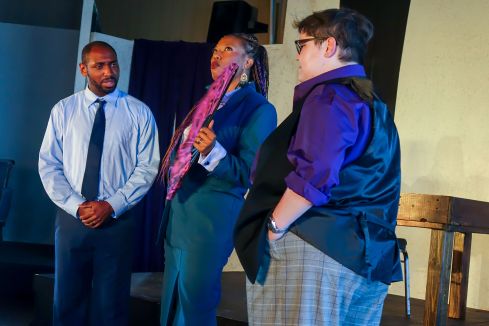
The curtain is finally going up in Charlotte on the works of playwright Qui Nyugen, the American son of Vietnamese parents who founded the Vampire Cowboys Theatre Company back in 2000. Soon afterwards, Nyugen’s brainchild transplanted from Ohio to Off-Broadway – where it became the first theatre company sponsored by NY Comic Con and the wellspring of “Geek Theatre.” Emphasizing sci-fi, stage combat, and gaming – with a biff! POW! comic book edge – Nyugen’s 2011 comedy-drama She Kills Monsters is typical of the breed.

Of course, the monsters are no more real onstage at The Arts Factory than they are in Dungeons & Dragons tabletop role playing. Try outlandish costumes, fantasy projections, and puppets.

So this co-production from Charlotte’s Off-Broadway and Women-In-Plays, directed by Sheri Marvin, is plenty of fun, much louder than it is fearsome. Yet there is a serious side to Agnes Evans’ quest for the Lost Soul of Athens in the fantasy realm of New Landia. Wresting the stolen Lost Soul from the fearsome five-headed Tiamat isn’t truly the crux of Agnes’s quest. Nor was it stolen, precisely, for we’re back in 1995, when demon overlord Orcus actually traded the soul for a neat TV/VCR combo.1

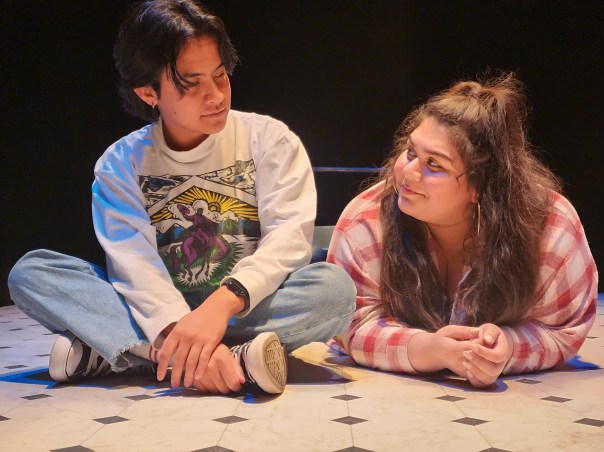
Agnes, a humdrum high-school English teacher, is on a quest to connect after losing her parents and her younger sister, Tillie, in a car accident. While preparing to liquidate her childhood home and move in with longtime boyfriend Miles, Agnes stumbles upon an unfinished Dungeons & Dragons module that Tillie has left behind – a first baby step toward realizing just how little she knew about her little sister while she was alive. Taking the module to Chuck, the notorious Dragon Master of Athens (Ohio), big sister learns that Tillie remains a D&D legend, revered as Tillius the Paladin in the gaming world.

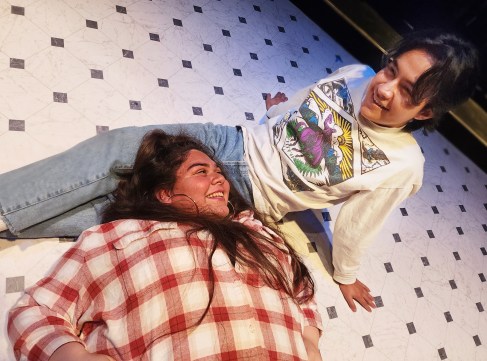
More humbling secrets lie ahead as Agnes enters the fantasy world of her sister’s legacy: Tillie was gay, and she was bullied at school – the school where Agnes teaches. Of course, live theatre heightens the impact of these revelations, thanks to some subtle nudging from Nyugen and a logical plot twist. Tillie is in the game as one of the companions who helps Agnes on her quest, and she’s a central character in the storyline. Nyugen enables Agnes to effortlessly converse with Tillius, who comes back to life during their adventures, giving the action hero a chance to vent the resentments she still feels toward her neglectful sister.6

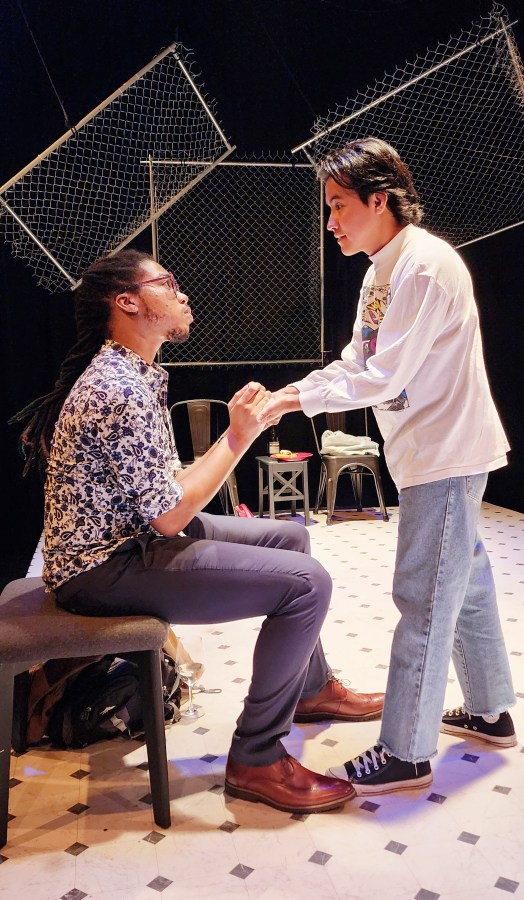
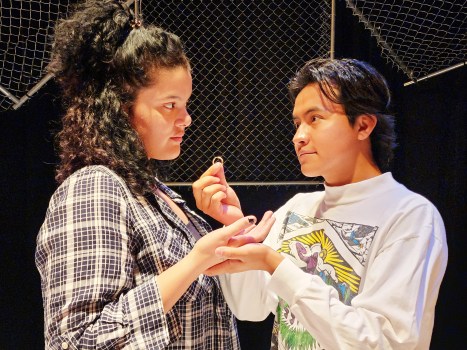
Friends of Tillie’s are in the storyline as well, along with Miles, who is cast as one the obstacles who must be slain if Agnes and her companions are to have their rendezvous with the five-headed Tiamat. So are the bullies, succubi named Evil Gabbi and Evil Tina, aliases that are not at all obscure. Of course, as Agnes shuttles between the role-playing D&D world and real life, she encounters all of Tillie’s companions – and enemies – at school.

And since the same actors portray the characters Tillie invented and the people they are modeled after, the difference between the fantasy world and the real world is largely erased, far more for us than Agnes, who is presumably encountering the tabletop D&D dramatis personae as plastic action figures.

If you can manage to take so much silliness seriously, you might descry a distinct vein of feminism in Marvin’s directing, for the men, when not merely annoying, consistently deliver their villainous vaunts at high volume. Kudos, then, to Nyugen as well for upending this traditionally masculine world of geekery. Needless to say, the real heavy lifting is done by our mostly female clan of heroic gladiators under the guidance of fight choreographer Katie Bearden and fight captain Nathan Morris, who moonlights as Dragon Master Chuck.5

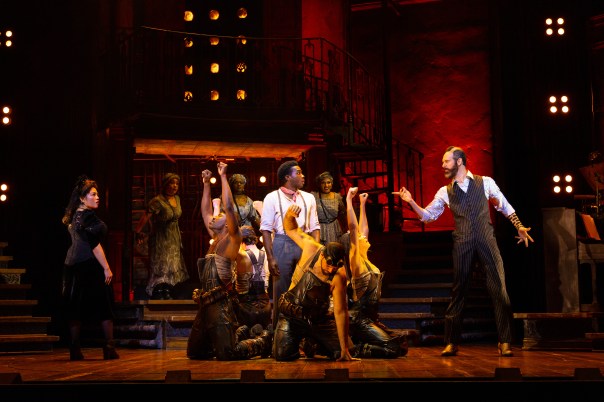
Lighting by Sean Kimbro decisively marks the borders between Agnes’ worlds. But the costumes by Ramsey Lyric enhance the fun and immerse us in Nyugen’s quirky fantasy. The tight leather action suit sported by Charlie Grass as Tillius, along with her dungeon war paint, instantly grabs our attention, the Viking war gear of her party dimly gleams its savagery, and the monkish cowl enveloping Morris as Chuck marks him as a mystic master of the dark D&D arts. Juxtaposed with these costumes, with Lyric’s fabrications representing New Landia outlandish ogres, and with his climactic Tiamat, Luna Mackie as Agnes looks rather humdrum in her functional everyday attire.

While Mackie is toughening as Agnes, Grass is softening as the resentful warrior sister, a gradual and graceful rapprochement overall with numerous bumps along the way, as Tillie drops one revelation after another. Mackie doesn’t immediately strike us as having much adventure queen potential, but her speedy transformation is nicely gauged – if you consider the difference between the learning curve of a board game and an apprenticeship for a black belt.

Rushed or not, Mackie’s metamorphosis is stunning: she absolutely rocks the role of Agnes the Asshatted. Yet there might be some in the audience who see Grass as playing the title role. They are that good, for we can see the softness and vulnerability behind the black leather and the black war paint as soon as they stride onto the scene. Their ferocity is a volatile mix of bellicose energy and pent-up resentment. There’s enough sincere force coming from Grass for Mackie to be genuinely shaken, so Agnes’s perseverance became authentic and ultimately admirable on opening night. For just a moment, the rapprochement of the sisters was rather moving for me.

Now we can get somber and sententious about the bullying and gender crises we witness here, but it’s back in 2011 when Nyugen writes his Vampire Cowboy romp and 1995 when he sets the action. So for Marvin and her cast, this is signal enough for outsized posturing from heroes and villains alike, epic declamations of WrestleMania proportions, mixed with the stereotypes and pettiness of a high school sitcom.9

While Mackie and Grass are admirably divided within, Caleb Hinkley as Miles gets to play two separate versions of the same person, big sister’s boyfriend that Tillie despises and the D&D distortion of him that Tillius can destroy. Kaeleigh Miller as Kelly and Kaliope, Joe Watson as Ronnie and Orcus, and Charlie Napier as Steve are also recognizably twin versions, real and imaginary, of the same people. For the evil succubi, Nevaeh Woolens as Tina and Michelle Strom as Gabbi, the gulf between reality and fantasy pointedly diminishes, for both are cheerleaders in Athens and New Landia – with bloodier tops and mouths as succubi.

10

Amari Rice may have the most lighthearted pair of roles as Vera, an incompetent guidance counselor in real life, and The Beholder, an appropriately short-lived enemy in New Landia. Easily the most poignant and affecting dual roles belong to Elizabeth Marvin. When we first meet her in New Landia, Marvin as Lilith is a horned demon queen who is Tillius’s closest companion, wielding a wicked battle axe, but in real life she is Lily, no boldness to her whatsoever, shyly denying any past relationship with Tillie, and likely in the closet.

Mostly bellowing, officiating, and narrating under his mystical hood as our Dungeon Master, Morris as Chuck subtly changes in the real high school world as he introduces Agnes to her late sister’s friends and tormentors. But learning the true-life identity of Tillius the Paladin, Chuck clearly sparks Agnes’s curiosity – and her epic D&D adventure – with his open, larger-than-life admiration. Under the radar, he is also learning about Tillie and Agnes as he presides over the elder sister’s D&D initiation.

In that respect, Chuck’s journey is the most like our own. Forget about Greek tragedy, and enjoy Geek theatre.

Kirkwood’s “The Children” Asks Hard Questions of Good, Smart, Caring People

Review: Three Bone Theatre Presents The Children

 By Perry Tannenbaum

The Children1

March 13, 2022, Charlotte, NC – Two retired nuclear physicists, a husband and wife both in their sixties, have taken up residence in a cozy coastal UK cottage, where they are visited without receiving prior notice by a former co-worker they haven’t seen in some 38 years, also in her sixties. These are the only characters we see in Lucy Kirkwood’s acclaimed drama, now playing at The Arts Factory in a taut Three Bone Theatre production – and I can’t say that any of the three physicists ever mentions his or her parents. Nor are there any flashback scenes in this 90-minute one-act that take us back four decades or more to when these over-the-hill atomic whizzes were young and previously together. So why exactly has Kirkwood called her dystopian drama The Children?The Cast of The Children

It’s the sort of question that rewards repeated asking as the plot proceeds and we learn more and more about the past that Hazel, Robin, and Rose have shared – and the daunting future ahead of them. There are a couple of substantial answers that gradually emerge, the subtler of these turning out to be personal and intimate. For the lives and careers of all three retirees have been shaped by past decisions to have or not to have children. More obvious, and more to the point, are the decisions that must soon be made in the wake of a disaster at the nuclear plant where all three of these physicists used to work, decisions that will impact not only their children, but also, locally and globally, the children – depending on how guilty, responsible, or obligated they feel.

We’re obviously dealing with a catastrophe on a scale equal to those at Chernobyl in 1986 and, even more pertinently with the earthquakes and tsunamis enfolded into Kirkwood’s concept, Fukushima in 2011, five years before the commissioned piece premiered in London. The cottage where Hazel and Robin are living is perilously close to the fenced-off area surrounding Ground Zero, which remains destabilized. Amid the brevity of Rose’s visit, Kirkwood manages to spread a veil of nebulosity over the extent and permanence of the damage inflicted by the catastrophe. There’s an ongoing rationing of food and electricity, but the couple’s isolation and their aversion to the Internet puts a lid on the info we get. Hazel and Robin are retired, yes. But in light of their isolation, ignorance, and apathy, we might also say – as Rose probably would – that they are resigned, not really thinking about how they might best use their remaining time.

Certainly, the cottage dwellers aren’t stressing over their culpability for the devastation that surrounds them when Rose intrudes. They would seem to be following Candide’s example at the end of Voltaire’s wicked, wicked novel, tending to their own gardens – or in Robin’s case, their fields, where he makes his daily escape before coming home to dine on Hazel’s homegrown salads. After 38 years, Hazel and Rose still have each other sized up rather well, Hazel knowing more about Rose’s attachment to her husband – and vice versa – than he would believe, and Rose knowing something about Robin’s wife that he never even suspected. As Kirkwood interweaves these personal revelations with the possible global crisis engulfing them, we began to understand how a group of nuclear physicists could have been blind for so long to the fiery red flags signaling so clearly to them that nuclear catastrophe was at hand. In their personal and professional lives, they have seriously miscalculated.The Children- Robin and Hazel

Directed by Three Bone co-founder Robin Tynes-Miller, with set design by Ryan Maloney and props by Jackie Hohenstein, this Charlotte premiere huddles the audience around the action in an intimate stadium layout like a miniaturized Circle in the Square on Broadway. The humble coziness of the setting, not at all contradicted by Davita Galloway’s costume designs, make this cottage look more rusticated than most production photos that come up on a Google search. Likewise, Lillie Ann Oden and Michael Harris have a more weathered look than the London and Broadway marrieds, as if they had aimed their portraiture toward farmers in their sixties or physicists in their seventies.

This rustic approach actually has some advantages, for Mitzi Corrigan as their visitor seems slightly younger, more active, more enlightened, and more modern than her hosts at first blush. She claims to have forewarned Hazel and Robin via email before appearing at their doorstep, and the laptop she is toting backs her up, looking out of place here in this back-to-basics abode. When it becomes apparent that Rose has been around the neighborhood for some time on her personal crusade, we cannot be surprised that this couple – steeped in stasis – has been unaware.The Children- Hazel and Rose

Another key thing that Tynes-Miller gets right, despite the longstanding hurts and grudges that will emerge among these former co-workers, is that all of them are good people, bonded together by the preventable tragedy that has broken them all. Oden has an edge to her as Hazel, dealing with the most guilts, savvy enough to be wary of Rose, yet the defensive chip on her shoulder is more like a light skillet held behind her back than a double-barrel shotgun dangling under her arm. She is polite, she is friendly, even loving, but you’ve got to coax it out of her now. As the former Don Juan of the nuclear plant, Harris mixes a shrunken amount of confident swagger into Robin and an occasional urge to dance into his prevailing disillusion, disappointment, and bitterness – with more to swallow heading his way. Beneath the crusty brooding, he’s tenderer, more considerate than his spouse, still sharp enough to be shocked and to make a quick decision.

Rose has had the most hurt to deal with over the years, yet Corrigan poured a sheen of insouciance and quiet purpose over her – until the old hurts and grudges spurted to the surface. She needed to be impressive in tamping down these emotions, with clear-eyed pragmatism and poise to succeed in her ultimate mission of persuasion. Or was it seduction that motivated her, as Hazel had good reason to suspect?The Children- Rose and Robin 1

Sadly, we cut all these people a hefty amount of slack because there is so much more than the overly hasty development of nuclear energy befouling our planet. Other industries are complicit in building a multitude of time bombs we constantly hear ticking around us, and many governments have dirty hands. Chernobyl and Fukushima have receded into the past, our gazes drawn to other filthy objects and humans. These ordinary people, for all the wrong they have done to each other, all the mess they have left for their children to clean up, are questioning whether they should continue sitting back, enjoying their retirement years, and doing absolutely nothing about it.

Maybe they’re the ones who should pitch in and help, despite the fact that no one person living in a toxic irradiated wasteland can even begin to turn the global tide. No, these fine actors are telling us as we look over their shoulders: many, many more ordinary people need to be doing the asking – and the acting.

Brooklyn Grace Receives a Classic Museum

Review: BNS Productions Presents The Colored Museum

By Perry Tannenbaum

CCC02899

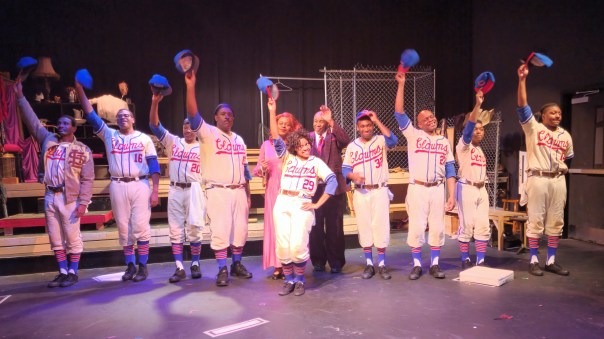
In every decade since it premiered Off-Broadway at the Public Theater in 1986, George C. Wolfe’s The Colored Museum has had a homegrown revival here in Charlotte. GM Productions premiered it up in the Attic Theatre at the old Afro-Am Cultural Center on 7th Street in 1993, and Carolina Actors Studio Theatre brought it to their C.A.S.T. location out in Plaza-Midwood ten years later. On Q Productions finally smuggled Wolfe’s 11 vignettes – or “exhibits” – into an Uptown site at Spirit Square in 2011.

Now BNS Productions has brought Colored Museum to its unlikeliest location, the Brooklyn Grace Venue, alias the Grace AME Zion Church on S Brevard Street. Each new revival more fully cements Wolfe’s satire as a classic – Winthrop U and UNC Charlotte have also chimed in with productions since 2009 – and each new resurrection that I see strikes me as fresh and hilarious as the first.

Of course, nothing compares with the edge and impact of your maiden encounter. Wolfe hurls a few choice barbs at white folk, mostly mocking their bland cruelty, but armed with an all-Black cast, it’s African-Americans and their culture that he assails with the most conspicuous gusto. All Colored Museum casts get to feast most hilariously on the sufferings and posturings of the Younger family in Lorraine Hansberry’s A Raisin in the Sun. Walter Lee’s wailings against “the man” in this “Last Mama-On-The-Couch Play” take a detour into Beau Willie Brown’s barbarity in Ntozake Shange’s for colored girls.CCC02756

Familiarity with those two stage gems helps you to savor Graham Williams, Sr.’s over-the-top brilliance as Walter-Lee-Beau-Willie, but his reappearance, immediately after intermission, as The Man only magnifies his triumph. For Wolfe delights especially in depicting the disfigurements that black people inflict upon themselves to survive and succeed in white America. The Kid, played by Jonathan Caldwell, must now disown and discard his Afro-comb, dashiki, autographed Stokely Carmichael photo, Afro-sheen, Jimi Hendrix and Sly Stone recordings, along with Eldridge Cleaver’s Soul on Ice – replaced, The Man tells him, by The Color Purple.

Black Power and protest must be tossed into the trashcan along with slavery if you wish to get to the top. The Kid is dismayed, incredulous, and beside himself when The Man reaches for… The Temptations Greatest Hits! Yes, if The Man is to feel totally comfortable in his black business suit and fully acclimate to white blandness, even “My Girl” must bite the dust.CCC02782

Women also get choice bits from Wolfe, beginning with Nasha Shandri as our prim stewardess, Miss Pat, welcoming us aboard Celebrity Slaveship and inviting us to fasten our shackles as we cross the Atlantic to Savannah. Dancing in the aisles seems to be allowed during our voyage – as long as we keep our shackles on – but “No drums!” Of course, we will get a bluesy cooking lesson from Sandra Thomas as Aunt Ethel, teaching us, with abundant historical ingredients, how to cook up “a batch of Negroes.” Uncanny Aunt Jemima resemblance here.

Shandri and Thomas both reappear in “The Last Mama-On-The-Couch,” with Thomas in the title role switching from cheery to grumpy and Shandri upbraiding Walter-Lee-Beau-Willie (and cataloguing her own sufferings) as Medea Jones, a subtle reminder that white folk are also known to drop babies from great heights. Most of this skit targets Raisin, of course, with Toi Aquila R.J. as Lady in Plaid serving as Shange’s leading Colored Girls emissary.

Meanwhile James Lee Walker, II, has a tasty role as our narrator, bestowing an Oscar-like statuette upon one actress after a heart-rending monologue and then ripping it out of her grasp when the next actress tops her.CCC02580

Walker has already topped himself as the regal, finger-snapping drag queen who imparts “The Gospel According to Miss Roj.” Revisiting Wolfe’s Museum, director Dee Abdullah limits herself to the crossdressing that’s in the script. In 2003, by contrast, Aunt Ethel and Last Mama were also done in drag. But Abdullah brings back Chris Thompson from the CAST production, so the West African choreography at Brooklyn Grace – and the forbidden drumming – have the same sparkle.CCC02717-1

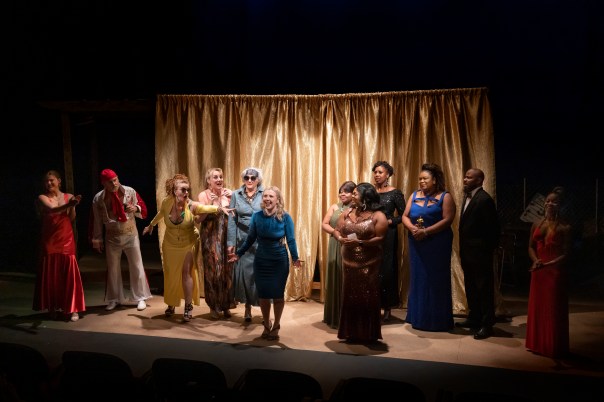
Acoustically, the Grace isn’t ideal for theatre, nor is the place outfitted for professional-grade lighting design. But Abdullah, Sandra Thomas, and Shacana Kimble compensate, teaming up for an admirable array of costumes, from the frumpiness of Last Mama to the imperious splendor of Roj – and on the other side of intermission, the voguish gown of LaLa Lamazing Grace, an expatriated Josephine Baker wannabe done with slaying disdain by Jess Johnson. Until her down-home roots are exposed.CCC02449

In “Hairpiece,” Shandri plays a woman who has literally burnt her roots. Or as Johnson puts it as LaWanda, “She done fried, dyed, and de-chemicalized her shit to death.” All to please the man that Shandri is now dumping. LaWanda is actually a talking wig stand, facing us on a makeup table (and presumably Shandri as well in a fourth-wall mirror). She’s debating whether her owner should be shaking her hot-pressed tresses back and forth when she irately gives her boyfriend the ax, or whether Janine, the Afro wig contemptuously advocated by LaTonya Lewis, should be the fearsome choice to make him shrivel.

While the wigs are debating whether Shandri is most powerful in her natural or chemicalized crown, it’s easy to forget the satirical barb that Wolfe has tossed toward the menfolk. The finally-dispensable boyfriend was a “political quick-change artist,” Janine dishes. Every time “he changed his ideology, she went and changed her hair to fit the occasion.”

Style is important, that’s for sure. Aside from Raisin, the most sacred cow that Wolfe takes down is Ebony Magazine, the barbershop bible of African-American life. Lewis and Williams are the supermodel couple of “The Photo Shoot” who have given away their lives to be beautiful and wear fabulous clothes month after month. Relentlessly smiling and feeling no pain.

Perhaps the wisest thing about Wolfe’s Museum – the good, the bad, the ugly, and the absurd – is that it’s simply there. Do with it as you wish.

“The ultimate questions from Wolfe apply with a fierce pertinence to all oppressed peoples,” I wrote in response to Abdullah’s 2003 production with CAST. “How do we carry the baggage of the past into the future without hampering and crippling ourselves? And how do we leave this baggage behind without discarding key parts of our culture, our heritage, and our identity? These grim questions go unanswered, but watching this energized ensemble wrestling with them will likely double you over with laughter.”

Can’t improve very much on those observations – unless I compress them for 2022 into Wolfe’s words. At the beginning of our journey and again at evening’s end, our stewardess, Miss Pat, tells us: “Before exiting, check the overhead as any baggage you don’t claim, we trash.”

That’s the key choice Wolfe aims to leave us with.

Weepy and Upbeat Church Singing at The Great Aunt Stella Center

Review: Theatre Charlotte’s Smoke on the Mountain

By Perry Tannenbaum

IMG_1248 

February 24, 2022, Charlotte, NC – There’s a bit of a Tar Heel tug-of-war going on between two small towns east of Charlotte, Mount Pleasant and Mount Olive, for the honor of having the best claim on being the site of Smoke on the Mountain, a homegrown musical that has maintained its popularity since 1988. Geographically, Mount Pleasant has the far stronger claim, due to its closer proximity to Charlotte, which is explicitly mentioned numerous times in the script, and because the Mount Pleasant Baptist Church is officially ordained as our setting in Connie Ray’s book.

Yet in terms of flavor, smell, and story in Alan Bailey’s original concept, Mount Olive and its famed pickle factory cannot be dismissed, for there are twin accidents near the pickle works that figure prominently in the opening scenario. Gawking at the gherkin spillage from the plant, the Sanders Family has tipped over its van and is therefore late in arriving to the church, where they are scheduled to lead a sing-along before a music-and-dance-averse congregation. Original musical arrangements were by Mark Craver, longtime member of the Red Clay Ramblers, and Mark Hardwick. Since both Craver and Ray hail from North Carolina, those roots run deep in the story and in the music.

Pastor Mervin Oglethorpe has invited the Sanders Family to sing at the Church in June 1938, part of his stealth campaign to lighten up – and modernize – his congregation, and the songs were chosen to evoke that era. “No Tears in Heaven” by Robert S. Arnold, for example, was written in 1935, and Albert E. Brumley’s “I’ll Fly Away” was penned in 1929. When Theatre Charlotte last presented this musical in 2010, they were able to build better scenery at their Queens Road than I had seen three years earlier at a Pineville Dinner Theater production. A fire at that barn in December 2020, however, has turned Theatre Charlotte’s 94th season into an extended road trip, stopping at various locations around the city.

If the company’s mid-December production of A Christmas Carol seemed more than a little dwarfed by Halton Theater on the campus of Central Piedmont Community College, the current location at The Great Aunt Stella Center could hardly be more ideal. With a full set of organ pipes upstage to frame the Sanderses and Pastor Oglethorpe, and with cushioned pews for the audience to sit in, The Great Aunt Stella hardly needs to pretend at all to be accepted as a church. In fact, we’re entitled to think that Auntie Stella determined the choice of Smoke on the Mountain rather than the other way around.

As stage director and music director, Kristin Graf Sakamoto has done a fine job in taking advantage of the venue – and of the cast, since she reports prevailing on members to pick up instruments they had never seen before. That certainly tamps down the bustle onstage I’ve seen in previous productions that were burdened with a house band and adds to the homespun authenticity of this Mountain. We may be a little confused and disoriented when the Sanders Family hurriedly makes their belated arrival, for all of their instruments are already onstage – guitars, bass, mandolin, and assorted percussion instruments.

June Sanders is the first to arrive as Pastor Oglethorpe stalls for time. Emily Nageotte does a fine job in giving us the comical pickle catastrophe backstory, explaining her parents’ and siblings’ delay while portraying herself as the odd duck in the family. Instead of singing with them, she will sign for the deaf – whether or not there are hearing-impaired people in the audience. Eventually, June will sometimes make more noise than other members of the family as, one by one, she removes a wacky assortment of percussion instruments – including washboard, spoons, and cowbells – from their hiding places during the course of the concert.IMG_1551

We’re in a church, so the evening’s program turns out to be a mix of homespun musicmaking and spontaneous testifying. As you might suspect, the Sanderses are a rusticated bunch, so a backwoods Mayberry shyness befits them all – with the exception of Liz Waller as Vera, the mama, affecting something close to a Minnie Pearl effervescence. Now there was also a proud and ornery side to Vera when her views didn’t coincide with Pastor Oglethorpe’s. Instead of coming to blows, they hurled Bible quotes at each other, citing chapter and verse for extra emphasis. Fretting with all kinds of picayune worries, Stuart Spencer as Oglethorpe keeps a perpetual crackle of tension in the air, heightened when his scriptural erudition is disputed, released only when he yields to the music. At first, he merely sings along at the top of his lungs, but when the spirit truly hits, he runs back to a cloakroom and fetches a harmonica.

The friction between the pastor and the Sanders Family (his singing contributions aren’t received enthusiastically), especially Vera, make for a needed dramatic undercurrent to spice up the singing and testifying until the hubbub that brings on our intermission. Burl, the genial patriarch of the family, seemed to be the peacemaker in Mike Cheek’s papa-bear portrayal, loyal to his wife Vera and all their cubs. It’s his brother Stanley, the black sheep of the family, who stomps out of the hall in a huff, and it’s Burl who must coax him to return.IMG_1728

After this kerfuffle, while Pastor O is having a couple of words with the Sanders girls, the stage is set for the most dramatic testimony of the night, when the wayward Stanley returns. Apparently the only Sanders to have tasted the fermented fruit of the vine or the distillery, Jake Yara is wonderfully quiet and penitent in Stanley’s testimony, humbled yet not shamed. His earnest confessional seemed to spur Molly Neal as Denise, the younger Sanders twin, to unburden her heart and reveal that she had once run away from home – to Charlotte! – in a poignant tale of teen heartbreak. Neal upstaged her younger twin with her abortive foray into showbiz, but Gray Ryan as Dennis had a simpler, more comical testimony, aspiring to fulfill the calling of a preacher despite his terror of public speaking.

The acoustics at Great Aunt Stella are better for music than theatre, so it’s fortunate that Sakamoto placed such a high premium on the voices in her cast delivering the two dozen songs we hear. Backup vocals are as meticulously rehearsed as harmonies, and the instrumental performances are quite serviceable. Some might prefer the weepy and morbid repertoire like “Meet Mother in the Skies,” “Everyone Home but Me,” and “Whispering Hope.” Among these Christian hits, I’ll take the quirky and the upbeat any day. Give me more like “Christian Cowboy,” “I Wouldn’t Take Nothing for My Journey Now,” “Angel Band,” “I’ll Fly Away,” and “I’m Using My Bible for a Roadmap.”

The Young Jewish Girl Who Became a Post-War Icon

Review: The Diary of Anne Frank @ Central Piedmont

By Perry Tannenbaum

The Diary of Anne Frank 

You can sneer and call her the poster child of the Holocaust, or you can marvel at how she continues to be a lightning rod. But 77 years after the last words of her secret diary were written, followed by her death at the Bergen-Belsen concentration camp six months later, nobody can say that Anne Frank has been forgotten – or that she will be in the foreseeable future.

A recent segment on 60 Minutes was devoted to solving the mystery of who betrayed her and her family to the Gestapo in early August 1944 after two years of hiding in the famed “Secret Annex” in Amsterdam. Managing to make even more of an ass of himself than we thought possible, anti-vaxxer Robert F. Kennedy Jr. somehow turned the 13-year-old Dutch immigrant into a talking point, comparing rules enforcing COVID vaccinations to the tyranny of Hitler’s Germany.

“You could cross the Alps to go to Switzerland,” he said of those threatened by the Nazis. “You could hide in an attic, as Anne Frank did.”

Before people had to worry about COVID and those pesky vaccines, the Anne Frank House, where the “Secret Annex” is preserved, attracted well over a million visitors every year.

So with Holocaust survivors thinning out, living memories of the Third Reich growing dim, and misinformation metastasizing, is the time ripe for dusting off and re-examining The Diary of Anne Frank? It has been done before. First published in 1950 and translated into English in 1952, The Diary of a Young Girl premiered on Broadway with its more familiar title in a Pulitzer Prize-winning adaptation by Frances Goodrich and Albert Hackett in 1955. The rebranding stuck after the film, directed on by George Stevens, won the Oscar and Golden Globes for Best Picture in 1960.

All of those originals have been edited, retranslated, or updated – many times, in the case of new graphic novels, children’s book abridgements, TV versions, and movie takes.

But Anne’s text, assembled by Otto Frank from multiple handwritten manuscripts, has only been re-edited a couple of times, once in a critical edition by the Netherlands State Institute for War Documentation in 1989 (revised in 2003), and once revisited by Anne’s father in 1993. The Goodrich-Hackett drama has only been overhauled once, by Wendy Kesselman, in a newly adapted version that opened on Broadway in late 1997.

That’s the version we’re seeing now at Halton Theater in a Central Piedmont Theatre presentation directed by Marilyn Carter. Since 2008, when I reviewed this new adaptation at Theatre Charlotte, it has become the Metrolina standard, with subsequent productions by Matthews Playhouse in 2010 and Davidson Community Players in 2018.

While the Halton isn’t as ideally sized for Anne Frank as Theatre Charlotte or the old Morehead Street location of Children’s Theatre, whose 1996 production remains the Queen City’s gold standard, set designer Robert T. Croghan doesn’t make the mistake of either glamorizing the Annex or expanding it to fill out the capacious stage. Amazingly, the compacted set has four levels without looking at all posh. Yet as we must peer over an unused orchestra pit that becomes a moat between the audience and the stage, our eagerness for a new CP venue, replacing old demolished Pease Auditorium, becomes all the keener.

We won’t have to wait long. They’re promising a spring unveiling.The Diary of Anne Frank

Strikingly fresh and radically different still don’t describe the revamped script, which hit me like it did in 2008 at the Queens Road barn – after previously seeing the original in Charlotte no fewer than three times. Yes, there are substantial differences, some of them welcome improvements and some curiously out of focus if you already know and love the original movie. Some of the signature moments, like Mr. Dussel’s comedy, have dropped out of sight. But the dramatic highlights are pretty much the same as always.The Diary of Anne Frank

What Kesselman has chiefly refreshed is the Holocaust context, deepening it with more frequent references while providing more extensive portrayals of Dussel, the Franks, and the Van Daans as Jews. Carter has Josh Logsdon as the dentist Dussel wearing a tallis and singing a traditional Hebrew prayer. Subsequently, we get pretty good pronunciation from Hannah Sidranski and Summer Schroter as the Frank sisters when they sing the “Maoz Tsur” after the Chanukah blessing.

The most sensible and gratifying change that Kesselman made was upgrading the presence of Otto Frank, who had become a more renowned public figure during the 42 years following the first Broadway premiere of The Diary. It makes a big difference that he no longer greets us at the beginning, discovering the red plaid diary onstage and ushering us into its imperishable contents. Instead of that prologue, Arthur Lightbody as Otto presides over an epilogue, where he can not only reclaim the abandoned diary but also disclose the fates of all the characters we have come to know over the previous 90+ minutes.

Considering how brutally sudden the Gestapo raid is in this newer script, I’ve found that Otto’s return is oddly helpful in processing the final moments of this little makeshift Jewish community. This is a more spasmodic and sobering narrative, less sensitive and romantic in depicting Anne. Sidranski is more energetic, brainy, and immature as Anne. Words gushed out of her so quickly on opening night that we often had only a vague idea what she was saying. At first, I hoped that Sidranski might soon slow down to evince her maturation during her two years in hiding.

That’s not how Kesselman and Carter seem to be thinking. It’s easier to see moodiness among these families than to see any of them evolving. They’re chafing under the restrictions of their survival mode, that’s for sure, and with the passage of time, we’re getting to know them better – and so are they.

Carter also seems to have spearheaded a rethink on Halton’s chronic audio woes. The setup of mics now dangling down from the flyloft yields far clearer – and continuous – sound amplification than we’ve heard in the past, though differences in levels could be detected, especially upstairs on the set, when actors were more directly under the mics.

Adults in the cast were projecting more consistently than the youths, easier to follow overall. But everyone is believable. Croghan’s costume design is as impeccable as his set, and Carter’s casting is always spot-on. Lightbody radiates a leader’s calm and quiet dignity as Otto, oozing warmth toward the youngsters, especially his favorite Anne, and seeming to take the long view while everyone else is caught up in the moment. By contrast, Rebecca Kirby gives us a sterner portrait of Anne’s mother, Edith, not adjusting well to the protracted confinement and never sunny enough to be called bi-polar.

You may feel otherwise about Poppy Pritchett and her flamboyant turn as Mrs. Van Daan, fetishizing her fur coat, worrying herself over what Anne might be writing about her, and flapping her protective wings around her ravenous husband when she isn’t berating him. On the other hand, Daniel Keith keeps a remarkably even keel in excelling as Mr. Van Daan, Otto’s one-time benefactor, perpetually in quest of respect always winding up as the hydrant of the underdog.

The Diary of Anne FrankMalychia Abudu-Clark and Zach Humphrey come by infrequently, essential buffers between the Secret Annex and the Gestapo, delivering needed supplies and news from the outside, never staying long enough to remove their outerwear. That would be risky for a Dutch national harboring Jews. They best demonstrate their caring when they urge the Franks and the Van Daans to accept Mr. Dussel into their company – and it is here that Lightbody is most impressive in his authority as Otto in waving aside all objections.

No doubt about it, Logsdon changes the vibe when he enters as Dussel. For the first time in months, the Franks and the Van Daans get the grim news of what’s happening elsewhere in the Jewish community. About the merciless Nazi raids. About the transports. At the same time, he’s disturbing the settled sleeping arrangements of the Franks and, moving in with Anne, disturbing the budding adolescent’s privacy and social life while consigning Margot, the older sister, to bunking with Mom and Dad.

The Diary of Anne FrankThere is friction between the roommates across the generational divide, but Logsdon never shrinks from it, frankly outraged when Anne wakens him suddenly, shrieking from her latest nightmare. Yet he is an elite force, reveling in Dussel’s standing as household cantor and tooth extractor, not quite as unflappable as Otto because he never has to take charge.

Margot is rather bland compared to her little diva sister, so Dussel’s arrival is rather fortunate for Schroter in playing the role, for she can proceed to establish herself as the family’s good sport, accepting her altered sleeping arrangements to start with and Anne’s intimacy with young Peter later on. Better yet, Margot is one of the two young people, along with Michael Swinney as Peter, that Anne can open up to when she’s ready for more mature conversations.

These conversations – less obnoxious, overamped, and impulsive than those she has with her elders – help to calm Sidranski down a bit as Anne and show herself off at her best. Huddled downstairs in Anne’s bedroom instead of upstairs where Peter resides and gets his private moments with our diarist, Schroter has the advantage over Swinney in being closer to the audience and more readily audible.

Of course, we strain harder to hear Peter’s precious conversations with Anne, thinking they will probably be the happiest she ever has.

Amend or Discard? We, the People, Decide

Review: What the Constitution Means to Me

By Perry Tannenbaum

Cassie Beck in the North American Tour of What The Constitution Means To Me - Photo by Joan Marcus (10)

Charm and wit can help you con your way onto a debating team when you’re a teen, but when you’re competing in front of a panel of sober academic judges, you’ll find that diligent study, ready knowledge, and sharp argumentation will be far more decisive in achieving victory. I learned this lesson the hard way, anchoring a senior class team of wiseguys that was ignominiously defeated by a squad of lowly sophomore nerds in front of a full high school assembly.

Lessons learned leaning over a chessboard or declaiming from a lectern can be every bit as brutal as those learned on a baseball diamond, a hockey rink, or the gridiron. While the excitement of sports makes for better action movies or TV, shows like Chess and The 25th Annual Putnam County Spelling Bee demonstrate that cerebral competitions are better suited for live theatre.Cassie Beck in the North American Tour of What The Constitution Means To Me - Photo by Joan Marcus (7)

But such shows are few and far between. That’s one small reason why What the Constitution Means to Me is so fresh and welcome right now. Written by Heidi Schreck as a chronicle of her experiences as a US Constitution debater when she was a teen – with a sharp re-evaluation of her relationship with that seminal document today – What the Constitution’s finishing touches dovetailed with the rise of the #MeToo movement, its first two productions straddling the Harvey Weinstein uproar in 2017.

By the time the show opened Off-Broadway in 2018, Judge Brett Kavanaugh was dominating the headlines, adding another layer of timeliness.

We need to look back to the Democratic National Convention of 2016 as a more probable inspiration for Schreck’s reassessment. That’s when Khizr Khan, the Muslim father of a U.S. Army Captain who was killed serving in Iraq, waved a pocket edition of America’s foundational document and pointedly asked the newly anointed Republican candidate for president, “Have you even read the United States Constitution?”

Overnight, that little pocket book became a bestseller.

Schreck’s play, now at Knight Theater, is largely a one-woman performance until its exciting and invigorating ending. It isn’t simply a reprise of 15-year-old Heidi’s breathless panegyric to the genius of our Founding Fathers, for even then, when she was earning college scholarship money at American Legion contests around the country, Schreck needed to be original and analytical in her presentations.

Older and wiser, Schreck could look back on her teenage debating years – and on our Constitution – with a more critical eye. Schreck, starring in both the Off-Broadway and Broadway productions, could play both Heidis onstage, the teen and the playwright. As the teen, she could be credulous, enthusiastic, awkward, naïve, and precocious. As the playwright, Schreck can playfully mock her younger self, or interrupt her and point out her quirks. Sharper still, she can not only take a more feminist view of the Constitution, she can flout the authority of the American Legionnaire who emcees young Heidi’s performance, strictly timekeeping her every utterance, and quizzing her on the 14th Amendment.

After all, unless the playwright gives him lines, the poor Legionnaire cannot respond to Heidi’s barbs.

The playfulness of Schreck’s concept nicely counterbalances its seriousness, for her feminist critique centers on her female ancestors – beginning with the immigration of her German great-grandmother to Washington State, purchased from a mail order catalog – and the abuse their husbands could inflict upon them with total impunity. Scenic designer Rachel Hauck’s paneled interior for the Legion Post, where Heidi will relive her debating exploits, unmistakably preps us for the assault to come.Cassie Beck in the North American Tour of What The Constitution Means To Me - Photo by Joan Marcus (5)

From wall to wall, hardly a gap between them, those panels are lined with the headshots of uniformed Armed Services veterans. You could say those photos – and the one thing they have in common – personify what the Constitution means to Schreck. In this legion, four long rows of photos, there is not one woman or one person of color. Our Constitution was written by white males, many of them slaveholders, to codify the rights, privileges, and citizenship of white males – including slave ownership – with the tacit or explicit exclusion of everyone else.

The exclusivity of the US Constitution doubly impacted the immigration of Schreck’s great-grandmother in 1879, who was committed to an asylum for “melancholia” and died at age 36. You see, the “shortage” of women that partially justified her great-grandfather in shopping for a bride was the result of Native American women no longer qualifying as American.

Looping in and out of her various guises, Cassie Beck as the Heidis of the touring production applies a thin gloss to her portrayal of teen Heidi, slightly exaggerated and visibly “acting” for brief moments and slyly self-aware at others. Our encounters with teen Heidi, often punctuated by adult Heidi interjections, are presented in two parts. First, there’s the formal essay comparing the Constitution to a crucible, reconstructed from memory because her proud mother inexplicably lost the original.Cassie Beck and Mike Iveson in the North American Tour of What The Constitution Means To Me - Photo by Joan Marcus

In the next stage, young Heidi picks a random Amendment out of a coffee can, written on a slip of paper, and is quizzed on it. Ushers hand out copies of the Constitution at this point, enhancing our involvement and excitement. She always draws the 14th Amendment and its multiple articles, so here the interaction between Heidi and the Legionnaire, a stodgy and pallid vet in Gabriel Marin’s meticulous portrayal, becomes more intense and entertaining. For here amid the question-and-answer volleys, young Heidi is often supplanted by adult Heidi, flouting the Legionnaire’s authority and steamrolling his prissy time limits – giving this one white male a taste of being bossed and oppressed.

Afterwards, we were done with young Heidi, and both Beck and Marin got the chance to step out of character and be themselves. Marin’s transformation, taking off his Legion hat, offered more contrast, but Beck’s relaxed confidence, talking about herself and how she became acquainted with Schreck – and how she empathized – augured well for the final segment of the show, where she’s called upon to be even more spontaneous and to interact with us.Cassie Beck and Jocelyn Shek in the North American Tour of WHAT THE CONSTITUTION MEANS TO ME - Photo by Joan Marcus

Depending on the performance you attend, Jocelyn Shek or Emilyn Toffler will stride forward to debate the following proposition: The United States Constitution Should Be Abolished. Each night, a coin toss will determine which side of the issue the participants will argue. Shek, who argued for keeping the Constitution, was a different breed of high-schooler than the Heidi we had seen, a little less high-energy, more focus, and abundant self-assurance.

By this time, adult Heidi has sufficiently faulted our Constitution to nearly make the debate over the future of this venerated document a fair fight. But every night, the audience decides which of the two debaters is the winner. How this happens I will not divulge, but I will say that I’m convinced this segment should more fully demonstrate how an imperfect participatory democracy really works.

Obviously, the primacy of our Constitution has been enhanced by last year’s bloody January 6 insurrection, compounding the relevance of Schreck’s script after it was already a 2019 Pulitzer Prize finalist. With its testimonies from the two actors, with its nightly debate, including a rapidfire Q&A when the debaters shot questions at each other contributed by a previous audience, Schreck has provided room for her show to breathe and flow along with the tide of changing events. Like the US Constitution.

As a framer of her own show, Schreck has clearly had more fun than the more famous framers did at the Constitutional Convention in 1787. So will you.

The Road Gets Bumpy, but Theatre Charlotte’s “Christmas Carol” Prevails at CP

Review: A Christmas Carol at Halton Theater

 By Perry Tannenbaum

IMG_9668

Almost a year ago, fire struck the Theatre Charlotte building on Queens Road, gouging a sizable trench in its auditorium and destroying its electrical equipment. Repairs and renovations will hopefully be completed in time for the launch of the company’s 95th season next fall, but meanwhile, actors, directors, designers, and technicians are soldiering on at various venues for 2021-22, their year of exile cheerfully branded as “The Road Trip Season Tour.” Ironically enough, Theatre Charlotte’s Season 94 began in September with a downsized musical, The Fantasticks, at the Palmer Building, a facility that once served as a training ground for firefighters. For their 14th production of A Christmas Carol, Theatre Charlotte has moved along to Halton Theater, the permanent home of Central Piedmont Theatre.

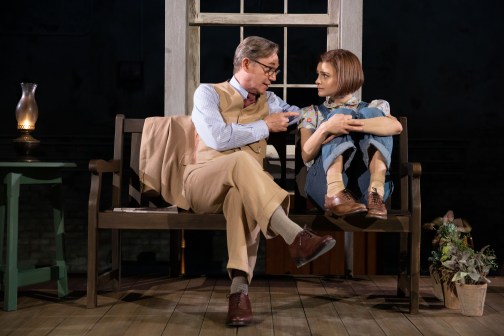
Timing is a bit awkward on the campus of Central Piedmont Community College, where a new theater that will be friendlier to dramatic productions – replacing the demolished Pease Auditorium – is slated to open in April with The Diary of Anne Frank. Graced with a generous orchestra pit, the Halton is more hospitable to big splashy musicals (when its sound system responds favorably to our crossed fingers). In fact, this transplanted production of A Christmas Carol, in Julius Arthur Leonard’s adaptation of Charles Dickens’ iconic novella, reminds us how well-suited the old “Queens Road barn” was for such spooky and creepy fare. Not only were the ghosts of Christmases Past, Present, and Future at home there, but so were such confections as Arsenic and Old Lace, Assassins, Blithe Spirit, and To Kill a Mockingbird. The Halton occasionally seemed oversized when You Can’t Take It With You took up residence there at the beginning of Central Piedmont’s current season, and you can imagine how their spectacular 2015 Phantom of the Opera emphasized the grandness of Andy Lloyd Webber’s grand guignol.

Encountering the vastness of the Halton in transplanting Theatre Charlotte’s cozy Christmas Carol, director Jill Bloede has been characteristically resourceful in executing its many daunting scene changes. At times, we could see cast members whisking set pieces off to the wings in a smooth out-with-the-old, in-with-the-new routine. But there were occasions when changes of scenery necessitated a complete closing and reopening of the stage curtains. Veiling the tediousness of that maneuver, Bloede has summoned repeated parades of a small band of merry carolers, coached by Jim Eddings, to cross the stage while the curtains are closed – so you would probably be right in thinking there are more carols sung this year than in Christmases past on Queens Road. My welcome for the carolers on opening night veered toward the unredeemed Ebenezer Scrooge’s grumpy attitude as the evening progressed, yet opening night is destined to be enshrined in Theatre Charlotte lore as the night of the infamous doorknocker scene fiasco.

One of the first indications that Scrooge’s house will be haunted, after a ghostly “Ebenezer Scrooge!” exclamation blows in on the Halton’s sound system, is the brief scene at the threshold to Ebenezer’s home. Here is where Scrooge sees a fleeting glimpse of his deceased partner, Jacob Marley, bringing his doorknocker to life. The precision needed to carry off such a simple scene only became apparent when it went awry. Either the Halton curtains were tardy in arriving at their centerstage spots, where they would fully frame Scrooge’s front door, or the actor who was to lurk unseen behind that door arrived early – and was very clearly seen, garishly aglow. Portraying Scrooge, Hank West seemed sufficiently poised to extemporize while the stage curtains and the lurking Marley came into proper alignment. But the carolers took their cue and entered before West could properly proceed, and the panicked actor behind the door fled. West finished out the brief scene as well he could without any eerie lights beaming through the doorknocker, but the special effect was lost – the only real reason for that scene.

Legions of Theatre Charlotte veterans – and new initiates in years to come – will no doubt keep the memory of this snafu alive for generations, heartily laughing all the more at the incident because it didn’t typify the production. Scenic design by Chris Timmons and lighting by Gordon Olson didn’t expand quite enough to comfortably acclimate at the Halton, nor did the company splurge on smoke or fog effects during its financial woes, which might have deepened the spell of the spookier Marley and graveyard scenes. Don’t expect any snow to flutter down on the vast Halton acreage, either. With balmy temperatures likely to prevail throughout the opening weekend, it’s Beth Killion’s set of period costumes that most successfully instill a chill into the air.IMG_8525

We’ve seen some of this cast before, notably West as Scrooge, Chip Bradley as Christmas Present, and Mary Lynn Bain doubling as Fred’s wife Elizabeth in the present and Belle, Scrooge’s old flame, in the flashbacks. All of these enlarge on their past performances to some extent, maybe West most of all. His meanness is more startling in person than it was in last year’s video version, streamed online, and his sorrow and penitence are also magnified. The graceful arc of Scrooge’s redemption is only slightly bumpier this year with West’s adjustments to the new space, Bloede’s script edits for this intermission-free edition, and a body mic. Projected into a larger hall, Scrooge’s newly minted intentions needed to sound more like settled resolves and less like agonized pleas. Bradley enlarges to a similar degree upon Present’s outsized cheer, the more the merrier in his case – until he issues his climactic admonitions, now sharper in their contrast. Bain seems most content to let her mic do her amplification, but she is stronger this year in the climactic flashback scene when she returns Ebenezer’s engagement ring.IMG_8694_dcoston

All the newcomers to TC’s Carol are quite fine, a testament to Bloede’s ability to attract talent when she holds auditions. In contrast with the veiled youthful mystery of Anna McCarty last year, Suzanne Newsom brought a nostalgic melancholy to the Ghost of Christmas Past that was quite affecting in its serenity, while Mike Corrigan appeared for the first time as Bob Cratchit – very different with his more muted brand of meekness from Andrea King last year but no less kindly or comical. For richer or poorer, Josh Logsdon and Rebecca Kirby were a fine pairing for the Fezziwigs, Aedan Coughlin doubled well as Young Ebenezer and Ghost of Christmas Future, and Riley Smith brought all the optimism needed for the sanctity of Tiny Tim. With Mitzi Corrigan and Emma Corrigan on board as Mrs. Cratchit and daughter Belinda, there’s plenty of family authenticity around the humble Cratchit hearth – or there will be when Mitzi returns from personal leave due to a death in her real family. Vanessa Davis spelled ably for Corrigan as Mrs. Cratchit at the premiere performance, augmenting her regular role as Mrs. Dilbur.

Assuming that Thom Tonetti was already in character as Jacob Marley during the notorious doorknocker scene, I’ll say his opening night adventures most typified the Theatre Charlotte crew’s tribulations in acclimating to a new space. Marley’s entrance into Scrooge’s home wasn’t dramatized with smoke and lights, and Tonetti didn’t enjoy the benefit of having his prophecies and imprecations magnified with thunderous jolts from the soundboard. During the flashbacks, the actor certainly earned some sort of sportsmanship award, appearing as the younger Jacob opposite the truly younger Coughlin.IMG_8645_dcoston

Steadying this production and assuring that its professional polish never deteriorated into community theatre chaos for long, West ultimately triumphed over all missteps and obstacles, bringing us the compelling Scrooge we expect in all his goodness. It’s still a strong story, and 24 of its most ardent Theatre Charlotte believers are moonlighting at Central Piedmont, giving this 87-minute production the old college try. A drama within a drama, to be sure, both ending happily.

Originally published on 12/18 at CVNC.org

New Techni-Colorful “Velveteen Rabbit” Struggles to Retain Its Aching Soul

Review: The Velveteen Rabbit at ImaginOn

 By Perry Tannenbaum

2122 The Velveteen Rabbit

Beginning with a musical version in 1992, I’ve now seen at least eight productions of The Velveteen Rabbit at Children’s Theatre of Charlotte, four at their former location on Morehead Street and four at their pioneering ImaginOn facility near Seventh Street Station. Scott Davidson’s dramatic adaptation of Margery Williams’ classic 1922 book, long a mainstay at Children’s Theatre after the musical version was discreetly discarded, was actually the first show staged in the smaller theater, now named the Wells Fargo Playhouse, when ImaginOn opened in 2005.

The company’s 2021 edition of the story, arguably more relevant for children in the midst of a pandemic, takes us in new directions – with a new stage adaptation by Michelle Hoppe-Long, CTC’s director of education. Hoppe-Long’s Rabbit hopped from page to screen last December with a different cast, a worldwide debut that was still viewable online back in March. Now it’s in its premiere live run.

Over the years, CTC’s Rabbit is likely the company’s most widely-known piece, since it has often travelled across the state in pint-sized portable productions with its travelling troupe, known once upon a time as the Tarradiddle Players. So perhaps the biggest shift between the former Rabbit and the new one is only becoming obvious now, as the ImaginOn staging leaps from the Wells Fargo to the larger McColl Family Theatre. Logically enough, Andrew Gibbon’s scenic design concept has discarded the simple, drab, intimate, and pastel look of the vagabond Rabbit in favor of a sweeping, eye-popping, and technically dazzling spectacle, abetted by Robyn Warfield’s bold lighting design. These flamboyant Disney fantasy elements are offset by Magda Guichard’s earthbound costume and puppet designs.2122 The Velveteen Rabbit

That same tension between imaginative extravagance and minimalist simplicity is evident in Hoppe-Long’s script and Melissa Ohlman-Roberge’s stage direction. These discordant elements may be viewed as indecision, but it seemed to me that this new hourlong Velveteen Rabbit was consistently plagued with wrong, illogical, and perverse decisions. Most incomprehensible and disastrous was the transformation of the title character from a woman in an outsized bunny suit into a puppet, visibly wielded by an actress bravely striving to deflect attention away from herself.

Why reduce the size, expressiveness, personality, and lovability of your lead character in transit from a small venue to a larger one? Portraying the Rabbit by proxy, Margaret Dalton never gets the chance to equal the exploits of Claire Whitworth-Helm, Lesley Giles, and Nikki Adkins, past greats in the role. And Dalton must also moonlight, without changing her costume, as the household Nana! Occasionally, Dalton’s double duties became awkward and confusing, if not cringeworthy.2122 The Velveteen Rabbit

In a story about a boy’s toy aspiring to become real, all of this wrongheaded simplification makes it more difficult for toddlers to see that the Velveteen Rabbit is real – and for them to empathize with its aspirations. A whole franchise of Toy Story films is descended from Williams’ story, but Hoppe-Long and Ohlman-Roberge not only change the Old Skin Horse to a less cuddly Rocking Horse, they eliminate or downgrade all the toys and real rabbits that torment our protagonist. These abridgements of the Velveteen Rabbit’s world seemed to compound the audience’s struggle to empathize with her – it certainly compounded mine – because we never felt her pain keenly. And when the family Doctor was also removed from the cast, the Boy’s tribulations were also muted at the dramatic climax when he fell sick. Yes, even the size of the cast was smaller at this bigger venue.2122 The Velveteen Rabbit

Ironically, simplifying and purifying the Boy also diverts our attention away from the Rabbit. More human stupidity and callousness from Lexie Wolfe as the Boy would have reminded us that the Rabbit should be our primary concern, though she does underscore those moments when the Boy disregards his cherished toy. Surrounded by such Technicolor splendor, it’s hard for Wolfe to break through and impress upon us that the Boy is not completely wholesome – and that his life before he falls ill is not totally idyllic. Instead, Wolfe diverts us with her charm as the Boy roams about with the Rabbit, pretending to be a warrior and pirate while immersing his cuddly toy in his fantasies.

This is the most vivid magic we get, yet Hoppe-Long has contrived to add a little more magic to the Williams yarn, expanding the role of the nursery magic Fairy. The sudden blooming of her presence in the midst of the Velveteen Rabbit’s most extreme desolation is beautifully conceived and splendidly staged, with Reneé Welsh-Noel’s lithe dancing skills adding to the wonder. Yet this new adaptation drops the Fairy into the beginning and middle of the story, where she has never appeared before, somewhat blunting the surprise of her climactic deus ex machina appearance at the end.2122 The Velveteen Rabbit

Welsh-Noel also moonlights as the Rocking Horse and the Boy’s distant but understanding Mom. There’s a delightful surprise cameo at the end of the show, buried in the playbill credits, when stunt rabbit Brambles replaces the puppet protagonist. Parents and toddlers can decide for themselves whether a live rabbit that must be protectively caged at odd intervals – to prevent it from romping around forever in the audience – enhances or diminishes the nursery magic. For me, it was cute at first, but the benefits didn’t last.

Originally published on 12/6 at CVNC.org

Sensory-Friendly Theatre, or “How can I help you be you?”

Preview: Tropical Secrets: Holocaust Refugees in Cuba

By Perry Tannenbaum

2021~Ilana Visits-02

Tyler made a surprising and daring decision at ImaginOn before attending the Sunday matinee of My Wonderful Birthday Suit. His mom, Ilana, had been sure that Tyler would want to wear noise-cancelling headphones at the performance, so I had to assure her that Children’s Theatre would be offering them prior to the show. Otherwise, she would need to pack his set of phones before they flew in from El Paso and make sure he had them when they left their hotel.

But Tyler refused the headphones that were available – in a really cool variety of colors, it should be mentioned – at the entrance of McColl Family Theatre. Instead, he chose a day-glo green worm, about eight inches long, from a wide array of fidgets and weighted cuddles on display. His younger sister, Brynn, chose a spotted little Dalmatian doggie that weighed five pounds. More surprises.2021~Sensory Friendly Theatre-01

Tyler had to live with his choice. Now when Oobladee and Oobladah, best friends on this side of Moonbeam, started blowing up balloons for the surprise birthday party they were planning for Shebopshebe, Oobladee’s bestie from the other side of Moonbeam… Tyler covered his ears with both hands, dreading the moment when a balloon would suddenly explode.

Yet he didn’t cower or turn away. He didn’t run for cover. His beautiful blue eyes remained glued to the stage.2021~Sensory Friendly Theatre-12

I was sure that none of the balloons would explode. Even if I hadn’t seen this show before, I could see that, sitting in front of the stage, “Tree” (resident teaching artist Kaitlin Gentry) hadn’t raised her two green glow sticks, the signal that “sensory rich” moments were around the corner. Anybody who had downloaded the Parent’s Guide from the Children’s Theatre of Charlotte website would also know that the balloons were “being blown up and let go, but they do not pop or make much sound.”

Tyler’s attention never wavered after the balloon scare, but he didn’t remain completely quiet. Gloria Bond Clunie’s script becomes heavier and more emotional. When Shebopshebe shows up from the other side of the rainbow, Oobladah is shocked to discover that Oobladee’s other best friend is brown. From the start, when he points at Shebopshebe and says, “You’re brown!” it doesn’t sound at all like a description – and she hears that clearly.

The pointing and the tone get meaner, more hateful, overtly racist. “People say that brown skin is…,” Oobladah stammers, leaning over a ledge and pointing an accusing finger down at Shebopshebe. He’s heard whispers that “you know…” and finally he blurts out: “Together – we should not play!”2021~Sensory Friendly Theatre-03

You might think the two girls would be furious. Instead, they’re both rolling on the floor, laughing hysterically.

“On the Other Side of Moonbeam – we play all the time!” Shebopshebe will respond, once she and Oobladee have caught their breaths.

And this is where Tyler breaks his silence. In a voice loud enough for Mom sitting next to him to hear. It’s also loud enough for me – his grandpa – to hear, sitting two seats away, next to his sister.

“That’s NOT funny!” Tyler calls out.

Nobody turns around to shush him. Nobody glares. At all of Children’s Theatre’s Sensory-Friendly Performances, autistic nine-year-olds like Tyler are free to call out, fidget, roam around the theater, cower in a corner, or find refuge in a quiet room, where they can still watch and hear all the comedy and drama with their mom or dad.

That’s really the point: they’re free to be themselves without being judged.2021~Sensory Friendly Theatre-17

Julie Higginbotham of Precious Developments has been overseeing the Sensory-Friendly Performances at Children’s Theatre since 2016, when ImaginOn’s new project was still a pioneering rarity. Now every run of every mainstage production gets a Sensory-Friendly Performance at its closing Sunday matinee. That includes the upcoming Tropical Secrets: Holocaust Refugees in Cuba, opening this Saturday and running through November 14.

“It’s a big deal!” Higginbotham often says – because it’s so true in so many ways.

She’s preparing actors, directors, designers, technicians, and ushers for the special performance – as well as carefully preparing printed and online guides for protective parents and surprise-averse children. This involves meeting face-to-face with the stage manager, the stage director, the musical director, and the actors. Higginbotham also attends the designers’ run-through, dress rehearsals, and performances during the run of the show, where she scribbles over the Children’s Theatre director of production Steven Levine’s script, containing all the light and sound cues.

Where should the volume on the mics be turned down? Where should a scream be changed into a loud exclamation? Where should a live gunshot effect be changed into a muffled recording? Where must a scene with strobe effects – almost automatically a two-light-cue alert – be redesigned so that triggers that would be hazardous to seizure-prone kids are gone?

Amid the final tweaks to lights and sounds happening during the run of the show, Higginbotham takes hundreds of photos – because the Parent’s Guide and the Child’s Guide are also illustrated full-color scenarios that prepare audiences for what they will see. That’s helpful when a stage adaptation or a set design significantly departs from an original book that kids and their parents are already familiar with.

She also annotates the script for “Tree” so that she can closely follow and precisely time her one-light and two-light cues. Higginbotham remained involved in the last 90 minutes before the Sensory-Friendly Performance and even while “Tree” was upfront waving her traffic-control glow sticks.

Grandpa had to rise and shine a couple of hours earlier than Ilana and the grandkids to witness Higginbotham’s final preps for My Wonderful Birthday Suit – after getting buzzed in at the ImaginOn loading dock.2021~Sensory Friendly Theatre-24

First came the final powwow with the actors, lighting crew, and “Tree.” Actors portraying Oobladee, Oobladah, and Shebopshebe all received Higginbotham’s final notes and reinforcements, with opportunities to air last-minute questions and concerns. Then the reconfigured “REWIND” scene – Shebopshebe’s brilliant and zany answer to the contrite Oobladah’s wish to “begin again” – was rehearsed and rerun without the strobes.

As the three actors exited and changed into their costumes, makeup, and matching masks (since ImaginOn is a public building, masks are worn by actors during performances), Higginbotham ascended the long lobby ramp to the top level of McColl Family Theatre. Time to prep the ushering staff, a mix of vets and newbies overseen by volunteer coordinator Louise Lawson.

Some ushering basics are turned on their head at Sensory-Friendlies. Ushers don’t simply show you to your seat, retreat to anonymity, and maybe sit back and enjoy the show themselves. They’re actively engaged in helping to ensure this special audience will enjoy their experience before the show and during the show.

Audience members don’t have a seat. With open, socially distanced seating, they have any seat. If say, they run up to the front of the house and find out that the sensory onslaught is too intense there, they can move back as far as they wish to any empty seat.

What ushers pay closest attention to is the kids’ needs. So my Tyler actually had extra backup during the little balloon scare that his mom may not have been aware of. Ushers were armed with the same fidgets, cuddly dogs, sunglasses, and headphones that Tyler was offered when he came in, standing at-the-ready, spread throughout the theater, instructed to come to his aid if they noticed he was constantly putting his hands over his ears and flinching.

“The biggest thing,” Higginbotham emphasizes to the volunteers, “is this: a lot of these families are overlooked, or they get stares. Our job is to actually see these folks, make eye contact, engage with everyone. If their communication style is one you don’t understand, that’s OK. Say, ‘Hello. We are really, really glad that you are here. What can we do for you? Can we show you to your seats? This is an amazing production, and we want to make sure you guys have a good time.’”

Any questions? Higginbotham is there to answer ushers’ concerns before and during the show, supervising the operation over a headset from the rear of the hall. Like a second stage manager.

Higginbotham’s meeting with Laura Beth Lee, the actual stage manager for Tropical Secrets, gave me a close-up view of how the Sensory-Friendly process begins – and a rewarding overview of the Precious Developments methodology.

2021~Tropical Secrets-18

The situation was somewhat surreal for this reviewer, since Higginbotham had not yet read the L M Feldman stage adaptation of Margarita Engle’s young adult verse novel. I’d covered the original webcast premiere back in March, but there were never live performances of the show and no Sensory-Friendly edition. The same cast, starring Adrian Thornburg as the Jewish boy Daniel and Isabel Gonzalez as Cuban native Paloma, are back with director David Winitsky. But Lee will be new to Cuba behind the scenes.

New wrinkles will confront everyone involved, however, since the production is moving from the McColl Theatre at the east side of ImaginOn to Wells Fargo Playhouse on the west, with a shrunken, more abstract set design customized for the new venue. Before Higginbotham and Lee powwowed in the “Lizard Room” on October 20, the returning cast had already rehearsed on the new set, likely because there hadn’t been a live show at the Wells since January 2020.

As the title indicates, Tropical Secrets is very much about this world – historical racism rather than the Moonbeam brand. With the 83rd anniversary of Kristallnacht falling on November 9, during the run of the show, Engle’s story will be very much in season. We really begin with that cataclysmic 1938 event in Nazi Germany, which prompts Daniel’s family to rush the 11-year-old onto an ocean liner bound for New York, where they all plan to reunite and live happily ever after.

Except that the USA turns the ship away from its ports – all of them – because there are Jews on board. Canada does the same. Hello, Havana! How in this wide world will Daniel’s family find their boy now?

Miracles aren’t likely here, and you can rule out rewinds. Meanwhile, with little more than an overcoat and a flute, little Daniel must find ways to survive and fit in. Paloma and Daniel bridge the gap between languages and cultures far more easily than their elders, but Daniel finds a link to his heritage in crusty old David, played by Tom Scott, a Yiddish-speaking ice cream vendor who sports a gaudy yarmulke.

“It’s also a very emotional show,” Lee tells Higginbotham, “a Holocaust show, so you’ve got police officers who are bursting in and yelling, there’s scary emotional outburst moments, so I can definitely see that there are these big impactful things.”2021~Tropical Secrets-32

Together with our dip into Yiddish and repeated Judaic references, Paloma has her own story – and considerable depths. She is our gateway into Cuban culture and the Afro-Cuban beat. Daniel will discard his flute for a drum and jam with percussionist Raphael Torn, who will also play the vibraphone. Topping that outbreak of rhythm and dance, there’s a full-fledged carnival scene.

Yes, there is sensory richness aplenty in Tropical Secrets – and the kid protagonists are sharp. Explaining to Paloma what living Jewish was like back in Munich, Daniel says, “In Germany, you have to wear a star on your shirt, so everyone can know what you are and hate you for it.”

Paloma’s dad is El Gordo, played by Frank Dominguez, the notorious decider when it comes to which ships are allowed to dock in Havana and which are turned away. Defending his wartime profiteering, El Gordo schools his daughter: “The world runs on business!” With no less conviction, Paloma looks her dad straight in the eye and fires back, “The world runs on kindness!

Emotional.

Impactful as Tropical Secrets will be, part of Higginbotham’s job will be to prep the able actors onstage for what to expect from their ultra-sensitive, surprise-averse audience – especially when volume has been trimmed to 75% or less and houselights turned down to half. They will see their audience more clearly than they did at previous performances. There will be fewer kids out there, socially distanced and maybe moving around or fidgeting. It may be jarring to look out into the audience and see kids talking back to the actors or wearing headphones. Or holding their hands over their ears. Or not making eye contact.

They might not even clap.

Parents will need to show proof of vaccination to enter the Wells for Tropical Secrets, but they won’t need to bring doctor’s notes or medical records for the Sensory-Friendly finale. Nor will this be an entirely special-needs crowd.

“Some folks prefer the softer presentation,” Higginbotham explains. “Some parents feel it gives their kids more freedom, and some folks can only get tickets for the Sunday matinee!”

If all goes according to plan, Higginbotham’s guides for parents and children will go out to all ticketholders on November 8, giving families six days to prepare.

Ilana was impressed by both Birthday Suit guides, but she didn’t see them as particularly useful for her Tyler, whom she describes as falling in the mild-to-moderate range of the autistic spectrum. Medication also helps him in tolerating sensory irritants.2021~Ilana Visits-22

“I don’t think Brynn or Tyler would’ve benefited,” Ilana says of the illustrated guide, “and it may actually have detracted from their experience. In children’s theatre, anything that dampens the surprise and wonder of a performance wouldn’t be optimal for my kids. And the show itself didn’t have anything too jarring (sensory-wise) that we would’ve needed to warn him about.”

On the other hand, My Wonderful Birthday Suit was far more palatable to Tyler than his previous theatre experience at Sesame Street Live! in 2019.

“Brynn loved it, but it was too loud and glitzy for Tyler,” Mom recalls. “Crazy loud, confetti storm, etc. We had to buy him off with a snow cone to get him through it.”

Higginbotham points out that the guides aren’t merely handy in preparing kids for Sensory-Friendly Performances, they also help in revisiting and remembering what they’ve seen. That can happen soon after the theatre experience is over or before the next theatre experience, when parents want to pique their children’s interest and anticipation.

“I showed Tyler the Child’s Guide,” Ilana wrote me, “and he was very excited and asked if you had sent pictures of the stage. Then he asked if I could send him screenshots of his 3 favorite pictures. Why? ‘Because they’re beautiful!’”

Unforeseen as that reaction might be, it’s what Higginbotham aims for.

“People need the freedom to be exactly who they need to be,” she says, “and to be able to feel like they’re supported. And man, we can’t predict everything, but we try. They need a non-judgment zone that I defend to the death. How can I help you be you? That’s my job.”