All posts by perryt77

Caritas a Cappella Delivers a Mix of Ancient and Modern Gems

Review: Caritas a Cappella Ensemble @ St. Alban’s

By Perry Tannenbaum

January 19, 2025, Davidson, NC – With so many churches in the metro Charlotte area, it’s little wonder that the Queen City is fertile ground for choirs and choristers – and receptive audiences for choral music. Considering this profusion of talent and activity, as well as the total absence of Caritas A Cappella Ensemble press releases in my voluminous mailbox and the lack of catch-up info on the Caritas website, I was able to forgive myself for not having known about this organization, founded by Cathy Youngblood in 2017, until signing up for this review.

More ominous, as we entered the St. Alban’s Episcopal Church, was the elephant in the room: a spanking new grand piano in the middle of the sanctuary, standing in front of two rows of music stands where the singers would be placing their iPads and music scores. Was there somebody at Caritas HQ (if there’s more to it than the PO Box given at the website) who needed to learn the meaning of a cappella?

Thankfully, the piano was there for a delayed pre-show, so the mammoth obstacle turned out to be a blessing. For once, my wife Sue and I had arrived early enough for a Music at St. Alban’s concert to take in the prelude event, where star students from the Davidson area are given the opportunity to play for an audience and warm us up for the featured guests.

Those of us who had arrived on time for the pre-show were rewarded, while awaiting the arrival of Tianyang Chen, with a couple of delightful morsels of Brahms from his teacher, Cynthia Lawing. Once Chen had gone through his recital of pieces by Ginastera, Liszt, Brahms, and Debussy, the elephant could be moved to make way for the marquee players.

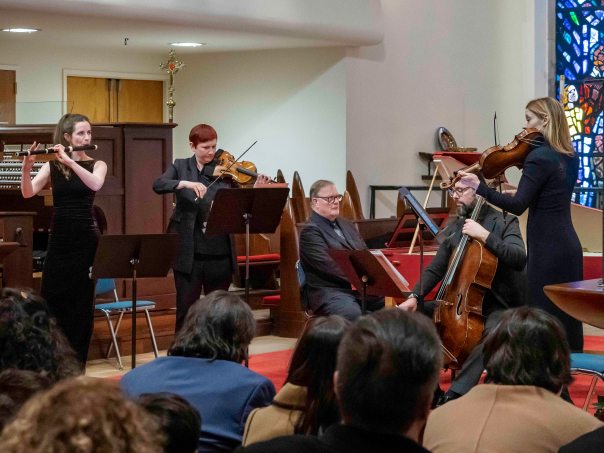
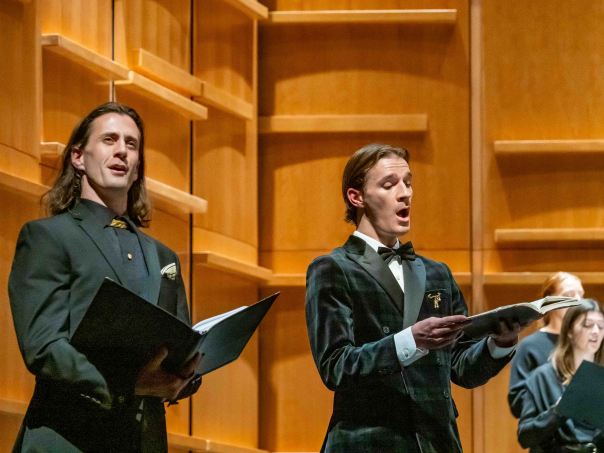
Surprises didn’t cease with the piano’s exit. Caritas artistic director Jeremy Mims entered the sanctuary in the usual way, but the Ensemble didn’t take their places behind the music stands. Instead, they encircled the audience – men in front, women at the rear of the hall – for the opening selection, “Musick’s Empire” from Triptych by Lloyd Pfautsch (1921-2003). Besides the ethereal surround sound blend, this presentation heightened the drama when Mims cued the female voices. Fittingly, the outré deployment of the Ensemble was devoted to a modern piece. It wasn’t until the singers took their places after this opening that the title of their concert, “A Capella Through the Ages,” could be fulfilled in a more orderly, chronological manner.

Fussing a bit with the printed program, replacing a couple of titles on the list with new selections and occasionally shuffling the order of performance, the concert kept to its original design, flashing back to the Baroque days of Vivaldi, Palestrina, and the Scarlattis with a nice mix of sacred and secular lyrics. Whether it’s Handel or Bach, we hear many of the mightiest works from that wondrous era, so it was nice to sample these less familiar gems.

What interested me most on the program was the predominance of more modern pieces, from the days of Bruckner, Holst and Vaughan Williams to the present day. Pieces like these, which sound surprisingly retro compared to the modern chamber and orchestral pieces we’re familiar with, have always been mainstays at Spoleto Festival USA concerts down in Charleston, SC, so I was eager to see how these performances would compare and how a North Carolina audience would react.

The composers’ names were no less intriguing and enticing. We don’t readily recognize contemporary composers Elaine Hagenberg (1979-), Kevin Memley (1971-), Eric Whitacre (1970-), and Pärt Uusberg (1986-) by their last names. As for Frank Tichelli (1958-), whose “Earth Song” was inserted after the program was printed, I was nowhere close to knowing how to spell his name when Mims announced it. “Sikelly” was my first stab. Well-matched to the slow-paced, richly-scored music, Earth’s lyric was rather simple at its core: “Oh war and power, you blind and blur. The torn heart cries out in pain. In pain. But music and singing have been my refuge, and music and singing shall be my light.”

Uniquely, the beauty of the hallelujahs later on was more like a solemn sunset than a jubilant festival. Sadly, Caritas’s enunciation was no clearer than that of multiple recordings – including one by the famed Seraphic Fire – I sampled on Spotify, which offered welcome first aid in deciphering the lovely lyrics. Consonants were often unclear, vain routinely indistinguishable from pain. And vowels! Try to hear “light” when that word pops up!

Never again will I blame myself for losing track of what a choir is singing in Latin (or any other foreign language) when I have the printed text before me. For that reason alone, Uusberg’s magical “Ōhtul” nudged “Earth Song” aside for me as the most impressive piece on the program. Since translations were appended to the program, full contentment with the performance was a simpler matter. The grand swell, as the poet’s song paddled away, was a lovely surprise after everything else – bird, little flower, and forest trees – had been silenced and lulled to sleep by the twilight. Erkki-Sven Tüür (1959-) and Arvo Pärt (1935-) will need to leave some space for this youngster on their pedestal as my favorite Estonian composers.

As for the practice of printing translations for vocal performances, a brief word. Follow the practice of most opera companies nowadays who project subtitles even when the operas are performed in English. Print the English texts with the translations for our fullest enjoyment.

“Nunc Dimitis” by Gustav Holst (1874-1934) impressed me nearly as much as the Uusberg, with solos from soprano Sarah Ochoa and tenor Nicholas Setzer. The soloists not only sang their brief solos purely, they set the stage for responses from the Ensemble at a dramatically augmented volume. Wisely, the Latin didn’t appear in the program, clearing the pathway to pleasure when we went straight to the translation.

Of course, the fullest experiences at this concert came from songs in our language that were either familiar to us or readily grasped in real time. The most enjoyable of these included Hagenberg’s joyous “Alleluia,” though it sported few more words aside from amen, and the finale that followed, “Ezekiel Saw de Wheel” as arranged by William L. Dawson (1899-1990). Most surprising of all was Vaughan Williams’ “O Mistress Mine,” from his Three Elizabethan Part-Songs, a rather frisky departure for a composer better known for the grandeur of A Sea Symphony, the anguish and majesty of Job,and the simple tragedy of Riders to the Sea.

Gerald Finzi’s “My spirit sang all day,” mercifully brief, didn’t really speak to me, and “Shenadoah,” as arranged by James Erb (1926-2014) disappointed. Crossing the “wide Missouri,” we have an inalienable right to more bass and sinew between the shores. Bypassing my personal distaste for the foundational baby-worship that pervades Christianity, the pairing of Whitacre’s “Lux Aurumque” and Memley’s “O Magnum Mysterium” were more pleasing to me in Latin, since ignoring the translations – and savoring Memley’s heavenly harmonies – was an option.

Amusingly enough, I had to adjust my attitude toward Caritas’s choice of William Billings’ “I am the Rose of Sharon” past the midway point of a largely repetitive and pedestrian performance. When the famed snippet from the Song of Solomon reached its denouement, “for, lo, the winter is past and the rain is gone,” you could look out the huge St. Alban’s windows and see that the rain really was stopping in response to these pertinent repetitions.

If you missed that, you couldn’t help but notice streaks of bright sunlight suddenly streaming across the front rows of singers. In his intro to the piece, Mims had hoped that the concluding verse would bring an end to the rain. But the power of Caritas’s incantations exceeded this extravagant hope. Repetitions and all, you won’t find me arguing with such cosmic success!

Photos by Perry Tannenbaum

A Near-Sellout Crowd Proves “Some Like It Hot” Has Staying Power

Review: Some Like It Hot at Belk Theater

By Perry Tannenbaum

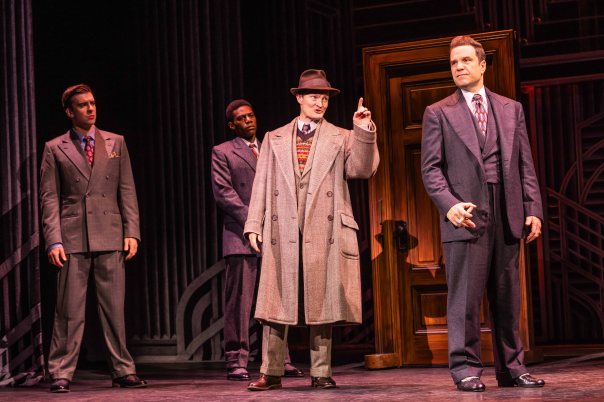
More than a decade before Cabaret, Tootsie, Victor Victoria, The Birdcage, and Kinky Boots pushed harder and harder against Hollywood’s crossdressing taboo, Billy Wilder’s SOME LIKE IT HOT smashed through in 1959. This was a deliciously adult film, and with Marilyn Monroe and Tony Curtis as the leads, deliriously appealing to hordes of teens who cherished the stars as their heartthrobs and hormone stirrers. Because of the sleeping cars and backstage dressing rooms tightly woven into singer Sugar Kane’s roving lifestyle, there was an extra edge of voyeurism for Marilyn to innocently exploit in close quarters.

True to its outlaw spirit, the story yanked us back to the days of Prohibition, legendary mobsters, and big band jazz – the speakeasy trinity. Any other kind of music in a musical adaptation of this comedy would be a turn-off for me. Listening to the sound of violins in the overture of Sugar, the first Broadway musical adaptation of Wilder’s screenplay, with music by Jule Styne and orchestrations by Phil Lang, my ears recoiled and my gorge rose as soon as the strings got involved with tremolos and sugary transitions.

No cocktails, please. Even Sugar drank hard liquor in the film. From a flask she stashed in her stocking.

Though many will question the liberties Matthew Lopez and Amber Ruffin take with Wilder’s storyline, they follow a more natural path with Marc Shaiman’s jazzier 2022 score than their 1972 predecessors. Predictably, as the current touring version confirms, they choose a more progressive PC path as well.

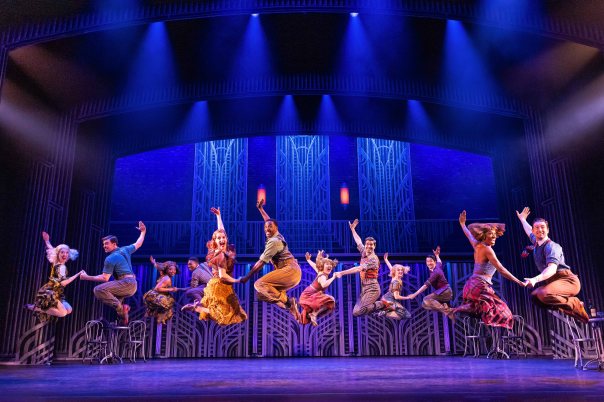
As soon as Sugar follows her boss, Sweet Sue, into the spotlight at Belk Theater, movie mavens and dilettantes will surely notice her radical Lopez/Ruffin makeover: Sugar isn’t lily white like the players in Wilder’s cast. Or dumb. Or objectified.

Now Marilyn wasn’t so dumb that she would pass up the chance to seduce a millionaire (it’s in the background checking that she faltered), but director/choreographer Casey Nicholaw has his leading lady, Leandra Ellis-Gaston, easing off a little when she presses that pedal. There are plenty of other places in this yarn where the comedy can be broadened.

The guys that Wilder’s risqué trailer called Marilyn’s “bosom buddies” get some subtler remodeling. Jerry still plays bass like Jack Lemmon, but he and bandleader Sue are now Black musicians. No less important, Tavis Kordell is going to take more readily to drag than his ‘50s counterpart, with a more profound and nuanced appreciation of womanhood than even Dustin Hoffman achieved as the more cerebral Tootsie. After a while, Jerry feels like he is Daphne, a transition that Kordell, a non-binary Raeford native and a UNC-Greensboro grad, is pleasingly at home with.

As Curtis did, Joe still blows the saxophone before and after he crossdresses, transforms into Josephine, and joins Sweet Sue and her Society Syncopators Band. But since Christian Borle was nearly 50 when he opened on Broadway in the role, the former Black Stache (Peter and the Starcatcher)and rockstar Shakespeare (Something Rotten!) was repeatedly chided for being old. So unlike the suave matinee idol of the film, when Matt Loehr whips off his blonde wig and reverts from Josephine to Joe, his hair is more salt than pepper.

Ranging further from the original, both Josephine and Daphne double their showbiz talents as an amazing tapdance duo – so the oldster has drawn a high-energy role. If Loehr is at pains to keep in step with Kordell and Ellis-Gaston, his huffing and puffing can only augment the comedy. Somewhat fiendishly, Nicholaw delights in giving all three leads a workout, even embracing the absurdity that all the Syncopators can become ace tapdancers – along with the waiters and bellmen they meet on the way.

Of course, when the tap duo is in disguise, they dance in high heels.

Momentum for the story – and the guys’ motivation to sequester themselves in drag – pushes from Chicago, where mobster Spats Columbo initially hires Jerry and Joe to perform. The production saves on scenery and props by keeping Spats’s killings indoors while arming him and his henchmen with pistols instead of machine guns. But Scott Pask’s scenery economies go too far.

Evidently, Pask never received the memo that all touring shows playing the Belk must be able to hit audiences in the eye with the production logo from a distance of 50 yards. Some Like It Hot not only lacks a logo on its faux curtain and proscenium, it’s missing any trace of color! Worse, the stage-filling motif is recycled over and over in various scenes, occasionally acquiring the hues of purple and turquoise. With the aid of smart bulbs, a quartet of chandeliers also reappears over and over during the band’s odyssey, as if they are stowaways on their voyage.

Hotel rooms, ballrooms, Spats’s office, and Osgood’s millionaire yacht are even more cheaply evoked. They do succeed in making Gregg Barnes’s costume designs look even more resplendent in relief, enhancing their Tony Award-winning aura.

Pity poor Devon Goffman as Spats – too resplendent! If the gangleader could only be more raffish and déclassé, Lopez and Ruffin might have armed him with a larger gang and Shaiman might have begrudged him a song. Goffman draws a disappointingly clean-shaven and corporate image, too seldom onstage to tighten the dramatic tension.

Nicholaw doesn’t seem to mind the void at all. Instead, he feasts on the show’s two big chases, choreographing them for their comedic flavor while evoking one of the most beloved trademarks of silent film. Ironically, we witness much of the touring Some Like It Hot as if it were a silent film because the sound at the Belk is as muffled and foggy as ever. We’d love Tarra Conner Jones as the irascible and ebullient Sweet Sue so much more if we could decipher what she’s belting so lustily. We can be thankful, too, when Ellis-Gaston gets to vamping, for her body communicates to us more completely than her larynx.

Only Edward Juvier consistently pierces through the sonic fog as the millionaire Osgood in his screwball pursuit of Daphne. Gather round him, fellow cast members, and let him preach unto ye the gospel of enunciation.

Ultimately, Lopez and Ruffin succeed in elevating the resolution between Joe and Jerry, diversifying the love match between Joe and Sugar, and crafting a more evolved relationship between Jerry and Osgood. Shaiman had the more formidable task in concocting his score, which is probably why his Some Like It Hot often feels so effortful onstage. They’re all striving so hard to create what the film so naturally was in the first place: a road musical with cherrypicked hits for Marilyn Monroe to croon, including “Runnin’ Wild,” “I Wanna Be Loved by You,” and “I’m Thru With Love.”

You can stream the original soundtrack online and judge for yourself. With a little extra diligence, you can search out Marilyn’s rare single recording of “Some Like It Hot” and see how it measures up to Shaiman’s title song, written with lyricist Scott Wittman. Pretty well, I’d say.

Review: “Messiah” at Knight Theater

Handel’s Messiah Rejoices Greatly with Charlotte Symphony

By Perry Tannenbaum

December 13, 2024, Charlotte, NC – While I’m not as faithful to the Yuletide visitations of George Frideric Handel’s Messiah as I was ages ago at Queens College CUNY, where I attended free concerts at least three of my four years, my diligence has lately improved. In the last decade, I’ve seen four performances, counting the one that launched this weekend’s run at Knight Theater, with Kenney Potter preparing the Charlotte Master Chorale and guest conductor Julian Perkins leading the Charlotte Symphony. I’d actually had my heart set on a Messiah performed at the Teatro Colón in early November, but an unresponsive press office and an unexpected dress code, discovered at the box office after we had landed in Buenos Aires, thwarted our plan.

Wrapped into our plans were an opportunity to hear how a Bach choir flying in from Stuttgart would handle the King’s English, and how the vocalists would compare with our esteemed Chorale and guests. Not to mention the fabled acoustics of Teatro Colón. Lacking those Argentinian comparisons, I can still say that the Chorale was a match for any chorus I’ve heard in Messiah, and that the guest vocalists were the best I’ve heard in recent memory, including those who performed with the New York Philharmonic in 2015. Those who look for a massive orchestra might have reason to pause before rushing to the Knight, for the scale of forces led by Perkins seemed more like the North Carolina Baroque Orchestra that performed with the Chorale at First United Methodist in 2018 than the band we saw at the Knight in 2017. Over a dozen different orchestrations evolved during Handel’s own performances of Messiah over 17 years, from 1742 to 1759, so Perkins could easily match a version to the number of his orchestral recruits.

Leading from behind a harpsichord – pretty novel in itself – Perkins had some interesting ideas on staging, deploying the brass to the balcony for their dramatic entrance into “For unto us a Child is Born” and then after intermission, bringing principal trumpeter Alex Wilborn downstage for a climactic “The Trumpet Shall Sound” confrontation with bass baritone Hadleigh Adams. Otherwise, it would seem presumptuous to say that Perkins, for all his Handel and Baroque expertise, directed any of the four guest soloists at all. Each one of them was magisterially confident and self-assured. Hadleigh was not the least of them in that regard, striding auspiciously to centerstage for the first time and quaking the hall with his “Thus saith the Lord” proclamation. After delivering his towering “Why do the nations so furiously rage together?” rebuke at the crest of Part 2, Hadleigh loudly clapped his book shut and stormed back to his seat.

Richard Pittsinger was not quite so flamboyant, for the tenor wore his hair the same way before and after intermission. But his impact came sooner with supremely creamy accounts of the “Come ye, my people” recitative and the “Ev’ry valley shall be exalted.” He truly made the “rough places plain” again and again with soft floating glides that never strained his breath control. Drama was definitely in his arsenal, just before the climactic “Hallelujah” chorus, when he delivered one of the more militant verses of the Psalms, “Thou shalt break them with a rod of iron.”

It was no less difficult deciding whom to love most among the women. Mezzo-soprano Diana Moore sang her first air, “But who may abide the day of His Coming,” so richly and dramatically that I could hardly wait for her return in “O Thou, that tellest good tidings to Zion” so she could conquer its challenging low notes. Even the QR code on the program sheet doesn’t lead to the text, so Moore faced a more amusing hurdle when she came to the “spitting” in her “He was despised and rejected of men” air near the beginning of Part 2. Pronounced too diffidently, the audience might wonder what was said – too emphatically and you risk laughter. Passing that test, she went on to a satisfying Part 3 duet with Pittsinger in “O death, where is thy sting?”

Less tasked and dramatic but far more lyrical, soprano Anna Dennis dazzled in each of her airs, especially in her first splash late in Part 1, “Rejoice greatly, O daughter of Zion!” Here the refrain ideally exemplified how spectacularly Handel brought his lyrics to life. Equal to the joy she delivered here was the sanctified tenderness Dennis lavished upon “I know that my Redeemer liveth” launching Part 3. The effect was all the more ethereal for the effortless way that Dennis reached her highest notes.

Of course, the “Hallelujah” and the closing “Amen” fugue make the mightiest, most lasting impressions, but the Chorale delivered drama and delight all evening long. They were hardly accompanied by more than the harpsichord and organ until the brass and sawing violins exploded into “Wonderful! Counsellor!” in the incomparable “For unto us a Child is born.” The dynamic was no less dramatic toward the end of the evening when they reached the shuttling between gloom and jubilation in “Since by man came death.” Most exquisite, perhaps, was the delicacy Potter and Chorale endowed upon “All we, like sheep, have gone astray” seemingly more staccato than we’d ever heard it before. A disagreement seemed to arise whether it was “glorify” or “purify” when the Chorale broke into so many contrapuntal groups for “And He shall purify.” Any other blemish in the evening was almost impossible to detect.

Photos by Perry Tannenbaum

Christmas at Pemberley Gets a Gendered Makeover

Review: Miss Bennet: Christmas at Pemberley @ the Cain Center

By Perry Tannenbaum

If it weren’t for all the adaptations we hear about on TV and in movies, we could say that it required supreme audacity for Lauren Gunderson and , to tread in Jane Austen’s footsteps and pen a sequel to Pride and Prejudice, her wittiest and most beloved novel. But despite the obvious commercial bent of Miss Bennet: Christmas at Pemberley, Gunderson and Melcon have aimed to capture Austen’s essence and bring fresh life to her characters.

As you’ll find up at the Cain Center in Cornelius, no small thanks to the audacious direction of Steve Kaliski, the script sprinkles a bit of modern perspective on the Bennet sisters and their beaus – occasionally forcing us to recognize that Austen’s times are not so different from our own. Elizabeth Darcy, the heroine of the novel, still retains enough decorum not to call Fitzwilliam Darcy by his first name. Even in the privacy of their own home!

Likewise, elder sister Jane and her beloved Charles address each other as Mr. And Mrs. Bingley. “Happy Christmas” rather than “Merry Christmas” is the greeting norm, and the Christmas tree tradition has yet to take root in England in December of 1815. It’s Elizabeth’s audacity that brings this German custom to the Pemberley drawing room with its attached library.

In some ways, history has circled back. Back in college, my professor instantly drew our attention to the epistolary nature of Pride and Prejudice. The story is largely driven by letter writing. A chief turning point in the story is contained in a letter from Darcy addressed to Elizabeth, debunking her previous prejudices against him!

The prevalence of letter writing astonished us then – and felt alien. Ancient. Forty-plus years later, the sight of Mary Bennet, her sister Lydia, and Arthur de Bourgh exchanging billets-doux while under the same roof has to remind me of today’s texting, Instagramming youth, perpetually thumbing their cellphones. Buttressed by books, these youngsters can put quill to paper.

With Kitty off in London, not expected to arrive until Christmas Day with her parents, Mary is the only Miss Bennet we see and unexpectedly the leading lady. Arthur is an entirely new character, rivalling Mary in his bookishness. Resigned to spinsterhood, Mary is shocked to find that they’re hitting it off.

The forward-looking Gunderson and Melcon, proclaiming that Austen is for everyone, encourage diverse casting. But Kaliski and his Davidson Community Players go further, bringing us an all-female/non-binary cast. It’s an added semicircle backwards to Elizabethan days when only boys and men were permitted to perform onstage.

All three of these transpositions – Brooke McCarthy as Darcy, Rhianon Chandler as Bingley, and Jennifer Adams as De Bourgh – add a fresh patina of mirth and comedy. As for the playwrights, they inject plenty of wit and sparkle of their own. Speaking to Darcy before we see that Jane is seven-months pregnant, Elizabeth broadly hints she is arriving “safely and enormously.” Lizzy is more tactful when the expectant mother enters and they exchange greetings:

Lizzy: Look at you! You’re radiant.

Jane: I’m as large as a cottage.

Lizzy: And exactly as a cottage, you are warm, filled with life, and lit from within.

Although McCarthy plays him with some florid gestures, we soon see that he is richly endowed with breeding and tact. When the punctilious Mary presumes to correct Bingley, by informing him that the tree standing before them is a spruce and not a fir, Darcy pointedly intervenes. Before any dispute can begin, he proposes that he and his longtime chum exit for a brandy.

The ladies can now rebuke Mary, if they wish. They do, while gradually discovering that their younger sister has more charm and talent than previously suspected. Arthur’s admiration for her shocks them as much as it shocks Mary herself. As it turns out, Lizzy and Jane better be witty and perceptive, for Mary and Arthur are the plumiest roles. Fortunately, with the arrival of Lydia, the silly sister with the sham marriage, Lizzy and Jane can redirect their sharpest barbs.

Arthur is the heir to the nearby Rosings estate, but he is a distant nephew of the late Lady Catherine and has never lived there. There is some juicy history at that estate, left over from Pride and Prejudice,chiefly the presumption that Darcy would marry Milady’s daughter and not the comparatively lowborn Lizzy. Not to worry, Pemberley gracefully catches us up if we don’t remember Austen’s original.

What makes the role of Arthur so appealing is that he has no clue how to run an estate – and no solid experience with other men, women, or people. Adams carries a book around with her as if it were Arthur’s security blanket. Without one, Adams seems at a loss for what to do with her hands and arms, so we see Arthur almost perpetually in a scholarly or supplicating pose.

Attempting a billet-doux, Adams as Arthur reminded me of Christian in Cyrano de Bergerac, only he has nobody to help him out. When Arthur learns that his cousin Anne, after getting jilted by Darcy, now presumes she is betrothed to him, Adams’ awkwardness and shyness veer toward desperation and panic. When bliss is achieved, Adams’ glow is mesmerizing.

Crippled by a similar lack of self-esteem, Sahana Athreya as Mary is no more experienced and no less shy than Arthur – so she can range from being pedantic and irritating to heartbroken and pitiful to vivacious and adorable. Athreya can also freely gesticulate with her arms and sit down regally at the pianoforte.

The central triangle is further complicated by Destiney Wolfe as the compulsively silly Lydia. Glossing over her troubled marriage doesn’t inhibit Lydia from flirting shamelessly with Arthur, giving us extra tastes of how unaccustomed he is to such attentions. Nor does Kaliski bar Wolfe from being as irritating as Mary at her worst. On the contrary. Wolfe, when she isn’t pouncing, is often prancing.

At the center of all the overtures from Mary and Lydia – and the strict orders from Agatha Emma as the imperious Anne – Adams gets to be meaningful as well as stressed and sympathetic. For Mary and Lizzy, in the face of Arthur’s inclination to yield to Anne, are at considerable pains to remind him that he has what women don’t: a choice.

Of course, when Gunderson and Melcon wrote their merry comedy in 2016, they had no inking that “Your body, my choice” would be staging a comeback. But the playwrights are far from declaring that women were powerless. Even before her Christmas awakening, Mary is strong enough to proclaim that she would rather wed a plant than an unsuitable man.

Caring about their sisters, Lizzy and Jane sustain their relevance, Skylar Schock as Lizzy warming up to Mary and Emma Kitchin as the Jane becoming Lydia’s tactful benefactor. Christmas can even be celebrated by Emma, for it turns out that there’s kindness in Lydia beneath her silly, meddlesome surface.

Kaylen Gess’s scenic and lighting design complement each other handsomely, with Caleb Sigmon’s projections adding an extra festive luster. I’d imagine that Gunderson and Melcon would have envisioned a much larger, more intrusive tree at Pemberley. But as a Tannenbaum, I’m probably prejudiced.

The tree outside Cain Center, let me add, is big and bright enough for anyone.

Ryan Clicks with the Master Chorale in a Walloping CSO Debut

Review: A German Requiem at Belk Theater

By Perry Tannenbaum

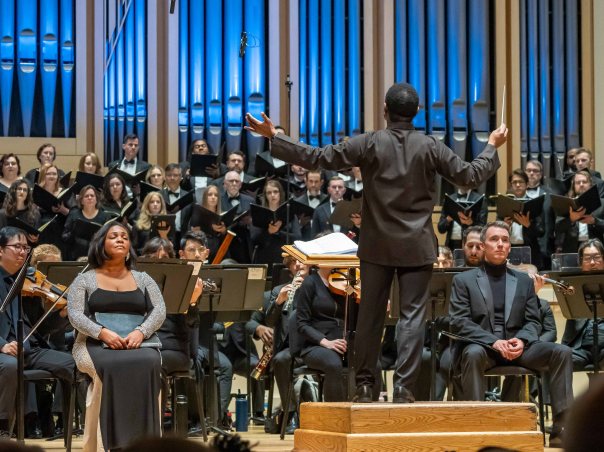
November 22, 2024, Charlotte, NC – In Kwamé Ryan’s first full season as the new music director of Charlotte Symphony, we aren’t getting to see him perform as much as we would hope, but when we do see him onstage at Knight Theater or Belk Theater, he always appears to be overjoyed to be here. Ryan was absolutely beaming as he took the Belk’s centerstage for the first time as CSO’s leader – and he certainly didn’t wear out his warm welcome, delivering a walloping performance of Johannes Brahms’ Ein deutches Requiem. Even before Ryan’s arrival, the new season has proven to be adventurous and diverse in its programming, showcasing fresh repertoire and youthful guest soloists.

Subscribers can judge for themselves whether Ryan’s outré intro to his debut program, coupling the Brahms with Latvian composer Pēteris Vasks’ Musica Dolorosa, was a sign of confidence or a symptom of nervousness. Whether or not my recollection can be trusted, Ryan’s scripted intro was unprecedented. Some intros we may have seen in the past could be dismissed as gratuitous – or countenanced as witty fluff. Here, Ryan’s intro was necessary, for we needed to be prepped for how the program would be delivered: without a pause between the music of the two composers. That would also be fairly unique. Our new maestro was crafting an experience.

Indeed, Ryan’s preface was necessary for another reason. Vasks’ piece flowed into the Brahms so smoothly it was as if they were written in collaboration and in the same key. Outside that merging point, the two pieces were quite different in the ways that they dealt with death. Responding to his sister’s untimely death, Vasks voiced his personal despair and compounded his feelings with grieving for his nation, still subject to Soviet rule when the Dolorosa premiered in 1984. Written for string orchestra, the mood of the opening section of Dolorosa may put you in mind of Barber’s Adagio. But the Vasks elegy eventually transcends the sameness and the hypnotic monotony of Barber’s dolor with louder and more piercing pain.

As the lower strings tap and strum percussively, Vasks gradually quickens the pace and turns up the volume as the beat becomes more insistent and dramatic. Once the dynamics peak, the strings, now smoothed out with a cessation of the percussion, become even more disturbing, tossing away pleasant tonality in a disciplined cacophony of fearsome chaos. The slashing lower strings, however, hadn’t been vanquished. They punctuated this harshness and dissonance at its height, seemingly puncturing it, for the noise homogenized into the sound of a diminishing wind or a siren receding into the distance – clearing the way for the quietest and most memorable episode in the Dolorosa. Principal cellist Jonathan Lewis, echoing the opening bars, played an eloquent lament from his downstage seat, accompanied only by the low mysterious hum – like a bass clarinet or a contrabassoon – emanating from upstage, hidden from my sight. The higher strings now took up the cello’s increasingly bold cry and built it to raw anguish.

The slightly hushed and abrupt ending of the Dolorosa nicely conformed with Ryan’s concept, and it dispensed with the shuffling of chairs usually necessary for the transition to full orchestra with winds, brass, and drums. Nor were the troops of the Charlotte Master Chorale obliged to parade in from the wings and settle into their perches above the Symphony. That honor was reserved for the guest vocalists, soprano Janai Brugger and baritone Alexander Birch Elliott, gracefully delayed until well after the transition between the Dolorosa and A German Requiem. The Brahms is not new to the CSO, last given by Christopher Warren-Green almost exactly 10 years ago – after his predecessor, Christof Perick, had presented it (already for the second time this century) in 2005.

With its consoling attitude, the Requiem is not at all a bad fit for the holiday season. You’re likely to recognize more than a couple of verses from the Brahms, conveniently projected in supertitles, as German translations of verses from Handel’s Messiah, the most beloved musical birthday celebration that we have. Most notably, you’ll get an Oktoberfest taste of “The trumpet shall sound.” Maybe sitting down in the orchestra, as opposed to the Grand Tier Circle, accounted for the heightened thunder of Ryan’s rendition, but Symphony somehow sounded crisper. The sudden sforzandos struck like a punch to the jaw, yet Ryan kept the ensemble under strict control, never threatening to overwhelm the hall with volume, emphatically relishing the work’s percussive moments.

Both Brugger and Elliott shone in their debuts. There was a noticeable Renee Fleming-like milkiness and sheen to Brugger’s voice, most appropriate for the motherly comfort she delivered in “Ihr habt nun Traurigkeit (You now have sorrow).” Elliott was even more impressive in his larger workload, a more pleading “Herr, lehre doch mich (Lord, teach me),” bolstered by a lusty Chorale response, before he delved into the “trumpet shall sound” mystery and affirmation of “Denn wir haben hie keine bleibende Statt (For here we have no everlasting city).” Belatedly, Music Chorale artistic director Kenney Potter was summoned onstage to share the credit for his singers’ brilliance and verve. He was absolutely beaming with delight.

Photos by Perry Tannenbaum

Harlem Gets Braided at Jaja’s

Review: Jaja’s African Hair Braiding at The Arts Factory

By Perry Tannenbaum

My dear old Mom was born and raised in Harlem over a century ago, when a massive African-American cultural and literary Renaissance named for Harlem had already begun, long after the fabled Manhattan district with its storied 125th Street had been a major destination for Northern Migration after Lee surrendered to Grant. Even then, it would hardly be respectful to change Harlem’s name to Little Africa after all these years.

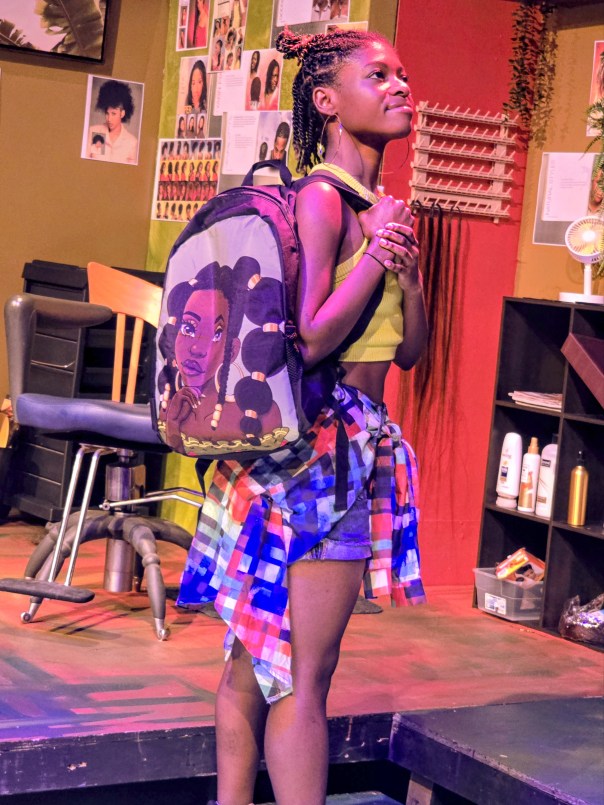
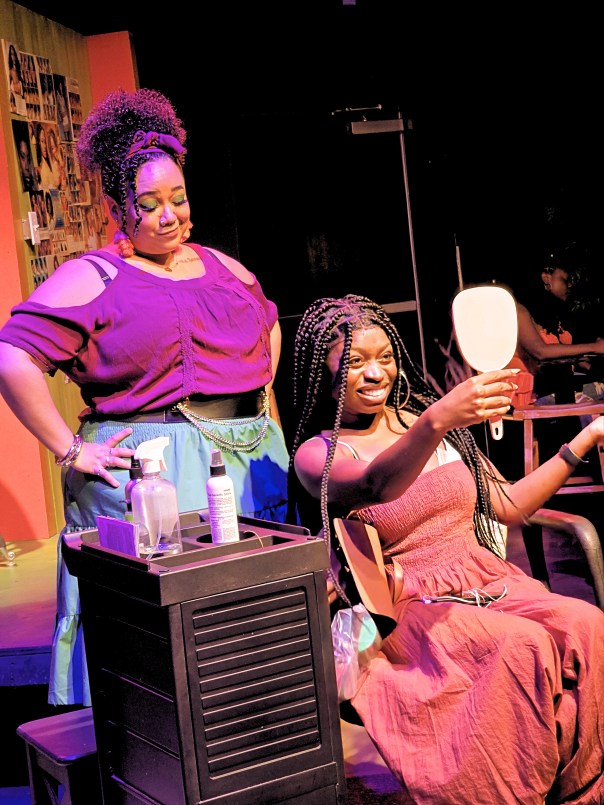
Yet playwright Jocelyn Bioh in her 2023 drama, Jaja’s African Hair Braiding,set on the corner of 125th Street, had me considering whether Bioh would rather call her Harlem – or at least this salon – Little Africa. The vibe and culture of Jaja’s, in Three Bone Theatre’s outstanding QC premiere at The Arts Factory, had me feeling that I was in another country while it was unmistakably my own.

Staffed and patronized by locals who hail from Senegal, Ghana, Nigeria, and Sierra Leone, neither Harlem nor Africa were the best places for Jaja’s craftswomen to be on a hot summer day of 2019 when Bioh’s action takes place. Aside from a breakdown in the braiding shop’s air conditioning, ICE lurks in the background as another of the women’s worries. Our own US President, the most powerful man on Earth, has bunched their homelands into the dismissive category of “shithole countries.”

Jaja’s daughter Marie, a brilliant bundle of chaotic energy, is running the salon today because Mom is getting married later this afternoon to an unpopular landlord who will provide her – and Marie – with the shelter of citizenship. That will free Marie, a valedictorian at her high school using a borrowed identity, to apply to an Ivy League school worthy of her energy, talent, and potential.

From the deluge of Marie’s opening monologue onwards, we realize that Jaja’s is a place bustling with life. Music is in the air, sometimes compelling the women to dance. There’s bickering, jealousy, hostility, vanity, teasing, and earthy humor. Not a murderer or a rapist in sight among the immigrants. Not even a pet eater.

About the only big mistake we can accuse director Donna Bradby of making is not helping us to observe Bioh’s signposts – via a wall clock and/or projections – of the time of day and the specified year this long, hot workday unfolds. Otherwise, Jennifer O’Kelly’s scenic design, Toi Aquila R.J.’s costumes, and Rod Oden’s lighting immerse us completely in Jaja’s humdrum-yet-exotic world for all of the show’s 95 minutes.

A clock on the wall, for instance, would help us to appreciate how long young Jennifer, an aspiring reporter, is willing to sit at Miriam’s station in order for the patient artisan to outfit her with a full head of microbraids. And how long does the bossy, rude Vanessa fall asleep at Aminata’s stand before waking to her new look?

The visible excellence of Bradby’s cast is matched by the variety of Deborah Whitaker’s pre-, post-, and mid-weave hair designs. When blackouts happen between scenes, stage manager Megan Hirschy must have a huge chore in the small Arts Factory space helping the scurrying players reappear with the right hair when the lights come back up. We never just sit there tapping our feet during transitions. They’re almost lightning-quick.

Nor does it trouble Bradby that it’s impossible to keep track of who’s from Senegal, Ghana, or Sierra Leone. Venecia Boone was assigned the task of dialect coach anyway, a really nice touch.

Of Ghanaian descent and native to nearby Washington Heights, Bioh obviously knows her characters as much as she loves them. She is also a performer, so Deity Brinson as Marie will not be the last of her players to be gifted with a juicy monologue. Like Marie and the braiders, we will wait a long time before Myneesha King appears as Jaja – in wedding white, of course, with a queenly crown of braids – and delivers the most powerful monologue of all.

Meanwhile, it’s Valerie Thames as Bea, the most fashionable and contentious of Jaja’s employees who fuels the liveliest action, seemingly able to hatch a new grudge at the drop of a spray bottle. The salon was her idea, not Jaja’s. Should have been a full partner in the biz. Refugee newcomer Ndidi is stealing her customers rather than customers just dropping Bea. Thames seethes, fumes, and makes scenes with a steely righteous dignity that sets us up for the turnabout that reveals her deep-down goodness and sense of community.

Until then, the human warmth of the shop emanates from Kellie Williams as Miriam and Vanessa Robinson as Aminata. Williams, rightly stationed upstage at the Arts Factory black box, is mostly distanced from the main sparring during her morning-to-night transformation of Jennifer’s tresses. But there’s a distant man on Miriam’s mind throughout her labors, and she’s spending enough time in Jennifer’s hair to become quite chummy with the 18-year-old by evening’s end.

While her bestie and gossip buddy Bea seethes and sneers, Robinson mostly effervesces as Aminata. She knows that she doesn’t have the patience for a daylong immersion in microbraiding, so she’ll have none of Jennifer despite her youthful sunniness. But EJ Williams as Vanessa riles her almost to the point of losing her cool, a comical series of shticks that begins with the pushy customer objecting to house rules that require her to step outside the shop to negotiate Aminata’s fee. Then Vanessa insists that she be braided with the implements and spray she has brought from home.

Aminata’s man troubles are nearer-to-hand than Miriam’s, for her wayward ne’er-do-well husband James only circles back to the nest to take advantage of her. Righteously divorced, Bea insists that Aminata drop this loser, dismissing the love factor that keeps her from following through with her resolve. Can’t help it when Graham Williams as James drops by and pushes his wife’s buttons.

So these skirmishes between Thames and Robinson, before and after James’s invasion, are the most delicious that we witness. Aside from her dreamer worries, Brinson as Marie is occasionally thrust into the middle of disputes, laying down the law for the prissy Vanessa and stepping into the middle of Bea’s various tussles with Ndidi, Aminata, and her defecting customer, Michelle. At one point, Marie even exiles the incorrigible Bea to the street!

The younger folk are calmer and more acclimated to post-truth America than their diva elders. Before we know it, Aminata is asking Marie how to tune the smart TV to YouTube. Sarah Oguntomilade as Ndidi, the highest-grossing braider in the shop, is especially cool – thoughtfully equipped by Bioh with headphones and loud music to tune out Bea’s accusations and tirades. There’s a really nice interlude when Graham fawns over and flatters her as the Jewelry Man, lavishing her with freebies. This Nigerian cameo as Olu was at least as crowdpleasing as his subsequent turn as the roguish Ghanaian, James.

Graham’s most impactful role is as Eric, the DVD man, who serves as the caring eyes and ears of the community. But it would be cruel to divulge any more.

Things happen quickly at Jaja’s. Notwithstanding the oppressive summer heat, each new character changes the temperature in the shop. Less obtrusively than Graham, Germôna Sharp brings in a variety of flavors as three different customers. The most dramatic of these is the diffident Michelle, who thought she would be switching to Ndidi when Bea wasn’t there. Most comical is Sharp as Chrissy, wanting braids that will make her look like Beyoncé.

As if.

Charismatic Parnther Justifies Shostakovich’s Top Billing at the Knight

Review: Charlotte Symphony Presents Shostakovich and Mendelssohn

By Perry Tannenbaum

November 8, 2024, Charlotte, NC – Hailing from Norfolk, VA – and perhaps the Sith Order of the Galactic Empire – guest conductor Anthony Parnther has brought a big James Earl Jones voice to Knight Theater and an even bigger personality. He instantly engaged Charlotte Symphony subscribers with a lengthy intro to the first piece of the evening, Samuel Coleridge-Taylor’s Ballade in A Minor (1898). Amid some insightful observations on the Black Britisher’s talents and his fin de siècle milieu, Parnther threw in some shtick that drew attention to his mighty larynx, looking askance at what appeared to be a perfectly fine microphone and coming to the mic’s rescue with his “opera voice” and, a bit later, with his “Shakespeare voice.”

In short, he dared to educate us and did a damn good job of it. The performance was just as brash, though occasionally too loud for the hall. There was gravitas in the opening measures sweeping into a zingy elan. Violins excelled in the midsection of the work with some very tender section playing, and the piece built nicely to an anthemic climax, reminding me of Jean Sibelius’s less-neglected symphonic masterworks. North Carolinians can point with pride to the best recorded version available on Spotify or Apple Music, featuring the Royal Liverpool Phil directed by Grant Llewellyn, who has given so much to The Old North State. Beyond that, Parnther could tell us very confidently that Black composers, according to the latest tallies, account for only 2.5% of programming among America’s top orchestras, knowing that we were quite entitled to feeling superior in the wake of hosting Sphinx Virtuosi a month ago – in a mostly Black and Hispanic program.

Sphinx’s visit turned out to be a gift that kept on giving, for the guest soloist playing Mendelssohn’s Violin Concerto in E minor, 16-year-old Amaryn Olmeda, was a first-prize winner – and audience fave – at the 24th Annual Sphinx Competition and toured with the Virtuosi two years ago. While I wouldn’t wish to compare Olmeda’s performance to my favorite recordings; including those by David Oistrakh, Yehudi Menuhin, and even Itzhak Perlman (who gave a live rendition at Belk Theater in 2019); there was certainly beauty aplenty in Olmeda’s account, with virtuosity to spare. But Symphony concertmaster Calin Lupanu attacked the infectious Allegro opening more fiercely in 2021, bowing with bolder panache when he played the piece online with Christopher Warren-Green at the podium. After a simple and lovely transition from principal bassoonist AJ Neubert, Olmeda was at her best in the middle Andante movement, freeing Parnther and the CSO to give her more robust support.

Olmeda relaxed and reveled more in the closing Allegretto-Allegro than she had in the previous outer movement, so Parnther and the CSO could be more assertive in their support, but true brilliance seeemed still beyond her at this tender age. Nonetheless, the audience joined me in giving Olmeda a standing O, perhaps sharing my feeling that we should pay her forward. Although attendance at the Knight was strikingly sparse, the young violinist was beaming. With a nicely articulated Bach solo, she returned our appreciation with an encore. Instinct tells me that the ripple of applause from the audience as intermission ended was in response to Olmeda joining them.

The young prodigy could not be faulted for the disappointing turnout, for the Sphinx Virtuosi had triumphed at Symphony’s annual gala last month. More likely, it was Shostakovich, topping the bill with his Symphony No. 9, who was the culprit on a beautiful autumn evening. Yet here was where Parnther and the CSO were at their best. The Norfolk native was pointedly suggestive in his introductory remarks, but mostly objective in his lengthy explorations – cuing us on what to look for in each of the five movements rather than telling us what to make of it. Thorough but never boring or academic, not at all show-offy or self-indulgent. Truly helpful.

The performance was spectacular, brilliantly contoured to the hall with fine evocative details, fully justifying Parnther’s enthusiastic intro. Which instrumentalist shone brightest in the opening Allegro was a tossup between Lupanu and piccolo stalwart Erinn Frechette, but principal trombonist John Bartlett stole all the scenes, emphatically partitioning the many episodes and injecting Shosty’s comedy with just two oompah notes. From that lighthearted opening – antithetical to what all Ninth Symphonies should be in the wake of Beethoven’s behemoth – we plunged into the depths and dolor of the Moderato, the lengthiest movement in this lapidary stunner. Principal clarinetist Taylor Marino, bolstered by section mate Samuel Sparrow, set the doleful tone of this sharply contrasting movement (again antithetical to the triumphal music Soviet Premier Joseph Stalin expected in 1945), achingly extended by two other principal winds, flutist Victor Wang and Neubert. Dreary strings increased the profundity of this oppressed lament, with Marino returning to soar above it in near-manic anguish.

It’s easy to lose your place after this unforgettable pairing of light and dark movements because the last three are played without pause, steadily increasing in intensity until a steady locomotion of victorious woodwinds are prodded into accelerating by the pulsations of the lower strings. These, in turn, triggered and excited the violins. Blaring brass then drove the journey into complete madness – and off the rails. Adding to the overwhelming bite of this sonic climax, the slashing, plucking, and sawing of the bowstrings across the stage added vivid visual drama.

Photos by Perry Tannenbaum

With a Riddling Program, Sphinx Virtuosi Youthfully Inspire Symphony’s Gala

Review: Sphinx Virtuosi @ Charlotte Symphony’s Annual Gala

By Perry Tannenbaum

October 9, 2024, Charlotte, NC – It’s always encouraging when an annual gala at least partially sheds its patrician aura of black ties, ball gowns, and champagne toasts. So I heartily applauded Charlotte Symphony’s musical director emeritus Christopher Warren-Green when, instead of mentioning crass sums of moneys raised or needed, he notified us that a part of tonight’s proceeds would be sent to those in dire straits in Western North Carolina in the wake of Hurricane Helene. In an even more unexpected gesture, the evening’s guests, Sphinx Virtuosi, announced that they would linger in Charlotte to play an additional concert on Friday at Charlotte Preparatory School – free if you bring a Hurricane Helene contribution.

They all worked well, together and apart, in gifting the gala audience at Belk Theater with a fine show, though not exactly what was initially planned. Or even what was listed in the printed program. Instead, a series of changes to the program were announced by email before and after the program went to press. Even then, a couple of new wrinkles emerged after the lineup seemed to be settled in the last inbox update on September 19. Maybe the plutocrats who dined and toasted earlier at the pre-concert cocktail and dinner sessions got a heads-up.

As a result of the first alteration, changing the title of LA-based composer Levi Taylor’s from American Forms to Daydreaming (A Fantasy on Scott Joplin), the opening segment of the concert became an explicitly extended tribute to Joplin. Actually, the Overture from Joplin’s only surviving opera, Treemonisha (1911), was nearly as new as Taylor’s offering and similar in length. The orchestration chosen by Warren-Green, arranged by Jannina Norpoth with Jessie Montgomery (a Sphinx Medal of Excellence winner in 2020), was premiered last year in Toronto as part of a “reimagining” of Joplin’s opera, so it didn’t quite sound like any of the handful of versions that Spotify can offer. Principal clarinetist Taylor Marino was brilliant playing the catchy recurring theme, an instrumental assignment that Norpoth reaffirms, but principal trumpeter Alex Wilborn’s spot struck me as a lively improvement upon Norpoth’s predecessors.

In a shorter, no-intermission program, it was nice to have a proper mood-setter leading into Taylor’s premiere – and Sphinx Virtuosi’s entrance – rather than a genial throwaway aperitif. Paradoxically, the Joplin overture, aimed for an opera house, was not as raggy as Taylor’s new work, an homage to the Joplin music we’re most familiar with. Personably introduced by cellist Lindsey Sharpe, the piece had an engaging solo spot for principal cellist Tommy Mesa and a refreshing jauntiness. Amazing how much more highbrow and classical the Joplin idiom sounds when you ditch the piano so justifiably associated with the “King of Ragtime.” Taylor took a well-deserved, enthusiastically applauded bow when concertmaster Alex Gonzalez pointed him out in the audience.

Sphinx’s outreach to Helene victims is quite natural when you consider its DNA. Conceived in Ann Arbor at the University of Michigan in 1997, Sphinx quickly became an important of young Black and Latino talent with its annual junior and senior competitions, open to musicians up to age 26, and its Performance Academy, a competitive boot camp, where faculty members include Norpoth, Gonzalez, and second violinist Rainel Joubert – who would play in the Delights and Dances string quartet when the Michael Abels composition, commissioned by Sphinx, had its Charlotte premiere.

The full ensemble departed – all too briefly – as Warren-Green and CSO delivered a more familiar Leonard Bernstein overture to his opera, Candide. If Sphinx had lingered offstage longer, the CSO performance might have been more prudently paced. Dynamics were OK, but when piece started off too swiftly, there was little room for Symphony to speed up when the piece thundered and thrust to its climax. The whole acceleration plus crescendo effect, so exciting in multiple Rossini overtures, was never even a possibility, surely the nadir of Warren-Green’s work with CSO as far back as I can remember.

Then the listed world premiere of Curtis Stewart’s Drill went AWOL, along with guest percussionist Britton-René Collins. This surprise was less of a disaster than the lackluster Bernstein, for the Sphinx Virtuosi returned instead with Samuel Coleridge-Taylor’s Allegro Moderato, the opening movement from his Four Novelleten (1903) for string orchestra. So many of Coleridge-Taylor’s principal works have yet to be recorded that it’s probable that this excavation, listed as Op. 59 in Wikipedia, has yet to get a hearing outside of Sphinx’s orbit – another gladdening example of the ensemble’s vital and generous outreach.

All the remaining works were glorious, throwing the Bernstein blooper far into our rearview mirrors. It helped a little to know your Vivaldi when Sphinx moved upstage to merge with the CSO as tango king Astor Piazzola’s “Verano Porteño (Buenos Aires Summer)” movement from his Four Seasons of Buenos Aires filled the stage with violinist Adé Williams as guest soloist. For those who saw Aisslinn Nosky playing the complete Vivaldi at the Charlotte Bach Festival, the Piazzola Four Seasons evoked some pleasant nostalgia, especially since the Festival Orchestra, like the Virtuosi, often performs without a conductor.

Williams, a winner of the Sphinx Junior Division back in 2012, still played with youthful vitality and joy. Both Symphony and Warren-Green were obviously fond of her playing, her swooping glisses, and the tango twists Piazzola brought to his baroque inspiration. Controversial in Argentina for his modifications of the trad tango – cab drivers often turned him away! – this summer piece was popular enough for Piazzola to draw encouragement for him to complete his seasonal cycle. The Belk audience responded favorably as well, with their first standing O of the evening.
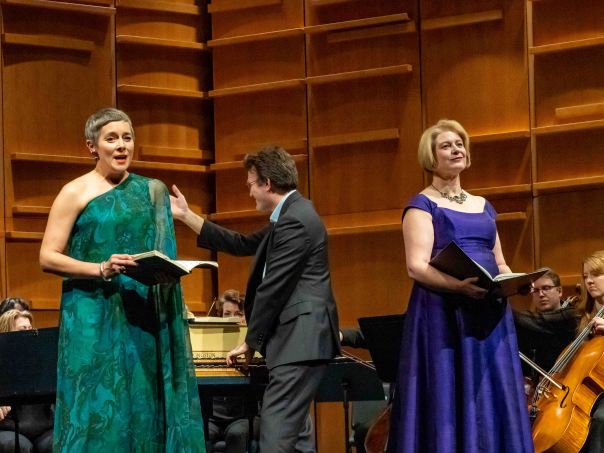
The Abels piece was an even longer, grander gatherum, with the string quartet arriving upstage where Williams had just stood. Joubert and CSO principal second violin were to Warren-Green’s left opposite CSO principal viola Benjamin Geller and cellist Gabriel Cabezas, the Sphinx Medal of Excellence winner in 2016. The Delights were rather delicate before the composer, who famously co-wrote the acclaimed Omar with Rhiannon Giddens, gradually ramped up to the Dances.Cabezas was more than able to eloquently launch Abel’s slow-building piece, which tacked leftward after his engaging solo with additional solo spots for the rest of the quartet members.

Nor was Abels in any hurry to layer on the orchestra, for their first contributions were background pizzicatos behind the full quartet before they picked up their bows. The piece is no less than the title work on a 2013 album recorded by the Harlem Quartet and the Chicago Sinfonietta conducted by Mei-Ann Chen. Definitely worth a listen if you missed the gala – and Abels’ Global Warming leads off the Sphinx Virtuosi’s recent Songs of Our Times release, their first album. Some rousing fiddling embroidered the loud and lively climax of Delights & Dances, easily the most epic piece of the night, programmed in exactly the right spot.

Mexican composer Arturo Márquez’s Conga del Fuego Nuevo (1996) was no less appropriately placed in the encore slot, starting up white-hot and danceable without lowering its flame. Fully recovered from his Bernstein misadventure, Warren-Green not only led the combined ensembles zestfully, he exhibited some winsome showmanship of his own, not only bidding Wilborn to stand up for his solos on muted and unmuted trumpet, but also commanding the winds and the brass to rise when moments came. How can a piece we’ve never heard before sound so familiar? Maybe via discreet borrowing and insistent repetition. No matter, CSO’s jolly encore became a curtain call at the same time – and a wonderful welcome to the 2024-25 season. Hopefully, the Coleridge-Taylor and the Abels were previews of the next Sphinx recording.

Photos by Perry Tannenbaum

“Beyond the Surface” Amazes and Parties-Down

Review: Beyond the Surface at McBride-Bonnefoux Center

By Perry Tannenbaum

The new Charlotte Ballet season is off to a blazing beginning. Presenting Beyond the Surface at the McBride-Bonnefoux Center for Dance through October 26, the troupe looked fresher and younger than ever. But the choreography was far, far younger: two world premiere hatchlings that emerged from their shells last Thursday from Omar Román de Jesús and Mthuthuzeli November, and a third Charlotte Ballet commission by Jennifer Archibald that had its premiere less than two years ago in the same studio.

On that auspicious occasion, Archibald’s fledgling was at the top of the Innovative Works program, sparking hopes that the pieces that followed would reach the same high level. This year, HdrM is nestled in the middle of the program – and my 2023 hopes were already realized again in 2024 with the premiere of De Jesús’s Balúm.

Yes, the first dance of the night easily merited a climactic spot in any evening of premieres: beautiful, complex, mysterious, symbolic, intricate, moving, epic, and surreal. Music by OKRAA, Ola de Luz, was relentlessly propulsive, with random noises at random intervals littered around the main core, a minimalist loop with a harp-like timbre. Once that core cleared the noisy interference, like a spiraling starship navigating through a belt of asteroids, a sudden hypnotic calm and spaciousness prevailed – and the wonder of this dance multiplied, lending it an uncanny glow.

De Jesús has indicated that he is exploring our interactions with the air that engulfs us, from the moment we are born until we take our last breaths. Or maybe that emergence from the noise field near the beginning of the piece is an expulsion from the womb, our birth after a pre-natal prelude. The Puertorriqueño choreographer also has a hand in scenic design and Branimira Ivanova’s costume designs, for she has some specific prompts to execute in fashioning the dancers’ outfits and props.

The most notable of these are black: Two umbrellas that conjure up the surrealism of René Magritte and the fearfully magnificent ambiguity worn by Rees Launer. One of the umbrellas starts upstage center, held by one of the dancers seated on a bench, and it gets passed from dancer to dancer during the action, frequently cycling back to its starting position. The other is held stolidly by a woman on a side bench who resolutely faces away from the action until the stunningly gorgeous denouement – when we get to see the air!

At various moments when Launer grips our attention, we can have different conjectures about what his stern character represents. A raging fire-and-brimstone preacher? a demon? a witch? the Angel of Death? Launer will be a member of two of the three ensembles that get to present Balúm during its current 16-performance run. Another standout in the opening weekend’s seven-member ensemble, Maurice Mouzon Jr., will be in all the performances of this piece.

The liquefied movement of the dancers – along with some robotic intertwining – was juxtaposed with no-less-idiomatic lifts that were more horizontal than vertical. Like chapter markers at the end of episodes, the ensemble would gather and swirl around the stage in an evocative oval parade. Autumn leaves swirling in the wind. Often two or three subgroups performed simultaneously before an ensemble swirl would resolve the dissonance.

What amazed me most was that synchronized entrances and overlapping actions were so precise when there were seemingly no musical cues to give the dancers a toehold. If you’ve heard music by Philip Glass, you know that minimalism is not particularly danceable music. Musicians playing it and maestros conducting it must concentrate intently on the score to keep their bearings amid the repetitiveness. I’m still gobsmacked by how this Charlotte Ballet team pulled this off.

Following Balúm, a piece so untethered from every aspect of its music except for OKRAA’s tempo, Archibald’s HdrM struck me from an altered perspective. Archibald’s ability to mesh expressive movement to a soundtrack of musical compositions by Ludwig Ronquist, Heilung, and Federico Albanese stood out more boldly than ever after the more abstract and surreal De Jesús piece – though these intimate bonds in HdrM could be broken by abrupt mechanical disconnects from the score.

Two other conflicting factors came into play. Most welcome was the opportunity to see the Canadian-born choreographer’s work reprised by three of the eight dancers who performed at the 2023 premiere, Raven Barkley, Luke Csordas, and Shaina Wire. The piece looked more natural and “lived-in” twenty months later, so its internal contrasts were sharper and its sensual moments more relaxed. Barkley, in particular, stood forth dramatically, as sensual, captivating, and devastating as we’ve ever seen her. Nor can you fail to notice the ‘do.

Here, more than in any other dance of the evening, the ensemble bought into the “Unfiltered” theme of CharBallet’s 2024-25 season with their spirited, lyrical work. My only worry was off the dance floor and in the program booklet, where Archibald’s useful explanatory remarks where no longer in print. There in 2023, she was concerned with environmental psychology and posed a pointed question: “Is there a social responsibility to humanize architecture?”

Just asking that question helps us to connect with Archibald’s struggling language of movement. It also hints at the likelihood that Kerri Martinsen’s drab costumes are intended as institutional, such as clothing worn in hospitals, prisons, or mental wards. Aside from the contrast between lithe and mechanical movement, HdrM holds our gaze with a nice balance of ensemble, individual, and pair segments that flow naturally into one another.

Like many finales we’ve seen before from CharBallet, November’s Vibes and Variations is the most celebratory and carefree piece of the night. After last year’s From Africa With Love, it’s also the second consecutive November premiere to kick off a season at the McBride-Bonnefoux Center. Where Africa was surprisingly serene and monochromatic, preoccupied with mauve-colored ostriches from his South African homeland and their exquisite fragility, Vibes seems to wander westward to South America, to samba, tango, and carnivale.

Ivanova’s costumes burst with pastel cotton-candy colors and outré pleating, what my late mom in her saltiest Yiddish would call ongepochket, crassly over-decorated. The bulges on the men’s costumes give them seahorse legs and the frilly women look like spinning tops in a color scheme that matches the men’s harlequin-like rigs. The music starts off rather quietly with Gaby Moreno singing the first vocal on the program, her cover of “Cucurrucucu Paloma” over a simple acoustic guitar accompaniment, smoldering with bossa nova intimacy and sadness.

Things intensify as the 15-person ensemble digs into the Bang on a Can All-Stars’ version of David Lang’s strangely percussive – and minimalist – “cheating, lying, stealing.” But the most intense partying launches when we arrive at beatmaker Jamie xx and MC Moose performing the brash, irresistibly mindless “Gosh.” Catching my eye most compellingly were Csordas and Fuki Takahashi, each of whom will be in two of the three rotating ensembles performing November’s piece throughout its current run.

If I have to predict who will land the title role in Carmen next spring when artistic director Alejandro Cerrudo and CharBallet unveil their Vegas-showgirl update, my guesses would be Takahashi or Barkley. Since that Charlotte premiere will be running for two weekends, both temptresses could take turns at it.

“The Humans” Is More Haunting Than Ever

Review: The Humans @ Armour Street Theatre

By Perry Tannenbaum

Thanksgiving in Chinatown, in the shadow of the fallen Twin Towers – Stephen Karam’s spooky, mystifying, and hilarious The Humans hands us a world teeming with paradox. For an afternoon in a creaky old two-story apartment, newly rented by Brigid Blake and her boyfriend Richard Saad, her family gathers to celebrate, the whole lot of them nursing open wounds – and their Alzheimer’s-stricken elder, “Momo” – trying to heal from recent setbacks.

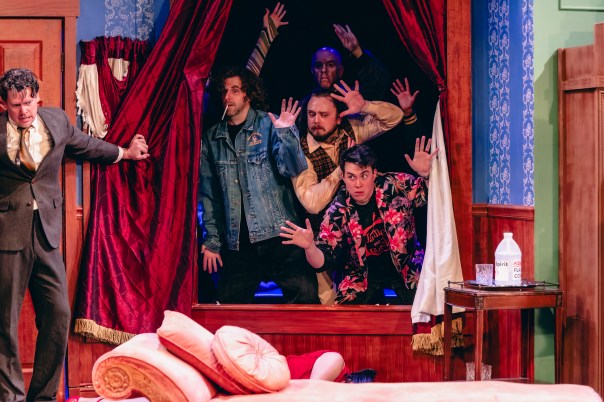
First staged in the QC at Knight Theater in a 2018 touring production starring Richard Thomas as family patriarch Erik Blake, Davidson Community Players brings us a downsized reprise in the first locally-produced staging, with the venerable Hank West in the lead.

Haunted by his return to the vicinity of Ground Zero and by his recent misdeeds, tormented by a deadly mix of sleeplessness and nightmares, Erik vies with elder daughter Aimee for which of the Blakes is suffering the most. Since last Thanksgiving, Aimee has come down with ulcerative colitis and taken major hits to her love life and her career as a Philadelphia lawyer – with major surgery looming on the horizon.

Yet Erik fires a wicked one-liner at Brigid, whose gripe, like his wife Deirdre’s, barely hovers above the “suck it up” level compared with his own. “If you’re so miserable,” he asks the health food fanatic, “why are you trying to live forever?” Inside negativity, Karam can be equally trenchant and funny when Aimee philosophizes about her recent breakup: “Maybe loving someone long-term is more about deciding whether to go through life unhappy alone or unhappy with someone else.”

Only Deirdre and Erik have an agenda for the afternoon, subtly suggested in a couple of brief dialogues. We’re mostly watching Karam’s keen observations of family interactions – their bonds, their tensions, their little quirks, and their tectonic divides. These appear all the more chaotic because dialogue often overlaps and action is happening simultaneously upstairs and in the more commodious basement.

Knight Theater probably gave us an oversized impression of Brigid and Richard’s love nest, while DCP’s Armour Street can’t help look both height- and space-challenged. Remarkably, Evan Kinsley’s more cramped set design lessens the struggle of viewing multiple tracks of action and family intrigue. Yet Karam and director Glynnis O’Donoghue are still able to provide enough compelling distraction at a key moment to allow the aged Momo to disappear without our noticing.

Even without two-story height, Kinsley’s set has an alleyway leading to an elevator shaft to accommodate the wheelchair-bound Momo’s transit between the two floors. The slice of set that serves as the upstairs somehow has enough space for the front door, an entrance to a bathroom (Aimee’s frequent retreat), and the only window looking out on the city. When the apartment’s oddities need to impact, Kinsley’s set and Sarah Provencal’s sound design deliver.

The divides between the Blakes will be familiar to anyone who has grown up in a family of siblings. Although Brigid would never consider living in Philly, the geographical divide is as important here as the generational difference, for neither of the daughters would ever think of moving back to Scranton, PA – except to a summer home that Erik tells us can move towards construction once there’s a sewer system near their pristine plot.

Those anticipated PA pilgrimages will not bring either of the sibs back into the bosom of the holy church. Nor will it erase the fact that these country folks’ children are irremediably citified, one a lawyer and the other an aspiring composer. Safety, religious, and lifestyle concerns plague the homespun parents. Ahead of their Thanksgiving visit, Deirdre has sent a care package that includes a statue of the Virgin to protect Brigid’s new home. Meanwhile, Aimee can expect an email any time a lesbian commits suicide.

Karam provides plenty for the Blakes to discuss in their near and distant back histories, with a handful of stunning updates. If things get dull, he serves up a choice collection of singularly awkward moments that would instantly embed themselves in family lore ever after, lovingly and mockingly retold at holiday dinners and special celebrations.

There’s even a “pig smash” ritual unique to Blake Thanksgivings, a nice spotlight for Richard. Often the aspiring social worker serves as our ears in his role as outsider, giving the Blakes the chance to explain all that is long-known among themselves.

These moments reverberate warmly within us, but the most haunting vibes, from Erik’s dreams and experiences, touch us all, nonchalantly invoking 9/11 and Superstorm Sandy – specters of terrorism and climate change. Over and over, whether Deirdre wheels Momo around or Aimee summons an Uber with her cell, we hear an eerie, insistent whisper from the playwright emanating from his vivid, painstakingly detailed dream: this is how we live.

On Davidson’s compacted stage at Armour Street, the natural flow of The Humans, the lack of powerhouse confrontations that shake us to the core when we witness such American classics as August: Osage County, Who’s Afraid of Virginia Woolf? or The Little Foxes, reminds us of Chekhov’s more placid classics. Rich and funny and touching as all the action is, we will likely struggle to discern a solid plot until Erik’s big reveal.

Inexperienced theatergoers are therefore advised to ignore any FOMO anxieties they may be experiencing and surrender themselves to the many delights, laughs, shocks, and epiphanies that West and his castmates deliver.

On the page, Karam’s script doesn’t pop out at you with the color and verve that O’Donoghue gets from this ensemble. West actually comes onstage with a couple of key advantages over Richard Thomas. We more readily accept West as an ordinary janitor-turned-equipment-manager, and he can bring out a curmudgeonly edge to Erik that I’d never noticed before.

No less surprising is the bubbly, goofball likability that Breanna Suarez brings to Brigid, though she is often the family contrarian and party-pooper in the script. The vibrant energy she exudes somehow turns pure negativity into simple immaturity, emphasizing Brigid’s spoiled qualities. As our genial hostess, Suarez tunes in on Brigid’s side hustle as a bartender, so she’s the life of the party while subtly fueling the true plot, endearingly committing a faux pas for the ages along the way.

Portraying West’s wife for the first time since 2005, when they both earned best actor honors in Coyote Ugly, Anne Lambert makes the wait worthwhile. Although Citizen Trump famously descended his escalator in June 2015, between the time that The Humans opened Off-Broadway and when it reappeared on Broadway with a completely new cast and director, Deirdre likely struck the late-2015 Broadway crowd as a MAGA maniac.

Interestingly, Karam could have taken Hillary Clinton as his model if he had written his tragicomedy 20 years earlier, but Lambert still strikes me as a MAGA nutjob even if that couldn’t have been the playwright’s intent. The religious zeal, the paranoia, and the constant moralizing are almost non-stop, so thanks to Lambert’s implacable disapproval, Deirdre winds up ennobling Erik and humanizing her daughters – just by enduring her. Yet there is an unmistakable sincerity to this steely, troubled soul.

Deirdre’s relatively spurious sufferings also brighten Aimee’s halo. Her woes are certainly the most tangible, so Alyssa Whitting has the freedom to add some hard edges to her performance, aiming her best zingers at Brigid with an assortment of barbs for the rest of the fam. Ascending and descending DCP’s imaginary staircase for extended poops, Whitting makes a pungent impression when she’s with us. She’s the slick urban professional among the Blakes, getting better reception on her cell than Dad and handling all the key calls.

Preoccupied with the cooking, Ryan Miles as Richard is also frequently on-leave from the family flow, but he’s a fine audience surrogate when we need things explained. Without fuss or bravado, Miles keys into the fact that Richard is the most laid-back, financially secure person in the room – the one lifelong New Yorker – in between Brigid’s age and Erik’s, accentuating his unique perspective.

Momo’s lines are annoyingly repetitive and approximately 85% gibberish to my ear, meticulously transcribed by Karam word-by-nonsensical-word. So if Wandy Fernandez is accurately delivering Momo’s babblings as written without considerable improvisation, she has performed one the most prodigious feats of memory in the history of theatre. There is wonderful variety in her performance with a lovely little miracle in the middle, which of course gratifies Erik and Deirdre the most. Words or not, the woman can also throw a fit.

The cryptic ending of The Humans, where the thin thread of Karam’s plot crystallizes, was clearer to me the second time around. Along the way, it’s helpful to note the circular shape of the Blakes’ history, the dream Erik divulges stage by stage, and the explanation Richard offers. Erik’s worries, sadly enough, are suddenly more topical in the Carolinas than ever before. After Sandy, the fact that Chinatown was a Zone A flood zone was fearfully real. Now that Asheville is isolated, adrift from interstate highways until next year, we can legitimately wonder what zone is not a flood zone after all the climate damage humans have done.

Richard says it succinctly, recalling a comic book he loved as a kid: “horror stories for the monsters are all about humans.”