All posts by perryt77

Outdoor Spoleto Headliners Beat the Heat

Review: Spoleto Jazz at the Cistern Yard

2019~Spoleto-062

By Perry Tannenbaum


There had never been anything like it at Spoleto Festival USA before – four consecutive days of 100-degree heat – and nothing like it in Charleston before, where temperatures that torrid had never previously been recorded in the month of May. Fortunately, two of the three outdoor headliners in Spoleto’s 2019 jazz lineup straddled the worst of the heat wave, Esperanza Spalding on the opening two nights of the festival and Carla Bley on the last night of the month after the heat had broken. Somewhat.

Leading a Geri Allen Tribute Quintet into Cistern Yard, drum diva Terri Lyne Carrington was caught smack in the middle of the cauldron. “How do you people deal with this heat?” she cried out shortly after sitting down at her kit. “It’s like a sauna up here!!”

2019~Spoleto-069

Carrington may have had the question, but it was clear that her all-star quintet, fronted by Craig Taborn and Ravi Coltrane, had the answer. They would fight fire with fire.

Before the trio, completed by bassist Robert Hurst, got rolling with the pianist’s originals, Taborn filled in with “Bemsha Swing.” The impromptu choice was marvelously apt, since Allen had covered Monk’s line on a solo CD recorded in the mid-80s – with less swing and more Monkish angularity. Taborn remained the dominant voice on both of the trio selections, “LWB’s House” and “A Place of Power.”

But not the only voice: Carrington immediately asserted herself on “LWB” under the pianist’s bravado, then an inconspicuous shifting of the lead as the drummer wailed more emphatically and the piano subsided into a vamp – before a Taborn-again explosion. On “Power,” the heavy bass line underpinning Taborn’s work clearly signaled that Hurst would be getting some solo space. So did Allen’s original recording on her 1989 Twylight album, with Jaribu Shahid on electric bass.

2019~Spoleto-065

Hurst’s acoustic solo made for a mellower prelude to Coltrane’s arrival – right on cue for “Feed the Fire,” the working title for the whole set. Everybody got in on the feeding, Carrington framing the other solos by opening and closing the piece. The fire inched closer to a blaze in “Swamini,” a more spiritual piece at the outset as the percussionist picked up her mallets and Coltrane, still on tenor sax, glided through the line and upwards into his zone. Between Ravi’s two solos, Taborn asserted himself forcefully to remind us that this was a tribute to another pianist.

A Beauty-and-the-Beast pairing followed as Coltrane picked up his soprano and lavished his burnished tone on “Unconditional Love,” one of Allen’s loveliest compositions. After Taborn, Coltrane, and Carrington all soloed, an extended drums-and-bass jam segued into “Running as Fast as You Can” with Taborn, both hands ablur, going entirely out, defying the heat as militantly as Carrington – though Coltrane would have a pretty bodacious answer.

The end of the concert had a couple of interesting novelties. Carrington sang the newly revealed lyric to “Your Pure Self,” received directly from the late composer, and tap dancer Maurice Chestnut came onstage to complete the Allen Tribute Quintet. In “The Dancer” and “Celebration of All Life,” Chestnut appeared to be burning more calories than the rest of the quintet put together, driving the group to a new level of energy and pure joy. Coltrane seemed to get the greatest kick out of trading licks with Chestnut, supercharged in his exchanges, but there was a closer fellowship between Carrington and the dancer when those two percussionists started trading.

At the climax of the celebration, there was a musical moment as touching as the spoken testimonials we had heard from Carrington and Coltrane, when the Tribute Quintet performed “Our Lady,” Allen’s tribute to Billie Holiday. We looked down a long corridor of jazz history in that moment, especially when Taborn, echoing Allen on her instrument, simply and soulfully played the blues.

47942904536_ffbe35b7b3_o

Scatting a few bars of Eric Dolphy before her band joined her onstage, Spalding declared that she was thereby fulfilling her obligation to perform jazz as part of Spoleto’s Wells Fargo Jazz series. That was slightly more respectful than Dee Dee Bridgewater, who told her 2017 audience that if they were expecting a jazz concert, they were out of luck. Or was it? Though most of her set was culled from the originals of her new 12 Little Spells album, which she can categorize as she pleases, she also performed works by composer/performers who didn’t shun the jazz label when they appeared at the Charleston festival.

Yes, Abbey Lincoln’s “Throw It Away” and Wayne Shorter’s “Endangered Species” were also on Spalding’s set list. Before she sang either of those, Spalding hearkened back to her own debut jazz trio album, Junjo, accompanying herself on acoustic bass in singing Manuel Castilla’s “Cantora De Yala.” Jazz or not, it was the loveliest vocal performance I’ve ever heard from Spalding. While the bassist could not equal the trademark huskiness of Lincoln’s voice, her rendition of “Throw It Away” was arguably jazzier than the iconic Abbey version at her 2003 concert in Gaillard Auditorium.

There was definitely more showmanship packaged into Spalding’s concert as she changed from slacks and T-shirt to a fairly formal dress after her band appeared. Corresponding with various body parts, the songs performed from 12 Little Spells, somewhat stripped of their studio trimming, were very reminiscent of the “Joni jazz” albums, Mingus and Miles of Aisles, that Joni Mitchell recorded back in the ‘70s. The resemblance was most striking when the versatile Morgan Guerin, camped behind keyboards most of the evening, abruptly picked up a tenor sax for “With Others,” the piece dedicated to the ears. Briefly, the Tom Scott backup sound lived again.

Spalding’s lyrics usually drove the rhythm of her vocals, an approach that grew rather monochromatic after a refreshing R&B excursion, the hips-driven “Thang.” With Esperanza taking over the catchy backup vocal riff and bringing it to the forefront, the Cistern Yard performance was far funkier than the studio version. When Guerin supplanted guitarist Matthew Stevens as the lead instrumental voice, the band grew edgier and more acoustic. Hotter. Stevens took a solid solo as Spalding capped the evening with Shorter’s “Species,” but Guerin took two, sustaining the heat. Ultimately, jazz prevailed.

47944768302_d2c7c2c3a2_o

All of the other performers in the Spoleto jazz lineup seemed comfortable enough with the notion of playing jazz, but those who played indoors – with blessed air conditioning – were no doubt the most comfortable. These included Dafnis Prieto Big Band at the lavish Gaillard and two six-performance engagements at the Simons Center Recital Hall. The tenor sax-piano duo of Mark Turner and Ethan Iverson is onstage during wrap-up week of Spoleto, but I caught pianist David Virelles during his Simons stint, beginning on the festival’s opening weekend and stretching past Memorial Day.

Virelles varied his format, flying solo during his first three concerts and teaming up with a fellow Cuban, master conguero and percussionist Román Díaz, for his final three gigs. Most of the titles went unannounced, and it wasn’t until after the duo had played Monk’s “Epistrophy” that Virelles indicated that previous pieces had been exploratory, recently composed work – perhaps awaiting titles to be given after some more workshopping.

From the opening moments, it was clear that this was a joint project. Virelles played a searching solo while the percussionist, armed with just a couple of congas and shaker bracelets, sat by. When Díaz made his entrance, it wasn’t merely to accompany. Instead, his congas gradually initiated a dialogue, at first with abrupt unrhythmic punctuations that seemed to be heeding voices other than Virelles’. The sudden strokes morphed into phrases, which became interpolations when the pianist paused to listen. As if the mutual feeling out had ceased, the melody and rhythm between piano and congas became more integrated as the tempo quickened.2019~Spoleto-025

On the ensuing piece, Díaz switched back and forth from sticks to hands in striking his drums while Virelles began with a heavily percussive approach of his own, grew suddenly boppish for a stretch, and finished totally out and cacophonous when his partner returned to sticks. On another work, the script was flipped for the most symmetrical performance in the set, Díaz beginning and ending the piece, framing Virelles outbursts that were darkly anchored at the bass side of the keyboard. In between, the conguero and the pianist each had a couple of spots where they held forth, Virelles almost bluesy in one of his, ruminative in the other.

With Díaz on hand, Virelles’ restless shifts and caprices were likely easier on the ear than they had been in solo performance – and certainly more readily recognized as Cuban. Yet there were lighter, more accessible moments. Díaz found some sort of bell to beat on as Virelles, only somewhat obliquely, played “Epistrophy” up to the break, going to his conga set to play us though the rest of the line. Seemingly flying along multiple paths at the same time, Virelles’ choppy, pithy solo had the poise and grace to briefly swoop into Monk’s famed “Misterioso” for a nibble or two.

The other announced piece, Miguel Matamoros’ classic “Son de la Loma,” began with Virelles’ longest solo of the evening, gliding from a merry stride piano to a rustic salsa before Díaz joined in. What followed was a Virelles original that most likely has its title, with the conguero comping conventionally for the first time. The duo’s farewell was inchoate and searching to start, Virelles seemingly gravitating toward something we would readily recognize – including Díaz, who lay in wait. Just as pleasing, Virelles settled into a 4/4 groove, where the two Cuban masters rocked us out.

2019~Spoleto-076

We would be remiss not to point out that half of the groups in this year’s Spoleto lineup – notably the smaller groups – hail from the ECM stable as that distinctive label celebrates its 50th anniversary. The Carla Bley Trio, one of the most prestigious names in the ECM catalogue, typifies the classical solidity and the chamber rapport we’ve come to expect from each new jazz, classical, folk, or world music release that emanates from the Munich HQ. Even among the cavalcade of notables who have built ECM’s enviable stature, the balance of Bley – Trios is exemplary.

Of course, Bley, saxophonist Andy Sheppard, and electric bass giant Steve Swallow have honed their wondrous synergy over the span of decades. Bley and Swallow are romantic as well as musical partners, their discography together goes back more than 30 years, so the bassist, playing his instrument’s upper range, gets his well-deserved space on nearly every tune. Sheppard, the youngster in the group at the age of 62, has been on board for a mere 24 years. He isn’t the glue in the outfit, since Bley and Swallow cerebrally intertwine with their edgy voices. Beginning on “Copycat,” Sheppard’s smooth soprano sound was more like the aromatic lubricating oil that kept the music flowing.

He took multiple solos on that opener and – switching to tenor – on the ensuing “Ups and Downs,” a line that hearkens back to the Bley-Swallow Duets album of 1988. A more topical edge sharpened “Beautiful Telephones,” which Bley told us was inspired by what impressed our incoming President when he first occupied the Oval Office in 2017. You might have gathered from Bley’s intro that she felt 45 was cherishing a rather stupid thing.2019~Spoleto-085Mischief was in the air. Before Sheppard picked up the pace and darkened his tone, Swallow and Bley both had their say, the bassist having a little more fun as he snuck a bit of “Beautiful Love” into his utterance. Bley asserted herself most emphatically in her lengthy summation at the end, weaving threads of “Battle Hymn of the Republic,” “The National Anthem,” and “Yankee Doodle” into her biting sarcasm before her final thrust, the kitschy conclusion of “My Way.”2019~Spoleto-078


With “Útviklingssang,” the mood lingered in mournful darkness without any witty barbs or quickening tempo. It was the oldest Bley work on the program, dating back to 1980, yet it resurfaced on Trios, the group’s ECM debut in 2013. Here the leader stayed in the background, allowing Swallow and Sheppard to spread the gloom. After the White House prank, here was an onset of grim sobriety.

“Well, this is a sad way to end,” Bley suddenly told us. Unseen eyes had been keeping watch on the weather throughout the concert after a late afternoon cloudburst had threatened the event. Now they emerged from the shadows at Cistern Yard and told Bley that there were approaching storm clouds. Festival officials were understandably concerned about exposing their Steinway to the elements and wanted to cover it immediately.

Bley pleaded for a few minutes of reprieve so she could end the evening on a more upbeat note. It was a pretty wild scene as many began fleeing to their cars, homes, and hotels, while the rest of stayed on as Bley reported her success and offered “Sex With Birds.” It’s the last of three parts in Bley’s “Wildlife” suite, first recorded in 1985 with an octet that included Swallow and reconfigured for the Trios release. Very likely, the group had planned on playing the whole triptych, yet the sampling we heard ended beautifully. Back on soprano, Sheppard faded out over a lovely Bley accompaniment, twittering happily.

Under the circumstances, a graceful save.

Gitai’s Elegiac and Abrasive “Letter to a Friend in Gaza” Strikes a Nerve

Review: World Premiere of Letter to a Friend in Gaza at Spoleto Festival USA

47973798501_c75ac1aee4_k

By Perry Tannenbaum


A rarity in the US, anti-Israel theatre pieces are nothing new in Europe – more than a couple were running when I first visited the Edinburgh Fringe Festival in 2005. So it wasn’t surprising to me that the artistic team for the world premiere of Letter to a Friend in Gaza were flying in to Spoleto Festival USA from across the Atlantic; hailing from France, Germany, and Israel; some with Syrian, Iranian or Palestinian roots.

What was surprising was that documentary filmmaker, theatre director, and actor Amos Gitai, the creator of this multimedia piece at Emmet Robinson Theatre, is a native Israeli who resides in Paris and Haifa. He served in an Israeli military helicopter unit during the Yom Kippur War of 1973, was shot down by a Syrian missile, and the 8mm film footage he shot during his service triggered his career.

As a lifelong supporter of Israel, now planning my third trip to the Holy Land late this summer, what really rattled me was hearing the most damning descriptions and denunciations of Israeli military actions spoken in Hebrew – with substantiating film projected behind the performers with English captions. What we heard in Arabic, mostly from poet Mahmoud Darwish, was comparatively benign, lyrical, and poignant. Touching, really, as delivered by father and daughter Makram and Clara Khoury, Israeli actors with Palestinian roots.

Sarah Adler’s Hebrew descriptions, quoted from Ha’aretz newspaper correspondent Amira Haas, were read in a just-the-facts Dragnet monotone that probably shortchanged the journalist. Another Hebrew text by Yizhar Smilansky (also known as S. Yizhar) is more confrontational, children asking their parents tough questions about their horrific deeds or acquiescence and getting weak answers that echoed Nazi war criminals responding to their accusers.

Before the actors took their seats at a long table outfitted with microphones and video cameras, there was a curious and chaotic film representing the sacking of the Holy Temple by the Romans and the expulsion of the Jews from Jerusalem. Lots of darkness, flames, and fleeing people, with a narrator reading from Jewish historian Flavius Josephus’ Antiquities – written under the watchful eye of the Roman Empire and its emperor.

That account eventually dovetailed with a litany of Arab villages remembered by the Khourys that had suffered a similar fate and survived only in nostalgic memory. What Gitai was obviously sketching was a Palestinian Diaspora that should resonate deeply with Zionists and Jews, whose storied Diaspora lasted 19 centuries from Roman days until the hotly disputed founding of Israel.

47973804106_51bac4f10f_k

Palestinian nostalgia was sweetened – and saddened – with elegiac music played on violin and oud, with singing from assistant director Madeleine Pougatch, who filled in for one of the performers whose visa was held up in administrative red tape. While Pougatch was singing, the multimedia presentation was most effective as the cameras facing the Khourys sprang into action and their video images were projected behind them – processed so that the live actors looked rather ghostly behind themselves.

Gitai didn’t join the actors onstage until late in the action when he read what sounded like an Israeli apology to the Khourys but was actually an excerpt from Albert Camus’ Letters to a German Friend. Just in case you had missed the Nazi analogy earlier.

While Letter to a Friend in Gaza was often cogent, powerful, and convincing, it was also one-sided and abrasive at times. There was plenty slingshots-versus-tanks and David-Goliath imagery following up on bombed-out footage shot Gaza and/or Occupied Territories, but not a single image of terrorist actions or carnage inside Israel. At the Sunday matinee I attended, people walked out during the show and afterwards while Gitai was sitting down for a talkback moderated by festival director Nigel Redden.

Undoubtedly, kindling controversy and sparking discussion were prime aims for Gitai in creating this piece and for Redden in staging the world premiere at Spoleto. They’ve definitely hit the bullseye on those counts with a piece that deserved more than five performances in Charleston. Letter to a Friend in Gaza is slated for another brief run at the Theatre de la Ville in Paris, September 4-7, and Gitai is reportedly in talks with Cal Performances at UC Berkeley.


Theatre Charlotte’s “The Producers” Is More Politically Incorrect Than Ever

Review:  The Producers

By Perry Tannenbaum

IMG_0681

When I first saw Mel Brooks’ The Producers on Broadway in 2001, my disappointment in not seeing Nathan Lane in the role of Max Bialystock was assuaged by the realization that the show was still so damn good with last-minute replacement Brad Oscar filling the megastar’s shoes. Each of the successive versions I’ve seen in Charlotte – the national tour at Ovens Auditorium in 2004 and the CPCC Summer Theatre production at Halton Theater in 2009 – has only strengthened my conviction that Lane was not an essential ingredient in the show’s success.

But isn’t it too much to expect a smashing Producers at Theatre Charlotte, where they don’t have a Broadway-sized budget – or even a spacious orchestra pit like the Halton’s? Make a couple of allowances and then prepare to be astonished.

Scenic design by Chris Timmons is cheesy, even by community theatre standards, and there are no live musicians in sight – or out of sight – at the Queens Road barn. Once you get past those visible and audible austerities, you can revel in the costume designs by Rachel Engstrom, so crucial to the big “Springtime for Hitler” climax, and in the deep cast, so necessary in putting over Brooks’ comedy and his schlocky score.

Benefitting from the embarrassment of riches that showed up at auditions, director Caroline Bower hasn’t squandered her good fortune. In David Catenazzo as Max, she has found a leading man who is as seedy as Timmons’ scenery. Mostly a secret kept in recent years by JStage at the Levine Jewish Community Center, where he has starred in A Year With Frog and Toad and Fiddler on the Roof, Catenazzo proves to have a strong singing voice to go along with his comedic gifts. He absolutely oozes corruption, eager to enlist humdrum accountant Leo Bloom to cook his books, eager to bilk show investors in a surefire flop, and rabid to shtup Ulla, the voluptuous Swedish actress who turns up early for auditions.

A second solid gold debut comes from Landon Sutton as the diffident Leo, more than nerdy enough for a numbers crusher who discovers how to pocket a shady profit from a Broadway flop. There’s pallid innocence to Sutton’s manner as Leo, plus a little endearing pudginess, that works well when he’s too timid to plunge into the crooked scheme he has inspired. But there’s a surprisingly strong and smooth singing voice when Leo jumps aboard on the reprise of “We Can Do It,” and hormonal heat in “That Face,” his serenade to Ulla.

Brooks’ book and lyrics are so politically incorrect that they still seem to draw a pass from the audience – apparently willing to overlook the sexist attitude toward Ulla and the mockery directed at Franz Liebkind, the pigeon-keeping diehard Nazi who has penned the worst musical script that Max has ever read, Springtime for Hitler. Bower makes the right choices in casting the very un-Swedish Hailey Thomas as Ulla, draping her curves with a modicum of modesty, and limiting her flirtatiousness in comparison with Max’s leering. The Sveedish accent is ba-a-a-d, which is paradoxically good, and she’s positively smashing in her Nazi eagle outfit.

Neo-Nazis are less of a laughing matter than they were 18 years ago, so it’s also wise to have Chip Bradley tone down Franz’s achtung authoritarian qualities and pile on some extra daffiness. The result is the best performance I’ve seen from Bradley, particularly when he shows us all how Hitler should be sung at Springtime auditions. Bradley’s eccentric excellence is sustained when we encounter the Greenwich Village artistes who will direct Franz’s stinker, Roger De Bris and his loyal assistant Carmen Ghia, handpicked for their inabilities.

Here we are blessed with the gay flamboyance of Matt Kenyon as Carmen and the Ethel Merman regality of Paul Reeves Leopard as Roger. It takes a professional-grade queen to pull off Carmen’s arrogant servility and Roger’s ornate Chrysler Building party dress. Kenyon and Leopard have the goods. Leopard is certainly a different kind of Hitler than Bradley when Roger must sub for Franz on opening night.

On my fourth go-round with The Producers, I wasn’t laughing out loud until the Springtime for Hitler auditions, where I found myself enjoying the outrageousness as much as the newbies in the audience. I suspect their expectations were surpassed as much as mine were 18 years ago when Lane’s absence was announced as I stood in line outside the St. James Theatre. Enthusiasm for the Little Old Ladies and their tap-dancing walkers crackled like I remembered it even if the shtick has gone a little stale for me.

Iesha Nyree as Lick-me Bite-me and Layla Sutton as Hold-me Touch-me rounded out the named characters in the cast, which lists another 14 ensemble members who make choreographer Lauren “Loz” Gibbs look good. So what ever happened to the biddie named Kiss-me Feel-me? A victim of downsizing, we must presume.

Torrid Times on Charleston Streets and Spoleto Stages

Reviews: Spoleto Festival USA

By Perry Tannenbaum

opening-ceremonies_47942928142_o

What’s hot at Spoleto Festival USA this year? By far the hottest is the Charleston weather, stringing together multiple record-breaking 100℉ days, absolutely unprecedented for the month of May. Upstaged by the heat, the next hottest trend is theatre.

Hard to say why, but at this year’s Spoleto, the trend is toward more theatre presentations and less opera. Even the lone opera, Richard Strauss’s edgy Salome, has a theatrical flair. We hear German sung in a modernized production that transports us from King Herod’s biblical-era palace to a swank rooftop soiree at a luxury high-rise. Yet the libretto adheres faithfully to the original tragedy, so it’s like reading the Oscar Wilde text on supertitles while the action unfolds. More about the body heat later.

When all is done on June 9, six different companies will have presented eight different stage works at various venues across Charleston, including two world premieres and a US premiere. From what we could see, the expanded number of choices was spurring ticket sales rather than diluting them, for at Gaillard Center, Memminger Auditorium, Dock Street Theatre, the Emmett Robinson Theatre, and the Woolfe Street Playhouse, my wife Sue and I encountered sellout or near-capacity houses. Even during midweek.

That applies even more intensely to the one production we couldn’t see, Target Margin Theater’s Pay No Attention to the Girl. All six performances of that show were sold out weeks before it arrived.roots_47942908078_o

World premiere or not, 1927’s Roots was hardly a leap of faith, since Spoleto has featured writer Suzanne Andrade and her company’s work before, beginning with Between the Devil and the Deep Blue Sea in 2008 and more recently with The Animals and Children Took to the Streets in 2012 and Golem in 2016. If you’ve never seen Andrade and 1927 at work before, it will be helpful to know that silent film and Lemony Snicket are their creative lodestars.

If Andrade wanted you to know that, she would have titled her new show A Series of Unfortunate Folktales, Anecdotes, and Myths. She couldn’t be nearly as coy about her silent film inspiration, for Paul Barritt’s animations, projected onto the upstage wall at Emmett Robinson, were charmingly integrated into each of the 10 stories that Andrade told – using unseen storytellers’ voices rather than the silent actors we see onstage.

Blocking was very precise when Andrade and the other three actors stood in front of the upstage wall, synchronizing their actions with Barritt’s silent movie. Integration is easier when actors walk through doorways cut into the wall or peep through boxy little windows. The latter effect was probably most enjoyable in the opening tale of a Fat Cat who begins his cosmic rampage by eating a maid’s porridge in her absence – and goes on to bigger, badder things. While the feline’s body is Barritt’s domain, Andrade or the equally adorable Esme Appleton peeps through the wall to become its conspicuously unferocious face.

Both Andrade and Appleton don 1927’s customary whiteface, making it difficult to tell them apart. Neither of them has much use for facial expression, their silent style favoring Buster Keaton more than Charlie Chaplin.

Students of literature could recognize two of Andrade’s other tales, for the King and his pathologically loyal wife Griselda are clearly on loan from Geoffrey Chaucer’s The Clerk’s Tale. The tale of the two copulating snakes and their surprising effect on the person who observes them dates back to Greek myth and Ovid’s Metamorphoses. Andrade’s cover was blown on that source when a chamber music program over at Dock Street Theatre featured Doug Balliett’s Echo and Narcissus, where all was revealed about how Teiresias happened to become the world’s best judge of whether men or women enjoy sex more.

Andrade’s concluding tale could itself be called “Roots,” since what happens to two siblings plotting to escape grandma’s dominion is clearly a vegetative intervention. 1927 Doug Balliett’seems to take a wicked delight in showing us that fairy tales aren’t always fair or happily-ever-after. The straight-faced soulfulness of the company made that delight fatally and deliciously contagious.

Shakespeare’s Globe, long an outdoor theatre fixture on the London scene, made their Spoleto debut at Dock Street in 2015 with the most affecting Romeo and Juliet that I’ve ever seen. Sadly, none of the actors or directors involved in that triumph have returned. What’s most recognizably Globe is the feel of their eight-person troupe and their approach to the Bard. They aren’t merely actors, for before our plays begin, they prove to be reasonably capable musicians!

Eleven of the 20 performances are pre-ordained, divvied up between the three plays that Globe has brought to Dock Street this year – Twelfth Night, The Comedy of Errors, and Pericles. The other nine shows of Globe’s run are “Audience Choice,” with the troupe at the service of the ticketholders’ will, expressed in a voice vote. Like the London Globe, scenery doesn’t change much. But costumes definitely do.

As Pericles, the Prince of Tyre, moves from Antioch to Tarsus to Pentapolis to Ephesus and to Mytilene, costumes become very useful in keeping us informed on where we are, whether we’ve landed at someplace new, or we’ve circled back to a previous king and country. Pericles’ troubles and wanderings begin when he ventures to solve a riddle to win the hand of the King of Antioch’s daughter. Death is the stated penalty for failing to solve the riddle, and death would be equally inevitable if Pericles proclaimed the solution in public – revealing that King Antiochus is in an incestuous relationship with his daughter.

Since most people aren’t as familiar with Pericles as they are with Romeo and Juliet, when Pericles flees for his life from Antioch to Tyre, then sails on to Tarsus to elude Antiochus’s hired assassin, our hero may not only be leaving his pursuer in the dust but also newcomers to the story. Why does Prince Pericles flee from a country he himself rules after so clearly showing his bravery in Antioch? And why does he then leave Tarsus, and where does he think he’s going?

Pericles can be rough sailing during the Prince’s early travels, and players changing costumes and nationalities can further jostle perceptions. As fine as Colin Campbell is in the title role, even he pops up in different guises, once as a Pirate who kidnaps Pericles’ daughter. The one constant in the cast, Natasha Magigi as Gower, wasn’t as clear and relaxed as she could be as our narrator. Many among us had left at intermission before Magigi redeemed herself during the epic resolution of Pericles’ woes.

Much of the hurly-burly settles down after the chief catastrophes, when Pericles believes he has lost his daughter Marina and his wife Thaisa, the king’s daughter he won in Pentapolis. Silly man, they’re merely scattered across the seas, one of them revived in a coffin. Mogali Masuku has an imposing dignity as Thaisa before and after her coffin sojourn, and Evelyn Miller as Marina has a saintly luminosity, suffering every bit as much as her dad. Tears flowed during both of the long-delayed reunions for those of us who had persevered.

Apportioning multiple roles to most of your actors usually works better in Shakespeare’s comedies, so I expected to be better pleased with The Comedy of Errors. What surprised me here was director Brendan O’Hea’s unusually dramatic approach to the action. With Mark Deselbeck as Egeon and Masuku as the Duke of Ephesus, the agony of Egeon’s trials, seeking his long-lost son, and the severity of his oncoming punishment – death for merely visiting Ephesus – take on a little more weight.

While the two servile Dromios of the story, Beau Holland visiting from Syracuse and Eric Sirakian residing in Ephesus, are comical enough in their confounded confusion, the slapstick aspect of their repeated thrashings by their masters is conspicuously toned-down. O’Hea is taking the candy wrapping off the abuses meted out by the twin Antipholuses upon their obedient Dromios. Campbell, as the Antipholus from Syracuse, is the more benign of the identical twin masters, getting comical mileage out of his absurdly familiar reception throughout Syracuse, especially from his twin’s wife Adriana.

But he has no patience with his Dromio’s apparent misconduct, and the slaps and kicks he delivers to her might appear a bit Three Stooges at first, but only if we’re conditioned by Comedy of Errors productions we’ve seen before. We are soon disabused. This is a master objectionably mistreating his slave. Bigger point: Shakespeare’s Globe, apparently, is no longer the grand museum it once was, where you simply go to see how the Bard’s works were presented during the Elizabethan Era. Updates and reconsiderations are now possible.

Antipholus of Ephesus was always a meaner piece of work, cheating on his wife Adriana and devaluing her virtues, but Anthony Gaučas takes this master’s unsavoriness further. There’s nothing comical about his reaction to being locked out of his own house, nothing comical about his resulting enmity toward Adriana, and we see a wildfire of jealousy break out when he learns that it was his twin brother who “dined” with her earlier in the day. Mistakenly taken into custody for an unpaid debt, Gaučas earns the presumptions from onlookers that he has gone insane. Nor does this Antipholus instantly reconcile with Adriana once all the mistaken identities have been cleared – and he has absolutely no welcome for his long-lost twin brother.

Amid all of these alterations – none of them violating Shakespeare’s text – Miller as Adriana emerges as the most admirable master or mistress that we see. She is clearly not a dainty pushover. Miller wears a larger cape than either of the identically clad Antipholuses, and she swishes it around in far more swashbuckling style. Hers is the noblest rage at this performance. Fully digesting the brothers’ origins and biographies on your ride home, you might find yourself realizing that Antipholus of Ephesus probably owes all of his fortune and property to this formidable, beautiful lady, making him an even more despicable heel.salome_47926126663_o

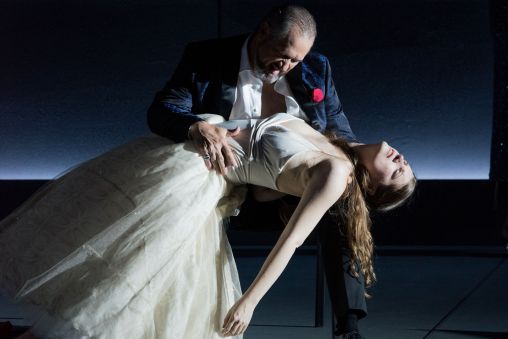
People still talk about the Salomé that directors Patrice Caurier and Moshe Leiser brought to Spoleto back in 1987, and it’s clear that the directing duo was bent on duplicating that éclat in their current reimagining of Strauss’s sizzling opera. They’ve succeeded – and you only have a couple of more chances to witness it on June 2 and 5.

The singing from the cast is rich and strong, allowing conductor Steven Sloane and the Spoleto Festival Orchestra to fill beautiful Gaillard Center with the sounds of Strauss’s score without drowning out the vocalists. Teaming up with set designer Christian Fenouillat and lighting designer Christophe Forey, Caurier and Leiser deliver a spectacular visual experience.

Looking out on night-time Jerusalem from a swank high-rise, we can’t expect the divine prophet Jokanaan to be imprisoned in a dingy dungeon. No, he’s confined in an apartment below. But after hearing Jokanaan’s powerful denunciations and imprecations from offstage during the opening scene, we first see baritone Erik Van Heyningen as the seer when his suite is lowered down from high above, far brighter than the surrounding night. Illumination and severe simplicity come with him.

What Caurier and Leiser bring to this holy sanctuary – and later, back at Herod’s rooftop – is wickedly, sensationally profane. They don’t merely ask soprano Melanie Henley Heyn to open her heart to Jokanaan in Salomé’s attempt to seduce the prophet. They also call upon her to bare her breasts in his bedroom. Nor was that necessarily the most shocking episode of the night, for when tenor Paul Groves as Herod prevailed upon Salomé to dance for him, he did more than join in. He dropped his pants, and Strauss’s famed “Dance of the Seven Veils” became the dance of the 10 thrusts. Or maybe that’s where I stopped counting.

Since Salomé knows she will be rewarded before her dance begins, you might say she isn’t abused here. But if she is, we feel uncomfortably supportive toward the horrific price she names – over and over, stretching the name of Jokanaan to seven syllables each time she demands his head. Even with all this salacious business, Heyn isn’t the most wanton or alluring Salomé that I’ve seen. The audacity of her overture to Jokanaan seems fueled by privilege more than vanity, so there’s enough youthful simplicity left in her to make Herod’s advances a stunning violation.salome_47926117157_o

Yet I’ve never heard more powerful demands for Jokanaan’s head, wickedly seconded by Edna Prochnik as the jealous and vengeful Herodias. Caurier and Leiser are somewhat remiss in not attempting to make an ultimate horror out of Salomé’s love song to the decapitated Jokanaan, but Heyn is also supreme in those moments. We expect the mighty righteousness of Van Heyningen lashing out at the “daughters of Babylon” who assail him, and Groves is a perfect fit for the powerful, conscience-stricken, and infatuated Herod. The most surprising vocal exploits came from tenor Zach Borichevsky as Narraboth, the captain of the guard who unwisely grants Salomé her visit with Jokanaan.

But it’s the production concept by Caurier and Leiser that will live longest in my memory – and Heyn’s performance that crowned it.esperanza-spalding_47942875852_o

Other highlights of Spoleto’s first week start with the jazz lineup – including Esperanza Spalding, the Dafnis Prieto Big Band, David Virelles, and an all-star tribute to Geri Allen from Terri Lyne Carrington, Craig Taborn, and Ravi Coltrane.

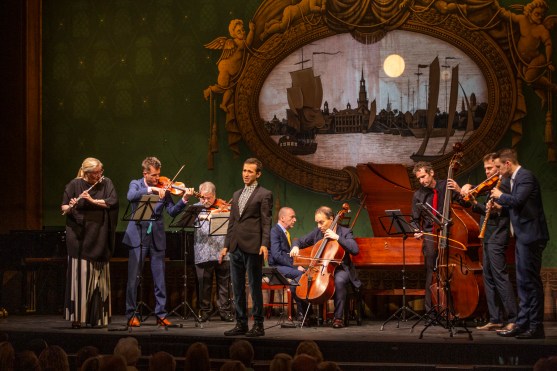
Meanwhile, the Chamber Music series hosted by Geoff Nuttall keeps getting edgier and wackier. Aside from Balliett’s hip refresh of Ovid, Stephen Prutsman’s new score for Buster Keaton’s old silent film, College, was smashing – when I was able to stop laughing at Keaton’s antics and pay attention to Prutsman’s.chamber-music-i_47958924527_o

You have plenty of time – and multiple opportunities – to catch Mark Turner and Ethan Iverson (June 5-8) at the Simons Center Recital Hall, but jazz fanatics must hurry or they will miss Carla Bley Trio (May 31) at Cistern Yard. Six more programs and 18 performances remain in the BofA Chamber Music series, twice daily through June 9. After making a delightful surprise appearance earlier this week singing a piece by Henri Duparc, tenor Paul Groves returns for Program VIII, headlining Benjamin Britten’s Serenade for Tenor, Horn & Strings.

The range, power, and delight of the lunchtime concerts is best illustrated by the concluding Program XI, slated for next weekend. Members of the band warm up with an 18th century bassoon sonata by Georg Philipp Telemann, followed by a recent Disco-Toccata for clarinet and cello by Guillaume Connesson. Then a deep dive into Beethoven’s “Ghost” Piano Trio with Inon Barnatan at the keyboard, Joshua Roman behind the cello, and Karen Gomyo on violin. All of the musicians heard thus far – and more – gather for the finale, a merry chamber music reduction of Rossini’s “Overture from Barber of Seville,” arranged by clarinetist Todd Palmer.caracalla-dance-theatre_32322768828_o

In the dance realm, the Bill T. Jones/Arnie Zane Company’s five-day sojourn in Charleston concludes this Saturday with repeats of all three parts of their Analogy Trilogy. For more lavish spectacle, stand by for Caracalla Dance Theatre’s One Thousand and One Nights (June 7-9), as the Lebanese company fuses Rimsky-Korsakov’s Scheherazade and Ravel’s Bolero with traditional Arabic instruments, melodies, and costumes. Expect this hottie to be a tough ticket.

Plenty more excitement awaits theatergoers, headlined by two Israeli and two Palestinian actors onstage together in the multimedia world premiere of Letters to a Friend in Gaza (May 30-June 2) at the Emmett Robinson. Up at the Woolfe Street Playhouse, 600 Highwaymen brings on The Fever (June 4-9), exploring group dynamics with audience participation. Cora Bissett’s What Girls Are Made Of (June 4-8) keeps it just as real at Memminger Auditorium, with the rock star bringing her teen diaries to life. Backed by a live rock band, of course!

There’s more. Find out what Circa, I’m With Her, Music in Time, St. John Passion, Westminster Choir, and the Festival Finale are all about at spoletousa.org.

Recapturing Old Hostilities – and the Path to Peace

Preview:  Three Bone Theatre Production of Oslo

By Perry Tannenbaum


Oslo_Square

Peace and the Middle East – they just don’t seem to belong in the same sentence, do they? Every week, we hear about a new flareup, a new conflict, a new bombing, and more death. So it’s timely that Oslo, the 2017 Tony Award winner for Best Play by J.T. Rogers, will be opening this week at Spirit Square. The Three Bone Theatre production, a Charlotte area premiere, revisits the back-channel talks that led to the historic handshake between Israeli prime minister Yitzhak Rabin and PLO chairman Yasser Arafat on the White House lawn on September 13, 1993.

Simpler, more innocent times – before we were educated (superficially, of course) about Sunnis and Shiites, before Americans discovered we despised Iran as much as Iraq, before Al Qaeda, 9-11, ISIS, beheadings, and chemical warfare. Long ago.

Beginning with a guerilla production of The Vagina Monologues at the WineUp wine loft in NoDa six years ago, Three Bone has grown gradually to the point where artistic director Robin Tynes feels ready for the challenge. Ready or not, Oslo is a substantial stretch for Three Bone.

There are more than 20 roles in Oslo, and most of 15 players covering them are making their company debuts. Actors in both the Israeli and Palestinian delegations need to feel the distrust and animosity of each side toward the other, travel the compressed journey to understanding and agreement in Rogers’ script, and repeat that three-hour odyssey – starting all over again with the same ferocious edge – night after night in performance.

That journey gets rockier if you’re fielding a diverse cast of Jews, Muslims, and Christians who come to the table with their own settled views. Respecting diversity had to go hand-in-hand with respecting the values of each performer’s time.

Negotiations1

“Yes, the rehearsal schedule was quite the challenge,” says director Paige Johnston Thomas, “15 people for 65 scenes! As they say in the theatre: I was told there’d be no math!”

Thomas, a fixture on the local scene for over 20 years, is making her debut with Three Bone. Kat Martin, brought aboard as assistant director and dramaturg, hasn’t worked at any theatre company before in the QC – and she’s drawing “rock star” accolades for her work in her Charlotte debut.

“Although I am not a Middle East expert,” says Martin, “a dramaturg’s job is to become an expert quickly then create points of entry for deepened understanding for creatives as well as community members.”

A dramaturg’s outreach to the community, after briefing directors and performers, often takes the form of explanatory materials in the show’s playbill. Martin’s involvement has been more proactive, involving the Oslo cast during her search for historical contexts. She began by speaking with John Cox, associate professor of Holocaust, genocide & human rights studies at UNC-Charlotte, who encouraged her to create a dramaturgy day where actors could listen and learn from community stakeholders like Palestinian activist Rose Hamid and Rabbi Judy Schindler, director of the Stan Greenspon Center for Peace and Social Justice.

Israelis1

That solid core was augmented by the participation of former Israeli soldier Stefan Pienkny, a veteran of the 1967 war, and two Palestinian refugees, Wafa Omran and Khalid Hijazi. Rounding out her gathering – and acknowledging the all-important peacemaking perspective of the Norwegians – Martin also invited facilitation expert Candice Langston, managing director of The Lee Institute.

“My biggest challenge was to keep the research real,” Martin emphasizes, “so I wanted to cultivate information for the cast while also making sure they were learning with their gut.” The three-hour crash course she organized for dramaturgy day began with Cox reviewing the historical background and Langston addressing the topic of building community dialogue.

Then there were hourlong small group meetups that paired the Israelis and Palestinians in the cast with the community stakeholders who represent those points of view. At the same time, actors cast as Norwegians lingered with Langston for more info on facilitating high-level negotiations. Climaxing the evening, the whole cast gathered together right after ingesting an hour of diverging partisan viewpoints, plunging into exercises designed to simulate the process of bridging those gaps, understanding the “other,” and finding common ground.

It was intense.

“An evening as an actor I won’t forget,” says Dennis Delamar, who will portray Yair Hircshfeld, one of the back-channel negotiators, and Shimon Peres, the foreign minister who would share the Nobel Peace Prize with Rabin and Arafat after the Accords were signed. “The evening focused on lived experiences, personal stories, facts, and some tears I observed which were quite integral in shaping my mindset. Stakes were definitely raised. I loved every minute of it.”

Norwegians2

Peres doesn’t enter until well after intermission. A political rival of Rabin, he keeps the Oslo talks secret – because he knows the Prime Minister will reject any agreement that isn’t airtight. It must be an offer that cannot be refused. Until the Israelis are close to that, no member of the government can be seen talking to the Palestinians. Needless to say, the Americans engaged in their endless fruitless talks must also be kept in the dark.

So that’s why Delamar is Hirschfeld all through the opening act – an economics professor at the U of Haifa!

“I connect with and enjoy playing Yair’s passion and intellect,” he says, “but also a certain amount of humor J.T. Rogers developed with this character. Sometimes he is out of his depths in the negotiations, but he’s never without a passion for the grave reason he’s there, fully invested in the outcome, proud of his part in the start of it all. I’ve enjoyed making him relatable in an endearing and real way.”

Yes, there are comical moments that leaven the animosities and tensions, but there are thriller elements aplenty. The possibility of ruining Peres’s political fortunes keeps the Israelis on edge, while for Mona Juul and Terje Rød-Larsen, the Norwegians pushing negotiations forward, getting their government to buy into the process – knowing they must keep the Americans in the dark – ratchets up their anxieties.

For the Palestinian delegation, PLO finance minister Ahmed Qurie and PLO liaison Hassan Asfour, secrecy is a matter of life-or-death. Only Arafat knows about these talks and how they’re progressing.

Vic Sayegh will take on the role of Qurie. Although he the mellower, less militant of the two Palestinians, he’s a radical departure for an actor whose QC credits began in 2003 with appearances in Steve Martin’s The Underpants and Charles Busch’s Psycho Beach Party. There’s no Kanaka shtick here, but there is a certain amount of savoir faire.

And the Palestinian does provide some comedy when he lets his guard down. Before encountering Hirschfeld in London for the first time, he confides to Larsen, his intermediary: “I have never met an Israeli. Face-to-face.”

Palestinians1

Very unique comedy, typical of the tensions Oslo whips up. But the finance minister quickly recovers in Hirschfeld’s presence, informing him that he hasn’t been to his homeland since 1967 when his whole village was forced to flee from “the advancing hordes of Zionism.” Awkwardness turns to polite hostility in a flash.

“Qurie often has an ulterior motive behind his words,” Sayegh notes. “He is very calculated. Like a poker player, he never lets his face give away his hand.”

Poker-faced or not, Sayegh sees Qurie’s motivations as deep and honorable. He’s relating them to his own experiences and heritage.

“As a young man, I remember meeting people who were Palestinian and subsequently looking for Palestine on a map,” Sayegh reminisces. “I would ask myself why they called a place that no longer existed, ‘home.’ Now I understand. Personally, my paternal grandparents were born in Aleppo, Syria. It was once a beautiful region of the world, but many years of conflict have reduced it to rubble. I hope that one day, peace in the entire region will allow me to visit the land of my ancestors.”

While Terje is the visionary who devises a successful model for conflict resolution – with a mixture dogged determination and quixotic optimism to keep it going – it’s the calm, meticulous, and brilliantly resourceful Mona who steers her husband around the political complications that threaten to scuttle his mission. Fresh on the heels of her pivotal role in the world premiere of Steven Dietz’s The Great Beyond, Tonya Bludsworth takes on the role of this unsung hero who buoyed her husband’s confidence while clearing his path.

“Prior to reading Oslo,” says Bludsworth of her journey, “I’m sure I felt like most Americans, that peace in the Middle East is not likely to ever really happen. But I was in tears when I first read the script, not because I was sad, but because I was overwhelmed by this incredible feeling of hope, and I still feel it every night in rehearsal. As Terje says, if we could just get past the politics and see the people, the personal, then there is a way.”

Miller, Muldaur, and JLCO Highlight Charlotte Jazz Fest

Review: Charlotte Jazz Festival 2019

2019~Charlotte Jazz Fest-001

By Perry Tannenbaum


Presented by the Leon Levine Foundation and staged by Blumenthal Performing Arts, the Charlotte Jazz Festival is continuing to grow incrementally in its fourth season. Despite some egregious rookie mistakes – the opening two-day fest in 2016 fell on the first two nights of Passover! – this year’s model ran like a Cadillac. Or perhaps it’s better to say a Lincoln, since the influence of Wynton Marsalis and members of his Jazz at Lincoln Center Orchestra has permeated this young-and-growing celebration since the beginning.

Rising vocalist and JLCO saxophonist Camille Thurman headlined the 2019 festival’s kickoff event at Romare Bearden Park with the Darrell Green Trio and a guest appearance by Marsalis. Hanging around for a second night, Marsalis and some other venerable vets meshed with The Future of Jazz Orchestra at Knight Theater in a lively Duke Ellington retrospective. Marsalis was gone on the following night at the Knight, but his melodies lingered on in a concert-length performance of Spaces by the JLCO and two featured dancers, Jared Grimes and Myles Yachts.

Then on the final night, while Tony Award winner Patina Miller was delivering an electrifying tribute to North Carolina icon Nina Simone, three aces from the JLCO sidled over to the Jazz Tent at Romare Bearden Park, each leading his own combo in a straight-ahead marathon that played on for nearly five hours. That immersion, collectively titled “The Gentlemen of Jazz,” was preceded the previous evening by “Ladies Sing the Blues” – ladies first, right? – which had nothing to do with either Lady Day or JLCO but plenty to do with the blues.

Bracing for the evening-long immersions on the last two nights, we began with The Future and the Duke, a new show that was headed to the Big Apple the following night. From the outset, with three horns – including Wycliffe

2019~Charlotte Jazz Fest-018

Gordon’s slide – launching “Black and Tan Fantasy,” and plunger mutes sprouting everywhere, the show was ready for primetime. Among the elders, it would be Dan Block who would get the most solo space, particularly when he put down his tenor sax and picked his clarinet, as he did early on in “Stompy Jones.”

With his customary cool, Marsalis mostly contented himself with narrating the proceedings from his seat in the back row with the other top brass. He stood up from that perch just once during his hosting chores, and interestingly enough, set off his signature trumpet pyrotechnics during “Old Man Blues,” with Gordon engaging in battle and the whole trumpet section whipping out two-tone derby hats to wah-wah the out-chorus. Anchoring the rhythm section, bassist Rodney Whitaker played the most notes among the blue bloods, but the he split his time behind the upright with Endea Owens, one of the most promising of the young bloods.

Appropriately referencing Duke’s first bassist in his introductory remarks, Marsalis programmed showcases for both Owens and Whitaker in “Portrait of Wellman Braud” and “Dancers in Love.” Covering the ‘20s through the ‘40s before intermission, the band mostly stuck with familiar titles like “The Mooche,” “Caravan,” “Cottontail,” “Sophisticated Lady,” “Rockin’ in Rhythm,” and – after an apt anecdote about young Billy Strayhorn – “Take the A Train.” Great intro to the Duke for newbies in arrangements suffused with authenticity.

Dealing with the ‘50s through the ‘70s after intermission, The Future was more eclectic and adventurous. Here we had “Royal Ancestry” from Duke’s tribute to Ella Fitzgerald, “Anitra’s Dance” from his adaptation of Grieg’s Peer Gynt Suite, and a couple of samplings from his film score work, including “Almost Cried” from Anatomy of a Murder. Rarest and most unexpected of all, the concert ended with a dip into The Afro-Eurasian Eclipse and, after the hip reference to Marshall McLuhan as the Duke’s inspiration,  “Chinoiserie.” Young Julian Lee excelled here on tenor sax, his second triumph of the evening after evoking memories of Ben Webster in “Cottontail.”

Other standouts among the young lions included Patrick Bartley doubling on alto sax and clarinet, Ben Cohen on bari, trumpeters Jumaane Smith and Noah Halpern, and trombonist Jeffrey Miller. Gabe Schnider mostly strummed rhythm but when he got the chance to solo on “Caravan,” the guitarist delivered, and whether it was the “Dancers in Love” duet or the iconic “A Train” intro, Sean Mason was a consistent delight at the piano.2019~Charlotte Jazz Fest-037

With Donna Hopkins, Deva Mahal, and Maria Muldaur playing title roles, the “Ladies Sing the Blues” triple header proved that the blues can be a very mixed bag. Hopkins and her youthful rhythm section took us down a “Dirty Alabama Road” in one song that was bluesy in a Joplinesque sort of way – Janis, not Scott – and mostly kept a torch-song tempo for her most distinctive originals, “Keep Talking Love” and “Heart Full of Love.” Her guitar licks also had an edge that kept her blues-rock groove burning. Muldaur came to the Jazz Tent with a bigger sound and naughtier intentions. Except for the flower that still adorns her hair, most people who remember Muldaur from her hit 1973 single, “Midnight at the Oasis,” would be surprised at how the years have altered the artist. Her entire set distilled the spirit of her most recent album, the Grammy Award-nominated Don’t You Feel My Leg (The Naughty Bawdy Blues of Blue Lu Barker) – until the obligatory “Oasis.”

The irony is that, if you had explored the eponymous album where “Oasis” first appeared, you would have found Muldaur singing the very same Blue Lu and Danny Parker “Feel My Leg” blues at the dawn of her recording career, backed by a battery of horns and Dr. John twiddling the keys. So the real evolution is in the singing voice, evident in the first notes of “Georgia Grind,” starting off her Barker family tribute. Considerable grit there, with the full mileage of all those years.

2019~Charlotte Jazz Fest-072

Going with the flow of her gravellier sound, Muldaur is less about the elegant, exotic innuendo of “Oasis” these days and more about such brash blues-singer declarations as Danny Barker’s “Loan Me Your Husband,” Vernon White’s “Leave My Man Alone,” Andy Razaf’s “Handy Andy,” and Blu Lu and Danny’s “Never Brag About Your Man.” In her robust intro to the Barkers’ opus, Muldaur made the connection between its advice and Sippie Wallace’s “Don’t Advertise Your Man,” with the appropriate nod to Bonnie Raitt.

On the bandstand, special dimensions emerged in live performance that don’t come through your earbuds via your iPhone. The heat and drama of “Loan Me Your Husband” were exponentially increased when Muldaur aimed her pleas directly at a matron seated in the second row of cabaret tables, maybe eight feet from the stage, and to watch David L. Harris solo2019~Charlotte Jazz Fest-062ing on “Trombone Man Blues” was way more than sexually suggestive when you saw the instrument’s sliding actions and heard its powerful moan. The audience definitely got the thrust.

Between Hopkins and Muldaur, we had to pass on Mahal in order to catch the Marsalis suite at Knight Theater. It was an early-evening, family-friendly concert that contrasted wholesomely with the risqué after-dark fare that was awaiting us back at the Jazz Tent. Each of the 10 segments was modeled on the sounds and movements of animals. Marsalis and his orchestra presided over the music while two dancers, tapster Jared Grimes and jook meister Myles Yachts, served up the moves – and, in Grimes’ case, additional percussion.

Yes, it had the elemental qualities of the LolliPops children’s concerts that Charlotte Symphony performs, and you can make a superficial comparison with Camille Saint-Saëns’ Carnival of Animals, a staple at such concerts. An equally apt analogy can be drawn between Spaces and Serge Prokofiev’s Peter and the Wolf. While there isn’t a narrative binding the creatures of the Marsalis menagerie together, there is definitely a tasty script introducing each of the critters.

Beginning with the observations on the chicken – most prevalent creature on the planet (if you count eggs), complexity of expression, ability to achieve REM sleep, closest living relative to T-Rex – you could tell that Marsalis and/or his ghostwriter had meticulously and whimsically researched their subjects, not pausing to dumb things down for the small fry in the audience. Surrounded by these pithy intros and the marvels performed by Grimes and Yachts, the JLCO struggled to capture our attention, even when their charts proved to be clever and resourceful.

2019~Charlotte Jazz Fest-050

When a brass player reared up with a sousaphone for “Pachydrem Shout,” Yachts danced circles around the whole band, making elephantine silhouettes on the upstage curtain along the way. Uncannier were Yachts’ backlit wrigglings during “Like a Snake,” the jook artist’s outstretched arms looking like a serpent slithering through the dancer’s body. The dance duets may have been the most formidable barriers to band recognition, especially when the most kid-friendly of them for “Leap Frogs” was followed by a surprise costume change, tux jackets and bowler hats for a waddling “Mr. Penguin, Please.”

The levity was leavened with a lyrical interlude. Tranquility overtook “Those Sanctified Swallows” long enough for Dan Nimmer’s piano, Carlos Henriquez’s bass, and Ted Nash’s piccolo to make an impression. Then for the Marsalis ode to “A Nightingale,” described as not only the most tuneful of birds but also the most akin to jazz musicians in their nocturnal habits, the dancers laid out so the band could shine. It was also an opportunity for Grimes and Yachts to rest up for the sunnier, more upbeat closers.

2019~Charlotte Jazz Fest-047

Grimes drew the solo spot for “King Lion” (actually about a lioness) with plenty of roaring from the brass, but the best moments in his dance were the percussion battles with drummer Charles Goold. Marsalis pushed the hoofers even harder for the concluding “Bees, Bees, Bees,” as the hornmen brought out kazoos to get a frothy hum going. When muted horns took up the drone, both Grimes and Yachts kept up with the frenetic pace, easily their best-coordinated duet of the night.

2019~Charlotte Jazz Fest-083

Three of the JLCO guys hung around the Queen City as headliners in the “Gentlemen of Jazz” concerts on the last night of the festival. It promised to be a revealing test for the Jazz Tent, since thunder and lightning were already prowling the metro area when we hit the highway. By the time we arrived for saxophonist Paul Nedzela and his quartet, it was evident that we weren’t going to gauge the effects of rumblings in the skies or rain on the roof. It was probably the weather, though, that was messing with the electronics.

Something was obviously wrong with the lights onstage, since Nedzela, on baritone for a luscious “Portrait of Jenny,” seemed to be in shadow compared with the ladies on centerstage the night before. Thanks to the miracle of acoustic instruments, we didn’t learn that the sound system wasn’t working until my wife Sue and I were exiting for the concert at the Knight. The last three compositions we heard before then were stellar, especially “Third Quartet,” where Nedzela switched from soprano back to bari for a ruminative duet with pianist Dan Nimmer, another holdover from the previous night. Chick Corea’s “Humpty Dumpty,” with Nedzela blazing on baritone, sent me out smiling.

2019~Charlotte Jazz Fest-126

When we returned, the bandstand was teeming with musicians, and the juice was back on for lights and sound. Like Spaces and the Ellington retrospective, Carlos Henriquez’s Dizzy Gillespie tribute, Dizzy Con Clave had Jazz at Lincoln Center fingerprints all over it. The entire set of Gillespiana, in fact, replicated titles released on the RodBros label last year under Henriquez’s name – and recorded at Dizzy’s Club Coca-Cola.

Except for trumpeter Michael Rodriguez and trombonist Marshall Gilkes, the octet joining Henriquez on the bandstand were not the same, so they brought fresh – and different –energies to the music.

This was especially true of Jeremy Bosch, who not only added his flute to the instrumental palette but also served as prime voice on the vocals, beginning with the opener, a spirited “Manteca” that demonstrated Henriquez’s con clave approach.This was especially true of Jeremy Bosch, who not only added his flute to the instrumental palette but also served as prime voice on the vocals, beginning with the opener, a spirited “Manteca” that demonstrated Henriquez’s con clave approach.

2019~Charlotte Jazz Fest-128

Numerous times, conguero Marcos Torres and drummer Marc Quinones clashed and bashed in spirited percussion orgies. Rodriguez and Gilkes were predictably prodigious in the horn section, but the ringers got their licks in as well. The seemingly diffident Jonathan Powell suddenly began exchanging trumpet volleys with Rodriguez in “Con Alma,” always sounding like he was playing a fifth higher, and Felipe Lamoglia rose up with a mighty tenor sax rant in “A Night in Tunisia.”

In a set that also included “Groovin’ High,” it was hard to pick a favorite, but “Kush” was easily the most revelatory piece I heard. Where has this gem been hiding out? Nor was there any arguing with the leader’s choice of “Bebop” as his closer. Fast, exhilarating and brassy, the chart provided Henriquez and pianist Robert Rodriguez with ample spaces to shine before the rousing out chorus.

To catch Patina Miller in concert, we had to sacrifice Kenny Rampton’s octet and the suite the trumpeter has crafted from the music for a recent off-Broadway production of Dominique Morisseau’s Paradise Blue. Understanding that Rampton partisans might feel just as strongly about their choice, we did not regret ours. There was a special homecoming vibe to the occasion, especially for Miller, who hails from nearby Pageland, SC. Lusty whoops gushed forth from the orchestra seats when Miller mentioned her hometown, and she invited her mom onstage to sing a duet on one number.

2019~Charlotte Jazz Fest-091

Heightening that warmth – and enthusiasm – was the tribute to Tryon, NC, native Nina Simone. From the outset of “Feeling Good,” it was plain, despite the disparity between Miller’s silvery voice and Simone’s husky contralto, that the two-time Tony Award nominee for her leading roles in Sister Act and Pippin (winner) had an affinity for the gospel-folk-blues icon and an appreciation of her legacy. The question of whether it took contralto depth to plumb the emotional depths of “Don’t Let Me Be Misunderstood” was quickly settled in Miller’s favor.

Backed by a quartet that included James Sampliner at the Steinway, Perry Smith on guitar, Gregory Jones behind the upright, and Joe Nero at the drums, Miller also proved she could swing some jazz in “My Baby Just Cares for Me” before the gospel-flavored duet on “Nobody’s Fault but Mine.” Astutely, Miller lightened the mood after Mom’s exit with “Marriage Is for Old Folks” before dialing the intensity back up – way up – with “Wild Is the Wind.”

2019~Charlotte Jazz Fest-107

That was our first glimpse of the summit of Simone essentials that Miller would ascend at the end of her journey. Meanwhile she roamed among less intense fare like “See-Line Woman” and “Love Me or Leave Me.” It was when she slowed the pace for “I Want a Little Sugar in My Bowl” that you could sense Miller was headed for the high country. We were already in rarefied air when she sang “Black Is the Color of My True Love’s Hair,” but then came a trilogy of Simone affirmations at the heart of her legacy.

In a breathtaking rush, “Mississippi Goddam” reached the pinnacle, followed by “Four Women” and “To Be Young, Gifted and Black.” No reaction at this year’s festival came close to the thunderous applause and the standing ovation that greeted Miller’s final emphatic “Goddam!” Her rage was so raw and, after more than 50 years, Simone’s words still rang so true – defiantly addressing this historical moment. Adding to the awesome spontaneity of this ovation was a lightning bolt of discovery: so many of the people, young and old, who sprang to their feet, galvanized by “Mississippi Goddam,” were hearing it for the first time in their lives.

Obviously, they needed to.

Stars of Opera Carolina’s Eugene Onegin Shine Brightest in Act 3 Showdown

Review: Opera Carolina’s Eugene Onegin

190507_OPE_ONE_143(1)

By Perry Tannenbaum

Opera Carolina subscribers have never been as fervid about Peter Ilyich Tchaikovsky as their Charlotte Ballet counterparts. On opening night of Opera Carolina’s Eugene Onegin, you could calculate the difference by gazing at the empty seats at Belk Theater. Artistic director James Meena, with a generous deployment of musicians from the Charlotte Symphony, gave an admirable account of the score. Scenic designer Peter Dean Beck engineered a setting that evoked the look and feel of the Metropolitan Opera’s Onegin, brimming with wintry birch tree trunks.

Still the new Opera Carolina production wasn’t quite engineered to change subscribers’ minds. In the early going, Alexy Lavrov’s performance as Onegin paled in comparison with what I experienced from the late Dmitri Hvorostovsky in New York. The baritone’s difficulties were compounded when the projected supertitles, wayward all evening long in tracking the action, failed altogether at the climactic moment when Onegin gave his polite and heartless answer to the passionate declaration of love that young Tatyana had written to him the night before. We lost some valuable nuances there.

Tchaikovsky and Alexander Pushkin, whose verse novel the composer adapted for his 1879 opera, no doubt expected us to like and empathize with the earnest young poet, Vladimir Lensky, more than with the best friend who suddenly became his mortal enemy. With tenor Sebastien Gueze as the pure-hearted poet, I also found Lensky more impressive, not only in his valedictory aria before the fatal duel with Onegin but also at the festive ball scene, where the poet’s jealousy over his friend’s advances to his fiancée Olga ruptures their friendship. After his moving performance of “Lenski’s Air,” I was doubly sorry to see Gueze go.

190507_OPE_ONE_358(1)


Yet once the fatal duel had concluded Act 2, something almost magical occurred. After the pivotal gunshot and confirmation of Lensky’s death, Onegin hung around, without the curtain going down, as the scene changed from the countryside to six years later at Prince Gremin’s St. Petersburg palace. Meena and the orchestra kept pouring forth the forlorn music of the bosky pre-dawn duel scene, Lavrov was solemnly helped into a dinner jacket, and just as the opening Polonaise for Act 3 cued the entrance of the noble guests to the ballroom, the baritone exited to the wings. He returned in a fresh garish white-streaked wig, reminding me somehow of the mature Beethoven, and was magnificent from that moment onwards. The wig change had to happen quickly enough so that Onegin could take in the arrival of Gremin and Tatyana – transformed from a forgotten reject into a poised, polished, and radiant princess. For me, it was Lavrov who was more radically transformed. During this humbling soiree scene, he was the person I empathized with. He was the singer I couldn’t peel my eyes away from.

In her youthful scenes, soprano Melinda Whittington as Tatyana didn’t decisively outshine mezzo Leyla Martinucci as her younger sister Olga. Both roles offer a nice range of emotions and feelings. Initially quiet and bookish, Tatyana breaks into bloom upon encountering Onegin, giddily pouring out her love into her letter and impetuously dispatching it to him against her better judgment. In broad daylight, she endures the double agony of realizing the mistake of her impulsiveness and then having it underscored by Onegin’s dignified rebuff. Olga is the cheerful and playful sister, secure in Lensky’s adoration, just a little too prone to teasing Tatyana and goading Lensky’s jealousy until it’s too late. In a matter of seconds, complacency is swallowed by catastrophe. Martnucci brilliantly bridges her flashes of blithe jollity and the sudden onset of shock and disbelief. To a large extent, the impact of the breach between Lensky and Onegin depended on Martnucci’s devastated reaction.

190507_OPE_ONE_406(1)

Whittington was more convincing for me in her quiet formal episodes with Onegin than she was in Tatyana’s great letter scene, singing it well enough but never living it with that intense mixture of terror and exhilaration that can only happen when you’re in free-fall, carried into the void by an overwhelming tide of love. She seemed to be following director Tom Diamond’s instructions station-to-station as she restlessly moved around Tatiana’s bedroom rather than infusing these movements with urgency and spontaneity. My confidence in Whittington’s dramatic capabilities remained shaken until the ultimate denouement, although she was majestic enough with her prince at the palace. When Onegin came begging for love and forgiveness, Whittington was fabulously conflicted, seemingly pleading for release and infuriated by Onegin’s temerity at the same time. As before, there was no restraint in Diamond’s direction, but Lavrov’s complete self-abasement and Whittington’s spasms of rage set the scene ablaze.

190507_OPE_ONE_442(1)

Of course, it was up to bass baritone Jordan Bisch in his cameo as the aging Prince Gremin to justify Tatyana’s devotion and make Onegin’s presumption play like treachery. With a garrulous, avuncular stage presence, wig and makeup designer Martha Ruskai’s best work, and one beautiful heartfelt aria, Bisch did exactly that. It isn’t quite as easy to analyze why Triquet’s gaucherie works so well at the ball before fireworks erupt between Onegin and Lenski, but tenor Johnathan White’s foppery – and AT Jones’s costume design – set exactly the right tone. While I couldn’t explain why subscribers were shunning Tchaikovsky, I could predict an enjoyable Eugene Onegin experience if they gave it a chance, especially if Opera Carolina’s two stars can reach peak form before Act 3.

L’Académie du Roi Soleil Unleashes Pent-Up Power in “Treacherous Love” Cantatas

Review: “L’Académie du Roi Soleil” at Tate Hall and the CPCC campus

By Perry Tannenbaum

2019~Treacherous Love_0018

Two baroque companies have risen to prominence over the past couple of seasons in Charlotte, different in size and scope but with obvious affinities. Over that span, the newer Bach Akademie Charlotte has performed two cantata series in Charlotte and nearby towns at various churches, now preparing to stage its second annual Charlotte Bach Festival in June. Not so high-profile, L’Académie du Roi Soleil has settled into Charlotte within the past year after a concert history that has traversed the Carolinas, with transoceanic excursions to Oxford and Cambridge, England.

While it’s possible that the Bach Akademie may branch out into works by Handel, Telemann and the French baroque masters in seasons to come, Académie has already planted its Gallic flag. Soprano Margaret Carpenter Haigh and harpsichordist Nicolas Haigh, who co-founded Roi Soleil in 2013, have established themselves as Bach Akademie mainstays as well. In their return to Tate Hall and the CPCC campus, Roi Soleil continued to emphasize the Sun King in their program.

Or should I say “Programme”? For in their terminology, their typeface, and in their performances, L’Académie proved that they have a style of their own. Starting their presentation at 12:30 PM, however, wasn’t a new wrinkle, for midday concerts are fairly routine at both the Oregon and Charlotte Bach Festivals. In fact, when L’Académie performed Couperin’s Leçons de Ténèbres at Tate last March, that concert was also a midweek lunchtime event. Fewer Francophiles were likely to be as familiar with this year’s lineup, which included Jean-Féry Rebel, Elisabeth-Claude Jacquet de la Guerre, Louis-Nicolas Clérambault – and a devastating theme: “Treacherous Love, Passion and Vengeance in 18th Century France.”

2019~Treacherous Love_0011

Giving Margaret Haigh the opportunity to make a solo entrance, Michael Haigh and Roi’s two string musicians, violinist Cynthia Black and viola da gamba player Gail Anne Schroeder, began the afternoon with Jean-Féry Rebel’s Violin Sonata No. 5. One of Louis XIV’s “24 violons du Roi,” Rebel came across as a blithe spirit in my first brush with the composer’s work. Especially in the third Viste movement, Rebel offered Black ample opportunities to impress with her vitality and virtuosity. In the opening movement, where Viste was just the first of three tempo markings – with a middle Grave section providing contrast – Black displayed the richness of her tone almost immediately. Nor was there any inwardness or solemnity in the Sarabande that followed, where the trio’s sound remained sweet instead of sad. After the exhilarating pace of the penultimate Viste, the final Gigue slowed down noticeably but remained joyously danceable.

When she emerged to perform the two cantatas on the bill, Margaret Haigh did not dwell on Jacquet de la Guerre’s gender in introducing her Semelé. Unlike Handel’s opera, which expands upon Ovid’s 53 lines on Semele in The Metamorphoses – with a libretto by William Congreve! – Jacquet’s cantata actually condensed Ovid’s original, so Haigh and the program booklet were obliged to fill us in on the backstory, where the Roman goddess Juno, jealous of her husband Jupiter’s love for Semele, disguises herself as the human maiden’s nursemaid and convinces her that she must get proof from Jupiter of his divinity. Here is where Jacquet began, sending her soprano onstage to tell us that Jupiter had rashly sworn to grant Semele anything she desired before she surprised him with her wish. The rules are the same as they were in the Old Testament: humans who view the face of god must die.

From then on, Haigh became Semelé, anticipating Jupiter’s arrival and – amid mighty displays of lightning – chiding herself for her doubts. Haigh’s best moments came when Semelé’s triumph was at hand and in her ensuing immolation. Jacquet gave the instrumental accompaniment an emphatic pulse here that the musicians picked up on, and Haigh took it upon herself to dramatize Semelé’s giddy vainglory, acquiring a strength in her “Quel triomphe, quelle Victoire” air we hadn’t heard earlier. For both Handel and Jacquet add on a sexy spice to Ovid’s narrative, a hint the Semele aspires to become a goddess herself if Jupiter couples with her in the way he would with Juno. “Je vais joüir de sort des dieux!” she exults. She will enjoy the lot of the gods.

Jacquet has her bragging that she knew how to please Jupiter, and Haigh reveled in repeating those hubristic vaunts. Our heroine’s fall is pretty steep in the ensuing recitative, and Haigh was suitably vulnerable, surprised, and pathetic in describing her own destruction. Haigh then reverted to her previous role as Jacquet’s narrator, drawing a moral that tenderness and warmth should be what we ask of love rather than blazing fire and glory. No wonder, then, that there’s no mention that Semele’s pregnancy incited Juno’s jealousy or that Dionysus, god of wine and revelry, would be her son.

In Clérambault’s Médée, no such restraints applied. After an introductory recitative, Haigh could immerse herself in the wickedly vengeful queen and stay there. Yet Clérambault humanized his Medea more than we might expect if we’re familiar with the vengeance Euripides ascribed to her in his ancient Greek tragedy. Taking his cue from the Golden Fleece narrative of the Argonautica, the Frenchman ignored the more fiendish aspect of Euripides’ storyline, when Medea kills Jason’s – and her own – sons. Clérambault concentrates instead on Médée’s ruminations before she kills Glauce, the Corinthian royal that her husband has abandoned her for. Where Euripides had Medea pausing to consider before slaying her own children, Clérambault had her pausing before murdering Jason, remembering how much she once loved him, and deciding to vent her rage on her rival.

2019~Treacherous Love_0016

Without needing to revert to her narrative role, without a particle of self-pity, and with the support of demons that Médée rabidly summons from hell, Haigh could be even more manic and powerful. Haigh seemed to revel in the give-and-take, the tender moments of fond memories giving way to fury, resolve, and exultation. Clérambault’s score also gave the musicians greater latitude to vent their energies. Before Médée called upon the demon jealousy, “Cruelle fille des enfers (Cruel daughter of hell),” Nicolas Haigh pounded a march-like intro on the keyboard, so when Margaret Haigh sang out, casting her spell, it was like Médée was giving the demons their marching orders.

There would be no neat moralizing here. After a recitative confirming that Médée’s father, the sun god Helios, had favored her cause, Black’s violin feverishly cued the “Volés, Démons, volés! (Fly, demons, fly!)” finale. Haigh sounded fully aware that she didn’t need to save herself for anything afterwards, and this was one of those times when Tate Hall couldn’t contain the power of her voice. Even when she was done venting and raging, the fury of Médée’s vengeful wickedness continued in Black’s violin, leaving us with the feeling that we had just witnessed the unleashing of an awesome elemental force.

Reservations Are Required – and Rewarded – at Charlotte Symphony’s “On Tap” Concert

Review: Charlotte Symphony’s “On Tap” Concert

By Perry Tannenbaum

2019~Symphony on Tap-21

Beer gardens, rathskellers, and brewpubs have traditionally encouraged their patrons to listen to music, lift their glasses in song, and maybe dance a polka, but for many classical music enthusiasts, Charlotte Symphony’s excursions to local breweries for their Symphony on Tap concerts may seem to be pioneering. Apparently, they originated in 2015 with a season kickoff party at Belk Theater, evolved into a similar event the following September at Booth Playhouse, before Symphony ventured forth to the NoDa Brewing Company for their third Symphony on Tap in November 2016. In terms of sampling these more informal concerts – and getting the word out – I will freely admit that I’m late to the party. Special dispensation was required to review the latest in this concert series, since it was sold-out weeks in advance.

2019~Symphony on Tap-19

Obtaining their tickets in advance, patrons pre-qualified themselves as interested in Symphony’s product, though you had to wonder how many of them had bothered to check out the CSO website and see what they would actually hear. When NoDa Brewing owner Susie Ford drew attention to the stage, the crowd quieted, and there was no great commotion when the musicians performed. Yet there were limits to the decorum. Lines to the taps got shorter when the concert started and, after a strategically placed intermission, when it resumed, but people continued to line up for their pints and sampler flights of NoDa brew. Symphony conductor Christopher James Lees was not all perturbed. On the contrary, he encouraged the relaxed atmosphere and even plugged the brewery’s award-winning Hop, Drop ‘n Roll on numerous occasions.

In a place where you couldn’t call for a Bud, a Blue Ribbon, or a Miller Lite, it was encouraging – but not altogether surprising – that Lees was emboldened to offer us more than a strict Haydn-Mozart diet. After opening with the “Adagio and Fugue,” not the lightest of Mozart’s works, we detoured into Gustav Holst’s St. Paul’s Suite. Further out on the musical frontier, the second half of the program began with “Tango” by Alicia Bachorik Armstrong, a living composer who was on hand to introduce the piece. Even the Haydn symphony that closed out the evening, the No. 30 “Alleluja,” was off the beaten path.

As I quickly discovered in the Mozart, the hall was unkind to low decibels and high frequencies. While the bass-heavy opening to the Adagio segment sounded natural enough, it had to compete for my attention with the churning hum of the brewing apparatus in the adjoining space behind the bar. By the time we reached the Fugue section, initiated by the double basses, I was fairly well acclimated to the steady hum, but I wasn’t pleased by the thin querulous sound of the violins as they layered on. Without the resonance of a church or concert hall, the trebles were more like the sounds we hear on authentic ancient instruments. The bass foundation under the violins was rich and lovely as the performance climaxed.

2019~Symphony on Tap-24

Unacquainted with the Symphony on Tap ground rules, I was afraid that we were only going to hear the spirited Jig from the St. Paul’s Suite. It transitioned nicely from a merry dance to a briefer, more insistent episode – almost a march – before the Vivace movement accelerated to an even quicker pace. Effectively shaped and very well suited to the room, the movement drew applause. Lees not only tolerated this beerhall response, he encouraged it, for he proceeded to introduce each of the next three movements before they were played.

Just as he had explained what a fugue was prior to the Mozart, he now deciphered the mystery of what an ostinato was before playing the movement that bore that title. Second violins initiated this repetitive figure over pizzicatos from the other strings, not the swiftest presto I’ve heard on this movement, and concertmaster Calin Lupanu soloed gracefully. Lovelier Lupanu was wrapped into the ensuing Intermezzo as he entered over delicate pizzicatos – and over a baby’s cries in his most virtuosic passages. Violist Ning Zhao engaged Lupanu in a couple of satisfying duets here as well. Probably the most engaging music of the evening, Holst’s Finale ended by meshing an Irish folk dance with the traditional “Greensleeves,” both melodies frequently playing simultaneously in this rousing Allegro. Even without the customary percussion, it energized the audience.

Born in the Philippines, schooled at the NC School of the Arts (when Lees was on the faculty), and currently residing in Greensboro, Bachorik Armstrong wrote her “Tango” for orchestra in 2016 and last year completed a string quartet version that can be auditioned at her website. Her personable intro of the orchestral piece rivaled those delivered by her mentor, chiefly pointing out that the piece grew out of her lifelong love of dance – and repeated efforts to excel at it. We could relate. Reflecting her tentative starts and reboots, Bachorik Armstrong could have easily titled her dance “Attempted Tango,” for its beginning was indeed tentative over a pizzicato vamp, until the violins danced more confidently to the plucked lower strings, and there were two definite restarts later on, initiated by the cellos and the double basses. Over the sustained bass figures, there were unexpected shifts in tone and tempo, with a modicum of modernism instead of a noxious deluge. Lupanu and a second violin had tasty little cameos toward the end.

2019~Symphony on Tap-09

A mini-break followed Bachorik Armstrong’s “Tango” – and the composer’s bows – as a modest group of wind players joined the strings. Still no percussion, but the question of whether Haydn’s Symphony No. 30 should be performed with timpani remains under dispute. The chronology of Papa’s early symphonies hasn’t been settled by the numbers assigned to them, but the “Alleluja” is the last of the numbered symphonies to be written in three movements. Surprisingly for a symphony that may have premiered on Easter of 1765 – or the Holy Week preceding – the “Alleluja” spirit is rather festive, with no slow or mournful movements. In other words, “Alleluja” was a perfect cloudless finale for a brewpub concert.

Wind instruments fared far better at NoDa Brewing than the violins, instantly pleasurable in the opening Allegro with a nicely gauged crescendo from the cellos toward the end. After setting the stage for flutist Erinn Frechette’s exploits in the ensuing Andante, Lees didn’t allow the tempo to flag to anything slower than a brisk canter. At that speed, Frechette’s filigree became brilliant over the crisp strings, and the flute’s birdlike warblings remained jocund, unalloyed by any solitary gloom. Collectively, the winds reached their fullest bloom in the impressive allegretto Finale. If Lees kept them a little too subdued in the opening Allegro, he unmistakably unleashed the woodwinds here to rollicking effect, establishing a clear 3/4 minuet sway along the way.

Although this was the last official Symphony on Tap for the 2018-19 season, the uniquely relaxed vibe of the series lingered on after the final note. Along with an audience mostly seated in casual dress at tables, instrument cases stowed under musicians’ chairs, and audience applause between movements, there was no sudden rush for the exits after the final note. The night was young and the taps hadn’t shut down. Charlotte Symphony has obviously reached out successfully to the community with these concerts, and NoDa Brewing Company isn’t the only joint they visit. Come summer, Symphony will return to Triple C Brewing for a June 27 concert in the Barrel Room, and a whole new flight of On Tap events is already booked for 2019-20.

“Spring Works” Delights With Sensuous, Satirical, and Classic Vibes

Review: Charlotte Ballet’s Spring Works

IN Cognito by Taylor Jones-1

By Perry Tannenbaum

Go figure. On opening night of Charlotte Ballet’s Spring Works, the most famous choreographer on the program wasn’t listed in the program booklet. Nor was his dance repeated at the next three performances after the Friday opening. Unless you noticed the insert inside your program booklet, you never did know that Merce Cunningham, who would have been 100 years old on April 16, was the mystery choreographer of the night. Or that Anson Zwingelberg, Charlotte Ballet’s representative at a Centennial Celebration at the Brooklyn Academy of Music on that night, was the dancer who repeated his performance from the special “Night of 100 Solos” gala.

For those of us who did eventually discover the insert, then looked up the celebrations – in London, Brooklyn, and LA – and tracked down the Vimeo replays of the live streams, most of the mystery was solved, except for the title of Zwingelberg’s solo. Others who freewheel their spectating without consulting their programs might still be puzzling the connection between what Zwingelberrg did and the Opus.11 pas-de-deux that followed.

With my program spread out before me, I knew instantly that I wasn’t watching Alessandra Ball James or Josh Hall, respectively in their 13th and 7th years with the company and listed as the partners in David Dawson’s Opus.11. Completing his second year, Zwingelberg is best remembered for his villainous Karl in The Most Incredible Thing last March. He wore a costume then. Although credits for designing Zwingelberg’s attire were given to Reid Bartelme and Helene Jung, your initial impression of their handiwork might be to assume that Zwingelberg had escaped from a work prisoners’ detail along the margins of I-77.

In his brightly colored jumpsuit – somewhere in the neighborhood of mauve, DayGlo orange, and Band-Aid – Zwingelberg performed one of Cunningham’s less dancelike solos. Arm, hand, and leg movements had an eccentric inward quality to them, occasionally endearingly comical, emphatically anti-musical, and occasionally spasmodic and crazy. A formal onstage introduction of some kind would have helped, to be sure, although it would likely have been nearly as long as the solo.

Opus11-1

Described as a “love letter” to Dawson’s two collaborators, dancer/costume designer Yumiko Takeshima and dancer/choreographic assistant Raphaël Coumes-Marquet, Opus.11 was unmistakably about love. Greg Haines’ hypnotic music and Dawson’s intimate lighting cast a nocturnal spell, more than sufficient to rekindle the chemistry between James and Hall. It should be familiar to CharBallet subscribers by now. If you’ve forgotten their man-goddess pairing at last year’s Spring Works, they’ve been Sugar Plum Fairy and Cavalier in Nutcracker and Peter Pan and Wendy in the meantime.

For James to reach such depths of sensuous surrender in a dance, she must trust Hall completely when she lets go. Years of dancing together have built a confidence in James that now appears to be absolute, so it’s really exquisite to see them so sinuously, emotionally, and fearlessly in action. It probably didn’t hurt that Coumes-Marquet himself was on hand to stage and rehearse this satisfying piece.

Helen Pickett, the choreographer who paired James and Hall so effectively last spring in her “Tsukiyo,” returned with the world premiere of a more complex work, IN Cognito. Dedicated to Blowing Rock native Tom Robbins with a title inspired by Villa Incognito, one of his later novels, Pickett plays with the idea of performers hiding behind their roles – yet exposing their true selves. Lighting by Les Dickert and costumes by Charles Heightchew evoked the brightness of 60’s and 70’s décor, yet there was regimentation and repetition in the early ensemble action that made me think Pickett had something pungent to say about peer groups and humdrum workplaces.

IN Cognito by Taylor Jones2-1

The 10 performers, including special guest Robert Plant, executed their impersonal dance moves amid innocuous furnishings. A couch, complementary ottomans, floor lamps, descending window frames and ceiling lamps defined a domesticated indoor space where people interacted without really connecting. Satire? Music by Oscar-nominated Jóhann Jóhannsson and Mikael Karlsson occasionally heightened the urgency of this dance but didn’t warm up its cold vibe. When the couch was put into service as a runway, the dancers briefly took flight.

Reprising Johan Inger’s Walking Mad, CharBallet recalled artistic director Hope Muir’s triumphant arrival in the fall of 2017, when this was the opening work on her first program. Premiered at Nederlands Dans in 2001, toured by Alvin Ailey, and staged by an international who’s who of companies, Walking Mad can be anointed a classic even if Inger’s name still isn’t a household word. It features nine dancers in moods ranging from giddy silliness to deep despair – and a very versatile wall – mostly dispelling the obsessive spell of Maurice Ravel’s famed Bolero.

Replacing Ryo Suzuki, who launched the piece in 2017, Maurice Mouzon Jr. made his entrance from the Knight Theater orchestra pit, dressed in a drab overcoat and a Magritte bowler hat, the first of numerous bowlers we would see. No music yet, wall only dimly evident in the gloom. Mouzon and Sarah Hayes Harkins would dominate the pre- and post-Bolero moments, the first in silence and the moody finale set to Arvo Pärt’s “Für Alina.” Withdrawn and grumpy, Harkins wouldn’t accept Mouzon’s coat, letting it drop to the ground.

The first uptick in intensity comes as the simple wall springs to life, plowing Mouzon towards us. Then the mood also begins to shift when there’s a breakout of silent vaudeville comedy at opposite ends of the wide wall, our first visual confirmation that other dancers are conspiring in the comedy. Silent film comedy, you might say, appropriate for when Bolero was premiered in 1928. Doors appear in the wall. Another uptick: Men dressed in dopey maroon party hats begin to chase around and through the wall. Women in similar hats, looking equally dopey, join the party.

We tend to forget – or not even know – that Ravel’s Bolero actually began as a ballet. But not like this!

Abruptly, the wall was bent into a perpendicular shape, the music was muted, and Elizabeth Truell dominated the enclosure, by turns unresponsive, terrified, and violent toward the men who tried to reach her. She was clearly the maddest of Inger’s walking mad, conceivably in an isolation ward, and most bizarre when she and her partners suspended themselves in the corner of the half-folded wall. Slamming all three of his dancers against the wall in this segment, the choreography had a sprinkling of French apache as we awaited the return of the Bolero.

Walking Mad-1

The logic seemed to be that the music returns to full volume when Truell peeps over the top of the wall, but that logic didn’t hold in this surreal world. Gradually the music and the snare drum’s tattoo returned. After an old vaudeville mirror shtick early on, Ingel had laid part of the wall down like a palette and turned it into a slightly elevated dance floor. Now the whole wall came down, and in a Kafkaesque sequence, the former partyers all returned in Magritte bowlers, dancing in manic unison rather stumbling glee. in the process, the mob tormented Mouzon, tossing off their overcoats as Bolero roared to its end.

Applause inevitably greeted that wild moment, although Mouzon remained spotlit downstage awaiting Pärt’s wan piano sonata to cue up. With business between Mouzon and Hayes centering on his coat once again, the two dancers came marginally closer to connecting. If Mouzon had strengthened and persisted in his overtures for an hour or so, the diffident Hayes might have relented a bit, but the young man didn’t have that kind of resolve.

You could have called Mouzon’s exit Chaplinesque if it had a sunnier energy – or any true animation, though he did scale to the top of the wall and balance himself there. Instead of jumping or throwing himself off the edge, Mouzon merely leaned forward and fell out of sight. Classic.