Tag Archives: Raven Barkley

New Costumes and Scenery Heighten the Wonder of Charlotte Ballet’s “Little Mermaid”

By Perry Tannenbaum

March 11, 2016, Charlotte, NC – Everything seems to be going so well at Charlotte Ballet as Jean-Pierre Bonnefoux stands on the verge of his final year as artistic director. During his tenure, Bonnefoux has seen his dance troupe establish residence in the trendiest theater in town on South Tryon Street while the company strengthened its educational program at its new administrative HQ on North Tryon Street. Two days before opening night of a nine-performance run of The Little Mermaid, choreographed by Mark Diamond, news broke that the McColl family – the BofA billionaires – had given the company $1 million to revamp Bonnefoux’s version of The Nutcracker, leaving little doubt about what the company’s most spectacular production will be for years to come. That announcement may have upstaged the new sets and costumes adorning the Diamond remount in the eyes of newspaper readers, but for the horde of little girls who helped fill Knight Theater to near capacity on opening night, the light in their eyes came from the new undersea wonders lavished upon The Little Mermaid.

There was definitely a fresh dazzle in the new costumes by Aimee J. Coleman, and their iridescence wasn’t confined to the rig Alessandra Ball James wore as the Mermaid before shedding her tailfins for legs. Three Little Mermaid Friends and a matching pair of Seahorses also gleamed, and there was a Day-Glo phosphorescence to the costumes of the Eels, the Undertow group, and the Fish. This new Little Mermaid signals that the extensive use of youthful dancers at Charlotte Ballet will no longer be confined to the annual Nutcracker extravaganza. No less than 20 kids are listed as Fish in the program, and they actually began the show with an extensive dance of their own, fluttering in formation and seemingly gliding across the stage in a manner that simulated black-light puppetry. Diamond had them admirably schooled to resemble a school of fish at multiple points in their dance.

Costumes that aren’t aglow are frequently marvels. Parents will no doubt need to dip into their program booklets to inform their princesses that Ryo Suzuki is an Anemone, but there’s no mistaking Raven Barkley for anything but a Sea Turtle. The sheer plenitude of sea creatures that have nothing to do with the story is a constant delight, not in the least Rylie Beck, making her way up the orchestra aisle at a snail’s pace and lurking onstage as the Hermit Crab – though she could easily be mistaken for a Mary Poppins’ old rucksack. As enchanting as all these costumes were, the new wow factor came from Michael Baumgarten’s lighting projections, functional when the Mermaid’s destined Prince gets thrown overboard during a storm but truly spectacular as we glide through undersea corals and canyons.

The low tech, held over from previous Mermaid productions of 2008 and 2011, mixes charmingly with the high tech as we watch the scene where the Prince is tossed by the tempest and the Mermaid rescues him. Three linen ribbons that stretched across the stage were the sea, and I’m sure that the sailboat James Kopecky fell out of wasn’t even half-built. Throughout the opening act, while the Mermaid remains a finned sea creature, Diamond solves the Mermaid’s mobility problem by having her transported in the sort of sledge the crippled Porgy might use, drawn by the same invisible hands that ripple the linen ocean from the wings. When Ball James rises from floor level, she remains horizontal thanks to the ministrations of her Friends and the rolling Undertow crew.

Although Addul Manzano makes a dashing appearance as the Sea King, Diamond hasn’t integrated him into the drama. Aside from the Mermaid, who occasionally appears on the verge of being heaved onto a dinner platter, it’s Jamie Dee Clifton who makes the biggest splash as the Sea Witch. Beyond pointing upwards, the Mermaid doesn’t articulate what she’s yearning for in the climactic encounter with the Witch, but the real exposition gap that Diamond leaves parents to fill in for their kids is the particulars of the bargain that the Mermaid agrees to when the Witch grants her the ability to walk on land. Clifton’s movements – and her saturnine costume – make it clear enough that goodwill and charity aren’t motivating the Witch as she grants the Mermaid’s wishes, and there’s a wondrous fairytale foreboding when Clifton hands Ball James the magic potion that effects her metamorphosis.

Thanks to the last of Baumgarten’s projections, the Mermaid awakens on a beauteous seashore with her newfound legs. Diamond doesn’t skip over the most absurd aspect of the Mermaid’s transformation, so we get an endearing, comical incongruity that no parent will be able to explain. After the Mermaid marvels at her feet and toes, she stands up tentatively on her legs like a newborn foal – and within seconds is dancing like the Princess Grace Fellowship winner that Ball James truly is. Even without the same undersea magic afterwards, Diamond constructs a second act that intertwines the Mermaid/Prince romance with a couple of strands of comedy and a couple of explosions of pure dance.

Along with two Charlotte Ballet II troupe members, namely Suzanna Duba and the hunched-over Ben Youngstone, Beck sheds her shell to become one of three Gossips. Singly, they snoop and scurry about in various corners and alleys of the set as the Mermaid glows, blushes, and plain shows off in response to all the attentions that the Prince lavishes upon her. Collectively, they engage in effusive sessions of head-bobbing, mouth-flapping gossip. But it’s a military trio, no more pertinent to the action than the Turtle before them, who provide the greatest comic delight. David Morse is pomposity itself as the General, head tilted back and sporting an imposing belly bulge. Yet he begins bickering lustily as soon as Josh Hall appears as the Admiral, topped with the appropriate seafaring hat. It becomes so heated – and of course, silly – that Amand Pulaj as the Secretary General is hard-pressed to keep them for pawing each other to death.

When he isn’t bickering, the General reviews a small brigade of Officers whose uniforms are colorfully unalike. But in her costumes for Suzuki, Juwan Alston, Iago Bresciani, Ben Ingel, Thel Moore, and Gregory Taylor; Coleman makes sure that each of the designs registers as unmistakably Russian, matching the spirited music by Glière that they dance to. Nearly all these soldier dances are solos where each of the men vies with the others in acrobatic éclat. But the Russian flavor only crystallizes what has gone before. There is some Debussy wedged into the score Diamond has chosen, but with the generous selections from Borodin’s chamber and orchestral works, the overall musical texture is decidedly Russian. When we adjourn from the Prince’s garden to the ballroom in his palace (the most impressive of Howard Jones’s new set designs), we could be at any Russian ballet, for Diamond’s dance stylings are as retro as the music.

During this formal cotillion, Sarah Hayes Harkins comes into full flower as the Prince’s Fiancée, a vision of cold elegant perfection as she dances with Kopecky, hardly deigning to notice her rival skulking in the corner in her damp rags. The tension between the supple, skittish, and vulnerable Ball James and the serene and imperious Harkins seems so ideal that I wondered how they could be switching roles for four of the nine performances. But they are merely the tip of a general shuffle of principals including Kopecky, Manzano, Hall, Morse, Clifton, and Chelsea Dumas. Diamond could easily shuffle a few more members from the main troupe and the satellite Ballet II dancers without marring the overall effect. The company that Bonnefoux has built is that strong.

© 2016 CVNC

Production Values Continue to Evolve at Charlotte Ballet’s Innovative Works

Innovative Works_Yamato_Dancer Ryo Suzuki

By Perry Tannenbaum

January 29, 2016, Charlotte, NC – Ever since the event was created in 2003, when Charlotte Ballet was known as North Carolina Dance Theatre, Innovative Works has been a special event in the company’s season, performed at a special venue that further set it apart. The size of these venues, the length of the pieces on the program, and the number of dancers in each work were all smaller than the big ensemble pieces staged at Belk Theater and, more recently, at Knight Theater. Charlotte Ballet artistic director Jean-Pierre Bonnefoux was not only providing a platform for edgier, lapidary pieces, he was also establishing an incubator for new choreographers, usually dancers or former dancers in the company, to expand their creativity and pave a pathway to their afterlives when they were no longer onstage.

Works first seen at Innovative have not only enriched the repertoire of Charlotte’s pre-eminent performing arts group, they have served as springboards for further choreographic creations and for the formation of new companies outside Charlotte established by the former fledglings. This year’s collection of miniatures, running at the Patricia McBride and Jean-Pierre Bonnefoux Center for Dance through February 20, presents the brainchildren of current and former troupe members wedged among works by the company’s resident choreographers. Included on the bill are pieces by Dwight Rhoden, Mark Diamond, Sasha Janes, David Ingram, Sarah Hayes Harkins, David Morse, Gregory Taylor, and Josh Hall.

That’s a bunch, to be sure, but three of the works choreographed by current dancers – the “Dancer Spotlight” – are presented in rolling rep, so each evening consists of six pieces. The first two, Rhoden’s “Ballad Unto” and Ingram’s “Omologia,” are staples in every performance of the run. Taken together, they exemplify how Innovative has evolved. Intimacy and chamber size are no longer requisites of new choreography unveiled at the McBride. Both of these pieces were long enough to present on the Knight Theater mainstage, and by the time they were done, we had seen 18 dancers perform, including three up-and-comers from the satellite Charlotte Ballet II company.

Although scenery is still outlawed in this studio setting, lighting has become very sophisticated. In fact, the hard-edge lighting designs by Jennifer Propst are very much at the forefront of both experiences. Further blurring the difference between Knight and McBride presentations, the previously filmed “Behind the Dance” segments, where the choreographers talk about either their aesthetic or the genesis of the piece we’re about to see, are now as much a part of Innovative as they were last October in Fall Works at the Knight.

Innovative Works_Dwight Rhoden_Ballad Unto

Photos by Peter Zay

Rhoden’s “Ballad Unto” sets Bach’s famed Chaconne, prerecorded on violin, upon five couples, yet this destination is preceded by a setting to assorted sounds, textures, and rhythms that seemed equally long and substantial. Jamie Dee Clifton and Josh Hall were the couple that grabbed my attention most dynamically, but Ben Ingel and Raven Barkley were also charismatic standouts. All ten of the performers delighted in both the high-speed handwork and the footwork that Rhoden challenged them with, consistently accenting the beat with precision. Rhoden himself had fresher, livelier ideas than you might expect from him this deep into his career responding to Bach. Propst had a fairly a fairly stunning reaction to the choreography, setting five squares on the floor in an M formation for the five couples, occasionally replacing them with – or superimposing them on – an inverted V.

Interaction between the dancers and Propst’s lighting design was even more salient in Ingram’s “Omologia.” As the eight dancers advanced toward us at the outset of the piece, set to Corelli’s “La Follia,” a bright illuminated line across the stage seemed to daunt their progress. Once the dancers took possession of the stage, we discovered that there would be two more lines of lights connected to the first – and that each of the three lines was actually comprised of three adjacent squares. So while the dancers danced in close sync with the music, the nine pre-programmed squares, blinking on and off, were similarly wed to the movements and the shifting tableaus of the dancers. Numerous permutations of the nine squares flashed before us, including U shapes formed by seven of the squares that opened out at various moments to all four points on the compass.

From these lengthy baroque abstractions, we suddenly transitioned to a very real subject with Harkins’ “#Hatehurts,” the sort of high-concept piece that has typified Innovative in the past. Diagonally across the stage from each other when the lights came up, Sarah Lapointe in the foreground and Ingel upstage sat in front of laptop computers, reacting to online bullying and its fatal consequences. Of the six dances, this was the only one that didn’t come to us paired with a filmed introduction. Sure, it was the piece that least required explanation, but it was also so short that a prelude may only have drawn further attention to the piece’s brevity. Perhaps if the seated opening tableau didn’t seem to be such a substantial portion of the piece, the effect would have been more powerful, for the dance seemed to end as it was just getting started once the couple converged at the middle of the stage. The ratio between the prerecorded bullying and suffering we heard about and the anguish we saw live from the dancers ultimately struck me as too message-rich, an effective presentation for middle schoolers, perhaps, but artistically too thin for me.

John Adams’ “Short Ride in a Fast Machine” served as both title and soundtrack for David Morse’s piece, brilliantly danced by Harkins and Hall. In costuming, lighting, and choreography, Morse divides his work in two. The dancers come on in dim light, Hall in a waistcoat and Harkins in a long flowing blouse. Turning up their intensity, the dancers shed these upper garments as the lights come up fully. This moment of liberation is amplified by the ensuing choreography, which utilizes the entire stage. Morse’s piece returns to the rotation during the evenings of the final weekend of the run, February 18-20. Next weekend, Morse’s spot is taken by Gregory Taylor’s “Requiem of a Meaning,” and Hall shows off his “Social Butterfly” on the third weekend.

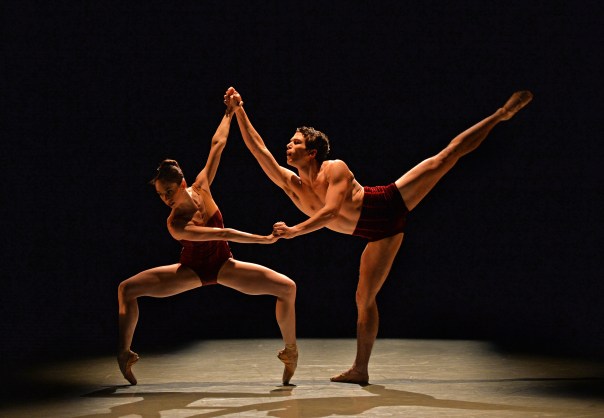
Hall will be borrowing rookie dancer Ryo Suzuki for his solo piece. Meanwhile, he is featured in “Yamato, earth/nature/drum,” a three-part celebration of Japan by Diamond, demonstrating that he’s no less eager to pursue new directions than Rhoden. The 12 people in this piece form a spherical mass as Propst’s shimmering lighting comes up, with Suzuki slapped across it horizontally. Then the ball explodes in big-bang fashion to an original score arranged by Rocky Iwashima, heavy with taiko pounding. Ultimately, the group regathers downstage in a tableau that is analogous to the spherical beginning but with Suzuki in an uplifted, triumphal posture. Inside of this effective framing, Suzuki and Addul Manzano are the dominant presences, although Barkley is hard to ignore whenever she’s involved.

Charlotte Ballet Innovative Works by Christopher Record

Photo by Christopher Record

For his new work, “Sketches from Grace,” Janes veered from his intent to create settings for works by Leonard Cohen, opting instead for a four-piece suite of settings to cuts by Jeff Buckley – including his cover of Cohen’s “Hallelujah,” which became a posthumous #1 hit for Buckley in 2008. The work showcases a punkish set of costumes by Katherine Zywczyk with faint, silvery highlights, beginning with Buckley’s most distinctive original, “You and I,” a brooding, floating, dreamy song that would seem to defy choreography. Yet Chelsea Dumas and James Kopecky fully conveyed the smoldering energy lurking in the lyric. Once covered by Nina Simone, “Lilac Wine” took the tempo up to a bluesy dirge, given an aching elegance by Ingel partnering with Alessandra Ball James. Bringing the tempo further up to a lethargic shuffle, “Hallelujah” was undoubtedly the climax of the suite, danced with such heartbreaking perfection by Hayes and Hall that the audience applauded as if it were the finale, although Janes’s video intro had promised us that all three couples had a concluding segment together. That closing ensemble was a more driven Buckley original, “Lover You Should Have Come Over,” very appropriate for the hubbub of three couples strutting their stuff simultaneously. Those last pushes in tempo, spectacle, and animation gave the audience one more reason to cheer.