Tag Archives: Josh Hall

Two-Thirds of Charlotte Ballet’s “Innovative Works” Are Truly Innovative – and Mesmerizing

Review: Innovative Works

By Perry Tannenbaum

What I especially love about Hope Muir’s first season as artistic director of Charlotte Ballet is the new blood she has infused into the choreography, bringing works by Javier de Frutos and Johan Inger to the city for the first time. So it was with considerable excitement that I went to see the 2018 edition of Innovative Works, premiering pieces by Myles Thatcher and Robyn Mineko Williams, choreographers we haven’t seen here before.

Staged at the McBride-Bonnefoux Center for Dance, where Innovative runs through February 17, both of these new imports triumphed – not only with their bold concepts but in the bravura performances that brought them to life. In between, however, we were subjected to the premiere of “The Weight of Darkness,” a lugubrious and monochromatic work by Sasha Janes that struck me as more inert than innovative. Murky lighting by Burke Brown and all-black costume designs by Aimee j. Coleman didn’t perk things up.

Usually, we can count on Janes to engage us with the sensuous, lyrical, and romantic elements of his work, often with a soupcon of eroticism. But here, commissioned by Angela and Robert McGahan to memorialize Angela’s sister, Irene Ross, Janes goes astray outside his comfort zone. Instead of celebrating Irene’s life, he uses the idea that 4am is the “death hour” as the starting point for his five-part broodings. Of course, the music he has chosen by Nico Muhly and Nico Muhly is neither uptempo nor uplifting.

Chelsea Dumas and Ben Ingel were an attractive couple in the first pas de deux that Janes created for this piece, and the pair of Alexandra Ball James and Josh Hall brought their nonpareil elegance to the second. Trouble was, there was nothing I haven’t seen before in the sequences of ballet moves that Janes doled out to these couples and nothing I’d clamor to see again. In the segments that framed the piece, the four couples of the ensemble only multiplied the tedium.

Perhaps “The Weight of Darkness” wouldn’t have seemed like such a thudding bore if Williams’ “To Clear” hadn’t been so utterly fresh and original. The language of dance movements and the vocabulary of the dancers’ interactions were both striking and new. At the heart of the asymmetrical structure Amelia Sturt-Dilley personified the angularity, restlessness, and urgency of Williams’ concept, appearing at the outset in the most outré of Coleman’s defiantly drab and casual costume designs.

When we first notice Sturt-Dilley perched on a chair, we’re not sure if she’s cautiously settling into it or getting set to flee in terror. Six other dancers, less vividly characterized, ride the wave of the original music score composed by Robert F. Haynes and Tony Lazzera. You might find their synthesis of organic flow with the mechanized pulsations of machines and hip-hop to be a little disconcerting. Fused with the unnatural, yet irresistibly fluid and rhythmic movement of the dancers, it’s just as likely that you will find it mesmerizing and utterly persuasive.

This is who we are, what we’ve become. That’s a strange takeaway from a piece that Williams says started with a thoughtful Bryan Ferry-styled contemplation of a woman, but something else in the choreographer’s filmed intro strikes closer to home. The close, not-quite-connecting interactions between the dancers always seem to deflect them in directions they had not anticipated taking. Totally involving and fascinating.
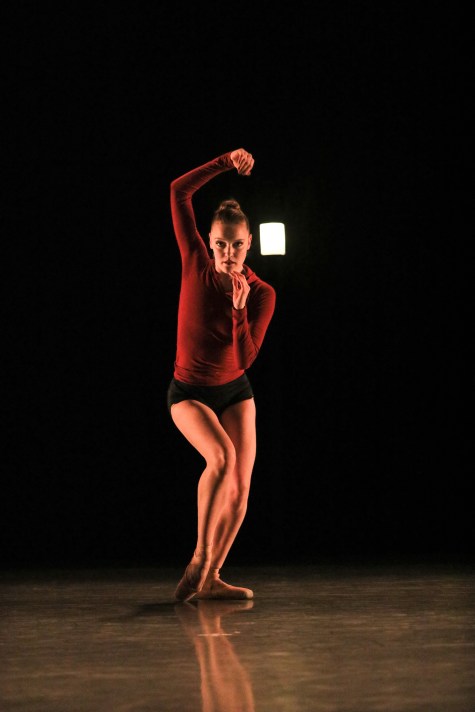
Concluding the program, Myles Thatcher’s “Redbird” remains abstract, but with Sarah Lapointe brilliantly dancing the title role, there are tantalizing suggestions of a storyline. Coleman dresses Lapointe in a bright red blouse – plus red hoodie, completing the cardinal evocation – that distinguishes her from the other seven dancers until the end when she sheds this plumage. In his intro, Thatcher shares that his choreography was a reaction to “a loss,” a way of processing grief.

Lanterns solemnly brought forth by the other dancers toward the conclusion of the piece may be signaling empathy, so when the redbird sheds her plumage, it’s quite possible she’s accepting their consolation and returning to the fold – and to what she looked like before she was aggrieved. Yet as Lapointe lets herself be absorbed into the group, in a gorgeous ritualistic tableau, there’s no telling for sure whether she has been consoled or coerced. Her outsider color may be unacceptable to the others. Or perhaps it is acceptable for a period of time mysteriously established by tradition.

The process may not work perfectly, but there’s comfort in knowing that you and your tribe are honoring it. And maybe an echo of the agony lingers.

Charlotte Ballet’s Flatter Slim-Fast “Nutcracker” Still Dazzles With Scenic Splendor and Scintillating Dance

Review : Nutcracker

1718Nutcracker_Chelsea Dumas and Juwan Alson_171208-Photo by PeterZay4286[13]

By Perry Tannenbaum

When I first heard that Charlotte Ballet would be trotting out its newish Nutcracker down in Charleston before bringing it back to the Belk Theater for its customary two-week run, it struck me as a good thing – spreading the word to South Carolina at the gloriously revamped Gaillard Municipal Center. But I hadn’t considered how the economies of putting the show on the road might affect the product at home. Musicians from the Charlotte Symphony Orchestra have been reduced this year from 60 to 35, according to Jean-Pierre Bonnefoux, the Nutcracker choreographer and past Charlotte Ballet artistic director. Furthermore, the mini-chorus that always sang from the orchestra pit in the “Waltz of the Snowflakes” at the end of Act 1 is gone. At least one orchestra member I’ve heard from isn’t pleased by the various transpositions required when you ditch the bass clarinet and are no longer tripling the flutes.

This slimmed-down score comes on the heels of last year’s million-dollar redesign of sets and costumes, austerity following ballyhooed largesse. The new sets sparkle with bright colors at the Stahlbaums’ holiday party in Act 1 and in the Land of the Sweets after intermission. The snow scenes literally glitter in both acts – and the cute little Angels float on a bed of clouds created by nicely tamed fog machines. Yet there was a two-dimensional quality to many of the new props introduced last year that, er, fell flat for me. It began, amusingly enough, with a lifesize cardboard housemaid that was wheeled out to the Stahlbaums’ anteroom and collected all the guests’ hats, coats, and scarves before wheeling back to the wings. But the two-dimensional motif didn’t end there, for the toy soldier that Herr Drosselmeyer brings for Fritz, the creatures that file off into the wings when the clock strikes midnight, the reindeer that peep into the Land of Snow, and Mother Ginger’s house are all pancake flat.

All this flattening muted bustle of the holiday party, which was deprived of the formerly grand arrivals of the Toy Doll and the Toy Soldier in cabinets, caskets, or palanquins. Mark Diamond’s shtick as Herr Drosselmeyer was radically hamstrung, stripped of his former hocus-pocus emceeing for the gift reveals, and while his leave-taking compensates a little for his no-longer-baroque-and-fussy entrance, most of the physical comedy is either gone or has lost its patina. Even the wrench Drosselmeyer used to fix Clara’s broken nutcracker seemed a shadow of its former absurdity. Where the flatness meshes with the new scenic design by Alain Vaës, the result is notably spectacular when the Christmas tree chez Stahlbaum grows to fill the entire upstage. The enchantment doesn’t stop there, for new scenery emerges behind it. Most spectacular, exceeding even Clara’s departure from the Land of Snow (escorted by the victorious Nutcracker), is Clara’s landing in the Land of Sweets below the clouds where the cute little Angels glide.

Worse than the absence of the bass clarinet for the “Dance of the Sugar Plum Fairy” (a bassoon doesn’t do) or the three flutes for the “Dance of the Reed Pipes” (barely noticeable) were the strings subbing for the mini-chorus. No matter how well they’re played, violins can’t say “Ah!” Under the baton of assistant conductor Christopher James Lees – and under the Belk stage – the Charlotte Symphony filled the hall rather nicely. With Sarah Lapointe and James Kopecky among the most elegant who have danced Sugar Plum and Cavalier, the climax of the grand “Pas de deux,” still sounded very powerful. But a subsequent listening session at home with a couple of reference recordings disclosed a shrieking piccolo that was probably missing from Tchaikovsky’s clangor at Belk Theater.

Charlotte Ballet’s dancers lifted the production high above any quibbles about props or orchestral instrumentation. The main corps and the satellite Charlotte Ballet II dancers maintained the high standard of past years while the work from apprentices, trainees, and students from the company’s academy and conservatory continues to ascend to new heights. Bonnefoux rehearsed the show in his first year away from the daily operations of the company, a great way for him to reconnect – and maybe a great burden lifted from anybody else who ventured to take on the complexities of Nutcracker casting. I was discreetly funneled into the Saturday evening performance so that I would be reviewing Cast A, the dancers who appear in all the publicity shots. An amazing 121 roles are double cast, so you can definitely say there is a Cast B. Yet there are also 21 roles that are triple cast, eight quadruples, and three – major roles – that rotate among five dancers. So on just one given night, over 150 splendid Holly Hynes costumes are in play backstage, and Bonnefoux is making sure that the cast du jour – no matter what the permutation – is in step. You can bet that he appreciates the expertise of Anita Pacylowski-Justo and Laszlo Berdo in staging and rehearsing all the student dancers.

It’s Clara and Fritz who must carry the action until Drosselmeyer dominates, so the Charlotte Ballet students aren’t merely background ornaments. Ava Gray Bobbit and Pierce Gallagher were the Stahlbaum sibs on opening night with Cast A, Gallagher one of two Fritzes and Bobbit one of four Claras. Though Gallagher absolutely reveled in Fritz’s energy and mischief making, Bobbit especially impressed me with her supple line, her perfectly calibrated childishness, and the utter ease and confidence she brought to every step. Only when Giselle MacDonald danced the Toy Doll did we ascend to the level of Charlotte Ballet II and when Maurice Mouzon Jr. followed as the Toy Soldier, we had our first brief sighting of the main company. Diamond has danced Drosselmeyer forever – yes, he gets a chunk of “Grandfather’s Dance” to strut his stuff – but he’s director of Charlotte Ballet II, not a company dancer. Even the rival rulers of the great Nutcracker war, Evan Ambrose as the Mouse King and Michael Manghini as the Nutcracker, were second-string members of Diamond’s company. Cast B digs even deeper, with company apprentices leading the Mice and the Nutcracker brigade into battle.

1718Nutcracker_Alessandra Ball James and Josh Hall_ Sugar Plum_Photo by Jeff Cravottafix_1112-8058_square[11]

Obviously, Bonnefoux has bequeathed a very deep bench to Hope Muir, his successor as artistic director. Aside from the athleticism of Mouzon, the varsity never trod the early earthbound scenes of this resplendent Nutcracker. Only when Sarah Lapointe and James Kopecky greeted us – and the dreaming Clara – in the Land of Snow, were we finally favored with the grace of the top-tier dancers. Lapointe and Kopecky were one of four couples who will perform these rites. Each of them will rotate in some of the upcoming shows into the higher empyrean as Sugar Plum Fairy and Cavalier, welcoming Clara to the Land of Sweets. Alessandra Ball James and Josh Hall took on these starring roles at the Saturday night opening, and Ball even surpassed herself. Her line and fearlessness now nearly match her peerless musicality. No less than five different couples get to excel in Tchaikovsky’s grand “Pas de deux” during the Nutcracker run.

The new Hynes costumes against the Vaës backdrops really do make the divertissements seem even more spectacular than before, showcasing the fine men in the company. Ryo Suzuki scintillated in his first year with the troupe, so his exploits now in third year fronting the “Gopak” weren’t revelatory. On the other hand, Juwan Alston brought amazing hangtime to his leaps in “Candy Cane,” even if he did teeter a bit on his final landing, and Humberto Ramazzina from Ballet II had an eye-popping precision in the “Chinese Tea.” Amelia Sturt-Dilley and Ben Ingel weren’t the most exotic purveyors of the Arabian “Coffee” duet that I’ve seen over the years, but they radiated sizzling sensual heat.

You almost wished that Charlotte Ballet could have trotted out an overhead camera or mirror when the last of the company’s great ballerinas, Sarah Hayes Harkins, made her decorous appearance as Rose at the center of the gorgeous “Waltz of the Flowers.” At the florid beginning and ending of the piece, Harkins was encircled by a dozen Flowers – petals, really, in Bonnefoux’s imagery – her height vis-à-vis the student dancers beautifully highlighted. Nothing less than the climactic “Pas de deux” could follow such pure, innocent beauty.

Ballet’s Hope Muir Makes Some Noise in “Fall Works” Debut

Review: Charlotte Ballet Fall Works

By Perry Tannenbaum

We didn’t have to wait long before realizing that Charlotte Ballet didn’t bring Hope Muir aboard as their new artistic director so that she would meekly follow in her predecessor’s footsteps. Jean-Pierre Bonnefoux made a lasting impression on Charlotte’s dance scene during his 20 years at the helm, and the first program at Knight Theater after his retirement, Fall Works, paid a graceful tribute to him with George Balanchine’s Apollo, one of Bonnefoux’s most important roles during his years as principal dancer with New York’s City Ballet. Sandwiching that tribute, last staged here by Patricia McBride in 2010, were a pair of choreographers we will no doubt be seeing more of after this 2017-18 season opener, Johan Inger and Javier de Frutos. Our first taste of Inger, Walking Mad, didn’t disappoint, and the de Frutos finale, Elsa Canasta, was a foretaste of the excitement he’ll be bringing to the Knight next March, when his fairytale pop ballet, The Most Incredible Thing, gets its American premiere.

Due partly to technical difficulties, Inger wound up upstaging de Frutos on opening night. Walking Mad began with a quiet surprise as Ryo Suzuki, dressed in a simple coat and bowler hat, climbed onto the darkened stage from the orchestra pit, continuing to advance toward the rear until we became aware of a rather plain-looking wooden wall. Without any warning, the whole wall advanced, sweeping Suzuki downstage with all the finesse of a snowplow. Signs of life appeared comically at both ends of this wall, and our presumption that the wall was ordinary – or stationary – was soon demolished in the traffic of the dancers. Eight more of them would emerge. Doors appeared in the wall for entrances and exits, the wall separated and folded, and for another episode, lay flat on the stage like a palette. If that weren’t bizarre and sufficiently unpredictable, what we saw from the dancers and what we heard in the music compounded the surprises.


Boys streamed out in nerdy little party hats, followed by girls in the same pointy hats. Maurice Ravel’s “Bolero” sprang up loudly, each new pass of the melody roughly marking the beginning of an unpredictable episode. Moods swung suddenly from party jubilation to trembling anxiety. Loose joyous limbs were succeeded by spasmodic tremblings of fear and anxiety, the 2001 choreography often resembling the Gaga dance idiom we’ve previously seen in Ohad Naharin’s work. Most affecting, perhaps, were the trepidations of Elizabeth Truell in her duets and trios, almost fetal in her withdrawal at times, throwing partners violently into the wall at others, and getting thrown in return. There were even moments when dancers were almost impossibly splayed on the wall. Suddenly, as the “Bolero” was growing wild, it seemed to stop as the wall went into yet another permutation, folding so that its two halves were perpendicular, Truell huddled in the corner. But the sound was only being muffled while she was in her agonizing isolation, returning to full blast as suddenly and unpredictably as the volume had dropped. The audience went wild as the Ravel concluded, but the spotlight on Suzuki signaled that Inger wasn’t done. Set to the somber “Für Alina” by Arvo Pärt, the choreographer added a coda, Suzuki making fumbling attempts to connect with Sarah Hayes Harkins before grabbing his coat, his hat, and fading upstage. The spare piano solo gently underscored the pathos.

After this dark and jagged piece, Balanchine’s Apollo was a very sunny contrast as Josh Hall portrayed the sun god. McBride, carrying on at Charlotte Ballet as associate artistic director after her husband’s retirement, had to be pleased with Hall’s equipoise and majesty, but there was also scintillating work from Apollo’s Three Muses. Drab as they had looked in

Walking Mad, Harkins as Polyhymnia and Chelsea Dumas as Calliope returned resplendently. Apollo handed out the appropriate props before the soloing began to Igor Stravinsky’s score, a plastic scroll to Calliope signifying poetry, a comedy mask for Polyhymnia signifying theatre and rhetoric, and a lyre to Terpsichore signifying music and dance – Alessandra Ball James making her first appearance of the season. Since he is often depicted with a lyre, Apollo inevitably chose Terpsichore for the climactic pas de deux after the second of his solos, and James certainly earned the honor. If Harkins is the most fearless and precise member of the troupe, I must say that James remains the most lyrical by virtue of her supreme fluidity. Just watch her arms and hands in this piece and you’ll see the essence of James’s musicality. After the Muses’ mini-festival of the arts, it’s always satisfying – and slightly surprising – to see the Muses teaming with Apollo to form a radiant sun in the last tableau.

Solo brilliance and individuality weren’t absent from Elsa Canasta, a piece built on familiar Cole Porter songs and a rarity among his works, “Within the Quota” – a ballet written for Sergei Diaghilev and his Ballet Russes, the same impresario and dance company that premiered Apollo in 1928. Diaghilev rejected Porter’s ballet even though the composer had just rescued him and his company when they skipped out of a swank Venice hotel without paying their bill. The de Frutos piece premiered in 2003 with Muir in the cast while she was still a member of the Rambert Dance Company in London, but it has undergone some intriguing evolution. Taking his cue from Ethel Merman’s rousing recording of Porter’s “Ridin’ High” (from Red, Hot and Blue), de Frutos originally had a female hostess at his party scene, his title a mash-up of famed hostess Elsa Maxwell and a bygone card-game fad that could have infused her parties.

Now the host is Levi Kreis, the charismatic singer and actor who won a Tony Award for his portrayal of Jerry Lee Lewis in Million Dollar Quartet. Here he’s in a jazzy Tin Pan Alley mode, a “sort of modern day Cole Porter,” according to the description that de Frutos sent Kreis. Needless to say, Ben Pope has had to transpose the keys of his original orchestration to accommodate Kreis, and he has added a prologue that didn’t exist in London. To make the new Charlotte Ballet presentation more of a singular event, Pope conducted his own score live for the first time, leading an ensemble that included a string quartet and an octet from Charlotte’s Jazz Arts Initiative.

Staging by Muir was less than ideal, for the varied percussion that might have blared forth in “Ridin’ High” when Kreis summoned bells, horns, and gongs was almost entirely interred in the orchestra pit. Worse still, Kreis was scandalously overmiked, garbling many of Porter’s familiar lyrics and rendering whatever he was saying in the Prologue unintelligible. Whether or not that malfunction threw the performance into disarray was hard to say. Kreis was listed as a participant in the instrumental “Within the Quota” segment, but he was gone after his wonderful interpretation of “So in Love” was compromised by sound problems. Nevertheless, with a passionate duet between Hall and Peter Mazurowki as Kreis sang, “So in Love” remained the most poignant episode in this piece, clearly depicting the anguish of forbidden love. Porter’s empathy and Kreis’s were particularly apt here, coming from gay artists.

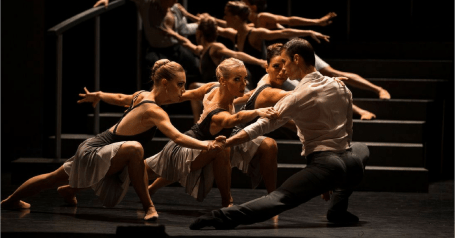
Kreis’s absence during Porter’s ballet music, a stunning orchestration from Pope, may have been a last-minute change by Muir after programs had been printed. Or perhaps Kreis was backstage frantically trying to contact the soundbooth. Either way, something major needed to be fixed before the next performance. When Kreis returned, so did the glorious James, this time partnered by James Kopecky. Adding delicious dimensions of danger and difficulty to the choreography, set designer Jean-Marc Puissant spread a modernistic staircase across half of the Knight stage, moodily lit by Bruno Poet. Ensemble action and the duets played up and down this rising horizontal expanse, and I found myself holding my breath during several jumps and lifts.

Aside from the deafening mic, my biggest disappointment was Kreiss’s physical detachment during the ensemble segments. He needed to be closer, truly communicating with the dancers, and I regretted his absence during the ballet, which ran over eleven minutes in the piano version I obtained prior to the performance. And if he’s truly our host, Muir and de Frutos ought to consider having Cole Porter’s guests pay attention to him. I’m not sure anybody onstage favored Kreis with a single glance.


“Wuthering Heights” Dances Madly to the End of Love

Review: Wuthering Heights

By Perry Tannenbaum

In the epigraph to his new ballet, choreographer Sasha Janes spread out one of Emily Brontë’s most lurid quotes over a full page in the program booklet for Charlotte Ballet’s production of Wuthering Heights. Contemplating her love for the elegant Edgar Linton and the mysterious Heathcliff, Catherine Linton likens her love for Edgar to the leaves of a forest, decorous and mutable, while her love for Heathcliff resembles the rocks below – short on delight, but necessary and eternal.

“I am Heathcliff!” Catherine famously tells Nelly Dean, the narrator of the novel.

Janes was not merely going to tell the story of Wuthering Heights, he was signaling that he would be trying to replicate its towering emotions, manias, and passions.

Incredibly, he largely succeeds.

It helps, of course, that the technical team behind him get the atmospherics right, most notably the lighting and projection designs by Christopher Ash and the costumes by Jennifer Janes. The Janeses are obviously on the same page conceptually, for the costumes designed for Catherine and Heathcliff are folksy and flowing, while the Lintons and Earnshaws tend toward genteel formality, starchiness, and pastels. Choreography magnifies those contrasts, controlled and elegant at Catherine’s wedding to Edgar, wild and athletic in her youthful frolics with Heathcliff.

Charlotte Ballet_Sasha Janes Wuthering Heights_Josh Hall and Chelsea Dumas_1_photo by Christopher Record

As the plot thickens and the protagonists mature, the pas de deuxs between Catherine and Heathcliff become darker and more sensual – and the costumes more diaphanous and scanty. Even uncannier than his choreography, the rightness of Janes’s musical choices assures that you can hardly tear your attention away from the dancers until the overwhelming final scene.

With his dark curly hair and his robust, muscular torso, Josh Hall (alternating with Ben Ingel) was the perfect blend of savagery and beauty as Heathcliff on opening night. After the intermission interval, Hall carried off Heathcliff’s astounding transformation from unrefined rusticity to steely, seething gentility marvelously well, and his partnering in the unique final pas de deux was both powerful and heartbreaking.

Working opposite the power and virility of Hall, Chelsea Dumas very likely convinced a hefty chunk of the opening night crowd that Catherine was the role in Wuthering Heights. Hers were the moves that gave the pas de deuxs with Heathcliff their wildness. Hers were the anguish and madness when the transformed Heathcliff married her sister-in-law Isabella, avenging himself for her betrayal of their love. Through it all, she stands up for Heathcliff against her abusive brother Hindley and her jealous husband Edgar.

Charlotte Ballet_Sasha Janes Wuthering Heights_ Chelsea Dumas_photo by Peter Zay

Both Janes and Dumas seemed to grasp that Brontë thought of Catherine as a woman whose fierce spirit and vitality were too much for her frail frame – particularly when pregnancy and parturition were added to her stresses. In the novel, Catherine’s death is a halfway mark, where our attentions begin to shift to a new generation after a raging, grieving Heathcliff curses his beloved and calls upon her spirit to haunt him the rest of his days.

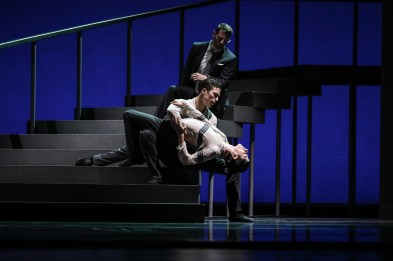
Following the lead of the 1939 film, starring Laurence Olivier and Merle Oberon, Janes makes Catherine’s death his denouement. Yet cursing and conjuring aren’t things that ballet does well. So Janes elaborates brilliantly on Heathcliff’s graveside vigil: here Hall clawed at the still fresh mound of dirt over Catherine’s body and actually pulled Dumas out of her grave. Then he danced a pas de deux with Dumas’ lifeless body, lifting and carrying her all over the stage, pouring out his love, his rage, and his grief.

Dumas remained inert as the music and the passion swelled, coming back to life for just a few precious moments, her second death intensifying Hall’s anguish and devastation. Tears flowed freely throughout Knight Theater.

Action before intermission, though clearly distinguishing the protagonists from the others, wasn’t always as brilliant. Janes tells the story well in theatrical vignettes, but there needed to be more real dancing from the supporting players. There could be more ensemble work when Catherine and Heathcliff first spy on the Lintons. By the time we do reach the outbreak of dance at the Catherine-Edgar wedding, it feels overdue and overlong.

Drew Grant as foster brother Hindley and James Kopecky as Edgar had unique dancing spots, Grant in a high-stakes card game with Heathcliff and Kopecky vying with Heathcliff for Catherine’s affections. Other supporting players – most notably Mark Diamond as Heathcliff’s foster father and Sarah Hayes Harkins as his wife Isabella – further demonstrated the depth of the Charlotte Ballet company with their exemplary dramatic work.

Though a final tribute to Jean-Pierre Bonnefoux has been hurriedly arranged for next month, Wuthering Heights was to be the last program in Bonnefoux’s 21-year tenure as Charlotte Ballet’s artistic director. Fittingly enough, the last ballet commissioned for the company under Bonnefoux’s leadership was paired with the first new work commissioned during Bonnefoux’s years, Alonzo King’s MAP, premiered when the company was still known as North Carolina Dance Theatre.

Bridging 1996-2017, the two works were a handsome frame for an impressive artistic director, president, and choreographer. Bonnefoux strengthened a company that was already excellent and made it more prominent in the city’s life. With its powerhouse educational and apprentice programs, Charlotte Ballet now plays a more important role in the city’s future. My turn to lead the cheers, Jean-Pierre. Bravo!

Two Pieces by Sasha Janes Highlight Charlotte Ballet’s Innovative Works

Review Dance: Charlotte Ballet’s Innovative Works and Its Tribute to Jean-Pierre Bonnefoux
By Perry Tannenbaum


Twenty years is a long time in the history of a dance troupe – four or more generations for Charlotte Ballet if you calculate how long the typical dancer remains before moving along or retiring. Charlotte Ballet’s artistic director, Jean-Pierre Bonnefoux, is taking the latter route after 20 seasons at the helm, an era during which excellence was admirably sustained while the organization grew in strength, most notably in its facilities and educational programming. So it was appropriate to dedicate the latest iteration of Innovative Works as a special tribute to Bonnefoux, not only because this annual showcase of new, exciting, and intimate works was his brainchild but because its current home has been the Patricia McBride and Jean-Pierre Bonnefoux Center for Dance since 2011. There’s no better place for Charlotte Ballet to celebrate.

When Bonnefoux first divulged his imminent fadeout to emeritus status a couple of years ago, he told me that he wouldn’t be choreographing any new pieces, although some new wrinkles were evident in the million-dollar makeover of his Nutcracker last fall. There were no surprises in the 2017 crop of Innovative pieces. The in-house feel of the programming still remains intact, all of the choreographers hailing from within the Charlotte Ballet orbit without any unexpected debuts.

The program began and ended with pieces by associate artistic director (and resident choreographer) Sasha Janes, whose pieces continue to grow more intriguing every year. In between, there were works by Mark Diamond, director of Charlotte Ballet II, Sarah Hayes Harkins, a longtime principal in the company, and David Ingram, a fondly-remembered alum. Continuing the tradition of recent years, each of these choreographers cut an intro that was projected on the side walls of the McBride-Bonnefoux studio before each dance began. Since Janes’ “Hallejujah” was a reprise from last year, Bonnefoux took the opportunity of subbing for Janes, reflecting back on his Innovative series while introducing a piece that was well worth its revival.

170126-peterzay48-web

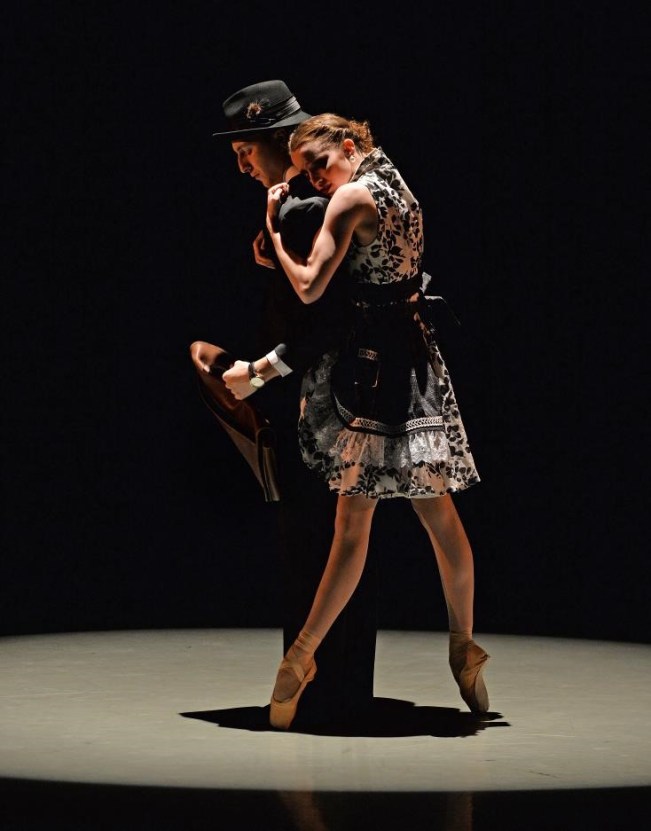
Opening the program, Janes’ “Utopia” was a startling piece to come from a man who spent his formative years in Australia, born more than a decade after the songs on his playlist – by The Platters, Link Wray, Patience & Prudence, and The Teddy Bears – found their way to jukeboxes on 45 rpm discs. The Aussie’s erudition with The Platters is particularly impressive in his sardonic look at 1950’s American domesticity, where everything wasn’t the Father Knows Best bliss that Eisenhower voters would have us recall. “No Matter What You Are,” the song that bookends Janes’ piece, isn’t at all among The Platters’ greatest hits. For over a half century, it has been hidden in plain view on the flipside of “Smoke Gets in Your Eyes” – a clever hint that we’re watching the flipside of the Ike Era. With Elizabeth Truell as the Wife and Josh Hall as the Husband, we watch the typical morning scene of seeing the family breadwinner off to work. Only there was some visible desperation from Truell as she clung to her husband, handing him his hat and briefcase, the devoted housewife gone slightly berserk. Hall was visibly impatient and eager to go, irritated with all the affectionate blandishments, but as we adjourned to his office with “The Great Pretender” (The Platters’ breakthrough hit), we could see that the Husband was suffering from frustrations – and neuroses – of his own.

170126-peterzay150-web-1024x774

Enter Jamie Dee Clifton as the Secretary, to the beat – and power chords – of Wray’s “Rumble.” Her attempts at seduction got a far more welcome reception from the Husband, though there were definitely some signs of distress as he absorbed the vamping. Yet with Patience and Prudence’s “Tonight You Belong to Me,” there could be no doubting Secretary’s conquest, though the necking session was interrupted by a phone call from the patiently waiting Wife back home. Truell’s ensuing solo, begun on the couch of her Psychiatrist (Michael Menghini) was the most sensational segment of the suite for me, savagely contrasted with the cuddlesome harmonies of The Teddy Bears’ “To Know Him Is to Love Him.” The frenetic energies that preceded this therapy session came to full boil, overflowing into a primal scream that Truell delivered into the unresponsive shrink’s face (before he presented his bill). As Janes predicted in his intro, the repetition of “No Matter What You Are” and the bizarre morning send-off took on an added level of irony as we saw so much more clearly how the lyrics applied to the married couple’s daily ritual.

fix_1008-5717-web-1024x683

The other works that preceded intermission weren’t as daring, ambitious, or satisfying. Set to a Chopin favorite, Harkins’ “Gemini” never convinced me that we were seeing two aspects of the same individual, and the promised improvisation element eluded me altogether though the performances by Drew Grant and Ben Ingel were certainly intriguing. Part of the problem was the damage that the McBride-Bonnefoux acoustics did to Ingel’s monologue when he ventured into the audience. Not sitting in the center sections, I hardly understood a word. Nor could I tell what it was that Grant replied from the stage or determine whether it echoed what his partner had just spoken. In this one respect, Booth Playhouse, where Innovative was staged 1998-2009, was a better venue, though it was no better for pre-recorded music and less hospitable for lobby receptions. “Ever After” by Diamond was a better showcase for Harkins’ talents as she partnered with Hall in an abstract piece about the transition to afterlife, set to music by J.S. Bach, Ivan Spassov, and Karl Jenkins. Destined to partner in the program finale later in the evening, the Harkins-Hall duo stole most of what was left, in the wake of Rose Nuchims’ lighting design, of the focus that could have gone to the three other couples onstage. Another barrier to full appreciation was the language barrier, Bach’s German and Jenkins’ Latin.

fix_1008-4071-jeff-cravotta-web-1024x682

Following the hypnotic ecstasy of Diamond’s piece, Ingram’s new “Flamouriá” after the break was rousing and refreshing, set to the music of Luigi Boccherini, which deserves to be heard more often. The modern visuals – huge balloons suspended over the action, projections on the rear wall – clashed provocatively with the 18th century score, and a certain amount of sloppiness was built in to the concept. Movement by four couples, led by Alessandra Ball James and James Kopecky, was by the dancers, “curated” by Ingram. This sparked numerous questions as I watched. Like the other works on the program, “Flamouriá” will be danced by multiple sets of dancers as Innovative continues it run through February 18. So, will the movement change to accord with the other set of dancers – and did Ingram allow his performers any latitude, or multiple choices, in their movements? Unfortunately, some of the sloppiness I witnessed was layered on by the new projection technology that was lavished on the piece. Most of the video was blurry and, at times, edges of the projections cut randomly and inelegantly on the rear screen, stealing focus from the dancers. I’d also thought that those massive white balloons might double as projection surfaces – a potential that went unfulfilled. There were some special moments when Nuchims’ lighting was uncluttered by the new gadgetry, most notably when the dancers became silhouettes against the ginormous backlighting of the rear screen.

1454643066_crop

Little needs to be added to the raves I posted at my own website a year ago when Janes’ “Hallelujah” was first unveiled as the penultimate segment of his “Sketches from Grace,” especially since Harkins and Hall danced it last January as well. Okay, maybe not as well as they did this year after living another year with the piece and their dance partnership. The “Sketches,” originally intended by Janes as a tribute to Leonard Cohen, was deflected from its original purpose when the choreographer heard Jeff Buckley’s cover of “Hallelujah” and turned the suite into a Buckley-based sequence. But if Janes had introduced this year’s reprise instead of Bonnefoux, I suspect that he would have mentioned the Canadian troubadour’s death (on the eve of our momentous Election Day). Pared down to the originating essence of  became a fitting tribute to Cohen, with Harkins and Hall sensuously evoking the darkness of his vision through their memorial flame.