Tag Archives: Devin Clark

“Thoughts of a Colored Man” Lauds Three Strong Women

Review: Thoughts of a Colored Man at the Arts Factory

By Perry Tannenbaum

So Lust and Passion walk into a bar… You can imagine how fervently I’ve longed to lead off a review with a line like that for close to 40 years. Well, now that Keenan Scott II’s Thoughts of a Colored Man has almost provided that opportunity, you can see that I’ve pulled the trigger. Jumped the gun. For in multiple scenes of Scott’s 2021 script, we can find Love, Lust, Depression, Passion, and Happiness all congregated in a Brooklyn barbershop run by Wisdom and Anger.

Scott gives us more than a hint that Colored Man was written as a companion piece of Ntozake Shange’s for colored girls who have considered suicide / when the rainbow is enuf. That 1976 “choreopoem” had seven women with similarly abstract names, corresponding with the colors of the rainbow, and it is similarly studded with monologues and poetry. Scott’s newer piece at the Arts Factory, flawlessly cast by director Sidney Horton for Three Bone Theatre and imbued with just the right sizzle and raw edge, comes at us evolved into SLAM poetry rants rather than incantatory spells.

Less obviously, Scott’s form is modeled on “Four Women,” one of Nina Simone’s signature songs. Simone gives us the names of her women after she has told their stories, but we’re usually not in suspense for appreciably more than a minute as the complete sequence clocks in at under five. Unless you’ve paid close attention to your playbill before the lights dim, this playwright will make you wait nearly the full intermission-less 90 minutes until, one by one, we get the group reveal.

Thankfully, plenty of names pop up in various scenes. At the barbershop, Kobe, LeBron, and MJ are upheld as the GOAT by bickering customers and kibitzers, moving right along to a similarly lightweight comparison of rap giants past and present. Equally memorable, and no less intense, there’s a lengthy dispute about the best basketball sneakers of all time as the group stands in line for a latenight release of the newest Jordans carrying the legendary Jumpman logo.

Wisdom welcomes us to Joe’s Barbershop, but it becomes clearer as the meandering chatter proceeds that old Joe has retired or passed away, leaving him in charge. Nor does anybody identify Depression as he’s bagging groceries, retrieving carts, or stocking shelves at Whole Foods, though he relays boss’s orders to an offstage Timmy. So as Scott veers and swerves on his path of SLAM poetry and raw prose, with some rhythmic prose bridging the gap, he is also at play with raw specifics and unspoken generalities.

The opening question that Depression poses, “Who is the Colored Man? Is he a king… or is he a slave?” invites that kind of approach. Or evasion. Ironically, only Depression will introduce himself well before the evening is over – at a little past 7:30 PM. One of the ways Scott has of stringing out his opposing tracks is by offering signposts in his stage directions that tell us what time of day it is, steadily moving us forward. Horton has these projected on the upstage wall perfectly on cue.

And whether you’re Love or Lust, Depression or Happiness, you have a personal story. Depression, for example, fumbled an opportunity to break away from Brooklyn and attend MIT on a full scholarship. Giving that up by taking care of his mom – without a moment’s hesitation – he settled for the ongoing indignity of Whole Foods.

On the other hand, Happiness is a stranger in town, living with his fiancé. He grew up in the South, his parents were the first in his family to earn six figures, and that’s why he was shunned by the relatives back home. Up in Brooklyn, he feels no less alienated, because he is prosperous and because he is gay.

Scott is pulling hard here against answering his own opening question. The reason that such fascinating hostility flares up between Depression and Happiness in an aisle at Whole Foods is that neither one can answer “Who is the Colored Man?” when they meet one. Both pointedly tell each other “you don’t know me” – which is what any of Scott’s characters could have shouted at us at the beginning if the playwright were less designing and discreet. Or if he hadn’t been aware that Colored Men themselves cannot answer any better than by telling us, one by one, who they are.

It’s hard for me to resist applying the same observation more widely to the whole Black theatre scene in Charlotte these days. Having sampled Penumbra in Minneapolis presenting August Wilson, Black Ensemble in Chicago celebrating Marvin Gaye, and a multitude of companies from across the US bringing their best to the National Black Theatre Festival in Winston-Salem in even numbered years – ahem, the International Black Theatre Festival for 2024 (July 29-August 3) – I’m always telling people that the Black performers, directors, and theatercraftsmen that we have in the QC are second to none.

Catch is: not only doesn’t the Charlotte theatergoing public seem to realize the bounty in our midst. The artists themselves seem to be sleeping on it. To a greater degree now than ever before, when we were merely equals.

Lesser performers and directors might struggle with the challenge of portraying Anger, Passion, or Wisdom and real people at the same time. Horton and his able cast wisely let it slide. When he’s not shaving, shearing, and trimming at Joe’s, Devin Clark as Anger trains and does drills with highly-ranked basketball players who aspire to the big-name colleges, the NBA draft, and huge commercial endorsements. Now they’re possible in college! Or he drifts into nostalgic recollections of his peak playing days when he was “nice.” He earned his scholarship back in the day, so he’s worried about how today’s NIL generation will maintain their dedication – and their grades, if b-ball doesn’t pan out.

Jonovan Adams, another mainstay on the local scene, also assumes a mentor’s role as Passion, a seasoned teacher of 26 students – plus cameo roles as social worker, psychiatrist, and surrogate parent, depending on the kid and his or her homelife. Neither Passion nor Anger is likely to strike you as particularly tough: more likely, Clark and Adams will come across as personable and authentic as ever.

It is well that Passion invokes the OGs of yesteryear who helped him growing up, hanging around the hood and doling out free advice. He wants to be one of those old heads now, a street scholar. That’s what cool, easygoing-yet-stern Graham Williams personifies at his shop as Wisdom, conscientiously doling out sharp cuts and implacably demanding a buck for the swear jar each time a customer – or Anger – curses or breaches decorum.

Dionte Darko as Lust is the most-often-fined in the group, a youngblood with repeat offenses in swearing, misogyny, and homophobia in and out of the barbershop. With his undimmed geniality, Darko is so useful to have around. Aside from needing to apologize to Wisdom for his multiple trespasses, he also riles up the romantic Daylon Jones as Love, so vulnerably poetic in his amatory feelings that he has not yet dared to approach his beloved – while Lust will instantly harass any skirt that walks by, previously known or not.

With similar boorishness, Lust also runs afoul of Nehemiah Lawson as Happiness. Renowned as the Minstrel of Something Rotten and Leading Player of Pippin at Theatre Charlotte, lead Drifter in Beautiful at Matthews Playhouse, and _thesingingdentist on Instagram, Lawson has more than sufficient urbanity and polish for portraying a relatively mundane financial director, so it’s interesting to see him in a performance that discards stage magic in favor of wariness, loneliness, and a touch of anxiety.

Maybe Scott would have preferred someone older than Lawson in Happiness’s encounters with Lust and Depression, but in the Whole Foods scene especially, Horton’s calculus paid off for me though it changed the chemistry. If there was any bullying flavor intended in the hostility between Lust and Happiness, that is gone.

Marvin King bookends the show as Depression and, with a long white tunic that echoes the twin white fires of his flowing beard, sanctifies it with a mystic, ceremonial aura that the more worldly SLAM poetry and prose never dispels. King’s mighty presence certainly endures when he descends to the degradation of a Whole Foods grocery drudge, and the reason why he discloses his name before anyone else will become clear enough if we’ve watched closely. In this cityscape of living, breathing, struggling abstractions, Depression is probably the one who best encompasses them all. By that time, Scott has fastened upon a fresh muse, supplanting Shange’s Colored Girls and Simone’s “Four Women.” This third inspiration is Lorraine Hansberry’s Raisin, handed down from Langston Hughes, and the effects of the sun are still the same as they were at the height of the Harlem Renaissance

“A Soldier’s Play Recalls” the Brink of a New Era

Review: A Soldier’s Play at The Gettys Center

By Perry Tannenbaum

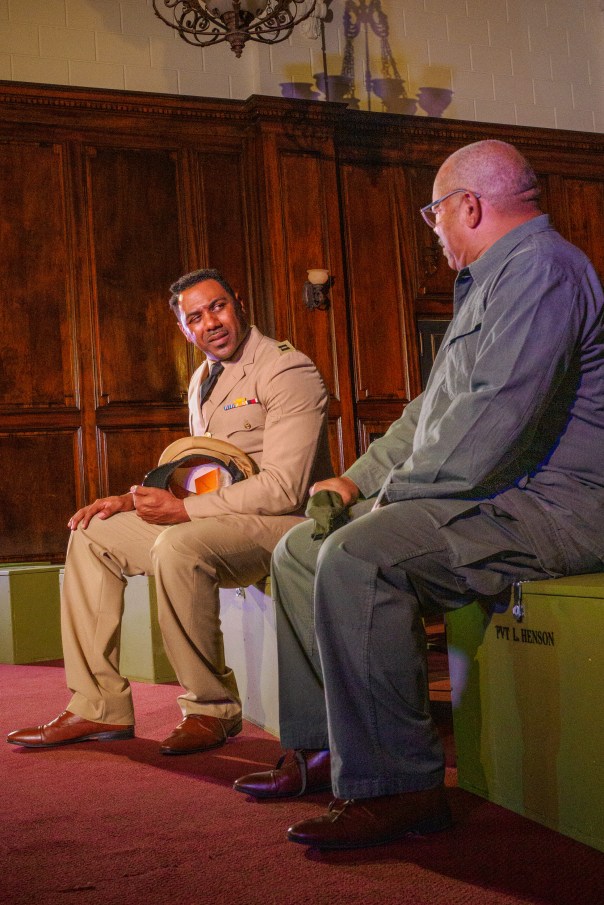
KKK, segregation, and Jim Crow are all in the air as Charles Fuller’s A Soldier’s Play unfolds in 1944 at Fort Neal, a fictitious army base in Louisiana. Yet there are beacons of hope, personified by the Black privates, the corporals, and the busted sergeant we see in a humble barracks. Broadway Lights subscribers saw a deluxe revival of the 1982 Pulitzer Prize winner at Knight Theater back in January, and the current Free Reign Theater reprise down in Rock Hill – not Rural Hill, that was Free Reign’s HQ last summer – only reaffirms the script’s stature as a classic.

Fuller captures these Black military men on the brink. Any day now, these eager recruits are hoping to be deployed across the Atlantic, where they can prove themselves on the battlefield fighting the Nazis. On the home front, we learn that this platoon of baseball players, culled from the Negro Leagues, has a chance to play the New York Yankees if their team can maintain its undefeated record through the rest of the season.

Not a far-fetched dream! Just three seasons into the future, Jackie Robinson will make his breakthrough MLB debut with the Brooklyn Dodgers, win Rookie of the Year honors, pop champagne with his white teammates as he celebrates his first National League pennant, and become the first Black athlete to play in the World Series – against the New York Yankees.

Fuller accurately fine tunes his soldiers’ aspirations, but he drops a bombshell into this Deep South outpost that is equally shocking to the Black scrubs and the white officers on base. When the ballclub’s manager, Tech Sergeant Vernon C. Waters, is murdered in the middle of the night, presumably by local racists, the feds in DC send Captain Richard Davenport to investigate.

DC or not DC, Davenport is a Black lawyer. How is he going to be able to point a finger at a gang of KKK knights, dragons, or wizards and proclaim “Arrest these men!” within the borders of Louisiana? It’s as if a DC thinktank had come up with the surest way for Waters’ murderers not to be prosecuted for their crime.

Nobody on base has ever seen a Black man like this before. Captain Charles Taylor, Waters’ former commanding officer, admits his discomfort in accepting Davenport as an equal. He’s also a bit flustered by the stranger’s cool and orders him to remove those glasses, forgetting that Davenport outranks him. Adams enjoys his teaching moment with a nice nonchalance as Tim Huffman seethes, finely calibrating Taylor’s redneck tendencies with his West Point pedigree.

Whether or not they can sense the Robinson breakthrough on the horizon – or grasp the MLK dream 19 years before he proclaims it – the Black ballplaying soldiers also show that there’s a learning curve for them in dealing with Davenport’s intelligence, competence, professionalism, and objectivity. Flustered, flummoxed, or wary, the corporals and privates quickly show that they are no less thrown by this Davenport phenomenon than Taylor.

And of course, they share Taylor’s skepticism about Davenport’s ability to charge a KKK-grade racist with any crime in Louisiana and make it stick.

Everybody, then, is taken aback as Davenport ignores race altogether, seeking to interrogate both Black soldiers and white officers in search of the facts, and allowing those facts – rather than easy presumptions – to lead him to the truth. Only the busted sergeant, Andrew Roberts as Private James Wilkie, seems to realize that Davenport is seeking evidence to form his opinion of who the murderer or murderers might be rather simply bolstering the opinion he already had.

Davenport is paying attention when Wilkie upsets the KKK hypothesis with a telling observation that Fuller cleverly assigns to the one man at Fort Neal who has lost his stripes. Roberts gives us a messy mix of servility and seething resentment as Wilkie’s complex layers unfold. It was Waters, after all, who busted Wilkie, so the former sergeant will become a prime suspect in the instant that the Klan is cleared of suspicion.

Not only does Wilkie open the door to new possibilities of viewing Waters’ murder, he also opens a window into the deep tensions that lurk beneath the graceful, flawless façade of the invincible team. In flashbacks triggered by Davenport’s ongoing interrogations, we soon see that Waters’ mix of servility and resentment was far more toxic than his subordinate’s. An unforgettable debasement of a Black man at the hands of white officers that Waters witnessed in France during World War I ignited a lifelong secret crusade against the “Geechies” that he despises, Southerners whom he sees as tarnishing the image of his race and hampering their progress.

It is an absolute mania, and even the best player on the team, Private CJ Memphis, does not escape Waters’ lethal prejudice. The chin-to-chin confrontation between Justin Peoples as Waters and Dominic Weaver as Memphis, modeled after the Claggart-Budd climax in Herman Melville’s Billy Budd, Foretopman, is more electric than any of the Davenport-Taylor faceoffs. In the sequel to the Waters-Memphis climax in the barracks, a jailhouse stunner where Waters berates and gloats over his latest victim, Memphis achieves a tragic stature when Weaver proceeds to channel Billy Budd’s Christ-like attributes.

Under Dr. Corlis Hayes’s beautifully judged direction, the deep Billy Budd conflict regains its dominance over the Davenport-Taylor sparring. The touring production, unlike the previous New York productions and the 1984 film adaptation, tilted our attention away from Waters toward Broadway star Norm Lewis, who took over the Davenport role on the road. Yet we still see quite vividly that the new man on base is the future.

Shining more light upon Waters’ diabolical obsession, Hayes and Peoples let us see that, in some ways, A Soldier’s Play is like a Perry Mason mystery. So many soldiers on his team detest Waters that almost every one is a legitimate suspect. Davenport’s main weapon is cross-examination – in Captain Taylor’s office, his own hastily-outfitted domain, or in front of the soldiers’ bunk beds and foot lockers.

Weaver’s performance as CJ, like a genial Willie Mays with a guitar, further focuses on the enormity of Waters’ crime. Memphis isn’t the only player who has tangled with his racist tech sergeant. PFC Melvin Peterson, a Northerner like Waters, is more offended than anyone by the sergeant’s bigotry, and Devin Clark, who shone so brightly as Brutus in Free Reign’s Julius Caesar last year, is more than up to capturing Peterson’s rage, which leads to a fight with Waters. His antagonism lingers on, flaring up again when CJ is baited by Waters and jailed.

Suspects abound, in the barracks and among the white officers. As Lieutenant Byrd, David Hensley’s defiance and antagonism toward Davenport, when he has the effrontery to question him, nicely contrasts with Hugh Loomis’s subdued pragmatism as Captain Wilcox, who realizes that his pal’s hot-headedness may have already landed them both in hot water. Hayes also has a welcome urge to expand the light and relaxed interludes Fuller built into his play, importing blues singer Big Mary from Fuller’s screen adaption, and offering Shar Marlin a chance to give us a sassy respite from the all-male action with her cameo. Nice touch.

Having seen numerous Jackie Robinson biopics and dramas over the years, we can see some pragmatism in Waters’ disciplined philosophy to the extent that it mirrors the template that the future Hall of Fame second baseman fit into when he made his debut on the big MLB stage – supplemented by some pointed advice. Waters keeps his feelings bottled up in the company of superior officers, eradicates rusticity and superstition from his actions and speech, maintains a sober low profile, and waits patiently for these quiet concessions to win him favor and advance his career.

There’s a constant tension between that approach and the tacks taken by Memphis and Peterson. Memphis likes being liked, displaying his talents, being himself, and letting his natural gifts take him where they may. Even if he does lack education and polish, Memphis is respectful, outgoing, and good, though we have to factor in the large portions of female adoration he attracts. Clark gets to be more pugnacious and far more fiercely intelligent, despising bigotry in any form, even if it comes from Waters, a superior whose orders he should obey. He will stand up strong for his beliefs at all times, even if it means taking a licking.

But the real deal, Jackie-wise, is Davenport. Adams amalgamates all the best of Waters’ calculated patience and Peterson’s egalitarian principles, with the ability to turn on some of CJ’s natural charm. Before the soldiers have shipped off to Europe, eager to prove themselves in World War II’s European theatre, Davenport is a fully-evolved marvel that people in Louisiana readily recognize and value. As we saw in the spit-and-polish version presented at Knight Theater, Adams also chafes a little at the relentless saluting and military barking that comes from Hayes’s drilling, aided by two military consultants who keep all the soldiers coming to attention.

After much seasoning and resourceful survival, Davenport arrives fully polished, ready for primetime and postwar America. He may not have the fire of Malcolm X or the towering eloquence of MLK, but we can imagine Davenport as a worthy ally for either of those pathfinders.

“Detroit ’67 Spins Motown Into History

Review: Detroit ’67 at Theatre Charlotte

By Perry Tannenbaum

Baked into many great American plays is the notion that dreaming big, striving for the golden apple of success, is a kind of latter-day hubris – sure to be tragically quashed and beaten down. Walter Lee Younger in Lorraine Hansberry’s A Raisin in the Sun was a grim example of such a tragic hero, dreaming of owning a liquor store in Chicago during the 1950s. It was hard for me not to think of Walter Lee’s beatdown – and paradoxically, the soaring success of Sidney Poitier, the breakthrough actor who portrayed him – as Dominique Morisseau’s Detroit ’67 unfolded at Theatre Charlotte.

Tautly directed by Ron McClelland and superbly designed by Chris Timmons, Morisseau’s work is darker and bloodier than Hansberry’s classic but emphatically more hopeful. Even with the background of the Detroit race riots of 1967, the pride of Black culture never leaves our eardrums for long as a clunky old record turntable, replaced by a slicker 8-track player and a pair of bookshelf loudspeakers, cranks out the hits of Motown’s famed music machine.

Come on, David Ruffin! The Temptations! Smokey Robinson and The Miracles. Mary Wells. Martha and the Vandellas. The Four Tops. Gladys Knight and the Pips. Marvin Gaye.

Morisseau’s protagonist, Lank, and his sister Chelle are trying to upgrade their unlicensed basement bar so that it will become more competitive with other after-hours speakeasies – when Sly, Lank’s best friend and a numbers runner, offers him an opportunity to buy into a legit bar. History lesson: a police raid on one of the unlicensed bars Lank and Chelle are seeking to emulate triggered the Detroit riots, the worst in 20th century America until another shining example of policing, the Rodney King riots in LA, eclipsed them in 1992.

While the riots rage and Michigan guv George Romney is calling in the National Guard, Lank and Sly are striving to scout out their hoped-for property and close on a deal – against Chelle’s wishes. Meanwhile, a second hubris slowly develops as Lank shelters a lovely white woman, Caroline, who has been battered and is mysteriously linked with the white underworld. She’s actually in more mortal danger than Lank.

Despite mutual suspicions, Caroline and Lank are drawn to each other. But they bond over Motown music, and they are both capable of busting a dance move.

The rioting in the Motor City was a prelude to the Black Power demonstrations at the Mexico City Olympics in 1968. We can also view them as a precipitating factor leading to the pride-filled Summer of Soul celebrations in Harlem and the rapprochement between the races on the musical scene that accelerated at the gloriously chaotic and inspiring Woodstock Festival of 1969, for so many of us the decade-defining event of the ‘60s.

So Detroit ’67 not captures a city in turmoil, it echoes the prime crosscurrents of that era, the struggle of Black people for their legitimate rights, the backlash from white people and government, and the mainstreaming of Motown as it breaks into pop culture. And by the way, Sidney Poitier’s To Sir With Love and Guess Who’s Coming to Dinner were both released in 1967. The question of whether Blacks were making significant progress, suffice it to say, was very much up in the air as we watch this action at the Queens Road barn.

Running an underground business together, Lank and Chelle are more advanced in their autonomy, street smarts, and connections than Walter Lee and his sister Beneatha were, still living under their mother’s roof with Walter Lee’s wife and child. Pushback against Lank’s feasible but difficult dream comes entirely from Chelle, who can realize deep down that continuing to run an illegal operation is also a risky choice.

Morriseau, McClelland, and Shinitra Lockett, making her acting debut as Chelle, all seem to have made this same calculation. So Lockett seems noticeably more vehement in her opposition toward Lank’s romance with Caroline than in her objections toward his business venture with Sly. On the business end, Sly’s persistence and charm in pursuit of Chelle’s affections bodes well for his deal-making prospects, another softening factor, for Lockett occasionally shows us that the slickster is making headway.

Because we see Graham Williams is so composed and self-assured as Sly, we can begin to see Lank as acting audaciously and responsibly. Yet there’s enough shiftiness mixed with Williams’ confidence for us to retain Walter-Lee misgivings about their venture, especially when the riots and the National Guard are thrown into the mix. Devin Clark, one of Charlotte’s best and most consistent performers for more than nine years, gives Lank a stressed and urgent edge. He’s not as regal and commanding as he was portraying Brutus last summer, but he’s far more spontaneous and charismatic.

Chandler Pelliciotta, in their Theatre Charlotte debut, brings a bit of shy diffidence to Caroline that meshes well with her story. Her worldly swagger has obviously been dealt a severe blow as she wakens, bruised and disoriented, in the basement of a Black man’s home she has never seen before. While Lank is drawn to her and wishes to protect her – we aren’t always sure which of these impulses is in play – Chelle has a couple of good reasons to wish her gone.

Not the least of these is the trouble Caroline is in with people who have battered her with impunity. The trouble might pursue her and find her at this fledgling underground speakeasy. It’s an awkward position tinged with risqué allure, but Pelliciotta’s performance leans more into the awkwardness, their glamor far less in the forefront than their fearfulness – for Caroline herself and for her protectors.

You can probably name 15 Black sitcoms that have characters like Chelle’s mismatched chum, Bunny: sexy, flirty, quick-witted, and imperturbable. Germôna Sharp, in her bodacious Charlotte debut, takes on her life-of-the-party role with gusto and sass. Sharp makes sure we’re not getting a PG-17 version of Bunny: slithery, regal, carnal, and militantly unattached. She will dance with anybody – Lank, Sly, or Chelle – but not for long, totally neutral amid the sibling fray.

Costume designer Dee Abdullah helps turn on the glam, more flamboyant for Sharp and more elegant for Pelliciotta. Morriseau withholds from her characters any sententious awareness that they are standing at Ground Zero of anything historic, now or in the future, but she clearly wishes that awareness on us. A distinctive black fist is prominently painted on one of the basement walls, right above the record player and the 8-track, and its presence is meaningfully explained.

Nor should we consider evocations of Hansberry’s classic urban drama as accidental. Morriseau’s script tells us that her protagonist’s name, Lank, is short for Langston. It cannot be a coincidence that the poet Langston Hughes wrote “Harlem,” the iconic poem from which Hansberry drew the title of her masterwork, A Raisin in the Sun.

Toni Stone’s Path to Glory Goes Beyond Winning and Losing

Review: Three Bone Theatre’ Toni Stone at The Arts Factory

By Perry Tannenbaum

202208173480315507725654890

Trivia questions: who replaced Hank Aaron when the future home run king moved up from the Indianapolis Clowns of the Negro American League to the majors? And who was the first woman to sign a professional baseball contract and play with a men’s team? The answer to both questions is Toni Stone, nee Marcenia Lyle Stone (1921-1996) – unless you’re a stickler for fact-checking and historical accuracy.

Then we need to face the truth that Hammerin’ Hank was already playing for the Braves’ farm club, the Eau Claire Bears, a season before Stone made her Negro League debut at second base with the Clowns. And before team owner Syd Pollock signed her to a Clowns contract, Stone had played in professional men’s leagues – if not the topmost major league – for 16 or 17 years, depending on which capsule biography you read.

Hearing all this for perhaps the first time, you’ll probably ask a truly important question, one that playwright Lydia R. Diamond surely asked after reading Martha Ackmann’s 2010 biography, Curveball: The Remarkable Story of Toni Stone the First Woman to Play Professional Baseball in the Negro League. Why haven’t we all heard about Toni Stone before, and why isn’t she more celebrated?

202208031526236485966839727

Amazingly enough, when Diamond’s Toni Stone premiered Off-Broadway in June 2019, the playwright didn’t blare out the answers that would become so glaringly obvious to everyone the following summer in the midst of #MeToo, #BlackLivesMatter, and our communal COVID hibernation. Diamond’s portrait of the pioneer nicknamed Tomboy during her childhood in St. Paul is more nuanced, diffuse, and detailed than it might be if she had begun sketching it after the cataclysms, polarization, and pandemic chaos of 2020. Or the nationwide schism of January 6.

Lucky us? In some ways, Three Bone Theatre’s production at The Arts Factory, meticulously directed by Dr. Corlis Hayes, reminds us how relatively dispassionate we were less than three years ago when we looked at neglected pathfinders and feminist icons. There’s a certain amount of useful calibration when Diamond seemingly steps aside and lets Toni tell us her story – and what she thinks of herself.

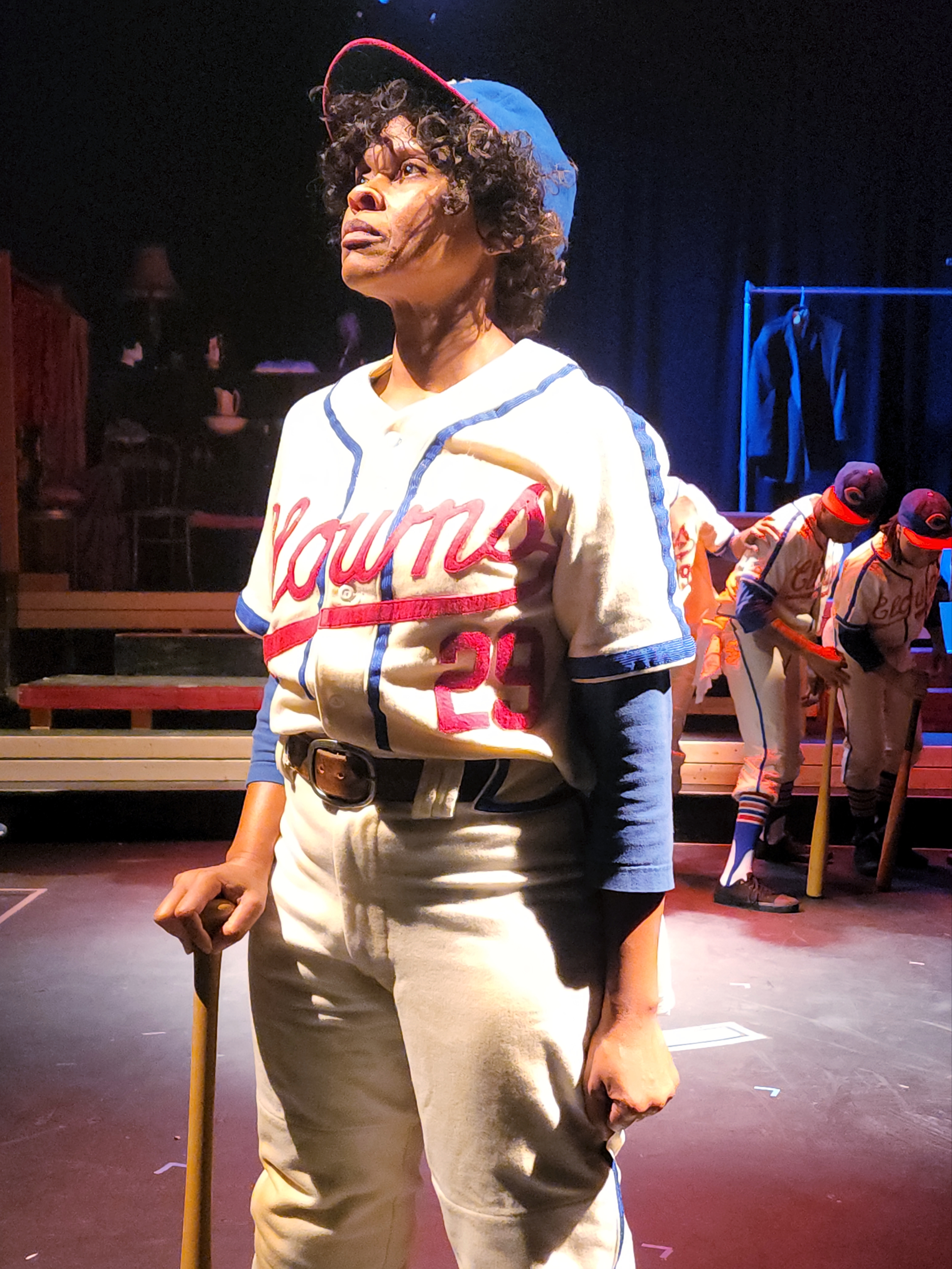
In her third standout outing of the year, Nasha Shandri immerses herself engagingly in all of Toni’s quirks, vulnerabilities, and strengths; candid rather than arrogant, sassy rather than seductive. Above all else, Toni loves baseball – the ball, the glove, the game. Both Diamond and Shandri make us believe it.

When she runs out of things to say, to us or her teammates, Toni will recite major league player stats, as if she’s collected and memorized every baseball card out there – as if the numbers have magic healing powers when she’s distressed. Diamond makes her so obsessed with baseball that romance and sexuality make her uncomfortable. Shandri has a mumbling recitation of stats at her disposal, or a Peter Pan aversion to being touched, whenever hormones begin flowing around her. She’s a natural, either way she goes.

202208174341351609522811290

An all-Black ensemble of eight men hustles around Jennifer O’Kelly’s appropriately seedy set, which packages a movable tavern, a ramshackle players’ dugout, and a dimly lit brothel, leaving most of the Arts Factory playing space free to fancifully, maybe laughably, serve as a baseball diamond. Eight men aren’t going to be enough to bring us all the mentors, parents, teammates, and romantic interests of multiple races and genders that Toni will deal with from her childhood through her baseball career (1936-1954). Props and costumes are stowed in the dugout as well as offstage to keep things flowing.

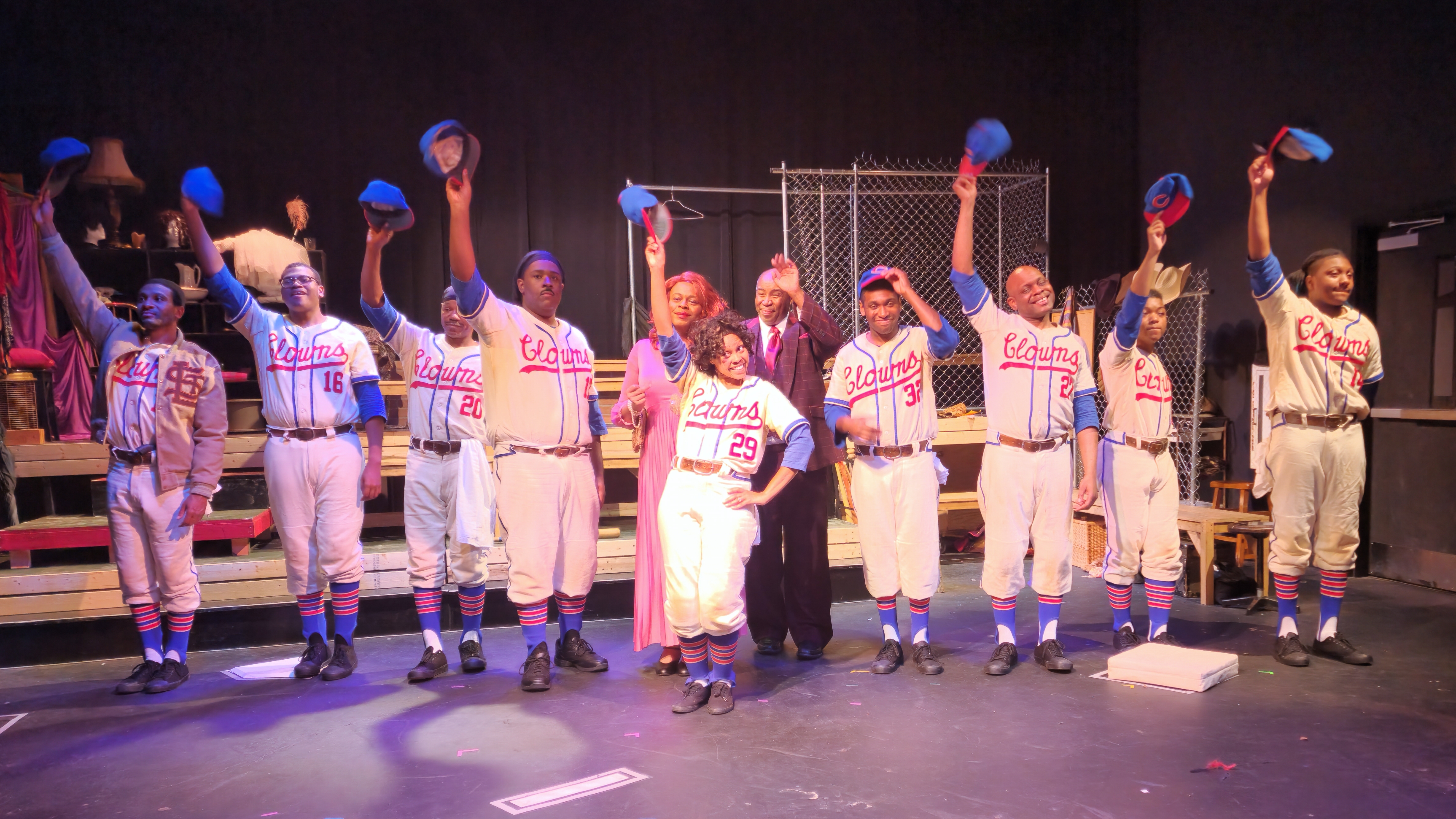
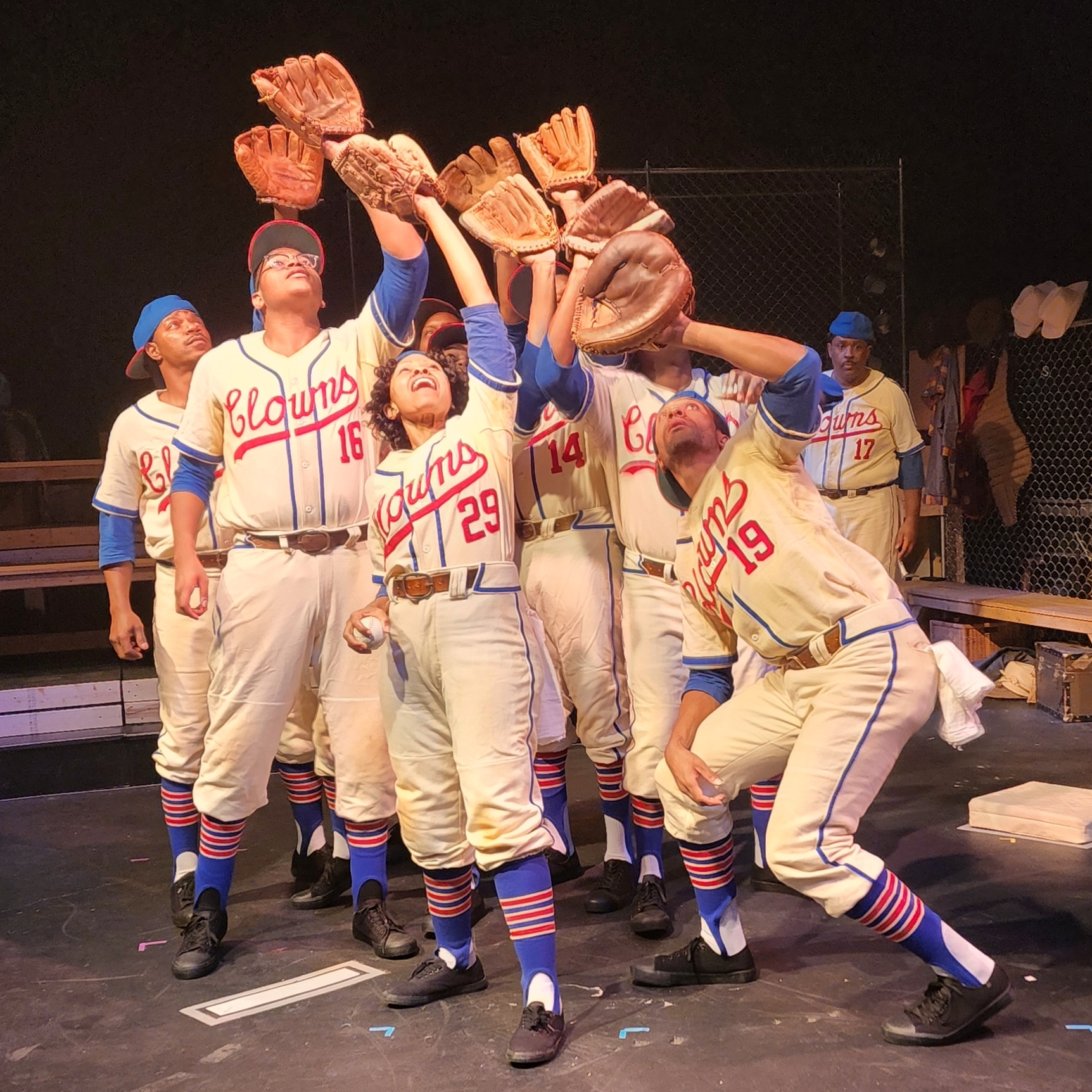
Cutting through much of the confusion, Diamond keeps the names, personalities, and fielding positions of Toni’s teammates as constant as the parks she plays in. All evening long, Shandri and her team wear the same Clowns uniforms, authentically rendered by costume designer Kara Harman. That way, Toni’s path comes across as less solitary while she moves from her early ballplaying days in a local church league to a series of American Legion and minor league teams in Minnesota, San Francisco, and New Orleans before her major-league apotheosis: a full year with the Indy Clowns in 1953, before she joined the famed Kansas City Monarchs for her final season.

Diamond and Hayes are both aware of the perils of allowing Toni and the shorthand differentiation of her crew to devolve into a wholesome replay of Snow White and the Seven Dwarfs. The playwright not only gives us frequent glimpses of the racism that dogs Toni’s progress, she also shows us the sexism and piggishness behind the scenes in the clubhouse, occasionally checked but never eradicated.

We also see that there are good reasons for the men’s resentments when Stone signs on with the Clowns. When Jackie Robinson broke the color barrier in 1947 and Larry Doby integrated the American League during the following season, the Negro Leagues began to crumble. By the time Aaron is signing with the Braves in 1952, the talent drain is on the verge of killing Negro League baseball, reducing its remaining teams to barnstorming roadshows.

Clowns owner Syd Pollock – nearly overacted here by James Lee Walker II – didn’t sign Stone to make his team better. Unlike previous owners, who signed Toni on her merit, Pollock signed her as a novelty to improve the marketability and entertainment value of the team, already baseball’s equivalent of the Harlem Globetrotters. In a notable confrontation between Shandri and Walker, Diamond shows us that Pollock isn’t interested in showcasing his new acquisition on a level playing field. To ensure his investment – not very much, if we’re talking about Toni’s salary – Pollock colludes with other owners to ease up on her in the middle innings, when their pitchers will throw her more hittable pitches.

Toni grudgingly keeps the secret, but her teammates aren’t as oblivious or dimwitted as Pollock presumes.  202208175826162527256458676

Hayes does her part, casting the other Clowns, so that Shandri doesn’t stick out uncomfortably as the smallest on the team. In particular, the other middle infielder is diminutive, in the vein of Phil Rizzuto, Jose Altuve, or Joe Morgan. On the other hand, Miles Thompson as Spec, the team intellectual, is not at all the dwarf that he was reputed to be. Along with Justin Jordan as Woody, the embittered teammate who is by far the most trouble for Toni, Thompson is quite an imposing figure.

More than one of the Clowns points up Toni’s sexual inexperience in their dugout and locker room banter. One whole scene, a rather bawdy little prank played on her with a baseball bat, more than emphasizes her naivete. It also heightens uncertainty among the men about Toni’s sexual orientation.

Clearly, Diamond wants to keep us guessing, too. The juiciest roles outside the clubhouse go to Robert Rankin as Millie, the madam of that brothel, and Keith Logan as Captain Aurelious Alberga, an elderly admirer who persistently pursues her at Jack’s Tavern, a San Francisco joint. Skittishly resisting Alberga’s initial advances, Shandri seems more attracted to Millie, whose sexual appeal is aimed at her teammates. Both Rankin and Logan give charismatic performances, worldly and mature, charismatic and confident.

Doubling as Drunk Willie when he dons his Clown uniform, Walker as Pollock is probably the best at marking those moments when white men enter the story. Hayes could have sharpened the portraiture a bit more when we meet the other white folk: Father Charles Keefe, the neighborhood parish priest who paves the way for Toni to play organized ball; and Gabby Street, nicely handled by Thompson, the former manager of the world champion St. Louis Cardinals, who yields to Toni’s repeated entreaties, making it possible for her to aim higher.

Melissa McDaniel Grisham’s choreography seems a bit toothless and pointless when the Clowns team goes into their pre-game shtick. From reviews I’ve read on the Off-Broadway production, the aim there was not just to show how athletic and entertaining the players were but also to show the degradation and of being clowns as well as ballplayers. There’s not even a hint of cringeworthiness here at The Arts Factory that critics had perceived in New York.

202206295146239102907529957

Yet the chemistry among the players has exactly the tang we want when they’re playing the game they love – under shabby, hateful conditions. Johnathan McKnight as the catcher Stretch exudes the authority of the team’s quarterback, and Devin Clark has the aloof dignity of Elzie, the Clowns’ pitching ace. Tito Holder energetically grins and pouts as Jimmy, the team dumbass, and Frank FaCheaux makes the most of the glimpse Diamond gives us of team comedian King Tut, whom Pollock dubbed “The Clown Prince of Negro Baseball.”

Toni Stone has a hazy mythic aura to it unlike most biographical baseball sagas. Intense nail-biting games down to the last pitch or the cumulative drama of a torrid pennant race are nowhere to be found. They are as irretrievable as the barnstorming Clowns’ won-lost records, batting averages, ERAs, and boxscores. What binds the roaming Clowns together like family, in spite of their frustrations and resentments, is the love they share with Toni – for the game.

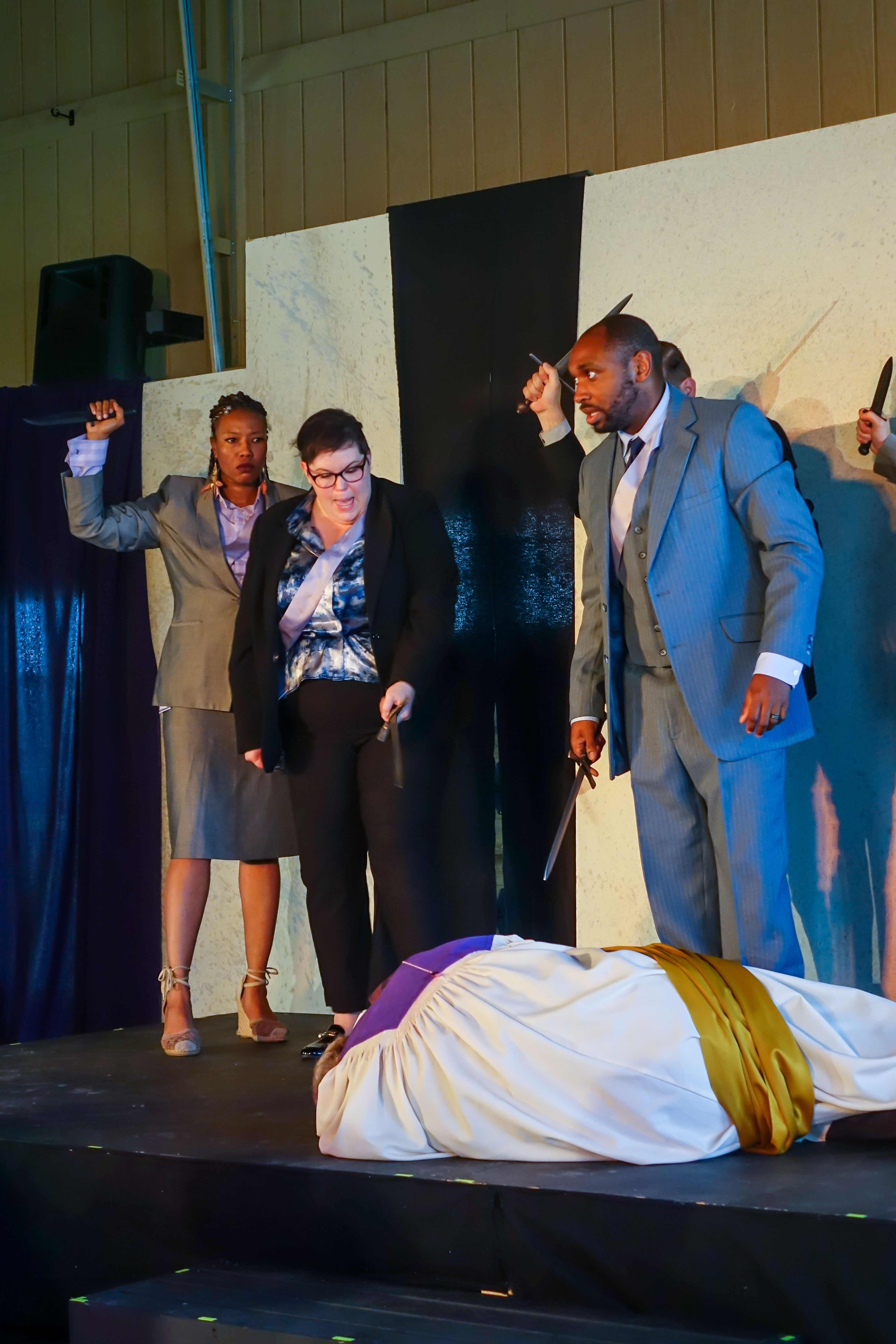
Great Caesar’s Ghost Heads for the Hills

Review: Julius Caesar from Free Reign Theatre Company

By Perry Tannenbaum


2022~Julius Caesar-22

It’s an odd juxtaposition, that’s for sure. In reviving Julius Caesar, Free Reign Theatre Company has taken what is arguably Shakespeare’s most urban tragedy and transported it to Historic Rural Hill, a 15-minute drive from the nearest town, suburban Huntersville. Coming by way of I-77 and the I-485 beltway to the Sunday matinee, we may have seen one traffic light after exiting the highways and entrusting our destiny to Google Maps.

When you arrive, you turn off a narrow winding paved road onto a narrower, arrow-straight gravel road that carves through a grassy rise, two rustic buildings looming at the top. On a sunny Sunday afternoon, the simple colors and weathered wooden structures of the place reminded me of Christina’s World at first blush, Andrew Wyeth’s masterwork. Even as we parked, it seemed unlikely that either of these buildings could be a theater. The shed at our right seemed too small, and the barn-like building in front of us seemed to be serving a different purpose.

The sheer number of cars in the makeshift lot gave me the sinking feeling that we were in the wrong place. The family emerging from another car did not have the look of theatergoers heading to see Julius Caesar. God help us.

Moving closer, I still felt that the old building might be serving as a café, with customers or picnickers mulling around under a ramshackle awning at the side. Wide double doors facing us didn’t seem to be in use, so we headed to the other side of this barn, where things finally began to make sense.

A long file of food trucks was aligned down the slope at the other side of the rise, explaining the phenomenal number of cars that had parked. The doors at this side of the big barn proved to be the entrance to Free Reign’s makeshift theater, extending all the way to the other end of the building. Actually, this theater extended beyond its rear wall – for those people who seemed to be dining al fresco on the other side were really Free Reign’s acting troupe.

Most of the backstage maneuvering in this production actually happens outdoors, with just a narrow corridor behind the temporary stage devoted to entrances and exits. Stage manager Megan Hirschy already had the comings and goings of the 17-person cast running with admirable precision by the time we witnessed the fourth performance, but could she really do it without a stash of Tylenol or other medicinals?

We couldn’t have mistaken the Roman citizens, senators, tribunes, tradesmen, or Caesar for picnickers if costume designer Heather Bucsh – and director Robert Brafford – had opted for the ancient attire from Italian fashionistas that was trendy in March of 44 B.C. Judging by the half dozen Caesars I’ve seen since the turn of the millennium (in Oregon, Canada, High Point, and Charlotte), it would be a novel idea these days to revert to authentic dress.

2022~Julius Caesar-14

Not surprising. The tensions in this tragedy between representative government and autocracy, freedom and slavery, those in power and those scheming to overthrow them – all of these resonate with us more readily in the New World than the dynastic Old-World struggles and power grabs that typify Shakespeare’s histories and dramas. For some odd reason, the approval of the common folk seems to matter in Julius Caesar, and that naturally appeals to Americans.

Because Shakespeare views Caesar, Mark Antony, and Marcus Brutus with such admirable objectivity, it has always been fairly easy for actors and directors to tip the scales one way or the other – to make this Caesar’s tragedy or Brutus’s – or to balance Brutus equally with his adversaries, making them both tragic victims. In Elizabethan days, Shakespeare’s contemporaries would have been more likely outraged by any opposition or treachery against a monarch. For generations, Antony’s funeral speech would be memorized as if it were gospel.

Today’s audiences are more cognizant of Antony’s cunning. The laughter that rang out at Historic Rural Hill as Ted Patterson delivered the famed oration was partially directed at Antony for his transparent manipulativeness. Mostly, it was aimed at the notion that “We, the people” would fall for it. We would need to be very rustic indeed for that to happen.

IMG_0148

Patterson lets us see, with a choice expression or three, how Antony marvels at how easy it is to sway a Roman mob, not exactly the same valiant and vulnerable romantic hero we find in Shakespeare’s Antony and Cleopatra. That’s enough to ensure that our sympathies will lean toward Brutus, but Russell Rowe gives us an extra nudge as Caesar, a little bit more arrogant, pompous, and egotistical than we might expect from a benevolent ruler – and a little less tender and empathetic towards his wife, Calpurnia, who pays more heed to soothsayers and bad dreams.

Offstage, Caesar is rejecting a crown three times during the opening scenes, but we actually see Brutus rebuffing Cassius when he repeatedly urges taking action, fearing that Caesar will relent, accept a throne, and become invincible. Both of the main adversaries show character, but Devin Clark as Brutus is clearly the gentler of the two. With just spare scenery at his disposal, Brafford shrewdly distinguishes between the dignity of Caesar’s household and the humbleness of Brutus’s at the other end of the stage.

There is also a palpable difference between the wives. Lauren Duckworth is regal as Calpurnia rather than adoring: when she counsels her husband against venturing out to the Capitol on the Ides of March, we assume that she’s angling to reign for decades as Empress of Rome. Alexandria Creech is definitely more submissive as Brutus’s wife, Portia, more intimate and seductive.

2022~Julius Caesar-31Both men give in to their wives, but Caesar’s yielding to Calpurnia is only temporary, largely because Cal has overstepped while Portia asks for less. More to the point, both leaders give in to their most potent political allies, Caesar finally deigning to accept a crown from Antony and The Senate, Brutus agreeing to join Cassius and his cronies in their assassination plot.

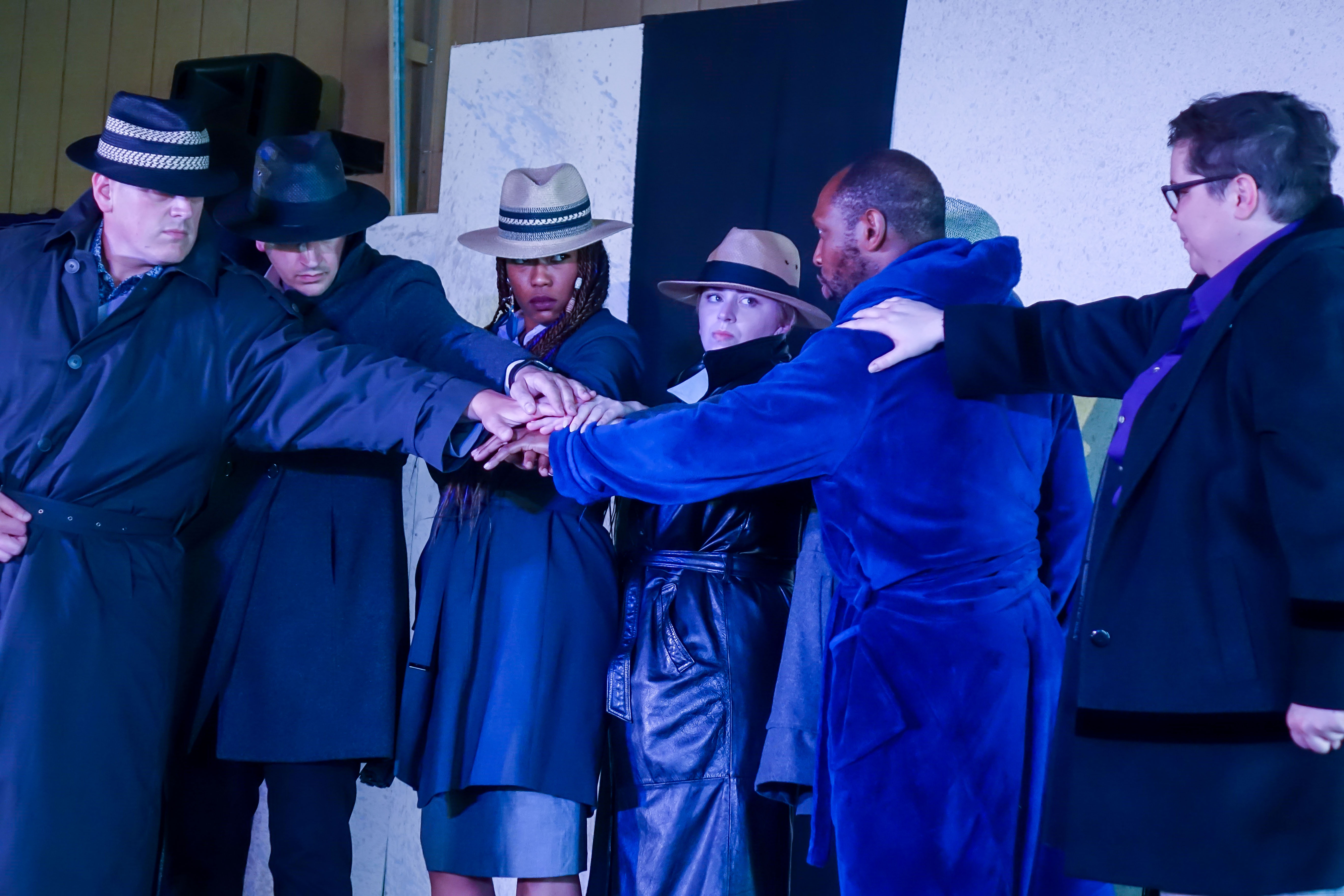
Off my radar since her college days 12 years ago, Chelsea Hunter is instantly sensational as Cassius. Along with Patterson, Rowe, and Clark, Hunter has one of the strongest voices onstage, so her Cassius is formidable and authoritative as well persuasive – perhaps even intimidating, notwithstanding Clark’s impressive sangfroid. What seems strange in this modernized Caesar, with its colorblind and gender-blind casting, is that Brafford didn’t cross a final frontier and change the pronouns of the text to suit his players.

Two thousand years after Caesar’s death – and 300 after Shakespeare’s – it’s perfectly ordinary to find women scheming and mixing it up with fellow politicos. So why hesitate?

2022~Julius Caesar-10

Brafford’s reluctance became most problematic and comical with Jess Johnson’s unmistakably feminine – and gossipy – take on Casca. Giving Cassius and Brutus the lowdown on Antony thrice offering the crown and Caesar turning it down with increasing reluctance, Johnson was repeatedly flapping open an oriental fan to punctuate her narrative. This mode of exposition was pretty hilarious and hard to quibble with, particularly in recounting what we know, we know, we know.

Johnson’s demonstrative antics were also handy at a matinee on a hot afternoon when the building’s AC was waging war against the heat outside, victorious against the torrid temperature but also against all but the loudest voices. Conditions for hearing all the actors and getting the full impact of the lighting are undoubtedly better at evening performances, and a boost for Great Caesar’s Ghost. But whoever had his or her hand on the switch should be coping with cooler weather next Sunday’s matinee – and better aware of the AC overkill this week that had some members of the audience rubbing their arms or shivering.

Less AC would be a win-win for noise and comfort.

2022~Julius Caesar-11

The view outside at Historic Rural Hill is likely pretty hectic during a performance, for more than half the cast is doubling, tripling, or more to play all the roles that Shakespeare prescribed. Brafford himself took on four roles aside from directing. My favorites among these platooned players were Jonathan Caldwell as the sassy Cobbler in the opening scene, Kristin Varnell as the spooky Soothsayer, and the inimitable David Hensley as Lucilius, the slimeball who hilariously impersonates Brutus in the heat of battle.

Best of all, though, is the chameleonic Katie Bearden, who plays no fewer than five roles, including Decius Brutus, surely the most underappreciated role in all of Shakespeare. For Decius undoes Calpurnia’s persuasion, reinterprets her prophetic dream, and with sly flattery convinces Caesar to come on down and accept the crown from The Senate. These are feats of dissembling and oratory worthy of Mark Antony, with no less impact on Roman history.

What was conspicuous for me in 2022 watching Julius Caesar – what I overlooked when I previously saw it at Spirit Square in 2014 – was the complete lack of dialogue between Brutus and Caesar before differences between them were settled with violence. Very much like America now and then, only so much more obvious today.

BNS Productions’ “Two Trains Running” Runs at Full Steam With a Deep Cast

Review: Two Trains Running

By Perry Tannenbaum

DSC05592

Like all of the other plays I’ve seen in August Wilson’s epic Pittsburgh Cycle ­ and I’ve now seen nine of the 10 – Two Trains Running is about community struggle and personal redemption. Each of the dramas digs into one of decades of the 20th century, and after Brand New Sheriff began its Wilson explorations with Jitney and the 1950s, their sophomore effort at Spirit Square takes us into the turbulent 1960s.

With so much memorable social and civil rights upheaval in that decade, not to mention the horrifying Birmingham church bombing and the assassinations of Medgar Evers and MLK, it’s no surprise that community struggles are more at the forefront of this Wilson work than the others. As it was in the ‘50s, when we looked on the city through Jitney, Pittsburgh is continuing its predatory campaign to demolish the predominantly black Hill District in the name of urban renewal. After Becker’s gypsy cab depot in Jitney, the city is moving in on Memphis Lee’s Restaurant.

DSC05659

Another young man is returning from incarceration and trying start a new life – but not quietly this time. Sterling is handing out leaflets for an upcoming Black Power rally and befriending Hambone, a mentally handicapped person who was cheated years ago by the white grocer across the street. At the same time, Sterling is seeking out a job or at least a lead from everyone else he speaks to at the restaurant. Standing up for other black people cheated by a white system – and for himself – Sterling is clearly a powder keg that will soon go off.

Memphis estimates that he’ll be back in prison in three weeks. As the days pass and he sees more of Sterling, who grabs whatever he can, Memphis will revise that estimate downwards.

DSC05797

Sterling teaches Hambone a Black Power slogan, but Memphis isn’t so easily swayed. It’s the central issue for black people of that time, especially here in 1969 after the MLK murder. Do they wait patiently and peacefully for what is rightfully theirs, marching and petitioning to make their wishes known – or do they resort to the same kind of violence that kept their people down? Memphis insists on doing things the right way, holding out for a fair price from the city for his property, firing the craven lawyer who advises him to cave.

Looking at Memphis’s regular customers, you’ll find additional evidence that MLK’s ideas didn’t die with him. Nobody intends to join the rally. A more popular road to self-fulfillment is winning the daily numbers game at odds of 600-1, and it’s Wolf who haunts the place, taking all bets, often through unauthorized use of the restaurant’s phone. The sagely and cynical Holloway will play a number as readily as Memphis or Sterling, but to change your life, Holloway recommends a visit to Aunt Ester, the 322-year-old soothsayer who lurks behind a faithfully guarded red door in an alley down the block.

Risa, the troubled waitress who has scarred herself, disparages the men who throw their money away on the numbers. To her mind, they’d get a better return from their quarters if they just dropped them in the jukebox. Until recently, she’s been a follower of the Prophet Samuel, but currently her rock and redeemer is lying in state across the street at West’s Funeral Home. She has no desire to see the man in a casket, but Sterling goes through the long lines waiting to see the Prophet and snatches flowers from the site and presents them to Risa, whose head he’s trying to turn.

DSC05549

It’s another illustrative instance of Sterling flouting decorum and convention. Why should her qualms get in the way of enjoying a few beautiful flowers that would die and be trashed in the next couple of days if she weren’t caring for them? West certainly doesn’t notice or mind, Sterling maintains. It’s true. When West comes by every day, he’s looking for Risa to serve him another cup of coffee and Memphis to accept his latest lowball offer for the restaurant.

The parallel rituals are significant, two of the sparkplugs that keep Wilson’s drama humming. The grocer fends off Hambone’s daily demand for the ham that was promised to him, and Memphis refuses to allow West to steal his property away for a bargain price.

BNS and director Corlis Hayes, in their second Wilson outing at Duke Energy Theater, are getting really good at this. Although smaller than the design the playwright describes, James Duke’s set captures the spirit of the time beautifully, perfectly calibrating the restaurant’s waning appeal so that we see it as a warm, welcoming place. Or at least we can imagine it that way, for Tim Bradley as Memphis is not at all the deferential restauranteur, arguing with customers, barking at Wolf for running numbers on his phone, bragging about duping West, bossing Risa unnecessarily, and expressing general disdain for his lazy people.

That’s all very much on the page, so Bradley finds ways to keep us empathizing with Memphis. Hayes and LeShea Stukes have far more latitude with Risa as we watch the waitress going about her job and reacting to various advances. Stukes plays her as sullen and cynical, allowing Risa’s resentment of her boss’s scolding tone to occasionally surface. Seeing her smile late in Act 2 is like seeing the sun come out after fives days of stormy weather. By the time that happens, we may suspect that the jukebox being out of order is troubling Risa as much as Prophet Samuel’s death and her boss’s bossiness.

DSC05563

Devin Clark struts around as Wolf like an arrogant sleazeball, but there are more depths, contours, and vulnerabilities to him than the iconic Sportin’ Life as he talks about himself and strikes out with Risa. Ramsey Lyric’s costume designs certainly help Clark strut his stuff, but they also help us to chart Jonavan Adams’s progress in his portrayal of Sterling, fresh out of prison. Hayes and Adams have worked together before on Wilson’s plays, so they both know the strength, the brashness, and the seething frustrations of these strapping young men. Trust me, Adams’ work as Sterling is even more powerful and nuanced than his 2017 outing as Levee in Ma Rainey’s Black Bottom.

BNS continues to have admirable depth in their Wilson lineups. You can understand why Jermaine A. Gamble would gravitate to a role as salty as Holloway, whose sharp observations are mixed with a strong belief in the supernatural, expressed in an unwavering advocacy of Aunt Ester’s powers. Gamble makes Holloway a reasonable man, good reason for having this kind of restaurant around. He’s the neighborhood. But the disruptive Hambone, restricted to little more than one repeated line, wouldn’t jump out at you as a plum role to audition for. Dominic Weaver makes it one in a performance of astonishing intensity and authenticity.

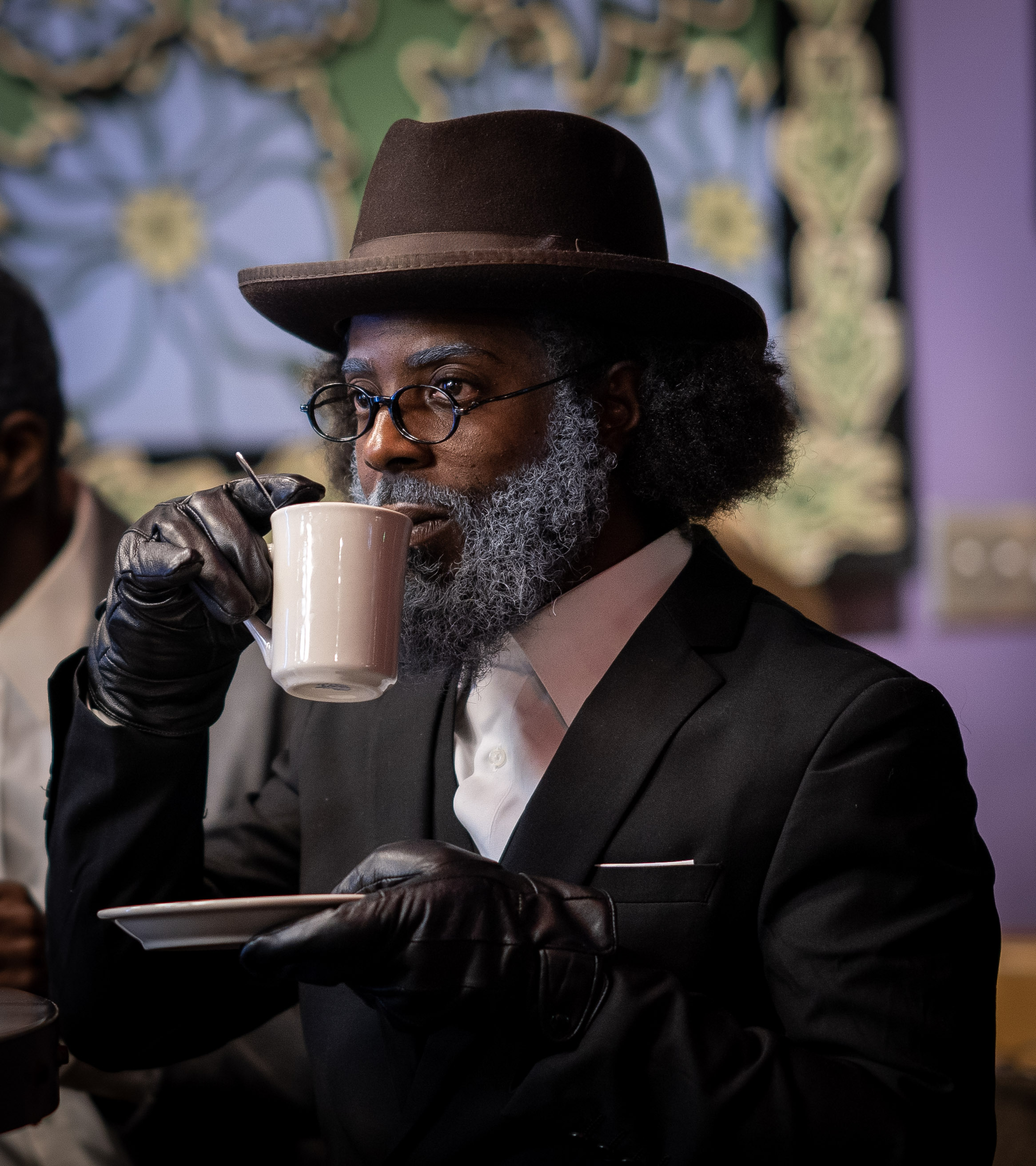
It was probably a group effort to make Weaver look so frightfully grubby as Hambone, but Lyric and Hayes draw my kudos for the sensation West makes each time he enters. Wilson prescribes that the undertaker is always dressed in an all-black outfit, including black gloves that he wears indoors, but designers only add a black hat in about half the productions I’ve tracked on YouTube – and none of them are as imposing as the formal chapeau Lyric chooses for Sultan Omar El-Amin. Hayes layers onto this formality, decreeing that El-Amin must meticulously spread a napkin across his lap at each sitting.

With such outré ammo, El-Amin steals each of his scenes without raising his voice to a level that might lead you to seriously suspect that he doubts his own power. By the manner he holds his cup and saucer, you’d think he was at high tea! From a man who has specialized in portrayals of angry, resentful, and mixed-up young men, El-Amin’s confidently restrained performance as an established 60-year-old widower is a stunner.

Two Trains Running at Spirit Square is a good place to climb aboard the complete Pittsburgh Cycle that BNS is planning to present in coming seasons. You won’t miss a thing because BNS is planning to reprise its previous production of Jitney in May. Then they plan to present Radio Golf, the final drama in the Cycle – and Wilson’s last completed play – next season. Two Trains is not the last stop, but you’ll need to catch it this week before it closes.


“Summer Night, With Unicorn” Plants the Seed for Professional Jewish Theatre at Shalom Park

Review:  Summer Night, With Unicorn

By Perry Tannenbaum

In a cycle that begins in November, The Levine Jewish Community Center jumped aboard the Jewish Plays Project two years ago as Charlotte became one of 12 cities adjudicating JPP’s annual Jewish Playwriting Contest. Charlotte has already assembled 21 readers for the judging process, tied with Chicago for the most among participating cities, in deciding the three scripts that are publicly presented in the spring at Gorelick Hall. That’s where the Shalom Park audience takes over, choosing the winner and also-rans for our region. From those results, a consensus national winner is chosen – not only for presentation at an annual Jewish play festival up in New York but also for full professional productions in all the cities where the Project has taken root. Last year’s contest was different from those that preceded, pitting all winners from previous contests against each other, so that an all-time winner from 2012 to 2017 would emerge. Decided by an objective points system, the 2018 contest actually produced two winners, Estelle Singerman by David Rush, winner of the 2013 prize, and Belfast Kind by Margot Connolly, the 2015 winner.

Among the co-winners, Charlotte chose Rush’s bittersweet comedy-fantasy. We had been told at the readers’ committee meeting back in January that Rush’s title was in flux. By the time it was presented at The Festival of Jewish Theater in June, Estelle had been renamed Summer Night, With Unicorn. That’s the title that JStage brought to Gorelick, sporting poster and playbill artwork with a Marc Chagall flavor that marvelously reflected the spirit and the magical realism of Rush’s play. The main figures in Kayla Piscatelli’s artwork are a crescent moon over the head and neck of a unicorn. Within that white unicorn, there is a silhouetted cityscape of skyscrapers with space enough above them for the Hebrew letters of the first four words of the traditional mourner’s kaddish. Estelle is a gregarious elderly Jew, not devoutly religious, since we meet her a little after 10pm at a lonely McDonald’s in Chicago. There’s nobody else to pester but Warren Spencer, an obvious Cubs fan busily clogging his arteries with a burger and a large order of fries.

Estelle would like this sullen, downcast, and brooding widower to believe she’s doing him a favor by sharing his fries and perhaps hoping to cheer him up as she invites him on a late-night odyssey. She will take him to a park, the Lake Michigan shore, a Christian Science reading room, a synagogue, and – inevitably – a zoo. Where else would Estelle and Warren converse with Seymour, a reincarnated giraffe? Rush proves to be very ecumenical in his ramblings around Chicago. The depressed and anorexic Hannah Kipper reads tarot cards on her lakeside blanket, the reading room is managed by a kindly Sister Rose, and the dark synagogue is haunted by a rabbi who’s unsure whether he’s alive or dead, a thickly bearded gent with Wandering Jew earmarks who has his visitors wondering who’s dreaming whom. Nor are the characteristics that Hannah and Rush assign to the Unicorn gleaned from the Encyclopedia Judaica, where there is no entry for the mythological beast.

Long before intermission arrives, we realize that Warren is a stubbornly lapsed Jew who is stewing in bitterness over the circumstances surrounding his wife Doris’s death. Estelle is a widow herself, habitually wandering the city at night because she’s afraid to go to sleep, promising Warren the glory of a sunrise over the lake at the end of their journey. We join Warren in wondering what Estelle’s ulterior motive is, getting hints that he isn’t the first to join her on her midnight rambles. As the lights go down for intermission, it becomes suddenly clear that Estelle is looking somebody to say kaddish over her. What we didn’t know was whether Estelle was alive, with a wisp of matrimonial motives triggering her quest, or dead, needing Warren’s prayers to bring an end to her ghostly wanderings. The other big question was whether Warren would ever say kaddish over his own beloved Doris, let alone this strange and mystifying Estelle.

My estimate is that I haven’t reviewed a theatre performance at Gorelick in almost 16 years, during which time the J has sprouted multiple new wings, one of them two stories high, along with a new entrance and dazzling new facilities – all of which make the Gorelick, now shunted from the front to the back of the complex, look old and drab by comparison. The stage and the dusty chairs we sat in could sorely use a refresh, for starters. JStage producer Susan Cherin Gundersheim, the cultural arts director at the Levine JCC (and a theatre professional in her own right), is clearly facing an uphill climb in convincing people to make a serious investment in the J’s theatre program. Gundersheim has managed to bring professional-grade theatre to the site regardless.

To check off all the design and directorial boxes, Gundersheim has brought in Piscatelli and Mark Sutton to don multiple hats, which they do admirably on their shoestring budget. Sutton’s set design, little more than three wooden frames after we exited McD’s, meshed well with his directorial concept, calling upon his audience to mostly imagine the scenes for themselves. Piscatelli’s costumes and lighting were no less complimentary, the raggedy cerements for the ghostly Doris and the gleaming silk cape for the Unicorn contrasting effectively with the garish attire of our earthbound protagonists.

There are plenty of Hebrew and Yiddish expressions studding this script like landmines. Fortunately, Sheila Snow Proctor navigated the treacherous terrain almost perfectly as Estelle, certainly better than Sutton, who allows Devin Clark to mangle his Yiddish mercilessly as the ageless Rabbi. Portraying a lapsed Jew, David Catenazzo probably earned a pass as Warren on his trespasses with the Hebrew blessing for putting on a tallit – I’ve heard worse during torah readings at my Conservative synagogue. Proctor not only clops around like a pensioner, slightly stooped, slightly squinting, she gets the essence of Jewish soul and humor, the impulse of kvetching leavened with a pinch of self-mockery. She even carries her late husband’s tallit bag and tefillin with a touch of reverence. Perhaps Proctor would have had an easier time of it if Catenazzo had similarly leavened his anger and impatience with hints of the Jewish soul that had loved and indulgently persevered with Doris when she wasn’t angelic. To some extent, Warren needed to be charmed by Estelle. Judging this role is a little like living the journey of Ebenezer Scrooge.

With two major cameos, the Rabbi and the giraffe, Clark had the most opportunities to shine among the supporting players. He was especially entertaining as Seymour sparring with Warren, who probed into the question of why he had been demoted to giraffe in his present incarnation. Yet Clark was curiously endearing as the bewildered Rabbi, notwithstanding the butchered vay iz meers. Liora Tal likely sparked some objections for how she delivered Hannah Kipper, a little underpowered and maybe a little too serene for a young fortune teller looking forward to death – but Estelle persisted in feeding her, and I didn’t think we were supposed to believe her, either. I’m afraid that Mariana Bracciale didn’t get much of a chance to shine as Sister Rose, but at least she got to glow in the denouement as the Unicorn, making her entrance and exit from the margins of the audience.

No cameo better encapsulated what Summer Night, With Unicorn was all about than Stephanie DiPaolo’s visit from the beyond as the ghost of Doris. Even more befuddled and uncomprehending than the Rabbi, DiPaolo only flickeringly registered what Warren was asking of her, but although she haltingly spoke, she never responded. That was very much the dynamic in Rush’s magical journey. Multiple possibilities presented themselves to Estelle when she posed the question we all have about what lies ahead, but through the night, there was no clearer answer than that death will surely come. With richer lighting, sound design, and a sprinkle of special effects, DiPaolo’s clarifying moment of confusion might have reached a finer pinnacle. Hopefully, when more people at the Levine JCC appreciate the gems these professionals are creating, they will also realize that the artists and their audience deserve a finer setting.


Selling Elegance, Spirit, and History for Just a Song

Theatre Reviews: I Love a Piano: The Music of Irving Berlin and The (curious case of the) Watson Intelligence

CPCCILoveAPiano6[7]

After its most lavish and extravagant production ever, last November’s The Phantom of the Opera, what was CPCC Theatre going to do to follow up? Well, since the laws of mathematics and the logic of budgets still apply on Elizabeth Avenue, the answer was simple: economize! Rolling into the parking garage, where the second story was unusually unoccupied, I was worried the audience for I Love a Piano: The Music of Irving Berlin would be as drastically reduced as CP’s expenditures.

Not to worry, I didn’t find that many more empty seats at Halton Theater last Saturday night than I saw at last February’s How to Succeed. More importantly, considering the relative merits of Berlin and Andrew Lloyd Webber, the show attracted a competitive enough turnout at auditions to yield a cast that is worthy of the music — including holdover Ryan Deal, who you may recall in the title role of The Phantom.

Like the audience, the orchestra isn’t reduced quite as much as the funding, a quintet led by music director Ellen Robison from the keyboard. They’re a busy bunch, accompanying the cast — all six of them triple threats to various degrees — through a songbook that includes 53 different titles. A few of these songs are reprised, and at one point, when Andy Faulkenberry’s “The Girl That I Marry” is juxtaposed with Corinne Littlefield’s “Old Fashioned Wedding” — while J. Michael Beech and Megan Postle are teaming up on the counterpoint of “You’re Just in Love” — there are four different vocalists onstage singing four different melodies simultaneously.

Conceived by Ray Roderick and arranger Michael Berkeley, Love a Piano never says Berlin’s name out loud. But the 11 scenes, beginning with Tin Pan Alley in 1910 and ending in a summer stock revival of Annie Get Your Gun in the late 1950’s, take us chronologically through the composer’s career. Or roughly so: “Old Fashioned Wedding” was written for the 1966 revival of Annie Get Your Gun, and you can bet the anachronisms don’t stop there.

With a generous portion of poetic license, the show sketches a musical portrait of a composer who was consistently able to mirror his times. The title tune, “A Pretty Girl Is Like a Melody,” and “Alexander’s Ragtime Band” take us back to a sepia-tinted era when rags roamed alongside sentimentality. As we cut from band shell to speakeasy, “Pack Up Your Sings and Go to the Devil” and “Everybody’s Doing It” evoke the wicked carefree spirit of the Roaring ’20s during Prohibition.

Two scenes are devoted to the ’30s, “Blue Skies” and “I’ve Got My Love to Keep Me Warm” offering consolation during the onset of the Great Depression. Then a suite of dance tunes, including “Top Hat, White Tie and Tails” and “Cheek to Cheek,” evokes the elegance of Fred Astaire and Ginger Rogers. Thanks to Mel Brooks, the audience failed to take “Puttin’ on the Ritz” altogether seriously.

For some reason, Roderick — or perhaps CP’s director and choreographer, Ron Chisholm — bounced the heyday of dance marathons from the 1930s to the 1940s, sketching that lugubrious phenomenon with “Say It Isn’t So” and “How Deep Is the Ocean.” When we authentically reached the World War II era, it was quite obvious that Berlin more than reflected the hopes, the pride, and the humor of the times. He simply was these things, with a flowering of songs that included “Oh, How I Hate to Get Up in the Morning,” “This Is the Army,” “Any Bonds Today,” and “Count Your Blessings Instead of Sheep.”

Even those left plenty of room to bring down the first-act curtain with two of Berlin’s most enduring songs, “White Christmas” and “God Bless America.” A more judicious dividing line would have been the beginning of WW2 toward the end of the ’30s. As it stands, Roderick drops a bunch of CARE packages on the 1950s, including “Easter Parade” from 1933 and everything attached to Berlin’s sharpshooting homage to Annie Oakley, which premiered in 1946.

I Love A Piano

Photos by Chris Record

James Duke’s scenic and lighting design, relying heavily on period slides and Berlin show posters projected onto three screens, move us gracefully from era to era. But it’s Debbie Scheu who most colorfully clinches the deal with her cavalcade of costume designs. Chisholm’s choreographic demands certainly tax his cast, with Littlefield and Faulkenberry negotiating their steps with the most apparent ease. On the other hand, while Postle and Beech looked like they might not be up to their challenges, both of them surprised me with their hoofing.

Deal and Kayla Ferguson were the remaining couple, most memorable in their “Blue Skies” duet. All six of the singers proved to be quite capable, not at all fazed by the spotlight, but Deal and Littlefield were my favorite soloists. The ensembles were often very lively and charming, but a special pinch of conflict was added in the summer stock tableau when Ferguson, Littlefield, and Postle all auditioned to be Annie opposite Faulkenberry’s Frank Butler.

“Anything You Can Do,” usually a comical face-off between Frank and Annie, is set up as an audition piece. So the comedy is reborn — as a rollicking showdown between three aspiring Annies.

Eliza and Watson 3

Time and reality bend in curious ways in The (curious case of the) Watson Intelligence, now at UpStage in NoDa through February 21. But so does playwright Madeleine George’s title, so what else would you expect?

Three rather curious Watsons that we’ve already heard of are trotted out and shuffled in Three Bone Theatre’s production, directed by Robin Tynes. The first of these is a relative, shall we say, of the Watson computer that defeated its human opponents on Jeopardy in 2011. Eliza, who collaborated with IBM on the victorious Watson, is now in her living room, working independently on a new android that sports a far more human body.

We travel back to the 19th century for the other two Watsons that we know. The first of these is the Watson summoned to Alexander Graham Bell’s side when Pa Bell invented the telephone, his assistant Thomas A. Watson. But we don’t really see him, either, on that historic day in 1876. Instead, it’s Alex repeatedly calling for him in brief blackout vignettes between other scenes. No, we must wait until 1931, when Watson goes on record at Bell Labs, insisting that what his boss really said was, “Mr. Watson — come here — I want you.”

The third or fourth Watson, depending on how you tally the computer chips, is more in control of his narrative, for this is the Dr. John H. Watson who ostensibly chronicles nearly all of the Conan Doyle adventures of Sherlock Holmes. You’ll find that Watson Intelligence is all about connections Ð personal and electrical — and vague connections between the android and Sherlock’s sidekick are established by a fifth Watson, a tech dweeb hired by Eliza’s ex-husband to spy on her.

Compounding the absurdities, Tynes has chosen a black actor, Devin Clark, to play the whitest sidekick in the history of literature. What’s more, Clark is perfection as all the Watsons, human and robotic, plus a special set of scenes where he dons Sherlock’s deerstalker cap. Chesson Kusterer-Seagroves crystallizes Watson’s role as the archetypal listener, pouring out her heart to the robot and the tech dweeb in modern times and bringing an intriguing mystery to Watson at Baker Street in Sherlock’s absence.

Ken Mitten rounds out the cast as Bell and the two Merricks who cause their Elizas so much distress. He’s a powerful stage presence, but I’m sure he’ll be even better when he’s more secure with his lines and cues.

Lady Bracknell Weathers Three Storms

Reviews of The Importance of Being Earnest and The Miraculous Journey of Edward Tulane

Jon Ecklund (John Worthing) and Lance Beilstein (Algernon Moncrieff) in The Importance of Being Earnest.

They were planning to open The Importance of Being Earnest on January 22 at Theatre Charlotte, where Oscar Wilde’s “Trivial Comedy for Serious People” hadn’t played since 2002. But the snow and sleet that were icing the roads hadn’t begun to melt away on the following evening, so opening night was transformed into an opening Sunday matinee. Even if I had been able to scale my icebound driveway, I was already booked for the opera at Belk Theater.

After all the reshuffling on my iCal, my wife Sue and I were finally able to catch up with Wilde’s menagerie of smart alecks at the second Sunday matinee, nine days after the originally scheduled opening. With so many other reshufflers in the crowd, the Queens Road barn was close to capacity. An extra performance has been slated for 2:30 this Saturday to help out other migrants.

The airy sophistication of Joshua Webb’s set design boded well for the blizzard of bon mots to come, but who were these Ernests opening up the action, Lance Beilstein as the roguish Algernon Moncrieff and Jon Ecklund as the deceitful John Worthing? Beilstein had briefly blipped on my radar last year when he was cast in a stage adaptation of Casablanca that didn’t happen. and Ecklund had never performed on a Charlotte stage before nailing his audition as Wilde’s protagonist.

Yet they instantly established a fine rapport, hinting early on that Algy and Ernest — as John calls himself in London — were not only great friends but kindred spirits.

There was a problem, however, even before the divine ladies arrived. Though their chemistry was sparkling, Beilstein’s cue pickup was razor sharp while Ecklund’s was erratic. Not a symptom you would expect from your lead at the end of your second week.

Ecklund’s symptoms became more serious during the scene change between Acts 2 and 3. In fact, he was taken to the hospital, reportedly suffering from dizziness, and didn’t reappear.

Johnny Hohenstein, who plays John’s butler at his country home, bravely substituted for Ecklund during the final 19 minutes, script in hand. That forced the imperious Lady Bracknell to announce herself when she triumphantly reappeared.

The waters were already troubled in Act 1 when Jill Bloede, amply bustled in a floor-length dress, first floated in like a majestic tugboat as Her Ladyship. It was she and she alone who must approve of Ernest as the prospective husband of Algy’s cousin, Miss Gwendolen Fairfax — a grim prospect, since her wicked nephew has already devoured all the cucumber sandwiches.

Lady B attempts to be judicious. Ernest’s income of seven to eight thousand pounds, the equivalent of $1 million annually according to the Norton Edition of the text, actually counts in his favor.

It’s Ernest’s lineage that is an insuperable stumbling block, for he cannot trace his family any further back than a leather handbag! My, how Bloede huffs when she repeats that fatal word, nearly adding an extra syllable to it each time she lingers on the first letter.

Lady Bracknell’s contempt was so hilariously absolute that when she exited, leaving Ernest and Gwendolen’s hopes of marital bliss in shambles, the audience erupted in lusty applause.

By the sort of insane coincidence that Wilde uses to resolve Ernest’s difficulties, Bloede’s name rhymes with Lady. So, after her current triumph, Jill is no more: she will no doubt have to suffer being called Bloede Bracknell for the rest of her days. You may revise my headline accordingly.

Needless to say, Bloede’s arrival calmed any worries that this production, directed by Tonya Bludsworth, would be anything less than a delight. Eleven years after starring in NC Shakespeare’s Twelfth Night, Gretchen McGinty’s professionalism still gleams with vitality and caprice as Gwendolen, irresistible despite her perverse silliness. She accepts Ernest, but only for the shallowest of reasons — she’s the perfect antithesis of Juliet.

Caprice continues to rule when we arrive at John’s country home for Act 2, where we meet his lovely ward, Cicely Cardew. Her requirements for a prospective husband are not merely similar to Gwen’s.

They are exactly the same, obliging both John and Algy to make christening appointments with the Rev. Canon Chasuble. Under the watchful eyes of Cicely’s governess, Miss Prism, Algernon has snuck into John’s home, pretending to be his fictitious brother Ernest, and swept Miss Cardew off her feet. That’s partly because Miss Prism’s eyes are devotedly affixed to the Reverend.

As we’ll learn in the denouement, it’s not the first time Miss Prism’s attention has wandered.

Further complicating John and Algy’s attempts to live double lives, Gwen follows her would-be fiancé into the country — with her mother barking at her heels. The running joke of Act 2, amid all the confusion of who’s really betrothed to Ernest, is the radical shifts of sisterly love and murderous hatred between Gwen and Cicely.

Mixed in with devout cynicism and decadence, punctiliousness and pomposity squandered over trivialities are the key ingredients of Wilde’s satire, and Bludsworth has her entire cast embracing it with the proper élan.

Emily Klingman is hormone-driven innocence in a lemon chiffon dress as Cicely, assiduously transcribing Algy’s marriage proposal into her teen diary, and Hank West bumbles quite sanctimoniously as Rev. Chasuble when he manages to recall where he is. Scrunched up like a squirrel, Stephanie DiPaolo is the essence of fretful and incompetent spinsterhood as Miss Prism.

Bludsworth also differentiates nicely between the servants. Ron Turek is urbane and dignified as Algy’s man, Lane; while Hohenstein, tasked to distraction by his temperamental superiors, is more apt to let his resentments play over his face as John’s butler, Merriman. Or he was until he was obliged to pick up Ecklund’s script and stand up to Bloede Bracknell.

Edward Tulane(C)Donna Bise 6686

Photo by Donna Bise

Not at all plagued by postponements, The Miraculous Journey of Edward Tulane opened at ImaginOn last weekend in as polished a production as you’ll ever see from Children’s Theatre. It’s a gem that will no doubt remind longtime subscribers of The Velveteen Rabbit, since the title character is a rabbit doll. Ah, but Edward is fashioned entirely of porcelain, except for his furry ears and tail (he prefers not to think about the origin of his whiskers).

Adapted by Dwayne Hartford from the novel by Kate DiCamillio, Edward’s story begins when he is given to 10-year-old Abilene Tulane on Egypt Street by her mysterious grandmother Pellegrina, the only human who knows his heart.

Unlike the Velveteen, Edward does not aspire to be real or human, but he is frustrated when Abilene doesn’t set him in a place where he can see the outdoors and the stars through her window.

Even before he is severely broken many years later in Memphis, Pellegrina perceives his flaws, and the inference is that he must suffer for them. But Edward’s sufferings and adventures will be epic ­— beyond human, to tell the truth.

Our protagonist remains the three-foot doll the DiCamillio created, but Mark Sutton is always close by to articulate his thoughts, shouldering and picking a banjo as Edward morphs into Susannahr, Malone, Clyde, and Jangles during his odyssey on land and under the sea.

Margaret Dalton figures most prominently as the bereft Abilene, but she resurfaces on numerous occasions during Edward’s journey, most notably as a frisky dog. Beginning as the semi-exotic Pellegrina, Allison Rhinehart ranges across multiple roles and genders, last seen as Lucius Clark, the sagely doll mender. Devin Clark rounds out the cast, shapeshifting from fisherman to hobo to handyman when he isn’t slyly inserting sound effects. Pure enchantment for 81 minutes.