Tag Archives: Chris Timmons

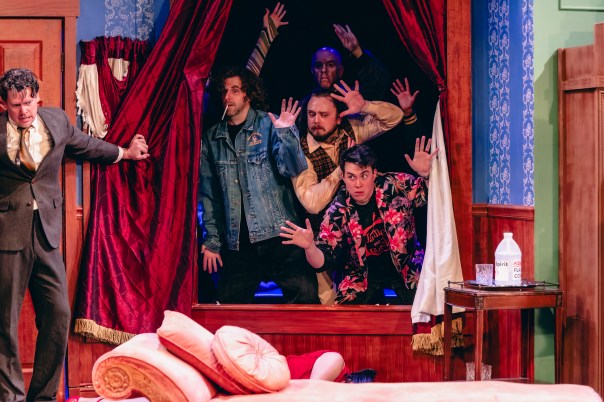
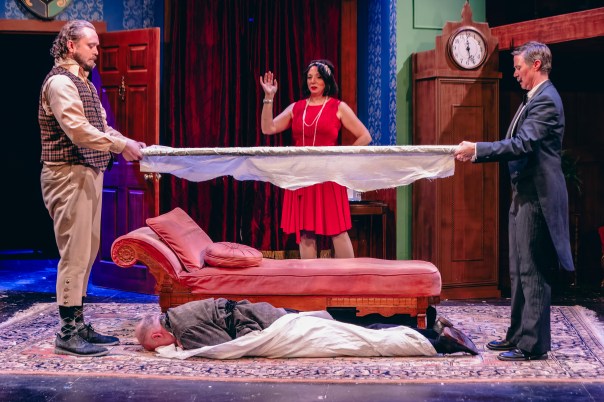
Old Barn’s “Orient Express” Is a Clue-ful Poirot Treat

Review: Murder on the Orient Express at Theatre Charlotte

By Perry Tannenbaum

We can thank the Brits for the notion that passenger trains should run with absolute timeliness and precision. Now that Ken Ludwig’s meticulous adaptation has opened at the Queens Road Barn, we can also thank Agatha Christie, Britain’s most avidly read mystery writer, for her Murder on the Orient Express. Layer on Jill Bloede’s bubbly direction – and dialect coaching – and the treacherous trip rattles along with a savory continental flavor.

That soupçon of glitter and effervescence is greatly enhanced by Theatre Charlotte artistic director Chris Timmons’ fleet and fluid set design, an art deco wonder that transitions delightfully from an Istanbul hotel to a smoky train depot to the luxe interiors of the Orient Express. Since the landscape and snowscape outside the legendary train are also moodily conveyed by projections, it’s difficult to draw a precise borderline between Timmons’ scenic exploits and his lighting design.

While the paucity of professional theatre companies in the QC continues to account for the plethora of professional-grade acting talent we behold at the Barn, so does the opportunity to appear in opulent costumes such as those designed by Sophie Carlick – for hotel waiters, train conductors, and various glitterati who can afford a first-class sleeping compartment on a luxury transcontinental train.

Speed is beneficial in a murder mystery, especially as it plods along, contrary to real life, when we’re introduced to a multitude of suspects who have sufficient motive to commit the cold-blooded crime. Anyone who grew up watching the Perry Mason series on TV (or has binged on it more recently) knows the classic drill: the murder victim antagonizes a slew of enemies. So many enemies that we’re unsure who might have done the deed and more than mildly uncaring about the victim, no matter how brutally they were killed.
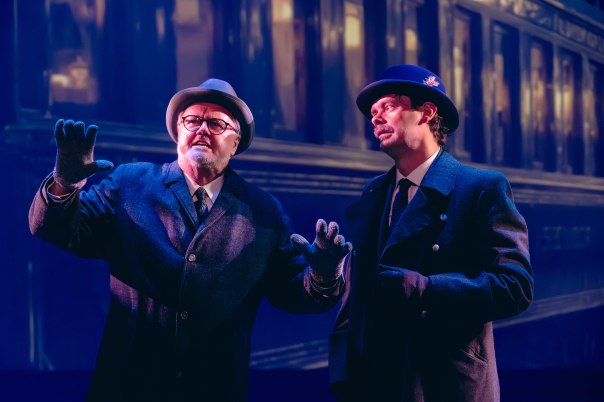
Ludwig admirably singles out our obnoxious victim-to-be and all the antagonisms he can spark while introducing us to Christie’s heroic protagonists, Constantine Bouc, owner of the Orient Express line, and peerless detective Hercule Poirot. There will be debate about Bloede’s decision to shitcan Poirot’s mustache wax and twirls in favor of a more conventional groom, but Brandon Samples’ initial entrance as the Belgian is star quality.

There’s a bit of aristocracy to Samples’ bearing that allows Poirot to fit in with his fellow passengers, including a princess, a countess, and a colonel. While Timothy Hager zestfully cements his repulsiveness as Samuel Ratchett, it’s also important for us to see that Poirot has sufficient dignity, discernment, and assets to reject Ratchett’s crass job offer.

Poirot also offers Samples a few brief episodes of befuddlement, for the culprit he is hunting leaves a blizzard of clues.

Unlike all of those complacent Perry Mason victims destined for the morgue and a court-ordered autopsy, Ratchett is keenly aware that he is being hunted. He’s willing to retain Poirot for a fabulous amount of money to protect him. Perry, you’ll remember, doesn’t arrive on the scene until after the wrong suspect is accused and arraigned. Here, Poirot is directly involved while the victim is alive. So when Samples shows no guilt or remorse for not accepting Ratchett’s offer after he is murdered, we’ll need further reasons for despising the playboy.

Christie piles them on and, in doing so, makes the bizarre solution to her mystery more plausible, for Ratchett is far more monstrous than he first seems to be.

Yet the elegance, hauteur, and glamor of the leading ladies would seem to instantly eliminate them from suspicion – or any close acquaintance with the vulgar victim. To think that Paula Baldwin as the Russian Princess Dragomiroff would deign to inflict eight stab wounds on the repellent Ratchett seems like sacrilege.

Likewise, Julia Howard as the serene and mysterious Countess Helena Andrenyi from Hungary seems worlds away from the slain playboy. The ethereal Gretchen McGinty as English governess Mary Debenham, also a smashing beauty, seems to live in an entirely different sphere, more involved with Scottish Colonel Arbuthnot (Ben Allen with a brash brogue) than the slain American.

As for Kathryn Stamas, as an esteemed actress traveling under the assumed name of Helen Hubbard, she is sufficiently brash, loudmouthed, and inconsiderate for us to worry whether Ratchett, trying to get some sleep next door and stewing with rage, will burst into her room and murder her. Murdering him would ruin her delight in riling him with her late-night singing.

However laudable it might be to murder Ratchett, three acts of God will prevent the ghoulish plan from eluding discovery: the unexpected arrival on board of legendary unraveller Hercule Poirot, the serendipitous intervention of Orient Express owner Constantine Bouc in securing a first-class compartment for Poirot, adjacent to the victim’s room. After these pieces are in place, with Bouc ready to serve as Poirot’s loyal sidekick, comes the fortuitous storm that halts the regal train in a snowbank out in the wilderness, giving Poirot sufficient time to investigate.

Bouc is obviously a key prong in Christie’s plotcraft, allowing Poirot to board the Orient Express and vesting him with the authority to investigate. Otherwise, our mustachioed sleuth wouldn’t be able to scan all our suspects’ passports or rummage through their luggage. Dramatically, he enables Poirot to interview all the suspects, another ritual of the mystery genre, corresponding to Perry Mason cross-examinations, that cries out for swift pacing.

The venerable Dennis Delamar would seem ideal for bestowing the requisite bonhomie on our gracious host and eager sidekick, except… for all his wholesome triumphs as Henry Higgins, Grandpa Vanderhoff, Kris Kringle, John Adams, Hucklebee, Jacob the Patriarch, and many more, has he ever done a French accent before? Maybe that was the question Delamar was asking himself on opening night when he uncharacteristically stumbled over a few of his opening lines.

Even for a semi-pro like me, those are lines you should be able to say in your sleep. Of course, Double D never broke character during his difficulties, so to neophytes in the audience, it may have seemed like the garrulous pensioner was stumbling over his English. Delamar’s imperturbability in this brief crisis only made Bouc more charming when he righted himself – and real panic was safely in reserve when the unsolved murder, right under his nose, threatened the image and prestige of his company.

Bouc also serves as a buffer between Poirot and the petty annoyances presented by our suspects, allowing Delamar to display his comedic chops. Samples, on the other hand, gets to revel in flipping over innocent façade after innocent façade in revealing the secret underbellies of his artful gallery of suspects. The parade of skeletons emerging from closets can’t help but add to our merriment.

So most of the actors on stage need to be adept not only in erecting their respective façades, but also in carrying off those deliciously satisfying moments when they are so disconcertingly exposed. Joshua Brand as Ratchett’s querulous secretary seems particularly innocent and above suspicion, while Emma Brand as the Princess’s trembling missionary ward is even further above. So pleasant when they fall.

Climb aboard this fatal train, and you’re likely to find the ride more fun than you expect.

“The Play That Goes Wrong” Fits Perfectly at The Barn

Review: The Play That Goes Wrong at Theatre Charlotte

By Perry Tannenbaum

Every time Inspector Carter declares his determination to solve “The Murder at Haversham Manor,” lights at Theatre Charlotte suddenly turn a lurid red to triple-underline the melodrama. This may be the only technical element that consistently goes right in The Play That Goes Wrong, now running – and decomposing before our very eyes –through February 23.

The mantelpiece over the fireplace in Charles Haversham’s study remains a work-in-progress long after the master is murdered. The painting above the mantle – clearly the wrong painting – doesn’t stay where it belongs, and a pesky door stubbornly resists efforts to unlock it when it isn’t wandering off its hinges. In similar disrepair, we may count the phone, the intercom, the elevator leading up to the second-floor office, and the walls themselves.

It is a precisely flimsy set, lovingly put together by Theatre Charlotte artistic director Chris Timmons, so precisely flimsy that it must conform to approximate dimensions to accommodate the cast. So active that the set predictably won the Tony and Drama Desk Awards for best scenic design in its 2017 Broadway debut. Like Michael Frayn’s famed Noises Off, another British play-within-a-play that goes comically wrong and wronger – but on a stage that revolves a full 180ᵒ – the set is like a machine. It could be packaged like an Ikea kit.

Written by Henry Lewis, Jonathan Sayer & Henry Shields, The Play That Goes Wrong nestles more naturally at the Old Queens Road Barn than at Knight Theater, where the national tour touched down in the QC six Novembers ago. The basic concept is that a small-time community theatre, perennially understaffed and underfunded, has suddenly received a grant that will finally enable it to present a full-fledged production.

No longer will Chekhov’s classic Three Sisters be reduced to Two Sisters at the Cornley University Drama Society. Nor will Lloyd Webber’s resplendent Cats be shrunk to Cat. It’s the birth of a new era!

But unfortunately, the new era hasn’t ushered in an influx of fresh acting talent and technical know-how. Dennis struggles with her lines and usually mispronounces the tough words written on her hands. Jonathan repeatedly re-enters the action before he’s supposed to. Sandra has an unfortunate knack of being in the wrong place at the wrong time; and her understudy, Annie, after subbing for Sandra when she’s knocked unconscious, reads terribly. Yet she refuses to yield back her role when Sandra revives.

Props aren’t reliably placed in their assigned locations by the incompetent crew. When they are properly placed or deployed, like the stretcher needed to carry the corpse through the finicky front door, they may not function properly. The Duran Duran CD, sought after by lighting-and-sound man Trevor before the play begins, will turn up inconveniently onstage deep into Act 2.

Which reminds me: even though those redlight cues are absolutely reliable, the portentous sound cues accompanying them are not.

Tonya Bludsworth directs all this carefully calibrated chaos with an able assistant director, Brian Lafontaine. Together, they and Brandon Samples as Chris bring out a key point that didn’t strike home for me as forcefully when I saw the touring version in 2019. Chris not only plays the plum role of Inspector Carter in The Murder at Haversham Manor, but he also serves as the stage director, prop maker, box office manager, and PR rep – totally responsible for this catastrophe, and obviously overstretched.

On the smaller Theatre Charlotte stage, Samples is closer to us and we can focus on him more sharply than if his flop sweat were dripping down at Knight Theater. Makes a difference when one protagonist seems to be especially invested in the worsening outcome, valiantly trying to cover up the metastasizing miscues, and gaping at the sheer scale of his own mismanagement and incompetence.

For me, Sample’s visible struggles – from his nervous shit-faced grins on up to his hissy fits – made Chris a little more poignant for me. Here is a man who cares so much about theatre, and he’s watching all his multiple shortfalls in artistry and management implode so spectacularly. We can feel for the rest of this woeful team, but not nearly as much.

Lee Thomas earns a distant second place in our sympathies just for the physical punishment he takes as Charles Haversham, the stepped-on, sat-on, and mishandled murder victim. Or for the dismal ratio of abuse absorbed to dialogue delivered. When he finally does speak, maybe for the first time at Theatre Charlotte since 2020, it is as an actor of mind-boggling incompetence, eclipsing nearly all of his castmates. Thomas is rather good at looking quietly embarrassed, confused, and discombobulated.

Jenn Grabenstetter as Sandra starts off in a sympathetic slot, cast as Florence Colleymore, the murder victim’s bride-to-be. Our empathy for her slackens when we learn that Charles’s brother, Cecil Haversham, is Florence’s true love. Or when we see how stylized Sandra is as a performer. Or when she skips ahead one line, answering Inspector Carter’s questions before he asks them. But we feel for her – a little bit, anyway – when the front door flattens her and her castmates prop her up inside a clock. When Florence revives, she has to battle Annie to reclaim her role with some fine screwball fight choreography by Allison Collins.

The character arc for Rachel Mackall as Annie is even more transformational, for her Florence starts off in a near-catatonic monotone until she does the first of her pratfalls, scattering the pages of her script and maybe dislodging a contact lens. That raises Annie’s energy level, leading to the subsequent miracle where, battling Grabenstetter for the spotlight, she suddenly has her lines memorized while becoming a vicious gladiator.

More WWWF-style action would not have been amiss, but there’s still plenty.

Like Selsdon in Noises Off, Dennis’s prime reason for existing in The Play That Goes Wrong is to roundly muck things up. Lewis, Sayer & Shields seem to be indicating that he’s inept, miscast, or over-the-hill. What the hell, Bludsworth casts a woman in the role, the venerable Andrea King, who may have actually portrayed more women on QC stages than men and describes herself like a cute puppy for sale in the digital playbill.

With so much incompetence surrounding the Haversham Murder production, it’s a bit cruel to arraign her as the sole culprit for substituting turpentine when a decanter of adult beverage is served to guests at the Manor. Or it is when that happens for the first time. It’s on her when the screwup is repeated, sparking a prolonged series of spit-takes because she has also forgotten a line that would propel the action forward instead of casting it into a never-ending loop.

King maintains a cheery insouciance no matter what kind of havoc she causes, enabling Cody Robinson as Robert to become king of the spit takes as the bride-to-be’s brother, Thomas Colleymore. With a preternatural Joe Belushi energy, Robinson demonstrates that Robert’s distaste for “White Spirit” can actually increase with each sip! When we think Robinson’s frustration and rage have peaked or even exceeded expectations, he still turns it up a couple of notches.

Adam Peal as Robert and Roman Michael Lawrence as Trevor fill out the roster of actors implicated in the murdering of The Murder at Habersham Manor. Robert is not only amateurish but also a carefree hambone, so naturally Chris gives him two roles to botch. Initially, Peal appears as Cecil Haversham, Charles’s scheming brother and Florence’s true love. But there’s more to butcher when Robert resurfaces as Arthur the gardener, laying on some eyewitness evidence.

Did I mention that Trevor, after losing track of his Duran Duran treasures, must abandon his functions as lighting and soundman when Annie, replacing Sandra, is also stricken? That script-scattering pratfall was just the beginning of her misadventures. While Lawrence has already shown us – and will continue to show us – how badly Trevor performs at his chosen specialties, we can brace ourselves for his slaughter of Florence Colleymore, postponed only by his reluctance to play the role.

On my second viewing, it was possible to pay more attention to the convoluted mystery plot by “Susie H. K. Brideswell.” Now I can confidently proclaim that Habersham Manor is a masterpiece of implausibility. Doesn’t work at all.

Woefully, Theatre Charlotte doesn’t seem to have experienced a financial windfall that parallels Cornley University’s. That would have enabled them to append a faux playbill for the Habersham Manor production to the conventional Play That Goes Wrong program. Then we could learn the last names of the players and the Habersham roles they play with less fuss and bother. A few tidbits about the players also enriched the experience of the touring production.

Apparently, when the playwrights founded their Goes Wrong franchise (Peter Pan and The Nativity are among the spin-offs), they must have been focused on crafting three of the roles for themselves to perform in London and Broadway – and meshing with Nigel Hook, their mad genius set designer. So they didn’t insist that their faux playbill must be printed to accompany the show.

That lack of detailing serves to emphasize where The Play That Goes Wrong doesn’t measure up to Noises Off! Frayn’s work fleshes out relationships between the actors onstage when they’re backstage and, with its first-act rehearsal scene, gives us a more vivid idea of how the play-within-a-play is intended to go. For that reason, despite all the hilarity that Lewis, Sayer & Shields deliver, I’d hesitate to recommend The Play That Goes Wrong to anyone who is new to theatre – or hasn’t experienced a play that goes right.

But for sheer fun in frightening times, this show is welcome medicine for everyone else. TikTok & Friends may have brought nostalgia for America’s Home Videos to a screeching halt, but this latest romp at the Queens Road Barn revives the special pleasure – and laughter – of similar train wrecks large and small running right at us, non-stop, on a live stage.

Joe Turner’s Come and Gone, directed by Corlis Hayes, last came and went at Central Piedmont Community College in 2015. Back then, the production demonstrated how ill-suited even a renovated Pease Auditorium was for the best of August Wilson’s dramas. Panoramic Pease has now been demolished, so it will be interesting to see Hayes come back again to the CP campus, along with Jonavan Adams reprising his role as Herald – at a real theater in the fledgling Parr Center. Dominic Weaver, also in the mix ten years back, gets a juicier role this time as Bynum, the conjuring root doctor.

Turner, the second play in Wilson’s decade-by-decade traversal of the 20th century, The Pittsburgh Cycle, is set at a Pittsburgh boarding house in 1911. Rather than hinting at WW1 later in the decade, the drama hearkens back to slavery, the Civil War, and their aftermath, both glorious and sad.

“Every character has a story, and every story has a song,” says Hayes. “The play explores African American identity, healing from trauma, and the power of community and self-discovery. More significantly the play is an examination of Black people in transition during The Great Migration.”

This weekend only!

“Next to Normal” Is Alive at the Barn!

Review: Next to Normal at Theatre Charlotte

By Perry Tannenbaum

July 4, December 7, September 11, and October 7 are all dates we remember for their historic meaning to the nation and the world. A similar earthshaking significance can descend on a single day in the life of a relationship, a marriage, or a family that can reverberate for generations – whether you were at the event or even alive at the time.

That’s essentially what we’re watching in Brian Yorkey’s Next to Normal with music by Tom Kitt, winner of the Pulitzer Prize for Drama in 2010 after winning Tony Awards for Best Musical, Best Book, and Best Orchestrations the previous year. Instead of doing things the traditional way, setting up the location and the situation in a big opening number that stages or recaps the prime catastrophe, Yorkey fast-forwards us more than 17 years, when the original hurt in the Goodman family has marinated and metastasized – a fissionable maelstrom that will soon explode.

With a fresh set of seismic events.

Diana is at the vortex of the mushrooming crises, so it’s both interesting and wickedly deceptive that Yorkey brings us into her drugged and delusional mind for much of the opening action. We still see the basic outlines of the family turmoil clearly enough. Her husband, Dan, keeps trying to go with the flow of Diana’s bi-polar mood swings. She navigates a series of therapists, looking for either a therapeutic epiphany or the perfectly calibrated cocktail of meds.

Meanwhile, Diana’s teen daughter Natalie feels neglected and unappreciated, living in the shadow of Mom’s obsessive devotion to her older brother Gabe. Warily, Natalie navigates her self-worth issues as schoolmate Henry tries to get closer and establish a relationship. When Natalie overcomes her shame and allows Henry, after much hesitation, to meet her family, we seem to have arrived at a breakthrough.

It’s a brave move and all goes swimmingly at the Goodman dinner table between Natalie and Henry until Diana walks in with a birthday cake, all smiles, candles lit. Yorkey’s sleight-of-hand has worked so beautifully that we wonder which of the two teens is the target of the birthday surprise. Suddenly things are going downhill – off a high cliff.

Like we’ve been overdosing on the meds so far.

Yorkey is very good at these slow build-ups where we see budding new hopes dashed by a sudden disappointment and fresh Diana relapses. After portraying Dan, the long-suffering husband in Queen City Theatre Company’s fine production in 2013, Billy Ensley takes the reins at Theatre Charlotte’s slightly slicker version. His suffering, grimly stoical, was very different from Johnny Hohenstein’s unfiltered and uncontrolled anguish. It’s easier to breathe at the old Queens Road barn when emotions get a space to release.

On the other hand, the Broadway edition starring Alice Ripley in 2009 (which toured here with Ripley in 2011) took a dimmer, more skeptical view of psychiatry and pharmacology, giving those productions directed by Michael Greif a darker, satirical, mad scientist edge. Around the corner from a cluster of medical centers and hospitals, Josh Webb’s set design on Queens Road is easily the brightest and most antiseptic I’ve seen. The usual two-story scaffolding that adorns rock operas is outfitted with colorful fluorescent lighting, though some flickering occasionally marred the serene pastels (intentionally?) inside the translucent fixtures.

So in transit to Charlotte, the emphasis continues to shift more emphatically away from the quackery to the suffering. Hohenstein’s broadened performance now rivals Melissa Cook’s bipolarity as Diana, for he’s still a domesticated dad to Natalie and a cheerful host to Henry between bouts of stressing and losing it in private and with his wife. In its fits and starts, Hohenstein helps us to balance the toll mental illness takes on its victims and on their loved ones. Easily the best of Hohenstein that I’ve seen and the most intensely consistent performance of the night.

Cook’s performance as Diana is as genuine and riveting as any I’ve seen in Charlotte or on Broadway – except when it isn’t. Whether you call it resistance or retreat, there are whole songs where she is suddenly no longer a cri-de-coeur rock singer and becomes a more traditional Broadway belter: sweeter voice with noticeably less emotion and intelligibility. Suddenly, it isn’t about how sensationally Cook is acting but about the singing, likely more in her comfort zone.

I can’t say for certain that the duality was there from the start, but there should be no turning back after the big birthday reveal.

And the words here are important – I could almost hear Ensley stressing this at rehearsals – for we get the best sound in a musical production, local or touring company, since MJ stormed the Belk last September at the beginning of the season. Kudos to Ensley for his pertinacity and, if there was any acoustic work or equipment upgrades in the mojo, glory to the staffers involved in the push, beginning with artistic director Chris Timmons and managing director Scot P J MacDonald. The old barn is sounding better than ever.

It needed to. In contrast with Spirit Square’s more intimate Duke Energy Theatre, where Glenn Griffin directed Normal, a musical on Queens Road requires ample decibels to reach the back of the house. Keeping with Theatre Charlotte wisdom, music director Ellen Robison trims her rock band to six musicians while placing them behind the singers.

Instinctively, Ensley finds a perfect pathway for his cast to turn up the volume. As if inspired by grand opera, he dials up the melodrama past suburban proportions so that most of the characters are wearing their hearts on their sleeves. Craig Allen as Drs. Madden and Fine, allows himself to be callous and ghoulish for the blink of an eye when the script absolutely demands it. Otherwise, he is the throbbing soul of earnest concern – moonlighting as a rock star in Diana’s delusions.

As Natalie, the only lonely daughter, I found Cornelia Barnwell to be more shut-down and compulsive than Abby Corrigan was on her express route to stardom in 2013. Barnwell’s voice is purest rock, piercing as a poignard with no blade. She seems to be the studious type in her scenes at school or alone with Henry. But she can flip and go rogue as soon as she sings. Very appropriate for Natalie, so anti-meds at the beginning because she has seen the wreck of her mom – before following in her footsteps. At the same upstairs medicine cabinet.

If a stoner-slacker can be seen as an oasis of calm, then that’s how Zach Linick will appear as Henry, faithfully devoted, non-judgmental, discreetly giving Natalie her space. There aren’t too many laugh-out-loud moments on this bumpy road to tentative stability, but when Natalie, resistant at first to Henry’s weed, leapfrogs him into wanton pill popping, Linick’s reaction bears watching.

Melodramatic or not, Ensley’s read on Next to Normal is more in tune with our chaotic times than the 2013 original, when Yorkey likely turned to the mad laboratory aspects of pharmacology and electroshock therapy to provide a counterweight to the suffering and gloom. Everybody is wronged here as if the world were all MAGA malcontents, but the uplift and electricity of Kitt’s score have always been there to supply lightning, spirit, and zest. Ensley relies on Robison’s band to deliver and their chemistry with all the suffering Goodmans is fire.

It’s especially white-hot in the stunning performance of Joey Rising as the disembodied Gabe. What a wonderful nuisance he is, impervious to all who ignore him! Over and over, he quashes the best hopes of his mom and dad, and he’s hardly less devastating to our own. If you find it hard to imagine a mad-scientist horror movie strain in this musical, the chill of hearing Rising’s defiant, jubilant “I’m Alive” will convince you that Yorkey believes devoutly in melodrama after all.

We in audience become like the frenzied villagers in Frankenstein, collectively yearning for Gabe’s destruction while wondering at Rising’s fire. But after he beats a full retreat, he returns, fierier than before. And then he multiplies!

Dialing Up the Almighty in Memphis

Review: The Mountaintop at Theatre Charlotte

by Perry Tannenbaum

A stage with a particularly authentic – or imaginative – set design is a good start for a director who wishes to immerse you in the world of a play. Yet few productions surround you with the theatre experience, making you feel outside your own world and inside theirs. Sleep No More was dedicated to achieving this mission with a Macbeth makeover up in Manhattan’s Chelsea district at a spooky hotel, where I saw it in 2015. So was Then She Fell the following night in Brooklyn, where I was plunged into the imagination – and mental illness – of Lewis Carroll.

In Charlotte, such efforts have been comparatively infrequent, but not unknown: Chickspeare’s Fefu and Her Friends on Cullman Avenue in 2001, numerous “environmental” productions by Carolina Actor’s Studio Theatre (CAST) in their days on Clement Avenue, and Matt Cosper’s legendary Bohemian Grove of 2014 that was staged god-knows-where – you had to agree to be kidnapped in a van by The Machine at the Actor’s Theatre parking lot to attend.

They do make an impression, these hyper-immersive presentations.

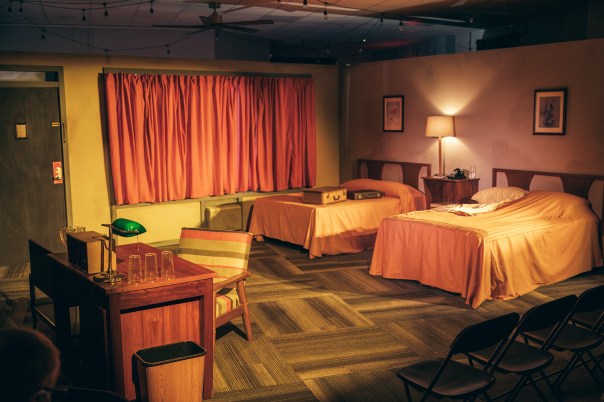
Cut to the legendary Queens Road Barn for the latest Queen City experiment in environmental staging. Yes, that’s Theatre Charlotte – in Myers Park! – on the cutting edge with its new production of Katori Hall’s The Mountaintop. Directed by the ageless Corlis Hayes and designed by Chris Timmons – with a nine-person “Lobby Transformation” team – this is the first fully-staged drama my wife Sue and I have seen in the 501 Queens Road lobby since the spare and forlorn Waiting for GODot in 2007.

Together with invaluable help from David Gallo, set designer for the 2011 Broadway production, and props designer Brodie Jasch from Fayetteville’s Theatre Squared, Dr. Hayes and her production team aim to take us back to the Lorraine Motel in Memphis on the night of April 3, 1968. Rev. Martin Luther King, Jr., returns from the Mason Temple, where he has just delivered his eerily prophetic “I’ve Been to the Mountaintop” speech.

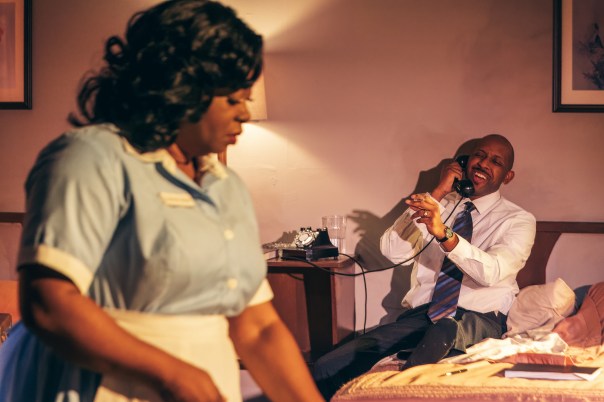
Every detail of the last room occupied by MLK has been replicated with meticulous authenticity – night tables and their contents, lamps, the chair and its fabric next to the window, the window curtains, the bed coverings – all the way down to the upside-down zero on the door to Room 306. With walls within walls, you must enter through this door to get your first view of the new theatre space in the lobby created for this production. Only the ceiling remains unaltered, with its fans and extinguished holiday lights. Explanations are appended in the digital program for those details which couldn’t be ascertained and those that would have conflicted with Hall’s script.

Since there is no intermission and all the usual concession outposts have been whisked away, they have thoughtfully made “Room Service” available to ticketholders via a QR code. In more ways than one, we are treated like kings at The Lorraine. Fun fact: the fateful motel was actually named after the hit 1928 song, “Sweet Lorraine,” popularized by jazz artists Teddy Wilson and Nat “King” Cole.

For all of Dr. Hayes’s reverent devotion to getting the look and feel of The Lorraine recreated as faithfully as she can, we soon see that it isn’t a shrine. Hayes is equally bent on getting to the heart of Hall’s pointedly irreverent drama. Hall provides ample time for solemnity and anguish at the end, but until then, she wants us to see the soon-to-be-martyred icon as a man, not a god, and not even as a holy man. The real Martin – or as God likes to call him, Michael – had his foibles, vices, and infidelities.

And notwithstanding the resounding valedictory declarations of the Memphis speech we’ve heard over and over – “So I’m happy, tonight. I’m not worried about anything. I’m not fearing any man” – Hall insists on reminding us that King did have worries and fears.

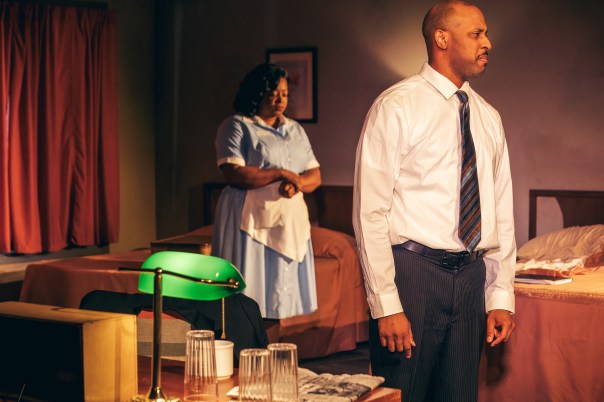
All obeisance to King’s saintly aura is swiftly discarded almost as soon as we see Justin Peoples taking on the role, before he walks through the audience to take a pee. Not only is he unkempt after his oratorical exertions and his walk through the rain, he has largely dropped his dignified public persona, at ease if not quite relaxed. Though he diligently examines his room’s rotary phone to make sure it isn’t bugged, we can hear that he has switched from formal to casual mode as soon as he speaks. It’s with an unmistakably Southern accent!

Immediately disarming. Neither the touring production by the famed Penumbra Theatre of Minneapolis that ran at Booth Playhouse in 2014, nor the homegrown Actor’s Theatre run of 2018 at Queens University, directed by April Jones, had quite the same spontaneous or undignified impact. The smallness of the lobby space at the Queens Road Barn certainly helps in establishing a closer intimacy with King and a sharper look at his vulnerabilities.

Maybe that folksy drawl would have been even more impactful if Peoples had held back on it until MLK had dialed room service after normal closing hours. The arrival of LeShea Stukes as the fetching Camae, a housemaid moonlighting as King’s waitress, would have been a good moment for Peoples to turn on the Southern charm. But for those of us who have seen The Mountaintop before, Stukes brings with her more than Camae’s sensual allure, more than her extra Pall Malls to satisfy King’s chain-smoking, and more than her working-class sass.

She now gives us solemn glances from behind King’s back, fully aware of the gravity of her true mission before she discloses it, morphing from pursued damsel to admonishing paramour to chum to messenger of God. None of these fresh wrinkles quite accounts for the marvelous voodoo or the juju that Hayes, Peoples, and Stukes have conjured up in creating the playful, poignant, and profound chemistry of this Camae and MLK.

Lighting designer Jennifer O’Kelly gently signals those moments when Camae might be contemplating why she’s there, foreshadowing the AV extravaganza that will accompany Stukes’ final mountaintop revelations. She will almost be speaking in tongues when we reach this visionary summit.

There’s little theology here, for when King dials up the Almighty, pleading his case for more time on this turbulent planet, she hangs up on him. Yet there just may be some deep dialectic in Hall’s scheme that narrows the gap that we might feel between God’s biblical judgment upon Moses at Mount Nebo and the judgment upon Martin in Memphis.

Moses was given a precise catalog of his greatest sins. Maybe in an afterlife he learned not to shatter any holy tablets or assault a boulder without God’s approval. But what was the great sin that deprived MLK of the Promised Land that awaited his people? The answer never comes explicitly in the play, but King’s sins – though relatively petty until we consider possible adultery – are graven in its marrow.

In an age when not a day goes by without yielding fresh images, outrages, and crimes committed by a lying orange buffoon, we might find ourselves shocked to be shoved towards such traditional moral moorings. Some of these values were written long ago in our marrow. Leading a people may still require adhering to a higher standard in God’s job description, not flouting the laws and proprieties that apply to everyone else.

Peoples and Stukes, with plenty of finely judged assistance, have found a way to make The Mountaintop more poignant, relatable, and human. Hall’s work becomes more touching, meaningful, and necessary each time I see it.

Follow the Yellow Brick Road to the Queens Road Barn

Review: The Wizard of Oz at Theatre Charlotte

By Perry Tannenbaum

With her rustic picnic basket, her toy dog Toto, her beribboned pigtails, and her iconic gingham dress, the 1939 movie version of L. Frank Baum’s imperishable heroine, Kansas-born Dorothy Gale, was designed to closely echo the Dorothy found on the pages of Baum’s 1900 novel. She was conceived in the lineage of Little Red Riding Hood and Lewis Carroll’s Alice as a little girl – credulous, easily surprised or disappointed.

Judy Garland was 16 years old when she began shooting The Wizard of Oz at MGM Studios. Her sub-5-foot stature bridged some of the age gap, but director Victor Fleming and the MGM braintrust didn’t stop there, trussing Garland up to hide her curves. All of this subterfuge (some would call it barbarity) was logical only because Hollywood, suspicious of fantasy and children’s fiction, wanted to reassure us that Oz, The Wizard, the Witches, the Winkies, and the ruby slippers were all nothing more than a little girl’s dream.

Noel Langley’s screenplay, revised chiefly by Florence Ryerson and Edgar Allan Woolf, went to extraordinary lengths to frame Dorothy’s adventures as a dream. The celluloid version supplied the Scarecrow, the Tin Man, the Cowardly Lion, Glinda, the Wicked Witch, and The Wizard with Kansas counterparts she will transform into Ozians. Baum never created a Miss Gulch or a Professor Marvel. In fact, when he adapted The Wonderful Wizard of Oz for the stage in 1902, Baum actually expelled Toto and the Wicked Witch from his cast – and did not permit the Lion to speak.

Langley obviously hasn’t gotten enough credit for his contributions to Oz mythology. The whole preamble to the cyclone and Oz is his, along with the wholesome welcome home to Kansas that crowds the screen with patronizing adults. Aunt Em is the only person who greets Dorothy in the book, where the ending is dispatched in less than 75 words. Dorothy finds a new farmhouse that Uncle Henry has built to replace the old one that killed the Wicked Witch of the East. No question in Baum’s mind: Dorothy has been away to a real place in real time.

When John Kane adapted The Wizard of Oz for the Royal Shakespeare Company in 1987, he went with Langley’s version of the story. Not only were the songs by Harold Arlen and the lyrics by Edgar “Yip” Harburg brought along for the ride, so was “The Jitterbug,” an Arlen-Harburg song that didn’t make the film’s final cut. If anything, Kane’s additions to the screenplay served to underscore the idea that Oz was a dream, dropping more key words and phrases that linked the magical land to Kansas. Auntie Em and Uncle Henry were added to the roster of Kansans who change costumes and join Dorothy in Oz.

That’s the version we have now as Theatre Charlotte kicks off its 96th season with a rousing trek down the familiar Yellow Brick Road. After her TC debut in 2022 at Camp North End during the company’s vagabond season, Allison Modafferi Brewster directs for the first time at the Queens Road barn. Leaning heavily on projection designs by Alison Nicole Fuehrer to navigate the geographies of Kansas and Oz, Modafferi and her cast of 40 (plus nine “Ruby” Munchkins who timeshare with the “Emerald Cast” that performed on opening night) heartily buy into the notion that Oz is a dreamland.

But in choosing Winthrop University senior Cameron Vipperman as the lead, Modafferri and costume designer Rachel Engstrom are pushing back against the idea that Dorothy must be a child. Or, to cite the range prescribed for auditions in 2006, when Central Piedmont presented this Wizard as their first summer extravaganza at the newly-built Halton Theater, between the ages of 14 and 17.

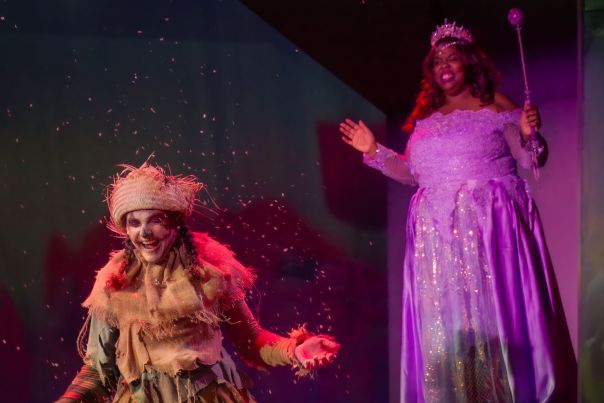
Gone are the ribbons, the pigtails, and the gingham dress, though Vipperman’s do does sport a couple of fairly subtle weaves. Nor does this energetic production go along with the notion that Miss Gulch and the Wicked Witch of the West must be gnarly old crones. Wielding her broomstick in a rather gladiatorial black outfit, Mary Lynn Bain was quite the action figure as the Wicked One. No corny cone hat for her!

Unless you’ve scouted productions down at Winthrop and Matthews Playhouse, neither of these antagonists will be a familiar name. Casting is no less adventurous for Dorothy’s Yellow Brick pickups. As the Scarecrow, Devon Ovall comes to the Queens Road barn by way of Northwest School of the Arts. Ashley Benjamin, the first female Tin Man we’ve ever seen in Charlotte, seems to be freshly arrived from Georgia in her digital bio. Only Kyle J. Britt can boast previous Queen City exploits prior to his present turn as the Cowardly Lion, having appeared at the barn in last year’s Christmas Carol as the Ghost of Christmas Present.

Noticeably younger than any Oz supplicants you’ll ever see again in an adult production – so close to Dorothy’s age that they seem to be her pals and never her protectors – this youthful trio is remarkably appealing. Ovall flops around and collapses with infectious glee as Scarecrow. Aided by strategic sound effects, Benjamin brought plenty of creaky stiffness to the Tin Man, but she often needed stronger miking.

Rachel Engstrom’s costume designs for these two weirdos are masterworks of simplicity, but her greatest triumph may be her Lion, little more than a wig gone wild and a couple of fringed sleeves. This is sufficient armament for Britt to make delicious meals of both his Cowardly highlights, blustering his “top-to-bottomous” bravado with gusto and regally rolling his r’s on “King of the Forest” – with an extra-chesty baritone.

Modafferri’s infusions of diversity and gender switching don’t stop with Benjamin. Brandie Hill brings a righteous gospel flavor to Aunt Em and especially to Glinda the Good, while D. Laverne Woods brings out the gypsy in Professor Marvel and the sass in the Wizard. Darren Spencer as Uncle Henry is a softer, more indulgent contrast to Aunt Em’s law-abiding rigor, making him the obvious choice to play the softy old Guard at Oz’s palace.

Mostly at the service of Fuehrer’s projection designs, set designer Chris Timmons’ neutral-toned slabs don’t quite allow the colors to pop until we first espy the poppy field and Emerald City beyond. The cityscape lingered a few seconds too long as we transitioned from Oz to the wicked West, my first inkling that there was more than one projector in play. The more concerning miscue on opening night was the stage crew’s failure to secure the flight of stairs leading up to the platform where the Wicked Witch makes her immortal “What a world!” exit.

Poor Bain took a nasty little tumble trying to get up there, nearly breaking her neck before she had a chance to melt, prompting Vipperman to be very careful when she climbed up after her. The wonderful reversal was still effective.

That climactic scene cannot be withheld from an adoring public, so Timmons had to choose between the complexities of using a trapdoor in the middle of his stage or building a platform. The latter solution is likely simpler, but its hazards were frightfully exposed last Friday. No doubt all the furniture moving and fastening will go better this week as the run resumes.

Technically, the Theatre Charlotte version of The Wizard is nowhere near as dazzling as the CP version of 2006, when the Witches, the Wizard, Dorothy, the Scarecrow, Miss Gulch, and a cow all flew, and Glinda floated gloriously in a bubble. Such lavishness is probably the main reason why CP shitcanned its Summer Theater programming this season – after four decades of serving as the best launching pad for emerging professional talent that Charlotte has ever seen.

Musically, the lack of a live orchestra dulls the brilliance of Herbert Stothart’s scoring, but music director Matt Primm and his talented cast rescue things nicely. After a shaky start, when Vipperman was too studiously on the beat, “Over the Rainbow” came to full bloom. Surrounded by the loosey-goosey shenanigans of Ovall and Britt, she blossomed even more in Oz. Pepper Alpern as Toto remained a wild card. Nobody knew what the mutt would do next, behaving, barking, or otherwise stealing focus.

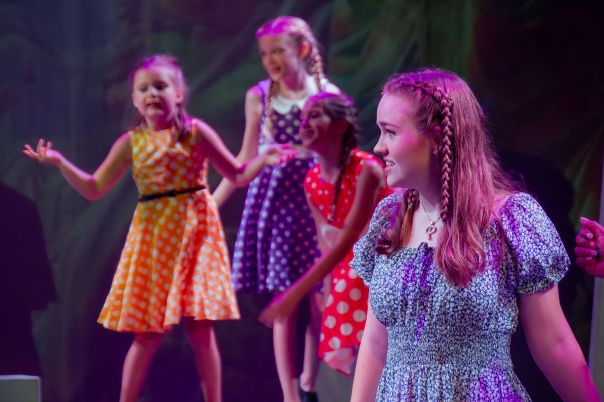
Engstrom and choreographer Vanessa Zabari held a deck full of winning cards to counteract this earthbound production’s lack of aerial aces. Dance numbers greatly enlivened the arrivals in Oz and the Emerald City when a bevy of Munchkins, a Youth Ensemble, and an Adult Ensemble strutted their stuff, captained by Aidan Conway. Punctuating the action at key moments with assorted tumbles, somersaults, and splits, Conway was also a pro-grade soloist when he wasn’t fronting the ensembles.

Thanks to Engstrom, Emerald City was a sea of multitudinous greens, and the changes of dresses for the adorable Munchkins were more than enough to convince me anew that Oz truly is a merry old land. But for the next two months, I’d be quite content if I didn’t see another damn polka dot.

“I and You” Sings Songs of Myselves

Review: I and You at Theatre Charlotte

By Perry Tannenbaum

Stevie Wonder made the point so memorably over 50 years ago when he dropped his Talking Book album: “You and I” sounds so much more melodious and natural than if you reverse those pronouns. As Laura Gunderson’s unique 2014 dramedy reminds us, now wrapping up Theatre Charlotte’s 95th season, I AND YOU sounds and feels rather awkward – even if it’s grammatically correct.

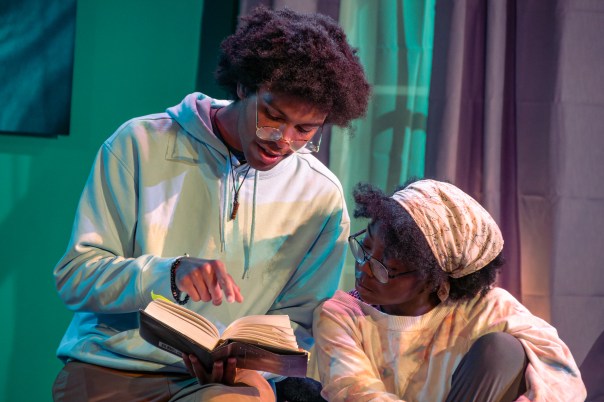
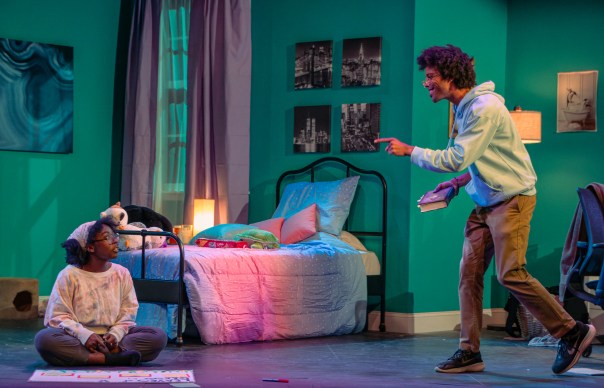
Predictably, the play is written for two high-school-aged people going through an awkward meeting, and director Rasheeda Moore makes the two-hander a little more fit for community theatre programming by rotating two different casts during the production’s two-weekend run. Pronouns figure prominently in the plot from the beginning, for when Anthony enters Caroline’s bedroom and meets her – without prior notice – for the first time, he’s carrying a really lame handmade poster and a fairly shabby old book, overflowing with scraps of sticky notes and bookmarks.

He’s a young man on an urgent mission, so desperate in his pleading that he almost sounds commanding. You and I, he is telling her, need to collaborate on a project for our American Lit class where we show how the meaning of I and You keeps changing during the course of Walt Whitman’s “Song of Myself.” That’s a rather big ask of Caroline, a rather ornery young woman suffering from a liver disease that keeps her out of school most of the time. She actually hates poetry, let alone Walt Whitman.

Caroline’s objections to poetry and how it’s taught in school are rather intelligent, and Anthony’s advocacy of Whitman is passionate and rather erudite for a teen. If they can get together, the outcome could be provocative. We know that Caroline isn’t really going to throw Anthony out, and we know that Anthony isn’t going to storm off, never to be seen again, so it’s gratifying that Gunderson only briefly feints in those directions. Once these formalities are dispensed with, our main interest jibes with that of the people before us onstage: getting acquainted and finding out why they’re worth our time.

Gunderson keeps it personal and unpredictable, with mercifully few ensuing chances that Anthony and Caroline will break apart before they get to know each other. They do get to know each other over two acts, with multiple scenes before and after intermission. Through various disagreements, crises, musical jams, and accords – and of course, through the lyricism and the merging, pantheistic spirit of Whitman.

Along the way, Anthony’s classroom assignment becomes a subtle template. For while he and Caroline are wrestling with the multitudes that Whitman packs into his pronouns, we find ourselves on the lookout for how the I and You speaking to each other onstage are changing before our eyes – in their views of themselves, each other, and what they can do and be together. Even so, the outcome was beyond my wildest imagination, though Gunderson had skillfully dropped a hint or two.

Moore is similarly thoughtful in how she handles her two casts, the Walt Cast and the Whitman Cast. They are listed in that order on our playbills, but it was the Whitman Cast, Njoki Tiagha and John Emilio Felipe, who actually premiered this production last Friday at the Queens Road barn. That’s the cast I saw at the Sunday matinee, so the Walt Cast (Dorian Herring and Isabella Frommelt) will be performing more times during the second week of the run as they continue to alternate, evening the score for the last time at this coming Sunday’s matinee.

You’ll also notice – and perhaps appreciate – that the players in each cast are listed in the order of Whitman pronouns they will explore. Chris Timmons’ set design is richly hued, a nicely coordinated mix of turquoise, blue, and purple, always in tune with Timmons’ lighting. The décor is more dreamy than girly, particularly when Caroline turns on the little light show she has installed. Bedridden though she often is, she is outfitted with a laptop, a cellphone that serves as a gateway to her someday becoming a photographer, a smoke detector with a dead battery, and a turtle pillow that she hugs fiercely and talks to.

Anthony, we learn, is a varsity basketball player fresh from a game where he had a traumatic experience. Not a total loser with women, he comes bearing waffle fries.

Although Gunderson specifies the race of each character, Moore demonstrates that she finds such prescriptions disposable. Her results with the Whitman Cast are quite admirable, though she needs to tell both players to turn up the volume if they’re to conquer the acoustic problems of the renovated Old Barn. Even the most veteran actors who have appeared there since the grand reopening have sometimes struggled to be heard.

Tiagha is near-perfect as Caroline, particularly in mixing the teen’s intelligence with her eccentricities. She only needs to let us know a wee bit more clearly that Anthony is getting over on her and that she is falling for him (and Walt’s poetry). The opposite problem afflicts Felipe, who is perennially a couple of notches too shy and worshipful toward Caroline – he’s a popular jock at school! – without gaining sufficient confidence as he begins to make headway. While I question those choices, I must applaud how intensely Felipe inhabits every moment. Furthermore, the rapport that Tiagha and Felipe have sown is superb at every turn.

Gunderson strikes the right chord in developing her protagonists through the music they love. For a boomer like me – who owns Jerry Lee Lewis’s complete Sun Sessions as well as John Coltrane’s complete Atlantic, Impulse, and Prestige recordings – her choices couldn’t be more perfect. Or authentic. YMMV, y’all.

“Detroit ’67 Spins Motown Into History

Review: Detroit ’67 at Theatre Charlotte

By Perry Tannenbaum

Baked into many great American plays is the notion that dreaming big, striving for the golden apple of success, is a kind of latter-day hubris – sure to be tragically quashed and beaten down. Walter Lee Younger in Lorraine Hansberry’s A Raisin in the Sun was a grim example of such a tragic hero, dreaming of owning a liquor store in Chicago during the 1950s. It was hard for me not to think of Walter Lee’s beatdown – and paradoxically, the soaring success of Sidney Poitier, the breakthrough actor who portrayed him – as Dominique Morisseau’s Detroit ’67 unfolded at Theatre Charlotte.

Tautly directed by Ron McClelland and superbly designed by Chris Timmons, Morisseau’s work is darker and bloodier than Hansberry’s classic but emphatically more hopeful. Even with the background of the Detroit race riots of 1967, the pride of Black culture never leaves our eardrums for long as a clunky old record turntable, replaced by a slicker 8-track player and a pair of bookshelf loudspeakers, cranks out the hits of Motown’s famed music machine.

Come on, David Ruffin! The Temptations! Smokey Robinson and The Miracles. Mary Wells. Martha and the Vandellas. The Four Tops. Gladys Knight and the Pips. Marvin Gaye.

Morisseau’s protagonist, Lank, and his sister Chelle are trying to upgrade their unlicensed basement bar so that it will become more competitive with other after-hours speakeasies – when Sly, Lank’s best friend and a numbers runner, offers him an opportunity to buy into a legit bar. History lesson: a police raid on one of the unlicensed bars Lank and Chelle are seeking to emulate triggered the Detroit riots, the worst in 20th century America until another shining example of policing, the Rodney King riots in LA, eclipsed them in 1992.

While the riots rage and Michigan guv George Romney is calling in the National Guard, Lank and Sly are striving to scout out their hoped-for property and close on a deal – against Chelle’s wishes. Meanwhile, a second hubris slowly develops as Lank shelters a lovely white woman, Caroline, who has been battered and is mysteriously linked with the white underworld. She’s actually in more mortal danger than Lank.

Despite mutual suspicions, Caroline and Lank are drawn to each other. But they bond over Motown music, and they are both capable of busting a dance move.

The rioting in the Motor City was a prelude to the Black Power demonstrations at the Mexico City Olympics in 1968. We can also view them as a precipitating factor leading to the pride-filled Summer of Soul celebrations in Harlem and the rapprochement between the races on the musical scene that accelerated at the gloriously chaotic and inspiring Woodstock Festival of 1969, for so many of us the decade-defining event of the ‘60s.

So Detroit ’67 not captures a city in turmoil, it echoes the prime crosscurrents of that era, the struggle of Black people for their legitimate rights, the backlash from white people and government, and the mainstreaming of Motown as it breaks into pop culture. And by the way, Sidney Poitier’s To Sir With Love and Guess Who’s Coming to Dinner were both released in 1967. The question of whether Blacks were making significant progress, suffice it to say, was very much up in the air as we watch this action at the Queens Road barn.

Running an underground business together, Lank and Chelle are more advanced in their autonomy, street smarts, and connections than Walter Lee and his sister Beneatha were, still living under their mother’s roof with Walter Lee’s wife and child. Pushback against Lank’s feasible but difficult dream comes entirely from Chelle, who can realize deep down that continuing to run an illegal operation is also a risky choice.

Morriseau, McClelland, and Shinitra Lockett, making her acting debut as Chelle, all seem to have made this same calculation. So Lockett seems noticeably more vehement in her opposition toward Lank’s romance with Caroline than in her objections toward his business venture with Sly. On the business end, Sly’s persistence and charm in pursuit of Chelle’s affections bodes well for his deal-making prospects, another softening factor, for Lockett occasionally shows us that the slickster is making headway.

Because we see Graham Williams is so composed and self-assured as Sly, we can begin to see Lank as acting audaciously and responsibly. Yet there’s enough shiftiness mixed with Williams’ confidence for us to retain Walter-Lee misgivings about their venture, especially when the riots and the National Guard are thrown into the mix. Devin Clark, one of Charlotte’s best and most consistent performers for more than nine years, gives Lank a stressed and urgent edge. He’s not as regal and commanding as he was portraying Brutus last summer, but he’s far more spontaneous and charismatic.

Chandler Pelliciotta, in their Theatre Charlotte debut, brings a bit of shy diffidence to Caroline that meshes well with her story. Her worldly swagger has obviously been dealt a severe blow as she wakens, bruised and disoriented, in the basement of a Black man’s home she has never seen before. While Lank is drawn to her and wishes to protect her – we aren’t always sure which of these impulses is in play – Chelle has a couple of good reasons to wish her gone.

Not the least of these is the trouble Caroline is in with people who have battered her with impunity. The trouble might pursue her and find her at this fledgling underground speakeasy. It’s an awkward position tinged with risqué allure, but Pelliciotta’s performance leans more into the awkwardness, their glamor far less in the forefront than their fearfulness – for Caroline herself and for her protectors.

You can probably name 15 Black sitcoms that have characters like Chelle’s mismatched chum, Bunny: sexy, flirty, quick-witted, and imperturbable. Germôna Sharp, in her bodacious Charlotte debut, takes on her life-of-the-party role with gusto and sass. Sharp makes sure we’re not getting a PG-17 version of Bunny: slithery, regal, carnal, and militantly unattached. She will dance with anybody – Lank, Sly, or Chelle – but not for long, totally neutral amid the sibling fray.

Costume designer Dee Abdullah helps turn on the glam, more flamboyant for Sharp and more elegant for Pelliciotta. Morriseau withholds from her characters any sententious awareness that they are standing at Ground Zero of anything historic, now or in the future, but she clearly wishes that awareness on us. A distinctive black fist is prominently painted on one of the basement walls, right above the record player and the 8-track, and its presence is meaningfully explained.

Nor should we consider evocations of Hansberry’s classic urban drama as accidental. Morriseau’s script tells us that her protagonist’s name, Lank, is short for Langston. It cannot be a coincidence that the poet Langston Hughes wrote “Harlem,” the iconic poem from which Hansberry drew the title of her masterwork, A Raisin in the Sun.

Misery Loves the Queens Road Barn

Review: Misery at Theatre Charlotte

2023~Misery-1

Fame can be unsettling, painful. It can be dangerous, corrupting, or toxic. But it was Stephen King who had the marvelous idea, with Misery, that fame could also be a gripping horror story – and in case anybody had forgotten, immensely lucrative. The 1990 film, adapted for the screen by William Goldman and directed by Rob Reiner, snagged a few awards for lead actress Kathy Bates as Annie Wilkes, bestselling author Paul Sheldon’s #1 fan. Goldman also crafted the 2012 stage adaptation that opened on Broadway in late 2015, starring Laurie Metcalf opposite Bruce Willis.

That’s the version playing now at Theatre Charlotte. Metrolina has seen previous incarnations of Misery, by Rock Hill Community and Off-Tryon Theatre, but those adaptations were by British screenwriter Simon Moore. So this Willis-Metcalf vehicle, directed by former Theatre Charlotte executive director Ron Law, qualifies as a local premiere.

The main attraction of the Moore version, retained by Goldman, is that it turned the restrictions of a live stage presentation to our advantage, stripping away the outside world almost entirely and making the story more claustrophobic – no pig, no media, no fretful literary agent, and just one law enforcement agent. It’s very much like a first-person narrative by an immobilized writer who wakes up unexpectedly inside a torture chamber.

Chris Timmons builds a silhouetted two-story set that meshes well with his drab, gloomy, lightning-streaked lighting design, while Christy Edney Lancaster layers on plenty of thunderclaps in her sound design along with pop song recordings that sound like they originated on 78 rpm shellac (quite possibly the same Liberace cuts heard in the movie). It’s very creepy at the old Queens Road barn when lights dim out and our attention becomes centered on the light shining from Annie’s upstairs bedroom, framed by lightning flashes.

2023~Misery-3We seem to be in a macabre fairytale forest or wilderness, snowbound outside of Silver Creek, Colorado. Sheldon has been severely injured in a car crash, Annie has extricated him from his wrecked Mustang, and she has somehow carried him up from a deep ravine in a heavy snowstorm and brought him home, where she is nursing him back into shape with splints, pills, intravenous fluids, and injections. As Sheldon’s #1 fan, Annie must have obtained King’s permission to stalk her idol through the storm, making this whole yarn possible.
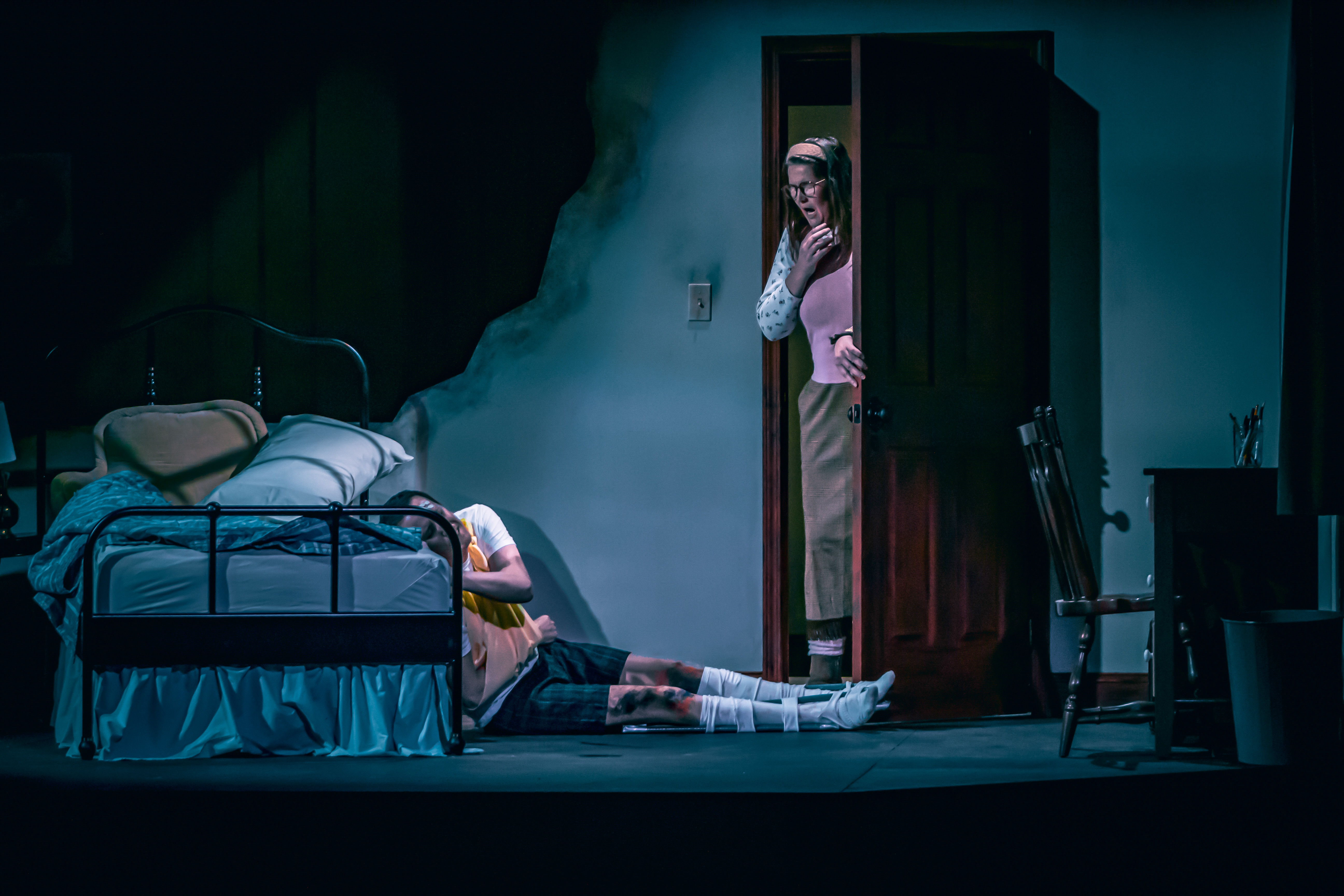
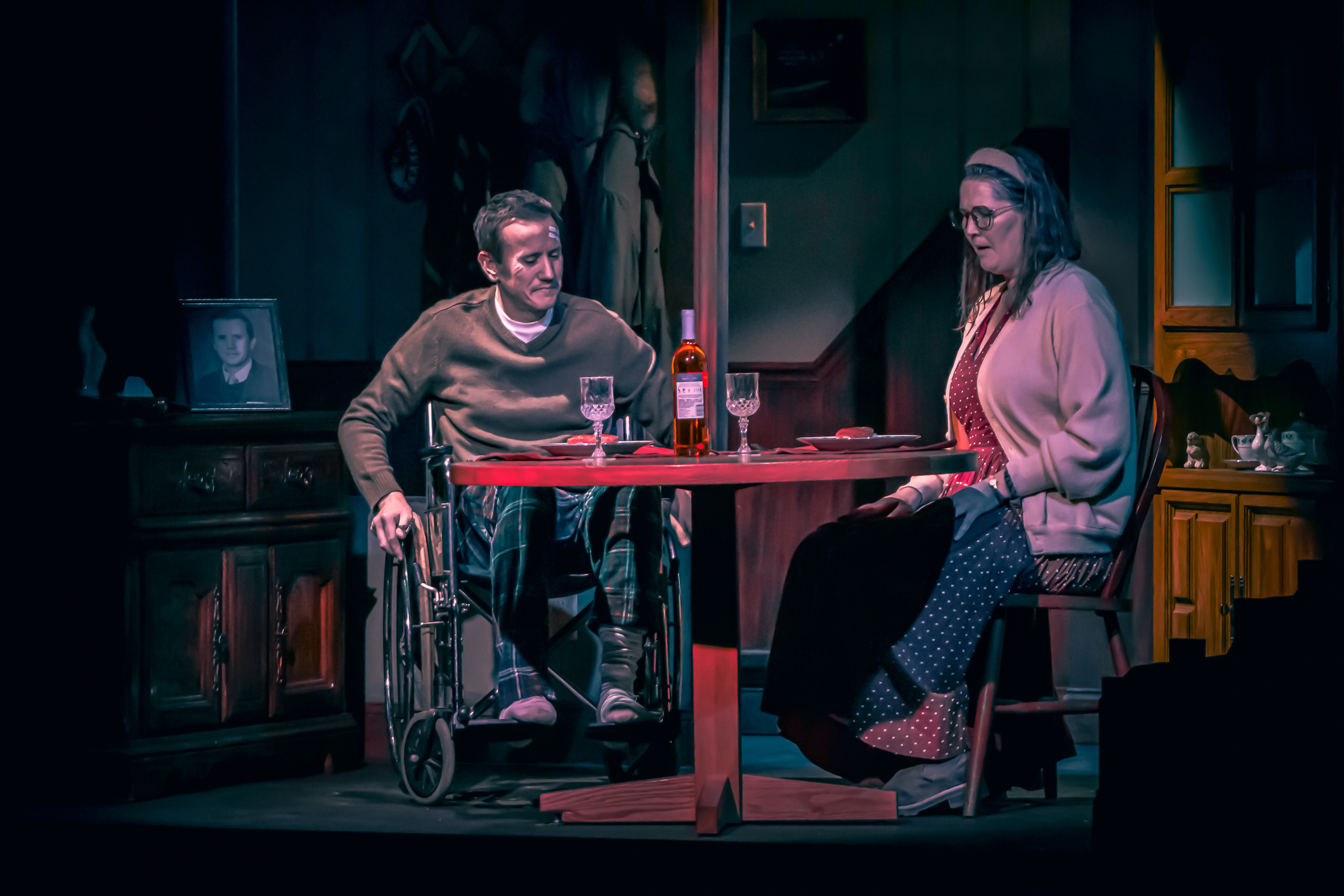
She is a nurse by trade, we quickly see, evidence of IV treatments still lingering in the bedroom Annie has selflessly devoted to Paul’s care. Yet as I observed in my review of the 2002 Off-Tryon production, this Annie is to nursing what Typhoid Annie was to food preparation. Whether she intends from very beginning to keep Paul on the premises as a companion to her pet pig, Misery, may be open to debate, but there are revelations that topple Annie’s already-shaky equilibrium.

Paul has decided that Misery’s Child, the newest installment in his popular Misery series, soon to arrive at bookstores everywhere, will be his last. The new manuscript in his briefcase, just finished at his nearby Colorado retreat, will be a total departure from those where Misery Chastain was his beloved protagonist, the woman who Annie credits for saving her life. Now that she has saved his life, she’s sees herself as entitled to disproportional payback from her captive. Autographing his new book for her will not be nearly enough.

She rips out the phone, fully cutting Paul off from the outside world and further plunging us into a nebulous bygone era. Devout enough to be outraged by the foul language in Paul’s manuscript, Annie can discard morality in the blink of an eye when it comes to granting her idol’s freedom. Anyone who has seen the film will vividly remember that violence is in her toolbag.

2023~Misery-2

Of course, sudden explosions can always blow Paul’s cunningest escape plans to smithereens in seconds, but the finest aspect of King’s plotcraft is the cerebral battle between the imaginative author and his fanatical, adulating nurse. Avidly following his books, scrapbooking multitudes of magazine articles about him, and maybe picking up inside dope about him from nearby locals in and around the Silver Creek Lodge, Annie is a formidable adversary. She controls his food and his medicine – and as Paul’s #1 fan, she compounds her advantage by knowing so much about him.

Paul must first recover health and mobility. Then he must watch and study his keeper closely if he hopes to prevail. Rescue is tantalizingly close each time Buster, the local sheriff, drops by. But Paul isn’t aware of the initial visits as his disappearance continues to be investigated. On your way home after the thrilling climactic scenes – or maybe days later – you may begin to surmise how Paul subtly aided the inquiry.

Not all of Paul’s stratagems work in this chess game, and the retributions Annie wields on her idol can be shocking. Even more shocking onstage, perhaps, because we never get a full peep at Annie’s scrapbook and her backstory. It’s got to be tricky role for Becca Worthington to pull off live, especially since she comes off as a little more rustic than Bates and a tad meeker. The range is broader without the Hollywood coquetry, and Worthington pitches her performance more darkly when Annie veers out of control, in keeping with the gloomy lighting scheme, where sunshine and snowbanks have no place.

Costume designer Sophie Carlick also darkens our portrait of Annie, discarding the crucifix necklaces and the prim nurse-like outfits, such as Julie Andrews might wear strumming a guitar in a meadow, in favor of more rugged clothes she can credibly wear indoors and out: boots, knit socks, and dumpy cardigans. Sadly enough, when Paul asks Annie to celebrate Misery’s rebirth with a romantic dinner, Worthington doesn’t have the time, in a no-intermission production, to elaborately glam herself up for the occasion.

2023~Misery-4

Timothy Hager has fewer rooms to navigate here as Sheldon than James Caan did in the movie, stealing contraband pills and a kitchen knife from the same room where his candlelight dinner scheme goes awry. Nor must he somehow emerge from a cellar – a fourth indoor location! – where he has been dumped because there is none. Yet Hager certainly manipulates his wheelchair with all the apparent difficulty of a newbie recovering from a separated shoulder, giving us the impression of an epic exploit. Without the benefit of closeup shots, he also makes sure that Paul’s fears are visible far beyond his eyes.

Effortlessly, Hager often radiates a shambling clumsiness in his attempts at hoodwinking Annie, a fallibility Caan hardly hinted at, endearing himself to us a bit pitiably in the darkness of this snakepit. Most importantly, Hager has a firm grip on the climactic typewriter scene where he precisely executes some truly nifty fight choreography.

2023~Misery-5

Transitioning to stage, Goldman most radically altered the role is Sheriff Buster, who only visited the Wilkes cottage once in Goldman’s screenplay. Law widens the discrepancies, casting Roman Lawrence as the lawman in an auspicious Charlotte debut. Buster is no less easygoing now, but he is conspicuously younger and less snoopy, no longer visible in scenes at the office with his wife, up in the sky in a helicopter, at the crash scene, at the lodge where Paul finishes his books, in a library researching, or at the general store. Lawrence is the closest thing in this show to sunshine, arriving each time without apparent urgency or suspicion. That sharpens the drama in the denouement.

Production levels have been a bit eye-opening in the first two shows at the Queens Road barn this year, a place we’ve never before compared with Children’s Theatre of Charlotte in terms of technical prowess. With Misery, Hollywood has arrived in Charlotte at the service of thrillers. Prep for King’s famed hobbling scene was impeccable, eliciting audible gasps from the audience, but that was mere prelude. Both blood splatters in the closing scenes were absolutely spectacular, worlds beyond what community theatre delivered in my day when we taped blood capsules to ourselves backstage and hoped for the best.

These more sophisticated spectacles were likely a collaboration between Timmons and all three of the players, possibly Carlick as well, and perhaps triggered by sound cues. Or Bluetooth! The difficulty of the tech was best demonstrated at a key moment when it went wrong – Play-That-Goes-Wrong wrong. A wastebasket began smoking before Hager could toss a kitchen match into it. Presumably unnerved, Hager then tossed a key manuscript page toward the basket instead of slam dunking it to be sure. He missed!

On a movie set, these screw-ups would become a hilarious outtake. But onstage, instead of cracking up, Hager and Worthington covered up. Good thing they did, for the next cluster of fight choreography and SFX followed immediately, the most challenging moment of all. It was perfect.

Shakespeare Is a Thieving Magpie in Theatre Charlotte’s “Something Rotten!”

Renovated Queens Road Barn is ready for its closeup

By Perry Tannenbaum

Something Rotten

 We are all stupid and silly – and we all love smart-ass musicals that tell us so. That’s the deep message of Something Rotten! Theatre Charlotte’s brash, big-ass extravaganza that’s raising the curtain for the grand reopening of the iconic Queens Road barn.

Yeah, it’s been awhile since a musical opened at our venerable community theatre’s home. That was early September 2019, when Oliver! launched what would have been the 2019-20 season. But COVID-19 shut everything down in early March, before auditions or rehearsals could even begin for Dreamgirls, scheduled to open in late spring. Then a latenight fire in the waning hours of 2020 gouged a huge hole in the theater floor, smoked the ceilings, and fried all the precious electronics – lights, audio, AC, computers – and kicked the company out of their house.

For over two years, while more than $1 mil in repairs, renovations, and new equipment requisitions could be authorized and completed, artistic planning continued while navigating insurance adjustments and jumping municipal hurdles. While the new 501 Queens Road gestated and marinated for more than two years, the company hit the road, resuming production in September 2021 and hopscotching the city to keep Theatre Charlotte alive in Charlotte. The Palmer Building, Halton Theater at CP, and the Great Aunt Stella Center were the first three stops on the season-long 2021-22 road trip.

Now there have been five or six shows at the old barn, in play or concert format, since Oliver! closed back in 2019, including two iterations of A Christmas Carol, a Theatre Charlotte gotta-do-it tradition. But nothing short of a musical, one with an authentic exclamation point yelling out its title, can truly show off a theater’s brand-new bells and whistles – or put them to their ultimate test.

Of course, there had to be some extra drama, an extended drumroll, before Something Rotten! could give the renovated Queens Road barn its much-anticipated relaunch. Scheduled for its closeup last October, the revamped site wasn’t going to be ready for opening night. The 2022-23 season had to be reshuffled, and the wondrous Shakespearean mashup of a musical was postponed.

A construction project. In Charlotte! Can you believe it wasn’t finished on time??

Billy Ensley, after directing the first little musical away from TC’s home, The Fantasticks, now pilots the first leviathan since the company’s return. Three of his mates from that Palmer Building gem back in 2021 are on board with Ensley for this new voyage, all of them playing major roles and all of them delivering.

I was fairly bowled over by the brash irreverence of Something Rotten! when I first encountered this Karey and Wayne Kirkpatrick concoction on Broadway in 2016. You might wonder if the Kirkpatricks had the zany antics of The Compleate Wks of Wllm Shkspr (Abridged) on their minds when they decided to take aim at the Bard of Avon and musicals.

Certainly the methods of their madness can be traced to the Reduced Shakespeare Company – with genetic material from Forbidden Broadway and The Producers also in the DNA. The Kirkpatricks discard the merely dubious ideas that Shakespeare’s works were written by someone else, or that his awesome greatness was only fully appreciated after he died. They ignore the reality that there’s only faint, sketchy traces of the man over the course the grand Elizabethan Era.

No, all those tropes are toast. The Kirkpatricks, with John O’Farrell collaborating on the book went full-bore misinformation and alternate reality. Months before The Donald descended the Trump Tower escalator.IMG_2969-2

Shakespeare is no longer a dim peripheral figure on the Elizabethan cultural scene. He’s a full-blown superstar, recognized and wildly adored wherever he goes. Mobbed by his rabid fans, he gives outdoor spoken-word concerts to sustain the mass hysteria.

The secret of the Bard’s genius is revealed. Like the Reduced Shakespeares, Forbidden Broadway, and the Kirkpatricks after him – not to mention The Donald – the real Shakespeare was a thieving magpie. Not only did he steal from ancients like Plutarch and Ovid, predecessors like Chaucer and Boccaccio, and contemporaries like Christopher Marlowe, he cribbed from unknown wannabes and the man or woman on the street.

Case in point: after defecting from Nick Bottom’s struggling theatre company, Will takes his former boss’s name with him and dumps it into A Midsummer Night’s Dream. Another case in point: Sniffing out the possibility that Nick is working on something revolutionary for the stage, Shakespeare embeds himself in his former company, where he swipes the complete manuscript of Hamlet from its true author, Nigel Bottom. Because big brother Nick has astutely told him that “to be or not to be” is trash. Not to be.IMG_2417

A hapless mediocrity, Nick is our hero. In his crazed search for the next new thing in theatre, Nick seeks out a soothsayer to look into the future, a rather Shakespearean ploy. The eccentric soothsayer that Nick picks, Nostradamus, turns out to be a genuine visionary, but his inner crystal ball seems to be afflicted with astigmatism. Skipping over the breakthrough artform of opera on the near horizon, soon to be birthed in Italy, Nostradamus is himself amazed to see… a musical!

So powerful is this concept that Nostradamus cannot even say the word without a vatic, conjuring sweep of his right arm. He wants Nick – and us – to see it clearly, too. Nick, poor thing, doesn’t have as juicy a role as the raving Nostradamus, who must convince his skeptical client that such an impossibility can be created, believed, and become universally popular. He’ll be able to bring my play to a complete stop and have my speaking characters suddenly start singing? And he’ll be able to interrupt this blatant interruption with a whole crowd of people dancing? Tap dancing?IMG_2703

Yes, yes, and yes, Nostradamus prophesies, and audiences will lap it up. We do see, for we were living proof of this seeming insanity at the Queens Road barn, just like I was at the St. James Theatre in 2015.

Over and over, the Kirkpatricks reinforce the idea that the road from brilliant concept to acclaimed masterwork is strewn with pitfalls. Nick begins with a colossal misstep, an upbeat number called “The Black Death,” which strives to match Mel Brooks’ “Springtime for Hitler” in utter tastelessness.

So Nick hurries back to his soothsayer. What will Shakespeare’s greatest triumph be, he asks, determined to beat the Bard to the punch. Pushing away invisible cobwebs between him and the future, Nostradamus proclaims, Omelet, the Musical is the future, confident he’s setting Nick on the right track.

With creditors and prudish censors dogging his way, Nick has ample complications to overcome. The backbreaker is Nigel’s resistance. Instead of sticking to the yolks and the big egg picture, Nigel is spouting useless lines like “To thine own self be true.”

Another Shakespearean device comes into play with little brother, the double plotline. While tasked with writing the world’s first libretto, Nigel is smitten by Portia, the lovely daughter of Brother Jeremiah, the most sanctimonious and censorious Puritan in London. Avid admirers of Shakespeare, both Portia and Nigel can see the parallel between their star-crossed plight and the tragedy of Romeo and Juliet, their idol’s newest hit.IMG_3812

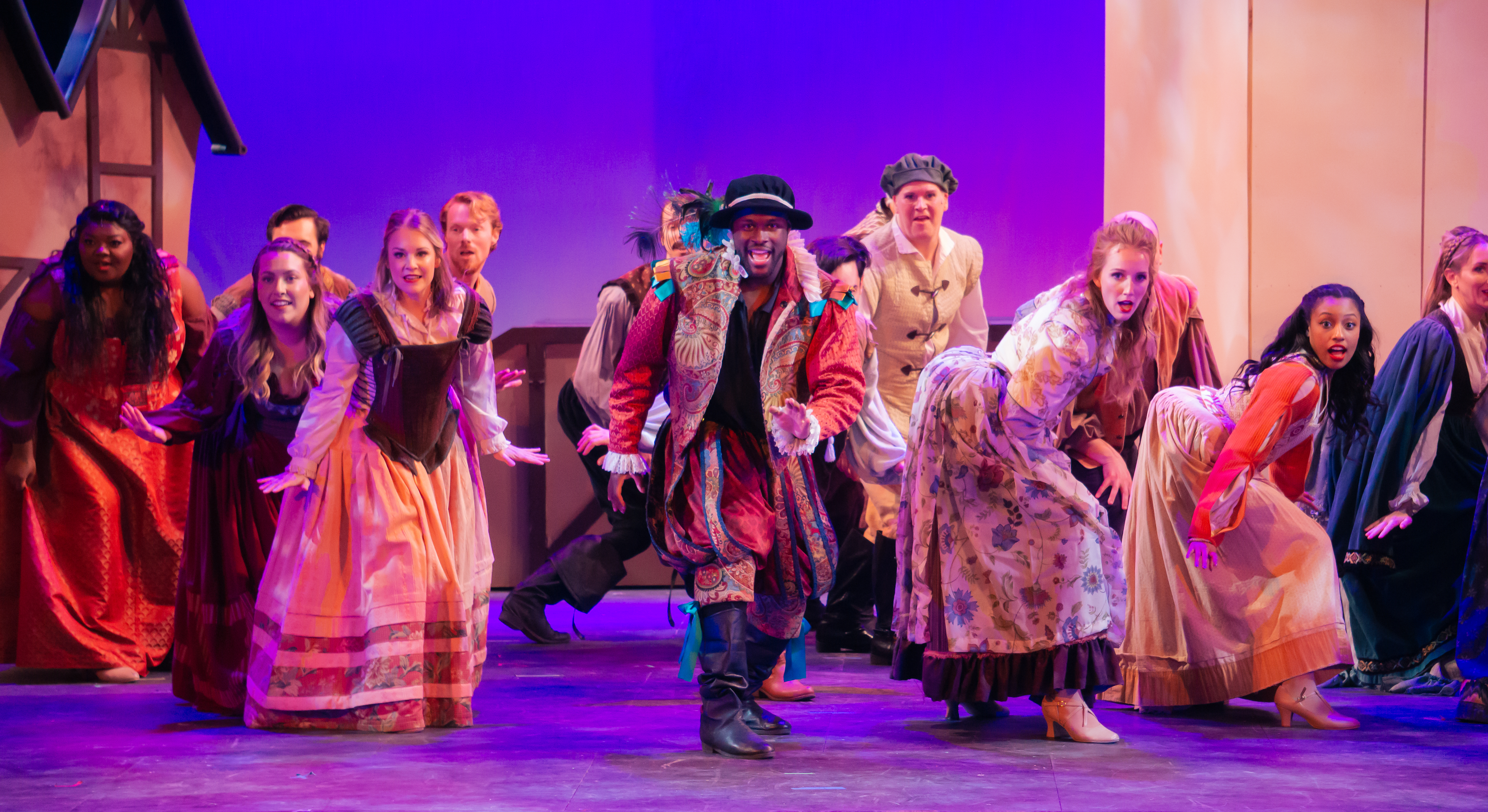
Ensley’s eager, able, well-drilled cast of 25 can seem like a teeming city in the confines of a barn, heartily welcoming us to two Renaissances, really, with Nehemiah Lawson as the Minstrel leading the ensemble’s bustling greeting – to the refurbished theater and olden days – when the curtain rises. They can form a credible mob around Will when he struts upon his stage.

Along with such teeming scenes, Ensley and choreographer Lisa Blanton and headshot sketch artist Dennis Delamar can pour in numerous references to familiar, beloved musicals we all know. Explicit references to Phantom, Les Miz, Cats, Sound of Music, and Chess are in the Kirkpatrick-O’Farrell script, but what about the sly nods to Annie, A Chorus Line, The Producers, and West Side Story?

There are more Broadway allusions than I’ve mentioned and still more that I may have missed. Ensley keeps the pace brisk.

Twice cast as Jesus at Theatre Charlotte in past seasons; along with leads in Rent, Memphis, and Arsenic and Old Lace; Joe McCourt steers us through Nick’s sea of troubles. Folks out in Matthews would remember McCourt’s exploits in Bonnie and Clyde more vividly, his first team-up with Ensley. The Arsenic and Old Lace agitation as Mortimer, when McCourt strayed from musicals into comedy, served as a nice precedent for his work here. When he leans away from straight-man chores opposite Will and Nostradamus, and into Nick’s showpieces, McCourt flashes his confident charisma – with comical seasoning – when he fumes “God, I Hate Shakespeare.”

McCourt is no less in command when he brings down the curtain for intermission with “Bottom’s Gonna Be on Top,” though his best soufflé may rise when he greets his troupe for the first Omelet rehearsal, absurdly exclaiming “It’s Eggs!” Yet this wannabe turn is decisively upstaged by the conceited rockstar and the wild-eyed prophet.

Perfectly cast at the Palmer in The Fantasticks, Mitchell Dudas and Kevin Roberge are even more smashing now. Dudas was a wonderfully swashbuckling El Gallo, the beguiling Fantasticks narrator, but he’s far slicker and more self-absorbed here, shining in his wicked showpieces, “Will Power” and “Hard to Be the Bard.” And the sheer arrogance of him when Dudas flashes his Shakespearean smile! You expect little LEDs to twinkle at the edges of his teeth.

Since “The Black Death” is an ensemble slaying, it’s Roberge who gets the killer solo of the night, “A Musical,” indoctrinating McCourt so thoroughly that the conjuring sweeps of Nick’s arm become nearly as prophetic. After his portrait of the more blustery Fantasticks dad, Roberge turns up his leonine energy more than a few notches. And the hair! Far more eccentric than the Einstein in Verizon ads. Think Charlton Heston on top of Sinai in The Ten Commandments.

Matt Howie, the naïf swain from Ensley’s Fantasticks, and Cornelia Barnwell mesh beautifully as the confidence-challenged Nigel and the overprotected Portia. But they’re overshadowed by a slew of quirkier characters who don’t sing nearly as much. Who comes first? Maybe Lindsey Schroeder as Bea, Nick’s proto-feminist wife, who fills out the contours of Shakespeare’s Portia in a memorable courtroom scene.

Certainly Hank West vies for the honor of favorite minor character as the shifty and resourceful Shylock, who remains a moneylender in Shakespeare’s world but transforms into the first theatre producer in Nick’s troupe and the New World. Delamar, our sketch artist and longtime Theatre Charlotte idol, gets props here for portraying a pair of pomposities: Lord Clapham, Nick’s skittish financial backer, and the Judge who must sentence Nick for his trumped-up crimes.

If there’s space for a feminist, a theatre producer, and a rockstar in this Renaissance makeover, there’s also room for a gay preacher and an outré transvestite. J. Michael Beech’s homosexuality as Brother Jeremiah is hardly latent at all as he strives to keep himself closeted with indifferent success, and we can presume that Paul Reeves Leopard as Robin gets the pick of the women’s roles in the Bottoms’ troupe, perennially dressed and simpering for the part.

Brave New World!

If the players I’ve named thus far decided to form a professional theatre company, I’d only be mildly surprised by their audacity. The new Old Barn made them all look good, first with the opulence of Chelsea Retalic’s period costumes – and the stark anachronism of Shakespeare’s glitter. Chris Timmons’ set designs didn’t look like he was working on a shoestring budget, either, indoors or out.

Better yet, the renovated 501 Queens Road facility has remained true to itself, in its lobby and its theater space. In the lobby, there are new, more modern-looking ceiling fans, which sit admirably flush to the upgraded ceiling. There were still extensive lines to the restrooms, so my inspections of the toilet – and the new backstage – must await visits to come.

In the theatre hall, the skeleton of the new scaffolding isn’t fleshed out at all with sheetrock, so the roofbeams are visible all the way to the bricks that meet it at the proscenium wall. More like a beloved old barn than ever! Artistic director Timmons, wearing his second hat as acting executive director, told me that the renovations made it possible to raise the stage proscenium. Yet there was a shower of confetti to climax the finale, where the “Welcome to the Renaissance” melody completes its last rebirth as “Welcome to America.”

Can’t remember the last time, if ever, that I had seen evidence of a functional fly loft at the Queen Road barn.

Best of all, there was a profusion of theatre lights shining in many colors, along with strategically spaced audio speakers. All are discreetly black, of course, so I couldn’t resist taking flash photos to confirm that all this equipment is spanking new. Everything worked flawlessly, including Theatre Charlotte’s soundboard. Nor did I notice any coughing or humming from the heating system. All was bliss, best feet forward, with nothing rotten except the show’s title.

Don’t be shocked to find that Something Rotten! is sold out for the rest of its current run. The show, the production, and the newborn theater are all that good. Timmons & Co. may need to add performances to meet the well-deserved demand.

The Road Gets Bumpy, but Theatre Charlotte’s “Christmas Carol” Prevails at CP

Review: A Christmas Carol at Halton Theater

 By Perry Tannenbaum

IMG_9668

Almost a year ago, fire struck the Theatre Charlotte building on Queens Road, gouging a sizable trench in its auditorium and destroying its electrical equipment. Repairs and renovations will hopefully be completed in time for the launch of the company’s 95th season next fall, but meanwhile, actors, directors, designers, and technicians are soldiering on at various venues for 2021-22, their year of exile cheerfully branded as “The Road Trip Season Tour.” Ironically enough, Theatre Charlotte’s Season 94 began in September with a downsized musical, The Fantasticks, at the Palmer Building, a facility that once served as a training ground for firefighters. For their 14th production of A Christmas Carol, Theatre Charlotte has moved along to Halton Theater, the permanent home of Central Piedmont Theatre.

Timing is a bit awkward on the campus of Central Piedmont Community College, where a new theater that will be friendlier to dramatic productions – replacing the demolished Pease Auditorium – is slated to open in April with The Diary of Anne Frank. Graced with a generous orchestra pit, the Halton is more hospitable to big splashy musicals (when its sound system responds favorably to our crossed fingers). In fact, this transplanted production of A Christmas Carol, in Julius Arthur Leonard’s adaptation of Charles Dickens’ iconic novella, reminds us how well-suited the old “Queens Road barn” was for such spooky and creepy fare. Not only were the ghosts of Christmases Past, Present, and Future at home there, but so were such confections as Arsenic and Old Lace, Assassins, Blithe Spirit, and To Kill a Mockingbird. The Halton occasionally seemed oversized when You Can’t Take It With You took up residence there at the beginning of Central Piedmont’s current season, and you can imagine how their spectacular 2015 Phantom of the Opera emphasized the grandness of Andy Lloyd Webber’s grand guignol.

Encountering the vastness of the Halton in transplanting Theatre Charlotte’s cozy Christmas Carol, director Jill Bloede has been characteristically resourceful in executing its many daunting scene changes. At times, we could see cast members whisking set pieces off to the wings in a smooth out-with-the-old, in-with-the-new routine. But there were occasions when changes of scenery necessitated a complete closing and reopening of the stage curtains. Veiling the tediousness of that maneuver, Bloede has summoned repeated parades of a small band of merry carolers, coached by Jim Eddings, to cross the stage while the curtains are closed – so you would probably be right in thinking there are more carols sung this year than in Christmases past on Queens Road. My welcome for the carolers on opening night veered toward the unredeemed Ebenezer Scrooge’s grumpy attitude as the evening progressed, yet opening night is destined to be enshrined in Theatre Charlotte lore as the night of the infamous doorknocker scene fiasco.

One of the first indications that Scrooge’s house will be haunted, after a ghostly “Ebenezer Scrooge!” exclamation blows in on the Halton’s sound system, is the brief scene at the threshold to Ebenezer’s home. Here is where Scrooge sees a fleeting glimpse of his deceased partner, Jacob Marley, bringing his doorknocker to life. The precision needed to carry off such a simple scene only became apparent when it went awry. Either the Halton curtains were tardy in arriving at their centerstage spots, where they would fully frame Scrooge’s front door, or the actor who was to lurk unseen behind that door arrived early – and was very clearly seen, garishly aglow. Portraying Scrooge, Hank West seemed sufficiently poised to extemporize while the stage curtains and the lurking Marley came into proper alignment. But the carolers took their cue and entered before West could properly proceed, and the panicked actor behind the door fled. West finished out the brief scene as well he could without any eerie lights beaming through the doorknocker, but the special effect was lost – the only real reason for that scene.

Legions of Theatre Charlotte veterans – and new initiates in years to come – will no doubt keep the memory of this snafu alive for generations, heartily laughing all the more at the incident because it didn’t typify the production. Scenic design by Chris Timmons and lighting by Gordon Olson didn’t expand quite enough to comfortably acclimate at the Halton, nor did the company splurge on smoke or fog effects during its financial woes, which might have deepened the spell of the spookier Marley and graveyard scenes. Don’t expect any snow to flutter down on the vast Halton acreage, either. With balmy temperatures likely to prevail throughout the opening weekend, it’s Beth Killion’s set of period costumes that most successfully instill a chill into the air.IMG_8525

We’ve seen some of this cast before, notably West as Scrooge, Chip Bradley as Christmas Present, and Mary Lynn Bain doubling as Fred’s wife Elizabeth in the present and Belle, Scrooge’s old flame, in the flashbacks. All of these enlarge on their past performances to some extent, maybe West most of all. His meanness is more startling in person than it was in last year’s video version, streamed online, and his sorrow and penitence are also magnified. The graceful arc of Scrooge’s redemption is only slightly bumpier this year with West’s adjustments to the new space, Bloede’s script edits for this intermission-free edition, and a body mic. Projected into a larger hall, Scrooge’s newly minted intentions needed to sound more like settled resolves and less like agonized pleas. Bradley enlarges to a similar degree upon Present’s outsized cheer, the more the merrier in his case – until he issues his climactic admonitions, now sharper in their contrast. Bain seems most content to let her mic do her amplification, but she is stronger this year in the climactic flashback scene when she returns Ebenezer’s engagement ring.IMG_8694_dcoston

All the newcomers to TC’s Carol are quite fine, a testament to Bloede’s ability to attract talent when she holds auditions. In contrast with the veiled youthful mystery of Anna McCarty last year, Suzanne Newsom brought a nostalgic melancholy to the Ghost of Christmas Past that was quite affecting in its serenity, while Mike Corrigan appeared for the first time as Bob Cratchit – very different with his more muted brand of meekness from Andrea King last year but no less kindly or comical. For richer or poorer, Josh Logsdon and Rebecca Kirby were a fine pairing for the Fezziwigs, Aedan Coughlin doubled well as Young Ebenezer and Ghost of Christmas Future, and Riley Smith brought all the optimism needed for the sanctity of Tiny Tim. With Mitzi Corrigan and Emma Corrigan on board as Mrs. Cratchit and daughter Belinda, there’s plenty of family authenticity around the humble Cratchit hearth – or there will be when Mitzi returns from personal leave due to a death in her real family. Vanessa Davis spelled ably for Corrigan as Mrs. Cratchit at the premiere performance, augmenting her regular role as Mrs. Dilbur.

Assuming that Thom Tonetti was already in character as Jacob Marley during the notorious doorknocker scene, I’ll say his opening night adventures most typified the Theatre Charlotte crew’s tribulations in acclimating to a new space. Marley’s entrance into Scrooge’s home wasn’t dramatized with smoke and lights, and Tonetti didn’t enjoy the benefit of having his prophecies and imprecations magnified with thunderous jolts from the soundboard. During the flashbacks, the actor certainly earned some sort of sportsmanship award, appearing as the younger Jacob opposite the truly younger Coughlin.IMG_8645_dcoston

Steadying this production and assuring that its professional polish never deteriorated into community theatre chaos for long, West ultimately triumphed over all missteps and obstacles, bringing us the compelling Scrooge we expect in all his goodness. It’s still a strong story, and 24 of its most ardent Theatre Charlotte believers are moonlighting at Central Piedmont, giving this 87-minute production the old college try. A drama within a drama, to be sure, both ending happily.

Originally published on 12/18 at CVNC.org