Tag Archives: Anne Lambert

Laugh Your Butt Off at “Meet & Greet”

Review: Meet and Greet at The VAPA Center

By Perry Tannenbaum

Auditions are a kind of interview, and interviews are a kind of audition. You enter, drop a résumé on somebody’s desk, and minutes or hours later, you exit elated or deflated. Instant drama. Singularly human. A paradigm of life.

At the VAPA Center, auditions and interviews are the entire evening for three weekends in Meet & Greet, a themed set of three one-act comedies produced by Charlotte’s Off-Broadway in the COB Black Box. Yeah, from the outside looking in on aspirants and applicants who have stressed for weeks preparing, strategizing, dressing, and grooming for the big moment or trial by ordeal, the denouement can be quite entertaining.

We can laugh our heads off at these overinvested humans and empathize at the same time. Imagining we were them or grateful that we are not.

Of course, there are perils for playwrights working within these familiar templates. Skirting predictability is the keenest, particularly if your audience has been exposed to sketch comedy over and over.

You can rest assured that each of the playwrights featured at VAPA contrives to make the familiar ritual different from what we expect, concealing at least one twist and surprise. Neither Susan Lambert Hatem’s Hamilton Audition nor Don Zolidis’s The Job Interview far exceeds the length of a typical TV sketch, so opinions will likely vary on whether they transcend the streaming standard.

Both of them have yummy roles for multiple players, so transcendence becomes less of a factor if you’re seeking comedy simply for escape in these dark days. The incontestable headliner of the evening is the finale, Meet & Greet by Stan Zimmerman and Christian McLaughlin – in terms of length, number of histrionic roles, and prestige. Zimmerman’s fame rests chiefly upon his extensive writing credits, most notably the beloved Gilmore Girls and The Golden Girls.

Meet & Greet clocks in at more than twice the length of most sitcom episodes. Between laughs or afterwards, you may catch yourself pondering why.
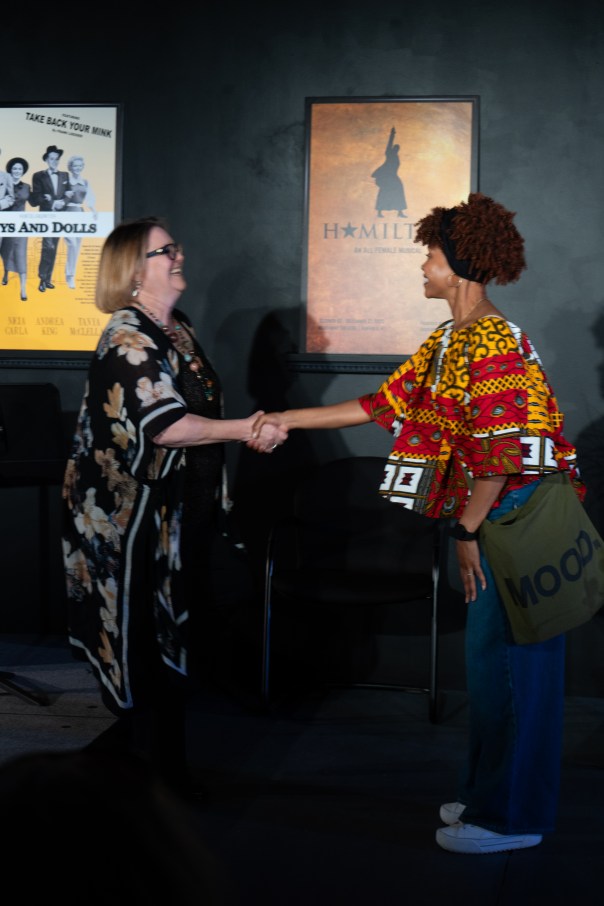
COB’s producing artistic director – and VAPA Center co-founder – Anne Lambert has her energetic hands all over this one-act hodgepodge, starring as The Director in her sister’s Hamilton Audition and (what else?) stage directing all that follows.

There may be an inside joke here. Do you really audition for the role of The Director in the play you have programmed by your sister at your own theatre? Do you think director Anna Montgomerie invited Lambert to play the role, or was the inviting done in the opposite… direction? Wouldn’t Lambert, not the shyest person on the Charlotte theatre scene, have leveraged some of her status – and experience – in determining how her character should be written and played?

We’ll never know, unless the saga of putting Hamilton Audition on its feet spawns another script. In the present instance, Lambert has invited the most prodigious voice in town to audition for the lead role in an all-female production of Hamilton, and the diva who has graciously consented is apparently the only person on the planet who has never heard of Lin-Manuel Miranda’s megahit.

More likely, people who come to see Hamilton Audition will not realize that Lambert was a co-founder of Chickspeare, which pioneered all-female productions of Shakespeare in the QC. It is not at all far-fetched to say that Lambert inspired the role she is playing as well as the play her sister has written. Posters on the rear wall touting fictional Chickspeare productions practically shout this in-joke out loud.

From appearances, you might conclude that Lambert is more out of her element directing a hip-hop musical than Nasha Shandri as Shondra Graves is auditioning for the role of Aaron Burr. Just you wait. Although she looks perfect for her dashing Founding Father role, Shondra gives a more atrocious hip-hop reading than you would dare to expect from The Director.

Comedy gold.

Amazingly, Shandri is supposed to be no less ignorant about rap than she is of Hamilton! Suddenly, the whole idea of a pioneering all-female version seems like a certain disaster… with fallout for females and minorities. It’s at this point that Graves and The Director probe the sexism that already lurks in the original gendered Hamilton. So yes, Hatem has put some meat on her hambone dialogue.

Whether or not Zolidis replicates that feat in The Job Interview is more open to question. The bio in the digital program, summoned by your QR code reader, states that Zolidis is one of the most prolific and produced playwrights in the world. Maybe the thuddingly generic blandness of this title explains why Zolidis was so previously unknown to me nonetheless.

Fortunately, his Job Interview playscript proves to be livelier and more imaginative. The basic premise, we will soon find, ensures that the sparks will fly. Both of the applicants waiting to be called into T.J.’s office, Chloe Shade as Marigold and Marla Brown as Emily, will be interviewed at the same time, adding the elements of confrontation and fierce female competition to the drama. For Emily, it’s already life-or-death.

If you’ve inferred that T.J. is eccentric and perhaps sadistic, you’re on the right track. Rahman Williams as T.J. doesn’t ask his applicants a scripted set of questions – or even the same questions. Deepening his aggression and moving us abruptly from interview to audition, he challenges Marigold and Emily to show him how they would handle specific on-the-job situations.

Not only might we say that the difficulty of the questions and roleplay challenges seems to be tipping the scales of fairness way off kilter, but we can also discern radical differences in the temperaments and preparedness of the two candidates. It would be impossible to find an aspect of Emily’s performance where she outscores her rival… aside from how desperately she needs this.

Now anybody interviewing for a job knows that he or she is already facing steep odds, but knowing that you’re outclassed during the interview is a special torture, one that permits Brown to go totally nuclear as Emily. On the other hand, Shade can play with the absurd and ballooning insult that Marigold, in all her perfection, is obliged to keep competing with this loser – and that the outcome still lies in the hands of this outrageous interviewer.

Rahman, in the meantime, gets to play with the disconnect between T.J.’s spit-and-polish military background and his high-level position at Build-a-Bear Toys. Three tasty roles, all well-done. During the run, Nicole Cunningham shares Shade’s chores.

Contrary to what you may be thinking while it plays out, Zimmerman & McLaughlin have aptly named their Meet & Greet. Take it in the same way that the four auditioning actresses do and ride the rollercoaster. To make it all tastier, two of the four have a history together, co-starring long ago during better days on a hit sitcom, Lane Morris as the embittered psycho Belinda and Stephanie DiPaolo as the bimbo Teri.

For my generation, I was thinking Joyce DeWitt and Suzanne Sommers from Three’s Company, but you might hear different echoes. Teri is the airhead who tends to spoil everything, or she is deeply misunderstood and cruelly typecast. Bubbling and pouting seem to be her main forms of expression. Also in the room before Teri’s majestic entrance is Marsha Perry as Desiree White, with some sort of acting experience as the star of the “Real Housekeepers of Palm Beach” reality show.

Contrasting nicely with Desiree and her leopard-skin bodysuit is Joanna Gerdy as the splendiferously monochromatic Margo Jane Mardsden, who has fallen from her regal perch as living Broadway legend due to a combo of drink and disgrace. Being among this gaggle, especially the déclassé Desiree, is already a devastating humiliation.

Yet as we can hear as they emerge from their auditions, both Desiree and Margo are spectacularly successful in their auditions for the role of Andrea, the leading lady of an upcoming series pilot. Leopard Skin draws uproarious laughter from the sanctum within before Diva Nun draws a thunderous ovation. Which one do the showrunners, producers, and writers inside actually prefer?

Every word that Tommy Prudenti utters as the Casting Assistant is a tantalizing clue to what the show and Angela will be, and there is a girlish coyness about him… and a deceptive servility. All through this epic catfight showdown, Zimmerman’s Golden Girls pedigree is on display in a blizzard of quips, taunts, and one-liners. We shall only divulge the maestro’s recipe for “sidewalk pizza” here: you jump out the window of a tall city building.

“The Humans” Is More Haunting Than Ever

Review: The Humans @ Armour Street Theatre

By Perry Tannenbaum

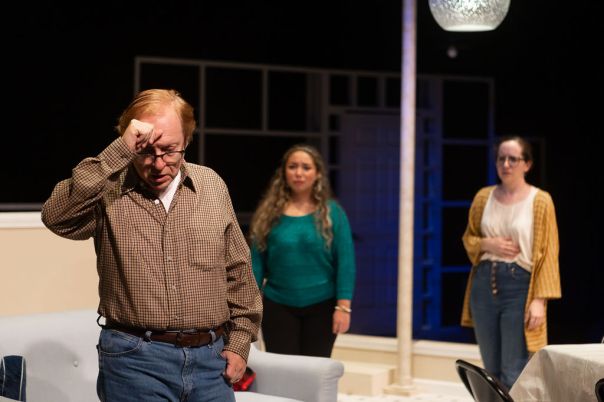
Thanksgiving in Chinatown, in the shadow of the fallen Twin Towers – Stephen Karam’s spooky, mystifying, and hilarious The Humans hands us a world teeming with paradox. For an afternoon in a creaky old two-story apartment, newly rented by Brigid Blake and her boyfriend Richard Saad, her family gathers to celebrate, the whole lot of them nursing open wounds – and their Alzheimer’s-stricken elder, “Momo” – trying to heal from recent setbacks.

First staged in the QC at Knight Theater in a 2018 touring production starring Richard Thomas as family patriarch Erik Blake, Davidson Community Players brings us a downsized reprise in the first locally-produced staging, with the venerable Hank West in the lead.

Haunted by his return to the vicinity of Ground Zero and by his recent misdeeds, tormented by a deadly mix of sleeplessness and nightmares, Erik vies with elder daughter Aimee for which of the Blakes is suffering the most. Since last Thanksgiving, Aimee has come down with ulcerative colitis and taken major hits to her love life and her career as a Philadelphia lawyer – with major surgery looming on the horizon.

Yet Erik fires a wicked one-liner at Brigid, whose gripe, like his wife Deirdre’s, barely hovers above the “suck it up” level compared with his own. “If you’re so miserable,” he asks the health food fanatic, “why are you trying to live forever?” Inside negativity, Karam can be equally trenchant and funny when Aimee philosophizes about her recent breakup: “Maybe loving someone long-term is more about deciding whether to go through life unhappy alone or unhappy with someone else.”

Only Deirdre and Erik have an agenda for the afternoon, subtly suggested in a couple of brief dialogues. We’re mostly watching Karam’s keen observations of family interactions – their bonds, their tensions, their little quirks, and their tectonic divides. These appear all the more chaotic because dialogue often overlaps and action is happening simultaneously upstairs and in the more commodious basement.

Knight Theater probably gave us an oversized impression of Brigid and Richard’s love nest, while DCP’s Armour Street can’t help look both height- and space-challenged. Remarkably, Evan Kinsley’s more cramped set design lessens the struggle of viewing multiple tracks of action and family intrigue. Yet Karam and director Glynnis O’Donoghue are still able to provide enough compelling distraction at a key moment to allow the aged Momo to disappear without our noticing.

Even without two-story height, Kinsley’s set has an alleyway leading to an elevator shaft to accommodate the wheelchair-bound Momo’s transit between the two floors. The slice of set that serves as the upstairs somehow has enough space for the front door, an entrance to a bathroom (Aimee’s frequent retreat), and the only window looking out on the city. When the apartment’s oddities need to impact, Kinsley’s set and Sarah Provencal’s sound design deliver.

The divides between the Blakes will be familiar to anyone who has grown up in a family of siblings. Although Brigid would never consider living in Philly, the geographical divide is as important here as the generational difference, for neither of the daughters would ever think of moving back to Scranton, PA – except to a summer home that Erik tells us can move towards construction once there’s a sewer system near their pristine plot.

Those anticipated PA pilgrimages will not bring either of the sibs back into the bosom of the holy church. Nor will it erase the fact that these country folks’ children are irremediably citified, one a lawyer and the other an aspiring composer. Safety, religious, and lifestyle concerns plague the homespun parents. Ahead of their Thanksgiving visit, Deirdre has sent a care package that includes a statue of the Virgin to protect Brigid’s new home. Meanwhile, Aimee can expect an email any time a lesbian commits suicide.

Karam provides plenty for the Blakes to discuss in their near and distant back histories, with a handful of stunning updates. If things get dull, he serves up a choice collection of singularly awkward moments that would instantly embed themselves in family lore ever after, lovingly and mockingly retold at holiday dinners and special celebrations.

There’s even a “pig smash” ritual unique to Blake Thanksgivings, a nice spotlight for Richard. Often the aspiring social worker serves as our ears in his role as outsider, giving the Blakes the chance to explain all that is long-known among themselves.

These moments reverberate warmly within us, but the most haunting vibes, from Erik’s dreams and experiences, touch us all, nonchalantly invoking 9/11 and Superstorm Sandy – specters of terrorism and climate change. Over and over, whether Deirdre wheels Momo around or Aimee summons an Uber with her cell, we hear an eerie, insistent whisper from the playwright emanating from his vivid, painstakingly detailed dream: this is how we live.

On Davidson’s compacted stage at Armour Street, the natural flow of The Humans, the lack of powerhouse confrontations that shake us to the core when we witness such American classics as August: Osage County, Who’s Afraid of Virginia Woolf? or The Little Foxes, reminds us of Chekhov’s more placid classics. Rich and funny and touching as all the action is, we will likely struggle to discern a solid plot until Erik’s big reveal.

Inexperienced theatergoers are therefore advised to ignore any FOMO anxieties they may be experiencing and surrender themselves to the many delights, laughs, shocks, and epiphanies that West and his castmates deliver.

On the page, Karam’s script doesn’t pop out at you with the color and verve that O’Donoghue gets from this ensemble. West actually comes onstage with a couple of key advantages over Richard Thomas. We more readily accept West as an ordinary janitor-turned-equipment-manager, and he can bring out a curmudgeonly edge to Erik that I’d never noticed before.

No less surprising is the bubbly, goofball likability that Breanna Suarez brings to Brigid, though she is often the family contrarian and party-pooper in the script. The vibrant energy she exudes somehow turns pure negativity into simple immaturity, emphasizing Brigid’s spoiled qualities. As our genial hostess, Suarez tunes in on Brigid’s side hustle as a bartender, so she’s the life of the party while subtly fueling the true plot, endearingly committing a faux pas for the ages along the way.

Portraying West’s wife for the first time since 2005, when they both earned best actor honors in Coyote Ugly, Anne Lambert makes the wait worthwhile. Although Citizen Trump famously descended his escalator in June 2015, between the time that The Humans opened Off-Broadway and when it reappeared on Broadway with a completely new cast and director, Deirdre likely struck the late-2015 Broadway crowd as a MAGA maniac.

Interestingly, Karam could have taken Hillary Clinton as his model if he had written his tragicomedy 20 years earlier, but Lambert still strikes me as a MAGA nutjob even if that couldn’t have been the playwright’s intent. The religious zeal, the paranoia, and the constant moralizing are almost non-stop, so thanks to Lambert’s implacable disapproval, Deirdre winds up ennobling Erik and humanizing her daughters – just by enduring her. Yet there is an unmistakable sincerity to this steely, troubled soul.

Deirdre’s relatively spurious sufferings also brighten Aimee’s halo. Her woes are certainly the most tangible, so Alyssa Whitting has the freedom to add some hard edges to her performance, aiming her best zingers at Brigid with an assortment of barbs for the rest of the fam. Ascending and descending DCP’s imaginary staircase for extended poops, Whitting makes a pungent impression when she’s with us. She’s the slick urban professional among the Blakes, getting better reception on her cell than Dad and handling all the key calls.

Preoccupied with the cooking, Ryan Miles as Richard is also frequently on-leave from the family flow, but he’s a fine audience surrogate when we need things explained. Without fuss or bravado, Miles keys into the fact that Richard is the most laid-back, financially secure person in the room – the one lifelong New Yorker – in between Brigid’s age and Erik’s, accentuating his unique perspective.

Momo’s lines are annoyingly repetitive and approximately 85% gibberish to my ear, meticulously transcribed by Karam word-by-nonsensical-word. So if Wandy Fernandez is accurately delivering Momo’s babblings as written without considerable improvisation, she has performed one the most prodigious feats of memory in the history of theatre. There is wonderful variety in her performance with a lovely little miracle in the middle, which of course gratifies Erik and Deirdre the most. Words or not, the woman can also throw a fit.

The cryptic ending of The Humans, where the thin thread of Karam’s plot crystallizes, was clearer to me the second time around. Along the way, it’s helpful to note the circular shape of the Blakes’ history, the dream Erik divulges stage by stage, and the explanation Richard offers. Erik’s worries, sadly enough, are suddenly more topical in the Carolinas than ever before. After Sandy, the fact that Chinatown was a Zone A flood zone was fearfully real. Now that Asheville is isolated, adrift from interstate highways until next year, we can legitimately wonder what zone is not a flood zone after all the climate damage humans have done.

Richard says it succinctly, recalling a comic book he loved as a kid: “horror stories for the monsters are all about humans.”

Private Anguish and Global Triumph Keynote “Everybody’s Got a Story”

Review: Everybody’s Got a Story at VAPA

By Perry Tannenbaum

If you like taking things apart and seeing how they work, there’s an interesting tension at the heart of Everybody’s Got a Story to Tell,the new Charlotte’s Off Broadway production at the VAPA Center. COB producer Anne Lambert describes it more accurately in her subtitle, “The One-Person Play Project.” Then if you apply a QR code reader to your program leaflet, you’ll find that Lambert pulls against the marquee title when she observes that, for some, performing onstage for an audience is a dreaded terror while for others it’s an addictive drug.

Onstage – or on The Moth Radio Hour – baring yourself to the world can be an exhilarating high, especially when you’re showered with laughter and applause. But it turns out that, although we’re certainly watching folk in the addict category, they’re not always telling us their own story. Or blurting it out to us compulsively as might be implied by Everybody’s Got a Story to Tell.

No, when you scan the three titles of the playbill, you’ll hit a roadblock to that confessional concept at the bottom of the page where you discover Eartha Kitt: Cotton to Caviar, written and performed by Toi Reynolds-Johnson. Before that title explodes any notion of a purely soul-baring evening of personal trials, the first play of the evening, Reflection: The Musical might detain you momentarily. Many, many confessions have been crafted into song. But not spontaneously. We know better.

Enriching this impure brew of personal effusions, the names that precede the titles splashed in yellow mustard typeface come into play: director Rob Coppel behind the scenes and PJ Barnes, very much up front as our host. Before we watch Reynolds-Johnson, Spencer Hawkins, and Tyler Wills perform the works they’ve written, Coppel and Barnes conspire to glue the disparate pieces together into a cohesive whole and conjure up the illusion of a natural flow.

Barnes as our emcee actually precedes us into COB’s VAPA nook, welcoming us as we enter and encouraging us to make ourselves at home. So briefly, we are part of the show for those who are already seated. The transition between greeter and emcee is as smooth as possible as the lights dim and Barnes starts strutting the stage in his more prestigious persona, weaving our everybody’s-got-a-story theme. How much of this BS is freshly improvised is hard to discern from whatever Coppel and the writer/performers have fed him in scripted form or as a sort of “head arrangement” as jazz musicians would call it. Whatever, Barnes is one slick and nicely turned-out dude.

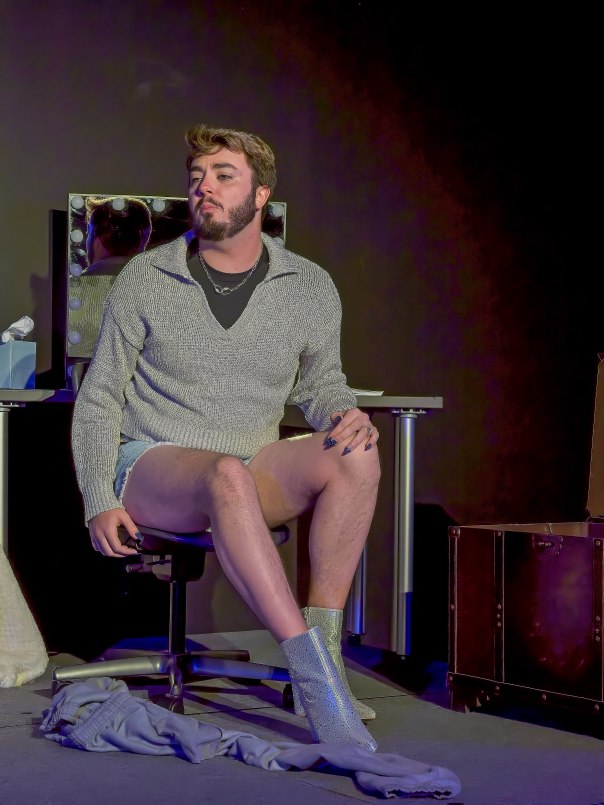
The polished impression that Barnes makes contrasts nicely with the vulnerability Wills projects in Reflection, a glittery gay man who is freshly suffering the gut punch of a breakup and feeling the sting of a rejection that will linger for more than a month. After an opening communion in front of a vanity mirror, it’s very apparent that self-loathing is also prominent among Wills’ ills, for he resolutely removes his cruising gear – rhinestone high-heels, high-cut denim shorts with glitter belt, and matching pullover – in favor of workout wear that might be adopted during the isolation of a pandemic.

Double underlining Wills’ self-flagellation, he covers both his vanity mirror and a full-length mirror in shrouds. The powder room is transformed into a house of mourning, and reflection is now done by journaling. In a series of songs and vignettes, Wills is reliving his story rather than telling it. Dramatic intensity is paradoxically increased by Wills’ refusal to break the fourth wall and speak to us, but the intimacy of our encounter with the playwright/lyricist suffers as our peeping is prolonged.

Nor do the pre-recorded melodies, composed by pianist David Roach, dispel the oppressiveness of the 40-day vigil as Wills continues to pour out his anguish and bewail his betrayal. Three nights before Passover, the 40-day, 12-step slog toward self-acceptance and reaffirmation began to feel to me like the Israelites’ 40-year exodus in the Sinai Desert. I gradually despaired that the next song would sound much different from the one I was hearing.

Wills and Roach need to tighten up their collaboration. Or else they need to liven it up with a greater variety of mood and tempos. We’re convinced that Wills has a fine voice and vocal range while we’re frustrated at not seeing more emotional range. Another way to let more light into Reflection before the inevitable uncovering of the mirrors would be by letting us in, occasionally poking some holes in that fourth wall, breaking up the tedium of self-involvement. Just allow the piece to breathe in the here-and-now with occasional retrospective commentary.

Or maybe Wills and Roach overestimated the amount of suspense they were creating. More, please.

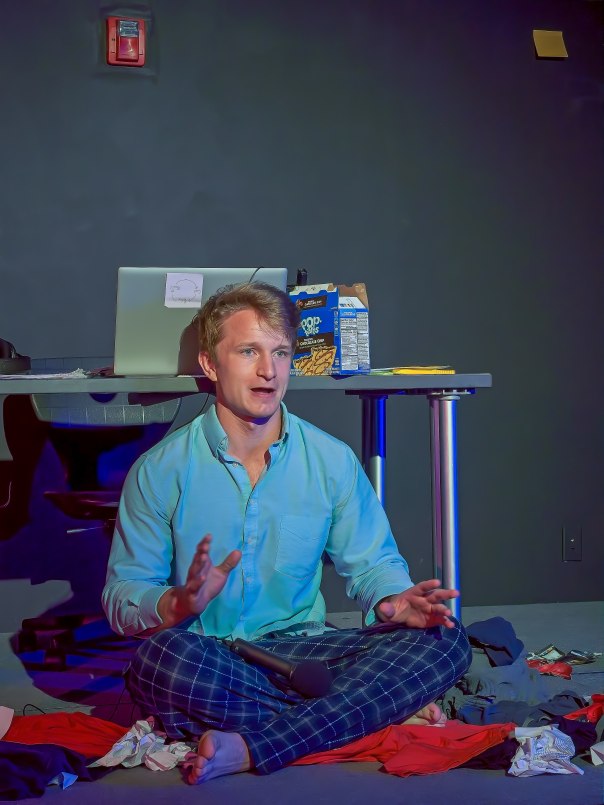
Notwithstanding Wills’ final affirmations, I welcomed back Barnes and his stylish patter with more enthusiasm than I’d anticipated. Hawkins and his You’re Accepted offered even more refreshing contrast, though it was also fueled by a breakup. Instead of grieving and self-quarantining, Hawkins deflected, launching into a series of spurious podcasts behind his laptop as if broadcasting his vocational and romantic woes to the wide world live from Davidson. After the parched drought of Reflections, we experienced a dizzying blizzard of sudden twists and turns, inexplicable leaps, mood swings, and casual reveals.

The more Hawkins revealed, the less authentic and autobiographical this confessional, by a Davidson College admissions officer, seemed to me. Cynical, cruelly dismissive, and burnt-out toward the pile of college admission essays on his desk, Hawkins was rather wickedly at-odds with the confessional mode of writing he was practicing himself.

Hopscotching as it does, Hawkins’ script defies a linear summary, likely because it has less to do with the troubles a college administrator has with women and his job, more to do with that cloistered academic’s difficulties in understanding and managing himself and what he’s doing. The quick pacing nicely supports our narrator’s caprices and indecision. What we wind up with is an artful and funny portrait of a peppy but unreliable narrator who lets down his guard often enough to clearly see both his charms and his flaws.

Of the two complete plays, Hawkins’ non-musical was better, but although Reynolds-Johnson’s Eartha was only presented in vignettes after intermission, it easily laid equal claim to the distinction of best on the bill. And where you had to wonder how autobiographical or authentic You’re Accepted and its admissions essays were, you could instantly perceive Reynolds-Johnson’s inspiration. Just look at her eyes! If she didn’t have the idea to portray Kitt on her own, somebody else surely suggested it. Likely on numerous occasions.

We can perversely suggest that R-J looks more like Eartha Kitt than Eartha herself, for when we see her as a child, born on a South Carolina plantation and rejected by both her parents in the opening Cotton scenes, she already looks like the woman she would become at the Caviar conclusion. And the powerhouse superstar who would one day bewitch Orson Welles, make Lady Bird Johnson weep at the White House with her Vietnam War comments, conquer Europe, and play Catwoman on the hit Batman TV series was never more than 62 inches tall.

R-J, likely no taller than her subject, revels in every phase of the Eartha bio. Even the digital playbill doesn’t say, but she’s probably as responsible for the spot-on costumes and props as she is for the writing – though Eartha wrote three autobiographies, plenty to glean from. Nor is R-J at all uncomfortable in sprinkling her various scenes and costume changes with frank narrative, engaging directly with her audience at times. Allowing the diva even more stature in her Caviar phase, Coppel brings Barnes back for one last hilarious shtick as the cabaret queen’s worshipful lackey. Although Adrienne Williams takes on her most prominent role here at the keyboard, we barely get a taste of the Evil One’s full repertoire in snippets of “C’est Si Bon” and “Santa Baby.” Just a cursory look and listen to the top stuff a Google search led me to was more than enough to convince me that there’s plenty of juicy episodes, from her tête-à-têtes with Welles to her verbatim White House harangue, remaining to be unveiled in the complete Eartha.As they stand, the vignettes at VAPA are very tasty and satisfying, but the complete Cotton to Caviar will be richer and spicier.

Photos by Perry Tannenbaum

“My Dinner With Andrea” Takes Feminism to the Limit

Review: My Dinner With Andrea from Charlotte’s Off-Broadway

By Perry Tannenbaum

My Dinner with Andrea 5298

Thanks largely to Anne Lambert and Charlotte’s Off-Broadway, the Queen City’s fiercest proponent of homegrown professional theatre and her spunky little company, we have now seen two provocative new plays by her sister, Susan Lambert Hatem. Not surprisingly, since Lambert is also a founding member of Chickspeare – “all female, all Shakespeare, all the time” was their catchphrase – both of the Hatem plays we’ve seen have been spiritedly feminist.

Lambert directed Confidence (And the Speech) at Spirit Square in 2018 and now takes on the title role in My Dinner With Andrea. Charlotte’s Off- Broadway has moved off-Tryon to The Arts Factory, the stand-in of choice so far for resident theatre companies at Spirit Square while that facility is reconfigured. In Confidence, we had a former presidential aide who was willing to recount her role in crafting Jimmy Carter’s “Crisis of Confidence speech, but only on the condition that she and her questioner playact the narrative – with her playing the President and the questioner portraying the aide, a role and gender reversal.

Like Confidence, Hatem’s new play is a reaction to the 2016 election. You might presume that an initial reaction would be angry and visceral, leading subsequently to a more reasoned and pragmatic response. This playwright is flipping that order. She’s angrier, more irrational and visceral now than she was three years ago.

Then her heroine was an academic who helped Hatem juxtapose Jimmy Carter’s reasoned, cautious, calculated, and inclusive methods of policy- and decision-making with the infamous 45’s. Furthermore, she showed us how naturally a woman (could the playwright have had Hillary in mind?) would fit into that more intelligent, deliberate, and statesman-like mold.

The anger and impulsiveness of My Dinner With Andrea indicate that there’s more than a little 2020 in Hatem’s fuel tank, firing up her engine. It wouldn’t be too far-fetched to say that Andrea, portrayed by the playwright’s sister, is a female Donald. Or an amalgam of the two 2016 candidates? A devious entrepreneurial maniac who is more ambitious than 45, more pragmatic and intelligent, and less likely to run off the rails and flame out.

After tasting the bitter fruit of whistleblowing, Julia Grace Brandt is a research scientist who can use a job that utilizes her talents without compromising her integrity. She agrees to meet with an old, somewhat estranged friend, Andrea Ranger, who has become a renowned A-lister, on a first-name basis with Serena Williams, multitudes of glitterati, and key influencers. Divorced twice, if I counted correctly, with no kids – and no-thank-you on the subject of motherhood.

My Dinner with Andrea 5254

Andrea’s next great entrepreneurial target, one that Julia is supremely equipped to spearhead, is the development of a wondrous vaccine, distributed globally, that will wipe cancer, heart disease, and Alzheimer’s from the face of the earth. Lurking behind those wonders will be a genetic side-effect of ridding mankind of men – or at least skewing the female-to-male birthrate ratio from 50-50 to a more comfortable 70-30, if not north of that.

“The future is female,” Andrea says, not kidding at all, though the phrase is familiar. As happens occasionally in dystopian sci-fi epics, she wishes to speed the process.

My Dinner with Andrea 5265

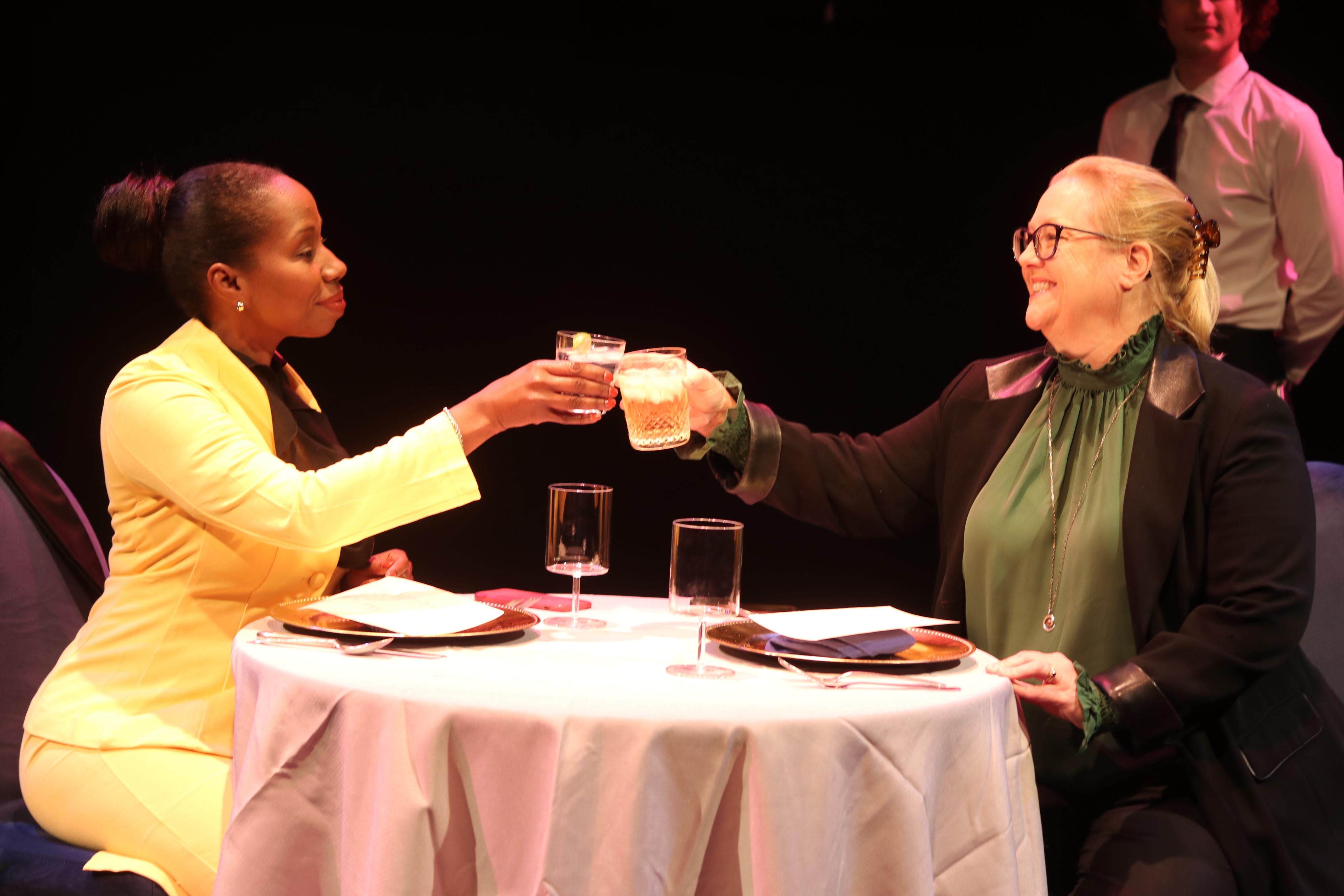
Certainly, there are sufficient urgent crises facing humanity – and more than sufficient patriarchy screwups – to justify Andrea’s design and haste. Likewise, there are reasons why the highly principled Julia will sit there, hear Andrea out, and negotiate rather than simply walking away. For one, the fabulously wealthy Andrea will very likely make a fabulous salary offer to her old friend. More immediately – and temptingly – they are meeting at Miesha, the most chichi restaurant in all of Atlanta, and Andrea is having their waiter, William, bring out every single delicacy on the menu, from the appetizers to the desserts.

The meal of a lifetime for an unemployed lesbian.

So yes, the resemblance between My Dinner With Andrea and the 1981 movie, My Dinner With André (written by and starring André Gregory and Wallace Shawn), isn’t accidental. Hatem’s script is more purposeful, confrontational, and sexual, a pretty explosive combo in a space as small and intimate as The Arts Factory.

Utilizing the ubiquitous cellphone of 2021, Hatem can brief us on the upcoming action by simply having Julia confide in her partner by phone as she waits for Andrea to make a fashionably late entrance. Back in 1981, we needed Shawn’s voiceover, as he walked toward the restaurant, to clue us in.

My Dinner with Andrea 5245

As the posh dinner and job offer unfold, Julia faces a couple of moral dilemmas informed by Hatem’s astute reading of 2020 and the Trump Era. Most obvious is the quandary that many who signed on to 45’s heinous administration ultimately faced. Should I risk soiling my reputation by joining this malignant organization, compartmentalize my work into the good that it might accomplish, and try to curb or sabotage its leader’s megalomaniacal schemes? Or should I distance myself from this creep as far as possible?

If Julia actually takes home Andrea’s prospectus and considers her devil’s bargain, she will probably be gauging her chances of subverting her vaccine development enterprise so that only good comes out of it. Or she may be simply fortifying her powers of self-delusion, finding excuses for allowing herself to be bought off, and placing herself in danger of being outfoxed by Andrea and other members of her brain trust, making her a duped accomplice in their diabolical scheme.

Adding some West Wing gravity to this tête-à-tête, Andrea has Julia ink a non-disclosure agreement before revealing how she plans to change the world. Enhancing the intrigue and giving us a little foreshadowing, William assists in preserving confidentiality by ceremoniously relieving Julia of her cellphone – and her smartwatch. We may think Andrea’s security concerns are frivolous and overblown, but then Julia suddenly comes face-to-face with her second moral dilemma, a climactic #MeToo moment that hatches more confrontation and dispute.

Echoes of that moment reverberated with me during the drive home, for I kept thinking how the incident would sit with Julia on her drive home and when she talked things over with her partner. Does what just happened potentially give her extra leverage down the road if she accepts Andrea’s job offer?

Tracie Frank plays Julia with such elegant cool that I could easily imagine her factoring this possible leverage into her ultimate calculus, for if the world isn’t in such dire straits that Andrea’s remedies are truly necessary, it could be if the psychopath makes headway. Maybe director Marla Brown could have called upon Frank to devour the culinary delights arrayed before her with more gusto to point up her susceptibility to temptation, but we see more than enough Epicurean enthusiasm to suspect there might be chinks in her armor. Frank’s is a nicely calibrated performance when you weigh it accurately, with the simmering rage of an unrepentant whistleblower often lurking beneath the surface.

Lambert has the juicier role as Andrea, seemingly with a green light to go all the way to a “Hillarump” Hillary+Trump if she pleases. Yes, we see her regally dangling all sorts of perks in front of her prey, flexing her wealth, but she also has a shrewd respect for Julia’s scruples, sees that bribery needs to be supplemented with down-to-earth charm and statistical persuasion to have her way. Brown doesn’t rein Lambert in to the extent that her confidence in emerging victorious – now at the restaurant and ultimately in the future – ever seems to wane, but she definitely credits Julia with being a formidable and admirable antagonist.

My Dinner with Andrea 5274

Matt Howie rounds out the cast as William, nicely complementing his elders. His youth and suave servility give a nice edge to Andrea’s cougar tendencies while cloaking her true motives, and his smiling condescension subtly puts Julia in her place – maybe steeling her spine.

While My Dinner With Andrea compares favorably with My Dinner With André – and with her earlier Confidence – I do wish Hatem had been more thorough in her research, which would have made this Dinner richer in its logistics. Male birthrates actually outpace female birthrates in today’s world, particularly in Asian countries where cultural influences and social engineering are in play, skewing the numbers. You can compound the steepness of that climb with other hills, including the FDA, the CDC, and anti-vaxxers.

How would Andrea outmaneuver and circumvent all those obstacles? Concrete answers would certainly bring this archvillain’s fiendishness to a loftier level. Asking those questions would also sharpen Julia’s acumen.

Fully embracing those considerations, a Dinner 2.0 could be a provocative knockout. Meanwhile, without fully sweating the details, Hatem’s lively play certainly begins offers us a different path to discarding democracy for the sake of a better tomorrow. Sadly, it also makes more sense than the path pursued by 45’s insurrectionists.

Flouting History and Scholarship, “Shakespeare in Love” Reveals How the Bard Became the Bard

Review: Central Piedmont Theater’s Shakespeare in Love

By Perry Tannenbaum

THEA2019-DLV-0926-0018

For centuries, theatergoers and scholars have mulled over the question of how William Shakespeare became the magisterial genius he was, how as a poet and playwright he came to know so much, write with such a honeyed tongue, and move so many so deeply. In 1998, screenwriters Marc Norman and Tom Stoppard tackled that question with Shakespeare in Love, taking a new approach and attitude. Discarding the usual methods of textual study and meticulous historical investigation, Norman and Stoppard wove a new fabric, some of it out of whole cloth and some of it stitched together from familiar scraps of information and familiar quotes.

THEA2019-DLV-0926-0027.jpg

Two operative principles preside over their work, normalizing Shakespeare as a writer. You will certainly come away from playwright Lee Hall’s stage adaptation of Shakespeare in Love, currently at Halton Theater in a handsome Central Piedmont Theatre production, with the notion that the Bard of Avon wrote about what he personally experienced and that he was a magnificent and insatiable sponge, absorbing everything that was said to him and sublimating it into magnificent verse and poetry. In the words of Henry James, repeatedly intoned in graduate level writing programs across America, Shakespeare was “one upon whom nothing is lost.”

You can also choose to be outraged by the shambles Norman and Stoppard make of actual history, beginning with the notion that the story of Romeo and Juliet is a Shakespeare original. Even undergrad lit majors know better. But you’ll likely be won over by the fun-filled attitude of Norman and Stoppard as they put together a story with sufficient romance, theatre and court intrigue, comedy, and tragedy to inspire not only Romeo and Juliet but also armloads of Shakespearean treasure afterwards. With Stoppard on the team, a genuine theatre insider, there’s a theatre-making perspective that adds to the excitement of the multiple plots that keep us scrambling to follow the action. Under the direction of Tom Hollis, the energy and enthusiasm of this teeming yarn were quite contagious for its Saturday evening audience.

THEA2019-DLV-0926-0128.jpg

Before Will meets Viola De Lesseps, who will inspire the playwright to change his frivolous “Romeo and Ethel” comedy into the tragedy we all know – and serve as model for the heroine of Twelfth Night – a hectic stew of rivalry, antagonism, and desperation is boiling around him. Assailed by writer’s block, Will is already past the time when he promised to finish new scripts for Philip Henslowe’s Rose Theatre and Richard Burbage’s Curtain Theatre. Henslowe’s need is particularly acute because he owes money to Fennyman, a shark who employs henchmen and torture to ratchet up his coercion. Christopher “Kit” Marlowe, Shakespeare’s greatest contemporary, is a friend here, helping Will toward shaping the plot of Romeo and feeding him lines for his most famous sonnet.

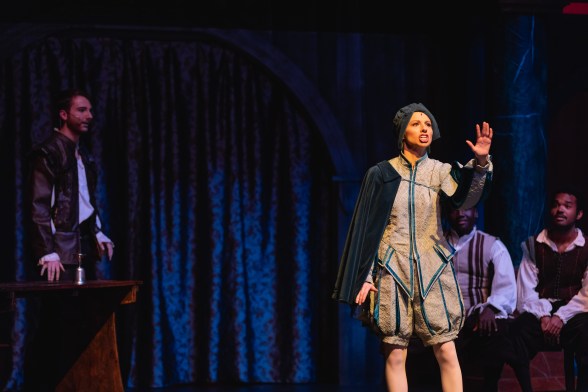
All of this desperation and streetfighting are a perfect backdrop for the luminescence of Viola. A beautiful noblewoman smitten by the theatre and Shakespeare’s verse, she disguises herself as Thomas Kent in order to audition for the role of Romeo, performing a speech from the Bard’s first hit, Two Gentlemen of Verona, as a sampling. (Audience members who don’t know that women were forbidden to act onstage during the Elizabethan Era will be deftly brought up to speed.) Until Viola shows up, Will hasn’t seen much to encourage him that he’ll be able to cast “Romeo and Ethel” if he ever finishes writing it. When Kent flees the audition after flubbing some kissing business, Will pursues, only to come face-to-face with Viola. So now it’s Will’s turn to be flustered.

THEA2019-DLV-0926-0295.jpg

Once Viola is on the scene, romance enters to dispel Will’s writer’s block and the world of Shakespeare in Love widens to include nobility, government, and royalty. Lord Essex, aspiring to Viola’s hand and fortune, is Will’s chief romantic obstacle, having obtained daddy’s permission – and Queen Elizabeth herself will also need to approve. If Viola does achieve her ambition and appear publicly onstage, the Master of the Revels, Edmund Tilney, stands in the wings, empowered to instantly stop the performance and shut down the theatre.

Jennifer O’Kelly’s set design, with its Globe Theater arches and balcony, emphatically reinforces the notion that the action we’re watching in Will’s life is the stuff of Shakespearean drama. Pre-recorded music composed by Paddy Cunneen, infused with the sounds of flutes and lutes, helps in the transitions from theaters and taverns to noble and palatial surroundings. With plenty of input from companies and theatre departments as far away as Greensboro, costume designer Emily McCurdy splendidly outfits a cast of 23 playing 60 different roles – though it might be pointed out that the Queen of England should have more than one dress. Choreography by Clay Daniels, when we reach the iconic Romeo ballroom scenes in real life and in rehearsal, meshes with the music simply and authentically.

Best of all, the key roles were aptly cast. Morgan Wakefield had an abundance of breathless energy and theatre enthusiasm that never seemed nerdy and – since she was the inspiration for Juliet as well as Viola – a total lack of vanity staining her beauty. While Wakefield’s energy largely fueled the pulsing effervescence of this performance, Jack Stanford was no less on point as Shakespeare. He walked a similar tightrope between pragmatic calculation and youthful impulse that Wakefield trod, never becoming too cerebral. As lines from Shakespeare’s future works showered him from all directions throughout the evening, I always sensed from Stanford that Will was absorbing rather than stealing them.

THEA2019-DLV-0926-0366.jpg

The nobles all sounded very polished, beginning with Jonathan Stephens as the pushy, valorous and conceited Essex and Pat Heiss as the sternly regal Queen Elizabeth – with a broad vein of worldliness. Jim Greenwood as Tilney was exactly the kind of prig you would want to cram into a trapdoor, costumed puritanically to make it obvious that he inspired Malvolio in Twelfth Night; and Anne Lambert bustled about officiously enough as Viola’s Nurse to make it obvious that Juliet should have one, too.

Out in the London jungle where the Rose Theatre struggled for survival, inexperience only occasionally peeped out among the players. Jeff Powell infused Fennyman with menace, convincingly shifting his attitude once the moneylender became stagestruck, and while Larry Wu could be downright bizarre as the tortured Henslowe, his intensity was endearing. A little more confidence and individuality would help Blake Williams in his portrayal of Kit Marlowe, but there was abundant stage presence from Bryce Mac as Ned Allyn, the star actor who took on the role of Mercutio, and from Brian Holloway as the predatory, opportunistic Burbage.

Chemistry between Stanford and Wakefield in the Will/Viola romance will sufficiently captivate groundlings new to the world of Shakespeare. But the more you’ve experienced of the Bard, the more you will be delighted by the quotes from Twelfth Night, Macbeth, and Lear that also creep in. Where the intended allusions and echoes ended and where unintended parallels began was sometimes hard to discern. When Elizabeth told Viola that even she could not dissolve an ordained marriage, was this a foreshadowing of what Theseus had to tell Hermia in A Midsummer Night’s Dream? While Romeo and Juliet was virtually writing itself before my eyes, it was reassuring to recall that genuine monarchs can understand the limits of their power.


Bound and Gagged in a Georgia Cabin

Review: Exit, Pursued by a Bear

By Perry Tannenbaum

IMG_9649

It’s been 28 years since I saw a murderous woman binding a man to a chair onstage, and I haven’t forgotten the spectacle of that near rape-victim turning the tables – and a spool of duct tape – on her would-be rapist. Maybe there were other instances after that stunning UNC Charlotte production of Extremities in 1991, one of the top five dramas I critiqued that year. If so, those action she-roes haven’t seared themselves in my memory the way that William Mastrosimone’s did.

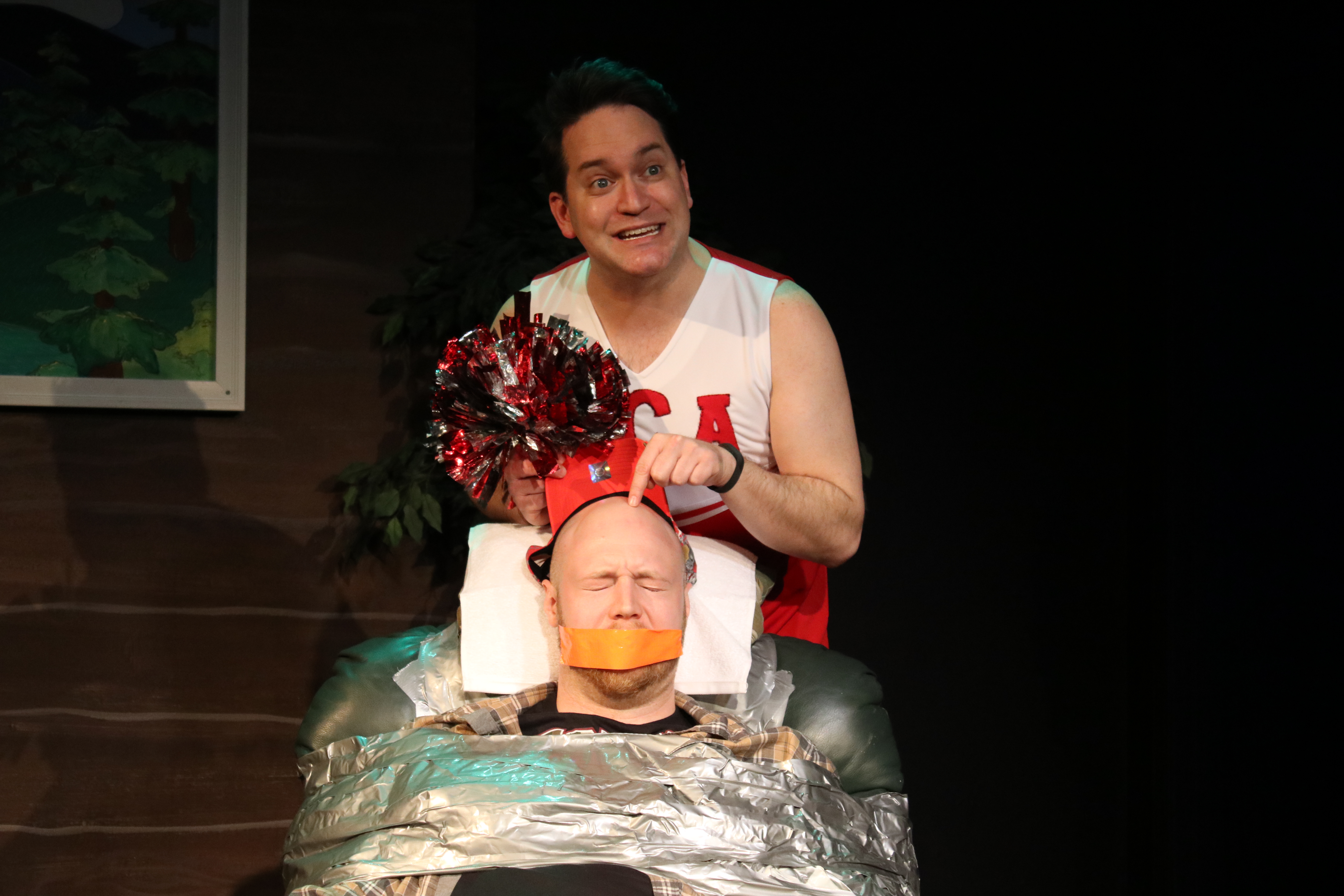
A trail of empty honey bottles greeted us outside the Warehouse Performing Arts Center storefront in Cornelius as we entered upon a similar scene in Exit, Pursued by a Bear, the new Charlotte’s Off-Broadway production directed by Anne Lambert. Once again, three people are deliberating what to do with the captive – Kyle Carter, who has abused his wife Nan for the umpteenth time. Lauren Gunderson’s 2012 play, subtitled “A Southern-Fried Revenge Comedy,” isn’t quite as intent on ratcheting up the tension.

Like Gunderson’s title, derived from Shakespeare, it’s complicated. Often cited as the Bard’s most outré – or hilarious – or expensive – stage direction, “Exit, pursued by a bear” occurs in Act 3, Scene 3, of The Winter’s Tale. The fleeing nobleman is the otherwise forgettable Antigonus, whose mauling is vividly reported a moment later by the curiously named Clown, a shepherd’s son, while the bear is still devouring its kill offstage.

IMG_9912

Nan isn’t intending to give her husband even that sporting chance at survival. She plans to abandon her secluded cabin in the Georgia woods and leave the doors open for any bear in the vicinity to enter. To hurry the process, Nan and her friends Simon and Sweetheart are adding inducements to make Kyle more aromatic and inviting. Some honey, of course, but here’s some luck: Kyle just killed a deer, so they can cut up some fresh meat and strew that around, too. Cool condiments!

Since Conrad Harvey as Kyle is already bound and gagged as we walk by with our tickets and drinks – hey, go ahead and take selfies with Conrad if you like – Gunderson is taking on two conflicting objectives when the lights come up. She’s painstakingly justifying what Nan is doing to her husband, and she’s striving to preserve the murderous unraveling of the Carters’ marriage in a comedy mold. Nan’s accomplices come in handy for both of these objectives.

Sweetheart is a stripper at a local bar who aspires to be an actress – or at least a movie star – and Kyle is Nan’s lifelong best friend. Since he is a bit of a queen in his Georgia Bulldogs cheerleading outfit, the stripper-transvestite combo is inherently comical as soon as it forms, if you’re not going to be offended by stereotyped affronts to political correctness and feminism. Part of the action, you must remember, is Nan overcoming her submissiveness and moving towards feminism. It’s a liberating leap.

IMG_9965

With Kyle as her literally captive audience, Nan will express the anger, frustration, and humiliation she has kept bottled up inside by playing out the key scenes that have pushed her to this drastic homicidal response. Since Kyle is indisposed – and hasn’t learned his lines – Julia Benfield as Sweetheart will step into the role of Nan’s husband in these flashbacks. Lambert has made a cagey casting choice here. Benfield is not only dwarfed by Harvey, you’ll see that Julie Janorschke Gawle towers over her as well. More built-in comedy.

Benfield is trashy in her cinched flannel shirt impersonating Kyle, and a fair amount of that trashiness appears to come naturally, but the more we get to know her, the more clearly we see that she isn’t a slut or a bimbo. With all the two-handed scenes in the flashbacks, you might worry that Simon is simply superfluous. But he’s more than a cheerleader. When Nan wavers, Simon is there to help shore up her resolve.

Not always the subtlest of performers, Ryan Stamey calibrates and balances his bloodthirsty zeal, his genuine affection for Nan, and his flaming outrageousness in such a precise way that he emerges as genuinely human rather than as a cartoon provocateur. With this kind of quirky support, Gawle can explore the serious depths that Gunderson explores in the Carters’ abusive marriage. Nan’s waverings are based in a pathological dependency that develops between an abused spouse and her abuser, ground into the rubble of crushed self-esteem.

IMG_9812

Gunderson also wants us to be ambivalent about the payback Nan is meting out, no matter how many Hollywood revenge flicks we’ve seen. As if he were on trial rather than passively listening to his sentence, Kyle gets his chances to speak and defend himself. More than that, he gets Nan to allow him a temporary reprieve from his bondage, so that he can re-enact the good times they had together before things went sour.

Harvey doesn’t mitigate the fact that Kyle is a boorish hayseed, but he also doesn’t hold back on the sincerity of “getting it” and his intent to be a better man. We’re apt to be a little torn, as Nan is, on the option of giving Kyle a second chance. Gawle is visibly affected by Harvey’s pleas, his evocations of past Kyles, and perhaps his newfound respect for the doormat who has risen up against him. So with the prospect of Kyle suddenly reverting to violence, there’s not only dramatic tension in the air but also multiple layers of give-and-take between Nan and Kyle, Nan and Simon, between the men and inside Nan’s heart.

Feminists will appreciate how this deadlock is broken.

IMG_0106

Gawle does everything right interacting with the other performers. She even gives herself moments when she ponders the enormity of what she’s planning – and to question whether she’s sufficiently calm to proceed after the suddenness and the adrenaline rush of what she has done and how it has changed her. One thing you might question is whether Gawle is as Southern or as trashy as Gunderson imagined her. Hang in there until Nan’s final scene, and you’ll likely see the rationale for the choice Gawle and Lambert have made in crafting her character.

Along with the cast’s work onstage, costume design by Ramsey Lyric, lighting by Sean Kimbro, and Jarvis Garvin’s fight choreography are all indicative of Charlotte Broadway’s professionalism. The only dodgy aspect of this production are the projections flashed on the upstage wall delivering stage directions when we reach Gunderson’s play-within-a-play segments. The lettering doesn’t exactly pop, and efforts to read them can draw attention away from the action. Maybe freezing the action might help solve the problem. Worth a try.

Otherwise, Exit, Pursued by a Bear is all-pro all the way. Consider yourself lucky if you can pursue and snag a ticket.

Hatem’s “Confidence (and The Speech)” Loses Its Way but Delivers a Poignant Ending

Review:  Confidence (and The Speech)

Nathaniel Gillespie, Jonathan Hoskins and Greg Parroff in a scene from CONFIDENCE Sept 2018

By Perry Tannenbaum

Say what you want about Jimmy Carter, he wasn’t about lining his pockets with money or telling other nations what to do, and he certainly wasn’t about cozying up to the Russians. Among his more controversial – and principled – actions, President Carter slapped a grain embargo on Russia in response to their invasion of Afghanistan and pulled us out of the 1980 Summer Olympics in Moscow. In the midst of an energy crisis, Carter faced a TV camera inside the Oval Office and, wearing a drab cardigan sweater, urged a nationwide audience to turn down their thermostats to 68ºF. After the turmoil of Nixon, Cambodia, and Watergate, President Carter was barely in office two days when he granted blanket amnesty for Vietnam War draft evaders. Probably his most egregious faux pas was reminding wasteful and self-indulgent Americans that we were wasteful and self-indulgent, that two-thirds of us were so apathetic that we didn’t bother to vote, that there was a growing distrust of government and the press, and that our nation’s self-confidence was slowly eroding. Free spending and trickle-down Reaganomics proved to be far more palatable to our shrewd electorate.

Actor Jo Hall plays President Jimmy Carter in CONFIDENCE Sept 2018

Using the pivotal “Crisis of Confidence speech of 1979 as her ground zero, with occasional traces of animus from the shocking 2016 election result, playwright Susan Lambert Hatem reappraises Carter’s leadership and courage in Confidence (and The Speech). Hatem’s sister, producer Anne Lambert, is directing a workshop production of the new play at Spirit Square with the company she founded, Charlotte’s Off Broadway. Taking us to Camp David, where Carter took an extra 10 days to refine his address – convening a domestic summit where he gathered ideas from “business and labor, teachers and preachers, Governors, mayors, and private citizens” – Hatem also trains a critical eye on how much input and impact women had on the deliberations. Seven years after Helen Reddy’s “I Am Woman,” it wasn’t exactly a roar.

To look at the Camp David process pointedly from this outsider’s angle, Hatem erects an unusual framework. For her eyes and ears, the playwright recruits a somewhat disillusioned history professor, Cynthia Cooper, who served as a White House intern when Carter’s national address was being crafted. We’re not exactly sure when young Jonathan Rollins approaches Cooper after one of her lectures (not until the end of the evening, anyway), asking her for her reminiscences on Carter, but his persistence is rewarded. There is one catch: Cooper will take us behind the scenes at Camp David only if she portrays President Carter in the retelling. Rollins will need to switch genders as well and portray the young Cynthia.
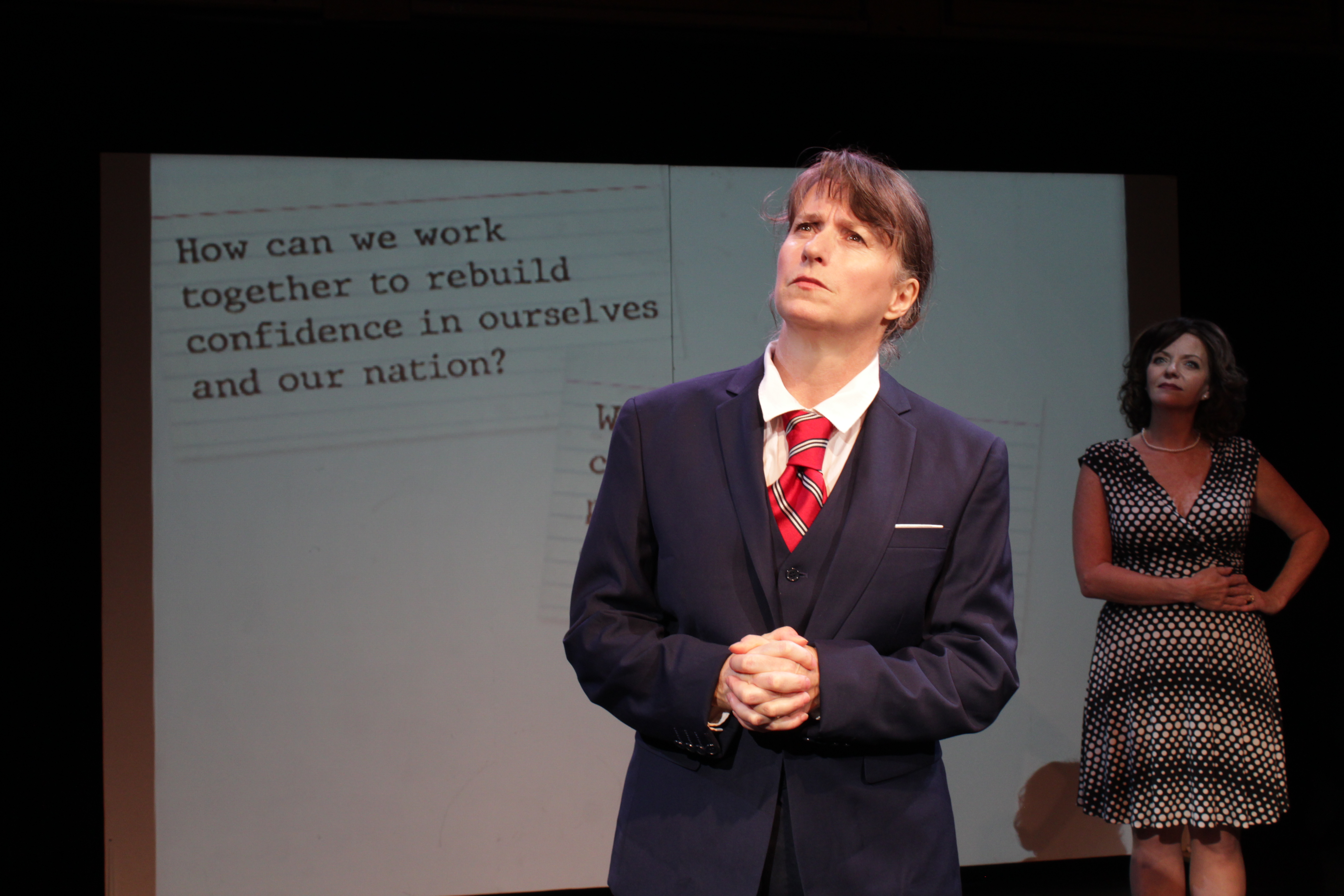
Josephine Hall takes on the challenge of rekindling our affection for Carter, and she captures 39’s dignity, determination, and quiet uprightness rather well, but the hours she presumably spent watching YouTube videos of Carter have been wasted. She hasn’t listened well enough to produce Jimmy’s distinct Georgia sound, producing a generic drawl that London and New York would deem adequate for their most pallid Tennessee Williams revivals. Nor does Hatem take the opportunity to shine a bright light on the difference a woman in a pantsuit and heels might have made if she had been standing in Carter’s shoes. Unexpectedly, Hall does her best work during her technically impossible private scenes with Rosalynn Carter and in the equally impossible town hall segment when Jimmy listens to the voice of the people and responds. These responses are improvised at every performance, for three audience members will be chosen to give input to the President on key questions facing the nation.

Berry Newkirk, Greg Paroff, Paul Gibson, Maxwell Greger and Josephine Hall in a scene from CONFIDENCE Sept 2018.JPG

Subjected to unwanted advances when he becomes Young Cynthia – and relegated to typing up notes and brewing coffee – Jonathan Hoskins drew a more revelatory role as Rollins. The harassment and abrasive sexism come from pollster Pat Caddell as Cynthia gathers information and works with speechwriter Hendrick Hertzberg. Hoskins gave us enough prissy drag comedy mincing around in heels to effectively contrast and underscore those serious moments when Young Cynthia was being ignored, patronized and disrespected. Another fine episode lies in wait for Hoskins at the end when Rollins sheds his importunate and demure pretenses to reveal his true identity. These are the moments when Hatem is most successful.

Focusing on the polls, the process, and the pragmatism of aligning the speech with Carter’s re-election prospects, Hatem neglects the content of the speech and how it responded to the crises it addressed. It all seemed so promising and convincing in the playwright’s rendering of the first staff meeting at Camp David. In addition to those already named, press secretary Jody Powell, chief of staff Hamilton Jordan, communications director Gerald Rafshoon, and Vice President Walter Mondale all seemed professional, intelligent, and capable. All were agreed that the speech originally for July 4 had been a disastrous snooze and that Carter had been wise to postpone it at the last minute and regroup. The thrust of the message, the stakes, and the pitfalls were briskly and excitingly laid out.

After we grasped Carter’s motivations, process and practicalities stifled the flow of ideas vying for inclusion in the final draft. Rafshoon and Jordan remained thinner than cardboard and as Mondale became little more than an ominous negative voice, Powell became a glib appeaser to a press corps hungry for substance. The play veered along a similar path for us with its gender-bending protagonists, sidestepping the meat of the speech. Deepening the portraits of Rafshoon, Jordan, and Mondale would be one way for Hatem to go – leaving Maxwell Greger to ably provide comic relief as the unctuous Powell. But I suspect the better path might be for her to parade more fleetingly developed characters into the mix – those teachers and preachers and businessmen and politicians that Carter talked about in his speech.

Actor Josephine Hall as President Jimmy Carter and Actor Lane Morris as First Lady Rosalynn Carter in COB's CONFIDENCE Sept 2018Yes, I’d advise doubling and tripling the roles of the staffers. Then Josh Logsdon would have more to do than Mondale’s brooding fatalism, the criminally underused Berry Newkirk could more fully display the full spectrum of his talents, and Paul Gibson as Jordan could flub a more interesting variety of lines. That tack would also present ways of sneaking in more background info about 1979 America and let us outside of the White House West Wing bubble that Hatem creates. With those enrichment opportunities missed, Greg Paroff as Hertzberg, both avuncular and ambivalent, emerged as the most compelling performer in a supporting role while Nathaniel Gillespie was convincingly cringeworthy as Caddell.

Technically, the Charlotte’s Off-Broadway production also disclosed its workshop status. The upstage screens weren’t utilized nearly enough for projections, furniture occasionally boomed or rattled backstage, and on one unfortunate occasion, a folding table failed to become Young Cynthia’s bed for a bedroom scene. But the Lambert sisters’ efforts eventually made a favorable impression on me with a new resolution that Hatem wrote in response to the catastrophe of Election Night 2016. I really shouldn’t reveal what happens, but I will say that it brought tears to my eyes – for a poignant reason I’ve never experienced before: knowing that what I was seeing and hearing onstage couldn’t possibly be true.


A Georgia-Born Playwright Reappraises Carter – in the Age of Trump

Preview: Confidence (and The Speech)

CATS cast photo + Anne + Susan #1[4]

By Perry Tannenbaum

Oceans are rising. California keeps burning. Women are still facing stalkers, abusers, detractors, and depressed wages. Innocent blacks are beaten and shot in the back by rogue cops – or point blank by vigilantes. Wouldn’t it be great to be led by a President who cares? While Obama nostalgia and Hillary regrets are keenest, all other past commanders in chief and presidential hopefuls – except maybe Bush 43 – seem to be more palatable alternatives than the racist boor who now sits so empty-headedly at his empty Oval Office desk.

Even Jimmy Carter? Why yes, says playwright Susan Lambert Hatem, whose Confidence (and The Speech) premieres at Duke Energy Theater this week. Growing up in Decatur, GA, a three-hour drive from the famed Plains presidential peanut farm, Hatem has been fascinated by the Carter presidency and his exceptional post-presidency since childhood. Her impulse to reappraise Carter began before the 2016 election.

Among Carter’s signature achievements were establishing the Departments of Education and Energy and successfully bringing Israeli prime minister Menachem Begin and Egyptian president Anwar Sadat together to the peace table for the Camp David Accords. Hatem has made a pilgrimage to attend Carter’s Sunday preaching at his plain Plains church and has extensively researched the record.

“He appointed more women justices and more minority justices than all previous administrations – put together,” she points out. “Carter paved the way to something. There is no Obama presidency without Carter’s presidency. His administration never dropped a bomb. Never started a war. Eight American soldiers were killed on his watch.”

When Confidence began taking shape in 2015, Hatem had good reason to expect that she would also be able to claim that Carter’s presidency paved the way to Hillary Clinton. Equipped with sound theatrical sense, Hatem knew that showing Carter establishing government agencies or appointing women and minorities wasn’t a dramatic pathway to resuscitating his stature.

Instead, she decided to focus on his pivotal “Crisis of Confidence” speech of 1979 addressing America’s energy crisis. She learned that Carter had cancelled the energy address he had originally scheduled for July Fourth and sequestered himself at Camp David for 10 days before emerging with what Hatem calls “The Speech.” Those 10 days were an attempt to change the course of our history.

“I discovered that the initial reaction to that speech was intensely positive,” Hatem recalls. “It was the best public reaction to a speech the White House had ever seen – there were phone calls and letters praising the speech. Later, the speech was used against him and became known as the ‘malaise’ speech – though he never said malaise.”

Before moving into his policy decisions and recommendations, Carter described an ingathering and reaching out.

“I invited to Camp David people from almost every segment of our society,” he told the nationwide TV audience, “business and labor, teachers and preachers, governors, mayors, and private citizens. And then I left Camp David to listen to other Americans, men and women like you. It has been an extraordinary ten days, and I want to share with you what I’ve heard.”

Hatem not only examines the domestic summit that Carter held at Camp David, she flips the script with her narrative structure. Young Jonathan Rollins approaches 60-year-old college professor Cynthia Cooper, a former Carter aide, and asks her to recall the leadup to the “Crisis of Confidence” speech. Cooper consents – on condition that Young Jonathan plays Young Cynthia in the retelling. Professor Cooper will play President Carter.

Why? Because Hatem is not just interested in how history is made. She’s concerned with who gets to make it. Set in 2019, when President Hillary would presumably declare her candidacy for a second term, Confidence (and The Speech) would be a look back at how we began to evolve toward this landmark of feminist progress.

And then came the shock of Election Night, November 8…

“After the 2016 election – I didn’t know what to do,” Hatem admits. “I had to put the play down for a bit. I couldn’t work on it. I didn’t know how the play would make any sense any more. Then January 2017 was the Woman’s March, and I was re-inspired. I knew I had to finish it. So many women were stepping up. So many LGBTQ activists. So many black women and men. So many voices were rising. I wrote a new ending – a cathartic ending to me. An ending that I think will excite some, and confuse others. It is purposefully somewhat ambiguous… and not.”

The road from re-inspiration to this week’s Charlotte premiere ran through Hatem’s sister, Anne Lambert, who already had two significant production projects in the works during 2017. Last summer, she was on the producing team at Children’s Theatre of Charlotte that presented a staged reading of Bend in the Road, a musical adaption of the beloved Anne of Green Gables. Then in late fall, Lambert’s own company, Charlotte’s Off-Broadway, presented a fully professional local premiere of Richard Greenberg’s Three Days of Rain.

Lambert had co-founded the all-female Chickspeare theatre troupe at a local brewery 20 years ago, so her sister’s gender-bending concept was right up her alley. Confidence was one of six plays that were read at Camp North End this past winter as part of the Charlotte’s Off-Broadway “Page to Stage 2018” series. Of the six works read script-in-hand from February through March, Hatem’s will mark the third to receive a full production.

This time around, Lambert is wearing two hats, producing and directing. Hatem especially values her sister’s experience with dark Shakespearean plays – where the Chickspeare gender-bending wasn’t done for cheap laughs or sexual effect.

“What I’m trying to do is explore how the cross-gendering can reveal another layer to the play’s themes,” says Hatem. “That’s where Anne and her direction have been so great.”

The Lambert Sisters tapped Josephine Hall for the challenging roles of Professor Cooper and President Carter – in an unusual three-way FaceTime audition with the playwright in LA, the producer in Charlotte, and their star in Greensboro. We haven’t seen Josephine Hall in a local production since she prowled Stonewall Street in Cougar: The Musical, the last of her three Actor’s Theatre appearances during the 2014-15 season. Though she teaches acting and voice at Greensboro College, Hall hasn’t totally disappeared from view. Some of us saw her at Belk Theater when the first national tour of The Curious Incident of the Dog in the Night-Time came to town in February 2017.

Hatem knew some people who had worked with Hall on that tour, and Lambert had been impressed with her performance in Vanya and Sonya and Masha and Spike at Actor’s Theatre. You could say they were pre-sold before they hooked up via their iPhones.

After starring as the discontented daughter of a former Reagan ambassador in the 2014 Actor’s Theatre production of Other Desert Cities, you also might say that Hall was serendipitously unsold on President Ronald Reagan. The Hollywood actor successfully pinned the malaise label on Carter’s watershed speech and wrested the presidency from him in 1980.

“I believe The Speech is a missed opportunity,” Hall says after living with it through months of study and rehearsals. “Most people – not just Americans – don’t want to think too deeply or like to change their daily habits. Carter was asking for both. It’s really no wonder that most people chose the ‘all is well, just spend more’ approach offered by Reaganomics. It is very sad, however. I try to imagine a world where America had paid attention and led the world down a more sustainable path.”

Homespun “Barbecue Apocalypse” Improves With Age

Reviews: Barbecue Apocalypse, The Sherlock Project, Life Is a Dream, and Madagascar

By Perry Tannenbaum

IMG_5740

In a year that included Lucas Hnath’s The Christians, Robert Schenkkan’s The Great Society and Rebecca Gilman’s Luna Gale among the top contenders, I could only give Matt Lyle’s Barbecue Apocalypse a lukewarm endorsement for best new play of 2015, ranking it #13 among 27 eligibles that I read for that year’s Steinberg Awards. Nor did colleagues from the American Theatre Critics Association strongly disagree with my verdict, since Lyle’s dystopian comedy didn’t make the cut for the second ballot, when we considered our consensus top 10.

But before Charlotte’s Off-Broadway decided to stage this show at The Warehouse PAC up in Cornelius, they did some reading and balloting of their own. From January through March, the company offered monthly “Page to Stage” readings presenting two different plays on each occasion. Then they asked ticketholders to vote on which of the six plays they would like to see in a fully staged production. Less than two months after the votes were counted, Barbecue is back for my reconsideration as the audience favorite.

And on further consideration, I must credit director Anne Lambert and her professional cast for convincing me that Barbecue Apocalypse is even better than I thought it would be – far more to my liking than real barbecue.

IMG_5885

Lyle would probably concur, since his patio hosts, Deb and Mike, are only grilling and basting because they want to avoid the embarrassment of having their friends – who are more trendy, stylish, and successful – see the interior of their home, decorated with lame movie posters. Deb succinctly describes her strategy as lowering expectations for the cuisine and the ambiance. Outdoors, she can point with pride to the fact that Mike has built the rear deck himself. Yet the barbecue event has obligated Mike to buy a propane grill off Craig’s List, and he’s afraid to light it.

He would also like Deb not to mention that he’s a professional writer, for his career earnings, after one published short story, now total 50 bucks.

All four of the guests feed the hosts’ sense of inadequacy. Deb is a decorator, foodie, and gourmet cook who makes sure to bring her own organic meat, and her husband Ash is a gadget freak, armed with the best new smartphone equipped with the most awesome apps. Win pretty much embodies his name, a former high school QB, now a successful businessman with Republican views. He lives to put Mike down and can seemingly get any woman he wants. Even his bimbo of choice, Glory with her Astrodome boobs, can claim formidable accomplishments, arriving late to the barbecue after nailing her Rockette audition.

What ultimately happens to this insulated suburban group reminds me of The Admirable Crichton, the excellent James M. Barrie tragicomedy I came across a couple of times during TV’s golden age, when colleges had core curriculums. A perfect butler to the Earl of Loam in Mayfair, London, Crichton and his betters were shipwrecked on a desert island in the Pacific, where his natural superiority emerged.

There are two basic differences between Barrie’s back-to-nature tale and Lyle’s. The shipwreck situation was reversible with rescue. Apocalypse isn’t. More to the point, Barrie was clearly targeting the blind rigidity of class distinctions. Here if we consider the implications of Barbecue Apocalypse, Lyle seems to have modernity in his crosshairs – how our world warps our aspirations and our self-worth, how it channels us into modes of living that are far from our authentic selves.

In the cramped storefront confines of the Warehouse, Lambert doesn’t attempt to design a deck that lives up to Mike’s pretensions, and Donavynn Sandusky’s costume designs are similarly déclassé, especially for the nerdy Ash. This robs Lyle’s concept of much of its slickness, which for me turned out to be a good thing. Aside from the Craig’s List mention, Lambert also dropped in a couple of local references that added to the overall homespun flavor.IMG_6440

Becca Worthington and Conrad Harvey were nearly ideal as our hosts, keenly aware of each other’s limitations and their own, yet visibly crazy for one another. Worthington with her status-conscious rigidity and stressing was clearly the closest actor onstage to Lyle’s vision, beautifully flipping her “We suck” persona after intermission and the apocalypse, when a full year of roughing it has elapsed. Harvey was more than sufficiently cuddly and self-deprecating – but credulity is stretched when a man of such size and stature is repeatedly dominated by his adversaries.

If you can accept that Greg Paroff was ever on a football field, let alone as a QB, you’ll be quite pleased with how he handles Win’s asshole antics. He is confident, he is arrogant, and if he’s possibly past 40, that only increases the disconnect between Win and his limber Rockette. Julia Benfield is absolutely adorable as Glory, and I absolutely adore how she’s still mincing around in high heels when she makes her disheveled entrance in Act 2. We totally believe that her familiarity with Tom Wopat doesn’t extend to The Dukes of Hazard in the ‘80s.

Probably not the best moment for Lambert when she cast Cole Pedigo and Jenn Grabenstetter as Ash and Lulu. They should remember the ‘80s, but I needed to stifle my doubts. Wardrobe and just the way he’s absorbed in his iPhone might help Pedigo out – and make him less wholesome, winsome, and juvenile before the apocalypse. Grabenstetter overcomes all objections when free-range Lulu gets snockered on generic canned beer, and both Pedigo and his scene partner truly click when adversity brings Ash and Lulu to a new lease on life in Act 2. I believe that’s an antler dance.

I won’t disclose what happens when Maxwell Greger walks on for his cameo deep in Act 2, but I do respect how Lyle makes him earn his paycheck with a sizable monologue. Greger does the denouement with a slight manic edge, and the technical aspects of his departure are impressively handled.

So it’s fair to say that apologies are in order for rating Barbecue Apocalypse in the middle of the pack when I first read it. Or excuses, since a rational man resided at the White House in 2015, and apocalypse seemed so fantastical.

But hold on. Charlotte’s Off-Broadway has already programmed two other plays from their “Page to Stage” readings for two fully-staged productions in the near future, Susan Lambert Hatem’s Confidence (and The Speech) for September and Lauren Gunderson’s Exit, Pursued by a Bear for next February. Maybe when these runner-ups get fleshed out, supporters of Lyle’s winning script might reconsider their votes!

A Catch-All Catch-Up

Our recent travels to Greece, Israel, and Jordan compelled us to miss a bunch of high-profile openings after we reviewed the reinvented Rite of Spring at Knight Theatre on April 6 and CP’s On Golden Pond the following evening. Even before we left, we had to pass on the Charlotte Dance Festival and CP’s Elixir of Love so we could adequately prepare for our trip. To see the birthplace of theatre, the Holy Land, and Petra, we had to miss out on the BOOM Festival, the reprise of Beautiful: The Carol King Musical, and the opportunity to host a pre-show preview of The Marriage of Figaro for Opera Carolina.

New openings when we returned were a must, so we hit the ground running with Charlotte Ballet’s Spring Works and Symphony’s Brahms-and-Bartok program. But our need to catch up with Carolina Shakespeare’s Life Is a Dream made us put off seeing PaperHouse Theatre’s Sherlock Project until it second week. It gets complicated. But I’ve tried to get up to speed while working on more reviews and features. File these under gone but not forgotten:

The Sherlock Project So a dozen actors and writers collaborated on PaperHouse Theatre’s mash-up of Sir Arthur Conan Doyle’s short story gems, producing a script that follows three guiding principles: keep it funny, keep it moving, and don’t, don’t, don’t ever explain how the great Sherlock Holmes arrives at his incredible deductions. Going back to their roots at the Frock Shop on Central Avenue, PaperHouse and director Nicia Carla found a frilly complement to the Victorian chronicles of Dr. John Watson.

But the frame of the story was wholly new, telling us that the deadeye detective in the deerstalker cap is a woman. Watson protects the woman who should be credited with all the purported exploits of Scotland Yard’s Inspector Lestrade because he knows that Sherlock is right: The general public is even less prepared to believe a female is capable of such brilliancies than Watson is.

Besides all of the Sherlockian brilliance and nonchalant arrogance, Andrea King reveled in all of the detective’s eccentricities, whether it was shooting up a 7% solution of cocaine, tuning up a violin, or lighting up a calabash pipe. Opposite King’s insouciant self-confidence, Chaz Pofahl wrung maximum comedy from Watson’s wonder and timidity – a phenomenon compounded by the gender factor as Pofahl switched from paternal protectiveness to awe or terror while King wryly twinkled and smiled.

The two main supporting players slipped into multiple roles, Angie C as a cavalcade of damsels in distress and Berry Newkirk in the plumiest cameos, ranging from the dull-witted Lestrade to the razor-sharp Professor Moriarty, mythically uncatchable. Apart from directing behind the scenes, Carla conspired in the action as Mrs. Hudson, Holmes’s discreet housemaid. Carla not only ushered in Sherlock’s distraught clientele or evil adversaries, she also presided over scene changes, when audience members had to exit the Frock Shop’s parlor to a murder scene in the adjoining room or out on the porch when Sherlock was pursuing… something. Had to do with fire.

Or when it was intermission, time for little cucumber sandwiches.

The whole show was a wonderful diversion. PaperHouse had to add another performance to their run, which we caught last Wednesday, and the remaining nights were already sold out. Like the PaperHouse faithful, I couldn’t get enough of The Sherlock Project. I wanted lots more – beginning with how did Sherlock deduce that Watson had just come from Afghanistan when they first met?

Life Is a Dream – Convinced it was a comedy rather than a political melodrama, Shakespeare Carolina and director S. Wilson Lee kidnapped Pedro Calderón de la Barca’s classic, written during Spain’s Golden Age, and transported it more than three centuries forward from a mythical Poland to a mythical Las Vegas. There in a seedy club on the strip, the two factions with their eyes on the throne were Frank Sinatra’s Rat Pack and Marlon Brando’s Wild Bunch.

Lee’s wild conceit didn’t do nearly as much harm as I thought it would, mainly because ShakesCar didn’t have the budget to carry it too far at Duke Energy Theatre, and the strong cast mostly played their roles as the text, sensibly adapted by Jo Clifford, said they should. So much depended on the broad shoulders of David Hayes as Segismundo. Heir to the throne of Poland, Segismundo has been locked away Prometheus-like in a mountain dungeon for his whole life by his father, King Basilio, who is foolishly trying to ward off the dire destiny predicted by an astrologer.

A boiling rage seethes inside of Segismundo, and a less mightily built actor than Hayes might need to strain himself to encompass it. Hayes projected the mighty rage rather naturally, which made it easier for him to flow convincingly into Segismundo’s softer emotions when – before he has even suspected his royal lineage – he is handed the Polish throne and the power to act on his newly awakened sexual urges as he sees fit.

Called upon to give a far more nuanced performance as Basilio, Russell Rowe delivered. Yes, he was cruel, but also conflicted, with a lifelong dread deftly mixed into his forcefulness. Though I feared the convoluted plot might be abridged or simplified, the intrigue, the complexity, and the epic monologues were almost entirely intact. As the vengeful Rosaura, Teresa Abernethy brought forth the masculine-feminine blend that the transgendered Clifford was aiming for in her translation, and James Cartee, an actor who often keeps nothing in reserve, showed unusual probity and maturity as Clotaldo, even as he tried to figure out his long-lost child’s gender.

Nobody was more suavely dressed by costume designer Mandy Kendall than James Lee Walker II as Astolfo, the successor that Basilio wanted if the true heir didn’t pass his test. But if anybody was victimized by Lee’s Rat Pack concept, it was Walker. I have no idea why he persisted in speaking so rapidly and unintelligibly, unlike any work I’d seen from him before. Was he attempting a Sammy Davis Jr. imitation? Couldn’t figure out what accounted for this curious outing.

Betrothed to this strange hipster, Maggie Monahan beautifully brought out the agonies of queen-to-be Estrella. Maybe the most Shakespearean role in this ShakesCar production was Ted Patterson as Clarin, who tags after the disguised Rosaura from the opening scene, as either her companion or servant – but definitely our clown.

On the strength of this effort, theatergoers can be excited about ShakesCar’s next invasion of Spirit Square, The Tragical History of the Life and Death of Doctor Faustus at Duke Energy from June 28 to July 7.

DSC03442

Madagascar – Okay, so I’ll grant that the musical adaptation of the 2005 Dreamworks film didn’t have the gravitas of the greatest Children’s Theatre of Charlotte extravaganzas of the past like their Boundless Grace and The Lion, the Witch, and the Wardrobe – or the bite of Ramona Quimby and Tales of a Fourth-Grade Nothing. But this confection was nearly perfection. Under the direction of Michelle Long, Madagascar hit a family-friendly sweet spot, straddling the realms of cartoon silliness, cinematic adventure, and theatrical slapstick and dance. I just didn’t like the deejay, everybody-get-up-and-act-stupid thing.

Scenic design by Jeffrey D. Kmiec never lost its freshness thanks to a slick stage crew and the eye-popping lighting by Gordon W. Olson, while the animal costumes by Magda Guichard probably made the strongest case for live theatre against multiplex animation. Choreography by Tod A. Kubo chimed well with Long’s direction, which used areas of McColl Family Theatre that rarely come into play.

Centering around four animals that break out of Central Park Zoo, Madagascar introduced us to Marty the zebra and his wanderlust. We moved swiftly from there. Following the lead of four penguins bound for Antarctica, Marty escaped the zoo, seeking a weekend in Connecticut. Not only are police, animal control, and TV bulletins on his trail, so were his pals Gloria the hippo, Alex the lion, and Melman the giraffe. Embarking underground in the Manhattan subway, Marty hardly stretched credulity much further by winding up off Africa.

Deon Releford-Lee was a spectacular triple-threat as Marty, but what dazzled most was the multitude of gems in this supporting cast, beginning with an intimidating Alex from leonine Traven Harrington and – on stilts, of course – a timorous Melman from Caleb Sigmon. Dominique Atwater disappointed me as Gloria, but only because we didn’t get enough of our hippo after her first big splash. Olivia Edge, Allison Snow-Rhinehart, and Rahsheem Shabazz fared better, drawing multiple roles.

While the book by Kevin Del Aguila shone more brightly than the musical score by George Noriega and Joel Someillan, I was amazed that so much story and song could be squeezed into barely more than 60 minutes. Combined with last October’s Mary Poppins, the exploits of Madagascar prove that musical production is an enduring strength at Children’s Theatre. I can’t think of a season at ImaginOn that had sturdier bookends than these musicals that began and concluded 2017-18. The crowd that turned out for the final performance affirmed that the 7th Street fantasy palace has perfected the craft of producing family fare.

Not only that, it showed me that Charlotte families have spread the word.

High-Grade, Homegrown and Professional

Preview:  Three Days of Rain

By Perry Tannenbaum

Maybe you’ve noticed: since the beginning of September, there has been an abundance of high-quality, homegrown and professionally crafted theatre productions around town – from new or returning companies as well as the usual suspects. Brand New Sheriff ignited the upswell with Jitney, the best drama of the year, and the drive continued with scintillating efforts by donna scott productions, OnQ Performing Arts, and The Playworks Group.

And that was just during the first three weeks!

3Days-ART[8]

Within the next two weeks, Actor’s Theatre unveiled a fiery American Idiot, PaperHouse Theatre trailblazed at the Goodyear Arts Center with The Revolutionists, and Children’s Theatre outdid themselves at ImaginOn with a high-flying Mary Poppins. Three Bone Theatre has sustained the seasonal glow with Fahrenheit 451 and the Actor’s Theatre encore, Hand to God, was merely better than the Broadway production.

You have several more chances to experience professional-grade excellence in local theaters before the winter solstice, including reprises by Chickspeare, OnQ, Children’s, and Actor’s of holiday faves. But if you’re itching to get a taste of the grassroots fervor that has gripped the Queen City throughout the fall theatre season – and escape the oncoming blizzard of Christmas repeats – your only choice is to check out Charlotte’s Off-Broadway.

Gestating at the Warehouse PAC up in Cornelius for the past five years in storefront productions, Charlotte’s Off-Broadway is staging an Uptown rebirth with the Metrolina premiere of Richard Greenberg’s Three Days of Rain. For founding producer Anne Lambert and her company, it’s their first presentation at Spirit Square since 2005 – and their first Actors’ Equity production ever.

Lambert isn’t coy about what she hopes will begin sprouting from all the recent professional grassroots action around Charlotte this season – a professional company with the same regional status and prestige that Charlotte Repertory Theatre had before it folded in 2005.

“Yes,” says Lambert, “I do see Three Days of Rain as a project that represents the beginning of a concerted effort to lift Charlotte’s Off-Broadway to a new level, to impact the city’s theatre scene and, yes, to move Charlotte closer to re-establishing ourselves as a logical home for a LORT (League of Resident Theatres) company.”

It begins by consistently producing high-quality shows that the community will continue to come out and see – and continue to hit their wallets and support. Butts and bucks. Part of the push on Lambert’s side is signing Equity contracts with her actors so that they are all treated and paid according to union standards. Two of the three Equity players, Caroline Bower and Brian Lafontaine, are longtime Charlotte favorites.

Lafontaine is also co-producing. He and Lambert last collaborated in 2003 when he acted in The Hotel Project, a pair of one-acts produced by Lambert and Matt Olin while they were, respectively, director of development and managing director at Charlotte Rep during its sunset years. More recently, Lambert and Lafontaine have been attending Creative Mornings, a monthly happening for Charlotte creatives organized by Olin and Tim Miner.

The old mojo began to work again during the supercharged meet-ups. Three Days of Rain was among the scripts that Lafontaine had brought with him from New York when he moved back to Charlotte. He was at a point in his career where he was thinking about producing a show that he wanted to do – at a professional level.

“Anne had told me if I ever wanted to get a show produced, she could get it done for me after we had worked together on The Hotel Project,” Lafontaine remembers. “I know how passionate she is, and how capable she is. She loves theater. She loves actors, and she loves contributing in any way that she can to the artistic community in Charlotte. She’s an incredible partner. There’s no way this would be happening without her.”

There was a notorious Broadway run of Three Days of Rain back in 2006 starring Julia Roberts, so Lambert had heard of the script when Lafontaine brought it to her. But she hadn’t read it. Months of discussions culminated in opting for the Greenberg play.

“It’s a well-written, Pulitzer Prize-nominated script,” Lambert stresses. “It’s sophisticated, it’s funny, it’s compelling, and it’s mysterious, full of Easter Eggs that reward the attentive audience member. It has six completely beguiling characters. I’m excited by the device of the dual roles, where the actors we see portraying Walker, Nan and Pip in Act 1 turn around in Act 2 and play their parents. These three talented actors in our show are so adept, so good at what they’re doing, they really are two different characters for me.”

Notwithstanding all that Roberts hoopla, Walker and Ned, the son and father Lafontaine will play, have always been the core characters at the heart of Three Days. Both are startlingly eccentric – and brilliant. After his dad’s funeral, Walker had vanished so completely that his sister Nan, the sensible branch of the Janeway family, had given him up for dead while he was holed up in Italy for a year. The siblings now meet at an unoccupied loft where, 35 years earlier, Walker’s dad had designed his masterwork, Janeway House.

But wait a second. When they finally read Daddy’s will, the sibs discover that, instead of going to them, the Janeway House has been inherited by their longtime friend Pip, the son of Theo Wexler, who was Ned’s partner at their architectural firm. It’s a mystery. To get to the bottom of it, Walker obsessively pores through his dad’s terse diary, which he discovered soon after he returned to the loft.

Friction, mystery, and brilliant minds are all in the mix.

“The dialogue is fantastic,” Lafontaine enthuses. “It has an almost Aaron Sorkin feel to it. Sure, I think it’s funny in a lot of places. Thank God. Otherwise, I think we’d be driving audience members to therapy after. And the mystery adds another interesting element to the play. But for me, it really is more of [a dramatic] study about the relationship between children and parents.”

Bower, who plays Nan and her mom Lina, burst onto the Charlotte scene in 2007 with starring roles in Thoroughly Modern Millie and The Wizard of Oz. By the time she dropped out in 2014, Bower had drawn acting paychecks from every company in town that cuts them – Actor’s, Children’s, and CPCC Summer Theatre. She became the most persuasive poster child we had for the notion that stage acting could be a viable profession in Charlotte.

Then she took a position as teacher and director at Providence Day School to expand the theatre program there and carry herself from car payment to car payment. She came out of “hiding” this past summer, choreographing Cry Baby at Theatre Charlotte, and now she is acting under her second Actor’s Equity Association contract within the space of two months.

“I am so lucky to have been a part of The Revolutionists and Three Days of Rain. Being a part of two projects that care enough about their actors to jump through the AEA hoops is humbling. Not only do the production teams care about their actors, but both of these scripts are the best of the best.”

Paige Johnston Thomas, who directs, brings an additional chunk of Charlotte Rep DNA to the Lambert-Lafontaine production team. Her first acting gig in the Queen City was in another three-person cast, playing C in Rep’s 1995 production of Edward Albee’s Three Tall Women. Thomas’s most recent paying gigs in theatre have been directing at Theatre Charlotte and Davidson Community Players.

But her most important role on the local scene is as an “anti-relocation advocate,” having founded C&J Casting with Mitzi Corrigan to help local theatre pros get steady work in commercials and film.

Thomas saw Bower’s outing at Goodyear Arts, where she portrayed a vain, charismatic, and bubble-headed Marie Antoinette.

“I texted her this after the show: ‘I couldn’t keep my eyes off you,’” Thomas relates. “Which in real life sounds kinda creepy, but in the acting world, it’s a huge compliment. She has an innocence that is constantly being belied by her quick intellect and emotional depth. It makes for great conflict, which makes great drama.”

Head for Duke Energy Theatre if you want to see it. Then consider hitting your hip if you like what you’ve seen.